




Abstract
Few studies focus on how reflection seminars can support the learning of knowledge in caring science when inserted throughout the curriculum. The aim of this study was to describe students’ experiences of participating in reflection seminars, using lifeworld theory and focusing on caring science. A qualitative descriptive study based on interviews was carried out, and ten students between 21 and 33 years of age volunteered to participate. A reflective lifeworld research approach was used. Reflection seminars contribute to developing students’ ability to relate to caring and life. A deeper understanding is obtained when reflection sessions are spread over a longer period and when reflection becomes a process. The process helps caring science to become more natural and useful. Reflective seminaries based on a theoretical foundation contribute to facilitate learning more readily. A good atmosphere pervaded by a lifeworld perspective characterized by openness and thoughtfulness contributes to learning.
Introduction
The present study is part of a longitudinal research project focusing on students’ learning of caring science during the course of a three-year nursing programme at a university in western Sweden. Reflection seminars were integrated throughout the three years of education 1 with the goal of increasing the students’ preparedness to use caring science in their future profession as nurses. 2 An earlier study, conducted after the students had completed their first term, found that the reflective seminaries contributed to increased understanding of caring science. However; there were certain prerequisites that needed to be fulfilled. As an example, trust and security in the group and a clear framework derived from a lifeworld perspective, were described as important for learning. 1 The present study focused on how students who have completed their third term of the nursing programme experienced learning caring science by participating in reflective seminars grounded in lifeworld perspective and with a focus on caring science.
Background
In Sweden, the nursing programme is a three-year higher education course. Student nurses must develop a wide range of competences, such as clinical competence and appling a holistic approach to the patient’s situation.3,4 Integration of different skills takes place during clinical practice as well as during theoretical parts of nursing education.
The aim and theme for each seminar.
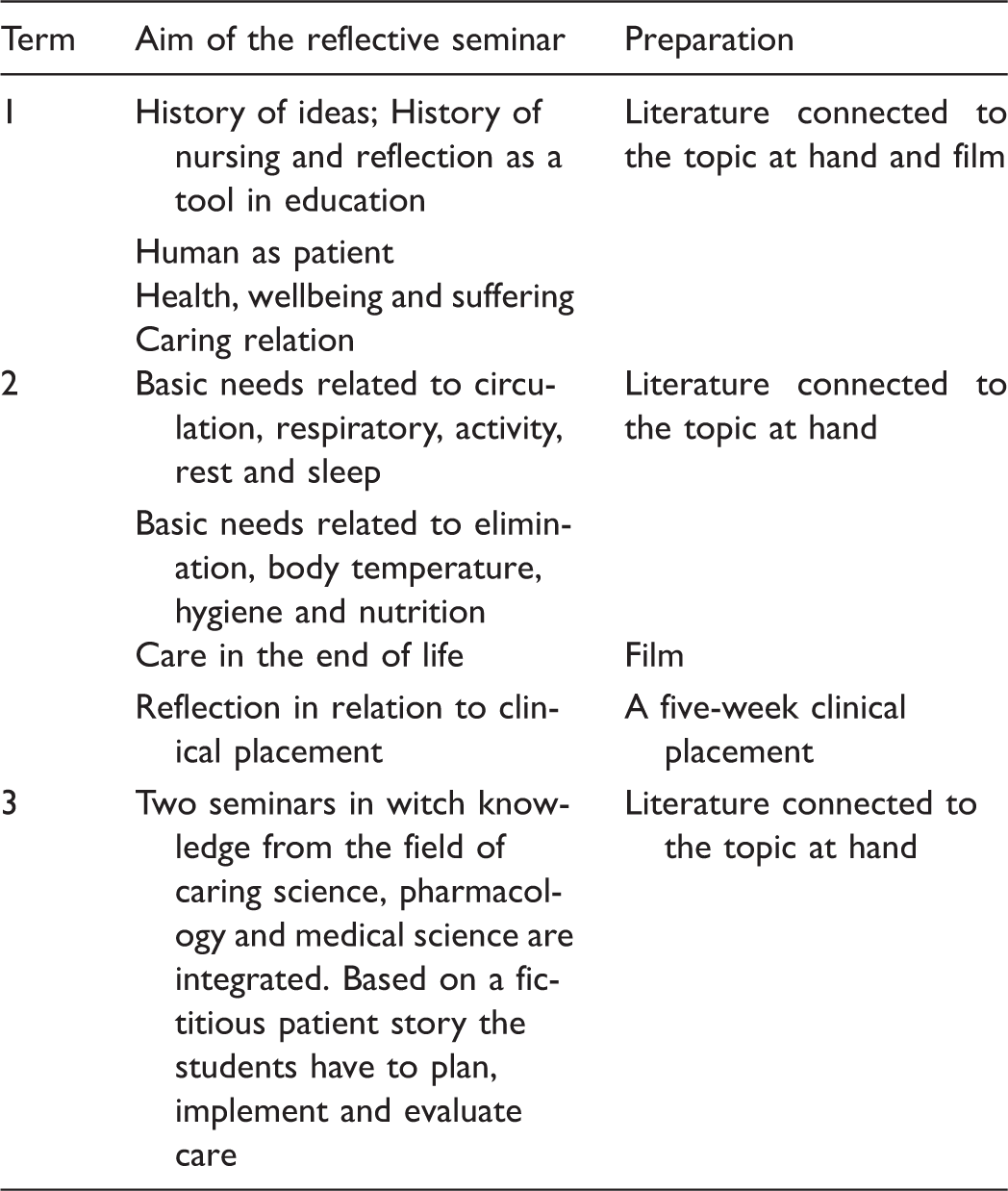
The theory in focus is caring science from a lifeworld perspective, meaning that patients’ lived experiences of health, illness and wellbeing are essential in caring.5,6 Furthermore, the lifeworld perspective constitutes the ground for the reflective seminars taking into account the students’ lived experiences in caring and learning situations. The congruence between ontology and epistemology in caring and learning situations is described as important for the outcome of students’ learning.2,7 Lifeworld theory was introduced by Husserl8,9 as a way to examine humans’ lived experiences. The lifeworld is unique for every human, but at the same time our lifeworlds are intertwined through relations with each other. In a reflection seminar, everyone participating brings with them their unique experiences and, as described by Ekebergh, 2 the starting point for reflection and learning has to be the student’s lifeworld. At the same time the situation per se creates a shared experience, a relational aspect described according to Merleau-Ponty 10 as intersubjectivity.
Reflection forces students to step out of their natural attitude and facilitates the transformation process taking part during nursing education. 2 Theory and practice have to be linked together, and research has proven that reflection can contribute to preparing students in their process of becoming independent nurses.11,12 In our everyday lives, the lifeworld is often taken for granted. An attitude described by Husserl as the natural attitude.8,9 In the natural attitude humans encounter the world in an unreflective manner. One purpose of reflection can be to make prerequisites for the student to challenge their natural attitude. One way to do this is to confuse, disarrange and thereby awaken the self. 2 At the same time as the natural attitude has to be challenged, the importance of taking into account the students’ earlier experiences 11 and lifeworlds 2 and interweaving these aspects in the current situation has been highlighted.
The informants were half way through the process of becoming professional nurses. Nursing education is about becoming, which can be understood as an inner transformation facilitated during reflections with preceptors and fellow students. 12 However, the situation can be challenging for the students and therefore it was felt important to illuminate how reflection seminars can contribute to the process of becoming a nurse.
Aim
The aim was to describe students’ experiences of participating in reflection seminars, using lifeworld theory and focusing on caring science.
Method
Design
This qualitative study is based on a reflective lifeworld research (RLR) approach.13,14 Reflective lifeworld research is based on Husserl’s lifeworld theory and theory of intentionality. 8 The lifeworld theory was further developed by Merleau-Ponty. 10 The goal of RLR is to describe human beings’ lived experiences of a specific phenomenon. 13 The phenomenon in this study is: Reflection seminars grounded in lifeworld theory and focusing on caring science, from the students’ perspective.
Reflective lifeworld research requires openness and flexibility towards the phenomenon in search for the phenomenon’s meaning and therefore the research process is characterized by a reflective attitude. A reflective attitude enables things that are not directly visible to become visible. As a phenomenon is related to the world, researchers also need to be aware, not only of their own pre-understandings, but also of the phenomenon’s relation to everything else in the world. This reflective attitude, characterized by openness, thoughtfulness, reflection, and close examination, is described in RLR as bridling. 13 During the entire research process the researchers have strived for an attitude of bridling. The pre-understandings of the authors in this study have been discussed and considered throughout the research process.
Data collection
The criteria for inclusion were students who had ended their third term in the nursing programme. The students should have participated in reflection seminars from the beginning of the programme. Ten students, eight females and two males, between 21 and 33 years of age volunteered to participate. Place and time for the interviews where determined by the student. Before the beginning of the interview the students were verbally informed about the study. Thereafter the students were asked to describe their experiences of reflection seminars in order to support the integration of theory, practice and lived experiences. They were encouraged to speak freely and follow-up questions such as ‘How do you mean?’ or ‘Tell me more about …?’ were asked for clarification and understanding. The interviews lasted from 30 to 45 minutes, were recorded and performed in a private room and later transcribed verbatim.
Data analysis
Data were analysed according to the principles of RLR. 13 According to Dahlberg et al. 13 the different parts of the analysis in RLR can be seen as elements in an intertwining process. In order to obtain an overall sense of the material all authors read the interview transcriptions as a whole several times. Then meaning units, related to the phenomenon, were identified. The analysis proceeded in order to understand the meaning of every unit. Meanings were unpacked with a bridling approach. Questions such as ‘How does learning in reflection seminars appear to students?’ ‘What does it mean to reflect on caring science concepts?’ were continuously asked to the text. The constant questioning to the text and the reflection on what the text said revealed meanings of the phenomenon. Thereafter, meaning differences and similarities were, through a constant movement from parts to whole text and back again, organized into clusters of meaning. Clusters of meaning can be seen as a preliminary meaning structure. The analysis was terminated by further problematizing the clusters in relation to one another in order to identify patterns that described the phenomenon.13,14 The analysis did not reach the most abstract level (essence) in RLR, but resulted in four themes of meaning presented as: Interpersonal interplay, Expectations regarding preparation and performance, A process towards deeper understanding and a reflective attitude, and Reflection is challenged by knowledge assessment.
Ethical considerations
The study was carried out in accordance with the principles of the Declaration of Helsinki. 15 The participants were informed verbally and in writing about the aim of the study, confidentiality and that participation was voluntary and could be determined any time. They all signed a written informed consent form. It is important to consider that the students might feel dependence due to their need to pass the exam. At the time of the study, none of the researchers was involved in the reflective seminars, helping the students feel at ease in the situation.
Findings
Interpersonal interplay
The interpersonal encounter occurring in the reflection group is of importance for learning and understanding caring science. By balancing security with challenges a process of development and growth occurs. The continuity of the reflection seminaries contributes to a feeling of being comfortable with participating; the situation is familiar and a perception of what will happen is present. The sense of security is enhanced by sharing the common experience of training to be nurses. We have chosen to become nurses … so somewhere we aim for the same goal … and there is some safety in that. There were people who were very talkative … but you noticed they were trying to hold back a bit so that the more quiet ones would get the chance to talk.
To achieve a deeper understanding through reflection, the safety found in a group where people know each other well has to be challenged. By dividing the groups randomly the possibility is given to reflect together with other classmates with whom no other relationships exist. The ultimate objective is not determined in a reflection, you never know where you will end. Therefore it’s better with people you do not really have knowledge about. They surprise and I think that is good.
Expectations regarding preparation and performance
Demands are placed on oneself to perform, and a clear structure for what is expected at the reflection seminar is asked for; otherwise feelings of insecurity obscure and interfere with the learning process. The reflection seminars become less meaningful.
A clear structure leads to a sense of security and of being able to participate in a committed way. The commitment is based on the possibility of being able to prepare oneself by reading and shaping one’s own thoughts and ideas that can be discussed together with other students. By receiving information in advance about the reflection seminar, a more committed and confident activity can take place. It would be good to be a little more structured before the seminar in order to enter the seminar even more prepared … to assure you have not read the wrong stuff.
Through the patients’ stories, caring science can come alive, and reflection results in a fusion of theory and practice and contributes to a greater understanding of what it means to become a patient. It also deepens the understanding of the importance of taking hold of the patient’s story. Care can be provided with greater security when the patient’s situation is reflected upon.
A process towards deeper understanding and a reflective attitude
Since reflection seminars are conducted over a long period of time they will not only lead to greater knowledge in the essence of caring science, but also to a developed ability to adopt a reflective stance. During theoretical parts of the first three terms of the education, an understanding of the difference between the reflection seminars and seminars is obtained.
The experience is that a seminar is more like a lecture where a correct answer must be accomplished, while a reflection seminar is more like a dialogue with fellow students to achieve the experience of others around a topic, and thereby obtain a greater knowledge and understanding of the wholeness. The amount of literature made people become much stressed thinking it was another seminar. That … I will be assessed here on what I can and can’t. But … it was reflection … where one can learn from each other. That’s a difference. … because you’ve always been forced to think according to the caring science concepts … and now it has become so naturally for you … you have it, sort of, constantly in mind …
A need is seen to introduce more reflection in education and clinical practice. A wish is to have reflection even during the medical courses since there are often many questions to be discussed within these courses. Benefits are seen in reflecting with others in order to understand and integrate knowledge in relation to medical and caring science. There have been many medicine courses that we have read, it has been much divided, first it was biology then heart and vessels. We have been reading in parts, and tried to get it together.
Reflection is challenged by knowledge assessment
It is important that the learning environment is shaped to be perceived as safe. As the seminars are mandatory one dimension includes the assessment, which means that everyone must be given space to make their voice heard. This is seen as a difficult balancing act and the reflection seminar can be perceived as too controlling. There was no time to talk, the atmosphere was not felt free, we went around in a circle and everyone had to say something, spontaneity is absent, everything happens on command … the quality will not be as good. It’s very difficult to sit next to someone who is very uncomfortable in the situation … someone who does not know which answer to be expected … there will be uncertainty and people will be embarrassed. The atmosphere in the room becomes very pressed. The brain is spinning all the time … although I may not say anything during the whole time I feel very active, even if I’m quiet.
Discussion
The reflective seminars described in this study are based on caring science and a lifeworld perspective. Using a specific approach in reflection contributes, according to Cox, 16 to facilitating learning more readily, compared to when reflection is used without theoretical foundation. The lifeworld perspective contributes to developing students’ ability to intertwine reflection as a means of being and as a way to relate to caring and life. Reflection has become a process enriching each day with new knowledge and understanding of phenomena encountered during education. Students have also adopted a reflective stance. If reflection seminars are conducted over a longer period of time and are integrated into the courses, students experience that an understanding of the meaning of reflection is developed. These insights developed in caring science and reflection may hopefully move to a general intention to use them in their future profession as nurses.
The interpersonal dimension affects the experience of participating in reflection seminars. This dimension is often described as an atmosphere of ambiguity in which security and insecurity are simultaneously present. There is thus no dualism between security and insecurity; instead the space in between them can be understood as a dynamic field in which the everyday taken-for-granted knowledge is challenged by taking part in reflection. According to Merleau-Ponty, 10 dialogue creates common ground among humans as perspectives merge into each other, leading to a feeling of coexistence.
Interpersonal encounters among those who have no other relationship lead to broader perspectives and deeper knowledge but also produce tensions in the group. But, as described by Gadamer, 17 to understand is to look beyond what is close at hand and to be open to a fusion of horizons. Openness according to oneself and the others might contribute to an understanding in which a fusion of horizons can take place. It is important to consider that the teacher must be attentive to the process taking place in the group. 18 Berglund et al. 19 argue that unsafety and insecurity are learning forces which can lead to good and valuable results but which are also challenging because learning is constantly in motion and demands a balance between challenge and safety. Gadamer 17 argues that risk taking is a prerequisite to understanding new matters and argues that understanding is a demanding activity requiring courage and will.
In the current context, students also have to pass the reflection seminars, meaning they have to prove knowledge in accordance with the curriculum. This assessment part of reflection seminars can contribute to building barriers to learning.20,21 The atmosphere in the situation is challenged when reflection and an assessment of knowledge have to be balanced. A good atmosphere protects against reflection being obscured by the knowledge assessment and ensures that knowledge is generated through reflection. To be supported and to feel that you belong in the group, that there is an interest in you as a person and that you are welcome, is important for a positive learning environment. 2
As the reflective seminars are integrated at regular intervals during the education programme, sensitivity to the needs of fellow students is developed. Learning and performance should not always be linked to being heard as the students feel happens when the reflection leader takes rounds and everyone has to speak. The atmosphere should also permeate the power of free speech where the participants’ silence and listening also have a great impact on learning and performance. To be able to listen one needs to be open and thoughtful in order to mirror the lifeworld perspective. 2 Listening can carry the other student through the reflection and may take a person out of loneliness. 22 Developing the ability to be a skillful listener contributes to an understanding of the importance of attentiveness when listening to a patient’s story. 18 Ekebergh 2 describes that if students are not allowed or able to share experience and theoretical knowledge a sense of loneliness arises. The reflective seminars were, however, experienced as alleviating loneliness and hopefully this experience can contribute to increased learning.
The students had expectations for learning in the reflection seminars and they had demands on themselves to perform. They wanted clear directives and guidelines regarding how to prepare and to be prepared in good time before the seminar. These findings are congruent with earlier research.1,18 Clear information can lead to maintainance of control and thereby also a higher level of satisfaction. On the other hand, reflection consists of processing what is experienced in relation to past experiences. 2 In this encounter between ongoing experience and previously proven understanding, new understanding and knowledge are created. To get to that point, people must have a desire to adopt an open mind; a willingness to understand something new that does not exist in the natural setting. 17 There is a desire for structure, but this must not be too controlling since openness and curiosity may then be lost. The lifeworld perspective is grounded in a reflective attitude, characterized by openness and thoughtfulness 13 and since the seminars are implemented on a lifeworld theoretical basis it is important that openness is not lost.
Limitations
A qualitative descriptive study with a RLR approach13,14 was seen as an appropriate approach to this topic. Openness and flexibility and a reflective attitude towards the phenomenon were seen to enable the researchers to make things visible that are not directly visible. We chose to follow one class throughout their education. The students volunteered to participate in the study and this may imply that they had a special interest in and positive view of the topic. This is always a risk, however, in this study diverse views emerged. The students determined the place and time for the interviews which, according to Polit and Beck, 23 makes it easier for respondents to participate and for them to feel confident and safe.
The interviewers tried to be open minded, sensitive and aware of their pre-understanding which, according to Dahlberg et al., 13 is of significance when using the RLR approach. We tried to use a bridled approach and the focus remained on the phenomenon. Reflections and discussions between the researchers were performed and these were a way to ensure validity of the results. Presenting the research process in as much detail as possible may also contribute to ensuring validity. However, the analysis did not reach the most abstract level (essence) in RLR, so transferability might be limited.
Conclusions
The findings show that the lifeworld perspective contributes to develop students’ ability to intertwine reflection as a means of being and as a way to relate to caring and life. A good atmosphere is crucial for learning outcomes in the reflective seminars and limits the possibility of reflection being obscured by assessment of knowledge. The approach of the reflection leader is crucial. There is a desire for structure, however, it must not be too controlling since the lifeworld perspective is characterized by openness and thoughtfulness and this may then be lost. A deeper understanding is obtained when reflection sessions are spread over a longer period of time and when reflection becomes a process enriching each day with new knowledge and understanding. Caring science has become more valuable and useful. These insights may hopefully then be intertwined in students’ forthcoming education and future work as nurses.
Footnotes
Funding
This research received no specific grant from any funding agency in the public, commercial, or not-for-profit sectors.
Conflict of interest
The authors declare that there is no conflict of interest.