




Abstract
Digitization in healthcare is accelerating worldwide. This article focuses on the X-Changery development project involving home-care nurses and their use of the iPad as a new tool in patients’ homes. The goal of the project was to bring knowledge from recent research on technological literacy in working life back to a work setting, thus giving nurses new technology competencies with the aim of enhancing their professionalism through the use of the iPad as a work tool. Through field observations, learning labs and focus-group interviews we can see that X-Changery gave home-care nurses a common language to exchange experiences and share knowledge about the iPad as a work tool. Use of the iPad in patients’ homes led to new habits and routines. Nurses acquired relational expertise, implying active use of technology. The results show the importance of focusing on and funding reflection on and discussion of the influence of technologies on professionalism.
Introduction and background
Digitization in healthcare is accelerating worldwide.1,2 Research shows that technology has influence on healthcare and to health professionals’ relationships with each other and with patients.3–5 In Denmark, a new national digitization strategy for the public sector has also had an impact on digitization and the use of technologies in healthcare. 6 Here, the strategy focuses on providing care to patients by means of new digital working methods involving new technologies in information and communications technology (ICT) systems and various other forms of medical technologies. This wave of digitization has influenced Danish health professionals’ work procedures and routines in various ways. 7
This article is based on the X-Changery development project conducted in home nursing in a Danish district which has introduced new digital workflows. Home-care nurses in Denmark treat patients in their own homes; this includes care and treatment of chronic and acute illness. Here, change processes have been initiated involving the introduction of the iPad as a new documentation tool for home-care nurses to use in their everyday work in patients’ homes. These changes may, for example, involve documentation of the patient’s medication, care of wounds including taking pictures of the wound, or searching for information about the patient in the electronic care system. Using an iPad, these changed procedures may now take place in the patient’s home. Before the introduction of iPads, nurses would print out information in the office and take it with them to the patient’s home. In the district concerned, both nurses and nurse leaders found it difficult to change work procedures in home nursing and to integrate the iPad into the routines of the group of nurses. Some nurses felt it to be inappropriate to bring out their iPad in the presence of the patient. The nurses were also clearly concerned that the ‘warm’ relationship they had with patients would be compromised by the ‘cold’ iPad. The Dutch anthropologist Annemarie Mol has described relations between health professionals, patients and technologies in new ways, where care should be seen as a practice which takes account of both material and human relationships and where technology and human warmth should not be regarded as opposites, but as complementary elements that together constitute care and treatment. 4
The X-Changery project focused on providing home-care nurses with technological literacy in relation to some of the dynamics that are set in motion when they use an iPad with patients in their homes. X-Changery was inspired by the Oxford Education Deanery, which aims to establish partnerships between Oxford University and leaders of local schools. The objective of the British partnership was to build a bridge between the world of research and the field of practice, in order to bring research expertise into, and thereby enhance, practice. It is precisely the enhanced professionalism that is the focus of the X-Changery project, which draws on knowledge from a Danish research project called Technucation. Technucation was a cross-institutional research project conducted in 2011–2015 with participants from Aarhus University, Metropol University College, University College UCC, the Danish Technological Institute and Roskilde University. The project researched knowledge of technological literacy in the professions (www.technucation). One of the main findings of Technucation is that new technologies are not merely tools, but form part of very complex interactions with working life and profession. Technologies provide many opportunities, but also inappropriate responses and frustrations, because technologies are typically multistable, learning-intensive and innovative. The concept of ‘multistability’ was developed by the US technology philosopher Don Ihde.8,9 Describing technologies as multistable refers to the fact that people’s use of technology varies according to where, when and by whom the technology is used. An iPad may be meaningful in a context where it is used to take pictures of a patient’s wound, but problematic in another context with another patient, although the technology is the same and works in the same way. Health professionals need to reflect on how meaningful the technology is in a particular situation. The research project Technucation has focused on this aspect in the development of an analytical model, the ‘TECS model’, that provides a new perspective on the concept of technological literacy, which has been the subject of educational research within what are known as STEM-related fields (STEM: science, technology, engineering and mathematics).
10
What is new about the definition of the theoretical concept in Technucation is that it concerns the technological literacy needed in practical working life.
11
The TECS model is based on empirical studies which explore understandings of what technology in use means for people involved with it in professional practice.
10
The research behind the TECS model was conducted in 2011–2015, and was based on visits to a broad selection of 32 Danish institutions (13 from the school system and 19 from the healthcare system). There were 149 interviews; 73 with informants from schools and 76 with informants from the health services. The analysis of the extensive empirical material involved the use of cultural theory, sociomaterial theory and the theory of professions.12–15 The TECS model has been developed as an analytical tool that can be used to understand, consider and talk about technologies at work and thus take an active and reflective approach to the use of technology in professional working life.5,16 The TECS model summarizes the Technucation definition of technological literacy, which reads as follows: Technological literacy means continually to learn, evaluate and analyse new technology, technology in situated practices, the complex ways of technology, the impact of technologies on the professions, and the interaction between these factors.10(p.204) Focus areas in the TECS model.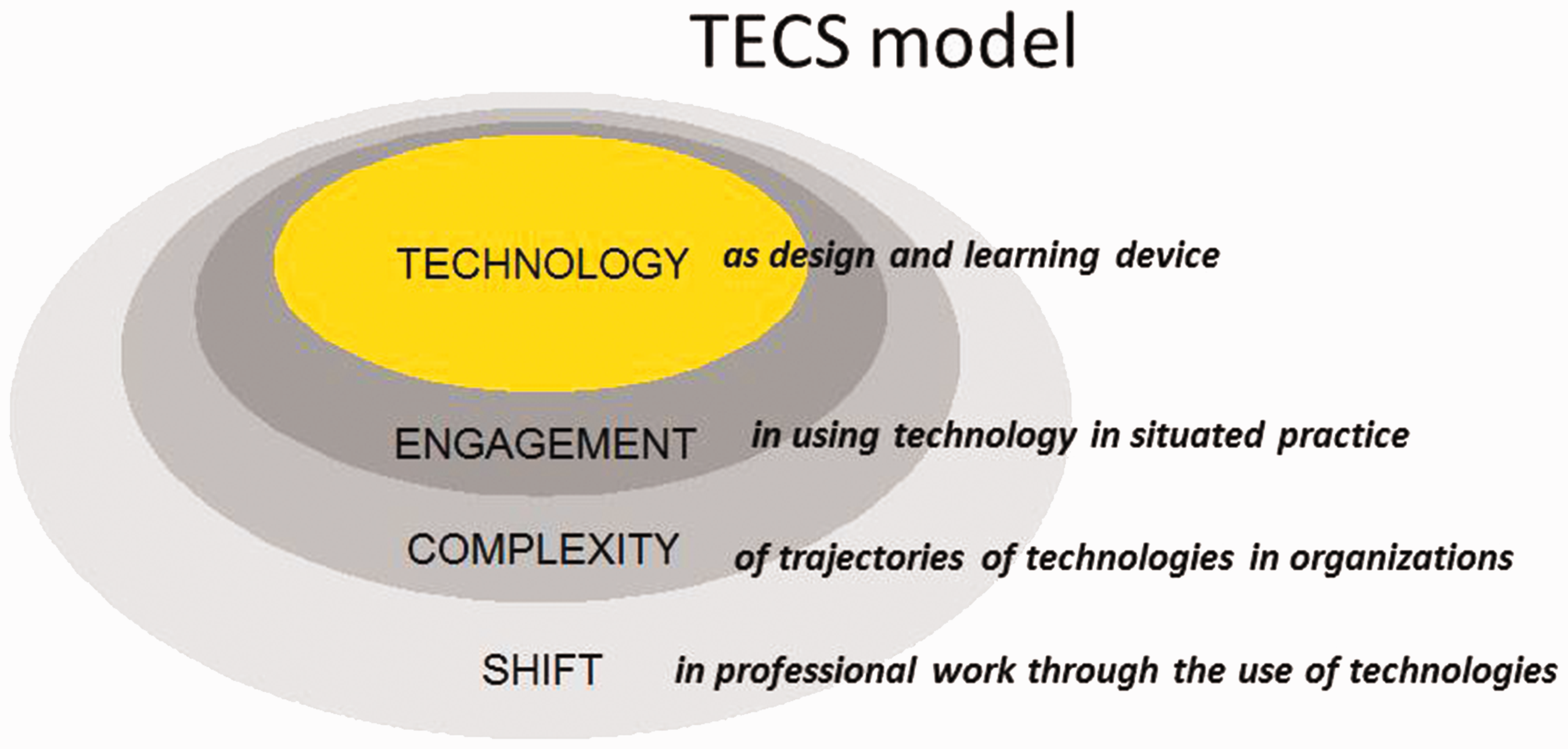
The four focus areas include selected relationships between practitioners and technology that a practitioner should learn to relate to in professional practice. Each of the focus fields can be used to analyse specific issues. Professionals can choose to focus particularly on the complex routes of technologies into organizations (complexity), on strategies for learning the technology itself and its design (technology), on the impact of the technology on the situated practice of working life (engagement), or on the impact of technology in changing professionalism (shift). Whichever is chosen, the model must be understood as a whole, where the four focus areas interact and continually influence each other. 16
The objectives of the X-Changery project
The main objective of the X-Changery project was to enhance the professionalism of home-care nurses in a Danish district by focusing on developing new competencies in technological literacy involving the use of the iPad as a work tool in patients’ homes. Here, it is important for us to emphasize that the goal of X-Changery was not to validate the TECS model but to bring research developed in practice back to a practice setting and thereby explore how access to technological literacy can help to give nurses new technological competencies and thus enhance their professional work.
Method
X-Changery is a collaborative development project conducted from summer 2014 to winter 2015 in home-care nursing in a district in Denmark.
Study population and inclusion criteria
Thirty nurses all permanently employed by the local authority, which represents day, evening and night work. The nurses have between 1 and 25 years of experience in the field of home care.
Timeline of the X-Changery project
Three representatives from the group of nurses and their leader participated with researchers from Technucation in planning the timeline of the project. It included two learning labs, one in November 2014 and one in February 2015. The laboratory approach must be seen within the framework of human science labs, where the focus is on learning through specific cooperative processes between people. 17 The learning labs in the X-Changery project focused on mutual learning and the exchange of experiences between nurses on the basis of their individual issues. Research findings from Technucation, including the TECS model, were presented to the nurses. They subsequently used the model as an analytical tool in critical reflections at work in connection with experiments conducted between the two learning labs. 18 Before the first learning lab, the authors conducted fieldwork, observing the working day of the home-care nurses. 19 These field observations took place during three day shifts and one evening shift; the researchers observed nurses in patients’ homes and in the office. The purpose of these observations was to provide insight into the nurses’ use and understanding of the introduction of the iPad as a work tool in patients’ homes. Field observations and meetings with the three representatives from this group of home-care nurses formed the basis for a common framework of understanding of opportunities, barriers and challenges experienced by the nurses in everyday work with the iPad.
In the two learning labs, the nurses worked together to analyse the background to the introduction of the iPad, shared knowledge of how the iPad worked, and discussed how a technology like the iPad modifies situated practice and affects their professionalism. The learning labs were thus participatory and inter-collegially experimental, being based on the nurses’ practical work in the patients’ homes with a focus on using the iPad as a documentation tool. All 30 home-care nurses working in the chosen district participated in the learning labs.
In the final learning lab in February 2015, four focus-group interviews were conducted; 20 there were two focus groups of seven nurses each and two with eight nurses in each group. The experiences of the nurses – working day, evening and night in home care – were represented in all four focus groups.
Focus-group interviews were used to generate data through the participants’ interactions with each other.
20
The purpose of these interviews was to identify a wide range of perspectives on and experiences of how the iPad had influenced the nurses’ work, and how the X-Changery project had affected their understanding of the iPad as a technological element in their work. In this way, all 30 nurses had the opportunity to give an assessment of the benefits of the project. The focus-group interviews were based on the following question: How do nurses feel that the X-Changery project has helped to establish technological literacy in the group of nurses and thus helped to improve their professional work when using the iPad as a work tool?
Ethics
The four focus-group interviews were conducted in accordance with the Declaration of Helsinki. 21 Each participant signed a declaration of consent and was informed about the purpose, voluntary nature and anonymity of the project.
Analysis
The data analysis was inspired by Malterud’s systematic text condensation method.
22
The condensation took place in three phases:
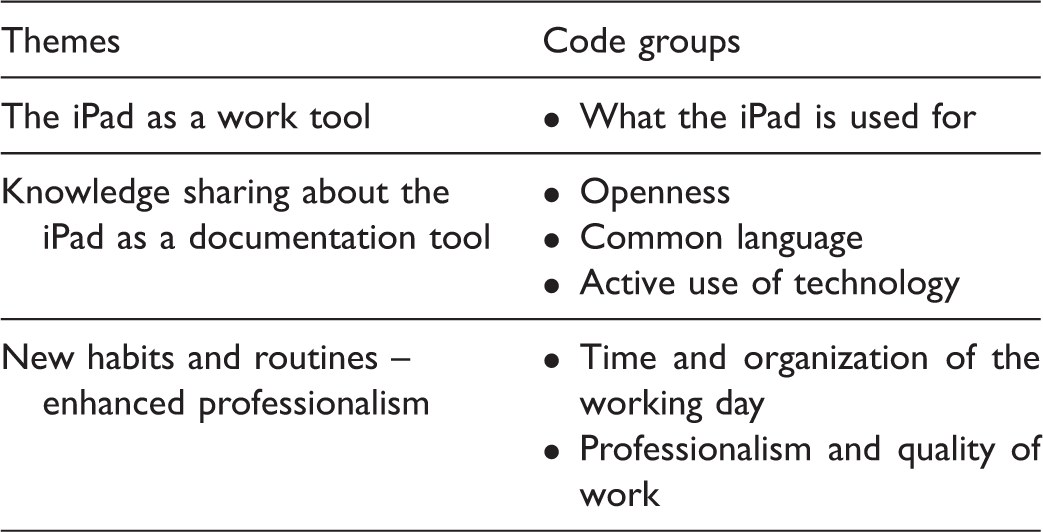
Phase 1: Each interview was read by both authors and experiences of the iPad were divided into themes and discussed between the authors. Phase 2: On the basis of the research question, meaningful units were identified and sorted. The text was read through line by line, and the meaningful units were coded. The coding and the meaningful units were then compared and harmonized between the interviews. Phase 3: The data were organized and reduced to six code groups of meaningful units. These six code groups were then reduced to three main themes (Table 1). Themes and code groups.
Theoretical framework
The four areas of the TECS model were used in the analysis and discussion of the results of the X-Changery project.
Results
The iPad as a work tool in home care
X-Changery has shown that the use of the iPad as a work tool by nurses in the patient’s home depends on the situated practice: it may be used as a reference tool to provide information about the patient during or before the visit, in connection with documentation in action plans or medication schedules or when equipment and medications are to be ordered in the patient’s home. There are also situations where the iPad acts as an electronic key to the patient’s home or as a camera to take pictures of a patient’s wounds.
After participating in X-Changery, nurses more often made decisions about which technology is most helpful in a particular situation. A night nurse said: If I didn’t have the iPad, I just couldn’t get through the night. For example, every time the police ring and say there’s a patient who needs help. Or if I need to find the address of relatives of a demented person who’s wandering around alone outdoors. There are so many things I couldn’t do, if I didn’t have the iPad.
Increased digitization in the local council as well as the X-Changery project has led nurses to feel that the iPad has become an integral tool that they cannot do without. One example of the increased digitization is that the keys to patients’ homes are now electronic on the iPad. The more familiar nurses are with the iPad, the more likely they are to use it.
Knowledge sharing about the iPad as a documentation tool
Through their participation in X-Changery, home-care nurses shared knowledge about and exchanged experiences of the iPad as a work tool. This led to increased openness in the group around the use of technology, established a common language and helped the nurses to use technology more actively. These three results will be elaborated on below.
Openness
X-Changery has meant that nurses share knowledge about the iPad as a work tool to a greater degree than before the project. Furthermore, the TECS model has given the group a platform for joint reflection on the reasons for using or not using the iPad in the patient’s home. One nurse explained: … we’ve never talked about those iPads before we joined the project. The iPad was almost an anonymous thing that you just had in your bag. Now it’s like: ‘ok then, you press this and then what do you do?’
The nurses expressed a greater understanding of their different experiences in using the iPad, and also expressed awareness of their different learning strategies when learning the functions of the iPad. Everyone now takes much more responsibility for using the iPad, and it’s become more acceptable to say things like: ‘Hey, this is actually a bit difficult’ or ‘Oh, what was I supposed to do again?’ By talking about it, we’ve found out who’s got the resources. Something new is that we’re now starting to say, ‘Have you seen there are some new apps?’ So we’re talking about the fact that there’s now something new on our work tool. We didn’t do that before this X-Changery.
Common language
The nurses found it meaningful to share knowledge about the iPad as a work tool. In this way, they could make their different experiences visible and thus create greater involvement and understanding of the iPad’s many uses. It was also valuable that the entire group of home-care nurses participated in X-Changery, as it gave them a common language and frame of reference for the exchange of experiences. We’ve now got a language. It’s been crucial that it’s been the whole group participating. To understand the learning model and the way we’ve worked with it, it’s almost a must to take part yourself.
Active use of technology
In the two learning labs and the period between them, learning to critically evaluate the use of technology was a recurring theme. The aim was that the nurses should learn to distinguish between active use of technology, where they reflected on reasons for using the iPad in a specific work situation, and passive use of technology, which is a routine, non-reflective opting in or out of a particular technology.
8
Working with active use of technology made sense for nurses and the active approach could also legitimize the fact that in some situations it may be appropriate to decide not to use the iPad. But this decision would be based on an analysis of the situated practice, and not just because the nurse chose to do as she had always done. One nurse said: Not only when we had those sessions [learning laboratories], but also in general I’ve become much more conscious of when I use my iPad, and when I decide not to use it. After this project, I find myself thinking, ‘So why did she use the iPad with that patient?’ What reasons did I have not to take the iPad when I went to the same patient? It’s important to have these discussions about making active choices.
New habits and routines – enhanced professionalism
The introduction of the iPad as a work tool has changed home nursing practice and provided new ways to see, think about and act towards patients and colleagues. This is a question of time and the organization of the working day and new experiences of professionalism and quality in one’s work. These two results are elaborated on below.
Time and organization of the working day
Participation in X-Changery enabled nurses to express how the familiar time structure changed when many administrative tasks in the day shift, such as ordering equipment and medicines and documenting care, no longer take place exclusively in the office, but may also be done in the patient’s home or in the car between visits. Some nurses choose to get some documentation done in the patient’s home, if it can be completed relatively quickly, while documentation requiring more time will be done later in the office. Many patients must be visited at certain times of day, and nurses generally find that there is insufficient time to complete all documentation away from the office. There are so many visits at fixed times that I don’t always have time to write about the patient during a visit. There is no time set aside for documentation between one patient and another.
Professionalism and quality of work
Some nurses found that their documentation was more objective in the patient’s home. For example, documenting the care of wounds was perceived as more accurate in the home, because the nurse would not suddenly be unsure about whether the wound was on the right or left leg. Furthermore, nurses found that the iPad camera facilitated advice and guidance from other professionals: If you’re unsure about how to treat a wound, then you can just take a picture and bring it to the office. Then I can either ask our wound specialist or some colleagues: ‘So what do you think about this wound?’
When the iPad is used as a documentation tool, it can help to ensure that all details are clearly shown and included, such as when the camera is used to take a picture of a medication form, which might previously have been copied by hand. By documenting after each visit, nurses found that they did not need to use their energy on remembering details from previous visits, but could keep sharply focused on the next visit. If you finish with one patient when you’re out on your rounds, you’re better prepared when you go to the next patient. If you’ve been on six or seven visits, you’ve amassed a lot of stuff that needs to be documented. Of course that means you’re not quite so focused. I haven’t brought it along, because I’d look unprofessional if I couldn’t figure out how to use it. But actually I think I just ought to take it out and use it without caring so much about what the patient thinks. Patients know it’s a tool just like anything else.
The possibility of involving the patient in the documentation of the actions performed in the home was experienced by some nurses as a positive aspect of care that could help to reassure the patient. For the patient, being able to see the treatment plan can be motivating and support patient autonomy in the disease course.
In contrast to the experience of appearing unprofessional when using the iPad, there were cases where the use of the iPad not only enhanced professionalism but also made the nurse appear more professional. It happened that patients brought equipment home from hospital that the nurse was unfamiliar with. Some nurses would then choose to seek knowledge on YouTube about how to operate the equipment, and could thus feel confident in handling it. It also happened that a nurse felt that she had insufficient knowledge of the patient’s disease, and therefore looked it up on the iPad: … it may seem more professional in some ways, because I can give patients a clear answer. For example, if there’s a question about the disease and I can’t remember the correct answer. Then I can Google the disease and explain to them what it says. So I think it enhances my professionalism in many ways.
Discussion
The results showed that the iPad is a powerful tool in home care and an indispensable technology which also has a positive effect on the perception of identity and the nurse–patient relationship. The iPad has influence on home-care nursing, but this was not discussed among the nurses before X-Changery. After the X-Changery project, nurses felt confident in showing uncertainty and ignorance about the use of the iPad through joint reflection on the use of the iPad in the patient’s home. A strategy of learning through exposure, that encourages learners to ask others about their ways of using technology and thus share knowledge with colleagues, is the strategy used by the nurses after taking part in X-Changery. 23 They reported having become more aware of the advantages of the iPad. These are elements from the technology focus area in the TECS model. Some benefits of a technology may be obvious, while others may require further study in order to determine whether they make sense in a particular situation. Here, the results show that a number of the nurses felt that the iPad had become an integral and indispensable tool, not only because of increased digitization in the local council in general, but also because a space for knowledge sharing on the possibilities and limitations of the iPad gave rise to new reflections on its impact on relational work. These home-care nurses have enhanced their relational expertise, representing professional competence in applying their own and others’ knowledge in a collective professional context. 13 Relational expertise reaches beyond individual expertise, as negotiations about, for example, the iPad’s possibilities and limitations lead to new knowledge about its application. This is made explicit in the shift focus area in the TECS model, where attention is focused on creating awareness that technology is not a passive tool, but a tool that actively intervenes in work processes and challenges relational work in new ways. X-Changery has generated awareness of how the iPad as an active tool helps to create new habits and routines for home-care nurses. This is seen in the nurses’ accounts of how they experience the iPad as helping them to organize their work in new ways, changing their familiar schedule. For example, there are new routines in some tasks, such as ordering equipment and documenting care, that no longer have to be done in the office, but may take place in the patient’s home. This will have an impact on work organization; it was probably not a factor in the decision to introduce the iPad, and is an example of how technologies can create cultural changes in working life. 12 The results also show that nurses found that the iPad enhanced professionalism and could help to ensure quality as a documentation tool. This is seen for example in relation to avoiding errors, as when one nurse found that the photo documentation taken in the patient’s home prevented any possible later doubts in her mind about the location of a wound.
The engagement focus area in the TECS model provided inspiration for analytical strategies that could be used in reflections on what happens when the iPad is used in situated practice. 8 Here, the findings from X-Changery show that the nurses achieved a critically reflective approach to their use of the iPad. The X-Changery project gave nurses tools to reflect on when it makes sense to use the iPad in the patient’s home, and also when it is not felt to be meaningful. The results show that nurses now do not simply avoid using the iPad from a routine and non-reflective approach, but that sharing knowledge with colleagues has led to critical reflection on whether the iPad serves a purpose in terms of professional goals in a particular situation.
The complexity focus area in the TECS model concerns the necessity for the users of a given technology to have knowledge and understanding of the purpose of purchasing and utilizing the technology. 24 Through their work in X-Changery and concrete use of the iPad, the nurses achieved an awareness of some of the political and professional interests related to the introduction of the iPad as a work tool.
The nurses now use the content of the TECS model’s four focus areas in understanding, considering and talking about the iPad as a work tool and thus actively and reflectively relating to when it makes sense to use the iPad in patients’ homes. The idea of the X-Changery project was to bridge the gap between research and practice, and thus bring expertise from the world of research into the field of practice. The Technucation research showed that technologies do something have influence on nurses’ working lives, but this is not something explicitly discussed in practice. The home-care nurses in the X-Changery project have enhanced their technological literacy and developed relational expertise that has opened up new ways to reflect on the impact of technologies at work. The results show that the TECS model can serve as a platform for joint reflection on the use of a technology.
X-Changery shows the importance of using resources and focusing on the impact of technologies on professionalism. New technologies are being introduced into professions with ever-increasing speed, and since technologies are active tools and not just neutral gadgets, it is important to give professionals skills in technological literacy to enable them to develop relational expertise in a technology-filled working life.
Conclusion
X-Changery gave nurses a common language to exchange experiences and share knowledge about the iPad as a work tool. The relational expertise gained by nurses helps to ensure that the selection and rejection of technology is based on its active use, whereas before X-Changery technology use was more passive.
X-Changery helped to focus on technological literacy among nurses and the results show that the iPad is now increasingly being used as a documentation tool. The results also demonstrate that the iPad has influenced the professionalism of home-care nurses and the timings and organization of their working day. The nurses attached great importance to the fact that this was only achieved because all nurses (day, evening and night shifts) took part in X-Changery.
Footnotes
Funding
Technucation was funded by the Danish Council for Strategic Research.
Conflict of interest
The authors declare that there is no conflict of interest.