




Abstract
Mental illness is a growing problem in numerous industrialized countries. Young women in particular report problems such as anxiety, worry and depression. The aim of this study was to evaluate a cognitive educational program offered to young women with mental illness by listening to how they discussed their own social skills and capability to obtain work or education. Five women in the age range of 18–26 years, who had been unemployed for at least four months, diagnosed as suffering from mental illness, and who also participated in a cognitive educational program were interviewed. The text from the interviews was analyzed using content analysis. The analysis resulted in the construction of the following theme: ‘Being together in an inspiring educational program supports the women’s own ability to devise a holistic life puzzle’. The participants’ answers were grouped into the following categories: ‘Perceptions of the educational program’ and ‘Social network’ with four subcategories. Being together with others in the same situation would appear to support the women’s own abilities, especially in an environment characterized by strict routines and nearness. These findings indicate the need to develop interventions for young women with mental illness which encourage spaces for collective support.
Background
Mental illness is one of the more serious public health problems in Sweden, as in other industrializes countries.1,2 The growing problem of mental illness causes considerable suffering for the individual by impairing their quality of life but also increased costs for society. 3 Young people seem to be those most exposed to mental illness; young women in particular report problems of anxiety, worry and depression. 4 The cause of this is multifactorial, and related studies have shown that poor self-esteem makes people more susceptible to mental illness.5–7 Individual self-esteem develops during childhood and is influenced by both the familial and scholastic situation, as well as by broader social inter-educational programs.8–12
Self-esteem
The concept of self-esteem has been defined in various ways, one of which is how individuals think about themselves and how they judge their own skills. An individual with poor self-esteem lacks self-respect and is therefore more susceptible to anxiety, worries and an inner insecurity, a condition also included in the concept of mental illness. 10 In several studies it was found that women reported lower self-esteem than men.4,11
In childhood, experienced self-esteem is about the same in both sexes, while during puberty it develops among young men, but declines in young women. This low self-esteem could be one explanation as to why women more often suffer from mental illness such as stress and depression. 10 In several studies cognitive educational programs have been developed and tested.12–14 Embedded within a social cognitive perspective is the understanding that individuals are filled with certain capabilities that define what it is to be human. Primary among these are the capabilities to plan alternative strategies (forethought). Participants achieve these through experience, self-regulation, and self-reflection. These capabilities provide human beings with the cognitive means by which they are influential in determining their own intentions. 14
Being merely unemployed or being out of work due to some disease over a longer period, and at the same time being young, implies being excluded from the social community. In the long term this can make it difficult to return to work or studies. It was therefore of interest to study whether a cognitive educational program intended to strengthen self-esteem could actually improve it and reveal how the participants assessed their own skills.
The overall aim of this study was a qualitative evaluation of a cognitive educational program offered to young women with mental illness, by listening to how they discussed their own social skills and capability to either obtain work or education.
Method and sample
Inclusion criteria were women aged 18–26 years who had been out of work for at least four months and were diagnosed as suffering from mental illness, who were enrolled in the Social Services’ department for young people in a small town or with the Swedish Social Insurance Agency, who participated in a cognitive educational program. All of these women (n = 15) were asked to participate in the evaluation of the program and five women decided to participate in the interview study.
Ethical considerations
The study was approved by the Ethics Committee of Lund University, Sweden (EPN 2012/438). The participations received both oral and written information about the study. The information given, emphasized voluntariness and the right to withdraw whenever those concerned so desired. There was a risk that participation in the study could have reminded the women more about their mental illness, and therefore there was a psychiatrist available if needed.
Cognitive education with the intention to improve self-esteem
The educational program is cognitively oriented, which means that an individual’s interpretations and how he/she thinks in a certain situation will also lead to certain behaviors. The intention is for individuals to achieve greater power over everyday life and to feel as good as possible in the life situation in which they find themselves today or in the future. In addition, an important part deals with the realization that ‘I’m not the only one to feel lost’. The education was led by specially trained lay-leaders. The program was based on several studies, which in turn are based on the confidence one has that the individual can master a new skill or affect their own health.12–15 The content of the educational program is outlined in Figure 1. The first part of the program ran for six weeks, five days a week, with the following themes: physical activity; discussion and reflection about the concept of self-esteem with emphasis on the concrete meaning for each participant; communication skills and using the creative arts such as drawing, painting, sculpture, drama, dance, movement, music and storytelling to express ideas and make meaning. In the second part, which ran for 10 weeks, the participants learned to take responsibility for their own lives, how to deal with their personal economy and what it means to live in today’s society, such as what rights and responsibilities one has as a citizen. The participants also analyzed different types of social problems in order to learn why they occurred, what consequences they have and how they can be solved. On two days each week, participants visited different workplaces to study how the above themes were implemented in real-life situations. During these visits participants took notes as the basis for reflections.
The content of the cognitive educational program.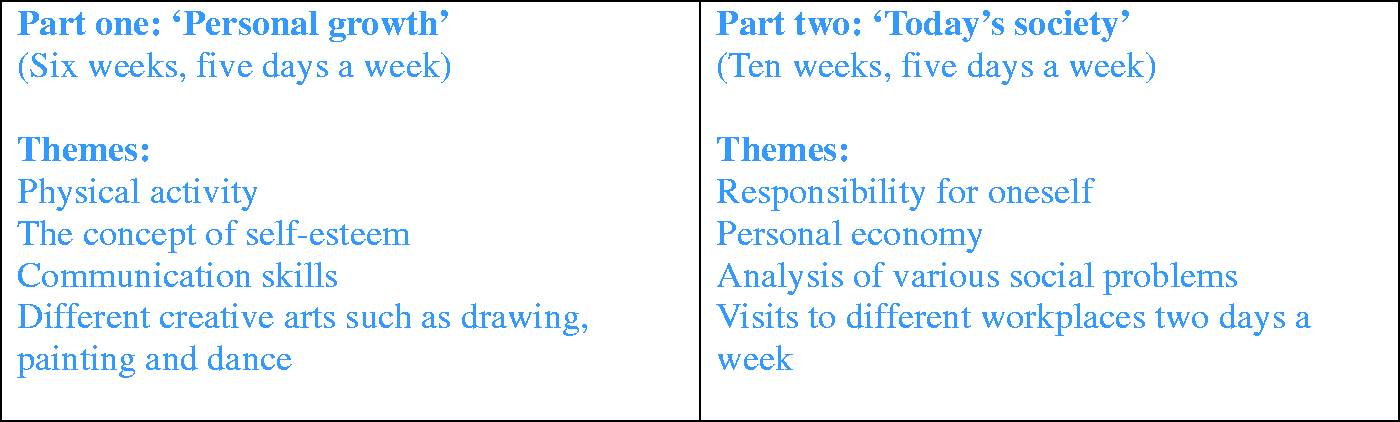
Procedure: Interviews
The sample was consecutive and out of 15 participants in the educational program, five decided to participate in this study. The women were interviewed twice, initially a couple of weeks after the educational program had started, and the second interview came six months after the participants had completed their education. The first interview took place in a room near to where the education took place, and an interview guide was provided. Initially, participants were asked to talk about their own resources in order to get into a social community, both helpful factors and detrimental ones. Examples of questions from the first interview were: What would you like to change in your life? What expectations do you have from the program? Examples from the second interview were: How did you experience the educational program? What do you do nowadays (work, studies, or other)? During the interviews, probing questions were asked in order to gain clarification and deeper understanding: What exactly did you mean by that? Sorry I don’t understand: Could you help by giving an example? Each interview lasted 40–50 minutes. At the later interview, participants were asked to talk about what they do today and whether the content of the educational program had led to any change. In addition, they were asked to evaluate the educational program (what was experienced as good or bad). This second interview was conducted by telephone for the participant’s convenience and lasted about 15 minutes. All interviews on both occasions were transcribed verbatim, comprising 40 A4 pages.
Analyses
Examples of subcategories, meaningful units, and citations.

Theme, categories and subcategories.

Findings
Three of the participants were living with a (male) partner, one was living alone and one was living with her biological parents. Four of these five women had lived in foster homes during childhood. All of them had contacted a hospital at different times due to various symptoms such as headache, gastric problems, depression, sadness, and sleeping problems. Four of the women had also been bullied during their school years. The analysis resulted in the overarching theme ‘Being together in an inspiring educational program supports the women’s own ability to form a holistic and meaningful life puzzle’, constituting two categories (Table 2). In the following section, the two categories with accompanying subcategories are described followed by exemplifying quotes.
Perceptions of the educational program
Ability to achieve personal goals
The women expressed varying degrees of personal goals relating to the educational program. Some articulated distinct goals, while others gave only a vague description of what kind of work they contemplated. Others expressed goals related to personal development as an important prerequisite in order to get an education and stand a chance of a better future. I have applied to do a university diploma in social work. Yes, working with people, I think. Something in healthcare or maybe talking on the phone or something like that then – I would like to. So that’s something I want to be able to practise and become more talkative and so on. And not to be so withdrawn and not care so much about what others think and feel about me.
Ability to achieve goal(s) after completing one’s education
The women felt that their participation in the educational program was an important prerequisite for achieving individual goals. The content of the program gave means to cope with difficult situations. Furthermore they learned a lot about themselves and how to take responsibility for their own life situation. Additionally, they felt supported by both the lay-leaders, and their fellow students. One respondent stated that there was too much fuss in the group but that the content of the educational program nevertheless provided tools and knowledge useful for their future. If I had not taken the education, I would still have been at home.
Enterprise/initiative
Responses regarding motives for taking the educational program produced two categories: external forces and internal forces. ‘External forces’ meant that some external person had referred them to the educational program e.g. via contact with the social services. It was my social worker who invited me to join this education – she wanted me to participate.
‘Internal forces’ can be described as a continuum meaning that some of the participants sought the educational program of their own accord, while others merely attended the educational program in order to occupy themselves during the day. It seemed very interesting, and I thought I might try anyway. It was because I wanted something to do during the day – but I was mostly negative.
Regarding expectations of the educational program, responses varied from being very specific to a vague attitude. Those who expressed a clear and specific attitude were also those who could articulate their own ability to cope with the educational program, had specific expectations, for example learning more about personal economy, learning new ways to think, and make new acquaintances. They described clearly their own merits in terms of ambition, goal-oriented and social competence. … I looked forward so much to doing different activities and going on field trips and making up my own budgets. I have decided on it, so that’s it – I’m stubborn.
The women’s answers were not focused on their own self-esteem, but were formulated in a more abstract way. … To learn how you can do things in another way, that you should lift your head and show that it is … yes I can do it even if I don’t have that self-esteem. I don’t know, because I don’t have good self-esteem – hmm, it’s perhaps to listen to others and … not to judge people.
At the follow-up interviews, women indicated that the educational program had given them a clearer structure. The relationship between impetus expectations and the individual’s own situation was expressed as holistic. All had started training, work, or had at least the will to seek employment. The educational program had helped both to provide concrete means and to improve self-esteem. We need this kind of lessons, learned relaxation that helped me. Now I’ve studied for my high school grades, not so sure that I would have done it without this education.
Social network
Socializing
The women expressed that their social life was limited. Some were living with a boyfriend, but none of them had numerous friends. One woman opined that the social media destroy people’s ability to meet in real life situations. Well you might meet someone once in a while, but it’s not often. People can’t hang out; it is mostly just socializing by computer and so on.
All the women wanted a better social network. Some of them wanted to be a part of, and start a family, while others were desperately waiting for some really good friends. They thought that it was difficult to make friends who could be trusted, although they were not afraid of making new contacts. But as far as I’m concerned, I need … it is enough to have two close friends, who really are … whom I know I can trust and thus be together with.
At the follow-up interview, the women said they had now made new friends or at least been encouraged to take new contacts. You can do and be more than you think, the lay-leaders were good and cared.
Discussion
The analysis in the study revealed that during the educational program the women developed ways of managing their daily lives. At the first interview they talked about their own initiatives, described different attempts to participate in the educational program, and gave a vague description of the kind of support they needed. At the second interview, the women gave a comprehensive description of how they coped with daily life.
All the young women had a background characterized by a traumatic childhood and adolescence. The common denominator was that the participants lacked several of the health factors known to be relevant to young adults for creating prospects of a good life. Previous studies have shown the following factors as health factors: having a reliable adult at one’s side during childhood, and having both financial security and a social network. It was also essential to achieve good results at school.17–21 Being included in a context and feeling involved in the community are also advantageous. The educational program seemed to have given them tools to manage their everyday life, including having been encouraged to make new contacts.
One important question was what aspects of the educational program supported the women in this positive way? The program was based on a social cognitive theory, which means that learning occurs by reciprocal interaction between the individual, the world and human behavior. They influence each other in the sense that they affect each other in all three directions. For example, if human behavior is the cause of changes in the world, it too becomes affected by these changes. This allowed participants in the program to learn new ways of behaving. The content of the educational program consisted of self-enhancing activities and of practical exercises such as practicing to go to job interviews. The implication of the said theory could be discerned in the interviews as it was clear that the combination of the women’s internal force with the content of the educational program supported the women’s own impetus. Another important aspect emphasized by the participants was the thoughtful and caring attitude of the lay-leaders. The lay-leaders’ skills and the ability to show confidence seem to be important for participants with mental illness. The degree to which these abilities and competencies have influenced the outcome is difficult to say. We can only conclude that this is of importance.
The social educator Ziehe 22 contributed an additional theoretical explanation for the impact of the named education program. He reported as early as 1989, that young people’s lives today are increasingly characterized by uncertainty and coincidence resulting from changes in cultural traditions, norms and edicts. This means that society expects increased responsibility on the part of the individual, although the scope for movement or action requiring dexterity and social skills has not obviously increased. Extended unemployment often leads to restricted flexibility, a feeling of exclusion and marginalization for ever-wider areas of society. When trying to explain or capture important processes in young people’s social lives, one needs to understand how young people devise a meaning in life by finding forums that will help them, especially in areas where they can influence their way of life. Providing young people with one or more forums in which to discuss and examine their opinions may help to develop of their identity. Similar to Ziehe, 22 the women in this study were provided with an opportunity to meet others in the same situation. Their discussion and reflections during the educational program may have helped them to devise a meaning in life, which added to their development. In addition, the educational program was an important prerequisite for achieving individual goals in terms of a clearer structure and means to cope with difficult situations. The overall theme ‘Being together in an inspiring educational program’ seemed to support the women’s own ability to form a holistic and meaningful life.
Methodological considerations
The interviews were conducted in a place where the participants could feel safe and calm. The second set of interviews was, in a way, much easier to perform because the women recognized the name of the interviewer who telephoned. The women described what they had done that day in a clear and transparent manner. In the second telephone interview, 15 minutes, although short, seemed a reasonable amount of time as a follow up. The sample was small and thus the results cannot be generalized. However, the findings from interviews with the women who participated in the program give valuable knowledge regarding how women with mental illness may respond to a cognitive educational program. The reason why only five women out of 15 decided to participate is unknown; in the application to the ethics committee we stated that these women were vulnerable and that we also emphasized voluntariness. Studies have indicated that, among people with mental illness, women may be less likely to participate in clinical research studies than men. 23
Conclusion
Young women with mental illness participated in a cognitive educational program. The program was evaluated by listening to how they experienced the program. From the interviews we concluded that ‘being together with others in the same situation’ apparently supports the women’s own abilities, especially in an environment characterized by strict routines and nearness. These findings indicate the need to develop interventions for young women with mental illness which encourage for collective support.
Footnotes
Acknowledgment
We would like to thank Center for Research and Development of Applied Public Health, Blekinge and Iréne Karlsson Parviainen.
Declaration of conflicting interests
The authors declared no potential conflicts of interest with respect to the research, authorship, and/or publication of this article.
Funding
This research received no specific grant from any funding agency in the public, commercial, or not-for-profit sectors.