




Abstract
Filial piety—the belief that children should provide care, support, respect, and obedience to their older parents—is a fundamental normative expectation in East Asian societies. This study investigates the relationship between the geographic proximity of children and the support received from them, and their parents’ perceptions of filial piety in rural China. We used the 2021 wave of the Longitudinal Study of Older Adults in Anhui Province to predict parental assessments of filial piety for each of their children. Random-effects linear probability models using an internal moderator approach were employed to compare coresident children with non-coresident children based on their proximity and support provided. Findings indicate that parents tend to perceive their coresident children as being more filial compared to non-coresident children, particularly when parents are in worse functional health. However, non-coresident children can compensate for their deficiency in being perceived as filial by providing more financial support and maintaining frequent telephone communication with their parents. The study's results suggest that filial piety norms in rural China have adapted to the diminished emphasis on intergenerational coresidence resulting from the trends of urbanization and significant rural–urban migration in modern China, requiring that children find alternative ways to fulfill their filial obligations.
Introduction
The Confucian norm of filial piety (xiao in Chinese) reflects the expectation that children show respect and provide support for older parents and has been a highly valued virtue in Chinese society for centuries (Wing, 1995). A key element of filial piety is the expectation that children will share a household with parents when they develop age-related vulnerabilities (Chu et al., 2011; Ikels, 2004), a practice that brings various benefits to older adults by facilitating the receipt of financial, instrumental, and emotional support (Chu et al., 2011; Ikels, 2004) and improving the psychological well-being of older parents (Chen and Short, 2008; Lin and Tang, 2021). However, studies have observed a decline in intergenerational coresidence in China, partly due to accelerated urbanization and rural-to-urban labor migration in recent decades (Chen, 2005; Logan et al., 1998; Zimmer, 2008), that has challenged the practice of this aspect of filial piety.
While there is extensive research on the living arrangements of older adults, including their determinants and how they change over time and influence parental well-being (e.g. Chen, 2005; Sereny, 2011; Wilmoth, 2001), few studies have examined how living arrangements and intergenerational support relate to whether children are perceived as fulfilling their culturally expected filial duties. Utilizing a modified version of the intergenerational solidarity model, the current study explores how parents assess their children's adherence to filial piety based on coresidence, geographic distance, financial support, instrumental support, and frequency of contact. By examining these aspects, we hope to shed light on the evolving dynamics of intergenerational relationships with respect to filial piety norms in contemporary rural China.
Intergenerational solidarity model and filial piety
The intergenerational solidarity model serves as a valuable framework by which to understand intergenerational relationships along the following dimensions: Associational solidarity (contact and interaction), affectual solidarity (emotional bonds), consensus solidarity (agreement on values or opinions), functional solidarity (the exchange of support), normative solidarity (beliefs about family obligations), and structural solidarity (factors that provide opportunities for intergenerational activities, such as geographic distance). The goal of the intergenerational solidarity model is to provide a comprehensive understanding of the complex and multidimensional nature of family relationships (Cooney and Dykstra, 2012; Silverstein and Bengtson, 1997).
Scholars have long been interested in the connections between different dimensions of intergenerational solidarity. For instance, studies have found that geographic distance as a form of structural solidarity influences the intergenerational support provided by children to their parents (Cai et al., 2022; Silverstein et al., 2008). Cai et al. (2022) found that in China, children tend to visit their parents less frequently the greater the geographic distance between them, but financial support increases and then slowly decreases as the geographic distance gets larger.
This study focuses on filial piety, which is an aspect of normative solidarity, albeit one which differs from it in several important ways. First, normative solidarity has typically been considered in terms of the responsibilities of parents and children to each other (Bengtson and Roberts, 1991), while filial piety typically emphasizes the duty of children to support their aging parents. Second, most studies on normative solidarity have focused on how parents’ expectations of filial support and the filial commitment of adult children impact functional solidarity or support exchanges between parents and children (Ding et al., 2021; Hwang et al., 2022; Lee et al., 1994; Silverstein et al., 2008; Wang et al., 2009). In the current study we consider predictors of the perceived fulfillment of filial piety from the perspective of parents, that is, the demonstration of filial piety by children in all its manifestations is the outcome of interest.
Using concepts from the intergenerational solidarity paradigm, this study examines how functional solidarity (intergenerational exchanges) and structural solidarity (geographic distance) influence normative solidarity, indicated by parents’ assessment of their children's fulfillment of filial piety. To the best of our knowledge, there is only one paper examining how the filial piety assessment of parents is influenced by intergenerational support and geographic distance between parents and children (Luo and Zhan, 2012). Our research expands on this literature by considering all children in the family. This sample enabled us to examine how the geographic proximity of each child influences parents’ views on their filial piety and to investigate how the interaction between their children's living arrangements and other forms of support influence these perceptions of filiality.
Filial piety in China
According to Confucian teachings, there are five principles of behavior that should be followed to demonstrate filial piety toward one's parents: providing support, including financial assistance and care when needed; showing respect and obedience; producing offspring, traditionally sons; honoring one's ancestors by establishing a good reputation; and providing a proper memorial service following parental death (Ikels, 2006; Li, 1997). Although filial piety emphasizes obedience to one's parents, it is historically rooted in the loyalty and obedience due to the emperors and rulers of society, especially between the Han and Qing dynasties of China (Yeh et al., 2013). Thus, filial piety was not only the central ethic within families, but also played an important role in reinforcing the social hierarchy (Bedford and Yeh, 2019; Zhan, 2006). After the establishment of the People's Republic of China in 1949, several political and policy changes altered the concept of filial piety. The Cultural Revolution of the 1960s and 1970s challenged the authority of parents in favor of the state (Ikels, 2004). In reaction to these changes, in the reform era (post-1978), the Communist Party of China enacted laws to reinforce intergenerational solidarity and parental caregiving. For example, the Law on the Protection of Rights and Interests of the Elderly detailed children's responsibilities in terms of visiting and providing care and financial and emotional support to their parents (Central People's Government of the People's Republic of China, 2012). Legislation regarding filial piety is closely related to the limited social welfare services for older adults, especially for the rural population, leaving family support as the primary means of elder care (Luo and Zhan, 2012).
Evolving norms of filial piety
Contemporary China has seen a shift in filial behaviors due to various social and economic changes, including a trend toward smaller families, economic development, urbanization, rural–urban migration, as well as the trend of women entering the workforce. These changes have had a significant impact on intergenerational support and the meaning and fulfillment of filial piety (Cheung and Kwan, 2009; Sung, 1995; Wang et al., 2009; Zhan and Montgomery, 2003), particularly in urban areas (Liu, 2022). Studies have found that the authority of older parents has declined and the autonomy and power of the younger generation has increased (Yan, 2016).
In contemporary China, older parents and their adult children tend to prioritize mutual respect, emotional bonds, and supportive relationships over traditional expectations of child obedience (Du, 2013). Bedford and Yeh (2019) conceptualized filial piety as two separate but related domains: reciprocal filial piety (emphasizing the authority of parents and obedience of children) and authoritative filial piety (focusing on children's gratitude towards parents and willingness to repay the care received from parents in early life); scholars have found that older adults in modern China tend to hold less authoritative but more reciprocal stances towards filial piety (Fu et al., 2020). Similar patterns have been found in South Korea, with mutual communication and emotional closeness between generations being an important resource for older parents (Kim et al., 2023).
As a component of structural solidarity, intergenerational coresidence, in which older parents live with adult children, has been declining as a fundamental element of filial piety. The proportion of older adults who live with their children declined from 69% in 1982 to 49% in 2015 (Song et al., 2023; Wang, 2014). Declining intergenerational coresidence has also been observed in other Confucian nations such as Japan and Korea (Kye and Choi, 2021; Takagi et al., 2007). While Confucian teaching discourages children from traveling far away from their parents (Confucius, 1998), the expectation of coresidence has been declining due to geographic mobility as a result of the labor migration of young adults. In rural China, parents do not necessarily view their children as less filial if they migrate to urban areas in order to work, partly due to the increased economic opportunities and financial benefits that this brings to the family (Luo and Zhan, 2012). Studies also show that although the most common type of intergenerational relationship is a tight-knit relationship, which is characterized by close geographic proximity, high emotional closeness, and frequent intergenerational exchange, out-migrated children can still maintain a strong emotional connection with their parents (Cui and Jin, 2015).
Nevertheless, intergenerational coresidence is often motivated by parents’ needs, such as widowhood and deteriorating health (Chen, 2005), and crisis-induced support is still expected and highly valued across generations (Hu and Scott, 2016; Whyte, 1997). Thus, intergenerational coresidence is still an important functional element of filial piety, partly because of limited services, pension benefits, and health care coverage in rural areas of China (Blaxland et al., 2014). Further, norms of filial piety emphasize the male lineage, with sons and daughters-in-law expected to be primary providers of housing as well as financial and instrumental support to their older parents and parents-in-law (Hu, 2017; Zhan, 2006). For example, migrating sons are more likely to be deemed unfilial than migrating daughters (Luo and Zhan, 2012).
Research questions and hypotheses
The primary focus of this study is to examine how intergenerational solidarity, taking into account factors such as geographical distance, instrumental support, financial support, and contact, influence parents’ assessments of their children's filial piety. Given the significance placed on coresidence and geographic proximity in traditional filial piety culture, we hypothesized that parents perceive children who live farther from them as less filial than children who live with them or in close proximity (Hypothesis 1).
Given son preference and gender asymmetry in obligations to older parents in rural China, parents hold higher expectations for filial piety from their sons compared to their daughters. Consequently, we hypothesized that children living apart from parents are viewed as less filial than those who live with their parents, and this would be especially true for sons over daughters (Hypothesis 2).
Based on the importance of children's coresidence when parents are functionally impaired, we hypothesized that children who live separately from their parents are perceived as being less filial than children who live with their parents when the parents have functional limitations (Hypothesis 3).
Due to the increased prevalence of labor migration in rural China, the aspect of filial piety that privileges coresidence with children might be undergoing a transformation to account for the geographic separation of family members. Thus, we hypothesized that non-coresident children compensate for their absence from their parents’ households by providing them with instrumental support (Hypothesis 4a) and/or financial support (Hypothesis 4b) and maintaining in-person contact (Hypothesis 4c) and/or telephone contact (Hypothesis 4d) with them as alternative ways to fulfill their filial responsibilities.
Method
Sample
This study used data from the Longitudinal Study of Older Adults in Anhui Province in China. The sample was initially selected in 2001 using stratified random sampling and included individuals who were 60 years of age or older and living in rural townships in the Chaohu region of the province. Anhui province and the sampling area is a relatively poor agricultural area with high rates of labor migration, typical of most rural areas of China. The baseline sample included 1715 respondents aged 60 and older, with follow-up surveys conducted in 2003, 2006, 2009, 2012, 2015, 2018, and 2021, with replenishment of younger respondents at each survey. The study focuses on data from 2021, when filial piety measures were introduced. The sample consisted of 1560 respondents, including both original and replenished participants. The analysis excluded those who never had a child or had no surviving child (N = 62) and those who had missing values on key variables (N = 101). Respondents provided information about each child, starting with the oldest and proceeding through the same set of questions for each younger child. The data were reshaped so that the analytic unit became parent–child dyads. The final data consisted of 3909 children nested within 1462 older parents.
Dependent variable and independent variables
The dependent variable was an evaluation of the filial piety of each child as evaluated by their parents. Parents were asked “How filial is this child toward you?” with the following response options: 1 = minimally, 2 = a little, 3 = average, 4 = above average, and 5 = very much. In the original Mandarin Chinese in which the survey was conducted, this question covers both the dispositional and behavioral aspects of filial piety that emanate from Confucianist thought. We converted this ordinal variable into a binary variable by combining minimally, a little, and average (= 0), and above average and very much (= 1).
Six indicators were used to evaluate the relationship qualities between parents and each child. Of most theoretical importance were coresidence/geographic distance, support received, and frequency of contact as possible modifiers of the detrimental impact of geographic distance on assessments of filial piety. Coresidence and geographic distance of children from parents were assessed as: living together, living in the same village, and living beyond the village. For instrumental support, the survey asked the respondents if they had received help with household chores or personal care from any of their children. If they had received such help, the survey proceeded to ask them to specify which child had provided the help and the frequency with which it was provided. To quantify the support children provided, we converted their responses into a monthly frequency scale. For instrumental support, “no help” was coded as 0, “seldom” as 0.25, “several times a month” as a random number between 1 and 3 (to account for variations in frequency), “at least once per week” as a random number between 4 and 29, and “daily or more often” as 30. Financial support was measured by the total value (in Chinese yuan, hereafter RMB) of money, food, and gifts received by parents over the last year. This amount was then log-transformed to reduce any skewness in the distribution. Finally, frequency of phone and in-person contact, originally measured on an ordinal scale, was converted to reflect monthly contact: “seldom” was coded as 0.25, “several times a year” was coded as 0.5, “once a month” became 1, “several times a month” became a random number between 1 and 3, “at least once per week” became a random number between 4 and 29, and “daily” was coded as 30.
Control variables
Control variables at the parent level included sex (female = 1, male = 0), age (in years), education (1 = none, 2 = primary school, 3 = junior middle school or higher), occupation (non-agricultural = 1, agricultural = 0), marital status (married = 1, not married = 0), income (log of annual household income), functional limitations, number of children, and parents’ generalized normative filial beliefs. To assess functional limitations, we calculated an average score based on the degree of difficulty in performing 15 instrumental and personal activities of daily living. Each activity was assessed on a scale from 1 to 3, with 1 = no difficulty, 2 = a little difficulty, and 3 = major difficulty or cannot do on one's own. Parents’ normative filial beliefs were measured by their agreement or disagreement with eight statements such as “children should take care of their parents” and “children should respect their parents”. Respondents rated their agreement with each statement on a scale from 1 to 4, where 1 = strongly disagree, 2 = disagree, 3 = agree, and 4 = strongly agree (see Appendix Table S1 for the details of the parents’ normative filial beliefs questions). We averaged these scores across the eight items. The items of the scale measuring filial belief have relatively good reliability (Cronbach's Alpha = 0.85). This variable is akin to the traditional representation of normative solidarity as a generalized set of expectations as differentiated from the relationship-specific filial piety measures that form the dependent variable.
At the child level we controlled for each child's sex (female = 1, male = 0), age (in years), marital status (married = 1, not married = 0), education (dummy variables for junior high school, senior high school or higher, with grade school or illiterate as the reference group), and occupation (dummy variables for professional or technical work, administration, commercial or service sectors, industrial worker, never worked, with agriculture as reference group). We also controlled for the birth order of children (first born = 1, others = 0), children's economic condition (more than enough economic resources = 1, approximately enough or less than enough economic resources = 0), emotional closeness with parents (very close = 1, not close or to some degree close = 0), whether the child is the parents’ preferred caregiver (yes = 1, no = 0), amount of financial support from parents to the children (in RMB), and whether the parents provided full-time grandchild care in the past year (yes = 1, no = 0).
Analytic strategy
We employed a two-level linear logistic regression model to accommodate the hierarchical structure of the data, with children nested within parents (Rabe-Hesketh and Skrondal, 2012; Wooldridge, 2020). Filial piety, initially measured ordinally, was converted into a binary variable. We utilized a random-effects linear logistic regression model for the analysis due to its clearer interpretation of interaction effects compared to nonlinear models (e.g. ordinal logistic regression), in which the significance and magnitude of interaction terms cannot be directly interpreted (Mize, 2019).
We estimated the main effects model first and then added interactions of coresidence and geographic distance from each child with potentially mitigating factors related to (1) children's gender, (2) parents’ functional health, (3) receipt of financial and instrumental support from children, and (4) frequency of in-person and telephone contact with children. Because the nature of social and instrumental exchanges between individuals in shared households makes it difficult to separate givers and receivers, measuring support and contact may be ambiguous within these residential contexts. For instance, financial support from coresident children likely encompasses mutual expenses such as utility bills and household supplies which would raise the absolute level of support by an unknown amount; instrumental work in a shared home almost certainly includes common household tasks such as cooking and cleaning for which neither the division of labor nor the main beneficiaries are readily identifiable. In-person contact and telephone contact were not asked with coresident children in the present survey, though it can be assumed to be high. Consequently, we operationally treated coresident children as a singular category with a value of filial piety invariant to the support and contact factors which are of primary interest for non-coresident children.
In order to assess interactions of support and contact with geographic distance conditioned on non-coresidence, we used the technique of internal moderation (Mirowsky, 2012). Internal moderators are effects that are relevant only to particular sub-groups in the sample. In our application, coding support and contact as zero for coresident children allowed us to compare the average level of filial piety among coresident children with that of non-coresident children with varying degrees of support provision and contact at specific geographic distances from their parents (for details see Mirowsky, 2012). See the Appendix for a detailed discussion of the models with internal moderators.
We also investigated how several aspects of intergenerational solidarity—geographic distance from parents and level of support exchanged between generations—interacted with children's background (birth order, gender, marital status). The full results of the three-way interaction analysis are available in the Appendix.
Results
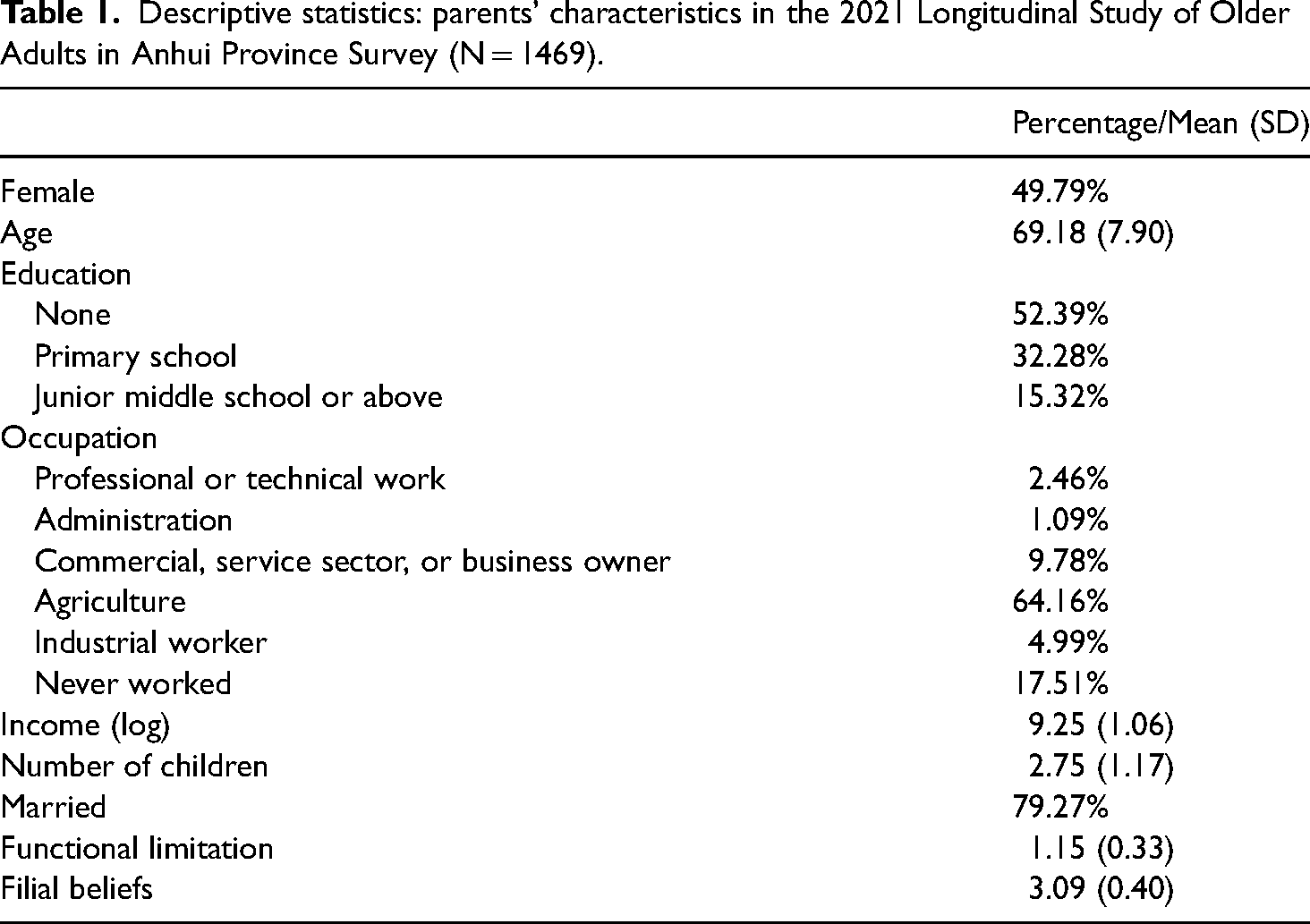
Tables 1 and 2 present descriptive statistics for parents and children, respectively. The average age of the parents is 69 years old. When considering educational attainment, the majority (52.4%) had a basic level or no formal education, 32.3% had completed primary school, and 15.3% had completed junior middle school or beyond. In terms of occupation, almost two-thirds (64.2%) were engaged in agricultural work while 17.5% had never been employed. The large majority of parents (79.3%) were married at the time of the survey. The mean score on the filial beliefs scale was 3 out of a possible 4, indicating a strong sense of the filial duty expected of children.
Descriptive statistics: parents’ characteristics in the 2021 Longitudinal Study of Older Adults in Anhui Province Survey (N = 1469).
Descriptive statistics: children's characteristics in the 2021 Longitudinal Study of Older Adults in Anhui Province Survey (N = 3909).
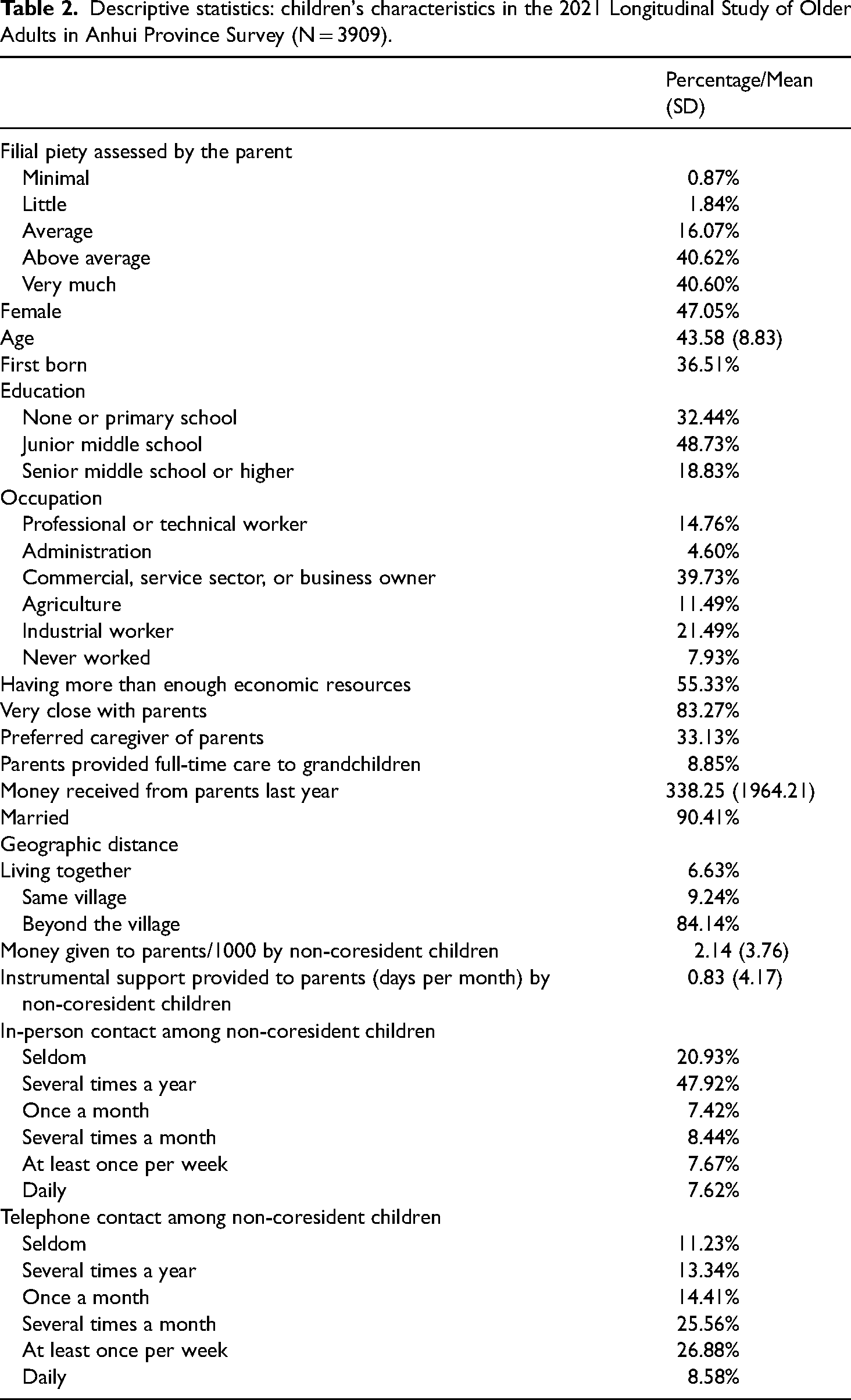
Table 2 provides the descriptive statistics for children. Parents tended to evaluate their children's filial piety as “above average” (40.6%) or “very much” (40.6%). Children comprised slightly more sons (52.9%) than daughters (47.1%). The average age of children was 43.6 years, and 36.5% were first-born children. Children achieved higher education levels than their parents, with 48.8% having finished junior middle school and 18.8% possessing a high school diploma or higher. About 40% of children were employed in the commercial or service sectors and 21.5% worked in the industrial sector, with a smaller proportion, 11.5%, in agricultural jobs. A very large majority of children (90.4%) were married. In terms of geographic distance and coresidence, children predominantly resided outside the village where their parents lived (84%), a small minority (6.6%) lived with their parents, while 9.4% lived in the same village. On average, each child contributed RMB 2140 (equivalent to approximately USD 300) to their parents annually. Those living apart from their parents typically provided about 0.83 days per month of instrumental support. The majority of non-coresident children met their parents in person seldom (20.9%) or several times a year (47.9%). As expected, the non-coresident children called their parents by telephone more often than visiting, with more than half these children calling their parents more than once a month (61%).
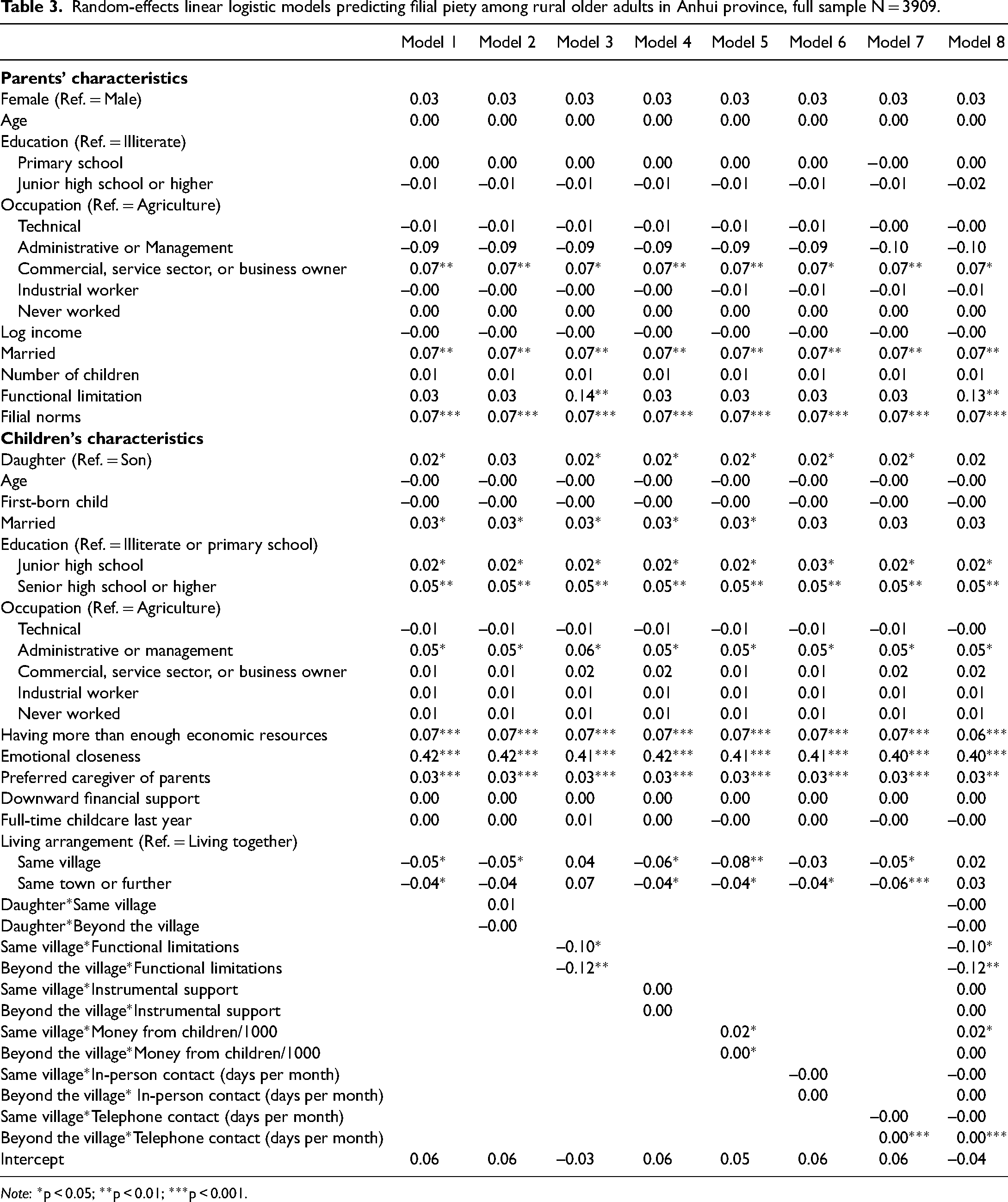
Odds ratio estimates from random effect ordered logistic models are shown in Table 3. Equation 1 consisting only of main effects revealed that parents with stronger beliefs about filiality viewed their children as more filial than those with weaker such beliefs. Supporting Hypothesis 1, children residing with their parents were considered more filial compared with those living apart but in the same village and those residing outside the village of their parents. As for other children's characteristics, daughters, those who were married, and those with higher education levels were seen as more filial by their parents compared to their counterparts. In addition, children who held administrative or management jobs, had better economic status, formed stronger emotional connections with their parents, and were selected as preferred caregivers were perceived as more filial by their parents.
Random-effects linear logistic models predicting filial piety among rural older adults in Anhui province, full sample N = 3909.
Note: *p < 0.05; **p < 0.01; ***p < 0.001.
In Equations 3 and 4, we added interaction terms of coresidence and geographic distance with child's sex and parents’ functional limitations. Equation 3 showed no differences in the relationship between coresidence/distance and parental assessments of filial piety based on the child's sex, providing no support for Hypothesis 2. Equation 4 revealed a significant interaction with parents’ functional limitations, with more impaired parents evaluating children living in the same village or outside the village as relatively less filial compared to parents who were less impaired, supporting Hypothesis 3.
In Equations 4–7 we examined interactions of support and contact with coresidence/distance using the internal moderator approach, described earlier, to test whether support and contact elevated parents’ rating of filial piety of non-coresident children closer to that of coresident children. The interactions added to Equation 4 suggested that increased instrumental support did not enhance filial piety evaluations for children living apart from their parents. Adding interactions with financial assistance in Equation 5 indicated that receiving greater financial support increased parents’ evaluation of filial piety for children living separately but in the same village and those living beyond the village, with the results being stronger for children who lived in the same village. Equation 6 demonstrated that children living outside their parents’ village did not experience an increase in perceived filial piety through more frequent visits. However, Equation 7 indicated that increasing the frequency of phone calls to parents did enhance this perception. Finally, Equation 8 adds all interactions together with negligible changes in the coefficients. Taken together, these results supported Hypotheses 4b and 4d, but did not support Hypotheses 4a and 4c.
At what level of support and contact does living apart become comparable to living together?
Our interest in proposing Hypothesis 4a–4d was to establish whether support from and contact with non-coresident children can raise perceived filial piety to the level of coresident children; to that end, we needed to plot point estimates from the interactions. In Figure 1, we plot the relationship between financial support on filial piety assessments for non-coresident children. We observed that the probability of a higher filial piety rating tends to increase with greater financial contributions. Children living in the same village as their parents reached the same level of perceived filial piety by contributing almost RMB 4000 per year, which falls roughly at the 85th percentile of financial support from non-coresident children. However, for children living outside the village, the financial contribution required to achieve the same level of perceived filial piety jumped to more than RMB 15,000 annually, reaching nearly the 99th percentile of financial support. This suggests that parents might expect greater financial support from children who live further away to compensate for the lack of physical proximity.
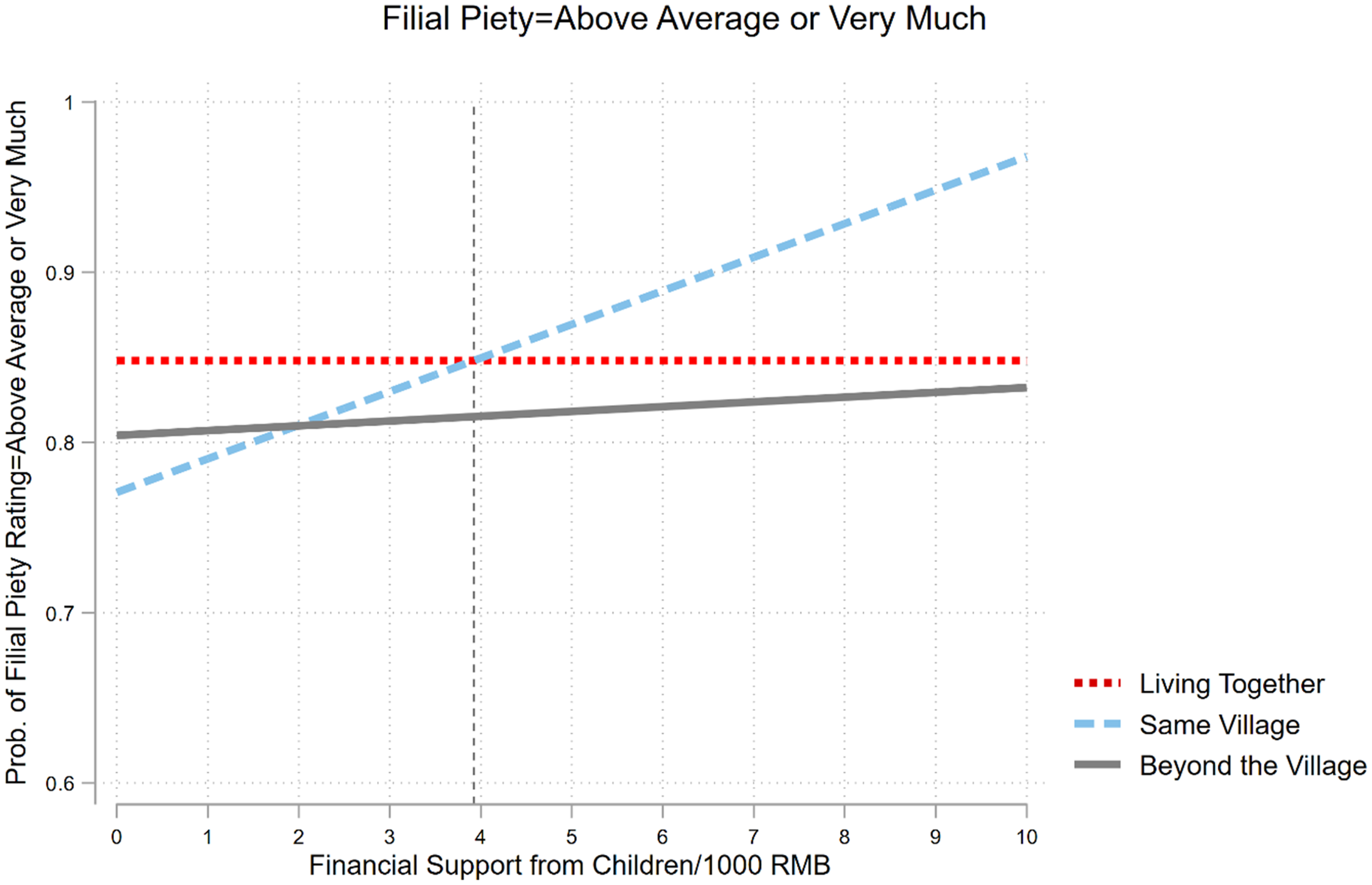
Living arrangements, upward financial support, and perceived filial piety of children.
Figure 2 illustrates how frequency of telephone contact relates to filial piety assessments of non-coresident children. Only children living beyond the village seemed to be able to reach the same level of perceived filial piety as children who live with their parents. This equalization happened when children called their parents 18.4 days a month, which is a very high frequency of calls (around the 80th percentile for non-coresident children). In other words, while calling their parents more can help compensate for the geographic distance, the frequency needs to be quite substantial for those children to be considered equally devoted as the children who live with the parents.
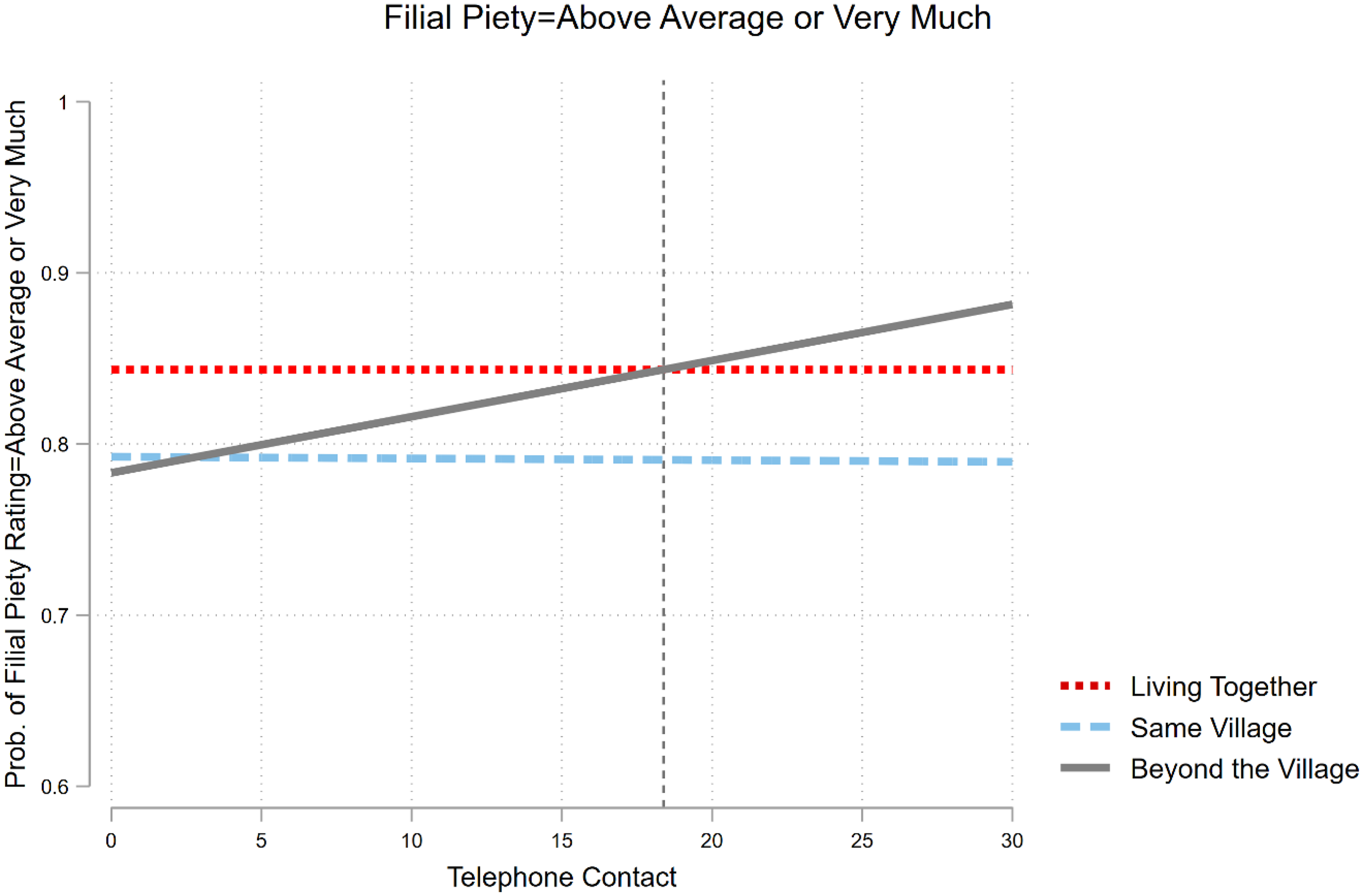
Living arrangements, telephone contact, and perceived filial piety of children.
Discussion
Utilizing the intergenerational solidarity model, this study examined how parents assessed the filial piety of their coresident and more distant children in rural China, and mitigating conditions that “level up” those evaluations of non-coresident children at varying distances. It is worth noting that there is a scarcity of research focusing on parental assessments of filial obligation fulfillment by individual children in China where expectations of children for support and care remain strong and living with children is a desired goal, though not as regularly fulfilled as in the past (Luo and Zhan, 2012). As China has undergone substantial economic development particularly in urban regions, rural-to-urban migration has become normalized and rural intergenerational coresidence has become less common. Thus, it is important to understand how these dynamics leading to changes in geographic distance (structural solidarity) and intergenerational support (functional solidarity) eventually affect the perception of filial piety (fulfilled normative solidarity), still widely considered a fundamental aspect of family life in China. Our results support our first hypothesis, showing that living with parents is still the gold standard for children to demonstrate their filial piety.
Our second hypothesis was that sons living separately from their parents would be perceived as less filial than coresident sons when compared to daughters in similar circumstances. Tradition confers tangible benefits on sons in early life and adulthood while also imposing upon them the responsibility to provide for their aging parents, which includes coresidence, particularly at the end of life (Cong and Silverstein, 2015). Surprisingly, however, perceived filial piety was similarly low for non-coresident sons and daughters, indicating that violating the Confucian dictate not to move away from parents holds for children of both genders, despite the prevalence of the value of son preference in Chinese culture. One possible explanation is the implementation of the one-child policy and the attendant decrease in the number of children per family, which has led to rural families having fewer sons to rely on in their old age (Hu and Scott, 2016), thereby gradually equalizing filial expectations based on children's gender. Recent research illustrates this trend, revealing that sons and daughters in rural areas provide similar levels of instrumental support to their parents (Lei, 2013; Li et al., 2004). However, it is important to note that sons contribute significantly more financial support than daughters in rural China, leveraging their income advantage in the job market. Meanwhile, daughters assume a larger role in providing instrumental support (Cong and Silverstein, 2014), leading to a new form of gender division in parental support responsibilities.
A parent's physical impairment, indicating the need for help with activities of daily living, was associated with non-coresident children being perceived as less filial than coresident children, supporting our third hypothesis. Thus, children who violate the norm of coresidence are assigned lower ratings of filial piety by physically vulnerable parents, who may view their more distant children as being less concerned with their elevated needs and less able to assist them on a daily basis. This supports the literature showing the contingent nature of filial piety as a response to the exigent needs of older parents (Silverstein et al., 2012; Zhang et al., 2014).
We found that although parents tend to regard their non-coresident children as less filial than coresident children, non-coresident children can to some extent “level up” their filial piety by providing more financial support and phoning their parents. These results support two of the four hypotheses in Hypothesis 4, and speak to the adaptation of filial piety to the contingencies of a highly mobile society in which rural villages have largely been depopulated of their working-age populations.
Our study is consistent with understandings of filial piety and its link to intergenerational coresidence as an evolving cultural norm in Chinese society. Previous research has indicated that filial piety norms have undergone changes, particularly in terms of the decline of parental authority, children's obedience to parents, and emotional closeness between generations (Yan, 2016). Our study reveals that another important aspect of filial piety, intergenerational coresidence, traditionally a highly valued means of demonstrating filial piety, has transformed as other forms of expression have become recognized as valid expressions of filial piety. Various economic and social factors, such as large-scale rural-to-urban migration, the implementation of the one-child policy which reduced the number of children available for intergenerational coresidence, and increased female labor force participation drawing rural women into cities, have likely influenced this dynamic.
In our interpretation of recent trends in China, cultural norms have adapted to structural changes associated with China's rapid development. Compensating factors speak to the pliable nature of filial piety for non-coresident children. Indeed, perceptions of the filial piety of more distant children by older parents can supersede that of the filial piety of coresident children if ostensibly greater effort is made by those distant children to provide social and financial support and maintain contact. In many cases, labor migration of children can enhance the overall living standards of older adults and their entire family through remittances (Brown and Poirine, 2005). As a result, parents have adjusted their expectations regarding their children's filial obligations and do not necessarily perceive their distant children as less filial after they migrate from their natal villages (Luo and Zhan, 2012).
Nevertheless, rural China has diverged significantly from urban China in its path toward modernization. As our results suggest, expectations of coresidence with children during parental crises remain high (Hu and Scott, 2016; Whyte, 1997). To a large degree, cultural norms persist in the predominantly agricultural and relatively poor communities we studied, with low pension amounts and a weak public safety net still requiring that older adults rely on children for basic needs. Regardless of the specific reasons behind intergenerational coresidence, living together generally involves shared living spaces, shared responsibilities, and mutual support between the generations. In such a residential setup, parents and children often contribute to the common household by pooling financial resources, sharing household chores, and providing emotional and instrumental support to one another. Furthermore, intergenerational coresidence has the potential to foster stronger bonds and familial relationships over time, influencing how parents evaluate their children's level of filial piety.
There are several limitations to consider in this study. First, the cross-sectional design prevents us from establishing the causal direction implicit in the findings. For instance, while our results indicated that children residing with their parents are more likely to be perceived as filial, it is plausible that the children deemed unfilial were motivated or even encouraged to migrate to other locations for work or possibly marriage. Second, we did not differentiate between various reasons for intergenerational coresidence when comparing coresident children with non-coresident children. It is important to consider that intergenerational coresidence can occur for various reasons. For instance, older adults may live with their children due to poor health and the need for care, or parents may move into their children's house to assist in taking care of the grandchildren. These different scenarios result in varying resource allocations within the household, reflecting different needs and contributions that may mask heterogeneity in evaluations of filial piety. In addition, our findings may not be generalizable to all of China due to several factors. First, filial piety practices differ between rural and urban areas due to the variations in socioeconomic development, modernization, and cultural norms (Lin and Wang, 2022; Qiu et al., 2020). Since our study was conducted in Anhui province, a primarily rural area with significant labor migration, the results may not reflect urban filial norms. Second, communities with different socioeconomic statuses might have varying migration rates and parental support norms. While Anhui's rural nature and high levels of labor migration made it suitable for studying the impact of geographic distance on filial piety, generalizing these findings nationally requires caution.
Despite these limitations, this study contributes to family studies in China by exploring the evolving norms and practices of filial piety. Furthermore, it carries significant policy implications. The substantial increase in adult children migrating to other regions in pursuit of better job opportunities has presented challenges for the older parents left behind. While such migration can bring financial benefits to the entire family, it often results in delayed instrumental support from children and challenges their ability to respond. Our findings indicated that older adults with physical limitations are particularly vulnerable and tend to hold higher expectations for the filial concern of their children. Consequently, parents with severe functional limitations may perceive children who live at a distance as neglecting their filial duties. Our results suggest that it is crucial that government policies prioritize the well-being of older adults whose children have migrated, especially those facing health issues and lacking social and financial support from their migrant children.
Supplemental Material
sj-pdf-1-chs-10.1177_2057150X241269265 - Supplemental material for Older parents’ perceptions of children's filial piety in rural China: The roles of coresidence, geographic proximity, and intergenerational support
Supplemental material, sj-pdf-1-chs-10.1177_2057150X241269265 for Older parents’ perceptions of children's filial piety in rural China: The roles of coresidence, geographic proximity, and intergenerational support by Wencheng Zhang, Merril Silverstein and Ying Xu in Chinese Journal of Sociology
Footnotes
Contributorship
Merril Silverstein and Wencheng Zhang conceptualized the paper. Wencheng Zhang conducted the data analyses under the supervision of Merril Silverstein. Wencheng Zhang wrote the first draft of the manuscript with support from Ying Xu, who contributed to the literature review. Merril Silverstein and Ying Xu revised the manuscript.
Declaration of conflicting interests
The authors declared no potential conflicts of interest with respect to the research, authorship, and/or publication of this article.
Funding
The authors received no financial support for the research, authorship, and/or publication of this article.

Supplemental material
Supplemental material for this article is available online.
References
Supplementary Material
Please find the following supplemental material available below.
For Open Access articles published under a Creative Commons License, all supplemental material carries the same license as the article it is associated with.
For non-Open Access articles published, all supplemental material carries a non-exclusive license, and permission requests for re-use of supplemental material or any part of supplemental material shall be sent directly to the copyright owner as specified in the copyright notice associated with the article.
