



Abstract
While the issues of childlessness and social support in old age have received considerable attention in more developed countries, the phenomenon of aging without children in China has been relatively underexplored. The existing, albeit limited, literature highlights the vulnerability of the childless elderly in China and the inadequacy of social care services, which is predominantly directed toward most impoverished groups. This study examines the care arrangements and social support mechanisms for childless older people in urban China, emphasizing the role of community-level officers in this context. Drawing on in-depth interviews conducted in 2019 with 27 childless elderly individuals and 10 community-level officers in Shanghai, the study reveals the formation of community-based substitute families. These substitute families, comprising neighbors, extended family members, and friends, provide daily assistance, emotional support, and sometimes intensive care. The establishment of these substitute families hinges on the childless individuals’ ability to navigate public and social resources, as well as the institutionalized mobilization and informal work strategies of community-level officers. We argue that the care arrangements for childless older people are significantly shaped by the state's aging-in-place elder care policy. However, the effectiveness of this policy is mediated by the informal work strategies of community-level officers and the proactive care planning by the childless elderly themselves. Our findings offer important insights for improving the current family-based elder care policies and enrich our understanding of aging without children in urban China.
Introduction
While the phenomenon of aging without children has been extensively studied in developed countries, its implications in Asian societies, particularly in China, have been less explored (Abe, 2022; Křenková, 2018). This gap is due to the historical rarity of childlessness in these regions (Lamb, 2020; Patel et al., 2021; Tanaka and Lowry, 2018). In China, research has predominantly focused on elderly care within the context of families with children, overlooking the challenges faced by childless older adults. However, recent shifts in Chinese family dynamics have begun to draw attention to the aging and childless population (Chen and Lou, 2023; Feng, 2018; Wang and Hu, 2021; Zhang, 2017; Zhong and Chen, 2021).
Despite representing a relatively small proportion of the overall elderly population, the number of childless older individuals in China has been rapidly growing over the past decade. Official statistics concerning childless seniors are unavailable, but scholars have used different methods and datasets to estimate their number, all of which suggest significant growth. For instance, based on data from the 2010 wave of the Chinese Family Panel Studies (CFPS), the number of childless older individuals was estimated to be approximately 5.75 million in 2010 (Wang, 2014). Based on data from the seventh National Population Census and the 2020 wave of the CFPS, as of 2020 this demographic accounted for 22.4% of China's elderly population, amounting to 59.09 million individuals. 1 Due to increased longevity, reduced fertility, and lower marriage rates, this population is projected to continue to grow (Sun and Wang, 2008; Wang, 2014). Studies have also stressed the multiple difficulties and risks faced by this group in old age, particularly due to the absence of support from adult children (Chou and Chi, 2004; Feng, 2018; Wang and Hu, 2021).
Nonetheless, the current social support for childless older people in China remains inadequate. Prior to the turn of the 21st century, elder care was family based with minimal public support. Public care services and assistance were restricted to the most impoverished elders in China, with the majority of the elderly population depending on family support in their old age. However, since 2006, there has been a gradual shift toward a family-supported social welfare model, owing to the rapid rate of population aging and the diminishing capacity of families to care for the elderly. Even though families continue to be the primary caregivers for seniors, social support and assistance for the elderly has been made available to enhance the care capacity of families. This includes home-care services, community-based services, institutional care, and pension and health insurance schemes, as well as other assistance programs. The 14th Five-Year Plan (State Council, 2021) emphasized the development of a comprehensive social support system for the elderly, enhancing basic elder care services, and strengthening the capacity of families in assuming elder care responsibilities.
Despite these policy efforts, significant challenges continue to affect the well-being of the elderly population in China, including those without children. The primary form of social support for the elderly is financial assistance, provided through pension and health insurance schemes. However, the actual supply of elder care services remains markedly insufficient (Xia, 2020). In addition, the availability and quality of elder care services differ significantly across regions, with urban areas being better equipped than their rural counterparts (Zhang et al., 2020). Moreover, the elder care sector faces several critical challenges, including underfunding, limited capacity in service delivery, a shortage of eldercare workers, and poor coverage (Feng et al., 2020; Krings et al., 2022). With regard to childless seniors, elder care services prioritize the needs of “three nos” seniors—those with no source of income, no working capacity, and no family support. As a result, while the welfare of impoverished childless seniors and older individuals who have lost their only children may receive some attention (Zhang, 2017), the broader social support system in China falls short in addressing the care and other needs of the majority of childless older individuals. This gap highlights that the social support system in China requires further development and enhancement to meet the diverse needs of this growing demographic.
Existing research provides valuable insights into the vulnerabilities faced by childless seniors in China and the institutional and informal support mechanisms available to mitigate these challenges. However, there are several notable limitations in the current body of literature. Firstly, studies on childless seniors in China, particularly in comparison to more developed countries, are relatively scarce. Current research also tends to focus predominantly on the economically disadvantaged childless elderly in rural areas, failing to capture the diversity within this demographic. This narrow focus does not fully reflect the complexities of China's rapidly aging population and the profound changes in family dynamics.
Secondly, the majority of the literature on elder care policies adopts a top-down approach to analyzing China's social support system, often neglecting the perspective of the elderly themselves. There is a lack of emphasis on how older individuals perceive and interact with elder care policies, and the institutional barriers they encounter in accessing care services. Consequently, the effectiveness of these policies is not thoroughly examined from the viewpoint of the elderly, particularly those without children. It remains underexplored to what extent current elder care policies alleviate risks for childless older individuals and how care services are utilized by them.
Thirdly, while existing studies on aging and older people explore the strategies elderly people employ to secure care and manage risks in old age, they often fail to adequately address the institutional resources and conditions that enable or constrain these strategies. Consequently, the factors contributing to the success or failure of these strategies are not thoroughly understood, particularly the role of grassroots governments in the policy implementation process.
To address these gaps, this study examines the care arrangements for childless older people in urban China. Recent studies have highlighted a reluctance among childless seniors to participate in equity release schemes, commonly known as reverse mortgage plans, due to perceived risks associated with the housing market and financial institutions (Zhong and Chen, 2021). Concurrently, other research has shown a marked preference among older people for government-supported care over commercial options, especially in rural areas (Li and Sun, 2021; Shi and Xie, 2015). These findings indicate that grassroots governments, especially at the community level, play a pivotal role in enabling childless older individuals to access care services and formulate their elder care plans. The involvement of grassroots governments in elder care arrangements for childless seniors thus warrants a more comprehensive analysis.
Accordingly, this study concentrates on the interactions between childless older people and community-level officers, examining how they collaboratively navigate resources to meet care and other needs in old age. By focusing on this specific demographic, the study contributes to a more nuanced understanding of the elder care landscape in China. Furthermore, it investigates potential alternatives to the dominant family-based elder care policy model in China, thereby offering valuable policy insights for addressing the challenges posed by an aging society.
Literature review
Studies of the elder care service system and related policies in China mainly address two critical aspects: the formulation and implementation of elder care policies. Analysis of policy documents and narratives reveals the evolution of elder care policy, highlighting the changing role of the government, the challenges grassroots governments face, and the core characteristics of these policies. Shi and Luo (2014) noted that the government's role in public elder care has undergone phases of growth, reduction, weakening, and subsequent reinforcement since the establishment of the People's Republic of China in 1949. Guo (2019) divided the development of China's elder care policy into three periods: the planned economy period (1949–1978), the period of building basic institutions (1979–2000), and the period of active development (2001–present). This categorization shows a gradual shift from a family-centric model to a more mixed and diversified approach to welfare.
Meanwhile, research on policy implementation has examined the dynamics between various service providers. Gao (2015) found that the current operation of the home-care and community-based elder care system has formed a cooperative mechanism involving local governments, non-governmental organizations, and market enterprises. However, despite the emergence of diverse stakeholders, the government remains the primary driver and funder of the elder care system, with other participants often marginalized or reluctant to engage (Ding and Yang, 2015; Guo, 2010; Jiang, 2017). However, an examination of how grassroots governments can provide services for the elderly or implement these policies under conditions of heavy workload is lacking. In addition, studies on elder care policies have revealed the pitfalls of the current elder care system. Li et al. (2019) pointed out some major problems within elder care policies, including a lack of integration and coordination, a tendency to focus on emergency responses over preventive measures, and insufficient attention to women's rights and work–family balance. Wu and Liu (2017) also found that China's elder care system has issues such as uneven investment in service infrastructures and a shortfall in demand-oriented policy initiatives. Further studies evaluating policy effects have confirmed a low uptake rate of these services, indicating a mismatch between the services provided and the actual needs of the elderly (Ni and Zhang, 2015; Wang, 2016; Wang et al., 2019). Wang (2013) also identified several systemic issues plaguing the elder care system, such as limited coverage, a narrow range of service programs, and rigid service delivery. Ding and Qu (2019) highlighted significant disparities in the quality of elderly care services across urban and rural areas, regions, and demographic groups within the elderly population.
In other words, current research on elder care policy stresses that while the social support system in China is well developed, elder care policy continues to heavily rely on family support due to the inadequacy of elder care services. The implementation of these policies is predominantly government driven. Acknowledging these limitations in social support for the elderly in China, a considerable amount of research has focused on the strategies employed by older people, including childless people, to manage care and mitigate risks in old age, examining various patterns and categories of practices (Logan and Bian, 1999; Thogersen and Ni, 2010). To this end, scholars have identified three primary sets of strategies.
Resource accumulation and self-reliance
Many older people strive to accumulate resources to ensure self-reliance in old age. Cash savings are commonly seen as the primary retirement plan, with urban residents often planning their elder care arrangements from midlife (Ding and Wei, 2016; Wu and Song, 2022). Those with lower pension levels may seek re-employment to bolster their economic resources (Ran and Lyu, 2020). In addition, in urban areas where housing prices are high, older individuals often view their homes as valuable assets, selling or renting them to secure financial stability in old age (Zhong and Chen, 2021).
Intergenerational exchange and mutual support
Mutual support among family members remains critical in old-age security for many seniors (Ding and Wei, 2016; Li et al., 2023). It has been found that aging parents often provide domestic and grandparental care to secure support from their adult children (Chen, 1998; Song and Li, 2010). In urban areas, parents may assist their adult children in purchasing homes, thereby establishing a new intergenerational contract that includes expectations of economic returns and elder care support (Zhong and Li, 2017). In families with multiple adult children, parents invest not only in sons but also in daughters to enhance their security in old age, with investments often reflecting the degree of filial piety (Song, 2010; Zhang, 2005).
Development of social networks
Older individuals often cultivate extensive social networks within their extended family, kinship groups, friends, and local community to supplement or replace family support. For instance, reliable friendship networks can serve as an alternative to family support (Rempel, 1985). In rural China, where public elder care services are scarce, older villagers within clans may establish and operate informal aged-care centers or nursing homes (Li and Sun, 2021). In villages with limited public resources, older villagers may cohabit and form family-like relationships for mutual care and self-reliance (Luo and He, 2022).
Compared to their counterparts with children, childless older individuals tend to engage more actively in diverse social networks, forming stronger connections with peers, collateral relatives, non-relatives, and social organizations (Albertini and Kohli, 2009; Bachrach, 1980). Social networks play a more significant role in providing informal care and support, and childless seniors try to identify a specific caregiver who is essential within these networks (Deindl and Brandt, 2017; Gray, 2009; Xia and Ma, 1995). They often invest time and resources to maintain reliable relationships and negotiate care arrangements using assets such as farmland and other property (Zhang, 2007). If a reliable caregiver is found, childless seniors are more likely to age within their communities; otherwise, they may resort to nursing homes (Chen and Lou, 2023).
Moreover, contemporary research highlights a degree of heterogeneity in the care arrangements of childless older people. It has been observed that marital status may significantly influence their propensity to form and engage in social networks. Childless seniors who have spouses, particularly men, are more likely to depend on their partner for care (Shi, 2012; Wenger et al., 2007). Conversely, those without spouses often seek to cultivate social connections beyond the family (Klaus and Schnettler, 2016). However, further investigations indicate that social engagement among childless older adults may also be shaped by factors such as gender and cultural background (Křenková, 2018). These insights underscore the complexity and diversity of care arrangements among childless older individuals, pointing to the multifaceted influences that make this a challenging area of study.
In other words, studies on care arrangements have stressed that older individuals are proactive agents and not merely passive recipients of policy who strategically adapt to their external socioeconomic environment. For childless older people, developing strong social networks, identifying a substitute caregiver, and establishing care contracts are key strategies for planning their care arrangements. This process often involves a willingness to exchange resources, offer time, land, and property, and engage in various social activities.
In summary, despite several limitations, existing research has provided valuable insight for our study of childless older people and their care arrangements in old age. To bridge the identified gaps, this study aims to explore the following research questions: How do childless older people manage care and cope with risks in old age? What roles do community-level officers play in facilitating care arrangements for these elderly individuals? In addition, the study seeks to understand the effectiveness of elderly care policies shaped by the interactions between childless older people and community-level officers. These inquiries aim to deepen our understanding of the dynamics at play in the care arrangements and social support for childless elderly populations.
Methods
In this study, we employed qualitative research methods, focusing on the elderly population without children to analyze their elder care arrangements and the roles of community-level officers in this process. We used purposive sampling to conduct in-depth interviews in 2019 with a group of childless older people in Shanghai. Shanghai, being the city with the highest degree of aging in China and having undergone drastic changes in family and marriage relationships, was selected to better understand the complexity of issues related to the childless elderly population.
There were three criteria for sample selection. Firstly, we selected older people without children. The definition of childlessness varies, depending on the specifics of how childlessness is reached, or the definition of “parent” and “child”. In this study, the term “childless older people” refers to Chinese individuals aged 60 and above without biological children, stepchildren, or adopted children. Secondly, we selected childless older people who owned at least one property and had a pension at the average level of the local elderly population. The impoverished elderly receive social assistance and receive elder care in public aged-care institutions, while the high-income elderly are able to afford marketized elder care services. By selecting the intermediate tier, we aimed to better capture the care arrangements of childless older people and the roles of community-level officers. Thirdly, we sampled in two communities of different types: one with better elder care services, facilitating us to better understand the interactions of childless elderly with institutional support systems, and the other with strong neighborhood relationships, in order to examine their interactions with informal support systems. This also helps us better identify the common patterns in the roles undertaken by grassroots officers.
In light of existing research, we further employed the principle of maximum variation in the sample selection. Academically, childlessness is categorized dependent upon the pathway to childlessness: infertility, death of children, voluntarily childlessness, or involuntarily childless (Quashie et al., 2021; Zhang, 2017). This study further classifies childless seniors in China into six categories based on marital status: (1) unmarried and childless; (2) married and childless; (3) widowed and childless; (4) divorced and childless; (5) married parents who have lost their children; (6) divorced parents who have lost their children. We maximized the sampling to gain a deeper understanding of the major patterns of care arrangements within this diverse demographic group, considering variables such as age, gender, marital status, health status, and family conditions.
Through introductions by community-level officers and snowball sampling by the interviewees, we were able to conduct our fieldwork in the Changning and Minhang districts of Shanghai. Changning, one of Shanghai's central districts, has better elder care services. We also conducted interviews in Pujiang County of Minhang District, a main resettlement point for relocated households during rapid urbanization. Most residents are local and familiar with one another, maintaining stable neighborhood relationships.
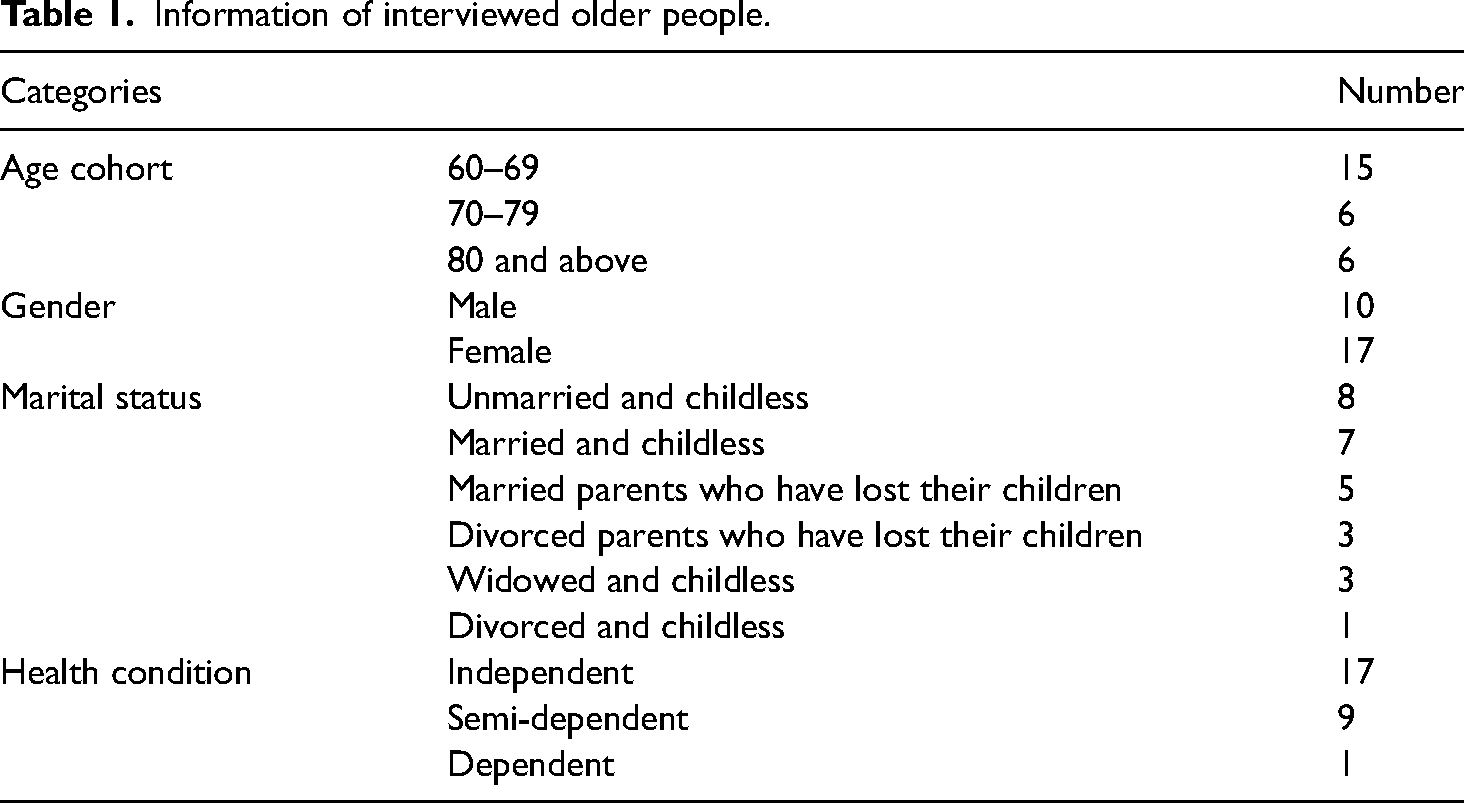
In total, we interviewed 27 childless older people. All interviewees were local residents of Shanghai, mostly with junior high school education, and a few with college or university degrees. Their major income sources were pensions, averaging 3000–5000 yuan per month, in line with Shanghai's average pension level in 2019. Most of them owned one property, with very few owning two. Over half of the interviewees were aged 60–69, in relatively good health, capable and in need of planning for elder care arrangements. For older people who were independent or semi-dependent, we conducted individual interviews. For those who were fully dependent, we interviewed them accompanied by residents’ committee officers. Table 1 provides the basic information of these interviewees.
Information of interviewed older people.
To better understand the implementation process of elder care policies and the interactions of grassroots governmental officers with this group of elderly people, we also interviewed 10 community-level and district-level officers who were responsible for elder care services and elder care policy implementation. We transcribed the interview recordings of the interviewees, coded them, and conducted thematic analysis.
Findings
Informal power dynamics of community-level officers
In recent decades, China has made significant strides in strengthening its formal social support framework for the elderly. In 2006, the State Council issued the “Notice of Enhancing the Development of Services for the Elderly”, laying the groundwork for an institutional framework for elder care. This policy advocates for a model where “aging at home serves as the main approach, supported by community-based services, with institutional care acting as a supplementary measure” (State Council, 2006). The implementation of these formal services has largely depended on grassroots governments, that is, street offices and residents’ committees (jie ju). The street office functions as the de facto street-level government, often described as the “street government”. Conversely, the role of the residents’ committees frequently deviates in practice from its statutory mandates.
Over the past few decades, residents’ committees in China have experienced a transformation process known as “administratization” (Gui and Cui, 2000). The 1982 Constitution of the People's Republic of China 2 and the Urban Residents’ Committee Organization Law 3 issued in 1989 recognized residents’ committees as self-governance organizations among residents. The committees served a supplementary function during the era dominated by the “danwei” (work unit) system (Wang et al., 2003; Yang, 2002). However, the pivotal role of the danwei system gradually shifted to the street office–residents’ committee system (jie ju zhi), as economic reforms led an increasing number of individuals to transition from the category of “danwei person” to “social person”. In response to these changes, a series of reforms aimed at strengthening the street office–residents’ committee system were initiated in the mid-1990s. These reforms empowered grassroots governments with greater authority, responsibility, and resources to address matters within their jurisdictions.
Since the onset of the 21st century, residents’ committees have been further consolidated and brought under the control of local governments in China. They have evolved into community-level governmental branches, operating under the leadership of street offices. Residents’ committees are often described as the “nerve tips” or “foundation stones” of municipal governments, as well as “legs” (tui) and “feet” (jiao) of street offices, playing a crucial role in implementing state policies and delivering social services (Wong and Poon, 2005: 417). This evolution is also conceptualized as the “territorialization of the local state” (Wu, 2002), indicating a shift toward relying on residents’ committees, which function as quasi-governmental organizations, to uphold the state system (Read, 2000).
Within the domain of social services, despite the trend toward outsourcing, residents’ committees continue to serve as the principal providers of formal community-based services. They are tasked with executing policies and assignments delegated by street offices and other governmental agencies. As stipulated by the Urban Residents’ Committee Organization Law, the responsibilities of the residents’ committees encompass five key areas: (1) execution of public service schemes; (2) representation of residents’ views and needs to the local government or its respective branches; (3) engagement of residents in the enforcement of state policies and laws; (4) leadership in maintaining community security; (5) mediation of disputes among residents.
Despite their pivotal role in community governance, residents’ committees do not possess the same authoritative powers over citizens as formal government organizations. To fulfill their responsibilities, these committees leverage the personal relationships or “relationship investment” of their members with the residents (Chen, 2012), employing what Gui (2007) has termed “informal power strategies”. This concept elucidates that when the residents’ committee, acting as an agent of the state, exerts influence over residents, this power dynamic manifests through personal connections rather than through institutionalized, formal mechanisms of restriction and compliance (Gui, 2007: 110). In essence, these “informal power strategies”, rooted in personal connections, draw upon the administrative, economic, and political resources available to the residents’ committee. Furthermore, they are influenced by the Chinese cultural context of social relationships, which emphasizes the importance of psychological recognition and cooperation among acquaintances, encapsulated in the concept of “mianzi” (face-saving).
As we observed in the field, it became evident that residents’ committees are highly motivated to build and maintain close relationships with community residents, as these relationships are crucial for the implementation of state policies. The target groups for these efforts include CPC (the Communist Party of China) members, building leaders, vulnerable older people, and other community members. Typically, the first two groups consist of volunteers who provide practical and emotional support for the elderly in the community. The building leader system, a pivotal mechanism, has been widely established across Shanghai. The residents’ committee proactively visits individuals deemed as potential leaders, who usually have better jobs and higher educational levels, or CPC membership. A building or residential area is classified into several groups horizontally or vertically. In every group, an ideal candidate is encouraged by the residents’ committee to assume the role of building leader or residents’ representative. These residents are unlikely to refuse the role, largely due to the influence of the Chinese culture of mianzi, which is reinforced by personal visits from the residents’ committee, expression of trust, and acknowledgment of their capabilities. Once established, the building leader system is maintained through the residents’ committee's continued investment in these relationships. This includes gestures such as presenting small gifts during Chinese festivals, organizing complimentary trips, or hosting appreciation events. With the help of building leaders, the residents’ committee secures a reliable framework for executing its duties.
The residents’ committee strategically mobilizes these “volunteers” to deliver services to the elderly population, with childless elderly individuals being a significant group of service recipients. One residents’ committee director outlined the role of the community: Now, a community has two functions. One is undertaken by formal organizations, residents’ committees and street governments. The other is provided by volunteers, who assist governments to solve most of the problems of these older people. (of4-pj, 16 January 2019)
In summary, the residents’ committees exert significant influence through “informal power strategies”. The majority of volunteers interviewed in the communities recalled their experiences of being mobilized and increasingly involved, as in the following example: When I had just retired from work, we [community members] did not know one another. We went to and came back from work without awareness [of these community activities]. After I retired, the director of our residents’ committee came to my home and asked me which activity I would like to take part in. Then we set up a liaison. Later on, I followed the director to organize some activities, then [my involvement became] more and more, such as [being] a building leader, volunteer, and so on. I have done a lot. (zzxq-D, 24 July 2019)
Institutionalized mobilization through social support schemes
Within the available services for the elderly in Shanghai, residents’ committees have been endeavoring to build social support networks through two key schemes: the Old Buddies Scheme and the Warm Neighbors Scheme. The Old Buddies Scheme, implemented by the Shanghai municipal government, specifically aims to assist the oldest and potentially most isolated segment of the population, those aged 80 and above who live alone, in building a supportive network of neighbors. The Old Buddies Scheme involves having one volunteer connect with five older people aged 80 and above living alone or not living together with any child. The volunteers go to their old buddies’ homes or call them to check on their situation and provide timely help. (gzxg-3, 18 January 2019)
The Old Buddies Scheme offers a comprehensive range of services for the elderly, encompassing daily check-ins, assistance with everyday tasks, support during emergencies, and participation in community activities. This scheme plays a crucial role in the lives of childless elderly individuals, facilitating daily interactions and support among “old buddies”, particularly in relation to household chores and day-to-day tasks, prompt assistance in emergencies, and even care during hospital stays. They [volunteers] often call their old buddies and ask about their health condition or what help they need. (ljxq-C, 25 July 2019) At the same time as being a building leader, I, together with my husband, [connect with] Aunt Wang. We have the same surname, Wang, right?! She is nice to us and we give her appropriate care. A simple example: she went out and left her key at home. This was on a day in summer with strong wind; when she went out to take out the rubbish the door slammed behind her. Then what was she to do? Ring my doorbell and let me to give her a key. She kept a backup key at my home. For another example, taking a shower. She comes to my home [to take showers]. Her home does not have a shower. Sometimes she has difficulties with electronic devices, like the air conditioner or other domestic devices, and so we help her with these small things. … My son had a wedding last year and Aunt Wang was invited to the wedding ceremony. She got carsick, but she had a very, very good time. She has rarely visited other places outside of this community. (pjxq-A, 16 January 2019) The neighbors here are warm. When I was in hospital [for a period of time], it was my neighbor who stayed up the whole night, day after day [caring for me]. So I have every reason to stay in this community. If I hired a care worker, it would cost thousands of yuan, so much of money. (mtxq-E, 13 March 2019)
The Warm Neighbors Scheme represents another form of social support service aimed at the elderly population. Funded by local governments, this scheme allocates spaces and organizes activities designed to encourage elderly individuals to become acquainted with one another, thereby enhancing interpersonal interactions and mutual support. By institutionalizing the process of relationship building and increasing interactions, the Warm Neighbors Scheme fosters a network of emotional support among residents.
The emergence of substitute siblings
Through the activities facilitated by these schemes, residents develop ever stronger relationships, which naturally lead to mutual assistance with household chores and emergency assistance. As one childless elderly individual shared with us: I go to the “Warm Neighbor” room every week for one hour, with others from the same community. We live near each other and have become close sisters; one is one year older than me and the others younger than me by a little bit. When we get together, this makes us very happy. We talk and open our hearts. Very nice, they are all nice. We are very close. When I have problems, they come to help. As soon as I call, they will definitely come. (ljxq-B, 18 January 2019)
Gradually, the relationship between the volunteers turns into one of “substitute siblings”, while individuals’ real sibling relationships are constrained and their connections become less and less due to various circumstances. One interviewee described the comparative change as follows: [Brothers and sisters] now don’t get together anymore, because they are older and older, and they can’t get around freely. If I invite them, they might have a fall. [If that were to happen,] their children will blame me. If they invite me to their places, I will go. But if I invite them to come over to my place, they are not free to come. If there's a problem [with their health during their visit], their children must blame me. They will say “it's all auntie's fault”. (mtxq-A, 30 July 2019) Brothers and sisters don’t meet often, they are all busy, they are all over 70 years old and they are helping their children to take care of grandchildren. (tsec-B, 30 July 2019) After my parents passed away, the connections among their brothers and sisters fell apart. They are not reliable and can’t help with anything. What can they help with? They are all busy with [helping] their only-child. (xfxq-A, 16 January 2019)
Informal relationships in Chinese society have traditionally been encapsulated by the term “differential mode of association”, reflecting the hierarchical nature of social interactions. However, the role of siblings tends to weaken with age, leading to a decrease in their functional significance in one another's social support networks. In contrast, relationships between neighbors have grown stronger, largely due to the institutionalized mobilization undertaken by community and state actors. These neighborly connections have become vital, providing a range of support services that includes emergency assistance, daily living support, hospital care, and companionship—functions traditionally fulfilled by family members. As the interviewees confirmed, neighborhood volunteers act as substitute siblings for the childless elderly.
The emergence of substitute children
Childless elderly individuals encounter significant challenges as they become frail or lose the ability to perform daily activities independently. For those in such circumstances, the absence of a reliable source of intensive care often leaves placement in a nursing home as the sole option. However, the preference to age in place was strongly valued by the elderly whom we surveyed. Their reluctance to be institutionalized in nursing homes was vividly expressed through descriptors such as “too expensive”, “die an early death”, or “the last option”. Recognizing the needs of childless older people and aligning with state policies that promote community-based services, residents’ committees have been proactive in dealing with these challenges. In response, they have gradually developed new strategies aimed at addressing the intensive care needs of the childless elderly in their final stages of life.
Residents’ committee members discuss care arrangements and willingness to enter nursing homes with the childless elderly now and then. They give advice, guidance, and direct help. If there is a relative, even living outside of Shanghai or with whom the elderly person has lost contact for a long time, the residents’ committee will seek to build the relationship between this relative and the childless elderly person. One residents’ committee member shared her experiences in such work: I know this auntie that has property that will be inherited. We as residents’ committee leaders, with guidance, give advice to her now and then. For example, she still has a relative in her distant hometown, so I contacted her relative, with whom she now keeps in contact. We [persuaded] her younger brother and sister to visit her, to try to give her a reliable social network. (of9-pj, 21 January 2019)
The endeavors of residents’ committees can lead to a revitalization of family support networks, to varying extents of closeness and depth of involvement, and often result in the closest pole of this spectrum. Two interviewees aged 80 and above had legally established substitute families, one with his nephew, the other with her niece. They carried out property notarization and officially appointed the future inheritance receiver to commit to taking care of them after they lose their daily living ability. The substitute children commit to providing terminal care and to arranging their funeral as well.
Residents’ committees establish contact in, guide, and supervise the complete process of forging such relationships. Residents’ committees are required by the government to take charge at the earliest time when a childless elder needs care. The residents’ committee plays the role of resource manager in the following working procedure: When they lose their daily living ability, residents’ committee staff take care of them at first, then contact their family member. As they are old, they need a custodian. We [residents’ committee staff] go to their residence first, then call their relative. If we can’t reach their custodian, we will report the case to the street government because emergency or long-term care arrangements require a great deal of money. Then the street government will decide how to resolve the situation, say, for example, by hiring a care worker if the elderly person suffers from a chronic illness. (of7-cn, 18 January 2019)
The residents’ committees have motivation to build substitute families for childless elderly people, based on the following rationalization: If the elderly person is seriously ill, we [the residents’ committee] can’t make decisions for them due to legal risk. We have to avoid such risk, right? The elder needs a family member, needs a custodian. We can help but we can’t decide [in a family member role]. (of7-cn, 18 January 2019)
Childless elderly people's investment in relationships with substitute families
Aging in place has been widely accepted as the main principle of later-life living internationally (Pynoos and Cicero, 2009). Living at home and in a community that they are familiar with can ensure older people's sense of independence, belonging, and security. However, childless older people are more likely to be institutionalized in nursing homes when they encounter frailty. Our research finds that childless older people are not passively waiting to be institutionalized. They take actions to realize their desire to live at home as long as they can. All interviewed childless older people maintained their goal of aging in place: Going to the nursing home is the last choice. If my condition allows, I want to stay at home. (mtxq-E, 15 March 2019) Staying at home lets me have sense of freedom. (ljxq-B, 18 January 2019)
Although the Chinese government has been implementing community services guided by the central idea of aging in place, on average older people do not think these formal services are adequate for fulfilling their aims. Services for the older people with the need for different extents of assistance are integrated under Long-Term Care Insurance, which was initiated in 2016 in Shanghai. Those impoverished older people without children or a spouse are endowed with full access to public care, but they have to move to elder care institutions. The total number of people receiving such means-tested institutional care in Changning district in 2019 was 20.
4
Therefore, as most childless older people cannot expect to receive sufficient intensive care from public services, they have to plan care arrangements by themselves in advance of the time in which they will lose their daily living ability. With respect to the affordability of marketized and public care services for supporting living at home, many childless older people expressed concern: Long-Term Care Insurance provides one or two hours of care a day, which is not enough to solve the problem, right? If I can live by myself [with full daily living ability], it is no big deal. If I can’t live by myself, it is not reliable. Then I have to have someone [to care for me] at home. I can’t afford this; it costs at least four to five thousand yuan [a month]. (ljxq-B, 18 January 2019)
The elder care services on the market in Shanghai are too expensive to be affordable using the average pension. One residents’ committee staff member evaluated the pension conditions of their local residents as follows: [I think that the] pension [level] in Shanghai is the highest in China. This one aunt received 4100 yuan in pension every month; my younger sister worked 38 years and gets about 5000 yuan. I worked 45 years and get 3500 yuan in pension every month. (of4-pj, 16 January 2019)
Older people in developed countries are characterized as “cash poor and property rich”. Such property-rich older people can resort to releasing their equity in order to afford elder care. Their counterparts in big cities in China have reached a similar stage on the surface due to the high value of their housing on the market. Homeownership among the elderly population in urban China reached 75.7% in 2014 (Ministry of Civil Affairs and National Office for Aging, 2014). However, in fact, the older people in China find it hard to rely on the equity release schemes provided by market actors such as banks and insurance companies. Such equity release schemes have been developing slowly in China, and have been widely criticized as moral risks (Zhong and Chen, 2021). Childless older people are the target customers for equity release schemes because older parents in China are deeply embedded in intergenerational relationships of reciprocal exchange. The interviewed older people expressed their distrust of financial organizations that provide equity release services: If it [the financial organization] goes bankrupt, what can I do? There's no possibility that I will give them my certificate of ownership. That's my only property and my lifeblood, my lifeblood, right? (ypnl-B, 19 January 2019)
To sum up, childless older people have considered public and private care options, and on this basis they have rationalized their investment in interactions with neighbors and extended relatives. As such, childless older people are willing to join state-led schemes designed to forge informal social networks and are even willing to use their property to establish reciprocal relationships.
Residents’ committees have a strong motivation to build substitute families for childless elderly people, as mentioned above. Elderly people's willingness to use their property in exchange for care from a relative plays a pivotal role as well. The residents’ committees play a role in educating the elders to make decisions and provide official guarantees of the realization of the care. One staff member of a residents’ committee put it this way: [In the case of one elderly lady, her] niece now has become her [legally] adopted daughter. As adopted daughter, what rights does she have? This auntie has given her apartment [to her niece]; we [the residents’ committee] assisted them to deal with notarization. This apartment will be her niece's property. Her niece was informed that she must fulfill the obligation of caring for the elderly woman and arranging her funeral. Now her niece is obeying the requirement of caring for her and regularly coming to her home. For her terminal stage, she has considered a lot. She has appointed her niece to arrange [matters]. (of9-pj, 16 January 2019)
Our research further reveals that while state policy aims to mobilize social support for all elderly individuals, the actual implementation within communities primarily benefits the oldest old and those living alone. This discrepancy can be attributed to two main factors. Firstly, community officers operate under a government-mandated agenda that prioritizes the needs of different elderly groups, with a particular emphasis on services for the oldest old and those without cohabitants. Secondly, childless elders in their 60s and 70s who retain the ability to manage their daily living tasks demonstrated a lower inclination toward planning for their future care arrangements during this research. Consequently, the focus of community services on the most vulnerable underscores a strategic approach to resource allocation, aiming to address the most pressing needs within the elderly community, while also highlighting the diversity of care arrangements among the elderly themselves.
Conclusion and discussion
This study examines the care arrangements for childless older people in urban China, with particular focus on the interactions between childless individuals and community-level officers in shaping such arrangements. Aging without children has been well studied in more advanced countries, but has received little attention in the context of China. In addition, while scholars have extensively studied the social support system for the elderly and their coping strategies in China, there has been a notable gap in understanding the roles of community-level officers in establishing care arrangements for the elderly, especially for the childless elderly. This study unveils the dynamic process of initiating and consolidating care arrangements for childless older individuals. The established substitute families provide comprehensive care, including daily assistance, emotional support, and long-term care. Such care and support is typically expected from extended family members. In this paper, these care providers are referred to as “substitute siblings” and “substitute children”.
Throughout the process of building and maintaining such substitute families, state actors, particularly residents’ committees, play a crucial role through institutionalized bonding, personal mobilization, persuasion, and supervision. The interaction between formal and informal support in Shanghai does not align with the “crowd in”, “crowd out”, or “complementary” models previously addressed in the literature (Reil-Held, 2006; Sundström et al., 2006; Wang, 2017). Contrary to the common perception of informal social support as static and uncompensated in the absence of elders’ efforts (Albertini and Mencarini, 2014; Larsson and Silverstein, 2004), this study finds that informal social support can be developed, consolidated, and its depth of care guided, mobilized, and supervised. This finding resonates with a case in the German context, where Klaus and Schnettler (2016) found that childless elders over 40 years of age can establish effective support networks with substitute children and kin. In addition, this study underscores the proactive role of the state in facilitating these networks within the Chinese context, highlighting a distinctive approach to supporting childless elderly populations.
Childless older people are dynamic actors, immersing themselves in interactions with state actors and social supporters. Compared to their counterparts with children, childless elderly people are more likely to be mobilized to participate in activities initiated by formal organizations like residents’ committees. They strategically arrange their resources, in a process that Yao and Fan (2009) described as “designating different functions”. The childless elderly are aware of their evolving needs as they age. They categorize their care arrangements into two stages, which they described as “being able to move freely” and “being unable to move”, the technical term for the latter being the loss of daily living abilities. While the childless elderly remain fully capable of daily living, they interact closely with neighbors like siblings. As they age and face the possibility of losing their daily living abilities, they are willing to exchange their assets for long-term and terminal care.
Formal support for the childless elderly is implemented by residents’ committees in communities. In urban China, residents’ committees are unique organizations with official resources and power, yet they are legally defined as self-governance organizations. Consequently, residents’ committees have developed “informal work strategies”, relying on personal connections with four groups of residents to implement state policies: building leaders, CPC members, older people, and those in need of help. The structure and characteristics of residents vary among communities within the same city, and even more so across different cities. The effectiveness of mobilizing and supervising informal social support for childless elders varies accordingly. Four key parameters mediate the effectiveness of the residents’ committees’ power: (1) the number of disadvantaged residents, (2) the number of older people and hobby groups, (3) the age of the community and the age and culture backgrounds of its residents, and (4) the number of CPC members and their available resources. These factors shape the power of residents’ committees in different cities and communities and help explain the varied effects of the establishment of social support networks for childless elderly. The effectiveness of social support networks also varies in different communities due to the varying efficiency of informal work strategies undertaken by residents’ committees and local elder care policies.
This study has significant implications for enhancing policies aimed at supporting the childless elderly and holds significance for the general elderly population as well. Since the mid-1990s, family support for Chinese elders has been shrinking, mainly due to the transition to smaller, nuclear family structures (Xin et al., 2018). Over the past two decades, the Chinese government has consistently allocated substantial resources to community-based care, with the policy objective of strengthening family care capacities. However, given the low fertility rate and rapid aging, the sustainability of this family-centric approach is questionable. Our study indicates that community-level actors, equipped with sufficient resources to deliver community services, can assist the elderly in establishing alternative, informal social support networks, thereby facilitating a longer life within their communities. Consequently, this study offers a potential alterative approach by which to enhance elder care policies in China.
Furthermore, existing research on social support for the elderly has frequently been criticized for focusing predominantly on the size of social networks and the frequency and type of interactions, with quantitative research being the primary method. Qualitative research that enables a deeper understanding of social networks for elders is scarce (Dong, 2016). This study fills this niche and aspires to instigate a dynamic perspective for future research on social support for older people in China.
This study did not yield significant insights into the heterogeneity of care arrangements among childless elderly. This limitation may be attributed to the sample size, which was possibly too small to establish a solid foundation for identifying patterns within specific subgroups. The research involved interviews conducted in two communities, each characterized by distinct community resources and neighborhood networks. Despite these differences, the study did not observe notable variations in the development of substitute families for the childless elderly between these communities. It underscores the potential for future studies to adopt a more granular approach, possibly with larger and more diverse samples, to better capture the complexities of care arrangements among the childless elderly. This could prove invaluable in guiding more targeted and effective policy interventions aimed at enhancing the well-being of this vulnerable segment of the population.
Footnotes
Acknowledgments
We would like to thank all the interviewees who generously shared their living experiences and all the commentators who provided constructive advice during the preparation of this manuscript.
Contributorship
The authors have individually confirmed their contributions to this manuscript as follows: The study's conception and design were the work of Xiaohui Zhong; the data analysis and interpretation were conducted by Limei Chen and the initial draft of the manuscript was crafted by Limei Chen, Xiaohui Zhong, and Jiaqi Pan. Each author has reviewed the manuscript and has given their consent to the final version being submitted for publication.
Declaration of conflicting interests
The authors declared no potential conflicts of interest with respect to the research, authorship, and/or publication of this article.
Funding
The authors disclosed receipt of the following financial support for the research, authorship, and/or publication of this article: The study is partly supported by the project “A study on active family policy in the governance of China's aging society” (Grant no.: 20BRK034) from the National Social Science Funds of China.
