



Abstract
This paper reviews research on the sociology of religion in China since the beginning of the new century. In terms of theoretical research, there are three main themes: first, research focusing on C. K. Yang's sociological study on religion, especially the theories of diffused religion and institutional religion; second, the dialogue with forefront issues such as the application of and controversies related to the rational choice theory of religion in China; and third, indigenous theoretical constructs, including “religious ecology theory” and the theory of the “Sinicization of religion”. In terms of quantitative research, this article reviews progress in the measurement of Chinese religiosity.
Introduction
The beginning of the 21st century has witnessed a proliferation in the sociological study of religion in China. Many colleges and universities now offer courses on the sociology of religion and have cultivated copious professional talents. Meanwhile, many academic conferences have been held, and domestic and international academic exchanges have dramatically increased. For example, the seminar “Sociology of Religion in China: Current Situation and Trends” was held by Renmin University of China in 2004. From 2009 to 2011, Peking University hosted several workshops on the sociology of religion. Moreover, the Chinese Sociological Association's Professional Committee on the Sociology of Religion was formally established in 2017, marking a new stage in disciplinary development. Founded in 2013, Sociology of Religion, edited by the Institute of World Religions of the Chinese Academy of Social Sciences, was China's first professional journal in this field.
The study of religion in China grew rapidly during the first decade of the 21st century. Figure 1 shows the trend in the number of published articles with “religion” as the keyword in the China National Knowledge Infrastructure (CNKI) database. The number of published articles on religion in the Chinese literature increased rapidly from about 2000 articles per year at the beginning of the century to nearly 6500 articles in 2014. After 2014, the number began to decline, however. Eight years later, the number of articles published in 2022 has largely returned to the level that was reached at the turn of the new century.
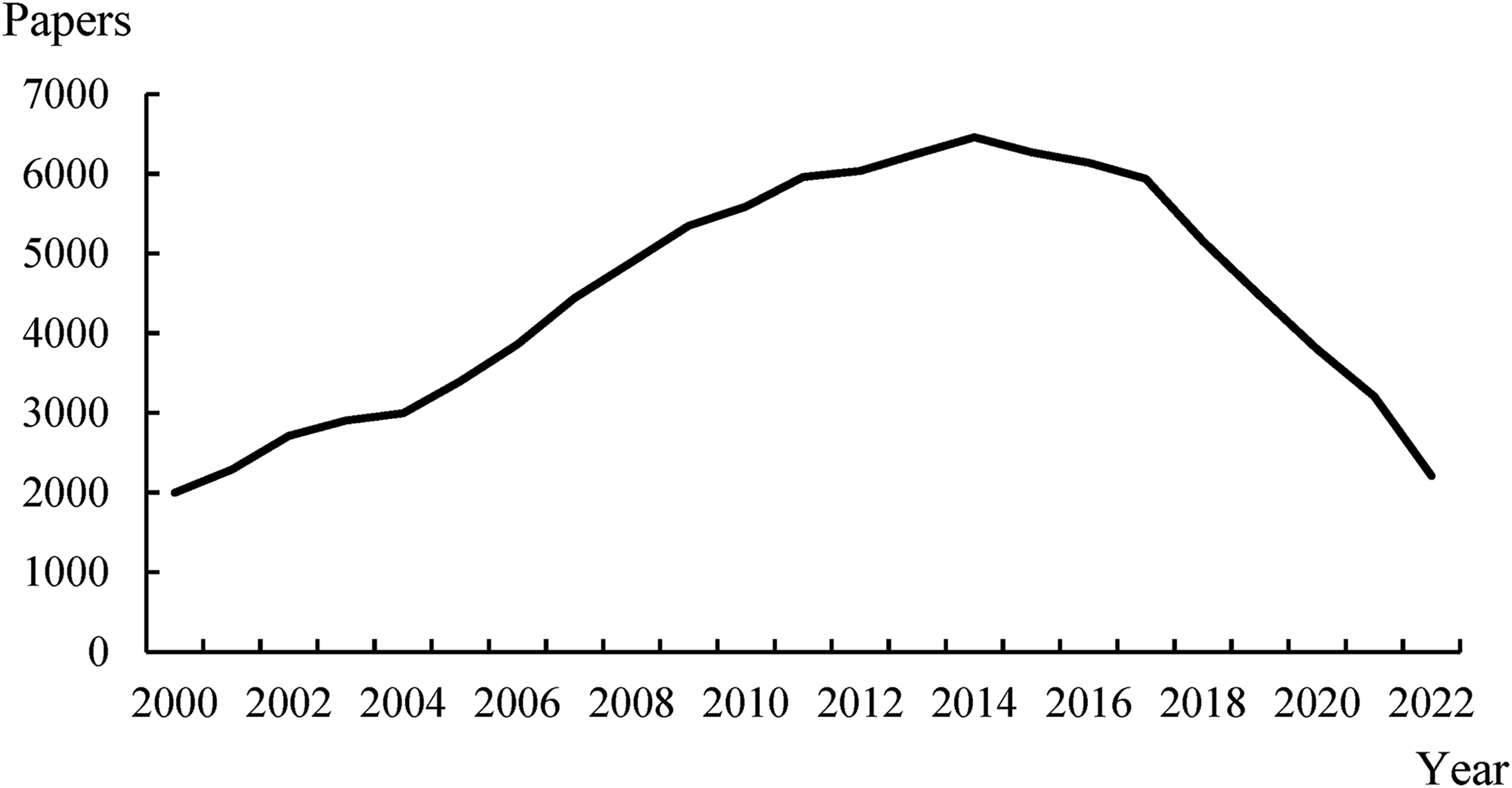
Trends in the publication of Chinese papers on religious topics since 2000.
Overall, disciplinary development in the sociology of religion in China has made great progress during the past two decades, with breakthroughs in the number of published papers, the establishment of research associations, and the launching of professional journals. Against this background, this paper attempts to review the sociology of religion research in the Chinese mainland over the past two decades and to provide an outlook for future research. Specifically, we have the following observations: first, C. K. Yang's Religion in Chinese Society: A Study of Contemporary Social Functions of Religion and Some of Their Historical Factors (1961) has always been the focus of Chinese sociologists of religion; second, the rational choice theory of religion has aroused widespread debate in China; third, “religious ecology theory” has gradually become an indigenous paradigm in religious studies; fourth, the “Sinicization of religion” has become an academic hot topic; and finally, the empirical measurement of Chinese religiosity has progressed significantly.
A homage to the classics: C. K. Yang and his theories
Religion in Chinese Society by C. K. Yang is the “Bible of Chinese religious studies”. 1 The Google Scholar database indicates that the book has been cited 1440 times as of May 2023. At the same time, the second-highest citation rate for books written in English was for Adam Yuet Chau's Miraculous Response: Doing Religion in Contemporary China (2008), with 651. This disparity in citation rates reflects the importance of Yang's work in Chinese religious studies.
The impressive citation rate of Religion in Chinese Society is certainly due to its high quality, but we must acknowledge that many of them are “polite citations”. Chau once commented that, with the rapid development of the sociology of religion in China, every discipline must “recognize its ancestors” (Fan et al., 2013) or, at least, create a figure (preferably a non-foreigner) and a piece of work to play a foundational role. Yang and his masterpiece seem to play the exact cornerstone role required by this domestic academic group concerning the study of Chinese religion (Fan et al., 2013). This comment, though somewhat harsh, makes sense. In many cases, scholars do not fully understand Religion in Chinese Society. This is evident from the confusing translation of the book's core concepts: “diffused religion” and “institutional religion”.
In his book, co-authored with Chong-chor Lau, The Chinese Society: From Unchanged to a Great Change, C. K. Yang translated “diffused religion” as “hunhe zongjiao” (混合宗教) and “institutional religion” as “duli zongjiao” (独立宗教) (Lau and Yang, 2001). Institutional religion emphasizes independence of theory, organization, and membership. Diffused religion, on the other hand, refers to the mixing of the religious system with the familial system or political system. Confusingly, Yang's own translation of these two key concepts is rarely mentioned by scholars; at the same time, many scholars are keen to propose various translations like “misan zongjiao” (弥散宗教), “puhua zongjiao” (普化宗教), “sankaixing zongjiao” (散开性宗教), “mimanxing zongjiao” (弥漫性宗教), and so on. These discussions of translation can certainly help us to explore the theoretical significance of Yang's work, but such discussions have not been able to substantially advance the theoretical development of the sociology of religion.
In the article “‘Diffused Religion’ and ‘Institutional Religion’: Why Religion in Chinese Society is a Classic”, Lu (2019) argues that the translation of “institutional religion” as “zhiduxing zongjiao” (制度性宗教) in Chinese academia is a misinterpretation. The correct translation should be “duli zongjiao” (独立宗教). Interestingly, this misunderstanding has led to many valuable discussions, and important achievements have been carried out under the framework of “institutional religion versus non-institutional religion”. One of them is the Research Report on Folk Beliefs in Fujian Province. For the first time, this report views the issue of folk beliefs from the perspective of a “large religious view”, defining it as a “non-institutionalized form of religion” (Chen, 2010: 170). Influenced by this report, folk beliefs were included in the management of the National Religious Affairs Administration and possessed legal status. It is perhaps a misunderstanding to consider diffused religion as “non-institutional”. However, using the concepts of “institutional” and “non-institutional” to understand religion in China has, ultimately, led to several far-reaching and extremely valuable academic discussions and policy practices that were not anticipated by Yang.
In future research, the typology proposed by Yang needs to be developed into a dynamic middle-range theory. In this regard, we can draw some insights from the development of “sect–church theory”. Initially, scholars of religion adopted two related concepts: “sect” and “church”. Niebuhr linked these two concepts, examining the dynamics of the transition between them (Niebuhr, 1929). Following him, more scholars focused on the subject and found that a sect could develop into a church over time. The generational change in membership, the improvement of the economic status of members, and the increase in the size of the sect all led to this transition. These discussions prompted the development of “sect–church typology” into “sect–church theory”. Inspired by this, future research in China should focus on how institutional religions evolve into diffused religions and how diffused religions breed institutional religions. In reality, there is no shortage of such cases. Take the “Three-in-One Teaching” (Sanyi jiao 三一教) religious sect in Fujian as an example. Once an independent sect with its own organization, scriptures, rituals, membership, and places of activity, it has gradually mixed with clan and community structures at the level of organization and has increasingly taken on the characteristics of diffused religion in recent years. If we can examine the factors that led to this transformation, it may be possible to develop the theory of “institutional–diffused religion”.
The dialogue with forefront issues: Religious market theory in China
Since the 1980s, Stark, Finke, Iannaccone, and Bainbridge have proposed the rational choice theory of religion (hereafter referred to as “RCTR”), starting from the assumption of the “rational man”. They treated religious belief as a rational choice, and constructed a systematic theoretical paradigm with a deductive logic model and rigorous empirical arguments, breaking the dominance of the secularization paradigm in the sociology of religion and promoting the advancement of the scientific study of religion (Iannaccone, 1984, 1998; Stark and Finke, 1988, 2000; Stark and Bainbridge, 1985). RCTR can be traced back to Adam Smith, who first applied the basic principles of economics to the explanation of religious phenomena. Smith argued that state-sponsored religious monopolies would lead to laziness among the clergy, which would weaken the religious vitality of society as a whole, while deregulated religious competition would enhance the efficiency of the church (Smith, 1776). Stark and other scholars absorbed and developed the view that “monopoly weakens faith, and competition brings vitality”, which is quite different from the secularization theory which suggests that “unity brings piety, and diversity leads to disappearance”. This view shook the secular paradigm that had long occupied the mainstream position, and the sociology of religion ushered in a “paradigm shift” (Warner, 1993).
Due to the lag in translation, domestic scholars in China remained immersed in the secularization theory represented by Peter Berger's The Sacred Canopy: Elements of a Sociological Theory of Religion (1911) in the early 1990s. It was not until the Chinese version of Stark and Finke's book Acts of Faith: Explaining the Human Side of Religion (2000) was published in Chinese that RCTR entered the Chinese literary world. The impactful arguments of RCTR overturned the academic imagination of the sociology of religion, as secularization theory—heretofore consecrated in China—was described as false by Stark and other scholars. The evidence of religious revival shattered the prophecies of secularization theory and new concepts such as rational choice, supply-side perspectives, religious economy, and religious markets triggered a great deal of discussion, criticism, and reflection (Li, 2015).
Since the start of the new century, discussion about RCTR has been extensive in China. There are 75 articles with the keywords “religious market theory”, “rational choice theory of religion”, or “religious economy” in the CNKI database. Figure 2 shows the distribution of these articles by period. It is evident that, before 2005, such theories had not received much attention in China, with only three relevant articles having been published in Chinese. Between 2005 and 2009, the number of articles increased. From 2010 to 2014 there was a period of heated discussion on religious market theory in the Chinese literature. During this period, 34 related papers were published, nine of which were published in 2010 alone. From the perspective of citations, seven of the top 10 most-cited papers were published during the period 2010 to 2014. In the following five years, the number of publications declined somewhat, but the heated debate continued and RCTR remains a hot topic in Chinese academia.
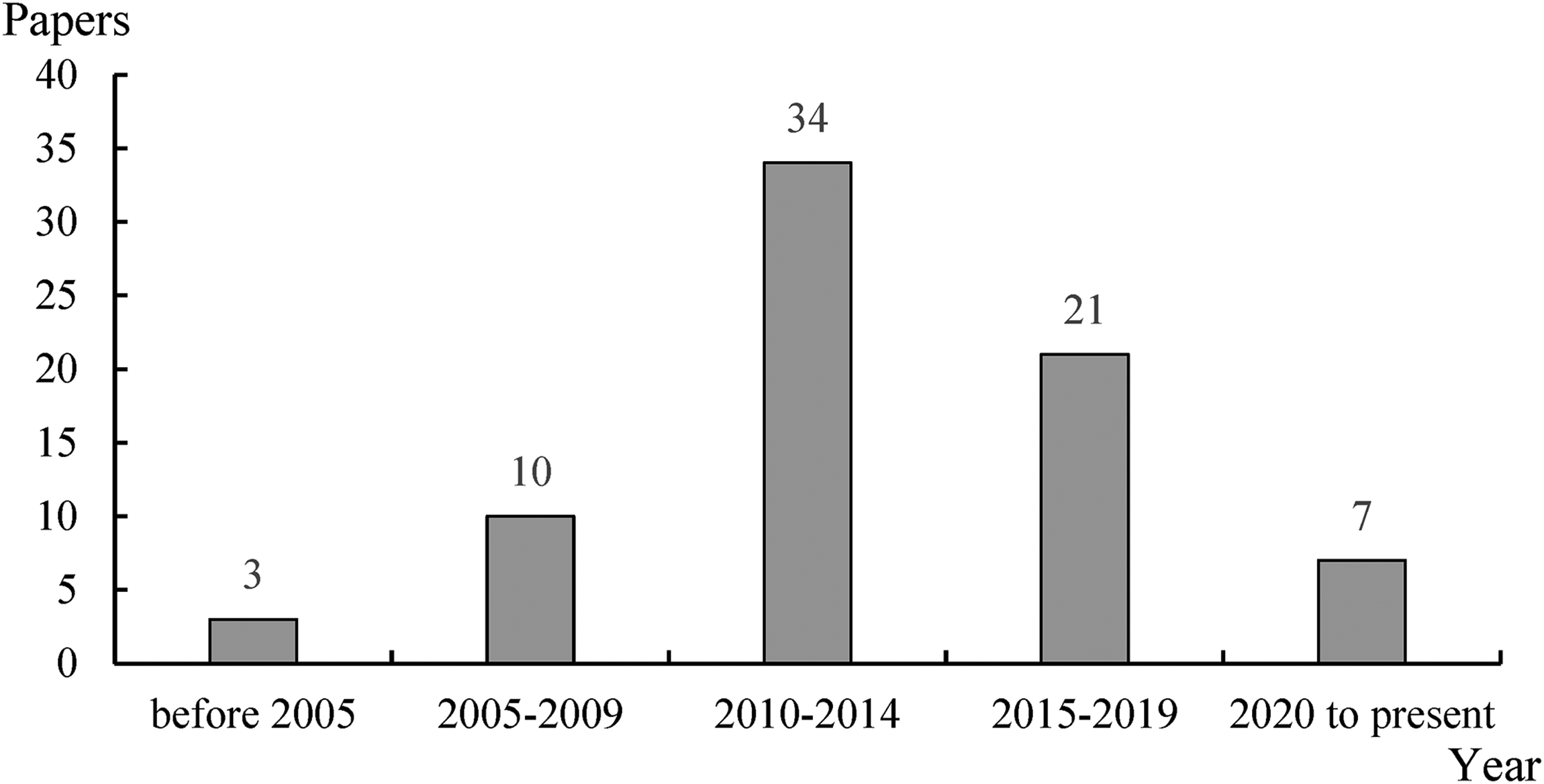
The number of papers related to religious market theory by period.
As was the case in the United States, RCTR has aroused many criticisms and controversies in China. One of the most prominent criticisms is the metaphor argument. Proponents of the metaphor argument come from a variety of disciplines, including religion, anthropology, and sociology (Goossaert and Palmer, 2011; Klein and Meyer, 2011; Qu et al., 2014). Their core viewpoint can be summarized as follows: RCTR is just an economic metaphor, not a new theory. It just restates known religious knowledge in economic terms; it neither uses economic methods to understand religion nor generates any new insights through its rhetoric of economics.
On the one hand, the metaphor theory argues that RCTR does not really adopt an economic approach, and only uses economic terms as a rhetorical strategy (Iannaccone, 1995; Robertson, 1992; Xu, 2017). Only a very small portion of religious phenomena has economic properties such as “price”, “transaction”, and “market”, beyond which the use of these concepts can only be a generalized metaphor (Palmer, 2011). The reason why RCTR chooses to wrap itself in economic terms is to take advantage of the discursive hegemony of economics and to make itself appear more “scientific” than other religious paradigms (Ji, 2008). On the other hand, the metaphor theory argues that the economic metaphor of choice theory does not provide a substantive explanation of religious phenomena. Religion is not economics, and RCTR cannot substitute for the existing theoretical explanations. It is “a metaphorical restatement of known facts without substantive explanation” (Ji, 2008:60), a “rhetorical tautology” (Bruce, 1993:200), and a “metaphorical mis-specification” (Bryant, 2000:521); it is thus doomed to fail to improve our understanding of religion itself (Cooper, 2013).
However, the critique of the metaphor theory is a misunderstanding of RCTR. RCTR truly takes an economic approach rather than just wrapping itself in economic terms. The core feature of modern economics lies in the use of normative language for theoretical modeling rather than in the use of various terms to build conceptual frameworks. The metaphor theory doesn’t understand the normative language of RCTR in terms of model thinking but focuses on some concepts and conclusions through habitual natural language. RCTR does not just use economic metaphors to describe religion but actually uses the method of theoretical modeling to derive formal models with simple assumptions and rigorous logic, to integrate existing theoretical insights and infer new ones, advancing the progress of research in this field. The greatest contribution of rational choice theory is that it is a theoretical attempt based on deductive logic (Hechter and Kanazawa, 1997). Therefore, the metaphor theory is not a correct path by which to go beyond RCTR, but rather is a criticism that is based on a misunderstanding (Wu and Lu, 2022).
Another criticism is that RCTR needs to be applied to China in a way that excludes its strong Christian centrism (Lu, 2008). Undoubtedly, the initial empirical target of the theory was the Christian religion in Western societies, which is strongly exclusive. However, in many East Asian countries, especially China, religion is mostly non-exclusive. This makes some propositions of the theory difficult to apply in China. For example, Stark argues that the older, larger, and more cosmopolitan a society becomes, the number of gods worshipped by the people in it will be smaller, and the power of the gods will be greater. China, however, seems to be an exception. Chinese civilization is both very old and very large, but there isn’t a dominant and exclusive religion. We must use China's empirical conditions to question religious market theory. But more importantly, we need to retain the significance of the questions it asks and learn from its research methods. The real value of RCTR lies in the emphasis on the real and systematic nature of religion, as well as transformations in methodological perspectives, research dynamics, and theoretical modeling, which are enlightening for the sociological study of religion in China.
The rise of religious ecology theory
Following religious market theory, during the past decade, religious ecology theory has become a new hot topic in Chinese religious studies. The rise of religious ecology theory in China owes to the development of Christianity, especially Protestantism. Christianity was introduced to China in the early 19th century and developed rapidly after the First Opium War. The number of Christians in China was only 700,000 in 1949. At the beginning of reform and opening up, the number was only 3 million. Evidently, the development of Christianity in China was relatively slow during this period. However, the number of Christians reached 10 million in 1997 and 38 million in 2018. From 3 million to 38 million, Christianity has now become the second-largest religion after Buddhism with an average annual growth rate of 6.5%. Its missionary motivation, adherents’ commitment, and development speed have surpassed that of Buddhism. Therefore, understanding the rapid rise of Christianity since reform and opening up has become one of the most important academic issues in the sociology of religion in China.
Scholars of religious ecology theory argue that the failure of China's religious policy led to an imbalance in religious ecology, thus removing obstacles to Christianity's development. At the same time, the rise of Christianity exacerbated the imbalance and allowed the development of Christianity to accelerate. In 1982, the Central Committee of the Communist Party of China (CPC) issued “Document No. 19”, which recognized the legal status of five religions in China, namely Buddhism, Taoism, Catholicism, Islam, and Protestantism. However, folk religion was still regarded as “feudal superstitions”, and thus as a target of repression. Buddhism and Taoism, which are closely related to folk beliefs, were also criticized. Without the label of “superstition” and with the support of overseas forces, Christianity quickly occupied Chinese society in the faith vacuum following reform and opening up. The expansion of Christianity, in turn, has further damaged the ecological balance of Chinese religions. Therefore, the only way to restore the balance of the religious ecology and curb the rapid expansion of Christianity is to change the current religious policy (Chen, 2008, 2010; Duan, 2009; Mou, 2009).
Religious ecologists further point out that the way to avoid the dominance of Christianity and restore the balance of China's religious ecology is by removing the label of “feudal superstition” that has been applied to folk beliefs, promoting the rationalization of religious policies, and seeking the same space of legitimacy for folk beliefs. Religious ecology is not only a causal explanation for the rise of Christianity but is also a discursive system by which to justify folk beliefs. Meanwhile, religious ecologists have always emphasized the importance of government involvement in the development of religion in China. They believe that reasonable macro-scale intervention should be consistent with the historical and practical characteristics of Chinese religions. Fully believing in free competition is too idealistic and may lead to disorderly expansion and religious monopoly, and could even endanger China's cultural security. In other words, religious ecological balance cannot be achieved through religion itself but must be regulated by the powerful “external force” of the government. This pursuit of “balance” comes from both the structural-functionalist origins and ecologists’ affirmation of traditional Chinese religious ecology. According to Mou, traditional Chinese religious ecology is characterized by “pluralism, harmony, and coexistence”. Unlike highly exclusive monotheistic religions, such as Christianity, traditional Chinese religions are inclusive in Confucianism, emphasizing “harmony in diversity” and opposing “religious conflicts”, thus providing a model for how global religions can “coexist and prosper” (Mou, 2012). Starting with the explanation of the “rise of Christianity”, religious ecology theory shows concern for the expansion of Christianity and sympathy for traditional religions and folk beliefs of China.
Currently, religious ecology theory has gained initial recognition within the international scholarly community, overseas Sinologists such as Vincent Goossaert and David A. Palmer (2011) and Philip Clart (2013) have all cited it as an emerging theory in Chinese religious studies. However, it must be acknowledged that religious ecology theory has also met with some criticisms. Proponents of religious ecology argue that traditional faiths represent the “spiritual world” of the Chinese people and that the rapid expansion of Christianity will cause Chinese people to face an “identity” crisis. But this dichotomy between Christianity and traditional beliefs is challenged by empirical facts. Tang suggests that many surveys (e.g., one conducted in Wenzhou) indicate that the development of Christianity has been predicated on a foundation of traditional beliefs. Christianity and traditional faith are not essentially different; in places where traditional faith is weak, Christianity cannot thrive. Moreover, Christianity has developed precisely based on its absorption of traditional faith and it has been indigenized while growing rapidly, becoming part of the Chinese religious ecology instead of destroying and replacing the original ecology (Tang, 2014a).
In conclusion, religious ecology theory explains the rise of Christianity from the perspectives of Chinese history, nationality, culture, and politics. Although some deficiencies exist, it remains a mainstream explanatory model in academic circles in China.
The Sinicization of religion
In 2012, the academic community formally proposed the “Sinicization of Christianity”. Peking University and the Chinese Academy of Social Sciences jointly initiated the “Sinicization of Christianity Research Project” and held the first academic symposium on the Sinicization of Christianity, inviting political, religious, and academic circles to discuss the coexistence between Christianity and Chinese culture, the Chinese nation, and Chinese society. This was the prelude to the broader discussion of the “Sinicization of Christianity” in the new century. In 2014, “A Seminar to Commemorate the 60th Anniversary of the Founding of the Committee of the Three-Self Patriotic Movement of the Protestant Churches and the Sinicization of Christianity” was held. At this meeting, Wang Zuo’an, the director of the People's Republic of China National Religious Affairs Administration, explicitly identified the “Sinicization of Christianity” as a “major issue” for future work related to Christianity in China (Wang, 2014). At the same time, Fu Xianwei, chairman of the Committee of the Three-Self Patriotic Movement of the Protestant Churches, also made the Sinicization of Christianity a “necessary path” for the development of Christianity itself (Fu, 2014). The academic, political, and religious communities basically reached a consensus in 2014.
In May 2015, President Xi Jinping put forward eight “musts” at the Central United Front Work Conference, including “actively guiding religions in adapting to socialist society” and “adhering to the orientation of Sinicization”. This speech marked the transformation of the academic discourse of the “Sinicization of Christianity” into the political discourse surrounding the “Sinicization of religion”. In the ensuing years, the “Sinicization of religion” appeared as an important expression in the National Work Conference on Religion, the Regulations on Religious Affairs, and the report of the 20th National Congress of the CPC. During the process of the origin and development of the Sinicization of Christianity, the academy has played the role of a “bridge” to promote this discourse to the political and religious communities. The three circles organized national conferences and gradually reached a consensus in the course of continuous discussions. President Xi's speech eventually marked the formal adoption of the term “Sinicization” by the CPC and the government, and its applicability extends from Christianity to all religions. After its inclusion in several important documents, the religious community began to formally implement this discourse on a practical level.
The academic publications in the field of the “Sinicization of Religion” are in line with the abovementioned lineage. As shown in Figure 3, unlike the “inverted U-shaped” trend in Chinese religious studies, the number of papers on the topic of “Sinicization of religion” has demonstrated an overall upward trend during the past decade. In the first decade of this century, discussion of the Sinicization of religion was relatively rare. With the introduction of related academic concepts in 2012, there was a slight peak in 2013, when the number of publications in this field exceeded 100 for the first time. Since the academic discourse was converted to a political discourse in 2015, however, there has been a surge in academic publications in the field, doubling to 225 in 2016. The number of publications has continued to increase, reaching a level of more than 300 per year by 2020. The Sinicization of Religion has become a hot topic in Chinese religious studies. The top-ranking sub-topics relate to the Sinicization of Christianity, the Sinicization of Buddhism, and the Sinicization of Islam. In addition, “religious work” and the “Marxist view of religion” are also high-frequency topics.
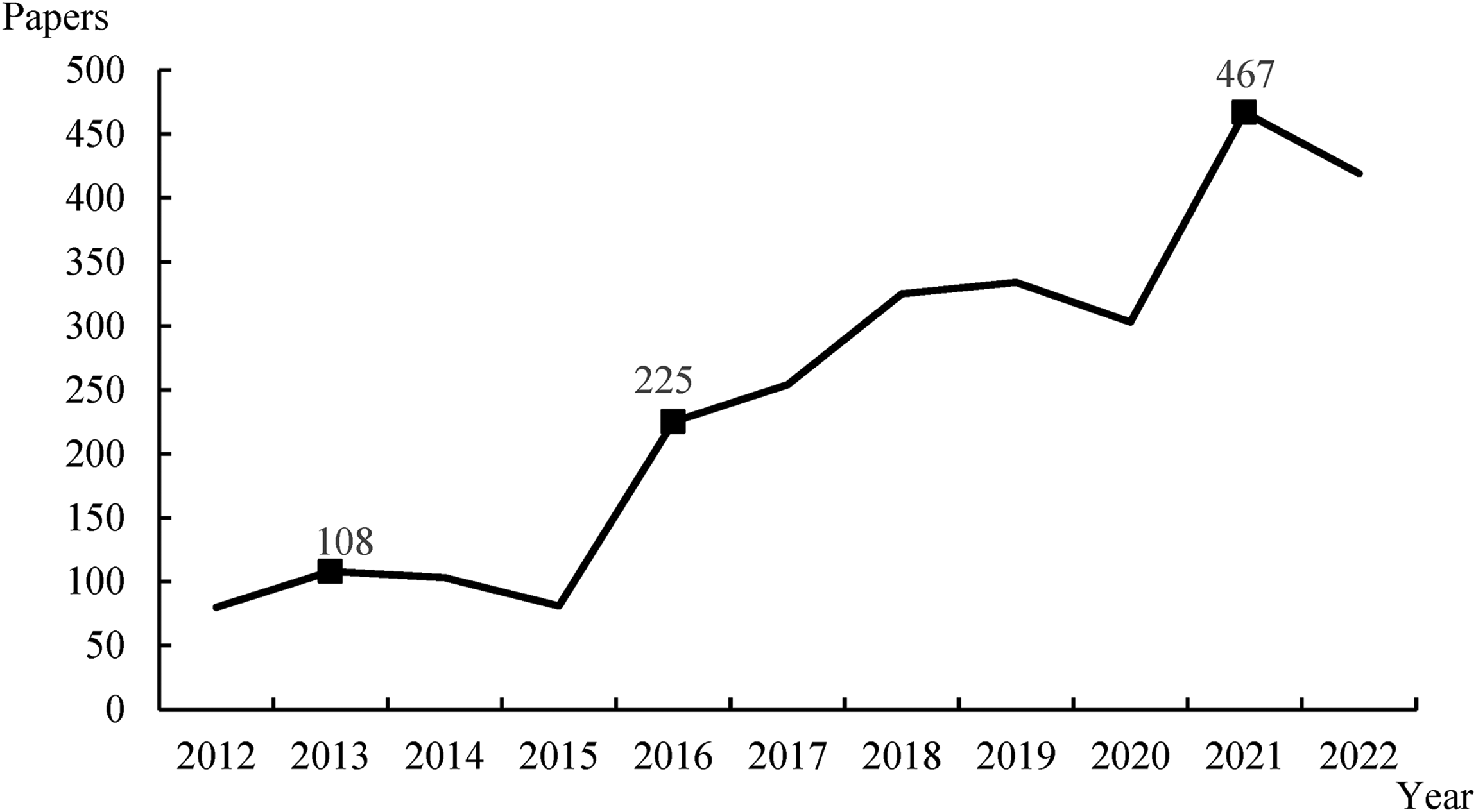
Trends in the publication of Chinese papers related to “Sinicization of religion”.
In general, the Sinicization of Christianity is a continuation of the political policy that “religion should adapt to a socialist society” (Li, 2015). This discourse and policy continue the goal begun in the early 20th century of transforming “Christianity in China” into “Chinese Christianity” and “the Christian occupation of China” into “China's occupation of Christians” (Tang, 2014b). According to Zhang Zhigang (2016), the Sinicization of Christianity has three principles: the integration of “Chinese culture, Chinese nation, and Chinese society”, which correspond to “cultural identity, national identity, and social identity” respectively. Zhuo believes there are “three major elements”, namely “identification with Chinese politics”, “adaptation to Chinese society”, and “expression of Chinese culture” (Zhuo, 2016). However, the key to the realization of the abovementioned integration and identification lies in Sinicization at the theological level, which is a consensus among the academic, political, and religious communities (Chen, 2017; Fu, 2014; Li, 2013; Liu, 2014; Tang, 2014b; Zhuo, 2016). Besides Christianity, other religions have their own characteristics in their path of Sinicization. For example, Islam has an ethnic dimension in China; therefore, the main content of the Sinicization of Islam is linked to the “promotion of ethnic harmony”. Buddhism has been integrated into Chinese culture historically and evolved into new forms with Chinese characteristics, such as the “Chan sect” and “Chinese Buddhism”. The contemporary “Sinicization of Buddhism” has two main aspects: one is to decommercialize and regulate the disorderly development of Buddhism; the other is the transformation of Buddhist scriptures and teachings into the ideology and culture to resolve the spiritual crisis of modern people (Ji, 2013; Wang, 1995).
Even though the Sinicization of religion incorporates the efforts of all parties, certain differences still remain among political, religious, and academic circles. One is the necessity of Sinicization. Some scholars argue that the Sinicization of Christianity has been largely completed and needs no further mention (Wang, 2013). In response to this challenge, Tang (2014b) points out that “localization”, “indigenization”, and “contextualization” are all proposed by the Church as a means by which to improve evangelizing in China, but “Sinicization” is more concerned with the harmonious coexistence of Christianity and Chinese society. Another difference is the relationship between religion and Chinese culture. The mainstream view is that Christianity should identify with and integrate into Chinese culture, reduce its exclusivity, and form a new model of Christianity within the Chinese cultural system (Guo and Lin, 2015; Liu, 2016; Tang, 2014b; Zhang, 2013). In this regard, some scholars also placed more emphasis on the heterogeneity of Christianity and Sinicization. Sinicization requires “boundaries” to bring different solutions to Chinese social problems (Li and Zhang, 2017). Christianity can be a resource for Chinese culture, and Chinese culture should choose Christianity to be part of the Chinese cultural community (Liang, 2017). This also means that the emphasis on the “Sinicization of Christianity” does not dilute the color of faith, but rather treats Christianity in a more tolerant manner, emphasizing the “two-way” nature of acceptance and adaptation (Cao, 2016; Fu, 2014).
Quantitative research in the sociology of religion
In addition to the advancement of theoretical and empirical research, the study of religion in modern sciences cannot neglect quantitative data sources. In many countries, religious beliefs reflect the sociocultural characteristics of the population and are a standard component of population censuses and social surveys. In the Chinese mainland, however, questions about religious beliefs have not been included in national population censuses, and available data on religion come primarily from the statistics of the National Religious Affairs Administration, while academic research still relies on social surveys to obtain quantitative data. Religion-related social surveys are the Spiritual Life Study of Chinese Residents (SLSC), the Chinese General Social Survey (CGSS), the China Family Panel Studies (CFPS), and so on.
Based on these research data, quantitative research on religious beliefs in China is centered on the following aspects. First, descriptive analysis of religious beliefs, such as how many Christians there are in China (Lu et al., 2019); college students’ Christian beliefs (Zuo, 2004); religious beliefs among the elderly (Du and Wang, 2014); and the intergenerational transmission of religious beliefs (Liu, 2017). Second, religious beliefs and politics, such as the influence of religious beliefs on political participation (Yi, 2017). Third, religious beliefs and economics, such as the influence of religious beliefs on the choice of financial assets (Ye et al., 2016). Fourth, religious beliefs and marriage and family, such as are couples of different religious beliefs less satisfied with each other? (Sheng and Zhang, 2023); do religious beliefs affect fertility intentions? (Li, 2017); and the relationship between folk beliefs and family formation (Hu and Tian, 2018). Fifth, religious beliefs and perceptions, such as the role of religious beliefs on trust (Han, 2014; Wang and Situ, 2010), and religion and subjective well-being (Chen and Williams, 2016). In general, however, the number of quantitative studies in the sociology of religion is still low and a systemic approach has not yet been formed.
Although quantitative research in the sociology of religion has yielded some interesting findings, the validity of its conclusions depends largely on the measurement of religiosity. Social surveys usually measure religiosity in four dimensions: affiliation, membership, practices, and attitudes. Respondents are typically asked about their denominational affiliation with a single-choice question; the options usually include Buddhism, Taoism, Islam, Protestantism, Catholicism, “no religion”, and “other”. Survey results using these kinds of questions indicate that the proportion of religious believers in China is less than 15%. Religious membership refers to whether an individual belongs to a religious organization. Religious practice focuses on how often respondents attend religious events or rituals. In addition to the above practices or behaviors, subjective attitudes are also an important dimension of religious measurement, which ask respondents to evaluate the salience of religion in life.
However, many social surveys lack validity when measuring religion in China. First, a challenge arises from the term “religion”. Most Chinese people have only a very vague understanding of the term “religion”. Many respondents who claim to have “no religious beliefs” are actually involved in various types of religious activities. Second, a denomination-based measurement scheme does not capture the reality of religious life in Chinese society. Chinese people are unfamiliar with boundaries between religious denominations. The denomination-based scheme not only ignores folk religions but also leads to misclassification. Third, the single-choice question regarding religious affiliation is not applicable to China. The single choice implies that China's religions are as completely exclusive as their Western counterparts. However, in traditional China, religious beliefs could easily be changed and were largely related to the life cycle. If we force respondents to choose any one denomination, it will distort the actual religious life of China and omit polytheists, who make up the majority of Chinese believers. Finally, religion is socially and politically sensitive in China and this sensitivity discourages respondents from disclosing their religious affiliations, which might be in conflict with societal expectations (Zhang and Lu, 2020).
In response, Zhang and Lu (2018) proposed several strategies to improve survey instruments using CFPS and tried to develop deity-based and non-exclusive schemes. First, CFPS introduced a deity-based scheme in the 2014 survey, altering the question “What is your religion” to “What do you believe in?”. The response categories were changed to “Buddha/Bodhisattva”, “Daoist deities”, “Allah”, “Catholic God”, “Protestant God” (changed to Jesus Christ in 2018), and “none of the above”. Second, CFPS added “ancestor worship” in 2014 and “ghosts” and “feng shui” in 2018. In 2020, “fate” was also added. Third, considering that Chinese religions are highly syncretic and non-exclusive, CFPS allowed respondents to choose two or more beliefs. In 2018 and 2020, CFPS changed the questions on religious affiliation from the check-all-that-apply format to the forced-choice format (Zhang and Lu, 2018).
One important finding of the improved questionnaire was that it could capture more religious believers, especially by reflecting the prevalence of folk religions, as was theorized in the classic studies of the sociology of religion in China discussed above. Although the improved scheme indicates that institutional religion adherents are still not a majority in the population, the deity-based scheme still yields a higher proportion than the denomination-based scheme. Compared with the denomination-based measurement, the deity-based scheme is easier for respondents to understand and avoids the confusion and sensitivity related to the word “religion”. These advantages allow the deity-based approach to provide a new reference for estimating the total number of religious adherents in China. Another important finding drawn from the new scheme is the mixture of religious beliefs in China. In 2018, CFPS demonstrated that belief in multiple religions is common among Chinese people, not only in combinations of folk religions and traditional Chinese Buddhism and Taoism, but also of congregational independent religions and Buddhism and Taoism, and between folk religions (Zhang et al., 2021). These two important findings corroborate the classical theoretical views on Chinese religion with quantitative data, reflecting the different understandings of religion in Chinese and Western cultures.
Discussion and conclusion
Chinese religious studies in the new century are gradually going beyond the “sociology of Christianity”, accumulating local experience, and advancing both in theory and methodology. Following C. K. Yang's exploration of Chinese religion, research has recognized important features that distinguish Chinese religion from the West. The exploration of and debate about religious market theory has been an attempt to introduce Western theory into China and to move beyond Western centrism. In the context of the rise of Christianity, religious ecology theory and the Sinicization of religion have gradually developed. Finally, a deity-based religious measurement scheme which is based on China's social context has also opened new horizons for quantitative research.
Footnotes
Contributorship
He Sheng collected and analyzed the data, and the two authors designed and drafted the manuscript together. Both of them read and approved the final manuscript.
Declaration of conflicting interests
The authors declared no potential conflicts of interest with respect to the research, authorship, and/or publication of this article.
Funding
The authors received no financial support for the research, authorship, and/or publication of this article.
