



Abstract
Gender inequality in the division of childcare between parents has long been a focal topic in the field of family and marriage research. Drawing on Chinese Childbearing and Parenting Intentions and Behaviors Survey (CCPIBS) and employing latent class analysis modeling strategies, this article examines attitudes toward gender roles in child-rearing among Chinese people and how they are shaped by socioeconomic determinants. The empirical findings show that the distribution of attitudes toward the gender division in childcare conforms to three ideal types: the traditional “mother-oriented” parenting style, the “father-oriented” parenting style, and the “parental collaboration” parenting style. Among these, the “mother-oriented” type continues to be predominant, but the “father-oriented” and “parental collaboration” types are gaining acceptance. The results also show that attitudes toward gender division in child-rearing are influenced by multiple socioeconomic determinants in contemporary China: educationally and occupationally advantaged groups, urban hukou holders, and younger cohorts are more likely to hold more egalitarian and liberal views regarding child-rearing, suggesting that trends in gender ideology in child-rearing could be explained using structural theories of attitudinal change.
Introduction
Gender-based inequality in the division of household labor is an important topic in research on social stratification and gender inequality. With the rise of women's liberation movements around the world, women's education levels and labor participation rates have improved compared to the past (Cotter et al., 2008), and more women have entered many previously male-dominated majors and occupations (England and Li, 2006). However, the development of the gender revolution has been uneven (England, 2010), and gender inequality within the family is well established and persistent. Gender inequality in the family is mainly reflected in gender differences in the division of housework, at the core of which is the responsibility of childcare (Craig, 2006). A growing body of research addresses how men and women share domestic responsibilities and the consequences for, and of, the movement of women into the paid workforce. With the increasing female employment rate, not only in developed countries but also in some developing countries, dual-earner families have become the mainstream in society (Bianchi and Milkie, 2010). However, even in dual-earner households women are still the primary caregivers and working women continue to be overburdened by the “second shift” (i.e., housework in addition to paid work) (Coltrane, 2000; Hochschild and Machung, 1989). The unequal gender division of childcare responsibilities has significant negative consequences. On the one hand, gender inequality in the division of childcare increases the penalties of motherhood (Budig and England, 2001), generates long-term stressful states for women, and affects their mental health (Coltrane, 2000). On the other hand, fathers’ involvement in childcare is important for child development (Astone and McLanahan, 1991). Children of involved fathers are more likely to develop the cognitive skills reflected in standardized intellectual assessments (Rabin, 1994), have higher psychological well-being (Amato, 1994), and attain higher levels of educational achievement and occupational competency (Boyum and Parke, 1995; Brody et al., 1994). Therefore, research on the gender division of childcare can enrich our understanding of gender inequality in aspects of work and family, as well as parenting and child development.
Previous empirical studies have focused on the time allocation of fathers and mothers on childcare (Bianchi et al., 2000; Budig and Folbre, 2004; Craig, 2006). Other studies have attempted to explore conceptual aspects of fathers’ and mothers’ willingness to spend time caring for their children (Gerson, 2002; Milkie et al., 2004). However, these two strands of studies have not yet explored attitudes toward gender division in child-rearing, nor have they examined socioeconomic differentials of different types of child-rearing values. In other words, even if both mothers and fathers are willing to invest time in childcare, what expectations do they have about the gender division of that childcare? Who should be the primary caregiver, the father or the mother? Or should the father and the mother work together and share the responsibility equally? Do different social classes have different ideas about the gender division of childcare?
It is especially significant to study gender roles in child-rearing values and their socioeconomic differentials in contemporary Chinese society. First, China's fertility rate has remained at a low level in recent years; the country even experienced negative population growth for the first time in 2022. Previous research has shown that parental discordance about gender roles in parenting, particularly the traditional belief that women should bear most of the responsibility for child-rearing, tends to reduce women's desire to have children (Testa, 2007). Therefore, we need to correctly understand how attitudes toward the gender division of childcare are distributed among Chinese people. Second, gender inequality in China shows an obvious unbalanced trend between the public and private spheres (i.e., between work and family life) (Ji et al., 2017). In the public sphere, women are now better educated and more women are entering professional and technical occupations; however, in the private sphere, there is still serious gender inequality, which is reflected in the unequal burdens allocated to women in the division of housework and childcare. However, China has undergone rapid development since the market transition in the 1980s, leading to vast improvements in income and education levels. Groups with higher levels of education and income tend to have a more egalitarian gender ideology. Thus it is reasonable to expect that there has been a significant shift in attitudes toward the gender division of childcare in recent decades.
Involved fatherhood and the gender division of childcare
Historically, both in China and worldwide, the distribution of childcare responsibilities has been associated with a patriarchal norm that defined women's role as caregiving and men's as providing for the family financially. Given the dramatic increase in women's paid labor force participation since the 1960s, early research in the West focused on the gender differentials in unpaid household work and the trends therein since the 1980s (Bianchi, 2000; Coltrane, 2000; Ferree, 1991; Greenstein, 1996, 2000). Research, again primarily based on developed Western societies, has suggested two main explanations for women's primary responsibility for housework and childcare. Becker argued that couples negotiate the division of time and energy between paid labor work and unpaid household work to maximize the utility of the family as a whole. Men's comparative advantage in earnings tends to keep women focused on domestic work and men focused on labor market work (Becker, 1991). Conversely, gender ideology theory points out that housework is not neutral, but defined and expressed according to specific gender expectations. Put differently, how individuals define their gender roles in their marriage and family is related to the proportion of housework that they perform (Greenstein, 1996). Previous research found some consistent results based on the above theories. Using time-diary data from representative samples from the US, scholars found that gender-based inequality in the division of household labor has continued to decline since 1965; however, this is mainly due to a dramatic decline in time spent on housework among women and the amount of time men spend on housework not changing (Bianchi et al., 2000). There is also evidence confirming that variables such as personal income and working hours only affect the amount of time women spend on housework but have no impact for men (Brines, 1994; Greenstein, 2000). Despite the reduction, on average women in the West still do about two-thirds of housework, and the amount of time spent on childcare has remained unchanged (Craig, 2006; England and Folbre, 2003).
While earlier studies tended to examine this topic in specific countries, such as the United States or Canada, subsequent studies have expanded the research to include more countries. Using 44 time-use surveys from 20 countries between 1965 and 2003, Hook (2006) found that men's time spent on domestic work and childcare was correlated to the level of female employment at the national level, but that this effect was influenced by other contextual factors, such as the length of available parental leave and men's eligibility to take parental leave.
In the past two decades, fathers’ involvement in child-rearing has been increasingly advocated for. This is due not only to the increase in female labor force participation, but also to the emphasis on the quality of child-rearing and the emergence of “intensive parenting” ideologies (Lareau, 2011; Shirani et al., 2012). With economic conditions improving and the spread of the second demographic transition worldwide, parents are shifting their emphasis from considerations about the number of children to have, to ensuring they can give their children the best possible start in life. The emergence of intensive parenting has coincided with increased social competition and the prevalence of individualism, which attributes children's success in future life to parents’ careful planning and risk management. Intensive parenting emphasizes child-centeredness and that parents’ time, finances, energy, and emotions should be arranged around the needs of the child. Lareau (2011) describes this trend as “concerted cultivation”, and these changes inevitably lead to changes in the relationship between husband and wife, including the adoption of a more equitable pattern of child-rearing and the greater involvement of fathers in the daily lives of their children, including extracurricular activities, sports, and so on. Research has found that paternal involvement in child-rearing has significant positive effects on multiple dimensions of child development (Amato, 1994; Boyum and Parke, 1995; Brody et al., 1994). Additionally, fathers’ involvement can also help alleviate working mothers’ concerns regarding the lack of care for children (Doucet, 2006). Although there has been more involvement of fathers in child-rearing in recent years, research has found that mothers still have to take on more caring responsibilities. To summarize, fathers are involved in a very different way, compared with mothers. Fathers participate more in leisure time, while mothers are involved more in multitasking and physical labor, they also have to handle more rigorous schedules and have more time alone with children (Craig, 2006).
China has long been influenced by Confucian culture. This has two important implications for childcare. On the one hand, Confucian culture emphasizes the importance of education, and that children's academic achievement is directly related to the successful upward mobility of individuals in the future. Therefore, intensive parenting has gradually become popular in China in recent years. As the female labor participation rate in China has been consistently higher than those of other Western countries for a long time, paternal collaborative involvement has become a necessary condition for intensive parenting. On the other hand, Confucian culture is also associated with patriarchy, so in the Chinese social context, men tend to have higher family discourse power and decision-making power (Ji et al., 2017). Previous studies have confirmed that fathers in Hong Kong have more decision-making power over important parenting matters (Liong, 2017). While there are still noticeable gender differences and unequal childcare arrangements in place, it is likely that China is undergoing a shift in the conceptual understanding of the gender division in childcare. Thus, I propose the following hypothesis:
In contemporary China, in addition to the “mother-oriented” parenting type, there may also be “parental collaboration” and “father-oriented” types. However, influenced by Confucian culture, the dominant type is likely to still be mother-oriented parenting.
Change of attitudes in the gender division of child-rearing
The current study further investigates which groups will be at the forefront of experiencing shifts in attitudes regarding gender roles in child-rearing. There are two broad categories of theoretical explanations for trends in the relationship between social attitudes and social structure: cultural norm theories and structural theories (Kiecolt, 1988). The normative approach places greater emphasis on the power of social culture and the attitudes held by the majority of society. This theory suggests that the impact of social change on different groups is similar, and attitudes and values are collective and transmitted to all members of society during the socialization process. Therefore, changes in values and attitudes occur simultaneously across different social groups without social structural difference. For example, Davis (1975) found that increasing racial tolerance in the US between 1954 and 1972–1973 mostly resulted from changes in attitudes across all cohorts and social groups. However, structural theories stress the contribution of specific social groups in society (demographic, ethnic, educational, cohort groups, etc.) and predict that attitudinal and value change occur first in some particular social groups. The structural explanation points out that the social structure shapes individuals’ living situations and life opportunities by constraining or promoting changes in individual values. The structural explanation puts forward two mechanisms by which social structure affects changing trends in social attitudes. The first is structural replacement theory, proposed by Stouffer (1955). According to this theory, changes in social attitudes are mainly caused by changes in the composition of the population structure. Stouffer hypothesized that increased tolerance of social nonconformity and greater prevalence of liberal values resulted from younger people being better educated and liberal groups replacing older cohorts. The second mechanism is the “trickle-down” thesis proposed by Schreiber (1978). Schreiber found that the shift toward more liberal gender-role attitudes occurs unevenly across social strata over time; he attributed this change to different social groups’ perceptions of social change. Specifically, more educated groups have greater access to mass media and are therefore more sensitive to trends and changes in society. To summarize, the “trickle-down” thesis points out that value change is a process of cultural penetration, which is related to differences in social groups’ perceptions of social change. Some specific social groups will perceive the impact of social change earlier and more deeply, and take the lead in changing their value tendencies.
However, structural explanations (cohort replacement and trickle-down hypotheses) account for less variation in tolerance and related attitudes than normative explanations (Smith, 1985; Taylor et al., 1978). In the context of changing values in Chinese society, structural explanations may be more explanatory. This is because Chinese society has undergone rapid social transformation and change in only a few decades, from a planned economic system to a market-oriented system. The processes of urbanization and modernization in China have also been very rapid. China has basically completed the transformation from an agricultural society to an industrialized society in a few decades, which took hundreds of years in Western societies. As a result, the differentiation process of the various social classes has also been very rapid in China, resulting in some social groups potentially having more liberal attitudes toward the gender division in childcare. According to the cohort replacement hypothesis, younger cohorts are likely to have more liberal attitudes, so they are more likely to endorse the “parental collaboration” and “father-centered” parenting types. Furthermore, according to the trickle-down hypothesis, more educated groups may also perceive the changes in social parenting behaviors and attitudes earlier, and thus may be able to change their parenting attitudes in terms of the gender division of labor earlier. Similarly, Lareau (2011) argued that middle-class and upper-class parents are more aware that the investment of energy and time in intensive parenting can result in the children's future success. Thus, they are also more likely to endorse more egalitarian attitudes toward the gender division in childcare. In this study, I mainly used education level and occupation type to measure individual socioeconomic status. Unlike Western societies, China's unique urban/rural household registration (hukou) system also stratifies individuals’ life experiences and opportunities; compared with rural hukou holders, those with urban hukou are likely to be better educated, have more access to mass media, and have better living conditions, so they may perceive changes in society earlier, thus contributing to a change in their perceptions regarding the gender division of childcare. On this basis, I propose the following hypothesis:
Younger cohorts, better-educated, and urban hukou holders are more likely to endorse the “parental collaboration” and “father-centered” parenting types.
Data, measures and methods
Data and variables
The data used in this study come from the Chinese Childbearing and Parenting Intentions and Behaviors Survey (CCPIBS), conducted by the Center for Social Research of Peking University. The first wave of the CCPIBS was carried out in 2020, and a total of 7958 samples were collected. The sampling method for the data is a quota sampling designed on the basis of a 1:1 male/female sample, drawing from the joint distribution of age groups (18–35 and 36–50 years old) and education attainment levels (junior high school and below, senior high school, college and above) as reported in the 2015 China mini-census. The distribution of gender, age, and education level in the sample has been adjusted through weighting to align with the distribution of the Seventh National Census population. The respondents were asked in detail about their social background, including education level, income, occupational status, their birth year, and so forth. Most importantly, the first wave of the CCPIBS collected data on child-rearing values. This set of questions mainly referred to the module “Child Rearing Values and Rules” in the 2019 wave of the Panel Study of Income Dynamics, and was adjusted according to the situation of China. In this study, I mainly used six questions related to attitudes toward gender roles in child-rearing.
The dependent variable is attitude toward gender roles in childcare. Questions on gender roles in childcare in the CCPIBS included two questions on the role of the father, two questions on the role of the mother, and two questions on the roles of both parents. Questions 5 and 6 relate to the emphasis placed on the importance of parenting behaviors and parenting styles to child development. Although these two questions do not directly measure the shared responsibility of parents, I think they essentially reflect the respondents’ emphasis on the shared responsibility of parents in raising children. In the later latent class analysis (LCA), these two questions also reflect completely different conditional probabilities in different potential categories. Therefore, I included these two topics in this analysis. Ranging from 1 to 5, where 1 means “Strongly Disagree” and 5 means “Strongly Agree”, each question contains five response options. In order to better conduct LCA, I redesignated the response options as 0 and 1, where 0 means “Disagree” and 5 means “Agree”. The descriptive statistical results of the six dichotomous variables are shown in Table 2.
The key independent variables are socioeconomic variables including hukou status, education, and occupational status. I did not include income because some respondents did not report their income information. Hukou is the current type of household registration of the respondents, divided into urban and rural hukou (urban = 1, rural = 0). Education is classified into four categories: junior middle school and below (reference group), senior middle school, junior college, college and above. Individuals of different genders may have significant differences in attitudes toward gender roles in childcare, therefore, I also explore gender heterogeneity in the results. Different birth cohorts experience different social contexts and social changes, thus they may have different attitudes and concepts. Cohort difference is also one of the focuses of this research. I divided the sample into four birth cohorts according to their year of birth: 1970s, 1980s, 1990s, and 2000s.
The control variables are marital status and number of children in the family. Marital status contains three categories: single or cohabiting outside of marriage (reference group), married, and divorced/widowed. Number of children contains four categories: childless (reference group), one child, two children, and three children and above.
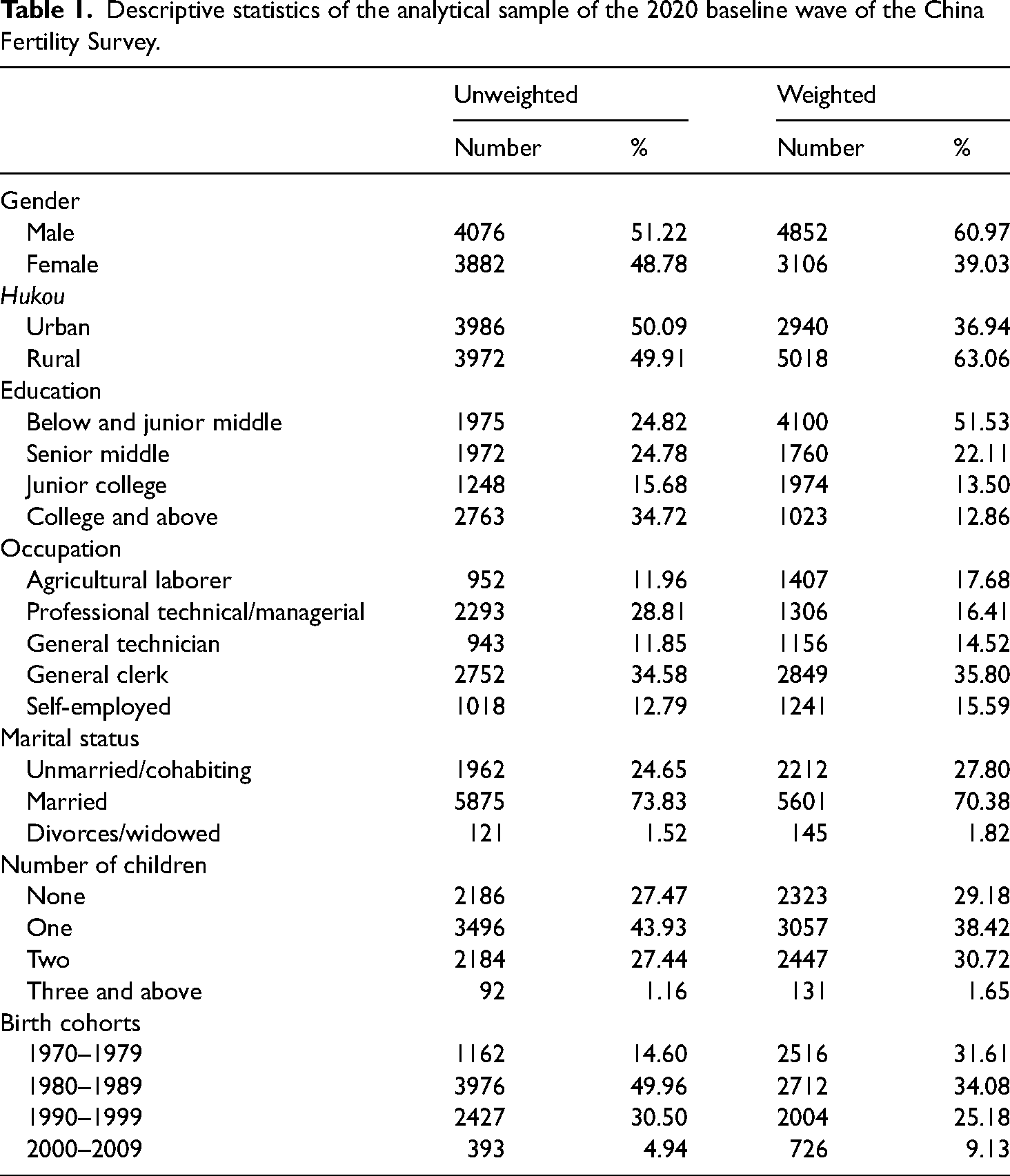
Table 1 presents the pre-weighted and post-weighted descriptive statistics of the analytical sample of 7958 respondents taken from the 2020 wave of the China Fertility Survey (CFS). The first two columns are sample size and percentage before sample weighting. Correspondingly, the last two columns report the weighted sample size and proportion.
Descriptive statistics of the analytical sample of the 2020 baseline wave of the China Fertility Survey.
Methods
This study employs the LCA model to construct ideal gender role types in the context of childcare. LCA models work on the assumption that the observed distribution of the variables is the result of a finite latent (unobserved) mixture of underlying distributions. The method assumes that the joint probability distribution of explicit class variables can be explained by a small number of mutually exclusive potential class variables, each of which has a specific tendency to value the various explicit class variables. Using a set of observed indicators, LCA models identify the solutions that best describe these latent classes, within which the indicators follow the same distribution. There are six explicit variables in this study, respectively denoted as A, B, C, D, E, and F. Thus, the LCA model can be written as
 .
.
In the model, i, j, k, l, m, and n represent the explicit variables;
The study also explores the socioeconomic differentials that influence the endorsement of particular gender role types in childcare. For this, I use multinomial logistic regression to predict the association between socioeconomic variables and different gender role types. This model can be written as
 .
.
This formula predicts the odds ratio of an individual's endorsement of the class j type to that of the class 1 type (the reference group).
Results
Attitudes toward gender division of child-rearing
I measure the overall attitudes of the Chinese respondents toward the gender division of childcare based on three dimensions: the roles of the father, mother, and both parents. The measurement was conducted using a sub-item attitude question.
The findings presented in Table 2 reveal distinct differences among respondents when it comes to defining the roles of fathers, mothers, and both parents in child-rearing. Regarding the first dimension, attitudes toward the role of fathers, approximately 62.6% of respondents agreed that it is important for fathers to spend time playing and communicating with their children. This indicates that the majority of respondents acknowledged the importance of fathers’ involvement in the parenting process, particularly in fundamental activities such as play and communication with their children. However, when it comes to the second dimension, “Fathers should contribute as much as mothers to parenting”, the level of agreement significantly decreases. This suggests that although most Chinese respondents agree that fathers should participate in child-rearing, the proportion of those who believe fathers should assume a major role in the parenting process and share equal responsibilities with mothers is relatively low. In terms of attitudes toward the role of mothers, less than 40% of the respondents agreed with the first statement: “The ideal family arrangement is for males to take the lead at work and females to take the lead at home”. This suggests that as society changes, the proportion of individuals holding traditional views on the gender division of childcare may be decreasing. However, approximately 50% agreed with the second statement: “If financial conditions permit, mothers should not work full-time until their children enter kindergarten”. This indicates that despite the decreasing proportion of individuals adhering to traditional gender roles, half of the respondents still believed that mothers should shoulder the responsibility of childcare. When examining the attitudes toward the role of both parents, the selected sub-items emphasize the importance of parental involvement in child development: “The parenting style of parents toward children aged 0–3 has an impact on the child's lifelong development” and “Parents should completely quit smoking and drinking, as well as change other unhealthy habits, for the sake of their children”. The proportion of respondents agreeing with these two sub-items is very similar, at approximately 50%. Furthermore, there is even stronger agreement that both parents should play a crucial role in the development of children aged 0–3.
Descriptive analysis of attitudes toward gender roles in childcare and the potential category probabilities and conditional probabilities.
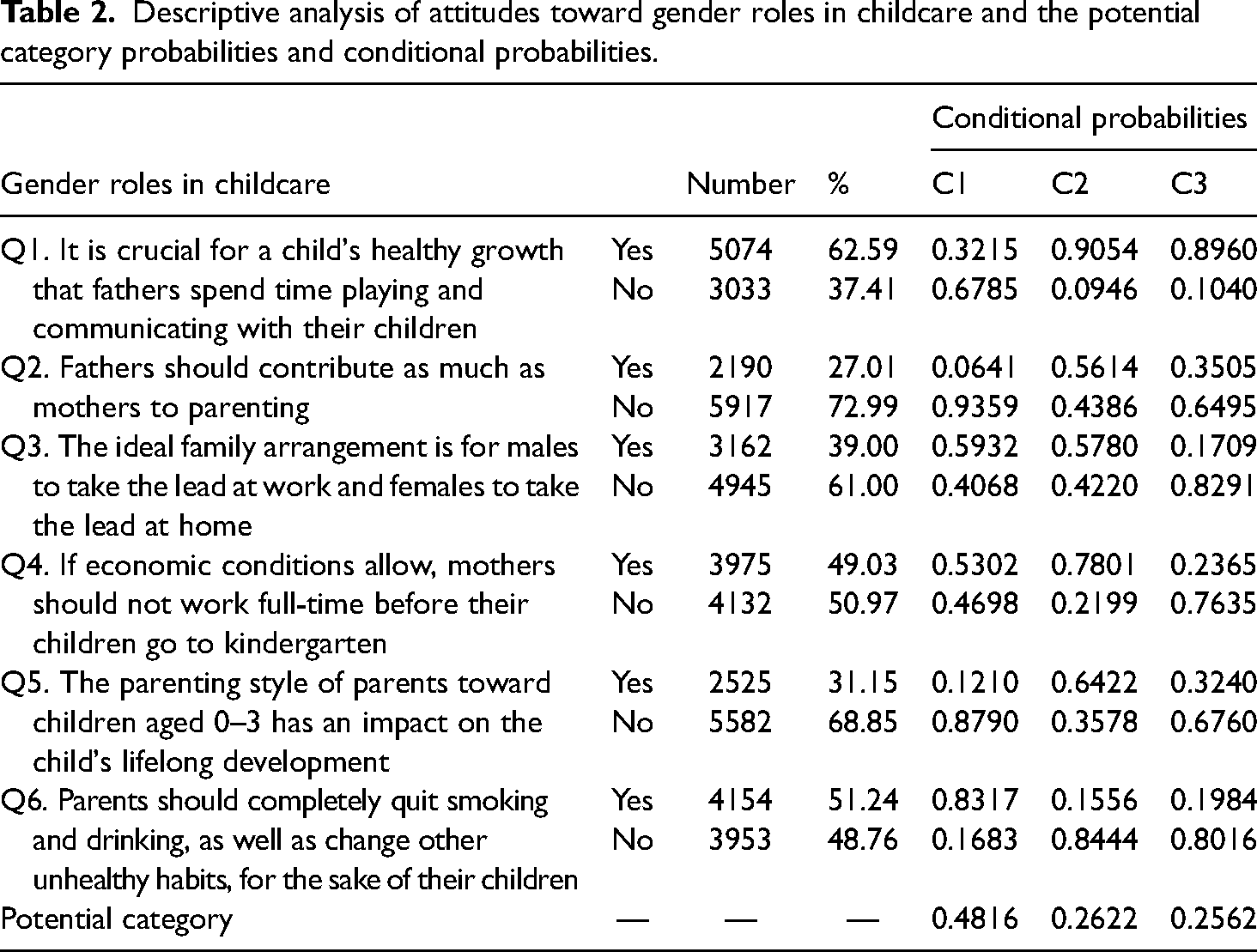
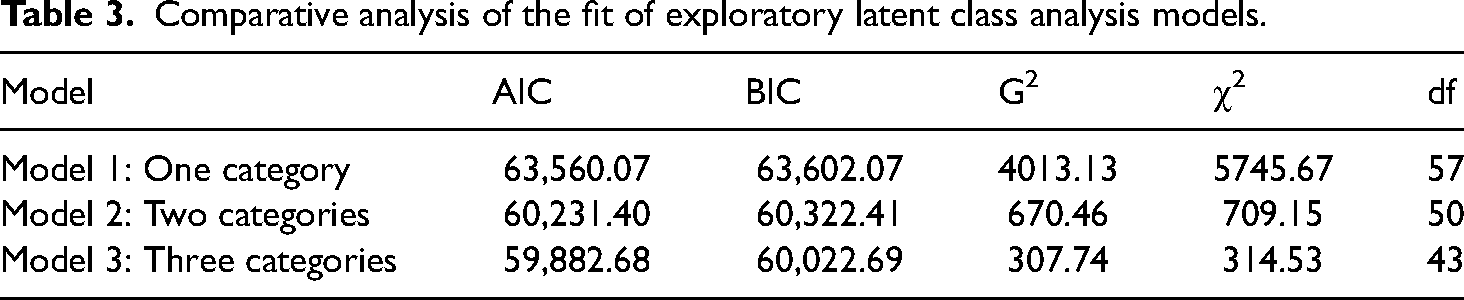
In order to better understand the combined behavioral patterns of Chinese residents regarding the gender division of childcare, it is important to examine not only individual attitudes within specific dimensions but also how respondents’ distribution patterns vary across different dimensions. To explore whether there is an underlying attitudinal pattern regarding the gender division of childcare, this study employs LCA. This approach allows for an exploration of potential categories that capture the combination of attitudes across the six attitudinal variables mentioned above. The results of the analysis are presented in Table 3. Among the potential models considered, Model 3 exhibits the lowest Bayesian information criterion values, and there is a significant reduction in the G2 and χ2 values as well. Consequently, this study identifies three potential categories representing different types of attitudes toward the gender division of childcare. Table 2 also provides the probabilities for each potential category and the conditional probabilities for each category based on different indicators. By examining the conditional probabilities of each potential category with respect to each explicit index, one can discern the characteristics of the different potential categories.
Comparative analysis of the fit of exploratory latent class analysis models.
Category 1 exhibits a very low conditional probability for the role of the father, especially in Q2 (fathers should contribute as much as mothers to parenting), where the conditional probability is only 0.064. This category underscores the insufficient focus placed on the father's involvement in childcare, particularly when contrasted with the responsibilities assigned to the mother. On Q3 and Q4, Category 1 also shows an emphasis on maternal responsibility, although the first category has a lower conditional probability on Q4 than Category 2. As mentioned earlier, the relatively low conditional probability of these two dimensions may be due to the extreme gender roles measured. Overall, Category 1 reflects the emphasis on the mother's childcare responsibilities. Consequently, this attitude type is labeled “mother-oriented”. Category 2 demonstrates high scores across paternal, maternal, and both parents’ roles, leading to the designation of this type as “parental collaboration”. Except Q6, Category 2 shows a relatively higher conditional probability in other questions regarding to gender roles in childcare than Category 1 and Category 3. Category 3 displays a high conditional probability for the role of the father, especially in Q1 “It is crucial for a child's healthy growth that fathers spend time playing and communicating with their children”, with a conditional probability of 0.896. However, Category 3 displays a low conditional probability for the role of the mother on Q3 and Q4, thus it is labeled “father-oriented”. The potential category probabilities for the mother-oriented, parental collaboration, and father-oriented types are 48.16%, 26.22%, and 25.62%, respectively, indicating that attitudes toward the gender division of childcare are diverse, with the mother-oriented type representing the highest proportion. Hence, Hypothesis 1 is essentially confirmed.
Socioeconomic differentials
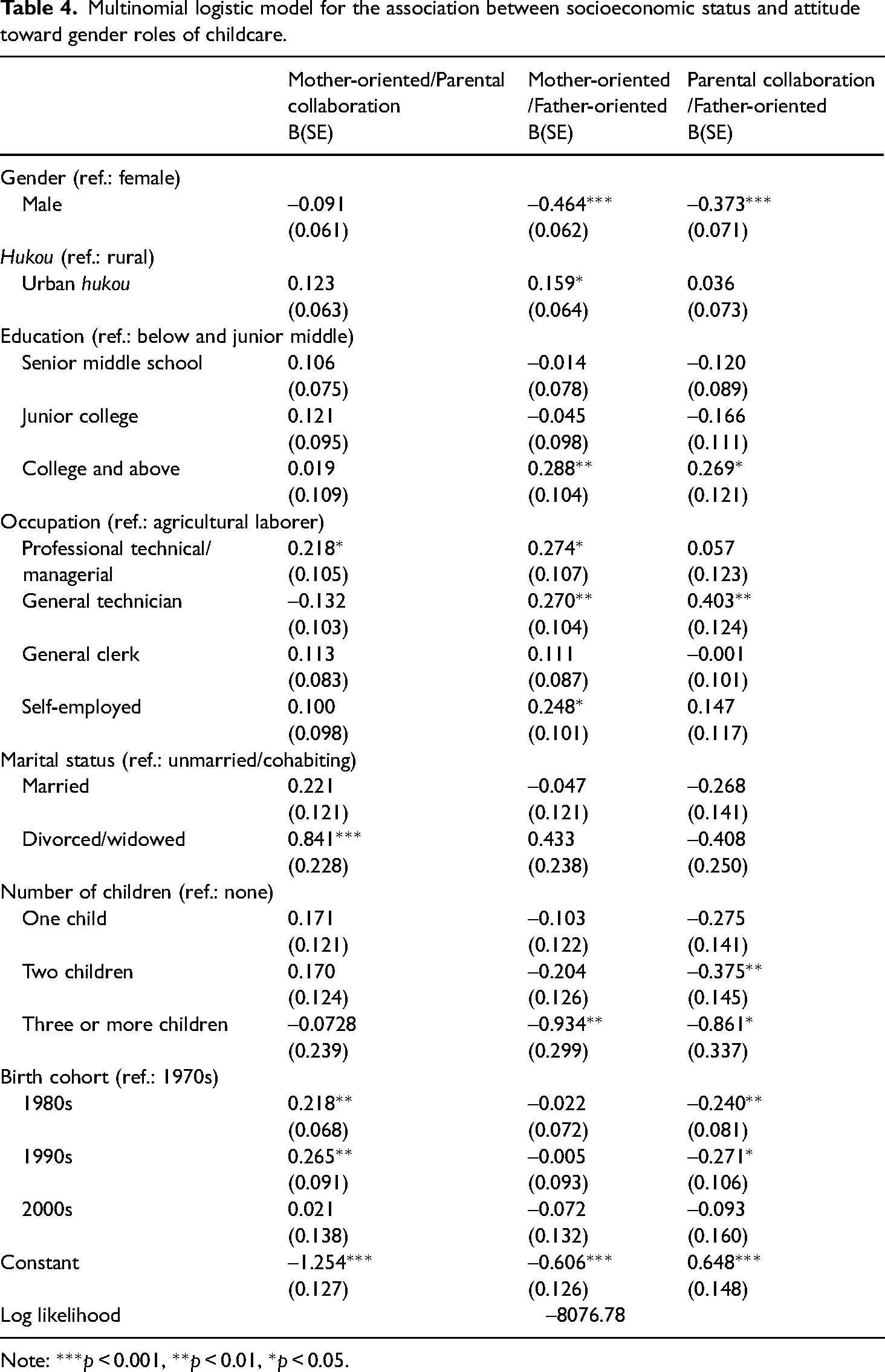
To examine the socioeconomic differentials on attitudes toward the gender division of child-rearing and test the proposed structural theory outlined in Hypothesis 2, this study categorized each sample into three groups based on the estimated posterior probability derived from the LCA model. Multinomial logistic regression models were employed to assess the effects of socioeconomic status and birth cohort, as well as other control variables, on the attitudes of Chinese residents. The results of the model estimation, presented in Table 4, demonstrate a significant association between socioeconomic status and attitudes toward the gender division of childcare.
Multinomial logistic model for the association between socioeconomic status and attitude toward gender roles of childcare.
Note: ***p < 0.001, **p < 0.01, *p < 0.05.
First, regarding education, individuals with more education exhibited a stronger inclination toward a “father-oriented” child-rearing style, as opposed to the traditional “mother-oriented” style. Specifically, when comparing respondents with a bachelor's degree or higher to those with a junior high school education or lower, the odds ratio for endorsing the “father-oriented” parenting type was 33.4% higher (e0.288) than that for endorsing the “mother-oriented” parenting type. Furthermore, for those with a college education or higher the odds ratio for endorsing the “father-oriented” type was 30.9% higher (e0.269) than that for endorsing the “parental collaboration” type. This could be attributed to the fact that the highly educated are more likely to be exposed to up-to-date knowledge, information, and progressive ideas regarding child-rearing, leading to the development of more progressive and open-minded views.
Second, from the perspective of occupational status, individuals of higher occupational status are more likely to hold more liberal attitudes toward the gender division of labor in childcare. Specifically, when compared to agricultural workers, professional/managerial workers had a 23.1% higher odds ratio (e0.218) of endorsing the “parental collaboration” type over the “mother-oriented” type. Additionally, they had a 31.5% higher odds ratio (e0.274) of endorsing the “father-oriented” type over “mother-oriented” type. This may be due to the fact that workers from non-agricultural occupational classes are predominantly employed in urban labor markets, which enables them to have access to the latest information about childcare concepts compared to agricultural workers. This outcome is consistent with Lareau’s (2011) previous research.
Third, when considering hukou status, individuals with urban hukou status exhibit more progressive attitudes toward the gender division in childcare. Specifically, for individuals with an urban hukou, the odds ratio for endorsing the “father-oriented” parenting style is 1.172 (e0.159) times higher than that for endorsing the “mother-oriented” parenting style. This can be attributed to the improved living conditions, enhanced access to educational opportunities, and higher occupational classes that individuals with an urban household registration typically experience.
Fourth, from the perspective of cohort differences, younger birth cohorts tend to hold more egalitarian and liberal attitudes toward the gender division of childcare. Specifically, compared to the 1970s cohort, the 1980s and 1990s cohorts have 24.4% and 30.3% higher odds ratios, respectively, of endorsing the “parental collaboration” type, relative to the mother-oriented parenting type. Similarly, compared to the “father-oriented” type, the 1980s and 1990s cohorts are more likely to endorse the “parental collaboration” parenting ideology. However, the 2000s cohort does not exhibit significant differences in parenting ideologies compared to the 1970s cohort. This may be due to the fact that the respondents in the 2000s cohort are still relatively young and have not yet been exposed to a substantial amount of information on parenting ideologies. Additionally, it is possible that the sample size of the cohort born in 2000 is relatively low within the dataset. It is important to note that the cohort differences discussed in this article represent more of a descriptive analysis. Cross-sectional data cannot distinguish whether the observed differences are cohort effects or age effects. An individual's attitudes toward child-rearing especially may change substantially before and after parenthood and throughout the development of the children. Although I have controlled for the number of children, cohort differences may also be driven by age effects. 1 I do not deny this possibility, and hope that follow-up data will help further distinguish between cohort and age effects.
Finally, the results indicate significant gender differences in parenting ideologies. Specifically, compared with women, the odds ratio of men endorsing the “father-oriented” child-rearing type is 37.1% lower than that of the “mother-oriented” type.
Conclusion and discussion
Gender inequality in the division of childcare has long been a focal topic in the field of family and marriage research. Persistent gender disparities in this context have far-reaching implications, affecting not only relationship dynamics within families but also the overall happiness, satisfaction, and performance of women in both their personal and professional lives. While considerable research has explored and confirmed the existence of gender inequality in the division of childcare, there remains a dearth of understanding surrounding attitudes toward gender and childcare. In order to address this gap in knowledge, the present study advances previous research by employing LCA to investigate such attitudes among the Chinese. Moreover, this study explores various socioeconomic differentials and cross-cohort dynamics, thereby contributing valuable insights to the wider field of research on gender and childcare.
Drawing on data from the baseline CCPIBS survey, this study provides a systematic examination of the ideal attitudinal types relating to the gender division in child-rearing and their differentials in contemporary China. The findings are summarized as follows. First, three distinct ideal types of gender division in childcare are identified: “mother-oriented”, “father-oriented”, and “parental collaboration”. Among these, the mother-oriented parenting type continues to hold the dominant position among the Chinese population, with nearly half of the respondents adhering to such values. The percentages of those who expressed agreement with the “father-oriented” and “parental collaboration” types were quite similar, each accounting for approximately a quarter of the respondents. The above analysis indicates the emergence of a new trend in attitudes surrounding the gender division of child-rearing, wherein the traditional predominance of mother-dominated child-rearing is waning. Nonetheless, due to the influence of Confucian family culture, the centrality of women's role and responsibility in child-rearing continues to be emphasized.
Second, this study finds multiple socioeconomic differentials of attitudes toward gender division in child-rearing. Consistent with the previous literature on the gender division of childcare and structural theories, this study finds that three dimensions of socioeconomic status—education, occupational status, and hukou status—are all found to influence, to various extents, individuals’ attitudes. Of these, one finding of note is that those with a college education or above embraced more advanced ideas and aligned more with a father-oriented parenting style. In terms of occupational status, there is no significant difference between the child-rearing attitudes of general clerks and agricultural laborers. However, professional technicians and managers, general technicians, and self-employed individuals held more liberal perspectives. Finally, hukou status strongly influences individuals’ child-rearing beliefs, and those with urban hukou are less inclined to hold traditional mother-oriented child-rearing concepts.
Furthermore, the study has identified notable cross-cohort differences in parenting beliefs. Both the 1980s and 1990s cohorts displayed a greater disregard for the traditional mother-oriented parenting style. However, no significant difference was observed between the 2000s and 1970s cohorts. These results indicate that structural theories play an important role in explaining the ideology of gender division in child-rearing in contemporary China. China's rapid social transformation in recent years has resulted in notable divisions between various groups. Individuals with different hukou statuses, educational attainment, occupation statuses, and from different birth cohorts find themselves in distinct positions within the social structure, experiencing diverse living conditions and opportunities during this process of societal change. As a result, their social attitudes are naturally likely to differ. Our findings also to some extent support the trickle-down effect, which suggests that in the Chinese context, the transformation of attitudes toward gender division in child-rearing initially begins with a shift in attitudes among the most privileged groups.
In conclusion, the findings of this study indicate that parenting beliefs in China are influenced by both traditional Confucian culture and Western concepts such as intensive parenting, resulting in a complex interplay between traditional and modern perspectives. This conclusion is consistent with previous scholars’ findings that China exhibits a mosaic-like family culture (Ji, 2017; Ji et al., 2017).
Footnotes
Declaration of conflicting interests
The author declared no potential conflicts of interest with respect to the research, authorship, and/or publication of this article.
Funding
The author disclosed receipt of the following financial support for the research, authorship, and/or publication of this article: This work was supported by the Philosophy and Social Science Foundation of Ministry of Education of China (grant number 20JZD032).
