




Abstract
Although residence patterns during the transition to adulthood are dynamic and have a high influence on subjective well-being, empirical studies are scarce, especially with regard to international comparisons. The way living arrangements during the transition to adulthood are normatively framed in bilinear, neolocal kinship cultures is very different from the way they are framed in patrilineal, patrilocal cultures. Thus, living arrangements such as living alone, living with parents and especially living with in-laws should correspond to varying levels of well-being depending on the culture. Based on panel data (National Longitudinal Survey of Youth – NLSY97, German Panel Analysis of Intimate Relationships and Family Dynamics, Japanese Life Course Panel Survey and China Family Panel Studies), we analyzed the levels of subjective well-being of young adults aged 20–35 in households of varying family composition across cultures and over time. Differences between patrilineal, patrilocal kinship systems in Japan and China and bilineal, neolocal kinship systems in Germany and the United States became evident in lower levels of subjective well-being of young adults in China and Japan than in Germany and the United States, when living alone or in single-parent families. Germany and the United States were similar in their strong gender differences in subjective well-being, with young women showing a much lower level than men, but differed with regard to the variation by coresidence type, which was higher in the United States than in Germany. Gender differences in Japan and China were related to living in extended households, which resulted in very low levels of subjective well-being for young women, whereas the impact was small in China. Despite the differences in kinship systems, institutional regulations, and opportunity structures, living in a nuclear family of procreation was associated with the highest level of subjective well-being for young men and women in all four countries.
Keywords
Introduction
In western societies, living as a young adult with one’s parents or in-laws is socially censured as an undesirable living arrangement and a threat to individual subjective well-being (SWB) (Ward and Spitze, 1992). Yet, from the global perspective, living with in-laws is normal (Freedman et al., 1994; Xie and Zhu, 2009): women frequently move into their in-laws’ households after marriage, and such arrangements are predominantly positively framed, if only by the male members of the patrilineage.
Different perceptions and evaluations of living arrangements are deeply rooted in divergent kinship systems. The major divide is between bilineal kinship systems on the one hand, within which descendants are considered equally related to ancestors from the father’s and mother’s side and frequently reside in neolocal – that is, independent – housing after marriage; and, on the other hand, unilineal kinship systems, within which descendants are only considered related to either the father’s or mother’s side and frequently reside in either patrilocal or matrilocal housing after marriage. Among unilineal kinship systems, the patrilineal type is by far the most common (Murdock, 1967, 1981).
Having inherited the northwestern European family system, societies like Germany and the United States favor a life-course pattern of early home-leaving and (late) neolocal family formation (Hajnal, 1982; Laslett, 1977; Macfarlane, 1978; Szoltysek and Poniat, 2018). Accordingly, individuation in adolescence and economic independence from parents by early adulthood is an important and prevalent developmental task in this life phase (Shanahan, 2000). In societies with patrilineal and patrilocal kinship systems like China and Japan, however, establishing intergenerational interdependence is less important and much less prevalent (Kagitcibasi, 2007; Nauck and Becker, 2013). Instead, the main developmental task in the transition to adulthood is to fulfill new, gender-specific obligations and responsibilities within intergenerational relationships. Thus, this system favors intergenerational coresidence with either members of the family-of-origin or in-laws.
From a social science perspective, these opposing traditions suggest several interesting research questions, regarding not only how cultural frames are revealed by coresidence patterns (Nauck and Ren, 2018), but also how these patterns are related to individual SWB. This paper addresses these questions by cross-culturally analyzing the relationship between coresidence patterns and individual SWB in the transition to adulthood. Individuals in this phase of life are most likely to experience significant changes in coresidence (Nauck et al., 2017) and are also most sensitive to changes in SWB (Trzcinski and Holst, 2008).
Studies of the effect of coresidence patterns and careers on any outcomes among young adults are scarce and isolated. Empirical analyses for Europe examine only the impact of young people leaving home at an increasingly high age, the effect of cohabitation on the quality of intergenerational relationships in later life (Leopold, 2012; Nazio and Saraceno, 2013), and the family-formation process of young adults. For southern European countries, the consequences of their long tradition of late nest-leaving for late marriage and low fertility have been documented (Billari and Tabellini, 2011; Dalla-Zuanna, 2001). Similar empirical evidence exists for East Asian societies such as Taiwan (Huang, 2013) and Japan (Raymo, 2003; Raymo and Ono, 2007), where living with parents is associated with a lower probability of forming romantic relationships and a delay in the transition to marriage and parenthood (Yu and Kuo, 2016). Among single parents, young mothers in Japan reported higher levels of SWB if coresiding with family members (Raymo and Zhou, 2012). In the United States, the effects of coresidence with parents varied depending on its permanence and on whether it represented a return to the parental home after nest-leaving (Copp et al., 2017).
Although SWB in adolescence and young adulthood has been a major point of concern in the United States and Europe (Richardson, 2014) and in East Asia as well (Yi, 2013), existing empirical analyses of the relationship between intergenerational coresidence and SWB focus on other age groups. The SWB of school-aged children has been studied, especially in the case of temporarily separated parents in East Asia (Ren and Treiman, 2016; Xu and Xie, 2015; Yi et al., 2009) and of permanently separated parents in the United States (Amato, 2000; Amato and Cheadle, 2005; Sun, 2001, 2003). Another focus of research has been the effects of parental coresidence with adult children on parents’ SWB. Multiple studies show for China and Japan that elderly people living alone report lower levels of SWB than those living with others (Chen and Short, 2008; Chen and Silverstein, 2000; Cong and Silverstein, 2008; Liu et al., 2020; Raymo et al., 2008; Ren and Treiman, 2015; Silverstein et al., 2006; Wang et al., 2014) and that middle-aged and older adults from “skipped generation households” report lower levels of SWB than the first and third generation living in these households (Wen et al., 2019).
The following analysis adopts a different approach. Taking a comprehensive view of coresidence patterns in young adulthood, it examines pattern development and patterns’ immediate outcomes from the young adults’ perspective. It focuses specifically on the correlation of SWB with various types of coresidence and, taking advantage of the panel structure of the data, it observes changes in the level of SWB after entry into each arrangement. The “level of SWB” as an outcome variable is advantageous for capturing emotional states, as it is continuously reinforced by living conditions in the respective type of coresidence.
The empirical analysis contributes to the existing literature in the following ways:
We investigate the effects of kinship systems on the relationship between coresidence patterns and SWB of young adults. Based on data from panel studies, we analyze the level of SWB of young adults aged 20–35 in various types of household composition. This age bracket was chosen because it encompasses the phase after finishing school, when major decisions about occupational careers, family formation and changes in coresidence are made. Household composition is described based on the kinship relationship between young adults and their respective household members. Depending on the kinship system, gender differences in coresidence choices vary. Bilineal kinship systems favor neolocal coresidence patterns and in the rare cases of intergenerational coresidence do not make a prescriptive differentiation between coresidence with parents and in-laws. In contrast, patrilineal kinship systems not only favor intergenerational coresidence, but in fact prescribe coresidence with parents for married male young adults and coresidence with in-laws for married females. Because of these crucial differences in kinship systems, gender differences in SWB are explicitly modeled. We analyze the dynamics of changes in SWB due to changes in the household composition in cross-cultural comparative perspective. We use harmonized panel data from China, Japan, Germany and the United States. We chose these countries because they vary systematically in geographic characteristics, socio-economic development, welfare state regulations and institutionalized kinship structures (Nauck et al., 2017).
In what follows, we first formulate bridge hypotheses about how societal-level cultural and socio-structural characteristics are related to SWB in specific coresidence patterns on the individual level (second section). After describing the data employed and the operationalization of the constructs used in the models, we report level differences in SWB between young men and young women for each coresidence pattern. We estimate separate fixed-effects models for male and female young adults in the respective countries, thus controlling for unobserved heterogeneity, and then we test the effects of changes in the household composition on levels of SWB.
Explaining cross-societal differences
Two mechanisms are thought to explain differences in SWB across coresidence settings in China, Japan, Germany and the United States. One mechanism is related to opportunity structure; that is, the extent to which young adults can freely choose their living arrangement. Its hypothesized connection to SWB is straightforward: the more opportunities to realize preferred coresidence choices, the higher the general level of SWB and the fewer the differences in SWB between coresidence types. The second mechanism is how these choices are influenced by cultural norms that frame coresidence. Cultural framing has cognitive and prescriptive components. The cognitive component consists of the provision of “routine solutions”, or those that have been frequently chosen and have proven to be successful options in their respective social contexts in the past. Non-routine residence choices are associated with increased insecurity about their consequences. The prescriptive component involves the ranking of residence options by their degree of social approval. Socially censured residence choices are made at a higher social cost (Opp, 2015). The link to SWB is also straightforward: unusual or socially censured coresidency decreases SWB. Although both mechanisms can be distinguished analytically, they are to some extent interdependent because the underlying culture shapes both the kinship system as part of the institutional structure of a society and the opportunity structure for residential choices. Accordingly, we expect that the cultural divide between a patrilineal, patrilocal kinship system (in China and Japan) and a bilineal, neolocal kinship system (in Germany and the United States) would also impact the respective opportunity structures on the societal level, which, in turn, shapes the level of SWB of young adults in their coresidence arrangements.
In Germany and the United States, a bilinear kinship structure (Goody, 1983) dominates in combination with low intergenerational authority distance (35 and 40 on a power-distance scale, respectively). In contrast, a patrilinear kinship structure in combination with high intergenerational authority distance is prevalent in China and Japan, scoring respectively 80 and 54 on power-distance (Hofstede, 2001). Low parental authority (in Germany and the United States) encourages autonomous individual choice among adolescents, whereas high parental authority and demands (in China and Japan) limit it, which is legitimized by the normative complex of “filial piety” (Fricke et al., 1994; Hashimoto and Ikels, 2005; Hu and Tian, 2018; Yeh et al., 2013); that is, the virtue of respecting one’s parents, elders and ancestors. Mutual obligations among generations are thus more forcefully implemented in China and Japan, and the intergenerational power distance imposes high levels of obligation on the younger generation. Furthermore, gender differences in the kinship structure are more pronounced in patrilineal kinship systems than in bilineal kinship systems. In patrilineal societies, women change kinship membership with marriage and usually follow patrilocal patterns of residence (Freedman et al., 1994; Raymo, 2003; Xie and Zhu, 2009). In contrast, neolocal housing of young couples is characteristic of bilinear kinship systems as in the United States and Germany (Nauck and Becker, 2013; Nauck and Ren, 2018; Reher, 1998). Intergenerational coresidence in extended households is thus not only more common in Japan and China, it is also more socially approved (Raymo et al., 2015). Following these considerations about the consequences of kinship system institutions, we expect that living in extended households (as a socially approved “routine solution”) is not associated with lower levels of SWB as compared with nuclear households in the East Asian societies of Japan and China. For Germany and the United States, with their institutionalization of neolocal housing, we expect that living in nuclear households is associated with higher levels of SWB, whereas living in any kind of extended household is associated with lower levels. This is not because intergenerational coresidence is socially censured in bilineal, neolocal kinship systems but rather because it is non-routine.
The following analysis concentrates on cross-national differences in the opportunity structure for coresidence choices of young adults, but it takes into account how these differences are interlinked with individual resources and the respective kinship systems. For example, on the individual level, economic resources such as household income increase coresidence choices, whereas low income makes the young adult dependent on parents and relatives, especially if neolocal residence arrangements are preferred (DaVanzo and Goldscheider, 1990). If a need for childcare is a constraint in the family formation phase, then (neolocal) coresidence choices are also influenced by the availability of childcare facilities provided either by the welfare state or on the free market (Zhang et al., 2014). On the societal level, welfare-state benefits such as housing subsidies or a supply of affordable rental housing increase the neolocal choices available to young adults (Nauck, 2014; Nauck and Ren, 2018; Nauck et al., 2017).
The societies in our sample vary considerably with regard to their welfare provisions. Heavily subsidized childcare, a large supply of rental housing, and housing subsidies are available for low-income young adults in Germany with no major regional disparities, and this makes young adults fairly independent of kin and personal networks (Hank, 2003; Hank and Kreyenfeld, 2003; Wagner and Mulder, 2015). One of the consequences of the conservative welfare state of the United States is that welfare benefits remain residual and that the policy of subsidizing rented housing is primarily targeted towards the homeowners and not towards the tenants and their individual rights. Accordingly, young adults in the United States making housing decisions remain more dependent on their parents’ resources. In contrast, in the case of patrilocal East Asian societies, living with members of the extended kinship system (Li and Huang, 2017) mobilizes intergenerational support for childcare in the transition to parenthood (Chang, 2015) or provides temporary shelter while pursuing higher education or seeking a job (Kins and Beyers, 2010; Mitchell, 2006).
Since coresidence choices are least constrained in Germany, differences in the association between coresidence arrangements and the level of SWB are expected to be comparatively low. Conversely, if the housing market is primarily based on real-estate prices, housing subsidies are not provided, and childcare facilities are either unavailable or expensive, residence choices of young adults are restricted and social and regional disparities should be comparatively high. However, variation in these opportunity structures is also affected by the level of urbanization, which is higher in Japan than in China and the United States.
From a kinship system perspective, living in a nuclear family of procreation is an important developmental task in the transition to adulthood and a significant marker of positive development in bilineal, neolocal kinship systems. We expect that this type of coresidence is associated with high levels of SWB for young adults of both sexes in Germany and the United States. As intergenerational coresidence, even after the formation of a family of procreation, is positively valued in patrilineal, patrilocal kinship systems, we expect that living in extended households is generally associated with higher levels of SWB in China and Japan than in Germany and the United States. However, opportunities for intergenerational coresidence play an important role for the level of SWB of young adults. These opportunities are generally lower in highly urbanized contexts, where living space is scarce and expensive, and are in these contexts more likely to conflict with the normative obligations of intergenerational coresidence. We expect that the level of SWB in extended households is lower in Japan than in China, where the level of urbanization is lower.
Temporarily living alone (and marrying late) has a long tradition in societies with neolocal kinship systems and is normatively accepted both as a temporary and as a permanent form of residence. In patrilocal kinship systems, living alone is at best tolerated as a temporary form of residence, and social disapproval of it is stronger for young women than for young men. We expect that living alone in the transition to adulthood is not only more frequent in Germany and the United States than in Japan and China, but also results in fewer negative consequences for SWB.
Differences in the gender-specific allocation of responsibilities and obligations between kinship systems may result in marked differences in the SWB of young adult men and women in the respective coresidence arrangements. In a patrilineal system in which most family duties are the responsibility of the higher-status elder male generation, young adult males find themselves in the comfortable situation of having few duties while benefiting fully from the gendered division of household labor (DaVanzo and Goldscheider, 1990). In extended households, their SWB should be higher than that of young female adults. Young adult women, in contrast, are subordinate to the elder female generation and because of the gendered division of household labor have more household duties in extended households than in nuclear households (Aquilino and Supple, 1991). From this gender-dependence perspective (Baxter and Kane, 1995; Jansen et al., 2016; Kunovich and Kunovich, 2008), we expect that the SWB of women is lower in extended households than in nuclear households.
Living as a single parent with children implies even more household duties and lower income opportunities. We expect that SWB in this coresidence pattern is low, especially for young mothers and especially in China and Japan, where this arrangement is rare and socially censured. Differences may also result from the respective causes of single parenthood across countries. Whereas permanent separation and divorce are the prevalent causes of single parenthood in Germany and the United States, the prevalent cause in China is temporary separation due to labor migration (Ren and Treiman, 2016; Xu and Xie, 2015). Accordingly, for single parents living with children we expect a lower level of SWB in Japan than in China and only a small impact on SWB in Germany, where single parenthood is almost as common as in the United States but is eased by higher welfare benefits.
We summarize our expectations in the following hypotheses:
Opportunity Hypothesis: in societies with less constrained residence choices (like Germany), SWB of young adults is less affected by coresidence arrangements than in countries with high constraints in the housing market, which results in a higher likelihood of forced choices (like in Japan, China and the United States). Individualism Hypothesis: in societies with a collectivistic culture (like Japan and China), living alone or in a single-parent-headed household results in lower levels of SWB of young adults than in societies with an individualistic culture (like the United States and Germany). Kinship Hypothesis: in societies with a patrilineal/patrilocal kinship system (like China and Japan), living in extended households results in higher levels of SWB of young adults than in societies with a bilineal/neolocal kinship system (like Germany and the United States). Gender Hypothesis: the more gendered the division of labor in a society is and the more that housework is delegated to women (like in Japan), the more the residence in extended or single-parent-headed households results in a lowered level of SWB of young women as compared to young men.
Data and methods
Data
Our empirical analysis was based on data sets that are similar enough to make them suitable for comparative analyses. All data sets are derived from panel studies with samples that were nationally representative, at least for the initial wave, and with similar periodicity of observation time points. All include similar birth cohorts, which reduces possible biases due to intervening period effects. Moreover, all data sets encompass the entire age span between 20 and 35 years and thus fully cover the transition to adulthood. They also have a set of predictors in common, which makes the testing of relevant research questions possible. We harmonized these empirical indicators ex post to establish measurement equivalence cross-nationally.
The data sets used were the National Longitudinal Study of Youth (NLSY97) from the United States, the German Panel Analysis of Intimate Relationships and Family Dynamics (PAIRFAM), the Japanese Life Course Panel Survey (JLPS) and the China Family Panel Studies (CFPS). From all four data sets, only information from respondents aged 20–35 in the respective wave were used.
The NLSY97 started in 1997 with an initial sample of N = 8984 respondents from the birth cohorts 1980–1984. The analyses used 17 waves, covering the observation period between 1997 and 2016 (http://www.bls.gov/nls/nlsdoc.htm). PAIRFAM started in 2008 with an initial sample of N = 12,402 respondents from the birth cohorts 1971–1973, 1981–1983 and 1991–1993. Data were collected annually (Brüderl et al. 2018; Huinink et al., 2011). Nine waves were used in the analysis, covering the observation period between 2008 and 2017 (http://www.pairfam.de/en/). The JLPS started in 2007 with an initial sample of N = 4800 respondents aged 20 and older. Data were collected annually. Eight waves were used in the analysis, covering the observation period between 2007 and 2014 (http://csrda.iss.u-tokyo.ac.jp/en/panel/). The CFPS started in 2010 with an initial sample of N = 42,590 respondents. CFPS is not a cohort study but covers the entire life span of all members of the sampled households (Xie and Hu, 2014). Data were collected biannually, covering the observation period between 2010 and 2016.
Operationalization of constructs and analytic strategy
As the analysis is based on existing panel studies, we performed output harmonization for all variables used in each dataset (Hoffmeyer-Zlotnik and Warner, 2014). The dynamics in the transition to adulthood were captured by the coresidence careers of the young adults within the observed age span between 20 and 35. We used multivariate imputation (Acock, 2005), replacing missing data for each wave in each country separately through chained equations (MICE). Research demonstrates that this method yields estimates that are less biased and more efficient than complete case analysis or other traditional approaches (Johnson and Young, 2011; Young and Johnson, 2015). We generated data sets using an imputation model, regressing incomplete covariates on the other covariates in the analysis.
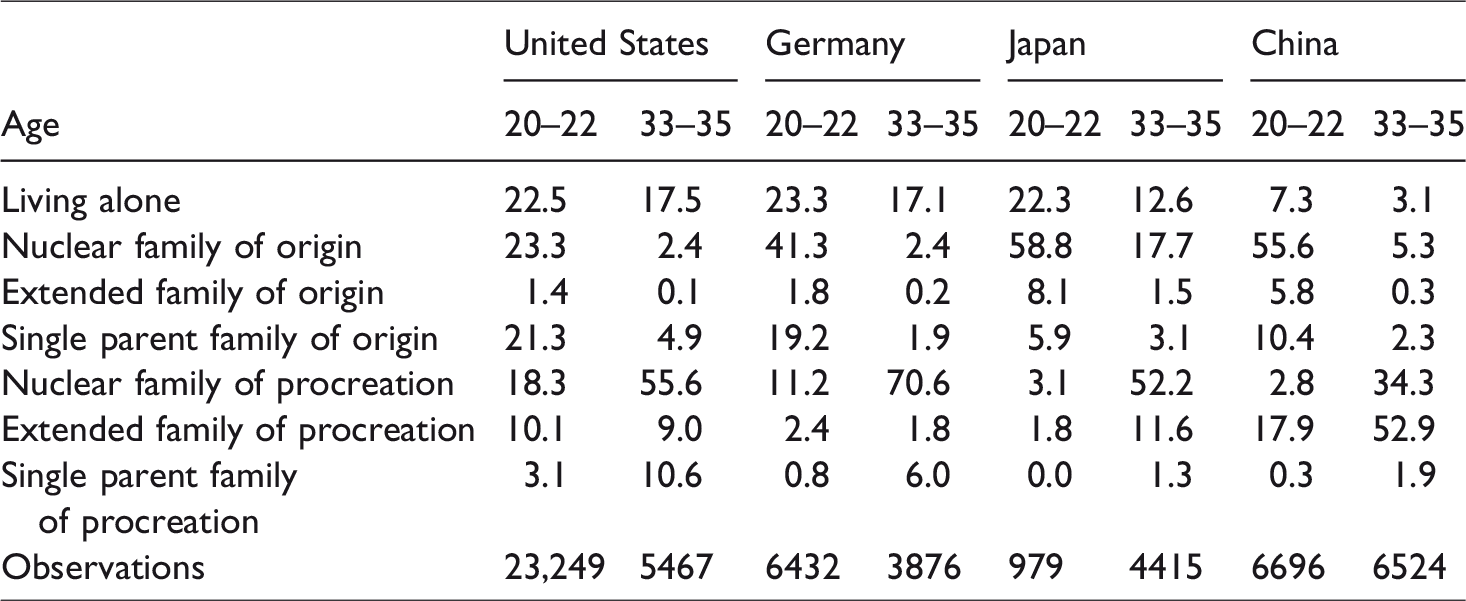
For the cross-sectional analysis (Tables 1 and 2), we pooled all observations across waves of each country’s panel studies for each respondent aged 20–35. Individuals were included as often as they were observed in the panel. Thus, the number of observations is higher than the number of respondents and varies with sample size, the number of waves in the respective study, and panel attrition. There are 43,128 observations for the United States, 29,361 for Germany, 15,170 for Japan and 38,675 for China. Descriptive statistics for all variables used in the analysis are presented in Appendix 1.
Changes in coresidence in the transition to adulthood in the United States, Germany, Japan and China (percent).
Adjusted means of subjective well-being by coresidence for young adults aged 20–35 in the United States, Germany, Japan and China (ordinary least squares (OLS) regression).
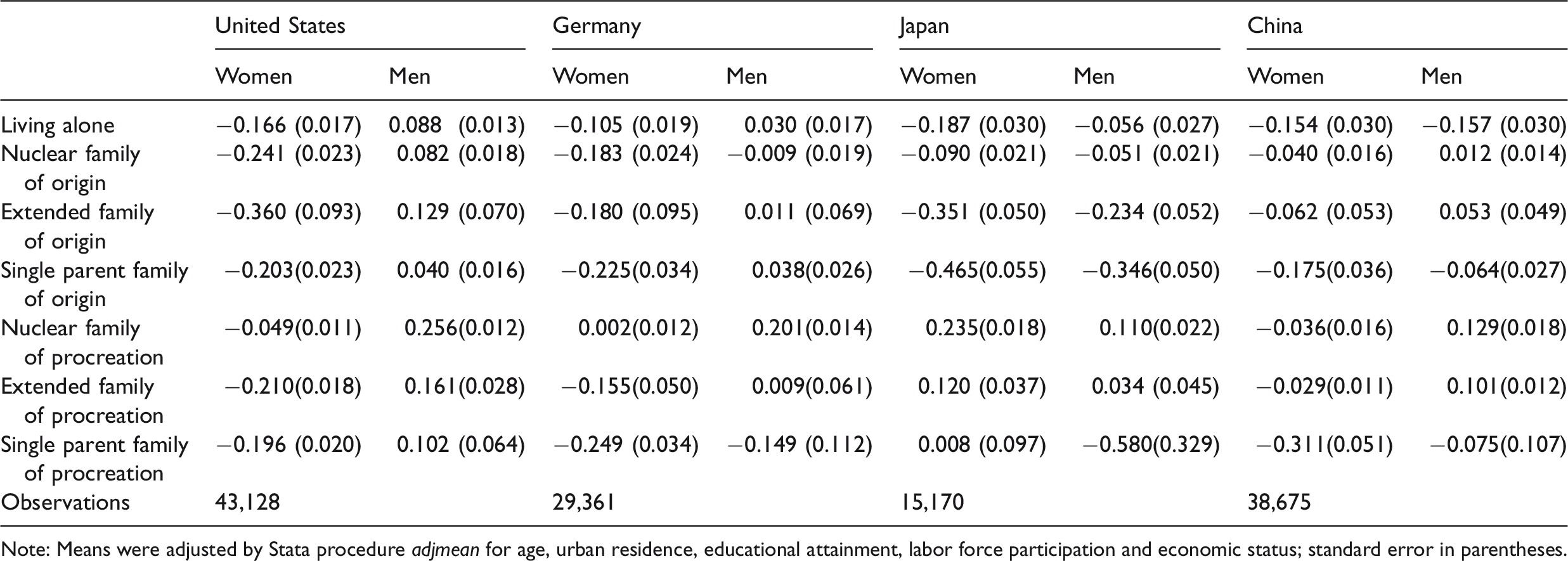
Note: Means were adjusted by Stata procedure adjmean for age, urban residence, educational attainment, labor force participation and economic status; standard error in parentheses.
For the panel analyses (Table 3), fixed-effects models were used. These models have the advantage of controlling for all time-invariant selection factors, including those that are difficult or impossible to observe or (specifically for our study) those that are not available in all four panel studies. Our objective was to identify whether and to what extent changes in the household composition of the young adults cause changes in their self-reported levels of SWB.
Coefficients of linear fixed-effects regression, by type of coresidence, in the United States, Germany, Japan and China.
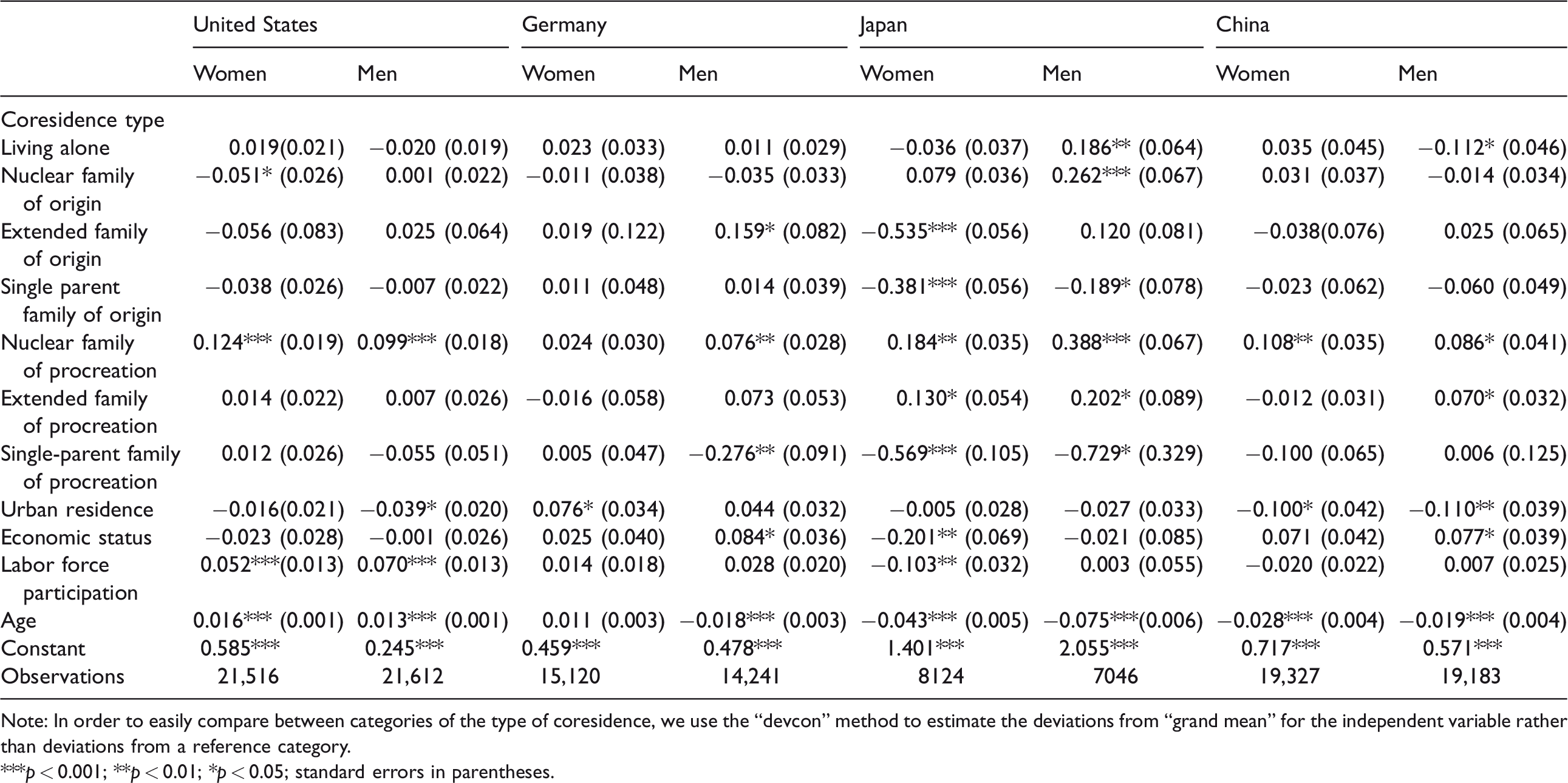
Note: In order to easily compare between categories of the type of coresidence, we use the “devcon” method to estimate the deviations from “grand mean” for the independent variable rather than deviations from a reference category.
***p < 0.001; **p < 0.01; *p < 0.05; standard errors in parentheses.
Coresidence types
We define seven types of coresidence using the following criteria, shortened from criteria originally developed in Nauck and Ren (2018):
Living alone: the young adult lives in a household with no member of the family of origin or kinship lineage (such as grandparents, uncles or aunts), no partner or spouse, no children and no in-laws. In rare cases, this household may include unrelated people such as friends, class-mates or work colleagues; however, most young adults living in dormitories, shared flats and the like reported the household composition in their parental home. Living in a nuclear family of origin: the young adult lives in a household together with both biological parents and possibly with siblings, but with no members of the kinship lineage, no partner or spouse, no children and no in-laws. Living in an extended family of origin: the young adult lives in a household together with both biological parents, and possibly with siblings, but also with members of the kinship lineage, but with no partner or spouse, no children and no in-laws. Living in a single-parent or supplemented nuclear family of origin: the young adult lives in a household with only one biological parent and possibly with siblings, or with foster parents, but with no partner or spouse, no children and no in-laws. Living in a nuclear family of procreation: the young adult lives together with a partner or spouse and possibly with children, but with no parents, no siblings, no other members of the kinship lineage and no in-laws. Living in an extended family of procreation: the young adult lives together with a partner or spouse, possibly with children, and also with parents and/or siblings or other members of the kinship lineage or in-laws. Living in a single-parent family of procreation: the young adult lives in a household with children, but with no partner or spouse, no parents, no siblings, no other members of his lineage and no in-laws.
SWB
The measurements of SWB were based on lists of self-reported items derived from established scales from clinical psychology (NLSY97: the 5 items of the Mental Health Inventory MHI-5, Berwick et al., 1991; PAIRFAM: 10 items from the State Trait Depression Scales, Spadema et al., 2002; JLPS: 6 items from the Short Form 36, Ware and Sherbourne, 1992; CFPS: alternatively 6 or 8 items from the Center for Epidemiologic Studies – Depression CES-D scale, Radloff, 1977). Although the respective scales targeted the same construct, their measurement varied substantially. In order to establish comparability, the respective scales were transformed to the same range and then underwent a z-transformation.
Controls for cross-sectional analysis
Individual SWB may depend on opportunity structures as indicated by population density in the country of residence, individual resources (operationalized as educational attainment), labor force participation and the economic status of the household. These opportunity structures vary significantly cross-nationally (Fulda et al., 2019). Moreover, SWB in specific types of coresidence may change with the age of the respondent. For example, living in a nuclear family of origin may be associated with higher levels of SWB at the beginning than at the end of the observation period. To make sure that the cross-sectional results are not a mere result of differences in the distribution of these structural categories, results are controlled for age and for the following variables that can vary over time (Appendix 1):
Urban residence: the US data classified places of residence as urban or rural using the Census Bureau’s 1990 standards, which defined as “urban” all “urbanized areas” or “places” with a population of at least 2500. For Germany, a population of 5000 was chosen as the threshold separating “urban” from “rural” places of residence. In Japan, places of residence were defined as urban based on a classification of counties as either core cities or urban counties. For China, the official designation of the Statistical Office was used, being based on hukou (official household registration) status and regional classification. Whereas Germany (56%), Japan (60%) and the United States (based on its low cut-off point: 80%) were classified as predominantly “urban”, the proportion of urban municipalities in China (46%) is significantly lower.
Educational attainment: educational attainment is operationalized based on the International Standard Classification of Education (ISCED97) (UNESCO, 2006) such that respondents are assigned a category ranging from “no schooling” to “doctorate”. In the United States, 53% of the respondents had at least “some college education”, in Japan 43% and in Germany 31%. China’s 6% is significantly lower. Whereas the educational level of young adult females was higher than that of males in the United States and Germany, the reverse was true for China and Japan.
Labor force participation: for coding respondents’ labor force participation, a cut-off of gainful employment of more than 20 hours per week was chosen. The labor force participation in the samples was higher for males than for females in all countries and higher in Japan and China than in the United States and Germany.
Economic status of the household: to classify the economic status of respondents, all household income information was pooled for each country across all waves and divided into deciles. Economic status is operationalized as the decile ranking of the respondent’s household, indicating their status relative to other households. This procedure ensures cross-national comparability and enables tracking of upward and downward economic mobility of the household during the life course of the respondent. Males’ economic status, so defined, was higher than females’ in all four countries.
Empirical results
Changes in coresidence in the transition to adulthood in different countries
Table 1 shows the marked changes in household composition of young adults between the beginning and the end of the transition to adulthood in all four countries. Moreover, it shows significant cross-national differences in the prevalence of household types, mainly between the East Asian countries, with their patrilineal kinship systems, on the one hand; and Germany and the United States, with their bilineal kinship systems, on the other hand. This difference is especially evident in the higher share of single-parent households in Germany and the United States and in the higher share of extended households in China and Japan. As expected for patrilineal kinship systems, gender differences (not shown) were prevalent in extended households with women living primarily with in-laws and men living with lineage members. In China, 40% of men aged 33–35 lived in extended households with lineage members, but only 5% lived with in-laws; of the women in the same age bracket, 36% lived with in-laws, but only 6% lived in extended households with their lineage members. A similar pattern was evident in Japan on a much lower level (men 6%/3%, women 3%/9%). These level differences indicate significant differences within East Asian societies, as do the differences in the respective shares of single-headed households in Germany and the United States.
Patterns of coresidence and SWB of male and female young adults in cross-cultural comparison
Table 2 presents the adjusted means of SWB of female and male young adults aged 20–35 by coresidence pattern in all 4 countries. It shows strong correlations between SWB, household composition and gender.
In all four countries, living alone was associated with lower SWB for young adult women than for young adult men. Whereas the SWB of young men living alone in Japan and even more among those in China was below average for all living arrangements, it was above average for young men in Germany and the United States. This reflects the divergent prevalence of living alone between collectivistic and individualistic societies.
Living with both biological parents in a nuclear family household was generally associated with higher SWB for young adult males than for females. Females in this arrangement reported especially low feelings of SWB in the United States and Germany, whereas gender differences were small in Japan and China.
Compared to nuclear families, living in extended family-of-origin households in the United States is associated with lower SWB for young women and higher SWB for young males. Whereas living in extended households of origin was associated with an average level of SWB in China (with a slightly higher level for young men), living in extended households in Japan corresponded to very low levels of SWB, especially for young women. These country differences reflect the differences in urbanization, which increases the cost in Japan of securing this normatively favored residence arrangement.
Living with a single parent was generally associated with lower levels of SWB for young women than for young men, with between-country differences. The most pronounced differences were in the United States and Germany, where the SWB of young men in this coresidence type did not differ from other family-of-origin arrangements. The low level of SWB of young adults in single-parent households in China and Japan reflect social censure and low prevalence of this type of living arrangement in both countries. Differences between both countries reflect its generally temporary nature in China, where parental separation is more often the result of labor migration.
Living in a nuclear family household of procreation was associated with the highest level of SWB for both young men and young women in all four countries. The level of SWB in this living arrangement was higher for males than for females in the United States, Germany and (to a lesser extent) China. Japan stood out because SWB among young women living in this arrangement is higher than among young men. This may reflect the normative pressure on young women in this country to get married.
In the United States and Germany, extended family households of procreation were associated with low levels of SWB for young women but not for young men. In China, the level of SWB of young men in this type of living arrangement was nearly as high as in nuclear households. In Japan, young women’s SWB in this type of living arrangement was also above average, but not as high as in nuclear households of procreation.
Single-parent households of procreation were similar to single-parent households of the family of origin. With the exception of Japan, SWB was lower for young women than for young men. Although based on very few observations, SWB for young women in Japan was higher if living as a single parent than if living with the family of origin or alone without children. In Germany, in contrast, single parenthood was associated with the lowest level of SWB among all seven coresidence types.
In sum, cross-sectional analysis provided empirical evidence relevant to hypothesized societal differences in the level of SWB during the transition to adulthood. The importance of the respective kinship systems was evident in differences between the United States and Germany vis-à-vis Japan and China in terms of level differences in SWB when living alone; that is, without kinship members in one’s household. It was also evident in the prevalence of extended and single-parent households, in its impact on the SWB of those living in these arrangements, and in the extent of gender differences in SWB in the various coresidence settings. However, cross-sectional analysis revealed some commonalities across countries. Young women generally reported lower levels of SWB than young men (Appendix 1). More importantly for this analysis, living in a nuclear family of procreation – that is, with a partner alone or with children – was associated with the highest level of SWB among all seven types of coresidence.
Changes in coresidence on SWB of young adults
Unobserved heterogeneity may have influenced the results from the cross-sectional analysis of pooled panel data. Fixed-effects models provide a stronger test of the effects of household composition on SWB. Table 3 presents separate models for young women and men, as the analysis was based on the assumption of a major divide between societies with regard to the institutionalization of patrilineal or bilineal kinship systems and their consequences for gender-specific differences in SWB. The models also include age and the co-developing life-course trajectories, such as migrating between rural and urban environments, changes in the relative economic status of the household and changes in labor force participation.
Life-course trajectories did not have the same effects in all four societies. Due to the generally high level of urbanization in Japan, moving into an urban environment had no effect on SWB there. It reduced SWB in China and (for young men) in the United States, with strong regional disparities, but it had a positive effect on SWB of young women in Germany. Changes in economic status had no effects on SWB in the United States, but they had a positive effect on young men in Germany and China. To our surprise, increased household income resulted in a significantly lower level of SWB for young women in Japan, which may be a consequence of cumulated obligations in the family and workplace. This is underscored by the finding that entrance into the labor force also decreased their SWB, whereas it increased the SWB of young adults in the United States. SWB generally increased within the age range 20–35 in the United States, which may be seen as an indication that the developmental task of individualization and personal autonomy was successfully resolved for the majority of young adults in the sample. In contrast, SWB generally decreased in Japan and China within this age range, which may be related to increased instrumental responsibilities of young adults in strong intergenerational ties.
Effects of entering into a specific household type on SWB were smallest in Germany, which underscores the effect of the German welfare system with its housing subsidies for that society’s most highly preferred housing choices (Fulda et al., 2019). For young German women, no significant differences between the various types of coresidence were observed. For young German men, entering into a household with a partner (and possibly children) had, as expected, a positive effect on SWB, but, surprisingly, entering into an extended household also had a positive effect on SWB.
Effects in the United States were markedly stronger. As compared to living with parents in a nuclear family, SWB increased significantly for young American women entering into all types of households with families of procreation, the strongest effects being associated with the nuclear type. Even living as a single parent or living alone resulted in higher levels of SWB. As in Germany, an increase in SWB for young American men only occurred with entering into a nuclear family of procreation. Effects of household transitions on SWB were low in China. Entering into a single household decreased the SWB of young men in China, but moving into a single-parent household, either as a single parent or with a single parent, did not decrease the SWB of young adults in China. This is related to the temporal limitations of such residence arrangements in conjunction with strong intergenerational ties even across spatial distance. Entering into a nuclear household of procreation had a positive effect on SWB that was similar for young women and for young men. However, living in an extended household increased SWB only for young men, which underscores gender differences in household responsibilities in extended households.
Strong effects of coresidence on SWB existed in Japan. For young Japanese women, entering coresidence in extended and single-parent families of origin resulted in very low levels of SWB, indicating that these arrangements were accompanied by increased levels of household responsibilities. In contrast, entering into a nuclear or extended household of procreation resulted in increased SWB for young women. The effect of living in nuclear or extended families of origin or of procreation on SWB was much stronger for Japanese men than for Japanese women. We take this as another indication of stronger gender dependence in the Japanese kinship system as compared to China, resulting in a gender imbalance of benefits from coresidence arrangements and hence in pronounced differences in SWB. Although low in prevalence, entering into a single-parent household resulted in a strong decrease of SWB for young Japanese adults. As these transitions generally occur in Japan not because of temporary labor migration as they do in China but due to the death of a parent or parental separation, the effects are much stronger. This places Japan in sharp contrast not only with China but also with Germany and the United States, where separation and divorce are much more prevalent and thus provide higher levels of security about their outcomes, which in turn means that SWB is not strongly negatively affected.
Discussion and conclusion
One of the advantages of the panel studies from the four countries used in this analysis is their coverage of those years of the life span during which most coresidence transitions occur and in which the related changes in SWB are strongest. Thus, we focused on: (a) a cross-sectional comparative analysis on level differences in the SWB of young adults in coresidence arrangements in the four societies; and on (b) analyzing the effects of coresidence transitions on SWB by means of fixed-effects regression models. Theoretically and empirically, this extends existing research on coresidence in the transition to adulthood by taking a cross-cultural perspective and focusing on an important but neglected outcome of coresidence arrangements. It complements research that has focused predominantly on the outcomes of coresidence arrangements for the older generation.
The analysis was driven by the expectation that constraints in the choice of coresidence options and the cultural framing of coresidence play important roles in the explanation for cross-societal differences in the SWB of young adults, and that cultural frames, as expressed in the institutionalized kinship systems, also play an important role in the explanation for gender differences in SWB among different coresidence arrangements. Theories about kinship systems and about gendered power relationships within families and kinship systems suggest divergent expectations regarding correlations between living arrangements and SWB. Whereas kinship theory predicts that living in extended households is associated with lower SWB of young adults in the bilineal kinship systems of Germany and the United States but not in the patrilineal ones in Japan and China, gender dependence theory predicts that SWB is adversely affected by living in extended households only among young women because young men benefit from extended female service while still being largely exempt from patriarchal duties. Our empirical analysis supports several of our hypotheses about country differences in the relationship between coresidence and SWB. Results regarding the prevalence of coresidence types at the beginning and at the end of the transition to adulthood (Table 1) and regarding the relationship between coresidence types and SWB of young adult men and women (Table 2) support the basic assumption about the big divide between the patrilineal and patrilocal kinship systems in the societies of China and Japan versus the bilineal, neolocal kinship systems in the societies of Germany and the United States (Kinship Hypothesis). Whereas patrilineal kinship systems favor living in extended households in the transition to adulthood, an important developmental task in bilineal kinship systems is acquiring autonomy independent of the family of origin, and this, in turn, favors neolocal household formation either living alone or within a family of procreation.
These differences were evident in a higher prevalence of extended households (both of the family of origin and of the family of procreation) in Japan and China in contrast to a higher prevalence of young adults living alone, in nuclear families of origin and procreation, and in single-parent families in Germany and the United States. It also showed up in the very low level of SWB among young adults living in China alone or in single-parent families, whereas no differences were observed between living in nuclear families and living in extended families. Japan was similar to China in that living alone and living in single-parent families was associated with low levels of SWB (Individualism Hypothesis), but Japan differed with regard to living in a family of origin or living in a family of procreation. Whereas in Japan living in a family of procreation was associated with high levels of SWB, especially for young women in nuclear families, living in extended families of origin was associated with very low levels of SWB, especially for young women. These differences support the assumption about the normative conflict in patrilineal kinship systems that arises when opportunities for living in extended households are restricted due to the high cost of housing in the context of strongly gendered household tasks (Gender Hypothesis).
Germany and the United States are similar in their strong differences between the SWB of young adult women and men, with young women showing a much lower SWB than young men. However, both countries differed with regard to the variation of SWB by coresidence type. Variation in SWB by coresidence type was higher in the United States than in Germany. Important differences in the associations between SWB and coresidence type were evident only for the most preferred living arrangement (the nuclear family of procreation) and the least preferred living arrangement (single parent for young men). On a much lower absolute level, variation in SWB among young German women across coresidence types was low. This supports the assumption that the high benefits of the German welfare state, especially housing subsidies, enabled young adults to realize their coresidence preferences (Opportunity Hypothesis).
Our empirical analysis also revealed some general trends across countries, the most important of which was that young men reported a higher level of SWB in all coresidence arrangements compared to young women (Table 2). The one exception, that young Japanese women reported a higher level of SWB than men when living in a nuclear or extended family of procreation, signifies the importance for young Japanese women of conforming to the norm of getting married. The other major trend – directly related to our research focus – was that living in a nuclear family of procreation was associated with the highest level of SWB for young men and women not only in the “bilinear” countries Germany and the United States, but in all four countries.
The direct effect of entering into a specific coresidence type on the SWB of young adults was demonstrated by the fixed-effects models presented in Table 3. The effect of changes in coresidence on SWB was comparatively small in Germany, which again supported expectations arising from the context of the German welfare state. In contrast, changes in coresidence had a strong impact on SWB in Japan. SWB decreased among young adults entering into a single household and into single-parent households, whereas it increased when entering into a nuclear or extended family household of procreation or re-entering a nuclear family of origin. Changes of household within the family of origin from a nuclear to an extended family had different effects on young Japanese men from on women: they increased the SWB of young men but decreased the SWB of young women sharply. This favors our gender dependence considerations. To our surprise, effects of changes in coresidence had relatively small effects on the SWB of young adults in China and the United States. In the United States, only the positive effect on SWB of entering into a nuclear family of procreation stands out. In China, gender differences were evident with regard to entering into single households, having a positive effect on the SWB of young women but a significantly negative effect on the SWB of young men, whereas the reverse was true for entering into an extended household. Young men and young women alike experienced an increase in SWB when entering into a nuclear family of procreation, with the effect being stronger for young women. These results support the gender dependence hypothesis. Differences in effect sizes between Japan and China underscore the differences between these countries with regard to permanent versus temporary separation in the case of single parenthood as well as regarding the opportunities to fulfill normative expectations about living in extended households (when differences in the level of urbanization are taken into account). This conclusion is corroborated by the finding that rural–urban migration had a significantly negative effect on the SWB of young Chinese men and women. In other words, in an urban context, Chinese young adults face the same constraints as Japanese young adults.
Our empirical analysis has its limitations. It is based on panel studies planned and carried out independently of each other and with different designs. These studies include both national household and life course surveys (CFPS, JLPS) and national cohort panel studies of youth with different numbers of observations per individual (NLSY and PAIRFAM). We were able to harmonize only a limited number of empirical indicators. Because each survey used different measurements for SWB (all being based on well-established and empirically tested scales), harmonizing the dependent variable was an especially difficult challenge. Standardization of the means and variance was seen as the best solution for comparisons within and between societies.
The aim of this paper was to provide a systematic approach to analyzing cross-cultural differences in the relationship between coresidence and SWB. But this study also raised several new research questions that lie beyond its scope. For example, what are the mechanisms behind the empirical finding that gender differences in SWB are so unexpectedly pronounced in the United States and Germany and generally so unexpectedly small in Japan and China? Is it the unquestioned acceptance of the norm of a gender-based division of household labor and of intergenerational obligations despite massive social changes (Hu and Tian, 2018) in these East Asian countries? Complementary cross-cultural research on intergenerational relations in the transition to adulthood is needed to assess their ambivalence in this – in comparison to parent–child and later-life relations –under-researched phase in the life course.
Footnotes
Acknowledgements
This paper is a result of the research project “The Transition to Adulthood in a Comparative Perspective” as part of the international project “Life Course and Family Dynamics in a Comparative Perspectives”, conducted in cooperation with Peking University, China; Princeton University, United States; Oxford University, United Kingdom; Erasmus University Rotterdam, the Netherlands; and Chemnitz University of Technology, Germany.
Declaration of conflicting interests
The author(s) declared no potential conflicts of interest with respect to the research, authorship, and/or publication of this article.
Funding
The author(s) disclosed receipt of the following financial support for the research, authorship, and/or publication of this article: This work was supported by the German Research Foundation (grant number NA164/19-1) and the National Science Foundation of China (grant number 71461137001).