




Abstract
The literature on social stratification and mobility in Imperial China reveals that the academic tracking system was one important source of educational inequality. The Imperial Examinations system in Ming Dynasty and Qing Dynasty China was a dual-track structure formed of Civil (wen) and Military (wu) Examinations. Earlier scholars have focused on the provincial and national levels of the system, paying little attention to the lowest, county-level shengyuan examination, the starting point of the wen and wu system. This study looks into the Account Books for Imperial Examination participation in Qing Dynasty Shicang, Songyang County, Zhejiang Province, focusing particularly on examination records of the Que lineage. After making a fortune in the iron-smelting business, the Ques first purchased an Imperial Academy studentship (jiansheng), then later married into local gentry families and began to participate in the Imperial Examinations. The Taiping Rebellion (1851–1865) brought a high mortality rate to the region, which increased the chances of success in the Imperial wu-track, the Military Examination. The Ques made use of this opportunity to participate in both the Civil and Military Examinations. This paper compares two common motivations for taking the examinations—protection of family wealth and status, and pursuit of the highest degree. This study shows that each motivation had a different outcome. Those only interested in safeguarding and enhancing family wealth were able to maintain a balance between pursuit of their degree and the family business, while those aiming at the highest degrees often fell into the trap of repeated attempts and eventual bankruptcy. The dominance of the first motivation among ordinary Chinese demonstrates the self-adjustment of local society to the Imperial Examination tracking system.
Imperial Examinations, merchants, and social mobility
The educational tracking system is one important institution for legitimizing educational inequality. Turner (1960) proposed two kinds of mobility in the British school system, namely sponsored and contested social mobility. Bourdieu (1998) found that social origin influenced one’s choice of major in elite French universities. In contemporary China, after completing their nine-year compulsory education, students are also faced with a choice of education tracks. In China today, the higher the socioeconomic status of the students’ families, the higher the probability that they will enter Key-point Schools or choose a regular High School rather than Vocational Schools (Wu, 2013). Previous studies in a historical Chinese setting have focused on the social structure based on students’ academic choices, while this paper treats the family as the agent investing in education, showing the initiatives taken by the common people when negotiating the examination structure. Using first-hand information on individual participation in the Imperial Examinations, available from grassroots Shicang in the Qing Dynasty, I analyze how merchant families opted for different tracks in the Imperial Examinations during the Ming and Qing Dynasties.
The Imperial Examinations were traditional China’s most important channel for social mobility, crossing the four-stage hierarchy of literati (shi), farmers (nong), artisans (gong), and merchants (shang). Taking the Examinations was the most important step for entering the literati class. Passing at various stages of the Examination, the civilian and merchant could enter the gentry stratum. Artisans and merchants were restricted from participating in the Examinations from the beginning of the Ming Dynasty (1368–1644), but this restriction was gradually annulled (Ho, 1967: 68; Zhang, 2005). Children from all backgrounds were encouraged to actively participate in the Examinations, which could transform their status and realize their dreams of upward mobility. Bourdieu’s theory of cultural capital states that economic capital can be transformed into cultural and political capital (Bourdieu, 1986: 241). The Imperial Examination system provides a typical example of this in pre-industrial society.
From the Southern Song Dynasty onward, one enjoyed gentry privileges for life provided one obtained the juren degree in the Provincial Examinations (Wu, 2008). During the Ming and Qing Dynasties, licentiates (shengyuan)—the lowest level of degree holders—were also entitled to gentry privileges (Chen, 2002). Student participation in the Imperial Examinations could, firstly, convert economic capital into political capital, which would better protect family wealth; and secondly, students could use the Examinations to obtain higher degrees and achieve truly vertical social mobility. 1 Owing to the traditional lowly status of merchants, families that had accumulated wealth through commercial activities were more eager than others to advance up the social ladder. In addition to demonstrating their wealth, the Imperial Examinations could also help the merchant class to expand their social network and participate in local public affairs. At the same time, privilege gained from success in the Imperial Examinations was a sure measure to improve social status and secure family wealth.
Ho Ping-ti’s analysis of Ming–Qing biographies, chronologies, novels, and other materials found that wealthy families encouraged their more brilliant and hard-working members to pursue success in the Imperial Examinations. Therefore, the upward trajectory of social mobility would generally develop towards this particular elite, that is, a shift from business to Confucianism (Ho, 1967: 77). Analyzing Qing Dynasty Examination Essays (zhujuan), Zhang (2003: 78–84) demonstrated how merchant families made use of their financial resources to purchase the jiansheng degree, bypassing the County Examinations and providing financial support for lineage members to sit for this and higher-level Examinations, such as would transform the common merchant household into an Imperial Examination household. This phenomenon was reflected at the regional level, and it has been demonstrated that the number of such successful individuals in the Jiangnan regions was closely related to the rise and fall of the regional economy (Xia and Fan, 1997).
Despite the prevalence of such a “business to Confucianism” culture, different family strategies affected subsequent career development and continuity of social status. For example, in periods of prosperity, merchants at Jinzhong County in Shanxi Province chose to purchase the jiansheng degree and continue to run their businesses, while some chose to invest in education and sit for the Imperial Examinations. However, during a period of commercial decline, only those who focused on education were likely to achieve gentry status (Guo and Zhang, 2014). Businessmen in Huizhou believed in the reciprocal transformation between business and Confucianism, that is, that success in business and the Imperial Examination were each transformations of the other. Some families, therefore, adopted a strategy of “one generation for business, one generation for the Examinations; one following the other”—temporarily relinquishing studies in order to do business, and training their children to seek Examinations’ success after success in business (Tang, 1997: 23).
The merchant class was very enthusiastic about investing in the Imperial Examinations, but the risks involved in sitting for the Examinations were also extremely high. The Imperial Examinations, first of all, were highly competitive, and the pass rate extremely low. In the case of the Civil Examinations, 97% of licentiates (shengyuan) failed the Provincial Examination, and 80% of the juren who had passed the Provincial Examination could not pass the Metropolitan Examination and thus reach the top of the Imperial Examinations pyramid. 2 The conversion of economic capital into cultural capital, therefore, was a lengthy process. In the Qing Dynasty, the wealthy Pans, merchants, moved from Huizhou in Anhui Province to Suzhou in Jiangsu Province. Five generations later, the Pans had truly realized their transition to an Imperial Examination household (Xu, 2003). Secondly, most of the highest degree holders (jinshi) in the Qing Dynasty were able to hold official positions, but only one-third of the second highest degree holders (juren) were able to enter official positions. 3 The proportion of tribute students (subordinate to juren and superior to shengyuan) was lower, and shengyuan were not qualified for any office. With a widespread practice of purchasing offices, the difficulty that jinshi and juren faced in gaining employment further increased (Ho, 1967: 51; Lee et al., 1975: 26).
To diversify their investment, besides the Civil Examinations, merchant families occasionally elected to sit for the Military Examinations. But for most of the Qing Dynasty, Civil or Military Examinations examinees were forbidden to sit these interchangeably (Shang, 2004: 213). Therefore, after completing their foundational education, young students would have to choose between the Civil and Military tracks. The Qing Dynasty followed Ming Dynasty policy and ruled through civil, rather than military officials. The political and social status of military shengyuan and juren was, therefore, much lower than that of their civil counterparts. More than half of local official positions were occupied by jinshi, juren, and tribute students from the civil track. 4 Only one-fifth of military officials, furthermore, had actually risen through the Military Examinations, the remainder having come from the army itself. 5 At the same time, Military shengyuan were not allowed to join the army: “Military shengyuan cannot be listed in the Brigade, if anyone violates this policy, both the military shengyuan and the Brigade Instructor should be punished” (Shang, 2004: 211). Subject to these restrictions, “the Military Examinations played an even less effective role than the Civil Examinations in selecting capable individuals” (Feng, 2002: 537). Despite this, the Military track placed higher demands on wealth, which implies a comparative advantage for merchant families.
Compared to the more stable returns of investment in land and real estate (Ho, 1967: 74), commitment to the Imperial Examinations was a surface “investment”, which in fact came closer to “consumption”. Wang (1988) compared consumption in the Imperial Examinations and officialdom to the modern economic concept of “developmental consumption”, that is the initial investment made by individuals in order to build a living: “The Imperial Examinations fever in the Jiangnan region during the Ming and Qing was so acute, that even families with only ten mu of land (around 16.5 acres) participated, employing tutors and hoping their sons could pass”. In this case, the family’s economic situation would inevitably affect decisions between the examination and business, whether the Civil or Military track of the Examinations was followed. As a form of consumption, there is the question of the rationality of this pursuit. As we will see, the famous example of Fan Jin, who came from a poor family, but persisted in sitting for the Provincial Examinations, and finally passed, may have been an outlier.
According to previous investigations, studying for and sitting the Military Examinations involved greater expenses, and the Military shengyuan’s family background was generally superior. At the same time, due to the preference for the Civil Examinations, “the gentry family showed disdain for the Military Examination track”. The examination cost more, “ten times more than the Civil, so poor families cannot afford this … also, Military Examination tutors monopolize the training, so outsiders cannot gain access” (Feng, 2002: 537). Xu Lingxiao, whose father was a County Magistrate, came across a county-level Military Examination around his father’s yamen at the end of the Qing Dynasty. He found that the Military students were “dressed beautifully”, quite different from many shabby Civil Examination candidates. The reason for this higher expense was that for the Military Examinations “one practiced techniques for bows and arrows, broadswords and horsemanship while continuing to employ private tutors, setting out places for practice, and the purchase of items (for horses) and horses, which was necessarily quite a cumbersome material expense, and poor families could not afford these considerable resources” (Xu and Xu, 1997: 55). Civil Examination participants were more likely to be poorer than their military counterparts, but most successful Civil Examinations candidates would choose the lifestyle of “literati”, and leave the commercial field. This kind of “lifestyle of the leisured class”, with collecting hobbies such as acquiring calligraphy and paintings, was more likely to exhaust family wealth than the cost of the exam itself (Ho, 1967: 154).
Merchant families’ motivations for participating in the Imperial Examinations can therefore be divided into two types: protecting family wealth; and pursuing upward mobility. There were also two tracks for such participation: Civil Examinations; and Military Examinations. Across different time periods and regions, what factors influenced families’ choices between business and the Examinations, or between the Civil and Military Examinations? Did the outcomes differ based on different motivations and participation strategies? This paper attempts to answer these questions by analyzing success in the Imperial Examinations achieved by the small-scale merchant Que lineage in Qing Dynasty China.
Que’s participation in the Imperial Examinations
The Que family of Shicang in Songyang, Zhejiang Province set up their business during the Qianlong Period (1736–1796) and obtained gentry status during the Jiaqing Period (1796–1820) through purchase of the jiansheng degree and participation in the Civil Examinations. From the end of the Daoguang through the Xianfeng Periods, the wealth of the Que family shrank, due to the Taiping Rebellion (1851–1865). Recently discovered, the Shicang Examination Account Books show that a large number of military examinees then emerged during the Tongzhi and Guangxu Periods (1862–1908), showing that some of the Que began to dedicate them to the more costly Military Examinations, while their brothers continued on the Civil track. This phenomenon makes us wonder: what were the major factors affecting merchant family choices both in business versus the Imperial Examinations, and the Civil versus Military tracks?
In terms of historical materials, scholars have employed Examination Candidate Lists (dengkelu), Examination Essays (zhujuan), Local Gazetteers, chronicles, and diaries to study the Civil Service Examinations. Small-scale merchant families normally have quite scattered historical materials, so they have not been studied thoroughly in any previous research. In recent years, a large number of Qing Dynasty local documents, including Account Books, have entered the horizons of researchers, providing excellent materials for the study of regional social history. This article employs the “Shicang Contracts”, compiled by the Department of History at Shanghai Jiao Tong University, to discuss the characteristics of the small-scale businessman’s participation in the Imperial Examinations. 6
In terms of research methods, I develop a contextual and organic analysis of Que participation in the Imperial Examinations. The “contextual” analysis situates Imperial Examination activities within the social and economic changes of the village. That the Ques participated in the Imperial Examinations demonstrates immigrants’ efforts to localize and join the gentry class. Imperial Examinations strategy shifts were related to the decline of the iron industry and the intrusion of the Taiping Rebellion. “Organic” analysis refers to correlating the personal connections in various documents and materials, such as Contracts, Account Books, and Household Division Documents, and here will demonstrate a change in the model of sitting for the Examinations at Shicang, as the Que came to “sit for both the Civil and Military Examinations”.
Zhejiang Province ranked second in Qing Dynasty China for number of civil-track jinshi (Ho, 1967: 228), though most jinshi came from several prosperous Prefectures such as the Provincial Capital at Hangzhou. Chuzhou Prefecture, where Songyang County was located, ranked at the bottom of Zhejiang’s eleven Prefectures and only produced eleven civil jinshi throughout the Qing Dynasty. Songyang County ranked in the middle of the Chuzhou Prefecture but had an outstanding record in the Military Examinations. The County could boast of three civil jinshi, one military jinshi, and 11 civil juren (only two in the Guangxu Period (1875–1908)), but 33 military juren and 13 from the Guangxu Period (Lü and Gao, 2011: 381–391). This coincides with previous findings that the Civil Examinations prevailed in affluent plains areas, while the Military Examinations prevailed in less developed mountain regions (Chen, 2011; Xia, 2001).
Shicang is situated in the southern mountainous area of Songyang County, Zhejiang Province. Shicang River runs through it. The villages of Chapai, Xiazhaijie, Houzhai, and Caizhai sit along both sides of the river. Thirty “Grand Houses” with an average construction area of over 2000 square meters still survive. Most were constructed from the late Qianlong through Jiaqing, and Daoguang (1821–1850) Periods, after villagers had built a fortune through iron-smelting. The iron industry reached its peak during the Jiaqing, but a sharp drop in domestic demand led to the industry’s decline during the middle and late Daoguang through Xianfeng Periods. During the Guangxu Period, recovering regional market demand spelled the revival of the Shicang iron industry, which survived through the Republic of China Period (1911–1949) (Cao and Jiang, 2010; Jiang, 2015).
Among immigrants enriched through iron production, most successful were three same-surname Que branches, migrants from Shanghang County in Fujian during the Kangxi Period (1661–1722). They settled down in Xiazhaijie, Houzhai, and Chapai. The Que of the Houzhai and Chapai Branches enjoyed a close relationship and hearkened to the same ancestor, Que Ronghou. In the Guangxu Period, two of Ronghou’s descendants returned to Shanghang County to renovate their ancestor’s Incense Hall (xianghuotang) (Wang and Cao, 2014). The Que of the Xiazhaijie Branch had only a relatively distant relationship with the Houzhai and Chapai Que. However, when the brothers Que Fangyao and Que Fenyan (both from Jiangxi Province) presided over the revision of The Que Surname Genealogy (Jiaqing Edition), the three Shicang branches established a tighter relationship. 7
By 1808, there were five jiansheng in the Xiazhaijie Branch, including Que Xueyi and his nephew, while Que Tingdui at Houzhai was a tribute student. In 1818, Que Tingdui provided funds supporting the construction of the Que Ancestral Hall—the Ganying Hall. In 1821, Que Tiankai, a successful merchant from Chapai, moneyed through iron, led construction of the Weize Hall; in 1843, Que Tiankai also directed the compilation of the Daoguang Edition of the Que Genealogy (Zhang, 2009). Accepting and adjusting the national cultural order—including orthodox gods, Imperial Examinations, and clan organization—helped Shicang immigrants to obtain gentry status and assimilate into local society (Zhang, 2009).
One could obtain gentry status in one of two ways in the Qing, namely through the Examinations, or through purchase. The practice of purchasing an office and title required family wealth: purchasing a jiansheng degree in the Qing, for example, usually cost 100 taels (a tael since 1959 has been standardized to 50 grams) of silver. More success was achieved through the Imperial Examinations, for which the impact of wealth was indirect. Before the Daoguang Period, the Shicang Que had relied on the purchase system to acquire a position in society. From that time on, however, the family actively participated in the Imperial Examinations and made great progress in this field.
The first edition of the Que Surname Genealogy, dating to the Jiaqing Period, and the Fourth Edition, from the Republic of China Period, do not offer a clear distinction between Civil and Military shengyuan; the same is true for the Que Generational Chronology, in which only the “students at the County School” or “students at the Prefectural School” are identified as shengyuan. Only a portion of the military shengyuan will be identified as “military students at the County School”. Combining Genealogy and Account Books, the author has identified the “Lineage Branch”, “Degree Type”, and “Examination Year” of civil and military students. 8 “Lineage Branch” corresponds to the three branches, namely the Que living at Xiazhaijie, Houzhai and Chapai. There were three “Degree Types”, namely jiansheng, Civil shengyuan, and Military shengyuan. Civil shengyuan can be further divided into four subgroups, the lowest status fusheng (secondary students), the zengsheng (supernumerary students), linsheng (stipend students), and tribute students. The student’s “Examination Year” corresponds to the year in which the student passed the examination and entered the County School; for those shengyuan and all jiansheng lacking Examination Year data, I use one’s birth year plus 25 to mark the Examination Year. This year is converted to an “Examination Period”: the first period is set as 1754 (when a Shicang Que first passed the county exam) to 1807 (publication of the Jiaqing Genealogy), and four periods of roughly 25 years each from 1808 to 1905 (the final iteration of the Imperial Examinations). This provides a total of five periods. Table 1 lists Shicang Que Imperial Examination successes by Branch, together with Degree Type and Examination Period.
Shicang Que Imperial Examination success.
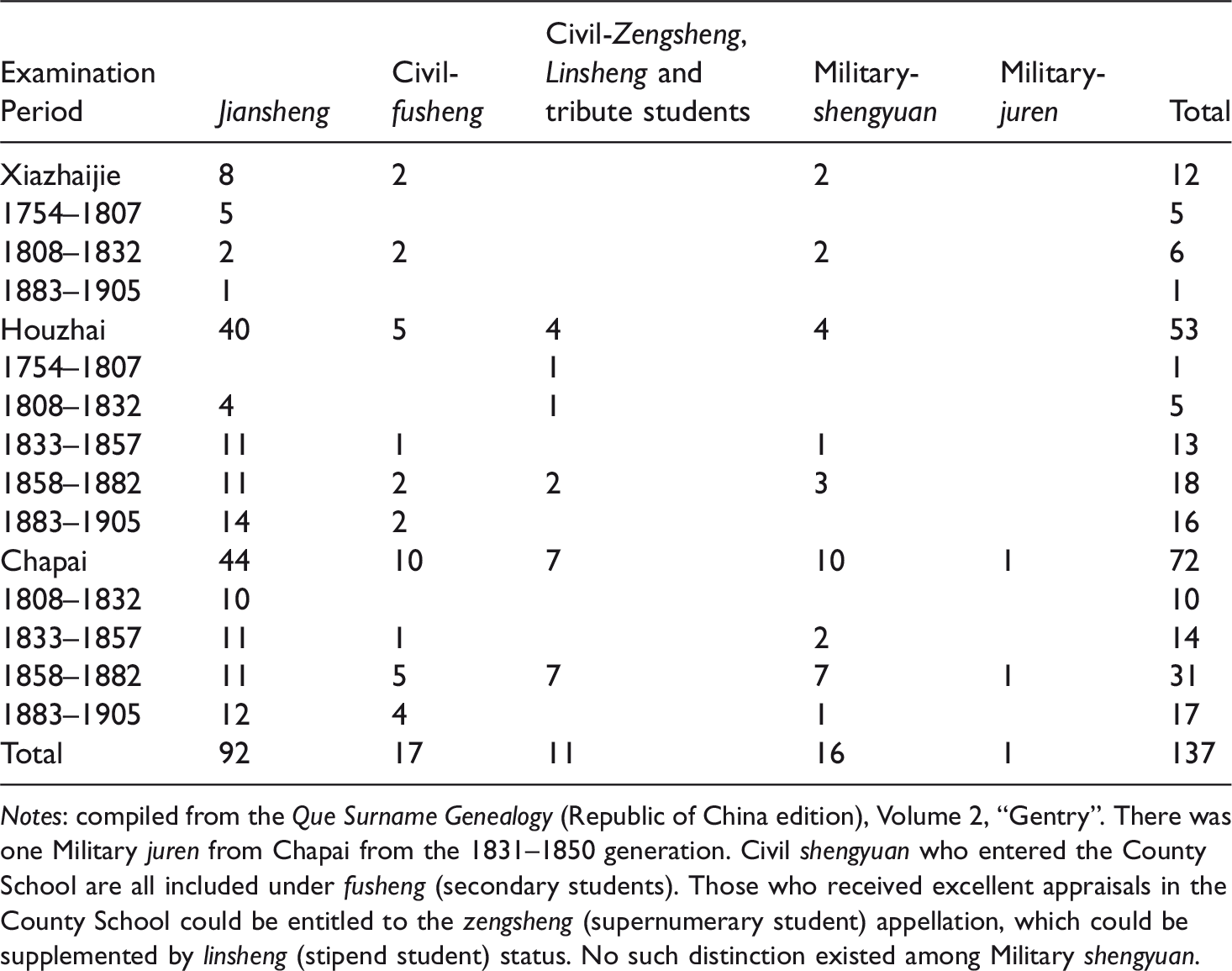
Notes: compiled from the Que Surname Genealogy (Republic of China edition), Volume 2, “Gentry”. There was one Military juren from Chapai from the 1831–1850 generation. Civil shengyuan who entered the County School are all included under fusheng (secondary students). Those who received excellent appraisals in the County School could be entitled to the zengsheng (supernumerary student) appellation, which could be supplemented by linsheng (stipend student) status. No such distinction existed among Military shengyuan.
The Que Surname Genealogy (Jiaqing Edition, 1807) listed 203 individuals with various degree types, but among these, only one tribute student lived at Houzhai, while five jiansheng lived at Xiazhaijie. However, the Republic of China Edition of the Que Surname Genealogy shows that a total of 131 males had obtained degrees after the Jiaqing Edition. Among them, 87 had achieved jiansheng status, accounting for 66% of the total. Evidently, purchase was the main way to obtain a degree for the Que in this period. For Civil Examination shengyuan, there were 17 fusheng, and 10 zengsheng, linsheng or tribute students. Among Military Examination candidates were 16 military shengyuan and one juren. 9
A total of 1277 males were born before 1890 among the Shicang Que, 160 of them from the Xiazhaijie branch, 190 from the Houzhai branch, and 927 from the Chapai branch. Males with various degree types account for 10.7% (137/1277) of this total population, of which 3.5% (45/1277) had achieved degrees through passing the highly competitive Civil or Military Examinations. These two figures are much higher than the average for Zhejiang Province. 10
Overall, the achievements of the three Que branches in the Imperial Examinations were considerable, but there were great differences between branches. The Xiazhaijie Que was the first branch to produce lower-level gentry, but the earliest to withdraw from Imperial Examination competition: seven Xiazhaijie Que purchased the jiansheng degree during the Qianlong Period, and, in 1823 and 1826 respectively, two individuals passed the County Military Examination. There was no further success. 11 Que in the Houzhai branch began purchasing the jiansheng degree after 1808, during the fourth generation at Shicang, and one to three individuals participated in the Civil and Military Examinations in each generation. Around the first compilation of the genealogy in 1808, no individuals in the Chapai branch had gained any academic degree, but this branch later took the lead, first through purchasing jiansheng status, thus gaining degrees and becoming gentry; breakthroughs in the Civil and Military Examinations followed from 1833 to 1857 and reached a peak between 1858 and 1882, when the Chapai Que purchased 11 jiansheng and produced 12 shengyuan in the Civil Examinations. The branch also gained seven Military Examination shengyuan students and one Military Examination juren.
The most successful Ques of the Chapai branch participated in the Examinations through two stages: firstly, purchasing jiansheng status, and, secondly, participating in both the Civil and Military Examinations. There were three causes behind their success. First, Chapai Que's success in the iron-making industry: Que Tiankai did very well through smelting iron—“the fire in the furnaces did not go out for three months”. Tiankai’s sons each operated their own iron furnaces (Cao and Jiang, 2010). Second, Chapai branch's breakthroughs in the Imperial Examinations, which followed a pattern of establishing family-sponsored education (Zhang, 2003: 119). The founding Que ancestor, Que Qixing, had established a Clan School, and Que Tiankai and descendants founded additional family education funds when dividing the household among their sons. 12 Third, the Chapai branch was more successful in achieving a balance between the Civil and Military Examinations. Under the leadership of Que Hanhe, a military shengyuan who passed the County Examination in 1850, the Chapai Que had achieved breakthroughs in the Military Examinations.
Protecting family wealth and sitting for both Civil and Military Examinations
In traditional Chinese society, the real motivation for participants in the Imperial Examinations could either be safeguarding their families or moving up the social ladder: it is often difficult to determine which. One indirect method lies in examining career planning for children and the relationship between the Imperial Examinations and “household management”. In traditional China, the individual’s career path was commonly set out by the father. Merchant families often arranged for some of their children to study Confucianism and, as a risk-avoidance strategy, arranged for others do business (Ho, 1967: 290). Enjoying a special status, the eldest son was often encouraged to participate in the Imperial Examinations, usually the Civil stream; it would be arranged that the second son, third son, and so on would do business, or participate in the Military Examinations. When the family economy deteriorated and it became difficult to provide this support for the Imperial Examinations, the family would give up on them and return to the commercial field (Tang, 1997) or abandon the Civil Examinations and turn to the Military Examinations. For small-scale merchant families, this type of planning and Imperial Examination strategy could indirectly reflect both motivation for protecting wealth and the pursuit of upward mobility.
The driving force behind Que participation in the Military Examinations was Que Hanhe, also the author of Account Books recording details of Examination participation. Hanhe’s study name was Feilong (Flying Dragon), and he had the fortuitous penname Dengyun (Ascending the Clouds). He was born in 1821, passed the Military County Examination in 1851, and died in 1880.
13
Que Hanhe’s cousin and disciple, the Military juren Que Jinzhang, described Hanhe’s Imperial Examination career: My Lineage Master, Que Dengyun, was the second son of Que Songshan, and my uncle … When he was young, he liked to read the Classics, which he had a fine understanding of, in which he stood out from the crowd. Then his father died, so he had to quit poetry and books and learn to run the family business. In the prime of his life, he began to learn martial arts, and become the student of Ye Tingfang, a famous Military juren in Songyang County. He could draw the bow like a full-moon, and shoot the arrow like a meteor. Although there were also other people with such strength, there was no one who could outdo him. He passed the Military Examinations, increasing local people’s enthusiasm for it. Truly a hero of Songyang, and a mighty man of Shicang!
14
Taking the Imperial Examinations required financial support. In addition to land inherited from his father, Que Hanhe also took an iron-smelting area inherited from his grandfather—an abandoned sandbar—and converted it to fertile land (Jiang and Cao, 2012: 137). At the same time, after accumulating wealth, Que Hanhe purchased land continually. He made 27 purchases of land over a quarter-century (1844–1869), spending around 801 taels of silver. 17 Que Hanhe therefore became a small-scale landlord, with the financial resources to maintain a high standard of living and participate in the Imperial Examinations. 18 Que Hanhe left a total of four Account Books recording Examination-related activities, as well as 14 family income and expense Account Books, one Account Book recording employee management, two Account Books recording the marriages of his sons and daughters, and two Account Books recording rented lands (Cao et al., 2018). These are important historical materials for studying Hanhe’s examination career and experience setting up workshops for tutoring Military Examination students. The Examinations Account Books record, in detail, daily catering expenses during the examination, the process of preparing for the examination, each individual equestrian practice session, and so on, with some records of the expenses incurred in household celebrations for admission into the County School.
Que Hanhe’s investment in the Imperial Examinations can be divided into two sections: his cultivation of his son; and the setting up of workshops and recruiting apprentices.
In the early days of the decline of the iron industry, Que Hanhe began converting a sandbar into fertile lands, as well as renting out and buying up land, while also cultivating his sons with traditional education. Que Hanhe followed a principle of providing equal opportunities for his sons. In the family employee Account Book, he provided details on hiring private tutors. We can parse out from this that his six sons entered private school at the age of six and finished schooling at the age of 13 (Jiang and Cao, 2012). After completing primary education, Hanhe’s career plan for his sons was as follows: the eldest son Que Yufan would go on to take part in the Civil Examinations, and the second son Que Yuyu and third son Que Yujin would both follow his path in preparing for the Military Examinations. Que Yufan achieved Civil shengyuan status in 1866. Two years later he was successfully increased to zengsheng (supernumerary student) level. 19 Que Yujin obtained the pre-student (yisheng) title in 1877. In the early Guangxu Period, during a wave of revitalization in the Shicang iron industry, Que Yufan is not recorded as running any business in the Geneology and Account Books; in the Shicang Contracts Yufan only appears as ghostwriter for one land transaction in 1896: a parcel of land sold to a cousin at a price of 27 yuan of foreign silver (Cao et al., 2012: [5] 88). In this period, meanwhile, Que Yujin set up an ironware store (Jiang, 2015). Hanhe’s plan for his son’s career reflects the traditional Chinese conception of birth order, namely that the eldest son would enjoy higher status. It also shows that, following the decline in the iron industry, Que Hanhe wished to improve social status via the Imperial Examinations.
After passing the Military County Examination in 1850, Que Hanhe headed to Hangzhou, to participate in the Zhejiang Provincial Examination of 1852, participating in the qualification examinations for three consecutive trials (1853, 1856, and 1859) to guarantee his right to sit the Provincial Examinations. But it seems Que Hanhe did not employ this right, since he has left no further record of sitting for the Hangzhou Examination. 20 The Taiping Army occupied Hangzhou from 1861 to 1862, so the Zhejiang Provincial Examinations were postponed for two rounds. In 1864, Que Hanhe gave up on these Qualification Examinations, completely washing his hands of the Provincial Examinations. 21 In 1865, at age 45, he opened a private school. Que Hanhe’s Examination Account Books contain no items for income through shuxiu (tuition fee) and jiejing (festival gifts), common in other tutors’ Account Books (Xu, 2006). Items furnishing income are concentrated around the County Examination period each April, and the Prefectural Examination each October; and expenditures include the purchase of ingredients, fees for equestrian practice, and the cost of chartering boats (to commute from Shicang to the County and Prefectural Schools). Que Hanhe is seen mainly playing the role of the organizer for Military Examination training and preparation.
Que Hanhe himself failed to obtain the Military juren degree, but his cultivation of apprentices was a great success. Que Jinzhang, the only Military juren in Shicang, attributed such success to Hanhe’s “patience and encouragement” and “teaching students according to their aptitude”. 22 Hanhe’s students for such Military Examination preparation, and their accomplishments, are presented in Table 2.
Figures for Que Hanhe’s students in examination preparation and their achievements.
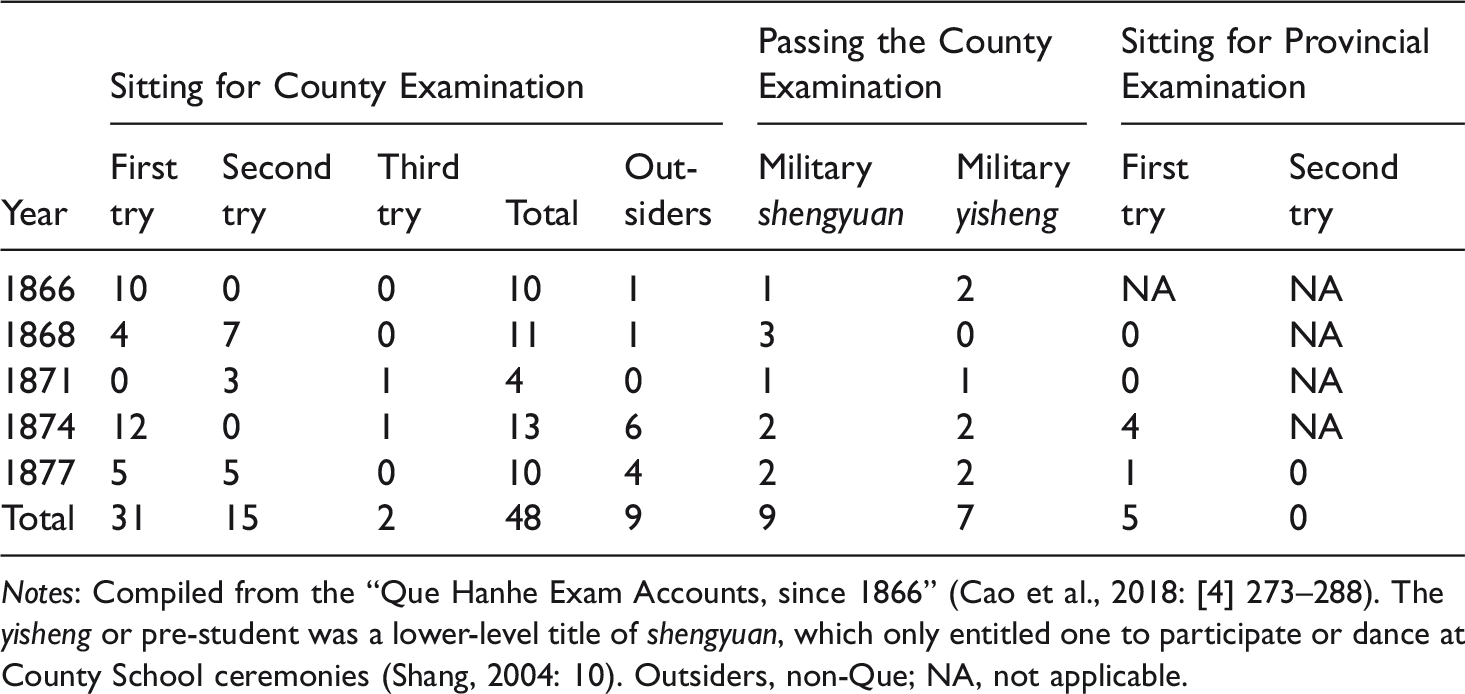
Notes: Compiled from the “Que Hanhe Exam Accounts, since 1866” (Cao et al., 2018: [4] 273–288). The yisheng or pre-student was a lower-level title of shengyuan, which only entitled one to participate or dance at County School ceremonies (Shang, 2004: 10). Outsiders, non-Que; NA, not applicable.
From 1866 to 1877, the Chuzhou Prefectural Government held a total of five rounds of Military shengyuan Examinations. Each round featured three levels: County Examination; Prefectural Examination; and Provincial Education Director’s Examination (yuanshi). 23 The County and Prefectural Examinations were generally conducted in April, while the yuanshi was conducted in October. Table 2 shows that during these twelve years, Hanhe trained a total of 31 students to sit for the Military Examinations, nine of whom passed, an overall pass rate of 29% [9/31]. The quota for military shengyuan for each round of examinations for Songyang County was 12 individuals, making 60 lucky students for these five rounds. 24 Que Hanhe’s students accounted for 15% of this [9/60]. Another seven were admitted to military yisheng status. Yisheng, also known as “Music and Dance Students”, could directly skip the County and Prefectural Examinations, to take the Qualification Examination directly (Shang, 2004: 10). It was as Que Jinzhang had said: “capable individuals come to be his disciples, no matter their age”, and indeed Que did “help endless numbers of students pass the exam”. In 1868, the Vice Minister of the Ministry of Rites and Provincial Military Commander for education of Zhejiang Province awarded Que Hanhe with a tablet inscribed with the words, “Excellence in Tutoring Examination Students”. 25
Table 2 also shows that of these 31 total participants in the Military Examinations, only 15 sat the examination twice, and only two participated three times; one was Que Jinzhang, who later became a Military juren. The Que achieved nine military shengyuan over these five rounds of examinations. But only five Que individuals participated in the Provincial Military Examinations, and none took part twice. Their behavior was like that of Que Hanhe, who quit the Provincial Examinations after only one try. By participating in the Military Examinations, therefore, one could achieve physical fitness and also sit for one or two rounds of the tests, in order to protect family wealth. This practice seems to have been popular among locals.
On the whole, Que Hanhe cultivated a large number of Military Examination students with a high pass rate and even successfully trained a Military juren. In addition to Hanhe’s own powerful organizational skills, another major reason for his success was the impact of the Taiping Rebellion.
Firstly, the Taiping Rebellion resulted in a population loss of 35% in Chuzhou Prefecture, with the most grievous losses in Songyang County (Cao, 2001: 483). The Taiping Army attacked Songyang County twice, in 1858 and 1861 (Lü and Gao, 2011: 503). Shicang was also invaded by the rebels and suffered huge property losses. 26 Northern and central Zhejiang suffered, and the number of Imperial Examinations participants decreased. Therefore, even if the quota of shengyuan did not increase, as in other counties in Zhejiang province, the pass rate of the Military Examination in Songyang would indeed increase over what came before. 27 A similar situation held for other regions (Liang, 2009).
Second, the intrusion of the Taiping Rebellion into Shicang also fueled young people’s enthusiasm to learn martial arts. For example, in 1862, Que Zhaoyou, a cousin of Hanhe, followed Hanhe’s lead in preparing for the Military County Examinations, passing the first round in 1863. He listed two reasons for his selection of the Military track. One was the rather time-consuming nature of his family business, with the Civil Examinations requiring more time; the second was the Taiping incursion, which had motivated Que Zhaoyou to “cast down the brush and take up arms”. 28
Evidently Hanhe’s decision to set up a workshop in 1864 was oriented towards the Military Examinations. Was this Military Examination preparation group, centered on himself, an extension of lineage organization, or a social group that transcended the lineage? In Table 2, the number of outsiders (non-Que) accounts formed 16% (9/55) of the total number of candidates. Among these the Gao’s and Ye’s, successful Imperial Examination families who formed the majority of outsiders, had marriage relationships with the Que. 29 Therefore, this was an examination group centered on the Que lineage.
Figure 1 shows (in italics) some of the Que lineage members who studied martial arts under Que Hanhe and includes one Military juren, five Military shengyuan, and three Military yisheng. In Hanhe’s own Shengzong Branch, Tiankai and Tiangui’s descendants were all involved in such applications. As has been already stated, before the rise of the Chapai Que, most degree holders came from the Houzhai Branch. With the establishment of Que Hanhe’s martial arts workshop, young people in Houzhai also followed Hanhe to learn martial arts, and three of them even successfully obtained the Military shengyuan degree.
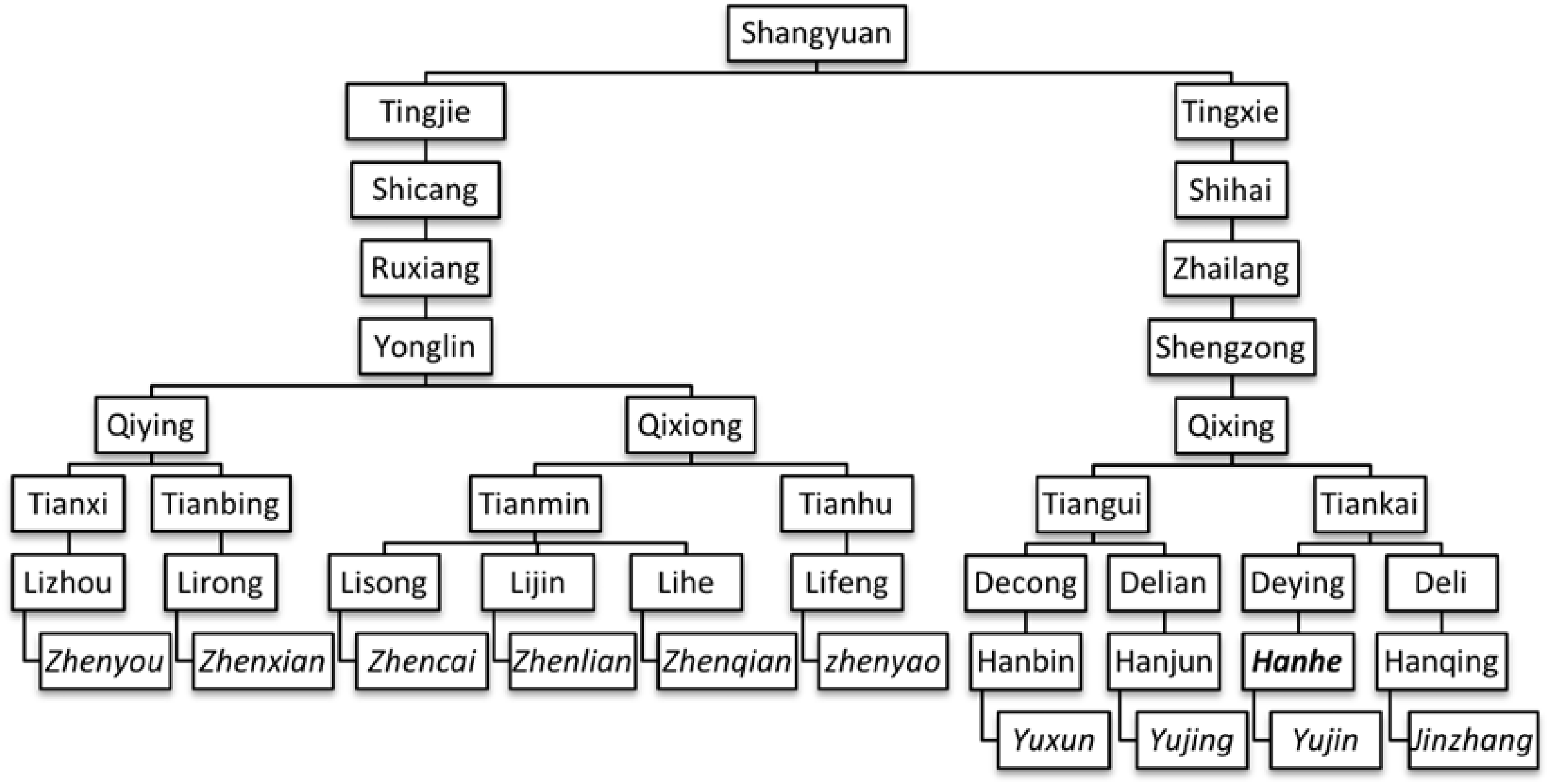
The students of Hanhe in the Martial Art Club (part).
Under Que Hanhe’s leadership, the Chapai and Houzhai Que adopted a strategy of sitting for both the Civil and Military Examinations, breaking through in the latter. In the Shicang Que Surname Genealogy and Household Division Books, there is no formal statement regarding treating the Civil and Military Examinations differently. 30 Although Shicang individuals continued to participate in the Civil Examinations, many students also seized the opportunity of a higher pass rate which followed the Taiping Rebellion, becoming Military shengyuan. This strategy of different lineage individuals sitting for both examinations legitimately raised the social status of the Chapai Que. Their de facto leader, Que Hanhe, also successfully achieved the goal of running a family business, while protecting the family through participations in the Imperial Examinations.
The trap of upward mobility
After successfully achieving this goal of protecting the family, Examination participants would have to make a decision about whether to continue to struggle to pass the next level or withdraw from the Examinations, to avoid the ultimate fate of failure in such a highly competitive system. Que Hanhe himself provides a good example of exiting the Provincial Examination after one try. But for those who were obsessed with Imperial Examinations, expectations of upward mobility offered by the system may have formed a sweet and invisible trap.
In the Chapai Branch, Que Yuheng and Yujing’s great-grandfather was Que Tiangui, their grandfather Que Deyin, and their father Que Hanjun. The brothers Tiangui and Tiankai had many successful iron-making descendants, Que Hanjun being one of them. While working in the iron industry, Que Hanjun purposely married into a successful Imperial Examinations family, his wife being Miss Ye, the daughter of Ye Zengfa (zengsheng) from Songyang County, and also sister to Ye Weifan (jinshi) and Ye Weiyuan (linsheng) (Luo, 2016). Miss Ye and Que Hanjun sired two sons and two daughters and trained both sons, Yuheng and Yujing, to participate in the Imperial Examinations. 31
Que Hanjun’s eldest son, Que Yuheng, was born in 1836 and admitted to the County School as a Civil shengyuan in 1864. Yuheng’s study of Confucian classics was highly valued by the family. First, the status of the eldest son was important, as the “key heir”. Yuheng was only 11 years old when his maternal uncle, Ye Weifan, passed the Metropolitan and Palace Examinations and became a jinshi. Yuheng learned more of the Classics and poetry from his junior maternal uncle, Ye Weiyuan (linsheng), than from Que Yuheng. 32 Ye Shulian, author of Yuheng’s biography, was the son of Ye Weiyuan, and so a friend of Yuheng, who later became his classmate at the County School. With his uncle’s guidance and also his own efforts, Que Yuheng successfully passed the Civil County Examination and entered the Prefectural School two years later. Yuheng’s investment in the Civil Examinations and the model provided by his senior uncle Ye Weifan, brought about a higher upward mobility expectation, and also, related to that, determination to achieve the literati lifestyle.
However, in 1858, Taiping rebels invaded Shicang, and Que Yuheng’s family fortunes declined. In order to revitalize the family, Yuheng decided to withdraw from the Civil Examination competition and turned to the salt business in neighboring Suichang County. Unfortunately, this business turned out to be a big failure. The failure was described by Chen Qifu in his biography of Yuheng’s younger brother, Que Yujing. 33
Que Yuheng had taken the Civil Examinations, while his younger brother Que Yujing chose the Military Examinations. Their father, Que Hanjun, made this arrangement deliberately. When Yuheng left home to escape debtors, his younger brother took over all family responsibilities.
Que Yujing was born in 1841 and died in 1892. His first wife was the second daughter of his elder uncle-in-law, Ye Weifan (jinshi). His second wife was from the Gao Lineage in Xiangxi Town in Songyang County. 34 Que Yujing therefore enjoyed a marital relationship with Gao Huanran, another civil jinshi in Songyang County. Gao Huanran spoke of himself as a marital cousin to Yujing and later composed a poem of mourning for him. 35
Yujing earned a fine reputation for taking care of his brother’s family after Que Yuheng had left home. At the same time, influenced by Que Hanhe, Yujing devoted himself to the Military Examinations, obtaining the Military shengyuan degree in 1868. While doing that, he reorganized his father’s business and seized the opportunity to revitalize the Shicang iron industry in the late 1860s. 36
Que Hanjun and his son Yujing both married wives from two distinguished nineteenth-century scholar families of Songyang County, the Ye’s and the Gao’s. This reflects the merchant family’s desire for gentry status via success in the Imperial Examination. However, Que Hanjun’s eldest son Yuheng insisted on sitting for the Provincial Examinations, failed, and then experienced a fiasco when trying to run the business. Que Yujing, on the other hand, participated in the Military Examinations in moderation, and undertook financial responsibility for the family. The contrasting fate of these two brothers serves to remind us of the risks of being too radical in one’s approach to the Imperial Examinations.
The Military juren, Que Jinzhang, provides another example of a wholehearted commitment to that industry. Jinzhang, who in the Que Genealogy also goes by the name Que Yuxiong, was born in 1849, and died, in the Republic of China, in 1921. 37 He followed Que Hanhe in the study of martial arts, and obtained his Military shengyuan Degree in 1871, successfully passing the Zhejiang Provincial Examination in 1875, on his second try, ranking 58th. 38 In 1878, Jinzhang’s grandfather, uncle, and father were all awarded the title of Honorary Commandant, the highpoint of Chapai Que glory in the Imperial Examinations. 39
After passing the Provincial Examinations, Que Jinzhang went to Beijing to sit the Metropolitan Examination. Lin Zhongxiang, a Company Commander (military post) from neighboring Longquan County, traveled to Beijing with Jinzhang for the same examination. Renting the same Beijing accommodation, the two became friends. Lin Zhongxiang described Jinzhang’s Imperial Examination for the Que genealogy. 40
Que Jinzhang, wrote Lin, had been to Beijing to participate in the Metropolitan Examinations, but the “expenditures were huge and voluminous, and thus it was hard to make ends meet”, and even his family was brought low by the costs. Following his failure in the Examination, Jinzhang apprenticed at the Brigade in Chuzhou Prefecture, but failed in the official selections by the Governor-general. 41 His participation in the examinations and pursuit of an official career began at the inception of the Guangxu Period, when the Shicang iron industry had already begun its revival. Jinzhang would obviously miss out on the chance to revitalize the industry in the manner of Que Yujing discussed above. Instead, Jinzhang chose to sell inherited land to support his examination expenditures. In 1894, he pawned one piece of land for 16 yuan of foreign silver, and in 1897, he sold a piece of rice paddy fields for 68 yuan of foreign silver (Cao et al., 2012: [6] 66, 72).
Yuheng, Yujing, and Jinzhang’s Imperial Examinations stories demonstrate how, when the Ques participated in the examinations, the huge cost of the Provincial and Metropolitan Examinations could drag down the fragile family economy, once the individual had pursued a goal beyond the protection of family wealth and become infatuated with examination success, regardless of whether this was on the Civil or Military route.
Conclusion
In “The Poem of the Prodigy”, Wang Shu wrote that “to be a scholar is to be at the top of society”. Unlike contemporary investment in human capital, sitting for the Imperial Examinations can best be seen as a kind of “consumption” due to the low pass rate. Among the various criticisms of the Imperial Examination System from the Ming and Qing Dynasties, most common was the rigidity of the eight-legged writing style, which did not favor truly talented individuals. Critics also pointed out that dreaming at night that they had passed the Imperial Examinations caused numerous students to actually sit for the examinations in a fever, resulting in a large number of lonely and useless scholars such as the Fan Jin in the famous Qing novel, Unofficial History of the Scholars (Rulin waishi) (1750). Through a comprehensive analysis of participation in the Imperial Examinations in a small-scale merchant family, this article attempts to break away from such myths.
The participation of the Shicang Que in the Imperial Examinations before and after the Taiping Rebellion provides an opportunity to closely examine the motivations and potential reasons for this family of small-scale merchants’ involvement in the examination system. In the 1800s, the Shicang Que had initially become wealthy through the iron industry. Later, by purchasing the jiansheng title and sitting for the Civil Examinations, they began to ally with local gentry families through marriage (Luo, 2016). Thus, the Que family was successfully localized and joined the gentry community of Songyang County. As further analysis reveals, following the economic depression of the Daoguang Period and the invasions of the Taiping forces that followed, Que Hanhe would direct young Que family members to participate in the Military Examinations, with outstanding results. Facing this new opportunity, descendants of old Que Imperial Examinations elites also rushed into martial arts under the leadership of Que Hanhe. Although this strategy of “sitting for both Civil and Military Examinations” was not necessarily deliberately planned, the pass rate would increase following the Taiping Rebellion, and it proved a wise choice for achieving upward class mobility.
Following Que Examination success, expectations of upward mobility through the Imperial Examinations formed a trap. Although the Imperial Examinations were beneficial, one’s participation needed to be moderate. In fact, those following a principle of moderate participation would not end up tragically like Que Yuheng, but could choose some culture-related occupations. Que Hanxin, a Civil shengyuan who entered the County School at the same year as Que Hanhe, became a fengshui master after quitting the Civil Examinations. 42 Que Yubiao, a Civil shengyuan, opened a pharmacy in Songyang County (Wang and Cao, 2014). Most Military shengyuan were like Yujing, practicing martial arts and doing business in parallel, and in some cases sitting just once for the Provincial Examination. Poverty due to over-application to the Imperial Examinations, as in Que Jinzhang’s case, was rare.
Huang’s (1985: 1) analysis of the peasant economy of Northern China pointed out the necessity of considering three aspects of small-scale peasant households in a single, inseparable unity when considering peasant behavior in rural society and the rationale behind it: small peasants were not only the profit seekers, as pointed out by the “formalists”, but also the producers of subsistence, as pointed out by the “substantivists”, and the exploited, in the Marxist sense. Similarly, the two varieties of motivation for the imperial examinations—the protection of the family and upward mobility—coexisted in the participation strategies of young Que students. When participating in the Imperial Examinations process, rural merchants would take advantage of different disciplines within the system. At the same time, only a very few examination devotees were caught in the trap of upward mobility. When Gu (1959: 22) wrote that students participating in the Imperial Examinations primarily gave the impression of doing so to protect their households, this reflected the natural consequences of self-adjustment within civil society.
Footnotes
Acknowledgements
I thank Professor Cao Shuji of Shanghai Jiao Tong University for giving me the opportunity to co-edit the Shicang Contracts Volume Five (Cao et al., 2018), which furnished me with these exciting historical documents. I also thank Edward Allen for providing useful comments and suggestions on this paper, especially this English version.
Declaration of conflicting interests
The author(s) declared no potential conflicts of interest with respect to the research, authorship, and/or publication of this article.
Funding
The author(s) received no financial support for the research, authorship, and/or publication of this article.