



Abstract
I present an overview of selected findings from four major research projects I conducted earlier in my career that were designed to describe and explain the patterns of continuity and change in family patterns in the People’s Republic of China: an examination of rural family patterns carried out through refugee interviewing in Hong Kong in 1972–1974; a parallel examination of urban family patterns carried out through Hong Kong refugee interviews in 1977–1978; an examination of the transformation from arranged to free-choice marriages conducted through a survey in Chengdu, Sichuan, in 1987; and an examination of patterns of intergenerational relationships carried out through a 1994 survey in Baoding, Hebei. The latter two projects included comparisons with the findings of earlier surveys of family behavior in urban Taiwan. Each project yielded findings that did not fit prevailing theories of family change, and in my efforts to explain puzzling findings, I ended up emphasizing the impact on families of the specific local institutions produced by China’s socialist transformation in the 1950s. Even though many of these institutional arrangements have been altered in the reform era, I argue that in certain realms of family life, the impact of pre-reform decades can still be seen in family patterns in recent times.
Keywords
Throughout my career, I have had a strong interest in puzzling out the complicated patterns of continuity and change in Chinese families. I have concentrated my research on social life in the People’s Republic of China (PRC), so my particular goal has been to collect information on current family behavior and trends in order to understand and explain how family patterns in post-1949 China have evolved and why. The methods I have employed have varied. I cannot claim the benefits, or the ethnographic battle scars, of having lived in a Chinese village or urban neighborhood in order to directly observe daily life and participate in family activities and rituals. Instead, I have relied upon two primary methods: in-depth interviewing conducted ‘at a distance’ in Hong Kong (three stints between 1968 and 1978) and, in the 1980s and 1990s, sample survey research on families in several cities, conducted with PRC collaborators. 1
Prevailing theories of family change
When I began my research on Chinese family patterns, there were two primary (and contending) theoretical frameworks used to try to understand family change in the PRC: the state directed-change framework and modernization theory. Singly or in combination, I found these frameworks inadequate for understanding the complex realities of contemporary family life that I had discovered in my own research (and in the work of others). As will become clear, I have come to think that elements of both these frameworks help explain some features of Chinese family change under some circumstances, but that they must be supplemented in order to understand the complex realities of family change patterns in the PRC.
State directed-change
The state directed-change framework can be viewed as an ‘irresistible-force-meets-an-immovable-object’ scenario. There are several underlying assumptions: that Chinese are very attached to their family traditions going back centuries and will resist attempts to make them change or adopt new family patterns (the immovable object); that the Chinese Communist Party (CCP) came to power with an ambitious social change agenda, with family change a high priority (as symbolized by the early adoption, in 1950, of the Marriage Law of the PRC) backed up by an impressive enforcement apparatus (the irresistible force); and that the resulting patterns of family change, or of successful resistance to change, are the outcome of the sustained struggle between these two opposing forces.
This is the primary framework used in C. K. Yang’s early book, The Chinese Family in the Communist Revolution (Yang, 1959; see also Meijer, 1971). Much of that work is devoted to examining the provisions of the 1950 Marriage Law and subsequent PRC government statements on family policy and state enforcement efforts, as well as press reports and statistical evidence, in order to determine both what the specific family-change goals of the CCP were and how successful or unsuccessful the CCP was in getting the Chinese people to comply. For the most part, Yang depicted only partial success by the CCP in fostering family change, with a combination of inability to effectively enforce its will and the entrenched resistance of Chinese families explaining the lack of fuller success in directed family change. 2 If one assumes that state directed-change is the primary force altering Chinese family patterns, the actual patterns of change should reflect state family-engineering priorities, with enforcement difficulties and family customs which the population was particularly determined to preserve explaining any departures from the official family-change targets. However, as I discuss below, in my research on rural family patterns in Guangdong in the early 1970s, that was not the pattern of family change I discovered.
Modernization
The rival framework that was also very influential at the time I began researching Chinese family change was modernization theory. In particular, William J. Goode had written a classic work, World Revolution and Family Patterns (1963), that examined historical evidence on family trends in various countries and regions around the globe to support his contention that the multiple transformations produced by modern economic development (industrialization, urbanization, bureaucratization, commercialization, etc. – all grouped together under the umbrella term, ‘modernization’) create pressures that tend to erode a variety of traditional family customs and foster trends toward what he termed the ‘conjugal family’. The conjugal family is an ideal type in the Weberian sense, rather than an actual family structure, one that emphasizes the husband–wife bond as the most important family tie, with couples making decisions and managing their families relatively autonomously, with little influence or interference from other kin (including parents). Among the concrete manifestations of conjugal families are a preference for nuclear-family living, marriage in young adulthood based on free choice of the future spouses, relative absence of patriarchal gender roles, and fairly brittle marriages, with substantial freedom to divorce. Given that most Chinese families in 1949 were, in Goode’s terms, quite unconjugal, this framework seemed to provide a promising framework for examining actual family-change patterns in the PRC. 3
Two features of Goode’s family modernization framework deserve special emphasis, given that the issue at hand is explaining family-change patterns in the PRC. First, in general, Goode saw state family policies and state social engineering (state directed-change efforts, in other words) as having substantially less influence on the course of actual family change than modern economic development. In Goode’s view, if any particular government tried to promote new family patterns that were not compatible with the current developmental level of the society, those efforts would be unlikely to succeed. 4 Second, in the views of Goode and other modernization theorists, it doesn’t matter much what form of property relations exist in a society or, in other words, whether economic development takes place in a capitalist or a state socialist mode. What matters most is, again, what level of economic development has been reached by the society as a whole and by particular regions and sub-populations. Modern economic development has a homogenizing effect on family patterns, with countries ‘converging’ toward more conjugal family patterns as they become modern industrial societies. Thus, contrary to Marx and Engels, the socialist families of the Union of Soviet Socialist Republics (USSR) and the capitalist families of the USA (as well as the post-Meiji families of Japan, etc.) should increasingly resemble each other while being quite different from their pre-industrial family forms. 5 According to the logic of modernization theory, then, within China the periods of most rapid modern economic development should have produced the most movement toward more conjugal family patterns, and those portions of the population whose lives have been most transformed by development transitions (e.g. urban, educated groups) should have departed the most from traditional family patterns. In addition, Chinese living in more highly developed areas outside of the Chinese mainland, such as Taiwan and Hong Kong, should display family patterns that are more conjugal than their counterparts in less economically developed areas. However, as I discuss in some detail below, the findings of my research again contradicted these expectations in multiple ways.
In the pages that follow, I selectively introduce findings on family-change patterns resulting from my various research projects, discussed in chronological order. As I do so, I will point out how specific findings contradicted expectations drawn from both the state directed-change and modernization frameworks, and I will also discuss my attempts to develop more satisfactory explanations of actual family-change patterns in the PRC.
Rural families in Guangdong Province during the early 1970s
In research William Parish and I conducted in 1972–1974, through interviews with refugees in Hong Kong, we tried to learn what recent and current family and marriage patterns were like in rural China. Except for a few cases from neighboring Fujian, all of our interviewees had lived in Guangdong villages. We asked our interviewees not only about their own family experiences, but also about those of their neighbors and friends. For example, in one part of our in-depth interviews, we asked them whether they had attended any recent local weddings. If they had, we asked them to describe the couple, their backgrounds, how they had met, the stages of decision making and ritual involved, how the wedding was celebrated and so forth, and then we repeated the questions for any other weddings they had attended. In this fashion we collected fairly systematic information about more than 300 post-1949 rural marriage cases in Guangdong scattered across more than 50 different villages. 6
What we discovered when we analyzed these marriage cases was a complex reality. In some instances, Guangdong villagers in the 1970s were fully complying with official family policies. For example, we didn’t learn of any cases of taking new concubines, nor did we hear of any recent cases of tongyangxi – a girl who had been adopted as a child and raised alongside the son of a family to whom she would later be married. However, we also discovered multiple current marriage customs that displayed only partial changes in the direction of CCP marriage change goals. For example, although couples were generally older when they married than had been the case before 1949, most brides (about two thirds) and about half of all grooms were marrying younger than the ‘late marriage ages’ the CCP stipulated in rural areas during the 1970s (23 for a bride and 25 for a groom). 7 Also, even though parents were not arranging the marriages of their children in the traditional fashion, they still often took the initiative in finding them potential marriage partners, and a son or daughter could not marry without parental approval. In another example, weddings still involved considerable feasting and expenditure, rather than the frugal and simple weddings recommended in CCP propaganda.
More surprising than instances of partial rather than full compliance with CCP family policy were two other patterns we discovered. First, we learned that despite the official prohibition of demands and negotiations over bride prices contained in the 1950 Marriage Law, very substantial bride prices were still being negotiated and transferred in virtually all marriage cases described to us for the 1970s, and even a production brigade CCP secretary had to offer a substantial bride price if he wanted his son to be able to get married. On the obverse side of the change picture, we also learned that in a substantial number of cases, traditional village and lineage exogamy rules had broken down, with some newly marrying couples being from the same village or even sharing the same surname. 8
When I attempted to cross-tabulate the degree of change away from traditional marriage customs with family change goals stressed versus not stressed in official PRC family policies (see Table 1), this complexity was confirmed. 9 In general there was very little correspondence between actual family-change patterns and the family-change goals of the state. In regard to marriage customs the CCP had tried to change, with some there was very substantial change, with others partial change, and with still others little sign of any change (see the left-hand side of Table 1); but the same pattern is visible in regard to family customs that the CCP did not try to change (on the right hand side of Table 1).
The pattern of change and continuity in rural marriages in the Mao era.
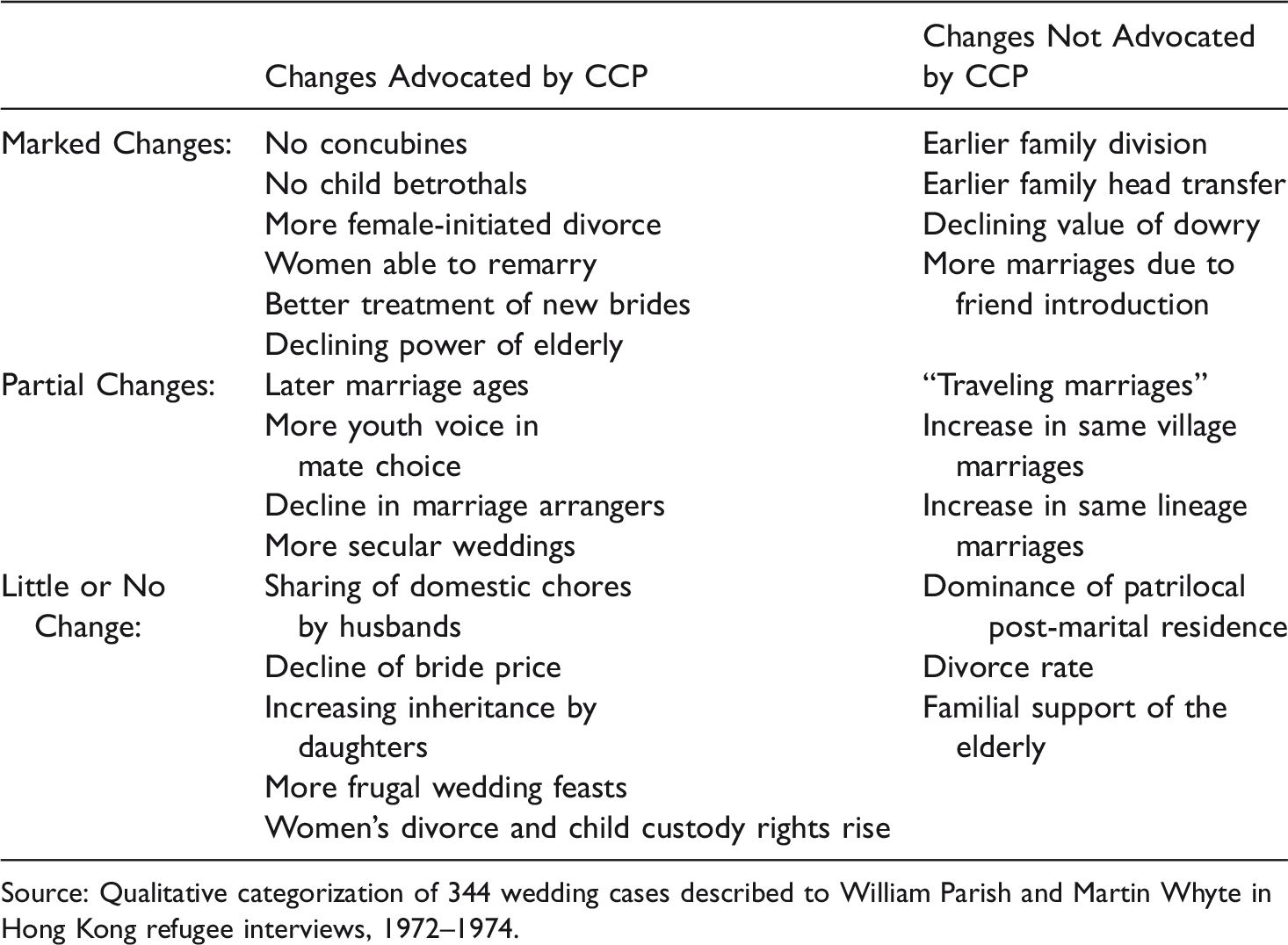
Source: Qualitative categorization of 344 wedding cases described to William Parish and Martin Whyte in Hong Kong refugee interviews, 1972–1974.
It is obvious that the state directed-change scenario does not fit the patterns observed in Table 1. It is also clear that modernization theory does not help clear up the confusion. The latter theory posits that economic development is the main driver of family change, and that when such development occurs, multiple aspects of family life become more conjugal. However, in the absence of much progress in terms of modernizing transformations, rural Guangdong families were becoming somewhat more conjugal in some respects (e.g. somewhat greater youth say in mate selection), 10 but not in others (e.g. continued demands and negotiations between families over bride prices). How can these divergent and apparently contradictory change patterns be explained?
In interpreting the complex pattern of continuities and changes in marriage and other family customs, Bill Parish and I became convinced that we needed to focus on the specific changes in the local village social institutions produced by the socialist transformation and other post-1949 changes. In subsequent writing, I have distinguished two roles that the state played as an agent of family change: directed-change and indirect (institutional) change. In terms of the latter, even though Guangdong villagers in the 1970s were not living in an environment that had been significantly industrialized, urbanized, etc. (i.e. modernized), they were living in a very different setting than existed prior to 1949. Agriculture had been collectivized (in 1955–1956), which entailed a large number of changes affecting Guangdong farmers, including the fact that they did not own land and other valuable property they could pass on to their children; that except for work on their private plot and sidelines, labor and earnings were organized collectively with neighbors rather than in family units; and that the earnings of women as well as men were very transparently visible and important to families, even though women usually earned lower work points than did men. Other important changes had occurred as well, including the fact that many more daughters as well as sons than in the past were attending (co-educational) schools at least through primary or even lower middle school levels as well as participating in village militias, irrigation construction projects and other activities alongside village youths of both genders.
We may consider this altered institutional context of the 1970s village socialism, but the important point to stress is that as Guangdong villagers adapted their family behavior to their changed surroundings, in some domains they moved away from traditional customs, while in other domains traditional customs were reinforced. In other words, the actual institutional changes in rural areas had complex, and in some realms unanticipated, consequences, rather than consistently promoting the full range of CCP family-change goals. So the sharp reduction in the role of the family as a unit of production and the associated decline of the family in inheritance and training in work skills, when combined with the increased time and autonomy of youths to associate with potential spouses without direct parental supervision, help to explain both the increasing voice of the young in the decision about whom to marry and the partial breakdown of traditional exogamy customs. 11
But at the same time, the fact that the work-point earnings of youths were distributed to the heads of their families, that housing was built and owned solely by families (i.e. with no local apartments available to rent) and that strict migration controls prevented youths from leaving and making a new life for themselves elsewhere, all contributed to the inability of rural youths to marry without parental approval. The work-point earnings of young women had become so important to peasant family economies that a bride’s family was not willing to part with her without the substantial compensation represented by a bride price, while the groom’s family was correspondingly quite willing to expend a bride price to gain control over her future earnings. 12
Since enforcement of the provisions of the Marriage Law was in the hands of local cadres who were linked by ties of kinship and as lifelong neighbors to families conducting marriages, it was not all that difficult to avoid or evade the rules on late marriage, payment of bride prices, etc. In many instances families simply went ahead and celebrated the wedding of their son or daughter despite the latter being under the stipulated minimum marriage ages. The new couple began their married life at that point, since in the eyes of local villagers it was the wedding feast rather than marriage registration at the commune office that determined when they became husband and wife. Then, when they had passed the stipulated minimum marriage ages, they went to the commune town and officially registered themselves as married, often several years after the fact.
In general, the focus on a more complex set of forces for change produced by a broad range of institutional transformations that affect people’s lives seems an improvement on prevailing ways of making sense of the kinds of changes that our research uncovered. 13 However, that does not mean that the two frameworks discussed at the outset are totally irrelevant. The background context of state directed-change during the early 1970s was in most domains one in which promoting family change had moved to the ‘back burner’ of the CCP’s agenda. So even if rural people were continuing to negotiate over substantial bride prices or engaging in other prohibited or discouraged traditional customs, this was not a matter of particular attention or concern to the CCP leadership then. Another example uncovered in our Guangdong rural interviews was that when family members died, they were universally buried rather than following the officially approved alternative of cremation. Furthermore, we also learned that in many villages, several years after the death of a parent, a ritual specialist would be hired to dig up the bones, place them in a special pottery urn and relocate that urn in a hillside site with favorable fengshui characteristics, all customs that the CCP would have labeled as superstitious. 14
However, since the time of our research, CCP-directed rural family change efforts have been dramatically increased in at least two domains, even if not across the board. The first and most familiar is that escalating state population controls led to much tougher and more direct and intrusive limits on fertility, so that rural families who adjusted their reproductive intentions to their local institutional setting rather than to the birth limits set by the state sometimes faced harsh consequences, including very steep fines, forced abortions and confiscated or destroyed housing and furnishings. 15 Then, beginning in the late 1990s, there was a new and widespread state campaign to require and enforce rural cremation, a campaign with its own coercive abuses of villagers, including forcible removal of the remains of already buried family members and collective cremations, acts that obviously made continuation of second burials impossible. 16
We also need to recognize that the market reforms and rapid economic development that China has experienced since 1978 have spread some of the change forces specified in modernization theory much more widely, precipitating further family changes in rural China. My own family research focus switched after 1980 to urban China, but from the work of researchers such as Yunxiang Yan (2002, 2003) we know these subsequent changes have shifted the balance even more markedly in favor of rural youths in relation to their parents. For example, the ability of rural young people to migrate to the city in search of higher earnings, the relative lack of family property that is a socialist legacy for rural parents, parental reliance on remittance income from their grown children, and the increases in disposable income and revival of elaborate and costly weddings; these and other trends unleashed by the post-1978 reforms produced situations dramatically different from what we observed in rural Guangdong in the 1970s. For example, young people have much more freedom to experiment romantically and even sexually prior to marriage, rural parents increasingly are expected to build a new house if they expect their grown son to return to the village and settle into marriage there, and couples have managed to shift marriage finance increasingly from exchanges between families to gifts and property controlled by the young couple themselves. In other words, even though in my own research, including the work on urban families that I discuss below, I have tended to focus on and try to explain the distinctive stamp that China’s post-1949 socialist institutions have left on family life, it is also important to recognize that both state directed-change and the institutional changes produced by economic development also play major roles in shaping Chinese families today.
Urban family life at the end of the Mao era
The second research project on Chinese family patterns I engaged in, again in collaboration with Bill Parish, was a study of social patterns in Chinese cities in the 1970s. As direct field research on the Chinese mainland was not yet possible, we again conducted this research through refugee interviews in Hong Kong in 1977–1978, with 133 former residents of a variety of cities on the mainland. The primary results were reported in our book, Urban Life in Contemporary China (Whyte and Parish, 1984). I won’t attempt to summarize here all the details of the urban family patterns described to us by our informants, but in general there was much closer correspondence between those patterns and CCP family policies than we had found in our rural Guangdong interviews, as revealed in the parallel accounts of 831 urban marriages we collected in this second project. For example, even though the post-1970 ‘late-marriage ages’ set by CCP policy for the cities were even higher than those in the countryside (a minimum age of 25 for the bride and 27–28 for the groom, unlike the 23 and 25 mandated in rural areas), we found large majorities of urban couples in compliance. We also did not encounter instances of the prevalent rural pattern of having a family wedding and beginning life as a husband and wife at an earlier age and then going to register the marriage officially once the minimum marriage ages had been reached. 17 Registration rather than a family feast was considered by urbanites to mark the point at which the marriage began, and most couples had only very simple wedding celebrations: perhaps a meeting with tea and candies with friends and colleagues in the workplace, sometimes with a speech by the CCP secretary, usually followed by a modest wedding meal at home for family and close friends. 18
More young adults than their parents took the initiative in finding a mate, although they generally then sought parental approval. 19 But a few couples married despite parental disapproval, something we did not find evidence of in our rural interviews. Marriage finance had also departed much more substantially from traditional customs than we had found in our rural interviews. There were generally no direct negotiations between brides’ and grooms’ families over bride prices, or for that matter over dowries. Instead the potential groom was expected to make several gifts to the potential bride in advance of their marriage in order to demonstrate his seriousness. To illustrate the different temper of the times, a fairly standard set of such gifts was referred to as ‘three turns and one sound’ (sanzhuan yixiang) – a wristwatch, a bicycle, a sewing machine and a transistor radio.
Post-marital residence also followed quite different patterns than we found in our rural interviews. Given the extreme scarcity of urban housing in the 1970s, couples were expected to live with one or the other set of parents if there was sufficient room, rather than to request an apartment through the work unit housing allocation system. It was much more common in such cases for the couple to follow the traditional pattern of moving in with the husband’s family rather than the wife’s. 20 However, despite the housing shortage, more than half of the newly married couples in our urban wedding cases started out conjugal life neolocally, living independently in an apartment they had signed up for and been allocated by a work unit. A further important point is that in this period married daughters departed from traditional customs by providing financial and other support to their own parents as well as to their husbands’ parents. In other words, the traditional patrilineal structures that still affected marriage in our rural interviews (with marriage finance negotiations between families and the bride fully incorporated into the groom’s family economically) had already broken down in the socialist cities of the late Mao era (with the couple relationship trumping extended ties, and a bilateral emphasis on providing support to both sets of parents). 21
How can we understand the fact that urban family patterns in the 1970s were substantially different in a whole range of ways from those prevailing then in the countryside? One possibility is that Chinese urban residents, being generally better educated, were more likely to be aware of and obey CCP family policies, resulting in closer compliance with official family change goals than in the countryside. Another possibility is that urbanites were subject to closer and more effective monitoring and control by bureaucratic enforcers of official family policies than their counterparts in rural areas, resulting in larger departures from traditional customs. These explanations are part of the picture: for example, it is plausible that many urbanites who married in the 1970s would have wanted to hold larger wedding banquets if they were not worried about getting in trouble with the authorities.
However, in our book, Bill Parish and I emphasized that the urban family patterns we observed in the 1970s were shaped primarily by the altered institutional features of urban socialism of the period. In other words, the same indirect change mechanism we found helpful in explaining family patterns in rural China also helped us understand the quite different urban patterns we observed, since the urban institutional setting of Chinese socialism was quite different from the rural one. And as in the countryside, that altered institutional structure fostered some changes in family patterns (such as the support provided by married daughters to their own parents) that were not the focus of CCP family change efforts. Another important source of the distinctiveness of rural family patterns is that after 1960, migration of rural residents into the cities was effectively prohibited for the next two decades, inhibiting the sharing and diffusion of customs in this and other realms across the rural–urban divide. 22
How did rural and urban socialist institutions differ in the 1970s? Very briefly, in rural areas, despite collectivization, families and kinship still played more central roles in people’s lives, and bureaucratic institutions and structures less or more distant roles, than in the cities. Generally families lived in housing they financed, built and owned themselves; they maintained a vestigial family productive economy (in the form of crops grown on their private plot and marketed, animals raised, crafts made by hand, etc.), agricultural skills were initially passed on from parent to child, young adults had no alternative to farming and co-residence with parents or parents-in-law, payment for agricultural labor went to the family head rather than to each individual laborer, aging parents had no viable alternative to relying on support from their grown children (usually sons and daughters-in-law) and as noted earlier, the local enforcers of CCP family policies were tied by personal history and kinship to the neighbors whose behavior they were supposed to monitor.
In China’s cities in the 1970s, in contrast, very few families retained ownership of the housing they lived in, most urbanites lived in rented apartments allocated by work units and housing bureau authorities, families did not retain any meaningful productive economy or responsibility for passing on job skills to their children, young people were sorted by school and bureaucratic authorities into work and housing destinations that were largely independent of their parents, 23 wages were paid directly to the individual earner rather than to the head of their family, most aging parents could count on retirement pensions and didn’t have to depend primarily or entirely on support from grown children, and of course the enforcers of CCP family policies and other mandates were almost always unrelated bureaucratic agents who couldn’t so readily be influenced by kinship or other ties. 24 These systematically different institutional arrangements, when combined with the ‘invisible walls’ between Chinese cities and countryside in this period, 25 provided the structural underpinnings for increasingly diverging behavior and norms in family life on the two sides of China’s sharp rural–urban divide.
Changes in mate choice in Chengdu
Since my research on the Chinese family during the 1980s and 1990s focused on urban China, to a considerable extent these later projects can be seen as elaborations and extensions of my earlier work with Bill Parish on urban family life during the 1970s, discussed above. Two primary research projects occupied my attention during those years: a study of the transformation from arranged marriage to free-choice marriage in the lives of women in Chengdu, Sichuan, based upon a collaborative survey I directed in that city in 1987; and a study of the relationships between aging parents and their grown children in Baoding, Hebei, based upon a collaborative survey I directed in that city in 1994. 26 Both of these projects included an important comparative element. I was fortunate to be teaching at the time I launched these projects at the University of Michigan, and my colleagues in the Population Studies Center at Michigan, particularly Albert Hermalin and Arland Thornton, had been conducting collaborative survey research in Taiwan over the years that focused on family change patterns on that island. 27
In the Chengdu survey, my Sichuan University colleagues and I had a representative sample of 586 ever-married women over the age of 20 living in that city interviewed in 1987. The Chengdu survey had another comparative reference point, since many of the questions were based upon a Detroit Area Study survey of ever-married women living in that city that I had directed in 1984. 28 In Chengdu we were primarily interested in a social trend that was not really relevant to family change in Detroit: the transformation from arranged to free-choice marriages in the lives of women in urban China. The women we interviewed had first married over a 55-year period, from 1933 to 1987, so by asking about the circumstances of their mate selection and marriage, we could compare the prevalences of arranged versus free-choice marriage over this time span. We modeled many of our questions about youth versus parental control over the mate-choice process on the surveys conducted by my Michigan colleagues in Taiwan, so we were able to see what was similar or different about a fundamental change in mate selection that had been occurring in the Chinese mainland and Taiwan.
Through this comparison it became clear that the dominant trends were broadly similar in Chengdu and urban Taiwan, with many strictly parentally arranged marriages experienced by older women in both locales, but almost none in the youngest cohorts. However, there were also two quite striking differences in the overall change patterns in these two societies. 29 First, in urban Taiwan, the change from arranged to free-choice marriage had occurred gradually and continuously over decades and marriage cohorts, while among Chengdu women there had been a very sharp increase in freedom of mate choice for those who married during the 1950s, but the shift to free choice essentially ‘stalled’ after that, such that the youngest wives in Chengdu had more constraints on their mate selection than their young counterparts in urban Taiwan. Figure 1 displays this overall change pattern, using a summary freedom-of-mate-choice scale constructed from six questions in the Chengdu survey. This graph shows that, despite the dramatic events on the Chinese mainland after the 1950s, including the Cultural Revolution and the onset of market reforms, women who married in the 1970s and early 1980s had not progressed much toward fuller freedom of choice than their counterparts who married in the late 1950s. For example, unlike in urban Taiwan, in Chengdu a dating culture had not yet developed, and well into the 1980s most brides married their first boyfriends. 30
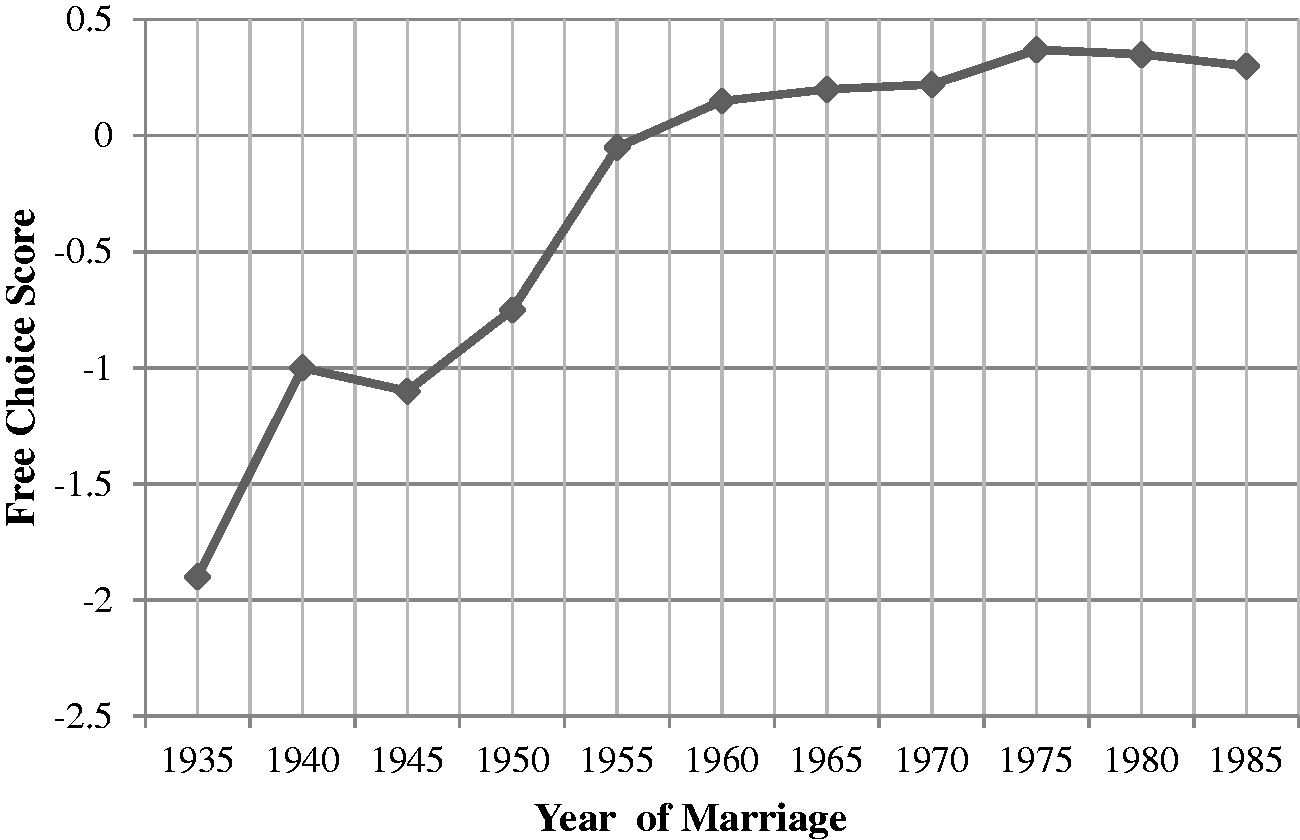
Chengdu trends in freedom of mate choice (three-year moving average)
The second contrast is that in Taiwan in all periods, women who were better educated and came from more middle class urban backgrounds tended to exercise more free-mate selection than other women (as modernization theory predicts), whereas in Chengdu that pattern was visible for women who married prior to 1957, but socioeconomic characteristics had no relation to how free-mate selection was for women who married after that year, as shown by the correlations arranged by Chengdu marriage cohorts displayed in Table 2. In Chengdu, some women who married in the 1960s and later exercised more freedom in their choice of mates than other women, but the status characteristics that influence such mate-choice freedom in Taiwan and other societies, such as the woman’s educational attainment, had lost their influence. 31
Social background correlations with freedom of mate choice scale, Chengdu 1987.
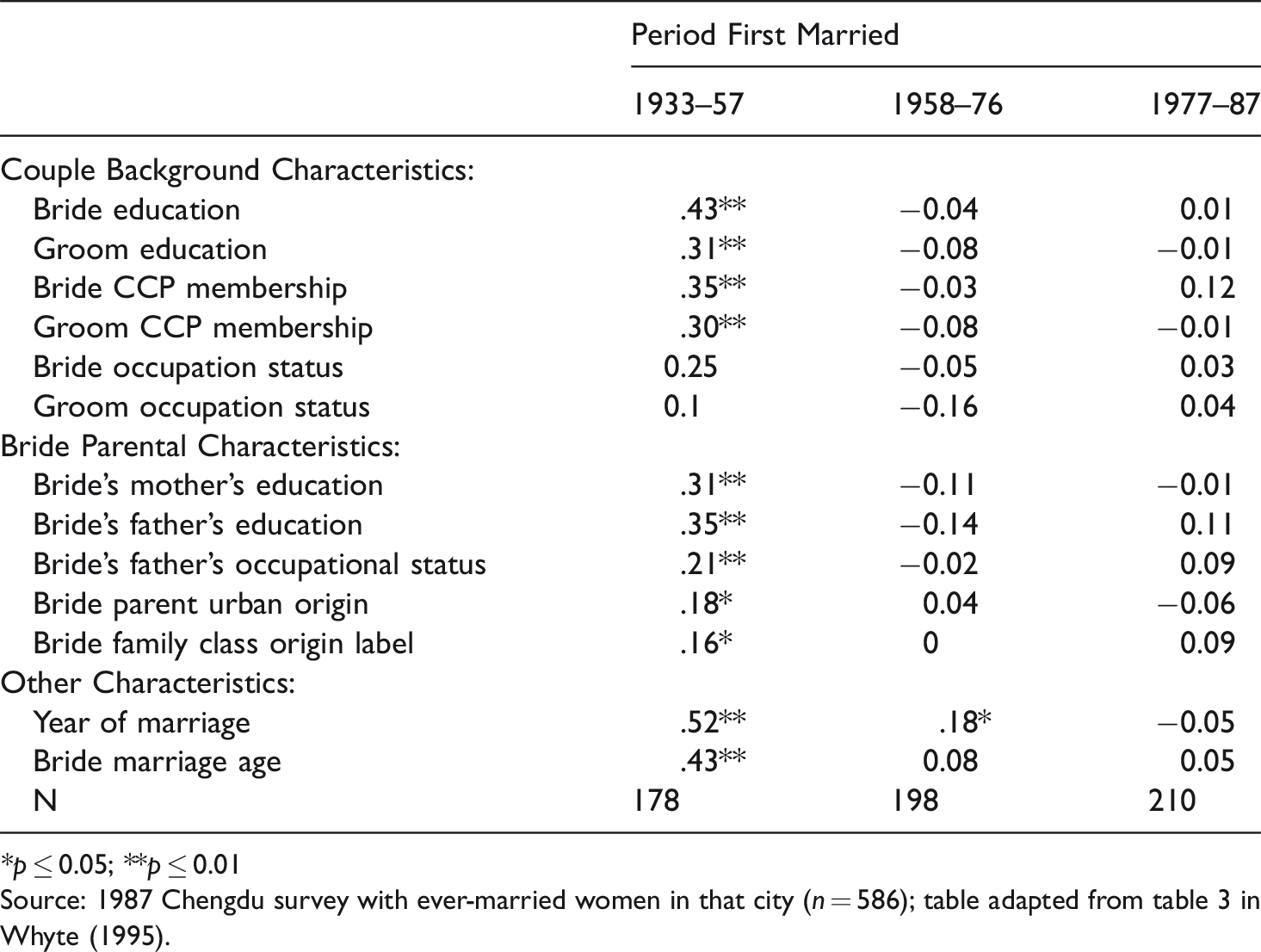
*p ≤ 0.05; **p ≤ 0.01
Source: 1987 Chengdu survey with ever-married women in that city (n = 586); table adapted from table 3 in Whyte (1995).
How can we explain the sharp rise and then stalled progress in freedom of mate choice we found in Chengdu, as well as the corresponding loss of influence of personal socioeconomic status characteristics in explaining the variation in such freedom after the 1950s? In my analysis of the Chengdu survey data, I concluded that these contrasts with patterns we would expect to find elsewhere, and which we do find in Taiwan, again reflect the distinctive impact of Chinese urban socialist institutions. As noted earlier, William Goode’s theory as applied to the family predicts that with industrialization, urbanization and other modernizing transformations, there should be a long-term and gradual undermining of parental power to arrange or control the mate selections of their children, and a corresponding gradual increase in the autonomy of their children to initiate and control the mate-choice process. At the root of these long-term changes in capitalist societies is the gradual shift from the family as the key institution socializing the young and preparing them for adulthood, including passing on work skills and inherited property, to the situation found in all modern societies in which schools and bureaucratic institutions provide the routes to adult jobs and lives for most youths and where families compete to prepare their children to succeed in schooling and the job market. When China carried out the socialist transformation of the entire economy in 1955–1957, the state drastically truncated that transformation, so that the shift from family production units to reliance on bureaucratic schooling and employment was completed in a few short years.
Once that transformation had been completed in urban China, by 1957, urban young people did not continue to gain increased freedom to compete for partners in a marriage market, as would be expected in a capitalist context. Rather, the state and its subordinate work units increasingly replaced parents as the primary monitor and constrainer of the mate-selection process. A variety of institutionalized practices were involved. Regulations were enforced that students, including college students (as well as apprentice workers in factories), were not allowed to enter into romantic relationships. The Spartan ethos of the time dictated that recreational venues where young people could find privacy to experiment romantically did not exist, preventing the emergence of a dating culture. 32 Official policy dictated that requests by state employees to get married had to be approved by work unit authorities, and by the 1970s urban youths had to wait until their late twenties before they could get permission to marry and be allocated housing. In general, a social order that frowned on public displays of affection and prevented the emergence of a dating culture persisted into the early reform period. 33 By the same token, the cellular bureaucratic nature of Chinese urban socialist institutions made where individuals were situated in that system a primary determinant of how much freedom they had to meet potential partners and select their own mates, and as a consequence reduced the salience of their own individual status characteristics and personal inclinations. So, from our Chengdu survey data it would appear that even in the initial years after market reforms were launched, the urban socialist order continued to place a distinctive stamp on one realm of family life: the mate-choice process.
Independent confirmation of my explanation of the changes over time in the links between individual socioeconomic status traits and marriage behavior is provided by a study of changing Shanghai marriage patterns published in 2014 (Cai and Wang, 2014). The authors of that study, Cai Yong and Wang Feng, examined the other end of the family-change process, as China was emerging from what they term the ‘forced collective synchronization’ of marriage behavior of the Mao era and showing signs of renewed individual choice and variation in marriage behavior made possible by the market reforms and other institutional changes after 1978. Their key finding (visually displayed in figure 4.4 in their chapter, which is based upon analysis of the 2005 1% inter-census survey) is that there was very little variation in age at marriage by educational attainment for either Shanghai men or Shanghai women who married between 1971 and 1980, but for those who married between 1996 and 2005, a ‘normal’ pattern of better educated individuals marrying somewhat later had clearly re-emerged. Although they use a different marriage indicator than my analysis of the 1987 Chengdu survey (age at marriage, instead of degree of freedom of mate choice), a comparison of the two studies suggests a social change that has now come full circle, from individual choice to collective synchronization and then increasingly back to individual choice once again (even though the revived influence of socioeconomic status traits wasn’t visible yet in Chengdu in our 1987 survey data).
Intergenerational relations in Baoding
The subsequent China survey project I directed was a study of relationships between parents over the age of 50 (n = 1002) and their grown children (n = 753) in Baoding, Hebei, based upon survey interviews carried out in that city in 1994. As noted earlier, that survey produced interviews with a representative sample of older Baoding residents (holders of Baoding hukou) and, for each such older respondent, attempted interviews with one randomly selected grown child. As in the Chengdu study, my Michigan colleagues had collected comparable survey data in Taiwan, so we were able to compare the patterns of family life and intergenerational exchanges in Baoding with those found in urban Taiwan during roughly the same period. 34
Again, we found broad similarities in the patterning of intergenerational relationships in Baoding and urban Taiwan, similarities that clearly reflect Chinese cultural traditions. For example, we found that co-residence of older respondents with a married child and regular material and other assistance provided by both co-resident and non-co-resident adult children were more common than we would expect to find in the USA or other modern Western societies. However, as in mate choice, we also found clear contrasts between the family patterns in these two Chinese cultural settings. A partial listing of such contrasts is displayed in Table 3. 35
Comparison of family patterns in Baoding (1994) and urban Taiwan (1980s).
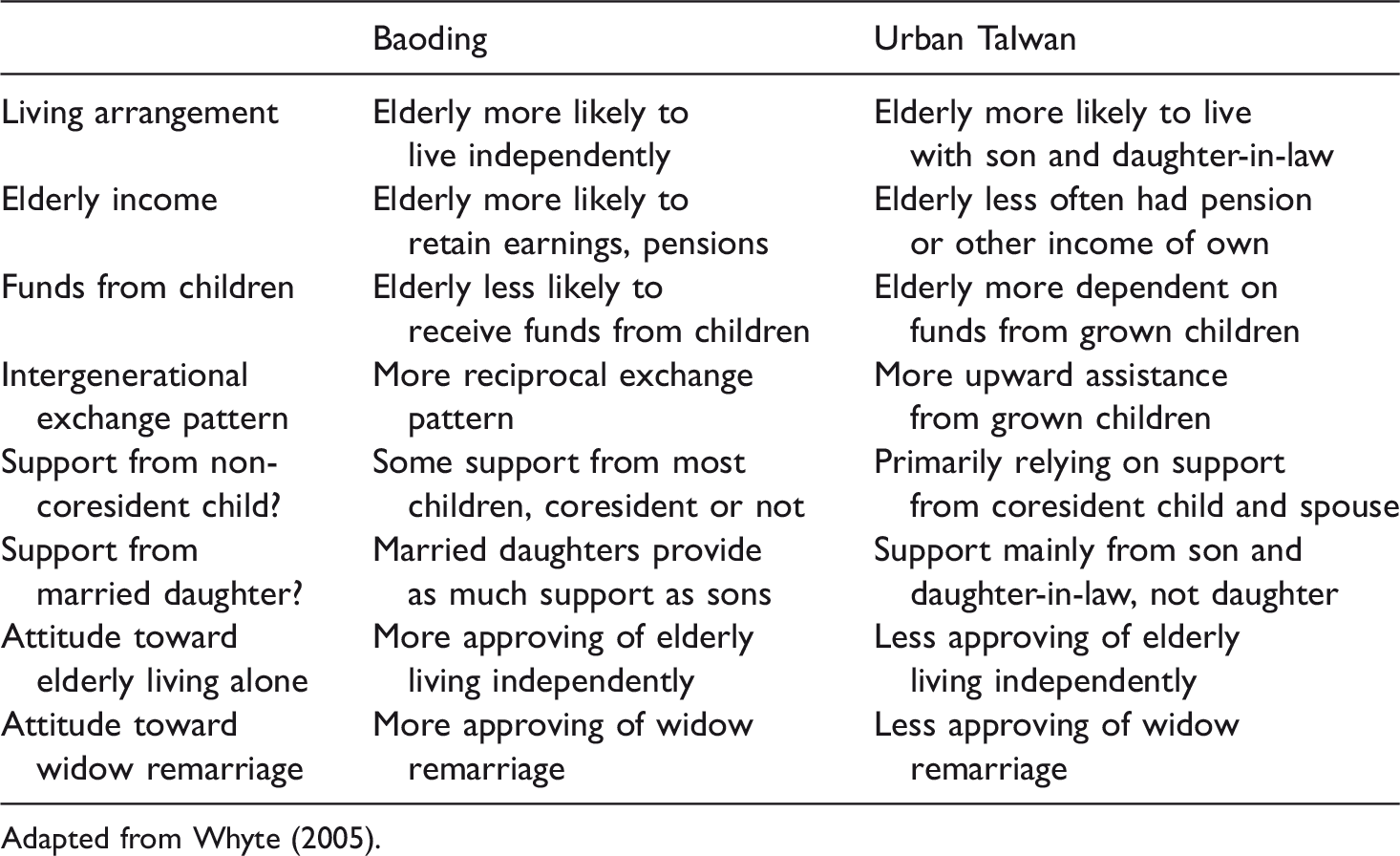
Adapted from Whyte (2005).
In general terms, the patterning of intergenerational relationships in Baoding had departed further from traditional Chinese family norms than was evident in the case of urban Taiwan. The contrasting patterns in this axis of family relationships seem readily understandable in terms of both distinctive characteristics rooted in Chinese socialism (e.g. pensions for most urban elderly, near universal employment of married women below the age of 50, lack of family property to inherit) and distinctive features of Taiwan (e.g. the relative absence into the 1990s of pensions for most urban elderly, the importance of family businesses and inherited property, the lower rates of employment of daughters and daughters-in-law). 36 Note that these contrasts do not accord with modernization theory, with the institutions of Chinese socialism making Baoding family patterns more ‘modern’ than those in richer and more economically developed cities in Taiwan.
I also want to highlight an important difference in the conclusions reached from the Chengdu versus Baoding comparisons with urban Taiwan. In the Chengdu study, I concluded that as of 1987, the transition to free-mate choice within that city had ‘stalled’ at levels below what was visible in the Taiwan surveys, with the resulting set of customs in the PRC in a sense more ‘traditional’ (e.g. with most women marrying their first boyfriend, rather than choosing from among several potential partners). In the Baoding–urban Taiwan comparison, in contrast, I found that intergenerational relations in Baoding appeared more ‘conjugal’ and less ‘traditional’ than those that still prevailed in Taiwan, more or less the opposite of the contrasts stressed in the Chengdu–urban Taiwan comparison. To be sure, some of the difference might be attributable to the passage of additional time (seven years) or distinctive features of Chengdu and/or Baoding. However, I think it is more likely that these contrasting conclusions indicate a fundamental truth about patterns of family change, and not only family change in Chinese societies. Forces for family change often affect various aspects and axes of family life differentially, producing more rapid and extensive change in some domains and less change in others. In other words, the sort of assumption made in both the directed-change and modernization theories discussed at the beginning of this paper – that the change force in question produces a linear and comprehensive change in all aspects of family behavior and attitudes – is not a realistic way to think about the complexities of family change.
Conclusions
Over the course of my career I have studied family patterns in both rural and urban communities in the PRC, in both the Mao era and the first two decades of the reform era, and using in-depth interviews ‘at a distance’ with Hong Kong refugees and collaborative sample surveys in several Chinese cities. From these studies several primary conclusions emerge. As argued at the outset, neither the state directed-change nor the modernization framework provides a very good fit with the realities of family change in the PRC, although both point to change forces that should not be ignored. In order to complement those theoretical approaches, I advocate relying on what I call a micro-institutional framework. The basic assumption in this framework is that, although individuals and families start with historically rooted family customs and desires to achieve certain family objectives, they also need to navigate the pursuit of those objectives within the specific local institutional contexts within which they currently live and work. Although the state can try to directly impose its will onto family behavior, as the directed-change framework stresses, it can more effectively and enduringly affect family behavior by intervening to change the local institutions that affect its citizens. However, those institutional interventions may end up having different and more complicated effects on family behavior than state authorities realize. For example, changes in local institutions may produce unintended consequences, such as the maintenance or perhaps even strengthening of bride price exchanges we found in rural Guangdong in the 1970s. The altered institutions also tend to persist once created, with the resulting institutional inertia affecting family behavior even when the state’s goals and priorities have changed. So to a substantial but variable extent, the institutional arrangements of centrally planned socialism have continued to shape some features of Chinese family life into the 1990s and beyond, even though the state now champions market distribution and new institutions that increasingly resemble capitalism.
Two examples not derived from my specific research projects show this persistent stamp of socialist institutions particularly clearly. The first is the continued central role in Chinese social life of the hukou (household registration) system institutionalized during the 1950s. Even though rural residents are no longer effectively prevented from migrating to the cities as they were in the two decades after 1960, they are still set apart and stigmatized, and they do not have the full rights and opportunities enjoyed by urban hukou Chinese, an institutional structure affecting mate selection, how migrant children are reared and schooled, and much else. 37 Even if urban migrants manage to convert to urban hukou, they still do not fully escape the stigma of their rural origins. For example, one recent study in Shanghai (Qian et al., 2019), where about 40% of the residents are migrants, found that even those who had converted to Shanghai urban hukou had a 68% lower chance of homeownership (controlling for education, age, gender and other background traits) than lifelong Shanghai citizens, while migrants who had not converted their registrations had a 90–92% lower likelihood of homeownership. In a similar vein, a recent survey study (Zhou, 2019) indicates that converters to urban hukou tend to marry other converters but are not very likely to be able to marry lifelong urban citizens.
The second example of institutional inertia is China’s regulations on retirement ages. In general, in urban China, men are required to retire at age 60 and women at 55 if they have a white-collar job, or at 50 if they have a blue-collar job. This regulation involves mandatory retirement at ages that are relatively young compared with other modern societies as well as differential ages of retirement for women versus men that would be illegal elsewhere. Given China’s rapidly aging population and the decline since about 2010 in the number of new workers entering the workforce, these low retirement ages are increasingly seen as undesirable and harmful. Where did these retirement age rules originate? In the Soviet Union, which was China’s model of socialist development during the 1950s. So even though China broke with the USSR in the Sino-Soviet dispute after 1960 and in most respects (such as the way the educational system is organized) tried to eliminate Soviet institutional practices in later decades, in terms of retirement ages, practices borrowed from the USSR seven decades ago linger on. Again, this particular institutional practice has important implications for how family life is structured, as in the ways in which domestic chores and childcare are divided. 38
Despite these examples of the enduring influence of China’s urban socialist past, it is obviously the case that much else about urban social institutions has changed during the reform era: not only the presence of tens of millions of urban migrants, but also the increasing dominance of private and foreign enterprises rather than state employment, the ability to change jobs in a context of less secure employment than in the years of socialist ‘iron rice bowls’, the relative relaxation of state monitoring and sanctioning of many kinds of popular behavior, the rise of commercial and recreational industries, the increasing affluence of the population and the rise of ‘conspicuous consumption’ in many spheres of life, the relative openness to foreign and international culture, information and travel, and much else. It is also important to note that in our 1994 Baoding survey the parents over 50 we interviewed had an average of slightly more than three adult children, with almost all of those children residing nearby. In China’s large cities today, in contrast, the average parent over 50 has only one grown child, and with an increased likelihood that this child will be living and working someplace else. Since I have not conducted new surveys on urban family patterns since the 1990s, I now have to rely on the research of others to understand how these many institutional changes have made urban families in China today quite different from the patterns we observed in Chengdu and Baoding earlier. However, I believe that applying the same basic micro-institutional approach described here is the best way to understand more recent family change patterns in China and those that will occur in the future.
My recipe for future research on Chinese family life and family-change patterns concludes by emphasizing the importance of focusing on specific features of family life in particular settings, and collecting as much rich and diverse data as possible about both those family patterns and the local institutional context within which the families researchers observe are formed and reproduced. And in trying to understand the family patterns you find, it is better to take an approach that might be called a ‘Chinese tea-leaf reading strategy’, of trying to look first for clear patterns and then hunt around for persuasive explanations in a variety of theoretical frameworks. In this hunt, the researcher would be well advised to keep in mind that the explanations for any particular feature of family life (such as the degree of freedom of mate choice) may well be different from the explanations of other features (such as the relations between grown children and their parents). Any single predictive theory or set of hypotheses specifying comprehensive changes in a particular direction is not likely to do justice to the complexities of evolving family life in the PRC.
Footnotes
Declaration of conflicting interests
The author declared no potential conflicts of interest with respect to the research, authorship, and/or publication of this article.
Funding
The author received no financial support for the research, authorship, and/or publication of this article.
