




Abstract
The One Child Policy initiated in the late 1970s created a birth cohort with an unusually high proportion of only children. This paper examines the relationship between being the only child in the family and educational attainment, as well as its potential variations by social origin. Drawing my sample from the China Family Panel Studies, I compare two birth cohorts born before and after the birth-control policy. Results show that in the younger cohort, being the only child in the family produces a premium in educational outcomes, including years of completed schooling and odds of progressing through critical grade transitions. In addition, I observe a pattern that the only-child premium tends to be larger for people with higher social origins in competitive grade transitions.
Introduced in 1979 and lasting for 37 years, China’s One Child Policy (OCP) created a unique birth cohort, consisting of an unusually high proportion of only children. Research on the generation born under the OCP shows that being the only child in the family is associated with an advantage in parental investment and educational outcomes (Hu and Shi, 2020; Xiao and Feng, 2010; Yang, 2007). This is consistent with the often-observed negative effect of sibship size on education, after controlling for family background characteristics, in studies conducted in many societies (e.g. Blake, 1981; Blau and Duncan, 1967; Lu and Treiman, 2008; Wolpin and Rosenzweig, 1980).
Past research demonstrates the importance of positioning the effect of having siblings on educational outcomes within the greater social context (Lu and Treiman, 2008), and post-reform China provides an interesting case for study, as people born under the OCP also grew up under an extraordinarily fast-developing new market economy, and a state-wide educational expansion (Lu and Treiman, 2008; Wu, 2010). For one thing, understanding the relationship between being the only child in the family and children’s critical educational transitions under this specific context has implications for exploring the coexisting forces involved in educational stratification. For another, it sheds light on policy making, especially for developing countries, in which policy makers experimented with using birth control policies purposefully in exchange for increases in per capita human investment (Qian, 2009).
In addition, past research on the impact of the OCP on educational attainment generally focused on studying moderation by gender (Hu and Shi, 2020; Ye and Wu, 2011); few researchers ever looked into moderation by social origin – that is, the socioeconomic status of the individual’s family of origin. This research, by examining the variation in the relationship between being the only child in the family and educational attainment by social origin, also attempts to demonstrate how structural stratification under educational expansion could be highly contingent on family and demographic characteristics.
Drawing on data from the 2010 baseline China Family Panel Studies (CFPS), the first part of this paper examines the relationship between being the only child in the family and educational outcomes in Chinese society, comparing two cohorts born before and after the OCP. The first birth cohort under study consists of those born between 1970 and 1978 (or ‘Cohort 1’ or ‘the older cohort’), and the second birth cohort includes those born between 1979 and 1987 (or ‘Cohort 2’ or ‘the younger cohort’). I picked the dividing line of 1979, the year in which the OCP was initiated, because it is generally considered to be a significant time point for the OCP’s impact (e.g. Banister, 1987; Bongaarts and Greenhalgh, 1985; Presser et al., 2006). The second half of this paper looks into the interaction between being an only child and the socioeconomic status of family of origin. I use father’s levels of educational attainment as a proxy for family socioeconomic background, as educational attainment is known to be the principal determinant of occupational status, and it is also known that both father’s educational and occupational status affect offspring’s educational achievement (Blau and Duncan, 1967).
The OCP and only-child premium
The Chinese government launched the widely known OCP to try to curb population growth after observing the demographic momentum and growth potential of the ‘baby boom’ cohort (Hardee-Cleaveland and Banister, 1988). Following the birth control campaigns begun in the early 1970s, the policy guaranteed a continuation in fertility decline (Coale and Li, 1987). However, the effectiveness of its restriction, that each couple was only allowed to have one child, varied greatly across the nation. This was due to the deferential implementation by local officials. In general, the state policy was more stringent with the one-child limitation in urban areas, but far less rigid in rural areas and for certain ethnic minorities, where the policy was implemented as a ‘one-and-a-half children’ or ‘two children’ policy (Chow and Zhao, 1996; Greenhalgh, 2013; Yang, 2007).
Families under the OCP had little freedom to decide how many children to have, as officials employed an elaborate set of harsh penalties to enforce the policy, including extra-children fines, confiscation of property, and dismissal from work for non-compliance (Hesketh et al., 2005). Meanwhile, rewards like monetary subsidies were granted to couples who complied with the policy. In 1979, 6.1 million couples who had given birth to only one child and pledged not to bear any more received the ‘One Child Honorary Certificate’, a recognition of the special contribution to the state. In the following years, the number of such families increased by around 4.4 million a year (Feng et al., 2014).
The birth control policies significantly changed family composition in China. Suddenly, the large family norm, which originated from the Confucian belief that ‘more sons bring more happiness’, was reversed. The average family size declined from around 4.8 in the early 1970s to 4.6 in 1980, below 4.0 in the 1990 census, and all the way down to 3.5 in 2000 and 3.1 in 2010 (National Health and Family Planning Commission, 2014). The OCP was especially responsible for the prevalence of three-member families, almost all of which were composed of two parents and one child, especially in urban areas (Feng et al., 2014; Wang and Fong, 2009). The only children born in such families were believed to be better off in educational outcomes, as they would not be impacted by the negative sibship size effect, which was frequently observed in families with multiple children (e.g. Blake, 1981; Blau and Duncan, 1967; Lu and Treiman, 2008; Wolpin and Rosenzweig, 1980). The negative association between having siblings and educational outcomes was generally explained from two theoretical perspectives. The resource dilution theory posited that familial resources were finitely distributed among children and an additional child reduced the amount available for each child (Blake, 1981; Downey, 1995). Likewise, the quantity–quality trade-off theory asserted that a larger number of children drove up the cost of raising them, proxied by the amount of family income spent on each child, leading to a trade-off between having siblings and personal developmental outcome (Becker, 1960; Becker and Lewis, 1973; Hanushek, 1992; Willis, 1973). To make things even worse, under the OCP, families with multiple children usually had to face more financial constraints due to hefty fines, which would affect the available resources that parents could invest in their children’s education (Feng, 2006).
In addition, researchers believe that the OCP played an important role in altering people’s perceptions of family and child-rearing. In one-child families, the core of the intra-family relationship was shifted from the needs of the older generation to the only children’s level of achievement (Feng et al., 2014). As the only hope of the family, the only children were shouldered with excessive responsibility and, thus, great parental attention and expectation, being branded as ‘little suns’ and ‘little emperors’ (Wang and Fong, 2009). Some scholars suspected that the OCP raised the societal standards for child-rearing by portraying low fertility as a means to improve the quality of life and educational and other achievements of children and achieve modernization (Qian, 2009; Wang and Fong, 2009).
Past research recorded that compared with people born into families with multiple children, only children under the OCP were generally better off in terms of parental care at an early age (Short et al., 2001), as well as in terms of investments in child care services, academic tutoring, formal schooling (Chow and Zhao, 1996; Hu and Shi, 2020), scores in schools (Xiao and Feng, 2010; Zhou, 2008), and risks of adolescent dropout (Yang, 2007). The first part of this paper thus aims to supplement the existing literature by considering whether only-child status, defined as being the only child in the family, is indeed associated with a premium in educational attainment in respondents’ completed years of schooling and, more importantly, critical school transitions to junior high, senior high, and tertiary education. I hereafter refer to this premium as the ‘only-child premium’. By comparing two birth cohorts born before and after the OCP, I examine the potential variations in the only-child premium under the population policy and the dramatic societal changes happening at the same time in post-reform China.
Economic and educational changes in post-reform China
The effect of having siblings on individuals’ educational attainment is dependent on socioeconomic and public policy contexts external to the family which influence the availability of family resources and distribution within the family. When the cost of schooling is low under government subsidies, for example, family material resources and family size are less important factors for education (Park, 2008). An empirical study on Chinese society from pre-liberation (before 1945) to the economic reform era (until 1996) concludes that when educational opportunities are expensive and scarce, children in large families obtain fewer years of education due to fiercer competition, and when education expands and becomes less expensive, the effect of having siblings generally disappears (Lu and Treiman, 2008). Thus, when studying the relationship between being only children and educational attainment, it is important to take the complex socioeconomic and educational context into consideration, which went through several major changes in post-reform China. The changes in the educational system were closely related to economic development since the 1978 economic reform and legalization of market economy. The phenomenal economic growth that followed these changes had increased the demand for skilled labor. This led to a restoration of the educational system, which was disrupted between 1966 and 1976, marked by the resumption of the merit-based College Entrance Examination in 1978. Many high schools, technical schools, vocational colleges, and four-year formal college programs reopened their doors for students, although these higher and post-secondary educational opportunities remained largely inaccessible to most people (Yeung, 2013). As the two cohorts studied in the paper were born after 1970, they should not have been impacted by the disruption in the educational system during 1966–1976, including the shutdown of secondary schools, because they were at most attending elementary schools in 1978.
The 1980s and 1990s saw a substantial expansion in the educational system at all school levels. In 1986, it was written into law that the first nine years of education should be compulsory. As indicated by Figure 1, in the 1990s, overall enrollment was nearly universal, and the progression rate to junior high school given the completion of primary school education increased dramatically in the 1980s, to over 90% by the mid-1990s. Higher education also went through an expansion in 1999, and the progression rates to higher secondary and tertiary schools increased dramatically (Min, 2007).
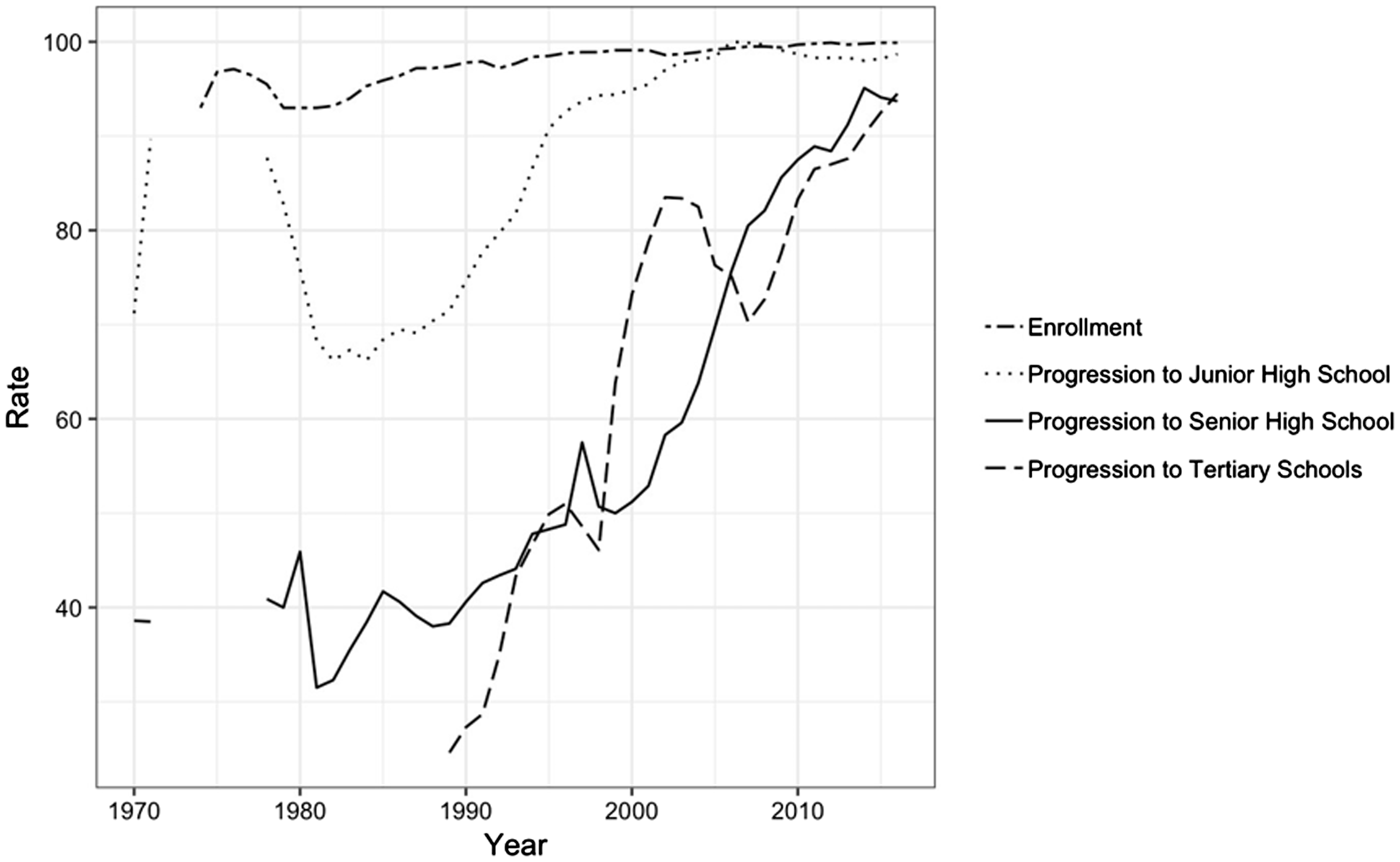
Education expansion in China, 1970–2016.
Contextual changes as presented in Figure 1 suggest that more places were available in schools for our younger birth cohort under study, who were born between 1979 and 1987. They experienced rapid educational expansion as they transitioned to junior high school around the years 1990–1998, 1 senior high school around 1994–2002, and tertiary schools around 1997–2005. The older cohort experienced the corresponding transitions in the years 1981–1989, 1985–1993, and 1988–1996.
However, some changes in economic development and educational reforms simultaneously limited access to education. For example, economic reform in rural areas and the household responsibility system drove children out of school to participate in agricultural work (Wu, 2010). In addition, the early 1990s fiscal reform in the education system transferred funding responsibilities from the central government to local and lower-level governments. Uneven regional economic development and local governments’ capacity to fund education resulted in disparities in educational opportunities across areas and regions (Tsang and Ding, 2005). To accommodate the increasing costs, schools were allowed to charge for tuition and fees. Thus, the compulsory phase of schooling was not free of charge, although it was supposedly at a low cost (Yang, 2007). For higher levels of education, the tuition and fees were even higher, which posed considerable challenges for low-income households (Guo and Wu, 2008; Yeung, 2013). In addition, the educational expansion in higher secondary and tertiary schools prolonged the expected years of schooling and made the opportunity cost of staying in school greater, which only exacerbated the situation (Ye and Wu, 2011). In summary, it is important to keep in mind when studying the younger birth cohort that while the expansion greatly increased opportunities at all levels of schooling, education generally became more costly.
These contradictory forces are likely to have impacted only children and people with siblings differently. As one-child families were able to concentrate all resources on the only children and had higher educational expectations and thus a stronger rationale for children’s educational investments (Wang and Fong, 2009), I expected the only children to be less impacted by rising costs than those with siblings, especially in the younger birth cohort. In other words, the economic and educational changes described in this section were likely to increase the only-child premium in the younger cohort born under the OCP.
Although it is convenient for researchers to study sibship effects on completed years of schooling in educational stratification models, different phases of schooling are likely to require different family resources and structural advantages (Mare, 1980). The assumption that each additional year in school has the same sociological meaning is not likely to hold under the drastic and complex socioeconomic and demographic changes in post-reform China. As illustrated in Figure 1, while elementary and lower secondary education became much more accessible for the younger cohort at the end of the 1990s, opportunities at the higher secondary and tertiary levels remained sparse. Students were likely to experience different levels of competition in progressing to junior high, senior high, and tertiary schools. Following Lu and Treiman (2008), who found that the sibship size effect generally disappeared when education became less competitive, I expected to see a more salient only-child premium in senior high and tertiary transitions.
The only-child premium by social origin in grade transitions
It has long been established in the literature that when education expands, socioeconomically advantaged groups maintain their advantage in the sense that the positive association between socioeconomic background and education only declines when enrollment for the most advantaged social group reaches the saturation point (Raftery and Hout, 1993). Maximally Maintained Inequality (MMI) theory thus posits that when a certain level of education remains competitive for all, the association between social origin and education should remain strong and positive.
I argue that in post-reform China, the fertility-control policy having coincided with educational expansion adds to the complexity in structural educational stratification. At educational levels where enrollment has not yet reached saturation and where a strong impact of family socioeconomic status lingers, the only-child status of those from a high-status social origin might matter more compared with those from a low-status social origin. In a situation in which the amount of resources demanded for school progression is way beyond the means of low-status social origin families, it is possible that the resource dilution mechanism would not be activated at all. In contrast, in school transitions where enrollment has reached saturation, the resource dilution mechanism is likely to be activated in families with low socioeconomic status compared with families with plentiful resources, in which school continuation is almost certain to happen regardless of the number of children.
This suggests a potential moderation by social origin on the only-child premium. Thus, not only could only-child status itself be a stratifying factor in competitive school transitions, but being an only child could be more beneficial for people from some social origins compared with those from others. This is also likely to be dependent on which school transition we are talking about.
Past research on the interaction of social origin and sibship size effect on educational stratification is limited. In the United States in the 1980s, Blake (1985) found that the influence of socioeconomic background on education was stronger in large families at the elementary school level. She suggested a re-evaluation of social stratification in the US, stating that “at least with regard to education, the ‘system’ appears to have been remarkably open for those coming from small families and relatively rigid for those coming from large ones” (Blake, 1985: 93). However, motivated by the resource dilution hypothesis that assumed resources were diluted more in larger families (Blake, 1981), Mare and Chen (1986) reasoned that the same increase in familial resources should benefit people from small families more as it was spread thinner. Thus, the effect of socioeconomic status should, in fact, be larger among smaller families if it existed, although using the same data as Blake (1985) they found no variation in the effect of social origin by sibship size.
While the issue of how the interaction between sibship size effect and family social origin behaves remains unresolved, no prior research has ever examined the case of the only-child premium. While the sibship size effect reflects the dilution of familial resources due to having more siblings, the only-child premium shows the impact of having no siblings at all, which means extremely concentrated and exclusive parental investment. Will the emergence of a large number of one-child families impact structural stratification through an only-child premium that differs among families with different levels of socioeconomic status? To answer this question and describe a more accurate picture of educational stratification in post-reform China, the second part of this paper examined whether and how the only-child premium is moderated by social origin at each critical grade transition for both cohorts.
Hypotheses
Building on previous research that generally finds a negative relationship between sibship size and education, I expected to see a positive association between being the only child in the family and educational outcomes, including years of completed schooling and grade transitions to lower secondary, higher secondary, and tertiary schools. In addition, I expected to see a larger only-child premium in the younger birth cohort and in more competitive transitions.
H1: Only-child status is positively associated with educational outcomes.
H2: The benefit of being the only child in the family is greater for the birth cohort born under the OCP than for the cohort born before its implementation.
Regarding the potential interaction effect in the association between only-child status and social origin, I proposed three competing hypotheses. The tests were run on the three grade transitions by birth cohort.
H3a: The benefit of being the only child in the family is greater among persons from families with low socioeconomic status.
H3b: The benefit of being the only child in the family is greater among persons from families with high socioeconomic status.
H3c: There is no variation in the benefit of being the only child in the family across different socioeconomic status levels.
Overall, I expected to see H3a or H3c at less competitive grade transitions, and H3b at more competitive grade transitions.
Data, variables, and methods
Data
I used data drawn from the 2010 baseline survey in the CFPS, a nationally representative and longitudinal social survey. The CFPS were conducted in 25 Chinese provinces and their administrative equivalents (municipalities and autonomous regions), excluding Hong Kong, Macao, Taiwan, Xinjiang, Tibet, Qinghai, Inner Mongolia, Ningxia, and Hainan. The sample represented 94.5% of the total population on the Chinese mainland. Through a multistage probability sampling method, 33,600 adults and 8990 young people in 14,960 households were interviewed. The response rate at the household level was 81.25%, and at the individual level was 84.14%. The waves were done in 2012, 2014, and 2016 respectively.
Data used in this paper were collected from the Individual Adult Questionnaire. They covered questions regarding the respondent’s educational attainment, family background, hukou status, and number of siblings. For education, the surveys recorded in detail the years of schooling completed by each respondent, which allowed analysis on both school transitions and years of completed schooling. Due to the survey design, all eligible adult family members from selected households were asked to participate in the Individual Adult Questionnaire. To address the likelihood of sample interdependence, I clustered standard error at the household level and thus reported more conservative confidence intervals. The data analyzed here were a sub-sample of the adult dataset. I restricted the analysis sample to include only those who were out of school at the time of the survey, which excluded about 0.1% of the sample. In this paper, I conducted a complete case analysis based on the variables described below. There was little loss in sample size due to missing data (0.1%). All descriptives and regressions were weighted to be representative at the national level.
Variables
The key outcome variables were years of completed schooling and grade transitions. Years of completed schooling was coded continuous. Grade transitions to junior high school, senior high school, and tertiary education, given that the prior level of schooling had been completed, were coded as dummies.
Completed education is of essential interest in educational stratification research. One advantage is that it does not obscure differences between leaving school permanently and short-term interruptions that may not affect one’s ultimate attainment (Lu and Treiman, 2008). Grade transition is also a variable that researchers have long been concerned with, since it takes into account the stepwise character of education and allows analysis of trends and differentials in access to schooling at various stages (e.g. Fienberg and Mason, 1979; Mare, 1980). In addition, as dummy variables, grade transitions enable logistic modeling which could mathematically tease out the effect of changes in the schooling distribution from uneven allocations of schooling based on socio-demographic factors (Mare, 1981). School transitions are coded based on respondents’ highest completed level of educational attainment, given that the previous level was completed.
The key explanatory variable is a binary variable, only-child status, which indicates whether the person is the only child in the family or not, coded 1 for yes and 0 for no. Although it is difficult to differentiate families who self-selected into one-child families from those forced by the OCP, it is clear that the OCP significantly increased the percentage of such households, leaving it meaningful to explore the societal changes before and after the policy change.
Another key independent variable is the socioeconomic standing of one’s family of origin. I used father’s educational attainment as the proxy and re-coded it into three categories of low, medium, and high levels. As noted in the literature, parental educational level is a determinant of both family size (Axinn and Barber, 2001) and offspring’s educational attainment (e.g. Blau and Duncan, 1967; Ganzeboom and Treiman, 1993). I used father’s highest educational attainment in the analysis, firstly because father’s educational attainment is not endogenous to sibship size, as family income, for example, would be, given the financial carrots and sticks of the OCP. I used father’s educational attainment instead of using both parents’ because in Chinese society, one’s educational attainment and other life chances are more dependent on father’s social status than on mother’s (Zhou et al., 1998). I considered the family’s social origin low if the father had at most completed elementary school, medium if he had a junior high school or equivalent degree, and high if he had at least obtained a senior high school-level educational degree. Family wealth or household income before the respondent was born or when the respondent was school age was not available in the data. Although the data set contains an International Socioeconomic Index of Occupation (ISEI) score for measurement of father’s occupational status, I refrained from including it in the models, mainly because it was measured at the time of the survey. Considering the many fluctuations and great changes in the Chinese economy and social structure after the post-reform years, it seemed naive to simply assume trivial changes in fathers’ occupations.
I included a set of control variables in the analysis. Because previous research had shown that gender was an important indicator of educational attainment (e.g. Hannum, 2002), it was included in the model as a control variable, coded 1 for female, and 0 for male. Hukou status and inequalities in educational opportunities and achievements have long been a focus in education stratification literature. Because of the unique household registration system in China, people with rural hukou household registration status are generally disadvantaged in enrollment status and school transitions due to limited economic resources (e.g. Qian and Smyth, 2008; Wu, 2010). Moreover, hukou status is also an important determinant of family size, given that the OCP rules were more relaxed in rural areas (Attane, 2002). I used respondents’ hukou status at the age of three as a control variable. It was coded 1 if the respondent held a rural hukou at the time. Literature showed that people with an ethnic identity other than Han had fewer years of schooling (Hannum, 2002). Additionally, as the OCP was less strict towards ethnic minorities, they could have more flexible family plans. Ethnicity was coded dichotomously, with Han as the majority ethnicity being 1 and others 0. Age was also added in the model as a basic control variable.
Lastly, I controlled for regional differences. Past research identified spatial inequalities in education due to unbalanced economic development (Kanbur and Zhang, 2005). The implementation of the OCP also differed at the provincial level (Attane, 2002). In order to get a sense of the regional variation in the distribution of only children, I coded region as categorical based on respondents’ birth provinces, and the categories include ‘East’, ‘Northeast’, ‘Central’, and ‘West’ according to standards set by the National Bureau of Statistics of China. Regional variation was presented descriptively. In the regression models, I controlled the regional differences by adding a variable of province ID, as was available in this dataset, and used it in the analysis as a fixed-effect variable.
Birth cohort was coded 1 for Cohort 1970–1978, and 2 for Cohort 1979–1987.
Methods
I used ordinary least squares regression to model the relationship between only-child status and years of completed schooling. It is presented in Equation 1,

To model the relationship between my key independent variable and grade transitions, I adopted a set of logistic models (Mare, 1980). The left side of the equation is the logged relative likelihood of progression at each transition j, given that the former level of schooling was completed. The other denotations on the right side are the same as in Equation 1, except there is no error term.

To test Hypothesis 2, I added a product term between only-child status and birth cohort in Equation 2. It takes the forms of Equation 3, in which Cohort stands for birth cohort. As the effect of the control variables could also change across cohort, given the drastic socioeconomic changes in post-reform China, I also included the interaction terms between all control variables and cohort. Similarly, to test the potential interaction effect in Hypothesis 3, a product term between only-child status and social origin is added to Equation 2. It takes the form of Equation 4.
2


However, as interpreting coefficients of the product term in logit models leads to an incorrect inference of the actual interaction effect (e.g. Ai and Norton, 2003), analyzing the differences in probabilities of the binary outcome and differences in the marginal effects of regressors on the probability is more useful (Long and Mustillo, 2018). Following the practice in Mize (2019), the model results in this paper are interpreted through predicted probabilities and presented in margins plots. Specifically, ΔjOC1 represents the difference in predicted probability at jth school transition between only children compared with those who have siblings in Cohort 1, and ΔjOC2 represents the difference in predicted probability at jth school transition between only children and those who are not only children in Cohort 2. These are commonly referred to as a ‘first difference’. To falsify Hypothesis 2, I tested the equality of the first differences by cohort (ΔjOC1 – ΔjOC2), which is commonly known as a test of ‘second difference’ – that is, the test of interaction. A Wald test is conducted. To see the details of the Wald test equation, readers can refer to Mize (2019: 87). Similarly, to test Hypothesis 3, let ΔjOCL denote the difference in predicted probability at jth school transition by only-child status for those from a low social origin; ΔjOCM denotes that for those from a medium social origin, and ΔjOCH denotes that for those from a high social origin. I tested the equality between ΔjOCL and ΔjOCM, as well as the equality between ΔjOCM and ΔjOCH.
Results
Descriptive statistics
Table 1 shows the descriptive statistics for the two birth cohorts and by only-child status. As expected, the educational attainment is higher among the second birth cohort, who stayed on average about 1.3 years longer in school. The percentages of those who made the transition at all three levels increased from Cohort 1 to Cohort 2. Given that the prior level of schooling was completed, the percentage of those who made the transition to junior high school increased from 72.5% to 81.7%, indicating a success of the National Nine-year Compulsory Education Law. There was a 7–8% increase in the percentages of people who progressed to senior high and tertiary schools, driven by the educational expansion policies at both the secondary and higher educational levels.
Descriptive statistics.
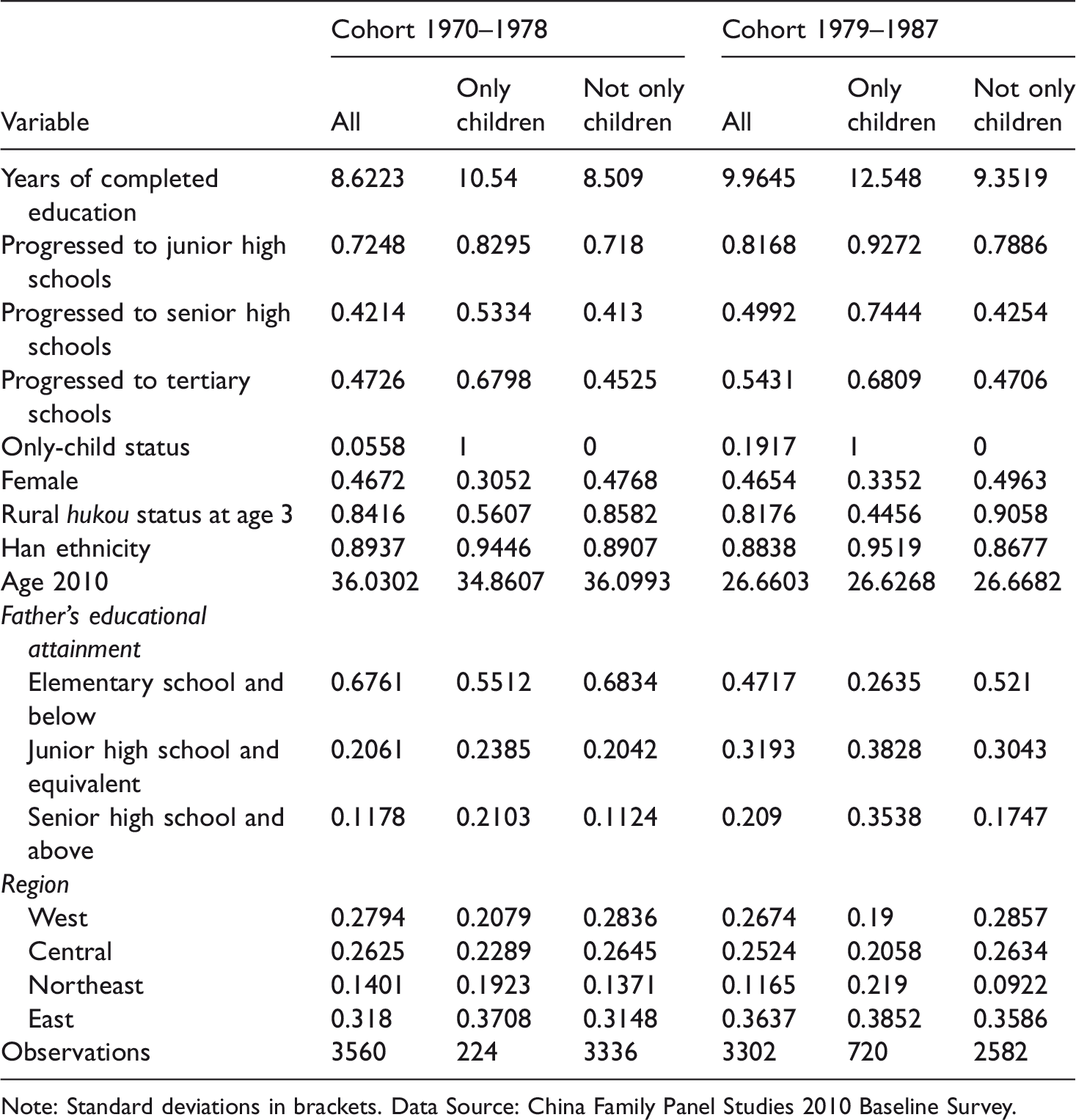
Note: Standard deviations in brackets. Data Source: China Family Panel Studies 2010 Baseline Survey.
The educational attainment of respondents’ fathers was also higher for the second cohort. Compared with the first cohort, fathers who had at most an elementary school attainment dropped from 67.6% to 47.2%; fathers who held at least a junior high school and equivalent degree increased from 20.6% to 31.9%; and fathers who obtained a senior high school and above degree increased to 20.9% from 11.8%.
Another notable difference across the two cohorts is the proportion of only children in the total population. For the younger cohort born during the implementation of the OCP, compared with the older cohort, the percentage increases dramatically from 5.6% to 19.2%. This also shows that the OCP was not uniformly and strictly implemented for all regions in China. The still relatively low percentage could be explained by the fact that the OCP was loosely enforced in rural areas, where a large proportion of the population resided at the time. Breaking the sample down by hukou status, the percentage of only children in urban areas was significantly higher – among the second cohort, about 44.6% – than that in rural areas, which was less than 10%.
Gender, hukou registration, ethnic composition, and region of residence remained largely the same across the two birth cohorts.
Table 1 also presents the educational attainment of respondents and their fathers by birth cohort and only-child status. We can see that for both cohorts, the only children had higher educational attainment. For Cohort 1, on average the only children stayed two years longer in school, while for Cohort 2 the gap was more than three years. The percentage of those who progressed to the next level of schooling at all three levels was higher among the only children than those who had siblings. From Cohort 1 to Cohort 2, the educational attainment for both only children and those who had siblings was improved. However, the increase was larger for only children overall. Most notably, at the progression to senior high school, among the second cohort 74.4% of the only children made the transition, about 20% higher compared with the only children in the first cohort. For children who had siblings, the increase was very trivial, about 1%. Regarding father’s educational attainment, the only children tended to have more highly educated fathers than their counterparts with siblings. The only children among the second birth cohort had the most highly educated fathers among the four groups. Regionally, only children concentrated more in the northeastern and eastern provinces than in the western and central areas.
The only-child premium by birth cohort
Concerning the association between only-child status and educational outcomes, the results demonstrate variations across cohorts and educational outcomes. Specifically, for Cohort 2, H1 is supported, that being the only child in the family is positively associated with years of completed education and grade transitions, except at the progression to junior high school. For Cohort 1, H1 is supported only when the outcome is the odds of progressing into tertiary education. The OLS regression coefficients on years of completed schooling and the coefficients from logistic regressions on grade transitions are in Table 2.
Ordinary least squares and logistic regressions on years of completed schooling and grade transitions by only-child status and controls by birth cohort.
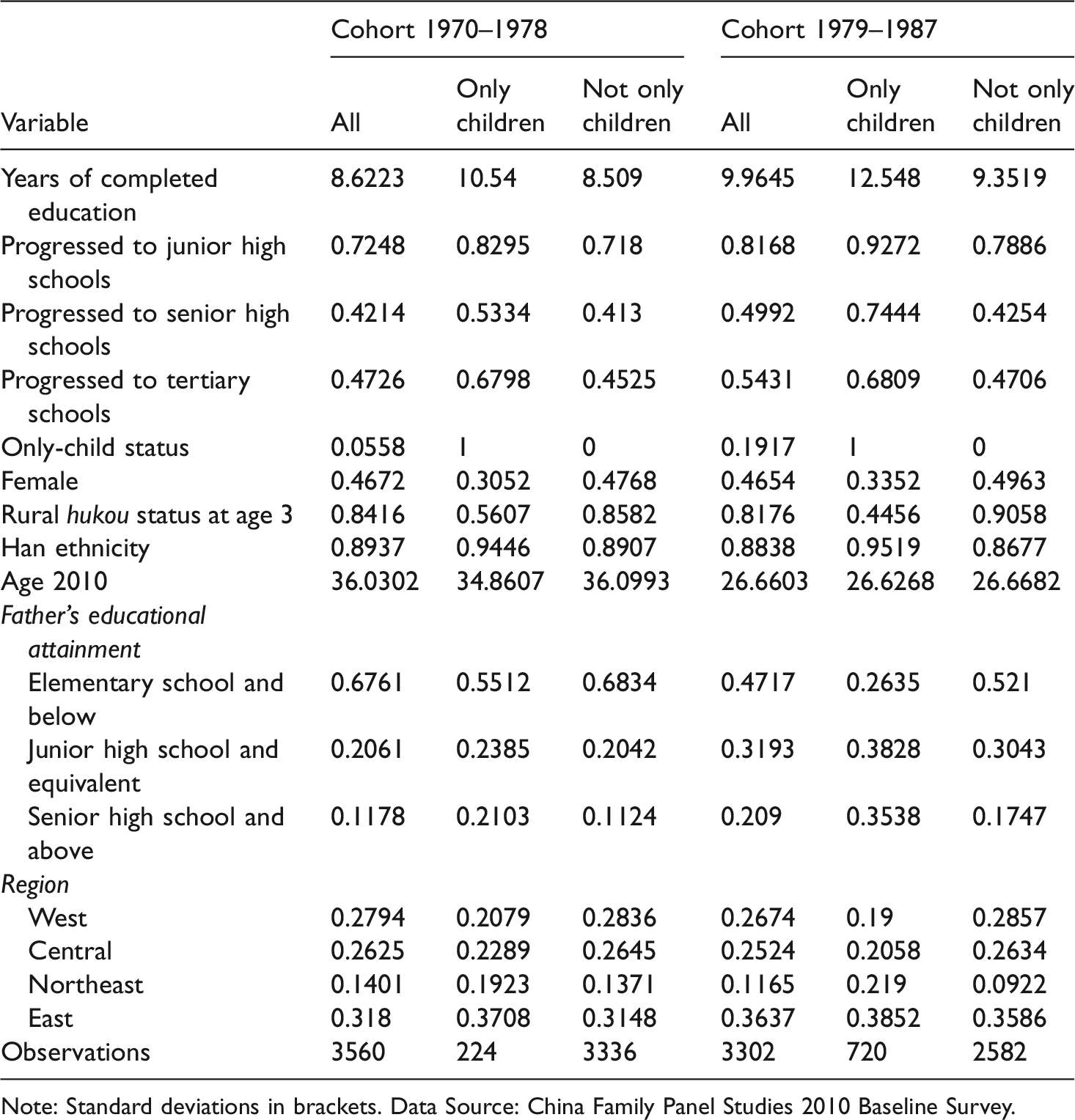
Notes: p-value: *0.05, **0.01, ***0.001.
Standard error in brackets.
Fixed-effect variable omitted.
Data source: China Family Panel Studies 2010 Baseline Survey.
For Cohort 2, controlling for father’s educational attainment, the respondent's gender, hukou, ethnicity, age, and province, being the only child in the family is associated with remaining about 1.1 years longer in school. The likelihoods of the only children progressing into senior high and tertiary school transitions are also higher. Compared with those with siblings, the only children are 1.6 (e0 . 496) as likely at the progression to senior high school, and 1.8 (e0 . 596) at the transition from senior high school to tertiary education. This finding is consistent with the research that found that only children were generally more advantaged in school. It also meets my expectation to see a larger only-child premium at higher grade transitions, where there is more competition. The coefficient of only-child status at the junior high school transition is not statistically significant, so there is not enough evidence to say there is an only-child premium for Cohort 2 at the junior high school transition. It is possible that after the law which makes junior high school a part of mandatory schooling, the level of competition in junior high school at the time of transition for Cohort 2 is considerably lower and thus the only-child premium generally disappears.
For Cohort 1, holding all else constant, being the only child in the family is associated with about 2.1 (e0 . 733) times the odds for children with siblings at the transition to tertiary schools. When the outcomes are years of completed schooling, and progressions to junior and senior high schools, the coefficient for the only-child status is not statistically significant. This could be due to the meager sample size of only children in Cohort 1, who were born before the implementation of the OCP. At the same time, however, the magnitudes of these coefficients are small, which indicates that before the OCP, the only-child status might not be associated with much differential access to secondary schools.
Figure 2 presents the predicted probabilities by only-child status and cohort across four educational outcomes. The solid lines are for Cohort 1, and the dashed lines are for Cohort 2. As expected, being the only child in the family is positively associated with educational outcomes, the ‘only-child premium’, and this is more salient in Cohort 2, with clearer slopes in the dashed lines than solid lines. As for across cohort comparisons, I test the equality in the marginal effects by only-child status for the three educational transitions. Results are presented in Table 3. The marginal effect of being the only child in the family on the probability of transition is statistically significantly larger for Cohort 2 compared with Cohort 1 at the progression to the senior high school level (second difference = 0.142; p < 0.05). The results show that only children from Cohort 2 have a significantly higher probability of progressing to senior high school (0.582) than those with siblings (0.480, Δ = 0.102; p < 0.01). For Cohort 1, the only-child premium at the senior high school transition is not statistically significant. At the transition to junior high school, for both cohorts, neither the first nor the second difference is statistically significant. At the transition to tertiary schools, for both cohorts, the first differences (difference by only-child status) are significant and positive. Only children in Cohort 1 have higher probabilities (0.641) of progressing to tertiary schools compared with those with siblings (0.457, Δ = 0.184; p < 0.01), and the same pattern is observed for Cohort 2 (first difference Δ = 0.111; p < 0.05). However, the difference in the marginal effects (the second difference) is not statistically significant at the 95% confidence level. The results lend support for H2 at the transition to the senior high school level.
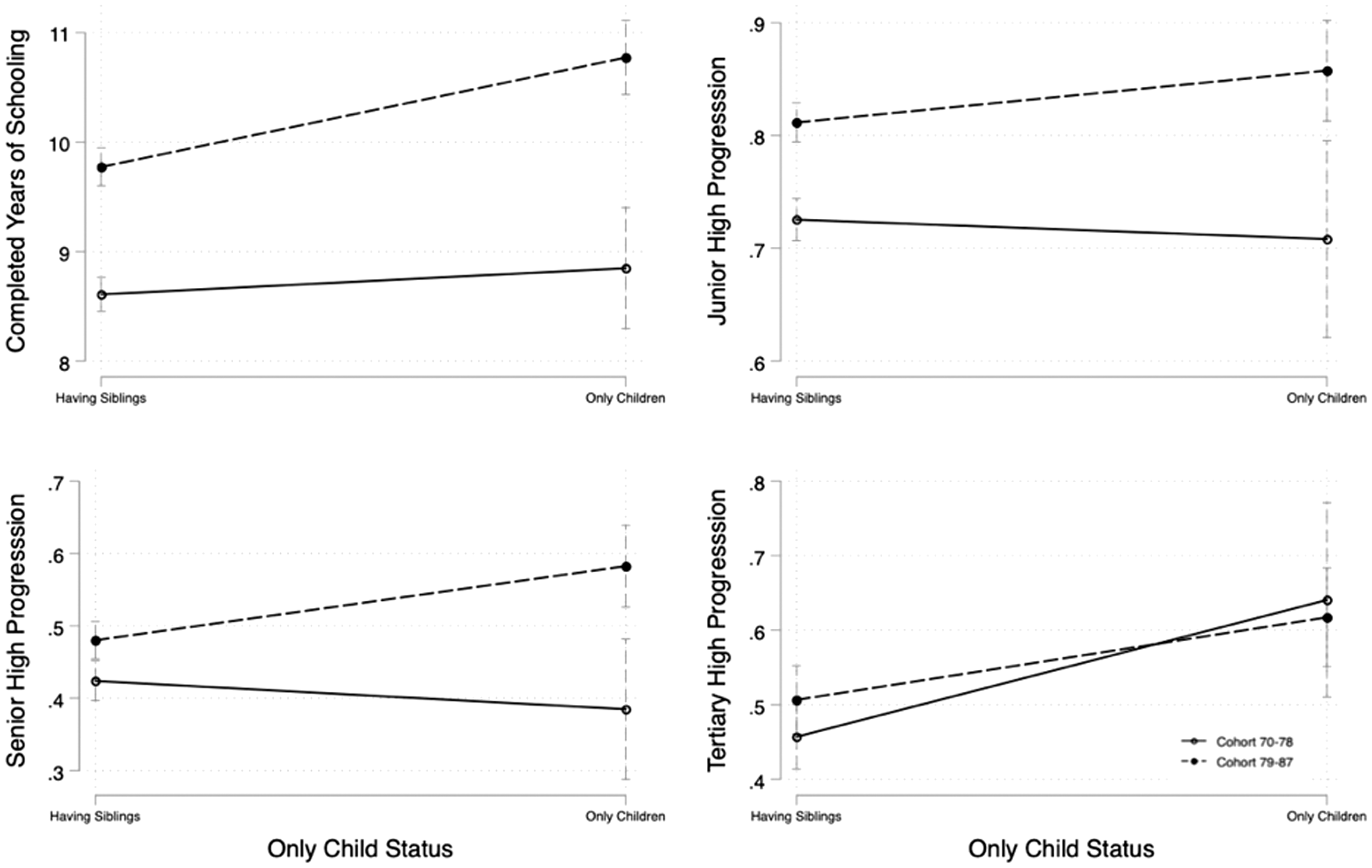
Model predicted completed years of schooling and probabilities of grade transitions for respondents by only-child status and cohort, with 95% confidence interval.
Marginal effects of only-child status and cohort on grade progressions, model with full interaction.
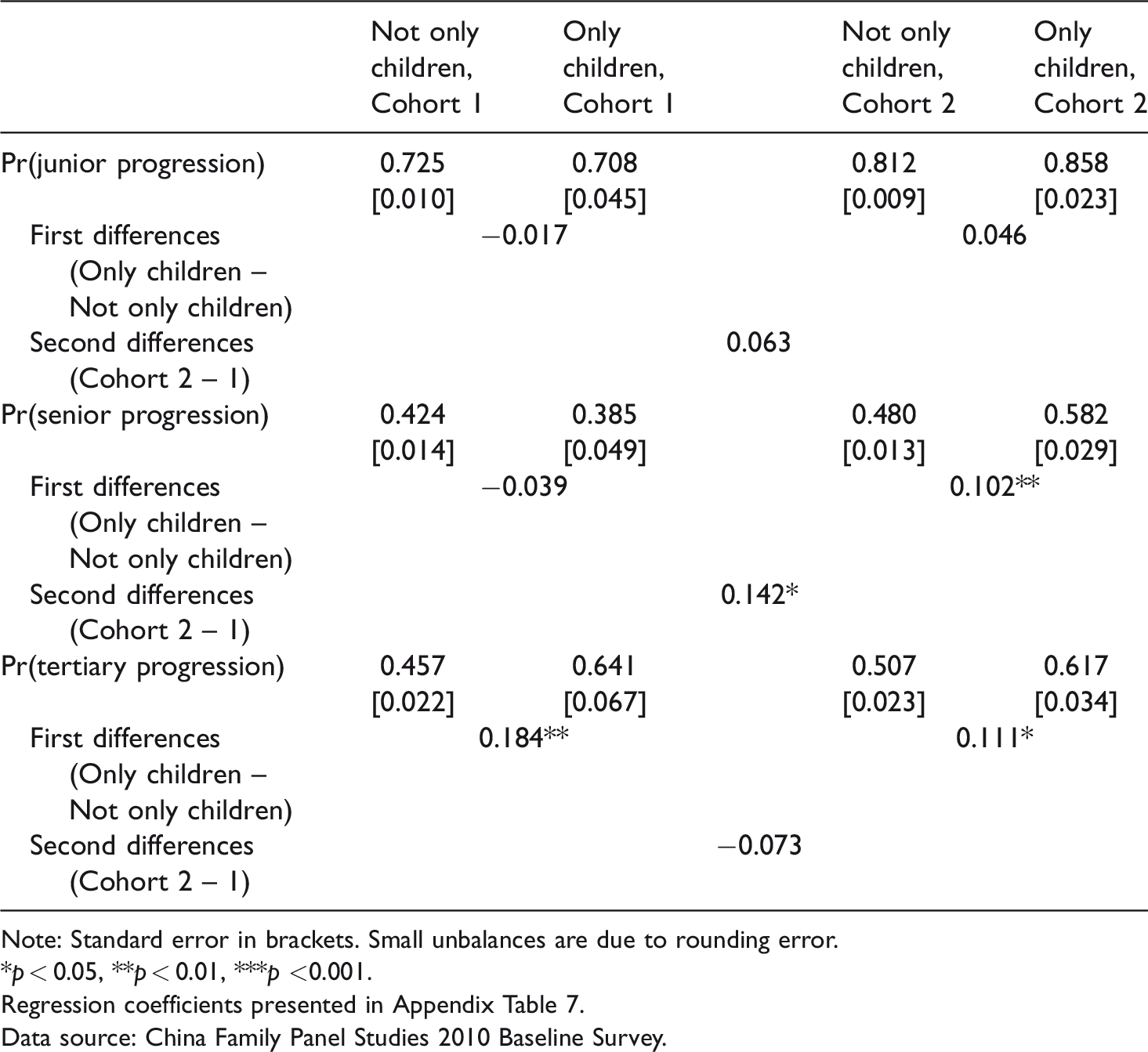
Note: Standard error in brackets. Small unbalances are due to rounding error.
*p < 0.05, **p < 0.01, ***p <0.001.
Regression coefficients presented in Appendix Table 7.
Data source: China Family Panel Studies 2010 Baseline Survey.
To summarize the above findings, given that the prior level of schooling is completed, at the transition to junior high school, for both birth cohorts, I have no evidence that being the only child in the family has any influence over the probability of progression. At the transition to senior high school, the benefit of being the only child in the family is larger for children from Cohort 2 than for those from Cohort 1. At the transition to tertiary education, for both cohorts, being the only child in the family is equally positively associated with progression.
Being the only child in the family means there is no sibling dilution mechanism at all. In addition, under the OCP, instead of the traditional family structure that puts the elderly’s needs at the center, the one-child families possess a child-centered family structure that tends to focus more of its resources on the child’s needs (Feng et al., 2014). Thus, these one-child families could be more likely to devote more attention to the education of only children, compared with one-child families before the OCP. The policy also actively promotes the idea that the ‘quality’ of children is valued over quantity, and one-child families, which comply with the policy, are likely to embrace this view and place higher expectations on their children. Often, if not always, the expectation is exceptionally high (Fong, 2004).
The younger birth cohort grew up within a complex social context, with several offsetting social forces (Lu and Treiman, 2008). The post-reform economy created many immediate economic opportunities for dropouts. For example, the household responsibility system since 1978 had driven peasants’ children out of school to participate in agricultural work. In a sense, the cost of schooling was higher due to the increased opportunity cost of staying longer in school, which could potentially intensify the sibship dilution effect in families with multiple children. At the same time, however, the economy also drove up educational returns out of a need for skilled labor, and, together with the expansions in both basic and higher education, exerted a positive influence over people’s perceptions about the value of education.
Within this social context, the OCP, by creating a large number of one-child households, is likely to have contributed to changing the dynamic in access to educational opportunities. Considering that one-child families in this new era had a strong rationale for investing all they could in their child’s development, it seems reasonable to expect that they would be more motivated by the improved social value of education and regard it as an important pathway for their child’s future professional development. Following the same logic, compared with larger families, one-child families were less likely to be impacted by the increased cost of schooling, either increased tuition, living expenses, or the opportunity cost. Therefore, only children, rather than those with siblings, were more likely to benefit from the increasing educational opportunities in the education expansion and eventually profited from the fast-developing economy by securing higher social positions through better educational degrees. That only children are significantly advantaged compared with children with siblings seems especially true at the senior high school progression.
Note that for Cohort 1, I found H1 to be supported at the tertiary school transition. Given that senior high school had been completed, the likelihood of only children entering tertiary schools is about twice (e0 . 733) the likelihood of those with siblings. The conditionality might reflect a strong selection effect, that people who completed all 12 years of prior education had relatively high educational aspirations and a higher likelihood of being only children. This is also consistent with the fact that before the education expansion, tertiary level schooling was extremely scarce. One possible explanation for this could be that places in tertiary schools were so limited that to continue schooling, families had to mobilize all their resources, including the advantages of their child being the only one in the family. Thus, only-child status is associated with differential access at the highest transition level.
Only-child status, social origin, and grade transitions
To adjudicate among the competing hypotheses in H3, I ran a set of logistic regression models with a product term between only-child status and social origin on three grade transitions for each cohort separately. This yielded six scenarios, shown as predicted probabilities in Figure 3.
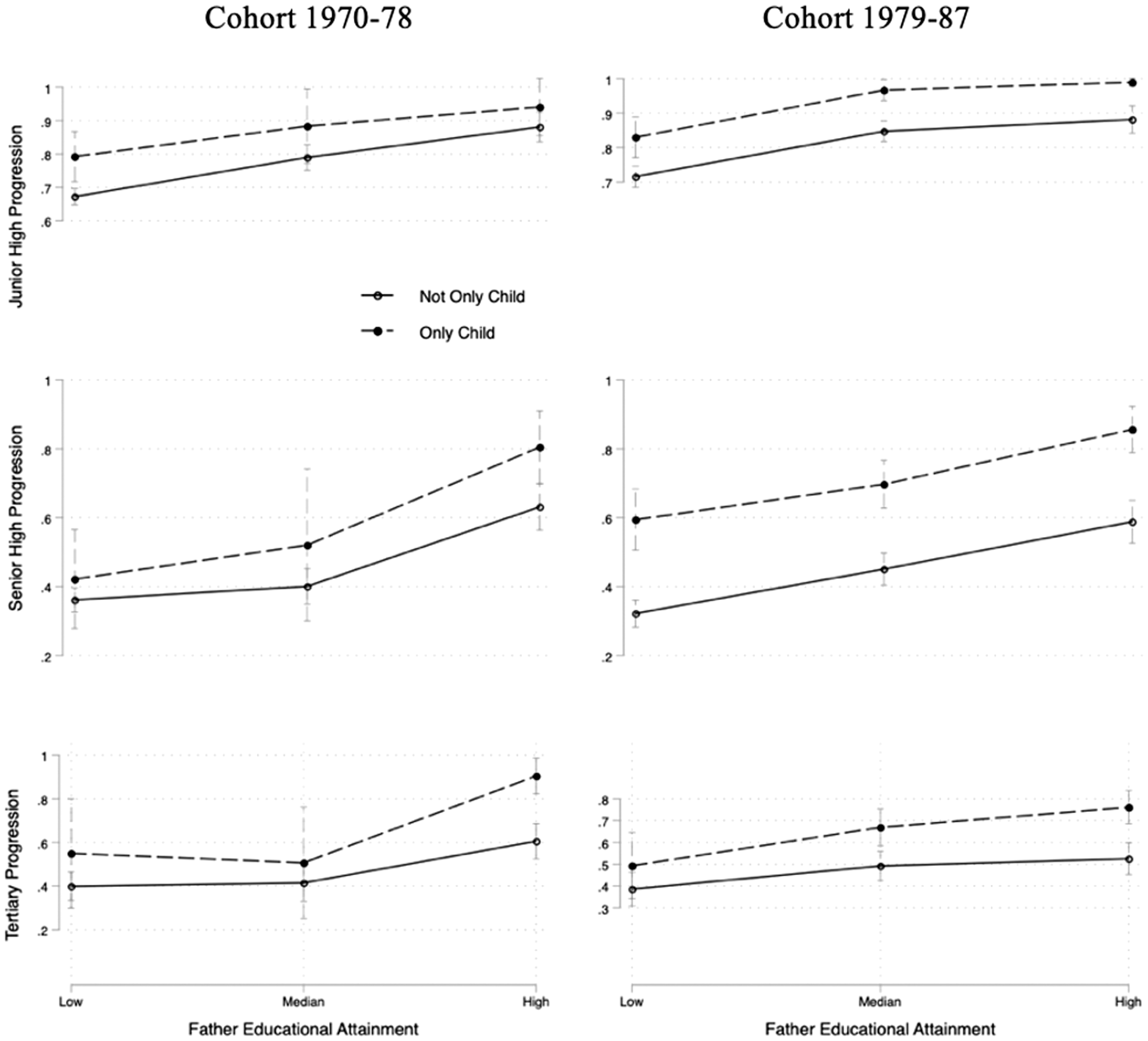
Model predicted probabilities of grade transitions for respondents by father’s educational attainment, only-child status, and cohort, with 95% confidence interval.
Gaps in the predicted probabilities between the lines of only children and those with siblings in numbers and the differences among the gaps in Figure 3 are recorded in Tables 1–6 in the Appendix. The tables also include tests of whether the only-child premiums differ from zero, and whether the sizes of the premiums differ across different levels of social origins in each scenario as specified by cohort and stage of transition.
Figure 3 and tests for the first differences illustrate a by-cohort pattern consistent with the results from the previous section. For Cohort 1, at the transition to junior high school, only children are more likely to progress compared with people with siblings only among those from low social origins (Δ = 0.12; p < 0.01). For the transitions at senior and tertiary levels, the situation is reversed in the sense that among people from high social origins, only children do better in terms of likelihood of progression (for senior transition Δ = 0.173; p < 0.01; for tertiary transition Δ = 0.299; p < 0.001). For Cohort 2, being the only child in the family is consistently positively associated with higher chances of progression at all three levels of school transitions, except at the tertiary transition between only children and those with siblings from low social origins. The coefficient not being statistically significant might be due to the small sample size. Although the secondary differences are all statistically insignificant at the 95% confidence level and thus H3c is supported generally, we nevertheless observe the expected patterns, looking at columns of the first differences. The similar pattern for Cohort 1 at the junior high school transition and Cohort 2 at the junior and senior high school transitions (smaller/equal gaps from low to high origins), as well as that for Cohort 1 at the senior school transition and Cohort 2 at the tertiary school transition (gap becoming larger from low to high social origins), suggest that for the younger birth cohort, transition to tertiary level schooling remains extremely competitive. The younger cohort enjoy the benefits from educational expansion at all levels. However, the expansion did not seem to reduce inequality in the higher education transition based on only-child status and family socioeconomic background. This is consistent with previous research that found structural inequality persisting for college-level education after the education expansion (Yeung, 2013). Drawing on the MMI theory (Raftery and Hout, 1993), my results suggest that enrollment in tertiary education is not saturated for Cohort 2. In addition, with increased tuition and life expenses, higher education becomes a less accessible option for low- or medium-income families, and given that, the sibling dilution mechanism would have little effect, because those families are not equipped with the needed amount of resources in the first place. The aforementioned smaller gaps between the lines for only children and those with siblings in Cohort 2 from low and median social origins, compared with those from high social origin, at the tertiary transition were a clear manifestation.
The comparison across the two cohorts suggests that after the education expansion, senior high school becomes less competitive, while enrollment in tertiary schools remains highly selective based on family background and only-child status. While for Cohort 1, at the senior high school transition, people with both a higher social origin and only-child status have higher chances for progression, for Cohort 2, the situation of only children from low social origins is greatly improved. This suggests that only children from low social origins benefit from the education expansion in the transition to higher secondary schools.
Discussion
To summarize, this paper examined the relationship between being the only child in the family and educational attainment and explored the potential moderation effect of this relationship by social origin, measured by father’s educational attainment. The social context under study is post-reform China, when Chinese society went through dramatic demographic, educational, and economic changes. The analysis is done on a sub-sample from the CFPS, which consists of two birth cohorts born in the years 1970–1978 and 1979–1987. The major difference between the two birth cohorts is that the second birth cohort was born under China’s OCP and grew up under rapid education expansion and fast economic development after the market transformation. In the analysis, I examined the aforementioned relationships for each cohort and across different educational outcomes.
The results show that for the younger cohort, the only-child status becomes an important predictor for educational attainment. Comparison between the two birth cohorts suggests that for people born under the OCP and education expansion, the gap in educational attainment by only-child status was enlarged between those from one-child families and those who had siblings, especially at secondary education levels. For the transition at the tertiary school level, only children were able to maintain their advantages. This was likely due to both demographic and educational policies. After the implementation of the OCP and the emergence of more nuclear families with only one child, families were more child orientated in the sense that families as units tended to focus more, sometimes excessively, on the child’s needs, including educational needs (Wang and Fong, 2009). At the same time, education expansion provided more places in school. The patterns in model predicted probabilities in this paper suggest that only children are more likely to benefit from these newly created opportunities than those with siblings.
The observed variation in the association between only-child status and educational attainment by social origin has implications for structural educational stratification under the impact of education expansion in post-reform China. For the older cohort, I found a statistically significant only-child premium among those from low social origins at the junior high school transition, but at senior high and tertiary school transitions I found it to be statistically significant only among those from high social origins. While the education expansion increased enrollments at all levels of schooling for the younger cohort, the only-child premium was found at similar magnitudes across social origins at the junior and senior high school transitions; at the tertiary school transition, I only found a statistically significant only-child premium among those from high social origins. The findings suggest that progression to tertiary schools remains highly selective based on social origin and only-child status.
My analysis could not establish a firm causal relationship. Although I controlled for a set of factors that are most likely to influence the number of siblings and educational outcomes, including a province fixed-effect variable, there are still likely unobservable covariates that I could not control for due to lack of suitable measurements in the data. There is a possibility of endogeneity, if parents intentionally limited or increased the number of children in order to maximize educational outcomes. However, Chinese society went through great fluctuations before and after the Reform and Opening Up; in particular, the disruption of the educational system during 1966–1976. It must have been uncommon for families to make such endogenous decisions, given the many unpredictable societal, political, and educational changes that had occurred and uncertainties about the future. In addition, under the birth control policies, most families actually had very little freedom to decide how many children to have (even in rural areas where the one-child restriction was more relaxed, it was still almost impossible for couples to have three or more children). Also, in a culture that traditionally asserted that more children meant more happiness, either complying with or evading birth control policies did not seem to result primarily from concerns about children’s educational outcomes.
In this paper presenting my education transition research, I could not consider whether the pattern holds for different types of schools at the same educational level. It is possible that the relationships I examined could vary for academic and vocational tracks, both treated as senior high schools in this paper, as academic tracks are generally more costly in time and money (Yeung, 2013). This merits the attention of future researchers, as it would present a more detailed picture of educational inequality and stratification in post-reform China.
As education is an important determinant of occupation and income (Bian and Logan, 1996), understanding educational stratification and the evolving social structures is fundamental for grasping the patterns of occupational stratification and intergenerational mobility in the era of a new market economy (Wu, 2010). Sociologists are always concerned with who loses and who gains from policy changes. The state-level demographic and educational policies have significantly affected the life trajectories for the cohorts born since the 1970s. On the one hand, a generation of Chinese sharing the common label of ‘the only children’ has been created. They have been greatly empowered in educational attainment by both concentrated parental attention and increased educational opportunities. What does this mean for their future career development and social mobility? If we consider better educational attainment to be one of the early consequences of the population control policy, what are the later consequences? For example, will the benefits of only-child status in educational attainment be transferred across generations as the only children age and begin to form new families? On the other hand, how do the benefits of being the only child in the family compare with the heavy responsibilities of taking care of elderly family members without any sibling support?
In addition, considering the unbalanced implementation of the OCP and uneven distribution of educational resources, people who are not the only child in the family are more likely to have been born in resource-scarce rural areas. In that case, having siblings would only add to their disadvantages in inequality of educational opportunity. My findings should thus caution policy makers, especially those in developing countries aiming for quantity–quality trade-offs by reducing fertility rates, about the possibility of introducing and enhancing inequalities. Consistent with past research on educational expansion, this research also suggests that merely opening up more slots in schools will not necessarily reduce inequality of educational opportunity.
Footnotes
Acknowledgement
The author would like to thank the Institute of Social Science Survey at Peking University for providing data for public use. I appreciate the reading by and comments from Professors Siwei Cheng, Mike Hout, and Kim Weeden on the earlier drafts. I thank two anonymous reviewers for their constructive comments on the manuscript. Lastly, I would like to express my gratitude for comments by the participants in my section at the International Chinese Sociological Association 2019 Annual Conference. Mistakes are my own.
Funding
This research received no specific grant from any funding agency in the public, commercial, or not-for-profit sectors.

Supplemental material
Supplemental material for this article is available online.