




Abstract
In this study, we investigate the correlation between migrant-related factors and migrants’ childrearing values concerning community-oriented versus individual-based dimensions, with a particular interest in the effects of rural household registration (hukou) status and settlement intention. Using data from the 2009 Longitudinal Survey on Rural–Urban Migration in China, we find that rural migrants stress individual-based qualities the most, such as independence, diligence, and responsibility, while they also emphasize certain community-oriented qualities, such as tolerance/respect, and obedience. Local or non-local rural hukou status at the city level is not an important factor in people’s migrant lives when it comes to shaping childrearing values. Instead, settlement intention is found to be more important than hukou status in affecting rural migrants’ childrearing values, particularly in non-local rural migrants, in that rural migrants with settlement intention tend to favor community-oriented values as opposed to individual-based values for their children.
Introduction
Rural–urban migrants in China are rural household registration (hukou) holders who make bold efforts to attain a better life in cities without obtaining permanent urban residency. The majority of rural migrants take the unwanted, low-paying jobs left by their urban counterparts in cities, often dirty, dangerous, and difficult jobs with little hope of advancement (Liang, 2004). Meanwhile, rural migrants are denied equal access to social welfare benefits in cities (Wu and Xiao, 2018), where they are socially and economically disadvantaged, and are regarded as second-class citizens (Solinger, 2006). In recent decades, as growing problems regarding their children’s health, safety, and education have begun to surface, the manner in which rural migrants rear their children has drawn extensive attention. However, little attention has been paid to conducting sociological analyses of rural migrants’ childrearing values.
Childrearing values are the standards used as a basis for determining what qualities people consider most desirable in children and may include what parents personally value or what they want for their own children, so as to prepare them for their present and future life conditions (Alwin, 2001; Youniss, 1994). In sociological studies, most discussion on childrearing values tends to relate to people’s work experiences, such as occupational conditions, because people evaluate which qualities are most necessary and useful in occupational life through their experiences, and then instill these values in their children to prepare them for good or even better lives (Breen and Goldthorpe, 1997). For instance, in Kohn’s (1969) seminal work, Class and Conformity: A Study in Values, the working and middle classes were found to have entirely different childrearing values. Because autonomy is more possible in middle-class occupations, whereas obedience to externally-imposed rules and directives set down by others seems more necessary in working-class occupations, middle-class parents tend to stress autonomy-related qualities for children, while working-class parents emphasize conformity (see also Alwin, 1990, 2001; Lareau, 2002; Weininger et al., 2009).
Based on the same line of reasoning, the present study explores the contrast in childrearing values between community-oriented and individual-based qualities by extending the effects of occupational conditions to the migrant experience. Community-oriented qualities have been emphasized in childrearing practices and values influenced by the collectivistic culture of China, particularly prior to the economic reform, such as obedience and unselfishness, values that emphasize group welfare over individual goals and focus on getting along well with others so as to integrate into the local community (Zeng and Greenfield, 2015). Since the state’s initiation of the economic reform in the late 1970s, society has increasingly required assertiveness and initiative-taking skills for social success and, accordingly, individual-based qualities for the achievement of personal goals, such as independence and creativity, have been increasingly valued in childrearing (Chen and Chen, 2010). Therefore, childrearing values in China now stress individual-based qualities more and endorse community-oriented value less.
Although there are some studies on the rural–urban disparity in childrearing styles or values (Chen et al., 2010; Jin and Liu, 2018; Liu et al., 2015), few studies focus on the correlation between migration-related factors and rural migrants’ childrearing values, especially concerning the community-oriented versus individual-based dimensions. As people generally consider what prevails in the surrounding society and seek to help their children adapt to it (Youniss, 1994), childrearing values are not only constrained by their current socioeconomic status but also affected by a broad array of life experiences (Alwin, 2001; Xiao, 2001). Among rural migrants, the migrant experience can be another important factor in addition to work experience, because migrant experiences affect their perceptions of which qualities are most necessary and useful for their rural–urban migration (RUM) and in their urban lives, and then they may try to instill these values in their children so as to prepare them for their future lives.
Among the migration-related factors, local and non-local hukou status and settlement intention receive special attention in the present study. RUM is seen as a unique experience in a society that causes migrant individuals to feel marginal (dissociative dimension) or special (beneficiary dimension). Due to their non-local geographic and cultural identities, the non-local rural migrants have more experience in both the disruptive and beneficiary dimensions than local rural migrants (Chu et al., 2014; Zhan, 2011). Theoretically, people with more disruptive or beneficiary experience tend to stress individual-based values and qualities and have a lower preference for community-oriented values (Sieben, 2017). Therefore, it is necessary for us to examine the disparity in childrearing values between local and non-local rural migrants. Similarly, as rural migrants intending to settle in cities permanently have different goals and even different perceptions of migration compared with those who only consider themselves transients in the cities, it is necessary for us to also examine whether they value different qualities in their children.
By examining these questions, our study has two goals. First, it contributes to the literature by presenting the state of rural migrants’ childrearing values concerning community-oriented versus individual-based dimensions. Second, it will extend our understanding of how childrearing values are shaped by life experiences by extending the effects of occupational experience to include the migrant experience, and, also, the findings can help us comprehensively assess the effects of RUM on rural migrants. Crucially, because the different childrearing values have different implications for children’s development in that community-oriented values may be helpful for children to integrate into local communities, whereas individual-based values may encourage children to get ahead in life (Mallman, 2017; Sieben, 2017; Van Deth, 2007), therefore, the findings may have certain implications for the development of rural migrants’ children.
Theoretical perspectives on the relationship between RUM experiences and childrearing values
In her study on the relationship between intergenerational class mobility and childrearing values, Sieben (2017) developed two theoretical perspectives to explain how social mobility affects people’s childrearing values concerning community-oriented and individual-based qualities: the dissociative thesis; and the beneficiary thesis. According to the dissociative thesis, social mobility described as ‘a disruptive experience’ leads to insecurity, social isolation, stress, and frustration (Friedman, 2016; Lareau, 2015). Thus, the socially mobile are more prone to disconnect from society and feel no need to be good citizens in terms of obeying laws and regulations (Sieben, 2017; Van Deth, 2007), and thereby decrease the importance of community-oriented values (Sieben, 2017). The beneficiary thesis predicts that the socially mobile have a stronger preference for individual-based values, such as determination and independence, that are associated with getting ahead in life (Lehmann, 2009; Mallman, 2017; Sieben, 2017).
The dissociative thesis and beneficiary thesis center the effects of social mobility on childrearing values, and they can be applied to explain how the rural–urban migrant experience affects individuals’ childrearing values for several reasons. First, RUM can be a disruptive experience. Rural people leave their hometowns and move to urban societies with which they are unfamiliar. Due to their rural and non-local hukou status, they are isolated and discriminated against by urban residents when they try to integrate into urban society (Mobrand, 2006; Zhan, 2011). They can neither go back to their hometown nor fit into the new society (Yue et al., 2013). As a result, they feel frustrated, stressed, and doubly isolated (Li and Chui, 2011). Second, RUM can be a beneficial experience both economically and psychologically. The majority of rural migrants improve their economic status by working in cities (Du et al., 2005). Importantly, migrants and young people in particular gain the valuable experience of independent decision-making (Zhong and Arnett, 2018). Therefore, in the present study, we try to use both the dissociative thesis and the beneficiary thesis to explore the childrearing values of rural migrants, and to give special attention to value disparity between local and non-local rural migrants and between migrants with and without settlement intentions.
RUM as a disruptive experience and community-oriented value
The first wave of RUM occurred in the late 1970s. In 2017, the rural migrant population in China was reported to have reached 286.52 million, among which around 171.85 million people were non-local migrants and about 114.67 million migrants were local migrants (National Bureau of Statistics, 2018). During the first two decades, rural migrants suffered strong hostility and prejudice from urban residents, and they were even referred to as ‘blind flow’ (mangliu), and were portrayed as senseless and irrational by the state media for a long time (Tse, 2014). Despite the fact that the state has been discontinuing its official discrimination policy and regarding them as important workers for the development of the state and the society, social exclusion and discrimination, which have been the main obstacles for rural migrants to integrate into urban society, are far from dissolved (Chen, 2013; Tse, 2016).
An increasing number of studies have shown that social networks are formed along the lines of hukou status, meaning that urban residents mainly establish networks with other urban residents and rural migrants are segregated from local urbanites (Mobrand, 2006; Pan, 2007; Zhan, 2011). Yue et al. (2013) examined the correlation between the social network and rural migrants’ integration and found that non-resident ties still made up the bulk of the migrant network and that institutional discrimination (primarily through the hukou system) was the strongest barrier to migrant integration (see also Li and Tian, 2012; Tang and Zhang, 2017). Meanwhile, due to low pay and social discrimination, the majority of rural migrants have to live in dormitories, factories, or construction sites or to reside with their families or fellow townsmen in urban villages (chengzhongcun), which are informal and poor residential areas (Wang et al., 2009). Residential segregation adversely affects rural migrants’ connections with urban residents and ultimately obstructs their integration into urban society (Wang et al., 2017). Social discrimination and residential segregation separate rural migrants from urbanites by labeling the former as outsiders in cities and causing them to feel isolated and frustrated (Li and Chui, 2011; Yang and Zhu, 2016).
In the Durkheimian tradition, disruptive experiences result in alienation and anomie, and socially isolated and frustrated individuals are less prone to connect with their community and feel no need to be good citizens by obeying laws and regulations (Sieben, 2017; Van Deth, 2007). As such, conformity to institutional authority and local governance become less useful in their lives, and they do not believe these qualities to be important for children to acquire (Sieben, 2017). Therefore, the disruptive experiences caused by RUM exert negative effects on people stressing community-oriented values to their children. According to Sieben (2017), people with more experiences of social isolation and discrimination are more likely to disconnect from their local communities, and are thus less likely to stress obedience to local governance and other community-oriented qualities.
Among rural migrants, as local rural migrants speak local dialects and are well adapted culturally to their host cities, they are less likely than non-local rural migrants to encounter discrimination and exclusion from local urbanites, and are therefore more likely to develop a sense of belonging (Cui, 2012; Wang and Fan, 2012; Zhu and Yang, 2019). Chu et al. (2014) explored the determinants of social integration among rural migrants and found that having a common place of origin results in local migrants and urbanites sharing a variety of attributes, including language (local dialect), culture, lifestyle, and identification with the place of origin, and these dimensions are often instrumental in diminishing social exclusion. As local rural migrants generally have an advantage in dialect over non-local rural migrants, they are more likely to be integrated into local urban society and to develop a sense of urban belonging (Zhu and Yang, 2019).
The disparity between local and non-local rural migrants in social integration is manifested in social networks and residential segregation (Chu et al., 2014; Wang and Fan, 2012; Zhan, 2011; Zhu and Yang, 2019). For instance, Zhan (2011) compared the work experiences of rural migrants from rural Chifeng in Chifeng City and those from Beijing and found that though in both Beijing and Chifeng City, migrant workers found it difficult to build social networks with urban residents, this appeared much more difficult for those in Beijing than for those in Chifeng City because the rural migrants in Chifeng City were more likely to establish social connections with urbanites through their relatives, fellow villagers, and friends. Therefore, rural migrants who worked in Chifeng encountered less social exclusion than their counterparts in Beijing due to their local geographic and cultural identities. Regarding residential segregation, Yang and Zhu (2016) studied data collected in eight cities in 2014 on rural migrants, examined the factors that influenced rural migrants’ social integration, and found that non-local rural migrants were more likely to be segregated from urbanites than local rural migrants in terms of residential segregation, which hindered them from integrating into the urban community. As non-local rural migrants experience more social discrimination due to their non-local geographic and hukou status, we propose the following hypothesis: H1: Non-local rural migrants are less likely than local rural migrants to stress community-oriented values for children than are local rural migrants.
RUM as a beneficial experience for rural migrants and individual-based values
Although RUM is accompanied by negative feelings and experiences, it is also viewed as beneficial to rural migrants both economically and psychologically. RUM, to a substantial degree, is a response to the wide gap between rural and urban areas in terms of socioeconomic conditions and life opportunities. RUM has become an important way for poor rural people to improve their economic status (Du et al., 2005).
Rural adolescents have reported high childrearing control (Chen et al., 2010), but when they migrate to cities, they obtain more chances to gain the valuable experience of independent decision-making. By examining the autonomy of rural migrants, Yu (2016) found that they had more autonomy in their lives than before they migrated, and that they found more ways to exercise independent decision-making and to reconstruct their human identities, and importantly, when they exercised independence and freedom in their choices, they felt hopeful and optimistic about their lives. Zhong and Arnett (2018) investigated the leaving home decisions of migrant women workers in China and found that autonomy and independence have become an increasingly important reason for women to leave home—they believe that migration can provide more opportunities for them to build a better future for themselves and enhance their autonomy. It is quite possible that once rural migrants discover the value of individual-based qualities, they wish to teach it and pass it on to their children to help them succeed in their future lives.
Additionally, according to Sieben (2017), as an alternative method of coping with their anomic feelings, the downwardly socially mobile attach much more importance to individual-based qualities for children than the upwardly socially mobile, because more is at stake for the downwardly socially mobile. Similarly, non-local rural migrants are far away from their hometowns and probably receive less family support than local migrants during their stays in cities, and thus they are theoretically likely to have more chances to exercise autonomy and be independent. Importantly, as we discussed above, because non-local rural migrants are unfamiliar with local cultures and dialects, they are more likely to be discriminated against and isolated from local urbanites, and therefore they are more likely to have a much stronger desire to improve their lives by emphasizing individual-based values because all these values are associated with getting ahead. Hence, we propose the following hypothesis: H2: Non-local migrants are more likely than local rural migrants to endorse individual-based values.
Settlement intention in the host city and childrearing values
According to the dissociative thesis, the isolation and frustration that the migrants suffered in their efforts to integrate into urban societies may make them less prone to connect with the local community, thereby weakening their community-oriented childrearing values. In the rapid urbanization of China, an increasing number of rural migrants tend to settle permanently in the host city (Yue et al., 2013). If migrant individuals intend to settle in the host city, it is necessary for them to establish a connection with the urban community, and even to be good citizens. Those intending to stay in cities only temporarily are more likely to migrate between cities and even go back to their hometowns, and thus integrating into an urban community is not their top priority, earning money instead being their main concern. Hence, it is possible that migrants who do not intend to settle in the host city are less likely to endorse community-oriented values and more likely to stress individual-based values.
In addition, the issue of whether settlement intention has different effects on childrearing values between local and non-local rural migrants merits attention. As non-local migrants generally pay much higher economic and social costs for their migration (Xie, 2012), when they intend to settle in cities, they may try harder than their local counterparts to integrate into an urban community so as to ensure that their paying such high costs has not been in vain. Therefore, it is possible that non-local rural migrants with the intention to settle in the host city are more likely to adopt community-oriented values. Based on the above analysis, we propose the following hypotheses: H3: Rural migrants with the intention to settle in the host city are more likely to adopt community-oriented values and less likely to adopt individual-based values. H4: The settlement intention in the host city has stronger effects on childrearing values among non-local rural migrants than among local rural migrants.
Data and variables
Data
We used data from the Migrant Household Survey (MHS) that was abstracted from the 2009 Longitudinal Survey on Rural–Urban Migration in China (RUMiC). The 2009 RUMiC was a project of international collaboration between the Australian National University, Beijing Normal University, and the Institute for the Study of Labor. The MHS aimed to explore the patterns and effects of migration in China (Akgüç et al., 2014), by randomly selecting 15 cities from nine principal provinces that both send and receive a large number of rural migrants. The nine provinces included Anhui, Henan, Sichuan, Chongqing, Hubei, Zhejiang, Guangdong, Shanghai, and Jiangsu. The MHS collected data from 5242 households consisting of 9347 individuals. The MHS survey questionnaires covered detailed standard demographic and socioeconomic characteristics of household heads and members. The data were all collected via face-to-face interviews.
The questions related to values were addressed to respondents over 16 years of age regardless of their marital and parental status. As the focal task of this study is to examine people’s childrearing values, we confine the analytical sample to married respondents aged 20–49. First, the majority of the respondents within this age range are likely to have stable values, life goals, and thoughts about what is most important to them. Second, the majority of married people aged 20–49 have children, and even though some of them do not have children during the survey year, they are likely to have views or some thoughts regarding children’s development.
Variables
The analysis included two dependent variables representing childrearing values: community-oriented values; and individual-based values. The respondents were asked ‘In addition to hardworking for good school performance, which of the following qualities do you think are important for a child to possess? (3 choices at most in order of preference)’. The 10 value items were independence (dulixing), diligence (qinfen), responsibility (zerengan), creativity (you xiangxiangli), tolerance and respect (dui bieren kuanrong he zunjing), thrift (jiejian), determination (jianyi), faith (you xinyang), selflessness (bu zisi), and obedience (tinghua). These value items were not coded dichotomously in the MHS. Therefore, the data did not permit us to conduct a factor analysis. According to previous literature on the measurement of community-oriented and individual-based values (Sieben, 2017), the community-oriented values include ‘tolerance and respect’, ‘selflessness’, and ‘obedience’; the individual-based values include ‘independence’, ‘diligence’, ‘responsibility’, ‘creativity’, ‘thrift’, ‘determination’, and ‘faith’.
Because in the community-oriented value dimension, there are only three options for respondents to select, whereas there are seven options in the individual-oriented value dimension, statistically, the probability of respondents choosing individual-based qualities is higher than the probability of their choosing community-oriented qualities. Therefore, our main purpose in creating the dependent variables of community-oriented values and individual-based values was not to infer respondents’ preferences between the two value dimensions but to examine the effects of migration-related factors on the two value dimensions, respectively.
Regarding the valuation of the community-oriented values, each quality that makes up the community-oriented value dimension represents a score of 1, whereas the quality that makes up the individual-based value dimension represents 0. If the quality is chosen as the most important quality, then its score will be multiplied by 3; if the quality is chosen as the second most important quality, then its score will be multiplied by 2; and if the quality is chosen as the third most important quality, then its score will be multiplied by 1. Then the scores in all three places will be added up, and the total score represents community-oriented value. The valuation of individual-based values is created in a similar way. Both value scores range from 0 to 6. A high score on the scale indicates an emphasis on the value, but for the reasons we mentioned above, it does not necessarily mean that people prefer individual-based values over community-oriented values, and vice versa. As each of the 10 qualities are independently presented and each has an equal chance to be chosen by the respondents, we can count and compare the frequency of each quality that was chosen by respondents to be important, and then infer migrants’ value or quality preferences.
The key independent variables included hukou status and settlement intention in the host city. Rural hukou status was distinguished as local and non-local rural hukou status at the city level in the questionnaire, and we categorized migrants with non-local city rural hukou status as ‘non-local migrants’ and categorized migrants with local city rural hukou status as ‘local rural migrants’. The MHS questionnaire asked respondents how long they would like to remain in their host city if the policy allowed. Possible answers included ‘1 year’, ‘not sure’, or ‘no idea’, all of which were coded as ‘no’, and ‘1–3 years’ or ‘forever’, both of which were coded as ‘yes’. In this manner, the settlement intention in the host city was coded as a dummy binary variable. The other control variables included gender, age, number of children, education, and occupation.
Analytical strategy
The analysis in this study was composed of three parts. With description statistics, we counted and compared the frequency of each quality that was chosen by respondents as their favorite qualities by hukou status and their settlement intention in the host city. Regarding the regression model, both the community-oriented and individual-based value variables are discrete variables with seven score levels from 0 to 6. Importantly, both the two score distributions are skewed (the community-oriented value scores cluster in low score levels, such as 0 and 1, whereas the individual-based value scores are concentrated on high score levels, such as 5 and 6, see Table 1). Given these conditions, to examine the effects of migration-related factors on the two value dimensions, it is much more appropriate to apply the ordered logit regression model than the ordinary least squares (OLS) regression model (Angrist and Pischke, 2008). In fact, we ran both models to check for consistency, and the OLS model gave us more or less the same results as the ordered models (same significance levels, same signs, and similar predicted outcomes). Lastly, we ran logit regression models on each of the 10 qualities to further reveal the effects of migration experiences on rural migrants’ childrearing values.
Descriptive statistics for the dependent and independent variables in married rural migrants aged 20–49.
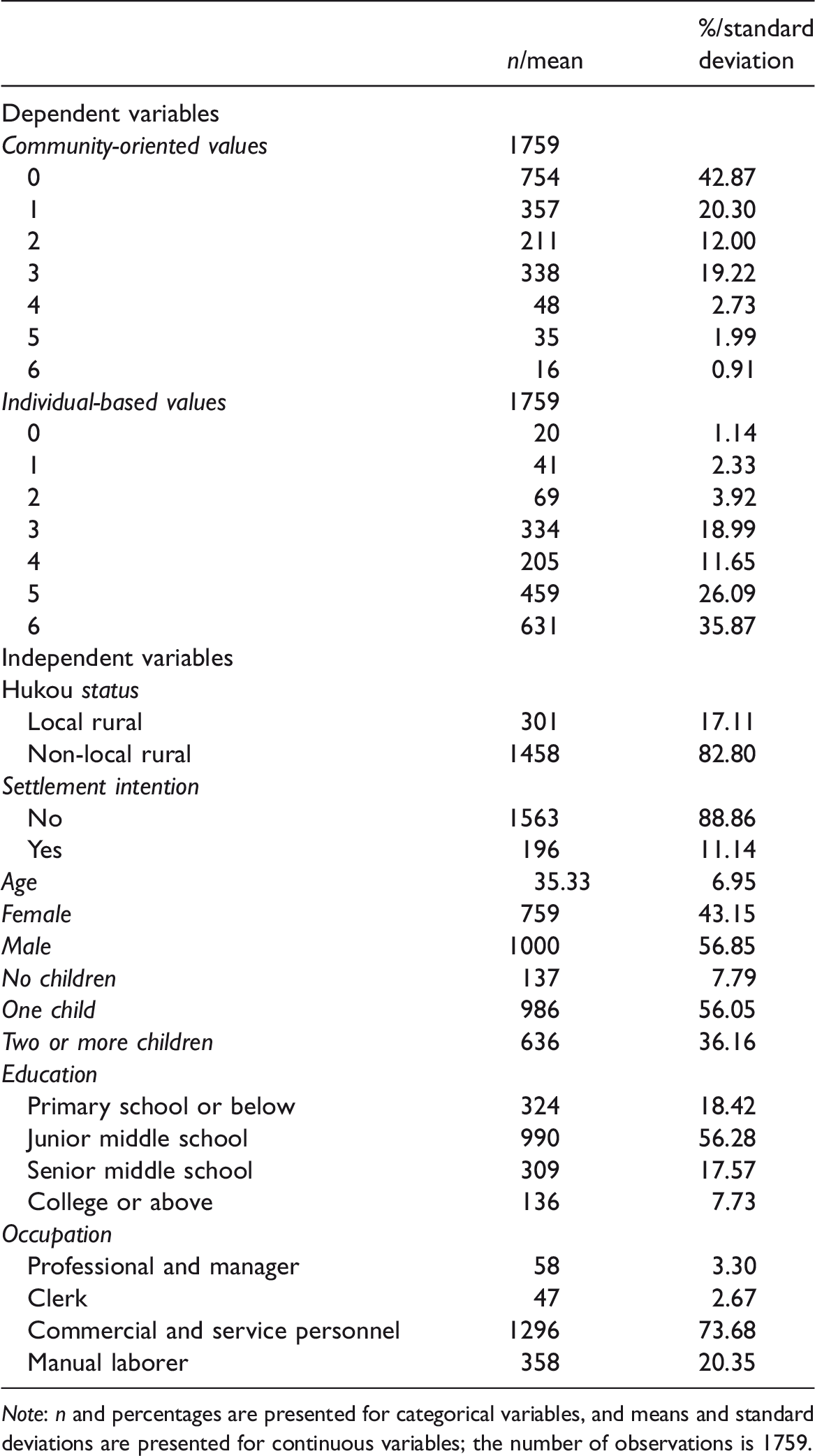
Note: n and percentages are presented for categorical variables, and means and standard deviations are presented for continuous variables; the number of observations is 1759.
Results and interpretation
Descriptive analysis
Table 1 presents summary statistics for dependent variables and independent variables in the analytical sample. In our analytical sample, about 43% of respondents did not choose any community-oriented qualities that they thought important for children to have, whereas the percentage of respondents who chose none of the individual-based qualities was only around 1%. As we mentioned earlier, we cannot infer that individual-based values are preferred much more in rural migrants than community-oriented values based on the scores of the two value dimensions. Therefore, it is necessary for us to compare each of the ten qualities in terms of the preferences among rural migrants (see Table 2).
Frequencies of each quality chosen as important quality.
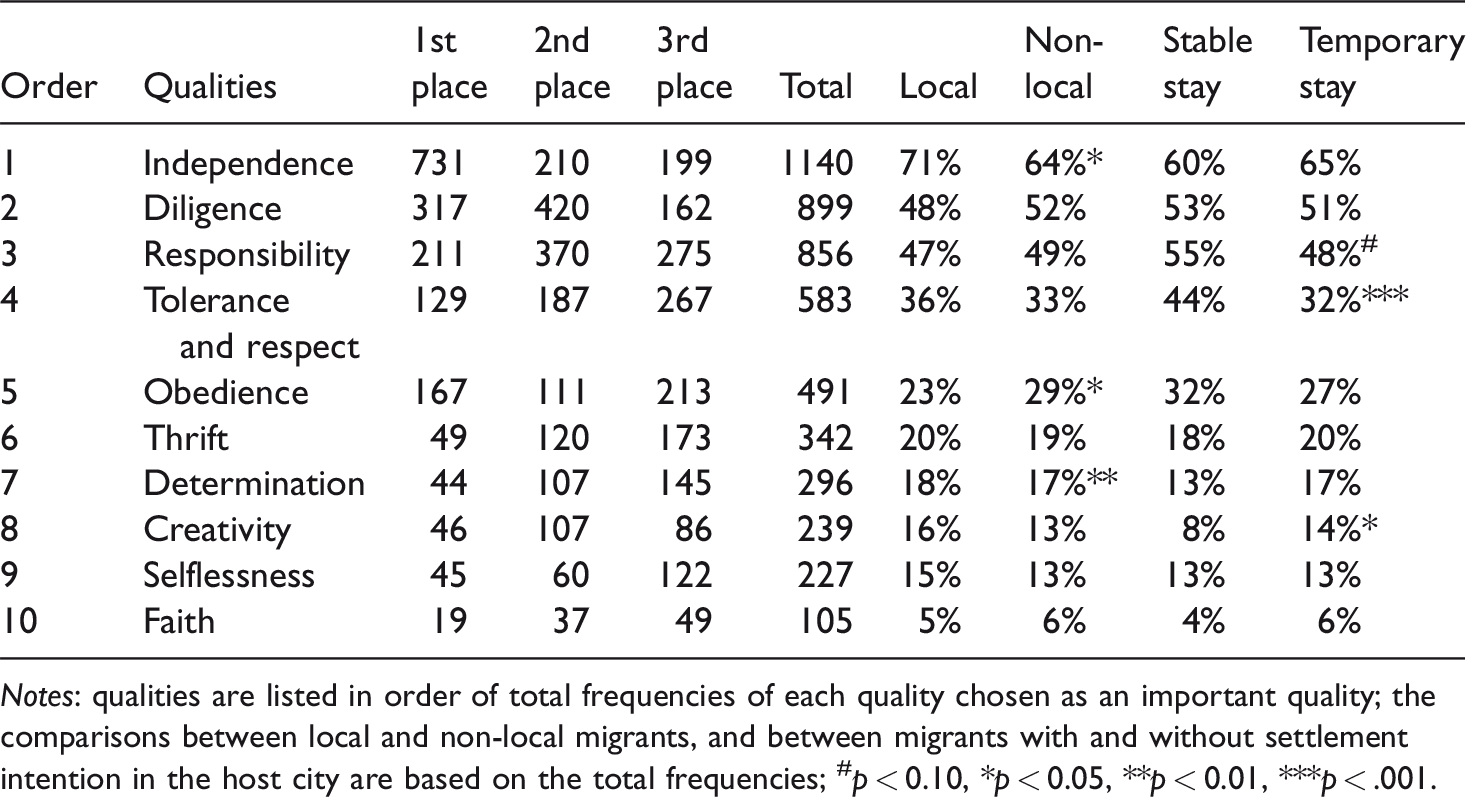
Notes: qualities are listed in order of total frequencies of each quality chosen as an important quality; the comparisons between local and non-local migrants, and between migrants with and without settlement intention in the host city are based on the total frequencies; #p < 0.10, *p < 0.05, **p < 0.01, ***p < .001.
Because respondents were asked to choose three qualities at most in order of preference, in Table 2 we report the frequencies of each quality chosen by respondents as an important quality for a child to possess from high to low. According to Table 2, ‘independence’ was the most popular quality in both local and non-local rural migrants and migrants with and without settlement intentions, though the non-local respondents had a significantly lower preference for the quality than their local counterparts. ‘Diligence’ and ‘responsibility’ were ranked in second and third places, respectively, in terms of the total frequencies. Therefore, the three most popular qualities among rural migrants were all individual-based qualities. In terms of the community-oriented dimension, ‘tolerance and respect’ and ‘obedience’ ranked in fourth and fifth places, respectively, and the total frequency of the two qualities was much higher than that of the other four individual-based qualities. From Table 2, it is obvious that rural migrant respondents stressed individual-based qualities the most, such as independence, while they also emphasized certain community-oriented qualities, such as tolerance/respect, and obedience.
Regression results
Table 3 presents the results obtained through ordered logit regression analysis of the community-oriented and individual-based value dimensions in married rural migrants aged 20–49. Consistent with our hypotheses, rural migrants with the intention to settle in the host city were more likely to emphasize community-oriented values, whereas rural migrants who stayed temporarily in the host city were more likely to endorse individual-based values. Specifically, migrants with settlement intentions attached importance to the community-oriented values by 0.35 units more (p < 0.05) and to the individual-base values by 0.27 units less (p < 0.05) than their counterparts who had no settlement intentions in the host city, respectively, net of other covariates. Hukou status has no statistically significant effects on the two value dimensions. The results of the interaction between hukou status and settlement intention show that non-local rural migrants with the intention to settle in the host city are more likely to endorse community-oriented values, and are less likely to stress individual-based values.
Ordered logit regression on community-oriented values and individual-based values.
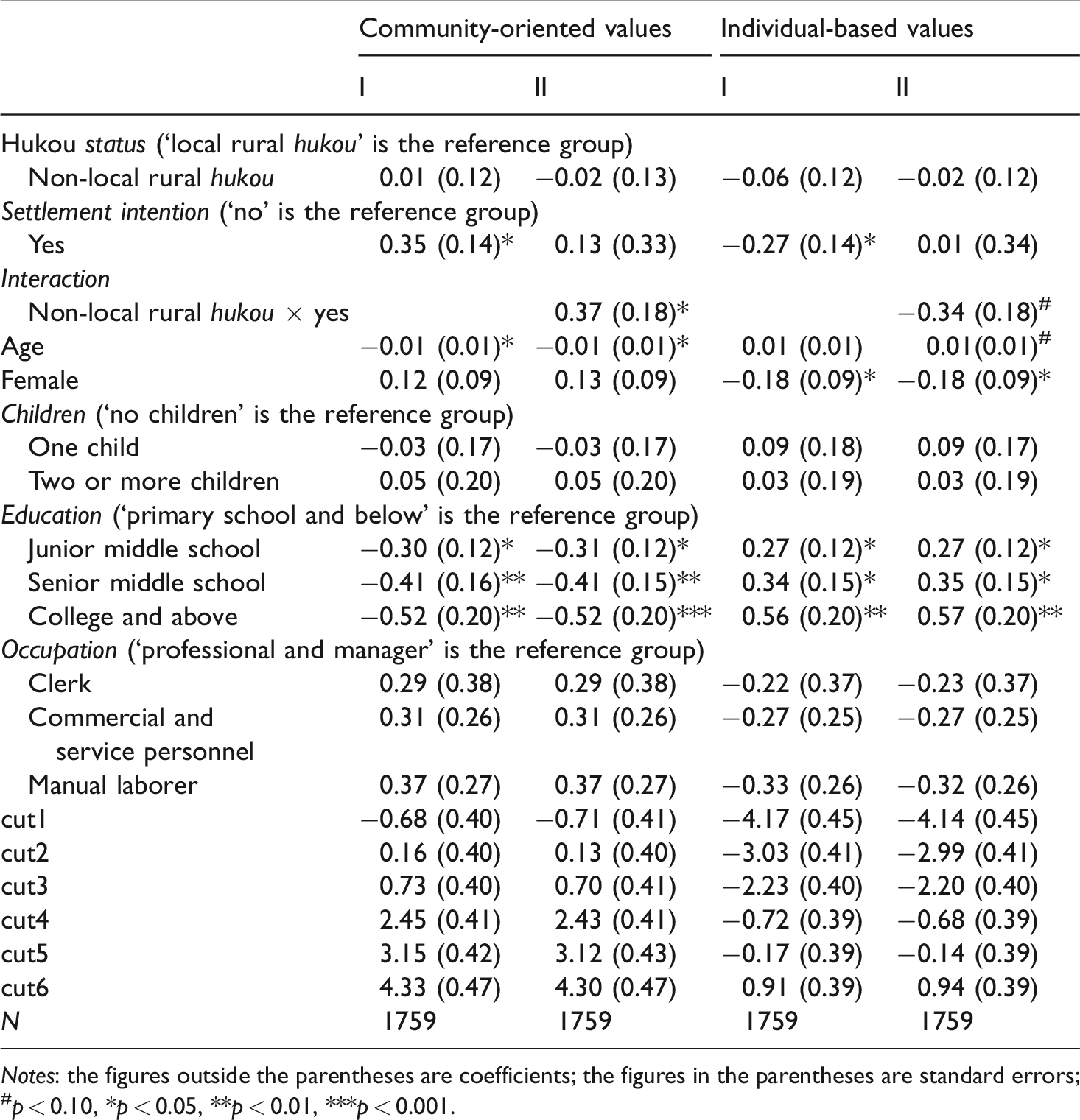
Notes: the figures outside the parentheses are coefficients; the figures in the parentheses are standard errors; #p < 0.10, *p < 0.05, **p < 0.01, ***p < 0.001.
From Table 3, we also found that younger migrants were less likely to hold community-oriented values, and women were less likely to emphasize individual-based values. Education is a significant variable in predicting migrants’ childrearing values even after controlling for other factors. Specifically, rural migrants with more education were less likely to endorse community-oriented values and prone to emphasize individual-based values. Occupation and number of children have no statistically significant effects on the two value dimensions.
Tables 4 and 5 present the results obtained through logit regression analysis of each quality in married rural migrants aged 20–49. Regarding community-oriented qualities, there are evident differences in their preferences for the quality of obedience across educational degrees, and hukou status. In particular, non-local rural migrants showed a stronger preference for obedience than local migrants, which is inconsistent with our first hypothesis. Migrants with the intention to settle in the host city were more prone to value tolerance and respect. The non-statistically significant effects of education, occupation, hukou status, and settlement intention on migrants’ valuing ‘selflessness’ indicate that rural migrants demonstrated a low preference for selflessness regardless of education, occupation, hukou status, and settlement intention.
Logit regression results on community-oriented qualities in married rural migrants aged 20–49.
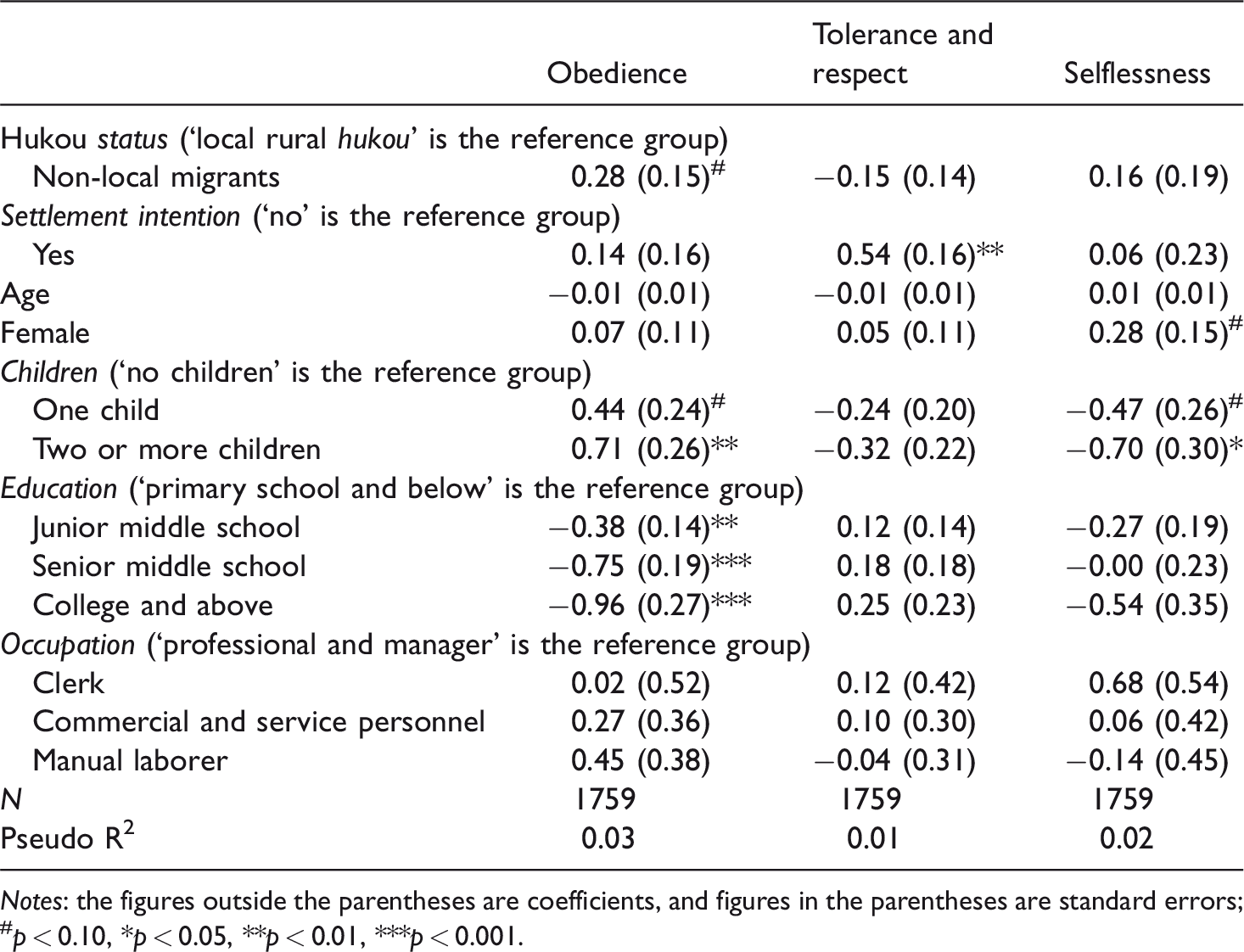
Notes: the figures outside the parentheses are coefficients, and figures in the parentheses are standard errors; #p < 0.10, *p < 0.05, **p < 0.01, ***p < 0.001.
Logit regression results on individual-based qualities in married rural migrants aged 20–49.
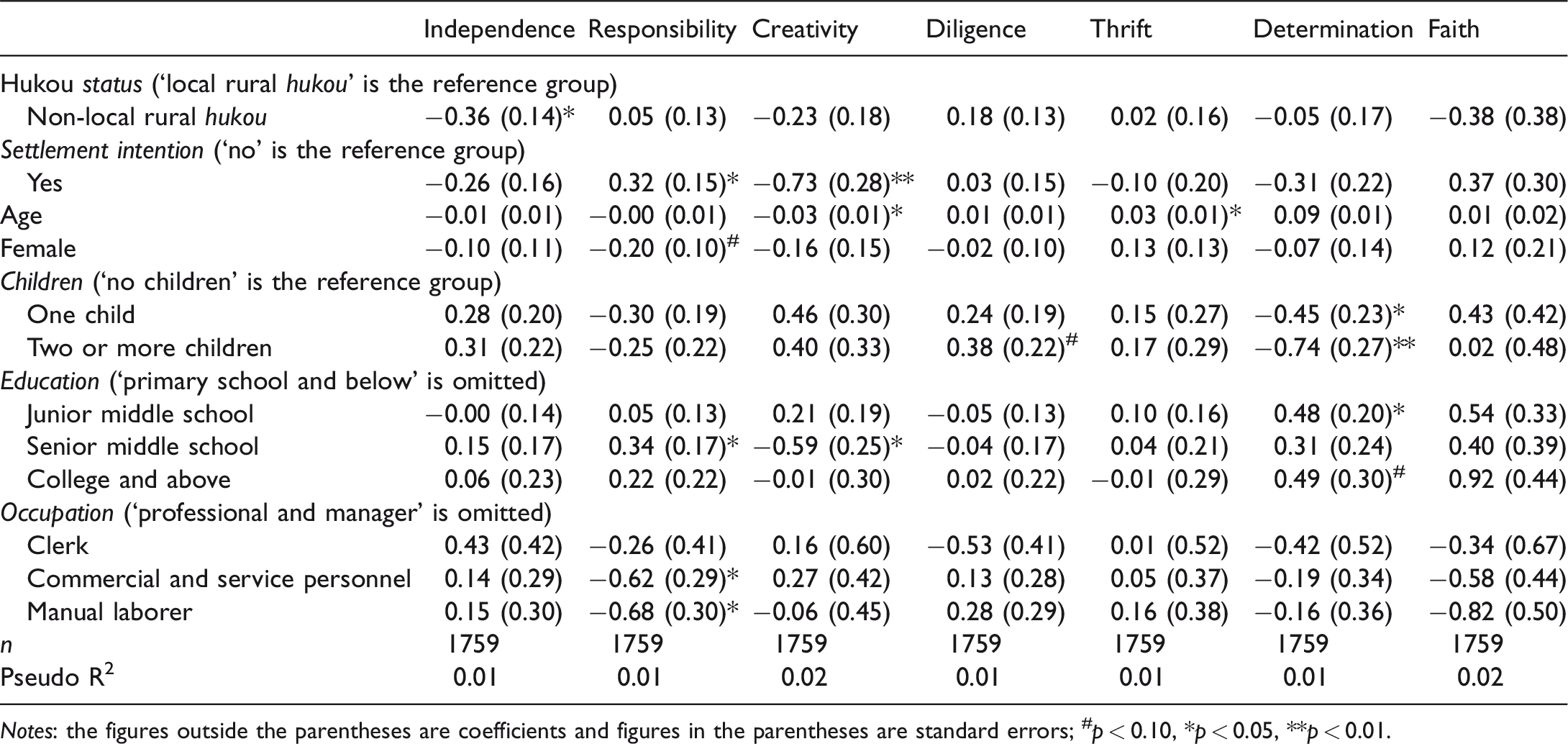
Notes: the figures outside the parentheses are coefficients and figures in the parentheses are standard errors; #p < 0.10, *p < 0.05, **p < 0.01.
Regarding the dimension of individual-based qualities, settlement intention, education, and occupation are found to have no statistically significant effects on migrants valuing independence and diligence. Considering that independence and diligence were the two most popular qualities among married rural migrants, our findings indicate that these qualities have saturated this group, causing little difference among them. Additionally, significant disparity between local and non-local rural migrants was found only in valuing independence, in that non-local migrants were less prone to value independence. Settlement intention disparities were found only in valuing responsibility and creativity.
Discussion
In this study, we present rural migrants’ childrearing values concerning community-oriented versus individual-based dimensions. We found that rural migrants show paradoxical value preferences to a certain degree. Specifically, they overwhelmingly emphasize individual-based qualities in children, such as independence, responsibility, and diligence, whereas they also embrace particular community-oriented qualities, such as tolerance/respect and obedience. In particular, we investigated the relationship between hukou status and childrearing values and between settlement intention and childrearing values by contrasting two opposing lines of reasoning. RUM as a disruptive experience leads to social isolation, exclusion, and frustration, which are assumed to negatively affect the importance people attach to community-oriented values and qualities in children. RUM as a beneficial experience to migrants provides people with opportunities to improve their economic status and exercise independent decision-making, and is thus expected to strengthen people’s preferences for individual-based values and qualities. In both cases, the migrant effects would be much stronger for non-local migrants than for local migrants, and settlement intentions may have more significant effects on childrearing values in non-local migrants. We tested these hypotheses in three steps, and the analyses reveal several major findings.
First, based on the ordered logit regression models in the rural migrant sample, we found that on the one hand, non-local rural migrants did not attach significantly less importance to community-oriented values nor did they show significantly more preference for individual-based values than local migrants. These findings disconfirm our hypotheses. On the other hand, consistent with our hypotheses, settlement intention is found to be positively correlated with migrants emphasizing community-oriented values, and negatively associated with migrants stressing individual-based values. Second, we added the interaction term of settlement intention and hukou status in the ordered logit regressions and found that non-local migrants with the intention to settle in the host city are more prone to emphasize community-oriented values and less prone to stress individual-based values, confirming our hypotheses. Third, we ran binary logit regression models on each quality separately with the same covariates in the analytical sample to thoroughly examine the effects of hukou status and settlement intention. We found that both factors have very limited effects on migrants valuing these specific qualities.
Our main conclusion is that though hukou status has some effects on migrants valuing certain qualities, local and non-local rural hukou status is not an important factor in people’s migrant life when it comes to shaping childrearing values on community-oriented versus individual-based dimensions. Instead, settlement intention is found to be more important than hukou status in affecting rural migrants’ childrearing values, particularly among non-local rural migrants. According to both the dissociative thesis and the beneficiary thesis, RUM is a unique experience in a society that causes migrant individuals to feel either marginal (dissociative thesis) or special (beneficiary thesis). At present, RUM is quite common among rural people. Though non-local migrants may be more likely to feel marginal or special, this may not be that new for them because they may already have acquired this knowledge by experiencing it before, or by being told about it by their friends or family, and hence they can quickly learn how to resolve any conflicts they might experience as a result of their migration. However, if rural migrants intend to settle in the host city, they have to integrate into it and devote more effort to networking with local communities, and hence they are likely to prefer community-oriented values. If rural migrants plan to stay only temporarily in the host city, being integrated into it is not their main concern, and they are more likely to focus on earning money and consequently care more about individual-based values that are associated with getting ahead.
Our findings on the positive correlation between rural migrants’ settlement intentions and their preferences for community-oriented values have important implications for the integration of migrants’ children into local society. Parents’ childrearing values guide their childrearing practices and, in turn, affect children’s development to a certain degree. If parents hold community-oriented values for their children, the children will tend to possess qualities that help them to establish social networks with and be integrated into local communities. Therefore, to improve children’s social integration in the long run, more migrant-friendly policies in cities should be implemented to enhance rural migrants’ sense of urban belonging.
As the dataset we use in this study is cross-sectional data, we do not have information about rural migrants’ childrearing values before they migrate to cities, and therefore the significant correlation between settlement intention and childrearing values found in the study does not necessarily imply a causal relation. It could be that people personally prefer community-oriented qualities before migration. After migration, these qualities may help them to establish networks with local communities that help them to settle in host cities, and, in turn, they hope their children will possess these qualities as well. However, even if this is the case, migration still plays a role during the transition from the values they personally favor to those they desire that their children will possess. In future studies, if we can compare the changes in rural migrants’ childrearing values before and after their migration, it would be more convincing when we interpret the findings based on the dissociative thesis and beneficial thesis. This calls for a longitudinal research design, in which the effects of RUM can be modeled. Alternatively, qualitative research should be conducted in the future to complement the quantitative study of how rural migration affects migrants’ understanding and interpretation of specific childrearing values.
Footnotes
Declaration of conflicting interests
The authors declared no potential conflicts of interest with respect to the research, authorship, and/or publication of this article.
Funding
The authors disclosed receipt of the following financial support for the research, authorship, and/or publication of this article: This research was financially supported by the China Postdoctoral Science Foundation (Grant Number: 8206300114).
