



Abstract
Based on perspectives of organizational mobilization, action strategy and political opportunity structure, this study systematically examines the effects of five factors – type of dispute, number of participants, rights-defending method, homeowners’ organization, and government response – on the results of homeowners’ collective actions by analyzing data collected from 191 cases of homeowners’ rights protection activities that took place in China between 1999 and 2012. Findings include the following: (1) in administrative disputes and mixed disputes which involve government departments, homeowners are less likely to successfully protect their interests than in other types of disputes; (2) mobilizing a certain number of participants is conducive to homeowners achieving a satisfactory result, but this does not mean that the more participants are mobilized, the more likely they are to succeed in a collective protest; (3) different kinds of rights protection methods and their combinations influence the results of homeowners’ rights-defending activities; (4) non-institutionalized radical actions do not help homeowners to realize their claims; (5) a well-functioning homeowners’ organization which truly represents the interests of homeowners can significantly increase the success rate of a homeowners’ collective action; and (6) government maladministration (improper intervention or administrative nonfeasance) severely hinders homeowners from successfully defending their legitimate rights and interests. These findings confirm the reality of a strong state and weak society in contemporary China.
Keywords
Introduction
Since the housing reform in the late 1980s, China’s urban housing provision system has been commercialized. With the accelerated urbanization, the real estate industry has developed rapidly, and whole neighborhoods of commercially available houses have sprung up like mushrooms in Chinese cities. The data from the National Bureau of Statistics of China (2015) shows that the amount of commercial residential building floor space sold increased from 27.5 million square meters in 1991 to more than 1.2 billion square meters in 2014, an increase of 45 times. The housing market boom and the large-scale emergence of new neighborhoods has been accompanied by numerous housing-related disputes, however. A common cause of these disputes is real estate developers, property management companies, or local government agencies ignoring or violating residents’ interests. Understandably, the number of disputes has increased drastically in recent years. In Beijing, for example, the number of lawsuits accepted by the courts that involved such disputes increased from 1,050 in 2002 to 9,050 in 2004, and then to 13,280 in 2007 (Qi, 2008: 27). Needless to say, many similar disputes have not been filed in court.
Facing infringements, some homeowners are strongly motivated to defend their rights. Hence, in recent decades, homeowners’ rights protection activities occurred very frequently in China (Read, 2003; Zou, 2005). In order to make their efforts more effective, homeowners who live in the same neighborhood and suffer the same problems usually band together to launch collective actions (Tomba, 2005). However, these collective endeavors end with different results. Given almost the same institutional environment, why do some homeowners’ rights protection activities succeed while others fail? Which factors influence the outcomes of homeowners’ collective actions? This study aims to answer these questions by analyzing the data collected from 191 cases of homeowners’ rights protection activities taking place between 1999 and 2012 in urban China. Based on the perspectives of organizational mobilization, action strategy and political opportunity structure, this research examines the effects of dispute type, number of participants, rights-defending method, homeowners’ organization and government response on the result of homeowners’ collective action. Through systematic analysis, I try not only to reveal the institutional barriers faced by homeowners in their self-governance of community public affairs, but also to demonstrate the role played by homeowners’ organizations in their collective actions, all of which may reflect the relationship between the state and the society in contemporary China. My findings may also help relevant government departments to set up effective resolution mechanisms for community disputes and to respond appropriately to homeowners’ collective actions.
Literature review
Factors influencing the outcome of social movements or collective actions
Theories of social movements and collective actions can help us to better understand the emergence, development, and consequences of these social phenomena. Previous research in this field mainly focused on the causes, mobilization mechanisms, and action strategies in these events. However, more and more studies have begun to pay attention to the outcomes of social actions and the factors influencing their outcomes (Gamson, 1990; Giugni, 1998; Porta and Diani, 1999). Charles Tilly (1978) pointed out several factors that might affect the results of a social movement. These include: the participants’ interests and incentives; their organizational ability; the mobilization mechanisms; the repression or facilitation of individuals joining the movement; the political opportunity structure; and the power of the social movement group. Later studies further distinguished four primary factors that might determine the outcome of social movements and collective actions: first, the political opportunity structure, which determines the emergence and development of a social movement in the first place (Amenta et al., 1992; Giugni, 1998, 1999; McAdam, 1999; Tarrow, 1998; Tilly, 1978); second, the power of the social movement organization, which has to do with group solidarity, the organizational foundation, and resources mobilization (Edwards and McCarthy, 2004; McAdam, 1999; Zald and McCarthy, 1997); third, the collective action strategies, which influence the effectiveness of the social movement and increase the chances of protesters reaching their goals (Gamson, 1990; McAdam, 1983); and fourth, the protesters’ demands, which determine the cost of making concessions for the actor being targeted. For example, Gamson’s (1990) research found that protest groups making single-issue demands were more successful than groups making multiple-issue demands. Protest groups that threaten to replace or destroy established groups in power or make broad changes in the political system are unlikely to succeed (Steedly and Foley, 1979).
These studies shed important light on social protests in China by pointing out some basic conditions for successful action. Scholars who study contentious politics in China, try, on the one hand, to find some similarities in social protests between democratic countries and authoritarian China and, on the other hand, to identify factors that make the situation in China different from that in democracies (Cai, 2010; Xiao and Kong, 2011; Yu, 2012). One important factor that attracts researchers’ attention is the authoritarian political system, which leads to a special state–society relationship and political opportunity structure (Huang, 2011; Zhao, 2006). For example, Zhao’s (2001) research emphasized many changes in China’s state-society relationship during the 1980s. These changes generated political opportunities to form an alienated academy, giving rise to ecology-based mobilization, restricting government policy choices, and shaping students’ emotions and public opinion, all of which collectively account for the tragic events.
In the context of China, one of the most important aspects of the political opportunity structure is government response. The role played by the government in China is different from that in democratic countries. Using the data collected from 266 cases of collective resistance in China, Cai (2010) found that the chance for a protest to succeed would be higher if it could exploit the gaps within the state hierarchy and get support from higher-level authorities. To achieve this end, the forcefulness of resistance is one important factor. Cai’s analyses suggest that the level of violence in confrontational protests, casualties or deaths, media exposure, and the size and scale of protests in terms of the number of participants, all increase the forcefulness of collective resistance, which affects the possibility of intervention by higher-level authorities. Another factor that may influence the results of a popular protest in China is the type of demand the protesters make. If a demand creates a zero-sum game between the government and protesters in the sense that the protesters’ gain is the government’s loss, this is seen as a high-cost demand for the government; otherwise, it is seen as less costly to meet. Based on cost-benefit calculations, government departments at different levels will choose different responses, such as concession, repression, or tolerance, which directly influence the outcomes of popular protests (Cai, 2010).
Unlike the situation in democratic societies, where social movements have become highly organized, professionalized, and formalized (Staggenborg, 1988), protests in China often lack an organizational base. This is mainly because until now the authorities in China have always treated all autonomous organizations, which are spontaneously formed by citizens and can hardly be fully controlled, as potential threats to the regime; thus, forming a protesting group is a very risky and politically sensitive action for protesters. However, the endeavor of joining together to fight against infringers has increased among peasants, workers, homeowners, and other social groups. Actually, some kinds of formal or informal protesting groups often exist in collective resistances in present-day China (Yu, 2005, 2012). These organizations are conducive to mobilizing social resources and supporters, leading collective actions to proceed in a more ordered and moderated way, which reduces the risk and provides legitimacy to collective actions (O’Brien and Li, 2006; Wu and Wen, 2010; Zhang and Zhuang, 2008). Thus, it is necessary to thoroughly and carefully examine the roles played by these organizations.
Another critical factor influencing the consequences of protest is the action strategy. One of the basic strategies for powerless people in China is to take advantage of the rhetorical discourses and commitments of higher authorities to curb local officials or other actors who violate their rights and interests (Bernstein and Lü, 2003; Ying, 2001). This strategy is also conceptualized as ‘rightful resistance’ by O’Brien and Li (2006) based on their research on peasants’ protests in rural China. Similar tactics can frequently be observed in other social groups’ collective resistances as well (Zhu, 2011). Protesters in rightful resistance normally frame their claims with reference to statutory rights supported by ideologies or endowed by policy-makers. They use a law-abiding strategy, avoid crossing the boundaries of an authorized channel, and try to exploit the divisions among the powerful (Chen, 2000, 2010; Shi, 2010; Yu, 2003). As O’Brien (1996: 55) argued, wherever a gap between rights promised and rights delivered exists, there is room for rightful resistance to emerge.
Deeply influenced by social movement theory, existing studies on homeowners’ activism in China have accumulated significant knowledge about the causes and strategies of homeowners’ rights-defending activities, but the consequences of these activities and the factors affecting them and the consequences have not received sufficient attention. Some scholars focus on the macro-level institutional factors. They have found that homeowners in urban China have a strong consciousness of their rights and ability to take action, but that the legal and political system which restricts citizens’ autonomous organizations has become an institutional obstacle for homeowners to express their concerns in an organized way (Chen, 2006). Other scholars argued that a real estate interest group had already formed in urban China, which consists of real estate developers, property management companies, local government departments, local courts, and so on. The superior position of this interest group makes it easier to encroach on homeowners’ interests. This is the deep-seated reason why homeowners engage in rights protection activities. In order to achieve success, homeowners must organize themselves to immobilize the real estate interest group (Zhang, 2005). The leadership of homeowner activists, the mobilization of a homeowners’ organization, proper strategies, and rich resources held by homeowners constitute the middle- and micro-level mechanisms for successful homeowners’ rights protection actions (Cai and Sheng, 2013; He, 2005; Zhang, 2005).
In addition, the type of homeowners’ action (cooperative action, technical action, or confrontational action); the composition of activist groups (old retirees or young professionals); the strategies adopted by homeowners; and the responses of the government (cooperation, concession, differentiation, negotiation, or embedment) are also found to have impacts on the outcomes of homeowners’ collective actions (Guan, 2010; Huang, 2013; Huang and Chen, 2008; Meng, 2005, 2007; Wang et al., 2013; Zhuang, 2011). The social networks between homeowners and government officials or journalists may significantly help the former to achieve satisfactory results (Shi, 2005; Shi and Cai, 2006). The informal political networks are often utilized by homeowners to establish, sustain, and operate homeowners’ associations (Zhang and Zhuang, 2008). In the internet era, the virtual networks built by the internet community forum improve the communication and interaction among homeowners, which facilitates the mobilization of their collective actions (Huang and Gui, 2009). Some research, however, has warned us that the extensive deployment of informal networks within homeowners’ organizations may lead to an oligarchy of a few privileged leaders, the exclusion of other residents, and the formation of faction politics, which undermine local governance and community democracy (Shi, 2010).
Research framework
Previous studies on social protests and homeowners’ rights-defending actions in China provide us with very insightful perspectives to better understand the dynamics of contentious politics in China. However, almost all existing research on Chinese homeowners’ activism is qualitative and is based on small-n case studies. The advantage of case studies is that they can dig very deeply into a typical case, examine it in detail, trace the whole process of an event, and uncover the event’s underlying mechanism. But the inherent limitation of this research approach is that it is difficult to display the general situation and trend of a social phenomenon, and it is also hard to make generalizations based on a small number of cases. As we know, every community has its own characteristics, so community disputes and homeowners’ actions in different communities vary, but as a kind of social phenomenon and social problem, they have some common features, and it is necessary to find out what these common features are. Previous studies have been more concerned about the causes, mobilization and strategies of homeowners’ activism, paying little attention to its results and consequences. This study tries to fill these gaps by quantitatively examining the effects of several main factors on the outcomes of homeowners’ activism based on data, which is systematically collected from cases of community disputes and homeowners’ collective actions occurring all over China.
Inspired by previous research, I examine five main factors from three perspectives: organizational mobilization; action strategy; and political opportunity structure. I measure organizational mobilization by the number of participants joining homeowners’ collective actions and whether a homeowners’ organization exists, which takes action on behalf of homeowners’ interests. I measure action strategy using the method or approach adopted by homeowners in their rights-defending activity. I measure political opportunity structure by the type of dispute and the response of the government to a homeowners’ action or organization.
Type of dispute. Previous research found significant variation in the success rates associated with different types of disputes, especially between civil disputes and administrative disputes. For the ordinary citizen, it is harder to deal with an administrative dispute than a civil dispute, and results are less likely to be successful in the former than in the latter (Cai, 2008; Landry and Tong, 2005; Michelson, 2007, 2008). Number of participants. The number of mobilized participants is a very useful indicator of the forcefulness of collective action. Existing research found that this indicator had a remarkable effect on the results of social protests. Generally speaking, the more participants are mobilized in a social protest, which manifests the capacity of protesters to organize, coordinate, and consolidate themselves, the more social influence and legitimacy they can gain, the more pressure they can put on the infringers and the more likely they are to succeed (Cai, 2010). Whether the same impact exists in Chinese homeowners’ collective protests needs to be checked. Rights protection method. Studies on social conflict and dispute resolution mechanisms in China have found that Chinese citizens tend to use different methods to solve civil disputes and administrative disputes. These methods and their combinations constitute citizens’ strategies for solving their problems, which influence the final results of dispute resolutions (Cai, 2008; Landry and Tong, 2005; Michelson, 2007, 2008). Political opportunity structure. This is the external conditions that determine the results of a homeowners’ protest. In the context of China, the most important political opportunity is the government’s response. In general, there are several modes of government response to social protests: tolerance; repression; concession; or a combination of concession and repression (Cai, 2010; Piven and Cloward, 1977). However, these modes of government response are not very suitable for homeowners’ collective actions. In China, homeowners, especially those who live in new commercial housing neighborhoods, are typically moderate, middle-class citizens (Cai, 2005). They usually restrict their rights-defending actions to their own neighborhoods, protest only for economic rights rather than political rights, express their claims within a legal framework, and make sure their actions are law-abiding. They seldom disrupt the social order and avoid crossing the bottom line of government’s tolerance. Therefore, the government rarely cracks down on peaceful homeowners’ activism. But it still responds to community disputes and homeowners’ collective actions. Grassroots government agencies are most likely to actively intervene into homeowners’ rights protection activities, which definitely and directly influences the results of community disputes and homeowners’ protests.
Usually, government agencies are inclined to intervene in the following three circumstances: (1) when homeowners’ rights and interests are violated by a real estate developer, property management company, or other actors, the homeowners often approach relevant government departments for help, appealing to the authorities to solve their problems; (2) because of the land finance, the real estate industry contributes significantly to local fiscal revenue, so local governments and real estate enterprises are inextricably linked by shared interests (Zhou, 2012). In some cases, local government departments or officials, real estate developers, and property management companies are in the same real-estate interest group. Thus, when homeowners’ collective resistance challenges the greedy profit-making behaviors of this interest group, the government departments or officials in the group take a hand in the case (Read, 2008a, 2008b; Shen, 2007; Zhang, 2005; Zhang and Liu, 2005); and (3) the government agencies themselves sometimes encroach on homeowners’ rights and interests, so they become the infringers whom the homeowners try to fight against directly. In the above situations, the government hardly can stand by with folded arms.
Government response is an important aspect of ‘political opportunity structure.’ Past research on contentious politics in China has not come up with a very suitable indicator to operationalize the concept of ‘political opportunity structure.’ This study tries to improve on previous research by using the variable ‘government response’ to concretize this abstract concept, and examine its effects on the outcomes of homeowners’ rights protection activities.
Homeowners’ organization. This term refers to a homeowners’ committee or homeowners’ rights-defending group which is genuinely able to represent homeowners’ interests. This reflects homeowners’ ability to mobilize and organize themselves, and is the internal condition that determines the results of homeowners’ collective action. Studies on social movements in democratic societies show that organizations play a critical role in linking previously unconnected social groups, mobilizing resources and participants, exchanging and spreading information, etc. (McAdam, 1983; McCarthy and Zald, 1973, 1977). Without an organizational structure, collective action will be very difficult to sustain (Oberschall, 1973). However, these findings are mainly based on events in Western democratic countries.
The role of organizations in social groups’ rights-defending actions in China has not yet been systematically explored, for two main reasons: on the one hand, in the context of China, an organization being formed spontaneously by protesters is a very politically sensitive issue, so protestors often use the strategy of ‘de-organization,’ which means they deliberately do not form a formal organization for their collective resistance (Chen, 2012); and on the other hand, even if some quasi-formal or informal group exists in social protests, it is usually loosely structured and operated, looking more like a network than an organization (Huang and Gui, 2013; O’Brien and Li, 2006; Yu, 2005, 2007). As a result, it is difficult for researchers to capture information on formal protest groups, let alone to examine the effects of organization on the outcome of protest. Fortunately, the situation in homeowners’ protests is different. Homeowners are endowed by national laws with the rights to establish organizations to implement self-governance in neighborhoods, so a homeowners’ committee is an officially approved organization. This offers us a good chance to probe into the role of homeowners’ organizations in homeowners’ collective actions.
Data and method
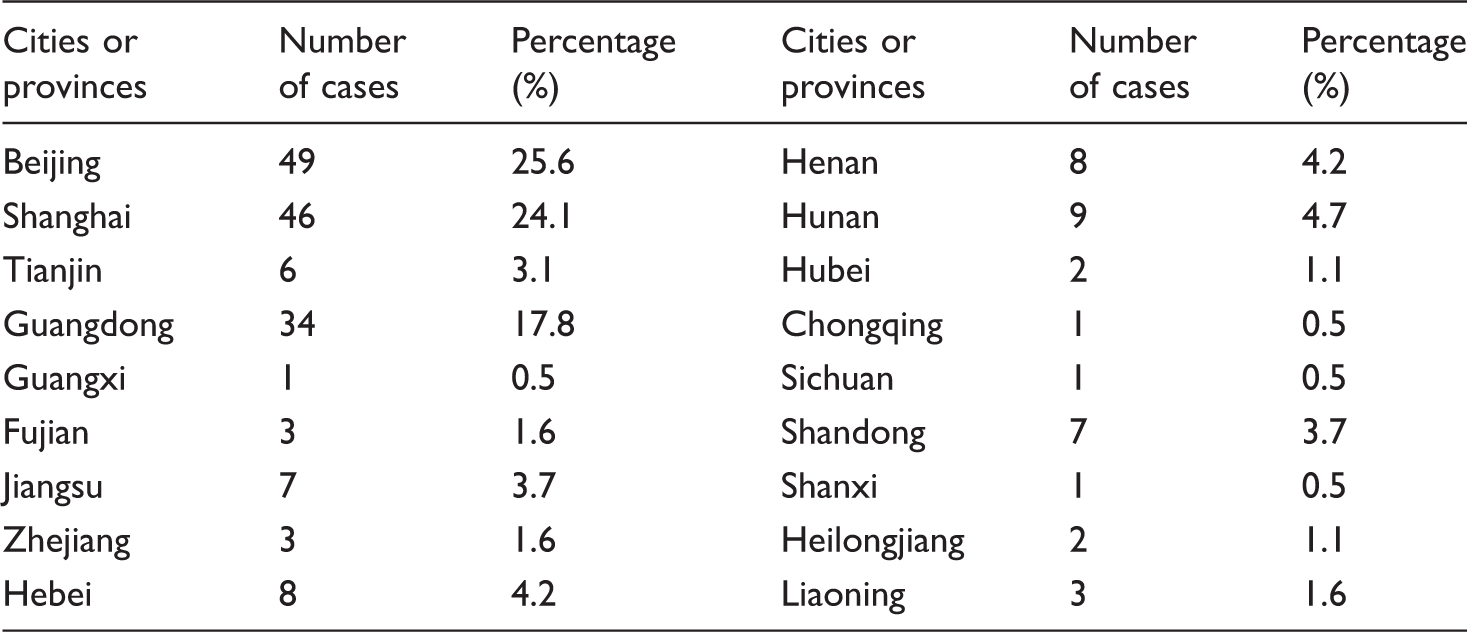
The distribution of 191 cases.
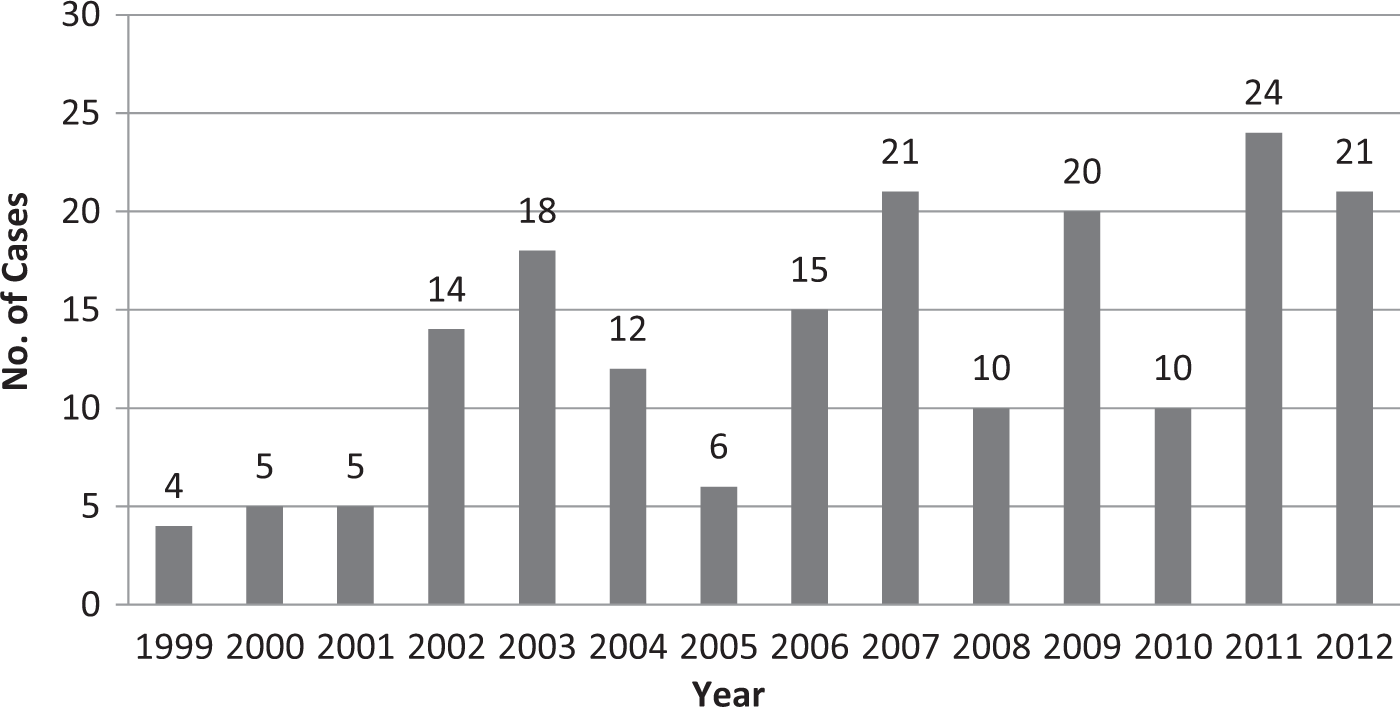
Number of cases in each year between 1999 and 2012.
For data collection, I used the search engines Google and Baidu, 1 and typed Chinese characters for ‘homeowner rights protection’ (yezhu weiquan) as key words in searching for cases. Since the motivation of homeowners in their collective action is very complex, not all the claims made by homeowners are reasonable and legal. I excluded the cases in which homeowners’ claims had no legal basis, so in this study I only focused on homeowners’ rights-defending actions with legitimacy, which means the claims made by homeowners were not only reasonable but also legal. 2
In order to satisfy the principle of random sampling and minimize case selection bias, while also ensuring that the selected cases had enough information for coding and analysis, three criteria were initially set up 3 : (1) for a case to be selected, at least one homeowners’ rights-defending action had to have taken place; 4 (2) there had to be explicit information on the results of the homeowners’ collective action, a condition which was necessary for later analysis. If most claims made by homeowners were satisfied at the end of their collective action, I treated the result as successful and coded the case as ‘1’; otherwise, I treated the result as failure and coded it as ‘0’; and (3) for a case to be selected, other information needed for analysis had to be available, including the source of the case, where and when the homeowners’ rights-defending activity took place, the duration of the activity, with whom the homeowners had a dispute, the content of dispute, the rights protection methods used, whether a homeowners’ organization existed that could really represent the homeowners’ interests, whether any confrontational conflicts or violent actions occurred during the event, the number of participants in the homeowners’ collective action, the responses of the government, and so on.
In addition to these 191 cases, I conducted nearly one hundred in-depth interviews with about 70 people in Beijing, Shanghai, Guangzhou and Shenzhen between 2005 and 2013. These interviewees mainly were homeowner activists, managers in property management companies, government officials, members of residents’ committees 5 , scholars, journalists, lawyers, etc. In addition, I conducted participative observations of homeowners’ activities in these four cities; these activities included internal meetings of homeowners’ committees, homeowners’ conventions, annual meetings of homeowners’ cross-neighborhood associations, seminars relating to community property management or homeowners’ self-governance, meetings for community disputes resolution, and homeowners’ rights protection actions. I also visited some homeowners’ committees to find out how they operated and how homeowners arrived at public decisions on community affairs. Such a multi-method, combining quantitative and qualitative research, can utilize the advantages of both, not only to comprehensively grasp the general situation in community disputes and homeowners’ activism, but also to understand the underlying mechanisms of these events.
Factors influencing the results of homeowners’ rights-defending actions
Type of dispute
In community disputes in present-day China, many kinds of organizations can act as infringers who encroach on the rights and interests of homeowners. In my collection of 191 cases, the percentage of cases in which a real estate developer was one of the infringers was 56.5%, and the percentage for property management companies was 42.9%. Government departments or grass-roots government agencies (subdistrict offices and residents’ committees) also often violate homeowners’ interests, the percentages being 20.9% and 14.7% respectively. Note that some homeowners’ committees may harm homeowners’ interests as well: there were 28 cases (14.7%) in which the homeowners’ committee violated homeowners’ interests. This situation mainly results from two causes: (1) at the very beginning, the real estate developers, property management companies or grass-roots government agencies (such as subdistrict offices and residents’ committees) manipulate the establishment procedure of the homeowners’ committee, so the committee members are not elected democratically and transparently. As a result, this kind of homeowners’ committee becomes a ‘puppet’ of the above-mentioned organizations and cannot really operate on behalf of homeowners’ interests; and (2) because of the lack of strict supervision mechanisms to regulate the operation of homeowners’ committees, if committee members are motivated by self-interest or are bought off by developers, property management companies, or other agents, they may sacrifice the public interests for their own interests (Cai and Sheng, 2013). Homeowners often have to face more than one infringer. In my 191 cases, 109 (57%) cases had only one infringer, 65 (34%) cases had two infringers, 14 (7%) cases had three infringers, and 3 (2%) cases had four infringers.
The types of encroachments the homeowners encountered were also very diverse, including:
Dishonest or contract-breaking behaviors of a real estate company (23%), such as a developer failing to fulfill its promises regarding ancillary facilities, or shrinkage in the area of an apartment. Low building quality (14.7%), such as using inferior materials, doing shoddy work, or leaving leaks in the house. Poor property management services (31.4%), causing homeowners to feel very unsatisfied. Arbitrary changes in the land-use planning of the neighborhood, or developers or property management companies illegally occupying public spaces or public facilities (31.4%). For example, developers might use green land to build new commercial buildings for sale or rent. Embezzling public benefits or maintenance funds (19.9%). For instance, some property management companies illegally appropriate a community’s parking fees for themselves when by law, these fees belong to all homeowners of the community. Problems caused by homeowners’ committees or other homeowners (16.8%). For example, some homeowners’ committees are manipulated by business companies or grassroots government agencies, which cannot truly protect homeowners’ interests; some homeowners’ committees split internally and cannot function well; and some homeowners build illegal buildings or unauthorized constructions which destroy the environment of the community. Irregular decision-making processes or the improper handling of community public affairs (16.2%), such as some homeowners’ committees making arbitrary decisions on important public affairs involving the community without all homeowners voting. Improper interventions or administrative nonfeasance of government agencies (21.5%). For example, some subdistrict offices are reluctant to register new homeowners’ committees, and some cities’ Bureaus of Land Planning fail to perform their duty to stop real estate developers from changing land use at will in a community and, on the contrary, give those companies administrative permission after the fact.
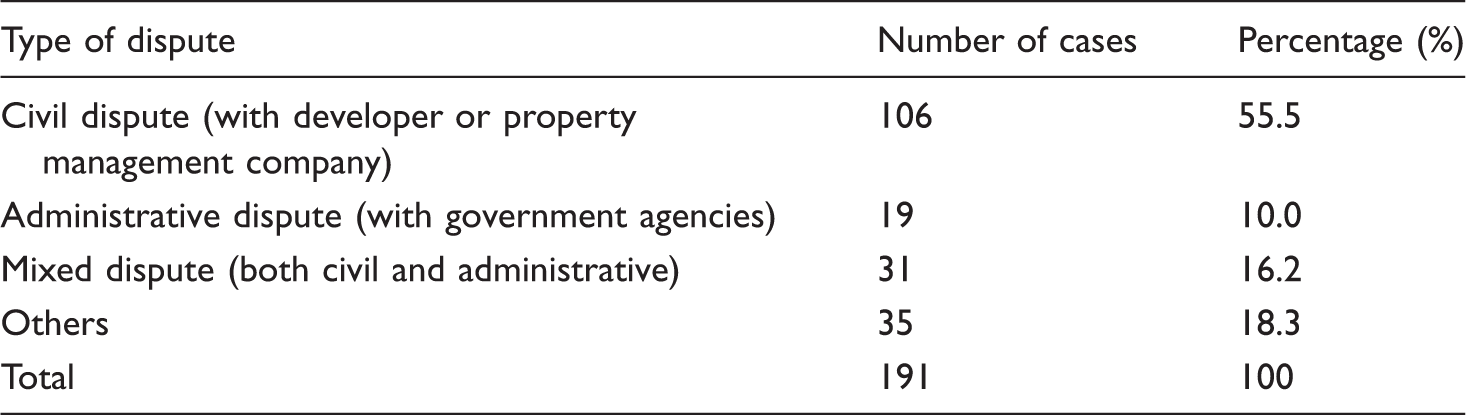
According to the type of infringer, I classify community disputes into three categories: civil disputes between homeowners and real estate developers or property management companies; administrative disputes between homeowners and government agencies; and mixed disputes, in which homeowners are in conflict not only with a real estate developer or property management company, but also with government agencies.
An example of a mixed dispute is a case in which a developer occupies a community’s green land to build new buildings and the Municipal Bureau of Land Planning also fails to regulate and punish this kind of illegal occupation and arbitrary change of land use, and thus, the interests of homeowners are not only directly violated by the developer, but also indirectly damaged by the Municipal Bureau of Land Planning. Another example is cases in which property management companies provide very poor services but charge high fees, so homeowners try to establish their own committee and fire the incompetent company, but are hindered from doing so by grassroots government agencies. These agencies often set up barriers to homeowners registering their own committees, without which, a homeowners’ committee is an unauthorized organization with no legal status and cannot represent homeowners to hire a new property management company. This situation leads to opposition between homeowners and grassroots government agencies.
The number and percentage of cases with different types of disputes.
The results of different types of disputes.
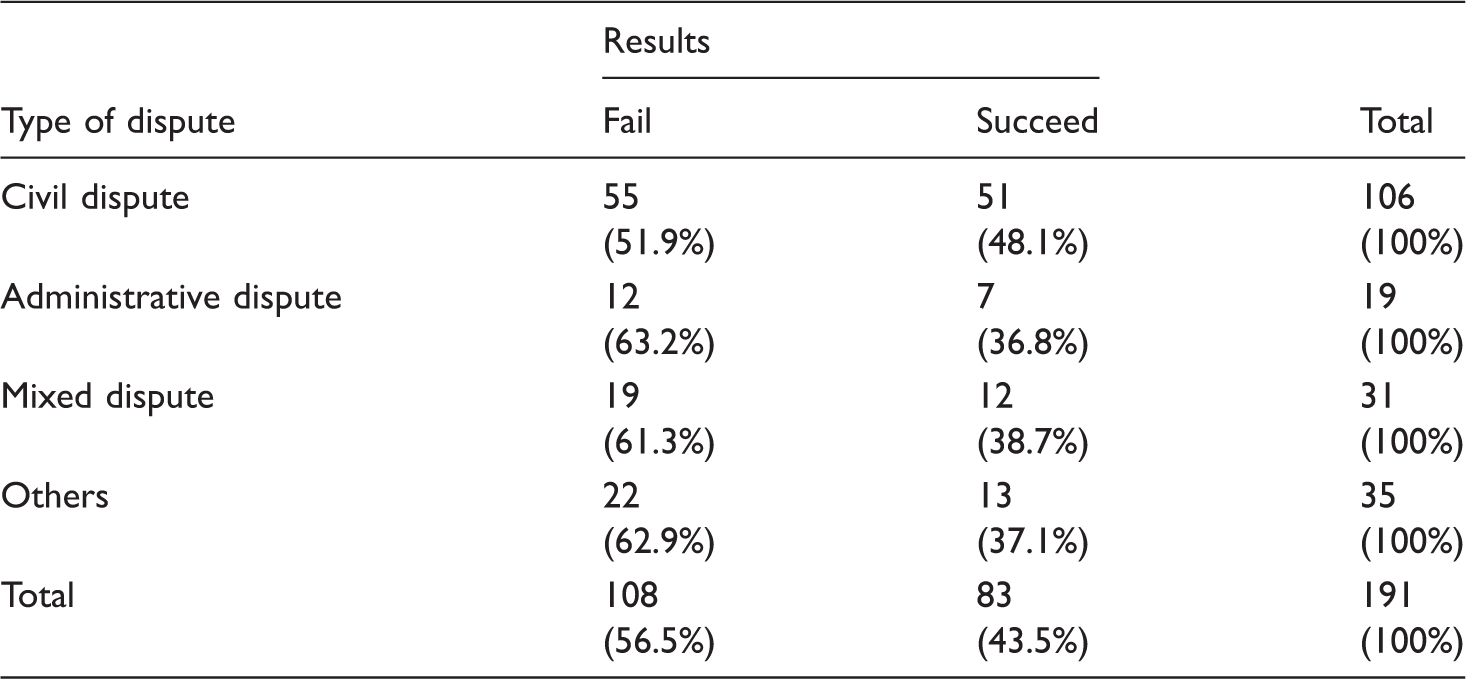
Note: Pearson χ2 = 2.126; p = 0.547.
These findings indicate a possible effect of dispute type on the results of homeowners’ rights-defending activities. In the civil disputes, the homeowners almost had a fifty-fifty chance of successfully protecting their rights and interests. When they became involved in disputes with governance agencies, however, whether in administrative disputes or mixed disputes, their chances of winning the case dropped dramatically, and in about two-thirds of cases, they failed. This, to a certain extent, reflects the reality of a strong state and weak society in present-day China.
Number of participants
In order to make their collective actions more influential, homeowners try to mobilize as many participants as possible. Out of our 191 cases, reliable information for only 53 cases was available concerning the number of participants mobilized in homeowners’ collective actions. Among these 53 cases, the median number of participants was 120, the first quartile being 60, and the third quartile being 250. 7 In addition, there were another 27 (14.1%) cases for which we could identify whether the number of mobilized homeowners had reached the necessary quorum required by ‘Property Management Regulations’ for public decision-making in a community, which means that at least one-half or two-thirds of all homeowners in this community had to be mobilized. 8
The success rate of cases with different numbers of participants.
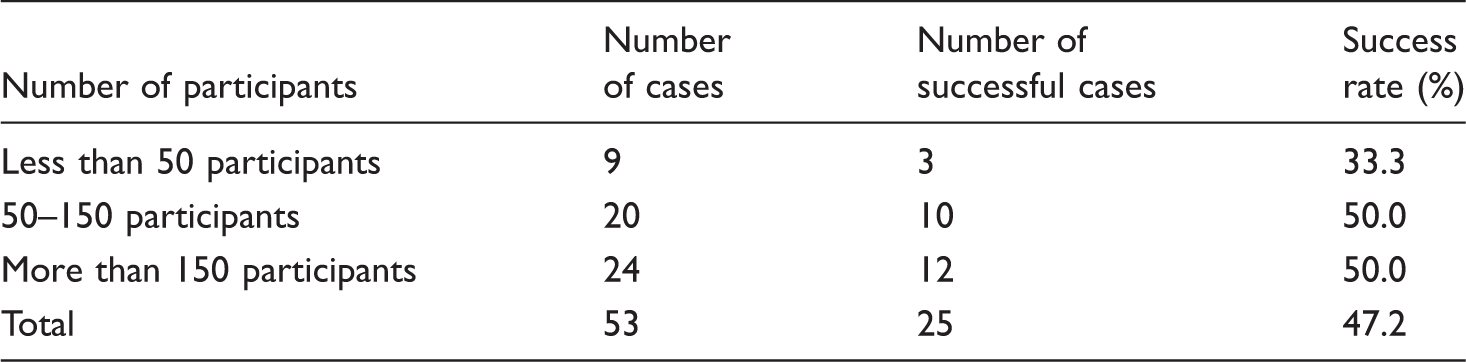
Note: Pearson χ2 = 0.833; p = 0.659.
These findings indicate two possibilities. First, if enough homeowners can be mobilized to join in a rights protection activity, it will help the participants to achieve a satisfactory result. However, this does not mean that more homeowners being mobilized will make them more likely to win their case. When the number of participants reaches or exceeds a certain threshold (such as 50), the impact of the participant number on the results of a rights-defending action may decline. Thus, we can see that the chances of success for homeowners’ collective actions which mobilize more than 150 participants are not necessarily higher than homeowners’ collective protests which have 50 to 150 participants.
Second, in some circumstances, reaching the quorum that is required by relevant laws and regulations for public decision-making in a community significantly increases the success rate of homeowners’ rights-defending actions. This is because reaching the quorum indicates that the collective action is highly supported by the majority of homeowners in the community, which confers legitimacy on the action. In addition, a large enough number of participants indicates not only homeowners’ strong capability of mobilization and organization, but also their active participation in community public affairs. For example, in some disputes relating to important community actions such as replacing a property management company, using maintenance funds, or selecting new members of a homeowners’ committee, a homeowners’ convention must be held to make valid public decisions. This means mobilizing enough homeowners to vote. Similarly, if a homeowners’ committee wants to represent all homeowners in a community to file a lawsuit against infringers, it also needs enough homeowners’ signatures for authorization. In these situations, mobilizing enough homeowners to vote or sign is a very important step in the process of rights-defending activity. In this sense, reaching the quorum is a necessary condition for homeowners to win the case.
Rights-defending methods
Success rate of cases using different rights-defending methods.
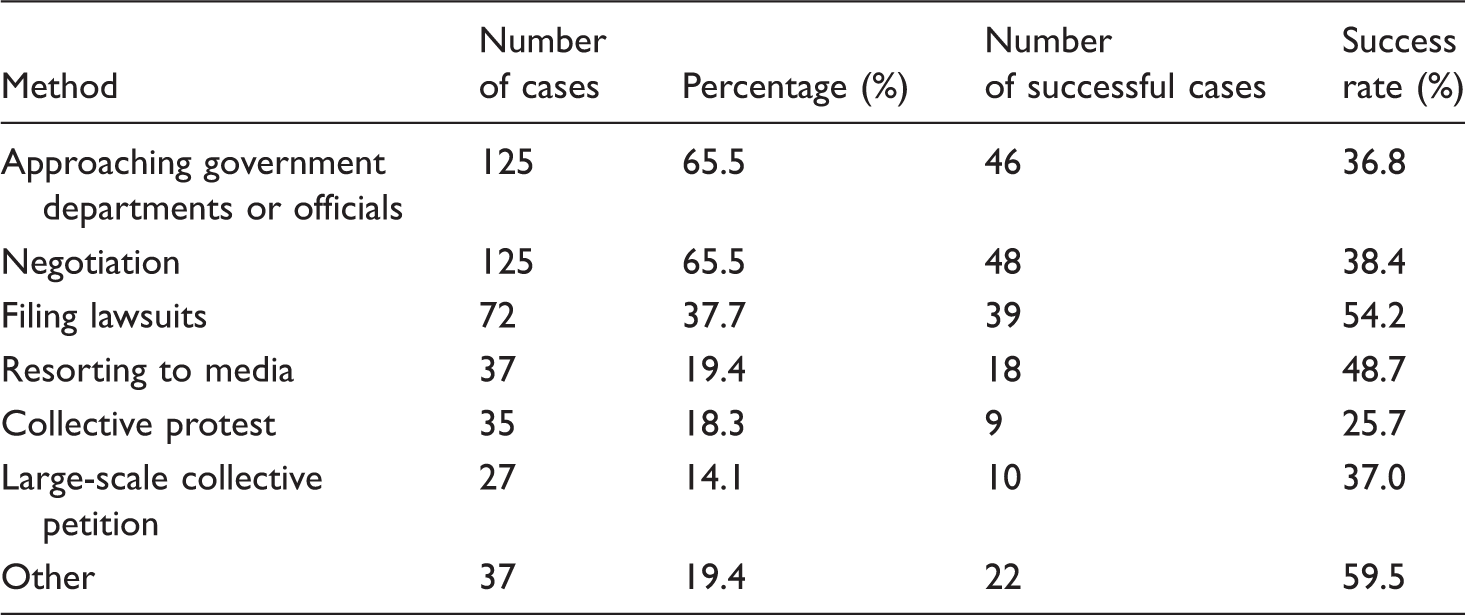
To address their problems effectively, in most instances (79% of all cases), homeowners try two or more methods simultaneously or try every possible method one-by-one until their problems are finally being solved. In the 191 cases, the average number of methods adopted by homeowners was 2.4. There were 40 (21%) cases using only one method, 75 (39%) cases using two methods, 49 (26%) cases using three methods, 15 (8%) cases using four methods, 11 (6%) cases using five methods, and 1 (0.5%) case using six methods simultaneously.
Table 5 displays the success rate of cases using different rights-defending methods. Among the 125 cases in which homeowners ‘approached government departments or officials’, 46 (36.8%) cases succeeded. In the 125 cases which used ‘negotiation,’ 48 (38.4%) cases were successful. The success rates of cases using ‘filing lawsuits’ and ‘resorting to media’ were a little higher, 54.2% and 48.7% respectively, but the success rates from using disruptive ‘collective protest’ or ‘large-scale collective petition’ were lower, only about 25.7% and 37% respectively. This shows that non-institutionalized or radical collective actions are not helpful to homeowners in defending their rights and interests.
Homeowners’ organizations
Theories of resource mobilization emphasize the role of social organizations in social movements, whether these organizations are formal or informal (Diani, 2004; Edwards and McCarthy, 2004; McAdam, 1999; McCarthy and Zald, 1973, 1977; Oberschall, 1973). Studies on homeowners’ rights protection actions in China find that homeowners’ organizations play a very important role in mobilizing social resources and participants and in devising strategies in homeowners’ collective actions and self-governance practices (Meng, 2005; Shi, 2010; Zhang, 2005). Concretely, the functions of a homeowners’ committee, as a legal organization for homeowners’ self-governance in a community, are as follows: (1) it provides an organizational foundation for mobilizing homeowners and resources in the community; (2) it is an officially recognized channel or platform, which has the legal status to represent homeowners in the community in communicating and negotiating with real estate developers, property management companies, or government agencies; (3) it coordinates and distributes responsibilities among homeowners’ committee members, which improves the efficiency of this organization; and (4) the organization is very helpful for accumulating successful experiences of community governance. Some effective institutions or organizational innovations can be preserved and then imitated by other communities (Cai and Sheng, 2013).
The results of cases with/without well-functioning homeowners’ organizations.
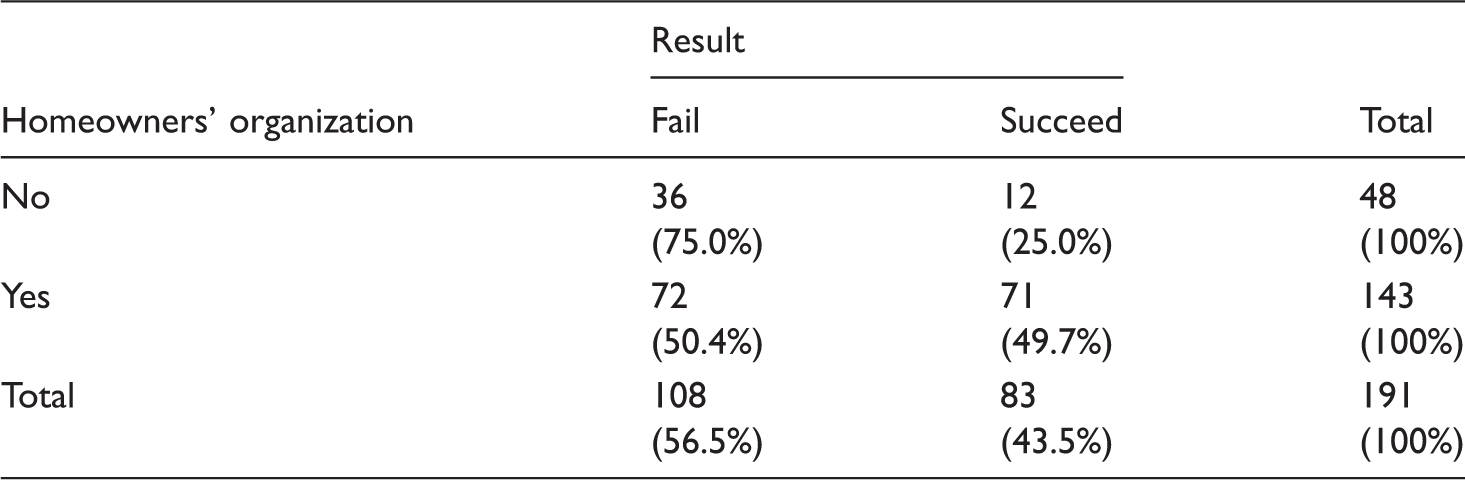
Note: Pearson χ2 = 8.887; p = 0.003.
From Table 6, we can see that in the 143 cases with well-functioning homeowners’ organizations, the success rate was almost the same as the failure rate (49.7% vs. 50.4%). This is not very consistent with our expectation. Previous research which emphasized the role of homeowners’ organizations in homeowners’ collective actions leads us to expect that in cases with well-functioning homeowners’ organizations, homeowners would have more opportunities to successfully realize their claims, but this hypothesis is only partially proved by the data in Table 6. In the next section, when we examine the effect of government response, we will find that the government response restrains the true positive effect of homeowners’ organizations.
Government response
In my literature review, I mentioned that the interaction between homeowners and government departments and the response of the government would influence the results of a homeowners’ rights-defending action. Based on the criterion of whether the government performs its duty properly, government responses can be classified into three categories: the first type is normal administrative actions, in which government agencies perform their duties and deal with community disputes and homeowners’ protests objectively and fairly; the second type is improper administrative interventions, in which government agencies’ actions have an obvious bias toward real estate developers, property management companies or other infringers, or deliberately set up obstacles for homeowners to prevent them from defending their rights and interests. For instance, when homeowners try to establish their own committee, some grassroots government agencies refuse to register the committee under various pretexts; and the third type is administrative nonfeasance, in which government agencies fail to fulfill their duties and obligations and respond with prevarication and delay. For example, grassroots government agencies often ignore the appeals of homeowners or use the strategy of ‘passing the buck’ or ‘delaying to reply.’ to deal with them. I define the last two types as ‘government maladministration’ and then examine the effect of government’s normal administration and maladministration on the outcomes of homeowners’ activism.
The results of cases with different government responses.
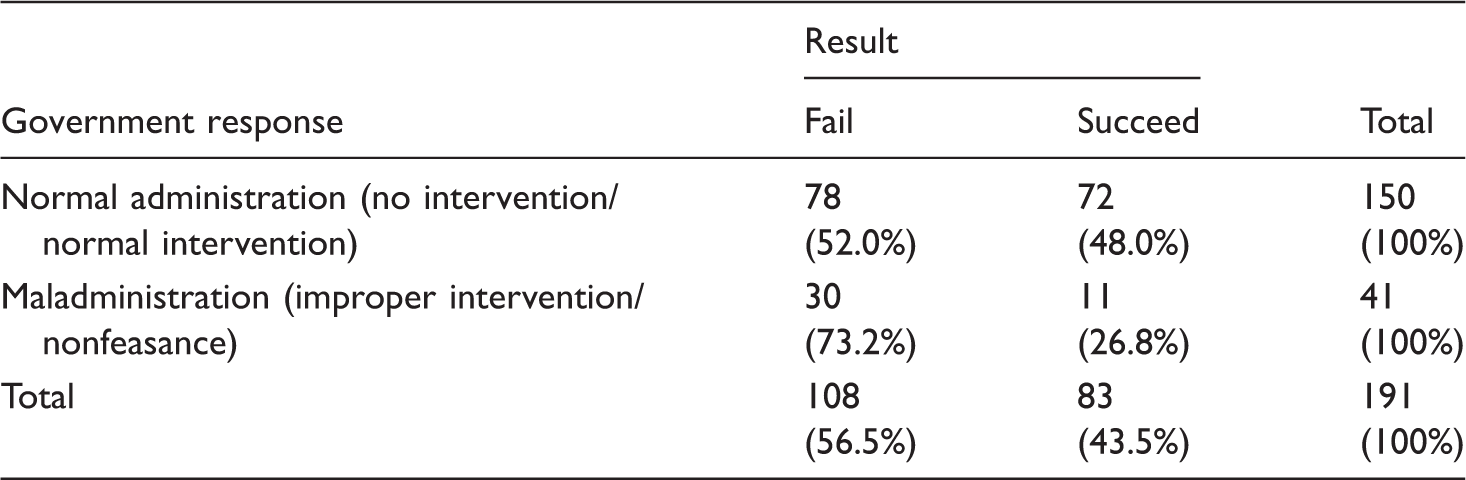
Note: Pearson χ2 = 5.873; p = 0.015.
The interactive effect of homeowners’ organization and government response on the results of homeowners’ collective actions.
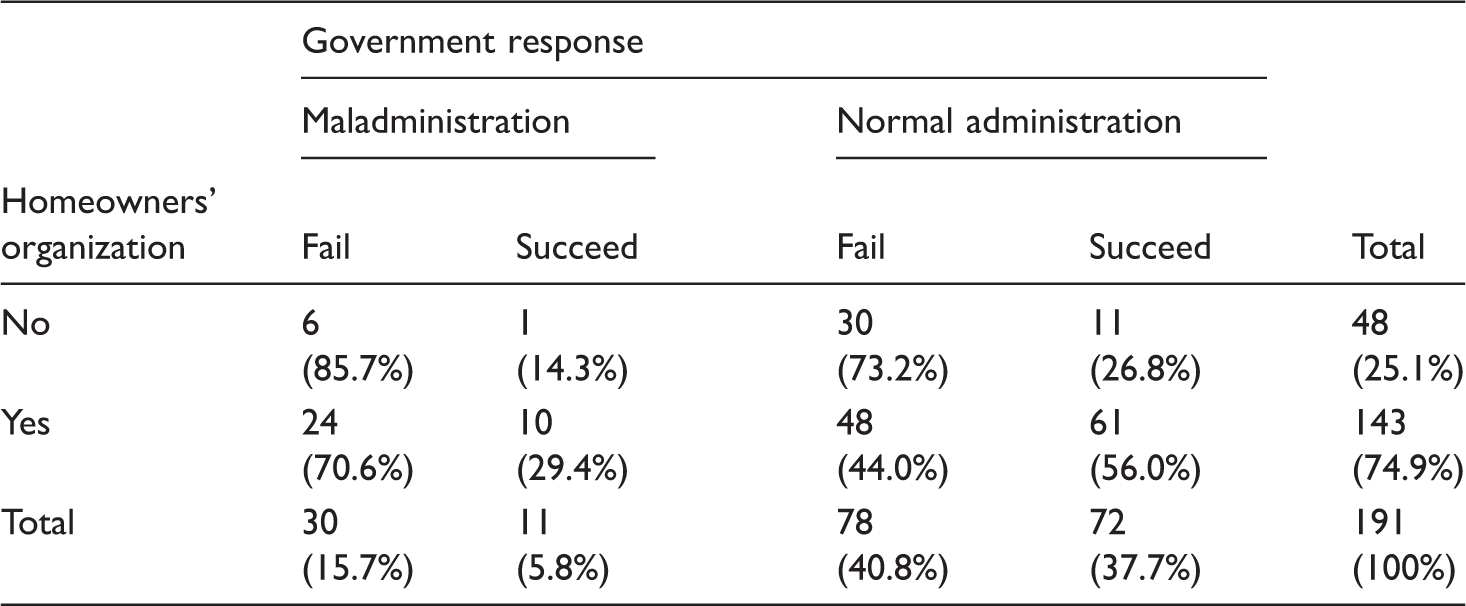
Comparing the findings in Table 8 with those in Table 6, we find that the true effect of homeowners’ organizations was disturbed by government responses. The positive influence of homeowners’ organizations on the results of homeowners’ rights-defending activities was partially restrained by the negative influence of government maladministration. This shows that the results of homeowners’ collective actions were affected by several factors simultaneously, and one factor may have influenced the impact of the other factors. Thus, in the last part of this research, we conduct a multivariate regression analysis to estimate the net effect of each factor when controlling for other factors.
Multivariate regression analysis
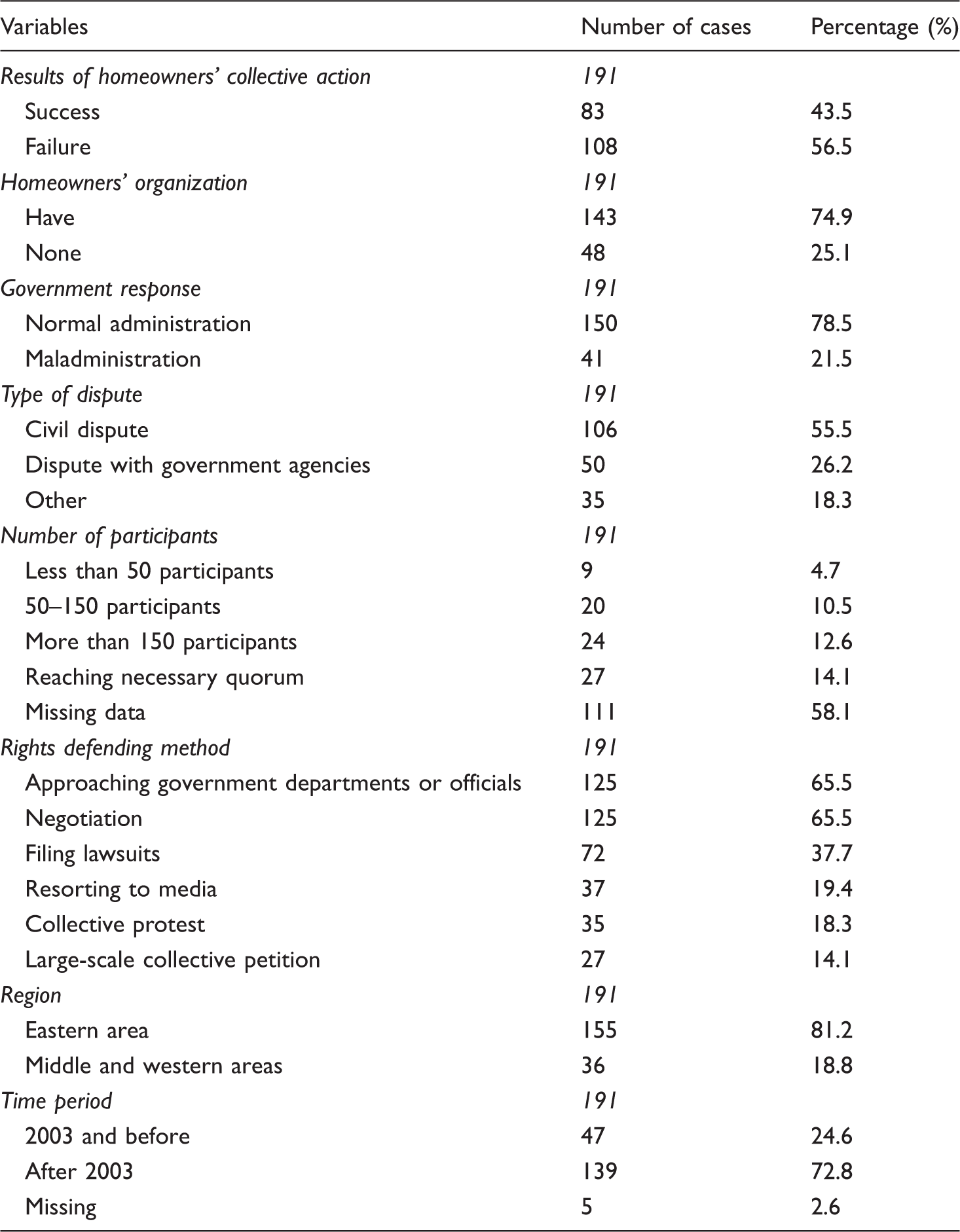
Description of variables.
A logistic regression analysis on the effects of factors on the results of homeowners’ rights-defending actions.
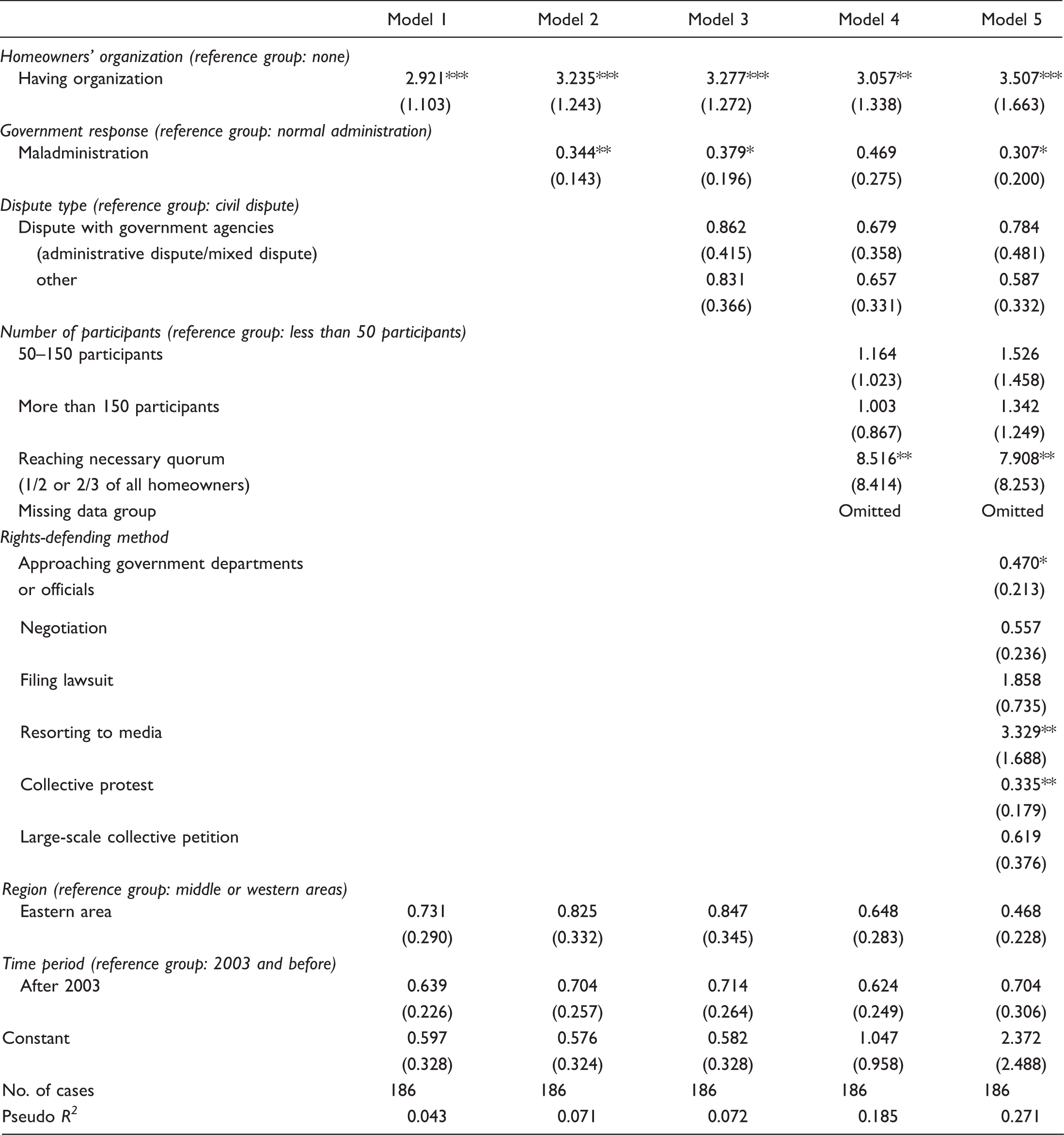
Notes: (1) ***p < 0.01; **p < 0.05; *p < 0.1; (2) the coefficient is odds ratio; (3) standard errors in parentheses; (4) because five cases do not have clear information on the start time, the sample size in the model is 191 – 5 = 186.
From model 1 to model 5, the results consistently show that after controlling for other factors, a well-functioning homeowners’ organization always played a remarkably positive role in protecting homeowners’ rights and interests (statistically significant at the 0.01 level). In the full model 5, the coefficient (in the form of odds ratio) of homeowners’ organization is about 3.5, which means that the success rate of cases with well-functioning homeowners’ organizations was 3.5 times that of cases without homeowners’ organizations. Nevertheless, government maladministration (including improper administrative intervention and administrative nonfeasance) had a significant negative impact on homeowners’ rights-defending actions (significant at the 0.01 level). The odds ratio is about 0.3, which means that the success rate of cases with inappropriate government responses was only one-third the success rate in cases without government maladministration.
When homeowners became involved in disputes with the government (namely, administrative or mixed disputes), the success rate was 22% (1–0.784 = 0.216) lower than that in civil disputes, but this result is statistically insignificant. This is mainly because when homeowners have disputes with government departments, the government agencies often make improper interventions or commit administrative nonfeasance. In the 50 cases with disputes between homeowners and government departments (19 cases with administrative disputes and 31 cases with mixed disputes), 31 cases involved government agencies’ improper interventions and administrative nonfeasance. Thus, the variable of ‘type of dispute’ and the variable of ‘government response’ are highly correlated with each other. Putting them together into the model, the effect of ‘type of dispute’ is disturbed by the ‘government response.’ After we remove the variable of ‘government response’ from the full model, the effect of ‘type of dispute’ becomes significant at the 0.1 level (the odds ratio is 0.399).
If the number of homeowners reached the necessary quorum required by laws and regulations on community public decision-making, the possibility for homeowners to protect their interests increased significantly (significant at the 0.01 level). 11 For homeowners’ rights-defending activities which could mobilize enough homeowners to meet the quorum for making valid public decisions (that is, one-half or two-thirds of all homeowners in the community), the chance of succeeding in these cases was almost 7.9 times the chance in cases with less than 50 participants.
Among various rights-defending methods, if the homeowners used only the method of ‘approaching government departments or officials,’ it seemed to be very difficult for them to achieve satisfactory results. Resorting to media, however, was useful to them in resolving grievances. The odds ratio of this approach is 3.329, and it is significant at the 0.05 level, which means the chance of success for cases using this method was about three times the chance for cases not using it. As mentioned above, non-institutionalized and radical methods did not help homeowners to successfully address their problems. If they used the method of confrontational protest, demonstration, sit-in or blocking roads as part of their rights protection activities, their chances of success were only one-third (0.335) those of cases that did not involve these types of actions.
Regarding region effect, there seemed to be no statistically significant difference in the success rates of homeowners’ collective actions between the eastern area and the middle or western area. As for the time effect, the regression results show that the promulgation and implementation of ‘Property Management Regulations’ in 2003 did not remarkably improve the predicaments homeowners encountered.
All the findings in this multivariate regression analysis are basically consistent with findings in previous cross-tabulation analyses, which gives us enough confidence to make credible inferences about community disputes and homeowners’ activism in contemporary China.
Conclusion and discussion
In recent decades, the real estate industry has flourished and commercial housing neighborhoods have been constructed on a large scale in urban China, a trend which has been accompanied by various community disputes and homeowners’ rights-defending activities occurring frequently. These disputes and confrontations threaten to not only harm homeowners’ quality of life, but also disrupt community order and even undermine social stability if they cannot be resolved properly. Therefore, it is necessary for us to clearly and comprehensively understand the causes, mechanisms and consequences of these disputes and of homeowners’ activism. This study used data collected from 191 cases of homeowners’ rights protection activities occurring between 1999 and 2012 in urban China to examine the impacts of several main factors on the results of homeowners’ collective actions.
My findings reveal that the violation of interests is the most direct driving force of homeowners’ resistance. Real estate developers and property management companies are the main infringers of homeowners’ interests. To maximize their profits, some greedy companies use a variety of strategies to encroach on homeowners’ interests. Suffering from these encroachments, some homeowners try to defend their interests with individual efforts. However, the vast majority of infringers are organizational entities, such as the alliance of real estate developers, property management companies, and government departments. Facing these powerful opponents, the power of the individual homeowner is very limited, and he/she will encounter various difficulties and obstacles. Some of the hardships are caused by deficiencies in policies or unreasonable institutional arrangements, and others come from artificial disturbances. In order to defend their own rights and interests more effectively, some homeowners who share the same grievances try to organize themselves to fight the infringers by forming protest groups or establishing homeowners’ committees. To protect their interests, homeowners try any possible method they can utilize, including negotiating with infringers, appealing to relevant government departments or officials for help, resorting to media to gain public support, or filing lawsuits. In most cases, using only one method or approach cannot adequately address homeowners’ problems, so they tend to use all feasible ways simultaneously or one-by-one. If the institutional and regular measures cannot work, they may resort to non-institutional or radical actions, such as blocking roads, demonstrations, sit-ins, protests or large-scale collective petitions.
Some of these methods are successful in realizing homeowners’ claims, while others are likely to fail. From the perspectives of organizational mobilization, action strategy, and political opportunity structure, this study examines the impacts of five factors, namely type of dispute, number of participants, rights-defending method, homeowners’ organization, and government response, on the results of homeowners’ collective rights-defending actions.
In civil disputes between homeowners and business enterprises, homeowners have nearly a 50% chance of winning the case. But if homeowners have disputes with government agencies, their chances of success drop dramatically. Mobilizing enough fellow-activists to join in not only strengthens the legitimacy and power of homeowners’ collective actions, it also generates greater pressure on infringers, which increases the probability of success. However, this does not mean that the more participants are recruited, the more likely homeowners are to succeed in defending their rights and interests. When the number of participants exceeds a threshold, the marginal effect of group size decreases. In disputes relating to important community public affairs, such as replacing a property management company, using housing maintenance funds, or changing an original plan of land-use in the community, reaching the minimum quorum (1/2 to 2/3 of all homeowners in the community) for making valid public decisions is a necessary condition for homeowners to successfully protect their interests. In most situations, homeowners prefer to use peaceful ways and institutionalized channels to deal with their problems. Only if these conventional ways fail and their problems cannot be solved over a long period of time, will the desperate homeowners resort to radical and disruptive actions in hopes of making relevant parties take their claims seriously. This reflects the moderate trait of homeowners, who are treated as typical middle-class citizens in present-day China. If they have any other alternatives, homeowners will definitely not launch actions that disturb the social order.
We also find that homeowners’ organizations, especially well-functioning homeowners’ committees that can really act on behalf of homeowners’ interests, make significant positive contributions to the success of homeowners’ rights-defending activities. This finding illustrates the power of organization. At present, the percentage of communities that have already established homeowners’ committees is still low.
12
Even if some communities have homeowners’ committees, these organizations seldom operate well. This situation has many possible causes, such as the lack of effective mechanisms for operation and regulation, low levels of public participation, a defective legal and institutional system, etc. According to my fieldwork observations, many homeowners’ organizations are established in the course of homeowners’ rights-defending activities. Once a homeowners’ organization, especially a homeowners’ committee, is established, it plays a very important role in homeowners’ collective actions and community governance in several respects:
The establishment of a homeowners’ committee is helpful for information transmission or exchange among homeowners, which arouses homeowners’ rights awareness. Currently in China, public rights consciousness of homeowners is weak, and most homeowners do not care much about community public affairs. The information about encroachment of interests revealed by homeowners’ organizations not only raises homeowners’ awareness that their rights and interests are being violated, but also links homeowners’ private interests to community public interests, which provides incentives for homeowners to participate in public affairs and collective rights-defending actions. A homeowners’ organization tends to keep homeowners’ actions within the legal framework and to ensure that homeowners defend their rights and interests with good reasons, advantages, and restraints (youli, youli, and youjie). This leads to the normalization and institutionalization of homeowners’ collective actions. Homeowners’ organizations take advantage of homeowners’ social networks to mobilize them and encourage homeowners to contribute their wisdom to community public affairs or suggest strategies for their collective actions. Usually, homeowners’ organizations try to avoid crossing the bottom line of government’s tolerance (such as by disrupting the social order), so as to minimize the risks and costs of homeowners’ collective actions. Hence, homeowners’ organizations, to a large extent, decrease the possibility of homeowners taking radical actions. The formation of a homeowners’ organization, especially a homeowners’ committee, provides an organizational foundation for homeowners’ self-governance in the community. According to the ‘Property Law and Property Management Regulations’, a homeowners’ committee has the legitimacy to represent homeowners’ public interests in the community. Through this officially recognized organization, homeowners can negotiate and interact with other actors of equal legal status, which enhances homeowners’ bargaining power. A homeowners’ organization is a necessary condition for homeowners’ self-governance in a community. In most cases, common interests motivate homeowners to consolidate and launch collective actions, but these interest-oriented collective actions are usually emergent, emotional, and short-lived behaviors. After the goal of their collective action has been achieved, or if the goal has not been realized after a long time and homeowners despair of succeeding, their collective action will cease. If this is the case, the collective action has little influence on the community’s long-term development. However, if a homeowners’ organization is built up, whether it is a rights-defending group or a homeowners’ committee, it will be helpful for community governance in the future in several respects:
In homeowners’ rights-defending activities, there often emerge certain leaders or activists, who usually become core members of the homeowners’ organization. The social networks among them play an important role in accumulating human resources and social capital for community governance. In a homeowners’ organization, activists need to cooperate with each other in arriving at an appropriate division of labor, establishing rules for public decision-making, setting up mechanisms for the organization’s operation, and framing organizational structures. All of these actions constitute the infrastructure needed for homeowners’ self-governance in a community. Some methods and strategies adopted by homeowners in their rights-defending activities have been preserved by homeowners’ organizations through organizational learning, which can also be applied to community governance.
Although a well-functioning homeowners’ committee has a remarkable positive effect in protecting homeowners’ interests, it is still not easy for homeowners to establish their own organization for three reasons: real estate developers or property management companies often stealthily or overtly hinder homeowners from forming their own organizations by setting up various obstacles, since they are aware that homeowners’ organizations are certain to prevent them from encroaching on homeowners’ interests; some grass-roots government agencies, such as subdistrict offices or residents’ committees, have an unfriendly or even hostile attitude towards homeowners’ committees because they are afraid that this kind of organization may challenge their authority and control power in their community; and because of the indifference of homeowners to community public affairs and the low participation rate, it is very hard to mobilize and organize the homeowners in a community. Even if a homeowners’ committee exists, research shows that the positive effect of the homeowners’ organization is often disturbed by the improper intervention of state power. A local government sometimes has a stake in real estate development, so officials are in the same interest group as developers and property management companies (Zhang, 2005). In addition, some government departments are skeptical of homeowners’ committees. For these reasons, government agencies often conduct improper administrative interventions or commit administrative nonfeasance to restrain homeowners’ organization efforts. Such administrative misconduct creates many institutional barriers to homeowners protecting their legitimate rights and interests.
In sum, increasing community disputes and the predicaments of community governance are currently closely associated with imperfect institutional arrangements as well as defective laws and regulations. In order to improve the quality of property management services and facilitate the practice of homeowners’ self-governance in a community, activists and policy-makers in China need not only to raise homeowners’ consciousness of public participation and enhance their ability to organize and mobilize, but also to improve relevant laws and regulations on the property management of communities, and to correct the improper administrative behaviors of government departments. This will create a better institutional environment for community property management and homeowners’ self-governance.
In recent years, some homeowner elites have realized that the fundamental way to prevent the violation of homeowners’ interests is to improve relevant laws and regulations as well as institutional arrangements at the legal and institutional levels, and to ensure that these laws, regulations and institutions can be effectively executed. Therefore, the ultimate goal of homeowners’ rights-defending activities is not only to fight against encroachments, but also to urge legislative institutions to make righteous laws, encourage government departments to administrate according to these laws, and urge judicial organizations to strictly enforce laws. In order to achieve this goal, some homeowner activists try many possible methods, such as filing lawsuits, collecting petitions, applying for administrative reviews, or even running for deputy to the People’s Congress at the grassroots level. In these ways, they push the government to realize homeowners’ rights and interests endowed by laws and regulations and to make these laws and regulations work in communities (Guan, 2010). Only when government agencies put themselves into the right positions, perform their duties according to the principles of fairness, openness, and impartiality, and carry on community governance according to the law while at the same time, homeowners’ initiatives in public participation are aroused, their capability of organization is strengthened, and the supervisory mechanism of homeowners’ committees is improved, can the difficulties and predicaments encountered by homeowners in self-governance of their communities be overcome.
Footnotes
Acknowledgements
I would like to thank Professors Yongshun Cai, Xiaogang Wu, Lianjiang Li, Benjamin L. Read, Yuzhao Liu, and two anonymous reviewers for their extremely helpful comments and suggestions.
Funding
This Research is supported by the Youth Project of the National Social Science Foundation ‘Research on the Effect of City Governance Mode on Community Disputes and Homeowners’ Actions’ (14CSH065) and ‘The Shanghai Training and Support Plan for University Youth Teachers’ (ZZSD15061).