




Abstract
Higher education plays an undoubtedly important role in promoting social mobility in modern society. Previous literatures have tended to focus on the comparison between those with college degrees and those without, treating the former as a homogeneous group and the schooling process as a ‘black box.' This article introduces the background and research design of the Beijing College Students Panel Survey and analyzes the first wave of the data to investigate social stratification within the Chinese higher education system, paying special attention to the roles of family background, special admission policies, and key-point high schools in the process. Results show that while family socioeconomic status and residence locations continue to exert direct influences on the likelihood of getting into three tiers of universities (national elite universities, ‘211 universities,' and ‘non-211 universities'), key-point high schools and special admissions policies serve as important mechanisms in this process. Attending key-point high schools can help students to achieve higher scores in college entrance examinations and thus to ensure equitable access to college education; special admissions policies apparently benefit those from advantaged family backgrounds. Moreover, those in the national elite universities are more likely to join the Party than their counterparts in other universities, although their intentions are lower. These findings have important implications for understanding the role of higher education in elite formation and social stratification in contemporary China.
Introduction
A key question in which scholars on social stratification have long been interested is whether educational expansion has provided more opportunities of access to children from disadvantaged backgrounds and therefore reduced social inequality or mainly benefited those from advantaged backgrounds, thus exacerbating social inequality (Mare, 1980; Shavit and Blossfeld, 1993). In Western developed societies, because enrollments in primary school and secondary school education are more or less saturated, researchers have started paying more attention to the influence of expanding higher education on structural changes in social stratification (Shavit et al., 2007). Undoubtedly, a college diploma has now become an indispensable credential for managerial or professional occupations, suggesting the increasing importance of college education in the labor market. On the other hand, the transition from elite higher education to mass higher education in many countries has been accompanied by further differentiations between elite research universities and second-tier and third-tier universities, the latter increasingly being occupied by students from working-class families (Brint and Karabel, 1989; Karabel, 2005). In addition, numerous studies have revealed that with the universalization of higher education, college credentials are devaluating, whereas the threshold for entering a desirable occupation is increasing (Lian, 2009; Shavit and Kraus, 1990; Van de Werfhorst and Andersen, 2005). Hence, further research on higher education should enable us to shed new light on how educational expansion and the differentiation process have re-shaped patterns of social stratification (Shavit et al., 2007).
China’s experience may deserve special attention from scholars on education and social stratification for two reasons. 1 First, unlike educational expansion in developed countries or regions, the unprecedented expansion of higher education in China since 1999 was driven by a sudden policy shift before secondary education was fully developed (Wang, 2014; Wu and Zhang, 2010). Junior high school graduates who fail to continue senior high school education have no chance to be in the pool for college admission, regardless of how many admission quotas become available. Such a substantial expansion has important implications for the distribution of higher education opportunities among different social classes. Second, the primary thrust of the Chinese higher education reform was economic. After the Asian Financial Crisis in 1997, domestic demand was sluggish and new high-school graduates found it difficult to find jobs; going to college could delay their entries into the labor force. Moreover, to boost domestic consumption, universities have started charging for tuition, 2 as Chinese parents are often willing to spend their family savings on their children’s education, thanks to the Confucian tradition that highly values education.
Throughout the history of the People’s Republic of China, the supply of higher education opportunities has, until recently, been limited. Scholars have long been interested in the role of college education in the formation of the Chinese elite class (Bian et al., 2008). Walder (1995) demonstrated two distinct career paths that lead to the elite being divided under the Chinese state socialism system: one path requires both educational and political credentials and leads to administrative posts; the other path requires educational but not political credentials and leads to professional positions. In the subsequent analyses of the life history data collected in 1996, Walder and his associates further showed that the impact of college education on both paths has increased since the economic reform, and the two paths tend to be more intertwined with one another than previously (Li and Walder, 2001; Walder et al., 2000). They speculated that the changes resulted from an increase in the supply of college graduates. Following the substantial expansion of higher education since 1999, the ruling Communist Party has also speeded up the recruitment of members from students and strengthened ideological control on campus (Guo, 2005). Indeed, the number of new Party members among young and college-educated people has rapidly increased since the 1990s, especially after Jiang Zemin, then the Party Secretary General, proposed the theory of the Three Represents, which aims to broaden the class base of the Communist Party. 3 Given the fact that the number of college graduates and the number of Party members have both increased at the same time, how the dual-path models of elite mobility and the pattern of ‘sponsored mobility' may change has become a new subject of investigation for scholars on Chinese social stratification.
Furthermore, previous studies have tended to focus on the distinct roles of educational credentials and party membership in elite status attainment and have largely neglected the influence of family background on the acquisition of human capital (college education) and political capital (Party membership). Against this backdrop, college credentials have become a principal pass for entry into the elite group, whereas Party membership serves as a criterion for further distinction and subsequently affects individuals’ career development. In the course of the transition from elite education to mass education, while Chinese higher education has become more differentiated than previously, access to elite college education seems to be more restrictive, and the social diversity of students in these colleges has declined accordingly (Liang et al., 2013; Shavit et al., 2007; Yang, 2006). The role of higher education in promoting social mobility/reproduction in China seems to be undergoing an unprecedented transformation.
Based on analysis of the data from the Beijing College Students Panel Survey (BCSPS) since 2009, I examine an important junction in the complicated process of gaining access to college education in China and its consequences, that is, how family backgrounds affect students’ access to different levels/quality of tertiary education in a highly differentiated system. Findings from this study will not only provide evidence to help us understand the process of elite formation in contemporary China but will also echo the heated discussion among scholars and the public on educational equity and social mobility in recent years.
In the remainder of the article, I first introduce the discussion on equitable access to higher education in China and show how national higher education policies, the secondary school tracking system, and college admission could have affected differential allocation of higher education opportunities. I then propose an analytical framework that incorporates family background, higher education, and social stratification and describe the research design and the coverage of the BCSPS project. In what follows, I analyze the 2009 survey data to show the determinants of placement in different types of colleges, college-entrance exam scores and the likelihood of receiving special admission policies, and the likelihood of joining the Communist Party in college. I attempt to connect my analysis to the existing sociological literatures on elite status attainment and social mobility under Chinese state socialism. Finally, I discuss the relevant topics for future research and conclude the article.
The mobility and reproduction of the Chinese elite in the course of higher education expansion
Cross-national comparative studies of social stratification have shown that education, including higher education, plays a double-edged role in social mobility. On the one hand, for students from disadvantaged family backgrounds, education serves as a vehicle for upward social mobility; families with advantaged socioeconomic status, on the other hand, will do their best to provide offspring with better educations so as to transfer the privileges to them that they themselves have acquired. Thus, education is also an important tool for social reproduction (Ishida et al., 1995).
Historically, education has had special significance in promoting social mobility in Chinese culture. In his classic work, The Ladder of Success in Imperial China: Aspects of Social Mobility 1368–1911, Ping-ti Ho (1962) reported that Jinshi (those with the highest title awarded in the imperial examinations) in the Ming and Qing Dynasties came from very diverse social backgrounds, including a high percentage from ordinary families: about 40 percent came from families whose members had had no titles for three generations. He thus concluded that traditional Chinese society was quite open, in which the imperial examination system had served as a unique channel to promote social mobility for a thousand years of world history.
Not surprisingly, people often draw an analogy between the historical tradition of the Chinese imperial examination system and the college entrance examination in contemporary China. For instance, under the Chinese household registration (hukou) system implemented in the 1950s, conversion of rural status to urban status has been extremely difficult, yet higher education provides those born of rural origins with a narrow but institutionalized channel for obtaining urban status and achieving upward mobility (Wu and Treiman, 2007). According to a nationally representative survey in 1996, among those of rural origins, about 11 percent gained urban hukou at the time of the survey and half of them achieved hukou conversion and intergenerational mobility by receiving higher education (Wu and Treiman, 2004). Based on the analysis of student registration cards, a research team led by James Lee found that the background of students at Peking University and Soochow University had become more diverse after 1949, as reflected in the composition of geographic regions, urban and rural areas, family background, and gender, among others. For instance, the proportions of students from workers’ and peasants’ families were 30 percent in Peking University and 40 percent in Soochow University, respectively; the proportion of working class offspring in the two universities even surpassed their proportion in the general population. The case of China is particularly noteworthy, given the fact that less than 3 percent and 5 percent of lower class offspring attended elite universities in the United States and France, respectively (Liang et al., 2013: 253–254). Hence, they concluded that higher education in contemporary China is more open than under the traditional imperial examination system. In other words, a large number of young people from underprivileged families are able to enter elite universities and become part of the elite after they graduate. Hence, the Chinese Communist Party started a series of social reforms and political campaigns with the intention of re-organizing old social structures by changing the social origins of elite members and achieving the revolutionary goal. While most of the reforms and movements had failed, the success of what they called the ‘Silent Revolution' in the educational sphere was attributable to not only the universalization of compulsory education and improvement in the quality of secondary education (key-point secondary school), but also to the objectivity and equity of the national college entrance exam system (Liang et al., 2013).
Nevertheless, such an optimistic assessment of the role of higher education in promoting social mobility recently has received criticism from scholars in both social history and contemporary social stratification. The first methodological issue concerns the interpretation of the statistical data. For instance, studying the historical records of enrolled jinshi with family histories of the past three generations in the Ming and Qing dynasties, including over 14,000 jinshi (possessing a high-ranking title) and 20,000 juren (possessing a middle-ranking title) and gongsheng (possessing a low-ranking title), Ho (1962: 112) provided a statistical description of the social composition of the jinshi class, and reported that an insignificant percentage of jinshi came from disadvantaged families. This figure, however, may not reflect the openness of the traditional social structure in China without knowing the distribution of different classes in the entire population at that time. As mentioned earlier, in contemporary China, among those from rural origins, only 11 percent obtained urban hukou, but these upwardly mobile people would constitute 44 percent of the urban population if we assume that the urban population accounts for 20 percent of the national population (Wu and Treiman, 2004).
The second methodological issue concerns social inequality in access to educational opportunities. While education undeniably plays an important role in talent selection, educational opportunities are unequally distributed among people from different family backgrounds. In this regard, education could serve as a tool for social reproduction and a legitimate means of transferring social status. Recent analyses based on the extensive collection of local and national data suggest that, in contrast with the conventional image of the imperial examination system, those who succeeded in passing the merit-based examination came from only around 300 large families in selected regions during the Ming and Qing periods (Clark, 2014; Liang et al., 2013). According to Benjamin Elman (2000), preparation for the imperial exam took a long time, and this was not affordable for ordinary families with limited economic resources. Elman (2013) further described how the Ming and Qing imperial exam was embedded in complicated social networks, which involved the cultural, political, and economic elite of the time, and how local elites and imperial officials attempted to influence the content of the exam, the selection of those who passed, and their placement in the bureaucratic system. These studies have revealed the other side of the story of the imperial exam in promoting social mobility in traditional Chinese society.
Not surprisingly, Western scholars on higher education have also pointed to the dark side of elite education in blocking social mobility in modern society. Educational opportunities in the US Ivy League universities have always been scarce, with fierce competition for them, the question being what criteria these elite universities based their admissions on. Academic performance was certainly important but far from the only factor being considered in student recruitment. In his book, The Chosen: The Hidden History of Admission and Exclusion at Harvard, Yale and Princeton, Jerome Karabel (2005) found that these three universities, since the 1920s, had begun changing their admissions criteria from objective academic performance to subjective assessment of applicants’ characters, including reference letters and face-to-face interviews. By setting up subjective standards preferred by the upper class, Karabel argued, these three elite universities aimed to maintain class boundaries in education rather than to nurture talents for the country.
Finally, the sharpest criticism on higher education and social mobility in a modern society came from Pierre Bourdieu and his associates. As Bourdieu and Passeron (1977) pointed out, in France, higher education does not alter social inequality, but rather enhances the reproduction of social classes, mainly through the transmission of cultural capital in educational attainment. More specifically, the admission criteria, curriculum design and exam content reflect largely the tastes and preferences of the privileged classes, who are educated and possess cultural capital; thus, the rate of college attendance in France varies greatly in accordance with students’ family backgrounds. Moreover, given the differentiation and stratification within higher education institutions, access to elite college education is often monopolized by children from privileged families, with important implications for their subsequent career trajectories after graduation. According to statistics cited in the book, The State Nobility: Elite Schools in the Field of Power (Bourdieu, 1989), children from the middle and upper classes account for more than 60 percent of the total students in elite universities such as École nationale d'administration, Institut d'Études Politiques de Paris – Sciences Po, and Hautes Études Commerciales Paris. Finally, almost all positions in the top 25 French firms were filled by graduates from these elite colleges, whereas graduates from less prestigious universities could only find employment opportunities in smaller companies. Hence, in the context of higher education expansion, inequality in access to elite college educations did not decline.
In the case of China, notwithstanding the much-applauded social diversity of higher education in reducing social inequality, Liang et al. (2013), in their book Silent Revolution, also cast doubt on the this trend continuing in the future. Along with the dramatic increase in enrollment, China had started reforming the admission system of college entrance exams since the end of the 20th century. While the old admission system based on test scores may not be able to eliminate the influence of family background and high school on one’s chances of getting into college, it was fair in the sense that the test score is the only standard with little room for manipulation. On the other hand, the admissions system had been widely criticized by the public for leading to exam-oriented education in high schools. In light of the criticisms, the Ministry of Education launched a series of reforms, granting provinces autonomy in administering their own exams, allowing colleges to independently recruit students, and putting more emphasis on the student’s all-round competence in college admission. These measures, as well as the policy of charging tuition since the late 1990s onward, have been re-shaping the role of higher education in social mobility and class reproduction in China.
Analytical framework and research questions
The question of how the double-edged role of education mediates the influence of family background on status attainment is a classic question in comparative social stratification research (Ganzeboom et al., 1991). To understanding the shifting of higher education from its role as a vehicle for social mobility to being a tool for social reproduction, we need to gain full knowledge about the schooling process of college students, particularly about how they are sorted into different tiers of schools according to their family backgrounds and own academic abilities. This process is intertwined with the expansion of higher education and its internal differentiation as well as admission policy reform. To answer the above question, we need to take the following three factors simultaneously into account.
First, differentiation among universities has become more evident than previously in China. The late 1990s witnessed not only rapid growth in the enrollment of college students but also a substantial increase in tertiary institutions. As Figure 1 shows, the number of tertiary institutions had increased from 1022 in 1998 to 2529 in 2014; the number of four-year colleges had increased even faster, from 684 in 2004 to 1202 in 2014,
4
owing mainly to the newly established or upgraded colleges. The door of access to elite universities, nevertheless, remains restrictive (Liang et al., 2013). Moreover, in the allocation of resources and teaching staff, elite universities are clearly favored. Two of the most famous policy initiatives, the 211 program and the 985 program
5
have aimed at building world-class Chinese universities and key disciplines for the 21st century. The former, launched in 1995, include 112 colleges and universities (109 civilian universities and 3 military ones), of which 39 premier universities are selected into the 985 program, with the input of more resources on research infrastructure.
6
This differential policy treatment has led to social stratification in the Chinese higher education sector, with great differences in access to government resources and in student qualities. The job market also makes a clear distinction among students from different types of colleges/universities. Many job advertisements clearly state that only graduates from the 985-program and 211-program universities would be considered.
The expansion of higher education in China, 1980–2014.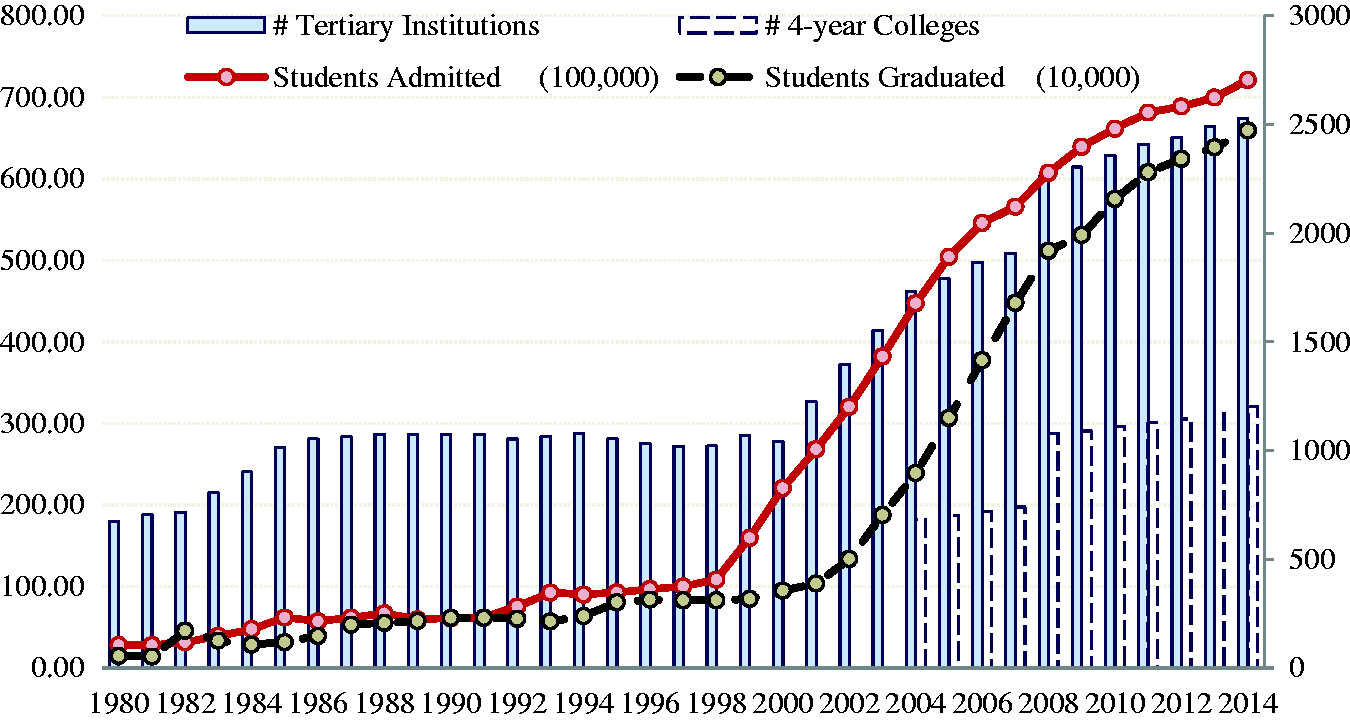
Second, in senior high schools, students have been sorted into different tracks. Social stratification within China’s higher education system can be tracked back to advantages/disadvantages accumulated in middle schools, primary schools, or even earlier at kindergartens. After the end of the Cultural Revolution, some primary schools and middle schools were deliberately selected as key-point schools, equipped with better resources and teaching staff, and access to the quality education in those key-point schools is mainly based on students’ test scores. While differentiation between key-point primary/junior high schools and the others no longer exists since the full implementation of nine-year compulsory education in China, key-point high schools beyond the compulsory education level have been retained at all levels of jurisdiction. Therefore, students may enter either key-point or non-key-point senior high schools after completing junior high school education. Thanks to more experienced teachers and better teaching facilities, students in key-point senior high schools are more likely to achieve higher scores in the competitive college entrance exam (Wu, 2013; Ye, 2015). The systems of student selection in both key-point high schools and colleges are closely tied to each other, based on academic performance, as measured by test scores. According to Liang et al. (2013), key-point high schools play a crucial role in determining access to elite education. In Jiangsu province, sufficient resources for high-quality education guarantee at least one province-level key-point middle school in each county, which dramatically increases rural students’ opportunities of receiving elite education.
Finally, the channels of admission in higher education have become more diverse than before. Since the resumption of college entrance exams in 1977, test scores have been employed as the major criterion in admission of students, although special treatment can also be given according to government policy priorities; for instance, ethnic minorities, children of revolutionary martyrs, winners in subject contests, student leaders, students specializing in arts or sports, and outstanding performers in ideological and political education are often given extra credits ranging from 10 to 20 points in different provinces, on top of their test scores in college admission. In particular, the Ministry of Education has granted selected universities autonomy in administering their own admission exams independently since 2004. Students can participate in the independent admission exams given by those colleges and universities through high school recommendation or self-application, and those who pass the assessment can be admitted with lower scores to the universities they have selected, as long as their national exam scores reach the threshold for the first-tier universities in the province. Of course, most such opportunities are available only to students from province-level key-point schools, as both referees and nominations are required to come from those schools, according to independent admission policies. For example, Peking University required applicants for its independent admission exam in 2004 to be ‘top students' at prestigious key-point schools at the province level (or equivalent). Such arrangements of school nomination give graduates from key-point schools more advantages in competition for limited slots in quality higher education (Liu et al., 2014).
Compared to the objective standard (scores) in the nationwide college entrance exam, the criteria adopted in independent admission exams tend be vaguer and more subjective. Parents with socioeconomic advantages not only can use their economic resources, social network and cultural capital to help their children get into key-point schools, but also know how to guide their children to participate in various extracurricular activities so as to meet the criteria for independent admission (Bourdieu and Passeron, 1977; Karabel, 2005). On the other hand, children and parents from disadvantaged families may feel confused and be pushed into an even more disadvantaged position. An analysis of the admission process of Peking University revealed that this admission policy reform has reinforced the advantages of upper-class students in access to elite education (Liu et al., 2014).
In sum, under the rapid expansion of higher education and increasing differentiation within tertiary institutions, family background remains a key factor in determining access to elite college education. Children from advantaged families not only have better chances to enter key-point schools and thus achieve higher scores on college entrance exams, but also enjoy the preferential policy that gives them additional advantages. As Figure 2 shows, the process described above constitutes the analytical framework of our current research on higher education and social stratification in China.
Analytic framework of family background, higher education and social stratification in contemporary China.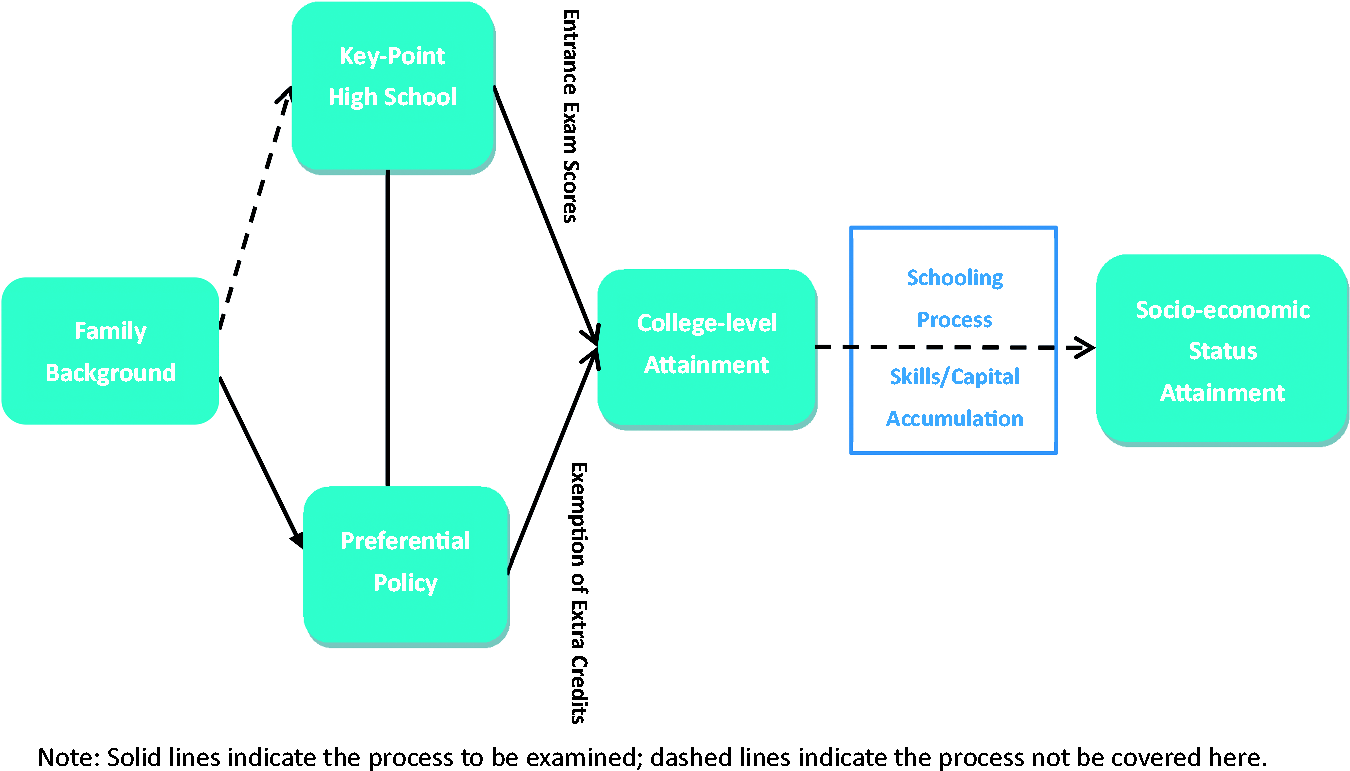
The focus of this article is inequality in access to higher education among children from different family backgrounds. Here I do not intend to examine the sorting of students into key-point high schools, but rather regard these schools as a crucial institutional design in the schooling process (Ye, 2015). The research question I intend to answer is how family backgrounds, types of high schools, college entrance exam scores and special admission policies work together to influence students’ access to different levels of tertiary education institutions. In this process, I pay special attention to how family backgrounds and types of high schools determine students’ exam scores and opportunities of enjoying special admissions policies. As a tentative analysis of the ‘schooling process,' I also investigate the intention and behavior of joining the Communist Party among different college students.
Data and variables
Data
The data analyzed in this article are from the BSCPS, which aims to track a group of college students over time and to conduct a systematic analysis of various problems encountered in the process of rapid expansion of Chinese higher education. Based on the sampling design of the benchmark survey of BSCPS, the target population is full-time undergraduate students in tertiary institutions in Beijing, including those under the direct administration of the Ministry of Education, those under the administration of other central ministries and commissions, and public universities under the administration of the Beijing Municipal Government. Considering the survey cost and sample representativeness, the benchmark survey selected two cohorts of undergraduate students, who were admitted in 2006 and 2008, respectively. The 2008 cohort would allow us to track the freshmen over their entire college years, whereas the 2006 cohort (junior students) would allow us to observe the trajectory of transition from school to work or postgraduate study without waiting too long. After the five waves of the panel survey from 2009 to 2014, all students had graduated, and the 2006 cohort had graduated for three years already. This database provides extensive information on college life, the learning experience of Chinese students, and their transition from school to work. 7
Using the registration records of students admitted in 2006 and 2008 to 54 public universities in Beijing as the sampling framework, the BCSPS adopts a multi-staged, stratified, probability-proportional–to-size (PPS) sampling method in design. We treat university as the principal sampling unit and major as the secondary sampling unit. As the share of students enrolled in elite universities has relatively declined since the rapid expansion of higher education and students in these elite universities are our central focus, Peking University, Renmin University of China, and Tsinghua University each is treated as a separate stratum in the sample design to ensure sufficient sample size. The remaining universities are divided into three strata: 211-program universities that are directly under the Ministry of Education or other central ministries/commissions (hereafter ‘211 universities'); 8 non-211-program universities under the Ministry of Education or other central ministries/commissions (hereafter ‘non-211 universities'); and universities under the Beijing municipal government (hereafter ‘local universities). According to the registration records, the number of full-time undergraduate students in the 2006 and 2008 cohorts amounted to 186,296, including 5626 at Peking University, 5069 at Renmin University of China and 5651 at Tsinghua University. The numbers of students from universities in the other three strata were 87,305, 21,708, and 60,937, respectively (Li, 2013).
Beijing College Student Panel Survey: Sample designs and tracking, 2009 to 2013 (full samples).
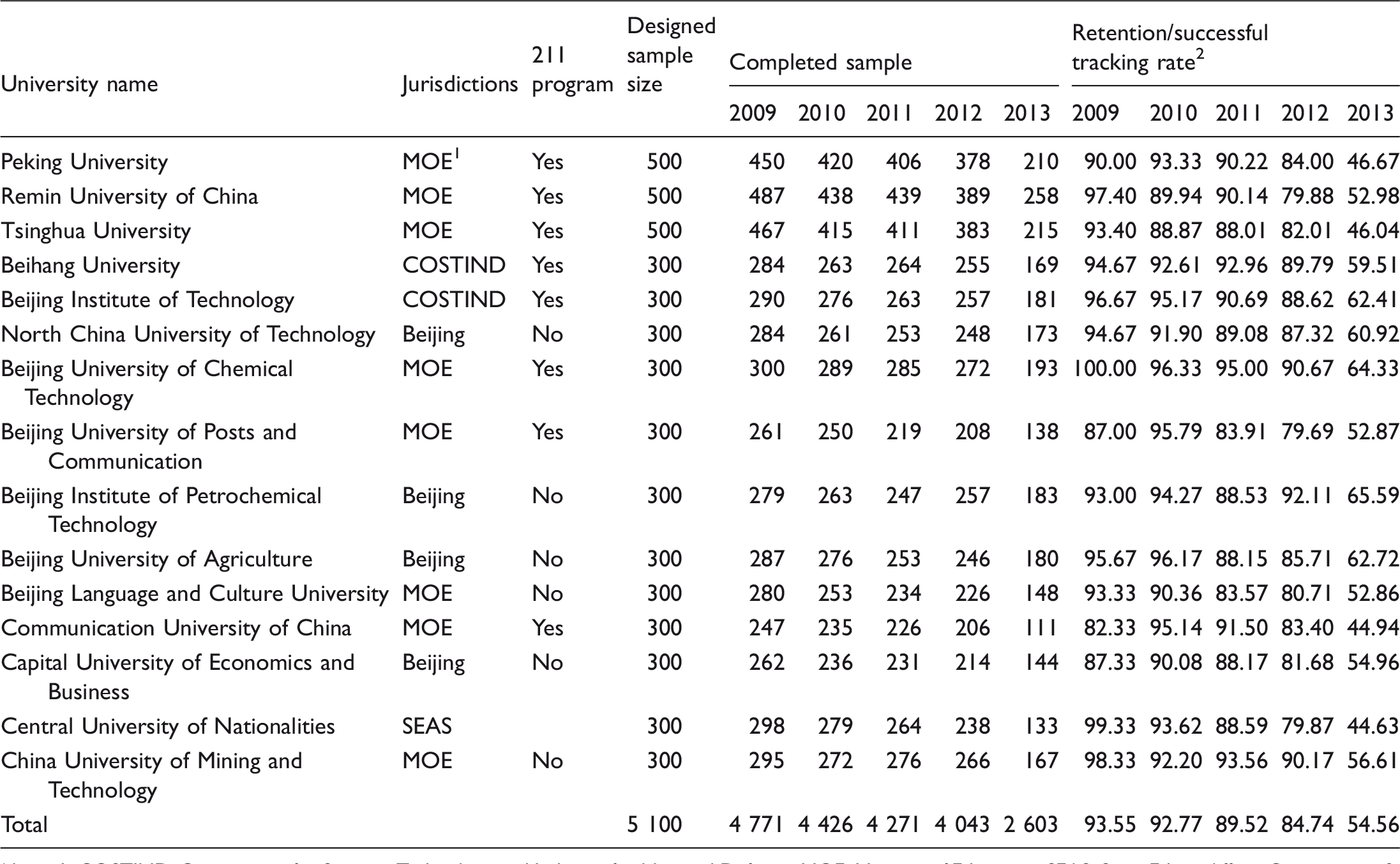
Notes: 1. COSTIND, Commission for Science, Technology and Industry for National Defense; MOE, Ministry of Education; SEAS, State Ethnic Affairs Commission; 2. The tracking rate is calculated based on sample in the first wave.
The BCSPS project had lasted for five years, and its sample design may accommodate different research needs. A total number of 1404 students from three elite universities – Peking University, Renmin University of China, and Tsinghua University – were interviewed, providing valuable information on the study of elite formation and higher education in contemporary China. The survey questionnaires covered a variety of items, with high consistency in question designs. For instance, except for basic information and psychological measures, the 2009 survey also included information on the process of college entrance, political participation, financial resources, job preferences, values and behaviors, and family background, among others. The 2010 survey included information on the process of college entrance, campus life, postgraduate study and overseas study, job seeking and employment, values and behaviors, as well as family background. An online questionnaire was used from 2011 on, keeping questions concerning campus life and values and behaviors and adding a new module on attitudes towards religion for the 2008 cohort; a separate questionnaire was designed specifically for the 2006 cohort, including questions on postgraduate study, romantic relationships, work, life, values and behaviors, etc. The 2012 survey covers questions related to interpersonal relationships in colleges, English learning, cultural activities, marriage and sex, postgraduate study (including overseas study), job seeking and employment, values and behaviors, etc. When the follow-up survey was conducted in 2013, the 2008 cohort had graduated for one year, and some new modules of questions were added, including job satisfaction, information on the first job, and overall evaluation of college life. This article analyzes the data from the 2009 survey to present some preliminary findings on the social stratification of admissions in Chinese higher education.
Variables
The tier of universities is the key variable of research interest. We code 15 sampled universities into three tiers: Tsinghua University, Peking University, Renmin University of China as the elite universities; other 211 universities as semi-elite universities; and the rest as ordinary universities (or non-211 universities). In addition, party membership and intention to join the Party during the schooling process in college can be regarded as a key indicator of seeking political capital that influences the career paths of college students. Both are coded as dummy variables (1 if yes and 0 otherwise).
As mentioned earlier, we emphasize how special admission and extra credits introduced in the process of reforming the college admission system have exacerbated inequality in higher education in China. We coded those who benefited from any of the above special admission policies as 1, and 0 otherwise. 10 This dummy variable is an independent variable in the analysis of social stratification in higher education, and the dependent variable in the analysis of how the likelihood of receiving special treatment is affected by family background and other factors.
Most students have gone through the highly competitive exam, based on which they were admitted to different universities and majors. Because of the decentralization of the college entrance exam, the exam scores students reported are not comparable across different provinces. We standardized the exam scores in accordance with the admission threshold of each province to facilitate comparison.
Students’ academic performances are difficult to compare across different majors and universities. Therefore, students were asked for their rankings in academic performance within the class. To interpret the results more intuitively, I divide the ranking by class size, and then subtract it from 1 to obtain a continuous variable ranging between 0 and 1. The higher the value is, the better the performance in class.
Among other independent variables, high schools that respondents attended are classified into three types: 1 = key-point high school at the provincial or national level; 2 = key-point high school at the prefectural or county level; and 3 = non-key-point high school. They are treated as a set of dummy variables in the analysis. Key-point middle schools at the provincial or national levels are the most prestigious – only students from these schools are eligible for independent admission exams.
As one of the indicators measuring family background, family residence (i.e., place of origin) is divided into four levels: 1 = rural villages and towns; 2 = county-level cities; 3 = prefectural-level cities; and 4 = provincial capitals or Beijing. Because of the regional inequality in China, it is difficult to find an objective index with which to measure the family economic standing in its local context. In the survey, students were asked to describe their families’ socioeconomic status: ‘Given the classification of five classes based on family incomes, which one do you think that your family belongs to? 1 = upper class; 2 = upper-middle class; 3 = middle class; 4 = lower-middle class; and 5 = lower class.' As only a small fraction chose ‘upper class' or ‘lower class,' we recoded the five options into three categories: 1 = upper/upper-middle; 2 = middle; and 3 = lower-middle/lower. Another important variable measuring family’s socioeconomic status is whether the students had urban hukou before they were admitted to college (1 if yes and 0 otherwise). In addition, gender, nationality, and cohort are coded as dummies and introduced in the models as control variables.
Descriptive statistics of the selected variables: Beijing College Students Panel Survey (2009).
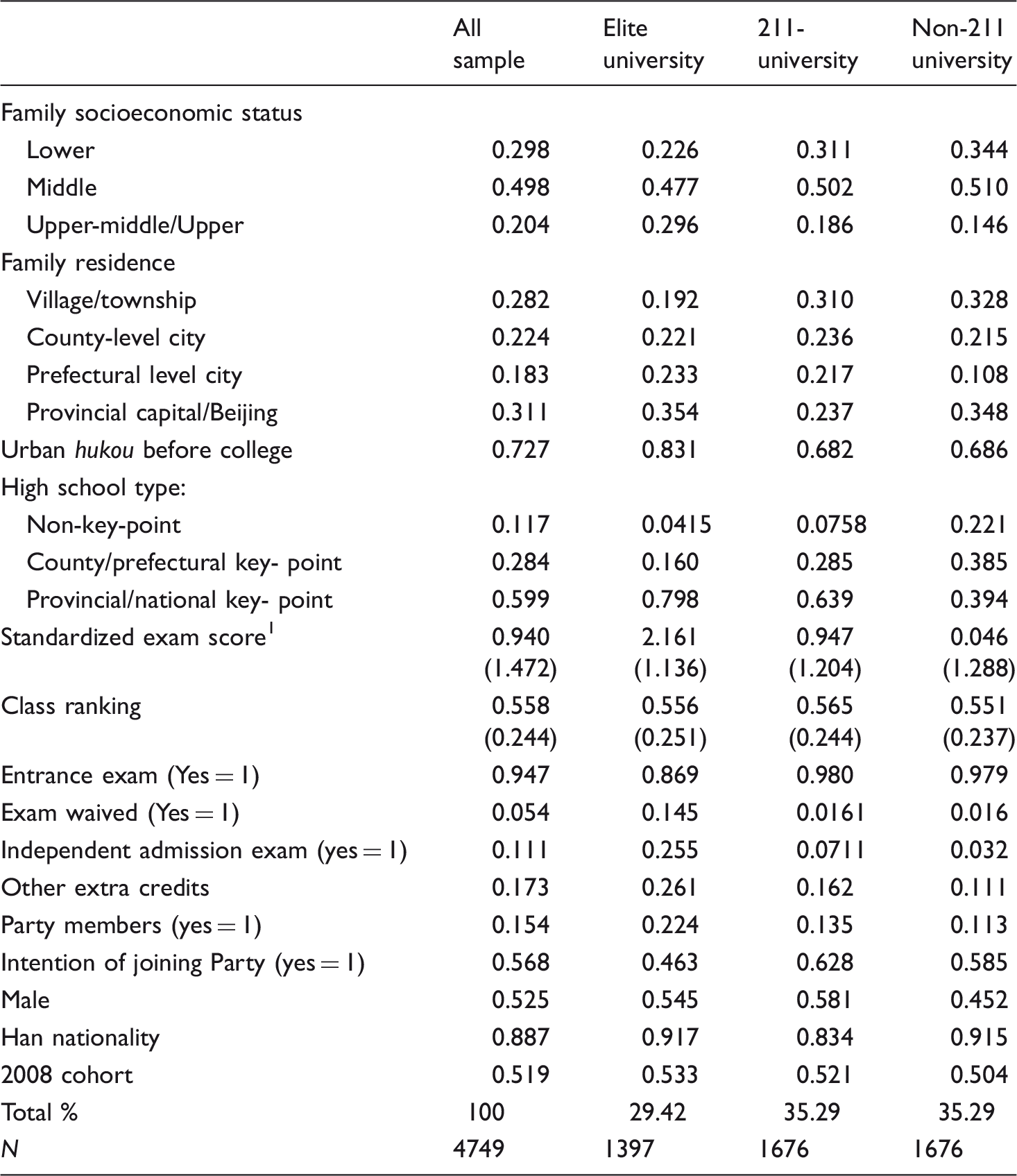
Notes: 1. Figures in parentheses are standard errors for continuous variables. The sample size for the standardized scores is 4117, as some students excused from the exam do not have exam scores, and still other students did not report their scores.
How do students in the three tiers of universities differ in terms of family background? According to the self-reported socioeconomic status, approximately 30 percent of students in the elite universities came from upper- or upper-middle-class families, whereas the percentages in other 211 universities and non-211 universities are 18.6 percent and 14.6 percent, respectively. Only 16.9 percent of students in elite universities were from rural hukou before college (83.1 percent for urban hukou). The percentages in the other two tiers of universities are more or less the same, accounting for 31.8 percent and 31.4 percent, respectively. Similarly, among students in elite universities, 19.2 percent were from rural villages and towns, while percentages in other 211 universities and non-211 universities are 31.0 percent and 32.8 percent, respectively. Moreover, a large disparity is found in the types of high schools that students attended. Nearly 80 percent of students from the elite universities graduated from key-point high schools at the national or provincial level, 16 percent were from key-point high schools at the prefectural or county level. For the non-211 universities, only 39.4 percent of students graduated from key-point high schools at the national or provincial level, 38.5 percent were from key-point high schools at the prefectural or county level. These results show the important role of key-point high schools in sorting students into different tiers of universities. In terms of political capital, a large proportion of students in elite universities were Party members, although their intention of joining the Party was relatively low. Compared to their peers in the other two tiers of universities, students in the elite universities are beneficiaries of the special admission policies.
The BSCPS covers tertiary institutions in Beijing only. Except for the three elite universities and universities directly under the ministries and commissions, many are local universities recruiting students mainly from Beijing. Students from other provinces who were unable to gain admission to one of the three elite universities and/or universities directly under the ministries and commissions were not included in the sample, which may have resulted in biased findings. Specifically, non-local students are more selective, and they are more likely to be enrolled in the elite universities, whereas local students from Beijing are more heterogeneous, including both top performers in elite universities and ordinary students in local universities. To remedy the problem and check the consistency of the results, we replicate the analysis of the full sample with a restricted sample that excludes 4 local universities in Beijing (Northern China University of Technology, Beijing Institute of Petrochemical Technology, Beijing University of Agriculture, and Capital University of Economics and Business).
In the following sections, I will first estimate multinomial logistic regression models to investigate the factors that determine the likelihood of being admitted to different tiers of universities. I will then estimate ordinary least squares (OLS) regression models and binary logistic regression models to examine determinants of entrance exam scores and the likelihood of receiving special treatment in admission, paying particular attention to the role of family background. Finally, I will use binary logistic regression models to analyze attainment of Party membership among Beijing college students.
Empirical findings
Multinomial logistic regression on entry into three tiers of universities (full samples, N = 4117).

Notes: Reference group is non-211 universities; ***p < 0.001; **p < 0.01; *p < 0.05; numbers in parentheses are standard errors.
Multinomial logistic regression on entry into three tiers of universities (restrictive sample, N = 3106).

Notes: Reference group is non-211 universities; ***p < 0.001; **p < 0.01; *p < 0.05; numbers in parentheses are standard errors.
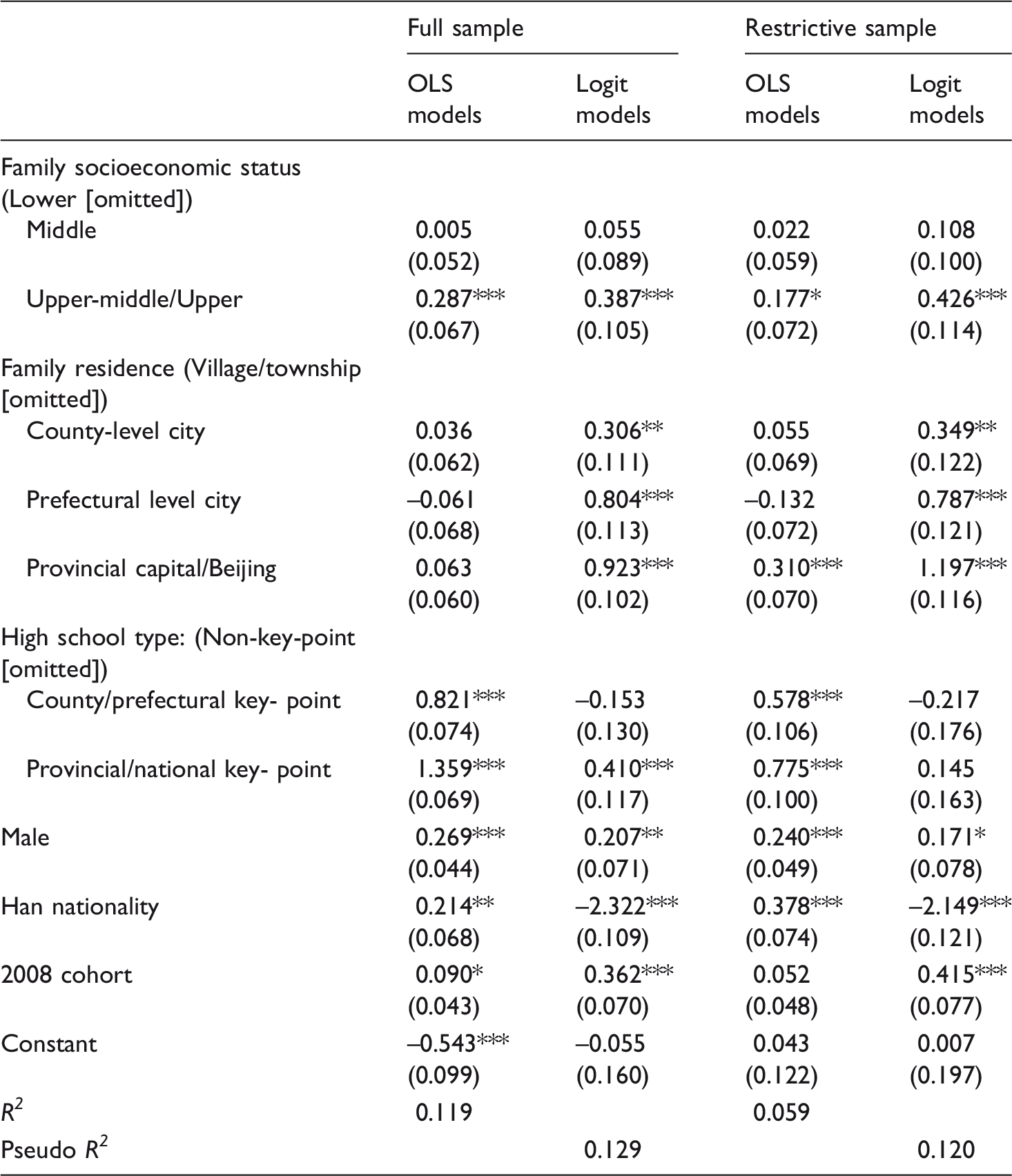
Estimation of ordinary least squares (OLS) regression models predicting college entrance exam scores and binary logit models predicting likelihood of receiving special admission treatment.
Notes: ***p < 0.001; **p < 0.01; *p < 0.05; numbers in parentheses are standard errors.
I further estimate binary logistic regression models to examine who are more likely to receive special treatment in admission. Results show that the roles of family’s economic status and residence are even more evident in this case. The odds of students from the upper-middle and upper classes receiving special admission are 47.2 percent (e0.387−1) higher than those of their counterparts in the middle and lower classes. The odds of those residing in county-level cities, prefectural-level cities, provincial capitals and Beijing are 35.8 percent (e0.306−1), 123.4 percent (e0.804−1), and 151.6 percent (e0.923−1) higher respectively, compared with the odds for those from rural villages or towns. In addition, as expected, students from key-point higher schools at the provincial or national level are also favored in special admission, although the effect is no longer significant after excluding local universities. Moreover, ethnic minorities are provided with preferential treatment in their exam scores, so the odds of enjoying special admission for the Han are only 9 percent (e–2.332) of those for ethnic minorities, based on the full sample, or 11.7 percent (e–2.149), based on the restricted subsample, excluding local universities. The discrepancies are statistically significant (p < 0.001).
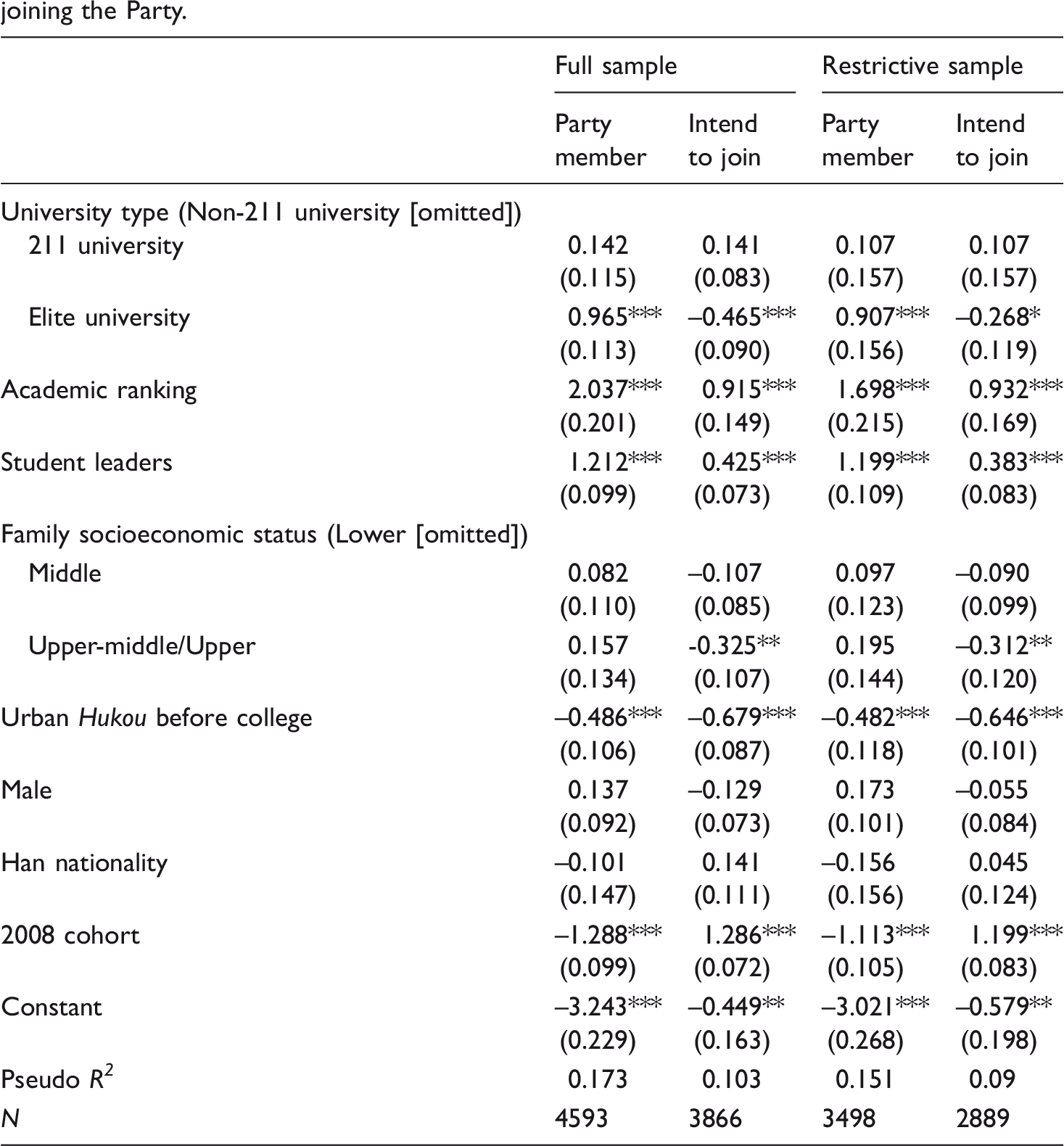
Estimation of binary logit models on Party membership attainment and intention of joining the Party.
Notes: ***p < 0.001; **p < 0.01; *p < 0.05; numbers in parentheses are standard errors.
Concerning intentions, our results show that students with better academic performances are more willing to join the Party. Although students in elite universities are more likely to join the Party, their intentions are, ironically, much lower than those of their counterparts in non-211 universities, and their odds are only 62.8 percent of the latter’s (e–0.465). In addition, students from upper-middle- and upper-class families are less willing to join the Party; and students with urban hukou are less willing to join the Party than students with rural hukou. Higher education expansion has postponed high school graduates’ entry into the labor market on the one hand but has also increased employment pressure for college graduates (Bai, 2006; Levin and Xu, 2005; Lian, 2009). As some scholars (Guo, 2005) have pointed out, college students, facing increased pressure, apply for party membership, mainly to obtain ‘insurance' for securing a good job in the future, rather than being motivated by the ideological call of the Party.
Conclusions and discussion
With the rapid expansion of higher education in China since the late 1990s, the internal differentiations within the university system have been accelerated. Universities differ substantially in earning resources, teaching staff, student recruitment, and future paths of graduates, with national elite universities at the top and non-211 universities at the bottom. Differential access to elite university education serves as an important mechanism in understanding the role of higher education in mobility and the reproduction of elites in contemporary China. Based on the baseline survey of the BCSPS, this article examines how family background, key-point high schools and the college entrance exam interact with each other in shaping the allocation of higher education opportunities among different groups. Results show that Chinese higher education has demonstrated a clear pattern of social stratification in the course of its transition from elite education to mass education over the decades.
First, family background directly affects access concerning the quality of college education. Other things being equal, upper-middle-class and upper-class children clearly enjoy advantages in getting into elite and other 211 universities. Meanwhile, if family residence is located at a higher administrative level (rural village/town, county/county-level city, prefectural-level city, and provincial capital, or Beijing), the children have greater opportunities to access an elite education. This corresponds to the spatial hierarchy in the distribution of resources in China, including quality high schools (Zhou et al., 1998).
Second, the systems of key-point high schools and exams have sorted the students according to their abilities, thus weakening the effects of family background on access to higher education opportunities. Whether or not students attend key-point high schools, especially those at the provincial or national level shapes their placement and trajectories in higher education. Through initial selection, experienced teachers, and quality education resources, key-point high schools provide students with better training to achieve higher scores in college entrance exams, leading top performers to gain admission to elite universities or other 211 universities. In this regard, the Chinese higher education system, influenced by the historical and cultural tradition of the imperial exam system, plays an important role in promoting social mobility.
Third, while college admission based on exam scores has, to some extent, ensured fairness in access to higher educational opportunities, various special treatment policies introduced in recent reforms, attempting to correct the negative side of ‘exam-oriented education,' have clearly favored students from advantaged families. Parents of these students utilize their social resources and cultural capital to help children obtain additional advantages through special channels, thus increasing their odds of getting into elite universities and other 211 universities. The preferential policies thus seem to have exacerbated inequality in access to higher education opportunities.
Finally, the internal differentiation of Chinese higher education is manifested not only in the different types of universities students can attend but also in differential opportunities in accumulating human capital, social capital, and political capital in those universities. These factors will also affect students’ subsequent career paths and socioeconomic attainment in the labor market after they graduate. To examine how the dual paths of elite mobility under state socialism have changed in the new era, I chose to analyze the attainment of Party membership among college students and their intention of joining the Party. Results show that students with urban hukou are less interested in joining the Party and, indeed, they are less likely to become party members than students who held rural hukou before their admission to college. Students from advantaged socioeconomic backgrounds also have lower intentions and likelihood of joining the Party. On the other hand, students with better academic performances have higher intentions of joining the Party, and they are also more likely to join. Students of elite universities, however, are an exception. While their intentions are lower, their actual probability of becoming a Party members is higher compared to that of their counterparts in other tiers of universities. This paradox may be a joint result of students’ self-selection and the Party’s recruitment strategies, which actively target highly educated young people in elite universities (especially students with good academic performances). This finding deserves further study to help us understand the role of higher education in promoting social mobility and enhancing social reproduction in contemporary China.
Notably, analyses of family background, key-point schools and special admission policies, and access to different tiers of universities are the first step towards gaining a comprehensive understanding of higher education, elite formation and the mechanisms of social stratification in contemporary China. The association identified here, however, shall not be interpreted as a causal effect, as students’ learning ability in high schools and other unmeasured attributes (e.g. non-cognitive ability), are closely related to family background, getting into key-point high schools, and receiving special admission treatment, but not included in the analysis. Therefore, we call for in-depth analyses of the ‘college process,' that is, the quality and experience of college education among students in different social classes in different universities, to find out how students accumulate human capital, political capital and social capital, leading to success after they graduate and complete the transition from school to work. The BCSPS has provided a valuable and comprehensive database for a series of research investigations.
Footnotes
Acknowledgements
The author would like to thank Dr. Wang Weidong and Dr. Li Ding of Renmin University of China for their contribution to the data collection.
Funding
The data analyzed here are drawn from the Beijing College Student Panel Survey (Wave 1), collected by the National Survey and Data Center, Renmin University of China, with support from the Hong Kong University of Science and Technology Research Project Competition (RPC07/08.HS02), the General Research Fund of the Hong Kong Research Grants Council (644510) (Principal Investigator, Xiaogang Wu), and the Scientific Research Fund of Renmin University of China (2009030080, 20100030415, Principal Investigator, Shizheng Feng).