




Abstract
This article examines the representations of Myanmar migrant workers and the Thai government’s press conferences in Thai and English during the COVID-19 pandemic. Through the lens of critical discourse analysis, the migrant workers were portrayed as helpless recipients of assistance, subtly reinforcing the alienation of migrants against the host society’s attempt at egalitarianism. The Thai government was positioned as a “protector,” strengthening the existing hierarchical power relations with foreign workers at the bottom of the social ladder. Buddhist morality was invoked to maintain patron–client relationships with the false impression of “brother and sister,” positioning Thai authorities as the attentive protector and Thai people as the benevolent host to whom the migrants should respect, obey, and be grateful. This supports Foucault’s notion that power is not the plain oppression of the powerless but the strategic building of power relations and dynamics between institutions and people in a society.
Introduction: the coronavirus outbreak among Thailand’s migrant workers
As 2020 drew to a close, migrant workers’ settlements in Samut Sakhon, a small coastal province in Thailand, were reported to be the epicenter of coronavirus infections. The area, known as “Little Myanmar” due to its high population of workers from Myanmar, was instantly ordered into quarantine as Thai authorities fought to control the virus. Yet, the number of reported cases in surrounding migrant communities reached an unprecedented level and became difficult to handle (United Nations Network on Migration, 2022). Almost all infected employees remained undiagnosed, allowing the virus to spread to the residents in nearby areas (Khemanitthathai, 2021). This incident was reported nationwide by the mainstream and online media in late December 2020, but it evidently resulted in the media’s reinforcement of discrimination against the migrant workers (Doungphummes et al., 2023), such as limited access to health care (e.g., Techawongstien & Phanthaphoommee, 2022) or even exclusion from job opportunities (e.g., Sakulsri et al., 2020).
Statistically, the monthly number of Myanmar migrants coming into Thailand is usually greater than 10,000, being motivated by employment opportunities and a decent standard of living (International Organization for Migration, 2023). However, Myanmar migrants are frequently subjected to different forms of mistreatment, including wage theft, exploitation by intermediaries, deplorable housing, and poor employment conditions (Sarapirom & Muensakda, 2018). Worse still, migrant workers were particularly hard hit by the second wave of the virus outbreak, as it accumulated 21,584 additional cases of infected workers between December 2020 and February 2021 (Rajatanavin et al., 2021). These appalling figures scared the audience of daily news reports and thus shaped many Thais’ perception of Myanmar migrants as a burden and cause of insecurity within Thailand’s territory (e.g., Rajaram & Grundy-Warr, 2004).
In fact, the eruption of discrimination against migrant workers during the pandemic is just the tip of the iceberg. It seems to support Grundy-Warr and Wong Siew Yin’s (2002, p. 95) contention that the Thai official institutions and media have long characterized Myanmar migrants as lawbreakers and dangers to the Thai national interest. Reports in the press about migrant workers’ involvement in criminality dramatized stories about violence, drug trafficking, and the dangerous conditions of the country’s borders with Myanmar, which were represented as a wicked group (Tunon & Baruah, 2012, p. 154). Media portrayals of this kind have largely entrenched the pessimistic view and intolerance of migrants in Thai society (Sunpuwan & Niyomsilpa, 2012, p. 56).
More specifically, such portrayals in media were reproduced in the state’s press conference, which was broadcast daily on all national radio and television networks during the coronavirus outbreak in Samut Sakhon. The daily press conference was part of the state crisis communication protocol under the Centre for COVID-19 Situation Administration (CCSA), which coordinated the response plans for the pandemic with input from senior officials across government agencies. While these briefings have arguably bolstered the public’s trust in government actions (Tangcharoensathien, 2020), it has reinforced the marginalization and otherness of Myanmar migrants, adding to the calamity of the COVID-19 pandemic on their lives in Thailand. In public discourse, the Thai government frequently employs the term “alien workers” to describe all migrant workers in Thailand. Thai government references to “alien workers” are often linked to these Myanmar workers in the media, especially during the Samut Sakhon incident, due to the high number of Myanmar workers in Thailand, which is around 1.5 million (Office of Permanent Secretary for Ministry of Labour, 2021).
Given the already negative attitude and misrepresentation of migrant workers in Thai media, this study is interested in how the government, primarily responsible for public health and well-being, has depicted them in the national media discourse while communicating to Thai and international audiences in the pandemic context. By analyzing and comparing the CCSA’s Thai and English press conferences during the coronavirus outbreak in migrant communities, we aspire to contribute to the wider knowledge of migrant representations in the mainstream media. This study answers the following questions: How were migrant workers presented in relation to the Thai government in the official communicative discourse? Does the Thai version present them differently from the English one? What social positioning activities do they engage in?
Mainstream media as a tool for constructing representations
Stuart Hall (1997) has described representation as the process by which a member of society uses language to assign meanings and organize signs to explain reality within the context of their larger value system and ideology. Since then, many relevant studies have examined the media’s portrayal of migration highlighting how migrants have been labeled as dangers or victims in relation to internal politics and mainstream press (Triandafyllidou, 2013). This implies that an interpretation without the input of the people being evaluated frequently risks establishing a particular representation of the vulnerable (Montenegro et al., 2017). The media of various kinds tend to construct certain representations of migrants because it is almost the only source of information at the national level, yet frequently does so at the expense of exacerbating their marginalization and exclusion from mainstream society (e.g., Benson, 2013; Famulari & Hatley Major, 2024; Phillips, 2016). When migrants cause problems, the media may portray them in a way that further alienates them from the local community (e.g., Diehl et al., 2021; Grove & Zwi, 2006). Even in renderings of spectacular but unemotional photographs of people in the news, massification can metaphorically lend immigrants the appearance of a group of indistinguishable individuals (Berman, 2016; Madrigal & Soroka, 2023). Journalistic selection can determine the dissemination of news coverage and polarization (Suk et al., 2022), which echoes and reinforces existing stereotypes of migrants and their exclusion from membership in the host country (Chouliaraki & Stolic, 2017).
Worse even would be if the host country’s official press release contained such biased information and representation. Many times, governments run the risk of inciting public intolerance when the ruling class supports (or ignores) racist depictions of migrants in the media (e.g., Dunn et al., 2007; Juhász et al., 2015; Van Dijk, 1992). Governments can exploit the media as a public relations tool to shape public opinions (Chepurnaya, 2023; Williams & Wright, 2022) or promote their nationalist policy on migration (Akşak, 2020; Siebers & Koster, 2022). Particularly concerning the COVID-19 crisis, Felberg (2021) observes in the case of Norway that the pandemic has acted as a lens through which mistrust, discrimination, and social inequality have become more apparent in the state’s official written discourse. Kaur-Gill (2020) likewise maintains that the coronavirus-related problems can influence the representation of migrant workers in the mainstream and official narratives with a focus only on the structural conditions of migrants (i.e., their lodgings as public health hazards). The nature of such narratives is significant for our research because the official communicative discourse, particularly during the crisis, is likely to be exploited by the mainstream media to further impose certain meanings and become a representation of the marginalized groups within the larger society. Voltmer and Römmele (2002) note that for effective public communication, the sender, the message, the channel, and the recipient must be managed with relevant strategies, whereas supporting information should be regarded as a combination of people, content, and medium. The role of the government of a country is undeniably crucial as a sender and medium of official crisis communication (Lazarsfeld et al., 2020).
The COVID-19 pandemic has also brought into focus the importance of government agencies’ understanding and the issue of communication with their people and outsiders (e.g., Felberg, 2021; Wodak, 2021, 2022). To lower the likelihood of virus transmission, information should be delivered in a method that enables it to directly support audiences. However, the plight of the marginalized group during the pandemic was sometimes portrayed as alarming reports about emergencies and something to be aware of (Brekke, 2022), thus illustrating the reliability of information sharing and the representation of the target audience. This situation points to a need for prompt action to deal with likely ambiguity and the possibility of (mis)representation.
As Andrijasevic and Mai (2016) posit, representation is “key to understanding the historical, cultural, and political specificity of the figure of the victim” (p. 3). The prevalent representations of victimized migrants across the globe necessitate an investigation into the relevance of its repetition in diverse cultural and political contexts. The ways in which inequality is conceptualized, communicated, and politically contested are all influenced by language disparities (Brubaker, 2015, pp. 20–21). In other contexts, our colleagues have examined the linguistic demands of migrant workers during the pandemic in Thailand. Phanthaphoommee (2022a) argues that the strength of the Thai population is still seen as the most crucial element in this monolingual society. In spite of the state’s best intentions, public communication about COVID-19 management and prevention is relatively scarce in a language that migrant workers can understand. This study further examines the perception of the authorities themselves through the lens of critical discourse analysis (CDA) of the CCSA’s press conference during the intense COVID-19 outbreak in Thailand. Aligning with Hall’s (1997) constructionist view, we aim to make a negotiated interpretation of the texts in question. We explain how the actors involved in the crisis communication discourse are officially represented and what implications for Thai society and the international communities can be drawn from the analysis.
Framework, data, and method
Our research is congruent with an approach that derives from CDA, one of whose central concerns is the study of discourse (re)production. Discourses, according to Fairclough (2003), are varied, intrinsically positioned representations of social existence. Differently positioned social actors tend to view and express different ways of social life. Discourses produced by social actors thus contain diverse interpretations of social life and worldviews. Not only does discourse depict reality in its existing state, but it also creates, conceives, and suggests alternatives that may be portrayed differently from the existing one. The interactions between social actors are reflected in the interconnections between the different discourses. They are a component of the language resources that individuals may employ to cooperate with or separate themselves from one another. Examining how discourse is (re)produced can reveal various linguistic characteristics (e.g., specific vocabulary, passive structure, or coherence) that were used to achieve a certain version of representation (Fairclough, 2015).
CDA is an analytical approach to text and utterance that employs different linguistic tools to examine the linkages between discrimination and dominance in written texts or utterances. To better understand how people interact with one another, CDA considers the relationship between language and its user (Wodak, 1997). Evidence from CDA usually elucidates how language is used to enact, sustain, or resist systems of social power, injustice, and dominance in a sociopolitical milieu (Van Dijk, 2001). Fairclough (2015, p. 57) argues that the process in which a text partakes in social interaction is discourse as social practice, while language users contribute meanings to their social realities through different genres. This connects to our topic under concern, which indicates how a person’s worldview as a representative of institutional agency can be expressed through language use. Discourse practice can be seen in the daily press conferences held by Thailand’s CCSA to provide updates on the COVID-19 outbreak in Thai and English. As a text producer, the CCSA possesses the utmost authority over the whole text production process, from script writing to TV broadcast. In comparison to the Thai public, their social status is legitimate; their authority over text production is absolute and authorized by relevant laws.
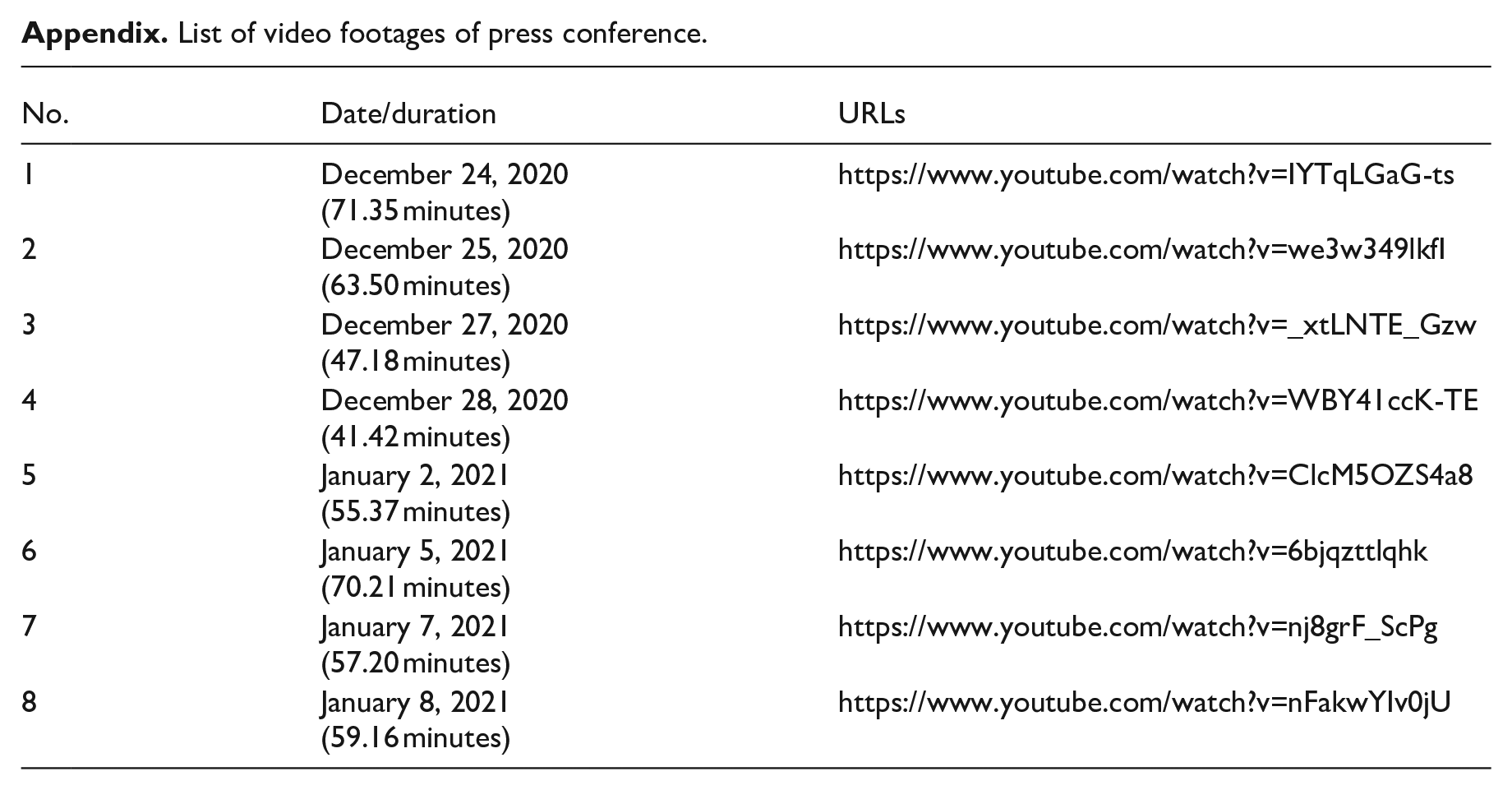
Data for this article was culled from eight video footages of CCSA briefing recorded and posted to YouTube by Thailand’s Public Broadcasting Service (Thai PBS; see Appendix). We focused our study on the second wave of the COVID-19 outbreak among migrant communities in Samut Sakhon (the end of December 2020 and the beginning of January 2021), during which the Myanmar workers and the Thai government (as a discourse producer) were repeatedly and meaningfully mentioned in the official footages. We studied the CCSA’s press briefings because they were the only official response to COVID-19 with a mandate to disseminate information to all Thai and foreigners living in the kingdom, which effectively addresses the research question. To guarantee transparency and morale among citizens, the CCSA communication provides reports on the infection situation, the confirmed cases, fatalities, testing, and global trends (Tangcharoensathien, 2020). One common function among these footages is that they represent the exclusive official broadcast of COVID-19 news to the Thai public and non-Thai speakers outside the affected areas. They were all updates on the situation in and around Samut Sakhon, where the local outbreak had been most severe among migrant workers. We have chosen the clips produced by Thai PBS because they are the only complete recordings, beginning with Thai and followed by the English part. Each clip lasts from 45 minutes to an hour and a half.
The Thai section was typically delivered by the CCSA spokesperson, while the English section was by the deputy spokesperson of the Ministry of Foreign Affairs. Generally, the length of the press conference in Thai is longer than in English, mainly because each spokesperson has a unique personality and speaking style. The first is typically long-winded, slow-paced prose, some of which is additional to the prepared script. He made numerous off-the-cuff comments about the management over the new wave of COVID-19 among migrant workers. The English one, based on its diplomatic nature, is more succinct, basically a simultaneous recap and translation of the Thai version with added content on international cooperation, business prospects, and effective national measures in coping with the virus. These topics seem to be elaborated to draw more attention to expats and foreign investors.
The Thai parts of the clips were transcribed, and the obtained texts were examined for keywords that could potentially yield identifiable actors and their actions. Among these keywords are raeng-ngan tang-dao (“migrant workers”), chao Myanmar (“Myanmar people”), khon Thai (“Thai people”), ratthaban (“government”), sobokho (“CCSA”), and krasuang-satharanasuk (“the Ministry of Public Health”). We looked for common textual patterns by noting recurring terms and expressions. With the text-focused nature of the analysis, the themes of the press conferences have guided us in the coding process through multiple meticulous readings of the text. In the same clips, the English section followed the same method. A list of the clips and their corresponding links is provided in Appendix. We are aware that visual presentation (e.g., infographic, color, caricature) in the press briefings can be fertile ground for yielding meaningful results of how the authorities present themselves and the migrant workers (Machin & Mayr, 2012, pp. 49–56). Thus, we equally focus our study on the authority’s text (and talk) and the photo presentation on the screen during the TV briefing.
As for data analysis, Reisigl and Wodak’s (2009) discourse-historical approach (DHA) is useful in our analysis of Myanmar workers’ representation in the official political discourse, as it aims to demystify the manipulative character of discursive practices with triangulation based on the context of discourse under investigation. We applied it to look at how the discourse producer’s claims were interpreted in relation to the text’s internal discourse (e.g., stereotypical or evaluative attribution), the connection between genres and discourses (structure of press release and coherence of language use), the institutional frames (the claims and underlining ideologies), and the sociopolitical and historical background that is woven into discursive practices (e.g., evocations, topoi, or vague references beyond immediate context; Reisigl & Wodak, 2009, pp. 93–94). We also used the theoretical questions advised earlier by Felberg (2021) to drive our research. How are migrant workers and CCSA, as the key actors, portrayed and maintained in the official presentation? Are these key actors vigorously acting upon others or the recipients of the action? Are the actors treated with some stereotypes? These questions are answered with the support of linguistic evidence, such as name-calling, pronoun use, and attitudinal tokens. These features can, more or less, influence a positive self-presentation or a negative other-presentation (see also Van Dijk, 1992). Social actions (the doing by the actors) in the discourse under inquiry will be scrutinized based on the way the key actors are appraised, such as by emphasizing credibility or spotlighting improper conduct in the process (Felberg, 2021, p. 99).
Representations of the disadvantaged others and our attentive government
This section discusses the positioning of migrant workers and Thai government agencies mentioned in the press conference (representation of actors). It also examines the discourses it reproduces to maintain the Thai government’s fundamental attitudes (representation of actions). Note that the following examples for the Thai version of the press conference are our literal translations of the quotes to highlight their original meanings, grammar, the chain of events, (in)coherence, as well as the relevance of graphic presentation.
Pronoun use
Pronoun use, as asserted by Van Dijk (2006), is crucial to the political process of distinguishing between members of the same group, those who are allies or enemies, and those who are on the outside looking in. By doing so, the individual can more easily separate between a positive portrayal of the in-group (us) and a negative one of the out-group (them). According to Wales (1996, p. 62), when using the first-person plural with dual references, a political speaker may presume they are speaking not only for the government (the exclusive sense) but also for the broader public (the inclusive sense).
In Thai, the pronoun rao (primarily meaning “we”) can apply to various persons. When one speaks to a subordinate, the first-person singular, the first-person plural, or even the second-person singular could be used. The speaker’s status and the register employed in each situation are the key dimensions of its various uses. In our case, both inclusive-we and exclusive-we have been identified. The inclusive-we consists primarily of Thais with ties to the Thai government. It is especially prevalent in the Thai version of the press briefing, as shown in (1).
1.
(a) The principle is that they are our neighbors working for us. If they are healthy, we will be too.
(Thai version, December 24, 2020, 45.24–45.36 minutes)
(b) Myanmar people here; if we care about them, they care about us too, so please help each other out. We will get through this together.
(Thai version, December 25, 2020, 45.39–45.42 minutes)
In contrast to the Thai public and migrant workers, the exclusive-we is used to refer to government agencies, which predominates in the English version. The use of exclusive-we seemed to be intended to demonstrate to the foreign audience that the Thai government was actively addressing the issue of the coronavirus outbreak among migrants, as in (2).
2.We hope to carry out measures so that there will be at least a minimum effect on trade, the economy, and the international market that Thailand has.
(English version, December 24, 2020, 67.45–68.04 minutes.)
Similar to the previous study on the Thai prime ministerial address, the official presentation uses both inclusive-we and exclusive-we. Inclusive-we refers to the speaker’s presentation along with Thais living outside of the country. It presupposes the concept of nationalism in an effort to unite the people. On the other hand, exclusive-we is the group of government and civil servants; it is occasionally used to refer to only the government, but it is typically used to refer to the government with civil servants at once (Phanthaphoommee, 2022b, pp. 32–33). This is also comparable to what Williams and Wright (2022, p. 14) refer to as “grammatical distancing” and a “hierarchy of responsibility,” whereby the inclusive sense of we can be used by the speakers to establish shared responsibility with the public.
These instances of we are made possible by the non-interactant they used to refer to Myanmar workers, which corresponds to the speaker’s recurring theme of nationalism (e.g., being a good host country). In this sense, the line between groups is clearly drawn to support the conservative belief that the Thai government diligently protects the country with care and conscientiousness in its duties. In dealing with the pandemic crisis involving migrant workers, it is hence their responsibility, and they need cooperation from their fellow Thais to take care of them so that we are all safe. Inclusive-we encourages a sense of togetherness, which is necessary to persuade the Thai people to endorse the government’s interpretation of health threats. Thus, exclusive-we makes the obligation the government would take on behalf of all Thais onerous and emphatic.
Migrant workers as those who need help
Our textual analysis reveals that migrant workers are largely portrayed as recipients of assistance, victims who may generate further difficulties, “brothers and sisters” who are our neighbors, and economic contributors to the country. More than half of the references to the term raeng-ngan tang-dao (“alien labor”) in the Thai version of the press briefing present them as people in urgent need of additional help from the Thai host, with Thai officials expending every effort to reach out to take care of them.
3.I saw a picture of some people taking their belongings—dry food, rice, or all good things—to donate to you.
(Thai version, December 24, 2020, 39.01–39.22 minutes)
4.The provision of other necessities and medical supplies . . . to the foreign migrant workers in Samut Sakhon. The treatments are the same as how we would treat Thai labor.
(English version, December 24, 2020, 66.44–67.07 minutes)
In addition, Myanmar migrant workers are positioned as the victims of wrongdoing by Thai intermediaries and the migrants themselves, who frequently make things difficult, primarily because they do not pay attention to and abide by the law, as in (5).
5.I ask for cooperation with the employer, with people who still do something wrong: moving migrants out, taking them to escape to other provinces, doing things that are not right . . . don’t seek personal benefits . . . and make the country suffer.
(Thai version, December 25, 2020, 25.45–26.17 minutes)
One could argue that the above example potentially fosters a sense of animalization, allowing for the transportation or herding of migrants at will, much like livestock. Migrant workers are also figuratively shown as an object in (6).
6.A big chunk is the workers of neighboring countries. The word raeng-gnan tang-dao [alien labor] nowadays is said to be sensitive as well . . . I’ll try to use the right words.
(Thai version, January 5, 2021, 19.58–20.17 minutes)
Although the speaker tries to downplay the negative connotation of the Thai term “alien labor,” the literal meaning of “big chunk” still seems to convey an unfavorable attitude. This is in line with Berman’s (2016) conclusion that massification gives migrants or refugees the negative impression of an undifferentiated swarm. The English version, meanwhile, implies that migrant workers pose a genuine dilemma for the Thai government over managing those infected, and this necessitates the assistance of external organizations.
7.The issue of labor or illegal migrants the government will be tackling in the due course.
(English version, December 24, 2020, 52.38–52.42 minutes)
8.This [the infected case among migrants] is the real tip of the iceberg, and we must be very strong in our measure.
(English version, January 2, 2021, 49.44–49.52 minutes)
Even if the English version is supposed to be based on diplomatic grounds, both (7) and (8) seem to imply that the concept of otherness still exists in the imaginations of policymakers. That is, the uses of tackling and the real tip of the iceberg presuppose problems that the “Other” has brought about, and it needs the government’s eminent role in solving them. The above remarks demonstrate that Myanmar migrants have to navigate their way through the pandemic and confront a range of attitudes and responses based on such an ingrained concept within the Thai state’s mentality. Our case is consistent with Brekke’s (2022) description of crisis communication among the marginalized, which may be portrayed as frightening news and a cause for concern.
Nevertheless, migrant workers in Thailand are also projected in a relatively favorable light by ascribing a sense of being neighboring brothers and sisters. When counted together, we found a total of 24 positive instances in both versions.
9.
(a) I ask for cooperation from the neighboring brothers and sisters to stay at your place.
(Thai version, December 24, 2020, 42.01–42.16 minutes)
(b) Seeing the reaction of the Myanmar brothers and sisters, many [Thai] people’s tears would then flow down.
(Thai version, December 25, 2020, 24.54–25.04 minutes)
10. The Thai government is following with concern with the hopes that our Myanmar brothers and sisters who have been affected by COVID in Samut Sakhon will recover soon.
(English version, December 25, 2020, 48.12–48.34 minutes)
Yet, even amid friendliness toward disadvantaged migrant workers, the speaker continues to portray their actions as the source of the problem in the same manner as before (cf. Tunon & Baruah, 2012). It is implied that leniency may be extended to the migrants provided they refrain from misconduct and follow the rules and supporting measures, particularly in the Thai version (11).
11. Manpower has been deployed to prevent escaping . . . and we ask for cooperation from the Myanmar brothers and sisters not to escape.
(Thai version, December 24, 2020, 39.01–39.42 minutes)
This negative perception confirms that the kinship-like relationship is, in fact, only a gesture with no real feeling of connection. Such a gesture is further compounded by inconsistencies in the presentation of migrant workers. That is, the term tang-dao (“the alien”), as earlier explained in Example 6, is considered disrespectful in Thai because it suggests alienating migrants from the majority of the host country’s population. Although the Thai spokesperson often tried to use a more neutral term, such as raeng-gnan kham-chat (“transnational labor”) or raeng-gnan pheun-ban (“neighboring labor”), the display of the term “alien” on the screen presentation on many occasions remains discordant with his intention to correct the terminology during the TV press briefing, as in (12).
12. Related to the cluster in Samut Sakhon Infection among foreign workers (proactive screening in the community), 35 cases.
(Thai version, December 25, 2020)
This contradictory stance seems to coincide with Kaur-Gill’s (2020) observation regarding the depiction of migrant workers in the state’s COVID-19 management, in which popular and official narratives tend to promote pandemic inequity discourses. Intriguingly, the English version is likely to give credit to migrant workers by emphasizing their fundamental and indispensable role as economic contributors to Thailand.
13.
(a) Hoping that it will also be an eve for even a stronger effort as one society. So here in Thailand, we view migrant workers as contributors to our society.
(English version, December 24, 2020, 69.24–69.40 minutes)
(b) Of course, the Myanmar migrant workers are the important part of Thai economy.
(English version, December 25, 2020, 48.59–49.09 minutes)
One objective of the English briefing is to demonstrate to the international audience that migrants play a significant role in Thailand’s economic growth and that Thailand recognizes and values their contributions. This gesture could nevertheless be construed as a signal that the Thai government is appreciative and ready to assist the migrants with all its resources, but largely so as to shed a positive light on the government itself in the process.
Thai governmental agencies as our protector
Undoubtedly, the portrayal of the Thai government purports to be benevolent and obliging, notably in the English version for international appeal. Most Thai government agencies, especially the CCSA, are characterized as benefactors who give leniency to Myanmar migrants (e.g., helping hands and trying not to directly blame them for what happened) and as attentive and spiritual leaders who can guide everyone through difficult times. When there is a crisis, they are responsible for enforcing the pertinent laws to keep society calm and working tirelessly for the sake of all. In both versions, the CCSA is mainly responsible for managing the COVID-19 situation as a whole and delivering assistance to individuals regardless of nationality, as in (14) and (15).
14. Integration with government, military prosecutors, police officers, and public health officers at Samut Sakhon to keep order and peace through twenty-four-hour control and surveillance
(Thai version, December 28, 2020, 15.15–15.34 minutes)
15. To reiterate, the royal Thai government has provided the same humanitarian assistance and medical care to Myanmar citizens, including Myanmar workers . . . as they do to the Thai national without discrimination.
(English version, December 27, 2020, 32.10–32.24 minutes)
The phrases keep order and peace through twenty-four-hour control and surveillance (14) and provided the same humanitarian assistance and medical care . . . without discrimination (15) clearly show the authorities trying to claim for their swift protection and take credit for controlling the situations and treating everyone equally. Nonetheless, one may infer from both examples that there are hidden worries that authorities must address, and the public may readily make the connection to migrants, who are stereotyped as potentially causing broader trouble for Thais if they do not receive proper medical care.
At the conclusion of the news conference on January 8, 2020, a photo of the Patriarch of Thailand’s Buddhist monk circle is displayed on the screen, along with his sermon about how doing good deeds for others is a means to gain merit (see Figure 1).
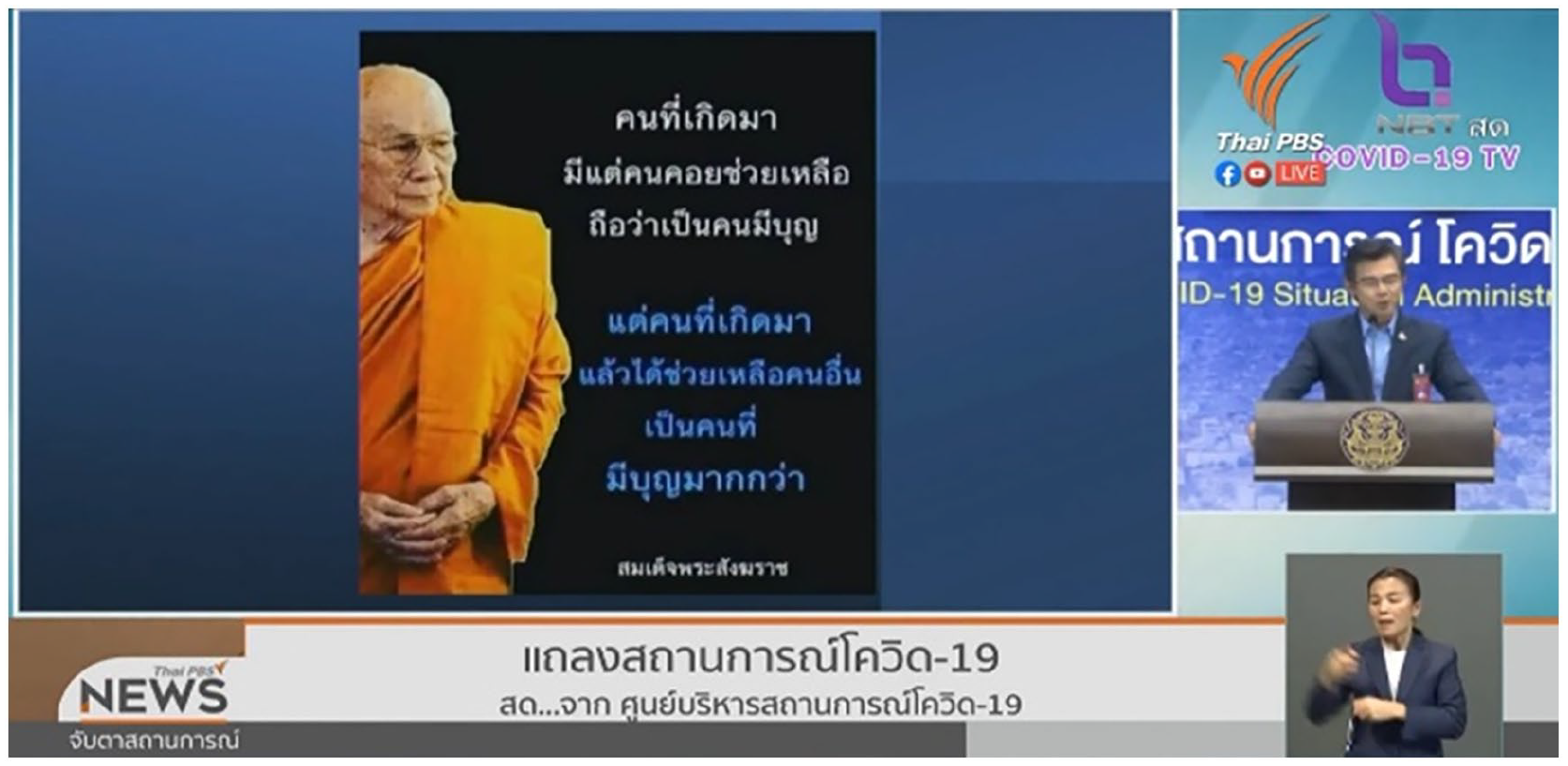
The presentation of the Thai Buddhist Patriarch and his sermon (January 8, 2021).
Almost 95% of the population in Thailand is Buddhist. One of its moral codes is to help others, which fits nicely with the character of an attentive leader among the Thai authorities. Such a moral quality is also made evident by remarks about the highest-ranking officials’ visit to the epicenter of the outbreak on their own, as in (16) from the Thai version and (17) from the English one.
16. Many government administrators who entered [the area]. Are they at risk? Yes, they are. But they had to do it as administrators who must take care of people.
(Thai version, December 28, 2020, 17.02–17.15 minutes)
17. Health minister . . . was welcomed by Myanmar workers in the area actually, and the representative expressed appreciation to the medical team for taking care of them.
(English version, December 28, 2020, 30.06–30.24 minutes)
Added to this, the English briefings also convey the reinforced image of the leaders in the fight against the disease. The government is often presented as a willing coordinator with international counterparts.
18.
(a) He [prime minister] focused on the management of information and of awareness, which is an important factor in continuing to fight the COVID. He reiterated and confirmed that the public health standard of Thailand would be able to control the COVID.
(English version, December 24, 2020, 51.24–54.44 minutes)
(b) Representative from Myanmar embassy . . . We continue to work closely with the Myanmar side in coordinating the medical check and treatment of Myanmar nationals.
(English version, December 28, 2020, 30.42–30.52 minutes)
One plausible explanation for this endeavor to demonstrate the government’s managerial ability and respect for human rights may be rooted in the concept of “face.” Face operates as social capital for society’s leaders, affecting the flow of power and awarding it to those who project an image of integrity (Persons, 2008). It would appear that the Thai government could maintain its image (or face) for global appeal by showing these diplomatic-worth gestures to vulnerable migrants.
However, if wrongdoings occur, Thai authorities do not hesitate to address the matter, as evidenced by the double conceptual metaphor of the CCSA as a doctor and as a soldier fighting the COVID-19 threat.
19. Right now, wherever we are sick, we take strong drugs there, inject medicines there, take care of where we feel pain . . . use the learning experience of the past year in this new battle.
(Thai version, January 2, 2021, 33.25–33.44 minutes)
The images of a guardian and a soldier are also presented in the English version.
20. The government has been combating the outbreak with all necessary measures in a timely manner.
(English version, December 24, 2020, 50.58–51.10 minutes)
Thai officials are also portrayed as hardworking administrators, especially in the English version, as in (21) and Figure 2.
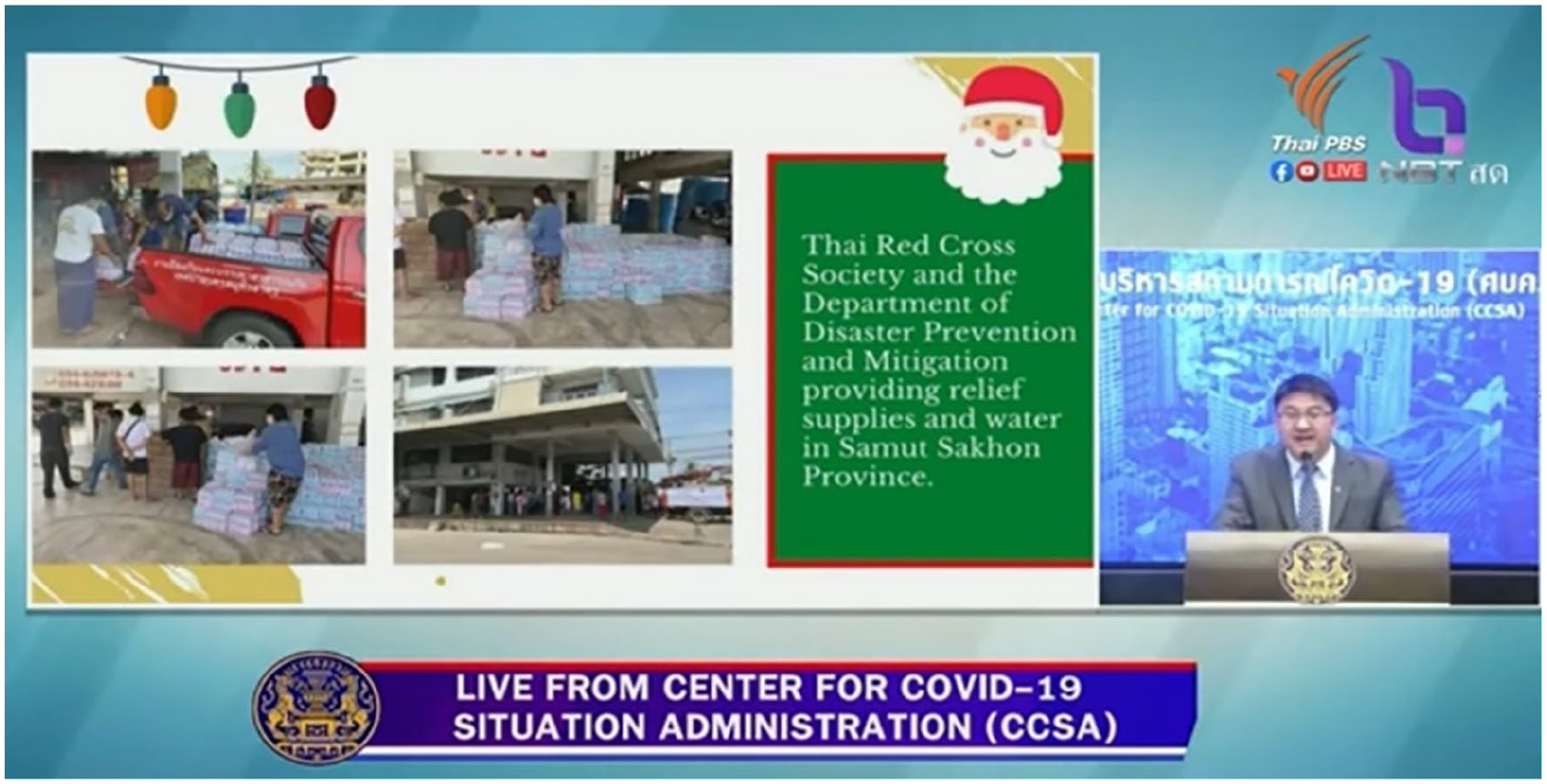
The photos of humanitarian activities by the government agencies (December 24, 2020).
21. To assure you that we are working diligently day and night to bring the recent infection under control as quickly as possible so that all of us can celebrate the new year in high spirits.
(English version, December 24, 2020, 50.14–50.47 minutes)
This type of remark and display of photos epitomize the polished image of officials’ unwavering commitment to Samut Sakhon, the epicenter of the new wave of disaster for which the Thai government must deliver a “swift” response to those in need. The above examples illustrate how the government has made use of official crisis communication to gain public support. In times of emergency, appropriate approaches for rebuilding its image could elicit favorable responses from the public and aid in building trust (Masngut & Mohamad, 2021). Our findings likewise support Bonsón et al.’s (2012) argument that media tools can lend a hand to the government by highlighting their efforts in such aspects as transparency, knowledge management, interagency cooperation, and, in our case, the image of the country’s timely and inclusive pandemic management.
Concluding discussion
Our study has revealed the importance of social actors’ representation through the scrutinization of the critical relationship between the state’s communicative discourse and Thai social dynamics. With pronoun use that accentuates the contrast between us and them, migrant workers in the CCSA’s communicative discourse are primarily shown as receivers of Thai leniency and victimized foreign “brothers and sisters” who may cause more problems but are valuable economic contributors to Thailand. The Thai and English versions similarly present Thai government agencies in a positive light as compassionate supporters of migrant workers and as attentive, spiritual leaders, and protectors for all nationals. When a crisis occurs, they are shown to be accountable for implementing the necessary plans to maintain security and work actively for the well-being of everyone, but at the expense of normalizing the migrants’ experience of the coronavirus emergency with the government’s vaunted intervention. Specifically, the English case is intended to garner more attention from expats and businesses with the highlights of international cooperation, investment opportunities, and efficient regulatory measures in battling the virus.
All the information provided in the press briefings depicted an image of the Thai government as a “protector” who worked extremely hard for the public’s safety, including the underprivileged migrants who were also part of their responsibility. The “protector” positionality entails the state’s power over others, which is manifested through its crisis communication strategy. Power, in this case, is not the plain oppression of the powerless migrant by the powerful Thai state but rather the manifestation of its solicitous yet domineering role. According to Foucault (1980), power operates beyond an agent’s imposition of oppressive measures on the powerless to include a strategic building of a system of power relations between institutions and people in a society. He argues that “[p]ower must be analysed as something which circulates, or as something which only functions in the form of a chain” (Foucault, 1980, p. 98). In our case, it is the reinforced chain of existing unequal power relations between the Thai state and its citizens, with economic migrants at the bottom of the social ladder.
Thailand’s key institutions (religion, family, and government) were put into play to harness the power of the discourse over the migrants. Buddhist morality was invoked to maintain a civil gesture, but it nevertheless assigned Myanmar migrants a separate role as the disadvantaged in order for the host to play the part of the selfless benefactor. Part of this communicative discourse reflects the patron–client relationship, in which we extend our hand to them because we care about them like family members. Still, they are also beneath us in status, which to some extent creates a sense of “otherness within nearness.” The others are referred to as Thailand’s neighboring “brothers and sisters” simply for the sake of the discourse producer’s credibility. This means that they have never been truly accepted as members of “the Thai family,” not even a more privileged group of Western migrants in Thailand (see other similar cases in Doungphummes & Zarchi, 2022; Thumvichit & Phanthaphoommee, 2024). Regarding governance, the process of covert othering found in both versions of the briefings is practiced by positioning the migrants vis-à-vis Thai authorities and Thai people. In other words, we-inclusive are portrayed as a benevolent host whom the migrants should indeed respect, obey, and be grateful to.
The sociopolitical implication of our findings is two-pronged. The first one lies in the state’s migration policy and how the government views itself as the one to be praised for crisis management success. We agree with Auethavornpipat’s (2017) assertion that Thailand’s policies should not be less than “migrant worker-friendly.” Non-inclusive and discriminative language in official communication must be avoided, while various supporting schemes should foster genuine dialogue and outreach to migrant communities. This means that government media should cultivate a positive attitude toward migrants among Thai audiences rather than preoccupy themselves with praising their success and reproducing othering discourse. The expression of the communicators’ attitude toward those in the official discourse must be careful not to turn it into “empathy without understanding” (Ignatieff, 1998, p. 295), a provision that makes the audience (in our case, the Thai public) become totally detached or abandon their involvement if they realize that such a representation counters their existing stereotypes. Perhaps in this way, Thais would no longer see migrants as competitors for employment and national resources, as was the case more than a decade ago (Sunpuwan & Niyomsilpa, 2012), especially considering that labor-intensive jobs and large-scale factories in Thailand now frequently hire workers from Myanmar. The second intertwined implication derives from the understanding that government communication in times of crisis is prone to being framed from a nationalist viewpoint that asserts its own superiority position while (inadvertently) subverting “others” (cf. Kawamura & Iwabuchi, 2022; Phanthaphoommee, 2022a; Wodak, 2021; Zhao, 2021). Some governments can use public relations to legitimize their choice of preventive measure, politicize fear, or even seek scapegoats by exploiting dichotomies such as the good and the bad, the healthy and the sick, or authorities and laypeople (Wodak, 2022, p. 305). What we have learned here is that fallacies in official communicative discourse (e.g., the insincere claim of neighboring “brothers and sisters”) can be used to justify the discourse producer’s actions. Anxiety can be projected onto certain representations (e.g., the disadvantaged versus the attentive “protector”), ultimately maintaining the asymmetrical power relations over “other nationals” while appealing to international audiences for national interests. Such an exclusive mode of discourse should be dismissed to at least slow down current sociopolitical dynamics that reinforce severe and pervasive kinds of inequality (Brubaker, 2015).
One limitation of this research is that it cannot provide all instances of migrants’ portrayal in this small space; therefore, it does not claim to be representative of other government communicative discourses. Further research might be conducted on the Thai government’s other minority representation discourses (e.g., political party campaigns or the government’s website). It is possible to conduct more in-depth research on the representation of Myanmar migrant workers in official policy formulation to substantiate the existing findings in terms of attitudes and actions, which may still reflect a nationalistic conservatism.
Footnotes
Appendix
List of video footages of press conference.
| No. | Date/duration | URLs |
|---|---|---|
| 1 | December 24, 2020 (71.35 minutes) |
https://www.youtube.com/watch?v=IYTqLGaG-ts |
| 2 | December 25, 2020 (63.50 minutes) |
https://www.youtube.com/watch?v=we3w349lkfI |
| 3 | December 27, 2020 (47.18 minutes) |
https://www.youtube.com/watch?v=_xtLNTE_Gzw |
| 4 | December 28, 2020 (41.42 minutes) |
https://www.youtube.com/watch?v=WBY41ccK-TE |
| 5 | January 2, 2021 (55.37 minutes) |
https://www.youtube.com/watch?v=ClcM5OZS4a8 |
| 6 | January 5, 2021 (70.21 minutes) |
https://www.youtube.com/watch?v=6bjqzttlqhk |
| 7 | January 7, 2021 (57.20 minutes) |
https://www.youtube.com/watch?v=nj8grF_ScPg |
| 8 | January 8, 2021 (59.16 minutes) |
https://www.youtube.com/watch?v=nFakwYIv0jU |
Declaration of conflicting interests
The author(s) declared no potential conflicts of interest with respect to the research, authorship, and/or publication of this article.
