




Abstract
Communicators often find it challenging to prioritize the public and manage their comments during risk communication. This study explored the effects of comments as interactivity cues on news diffusion while considering situational factors under the framework of the Situational Theory of Problem Solving in the context of the US-China trade conflict. For this purpose, the researchers conducted an experiment to investigate the effects of interactivity cues and public segmentations on news sharing. The findings suggest that comments elicit different news-sharing behaviors among different segments of the public. The aware public shares more news than the activists/active public who are more likely to share when exposed to news posts with disabled comments than those with enabled comments. The results regarding the different segments of the public suggest the absence of the latent public in hot issues. Furthermore, the results suggest that message attributes have a limited effect on individuals’ information-processing behavior unless considering situational factors. The theoretical contributions and practical implications for communicators are further discussed.
Recently, an increasing focus has shifted to news sharing due to its impact on the senders and recipients. In this regard, newsreaders perceive shared news as more influential since it is sent by the people they follow and friends who are more trustworthy than other general social media sources, whereas the senders gain cognitive by eliciting higher levels of information processing and social benefits by strengthening their social relations (Bialik & Matsa, 2017; J. Cho et al., 2018; Mitchell et al., 2017; Yoo et al., 2017). In this context, the current study explored news sharing as communicative behaviors impacted by comments as interactivity cues (disabling, censoring, and enabling the commenting function), drawing from the Situational Theory of Problem Solving (STOPS) that examines the manifestation of communicative behaviors affected by individuals’ perceived problem recognition—assessing the connection between a problem and oneself, involvement recognition—assessing the connection between a problem and extended self, and constraint recognition—assessing the internal and external barriers of coping the problem (Kim & Grunig, 2011). The theory also discusses and provides insights into how to prioritize a proactive public characterized by a high problem and involvement recognition but low constraint recognition to limit their communicative actions, to reduce the influence of a risk or crisis situation (Kim & Grunig, 2011).
As STOPS was often adopted to examine how and why the public showed different communicative behaviors, limited studies have explored the public’s manifestations in responding to different social media conditions. Often, social media users post comments online wanting to “correct an error,” “know something about the subject that wasn’t in the article,” “give my personal perspective,” “disagree with the author,” and “persuade others” (Aschwanden, 2016). Thus, it is not surprising that many organizations have disabled the commenting function on their social media accounts to prevent online users from posting their thoughts (Parsons, 2017). Some organizations justified this action by saying that it would be helpful to avoid hatred and biases, whereas many others expressed those nasty comments negatively influence their brand image and reputation (Cheng, 2019). According to some scholars, people are not affected by the exposure to others’ opinions simply because they have strong pre-existing beliefs and selectively expose themselves to opinions consistent with their own (Anderson et al., 2014; Walther et al., 2010). However, online users could react negatively when the comment section is disabled. Disabling commenting influences how the audience perceives the source of information (Keller, 2013; Liao & Mak, 2019). The interface of a dialogue box on the website of an organization generates more trust among the audience in the organization as it allows the audience the choice to speak out (Sundar, 2008). However, the Chinese government, party press, and organizations often consider “disabling commenting” as a strategy to control the spread of negativity. The study focuses on Weibo, a Chinese social media platform similar to Twitter, from which people receive local and national news. By the end of the second quarter of 2019, Weibo had 486 million monthly active users, making it an important channel for the distribution of political information and the construction of ideology (China Internet Watch, 2019). Commenting cues could heuristically influence individuals’ communicative actions moderated by situational factors recognized by STOPS. In other words, the social media users’ assessment of a problem would strengthen and weaken the effects of commenting cues on their behaviors.
To fill this gap in the literature, the current study examined how social media news was shared by different segments of the public that are categorized by situational factors during the US-China trade conflict, and this expanded STOPS literature due to the following: (1) message stimuli (commenting cues) could trigger various actions from different segments of the public, (2) the public deals with the risks and uncertainties regarding its economic impact and China’s national image, (3) STOPS can be applied differently in the international contexts (Zheng et al., 2016), (4) China’s tight control over the media might produce inconclusive results since the interactivity, namely online commenting, on social media has changed the media landscape, and (5) critical issues might cause different communicative actions due to extensive coverage by the mainstream media.
Thus, the present study aimed to understand news sharing as an information-processing behavior through the STOPS framework by considering the heuristic effect of comments, which could help explain how the public communicates and participates in political discussions on social media platforms. Moreover, this study examined how activists and aware members share social media news while considering interactivity cues (disabling/censoring/enabling the commenting function). Furthermore, the present study contributes to STOPS by examining the causal effects of media stimuli on information-forwarding behavior. In addition, it also contributes to public relations practices, as the tactic of disabling the commenting function would bring backlash to the practice because it increases communicative actions. Last but not least, it provides insight into how to prioritize the public in communication.
Literature review
Situational Theory of Problem-Solving (STOPS)
STOPS explains how scholars and practitioners in public relations prioritize the stakeholders characterized by high problem and involvement recognition but low constraint recognition to limit their communicative actions that might enlarge the impact of a risk situation (Kim & Grunig, 2011). STOPS is drawn from the foundation of the Theory of Decision Making (Grunig, 1997) and the Situational Theory of Public (STP) (Grunig, 1997) which explains when and how the public seeks and shares information to cope with a problem. However, STOPS overcomes a few limitations of STP. In this sense, it proposes additional antecedences such as referent criterion and situational motivation and expands information actions considering both active and passive communication behaviors (Kim et al., 2010; Kim & Grunig, 2011). Furthermore, STOPS revises situational variables and reconceptualizes involvement recognition from the level of involvement (Kim & Grunig, 2011).
According to STOPS (Kim & Grunig, 2011), the active, aware, and latent public have been defined based on situational factors—their capabilities in problem, involvement, and constraint recognition. More specifically, problem recognition refers to the perceived discrepancy between what has been done and what should be done in a problematic situation. Involvement recognition assesses the connection between the problem and oneself. Constraint recognition evaluates the limit of an individual in doing something to solve the problem (Kim & Grunig, 2011; Kim & Ni, 2013). According to the situational factors, the proactive public has started working to solve the problem, the aware public has just recognized the problem, and the latent public has not detected the problem yet. For example, Kim et al. (2011) found that problem recognition and involvement recognition of the shortage of bone marrow donation increased information seeking and attending related to this issue. Specifically, the activists/active public was more likely to exhibit behaviors of information seeking, forwarding, sharing, and permitting compared to the aware public (Kim et al., 2011). Scholars also examined the theories in a variety of areas, including environmental issues (Lim et al., 2016; Xifra, 2016), health communication (Aldoory et al., 2018; Hong, 2018), non-profit communication (Zheng et al., 2016), political communication (Chon, 2019; Hamilton, 1992), and risk and crisis communication (Aldoory et al., 2010; Aldoory & Grunig, 2012).
However, other studies demonstrated some inconsistent findings. Lamm et al. (2018) found that individuals’ recognition and involvement in the issue of water-saving decreased their level of communicative actions. Aldoory et al. (2010) examined the effects of risk experience portrayals in media coverage on individuals’ information processing and seeking behavior, and they found that the risk experience did not influence information processing and seeking. These studies suggest that the effects of media exposure and contexts may vary in communicative actions. For example, critical issues are often triggered by events that significantly impact society and nations (Y. R. R. Chen et al., 2017; Kim et al., 2012). Studies on hot issues revealed a weak association between problem recognition and communicative actions due to the extensive media coverage and loss of interest (Aldoory & Grunig, 2012; Y. R. R. Chen et al., 2017; Kim et al., 2012). In addition, the latent public will be absent due to the extensive media coverage and excessive attention directed at the hot issue. Ultimately, these inconsistent findings suggest further research is required to examine and extend STOPS.
STOPS and news sharing as a communication action
The original STP and STOPS have examined information forwarding as one of the outcomes of situational factors. News sharing as a behavior of information forwarding refers to the “planned, self-propelled information giving to others” when exposed to news stories about an issue (Kim & Grunig, 2011, p. 4). News sharing is an essential aspect to explore because studies have demonstrated that it affects both the message senders and recipients (J. Cho et al., 2018; Mitchell et al., 2017). On one hand, shared media content generates more follow-up information-processing behavior such as re-sharing the message to others (Hennig-Thurau & Walsh, 2003; Mitchell et al., 2017). People give more credit to sources that are their friends and people they follow on social media, which makes the messages more influential to the audience (S. Cho et al., 2014). On the other hand, news sharing often reinforces the sharers’ existing beliefs and reshapes an individual’s self-concept and identity through information seeking and assessing (J. Cho et al., 2018; Yoo et al., 2017). Online sharing behavior increases mutual empathy as the sharers must consider the needs and desires of others, which facilitates individuals’ social interaction and participation (Hennig-Thurau & Walsh, 2003).
Furthermore, STOPS scholars have explored information sharing as the outcome of situational factors (Kim & Grunig, 2011; Z. J. Yang et al., 2014). However, very few of them offered a direct and causal link between the situational variables and the responses to media stimuli, where individuals may take immediate actions when they encounter media content online. The Internet has largely changed the media environment and communication behaviors of the public. Social media allows online users to send and/or forward messages to others with a simple click. Moreover, the public can participate in news production by sharing and providing personal perspectives. In this sense, the present study focused on news sharing which refers to a self-propelled behavior of forwarding news to others.
Based on STOPS’ situational factors and previous discussions on hot-issue communication, the aware public might share more news than the activists/active public whose motivations to communicate are diminishing due to extensive media coverage and loss of interest, although they recognize and feel personally involved in a problem. Hence, the researchers hypothesized the following:
H1. The aware public shares more news than the activists/active public.
Heuristic process of news sharing
As Kim and Grunig (2011) extended the STP to the Situational Theory of Problem-Solving (STOPS), they posited that situational factors influence the public’s communicative actions through the mediation of situational motivations. Lim et al. (2016) tested the extended situational public engagement model (SPEM) and revealed the effects of situational variables on public engagement, successfully explaining individuals’ communicative actions under the collective public behaviors in a rapidly changing media environment. Although SPEM and STOPS can effectively explain when and how members of a public segment communicate in a situation, both considered information sharing as a goal-driven process and had limitations in explaining individuals’ sharing behaviors.
News sharing may not only go through a decision-making procedure but can also be triggered by environmental stimuli (Lee & Ma, 2012). The Elaboration Likelihood Model (ELM) provides a framework for understanding the role of heuristic cues in information processing (Petty & Cacioppo, 1986). ELM’s high-effort process is based on the cognitive response theory, which explains that changes in attitudes are affected by cognitive responses elicited by message characters, whereas its low-effort process is based on the heuristic mechanism that attitude changes are driven by peripheral cues such as color or music (Petty et al., 1997). Heuristic cues such as a source, a message, or a context could affect an individual’s behavior (Petty & Cacioppo, 1986). Many studies have found that the credibility of the source and the news impact an individual’s behavior. However, sharing the news multiple times might diminish the effectiveness of the sources (Appelman & Sundar, 2016). The recent concern regarding fake news and misinformation makes the evaluation of a news article difficult (Allcott & Gentzkow, 2017; Tandoc et al., 2018). Thus, other social media metrics, such as comments, would effectively influence an individual’s communication behavior. Therefore, the present study created a comprehensive model to understand news sharing as a communication behavior of the STOPS by considering the heuristic effect of commenting cues.
Comments as heuristic interactivity cues
Interactivity is one of the major reasons why social media is valued, as the audience is not given much of a voice in traditional media (Bala, 2014). The availability of interactivity indicates the participatory nature and the openness of media platforms (Sundar, 2008). For instance, an open comment box might be seen as a surface characteristic that can trigger positive attitudes toward the platform. Regarding computer-mediated communication, Sundar (2008) discussed that the cues of interaction, such as the dialog box, indicate a responsive medium and an option to address the users’ needs when using the platform. The availability of choice and the feeling of control alter individuals’ attitudes and behaviors (Sundar, 2008; Sundar & Wagner, 2002).
Social media not only helps build relationships between organizations and the public but also allows people to directly listen to one another with the help of the “comment” function (Mangold & Faulds, 2009). However, some organizations disable this function to control the “unpleasant” voice of their stakeholders (Parsons, 2017). Previous studies have found that enabling comments could be an interactivity cue that influences the trustworthiness of an organization (Liao & Mak, 2019). Keller (2013) and Liao and Mak (2019) revealed that people are more likely to trust an organization when the comments section of its social media posts is open. A dialogue box generates an interactivity heuristic that triggers a heuristic process when the audience is allowed the choice to provide their perspectives (Sundar, 2008). However, disabling commenting is indicative of the low transparency of the information provided by the source.
In the context of China, usually, the government decides which news is allowed to surface on social media (Cheng, 2019). Hence, people choose to express their opinions by commenting on the social media news posts as an alternative way to speak out, which makes commenting significant in influencing China’s media landscape. People often seek others’ opinions to counter the state-run media’s stand—pro-Chinese government position on issues. A report on Internet commenters found that people write comments to correct errors, provide their personal experiences, offer additional information not available in the news stories, and disagree with the source (Aschwanden, 2016). Viewing comments on news posts might confirm the existing attitudes of social media users or provide complementary information on an issue.
However, the Chinese government and state-run media often use disabling and/or censoring the commenting function as strategies to control the voice of the opposition in the long run (Chao, 2012; Cheng, 2019; Myers & Mozur, 2019; Y. Yang, 2018). Disabling comments denotes an organization completely closing the comment section while censoring comments refers to the source selectively choosing and deleting comments to make it appear more pro-China. The interactivity of a post with censored comments is relatively higher than one with disabled comments, as people still have a choice to comment on the news. However, disabling as well as censoring commenting could generate backlash in terms of restricting outspokenness (Laran et al., 2011). The effects of this backlash suggest that the users tend to speak out when they do not see the heuristic interactivity cue since the commenting function is disabled; thus, they view the information as biased and refuse to be persuaded by the perspectives presented by the news (Laran et al., 2011). Consequently, the public might feel obligated and have more desire to express their opinions by sharing the news with their friends and family to discuss the issue. Hence, the researchers proposed the following hypotheses:
H2. Compared to the news that enabled commenting, people are more likely to share (a) the news with disabled commenting and (b) the news with censored commenting.
H3. Compared to the news with censored commenting, people are more likely to share the news with disabled commenting.
Public segmentation, commenting, and news sharing
STOPS suggests that proactive public members with high problem recognition, high involvement recognition, and low constraint recognition are more likely to share information to resolve the problem (Kim & Grunig, 2011). However, a few studies revealed inconsistent findings related to the STOPS in terms of issue differences. Hot issues decrease the likelihood of information-processing behavior since the issue is covered in news outlets “everywhere,” and the proactive public is tired of it (Y. R. R. Chen et al., 2017; Lamm et al., 2018). Usually, compared to the aware public, the proactive public (activists/active public) consumes or is exposed to issue-related news more consistently and may have less communicative actions due to extensive media coverage of the hot issue topic. In addition, they might be involved in the trade conflict and observe the impacts of the issue on their company or the people they are close to. Thus, they already have many other sources to verify the news they encounter. As reiterated earlier, disabling commenting reduces the perceived interactivity and would increase the likelihood of activists/active public sharing social media news. Hence, a more active public should be less likely to respond to the news with regular comments; instead, they feel obligated to spread the news with disabled comments, especially when they feel “knowledgeable” on hot-issue topics. Hence, the researcher proposed the following:
H4. Activists/active public are more likely to share when exposed to the news with disabled comments than when exposed to the news with enabled comments, compared to the aware public.
In contrast, the less active public (aware public) might have limited access to explore the hot issue, as they exhibit low problem recognition and are less involved. They may respond to the news either with or without comments right away to cope with the uncertainty of the situation. News without a “comment” box would also generate more communicative actions from the aware public than it does from the activists/active public. The interactivity cue may be more salient for the public who perceive more bias when the cue is missing (Liao & Mak, 2019), as they do not have much information to help them process the exposed news, which then triggers more communication behaviors such as information sharing. The previous evidence was not exhaustive; hence, the researchers proposed the following research question:
RQ1. Is the aware public more likely to share social media news with disabled commenting or enabled commenting?
Moreover, people feel more doubtful when they see censored comments than enabled comments; however, they perceive less bias in posts with censored comments than those with disabled comments, as a space to conduct discussions and make judgments still exists. Regarding the public segments, the aware public reacts to the interactions even when comments are censored. They may also react more actively to the disabled commenting function than to censored commenting. However, the censored commenting function might not trigger many communicative actions of the aware public since it indicates a certain form of interactivity. Thus, the researchers raised the following research questions:
RQ2. What would be the differences in the news-sharing behaviors of the activists/active public and the aware public when exposed to the news with disabled, censored, and enabled commenting?
Study context: the US-China Trade Conflict (USCTC)
The USCTC is an ideal case for exploring the phenomenon of social media news sharing through the lens of STOPS and the effects of heuristic commenting cues. Zheng et al. (2016) tested the theory through a non-profit fundraising case and revealed that the theory applies differently to China and the United States. The USCTC issue has been heavily covered by the Chinese state-run media since US President Donald Trump decided to increase imposed tariffs on Chinese goods at the beginning of 2019 (Areddy, 2019). Usually, the Central Chinese Television (CCTV) prime-time news roundup features strong statements on the trade conflict and states that China is confident about its ability to “fight back” in an attempt to set an agenda for the Chinese public (Cheng, 2019). CCTV has also generated 35,000 Internet news posts on the largest online news website Sina, which collects news articles from multiple national news outlets (Sina, 2019). Furthermore, it increases perceived risk due to its impact on China’s economy and its people’s daily lives (Jiang, 2018). The rising price of imported fruits and other consumer products is alarming in the sense that it indicates that the conflict would further influence international business and agriculture segments in the long run.
The concerns regarding the economy arouse heated discussions on social media platforms. Millions of online news consumers have discussed the USCTC through Weibo, which is known as Chinese Twitter. Weibo is influential in political communication, as it is an important medium for news seeking, commenting, and sharing. Similar to how individuals consume news on Twitter, Weibo users can easily access news from everywhere via mobile devices (Grieco, 2017). Wohn and Ahmadi (2019) found that micro-news consumers continually read breaking news and hot-issue news on such mobile platforms. These findings make the USCTC an ideal case to study news consumers’ communicative behavior toward hot issues in the Chinese context since (1) Weibo users share similar motivations for seeking and forwarding news compared to Twitter, a more popular social media for news; (2) it is also unique because of information control exerted by the government on users’ reactions.
The STOPS explains that the proactive public might be more likely to share trade-war news since it helps them resolve the perceived risk of the issue. Most STP/STOPS scholars believe that situational factors predict information behavior. However, communication behaviors may strengthen individuals’ cognition of the USCTC, which would enhance their problem and constraint recognition capabilities. The more people use Weibo to seek and share information on the USCTC, the more likely they consider it as a serious social and national problem and find they cannot contribute to improving the situation. In other words, the public’s information-sharing behavior also strengthens their cognition of an issue. Thus, it is important to explore if different public segments would behave differently when exposed to news stimuli about USCTC on Weibo.
Drawing on the STOPS (Kim & Grunig, 2011), people with high USCTC recognition would perceive a huge gap between what the government has done for the conflict and what it should do to solve it. With high involvement recognition of the issue, they might identify strong effects of the conflict on themselves, their family, or friends, and with higher constraint recognition toward USCTC, they find that their scope of action to reduce the severity of the situation is limited.
In addition, the effects of situational factors vary according to the issue. Some studies have not found positive relationships between the public’s connection to the issues and their communicative actions. For example, Lamm et al. (2018) found that individuals’ recognition and involvement in water-saving decreased their level of communicative actions instead of increasing it. Aldoory et al. (2010) examined the effects of different portrayals of the shared risk experience between terrorism victims and media spokespersons on individuals’ information processing and seeking behavior and found that the risk experience influences their problem recognition abilities but not their information processing and seeking abilities. In addition, previous studies have found that the proactive public does not actively share the news when exposed to hot-issue news due to the decline in interest as it is extensively covered everywhere (Y. R. R. Chen et al., 2017; Lamm et al., 2018). Hot issue topics such as USCTC are often triggered by events that have a great impact on society and across nations (Y. R. R. Chen et al., 2017; Kim et al., 2012), which, consequently, lead to different communication behaviors.
Methodology
Participants and the procedure
The researchers conducted a between-subject experiment to examine the effects of interactivity cues, public segments, and interactions on social media news sharing. The researchers adopted a snowball sampling technique to recruit the study’s subjects after receiving the approval of the Institutional Review Board (IRB). This sampling method was used since the study was politically sensitive, which made finding participants hard. Most of the sampling pools in China were not allowed to answer trade-war-related questionnaires. As the first step, a faculty member of a large Chinese public university in a metropolitan area reached out to 35 undergraduate students belonging to different provinces and municipalities all over China. These students were properly trained and instructed during class hours before they recruited subjects from their friends and family, during which specific sample profile instructions were given to them: the subjects must be older than 18 years. Thus, the ages of 50% of the participants they recruited were between 18 and 35, 30% were between 35 and 45, 20% were aged above 45, and the gender distribution was even. The goal of the instruction was to gain a more diverse sample population. In the last step, the recruiters (students) sent an electronic link to the people who chose to participate in the study and offered them 10 RMB (around 1.5 USD).
The survey-based experiments were constructed through Qualtrics in Chinese. One of the researchers translated the study into Chinese, and another researcher verified the translation and conducted a pilot study to minimize misinterpretations. The participants were asked to answer questions regarding situational factors before they were exposed to different commenting cues, to categorize them into different segments of the public. After the exposure to the manipulation, they answered questions about their sharing intentions. A total of 420 participants completed the experiment. The response rate was over 95% because the subjects were the family and friends of the recruiters. The researchers included 304 participants for the data analysis by excluding the subjects who completed the survey in less than 2 minutes, who did not give their consent for further study, and who did not pass the manipulation check.
Stimuli
The researchers conducted the experiment with a between-subject design with three conditions in terms of interactivity cues: disabling commenting (O1), censoring commenting (O2), and enabling commenting (O3). In each condition, the subjects were evenly and randomly exposed to two trade-war news that supported the Chinese tariff policy since most trade-war news is pro-government. There is no significant difference regarding their effects on the dependent variable (t = .56, p = .58). The two-news design would ensure that the effects of comments on news sharing can be replicable for different news articles. In O1, the subjects were exposed to the news for which the comment section was disabled by the original news outlet (N = 106). In O2, news with comments selected by the news outlet (censored commenting) was presented to the subjects (N = 104). In O3, the subjects were exposed to news posts with regular comments, comprising the control group (N = 94), see Supplemental Appendices A and C.
Manipulation check
The manipulation check was done through a question: “Did you see any comments on the news you just read?” The subjects could choose from “no comments,” “have regular comments,” “comments were censored,” and “comments were disabled.” In the end, 304 participants (73.2%) passed the manipulation check.
Measurement
Public segment
The public segment was measured through a summation method developed by Kim and Grunig (2011). The method uses the midpoint of three situational independent variables, including problem recognition, involvement recognition, and constraint recognition, as the cut-off point (e.g., 3 on a 5-point Likert-type scale). Then, the researchers re-coded the situational variables as high (1) and low (0). For instance, a subject rated 5 for problem recognition, 3 for involvement recognition, and 2 for constraint recognition on a 5-point Likert-type scale. The researchers also re-coded problem recognition as high (1) and involvement recognition as high (1). For the subject’s constraint recognition, high constraint recognition was re-coded as (0), whereas low constraint recognition was coded as (1) since the variable is reversed. In the last step, the researchers summed up the three recoded values and categorized them: 0/1 = latent public (N = 10), 2 = aware public (N = 187), and 3 = activists/active public (N = 107) (see Table 1). The results regarding the different segments of the public confirmed our discussion about the absence of the latent public in hot issues.
Public typology using situational independent variables.
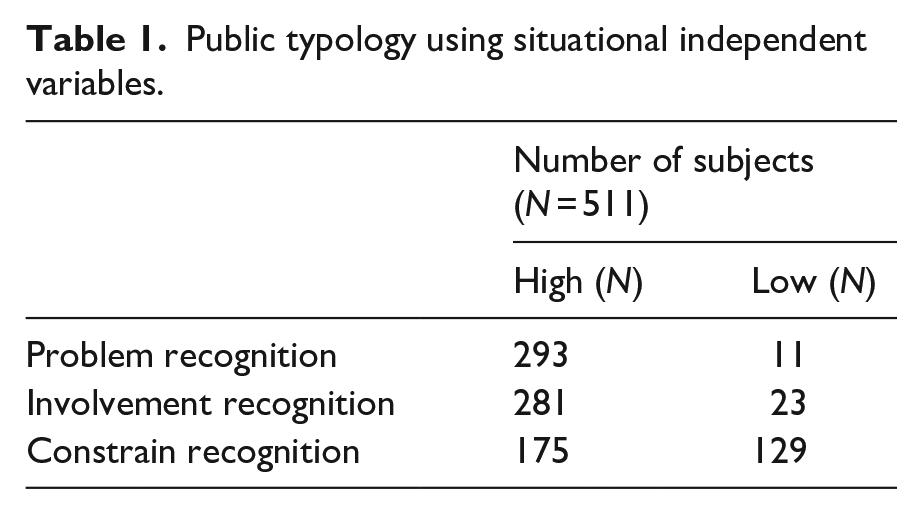
The researchers measured each situational variable—problem recognition, involvement recognition, and constraint recognition—through four items (see Supplemental Appendix B). The items of the measures were translated into Chinese from English while retaining the meaning. Back translation was used to improve the subjects’ comprehension in the Chinese context. The subjects were asked to indicate the extent to which they agreed with the statements through a 5-point Likert-type scale, ranging from “strongly disagree” (1) to “strongly agree” (5) before they were exposed to the stimuli. The alpha levels were higher than .70, which meets the minimum internal consistency coefficient (Whitley & Kite, 2013).
News sharing
The construct was measured through three items using a 5-point Likert-type scale. The variable inquired about the subjects’ online-sharing decisions by asking them how strongly they felt to do the following actions after being exposed to Weibo news posts: “share the news directly through Weibo (the social media platform),” “share the news to my family and friends through instant message apps,” and “share and comment on the news with my family and friends via instant message apps.” Cronbach’s alpha was .86.
Control variables
Generally, experiments aim to draw causal relationships at a group level based on the counterfactual model through randomization (Morgan & Winship, 2007). Hence, the current study did not control factors that might reflect individual differences. However, demographics were controlled to ensure the theoretical rigor of the study, as the demographics were not evenly across the groups. Among all the 304 subjects, 117 (39.5%) were male and 179 (60.5%) were female. The group with an age range of 18–25 (N = 314, 62.8%) was the largest; 44 (8.8%) were between 26 and 35; 82 (16.4%) were between 36 and 45; 60 (12%) were 51 years or older. More than two-thirds of the subjects (70%) were currently enrolled in a bachelor’s degree program or have a bachelor’s degree. In terms of individual income, 186 (62.8%) informed that their monthly income is under 3000 RMB (about 440 USD); the monthly salary of 56 (18.9%) was between 3001 and 6000 RMB (about 440–880 USD); 21 (7.1%) was between 6001 and 9000 RMB (about 880–1320 USD); and 33 (10.9%) was over 9000 RMB (about 1285 USD).
Data analysis
Frequency and descriptive analyses were used for data screening and cleaning. Reliability analysis was used to create the composite variables. The analysis of covariance (ANCOVA) was adopted to test the main effects of manipulation on the outcome variables and the interaction between the interactivity cues and public segmentation.
Results
The researchers used an independent t-test to test H1 that the activists/active public shares more social media news than the aware public. The results suggest that the aware public (Mean = 2.66, SD = 1.10) is more likely to share news than activists/active public (Mean = 2.17, SD = 1.05; t = 3.70, p < .001). Thus, H1 was accepted.
The researchers used an ANOVA to explore the research questions and H2 and H3 regarding the effects of interactivity cues on sharing. The findings do not reveal a significant difference among different interaction cues on sharing social media news, with F (2, 298) = .93 and p = .40. More specifically, individuals are not more likely to share (a) news with disabled comments and (b) news with censored comments, compared to news posts that enabled commenting. Overall, no difference between the effects of censored and disabled commenting on sharing behaviors was detected. Thus, H2 and H3 were rejected.
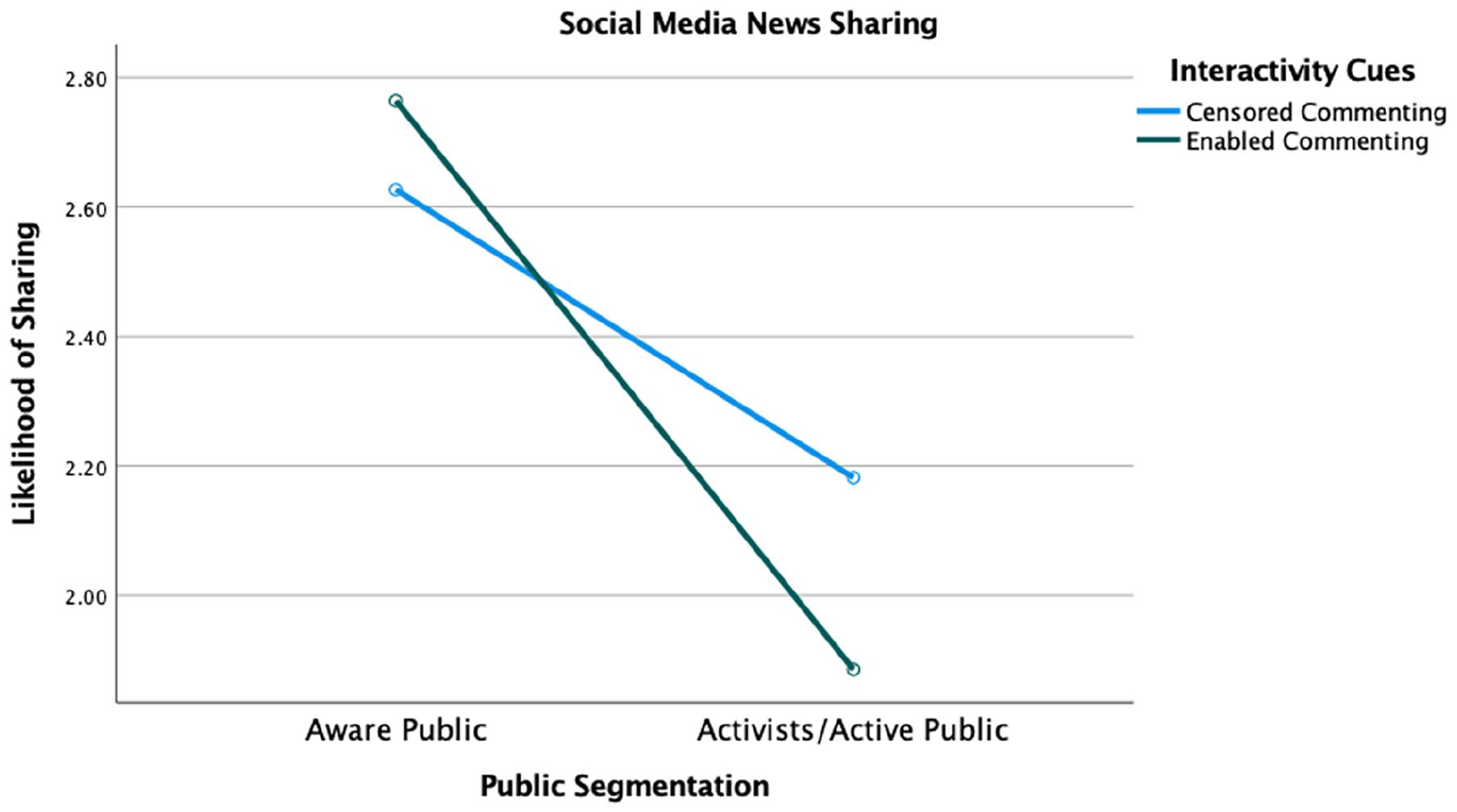
An ANCOVA test was used to test the interaction effects of public segmentation and interactivity cues (disabled commenting vs. enabled commenting) on news sharing (see Figure 1 and Table 2). The findings suggest an interaction effect of interactivity cues and public segmentation on social media news sharing, R2 = .10, F (7, 180) = 2.71, p < .05, η2 = .10 (see Table 2). The activists/active public were more likely to share the news when they were exposed to disabled commenting than when exposed to enabled commenting, compared with the aware public, F (1, 180) = 7.70, p < .01, η2 = .041. Therefore, H4 was accepted. To answer RQ1, the aware public was more likely to share news with enabled commenting than disabled commenting. However, it is noteworthy that their intentions to communicate were high in both conditions.
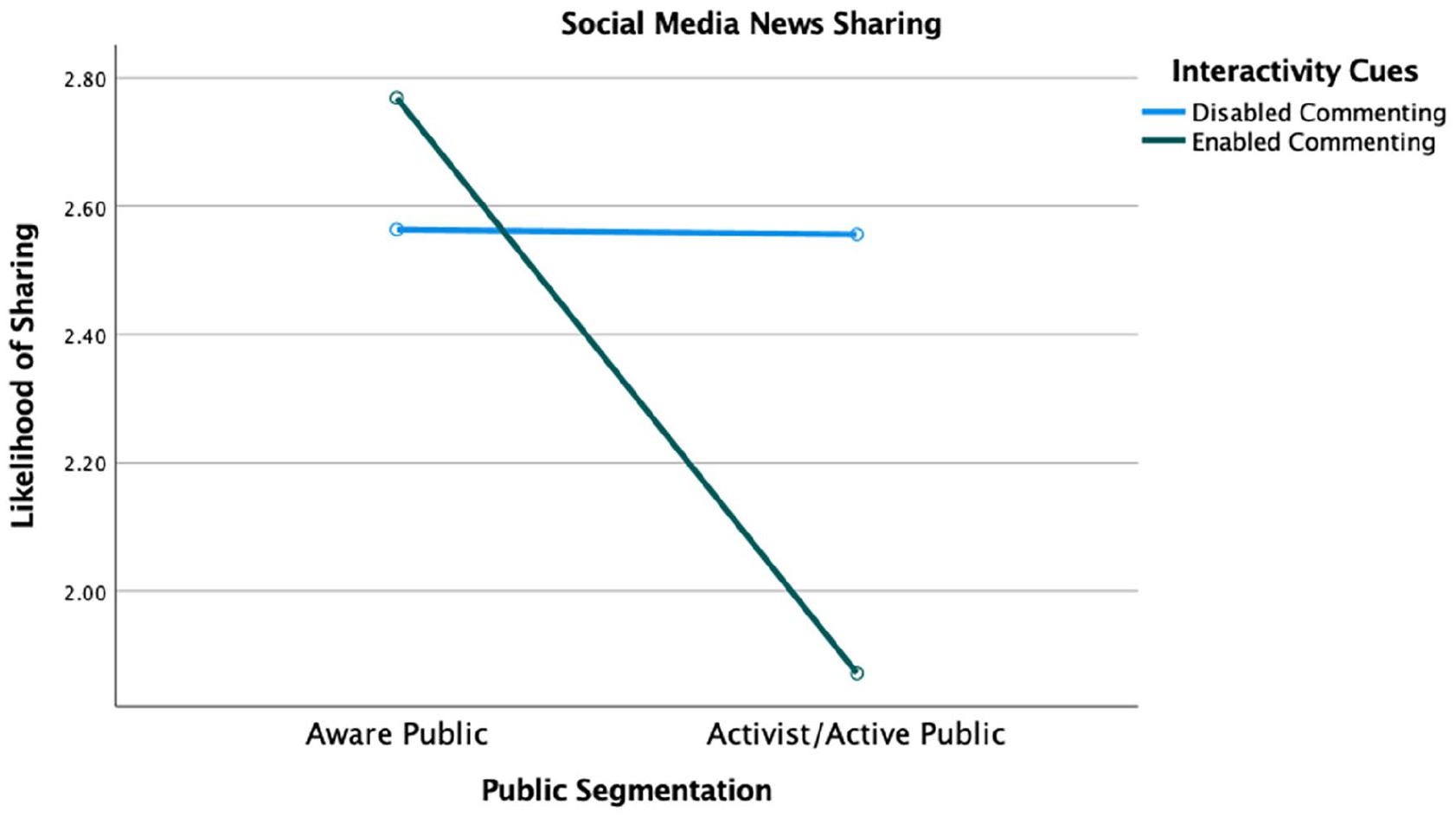
Disabled commenting versus enabled commenting effects.
ANCOVA: Main effects of interactivity cue and public segmentation on sharing.
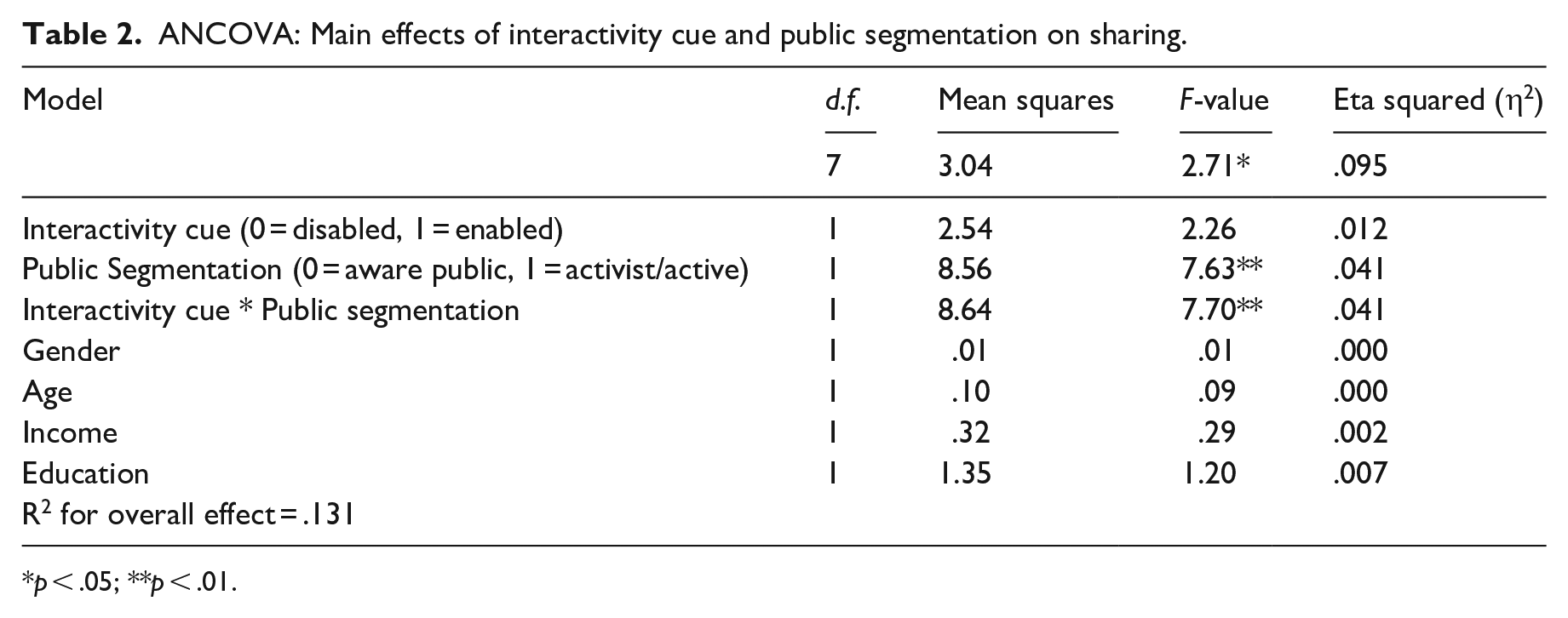
p < .05; **p < .01.
To answer RQ2, two additional ANCOVA tests were adopted. The first ANCOVA test did not suggest a significant interaction effect of interactivity cues (disabled vs. censored commenting) and public segmentation on news sharing, R2 = .05, F (7, 189) = 1.37, p = .22, η2 = .048, although Figure 2 shows that activists/active public shared more news with disabled commenting than censored commenting, F (1, 189) = 1.81, p = .18, η2 = .009. However, the aware public did not show much difference in news sharing when exposed to different commenting conditions. The third ANCOVA test also did not suggest a significant interaction effect of interactivity cues (censored vs. enabled commenting) and public segmentation on sharing, R2 = .13, F (1, 179) = 3.83, p < .01, η2 = .13. Figure 3 reveals that both activists/active public and the aware public did not exhibit notable differences in terms of censored and enabled commenting conditions, F (1, 179) = 1.76, p = .19, η2 = .010.
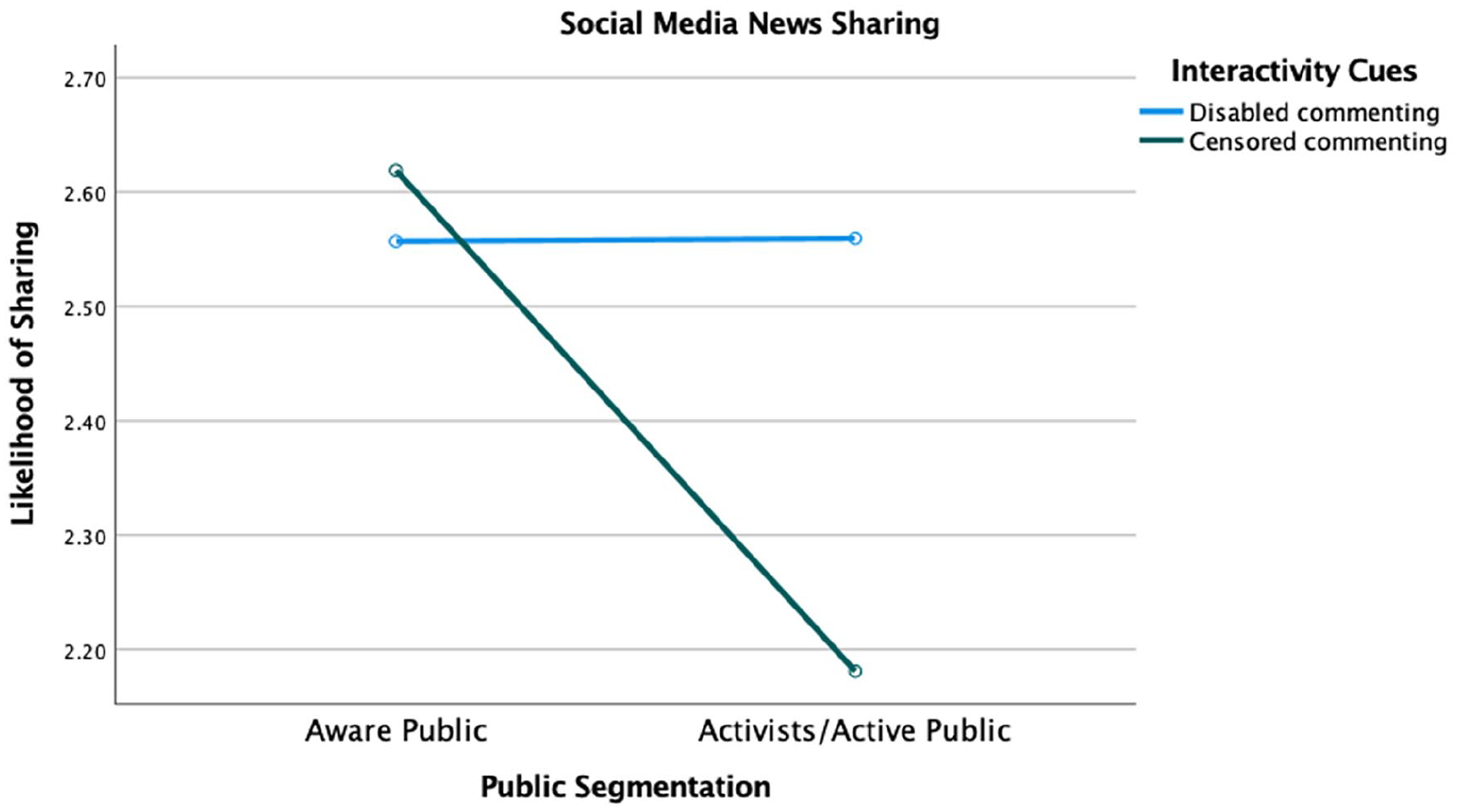
Disabled commenting versus censored commenting effects.
Enabled commenting versus censored commenting effects.
Discussions and limitations
Interactivity cues and the public’s responses
The study examined how different public segments share social media news in response to interactivity cues such as enabled, censored, and disabled commenting. It revealed that different segments of the public exhibit different news-sharing behaviors. The results are not consistent with the original STOPS that the public with high problem recognition, high involvement, and low constraint recognition was more likely to process issue-related information; instead, the results confirmed the findings of previous studies that activists/active public did not share much due to the hot-issue effect as they grew tired of the extensive media coverage of the USCTC (Y. R. R. Chen et al., 2017). The proactive public had already recognized the USCTC as an issue of national and economic importance that might affect their jobs and lives, whereas the latent public was absent in the context of hot issues. Heavy media coverage of the issue has decreased the likelihood of the proactive public doing something about the issue pertaining to the news because they have been increasingly exposed to similar information and have grown tired of responding to it. However, the people from the aware public were more likely to share the news after the exposure, as they were somewhat involved in the issue and sought some information—but not too much. They tended to exhibit communicative behaviors to cope with the situation (Grunig, 1997).
Moreover, regarding interactivity cues, commenting did not perpetuate any differences in news sharing, and this is inconsistent with previous findings suggesting that disabling comments reduced the interactive heuristic, which increased people’s willingness to speak out as they might perceive the news as biased and in need of their perceptions to correct the misinformation within it (Laran et al., 2011; Liao & Mak, 2019). In this study, disabling comments did not increase news sharing. However, the results found an interaction effect between interactivity cues and public segmentation on news sharing. The activists/active public were more likely to share the news when they were exposed to disabled commenting than enabled commenting. Lack of interactivity reduces the trustworthiness of the news and the government-run news organizations; thus, the proactive public (activists/active public) feels obligated to share and discuss the news with others, as they have more counter-information that enables them to participate in the news co-production activity (Laran et al., 2011). Disabled commenting motivates them to provide their personal experiences or offer additional information not available in the news stories (Aschwanden, 2016). Furthermore, the aware public was more likely to share news with enabled comments than disabled comments. In this context, the results are consistent with the previous findings that the less active public was more likely to speak out about an issue, as they did not have enough relevant resources to counter the original news and were more biased toward comments (Liao & Mak, 2019). Thus, the less active public members are more likely to share news posts that contain regular comments, as they need balanced and comprehensive information to cope with the situation.
In terms of censored commenting, it allows newsreaders to have some room to express their opinions, as, in this case, transparency is higher than in posts with disabled commenting. However, the aware public did not exhibit notable behavioral differences in news sharing when exposed to different commenting conditions. Although there is a lack of statistical support for our findings, the proactive public shared more news with disabled commenting than censored commenting. This is due to the fact that less transparency and interactivity increase the proactive public’s communicative motivations (Laran et al., 2011; Liao & Mak, 2019). Interestingly, the proactive public and aware public did not demonstrate significant behavioral differences when exposed to censored and enabled commenting conditions, and this may be due to the fact that both could still read some complementary information from the available comments about the trade conflict. Censored commenting would satisfy their need to read counter information, especially when it comes to the hot issue environment, they could gain a more comprehensive understanding of an issue by seeking out alternative or opposing information.
Notably, the less active public tended to share more news. A few reasons may contribute to their communicative intentions: (1) Most of the time, the summaries of the news do not contain detailed information about the issue, which makes the commenting function useful for interpreting the news. (2) Generally, people have low trust in social media news, so immediate communication becomes necessary. (3) The tight control of the Chinese government on media content makes news consumers uncomfortable, which triggers backlash effects that are a psychological mechanism of reactance causing news users to increase their demands to express their opinions (Laran et al., 2011; Miller, 2022). Hence, the public is ready to act even if they do not have much problem and involvement recognition at the beginning. Thus, the STOPS was revisited while considering the interactivity of news.
Hot-issue effects and Chinese context
This study explored news consumers’ immediate communication behaviors after being exposed to real hot-issue news on Weibo, which expands the scope of STOPS that was tested through the existing communicative actions of the public in coping with a problem. The study tested STOPS in the Chinese context. The case was unique for studying the theory. The Chinese government is strict in terms of which media content is allowed to surface. In a collectivist culture, people are less likely to speak out to express their own opinions than in a Western individualistic culture. Thus, the exploration became more significant when it found that the less active public members exhibited a strong intention to share news on the USCTC, which contradicted the long-term strategy of comment censorship in China.
The exploration of the response to media stimuli and interactivity cues contributes to the theorizing process of the STOPS, as it examines individuals’ heuristic responses and cognitive information processing. In addition, it further suggests that situational effects may vary with the nature of the issue. The most proactive public had a less communicative response—sharing the exposed news—because the USCTC has been widely and extensively reported by the party media since the beginning of 2019. Moreover, the interaction effects extend the use of STOPS and suggest that message attributes, such as comments, have a limited effect on individuals without considering the significant role of public segmentation. The persuasive power of message factors might be diminished due to individual differences.
Practical implications
The study provides practical implications for communicators. Notably, interactivity is the key to the online sphere for any political discussion and commercial activities. As the study revealed, the proactive public may become latent when they are in an engaged news condition, especially in a hot issue context. While the present context may appear unique, people often find themselves in high-profile news situations, such as during presidential elections, where news outlets remain engaged and are afraid of being left behind. The lack of transparency damages not only the credibility of entities but also the stakeholders’ confidence in the organizations. Responding to organizations’ messages as helping and a corrective act urges organizations to better serve the public and address concerns.
In addition, public relations (PR) practitioners should revisit their strategies for promoting organizations’ images and building reputations. They may classify their target audience and prioritize them in response to their needs. Disabling the commenting function as a passive PR tactic should be questioned. In particular, this is not a desirable strategy that should be used during the breakout of hot issues. The STOPS suggests that public relations practitioners and strategic communicators should prioritize individuals with higher problem and involvement recognition and lower constraint recognition over those who lack these attributes. However, disabling and censoring comments will raise the public’s attention, compelling them to start using communicative actions to resolve the problem in question. A disadvantage of this strategy is that it promotes the spread of the risk situation rather than its inhibition.
Furthermore, the study provides insights to news organizations, suggesting they should provide unbiased and balanced summaries in social media posts, as it is difficult to see the whole picture with limited short texts. It means that reporters should craft impartial and equitable summaries of the news and strive to maintain a sense of equilibrium in the posts. People feel an obligation to spread the news and seek additional information from others when they do not perceive a fair and comprehensive understanding of a subject.
On another note, the present study has a few limitations. Our study only examined individuals’ behavioral intentions on a single issue, limiting its generalizability of the effects of interactivity cues on news users’ sharing intentions. Although the issue was typical, it did not reflect the broader range of news available. The study setting was on Weibo, meaning that the results may vary across different social media platforms. The experimental design may not be the real experience of the news consumers. In real life, news source credibility and commenter trust might affect how people react to the news. However, the experimental design controlled the source and contributed toward the theorizing of the STOPS. The researchers could observe true behaviors in the subjects when they encountered news with different levels of interactivity. The social and cultural norms would also influence the ability of problem, recognition, and involvement recognition that further affect the public’s communicative behaviors, which could be a future direction to explore. Future studies could also consider hot-issue as an independent factor that generates different communicative actions. In addition, the study did not consider the role of individuals’ nationalistic spirit in information processing, as it is an international diplomacy issue. Future studies might focus on the perceived credibility of the media content and the sources and the different communication behaviors of the target groups.
Conclusion
In conclusion, the study explored how different publics, namely aware and active publics (activists), shared social media news considering different interactivity cues including enabled, censored, and disabled commenting. The results found an interaction effect between those interactivity cues and public segmentation on news-sharing behavior. The study also revealed that less transparency on the comments of social media news will trigger the public to act. Although the study has some limitations on the generalizability of the study setting, sampling method, and chosen issue, it contributes to the STOPS by examining the news users’ immediate communicative action after being exposed to news items in the Chinese context, expanding the scope of the original STOPS. It also provides insights into journalism and public relations practices, emphasizing the need to evaluate their target audience and the transparency of social media news.
Supplemental Material
sj-docx-1-ctp-10.1177_20570473241256987 – Supplemental material for Interactive cue matters: The moderation role of situational factors in the effects of user comments on news sharing
Supplemental material, sj-docx-1-ctp-10.1177_20570473241256987 for Interactive cue matters: The moderation role of situational factors in the effects of user comments on news sharing by Nicky Chang Bi, Ruonan Zhang and Peiqin Chen in Communication and the Public
Footnotes
Declaration of conflicting interests
The author(s) declared no potential conflicts of interest with respect to the research, authorship, and/or publication of this article.
Funding
The author(s) disclosed receipt of the following financial support for the research, authorship, and/or publication of this article: This work was supported by the Shanghai International Studies University under grant.

Supplemental material
Supplemental material for this article is available online.
Author biographies
References
Supplementary Material
Please find the following supplemental material available below.
For Open Access articles published under a Creative Commons License, all supplemental material carries the same license as the article it is associated with.
For non-Open Access articles published, all supplemental material carries a non-exclusive license, and permission requests for re-use of supplemental material or any part of supplemental material shall be sent directly to the copyright owner as specified in the copyright notice associated with the article.
