




Abstract
This article aims to investigate the negative effects of smart push technology, which is becoming increasingly popular in digital devices and online services, particularly in smartphone-based applications (apps). Specifically, empirical relationships among the features of the app content delivered by smart push technology, fear of missing out, and smartphone addiction are explored by constructing an integrated model. The proposed relationships were tested by analyzing survey-based data collected from 227 valid samples through partial least squares-structural equation modeling. The analysis confirmed the hypothesized positive relationships among the features of app content delivered by smart push technology (entertainment and timeliness) in smartphone-based apps, fear of missing out, and smartphone addiction. Moreover, fear of missing out served as a mediator between the features of smart push technology and smartphone addiction. This study makes a significant theoretical contribution to the digital communication technology and smartphone addiction literature by revealing the influence mechanism of smart push technology on smartphone addiction. Furthermore, this study has a number of practical implications for policymakers as well as app developers.
Introduction
With the society entering a net-worked era via the widespread use of smartphone, smartphone applications (apps) have become an indispensable component of people’s lives, making it easier for people to participate in daily activities, such as information acquisition, entertainment video viewing, and online shopping (Hsu & Tang, 2020). Meanwhile, smartphone apps offer a huge amount of content covering a wide range of types. For example, more than 500 hours of fresh videos were uploaded to YouTube per minute worldwide in 2019 (Hale, 2019). To stimulate people’s interest in using the app, smart push has become one of the key functional principles of smartphone apps (Hsu & Tang, 2020), which can intelligently push relevant content according to app users’ specific personal preferences (Sarker et al., 2021). Under the catalyst of artificial intelligence (AI), the use of smart push function in AI-powered intelligent apps is becoming more widespread (Sarker et al., 2021). According to the report provided by Business of Apps (2023), the average US smartphone users receive 46 push notifications every day in 2021, and 91% of Android users opt-in to receive push notifications. As the push notification function can restructure temporal and spatial conceptualizations within communication (Wheatley & Ferrer-Conill, 2021), it has been regarded as an important way to influence people’s responses (Gavilan et al., 2020). For example, a report published by Moengage (2023) showed that app users who subscribe to push notifications result in doubling of retention rates, with app engagement rate touching 88%, implying that smart push function is critical for mobile apps.
In the academic field, Lünich et al. (2021) argued that although the use of digital apps allows people to enjoy the gains immediately, they need to face the potential harm that comes with apps. Specifically, Lee et al. (2015) argued that various apps and smart push functions may increase the likelihood of smartphone addiction. Sha et al. (2019) claimed that people are not addicted to the smartphone itself but to the smartphone apps or functions offered by the smartphone. Although research into smartphone apps has received increasing attention, most research focuses on the technical issues (e.g., Buganza et al., 2015; Qu et al., 2017) or the positive effects of app utilization (e.g., Bahadori et al., 2020; Bush et al., 2019). In recent years, scholars have urged that attention also needs to be paid to the potential negative effects of smartphone apps (Lin et al., 2019), such as the causal relationship between smartphone app use and psychopathology (Stanković et al., 2021).
Since smartphones have been recognized as an important host for addictive behaviors (C.-Y. Chen, 2020; Elhai et al., 2020), several studies have tried to reveal the negative reactions linked to excessive use of smartphone apps. For example, C.-Y. Chen (2020) demonstrated that subjective norms and social identity have positive effects on addictive smartphone app use (LINE in her study). Similarly, Noë et al. (2019) argued that smartphone addiction is associated with people’s interaction with social apps. Furthermore, several scholars argued that smartphone app push function may influence users’ behavior (Wohllebe, 2020) or may lead to smartphone addiction (J. Lee et al., 2015). However, research on smart push technology is still relatively new (Wohllebe, 2020), with limited studies exploring whether and how smart push technology for smartphone apps can lead to smartphone addiction or smartphone use disorder (Cha & Seo, 2018; Z. Yang et al., 2021). Focusing on the customer experience of mobile apps, McLean et al. (2018) found that entertainment and timeliness had a significant impact on customers’ experience of mobile apps. Recently, Al-Nabhani et al. (2022) underscored the significance of both entertainment value and timeliness as influential factors in the continuous usage of mobile apps. Therefore, in this study, we consider these two factors as the most important features of smart push technology and explore the mechanism of their impact on smartphone addiction.
From the perspective of addiction, World Health Organization (2019) warned that the excessive use of digital technologies has grown into a public health concern worldwide, in which smartphone addiction is rising to be one of the most important public health issues (Ratan et al., 2022). Although the measurement of smartphone addiction has not reached a broad consensus (Wu-Ouyang, 2022), scholars have tried to explore the negative outcomes of smartphone addition, such as negative emotions such as depression (Elhai et al., 2020) and anxiety (Wan Ismail et al., 2020) and physical problems such as musculoskeletal symptoms (Hanphitakphong et al., 2021) and low levels of physical activity (S.-E. Kim et al., 2015). Another set of studies have focused on probing the main causes of smartphone addiction, which highlighted that a user’s personality and their emotional health are two of the most important antecedents of smartphone addiction (Busch & McCarthy, 2021; Herrero et al., 2022). However, several scholars argued that plenty of smartphone addiction research did not clarify the underlying causes of smartphone addiction (Y.-K. Lee et al., 2018; Wu-Ouyang, 2022). In recent years, FoMO was considered as a crucial psychosocial factor that correlates with smartphone addiction (Wu-Ouyang, 2022), but the underlying mechanisms for this have not been revealed (Busch & McCarthy, 2021). Furthermore, although smart push technology-based apps have become a crucial part of smartphones, little is yet known about the underlying mechanism that links the smart push function of apps with FoMO and smartphone addiction (van Essen & Van Ouytsel, 2023). From both technical and public health perspectives, it is urgent and necessary to unravel the relationship among them. Therefore, this study aims to address a significant gap in the current understanding by developing an integrated model grounded in the Stimulus-Organism-Response (SOR) theory (Mehrabian & Russell, 1974). The SOR model is particularly suited to this study for several reasons. First, addictive behaviors, which are central to our investigation, are widely recognized as responses to environmental stimuli (Koob et al., 2020). This aligns with the “Response” component of the SOR model, which posits that an organism’s response is shaped by external stimuli. Second, the concept of Fear of Missing Out (FoMO) is considered an organismic state that emerges in response to certain stimuli (Jabeen et al., 2023). This directly corresponds to the “Organism” component of the SOR model, further validating its applicability to our study. Finally, technological features, which form a crucial part of our research context, can be viewed as environmental stimuli (Gong et al., 2020). This resonates with the “Stimulus” component of the SOR model, reinforcing its relevance to our study. Furthermore, the SOR theory has been adopted as a strong theoretical foundation in studies related to the context of smartphone applications (e.g., Chopdar & Balakrishnan, 2020; Tak & Gupta, 2021). In light of these considerations, the SOR framework provides a robust and comprehensive theoretical basis for our study, enabling us to effectively investigate the complex interplay between addictive behaviors, FoMO, and technological features. By adopting the SOR model, we aim to provide deeper insights into these phenomena and contribute to the broader academic discourse.
Literature review and hypotheses
Smart push technology of a smartphone app
The origin of smart push is push technology proposed by PointCast Network in 1996 (W. Zhang et al., 2019), which has gained widespread popularity since then. Smart push means that the contents can be sent to the app users automatically based on their previous or inputted preferences by using a series of data-driven algorithm (Lacey, 2014). Essentially, the logic of smart push is a push-based communication model, which is currently the most popular paradigm for building smartphone apps with the rising of wireless and cellular networks (Chong & Ma, 2021; Sofia & Mendes, 2019). Hsu and Tang (2020) argued that smart push is one of the key features of current smartphone apps. From the technical perspective, smart push can dramatically reduce the number of client requests processed by the server to achieve high-efficiency content transmission and resource utilization (Hua et al., 2012). From the perspective of app users, different from the pull methods in which users actively search for information (S.-K. Kim et al., 2016), smart push is characterized by proactive and immediate delivery of information based on users’ previous or inputted preferences. In recent years, several studies have tried to explore how smart push affects people’s smartphone or app usage behavior (Wohllebe, 2020). For example, S.-K. Kim et al. (2016) found that people exhibit a sensitive reaction to smartphone push notifications. Dale et al. (2019) argue the push notifications in a smartphone app may influence people’s behavior in public health. Based on the SOR model, Wohllebe (2020) infers that smart push notifications act as a trigger that can affect the app user as an organism and stimulate a reaction. However, it is worth noting that smart push technology always come with both positive and negative influences for app users (Glaveski, 2019; Wohllebe, 2020; Wohllebe et al., 2021).
SOR model
Originating from environmental psychology, the SOR model considers external environmental factors and conditions as stimuli (S) that are believed to impact an individual’s internal states (O), and response (R) can be conceptualized as the outcome of stimulus and organism (Mehrabian & Russell, 1974). According to the SOR framework, an individual’s cognitive and affective states is not only influenced by the contextual stimuli but can also mediate the relationship between stimulus and response (Fu et al., 2021).
In recent years, a number of studies have extended the SOR model to the context of information communication technologies to gain a deeper understanding of the interaction between human and information technology (Jung et al., 2021; Song et al., 2021). In addition, the SOR model has also been successfully adopted in several studies related to mobile apps usage (C.-C. Chen & Yao, 2018; Chopdar & Balakrishnan, 2020; S.-E. Kim & Jung, 2022). According to the existing literature, technological stimuli attributes (e.g., app design) and information exchange-related features (e.g., inform-ativeness, interactivity) can be categorized as external stimuli (Hsiao & Tang, 2021). In terms of study related to FoMO, based on the SOR model, Sharma et al. (2023) identified information overload as a stimulus and found that it can trigger FoMO, as well as anxiety and phubbing, in Generation Z social media users. Focused on adolescents using the TikTok app, Qin et al. (2022) verified that the information quality and system quality as external stimuli can significantly influence an individuals’ inner state (flow experience in their study) which in turn influences adolescents’ TikTok addiction behavior. Thereby, this study employs the SOR model as the theoretical framework to investigate the potential mechanisms by which smart push technology of smartphone-based apps influences smartphone addiction. Specifically, we examine the effect of the features of the app content delivered by smart push technology on FoMO and, in turn, the risk of user’s smartphone addiction.
Smart push and smartphone addiction
In real-world practice, with the rapid growth of the number of smartphone apps with similar functionality, the competition among app developers has become fierce. Under the goal of being user-centered (Underwood et al., 1998), how to catch and retain users is the focus of app developers’ strategic thinking. Scholars have also delved into the app issues such as the news content’s impact on app users’ attitude (Xu et al., 2014); the relationship between characteristics of retail apps and consumer’s affective involvement with apps (Kang et al., 2015); benefits of business app’s engagement initiatives (Gill et al., 2017); and the visual, aesthetics of interfaces’ influences on the adoption of app (Hoehle & Venkatesh, 2015; Kumar et al., 2018). Meanwhile, the overuse and addiction issues have also become a concern around the world with the global popularity of smartphones in the past few years (Montag et al., 2021), although the detecting indicators of unhealthy smartphone behavior face challenges (Noë et al., 2019). Since scholars (Chae & Lee, 2011) first proposed smartphone addiction in 2011, interest in this issue has grown significantly (Noë et al., 2019). In their recent research, Noë et al. (2019) determined that user–app interaction was significantly correlated with users’ smartphone addiction. Smartphone apps supply a variety of content across a broad range of theme categories for users. For example, people can view various kinds of videos such as news, education, interview, music, and so on. Focused on social media communication platforms, Hamilton et al. (2016) confirmed that entertainment and timeliness of delivering content are two critical motivational factors that inspire individuals to interact with brands on social media platforms. In the context of apps’ usage, H. C. Yang (2013) argued that entertainment-seeking is one of the important motivations that drive young Americans to use apps. Hew et al. (2015) also argued that if a person realized that the usage of apps is enjoyable, they would have higher motivation to use apps. In the context of mobile apps for apparel shopping, Y. Lee and Kim (2019) found that entertainment gratification played a significant role in predicting consumers’ intention to reuse mobile apps. Furthermore, as a society, a lot of people have an allure to incessant entertainment, and smartphone apps are arguably the most prevalent tools to achieve this. Since smartphone apps have the advantage of providing entertainment benefits for users more conveniently, users are more likely to rely on a smartphone because of the entertainment provided by apps. Zhitomirsky-Geffet and Blau (2016) regarded entertainment as one of the features of mobile apps and predicted that it can lead to an increase in the risk of smartphone addiction. Abbasi et al. (2021) demonstrated that smartphone entertainment-related use positively influences users’ smartphone addiction. The study of Qin et al. (2022) and N. Zhang et al. (2023) argued that entertainment feature of short-video apps is more likely to make adolescents addicted to them. From the perspective of the smart push of smartphone apps, we infer that the entertainment feature of smart push content may increase the risk of user’s smartphone addiction. Thus, the following hypothesis has been developed:
In the field of information systems, scholars (e.g., Au et al., 2002; Doll & Torkzadeh, 1988) validated the influence of timeliness on user satisfaction. In general, timeliness refers to the time expectation for the accessibility of information or data (Immonen et al., 2015). In the context of social media platforms, K. Li et al. (2022) argued that individuals are keen to seek information in a timely manner to reduce their concerns and information uncertainty, thereby increasing the possibility of their engagement with the information source. Some scholars asserted that engagement is strongly associated with addictive behaviors (e.g., Brunborg et al., 2013; Moge & Romano, 2020), and it is even difficult to distinguish between them (Kardefelt-Winther et al., 2017; Seah & Cairns, 2008). T. Yu and Zhang (2023) focused on the use of social media platforms, asserting that the timeliness feature makes people more dependent on these platforms. Therefore, it can be inferred that there ought to be an association between timeliness and addictive behaviors. In recent studies, timeliness has also been taken as a critical usability attribute of apps (Z. Yu & Yu, 2022) and mobile technology (Feng et al., 2016). However, the effect of timeliness on smartphone addiction has yet to be examined. If the app can automatically push or update in time, users will constantly and quickly get the content that they are interested in or concerned about. Such a pattern may arouse the risk of addiction because it allows the user’s brain to obtain continuous high stimulation (Hadlington, 2015). According to the above arguments, we developed the following hypothesis:
Smart push and fear of missing out
FoMO is a quite new term, which has gained widespread attention in recent years under the digital-driven social wave (Przybylski et al., 2013). The broadly accepted definition was made by Przybylski et al. (2013), who defined it as “a pervasive apprehension that others might be having rewarding experiences from which one is absent.” Milyavskaya et al. (2018) argued that FoMO is likely to be derived from the overabundant options for similar activities or experiences, coupled with the anxiety of missing the “best” choice and the worry about the options that were not selected.
According to self-determination theory (Ryan & Deci, 2000), a deficiency in basic psychological needs can raise the sensitivity to FoMO on things (Dogan, 2019). Therefore, Przybylski et al. (2013) suggested that factors related to essential psychological needs, emotions, and life satisfaction may trigger FoMO. With the smart push technology embedded in smartphone apps, individuals can constantly receive information related to the subjects of their concern, which can easily fuel a desire for more psychological needs, thus distracting people from their in-moment experiences and increasing the anxiety of missing out (Alabri, 2022). Several recent studies have shown that the smart push technology in apps has an association with FoMO (Alabri, 2022; Clor-Proell et al., 2020; S.-K. Kim et al., 2016). Compared with traditional push technology, smart push does not change the content to be delivered but rather the technical logic behind the push content (Lacey, 2014; Zumstein & Hundertmark, 2017). Schmuck (2021) argued that the continuous stream of entertainment information that is automatically recommended by algorithmic selection may fuel the feeling of FoMO. Klobas et al. (2018) considered that entertainment seeking through social media apps is an important way to satisfy the psychological needs of smartphone users. As a result, the continuous pursuit of entertaining content stimulates the sense of missing out on something important. Recently, Servidio (2021) found that entertainment is positively correlated with FoMO for smartphone users. Sever and Özdemir (2022) also identified that entertainment motivation is significantly related to FoMO in the context of smartphone use among Turkish university students.
From the technical point of view, the timeliness of content push is one of the important advantages pursued by push technology (Hong-Bo et al., 2012; Z. Li et al., 2014; Morrison et al., 2017). However, Xie and Newhagen (2014) argued that constantly delivering information on digital devices may deprive people’s brain rest time, which will further induce stress and cognitive dilemmas. If the app can promptly and continuously push the content, users may feel pressure and thus worry that they may not be sufficiently involved in the app’s content they care about (Alutaybi et al., 2019; Stieglitz & Dang-Xuan, 2013). In addition, scholars argued that the timeliness of information delivery on social media platforms can lead to information overload (Kaufhold et al., 2020). The resulting perceived stress on users can have a strong impact on their psychology and behavior, leading to emotional sufferings (Sharma et al., 2023).
Ye et al. (2022) affirmed that information overload makes it more difficult for social media users to get the information they consider valuable, further increasing their FoMO. Recently, Du (2023) argued that although timeliness is one of the important features of AI-powered news apps, the overwhelming flood of information rather increases app users’ concern about missing out on important information. Besides, the content tsunami caused by the timeliness of push technology can also induce attention deficit (Bhatt, 2019). This may increase the level of FoMO by stimulating app users to constantly desire new contents (Dalvi-Esfahani et al., 2019).
Based on the analysis above, we focus on the context of the app’s smart push technology and hypothesize as follows:
FoMO and smartphone addiction
As FoMO is one of the most well-known phenomena in various online contexts (Akbari et al., 2021), it is no longer a new concept despite its introduction only by Przybylski et al. (2013) in 2013. In the existing literature, almost all studies show that FoMO is a predisposing factor for negative behavior, especially in digital contexts (Hayran et al., 2020; Tandon et al., 2021). For example, scholars have shown that FoMO can significantly influence problematic use of social network sites (Przybylski et al., 2013), Facebook addiction (Uram & Skalski, 2022), and social media addiction (Sultan, 2021). Recently, a few studies tried to investigate the effect of FoMO on problematic smartphone use (Elhai et al., 2020), and smartphone addiction in adolescents (Coskun & Karayagız Muslu, 2019; L. Li et al., 2021; Wang et al., 2019), which found that FoMO was positively related to problematic smartphone use as well as smartphone addiction. Thus, focusing on the context of smart push technology of smartphone apps, we hypothesize that:
Mediating role of FoMO
In their pioneering research on FoMO, Przybylski et al. (2013) proposed that FoMO may play a mediating role in the effect of psychological needs deficiency on social media engagement. Since then, the mediation role of FoMO has been studied by many scholars. For example, Wang et al. (2019) confirmed that the relationship between sensation seeking and smartphone addiction was mediated by FoMO; Duman and Ozkara (2021) confirmed that FoMO mediated the relationship between social identity and online game addiction; Elhai et al. (2020) identified that the influence of depression and anxiety on problematic smartphone use was mediated by FoMO. According to the SOR model, the impact of environmental stimuli on the response will be mediated by the organism (Wu & Li, 2018). Entertainment and timeliness of the smart push content are stimuli to app users, and their impact on the user’s response may also be mediated by an individual’s emotion. FoMO is generally labeled as an emotion (J. Zhang et al., 2021). Thus, it can be inferred that FoMO could be a mediator between an app’s smart push and smartphone addiction. However, no research has directly studied this mediation effect up to now. Therefore, we proposed the following hypotheses:
Borrowing from the SOR model and the aforementioned discussion, the conceptual model was developed and shown in Figure 1.
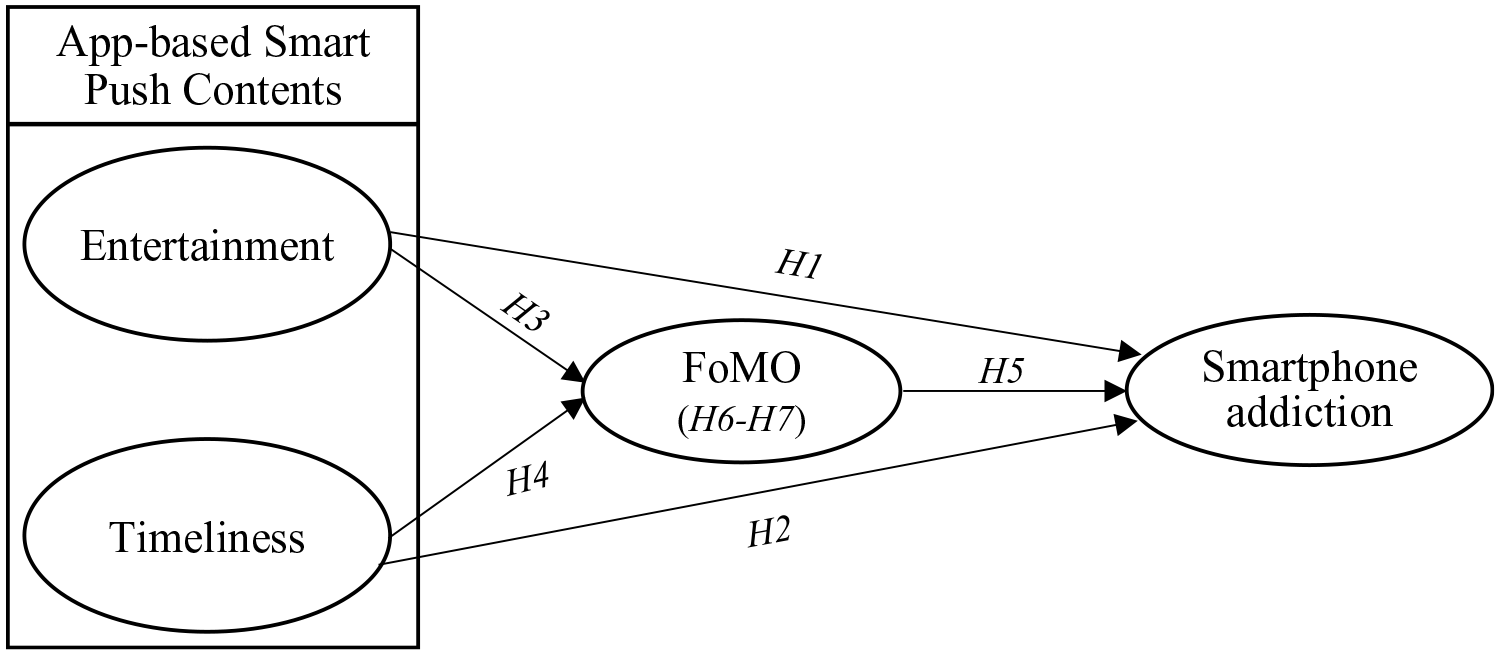
The conceptual framework.
Method
Measurements
The questionnaire was developed including two parts. Part 1 was related to demographic profiles (gender, age, education, and hours spent on Smartphone apps per day), and part 2 was used to seek data on entertainment, timeliness, FoMO, and smartphone addiction. All items of part 2 for measuring the constructs were borrowed from past literature and adapted to suit this study. A 7-point Likert-type scale, ranging from 1 = “Strongly Disagree” to 7 = “Strongly Agree” was used for all items. Specifically, the entertainment of the app’s smart push content was measured via a three-item scale that was adopted by Xue et al. (2020). The original scale of Xue et al. (2020) showed satisfactory reliability and validity (CR = 0.85; average variance extracted [AVE] = 0.65; Factor loadings are over 0.78). An example question in this study included “Smartphone-based applications often automatically push interesting content to me based on my preferences, attracting my continuous attention.” Timeliness of the app’s smart push content was measured through three items adapted from Filieri and McLeay (2014). The original scale of Filieri and McLeay (2014) had good reliability and validity (Cronbach’s α = 0.84; Factor loadings are over 0.74). An example of a question in this study is: “Smartphone-based applications always push the up-to-date contents to me automatically based on my preferences.” The original scale of FoMO was developed by Przybylski et al. (2013), based on which Q. Li et al. (2019) validated the Chinese version of the scale. This study slightly modified the scale to measure FoMO with 9 items. The original scale of Przybylski et al. (2013) exhibited reasonable reliability and validity (Cronbach’s α = 0.90) and Cronbach’s α of Q. Li et al. (2019)’s is 0.72. One example item in this study is “I get anxious when I don’t know what my friends are up to.” Finally, 10-item measures based on Kwon et al. (2014) were taken to capture respondents’ smartphone addiction proneness. The original scale of Kwon et al. (2014) indicated acceptable reliability and validity (Cronbach’s α = 0.91). Zhao et al.’s (2022) Chinese version of the smartphone addiction scale, which was modified according to Kwon et al.’s (2014) study, also showed good, but relatively lower internal consistency than the original scale (Cronbach’s α = 0.88). One example item in this study is “Feeling impatient and fretful when I am not holding my smartphone.” Considering that the respondents are Chinese, the back-translation technique was adopted to ensure the equivalent of measures between the Chinese version and the original English version. Before delivering the questionnaire to the respondents, the pilot test was conducted with a convenience sample of 30 smartphone app users. A small number of items were refined according to the results of the pilot test.
Sampling
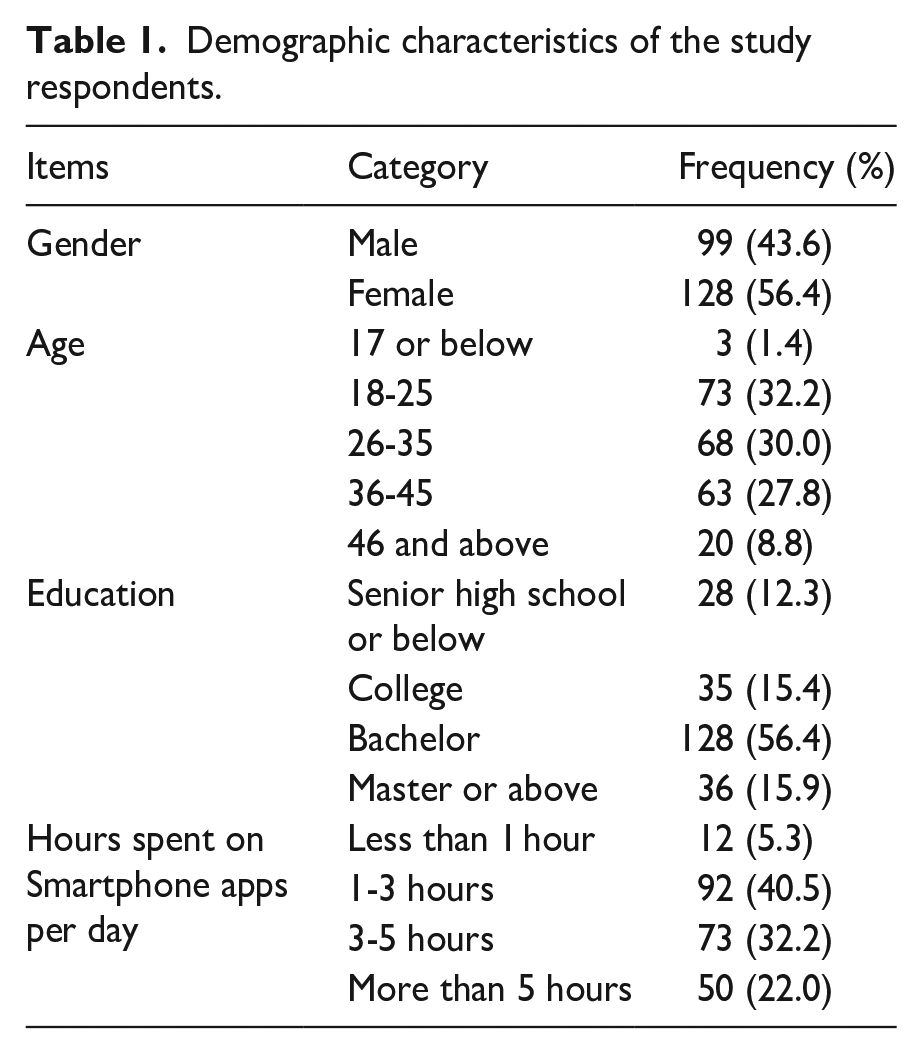
This study collected data through the Tencent Questionnaire system, which is an online-based survey platform and can push questionnaire links via QQ and WeChat since these two social media tools have hundreds of millions of active users in China (Huang et al., 2021). A nonprobability snowball sampling strategy was adopted in the data collection process, in which the invitation and survey link were sent to WeChat and QQ contacts, and participants who voluntarily responded to the survey were asked to forward the invitation to others in their WeChat and QQ networks. We mainly focused on users of smartphone apps in the Guangdong Province and Macao. To improve the representativeness of the sample, only respondents who had used at least one smartphone app were invited to attend the survey. The data collection lasted for one month, from the beginning of October to the end of October 2021. The initial response of 248 respondents was received; however, 21 obviously aberrant responses (all items have the same scores) were deleted and 227 valid responses were ultimately considered for further analysis. Of the 227 respondents, 56.4% (128 people) were female, 89.9% (204 people) were between 18 and 45 years old, and 56.4% (128 people) had a bachelor's degree. Approximately 54.2% of the respondents reported using Smartphone apps more than 3 hours/day. The respondents’ demographics were summarized in Table 1. The distribution of the data was tested by using the skewness and kurtosis coefficients. The values for skewness and kurtosis coefficients of all the observed variables were satisfactorily within the criteria of normality (3 for skewness and 10 for kurtosis) (Kline, 2015), showing the normality of data in this study.
Demographic characteristics of the study respondents.
Data analysis
In this study, we used partial least squares-structural equation modeling (PLS-SEM) to test the conceptual framework. In recent years, PLS-SEM has become a widely applied technique in many social science studies because it has some advantages compared to CB-SEM (covariance-based structural equation modeling) (Hair et al., 2019). Specifically, the former has a higher degree of statistical power than the latter, when dealing with a small sample size of less than 250 or non-normal data (Ringle et al., 2015; Willaby et al., 2015). In this study, we used the “10 times” rule for sample size in PLS analysis suggested by Kock and Hadaya (2018) to determine the minimum sample size, which requires the sample size should be greater than 10 times the maximum number of inner or outer model links pointing at any latent variable in the model. According to this rule, the sample size of 227 in this study surpasses the minimum sample size requirement for PLS-SEM analysis. In addition, PLS-SEM can implement concurrent analysis for both measurement and structural models, which is conducive to achieving more precise results (Alshurideh et al., 2023). Recently, Dash and Paul (2021) compared CB-SEM and PLS-SEM using a large sample size of normal data (N = 466) and concluded that both methods are efficient, while PLS-SEM provides more flexibility. Considering the above analysis, especially the sample size of this study, the PLS-SEM was performed by using SmartPLS 3.0 software.
Findings
The participants were 227 smartphone app users in China. For PLS-SEM, prior studies confirmed that a sample size of 100 is commonly an acceptable starting point (Chin, 2010; Hair et al., 2012; Rigdon, 2016; Willaby et al., 2015; Wong, 2013). Thus, the sample of this study reaches the sample size requirement of PLS-SEM. Based on the previous research (Elhai et al., 2020; H. Yang et al., 2021), which found gender differences in FoMO and problematic smartphone use, gender difference tests were performed for the variables in this study. We found that gender differences existed in smartphone addiction (p = 0.009), and males (4.03) scored significantly lower than females (4.60). The gender differences in the values of other variables were not significant. Thus, we controlled smartphone addiction for gender when performing SEM analysis.
Construct validity and reliability
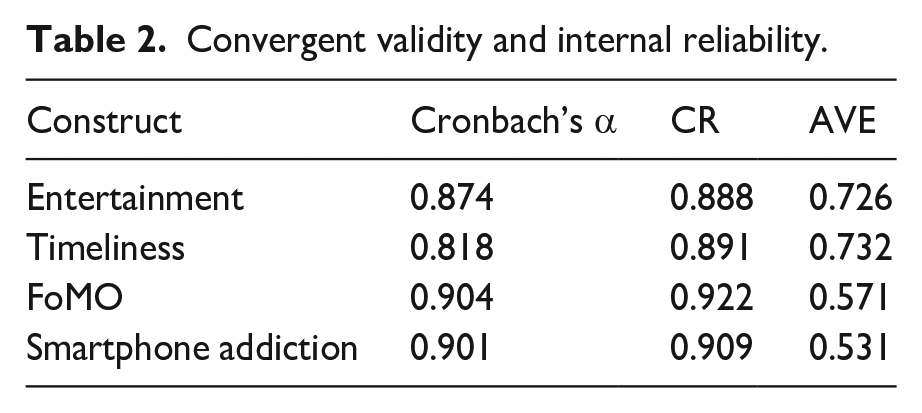
To evaluate the reliability of each construct, both Cronbach’s α and composite reliability (CR) were calculated. Table 2 shows that the Cronbach’s α value and CR value of each construct are above 0.7. The AVE value of each construct exceeded 0.5. These results showed that the internal consistency reliability is good enough. For discriminant validity of the constructs, the arithmetic square root of AVE values for all constructs is larger than the absolute correlations between these constructs. Thus, the discriminant validity of the constructs is confirmed. The above-mentioned results are shown in Tables 2 and 3.
Convergent validity and internal reliability.
Discriminant validity.
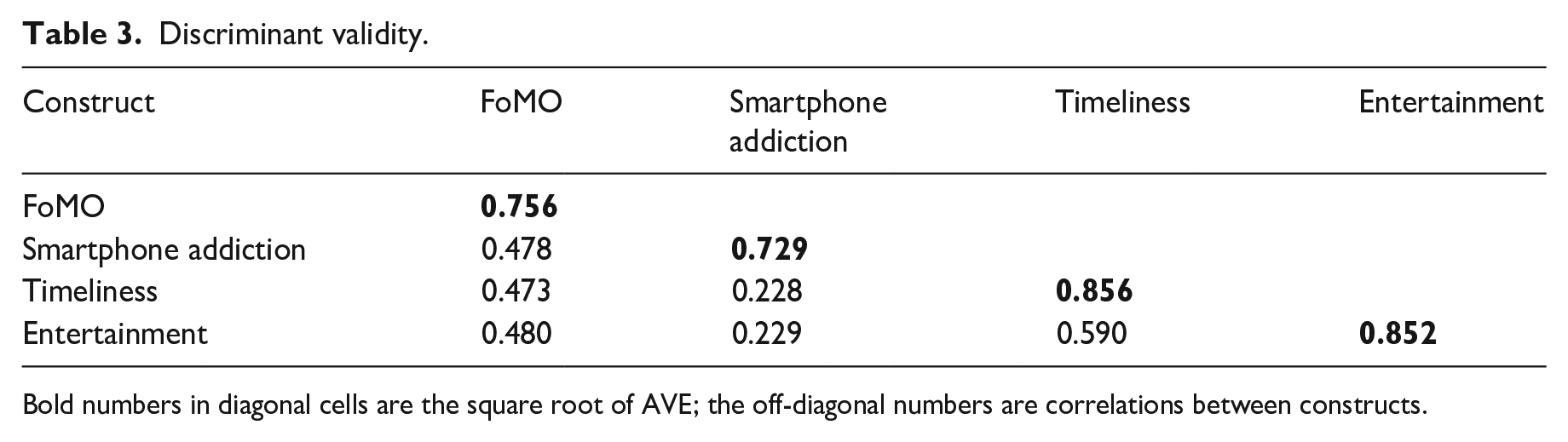
Bold numbers in diagonal cells are the square root of AVE; the off-diagonal numbers are correlations between constructs.
Structural model results
The direct relationships related to the hypotheses were tested first. The standardized path coefficients and p-values for our model in this study are shown in Table 4 and Figure 2. The findings indicated that both entertainment (β = 0.309, t = 3.419, p = 0.001) and timeliness (β = 0.291, t = 3.029, p = 0.002) were important antecedents of FoMO. Hence, H3 and H4 were supported. Furthermore, FoMO (β = 0.447, t = 5.595, p = 0.000) was positively related to smartphone addiction, supporting H5. However, the direct effects of entertainment and timeliness on smartphone addiction were not significant, therefore reject hypotheses H1 and H2.
Structural path analysis: direct effect.
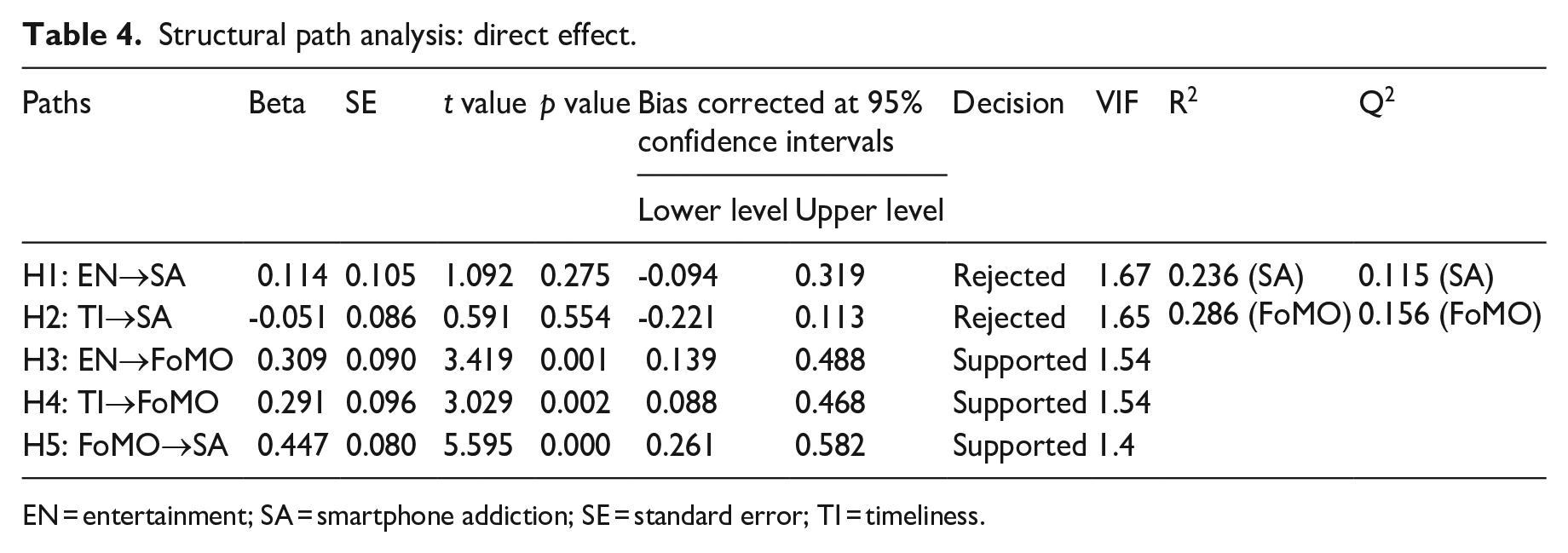
EN = entertainment; SA = smartphone addiction; SE = standard error; TI = timeliness.
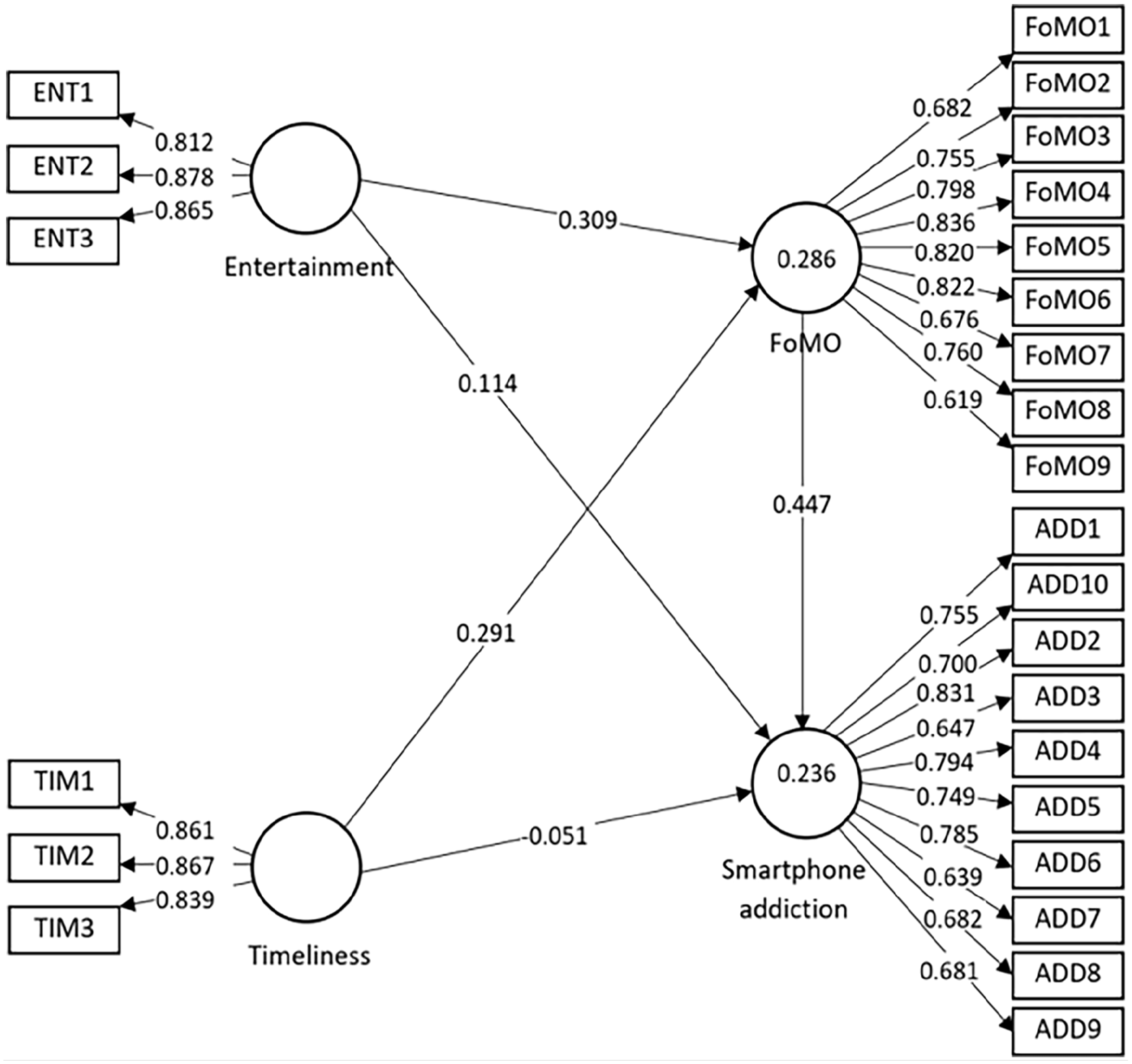
Structural model results.
Mediating effect test
To examine the mediation effect of FoMO, we used the bootstrapping method to generate 95% bias-corrected confidence intervals. The findings indicated that entertainment had specific indirect effect on smartphone addiction in the presence of FoMO (β = 0.138, LCL = 0.055, UCL = 0.248, p < 0.05). Thus, H6 was accepted. Similarly, timeliness had specific indirect effect on smartphone addiction through FoMO (β = 0.130, LCL = 0.039, UCL = 0.233, p < 0.05). Thus, H7 was supported. The mediation effect results were shown in Table 5. Since the total effects of entertainment (β = 0.253, t = 2.485, p = 0.013) and timeliness (β = 0.248, t = 3.078, p = 0.002) on smartphone addiction were both significant, and their direct effects on smartphone addiction were not significant when FoMO was added as a mediating variable, it can be ascertained that FoMO served as a full mediator.
Structural path analysis: the mediation effect of FoMO.
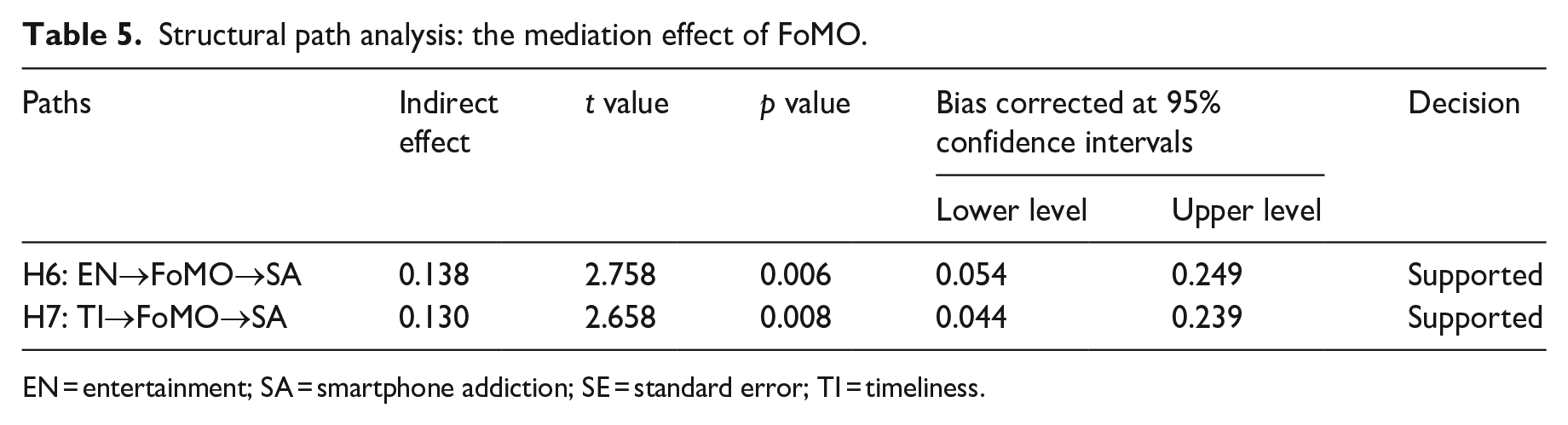
EN = entertainment; SA = smartphone addiction; SE = standard error; TI = timeliness.
Assessment of the structural model
To test the goodness of the structural model, we first used the VIF (variance inflation factors) to examine the multicollinearity. The results indicated that the largest value of VIF was 1.67, which was smaller than the suggested value of 3.0 (Hair et al., 2019), suggesting the collinearity was not a concern in the structural model. Second, R2 for smartphone addiction is 0.236 and for FoMO is 0.286, both were higher 0.1 (Hair et al., 2019), indicating a satisfactory explanatory power. Finally, Stone-Geisser’s Q2 value was computed to evaluate the model’s predictive relevance. As shown in Table 4, Q2 value of smartphone addiction is 0.115 and of FoMO is 0.156 for FoMO. Hair et al. (2019) argued that the values of Q2 larger than zero indicates the significant predictive power. Hence, the structural model’s predictive accuracy was not a concern.
Discussion
As smart push has been a practically essential function of smartphone-based apps, it is necessary to explore its impact on people’s behavior. Almost all existing studies focused on the positive effects of smart push function of smartphone app from the technical perspective (e.g., Bahadori et al., 2020; Buganza et al., 2015; Bush et al., 2019; Qu et al., 2017). Different from extant literature, this study tried to delve into the dark side of smart push of smartphone-based app by investigating how it affects smartphone addiction tendency.
According to the results of empirical analysis, we found that the entertainment aspect and the timeliness aspect of the app content delivered by smart push technology have no direct effect on smartphone addiction (H1 and H2). However, we found that the entertainment aspect and the timeliness aspect of the app content delivered by smart push technology are important predictors of FoMO (H3 and H4), and in turn, FoMO has a significantly impact on smartphone addiction (H5). For H6 and H7, we examined FoMO as a mediator between the features of the app content delivered by smart push technology and smartphone addiction. We found that FoMO plays a critical mediating role on the relation between both the entertainment as well as the timeliness of the app content delivered smart push technology and smartphone addiction, supporting H6 and H7. While several studies have stressed the significant effects of entertainment and timeliness elements on addictive behavior (e.g., Ezeonwumelu et al., 2021; Jeong et al., 2016; Shang et al., 2017; Zhao, 2021), which have not considered the mediating variables of entertainment and timeliness elements in relation to addictive behavior. As a result, the full mediating role played by FoMO between two features of smart push technology (entertainment and timeliness) and smartphone addiction is the most critical reason why H1 and H2 were not supported. Therefore, it is crucial to incorporate FoMO as a mediating variable to examine the impact of entertainment and timeliness elements of smart push technology on smartphone addiction in a more comprehensive manner. Although the effect of timeliness on addiction has been nearly untested empirically in existing research, the result of H1 in this study was consistent with the small number of previous studies that also found the direct effect of entertainment feature on addiction was insignificant (James et al., 2017; Zhao, 2021).
At the empirical level, our findings are consistent with previous studies. For example, the research of Servidio (2021) and Sever and Özdemir (2022) showed that entertainment variables are significantly correlated with smartphone users’ FoMO. An important characteristic of smart push is that the content that app users care about can be presented next to each other. If the contents are entertaining, it will stimulate people’s pursuit of pleasure. As a result, people may have a lot of anxiety about missing the access of the smart push content for entertaining themselves. Since a very few studies has empirically tested the relationship between content timeliness and FoMO (Clor-Proell et al., 2020; Müller et al., 2021), the result of our study contributes to confirm the assertion of some scholars that the real-time information flow can cause changes in people’s psychological state (Xie & Newhagen, 2014), and the abundance of information exceeds people’s information digesting capacity will induce negative emotional stresses (Sharma et al., 2023; Ye et al., 2022). Meanwhile, excessive timeliness of content pushing may cause information overload (Kaufhold et al., 2020), and attention deficit in the face of massive information (Bhatt, 2019) makes people anxious not only about dealing with existing app contents but also new contents pushed by app constantly, which will trigger an increase in the level of FoMO (Dalvi-Esfahani et al., 2019). In addition, the significant influence of FoMO on smartphone addiction tendency strengthen the results of existing studies (e.g., Coskun & Karayagız Muslu, 2019; L. Li et al., 2021; Wang et al., 2019), in which scholars consistently believe that FoMO is one of the remarkably critical influence factors of problematic digital technology use. Most importantly, this study confirmed the mediating role of FoMO between the features of the app content delivered by smart push technology and smartphone addiction. The results may be understood by the fact that FoMO is more often conceptualized as being linked to anxiety rather than depression (Elhai et al., 2020; Przybylski et al., 2013). Thus, the more entertaining contents received, the more anxious people could experience due to the desire for more entertainment. As Vorderer (2001, p. 250) stated that “Media users who feel entertained are more interested, more attentive, and therefore more eager to select, to follow, and to process the information given by a program than those who are not.” A person with high level of FoMO is prone to satisfy the desire to overcome their anxiety and depression of missing app contents by using smartphone, leading to a high probability of smartphone addiction. In this vein, our finding can provide support for existing studies, for example, Elhai et al. (2020) found that FoMO mediated the relationship between anxiety and problematic smartphone use severity. Responding to scholars’ view that smartphone addiction research is atheoretical (Billieux et al., 2015; Wu-Ouyang, 2022), the results in this study indicated that the SOR theory is applicable to be the theoretical foundation for exploring the underlying mechanism of smartphone addiction. Specifically, this study affirmed that the smart push functions of smartphone apps act as stimuli (S) that influence FoMO as an internal (psychological) state of app users (O), and further drive to smartphone addiction as behavioral respond (R), indicating a mediating mechanism of FoMO in this process.
Theoretical and practical implications
Our study sheds light on several valuable implications at both the theoretical and practical level. From a theoretical implication perspective, to our knowledge, this research is one of the first that focuses specifically on and examines in detail the relationship between the features of the app content delivered by smart push technology, FoMO and smartphone addiction. In particular, the foremost contribution of our study resides in the mediation role of FoMO in the association between entertainment/timeliness of app’s smart push content and smartphone addiction tendency. Although scholars argued that user-app interaction is closely related to smartphone addiction studies (e.g., Coskun & Karayagız Muslu, 2019; L. Li et al., 2021; Noë et al., 2019; Wang et al., 2019), we offered a more in-depth understanding of the relationships among the features of the app content delivered by smart push technology, FoMO and smartphone addiction tendency. As far as we know, this is the first study to explore the effect of FoMO in both the app’s smart push technology and smartphone addiction context. We identified that FoMO plays a mediating role not only in the relation between entertainment and smartphone addiction but also in the relation between timeliness and smartphone addiction. This finding stressed the significance of FoMO as an illustrative mechanism in the link between the smart push content characteristics and smartphone addiction and highlighted the value of exploring mediation models. Furthermore, the application of SOR model as the theoretical mechanism extends the academic understanding of smartphone addiction in the digital communication technologies context by revealing the association among smart push functions, FoMO, and smartphone addiction. Since this issue has rarely been addressed in existing literature, this study contributes to the literature on digital communication as well as smartphone addiction by filling this gap (Cain, 2018; Cha & Seo, 2018; Reinecke et al., 2022; Wohllebe, 2020).
Regarding practical implications, by investigating how the smart push technology of smartphone-based apps influences people’s smartphone addiction tendency, the results of this study call for attention to the negative side of smart push technology. All stakeholders including app developers, smartphone users, and policymakers can gain implications according to the findings. The world is entering an era of intelligence in which smart push technology is the new normal in many digital devices. It is vital to find the best balance between the benefits and negative effects of smart push technology. App developers should take social responsibility to use smart push technology more scientifically to avoid the negative effects by considering the push content characteristics. The government should also formulate policies and guidelines to regulate the behavior of app developers by clarifying the standards and specifications of app smart push technology. Given that smartphone users lack a deep understanding of the association between smart push technology and smartphone addiction tendency, it is necessary to take measures to educate smartphone users so that they can have healthy experience with app use.
Limitations and future research
A few limitations have to be recognized in our research. One limitation was that the participants were Chinese, the findings should be carefully generalized to different socio-demographic groups. In the future, we encourage researchers to verify our model using other cultural population groups. Another limitation concerns the features of app contents delivered by smart push technology. In this study, we only considered the effects of two features (entertainment and timeliness) of app contents delivered by smart push technology, entertainment and timeliness, future research could explore how other features related to smart push technology (for instance, credibility and accuracy) influence FoMO and smartphone addiction. Furthermore, future research also could investigate what smart push feature app users prefer and the reasons behind their preferences. Finally, this study only assessed the mediation mechanism of FoMO, while other diverse personal and psychological variables (e.g., self-control, personality traits) may also mediate the relationship between smart push technology and smartphone addiction. Thus, future scholars could extend the study by including other mediating variable to offer insight into the effects of app’s smart push technology.
Conclusion
In this study, we probed the negative effects of the smart push technology that is widely embedded in smartphone apps today. We found that the smart push technology does not directly drive smartphone addiction, but FoMO mediated the relationship between entertainment and timeliness of the smart push content and smartphone addiction. The findings suggest that the negative link between smart push technology and smartphone addiction is due to the underlying cyber psychological mechanism. Thus, we can claim that technology itself is neither good nor bad (Kranzberg, 1986), but the key lies in the people who use it.
