




Abstract
This article examines the role of media technology in determining preconstitutive enemies of the political order. To do so, it analyzes how discipline-specific methods of enemy detection, analysis, and neutralization correspond to different media environments. Media have a diagnostic and prescriptive significance: not only do they locate enemies that conform to their own unique standards of measurement, they also offer reprogramming resources that accentuate their own peculiar biases and capacities. Episodes in the history of biology and psychology are examined for evidence of this media logic.
Media make enemies. Media find enemies. Media fix enemies.
In the history of the human and social sciences, disciplines have repeatedly produced unique media-specific methods for analyzing and policing military threats and domestic enemies. Media technology plays an indispensable role in determining how we perceive and diagnose the “enemy within” (such as the terrorist, the criminal, the mentally insane, and other insider threats). As Friedrich Kittler (2012) puts it, “every media system has the enemies it produces” (p. 386), and as such, these media systems carve the parameters of our political legibility in such a way that new forms of enemy become visible—perhaps inevitably so (see Packer & Reeves, 2020, pp. 5–7). Just as microscopy introduced us to billions of new pathogenic enemies in our food, water, and air—and just as overseas drone surveillance introduces us to terrorists we never knew existed—media technology is a necessary and constitutive element in enemy detection and production. In the end, new media give us new enemies—and in the domestic political context, different media engender different “political immune systems” (Bratich, 2008, pp. 44–45), different ways of finding, fighting, and fixing terrorists, criminals, and other internal enemies of the political order.
These political immune systems accord with a particular “discourse network,” which media theorist Friedrich Kittler (1990) defines as “the network of technologies and institutions that allow a given culture to select, store, and produce relevant data” (p. 369). Through its unique capacities for selecting, storing, and producing relevant data (also see Burke, 1969, p. 59), a discourse network sets before us what is relevant: it reveals the truth of the world by ordering reality in accordance with its material interventions. It is obvious that these revelations play a crucial role in what we recognize as politics in its most fundamental sense: the determination of friends and enemies (see Schmitt, 2007); at the same time, by way of the discourse network’s instruments and institutions, these revelations also crystallize into disciplinary knowledge. These two concerns—the politics of friend/enemy determination, and the facticity of discipline-specific media technology—converge in human sciences research that aims at studying, diagnosing, identifying, and attempting to eliminate internal enemies of the state. These “preconstitutive enemies” (see Packer, 2007)—those enemies which, simultaneously internal and external to a political community, establish the bounds of inclusion, exclusion, and belonging—are determined by media technology, insofar as media intervene into our political and epistemological fields by (1) making certain objects and persons perceptible as enemies, and (2) presenting before us certain political methods as possible and appropriate for addressing these enemies.
Because these media-determined enemies are preconstitutive, they ensure that we live in a condition of incurable political “woundedness.” The result is what we, following scholars like Lisa Parks and Starosielski (2015) and John Durham Peters (2015), might call an “infrastructural woundedness”—a concealed yet essential political woundedness whose parameters are determined and made possible by media technology. From the microscope to the drone to contemporary mechanisms of National Security Agency (NSA) surveillance, media technology has a constitutive significance vis-à-vis this woundedness: all contemporary methods of threat detection and enemy analysis are media-dependent, and thus media determine the contours of the preconstitutive rupture that establishes the politics of belonging and exclusion (see Robertson, 2010; Silva, 2016). Media technology, accordingly, has a diagnostic and prescriptive function by arranging our social conditions and our political attention in such a way that they determine how we approach questions like the following: what is a wound, who is the wounder, and how we can imagine fighting back against such threats to health, social harmony, and wholeness? Ultimately, if political woundedness is an inevitable condition of living with media technology (see Stiegler, 1998, p. 193; cf. Foucault, 2003), these resolutions are constantly disrupted and refocused on new sites of enemy potentiality. In a word, if our political woundedness is preconstitutive, media provide the infrastructural conditions for that disorder.
To explore this problem, this article analyzes how the media/technological biases of the human sciences determine their theorizations and descriptions of an exemplary and inevitable political wound: the insider threat. It highlights how these media-based diagnostic procedures and prescriptions shape the epistemological and political contributions of the disciplines at hand. To do so, the article first explores the role of media technology in the human sciences. Then, it proceeds to apply these insights to historical and contemporary media-centric examples of how biology and psychology have diagnosed and attempted to neutralize the insider threat. We then reflect on what these historical lessons suggest about future strategies of addressing preconstitutive enemies with digital technologies of surveillance and correction.
Media technology and disciplinary knowledge
This infrastructural woundedness is embedded in disciplinary knowledge making. Different disciplines of knowledge, whose expertise is based on different media apparatuses, reflect these media-driven biases in their scientific approaches to finding, analyzing, and fixing enemies. For instance, since the nineteenth century, biology has been deployed by academics, police scientists, and military researchers to detect enemyship as a phenomenon that is located within the human body. Given the specifically immutable character of this biologically determined enemy, it calls for very specific modes of defensive engagement that, naturally, biology is equipped to provide. While this has given rise to methods for directly working on the species as a biological phenomenon (as in eugenics and less ominous health campaigns, for example), it has also centered on physically isolating the biological threat—imprisonment, in particular, provides an excellent means of separating threatening bodies, in their presumed contagiousness, from the law-abiding population. It is found that the biological enemy, which is best detected by media like photographs, fingerprints, electrocardiograms (ECGs), brain scans, prenatal screening, and other instruments of biological analysis, needs to be eliminated in a way suited to the biological—antiseptics, pharmaceuticals, exercise, surgery, confinement, detention, exclusion, dismemberment, decapitation, genocide, and so on.
Just as with the biological sciences, the social sciences have repeatedly produced media-specific methods for finding, classifying, analyzing, and engaging domestic enemies (radicals, terrorists, racial threats, etc.). Psychology, for example, has its own instruments of enemy detection and its own methods of enemy elimination: the polygraph, for example, is a means of locating the deeply concealed psychological truth of the potential enemy. The Rorschach test, the Luria–Nebraska Neuropsychological Battery, the Halstead–Reitan Neuropsychological Battery, IQ (intelligence quotient) tests, and other common media-based methods of psychological screening approach threat potentiality as a specifically psychological phenomenon that is best detected by the traditional methods of psychological diagnosis. Yet, once this enemy is detected, psychology does not specialize in biological forms of enemy engagement; while biological and psychological solutions to the enemy can be combined in various ways, particularly in penal and rehabilitative institutions, each has its own specific disciplinary commitments and methodological procedures. Therefore, while various modes of elimination and exclusion are specifically biological solutions to the enemy, psychology offers its own media-specific projects—such as psychotherapy, mass propaganda, and reeducation—that accord with the media biases of their detection methods and thus addresses themselves to the imagined malleability of the human psyche. So the story goes: enemyship expresses itself indelibly in the contours of the psyche. Hence, with good enough media technology, enemyship can be detected and, then, addressed through diverse strategies of psychological correction.
Enemies in the blood
Biology has long been a key engine of our political immune system, and it was one of the earliest disciplinary sites for carrying out insider threat detection and analysis. While the police force gained power and resources throughout the nineteenth century, its need for new knowledges and new instruments grew. As eugenics crept into most nooks of scientific inquiry, many scientific experts and community leaders argued that police authorities could address crime rates by linking citizens to vast surveillance databases filled with photographs, family genealogies, and life histories. These databases were in part aimed at providing authorities with a vast resource they could use to isolate the genesis, habits, and physical characteristics of Homo criminalis, the biologically determined criminal subject (Beirne, 1993). With the right technologies and procedures, it is argued that the source of this biological enemyship can be made visible and then subject to various regimes of biometric measurement, diagnosis, and discipline. According to this logic of “biocriminology” (Rafter et al., 2016), the traces of the enemy circulate within its blood; they are stored in its bones and its DNA; they are, if one looks closely enough, written on its face.
Best known for his work in establishing eugenics, Francis Galton was also a photography expert and the inventor of composite photography. For Galton (1878), composite photography could help highlight the essential characteristics of a given population group: “Having obtained drawings of photography of several persons alike in most respects, but differing in minor details, what sure method is there of extracting the typical characteristics from them?” (p. 97). This process of “extracting the typical” was used to theorize the average physical characteristics of ideal and threatening populations. For one of his first experiments, Galton made a composite photograph of several murderers and violent thieves. According to him, this composite process smooths away the unique facial features of the individual offenders and discloses instead something essential about “the criminal”: in the composites, “The special villainous irregularities [of the individuals] have disappeared, and the common humanity that underlies them has prevailed. They represent, not the criminal, but the man who is liable to fall into crime” (Galton, 1878, pp. 97–98). Galton’s composite photography was designed to shift the plane of enemy intelligibility: while each individual photograph reveals the superficial visibility of a criminal, the composite locates a threat potentiality that lies beyond the level of immediate visibility—something that is only detectable with the collection, storage, comparison, and synthesis of other archived photographs (see Sekula, 1992). The size and shape of one’s facial features, one’s weight, one’s height—one’s biological makeup, as analyzable through the photograph and related technologies of measurement and capture—revealed an abundance of information about one’s potential to threaten the social order (cf. Siegel, 2014, pp. 206–207).
This early experiment in eugenic science was fueled and determined by the biases and affordances of its media environment. Its diagnosis of deep, dysgenic sociopolitical wounds was only rendered possible by police photography and the prodigious archives that accompanied it. This branch of eugenic science thus reflected and fueled a whole biometric eugenics apparatus that sought to discover and analyze the specifically biological conditions of the insider threat: the race science of the early twentieth century, in particular, thrived on measuring and classifying individuals according to racial and class types (and then, of course, assessing their threat to the social body accordingly; see Pick, 1993, pp. 75–87). The biological understanding of enmity forwarded by eugenics, therefore, was founded on a media-specific logic of enemy identification. Its primary method of representation, photography, was accompanied by an entire apparatus of measurement, storage, and analysis—including calipers, ink pens, rulers, gauges, and file cabinets (Morris-Reich, 2016, pp. 34–84; Reeves & Packer, 2013). Located within this media environment, the photograph takes on a specific representational function—its significance is always deferred, always figural, in that it succeeds only in continuously circulating the physiological essence of the criminal. The individual represented in the photograph disappears; the photograph, just like all the anonymous files surrounding it, discloses nothing but Homo criminalis. It carries with it every scoundrel in the history of humankind. The enemy in the photograph, therefore, is a speculative enemy—the enemy as sign, as spectrum, as endless circulation of the natural born killer (see Figure 1).
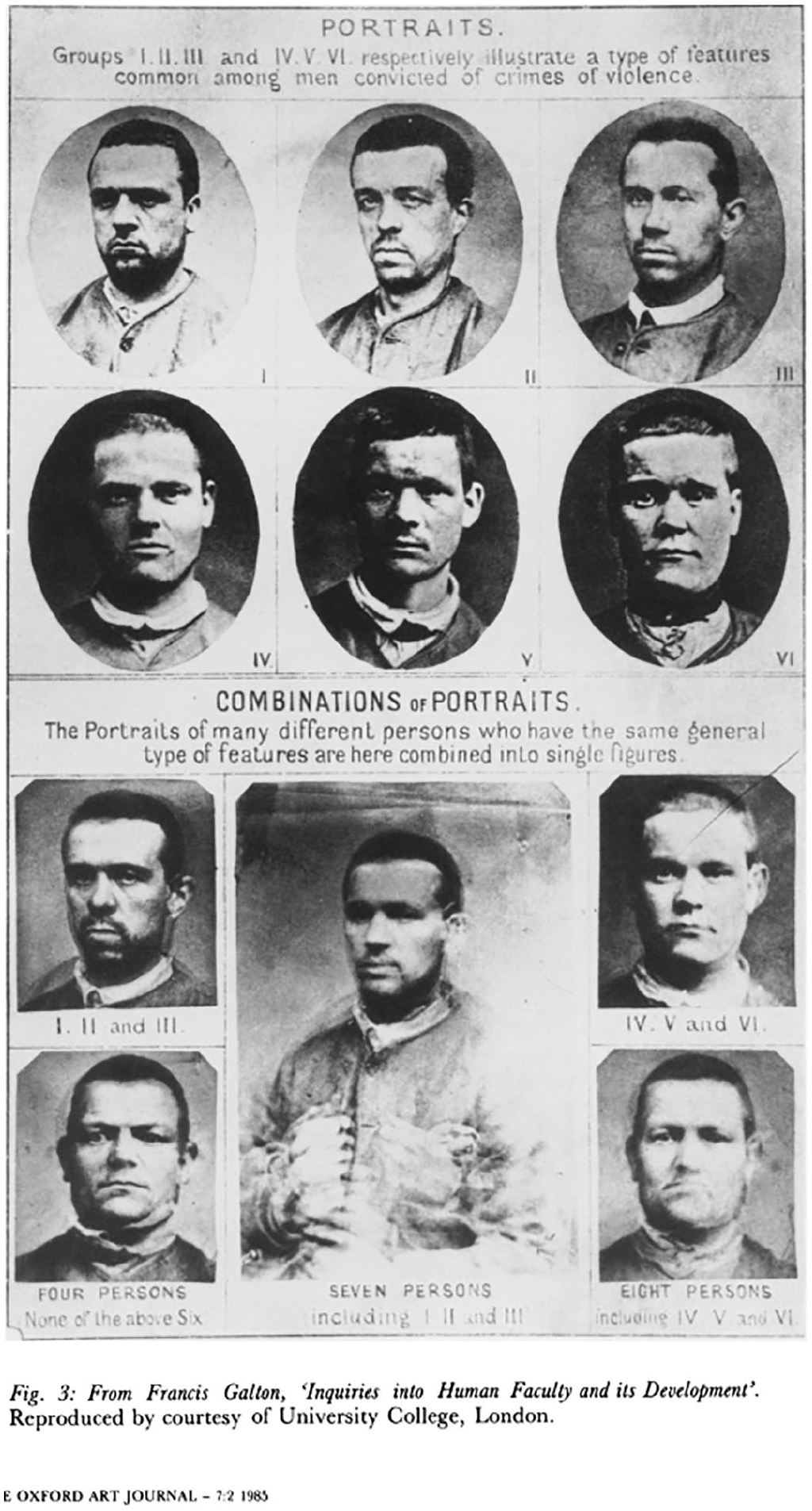
Galton provides a photographic composite of the violent Homo criminalis. (Green, 1984, p. 7).
With computerization, however, these biometric technologies’ main function shifts from the speculative to the investigative. At that point, the photograph becomes more than just a sign filed away in a stack of other redundant signs. While fingerprints have been gathered and stored by police departments since the early twentieth century, predigital fingerprint analysis was extremely difficult and painstaking, not to mention worthless in most investigations. But with the formation of computerized databases in the 1980s and 1990s, biological data came to comprise the very backbone of criminal identification (Magnet, 2011, pp. 51–68). Computerized biometrics became a media-specific form of threat analysis that allowed for the transformation of biological traces and body representations into easily processable data. Unlike the composite photograph, the systems of classification specific to computerized biometrics did not search for the general in the particular; instead, they sought to capture the molecular biological peculiarities of the individual. This individual no longer signified “the murderer”; the murderer, who had lost its photographic essence, could only be discovered by the vast accumulation of biological data about the guilty (as well as the innocent). The human biomachine, which oozes a never-ending data stream from its orifices and pores, was constantly compelled to testify—a 0 or a 1, guilty or not guilty.
Intensive media (those used to make legible the inside of a body) open subjects up to friend–enemy assessment and draw into the realm of analyzable data an ever-growing temporal frame (see Murray, 2009, pp. 69–87). Dangerous data are “flagged,” cross-referenced, and acted upon. Civilizational affiliation, family lineage, religious genealogy, and cultural heritage are brutish markers of enemyship. Slightly more refined media are used to build lifelong data sets for tracking changes in attitudes, beliefs, political affiliations, infirmities, access to weapons, and proximity to ideological contagion. Fine-tuned media measure changes in bodily function (brain waves, perspiration, breathing patterns, muscular ticks, eye-movement, body temperature) not immediately accessible to human perception, and are indicative of more immediate threats. These fine-tuned threat detection practices, of course, have served an important function in foreign U.S. war zones like Afghanistan, where local populations are subjected to various forms of biological analysis—like fingerprint impressions, iris scans, tissue sample analysis (Gorman, 2011), even gait evaluation (Boyd & Little, 2005)—and then compared with biometrics-enabled watchlists (Center for Army Lessons Learned, 2011). For the U.S. Army, mapping “the human terrain” (González, 2008) is an essential step in fighting the internal enemy by analyzing each encountered person and classifying them, according to threat databases, as friend or foe. These same methods of analysis, especially under the guise of facial recognition, are being deployed against the domestic insider threat (Gates, 2011); indeed, half of all U.S. adults are stored in the Federal Bureau of Investigation’s (FBI) facial recognition database (McLaughlin, 2016). This vast human terrain derives its investigatory potential from the presumed permanence and stability of the features captured. In a word, digital biometric analyses do not rely on waist sizes, but on those less malleable elements of the human terrain such as the iris signature and facial structure. This enemy cannot be captured in a composite; it is a media-determined enemy, an enemy deprived of its community and placed within a family tree of incurable delinquents. The biological enemy produced by computerized biometrics is, moreover, a whole enemy. Its traces do not gesture toward other criminals, insurgents, or terrorists, but only toward its own indivisible identity. It circulates in an unmistakable digital monism. Even if the terrorist cuts off its own thumb or gouges out its own eye, it still remains a terrorist. That is why the biologically determined enemy, whose intelligibility is media-determined, must be detected and removed from circulation. It must be taken out of the data stream.
Enemies in the head
The psychologically determined threat, on the contrary, introduces different considerations. Psychological analysis has always in one way or another been driven by the methodological conditions made allowable by media. As Friedrich Kittler (1999) explained, the phonograph was central to Freud’s development of psychoanalysis and his “talking cure” (p. 141). When the U.S. military earnestly turned toward psychology during World War I, it used psychological profiling as part of its newly implemented Selective Service process. In addition to assessing the psychological well-being of potential soldiers, the military carried out a particularly infamous set of intelligence tests, Army Alpha and Army Beta, on more than a million of their own draftees to locate mental capacity and deficiency. In point of fact, it could be argued that American involvement in the Great War also had a profound effect on legitimating the foundering young discipline, as it produced the first significantly large psychological database from which broad societal generalizations begin to be made (Samelson, 1977). Furthermore, the use of the Hollerith Tabulating machine to compute large quantities of data and store these data on punch cards had a broad set of ramifications for how many different forms of variable analysis could be run. Mental “deficiency” within the draftee population was generalized to the broader population. Army Alpha and Army Beta were spearheaded by Harvard psychologist and eugenicist Robert Yerkes, who used his research on soldiers to substantiate such claims as “no one of us as a citizen can afford to ignore the menace of race deterioration” (see Tucker, 1996, p. 82; also see Richards, 2003). We can think of this in terms laid out by Foucault (2003) in which the “race” war works to cleanse the internal population of the “unfit” while also legitimating attempts to characterize the national claims for warfare by understanding the other—the fascist, the communist, the terrorist, and so on.—as psychologically deficient, unfit, and “dangerous.” With this merging of military and domestic aims, psychology found increasing legitimacy for its capacity to assess individuals and populations during this period, in large part because of its supposed success in the war effort. The workings of the unconscious came to be seen as something that demanded excavation; with the right media technology, its secrets could be unearthed in order to provide immense political and military value. As Galison and Packer (2016) have pointed out, the Rorschach test was conceived of and promoted in media-centric terms: it was said to offer an “X-ray of the soul” (Johnson, 2012), thus providing a clear mediation of the previously invisible unconscious. For Rorschach (1942), his test was a key technology of “psychodiagnostics,” and it was given such epistemological credence that it was eventually used to test Nazi war criminals at the Nuremberg Trials.
This X-ray approach to the psyche was palpable in the work of many of Rorschach’s colleagues who joined him in diagnosing the psychology of the internal threat. In fact, probing the psychology of fascism and communism became a decades-long cottage industry during the 1930s. Wilhelm Reich’s (1933) The Mass Psychology of Fascism was the most famous of these works, and it described the rise of fascism and Bolshevism as both resulting from the same psychological impulses and a latent openness to authoritarianism (see Deleuze & Guattari, 1983, pp. 29–30). Reich applied a media-tinged hermeneutics to this situation: for him, political will is a psychological phenomenon that, like a chalkboard, is always open to erasure. Psychological manipulation can directly lead to individuals, and more importantly “the masses,” being led to act against their own interests (ala Marxist critique) by potent symbols that are transmitted via radio and related mass media technology. For Reich, the swastika is one such talisman which was used to manipulate the unconscious by writing itself directly onto the psyche. The human psychological condition, for Reich, is a media construction—a tabula rasa that can be easily overwritten, or a screen on which newer, brighter images can be projected. This media hermeneutic was adopted by many U.S. psychological professionals in the postwar period, when psychologists were deployed to root out overt communists and latent communist tendencies. Andrew Stouffer, the eminent U.S. psychologist who produced an authoritative examination of the psychology of war—the four-volume text Studies in Social Psychology in World War II: The American Soldier—would eventually direct his expertise toward examining the broader national character for its susceptibility to communism and extremism (Stouffer, 1965). Following in the footsteps of Reich and other predecessors, Stouffer questioned confrontational methods of reeducation in favor of a surreptitious psychological training. His interview transcripts and rudimentary statistical data set the population before researchers as a stable and manipulable collection of characters; these characters, by their very ontological status as media objects, then begged to be addressed with the tabula rasa model of mass psychology (see Reeves, 2020, pp. 36–37).
As the Cold War heated up, psychology used new media technologies to re-center its focus on the dangerous individual, focusing especially on the potential Soviet spy or Communist sympathizer. Polygraph machines, which were imagined to compel subjects to “speak the truth” of their treason, became prominent features of Red Scare and House Un-American Activities Committee (HUAC) interrogations. More elaborate schemes for applying the field’s knowledge to the problem of truth-telling involved LSD (lysergic acid diethylamide), hypnosis, and various modes of psychological torture. During this era, a host of media were applied in the realm of counterespionage to test citizens’ adherence to U.S. doctrine. The lie detector, for example, was widely used during the Red Scare to diagnose “pinko” delusions (Alder, 2007, pp. 215–228). At this time, too, a great deal of work was done by the Central Intelligence Agency (CIA) and its global competitors to elaborate new forms of psychological warfare. For instance, during the early 1950s, the field of psychology was invested in studying and elaborating new means for carrying out menticide, described by its Dutch American theorizer as a psychological intervention “in which a powerful tyrant synthetically injects his own words and thoughts into the minds and mouths of the victims he plays to destroy”; because of how thoroughly it subverts one’s consciousness, it is “more deadly than lethal weapons” (see Derksen, 2017, p. 143). Following the Second World War, menticide was seen as a legitimate end goal of psychological practice and was promoted as a military strategy of utmost importance (Robin, 2001, pp. 163–172). In occupied Europe, the tabula rasa model of mass media projection and the intensive, individual-centered model of media-centered interrogation dominated the imagination of this overtly politicized corner of the psychological discipline. And these trends, of course, have only evolved according to our radically new media environment during the Global War on Terror. As a number of psychologists have aided the war effort by delving into the psychological vulnerability of the terrorist (see especially Bjorgo & Horgan, 2009, Horgan, 2009, 2014), they have come to realize that a new war demands a new psychology, and a new psychology demands new media (see Schuurman & Eijkman, 2015)—such as global positioning system (GPS)-based mobility tracking and web-based de-radicalization programs. The supposed ubiquity of the terrorist threat accords with these new enemy surveillance methods and the corresponding galactic reach of our technologies of psychological reform, such as those headed by corporate–military partnerships like Defense Advanced Research Projects Agency’s (DARPA) Quantitative Crisis Response Team and Google’s data-driven Jigsaw initiative.
Conclusion
This article has approached “the wound,” this special issue’s cohering theme, as a constitutive phenomenon of life with media. It has explored the media dependence of our woundedness, analyzing how common disciplinary methods of diagnosing and addressing social and political wounds are inextricably bound up with media technology. This phenomenon has a political and an epistemological dimension, as media technology determines what is intelligible as a problem; then, it also imposes a facticity onto our political imaginations, informing and limiting our range of possible responses to that problem. This has applied both at the level of individual diagnosis and correction, as well to “mass” strategies of population analysis and collective social engineering. Delving into this history of media-dependent wound production helps clarify the media-dependent nature of our current malaise, calling on us to interrogate our assumptions about what our wounds are, how they should be addressed, and why we seem so inexorably inclined to find wounds that need to be healed by contemporary, media-centric methods of political regulation.
Biology and psychology, of course, are not the only sites in which this media-determined battle rages. Appropriate to the moment, meta-disciplinary scientific analysis has found the enemy—and its solution—in “the network.” The network is more than just a battlespace—it is imagined to be the cause and the solution to the current crisis in enemy identification, and, at the same time, it is said to exhibit unique criminogenic qualities, most importantly “complex globalmicrostructures” (Taylor, 2015, p. 98). Arquilla and Ronfeldt (1996)—along with Galloway and Thacker (2007)—suggest that netpower and netpolitics operate in asymmetrical ways. Yet, they also operate in a recursive fashion. According to its own logic, the network produces the enemy of the network, which then produces a network solution to that enemy. Accordingly, media technology ensures the wound’s perpetual existence. Given this recursive media logic, these strategies of political regulation, of course, will only escalate. And with emerging technologies of detection and cultural governance, we are the threat and the experiment. Every piece of a human is a potential indicator of their enemyness: every human churned out by media correction is still a potential threat, no matter how remote. The algorithm is incessantly searching to commit menticide on all becoming-enemies—constantly experimenting, slowly turning them into a becoming-friend. Its search-and-salvation mission will continuously create new becomings and potentialities in an endless loop. As the CIA (1956) concluded in a Cold War report on Soviet political subversion, the cycle of enemy creation “repeats endlessly and automatically even though this endlessly repeated action can never produce a solution.” Ultimately, there is no solution to the insider threat. But where there are media, there must be a solution.
Footnotes
Acknowledgements
The authors thank the Oregon State University Center for the Humanities for supporting this research.
