




Abstract
This article takes an ecocritical approach that challenges the urban imaginary informing the notion of place and the identity of inhabitants in mainland China. It explores an alternative mode of imagination, symbolized by the flow and instability of water. The work of documentary filmmaker Dong Jun and renowned writer Su Tong can be seen as attempts to evaluate and revisit history and memories through a reconnection with water, whether it be the Yellow River in Dong Jun’s Flood or the river/water world in Su Tong’s The Boat to Redemption. Instead of commenting directly on the destruction of nature as a result of human development and cultural upheaval, both works use water as an indirect means to raise these issues.
Keywords
Introduction
The scholarly analyses of nature and the non-human world that became popular in the West in the 1980s have evolved into the wide-ranging discipline of ecocriticism. Ecocriticism’s popularity continues to grow in response to the destruction wrought in the name of development. While ecocritical paths lead in several directions, one fruitful line of inquiry has focused on the ways literature and other art forms help to record, capture, and reflect on the unequal relations between humans and non-humans, and the exponential damage to the environment resulting from climate change, and natural and anthropogenic disasters. Ecocritical studies also analyze the reception of art works dealing with environmental issues, gauge the effectiveness of various media in exposing the problems of the Age of Anthropocene, and attempt to illuminate our interdependence with the natural and non-human world. The scope of ecocritical discussions is often expanded by cross-referencing other cultural contexts or various forms of art productions. The degree to which cultures outside of the West can contribute to ecocritical scholarship and influence art is an interesting topic to pursue. The Chinese traditional belief that “heaven and human beings are one,” for example, has clear ecocritical implications that could lead to fruitful new perspectives.
In the midst of the multitude of ecocritical debates on the subjects of climate change, the squandering of natural resources, and the dire consequences of urbanization, this article will focus on one specific resource—water—as a way of connecting the many perspectives on the relationship between nature and identity formation in the context of China. Water is a prime resource that has been critical to the growth of the Chinese empire. Water is both a cultural symbol that signifies a prosperous agrarian culture and a potential threat due to China’s history of flooding. To mitigate the threats posed by water, humans have attempted to exert control over nature (e.g. by constructing dams to redirect the flow of water). Water redirection projects such as megadams have also been recently perceived as nation-building enterprises that draw attention to political and economic prowess of the nation. According to Andrew Mertha (2008/2010), “Over the centuries, flooding was a key indicator that the emperor had squandered the Mandate of Heaven” (p. 1). As a symbol, too, water is vital to the social development and nation-building of the PRC. The development of hydro power and its associated infrastructure has been the focus of attention both positive (the economic opportunities) and negative (the destruction of the environment) (Hvistendahl, 2008). Compared to the heated socio-political debates, cultural discussions are less focused on the trope of water. One suspects the most familiar trope in the cultural imagination is the binary between yellow river and the blue ocean represented in TV series River Elegy (He Shang 河殤, 1988–1989). Yet given the significance of water-related social and political interventions, it is important to look at attempts to appropriate water tropes in the artistic and cultural realm. This article offers perspectives on water, apart from its functional and instrumental dimensions, and its role as a means for writers and filmmakers to express their concerns about the current state of the relationship between Chinese society and nature.
This article reflects on the urban imaginary informing the notion of place and the identity of inhabitants in mainland China. It explores an alternative mode of national imagination, symbolized by the flow and instability of water. The work of documentary filmmaker Dong Jun 董鈞 and renowned writer Su Tong 蘇童 can be seen as attempts to evaluate and revisit history and memories through the medium of water, whether it be the Yellow River in Tsiang & Dong’s (2008) Flood (Dashui大水,) or the river/water world in Su’s (2009/2010) The Boat to Redemption (He’an河岸, hereafter Boat). Instead of commenting directly on the destruction of nature as a result of human development and cultural upheaval, both works use water as an indirect means to question human dependence on natural resources and the ways in which identities are shaped and modified by the ebb and flow of history. Along with the progress of human history, nature also flows. Hegemonic ideology, urban discourse, and capitalist logic inform the way Chinese societies are imagined in these two works, but Flood and Boat also represent attempts to debunk the urban and rural myths that have continued to haunt the living.
This article examines the intersections and interactions of nature and culture as portrayed in the works of Su Tong and Dong Jun. Produced within a short time of each other (Flood in 2008 and Boat in 2009), these two works can be perceived as responding to growing concerns about water management and state power and reflecting on the conditions of everyday life. While different in form and style, both works use water as a symbolic trope to explore the cultural memories linked to nature. The two works serve different purposes and offer different satisfactions, but in both cases water is shown to shape social reality and its representation. In the case of Su, a widely read author of works that rely on mythic backgrounds and motifs, the new focus on water in his work invites analysis. Water serves as a main character in Boat: it is a means to revisit the history of the Cultural Revolution and also to rewrite history from a more metaphorical perspective. While Boat explores the cultural connotations of water, Flood reveals the buried truth behind the nation-building construction of megadams. The documentary serves as powerful critique of technological advancement and its relationship to national power. The failure of these dams exposes the fleeting nature of national pride and its spectral haunting of the everyday lives of the people. With shared concerns but different artistic approaches, both works suggest that human actions are embodied in nature and shaped by water. They articulate a kind of ethical ecology that infuses the material world with the moral consequences of historical events. Focusing on the waterscapes—the actual places and represented landscapes in the documentary and novel—this article examines the impact of water on the construction of Chinese identity. The waterscape represents a new mode of inquiry into the interconnectedness of nature and identity. Nature is a medium on which individuals project their feelings regarding the land and their cultural lineage, and their frustration with the dominant ideology, which often insists on the necessity of urban development.
Boat and Flood both attempt to connect body, memory, and nature. For Su Tong, nature forms part of history: the rise and fall of a town, even the tribulations of national history, are strongly connected to the movement of flow and the underlying implication of uncertainty embodied by water. Refusing to celebrating human power or the urban infrastructures that disregard nature’s force, the novel presents the story of a person who depends on the flow of water and follows the cycle of seasons to best appreciate the opportunities provided by nature. Nature is integral to the formation of identity of the diasporic characters in the novel. While Boat highlights the intertwined role of nature and humanity in terms of survival and meaning-making processes, Flood goes further, maintaining that attempts to interfere with nature inevitably lead to utter destruction. Human arrogance is at the root of efforts to stop and challenge water; the consequent damage is, therefore, manmade, not natural. The documentary relies on memories, which call into question the great visions of national power based on the human sacrifice involved in endless construction. Its effects often rely not on the presence of people, the embodiments of memory, but on their absence: the empty spaces surrounding the megadams reveal the nihilistic effects of the destruction of a village and its history. Studies of China’s water crisis show that the construction of dams “upset the ecological balance and caused resources to dwindle” (Ma, 2004, p. x). While Boat and Flood both address the implications of China’s water projects, the former stresses the interconnection of humans and nature, and the latter, their mutual destruction.
Independent cinema was chosen as the focus of this discussion because mainstream cinema rarely deals with environmental problems per se. With its wide range of subject matter and history of critiquing government’s close relation with big business, independent cinema has become a platform for critical thoughts and reflections. Nature has always been the avenue through which Chinese artists, poets, and painters channel their emotions, personal ideals, and political beliefs (Cahill, 1977; Sullivan, 1962). While Dong shares many of the concerns of earlier independent filmmakers in mainland China, Taiwan, and Hong Kong (who dealt with socio-cultural developments from a wider perspective), his work draws inspiration from the more personal and experimental use of the medium typical of the sixth generation of filmmakers such as Wang Bing, Jia Zhangke, and Hu Jie (Berry, Lu, & Rofel, 2010; Lin & Sang, 2012; Zhang & Zito, 2015). The choice to concentrate on small and mundane aspects of life unites many young Chinese filmmakers, who have seen their works widely circulated in film festival circuits. As Harry Harootunian (1999) points out in his seminal writings on Japanese modernity, smallness—the portrayal of little daily events—can be a historic optic through which bigger social issues can be registered. The focus on the quotidian in Flood is an example of smallness: ordinary daily events can expose the ways that power and control are embodied in social practices and that the human body can be perceived as “weapon of domestication and disciplination and of identification, subjection, and resistance” (Wolputte, 2004, p. 254).
This article explores the ways in which the imaginaries of water help us to reflect on the personal and the historical in Chinese-language films and literature. How do the experimental cinematic techniques used by the filmmakers provide a unique poetics of cinema that connects us with nature? Can we see a trend in independent films and avant-garde literature to recognize the personal and the socio-historical? If so, will this trend foster conditions for a stronger sense of environmental awareness?
Bodies, memories, redemption
With the novel Boat, Su Tong won the Man Asia Literary Prize in 2009. His was a major voice in the avant-garde literary scene in China between the mid-1980s and the 1990s. Experimentation, rather than literary content or ideology, was the dominant influence on Chinese literature in the 1990s. According to critic Liu Kang (2002),
The Chinese avant-gardists detested political radicalism and were ambivalent about aesthetic radicalism as well. Eventually, they were compelled to abandon radical and subversive modes. Unlike its western European counterparts (at least the French avant-garde group associated with Tel quel), the Chinese avant-garde showed a strong sense of ambiguity and ambivalence over politics and radicalism. (p. 97)
The avant-garde movement inspired the rise of a new wave of novelists in China, among whom Su Tong has a prominent place (Liu, 2002, p. 96).
Su Tong’s novels cover a wide range of subjects: a fictional empire, Empress Wu Zhao of the Tang dynasty, adolescence in communist China, and a family’s rural legacy. His works have captured the world’s attention by probing the sexual and psychological aspects of everyday life in a highly imaginative and shocking fashion. The southern province that figures in Su Tong’s works represents an allegorical time and space. His portrayal of the countryside and the fate of the peasants has led to the characterization of his work as “nostalgic realistic” (Liu, 2002, p. 103). It is often through dichotomies—countryside versus city, landlord versus peasant, man versus woman—that new narratives emerge that demand a more complex understanding of the past and create a more polyphonic arena of cultural production.
In the late 1980s and early 1990s, as China entered a period in which the evolution of commerce became the standard version of national history, revisiting the rural past became a means of effecting a larger cultural-ideological repositioning. The Cultural Revolution is often portrayed in literature and films, which ensure that the general public and the ruling parties will not forget the wounds of that period. Lu Jie (2001) observes that the Chinese urban fiction popular in the nineties emphasized “an urban/rural dichotomy, in which there is a profound distrust of the city. Indeed, this antiurban psychological complex can be traced to Mao’s revolutionary legacy—and even further back to China’s agrarian cultural tradition” (Lu, 2001, p. 108). In Boat, land as a topographical site has become ridiculed and challenged. The search for roots that characterized the literature in China in the 1980s marked a quest for “authentic Chinese culture” in hopes of rebuilding a Chinese cultural tradition (p. 122). In Boat, the image of roots has been replaced by water, representing a new cultural perspective. This perspective challenges the historical trajectory of Chinese tradition and its stable identity rooted in land, and replaces it with fluid, mobile, and marginalized water imagery. It questions the feverish search for roots that has characterized the period since the Cultural Revolution and provides an alternative vision of nature. The depiction of the river and the portrayal of both the benefits and threats of water force us to reconsider the relationship between nature and humanity that has been obscured in an increasingly urban and market-driven China.
The use of water as a site of contested signification allows us to perceive water not merely as one fold of the world (as mere representation of its physical status) (Mi, 2009, p. 19) but as a mobile and fluid source of national identity. This use of water is closely associated with references to the human body and, by extension, the national body. For philosophers such as M. Merleau-Ponty, “body should not be considered as an object but as the subject—the existential ground—of culture and the latter should be studied by focusing on embodiment” (Wolputte, 2004, p. 257). In a similar way, major cultural, social, and political changes are etched on the bodies of Su’s characters, and readers are invited to witness their agency, subversion, and vulnerability in their lives following the flow of water to places where they have not visited, and also to survive in the adoption to the nature’s cycle. History must be read not as anthropogenic achievement but as a flow that shapes and reshapes the world.
Boat is set during the Cultural Revolution. Ku Wenxue, reputedly the orphaned son of the legendary revolutionary martyr Deng Shaoxiang, is a powerful party official. It is believed that his mother was hanged by the enemies of the communists during the civil war before Mao’s victory in 1949, leaving behind a baby son with a fish birthmark on his backside. When the baby grew up, famed for his lineage and his birthmark, he became a powerful presence in Milltown, a smallish village on a river. But doubts grew about the authenticity of his origins, which he himself had never questioned. After many other boys and men flaunted similar birthmarks, he was disgraced. Further shamed by the exposure of his extramarital affairs, he castrates himself and starts a new life on a barge fleet among a group of ostracized boat people, taking his teenaged son, Dongliang, with him.
The novel is narrated by Dongliang and follows his coming of age on the water. Nicknamed Kong Pi (“empty fart”) by the townspeople, Dongliang belongs to neither the boat people nor those on land. It is only when an orphan named Huixian is adopted by the boat people that Dongliang finds an anchor for his otherwise floating life. Dongliang falls in love with Huixian and begins a decade-long, hopeless obsession with a girl who has lived a similarly rootless life between the land and the boat. Eventually, fate seems to favor Huixian, allowing her a place on land, while Dongliang returns to the boat only to witness his father disappearing into the river with the martyr’s memorial stone.
As is the case in many other novels of Su Tong, the single-minded persistence of revolutionary fervor during the Cultural Revolution is translated into erotic desire, which is intertwined with the hatred fostered by a history of long-term suppression. Ku Wenxue’s castration and Dongliang’s obsession reflect the gestures people make when confronted with the brutal forces of Chinese history.
In referring to “waterscapes” in this article, I am using the suffix “-scape” in the sense described in Arjun Appadurai’s (1996) Modernity at Large. Appadurai argues that in the new global cultural processes, our imagination functions as a “social practice” (p. 31). Our imagined sense of self and our relationship to others is no longer a mere fantasy or elitist creation but “an organized field of social practices, a form of work (in the sense of both labor and culturally organized practice), and a form of negotiation between sites of agency” (p. 31). For Appadurai, the new global economy can no longer be understood in terms of any pre-existing economic models; it has to be understood as necessarily irregular, constantly changing, and very complex. He recommends the use of suffix “-scape” to acknowledge this change. Even though this article does not deal with the international activities described in Modernity at Large, it adopts the notion of “-scape” to highlight the perspectival constructs of water, which are inflected by historical, social, and cultural positioning across time. There are many literary examples of the recurrent use of water as important motif and agent. In the novel The Hungry Tide, for example, the renowned Indian writer Amitav Gosh uses the image of water as “a way to steer clear of taking a moral or ideological stand while addressing the complex struggle between humans and animals for survival” (Anand, 2008, p. 23). My use of the term “waterscape” includes both water’s physical existence as part of the world we inhabit and its imaginary, which has shaped the collective memory.
In Boat, the imaginary world of the river is depicted as the “abject” of the official history. Julia Kristeva (1982) uses the term “abject” to describe something that
has only one quality of the object—that of being opposed to I. If the object, however, through its opposition, settles me within the fragile texture of a desire for meaning, which, as a matter of fact, makes me ceaselessly and infinitely homologous to it. (pp. 1–2)
“Abject” is a contradictory term because it suggests both the connection to and the refusal of the dominant power. On one hand, the river depicted in the novel signifies the continuation of the revolutionary legacy. The offspring of the “Revolution Martyr” is saved and raised by the river:
Water carried Deng Shaoxiang’s legacy downriver, floating from wave to wave. People on the bank who ran after the nearly new basket spotted a clump of water grasses, like a tow rope, carrying the basket along in fits and starts, disappearing and reappearing, as if warning off anyone who might try to catch it. (2010, pp. 15–16)
On the other hand, the river drags the younger generation under the waves of a stormy sea of hopelessness. After Ku Wenxue’s status as a Revolution Martyr’s son is challenged, he and Dongliang (or Kong Pi) have no option but to leave the land and lead a life that has no return. At the beginning of the novel, the narrator comments laconically,
Most people live on dry land, in houses. But my father and I live on a barge. Nothing surprising about that, since we are boat people; the terra firma does not belong to us. (p. 1) So I had to choose. Two sets of inauspicious gifts were arrayed before me. One was Father and a barge, the other was Mother and dry land. There was no way out, I had to choose one over the other. I chose Father … Like water that keeps flowing, or grass that keeps growing, there was no choice involved; it was all up to fate. My father’s fate was tied up with a martyr named Deng Shaoxiang, and mine was tied up with him. (p. 54)
This strong sense of destiny and fate forges a complex bond between generations that remains outside of the dominant political discourse. If one is considered illegitimate or outside the system, one’s identity is bound to be challenged and eradicated. Still, although they are outcasts of the Party, the boat people in Boat represent a world that still cherishes familial ties, love, and friendship. The crew members of Sunnyside barges are willing to adopt Huixian, who was abandoned by her mother in Milltown. The waterscape is not associated solely with the experience of exile of the boat people; instead, it hints at a larger phenomenon of displacement as a result of development. The waterscape, thus, represents a history that is often neglected yet that continues to express the heterogeneous voices that challenge the hegemonic discourse.
Topographical writing of the waterscape
The representation of a river can be perceived as a form of topographical writing—appropriating J Hillis Miller’s notion of “topography.” Miller notes the etymology of “topography”: “Greek word topos, place, with the Greek word graphein, to write” (Miller, 1995, p. 3). Etymologically, it means the writing of a place. He argues that “Topographical setting connects literary works to a specific historical and geographical time. This establishes a cultural and historical setting within which the action can take place” (pp. 6–7). Miller’s discussion implies that temporalities have to be understood as multiple: there are times that are anthropocentric and there are also times that are beyond the cognition that shapes our understanding of history and place. In Boat, time is both moving forward and stagnant. While Ku Wenxue cannot let go of his identity as the son of a martyr and is rooted in the past trauma of the Cultural Revolution, his son, Dongliang, like the Angel Novus of Paul Klee, is caught in the present, and, at the same time, is dragged into the future by the relentless march of progress. Sharing the uprootedness of Heidegger’s modern man, Dongliang and the boat people represent the identity crisis of the Chinese people who failed to form attachments to the land in the aftermath of national upheaval.
The topographical description of the river in Boat presents a nuanced reading of the relationship between humanity and nature. Unlike the “green discourses” that critique China’s environmental deterioration, novels and short stories examine how humans should “make friends with nature” to survive the ongoing ecological crises and achieve some semblance of harmony with the planet (Yang, 2012, p. 109). Su emphasizes the interdependence of nature and humanity. He rebels against the depredations resulting from national industrialization that consumed land resources and created an unprecedented environmental crisis, the gradual extinction of species, and the rise in epidemics. Describing the “hundred-year flood” created by the first petroleum pipeline in the Golden Sparrow River region, Su writes,
It was as if someone had ripped open a hole in the sky and let water stored up for a century come cascading down. As the river rose, the surrounding land receded abruptly. Floods began in the mountainous upper reaches and surged downriver, drowning river-side villages on their way. Land transportation came to a halt, leaving only waterways open. With water everywhere and as the Golden Sparrow River overflowed its banks, heroic qualities emerged. (pp. 120–121)
This roaring of nature seems to express outrage at China’s rapid reduction of forestry, lack of fresh water, and endangered wildlife. The novel reminds the public of the ecological deterioration across China. In this respect, Boat resembles other writings about nature in post-socialist China. Rather than directly condemning urban development, as Liu Qingbang 劉慶邦 does in Red Coal (Hongmei 紅煤, 2006), 1 some Chinese novels use stories to inspire the kind of profound self-questioning that is prompted by moral issues: “stories matter because they shape our values, inform our sense of our humanness, and by indirection shape our environmental behavior” (Yang, 2012, p. 112). Zhang Wei’s 張煒 A September Fable (Jiuyue yuyan九月寓言, 1993), for example, draws attention to the spirit of land that has been carelessly forfeited by humanity’s constant pursuit of economic development. Jia Pingwa’s 賈平凹, Memory of a Wolf (Huainian lang 懷念狼, 2007) and Jiang Rong’s 姜戎, Wolf Totem (Lang tuteng狼圖騰, 2004) call for the protection of wildlife by portraying the symbolic relationship between herdsmen and wolves. These Chinese writers remain focused on rebuilding harmony between humanity and nature, and espouse an ecological holism, which should inform all human behavior (Yang, 2012, p. 116).
Rather than following these attempts to unify nature and culture, Su Tong suggests nature possesses a kind of sublimity that cannot be appropriated. It lures. The waterscape in the novel is personified—it talks:
Come down, they were saying, come down. That was new, but what did it mean? Who was to come down? Was I supposed to somehow climb into the cans? I didn’t believe that was what the river was saying, so I ran to the starboard side, where the five cans had all come together and were saying, in a low but stern voice, Come down, come down. (p. 221)
As a child, Dongliang trusted the river because it was the only friend he could freely talk to. However, its stern voice also cost his father his life: Wenxue tied himself to the memorial stone of his mother and answered the call of the river. The blind obedience of his father, however, blocked the communication between the river and Dongliang:
The strange thing is, after he went down, the river stopped speaking to me. I spent three days in the river and on the boat, but it never spoke to me again, not once. Did the river see my father as a fish? He had disappeared into the water, but the river did not send me its condolences, nor did it offer me congratulations. (p. 472)
The blocked communication suggests that there is no easy coexistence of nature and culture. The topographical writing of the river does not tell us much about river; instead, it deals with the opening up of relationships and connections with the other. The novel ends with a sense of the world’s unfinished nature. The communication is blocked but the impact is made. The story will be told again and again, and the legend lives on.
The watery turn and its political significance
Su Tong draws on pre-existing connotations of water, part of the inherited stock of Chinese culture, but transforms them to reflect current attitudes toward its attraction, desire, vitality, and danger. The prevalence of images of water (rivers, seas, streams, etc.) in post-socialist texts is a phenomenon that requires explanation. In his work Water and Art (2010), David Clarke discusses the importance of the watery turn in contemporary art, observing that it is “in response to particular state ideologies and modernization policies, and may be read as offering a critical and even subversive engagement with them” (p. 216). Clarke’s discussion sheds light on the recent turn to nature as both subject matter and a means of framing the narrative. An example of a work of art that uses water as symbol of rebellion is Huang Yongping’s A History of Chinese Painting and A Concise History of Modern Painting Washed in a Washing Machine for Two Minutes (1987). Clarke points out that the painting is complex because
[a]llusion is made to time’s propensity for eroding or washing away historical memory, but washing can also imply purification or clarification and these latter conflicting meanings are also encouraged since one of the photos is of a Chinese researcher washing a skull recovered from the site of atrocity. (p. 223)
The prevention of drought and flooding remains a central concern to the PRC despite all that has changed in China during the era of market reforms (Ma, 2004; Wu & Zhang, 2017). The Three Gorges project is a prominent symbol of China’s progress and economic modernization,
which serves to sustain consent for one-party rule, to prevent widespread emergence of demands for an alternative, more democratic, conception of national development, and to launder China’s international reputation of the inconvenient stains of blood left by the repression of 1989. (Clarke, 2010, p. 228)
The new water barrier was presented as the modern equivalent of the world-renowned land barrier of pre-modern China. Much water-themed contemporary art in China can be best understood as a challenge to the state rhetoric concerning the control of water.
Another prominent example of a water-themed work of art is a series of oil paintings by Liu Xiaodong, entitled Three Gorges: Displaced Population, that focus on the mundane realities of the construction itself. The series undermines any clichés of seamless economic progress. Liu’s interest in representing the lived experience of individual migrant laborers results in art that is devoid of the heroic optimism that characterized Li Hua’s much earlier dam construction image Conquering the Yellow River. In the latter, “no sense of individual subjectivity is found, merely a swarm of worker bees cheerfully contributing to a collective goal” (Clarke, 2010, p. 229). The control of water is both symbolic and pragmatic. It reflects the Chinese government’s urge to control not only nature but also any form of “otherness,” and to achieve dominance both ideologically and practically. The references to nature and its power to enchant in the works of these contemporary Chinese artists and the novels of Su Tong contest the dominant official ideology.
Water stories that haunt
In the first edited volume to focus on ecocinema in China, Chinese Ecocinema: In the Age of Environmental Challenge (2009), Sheldon Lu maintains that “ecocinema is cinema with an ecological consciousness. It articulates the relationship of human beings to the physical environment, earth, nature, and animals from a biocentric, non-anthropocentric point of view” (p. 2). Lu’s discussion of the connection between nature and human beings draws attention to the inherent differences between the Euro-American and Chinese contexts and cautions readers to beware any uncritical transplantation of ecocritical paradigms. In the case of Boat and Flood, however, ecocritical approaches can be effectively employed to reflect on interconnectedness. Both works show how the symbolic meaning of cultural works can convey the influence of nature in shaping human history and biology. Su’s novel highlights the way nature shapes one’s bodily movement and hence one’s development through life. Cinema too has focused on our relationship with nature. Mi Jiayan (2009) argues that the depictions of water in Chinese film can be categorized according to three groups: those dealing with the shortage/scarcity of water, with the toxification of water, and with disruption of water (pp. 19–20). Flood represents an additional category, as it depicts the aftermath of dam construction.
This comparative study finds similarities and differences in the depiction of everyday life in a realistic context (Flood) and a fantastic context (Boat). Both present the Chinese people’s dependent relationship with water: the novel presents the floating life of diasporic people who move wherever the water takes them, while the documentary records the real human suffering that is the consequence of people’s desire to control nature. Dong’s work undermines the myth of the seamless economic progress of dam construction by exposing the economic, cultural, and social damages sustained in the name of development. When one compares the novel to the documentary, we can see how an issue can inspire both a fantastic allegory and a factual condemnation.
In Flood, Dong Jun uses waterscapes to explore the concepts of history, the self, and place. Watery imagery is used to address and negotiate memories, histories, and political agendas. By adopting water imagery rather than root imagery (which is more intimately connected to land in Chinese history), Dong develops a more fluid set of associations, beyond geographical constraints. Flood documents the myth of controlling water (through building dams) and its destructive consequences in history. Juxtaposing oral histories and images of nature devoid of human beings, Flood challenges Chinese history and myths.
In his discussion of the paradigm crisis in contemporary Chinese historiography, Arif Dirlik (1996) maintains that “The central event of the last decade is the repudiation in China of revolution in the name of modernization, or, stated differently, of socialist in the name of capitalist modernization” (p. 249). He continues,
While the modernization narrative persists in its culturalism, the cultural explanation is vastly different than in the past. Chinese culture, viewed in the immediate postwar years as an obstacle to modernization and somehow held responsible for Communism, has been converted now into some kind of progressive force that breathes new life into a capitalism plagued by contradictions. (p. 260)
The complex interrelatedness of cultural discourse and modernization discourse noted by Dirlik is illuminating in the context of Flood. For mainland audiences of popular culture, the blue ocean signifies the modern promise of “political liberty and neoliberalist market economy” (Lu & Mi, 2009, p. 6), in contrast to the backwardness represented by yellow earth and China’s river culture. Sheldon Lu notes that this representation of rivers was widely disseminated by the television series River Elegy. He draws attention to the effects of the anthropocentric desire to control the natural course of rivers through the construction of dams, which not only upset the balance of the ecosystem but also destroy communities and historical sites. Documentation of similar construction and destruction can be found in Flood: Dong shows the dangerous power of water and the arrogant presumption of humanity, and condemns the emptiness of both.
Water serves as a powerful metaphor in China’s cultural tradition. Although China has a long coastline, the Yellow River is the cradle of its civilization (Yang, 1993, p. 51). Chinese people respond to water with awe, and with fear because of the threat of flooding. Da Yu (大禹), a half-historical, half-mythical figure of Chinese folklore, dedicated his life to controlling floods. In Flood, the myth of Da Yu is rewritten for the modern times (Zhao, 1989). Mao’s campaigns placed people in direct opposition to nature: man had to conquer nature at all costs (Harrell, 2013; Shapiro, 2002). By drawing on the myth of Da Yu, Dong challenges the binary opposition of humanity and nature. Through images of overpowering water and the repeated use of extensive long shots, Dong creates an atmosphere that undermines the anthropocentric point of view. He also uses the personal stories of the survivors and inhabitants to challenge the official story of the conflict between the human and natural worlds.
The opening scenes of Flood establish the historical background. They remind the audience of China’s first large-scale economic development project in 1957, which led to the construction of Sanmen Gorge Dam 三門峽水電站. The dam used China’s natural resources to generate electricity and control the flood of Yellow River. From the outset, the audience is shown the irreparable damage that was done to historical sites, collective memories, agricultural ecology, and the hundreds of thousands of people whose livelihoods were sacrificed for the sake of this ambitious and destructive project.
Myth and memory are important elements of Flood. While the documentary’s Chinese title Da Shui (Big Water) is relatively neutral, the English title Flood has complex associations. On one hand, it refers to the ecological disasters and the destruction of natural and habitats that have threatened the Chinese people throughout history; on the other hand, it refers to the action of suffusing and filling. This latter meaning is particularly applicable to a film that conveys how myths are suffused by Chinese history. The myth of the threatening power of water is reinvented to justify human control. The specter of a flood prompts and legitimizes the anthropocentric will to control. By juxtaposing the aggrandizement of human effort (the myth of Da Yu’s taming of water) with the ruins of the Da Yu Temple as a result of the construction of Sanmen Gorge Dam, the documentary undermines the claims of human domination. Humanity’s limited power is in stark contrast to the long, ever-running Yellow River. The composition of a scene where humans appear as tiny dots in the foreground and the Yellow River dominates the middle and background (see Figure 1) bears witness to the presumption of the urban imaginary.
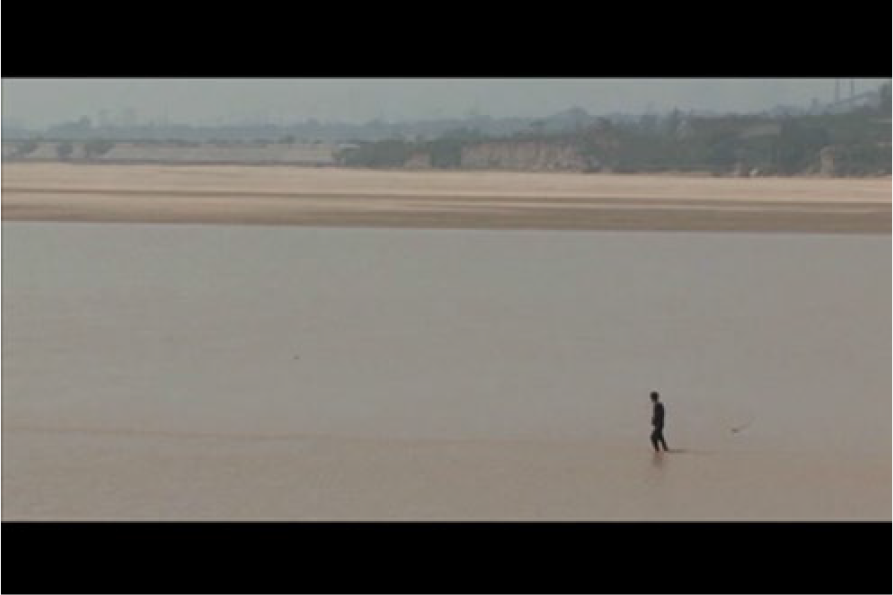
The opening shot of the Yellow River.
As the documentary unfolds, the audience learns more about the destruction caused by the creation of the Sanmen Gorge Dam, the first megadam in China. “Megadam” is a term used by Rob Nixon (2011) in his discussion of the politics of visibility in the struggles between world powers. Nixon maintains that megadams themselves are “a kind of national performance art” (p. 156) that projects a “nation’s outsize hopes” (p. 157). Flood does not have a narrator; instead, the audience is presented with interviews with survivors who were forced to leave their homes and live in dire circumstances because of the construction of the megadam. Weihe, an old ferry port where farmers could travel between one bank and the other, was completely destroyed by the construction of the dam. Villagers along the river bank were repeatedly relocated over a 40-year period, leading to the dissolution of extended families and communal lives. Tongguan Fort, a historical site that once signified the glorious period of Cao Cao, was demolished because it was believed that a flood would have ruined it. The prediction proved to be mistaken, and the site has been replaced by the Venice Hotel and Yellow River Fish Barbecue, destinations for non-existent tourists. The destructive effects of the megadam on human lives are shown in static shots that capture the immobile, ruined, and deserted spaces that dominate the landscape. Making mockery of the government posters on town halls proclaiming the dam’s success, the documentary shows us the desolation that undermines any notion of progress. The docents at the Da Yu Temple museum and the Tongguan Fort museum repeat scripts that recount the glorious past mechanically: that past has been irreparably lost. The drastic difference between the acoustic (the speech of the docents) and the visual (the pictures of desolation) underscores the consequences of human greed and desire.
The desolation and its withering of collective memories and communal lives are conveyed through personal accounts and also through scenes of emptiness and ruination (Figures 2 and 3). The camera invites the audience to look at the static objects, the deserted spaces, and the ironic presence of the glorifying party slogans. The constant struggle between nature and humanity has no easy solution.
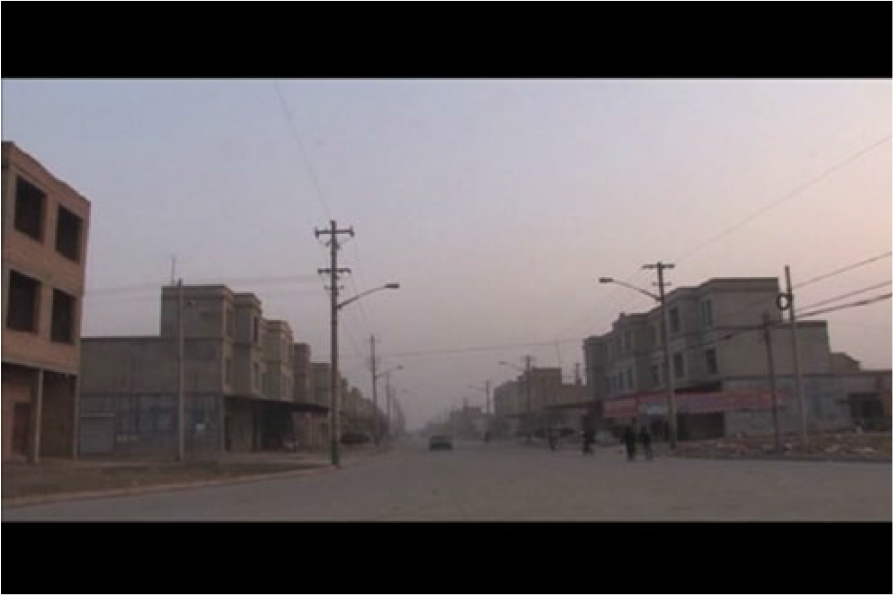
The empty space of Xinyu Village.
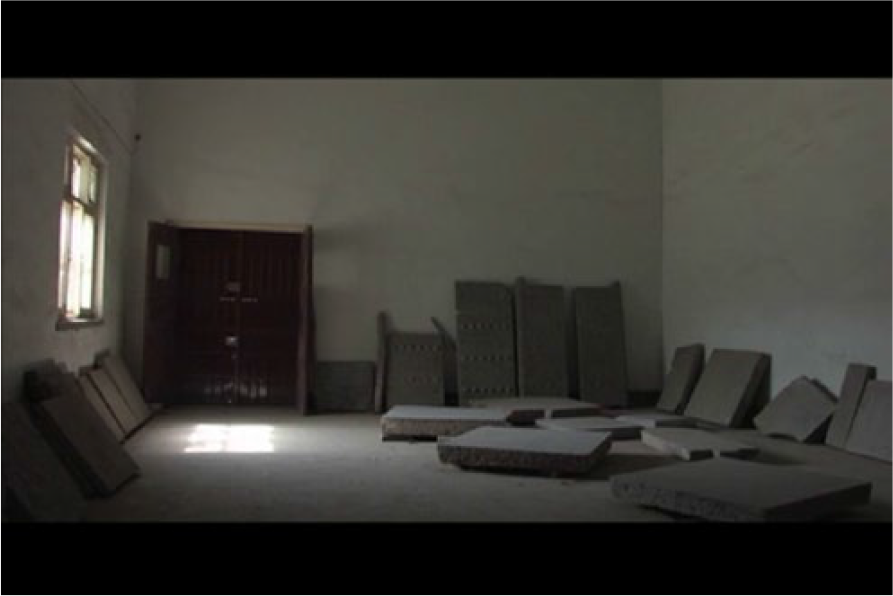
The ruins in the museum at Tongguan Fort.
The static and ruined objects are in stark contrast to the lively, flowing, undisturbed water images in the documentary. The waterscape evokes the power of nature and challenges the utilitarian mentality that is used to justify progress and anthropocentrism. The flow of the interviews can be perceived as replicating the flow of water. The narrative unfolds along the course of the Yellow River, from its origin through the many towns it passes, disclosing the stories of those who lived near its banks. The movement of the river is seen and heard in the interviews, reminding us of its continued presence and activity. This continuous activity is attuned to an undercurrent of human awareness, which challenges the myths of the post-socialist market economy.
In his discussion of water pathology in the new Chinese cinema, Mi Jiayan (2009) treats “water” as a verb and explores “its function as an ecological practice, a dynamic semiotic that mediates the formation of a complex network of political, social, and cultural identities” (p. 19). Mi’s “cognitive mapping” links water to topographical identity, but the constant presence of water in Flood suggests more strongly water’s chronological presence as a witness to historical trauma. The active flow and omnipresence of water highlight the necessity to abandon the anthropocentric view to see water’s potentiality. While Mi’s (2009) “green screen” raises concerns about contemporary environmental and ecological movements (p. 37), Flood endorses a more embedded relation with nature and water at both the imaginative and ecological levels. The refusal to make water into a spectacle by highlighting its destructive power or its fantastic display is a conscious departure from the common use of nature in cinema. Water cannot help but be viewed as a threat to the people, but human greed and desire are more to blame for the destruction of ecological habitats and communal lives.
The flow of water and its embodied power and liveliness are also portrayed in the works of a local poet, Ma Jianwen, featured in the documentary, who never stops reflecting on, writing about, and recording the grievances of the relocated immigrants. His choice of classical poetic forms 2 draws attention to his displacement as a writer and as a man in the modern world. His refusal to be silent can be linked to the unceasing activity of the water. Flood is not merely a condemnation of political irresponsibility and the dire consequences of the CCP’s political ambitions; it is also a portrait of the everyday struggles of the interviewees to re-establish a relationship with nature. Their feelings toward nature are neither reductive nor possessive. They seek a relationship that is fluid and lively and avoids the traps of stereotyping and condescension. Through the vivid representation of the flow and rhythm of water, Flood avoids the reification of nature and provides the audience with an alternative version of what water signifies in people’s lives. Water as lively matter is powerful and appealing; it helps people to understand their relationship with history and memories. If water signifies anything, it is not a cultural myth but the importance of having a channel through which one can reflect more profoundly on history and memories.
Conclusion
I see the waterscapes in Flood and The Boat to Redemption as a means of building a connection and inspiring new ways of thinking. The waterscapes in both texts are embodiments of social processes and political change. In Boat, the characters’ experience is entwined with the natural landscape they inhabit. From land to water, Dongliang’s body (and its mark) embodies ideological assumptions, discriminatory perceptions, and cultural practices that continue to change and evolve. The meaning of one’s corporeal existence is connected to, and dependent on, the natural environment one inhabits. The body houses a body of memories and is susceptible to the fluctuations of social, ideological, cultural, and economic systems. According to J Hillis Miller, “The writing of a novel, and the reading of it, participates in those activities. Novels themselves aid in making the landscape that they apparently presuppose as already made and finished” (Miller, 1995, p. 25). In a way, the waterscapes in the works discussed in this article are bridges that revive interest in supposedly static and finished landscapes, meanings, and habitats. Flood and Boat portray water as a means of reconnecting humans with nature and revealing their interdependency. The depictions of the waterscapes challenge the stagnancy of the dominant discourse. In both works, water bears witness to the massive displacement of Chinese people, but its unstoppable flowing energy also hints at the possibility of healing, assembling, and reviving communal ties at this critical stage of the Anthropocene.
The waterscape in Boat reflects new fluid narrative structures, where stories follow the path of crisscrossing currents (one, the story of a father and son; another, the story of the orphan Huixian). The waterscape is the central topos around which everything in the novel organizes itself. This configuration is open to interpretation both laterally, in relation to all the histories before and after the Cultural Revolution, and also vertically, in relation to the hidden emotions and political purges in all the layers piled one on top of another in Milltown.
In his refusal to present stark dichotomies, Dong’s Flood opens up the possibility of dialogue between myth and reality, the constructed and the imagined, and the country and the city. By demythologizing the urban imaginary and adopting the more fluid, unpredictable, and lively imaginary of the waterscape, his work offers a means of mending relationships with others and with the past. By challenging established myths, refusing to be reductive about the relationship between nature and human beings, and blending environmental concerns with broader socio-cultural histories, the critique of the dam construction represents a significant shift not only in the perception of water but also in the insights afforded by the developmental model.
As this article demonstrates, Su Tong and Dong Jun employ similar tactics. Both use water to oppose mainstream narratives: history in Flood; memories and desires in Boat. The intent of these two works is not only to promote environmental awareness: nature—water in this case—is used as a source of reflection and contemplation of alternatives. In and through water, these artists fight against the dominant narrative; in and through water imaginaries, they open up opportunities of thinking about nature differently—not as a standing reserve but as a powerful resource for reflection on socio-cultural matters. Both deliberately avoid taking a grand subject as their focus. They start with the trivial and the mundane. Flood and The Boat to Redemption are powerful because they show that the grand narratives are losing their momentum and sway; it is in our everyday experiences that we deal with the large global issues of climate change and cultural myths. These works provide the conditions for broad campaigns to raise awareness and promote the protection of the non-human world, but they also reveal that nature offers other trajectories that will educate us and deepen our human experience.
Footnotes
1.
The story offers a typical example of moral failing in rural China, portraying the ways that the protagonist chased fortune by any means, the twisted soul of humans, and the devastating environmental consequences of coal mining.
2.
The metrical pattern of classical Chinese poems usually consists of four or eight lines of five or seven words, each line set in accordance with strict tonal patterns.