




Abstract
After the earthquakes hit northeastern Japan and caused the catastrophic meltdowns at Fukushima on 11 March 2011, a large number of families chose not to relocate and are still living in contaminated areas. From the summer of 2011, Japan started a hoyo—health recovery camp which has been mainly aimed at helping people, especially children, to relieve the stress of their minds and bodies that have been affected by the radioactivity. This camp offers children therapeutic treatments by sending them for a few days to places that are out of the radioactive contamination zone. In the camp, a place with less pollution becomes the key link between the recovering person and the program, and the landscapes are therapeutic for the human body and mind. In this article, I focus on the health recovery camp as being a form of relocation and recuperation from a historical perspective and show how this camp provides a therapeutic landscape for healing. I consider the concept of therapeutic landscape which was developed by Wil Gesler in the early 1990s to be an insightful and effective approach for studying closely the process of healing in the nuclear pollution era, even though the cultural contexts of Gesler’s and the present study are very different. Working from a non-Western perspective and also from that of health recovery from radiation exposure, my study focuses on the interaction between health recovery camp participants and the natural, built, symbolic, and social factors which Gesler mentions as aspects of “healing environments.”
In the summer of 1914, Baba Elementary School in Kanazawa City of Ishikawa Prefecture of Japan started a morning mountain climbing program in order to improve students’ physical strength. After that, the school also started a school camp held in the woods. These programs were offered not only to regular school children but also to weak or mentally ill children. It was proven beyond doubt that all children, whether fit or weak or mentally challenged, made notable progress in their physical strength.
In the summer of 2011, after the Fukushima nuclear power plant accident, Japan started a relocation and recuperation program which has sent children who were radiation-affected for periods of time to places that are out of the radioactive contamination zone in order to help the children to dispel the cesium from their bodies and raise their immunity. In both cases, place has taken on an essential role of aiding in recuperation.
Both the programs held in 1914 and those at present have followed a key medical principle called hoyo (保養). In Japan, it means recuperation or preserving of health and the tradition dates back some 300 years and originated from the traditional Chinese health concept yangsheng (养生). When the word kenko (健康) came to be used to express the English word “health” in Japan, the term hoyo became less used. But the Fukushima nuclear disasters have brought new attention to the principle of hoyo. The incidents have also given this principle new implication.
In this article, I show how the hoyo health recovery camp of Japan provides a therapeutic landscape of healing in a historical context and explores the ways in which the physical landscape, the social environment, the built environment, and the symbolic environment contribute to healing and well-being, and how these four elements which Wil Gesler mentions as aspects of “healing environments” intertwine and interact to produce places which function as a healing landscapes and work for people suffering from the nuclear disaster.
Therapeutic landscapes
Wil Gesler (1993) was among the first scholars to propose the concept of Therapeutic Landscape in 1993. In the book Putting Health into Place, Kearns and Gesler (1998) point out how place involves an interactive link between social status and material conditions and can be used to interpret a range of situated health effects that imply a link between mind, body, and society. In his later work, Gesler (2003) proposes what he chooses to call a healing sense of place, the important aspects of healing include its multidimensional character; wholeness, connectedness, or integration; healing from within; an ongoing process with meaning in one’s everyday life. He points out it is necessary to examine four related and overlapping types of environments when dealing with the therapeutic landscapes: the natural, built, symbolic, and social environment.
Studies on the therapeutic nature of health camps for children in New Zealand by Kearns and Collins (2000) suggest that the “therapeutic landscape” idea developed by Gesler provides a useful framework to explain the development of camps as sites for enhancing child and family welfare. There are many similarities between the camps in New Zealand and the health recovery camp of Japan in the modern historical background. But at the same time, there are also many differences between them since their cultural contexts are very different. In particular, Japan’s health recovery camp is held for children who have been affected by radioactivity from nuclear disasters; a situation such as has not occurred anywhere else except in Chernobyl. So I will survey the history and current status of children’s health recovery camps in Japan and locate these sites within the theoretical context of therapeutic landscapes. In addition, I want to express concerns about how landscapes can in this case become therapeutic in dealing with the damage from nuclear disaster in this case.
For this purpose, I will review a documentary film produced in 2014 that was dedicated to Japanese people living in the post-meltdown world of Fukushima and analyze three health recovery places where I have conducted interviews with the organizers—one of which I visited for participatory observation. As Gesler and Kearns (2002) have written, every healing place tells its own story, and through examining the Japanese story of healing places, I aim to think about how to contribute to planetary healing in the era of health endangerment.
Little voices from Fukushima and Belarus
The Japanese documentary film produced in 2014 named Chiisaki koe no kanon (Little Voices from Fukushima) was dedicated to Japanese mothers and their children living in the post-meltdown world of the Fukushima Daiichi nuclear power plant disaster from December 2011 to August 2014. In the film, there is a diagram that shows the increase in the number of children suffering from thyroid cancer since 2008. In 2008, there were no such cases; but by 2014, the figure had jumped to 112. And the radioactivity affected not only Fukushima but also the neighboring prefectures such as Tochigi. This film described how the mothers and society at large in Japan were affected in their efforts to protect children from the pollution.
In this film, the main character, a mother named Sasaki, who is the wife of the head priest of a temple, is living in Nihonmatsu City of Fukushima (around 50 km from Fukushima Daiichi nuclear power plant). The Sasaki family did not evacuate and relocate to another place and they made a decision to live in their hometown with their whole family instead of getting separated from each other. She and her husband began the fight for their rights to keep their children safe from the effects of radiation. They were trying to find out how not to be exposed and how to continue in a healthy way.
In the course of telling Fukushima’s stories, this film also takes us to Belarus, where we learn from mothers who experienced the Chernobyl nuclear disaster in 1986. The people living in Belarus are still suffering the aftereffects of the Chernobyl nuclear disaster and still continue making efforts to deal with their exposure. This film shows how a pediatrician, who was the chair of a charity for children and also a single mother, raised children despite the aftereffects of the radiation. It gives a careful look at the ways that many families adjusted their lives when they were forced to evacuate. The pediatrician of Belarus talked to mothers in Japan on camera, saying that even though what Belarus has done might not apply fully in Japan’s case, there might yet be another scenario for adapting the responses to the needs of Japan, but it is necessary first just to take actions so that ordinary people can gain strong power in going through the process.
Responding to the pediatrician’s requests, Japanese mothers and citizens started to take actions and one of their actions—the hoyo health recovery camp—has been encouraged by the success of the Chernobyl treatment efforts. The Chernobyl treatment refers to the relocation of affected children for a 24-day stay at a site where there is a plentiful natural environment and the least pollution, where the children are given a clean and safe diet, and there are peaceful and nurturing physical and mental environments to help the children reduce their internal radioactivity levels and strengthen their immunity. According to the pediatricians of the Chernobyl Children’s Fund, because the children living in the contaminated sites are physically weak, it is significant that the 24-day rest period can reduce 25% to 30% of their internal radioactivity levels and can raise their immunity (Kamanaka, 2014).
The hoyo health recovery camp is conducted in Japan by Japanese Nonprofit Organizations (NPOs) and Nongovernmental Organizations (NGOs), which are said to have learned from Belarus. Although most of the organizers of this program are civilians, it has been difficult for management to collect sufficient money donations to enable long-term stays at the camp. Therefore, this health recovery camp in Japan offers much shorter periods than the 24-day program in Belarus.
We can say that the health recovery camp is learning from Belarus, but it is important to realize that there was a tradition for promoting children’s health in the Taisho period in Japan some 100 years ago and we can also trace the roots of this tradition to health literature of the Edo period in Japan, dating back some 300 years. The original scenario for treatment of the Fukushima children—similar to what the pediatrician of Belarus pointed out more recently—already existed in Japan. The time has come to recall it and re-energize it. The functions of place and social support play important roles in the traditional recuperation and also in the recuperation in the contemporary pollution era.
From roots to blooms: the role of hoyo in the past three centuries
Hoyo is a term used to explain the idea of “nurturing life” in Japan that reaches back 300 years to the Edo era. The term is often used to explain a wellness-recovery treatment based on traditional Japanese health preservation—yojo (養生), which came from the traditional Chinese health principle of yangsheng (养生). The nurturing life principles of yojo characterized Japanese health culture until the Meiji era (1868–1912).
The yojo culture of the Edo period brought about not only the publication and popularity of health-related books but also the founding of free public medical institutions such as the koishikawa yojo facility. It was located in a place that was high and had dry climate conditions that would weaken disease infections, and also serves as a haven that would be an ideal place for evacuation when fires approached (Ando, 2005). During the Taisho era (1912–1926), as a substitution for the yojo facility, the institution of hoyo facilities was developed. Especially in Kyoto and Kanazawa, there were many more cases of mental illness recuperation than in other provinces (Kan, 1937). The two cities both set the facilities apart from the center of the town because the facilities took in mainly sick people with problems such as mental disease, Hansen’s disease, and tuberculosis (Kobayashi, 1974; Nakamura, 2013).
A little before that time, tuberculosis prevention had become important in Japan since the trend of epidemics had expanded from outbreaks of the acute infectious disease cholera to those of the chronic infectious disease tuberculosis, around 1900. And unfortunately Ishikawa Prefecture had the highest mortality rate due to tuberculosis since this area provided many laborers who went to the big cities. Kanazawa is the prefectural capital of Ishikawa, and in 1930, the tuberculosis mortality rate in Kanazawa ranked No. 1 in Japan (Kobayashi, 2000). The Meiji government rushed to develop prosperity and military strength, so it feared social dysfunctions, including reduced working ability caused by infectious diseases. So at that time in order to prevent the spread of tuberculosis, the task of strengthening the weak and making their bodies healthy was seen as the most important thing for Japan (Kano, 2001). In this situation, events aimed at getting frail children into a good natural environment to improve their physical condition were held in various parts of Japan. Kanazawa was especially keen about it. The Baba Elementary School’s activity was an outstanding example.
In the summer of 1914, Baba Elementary School in Kanazawa started a hoyo program of morning mountain climbing in order to improve students’ physical strength. The location, Mount Utatsu, lies to the northeast of the Asano River, which is one of the main rivers of Kanazawa. It is about 1 km from Baba Elementary School to Mount Utatsu, and it takes almost 15 minutes to cover the distance on foot. Later, from 1916, the Baba School also started a school camp held in the woods for regular school children, and from 1917, they also provided their programs for weak children and for those with mental illness, allowing them to spend nights at the home. The camp included “early-rising and excursion” and “river swimming education,” and the school found that both the regular school children and the weak and mentally ill children increased their weight and girth (Kanazawa Baba Elementary School, 1921; Nakamura, 2015). Because of these magnificent results, in 1922 the Ishikawa branch of the Japan Red Cross also held a 20-day summer children’s hoyo camp just for weak children and it obtained a similarly successful result (Japan Red Cross, 1922; Nakamura, 2015).
From the end of the Meiji era, summer camps like the one in Kanazawa became active and various names were used for them—not just hoyo. Since in the Meiji period, with Japan opening the country to foreigners, a lot of words about health that were used in Western medicine were translated into Japanese and they came into general use. Among the several names that became used for children’s health recovery camps, “rinkan gakko” (林間学校), which were open-air school modeled on the feline colonies of Germany, were introduced to Japan and they spread widely after 1907 (Watanabe, 2005). Japan learned the method from Germany at first and used it with the aim of improving children’s weak bodies, but later the aims went far beyond health care and extended to other educational values, from around 1924 (Noguchi, 2010).
In the case of these facilities of 100 years ago, we cannot just simply say their ideals were borrowed from foreign cultures; rather, the homegrown parts and those learned from foreign countries were intertwined and interacted to produce the Japanese style recuperation. Also, these types of places functioned as healing and working landscapes for people living in that period. Today, once again, such an interactive healing process is being used for people who are suffering from nuclear disaster.
Putting recuperation back into the place—scenario for Fukushima
In this section, based on the interview of the health recovery camp organizers in September 2016 and participatory observation of the camp place in September 2017, I would like to clarify the healing function of hoyo in the contemporary pollution era, with reference to the place and the efforts of the common people.
The health recovery camp for Fukushima children is established at sites which are far away from the children’s homes. The main criterion for making the choices of the sites is that of having a natural environment where there is very little pollution. The camp place I visited was located in Komoro City of Nagano Prefecture, which is about 260 km from the Fukushima nuclear power plant. It was also established as an interaction place for bringing together people from cities and farming villages. It has been supported by a non-profit organization and a local private organization since 2011. They call the place an “eco-village” (Figure 1). The location is at the foot of Mount Asama, which is about 15 minutes from Komoro City station by car. In the eco-village, the organizers provide spaces to practice and learn sustainable lifestyles in order to let children get back to the origins of food, clothing, and housing by way of growing or producing them with their own hands. They try to create an exciting and relaxing space where everyone can have an actual experience, learn things, and relax. In the eco-village buildings, one can see fields, a kitchen space, a gymnasium, an open-air concert hall, a yurt, a straw hut, a playground, and small shops. But these buildings were not constructed by the organizers.
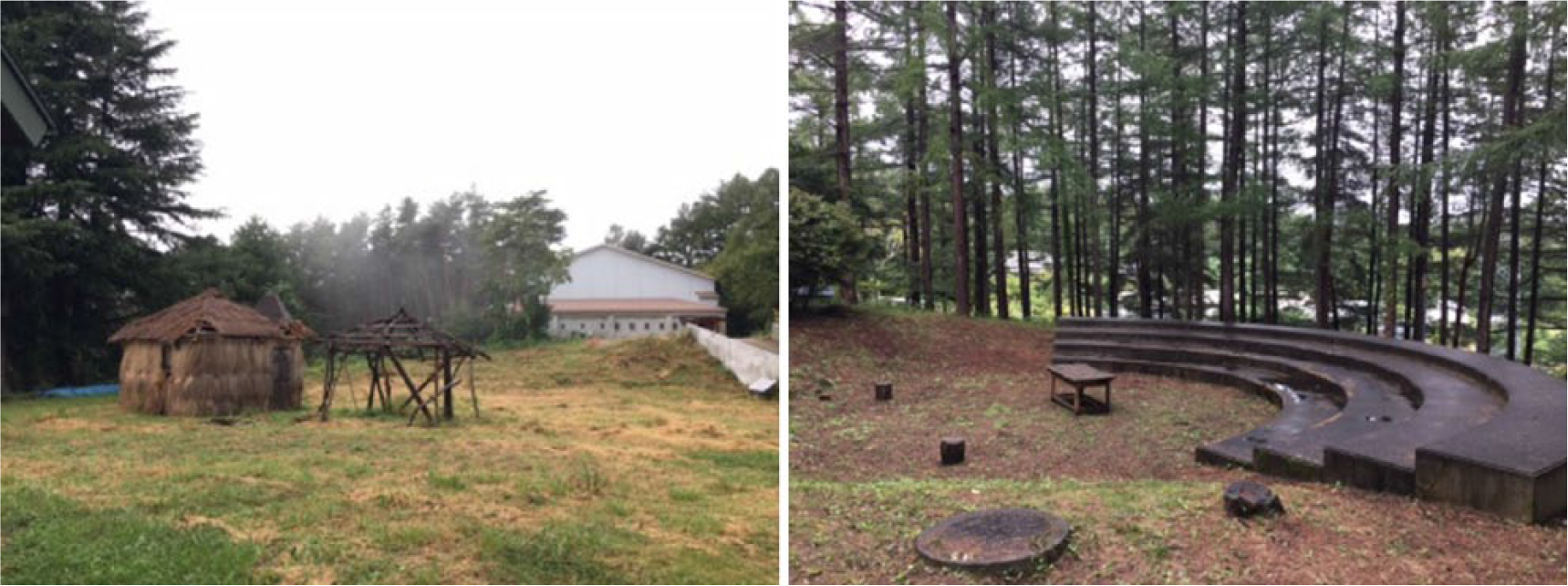
Site of the hoyo camp held in Komoro City of Nagano Prefecture, September 2017.
According to the introduction given by the chief of the staff, the eco-village is owned by the government of Minato Ward of Tokyo, and it was previously used as one of the open-air schools I mentioned above. The government of Minato Ward of Tokyo built the gymnasium and accommodation for the open-air camp school that had been approved for use by 300 people. But since there was not sufficient demand for it as an open-air school and since it did not have a sufficient budget to maintain the management of facilities, the government arranged for the facilities to be rented to the private sector. Then the health recovery camp organizer agreed to rent this place from the government of Minato Ward of Tokyo. This place has an effective historical recovery record, but it had been ignored for a while before the disaster happened.
At the camp, the organizer provides services to disaster-hit victims, as well as to other children, such as children from abandoned schools nearby, and also to adults. This allows them to have the experience of going to the fields; touching the soil, plants, and insects; and taking care of growing crops. They believe that people’s interest in food will be heightened if they know how the crops they have grown by themselves become food.
Every year in early August, the organizer accepts 15 to 20 elementary school children from Fukushima to have 2 nights and 3 days of camping in the eco-village. The 3-day camp’s schedule starts with getting up at 6:30 a.m., followed by a workout of Japanese morning exercises and then breakfast. Children help to prepare the meal and also clean up after breakfast. The events of the day include farmwork and some workshops like color print or play at “being a samurai” and they get in the hot spring and get to bed at 9:30 p.m. According to the report of this camp, the participants’ parents said it was good to let children touch the soil without fear.
After the 2011 Fukushima nuclear power plant accident happened, children’s outdoor activities had been restricted in the radioactively contaminated regions (Masuda et al., 2014; Mukai, 2013; Nishimura, 2014). Although they live amid natural surroundings, the children could not touch physical objects (Shiraishi, 2013). So first of all, the camps like the ones mentioned above provide children with chances to touch and use soil with no worries. Putting their bodies in locations which are between cities and farming areas and surrounded with nature, children can experience a life in harmony with nature and speed up their recovery from the disasters.
The other two health recovery camps where I conducted interviews are also in great environments like the one above, and, in addition, one of their organizers is also a Fukushima disaster victim. He had lived in Nihonmatsu City of Fukushima—the same city as appears in the documentary film introduced above. He and his family fled to Yonezawa City of Yamagata Prefecture, but the evacuation life was very hard for them. As a radiation victim, he decided to do something to support the people who still are living in the post-meltdown world around Fukushima. He and other organizers launched a non-profit recreation facility project and renovated a 100-year-old house for the camp which is located in the center of Sado Island, Niigata Prefecture, 240 km from the Fukushima nuclear power plant. Sado Island is located in the Western part of Niigata Prefecture, and it has Japan’s largest area of island nature. The island is surrounded by the sea, and it has mountains, rivers, lakes, fields, and rice paddies. Sado also has been recognized as the first world agricultural heritage site in Japan. The health recovery camp is held in the 100-year-old house a few times annually, such as in spring break, summer holidays, and other holidays. Children in the camp play in nature, cook rice on a stove made by themselves, and break wood to heat the water for their bath in the evening. During the camp, children experience Sado local culture and learn the vitality of natural remedies for recovery, and enhance their physical health and mental health.
Some might imagine that this camp is like a regular summer camp. Indeed, it does include elements of regular camps, like the aims of nurturing healthy, athletic children who have autonomy, aggressiveness, cooperation, friendship, responsibility, creativity, and solidarity, which the children can hardly experience in school or at home. But the most important goal of these camps is not focused on traditional aims of education but on recovery of body and mind from the nuclear disaster. In terms of their therapeutic effect, the camps emphasize the closeness between the children’s physical conditions and natural life cycles at these well-preserved sites. The camps get children to live in contact with nature’s most nurturing functions, which allows the children to improve and recover their internal immune systems.
According to the third organizer I interviewed, their group is making efficient use of places like the two above and they are also trying to provide a sustainable support for the victims. First, this organizer is making use of old private guest houses to provide accommodations for their camp. The location is in Shima City of Mie Prefecture. Shima is a city located in the southern part of the Shima Peninsula of Mie Prefecture, about 510 km away from Fukushima. The East and the South of the city face the Pacific Ocean. The organizers of the camp are trying to relieve the stress of the mental and physical problems of the Fukushima children, and their aim is to provide ordinary daily life for the children and their families. So after the children return home from the camp, the organizers continue to send vegetables (organically grown, pesticide-free crop farming) to support the participants and their families and friends living in the post-meltdown world.
Relying on the investigation reports of camps conducted by the 311 Japan Nuclear Disaster Aid Association (2016), we know there are 29 prefectures that are hosting such camps now and that 69% of the camp organizers have been appointed since the Fukushima disaster. The camps like these three mentioned above are nearly always located in the mountains or near the sea. From November 2014 to October 2015, 234 organizers led camps which have hosted 15,000 children and their parents. These camps are playing an important role in recuperating the health of Fukushima area children. There still are no data that quantitatively show the precise effects of the physical condition changes of children after attending the camps, but from the qualitative investigation done with the children and their parents, we can see a lot of positive results.
Children’s responses showed: less worry about radioactivity played with friends and staff members with all our minds and energy had less stress got healthy energy Parents’ responses showed: child became more interested in nature more smiling and more bright expressions on their faces calming down getting their appetite back gradually refreshed and pumped up. (311 Japan Nuclear Disaster Aid Association, 2015)
From these results, we can find persuasive evidence that both children and parents have experienced healing from the camps. These camps encourage an interdependence between mind, body, and society in these therapeutic landscapes.
Conclusion
During the process of recuperation that occurs in environments like those provided at hoyo facilities, the specific things that people try to avoid and what they have to face may show some differences on the surface according to the era and local conditions, but they share an underlying measure of concern for human life.
Originally, hoyo was aimed at fostering recovery from illness and regaining health some 300 years ago, and then the aims were broadened to help develop national prosperity and military strength some 100 years ago. Today, the goal of hoyo is still for recovering and keeping oneself healthy, but we need to ask, can one actually accomplish the goal by just staying at home and doing things by oneself ? Judging from the case of the Fukushima nuclear accident, we have seen that people cannot usually accomplish such things alone.
Spending time in places without pollution has come to take on an even more essential role in fostering recuperation of health since 2011. At the facilities described in this article, children did 15-minute walking sessions in the mountains, like the Baba Elementary School students did 100 years ago, but now it seems this is not enough for the Fukushima children. In the case of modern facilities, in order to make them places of healing, mobility should be seen as a means, and place should be seen as the destination. But fostering mobility must rely on social support. According to the organizers of the hoyo camps I mentioned above, if they had not taken actions like that, the children’s recoveries would not have made progress at all. In our present society, the social environment is taking on a much more definitive role than before, and so it has become ever more important to help people recall the natural, create a new meaning of hoyo, and make new healing places for the victim of the nuclear meltdown.
When people’s regular lives are harmed by disasters like the nuclear disasters, going to specific idealized sites reputed for health and healing will be needed in order to foster recovery from the bodily and emotional damage and social environment will play a major role in helping to achieve this recovery process and allowing it to proceed sustainably. Today, we need to pay more attention to the traditional therapeutic landscapes and consider that now is the time to feel acutely how the natural environment will become even more important than ever before. This idea implies not only a lasting harmony between people and the natural environment but also a sustained balance between human development and the well-being of the natural environment.
No matter whether we are living today or 300 years ago, lucid waters and lush mountains are always invaluable assets for all living beings. In the era of health endangerment, our lives must always be rooted in a real place that can recreate a wholeness and a planetary healing.
Footnotes
Acknowledgements
I would like to express my sincere thanks to the three hoyo health recovery camp organizers I interviewed, especially the organizer in Komoro City.
Funding
The author(s) disclosed receipt of the following financial support for the research, authorship, and/or publication of this article: This work was supported by JSPS KAKENHI, Grant Number 17K02446.