



Abstract
This article argues that during and after Hurricane Harvey, Houstonians used the hashtag #houstonstrong as a way of creating a public. This public functioned much in the ways defined by scholars as a means to forward collective action outside the confines of the state. Although it formed adjacent to state mandates, this public never agitated against state practices. Instead, #houstonstrong became not only a way to organize civilian and privatized rescue during the storm but also a point of pride for Houstonians and businesses across Houston. Therefore, I argue that even though #houstonstrong functioned as a traditional public in many ways, its adherence to neoliberal logics makes it a complex form of publicity that challenges the binary between traditional and neoliberal definitions of public behavior.
On 25 August 2017, Hurricane Harvey made landfall at Rockport, Texas, as a category 4 hurricane. It slowly moved north, settling over the Houston Metro area, and for the next 4 days it dumped 33 trillion gallons of rain across the region. In many ways, Harvey was a perfect storm, with its slow rotation and scant movement allowing it to collect lukewarm water from the gulf and dump indiscriminately across the whole region. But Harvey was a perfect storm in other ways, too. It exposed the lack of governmental oversight in Texas, as breaches to the many petrochemical plants caused by the storm polluted the city’s air, land, and water at levels far greater than allowed.
While the ramifications of the storm are still being sorted, the dominant image was of a city joining together and helping those in need, regardless of race, class, or creed. From the lauding of Houston’s own Mattress Mack, who opened his local furniture stores to evacuees, to stories of everyday people in their personal boats and lifted trucks rescuing neighbors and then moving on to other flooded neighborhoods to come to the aid of strangers, these images became the branding of the storm’s recovery under the hashtag #houstonstrong. This essay is not an attempt to downplay the remarkable work of an imperiled city joining together in a time of need. The heroic and courageous work of everyday citizens is indeed something to celebrate. But what this article aims to articulate is why the resilience and grit of Houstonians was not merely an add on to the rescue efforts of Harvey, but a necessary and accounted for part of the recovery efforts employed by the city. The celebration of that fact in the larger media works to rhetorically support the neoliberal government models at work in Houston.
As Robert Asen and others have claimed, neoliberal publics pose a distinct challenge to rhetorical scholars invested in activism and deliberative change. As scholars who study public sphere theory have noted, traditional publics and counterpublics are formed not only through identificatory means but with the idea of collective deliberation and/or action in mind. But as Asen (2018) notes (drawing on Wendy Brown), the economic and political challenges of neoliberalism have created subjects who see themselves as individuals who operate in their own self-interest and are often in competition with one another.
The overarching focus on the individual is not the typical identification needed to build a public and/or counterpublic articulated in public sphere literature. Asen and others who are working to forward the idea of publics under neoliberalism claim that the fact that people see themselves as individuals seeking to promote their own self-interest can be a way to form a neoliberal public (Asen, 2017; Pason, Foust, & Rogness, 2017). An example of the type of neoliberal public Asen describes that is borne of individual interest is the #metoo or #timesup movement. These movements are built on individuals coming forward with stories of harassment and abuse to agitate for change. But instead of the hashtags eclipsing the individual stories, it is the sheer volume of individual outcry and testimony that gives these particular counterpublics their power (Larson, 2018).
This essay is less about neoliberal publics borne from individual stories and interest, and more about how a collective public was formed within the context of a neoliberal city facing a neoliberal catastrophe. As the citizens of the Houston metro area survived 5 days of unrelenting rain that dropped over 60 inches of water across the city (Samenow, 2017), the citizens of Houston worked together to rescue and recover with one another under the hashtag #houstonstrong. As the recovery continued, media did focus on some individual stories, but overall, it was the collective action—the building of a public in the non-neoliberal sense—that captured the imagination of people across the globe. So in a sense, the people of Houston during and after Hurricane Harvey represent a public we recognize: one where everyday people are eschewing the neoliberal commitment to individualism and competition and creating a “common good.” But these citizens have yet to take their collective action to the polls and/or agitate for any change in city policy or development to prevent future flooding or to seek collective monies for rebuilding. Instead, we see a rallying around private recovery that continues to support Houston’s investment in neoliberal values.
In other words, because of Houston’s status as a “local government corporation,” the rescue and recovery efforts in the wake of Harvey were always going to be privatized. And the privatization of the rebuilding of Houston will continue during the upcoming years. The formation of a public during and after the storm under the #houstonstrong hashtag is an example of a neoliberal public that seems to be invested in the collective good, but is ultimately stymied by Houstonians’ acceptance of the city’s economic policies. As I will show throughout this essay, there is hope to be derived from the public formed around #houstonstrong, but as scholars of rhetoric, neoliberalism, and publics, we need to figure out how to forward that collectivity to not merely reify the neoliberal economic ideologies of a place. Instead, we need to find out how to intervene in these moments of collectivity and show how neoliberal ideologies create the conditions under which people are making their choices. 1 Ultimately, this essay asks us to occupy the murky waters where a neoliberal public both resists assumptions about homo oeconomicus but is borne from the neoliberal context of its city policies, and reckon with the types of resistance that can or cannot happen from there.
Harvey: Houston’s catastrophic neoliberal legacy
Waking up 29 August 2017, with news of failing levees and reservoirs in Houston, the city I’ve called home for the last 10 years, was emotionally trying. Even though Harvey was on track to end its deluge of rain on the Houston metro area and move east, there was a consensus that Houston, with its high density of petrochemical plants, was not yet out of the woods. So on 29 August, the anniversary of Hurricane Katrina—another hurricane whose effects were felt for years after the event—Houston was quite clearly revealed as another example of the devastating results of neoliberal economics’ neglect of state municipalities and local governments.
As Hurricane Harvey lost its momentum, Houston’s problems were just beginning. Due to Houston’s commitment to a “No Zoning” policy, several housing developments had been built in watersheds across the metro area, leaving significant flooding in scattered areas around the city. Water levels were going down very slowly because at this point, levees, creeks, and tributaries were still at maximum capacity as water flowed out to the gulf. There have been many pieces written about Houston’s lack of zoning, urban and suburban sprawl, poor city planning, and lack of attention to drainage, and all have been blamed for the devastation endured by Harvey (Coy & Flavelle, 2017; Joyce, 2017; Patterson, 2017). All of these critiques do have a semblance of truth to them: Houston’s city planning (or lack thereof) has gone unchecked for decades in the name of economic growth. Michael Oluf Emerson and Keven T. Smiley (2018) have aptly named Houston a “market city” as opposed to a “people city.” As such, they claim Houston celebrates the individual, private property, deregulation, and sprawl. As sociologists and urban planners, they are not judging Houston, but Emerson and Smiley do assert that the core values of neoliberalism are central to market cities, and that those values permeate not only the political and economic landscape but also every citizen’s cultural assumptions regarding how to act and interact with Houston and one another. In fact, Emerson and Smiley (2018) claim that “residents of a city […] rely on, respond to, and re-create the gravitational pull of cultural beliefs about what is possible and what should be prioritized in their city” (p. 3).
In other words, our current understanding of neoliberal rationality has “[disseminated] the model of the market to all domains and activities—even where money is not at issue—and configures human beings exhaustively as market actors, always, only, and everywhere as homo oeconomicus” (Brown, 2015, p. 31). If everyone sees themselves as rational actors competing in a cost–benefit scenario, then it is easy to understand a city’s commitment to the market. As long as the city is providing some form of support through city partnerships with individuals or businesses, then the logic of the market will always produce winners and losers, after all, and it is those who work hard who will succeed. Or so the rationality of neoliberalism espouses.
These ideological commitments have allowed Houston to continue as a “‘local government corporation’—a quasi-governmental entity that’s also a nonprofit organization able to receive and spend both taxpayer funds and private donations in order get things done that benefit the public” for over three decades (Fulton, 2018). The organization of city policy and procedure runs more like a traditional publicly optioned corporation than a democratic civic entity. For example, most of the city’s local government corporations are redevelopment authorities, which work in tandem with TIRZes, or tax increment reinvestment zones (which aren’t local government corporations) to negotiate with private developers and build public infrastructure in different districts around the city, such as downtown and midtown. (Fulton, 2018)
The redevelopment of the city is “technically” the purview of city management, but that management has been given over to corporate entities whose charge is to act in the best interest of the local neighborhoods and the city by negotiating pricing with other corporate developers. Nowhere in this process are neighborhoods’ due diligence, civic meetings, or voting for the expenditure of tax dollars mentioned. Instead, the development of Houston is in the hands of quasi- and full corporate interests who have been authorized by those who the citizens have voted into office, thus putting civic participation at quite a remove. And unless there are bonds specifically set to raise individual homeowner taxes, Houstonians rarely get involved with these civic development issues. Public deliberation at city council, Home Owners Association (HOA), and other civic area meetings are poorly attended, and ultimately, in a city that functions as a local government corporation, most things come down to how money is exchanged, not how civic interests are served, and the citizens of Houston are fine to keep it that way (Binkovitz, 2018; Kinder Institute, 2018).
This critique of lack of civic participation seems to align with discussions of voter apathy, but it is the unrestrained relationship between corporate interests and the state that proves risky in a local government corporation. Because of the formalized relationship between the state and corporate interests, there are clear mechanisms for private interests to provide the money to the state and the state in turn to provide the policies and policing that supports privatized interests. This is not nearly as Machiavellian as it reads, because the relationships are merely the status quo that forwards city development. 2 But who determines what gets funded, who benefits from the funding, and where any profits from the funding reside is much less clear. Ultimately, for the purposes of this argument, when a city’s culture focuses on the individual, private property, and corporate interests, it becomes difficult to sway people to provide for the collective or public good because it is impossible to disarticulate that concept from individual or corporate self-interest.
Houston’s support (or lack thereof) for the homeless exemplifies how the city has privatized the public good. Churches and non-profits have sought partnerships with the city to help get the homeless off the street, and although Houston is the first city to work with a national veteran’s organization to get 100% homeless veteran placement off the street, the city of Houston has not invested significant funding or manpower into any of these initiatives (Bernard-Smith, 2015). Instead, the city has passed harsher laws about vagrancy and squatting in an attempt to push the homeless into their partners’ shelters and programs.
The homeless problem in Houston is just one example of how a local governmental corporation can create a partnership between the policing arm of the state and the corporate interests of the state, which include corporations who profit from state services. In many ways, what Houston, as a local municipality with elected officials, brings to any partnership is far more lucrative than money or labor—it brings governance and the capacity to produce laws that can support or filter people or money into the hands of its corporate partners for profit. And it is the investment of policies that police certain populations rather than others in the name of partnership that makes these contracts particularly troublesome. What enables the civic acceptance of these partnerships is the fact that “neoliberalism is the rationality of contemporary capitalism—a capitalism freed of its archaic references and fully acknowledged as a historical construct and general norm of existence” (Dardot & Laval, 2009/2013, p. 4).
During the aftermath of Harvey, the results were very much the same. All of the publicity, coordination, and rescues performed under #houstonstrong served to maintain the status quo in which Houston’s government outsources civic responsibility to the private sector. As I will discuss in the following section, Houstonians did not see this as outrageous, even in time of crisis, because in Houston, the rhetoric of personal responsibility, which is deeply connected to the work of neoliberal economics and policy, is quite strong. Even children understand that it is their job to act when they see something amiss or someone less fortunate in need. For example, when Dickinson, Texas, teen Virgil Smith was interviewed while receiving the prestigious Citizen Honors Award by the Congressional Medal of Honor Society, his only response was, “I thank God that no snakes or alligators bit us” (quoted in Ramirez, 2018). Smith’s humility and bravery in the face of a crisis is the enduring story of Hurricane Harvey. 3 It is the story of the individual against the storm, rising to the challenge to help his community.
#houstonstrong: the rhetoric of personal responsibility in the time of crisis
In the aftermath of the disaster, the phrase and the hashtag “#houstonstrong” proliferated across news coverage and social media. The defining story of Hurricane Harvey focused on individuals and communities coming together to help during and after this massive storm. Stories circulated about the retired military men from Louisiana, the Cajun Navy, formed after the dismal national response to Hurricane Katrina, coming to town to help the citizen rescue efforts. There were also countless local stories of Houston folks with boats, raised pickup trucks, and even mattresses who waded through the murky, infected flood waters to get their neighbors to safety. 4 As James Aune (2001) reminds us, “There are times when human beings need to hear inspirational messages about self-reliance and the struggle to ‘be all you can be,’” and Hurricane Harvey was certainly one of those times (p. 75). All of the stories and images circulating under the #houstonstrong hashtag served to demonstrate the collective resilience of a city under siege from Mother Nature. These stories and images also showed that even in a neoliberal space such as Houston, a more traditional public can form, but it will not resist the neoliberal ideologies from which it is borne. In other words, even though it embraces the collectivity of traditional publics, the strong reliance on the rhetorics of personal responsibility keeps the public of #houstonstrong staunchly neoliberal. No matter how inspirational the stories were, each one served a city whose disaster planning factors in the voluntary work done by the private sector.
Houston’s emergency response, like many large-scale disasters, follows the “whole-community response” guidelines and expectations set forth by Federal Emergency Management Agency (FEMA). Over the last 8 years, this policy has been developed and practiced in disasters both large and small scale. FEMA has viewed a whole-community response favorably in comparison to a top-down approach. As Graham (2017) explains, The basis for whole-community response is that, while the government simply can never provide a response as quickly as needed, a top-down response from the government isn’t the best answer anyway. Local people know much better what they need, and they benefit from being involved.
In Houston, where citizens are already positioned to be responsible for their own best interests, whole-community response worked strikingly well. But underlying the discussion of allowing people to participate in their own rescue and recovery is the problem of a proposed presidential budget that threatens support for disaster relief and first responders across the country (Rein, 2017; “Trump’s 2018 Budget,” 2017). In this light, the focus must be kept on the extraordinary efforts and resilience of “everyday people,” and the hashtag #houstonstrong certainly helped serve that purpose.
For example, the YouTube video of Airc Harding playing his piano in his flooded Friendswood home circulated across the globe, with both the BBC and The Guardian carrying the story (Aylor, 2017; BBC News, 2017). The video quickly went viral—circulating not only through formal media outlets but also social media channels. Because of all the attention, Harding received word that musician Vanessa Carlton would purchase him a new piano. Harding’s story is just one of the many heartbreaking and inspirational stories that circulated during the aftermath of Harvey. These “short, everyday, familiar texts” designed for social media “that show readers how to act, feel, and participate in social life” serve to inspire and emotionally involve each viewer with the tragedy of Hurricane Harvey (Riedner, 2015, p. 13). Each image, video, and story was retweeted and shared millions of times across social media platforms. Each story and image was both heartbreaking and inspiring, and each one was accompanied by #houstonstrong, providing a lesson to the world about the resilience of Houston.
Part of the draw of #houstonstrong is it enabled the world to experience the effects of Harvey and the evacuations as they happened. Because Harvey was a dirty storm—heavy on rain, light on wind—the loss of electricity and communication services was minimal. Therefore, individuals could keep in touch, share images, and coordinate rescues through social media. Soon Twitter, Facebook, Nextdoor, and local emergency apps and websites were full of threads of people asking for and offering help, as well as photos of the devastation facing neighborhoods in the Houston metropolitan area. The magnitude of the information circulating through the news and social media allowed the world to both suffer along with as well as admire Houston. Through the circulation of #houstonstrong, a public was born.
Fitting scholarly definitions of the public sphere, this public represented a group of people who created a collectivity based on a common or shared interest—in this case, survival and recovery—working together for the public good (Habermas, 1962/1989). The public was not only invested in “sharing their story” through social media; they also used social media to coordinate rescue efforts of citizens across the greater Houston metro area. The coordinated response, often using the hashtag #[blank]strong with a particular neighborhood name in substitution for Houston, was very effective, and in direct response to statements from officials, which told citizens to not use official channels to seek help because city and state services were far too overburdened to provide help in a timely manner. “Texas officials repeatedly emphasized the importance of personal responsibility. They warned people not to call 911 unless their life was in immediate peril” (Sullivan & Holley, 2017). Of course, it makes sense that in a disaster the size of Harvey there would be need to supplement authorities. Most first responders were working 24-hour shifts to evacuate people from flooding homes and neighborhoods across the region. But there were also police and National Guard assigned to protect businesses and homes in more affluent neighborhoods across the city. When asked why these officers were not engaged in rescue efforts, they would answer that they were assigned to protect the community (J. Wingard, personal communication, April 11, 2018).
Unlike the citizens in New Orleans during Hurricane Katrina, citizens of Houston did not protest the misuse of public servants. Instead, they created their own public to augment the lack of social services. In other words, the people of Houston created a neoliberal public that resisted the individualized nature of homo oeconomicus, but they still very much participated in the privatizing of the city’s Hurricane response without question. Add to that the circulation of images and stories of heroic saves made by everyday people and images of individual resilience under the #houstonstrong hashtag, and no one could argue with putting the rescue into the hands of Houston’s citizens. As they showed the world, Houston’s whole-community response across the region was inspiring. But what undergirds the individual’s call to act in time of need is the rhetoric of personal responsibility, which also supports structures of a local governmental corporation. During Harvey, that rhetoric was amplified to call on individuals in times of crisis.
The rhetoric of personal responsibility is a key component of neoliberal ideology. As Rebecca Dingo (2012) discusses, personal responsibility was the key rhetorical shift in national legislation that undid the fiscal and legislative support of the Keynesian welfare state, and as I have discussed, the rhetoric of personal responsibility (in particular, the infamous “See something; say something” campaign that took hold post-9/11) was key in the passage of the Patriot Act (Wingard, 2013). The idea that individual citizens are not only responsible for their economic salience but also the safety of their communities is deeply tied to the logics of neoliberal capital. The circulation of #houstonstrong not only reifies these rhetorics but continues the idea that individuals and their efforts are central to the successes and well-being of their communities. Even though the use of #houstonstrong was a way for Houstonians to create a public during Harvey, the lack of systemic deliberation or resistance tied to the hashtag created an opportunity for #houstonstrong to become an empty signifier that could be commodified, thus demonstrating how the #houstonstrong public represented both collective action and neoliberal capitulation.
Mattress Mack: #houstonstrong’s neoliberal icon
As discussed above, the neoliberal economic model relies on the corporatization of local government to support the partnerships between private interests and government which are becoming increasingly normalized. It also espouses the need for personal responsibility to help insure safety and success. No one exemplifies these characteristics more than Jim McIngvale or “Mattress Mack,” owner of Gallery Furniture, a Houston-based furniture chain. As news of flooding broke the first night of the storm, Mack put out an announcement over social media and through the local news that each of his furniture showrooms would be opened as a shelter. People and their pets would be allowed to come stay in the furniture stores until FEMA could set up extended housing for flood victims. When asked about his eagerness to open his high-end furniture stores to hundreds of wet and displaced flood victims, McIngvale said, “We put out a Facebook feed that we were going to rescue people, because there was so much need. … The city and the local authorities did a great job; they just couldn’t get to all the 911 calls” (quoted in Glenn & Cheslow, 2017).
McIngvale understands his role as a businessman in Houston is to help his city when the need arises. “To hell with profits, let’s take care of the people. It’s the right thing to do. It’s the way I was brought up” (quoted in Murphy, 2017). This may seem out of character for a successful businessman, but McIngvale, who sees himself as a “capitalist with a minor in social work” (Smith, 2017), believes that as a Texas businessman, his first priority is to his fellow Texans in their time of need. Again, there is no criticism of the city’s response; instead, there is an understanding that to be successful in business in Houston, there are times that you need to put Houston before your business. From there, like those businesses that have directly partnered with the city, McIngvale will see success.
The city of Houston has not officially partnered with McIngvale, but the news of him opening his showrooms and warehouses and sending his delivery trucks to rescue stranded flood victims has put both McIngvale and Gallery Furniture in the spotlight. In addition to a petition circulating to name 27 August Official Mattress Mack Day in Houston, national media outlets picked up on his story and have run interviews with McIngvale, set up donation sites, and praised the philanthropic businessman. In fact, McIngvale’s act of charity caught the eye of President Trump (2017) who said of McIngvale, “When the rain began to flood the streets of the city, he sent out his furniture trucks to rescue the stranded,” said Trump speaking at the Values Voter Summit. “He brought them back to his store and gave them food and gave them a clean, dry place to stay, even if it meant ruining countless dollars worth of furniture. As ‘Mattress Mack’ put it, ‘My faith defines me. It’s who I am’. In ‘Mack’, we see the strength of the American spirit.” (Quoted in “President Trump Praises,” 2017)
Trump’s comments echo the images of #houstonstrong. He highlights the selflessness of a successful businessman who supported his community using what he had to offer. These images resonate with the American people because of their roots in the rhetoric of personal responsibility, and they resonate specifically with Houstonians because of the city’s commitment to the success of individual and business efforts in the face of adversity.
It does not matter that McIngvale will take a loss from any damage of furniture on the showroom floor. His positive press, combined with his tax write-off, will more than make up for that loss. Again, we see the rhetoric of civic responsibility provide businesses with avenues toward economic success and then community-minded businesses use that success within their community. Much like the collective action of the public under the #houstonstrong hashtag, Mattress Mac sees himself as a “true Houstonian” and humanitarian because he uses his private business to support the city. From all reports, McIngvale is a true philanthropist and has been since his business began turning a profit in the early 1980s. But his choices as a businessman are made much like those of the citizens of Houston: they are all part of a milieu that has rewarded innovation and profit and that requires businessmen to provide support for civic need when the city and state cannot provide it.
Profiting from Harvey: selling #houstonstrong
McIngvale is the standout example of a local business stepping in to support the city that supports his business. Another example during Harvey was H-E-B, a Texas-owned and operated grocery chain that not only brought in trucks of supplies but also deployed their “mobile kitchens and disaster relief trucks” to the Houston area shortly after Harvey made landfall (“H-E-B Deploys Supplies,” 2017). In addition, across the Houston metro region, H-E-B worked to open local stores quickly and efficiently, setting up a point-of-checkout donation program for Harvey victims, so that folks in the Houston area could get the food and supplies they needed (“H-E-B Donates $100,000,” 2017). H-E-B also ran commercials showing local workers receiving help remediating their homes while cooking meals for other victims. All of H-E-B’s relief efforts reinforce the Texas ideology that local business is a part of governmental and community infrastructure. Again we see the privatization of services that were once the purview of the state.
Each of these declarations of assistance and the lauding of the efforts of the “More than 100 HEB Partners (employees) [who] volunteered to accompany the convoy and assist affected residents” (“H-E-B Donates $100,000,” 2017) on H-E-B’s social media was accompanied with the hashtag #houstonstrong or #texasstrong. Much like McIngvale’s efforts, H-E-B was not stepping in as a cynical business move, but the tax breaks and word-of-mouth press that solidified H-E-B as the locally grown and invested grocer has certainly helped, even as they had to shutter at least one profitable Houston store due to severe flood damage (Para, 2017). But direct profit or loss of McIngvale or H-E-B’s businesses, as important as it is to understanding the neoliberal underpinnings of Houston and Texas, is not as germane to the rhetoric employed by them post-Harvey. In fact, locally their use of the hashtag #houstonstrong or hashtag #texasstrong was seen as appropriate and a way that “Mattress Mack” and H-E-B showed they were in the thick of the crisis with the community. They were part of the struggle.
The successful circulation of the hashtags #houstonstrong and #texasstrong during the rescue and recovery efforts of Harvey made them a prime target for seeming appropriation. What began as a grassroots means to define solidarity and solace in the face of adversity became a means for advertisers and businesses to note they are part of the community, just like Mattress Mack or H-E-B, and thus should be rewarded with Houstonians’ business. In other words, in the months after the storm, the hashtags #houstonstrong and #texasstrong have been utilized as a way to sell everything from furniture to cars. As we approach this year’s hurricane season, it does not seem that those hashtags are going away.
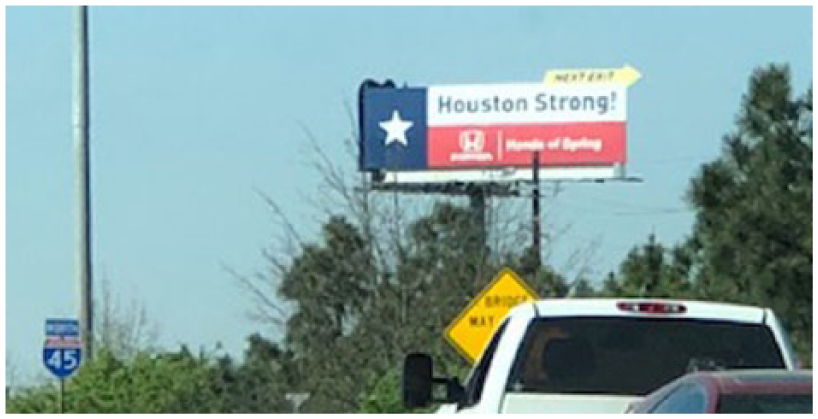
I-45, Texas’s longest north to south freeway through Houston, is littered with billboards, and #houstonstrong can be found on several of them. Not only do local companies employ the hashtag, but international companies, such as Honda, use the hashtag to catch the attention of drivers. These billboards mirror television ads that run during local news and sports programs where furniture stores, such as The Dump—a remainder warehouse chain based in Richmond, Virginia, offering low cost alternatives to pricier furniture stores such as McIngvale’s Gallery Furniture—use the phrase Houston Strong in their ad copy. Each time the phrase or hashtag is used, it is meant to denote a connection to Hurricane Harvey, the community bonding which happened during the rescue and continues during the recovery of the storm. Ultimately, it is a move to align each national or international business with the local values of Houston and Texas. Therefore, Honda and The Dump’s use of #houstonstrong is not so much a move toward appropriation, but instead it is a rhetorical move wherein the hashtag has evolved into a unit of meaning that holds local and community memory and identity.
Because Houston is a neoliberal city, the citizens of Houston who once formed a public under #houstonstrong have no qualms about seeing the hashtag connected to selling cars or furniture. The public and the hashtag have always been neoliberal, because Houston is. Whenever Houstonians see #houstonstrong, they remember the individuals and businesses who stepped in to save their fellow community members in a time of crisis.
Branding Houston: selling diversity
While the generosity of businesses like Gallery Furniture and H.E.B. and the efforts of Houston citizens under #houstonstrong resist neoliberalism, they are borne of its ideologies. Therefore, as Emerson and Smiley (2018) have noted, there are certain futures that are unimaginable to the citizens of Houston because of the cultural milieu in which they live. That lack of possibility is supported in the ways that the Houston media downplayed the work of the national and state agencies in Houston, as well as how the #houstonstrong hashtag became coopted as a way to “sell” Houston to the greater United States.
During the storm, the focus on individual (citizen or business) efforts under the hashtag #houstonstrong eclipsed the coordinated effort from local and national government. The National Guard, FEMA, the Army Corp of Engineers, the US Environmental Protection Agency (EPA), the Centers for Disease Control and Prevention (CDC), as well as police, fire, and medical professionals from all over the United States had all been working tirelessly since before Harvey made landfall (“EPA’s Response,” 2017). But these stories were not nearly as visible as the stories of the individuals who grabbed their canoes and saved their neighbors. The focus on individual heroism and resilience allowed the global audience to find hope in times of disaster. However, in celebrating the individual, #houstonstrong allowed for the state to remain relatively absent in conversations about Hurricane Harvey. 5 The lack of visibility of national and local government also fits into a very common narrative about the Lone Star State. Texas, and Houston is no exception, prides itself on not needing help from the federal government. A prime example was in 2008, when then-Governor Rick Perry (now Secretary of Energy) very publicly refused aid for our compromised economy. And that declaration was very newsworthy. What was not deemed newsworthy was the fact that the legislature overrode Perry’s injunction and took the aid just months later. Many Texans or folks across the United States did not hear this story (Meyer, 2009).
When there were images and stories of governmental agencies at work, those stories overwhelmingly showed servicemen saving people from flooded streets by foot, in boat, or in large vehicles. In contrast to the images of citizens saving citizens, the majority of these images consisted of multiracial or ethnic rescues. Whether it be a White serviceperson saving an ethnic citizen or ethnic service person saving a citizen of a different race did not matter. These images circulated quickly under the hashtag #houstonstrong with statements about how Houston finds strength not only in its resilience but also in its diversity.
There we were, Houstonians of every stripe, pulling strangers out of rising floodwaters. The images of people of every color and economic background huddled together on flat bottomed Jon boats and in the backs of trucks, as depicted on the most recent cover of the New Yorker, were as compelling as they were astonishing, particularly to a country so divided by race in recent months. (Balke, 2017)
These images not only served as a reminder of the severity of the storm but also as a reminder of a version of the American Dream that relies on the influx of immigrant cultures (and labor), which had been seemingly under attack throughout the 2016 Presidential campaign.
Houston SWAT officer Daryl Hudeck rescues Catherine Pham (Phillips, 2017).
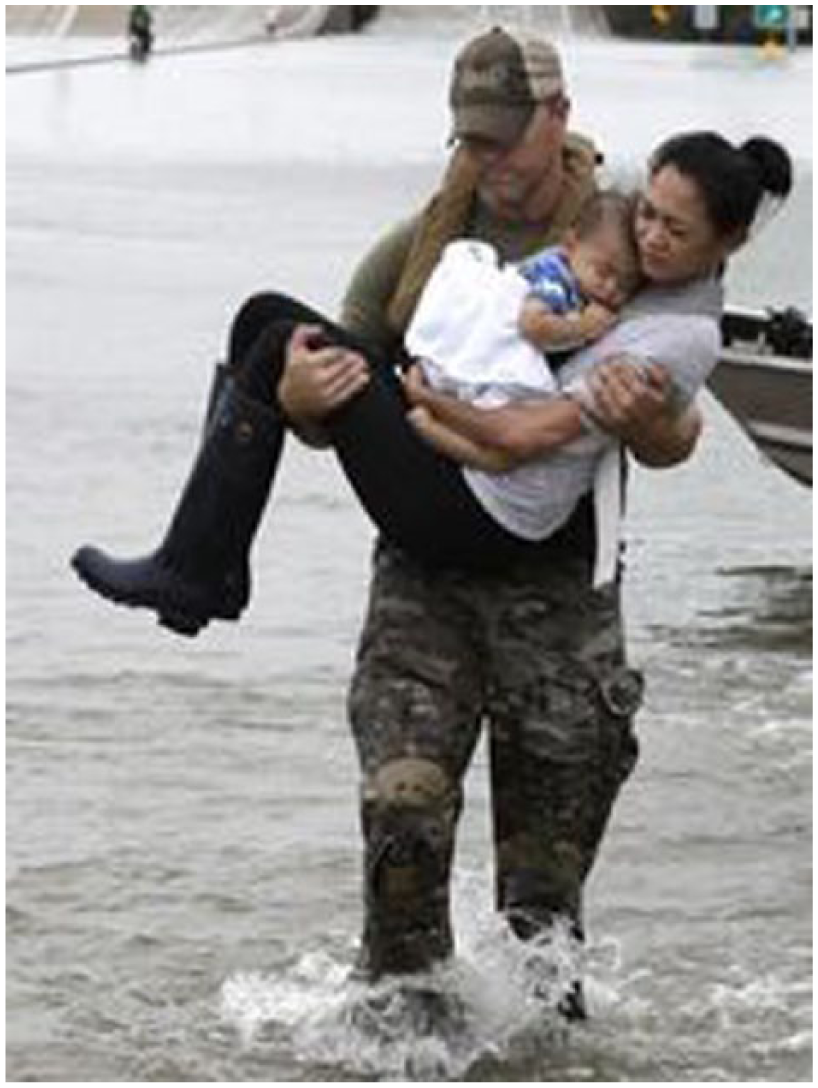
One of the most shared and retweeted photos was of a White SWAT officer in army fatigues carrying an Asian woman holding her infant as they waded out of knee-deep water (Geller, 2017). As this image circulated, it served as evidence that Houstonians were not only strong, but they were the embodiment of diversity. News outlets like USA Today used this photo to reassure what some media had named a “fractured America” that in times of crisis, ordinary folks still believe in the American Dream and will join together, regardless of race, religion, or other seemingly dividing factors (Editorial Board, 2017).
According to a Los Angeles Times article, Houston is now the most diverse city in the United States, and because of the demographics of its diverse youth, it has the chance to change Texas’ political landscape in the coming years (Mejia, 2017). In addition to Houston’s changing demographics, its notorious lack of zoning, coupled with its rising cost of living has allowed for the city’s ethnic distribution, for the most part, to follow class lines (Harden, 2018). Therefore, it was easy to present a version of the American dream wherein diverse community members came together to help one another post-Harvey. Instead of presenting a city facing crisis divided by race, class, or various contrasting beliefs, the images from Houston gave hope to America that in times of trouble, the American Dream of old could still suffice. The circulation of these images in the wake of Harvey presented a comforting alternative to the volatile version of the American Dream presented by the “Make America Great Again” followers, but these images also serve an important neoliberal rhetorical function—they brand Houston as a diverse and resilient city.
As I have discussed in previous work, branding has moved beyond mere advertising of products through the invocation of a lifestyle. Branding can now be seen in political campaigns, on university campuses, and in reference to an individual’s core personality attributes. But branding as a distinctly neoliberal symbolic process works to obfuscate, to make labor invisible. Therefore, when something or someone becomes a brand, it immediately becomes an object or commodity to be exchanged. As such, a brand secures a person, place, or thing’s place within capitalist exchange (Wingard, 2013).
In the case of Houston post-Harvey, branding Houston serves two distinct purposes: (1) it gives the emotional support and recognition Aune speaks of to the individuals, local business, and local charities who are doing the lion’s share of on-the-ground rescue and recovery work; and (2) it puts Houston into the national spotlight as a place where business and individuals can be successful, even in times of disaster. Both of these purposes serve to support Houston’s economy in the long run because (1) they keep individuals, business, and charities working during the recovery through praise and notice and (2) it reassures people and businesses that even though Houston may suffer severe hurricanes, it manages them well and gets back up on its feet quickly, thus avoiding an economic downturn.
These brands, narratives, and rhetorical strategies fit with the economic imperatives of neoliberalism. They speak to our need to be personally responsible for our actions and communities, as well as to be innovators. They also tie deeply to Texas’ distrust of governmental support, and through the invocation of hard work and “grit,” the images of diverse community members helping themselves resonate to a shell-shocked nation. But even more so, these images help to remind Houstonians and other Americans that Houston is a thriving city, no matter what disasters may come its way. Therefore, Houston can be counted on to continue contributing to the US economy long after the rains of Harvey have subsided.
Conclusion: recovering from Harvey, the potential of a neoliberal public
Houstonians certainly embody all the characteristics of #houstonstrong even months after the hurricane. Through #houstonstrong, the national media and the people of southeastern Texas constructed a narrative around Hurricane Harvey that highlighted the resourcefulness, generosity, resilience, and diversity of Houston. The hashtag and corresponding images fit nicely with Houston’s status as a “local government corporation” or “market city.” As the hashtag began to circulate beyond those directly involved in the rescue and recovery efforts, it continued to reinforce the image of Houston as a self-sufficient and rebounding city. In many ways, Houston is very much all of those things. But if the dominant narrative circulating about Hurricane Harvey is the one represented by #houstonstrong, it occludes the city and state’s culpability in creating and relaxing policies whose environmental impact had direct effects on flooding and the uneven recovery process after Hurricane Harvey. In other words, the use of #houstonstrong enabled the occlusion of how Houston and Texas’ neoliberal structures and ideologies are factors in the long-term recovery many Houstonians will face. The identificatory work of #houstonstrong can still be seen across the city, and not only in billboards and advertisements. Houstonians are proud of the way their city “came together” during and after Harvey to help each other. Houstonians still defend this version of the public, even as the 2018 Hurricane season begins.
Case in point, on 7 June 2018, it was reported that during a call with first responding agencies to prepare for the 2018 hurricane season, President Trump, while praising the work of the US Coast Guard’s relief efforts during Harvey, stated, “Sixteen thousand people [were saved by the U.S. Coast Guard during Harvey], many of them in Texas, for whatever reason that is. People went out in their boats to watch the hurricane. That didn’t work out too well.” As that single comment blanketed the local news, Texas first responders and local people began to discount the President’s claims utilizing the hashtag #houstonstrong. Each article and social media response to Trump’s statement echoed the words of Francisco Sanchez, the spokesman for Harris County’s Office of Homeland Security & Emergency Management, who stated, The response from our community members and folks at the Cajun Navy that brought their boats, put them in the water to rescue people and to help, filled the gap that we couldn’t simply because of size and scope of what Hurricane Harvey was doing to our community. (Quoted in Zelinski & Bernard-Smith, 2018)
This may seem like a rather small mark of resistance that reasserts the framing of #houstonstrong within larger neoliberal narratives, which include triumph over adversity, community members coming to each other’s aid in a time of need, and the story of the rebuilding of a life after indescribable loss. Nevertheless, these assertions against Trump’s statement also reflect a moment where the collective public—both public officials and citizens on social media—is working together to assert an identity for their community in the face of adversity. It just happens to be that the identity being asserted is a neoliberal one. As one commenter on the Facebook group “Houston after Harvey: A Houston Chronicle Community” states, Just a reminder, “By the end of the storm, members of the Cajun Navy and other civilian volunteer organizations had rescued 35,000 people.” It’s sad that such a unifying moment filled with compassion and courage in our city during Harvey is being degraded by the president. The Coast Guard was amazing as well but no need to attack and blame the people of Houston in order to give them credit and show appreciation. #houstonstrong. (Parker, 2018)
Even almost 9 months after Harvey dissipated, the memory of the work of the citizens of Houston is a point of pride for Houstonians. So much so, that they do not see it in contrast to the work of social services, but instead as an added benefit that the city offered during a time of crisis. Furthermore, the citizens of Houston do not see any discrepancy that the state agency established to protect them during just these types of catastrophes saved less than half of the number of people saved by the citizens of Houston and Louisiana. Therefore, when the defense of Houstonian’s participation in the rescues during Harvey is mounted, it is one that does not particularly agitate against the president or his policies, but instead reaffirms the narrative that #houstonstrong is a defining characteristic of Houston.
In other words, the public is resisting the President’s assertion, and therefore could be characterized as the work of a counterpublic. But that resistance is not agitating against the local status quo. Instead, it is reifying the neoliberal values of personal responsibility and privatization that are central to the city of Houston. In many ways, this example demonstrates how this particular collectivity has turned our notions of a public upside down. I would argue this particular public acts like a public but from a very different ideological vantage point because of Houston’s commitment to neoliberal governmentality: any positive gains to move a public forward will be done so within the structures of neoliberalism. Can there be true resistance from a neoliberal public? Or is resistance ultimately futile? I do not think so, but I do think that the resistance provided from a public steeped in neoliberal ideology is quite different than our traditional notions of resistance and counterpublics, and we will have to become much more thoughtful about how to enable deliberation from those publics in the future.
Footnotes
Acknowledgements
I would like to acknowledge the terrific feedback on several drafts of this essay from Rob Asen, Rebecca Dingo, and Michael Sicinski. In addition, I would like to acknowledge the citizens of Houston and east Texas for their neoliberal grit in the face of disaster.
Notes
Author biography
Jennifer Wingard is an Associate Professor of English and affiliate to the Women and Gender Studies Program at the University of Houston Houston, TX. Her research focuses on how the impact of neoliberalism on civic and political rhetoric implicates marginalized groups within the U.S.