




Abstract
Rankings of new media events function as an important way to define and interpret these events in public space. By analyzing 40 rankings of 413 new media events between 2007 and 2016, we first provide an empirical analysis of the widely discussed decline and substantial shifts of new media events around 2014, namely, the decrease of contentious events and the increase of consensus events. Second, we find that some of the actors construct the rankings based on their long-standing values and philosophies, such as commercial media’s emphasis on progressivism and liberalism, and government propaganda departments’ focus on social management and institutional order. The divergent constructions over the naming and ranking of new media events demonstrate that new media events have become sites of contestation over the dominance of the Internet space and the collective memory of the Internet history in China.
Introduction
Digital formations are new social forms and institutions arising from digital space and networks, including electronic networks, communities, and markets (Latham & Sassen, 2005). With the evolution of new digital technologies, the types and manifestations of digital formations have undergone many changes, and many new forms have appeared. In China, various kinds of digital formations have appeared, such as online communities, WeChat groups, new media events, emojis, and e-commerce. They form in digital space but have involved divergent social interactions and influenced offline society at different levels. Various types of sociopolitical actors have engaged in the contestations and negotiations over the potential social influences of these digital formations.
New media events (新媒体事件, xinmeiti shijian), also called Internet events, are public events for expressing and discussing public issues and social conflicts concerning pursuits of interests, emotional expression, or social moralities. Traditional media and new media interact with each other in various discursive practices, leading to the creation of new media events (Wu, 2014). Since April 1995, when early Internet users started to plead for international medical help for a college girl named Zhu Ling who was poisoned by thallium, China has witnessed many new media events, some of which even attracted international attention (Jiang, 2014; Qiu & Miao, 2016). The distinguishing feature of new media events lies in Internet users’ massive participation in both online public discussion and offline collective action. The main issues of contention may include rights protections, anti-corruptions, collective signature, civil assistance, and various discussions in bulletin board system (BBS), blogs, microblogs, and so on (Yang, 2009a). In general, the idea of new media events has emphasized the inherent feature of contention of those events, and new media are important sites or fields for the frequent happenings of the contentious activities.
Since new media events are significant social phenomena, they have attracted wide attention across social groups and actors (Wu, 2014). Different annual rankings (排行榜,pai hang bang) of new media events have appeared. For example, the annual report of Internet Yuqing 1 Analysis published by the People’s Daily online website (people.com.cn) is based on data collected from various online platforms; the Tianya Forum (bbs.tianya.cn) rankings are based on netizens’ votes; the Southern Metropolis Daily (SMD) rankings are based on experts’ recommendations and readers’ or netizens’ online votes; and the China Internet News Research Center (Zhongguo Hulianwang Xinwen Yanjiu Zhongxin, CINRC) publishes rankings which are highly ideological. These rankings list different new media events and bestow different salience and interpretations to the listed events. Questions then arise as to why different social actors actively take part in naming and ranking new media events and why there appear so many different naming and rankings of new media events.
Borrowing from Bourdieu, this article attempts to explore how the naming and ranking of new media events function as a “field of power” (Bourdieu, 1989, p. 16) that engages symbolic struggle and interaction over the construction of social reality. We argue that naming and ranking new media events structure an action of definition and interpretation. It constitutes part of a larger symbolic struggle over the dominance of the Internet space, namely, Internet for contention or Internet for management. By longitudinally and comparatively examining the politics of naming and ranking new media events between 2007 and 2016, we seek to shed light on the changes and evolution of China’s cyberspace seen through the lens of new media events.
In addition, the development of new media events has first undergone eruption since 1995 and then gradual decline in recent years, especially after 2010 (Qiu & Miao, 2016). Scholars observe that the frequency, scale, and intensity of new media events have declined in recent years (Yang, 2017). This raises questions concerning the extent and causes of the decline, which calls for empirical analysis of the general development of new media events. A study of the rankings of new media events may serve as such an attempt. Furthermore, examining the changes and power dynamics in the symbolic construction of new media events could, from a long-term point of view, illuminate research about the collective memory or digital memory of Chinese Internet space (Zhang & Gan, 2014; Zhong, Lin, Liu, & Yang, 2017).
Divergent naming of new media events and the contestation
New media events in China have multiple labels. Sometimes they are called “Internet mass incidents” (网络群体性事件, wangluo quntixing shijian) (Dong & Wang, 2011), “which is modeled after the term mass incidents, an official label for protest activities” (Yang, 2016, p. 9). Early in 1994, public security departments and political and legal bureaus in China started to pay attention to collective events and linked them with social stability maintenance (Li, 1994). The concept of Internet mass incidents extended the logic of activism and connotes negative meanings of social disruptions (Yang, 2016). This concept has been the mainstream term referring to new media events since 2003 and has been widely used in crisis management research (Dong, 2016). The second term “Internet events” (网络事件, wangluo shijian) (Yang, 2009a) emphasizes the development and usage of the Internet (wired network) and mobile phones (wireless network) in the making of these events. The third is “Internet collective action events” (网络集体行动事件, wangluo jiti xingdong shijian), indicating both features of traditional collective action and the Internet (Yang, 2009a). The fourth is “Internet public opinion events” (网络舆论事件, wangluo yulun shijian) (Hu & Chen, 2017) or “Internet public opinion supervision events” (网络舆论监督事件, wangluo yulun jiandu shijian) (Liu, 2012), suggesting online exposure or public supervisions of wrongdoings or illegal events (Xu, 2016). The fifth is “discourse events” (话语事件, huayu shijian), which employs the perspective of discourse analysis in examining new media events (Zeng, 2011). The sixth is “media events” (媒体事件/媒介事件, meiti shijian/meijie shijian) with an emphasis on the wide social attention aroused by these events, which calls for redefinition of the original concept of media events as developed in Dayan and Katz (1992). The seventh is “Internet yuqing events” (网络舆情事件, wangluo yuqing shijian), indicating the contentions and the logic of top-down control. Among them, the terms “Internet mass incidents” and “Internet events” appeared early, while other concepts were gradually applied with the rising amount of relative research in the Chinese-language literature (Dong & Wang, 2011).
The various names and definitions about new media events mostly refer to the same phenomenon, but with different connotations. They jointly constitute an aggregation of conceptions about new media events. The divergent conceptions further reveal a pair of “control–reform” relationship between the government and the public. On one hand, new media events challenge the government’s administration, established social order, and even political legitimacy (Dong & Wang, 2011; Yang, 2016). The present government conceives of the Internet as the “major battlefield of ideological struggle” in which “we should dare to show our sword” (Jingping, 2013). By using terms such as Internet yuqing events or Internet mass incidents, government authorities seek to link new media events with social disorder, which further implies the government’s authority or legitimacy to control and resolve these disruptions. On the other hand, the public and the academia mainly want to promote social reforms via new media events. The term of new media events locates these events in areas of new media and society and “avoids the charged political connotations of online activism” (Yang, 2016, p. 9). According to Y. Zhong and Yu (2010), among the 160 significant Internet public opinion events between 1998 and 2009, more than 66% demonstrated positive social impact. The two approaches toward new media events suggest a dominator–challenger relationship and reveal “an ongoing struggle between a utopian view of technology as enabling the protection of freedom, choice, and equality, and a growing concern with the corporatization of the Internet” (Dumitrica, 2013, p. 587).
The essence of different naming lies in that new media events have become a contentious “field of power” (Bourdieu, 1989, p. 16) involving different sociopolitical actors in the construction and negotiation of social reality. As Yang (2016) argues, “Far from a naïve confusion of the meanings of a word, this conflation represents a history of political struggle over the meanings and practices of online activism” (p. 7). According to Bourdieu (1989, p. 16), social actors’ symbolic struggles in the field of power largely depend on the volume and structure of the capital they possess—economic, cultural, social, and symbolic capital. In the case of new media events, the symbolic capital includes social actors’ ability to name, classify, rank, and interpret these events, which could, jointly with other forms of capital, reproduce and restructure the power relations in social practice.
Given the periodical changes observed in the developments of new media events in China, this study identifies five major periods. The first period, from 1995 to 2002, is the gestative period, when neither the government nor social elites understood much about new media events. The second period, between 2003 and 2006, witnessed the fast growth in the number of new media events, with BBS being the dominant platform for social contention and interaction. Meanwhile, the government started to actively engage in managing and controlling online protest. The third period, from 2007 to 2009, is the prime time for the development of new media events, with struggles for material interest and civil rights being the major concerns. The fourth period, between 2010 and 2013, is the era of Weibo, when the major locus of social contention shifted from BBS and online forums to Weibo, which demonstrated the substantial influence of microbloggers over the evolution and resolution of contentious events. Meanwhile, the government started to reinforce its administrative management over the Internet, and many big “Vs” (i.e. the opinion leaders who possess a large number of followers) on Weibo suffered serious setbacks (Zhu, Shan, Liu, Lu, & Qi, 2014). The most recent period, from 2014 to the present, is a time of transformation and adjustment. Since 2013, China’s Internet culture and political environment have changed a lot, with contentious events declining and consensus events increasing (Yang, 2017). The periodization of new media events helps to capture the critical points of the history of the Internet development in China and could illuminate the changes of naming and ranking new media events in a longitudinal time span.
Rankings of new media events and the symbolic struggles
Rankings are important instruments for constructing the public visibility, salience, and recognition of new media events. By making the public see, know, recognize, and remember the listed new media events, sponsors of the rankings seek to impose the legitimate definition and interpretation of those events on society and direct the corresponding social realities and practices (Bourdieu, 1991). Rankings involve inclusion, selection, sequencing, and justification. To include certain events in the rankings and exclude others implies the sponsor’s definition of new media events. To place events in certain sequences suggests the sponsor’s interpretation over the significance of those events. The events listed in the rankings imply a credential that assumes social recognition and guarantees symbolic capital, which in turn could reinforce the ranking sponsor’s legitimacy in the symbolic struggle over the construction of social reality—a “double structuring” process (Bourdieu, 1989, p. 20). In the ranking process, certain values, ideas, preferences, and protocols of actions are embedded and implanted, which could generate wider symbolic struggle across social actors.
New media events in China have existed since 1995, but there were very few rankings about these events before 2006. Among the earliest ones, the magazine Computer and the Internet (Jisuanji yu Wangluo) published the Review of the Top 8 Hot Events on the Internet in 2006 (Yao, 2006), which were identical with the top 8 events published by netizens on Tianya forum (Shanjie renyi, 2007). Only in 2007 did formal and systematic rankings based on Internet users’ data appear. The first and most systematic annual ranking was published by the Internet Yuqing Monitor Office (Hulianwang Yuqing Jianceshi, IYMO), an organization associated with the People’s Daily. The IYMO published the first annual report of the Chinese Internet Yuqing Analysis in 2007 and listed the Top 20 Most Concerned Events by Netizens based on the number of posts published on the three major online forums at that time, namely, Tianya forum, Kaidi forum, and Qiangguo forum (Zhu, Hu, & Sun, 2008). Although the methods of data collection and calculation have changed along with the evolution of new media technologies and platforms, the IYMO’s regular annual report of Internet yuqing has become a brand ranking since 2007.
In general, there are mainly three types of rankings about new media events in China. The first type is run by government institutions and party media. Early since 2004, the central and local government propaganda departments have established their own yuqing collecting and analyzing systems (Hu & Chen, 2017), and they are the major institutions to produce the official rankings of new media events. The China Internet News Research Center serves as a representative. It is affiliated with the Cyberspace Administration of China (CAC). Accord-ingly, provincial CINRCs have been established and organizationally associated with local government propaganda departments. For example, the CINRC in Zhejiang province was introduced as follows: It is a non-profit organization directly under the Zhejiang Propaganda Department and Foreign Communication Department (including News Office and Internet Information Office), being responsible for collecting, analyzing and reporting online yuqing, and conducting 24-hour Internet monitoring. Its political level is equivalent to the county level. (Zhejiang Online, 2017)
Rankings of new media events published by CINRCs generally manifest evident political and ideological features and assume propaganda purposes. Meanwhile, party media and their affiliated online websites constitute other important sponsors of the official rankings, represented by the People’s Daily and its IYMO, the Xinhua News Agency and its Internet yuqing monitor center, and the Global Times and its yuqing investigation center (Hu & Chen, 2017). They regularly provide yuqing monitoring and management services to local government institutions. As such, this type of ranking is part of the government’s administrative management and social control over the Internet, in particular in crisis situations of the post-SARS (severe acute respiratory syndrome) era. The second type of ranking is published by commercial media with the tradition of doing “public opinion supervision.” For example, the SMD and the Yangcheng Evening News (YEN), both located in Guangdong province, publish rankings of new media events from time to time, mainly based on experts’ and readers’ recommendations and evaluations. As generally recognized, Guangdong province is arguably “the most politically open journalistic environment in the country” (Hassid, 2011, p. 816), and among media in Guangdong, many are outspoken, courageous, and adhere to American-style professionalism (Hassid, 2011; Lee, He, & Huang, 2007). Since early 2000s, the Guangdong media have pioneered in reporting new media events and promoting social and legal reforms, such as in the case of Sun Zhigang 2 in 2003 and the case of Deng Yujiao 3 in 2007 (Liebman, 2011; Xu, 2016). Rankings published by this type of sponsors convey their own values and standpoints over new media events. As a former manager of the SMD spoke of the distinguishing feature of Chinese-language Internet media selection activity, “It is what we frequently emphasize, the SMD value and the SMD standpoint … we mainly want to influence the values … our rankings and evaluations naturally contain the direction and communication of values” (Xu, 2013). The values the commercial media attempt to advocate are mostly progressive and liberal, which are grounded in the framework of civil society and democracy.
The third type of ranking is published by online platforms (e.g. BBS and Weibo), represented by the Tianya forum and Mop forum rankings. From 2011 to 2015, the Tianya forum annually published the Top 10 Hot Events based on netizens’ nominations and votes (Shizuo Zhimen, 2014). The Mop forum collaborated with several traditional media and published rankings of new media events in 2009 and 2010. This type of ranking is non-official and mostly represent netizens’ choices. The Sina Weibo publishes annual or semi-annual review of hot events or topics on Weibo, which is mainly based on Weibo data, such as the number of posts, number of reposts, number of comments, and number of new followers (Fan, 2016; Tech.sina, 2011). Sina Weibo’s rankings are likely to include commercial concerns and sometimes political concerns.
By publicizing the rankings of noticeable social events, divergent sponsors or stakeholders seek to construct their respective credibility for defining and interpreting these events. Behind the different naming and ranking strategies of new media events, the respective sociopolitical groups actively take part in the symbolic struggles over the domination of the Internet space. The construction of the Internet space can further shed light on the constructions of “wider social values, meanings, roles, and functions” (Dumitrica, 2013, p. 586). This study attempts to take a glimpse of this kind of symbolic struggles by analyzing the naming and content of major rankings of new media events in China.
Data collection and analysis
Based on the three types of rankings discussed above, we collected rankings published by government propaganda departments (i.e. CINRC ranking in 2014, Qiushi net ranking in 2015), party media and their affiliated websites (i.e. IYMO rankings between 2007 and 2016, Xinhua net rankings in 2016, Nanfang Daily ranking in 2007, China Youth Daily website ranking in 2010, China Youth website rankings in 2013 and 2015), commercial media (i.e. YEN, SMD, and Xinkuai Daily rankings), and online platforms (i.e. Tianya forum rankings between 2011 and 2015, Mop forum rankings between 2009 and 2010, Sina Weibo rankings between 2011 and 2016). As to events that spanned 2 or 3 years, we only kept the first ranked events and deleted the replicated ones that appeared in later rankings. In total, we collected 40 rankings between 2007 and 2016, including 413 independent new media events.
By analyzing the different naming strategies, the inclusion of specific events and the cross-ranking overlaps, changes of the types of new media events included, and changes of the functions of these events, this study could shed light on the perspective of new media events as sites of contestations over the dominance of the Internet space. Nevertheless, it is necessary to point out that these rankings only list the most visible new media events. Beyond them, there are many others that did not enter our analysis.
Results
Naming and ranking of new media events
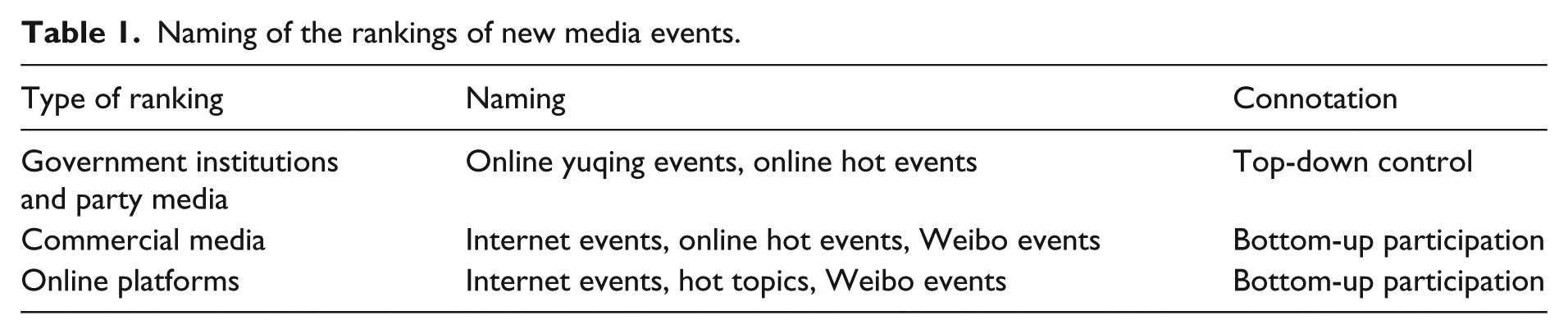
As discussed earlier, different social actors have applied different naming strategies toward new media events, implying their respective attitudes and purposes toward these events. Based on the naming of the 40 rankings between 2007 and 2016, we found that propaganda departments usually use the concept of “online yuqing events,” online yuqing research centers associated with party media prefer the term “online yuqing events” or “online hot events,” and commercial media as well as online platforms mostly employ the term “Internet events,” “hot topics,” or “Weibo events.”
Although the terms appear somewhat similar and only vary slightly in meaning, they suggest different values and reasoning logics toward new media events. As noted above, the power institutions frequently refer to the concept of “yuqing.” The literal meaning of “yuqing” is the intelligence of public opinion, implying that the subject of “yuqing” is those who need the intelligence—the political or administrative power holders—in order to maintain social order or stability (Hu & Chen, 2017). On the contrary, the term public opinion is born with democratic meanings. By engaging public discussion about social affairs, ordinary citizens could actively participate in the social management process (Hu & Chen, 2017). As such, “yuqing” indicates the logic of top-down control, while “public opinion” suggests the logic of bottom-up participation. In this sense, the term “yuqing” is the manipulative variation of public opinion in the Chinese context (Hu & Chen, 2017).
On the other hand, Jiang (2014) suggests that Internet events are public events, which can function as public opinion to pressure government to improve public life. Using “Internet events” or “Weibo events,” commercial media and online platforms avoid the logic of control and emphasize civic engagement and public supervision via the Internet, as well as promote social reforms. The term that commercial media prefer particularly complies with their long-standing journalistic values and the advocated professionalism. The two contrasting terms and their divergent connotations indicate the respective values and logics over new media events—Internet for social control or Internet for public engagement. From naming, reasoning to action, these terms aggregate the apparently diverse social actors in new media events and extract a clear pair of relationship between dominator and challenger in China’s Internet space, both striving for the legitimate image of social reality. Table 1 summaries the naming and its respective connotation of the different types of rankings.
Naming of the rankings of new media events.
With regard to the same new media event, different types of rankings also employ different naming strategies. Take the case of “My father is Li Gang” 4 as an example. The IYMO named the event as “Li Gang’s son drove into people and caused death in campus”; the China Youth Daily website listed the event as “Li Gang gate” event (imitate the Watergate scandal); and the Mop forum, in association with the other 22 traditional media, mostly commercial newspapers, named the event as “Li Qiming drove into people” or “my father is Li Gang.” Compared with the neutral naming strategy of the party media–affiliated IYMO and other websites, online forums and commercial media applied the popular and sarcastic naming of “My father is Li Gang.” By making the naming easily recognized and widely circulated, commercial media and online forums used the event to mobilize massive netizens’ emotional responses (Yang, 2009) and expressed both sarcasm and criticism toward the officiallings and their wrongdoings, which is in fact a kind of public supervision and online activism (Xu, 2016; Yang, 2009b).
As to the “D8 Expedition” event, 5 most online platforms employed the term “D8 Expedition” or “D8 expedites on Facebook,” a short and easy-to-remember naming tactic, in order to promote the mass circulation of the event. The IYMO named it as “D8 emoji package battle,” while propaganda department named it as “D8 goes on an expedition on Facebook to battle against the Taiwan independent separatist force” (china.com.cn, 2017). Compared with the relatively neutral naming strategy of the party media–affiliated IYMO, the government propaganda departments displayed evident political rhetoric in the naming of this event and indicated clear judgments toward the event. Either for online mobilization or for political unity, the different naming strategies toward the same new media events show that naming and ranking have become “sites of contestation” (Barman, 2013, p. 106), where political and social actors actively define these events and interpret the meanings involved—mostly for their own purposes.
Type of new media events
Based on the topics or subjects involved, we categorize nine types of new media events (Xu, 2011): (1) civil events that concern people’s daily life, such as the rising consumer price and trends of real estate market; (2) significant political/economic/military events, such as the Beijing Olympic games and the satellite launches; (3) nationalism events, such as the Tibet riots and anti-Japan demonstrations; (4) official-citizen contentious events, mostly involving officials’ wrongdoings or improper behaviors; (5) cultural and entertainment events, such as sports games and celebrities’ personal affairs; (6) social moral events, such as microphilanthropy and animal welfare; (7) public security events, such as earthquakes and bus fire tragedies; (8) social class contentious events; and (9) others
Table 2 shows changes of the nine types of new media events between 2007 and 2016. For one thing, the official-citizen contentious events first expanded between 2007 and 2009 and have sharply declined since 2010. Another notable feature is that significant political/economic/military events sharply increased and reached the peak in 2014. The fact that non-contentious events largely entered the rankings of new media events suggests that the original meanings of new media events involving conflicts and contention have changed and have been substituted by consensual events. Public security events continue to enjoy high frequency in the rankings, except for the drop in 2012. Civil events experienced the largest fluctuation across time, with the highest frequency in 2007. Social moral events and cultural and entertainment events jointly took up the majority of the rankings, both with relatively high frequencies across time. Nationalism events also fluctuated considerably, with high appearances on the rankings in 2008 and 2015. In general, the types of new media events shown in the rankings have gradually diversified in the more recent years. Since 2014, many rankings have paid attention to international and overseas events, including those in Hong Kong, Taiwan, Macau, and other places. Rankings sponsored by propaganda departments also listed international events, so did Sina Weibo’s rankings. As the IYMO comments, Yuqing outside the mainland China has caught more and more Chinese netizens’ attention, such as the students’ Occupy Legislative Council movement in Taiwan, the Occupy Central movement in Hong Kong, and the Ukraine political upheaval. Fortunately, thanks to the successful guidance of yuqing, these movements did not influence the domestic situations. The Ukraine upheaval was interpreted to mean that swinging to the West could cause the national separation issues. The world outside has been in a constantly changing situation, but those changes did not cause any unrest in mainland China. It is a sign of the stable political situation in the mainland. (people.cn, 2014)
Changes of the types of new media events, 2007–2016.
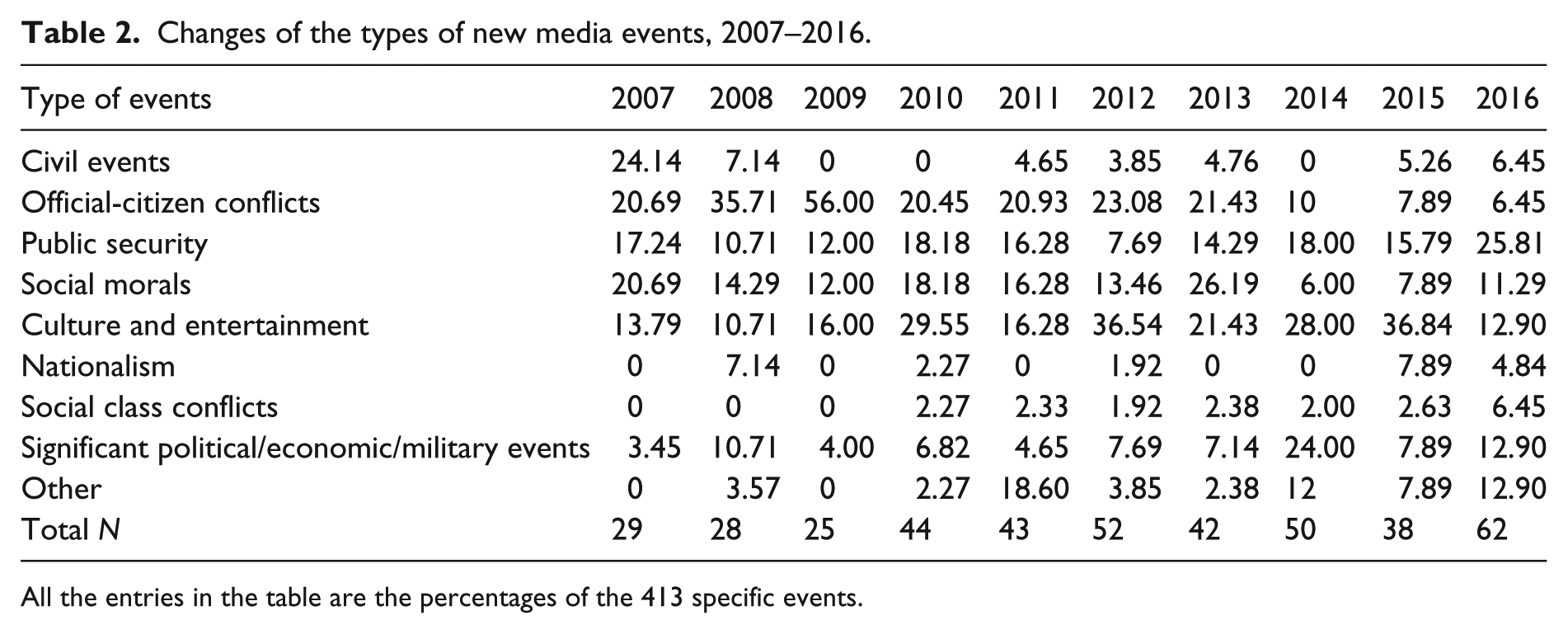
All the entries in the table are the percentages of the 413 specific events.
The comments above suggest that listing international events, in particular sensitive political ones, is not for the sake of increasing the volume and intensity of public attention that arouse in the mainland—in fact some events are strictly censored because these events contain possibilities for different interpretations and constructions. They are used as symbolic instruments to serve the political actors’ needs and purposes. It shows yet again that new media events are an important instrument of social construction of reality, and underlying government-sponsored rankings are the logic of political guidance and control.
Function of new media events
Based on previous research, we distinguish two major functions of new media events—contentious events and consensus events. Table 3 shows the changes of the two functions between 2007 and 2016. The number of contentious events reached the peak in 2009 (76%) and considerably declined after 2014, while the number of consensus events gradually increased over the years, despite minor fluctuations. The findings are consistent with Yang’s (2017) observation that the key changes of the Internet politics and cultures since 2013 were the decrease of contentious events and the increase of consensus events. It further indicates that the rankings of new media events as “sites of contestation” (Barman, 2013, p. 106) have been under constant construction, deconstruction, reconstruction, and transformation. Along with the decrease of contentious events in the rankings, the dynamics of the dominator–challenger relationship in the symbolic struggles over the Internet space has become less vibrant, and the degree and intensity of contention are weakened, while Internet management is strengthened.
Changes of the functions of new media events, 2007–2016.
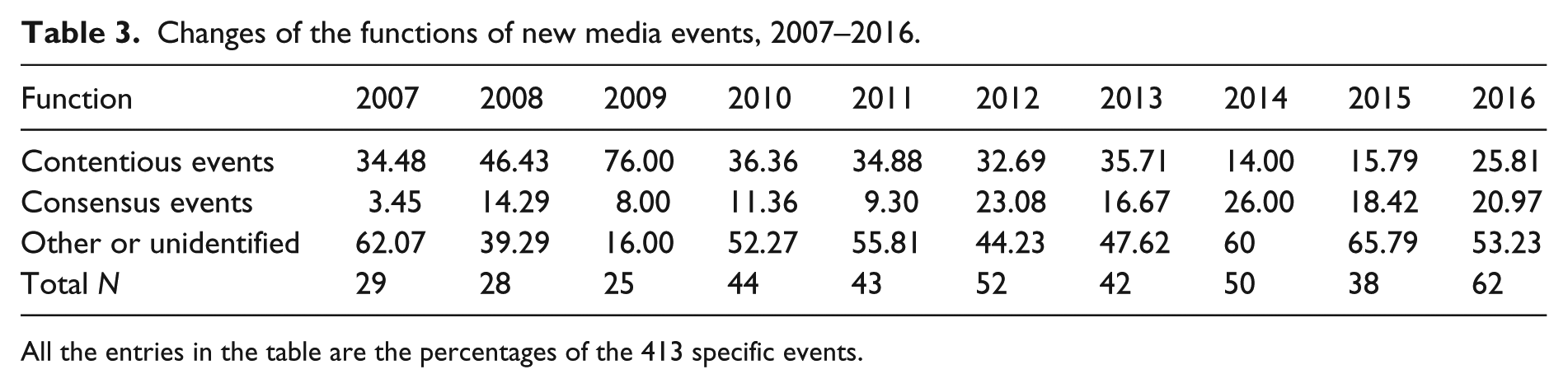
All the entries in the table are the percentages of the 413 specific events.
There are several reasons accounting for these changes. First, according to the changes of the types of new media events shown in Table 2, the number of official-citizen conflicts events sharply declined after 2014, while the number of significant political/economic/military events reached its peak in this year. Second, rankings sponsored by government propaganda departments started to appear in 2014, which mainly included the significant political/economic/military events that rarely involved social protest. This shows that the government as a type of sponsor has been actively engaged in the symbolic struggle over the construction of new media events. By naming and ranking these events, the government seeks to confer new definitions and interpretations over the idea of new media events. Furthermore, as Bourdieu (1989) suggests, rankings sponsored by the government provide “a base for symbolic struggles over the power to produce and to impose the legitimate vision of the world” (p. 20). The vision is not only political but also has social, cultural, economic, and symbolic significance in the network society.
Third, the IYMO offered an explanation of its 2014 ranking, stating that the consensus among traditional media, public opinion leaders, and netizens over new media events rebounded from the bottom in 2009 to its peak in 2011, and the degree of public recognition of the most remarkable events also went up from the bottom in 2009 to its peak in 2014. After 2014, the number of official-citizen conflict events listed in the IYMO rankings largely declined, while between 2007 and 2013, this type of events averaged six times every year and appeared 43 times in these years. It is possible that official-citizen conflicts happened less frequently after 2014. Nevertheless, the Tianya forum rankings of new media events still included the official-citizen conflicts events, accounting for 30% and 20%, respectively, in its 2014 and 2015 rankings. It suggests that this type of events may not have declined in reality, but has been purposively excluded from the lists.
Besides the changes of the specific new media events included in the rankings, more profound transformations of the landscape of Internet space were taking place due to the government’s series of administrative managements. As the People’s Daily–affiliated IYMO wrote in the 2013 Annual Report of Chinese Internet Yuqing Analysis, since August 2013, the government substantially reinforced the Internet management; the Ministry of Public Security launched a special action to fight against Internet rumors and detained a number of Weibo big “Vs”; besides, the expansion of party media and government Weibo accounts constituted an important establishment force in the universe of online public opinion, which published more microblogs than the big “Vs” (Zhu et al., 2014). It suggests that the government has employed the strategy of “hardness with softness” (gangrou bingji) to manage the Internet space, with “hardness” being censorship and intervention and “softness” being actively creating pro-government discourses (Yang, 2017). The rising number of consensus events in the rankings of new media events is the effect of the “softness” management strategy. In addition, the proliferation of the new social media platform—the WeChat—contributed to the decrease of Weibo active users and their activities. Compared with the public feature of Weibo, WeChat is more like a closed or semi-closed circle of familiar people, which could considerably weaken the effects of massive circulation and mobilization of thoughts and actions in new media events.
Overlaps among different types of rankings
Of the 40 rankings of new media events sponsored by three different types of actors, some list the top 10 or top 20 events, while others list the top 30s. To facilitate comparison across these rankings, we only compare the overlap rates among the top 10 or 20 events. In addition, since the IYMO rankings are the most consistent and the most complete, we use them as references to compare with other rankings. As shown in Table 4, between 2007 and 2009, commercial media rankings overlap with those of IYMO at about 40%–50%. However, the overlap rate decreased to only 10%–20% after 2010, and since 2014, there is rarely any commercial media rankings of new media events. With regard to the government propaganda departments’ rankings, they appeared since 2014 and kept a moderate overlap rate with the IYMO and even showed an increase rate in 2016. As to online platforms, mainly BBS and Weibo, the overlaps between BBS and the IYMO were at 30% in 2009 and 2010 and started a fluctuated increase since then.
Comparison of the overlaps across different rankings of new media events, 2007–2016.
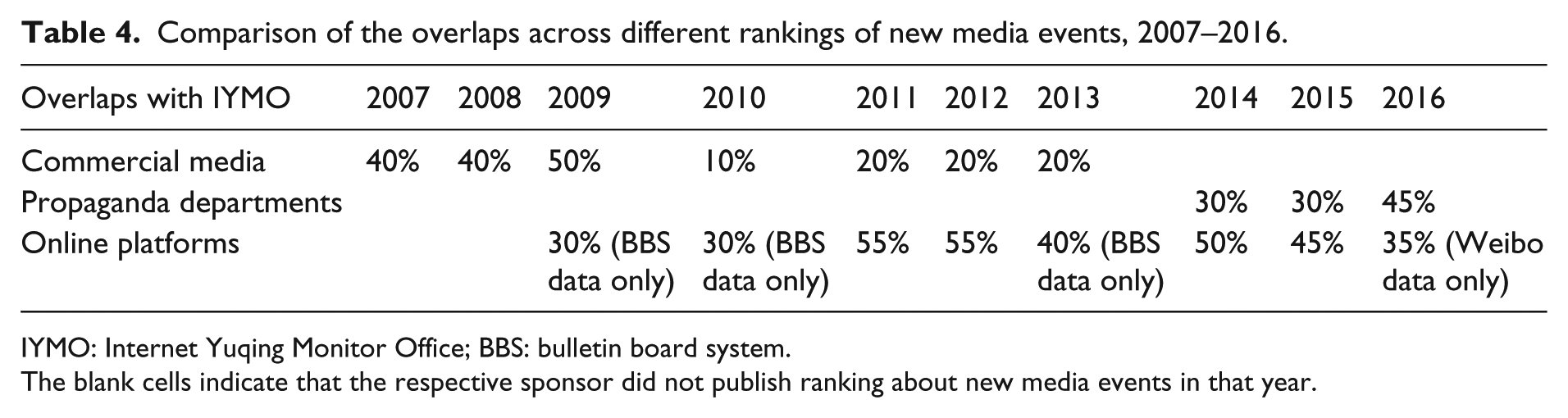
IYMO: Internet Yuqing Monitor Office; BBS: bulletin board system.
The blank cells indicate that the respective sponsor did not publish ranking about new media events in that year.
In general, most of the rankings shared lower than 50% of overlap rates, suggesting that different sponsors did create their own definition and construction of new media events via inclusion and exclusion of specific events. In addition, the data indicated the visible decline of commercial media in the contestation of new media events since 2013 and the convergence of IYMO that represents the party media and the government propaganda departments since 2015. Online platforms, however, did not demonstrate a clear pattern compared with the IYMO rankings.
If we take a specific year to compare the rankings, we can observe further differences over the construction of new media events. For example, in 2010, the YEN ranking highlighted social moral and official-citizen conflict events, with 40% and 20%, respectively, while the IYMO ranking included six cultural and entertainment events (30%) in the top 20 events. Commercial media and online platforms’ rankings of Weibo events also highlighted cultural and entertainment events (50%) and official-citizen conflicts events (30%). Furthermore, the IYMO’s ranking in this year did not include the destructive fire in Shanghai, which in fact caused great public uproar. The event entered many rankings published by commercial media and online platforms and ranked third on Mop’s list of top 10 Weibo events.
The rankings in 2014 are another example. The IYMO ranking in this year listed seven public security events and three cultural and entertainment events, which jointly account for 50% among the top 20 events. The propaganda department’s ranking includes eight significant political and economic events in the top 10 events, such as economic reforms, the fourth plenary session of the Communist Party Central Committee, and the new normal of economic situation (Li, 2014). Tianya forum, however, listed three official-citizen conflict events out of the top 10, including anti-corruption events. The propaganda department’s ranking shared 30% overlap with that of the IYMO, and 20% with that of the Tianya forum, while the IYMO and the Tianya forum shared 50% of overlap.
With regard to the 2015 rankings of Weibo events, Sina Weibo’s rankings include various types of Weibo events as well as significant political and economic events, while commercial media and online platforms’ Weibo events rankings focus on entertainments (70%) and social moral events (20%). The two types of rankings share 40% of overlap in 2011, 30% in 2014, and only 10% in 2015. It suggests that even when we narrow the scope of new media events down to Weibo events, different sponsors still employ divergent ranking strategies to highlight certain types of events.
Interpretations of new media events across different rankings
Beyond the “what” questions about specific events and their sequences on the rankings, sponsors sometimes offer interpretations over the selection principles and the social impact of these events, accounting for “why” certain events were included and ranked. For example, the SMD listed the Guo Meimei event 6 in the 2011 annual ranking and commented that the event was a trigger that allowed massive numbers of netizens to expose the scandals of the Red Cross in China. The SMD conveyed evident values of progressivism and clear support to the challenging power of new media events toward the status quo in social, legal, and even political arenas. It sought to use new media events as symbolic instruments to voice its own values.
The propaganda departments also employed discursive strategies to interpret the rankings of new media events. In 2014, the CINRC associated with the propaganda department listed the “Occupy Central” movement in Hong Kong and defined the movement as illegal, which “motivated strong patriotism in society.” Another listed event—the Kunming railway station terrorist attack—was interpreted as raising massive wrath and building social consensus toward terrorism (Xinhuanet, 2014). As such, the propaganda department seemed to borrow the concept of new media events or yuqing events to serve purposes of public administration and social management by emphasizing the positive social effects of negative yuqing events.
In addition to the interpretations of specific events, sponsors of rankings sometimes offer general comments on public opinion leaders in new media events. In 2008, the IYMO stated that in the process of Internet management, the government should keep in touch with the opinion leaders and respect their rights to supervision and criticism over social problems and official scandals (Zhu, Shan, & Hu, 2009)—optimistic attitudes toward online public opinion and its supervising functions. In the 2013 annual report of Internet yuqing events, however, the IYMO focused on the negative effects of online public opinion, stating that some big “Vs” on Weibo had numerous followers, which might enlarge the negative effects if they posted untrue news or rumors (Zhu et al., 2014). Meanwhile, the IYMO started to shift concerns from exposing negative events to voicing positive events. In 2015, the IYMO commented over the annual ranking that positive energy (zheng neng liang) had won the power of public discourse (Zhu, Pan, & Chen, 2015).
From online public opinion supervision to positive energy, we have observed the same sponsor’s substantial changes toward the interpretation of new media events and subtle shifts in attitudes toward the challenging power of new media events. From exposing wrongdoings to establishing social cohesion, the function of new media events has undergone transformative changes, suggesting that the construction of new media events has been under constant contestation and negotiation. The changes over the definition and interpretation of new media events were tightly accompanied by the government’s Internet management policies (Yang, 2017; Zhu et al., 2014). On one hand, the government continued to censor online public opinion, in particular via the regulations of real-name registration on WeChat and the institutionalization of online opinion guidance (Zhu, Pan, & Shan, 2014). On the other hand, it started to employ the “soft management” (rouxing zhili) strategy to administer the Internet public opinion, such as encouraging the communication of “positive energy” and civil discussion (Yang, 2017; Zhu, Pan, & Shan, 2014). It shows that the government has gradually taken the lead in the sites of contestation over the discursive power of the Internet and has utilized its dominant political and legal power to weaken and transform the challenging feature of new media events toward its own use. As the IYMO wrote in the 2016 annual yuqing report, the government’s response capacity toward online public opinion increased a lot (Zhu, Pan, & Chen, 2016). Through both hard and soft management, online public opinion has been largely incorporated into the government’s agenda, and its challenging power was therefore undermined.
Looking back to the divergent naming and rankings of new media events, we first find that new media events have become the critical sites of contestation over the discursive power in sociopolitical areas, where expression, negotiation, domination, and contention frequently take place and interact with one another. Through both online and offline participation, the government, mainstream media, and online public opinion form a triangular relationship of “dominator–mediator–challenger” in the sphere of controversy in Chinese society (Liu & Chang, 2018), and the various forms of this relationship can be viewed as the consequences of the actors’ symbolic struggles. Naming, ranking, managing, and resolving new media events are different representations of the struggle. To some extent, naming and rankings of new media events have become a profitable industry for the trading of symbolic capital such as public reputation, recognition, social trust, governance performance, and political legitimacy (Hu & Chen, 2017; Yang, 2017).
From the perspectives of sociology of knowledge and social constructionism (Berger & Luckmann, 1966; Park, 1940), the naming, ranking, definition, and interpretation of new media events are important forms of social knowledge that abstract and formalize the transcripts of social reality from the numerous happenings in practical lives. Those who can dominate the production and communication of social knowledge about the Internet could largely legitimize themselves to steer society and control the institutional order. As Dumitrica (2013) indicates, the discursive constructions of the Internet “are understood here as a site of struggle over meaning and, by implication, over social order” (p. 586). In this sense, the contention over the construction of new media events could go beyond practical interests and touch fundamental values and ideologies of the whole society.
From a long-term point of view, the dominant social knowledge and social transcripts may become the collective memory of social members at large. As Chang and Holt (2011) point out, “each name drives and is sustained by narratives in the process of ‘collective remembering’, telling stories, suggesting links with behavior and unfolding events, giving full expression to metaphors” (p. 397). Ranking not only suggests the visibility, salience, and significance of new media events but also conveys the legitimacy of these events. Zhong and colleagues (2017) find that the visibility of new media events in traditional media coverage is positively correlated with people’s collective memory of these events, and they suggest that new media events that appeared on media, in particular traditional media, are often those permitted to be publicly discussed, which says, the safe events. By emphasizing what could be remembered about the listed events and forgetting those unlisted, rankings function as an important mechanism of collective memory (Klaic, 2011). At any rate, ranking new media events is an effective way to write China’s Internet history, officially or unofficially.
Conclusion and discussion
By taking the ranking of new media events as an exemplar of the symbolic struggle among different sociopolitical actors in the Internet space in China, we find that different actors actively engage in the contestation and construction over new media events by proposing different naming and ranking strategies. Some actors construct the rankings based on their values and philosophy, such as commercial media’s emphasis on progressivism and liberalism, and propaganda departments’ focus on social management and institutional order. Rankings are not merely the products of political and power struggles but are also consequences of economy, technology, and public opinion. Essentially, the divergent constructions over the naming, visibility, and public salience of new media events demonstrate the symbolic struggles over the discursive power of the Internet space, which, in the long run, can shape the landscape of social knowledge and collective memory of the Internet in China. By highlighting the listed events and “forgetting” those unlisted, rankings of new media events form, maintain, and transform the collective memory of these events. If we look back at the history of the Internet in China, we may find that these visible and ranked events constitute an indispensable part of the history. To some extent, the rankings even construct the Internet history. The contestation over the ranking of new media events manifests the struggle over the writing of Internet history.
A turning point in the development of new media events appeared in 2014, when the government propaganda departments started to publish their own rankings of new media events, which were different from the other types of rankings both in the definition and in the interpretation of new media events. The empirical data show the decrease of contentious events, the increase of international events, and the growing visibility of significant political and economic events that are barely contentious. Meanwhile, the government’s management of new media events has become more professionalized and sophisticated, which means that many contentious new media events could be resolved even before they become widely publicized. For this reason, it is possible that the observable new media events have decreased in numbers and scales since 2013.
We may ask why there are so many rankings of new media events. The reasons are not only political or ideological but also economic and social. Take the IYMO for example. Besides the annual rankings, it also publishes provincial, regional, and departmental (e.g., the Public Security Agency, the Court, and the Procuratorate) rankings of new media events, which increase the administrative pressure on local governments. At the same time, the IYMO offers services like yuqing monitor, analysis, management consultancy, and online media public relation consultancy for central and local governments as well as enterprises and social groups (IYMO, 2012). By regularly publishing provincial yuqing rankings, the IYMO pushes local officials and enterprises to reduce the negative social influence of local events. Some institutions and corganizations may even pay money to yuqing centers to request that their local events not be listed in the rankings or to simply delete online posts about local affairs (Hu & Chen). That is one of the reasons why the yuqing industry has become a huge business under the central government’s emphasis on Internet management and political performance. Meanwhile, politically, the government seeks to guide online public opinion along with the legitimate ideology through rankings. Rankings are evidence of the government’s cleaning of the Internet space. In addition, rankings are important fields for commercial media to convey their stance and reinforce their social impact. As to individual netizens, publishing their own rankings of new media events is a form of bottom-up discursive struggle.
This study offers empirical evidence to support the widely discussed arguments about the decline and the substantial shift of new media events in the most recent decade. We sought to employ the perspective of symbolic struggle to explain the changes in the rankings of new media events. However, since we mainly focused on rankings as products of the symbolic struggles across social actors, more interesting issues about how these rankings are produced, via which criteria and why, are yet to be addressed by interview or field observation. Future research may focus on the dynamics of the production of rankings as well as on the commercial aspects of the ranking industry.
Footnotes
Acknowledgements
We thank the symposium organizers and attendees for their valuable comments and suggestions. Research supports from the School of Journalism and Communication at Wuhan University and the College of Literature and Journalism at Sichuan University are gratefully acknowledged. An earlier draft of this paper was presented at the Symposium on Digital Formations and Chinese Experiences: Creation, Appropriation, and Circulation held at the Penn Wharton China Center in Beijing, June 2017.
Funding
This work was an output of the Independent Research Project (Humanities and Social Sciences) of Wuhan University, which was supported by the Fundamental Research Funds for the Central Universities in China, and an output of the Significant Research Project–Internet Communication Forms and Social Governance in the Central-Western China, which was supported by the Ministry of Education in China [17JJD860004].