




Abstract
This article proposes that the emergence of a digital working class is among the most important digital formations in contemporary China. From the information have-less to network labor, the class formation process is not only massive in scale but of special historical significance that constitutes a fourth phase in the making of the Chinese working class. There is urgent need to theorize the digital working class based on a wide range of theoretical resources. Toward this goal, the circuits of labor model is discussed as an inclusive framework to link up various analytical concepts and provide a more holistic picture about both the contextual forces shaping the digital working class and internal dynamics within. The conceptual model sheds light on empirical cases such as Apple Inc., Tian Yu, and Fan Yusu, showing that while the circuits of labor model still needs more development, it is likely to pave the way for a new praxis of class-conscious digital formation. The limitations, scope of application, and future prospects of the circuits of labor model are also discussed.
Introduction
Class formation is among the most fundamental social dynamics of any society, yet it is also among the most often neglected. Under the circumstances of “neoliberalism with Chinese characteristics” (Wang, 2006), issues of social class are marginalized, if not completely suppressed, in state propaganda apparatus as well as market-oriented legacy media, as if social class no longer exists in post-Mao China, an era dominated by elite politics, which is in fact also contested from the bottom up, including in intellectual circles (Zhao, 2008; Zhao & Wu, 2017). If class still matters at all, it is the dominant class, the ruling class, and/or “the middle classes” that come to limelight instead of the working class or “the subordinate classes” (Goodman, 2014, pp. 92–122). The unmaking of China’s working class is, however, accompanied by two crucial developments: (a) China has become the world’s largest industrial powerhouse, especially since the country entered the World Trade Organization (WTO) in 2001, which would have been impossible without the world’s largest industrial workforce (Hong, 2011) and (b) the rapid diffusion of digital media technologies, especially “working-class ICTs” (information and communication technologies) among diverse working-class populations, which creates a new stratum of the “information have-less” that paves the way for the emergence of “working-class network society” (Qiu, 2009). The massive industrial materialization of China’s new working class, lacking access to conventional institutions (e.g. trade unions) and legacy media outlets, thus has few choices other than taking digital channels as the main conduit of its social formation.
What are the basic characteristics of China’s digital working class (DWC), its patterns of formation, the vectors influencing this crucial social emergence? How to make sense of the DWC, using what theoretical resources and historical points of reference? This article attempts to address these questions at a macro, historical level, while also providing empirical glimpses at developments on the ground and online. The main theoretical argument is that we need a holistic conceptual framework in order to better understand China’s DWC. One such framework is “circuits of labor (CoL),” proposed by Qiu, Gregg, and Crawford (2014), which needs further fleshing out and critique. The later part of this article introduces the CoL model, demonstrates its usefulness, and discusses its limits and implications for future research on digitally mediated social class formation in China and beyond.
DWC: contexts and concepts
Rather than an isolated development, the rise of China’s DWC needs to be understood as part and parcel of four overlapping grand historical processes: industrialization, urbanization, globalization, and privatization. During the Maoist era, although the Chinese Communist Party (CCP) invested considerably in industrial buildup, especially in the heavy industries, overall, the national economy remained predominantly agrarian with the agricultural sector absorbing most of China’s labor force. By the end of the 1970s, urbanization in China remained at a low level compared to other large third-world countries (Qiu, 2009, p. 87). Pursuing the strategy of “self-reliance,” the country’s state—owned and collective enterprises—accounting for 95% of urban economy in 1978—had negligible transactions with either blocs of the Cold War, while the very few privately owned businesses could only survive through limited activities in their restricted localities (ibid, p. 89).
In a generation’s time, the trends were decisively reversed when digital media started to diffuse in the mid- and late-1990s (Hsing, 2010). From 1978 to 2005, the level of urbanization measured by the percentage of Chinese population living in cities increased from 17.9% to 43%; the proportion of non-agricultural sectors (manufacture, construction, and services) in national economy leaped from 29.5% to 55.2% (China Population Statistics Yearbook, 2006). An equally fundamental change is for the Chinese economy to become export-driven with the country producing in 2005 more than a third of the world’s computers and mobile phones, more than half of the world’s digital cameras and air conditioners, and more than 70% of the world’s lighting equipment and shipping containers (Zeng & Williamson, 2007). Private enterprises, rather than state-owned enterprises (SOEs) or collectively owned enterprises, are responsible for the bulk of the high volumes of export that makes China “the world’s factory.”
These are, in broad strokes, the social contexts for the rise of the DWC: the new working class takes shape, while starting to adopt digital media, under conditions of the fundamental, macro-structural transformations as China urbanizes, globalizes, industrializes, and privatizes its economy in leaps and bounds. As Marx (1979) proclaimed, “Men make their own history, but they do not make it as they please; they do not make it under self-selected circumstances, but under circumstances existing already, given and transmitted from the past” (pp. 103–104). Things digital are instruments of class making but they are also tools of capital and tools of the state. They mark a new sense of history making, but the underlying circumstances of economic inequality and labor disempowerment have to be reckoned with (Hong, 2011; Zhao, 2008).
Against such a backdrop, it is imperative to avoid the common misunderstanding that construes social class as a hierarchical structure in which individuals are divided into static categories of the upper class, the middle class, the working class, and the underclass. Such an approach of categorization may be useful for the understanding of past conditions and contemporary society at a superficial level. But its utility is limited to shed light on the DWC, whose internal composition and external relations are both multi-faceted and in flux under new and old conditions of “digital capitalism” (Hong & Wang, 2015; Schiller, 1999; 2014).
This is, of course, not the first time when we confront blurry boundaries around processes of class formation. EP Thompson’s (1966) famous account of the English working class begins with the first chapter “Members Unlimited.” For him, social class is neither constant nor innate. Rather: class happens when some men, as a result of common experiences (inherited or shared), feel and articulate the identity of their interests as between themselves, and as against other men whose interests are different from (and usually opposite to) theirs. (1966, p. 9)
The solidity of old-class categories melted into air well before the arrival of the digital when neoliberal forces of industrialization and globalization, privatization, and urbanization had undermined Maoist class politics and re-configured class relations from the top down. Digital media, under such circumstances, is not a novel social development. Instead, it extends and strengthens the existing tendencies of Chinese neoliberalism.
Following Thompson, while considering the Chinese contexts, I submit that it would be much more fruitful to construe social class as a relational concept when an individual’s class status is defined not simply by relatively static socioeconomic status and binary positions, for example, of buyer vis-à-vis seller in the labor market. Rather, it is defined more precisely by one’s class identity and political, cultural affiliations, which may or may not overlap with one’s income or education. More importantly, social class also operates at collective and societal level, as a movement or process that is often removed from an individual’s class membership, when new forms of solidarity emerge from diverse groups and bind them into a new force of transformation. This dynamic and relational process of class formation is arguably of more central importance to the working people, “the multitude” (Hardt & Negri, 2004), than to the power elite.
The DWC is thus a process of emergence. In the Chinese context, there is, on the one hand, what I term “the information have-less” (Qiu, 2009), that is, workers, working families, and communities, who have gained access to working-class ICTs but they still face discrimination in society, online and off. As a result, they also have less vest interests—compared to the more privileged groups—in the status quo. This means that the information have-less groups can be seen as the digital reincarnation of Marx’s “class in itself.” When more organized, acquiring more class consciousness and more capable of articulating and promoting their own class interests, the have-less people would be transformed into “network labor,” a “class for itself” that serves as a third pillar of network society on par with “network enterprise” and “network state” (Qiu, 2009). In other words, the concept of the DWC is designed to capture the entire historical process from the information have-less to network labor, a hypothesis that is still in an early stage of its empirical unraveling.
More specifically, the DWC results from two modes of digitally facilitated class formation. First, “networked labor”: workers and their work becoming digitized and networked by multinational corporations according to the logic of network enterprise, often in collaboration with network state, for example, Chinese government working alongside the United States in promoting the interests of Walmart (Chan, 2011). Capitalism has entered a digital phase. Even the idiosyncrasies of individual capitalists cannot resist the move toward digitalization, whose applications go far beyond computers and hand-held devices in the workplace into the web of world trade and the depth of the financial market. The result is a planetary system of “international division of digital labor (IDDL)” (Fuchs, 2014, p. 5) that encompasses such diverse industrial sectors as mining (e.g. rare earth minerals from Baogang Group), components manufacture (e.g. BIEL, a major producer of touch screens), electronics assembly (e.g. Foxconn, which make iPhones), digital content and services provision (Yao, 2017), and e-waste processing (e.g. in Guiyu, Guangdong Province). Some of these jobs belong to conventional extractive, manufacture, and construction sectors; others such as technical support and content production are novelties necessitated by the New Economy. Together, this industrial system of digital media, broadly defined, gives rise to millions of jobs, including large quantity of “programmable labor” in the Chinese context (Qiu, 2009). Workers employed to perform these job duties do not create or alter their work out of free will. They are “networked” more or less passively by the system, so to speak.
Second, and on a smaller scale, we see workers proactively adopt and modify digital media to better suit their work needs, the needs of their families and communities, and the collective interests of the information have-less while articulating and defining their needs and interests that would serve as the basis for the emergence of network labor. The key here is “needs,” including “informational needs” or more broadly speaking “existential needs” of the working people to find jobs, residence, health care, and education—in order for themselves and for their families and communities to survive in the whirlwind of neoliberal digital capitalism with Chinese characteristics. Needs do not come from advertisement or viral marketing campaigns designed to install desires and wants in the minds of consumers. If there is something solid about the DWC, then it must be this foundation of individual and collective needs, without which the information have-less would face extinction and life-threatening peril. At the grassroots level and in everyday work and life, members of the have-less groups such as migrant workers and retirees would use the likes of cybercafé and affordable mobile services to help each other and form their own networks. At critical moments (e.g. strikes) and particular places (e.g. grassroots nongovernmental organizations (NGOs)), the networks of everyday micro-coordination would scale up into meso- even macro-level network labor formations with distinct class consciousness and sociopolitical organization. Much more than tools of communication, the digital becomes the backbone of workers’ shared common experiences as they form spontaneous networks, horizontally and from the bottom up.
The two routes of DWC formation, one relatively passive and the other more proactive, are anything but linear social processes. Marxian class theory is often misunderstood as another version of economic determinism, when industrialization inevitably leads to the growth of working-class population, which in turn means the strengthening of working-class power and identities. This reductionist and mechanic view of what Fredric Jameson (1974) calls “vulgar Marxism” (p. 293) does not hold if one examines the discrepancy between economic reality and working-class consciousness in modern Chinese history.
From the founding of CCP in 1921 to the establishment of the People’s Republic of China (PRC) in 1949, the Chinese economic base was almost exclusively agrarian with negligible working-class population. Attempts of large-scale industrialization were stalled by warlords and armed conflicts. Yet, the CCP was able to mobilize wave after wave of working-class political consciousness among the poor and certain members of the elite in support of its successful revolutionary cause against the Nationalists who were defeated in the civil war. From the first Five-Year Plan (1953–1957) onward, the PRC invested strategically in industrial buildup, especially in SOEs, and the economic structure was transformed steadily, although by the late 1970s, more than 70% of China’s economic output still came from agriculture. However, under Maoist rule, which epitomized in the Great Proletarian Cultural Revolution, class identity and politics of class struggle became super-intense, reaching its peak in recent history (Meisner, 1999).
The beginning of the 1980s marked the start of an interregnum period that was also China’s neoliberal turn. Post-Mao industrialization was spearheaded first by township and village enterprises (TVEs) and then private businesses including joint-venture factories that sprung up in southeast coastal areas, attracting migrant workers from the hinterland as their main source of labor. Working-class population took off. For the first time, employment in manufacture, construction, transportation, and services surpassed agriculture. But this interregnum period witnessed a decline of working-class politics. As capitalist “boss (laoban)” became the new celebrated identity in commercial media and in everyday conversation, “worker (gongren)” was increasingly marginalized in oblivion except when occasions would arise for “migrant workers (nongmingong)” to be ridiculed as country bumpkins or for “laid-off workers (xiagang gongren)” to be watched over as potential threat to “social stability” (Hurst, 2009; Lee, 2007). Since China entered the WTO in 2001, it has become “the world’s factory,” also home to the world’s largest working-class population. Industrialization, including in the digital media sectors, has become a major pillar of Chinese economy. However, working-class consciousness and solidarity have arguably reached its lowest point in modern history.
The above overview in retrospect reveals a counter-intuitive pattern: as China industrializes, its working-class politics subsided instead of going through an upswing. Why? Reasons can be found in the ebb and flow of global communism bookended, for instance, by the rise and fall of the Soviet Union and in the transformation of the CCP itself into a post-revolutionary bureaucracy suppressing rather than mobilizing labor movement. Another important factor is the changing subjectivity of Chinese workers, whose agency is molded in institutional structures and media environments of the time. While class consciousness can result from political mobilization with little economic base, it can also dissolve in conventional identities (e.g. nationalism), consumerism, and political apathy through structural cultivation. Extending this analysis, one therefore shall conceptualize the DWC as a complex and historical process full of contradictions—between the economic and the sociopolitical, between the technological and the cultural and ideological—all integral to the multi-faceted class politics in China today, including both class making and unmaking, both formation and deformation.
Theoretical resources
Under conditions of neoliberal structure–agency relationships, working-class subjectivity is weak among not only manual workers and wage laborers but also intellectuals studying digital media in contemporary China. A meta-analysis of 1705 Chinese- and English-language articles in the field of China ICT research exposes a highly uneven terrain (Qiu & Bu, 2013): Researchers devote most of their attention to four types of subjects who are supposed to be owners, managers, and agentic decision-makers on matters related to digital media including (a) commercial enterprises (587 articles or 34.4% of the total sample), (b) Internet users (560 or 32.8%), (c) media professionals such as journalists and web designers (495 or 29.1%), and (d) the party state (419 or 24.6%). In stark contrast, only .9% (16 articles out of 1705) examines how workers use digital media, significantly fewer than studies on farmers using ICTs in rural areas (1.4% or 24 articles).
There is nothing natural about the dramatically lopsided academic field that scrutinizes commercial enterprises, professionals, and party-state authorities while having scant interests in working-class people and the issues they face. The uneven pattern runs against the backdrop of a massively industrializing Chinese economy. It also defies the demographics of Chinese Internet user population. According to official statistics, 41.1% of Chinese Internet users did not receive a bachelor’s degree in July 1998, meaning they are likely to have working-class jobs. The percentage climbed up to 78.8% in July 2008 and to 88.4% in June 2017 (China Internet Network Information Center (CNNIC), 1998/2017). Using education attainment as a partial indicator for social class formation, one can see that nearly 9 out of 10 Chinese Internet users belong to the working class or the information have-less stratum. Yet, researchers for the most part only concentrate their analysis on the top one-tenth of the entire user population, be they entrepreneurs, professionals, officials, or middle-class users. Notable exceptions in recent years include Hong (2011), Hong and Wang (2015), Zhao and Wu (2017), and Yao (2017).
The vast mismatch presents a serious problem as well as a rare opportunity for scholars to bridge the gap between social reality and academic theorizing at a time of fundamental structural change, from industrialization to urbanization, now extending into digital spaces. This is particularly so if we see social theory as cumulative, dynamic, responsive to changes in society (including in online environments), and having dialogue with classic theoretical formulations. The most obvious of the classics would be Marx’s systemic analysis of capitalism revealing the hidden mechanisms of surplus value exploitation and labor alienation as well as his model of communist revolution triggered by internal contradictions of capital, expressed through class struggle by the proletariat. Nick Dyer-Witheford (1999) had long argued for continued relevance of Marxist analysis under conditions of high-technology capitalism. More recently, Christian Fuchs (2015) calls for a revival of Marxism by revisiting Capital Volume I when he sees the struggle between digital commons and proprietary corporate Internet as the new “class struggle” in digital capitalism.
It is, however, not just Marx, his followers and critics. Researchers from other social-science traditions can find important theoretical resources from Max Weber as well as Emile Durkheim, among other theorists. Weber (2012), for instance, developed the famous critique regarding the “iron cage” of rationality which can be seen as a strong form of bureaucratic disciplining against all living labor through a cultural and organizational mode of alienation (p. 115). Society-wide, beyond the firm level, Weber’s analysis of “opportunity hoarding” explains another mechanism that gives rise to class formation and polarization through manipulated legal frameworks and skewed market relations (Wright, 2009). Although Durkheim (1997) is sometimes used by conservatives to justify class inequality as naturalized “stratification” of society, his original work in fact criticizes “abnormal division of labor” as a result from financial crises, “unnatural” class divisions, and poor business coordination, all contributing potentially to what he would call anomie, that is, societal disorder that would disrupt the life of everyone, particularly working-class people who are less resourceful and often found themselves in disadvantaged positions.
Classic social theory also has its critiques, one of which has special relevance to conceptualizing class formation in the Chinese context if one situates China in the broader context of the Global South. That is what Raewyn Connell (2007) would term “southern theory,” by which she understands the Asian, African, Latin American, and Indigenous thinking about European colonization, resistance by the southern populations, and their anti-colonial struggles. Connell applies two “tests of realism” to famous social theorists, such as James Coleman, Anthony Giddens, and Pierre Bourdieu, and found them failing the tests in that (a) they neglect colonization and dispossession while assuming Eurocentric universality and (b) they show no “capacity to recognize the dynamism of the periphery” (Loc 3732). As argued elsewhere, dispossession especially in the form of macro disempowerment under conditions of Chinese neoliberalism (Qiu, 2009, p. 94) was a cornerstone for the common experiences of the information have-less, who are, however, anything but passive and hopeless. Instead, they deploy diverse and dynamic strategies such as “social media on the picket line” (Qiu, 2016a). Both the experiences of dispossession and the strategies of resistance are essential to our theorizing of the DWC, which should be construed in relation to the broad range of southern theories, regionally in Asia and globally.
Another wealth of theoretical resources is under the rubric of “immaterial labor,” which is central to the fast growing literature on “digital labor.” There are at least two origins for the interests in immateriality, both having a lot to do with Italian radical theory. One is the autonomist Marxist tradition a la Lazzarato (1996) that zooms into informational and cultural work, Terranova’s (2000) concept of free labor under conditions of the New Economy, as well as the now-famous notions of social factory and multitude that apply at the societal scale (Hardt & Negri, 2004; Negri, 1989). The other is the feminist tradition that originated from critical assessments of social reproduction in the community, domestic sphere, prostitution, and care work (Dalla Costa & James, 1972; Federici, 1980; Fortunati, 1995, 2007), which was reinforced by influential works such as Hochschild (1983), Haraway (1991), Gregg (2011), and most recently, Jarrett’s The Digital Housewife (2015). The feminist tradition differs from the autonomist tradition in two important ways. On the one hand, it does not associate more economic, social, or cultural value with “immaterial labor” as opposed to material or manual labor, whereas it is a common tendency for autonomists to assume immaterial labor as an elevated form of work. On the other hand, feminists tend to pay more attention to theorizing beyond the metropolitan core regions of the Global North, thus converging with “southern theory” (Connell, 2007). As will be discussed in the following, a gender-sensitive approach is of particular importance to the social and cultural analysis of China’s immaterial labor and to the understanding of the DWC at large.
It is impossible to exhaust all scholarly assets that may contribute to the conceptual analysis of China’s DWC. Other helpful resources range from Gramsci’s (1971) theory of hegemony, intellectuals, and class formation, to British cultural studies, for example, Paul Willis’ (1977) examination of working-class youth, to German philosophy, for example, the proletarian public sphere (Negt & Kluge, 1993), to Manuel Castells’ (1996) constructs of the generic versus self-programmable labor. Overall, there is no lack of theoretical resources. On the contrary, the main challenge is that there are way too many new and old concepts of labor, material or immaterial, calling them knowledge workers, creative class, affective labor, volunteer labor, care worker, venture labor, playbor, fan culture, or commons-based peer production. The list goes on. Given the extraordinary size of the Chinese Internet and internal variation of Chinese society, each of these labor concepts can find a large or small niche in describing and even explaining some aspects of the DWC. Yet, the general picture is an archipelago of concepts which “consists of scattered pieces of knowledge, strung together by quite different approaches, dominated by loose fragments at national and local levels, disconnected from each other and from global contexts” (Qiu et al., 2014, p. 567). Our goal, however, is to conceptualize the DWC as dynamic structure and relational process with its historical complexities and internal contradictions. A more coherent and holistic framework is, therefore, in order.
The CoL model: applications and limitations
Drawing from previous attempts to theorize cultural circuits (e.g. du Gay, Hall, James, Mackay, & Negus, 1997), “circuit of capital” (Dyer-Witheford, 1999), “survival circuits” (Sassen, 2004), and “short circuits” (Zhao & Duffy, 2007), Qiu, Gregg, and Crawford propose the model of CoL “to connect conceptual developments at the crossroads between labor and ICTs, and to do so without discounting the significance of the corporeal and affective dimensions of the formal market sphere for labour” (Qiu et al., 2014, p. 567).
The CoL consists of two inter-connected circuits: one formal and the other informal (see Figure 1). The formal circuit is essentially one of economic production, top-down command, and the domination of capital over the working-class bodies. The factory regime in Marx’s Capital Volume I is a prototype of the formal CoL but it has since been expanded to the community and domestic sphere, to the affective domain and at a societal level. Based mostly on formal contractual relations as well as forces of customs and myth (e.g. myth about Steve Jobs or about the obedience of young female workers), the formal CoL is characterized by a social hierarchy of self-programmable, white-collar, and creative labor, who sells their high-value skills and knowledge, on top of programmable, gray-, and blue-collar workers, who sell their generic labor “below the line” (Mayer, 2011). This is a vertical system where the flows of capital, information, labor power, and resources are optimized for the accumulation of economic value. Automation through artificial intelligence (AI) is, for instance, among the latest tools to reach the goal of profit maximization in the formal CoL.
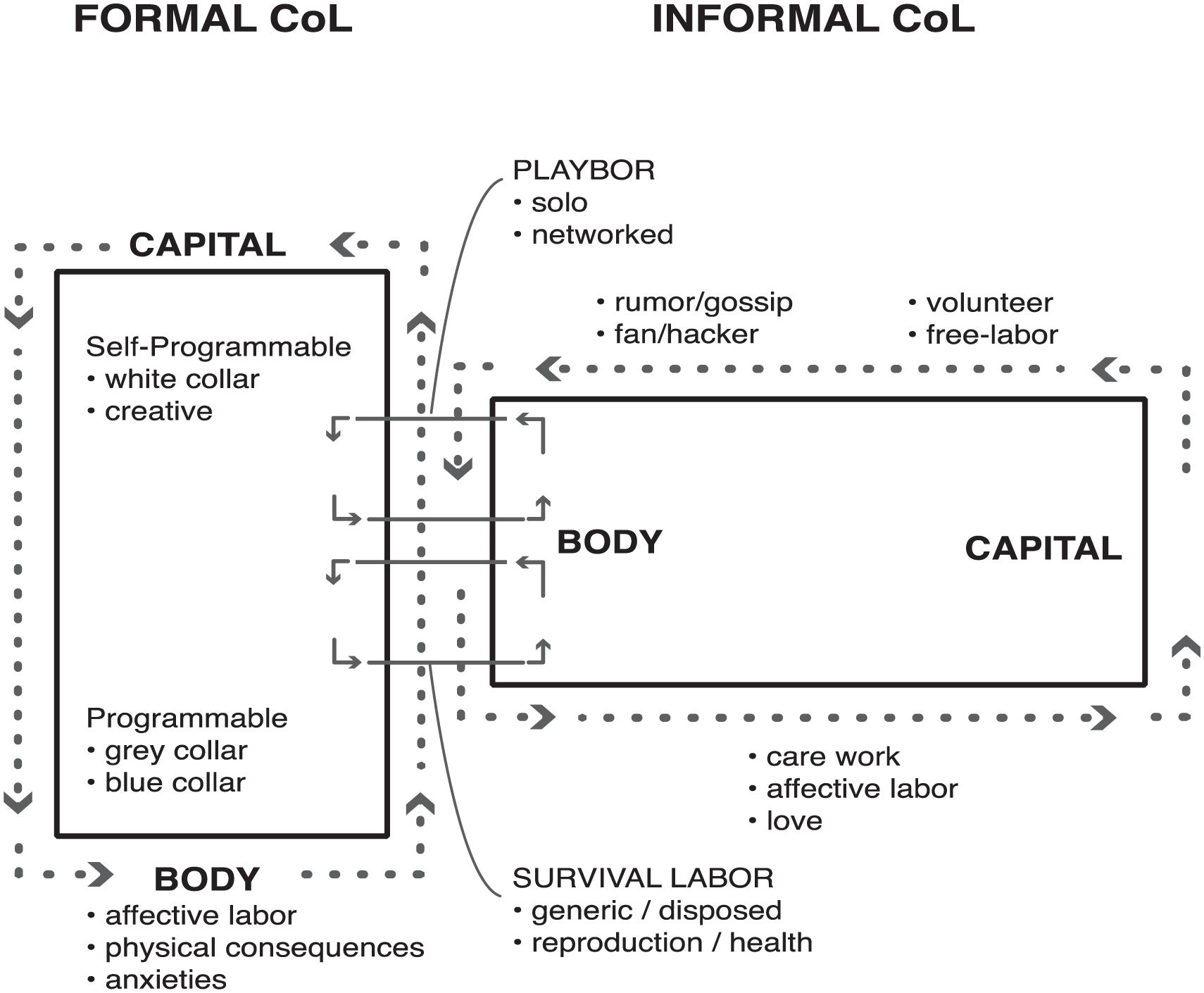
The circuits of labor (CoL) model (Qiu, Gregg, & Crawford, 2014).
The informal CoL, on the other hand, is more about the circulation of social and cultural capital more than the accruement of economic capital. It is largely informal because the activities are often voluntary, communicative, community-based, gemeinschaft (instead of gesellschaft). Body and embodied actions remain essential but they are sustained through horizontal, participatory, peer-to-peer, egalitarian network relationships. Labor, in a collective sense, is self-reproduced, self-valorized, and not alienated. If the formal CoL corresponds to the mode of DWC formation when workers are passively “digitized” and “networked” by the system, then the informal CoL would essentially be the many ways for workers, their families, and communities, to adopt ICTs proactively and apply their cultural creativity in social innovations that address their informational, communal, and existential needs. A good example is worker poems circulated in Chinese cyberspace, some of which became the basis of worker songs, free-of-charge musical performance, and freely downloadable MP3s by New Labor Art Troupe in Beijing (Qiu, 2009, pp. 121–123).
The formal and informal CoLs are connected through two short circuits; one being survival labor spun off from the formal CoL, sometimes due to system-generated unemployment and sometimes because the worker’s body is so abused that occupational diseases and work injuries arise. If not taken care of by the formal system, dispossessed workers may enter the informal circuits through the survival moment or else they face expulsions (Sassen, 2014). The other short circuit is “playbor” (Kücklich, 2005), when a more privileged group draws material and more often immaterial resources from both the CoLs in either solo or networked modes. Through the playbor short circuit, the formal structure can acquire resources from the informal community, for example, when a marketing company capitalizes on a trending meme that originates from an obscure subculture community. The informal networks may also borrow symbols, communicative strategies, and of course technologies and technical practices, from the formal side to enrich their social and cultural repertoire, achieve stronger affective effects (for instance, humor or empathy), even have “creative insurgencies” at times of crises (Kraidy, 2017).
The CoL model is still schematic, although its conceptual value should be recognized in (a) its linking up of isolated concepts of labor in both industrial and post-industrial conditions that are characteristic of China today and in (b) its offering of a structured way to observe, assess, and explain dynamics within the DWC and factors shaping such dynamics. A straightforward application is the business model of Apple (Figure 2). While Apple Inc. headquartered in Cupertino, California, sits at the pinnacle of the formal CoL; it depends on Chinese manufacturers such as Foxconn to produce its gadgets that serve as the basis for content creation, service delivery, and digital consumption in general. Employees in Foxconn and associated software and hardware industries have their bodies dominated by the design logic of Apple Inc. But it’s not only employees on the payroll in China, the United States, or elsewhere, but also Apple fans, who gossip about the next iPhone, who “like” a new corporate video featuring Tim Cook, whose informal, affective investments feed into Apple’s corporate image, into its R&D, and into its record-high profits. While public attention is directed to the cool and the playful, with or without Apple’s funding of the online advertising campaign, injured workers and victims of vocational diseases are disposed of, not to mention the long string of worker suicides at Foxconn (Qiu, 2016b). The formal CoL, in this case, absorbs cultural value from the informal CoL while discharging its human costs into the social domain. As such, the logic of capital domination over the body of workers is amplified from the formal to the informal CoL through both points of short circuits. This is how the story of Apple unfolds in China, giving rise to a new army of DWC who has little control over its own fate.
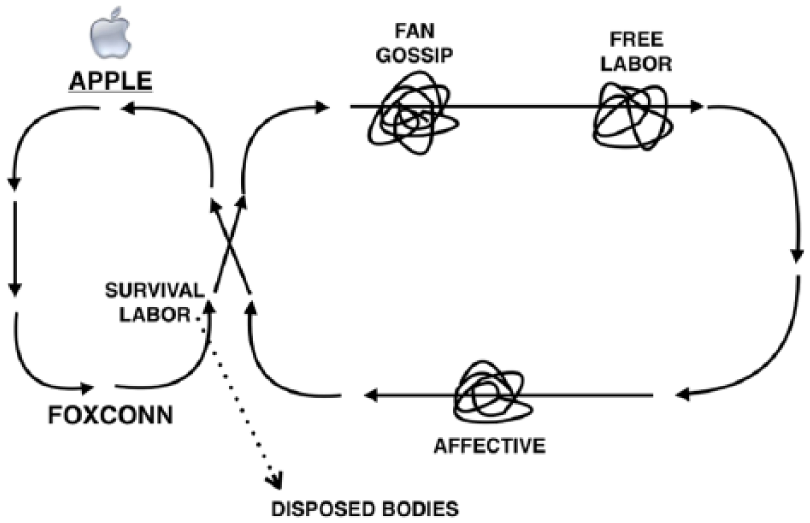
Application of the CoL model (1): Apple Inc.
Continuing the analysis of Foxconn, Qiu et al (2014) focus on an alternative CoL model, that is, the case of Tian Yu, a 17-year-old migrant worker who jumped from her Foxconn dormitory in 2010 and miraculously survived, although she has to spend the rest of her life in wheelchair (pp. 574–575). Figure 3 shows how the disposed body of Tian Yu entered the informal CoL. First, there was care and love for her from not only family but also university students (including two of my students) from Hong Kong, Mainland China, and Taiwan. Then, Chinese journalists and “netizens (wangming)” volunteered to tell and share her stories through both traditional media and social media. Tu Qiao, a reporter from Shenzhen Evening Daily, taught her to make handcrafts, and Tian Yu, with help from her family and relatives, started to make beautiful handmade slippers that they put for sale on Taobao, China’s major e-commerce portal. “Tian Yu slippers” as they were called suddenly went viral in 2013 because China’s Internet “Big-Vs” such as Yao Chen retweeted posts about the handcraft through their Weibo account (Qiu, 2012). Yao Chen, for example, has 80 million followers, comparable to Justin Bieber whose Twitter account has 102 million followers. The surge in public attention energized the small group of workers, students, and NGO activists around Tian Yu and their informal CoL was able to sustain itself without being sucked into the formal system. This is, therefore, a model of the horizontal networks being able to achieve self-sustenance and resist the vertical logic of capital domination through affective care work and social media free labor. It starts from survival labor while switching off the short circuit of playbor.
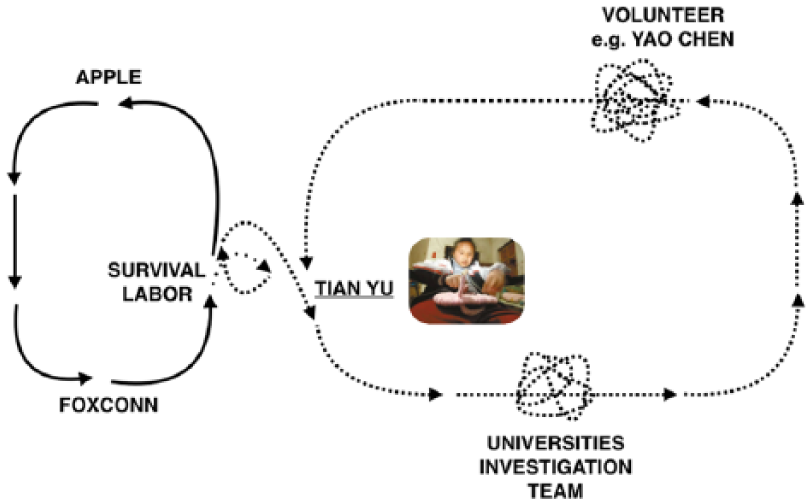
Application of the CoL model (2): Tian Yu.
The third and last illustration (Figure 4) is the so-called “Fan Yusu Phenomenon,” where the CoL model finds its application through a very different case, an unprecedented event when working-class cultural formation draws from the formal structures while successfully interrupting the logic of commodification. Fan Yusu is a 44-year-old domestic helper, who provides childcare to wealthy Beijingers. Growing up in the countryside, she dropped out from school at age 12 but kept reading literature and “developing her understanding of literature based on her life experiences, outside orthodox textbook literary history” (Zhang, T., 2017). She joined a “workers’ literature group” at Picun Village in the far outskirts of Beijing. On 24 April 2017, “Noon-time (Zhengwu)” a non-fiction WeChat public account under the corporate news portal Jiemian.com published Fan’s 7000-word essay “I am Fan Yusu,” which was shared more than 100,000 times within a day. Her writing is economical and powerful, sometimes sarcastic, sometimes bitter, but always confident with dignity, in a style that reminds this author of Ernest Hemingway, although key to her success has more to do with her “moral sway” than “her language and narrative flow” (Zhang, T., 2017).
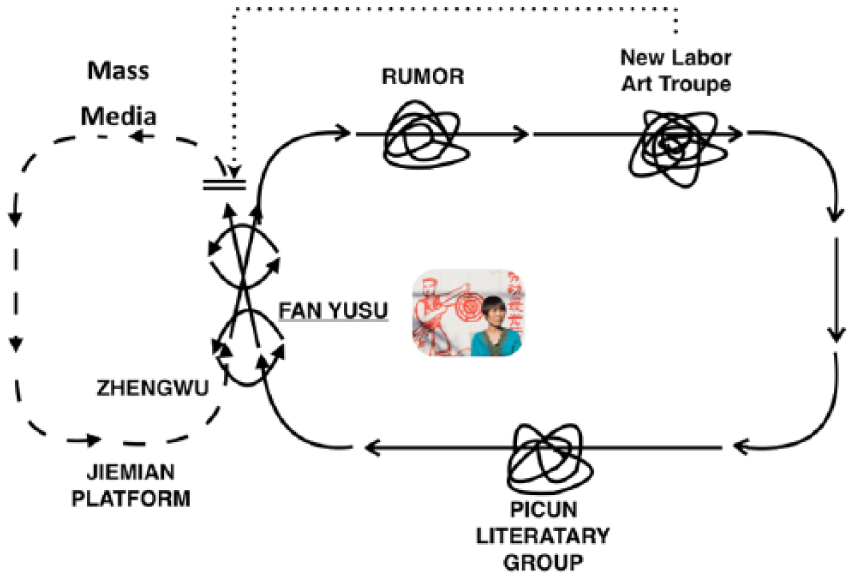
Application of the CoL model (3): Fan Yusu.
Since the beginning of the Chinese Internet in the 1990s, never before had a piece of pure text generated so much circulation and discussion in the general public beyond the small circles of grassroots worker-culture organizations. While this was not the first time when worker-generated content went viral (Sun, 2012; Qiu, 2009, 2016b), in almost all previous cases, the items being circulated included, or relied upon, images such as photographs and audio-visual materials. Selling her generic labor as domestic helper, Fan Yusu once found her position at the bottom of the formal CoL. But she leaped through the short circuit of survival labor to take part in the literature group, a collective unit of DWC that meets on weekends. It’s both a hobby group and a creative workshop when a dozen workers sharing interests in literature would discuss and improve their writings together with intellectuals such as Zhang Huiyu. According to Zhang, H., (2017), Fan stood out from the literature group because she reads a lot, especially on her smartphone and through her WeChat subscriptions. No one could predict the sudden popularity of her writing, but it resulted from Fan’s many years of reading and working experiences as well as the many months of collective agency-building within the workers’ literature group.
This literature group is a branch of New Labor Art Troupe (NLAT, Xingongren Yishutuan) in Beijing, which used to be known for their musical and theatrical performances as well as their Migrant Worker Culture and Art Museum (dagong wenhua yishu bowuguan) and Migrant Worker Spring Festival Gala (dagong chunwan) (Qiu, 2009). Since 2002, the NLAT has developed a long tradition of using mass media and social media for expression and advocacy goals promoting the voices and interests of migrant workers. When reporters swamped Picun Village trying to find Fan Yusu for interview opportunities, this collective experience of media management allowed NLAT and the worker’s literature group to do something more audacious than the past: they not only switched off the short circuit of playbor but also disrupted the routine industrial process of mainstream media, thus severing the channel through which the formal CoL commodifies the informal CoL. An old ailment in mainstream media coverage of worker culture is that taking a middle-class stance, reporters often see worker culture as crude, exotic, if not laughable. It was quite common for workers to be treated with disrespect under the assumption that workers are willing to sacrifice everything for any media attention. This began to happen when Fan Yusu’s article became an instant hit. She and her families—even her mom back in her home village—were under great pressure when commercial media tried to construct sensational stories about her and her work. But 1 day later, on April 26, a WeChat screenshot began to circulate saying Fan has disappeared into an unknown temple deep in the mountains. The limelight then fell on other members of workers’ literature group including Zhang Huiyu as well as members of NLAT with considerable media management experiences such as Wang Dezhi, who spoke out against excessive commodification of the story, against exoticizing Fan’s literary work, while arguing for respect, equal treatment, and careful listening to the voices of workers. As a result, the Fan Yusu Phenomenon turned out to become arguably the best exemplar for network labor formation through Chinese social media.
The utility of the above cases is to demonstrate how the CoL model may help shed light on the DWC, including both the passive and proactive moments when the working class in transformation relates itself to digital media. Important is to note that the situation of formal CoL dominance captured in Figure 2 (i.e. Apple Inc.) is prevalent in China and around the world. But cases such as Tian Yu (Figure 3) and Fan Yusu (Figure 4) with varying degree of success for informal CoL self-sustenance remain rare. Even when Chinese social media are put to active use in DWC formation, such as Weibo volunteer labor promoting “Tian Yu slippers” and WeChat discussions of Fan Yusu’s literary work, the social media platforms remain corporate products under the managerial control of both capital and state. After three days into the “Fan Yusu Phenomenon,” WeChat censored Fan’s original article without any explanation. Interview by this author with people close to the WeChat team revealed that this was a case of WeChat’s corporate self-censorship: they worried about state intervention because the article had attracted too much attention, thus they pulled the plug before receiving order from the officialdom. Corporate ownership beneath the informal circuits is a fundamental reason why cases such as Tian Yu and Fan Yusu remain rare. It also shows that the CoL model still needs a more in-depth political economy analysis and a better account of the Chinese state.
Another angle to critique the CoL model is to ask: what exactly are the substances flowing in the circuits? In the above discussion, we mentioned economic capital, cultural capital, social network resources, labor power, creativity, command, symbols, and information, some of which can be exchanged with some others. But all these are things easily observable on the surface. Underneath them, the real substance being transacted is value, not only economic and monetary value but also social, cultural even political value, which is now digitized and can therefore be handled and stored in digital form. This is probably why the formal CoL can be so powerful and widely influential because money talks and can be bartered with power. The “exchange rate” so to speak may vary, but there is a mechanism to transact between different currencies in different markets and non-market spaces. In contrast, it is more difficult for social and cultural capital to travel within the informal CoL and beyond because the value underneath is often territorially bound. Solidarity won’t emerge until the common experiences of one group of workers are translated into the language of another group. Hence what Mezzadra and Neilson (2013) refer to as the challenge of translation exist, first and foremost, within diverse working-class populations although, among China’s DWC, they are within one nation and most workers are already online. The cultural translation within the DWC has no basic currency or exchange mechanism. If we take the existential needs of the working people as a cornerstone for working-class social formation, then they must be insufficient because the needs are unique to each group and sometimes they contradict each other. Therefore, it is much more commonplace for the informal circuits to clash with one another as compared to the formal circuits, which also collide but less frequently. Hence, the formation of the DWC will likely depend on answers to this central question of translatability—toward a more universal substance of value that flows through the CoL.
Yet, by reflecting on the cases of Tian Yu and Fan Yusu, one may also see some partial answers to the question of translatability. Both of them are triggered by existential needs at the “survival circuits.” Then they rely on a collective social support network, which should be taken as a necessary condition for DWC formation. Both Fan and Tian happen to be female migrant workers from rural Hubei Province in central China. The identities of woman and of rural upbringing are both important enablers for their stories to travel widely. More importantly, they invite reflections about feminine solidarity with its affective power to traverse social boundaries, instead of masculine worker struggle as the sole cultural form of Chinese working-class formation. Militancy of Maoism remains an indispensable revolutionary legacy for the DWC today, but it cannot exclude new resources of the digital era as exemplified by feminine solidarity. After all, class making is a complex, dynamic, and relational process that cannot be detached from the social reality facing Chinese workers, male or female.
Conclusion
This article submits that the emergence of a new working class—the DWC—is among the most important digital formations in contemporary China. From the information have-less to network labor, the class formation process is not only massive in scale but of special historical significance that constitutes a fourth phase in the making of the Chinese working class, a stage characterized by the juxtaposition of structural economic transformations, authoritarian politics, and neoliberal subjectivities. There is urgent need to theorize the DWC. Yet, the mismatch is remarkable between scholarship and empirical reality, between social consciousness and labor’s economic role. Although there are a great number of classic and contemporary theoretical resources to build upon, the existing concepts are mostly from the past and from outside China. Moreover, recent constructs of digital labor globally and in China are scattered, failing to connect with each other, which paradoxically reifies capital’s strategy of divide and rule.
Preliminary as it is, the CoL model is proposed as a more inclusive framework to link up various analytical concepts and provide a more holistic picture about both the contextual forces shaping the DWC and internal dynamics within it. This model consisting of the formal and the informal CoLs, interconnected through the two short-circuit points of survival labor and playbor, can be used to describe, explain, and compare real-world observations about the DWC, which was illustrated through the discussions of Apple Inc., Tian Yu, and Fan Yusu. Operating at a macro, historical level at the current stage, the CoL model still needs more conceptual developments at meso- and micro-levels, for example, regarding (a) the role of the state, building on Hsing (2010), Hong (2011) and Hong and Wang (2015); (b) the mediating role of intellectuals, following for instance Zhao and Wu (2017); and (c) meso-level labor organization particularly the ways in which working-class values and subcultures are translated from one group of workers to another, and from working-class populations to the general public, drawing from the wealth of theoretical resources, especially Gramsci’s (1971) notions of praxis and class consciousness, hegemony, and organic intellectuals. If further developed, a full-fledged CoL model may pave the way for a new praxis of class-conscious digital formation within China’s DWC and beyond. Class analysis should be, eventually, a global project. The large scale and rich dynamics of China’s DWC call for theorizations that are based on, but not limited to, Chinese experiences.