




Abstract
News reporting on conflict situations mainly manipulates discursive and representational strategies in portraying people, actions and events either negatively or positively based on certain prejudiced ideologies. This article examines salient discursive strategies deployed by Nigerian and Cameroonian newspapers to represent socio-political ideologies in their reports on the Bakassi Peninsula border conflict. Data comprise 127 instances of discourse strategies drawn from two Nigerian and two Cameroonian English-medium national newspapers published between August 2006 and August 2010. By integrating insights from van Dijk’s Critical Discourse Analysis, findings reveal that both countries’ reports create polarity of positive in-group and negative out-group ideologies through seven discursive strategies which include slanted headlining, negative labelling, evidentiality, number game, hyperbolism, victimization and depersonalization. The strategies embody ideological prejudices of positive self- and negative other-representations which are rife in both nations’ news reports on the disputed Peninsula.
Introduction
On 14 August 2008, the highly disputed Bakassi peninsula, a 1690-km border between Nigeria and Cameroon, was finally handed over to Cameroon by Nigeria, following the 10 October 2002 judgement of the International Court of Justice (ICJ) at The Hague. During the period of the crisis and the handover, Nigeria and Cameroon were engulfed in constant clashes and dispute over the sovereignty of the ‘oil rich’ peninsula. The conflict which was politically and economically based attracted widespread attention including that of the mass media. Several discourses emerged from the media of Nigeria and Cameroon who reported on the day-to-day chaotic events of the conflict. Most news reporters, if not all, claim to be objective in their reports. To them, reporting involves giving the ‘exact’ representation of facts and events. On the contrary, some media scholars are of the opinion that objective news reporting is not possible since language which is the major tool in reporting is an embodiment of ideology (Beard, 2000; Dellinger, 1995; Fowler, 1991; Reah, 1998). Supporting this view, Fowler (1991, p. 2) claims that ‘news is not a value-free reflection of facts’, since the linguistic structure of ‘a news text embodies values and beliefs’ (Fowler 1991, p. 66). In the case of the Bakassi Peninsula boundary dispute which is an international border conflict involving two sovereign nations, news reports from the contending nations are bound to be biased. This is primarily because language which is the primary means of reporting is never innocent, free or neutral, but reflects beliefs and ideologies of the users (Taiwo, 2007). What is obtained is that language (especially discourse structure and strategy) is often manipulated to represent conflict actors and events based on the perceptions and ideologies of the reporters. According to van Dijk (2006), the representations which are usually ambivalent have underlying ideological prejudices, where the in-group is positively presented and the out-group is negatively represented.
Discourse strategy is a fundamental means of representing diverse points of view as well as ideologies in news reports. According to Reisigl and Wodak (2009), discourse strategy is an intentional plan of discursive practices and tactics employed in discourses to achieve a particular social, political, psychological or linguistic goal. They project the fact that the strategies are deliberate and are often deployed to achieve the targets of the users. To van Djik and Kintsch (1983), the strategies have to do with ‘various possible routes in a complete course of action in order to reach a wanted goal’ (p. 11). The communicative goals among other things include representing conflict events, actors and their actions/roles in either a positive or negative light. Hence, in reporting conflict situations, discourse strategies become important linguistic tool ‘manipulated’ to frame in-group and out-group memberships.
This study, therefore, analyses salient discursive strategies deployed by the Nigerian and Cameroonian newspapers in representing the Bakassi Peninsula border conflict, with a view to unveiling underlying ideologies in the dichotomous categorization of the actors and their actions. Insights are drawn from van Dijk (2006) to analyse how the strategies are ‘manipulated’ to create polarity of in-group favouritism and out-group derogation as well as uncover the ideological differences in the representations of events and participants in the conflict. On the whole, the study provides insights on how polarization of positive in-group and negative out-group ideology is reproduced and legitimized in a border crisis situation through the discourse structures of news reports.
An overview of the Bakassi peninsula border conflict
The Bakassi peninsula border conflict was a boundary dispute between two brotherly nations – Nigeria and Cameroon. The peninsula is a relatively small but politically and economically significant region. It is located at the extreme eastern end of the Gulf of Guinea, covering an area of some 1000 km2 of mangrove swamps, creeks and half-submerged islands. The location of the Bakassi Peninsula is considered very strategic as its positioning makes it a potentially effective base for defensive and offensive military operations for both nations. Thus, Mbuh (2004) describes the peninsula as ‘a strategic underbelly of Nigeria’. The region acts as a pathway to both Nigeria and Cameroon since it harbours two important seaports in Douala (Cameroon) and Calabar (Nigeria).
The origin of the conflict dates back to the Berlin conference of 1884–1885 where Africa including the Bakassi peninsula was arbitrarily partitioned and drawn on maps by the colonialists (Ushie, 2010). Britain signed a treaty in 1884 with the Calabar Chiefs and Kings (in present day Nigeria) who occupied the peninsula from the earliest time. On 11 March 1913, Britain signed another treaty with Germany who had been ruling Cameroon on the delimitation of their neighbouring colonies and ceded part of the peninsula to Germany. After Nigeria and Cameroon’s independence in 1960, the Southern/Western Cameroon decided through a plebiscite to merge with the Northern/Eastern Cameroon and form a Federated Republic. This brings into the limelight the ownership question of the boundary as the peninsula falls within the geographical confines previously administered by the British. In trying to redefine their boundaries to represent present situation, Nigeria and Cameroon were drawn into avoidable and protracted disputes over the peninsula artificially demarcated on maps. However, actual violence in the border area started on 16 May 1981, when Nigerian military patrol army and Cameroonian troops clashed at Rio Del Rey area of the border during their surveillance. The incident led to the killing of some soldiers and civilians. Armed assaults, shooting, harassment and torture continued to plague the Bakassi region, leading to many casualties and deaths.
The struggle for the region involved the use of force by both nations, through military activities. Major conflict actors were the Cameroonian gendarmes, Nigerian military and several Nigerian militant groups such as Niger Delta Defense and Security Council (NDDSC), Movement for the Emancipation of Niger Delta (MEND), Bakassi Freedom Fighters (BFF) and so on. The activities of these groups brought about various forms of violence, leading to Cameroon filing a law suit at the ICJ for its adjudication on 29 March 1994. In 2002, the court decided in its judgement that ‘Pursuant to the Anglo-German Agreement of 11 March 1913, sovereignty over Bakassi lies with Cameroon’ (Lacey & Banerjee, 2002). The Court instructed Nigeria to transfer possession of the peninsula to Cameroon. However, the conflict was finally resolved in 2006 in the New York with the signing of the Green Tree Agreement by both nations’ presidents. The agreement bordered on the modalities for implementing the ICJ’s judgement. Consequently, there were two handovers – partial and final in 2006 and 2008, respectively. Each of the handovers brought about renewed grievances and attracted resistant/violent reactions. However, despite the handovers, there are still pockets of crisis till date particularly among the different interest groups within the region.
The Bakassi border crisis, however, extends beyond mere determination of boundaries to competition for the control of valuable material and natural resources in and around the conflict territories. The dispute was heightened upon the discovery of oil in the area in the early 1980s. According to Mbuh (2004), oil was a catalyst of the conflict. Nwachukwu (2008) opines that the area holds oil deposits of billions of barrels. In the same vein, de Konings (2008) states that the Peninsula contains several trillion cubic feet of natural gas beds, potentially more profitable than the reserves of crude oil. Hence, due to the extensive reserve of oil and gas in the region, Mbuh (2004) and Mbaga and Njo (2007) describe the region as ‘the richest Peninsula in Africa’. The rare economic potential of the peninsula has been acknowledged in the literature. Besides oil and other mineral deposits, the peninsula is described as a veritable ground for fish farming and other water-based businesses for the daily sustenance of the people. Thus, the over three decades of diplomatic dispute between Nigeria and Cameroon, on one hand, and the continual clashes among Bakassi inhabitants within the same period, on the other hand, are directly linked to the struggle for ownership and control of the peninsula and its enormous economic resources.
News analysis and conflict situations
Language is an important tool for the media as it uses it to influence attitudes and beliefs in our everyday lives. Apart from the fact that most of our social and political knowledge and beliefs about the world are derived from the dozens of daily media reports, language in news reports is often manipulated to influence and form our opinions and worldviews on issues. Previous researches on print media representation of conflict situations have shown instances of subjectivity in the language use of media practitioners. At the global scene, most of the issues range from racism (Teo, 2000), discrimination and bias (Flowerdew, Li, & Tran, 2002; Hawkins, 2009; Kalb & Saivetz, 2007; Richards, 2007), framing (Lee, Maslog, & Kim, 2006), labelling and othering (Phelan, 2009), to subjectivity and bias (Fang, 2001; Viser, 2003; Zacharias, 2004).
In Nigeria, in particular, studies such as Ayoola (2008, 2011) and Chiluwa (2011, 2012) have also explored language as used in media report of land conflict. The studies examine language in relation to land matters in the Niger Delta region focusing attention on labelling and its pragmatic functions. Despite the significant role of discourse strategies in the media reports of international crisis situations, relatively few studies have been carried out on this, especially on inter-state conflict involving two sovereign nations. This study, therefore, examines the deployment of discourse strategies in the Nigerian and Cameroonian newspaper reports on the Bakassi Peninsula border conflict. It specifically takes into consideration the cognitive aspects of language which impinge upon news reporting process to project group cohesion and different memberships’ representations.
Socio-cognitive model and ideology in the media
van Dijk’s (2006) socio-cognitive model of Critical Discourse Analysis (CDA), which emphasizes the cognitive interface between discourse structures and social structures, is employed to analyse how discourse strategies are ‘manipulated’ to create polarity of in-group favouritism and out-group derogation as well as uncover the ideological differences in the representations of events and participants in the conflict. The study of implicit ideology is the core preoccupation of CDA, a theory that seeks to make clear the opaque connections between discourse practices, social practices and social structures. Within CDA, there are three leading figures and approaches: Wodak’s (1989, 2001) discourse-historical approach, which focuses on the historical perspectives in explaining and interpreting discourse; Fairclough’s (1989, 1995, 2003) socio-semiotic model, which heavily relies on Hallidayan systemic functional linguistics in the study of discourse; and van Dijk’s (1991, 1995, 1998, 2006) socio-cognitive approach, which is biased towards a cognitive view of discourse.
Van Dijk’s (2006) model offers a framework on dichotomous categorization of people in the media for reflecting the basic ideological strategy of ‘negative other-representation’ and ‘positive self-representation’. The framework states that positive self-representation or in-group favouritism and negative other-representation or out-group derogation are semantic macro-ideological strategies used to create division between ‘good’ and ‘bad’, ‘superior and inferior’, ‘us’ and ‘them’ and so on. According to van Dijk (2006), the macro-ideological strategies are discursive ways to either enhance or mitigate ‘our’/‘their’ bad characteristics and, as a result, mark discourse ideologically. van Dijk goes further to propose some of the discursive strategies for realizing positive self-representation and negative other representation as ‘actor description’, ‘categorization’, ‘euphemism’, ‘evidentiality’, ‘example’/‘illustration’, ‘generalization’, ‘hyperbole’, ‘lexicalization’, ‘metaphor’, ‘self-glorification’, ‘number game’, ‘polarization’, ‘presupposition’ and ‘victimization’. These strategies are utilized in news reports to construct polarity as well as social inequality and bias.
Discourse strategies have different ideological postures. Here, ideologies are systems of beliefs which are shared by the society and which indirectly influence the personal cognition, beliefs and attitude of group members in the act of comprehension and production of discourse. Ideologies are, in most cases, socially acquired and often lead to different mental representations. Mental representations, according to van Dijk (1995), ‘are often articulated along “Us” versus “Them” dimensions, in which speakers of one group will generally tend to present themselves or their own group in positive terms, and other groups in negative terms’ (p. 22). In the same vein, the group schemata of in-group and out-group form the underlying stereotypes or prejudiced representations of social cognition of the news reporters. In order to analyse and make explicit the contrastive dimension of ‘Us’ versus ‘Them’, the study adopts van Dijk’s model to examine the discourse strategies in the reports. It also examines the formal linguistic structures – lexical and syntactic choices – employed to emphasize polarized group actions and opinions. While the discourse-historical approach developed by Wodak (1989; 2001) focuses on the ‘historical’ contexts of discourse in the process of explanation and interpretation of texts on social issues such as sexism, racism and anti-Semitism, the socio-semiotic approach favoured by Fairclough (1989, 1995, 2003) is an interdisciplinary approach to the study of text and talk, which views ‘language as a form of social practice’. van Dijk’s (1991, 1998, 2006) socio-cognitive theoretical framework is the most suitable for this study as it lays emphasis on the cognitive interface between discourse structures and social structures. The relevance of van Dijk’s model could be recognized when we consider the imperativeness of groupness (or shared belief) in conflict discourse and the need for each country’s media house to exhibit favouritism and prejudice in their reports. The assumption here is that news reports are ideologically embedded socio-cognitive and political practice. Thus, ideologies of specific groups are encoded in their language use and presented to media consumers in society in news reports
The media is an organization that is controlled by both external and internal influences. The influences play a great role in determining which stories are newsworthy and how they are presented to the audience. According to Dennis and Merrill (1984), at the organizational level, ‘The well-trained editor or news director makes judgments reflecting prevailing journalistic practices and the specific needs of the audience as perceived by upper management’ (p. 137). Hence, factors such as individual, media routines, organizational, extramedia, and ideological combine to influence and shape production of media contents (Shoemaker & Reese, 1996). Specifically, media ideology is a feature of a group, community or organization and is not exclusively a property of individuals and their belief systems. That is, the ideologies of the owners or sponsors of the mass media combine to influence mass media content, especially in news gathering, selection, editing and transmission. Media ownership could be private (an individual or group) or government. Therefore, an ideological position held in news or by the mass media is a function of the newsroom and news organization and not the journalists.
Methodology
The data comprised news reports on the Bakassi Peninsula border conflict purposively drawn from two Nigerian (The Punch and The Guardian) and two Cameroonian (The Post and Eden) national English-medium newspapers through a purposive sampling. The newspapers were selected because they were national newspapers and were among the largest media outlets in terms of circulation and wide readership in their respective countries. Out of a total of 650 news reports on the dispute, 164 (87 Nigerian and 77 Cameroonian) published between August 2006 and August 2010 were purposively selected based on the subject matter of crisis and violence. The period covered the partial handover of Northern part of Bakassi to Cameroon in August 2006, the final handover of the Southern part of the peninsula to Cameroon in August 2008, the evacuation and resettlement of Nigerian Bakassi inhabitants, the withdrawal of Nigerian army from Bakassi in 2008 and the signing of the Green Tree Agreement in 2006. This period was also chosen because it was the time the media consistently reported on the turnout of events in the conflict. The data were subjected to CDA to uncover how the discourse strategies projected polarization. In all, 127 instances of the deployment of discursive strategies – 65 were from the Nigerian newspapers while 62 were from the Cameroonian newspapers – were extracted and numbered NDS1–NDS65 (Nigerian Discourse Strategy (NDS)) and CDS1–CDS62 (Cameroonian Discourse Strategy (CDS)) for analysis. However, because of limited space, only a few text samples were analysed in this article. In addition, out of the discursive strategies that van Dijk promulgated in his theoretical approach, only seven are found relevant for the present study. This is based on the peculiar nature of the data.
The professional ethics or ideology of news reporters is a reflection of the media’s institutional and organizational contexts. Also, the content of individual journalist’s articles or news reports is influenced by occupationally situated ideologies. Better understanding of news items entails a look at the institutional and organizational contexts of the selected newspapers. The Punch and The Guardian are two privately owned and independent Nigerian daily Newspapers. They are iconic and notable for reporting mainly socio-political news and are founded by past editors and columnists of The Daily Times, a government-owned newspaper. Both Newspapers have at one time or the other taken a strong political stance and opinion against the government of the day that led to either jailing of their editors or closing down of their media houses. While The Guardian has as its slogan ‘Conscience, nurtured by Truth’, The Punch prides itself as ‘The Most Widely Read Newspaper’. In the same vein, The Post and Eden are leading privately owned and independent English language newspapers in Cameroon. They are bi-weekly newspapers. Eden has the Slogan ‘The Nation’s foremost newspaper for sustainable development’.
The organizational structure of the privately owned newspapers is similar. At the highest level is the Board of Directors which is followed by the Chairman, the Managing Director/Editor in Chief, Executive Directors, Editors/Senior Management or Manager, Assistant Managers, Senior Staff/Reporters and finally at the bottom are the Intermediate Staff (Administrative assistants and Typists). While the Board of Directors and the Chairman are not directly involved in the day-to-day running process of the media organization but rather they meet from time to deliberate on issues that are of corporate interest like infrastructural development, the Managing Director/Editor in Chief sees to the day-to-day running of the organization. The government rarely determines the content of the newspapers since the newspapers are not state-owned. The articles published would obviously not propagate pro-governmental ideologies. They are private and would obviously preach independent or anti-governmental ideologies. However, being national newspapers, the ideologies inherent in the nations’ newspapers would be expected to support the views of the respective countries and not oppose them.
Analysis of discursive strategies in the news reports on the Bakassi Peninsula discourse
Seven discursive strategies deployed by the Nigerian and Cameroonian newspaper reports on the Bakassi Peninsula border conflict are slanted headlining, negative labelling, evidentiality, number game, hyperbolism, victimization and depersonalization.
Slanted headlining
Newspaper headlines constitute a discourse site for ideological manipulation and evaluation in conflict news reporting. According to van Dijk (1995), headlines in newspapers, taken as prominent expressions of the overall meaning or gist (semantic macrostructure) of a news report in the press, form a special discourse category that is probably more likely to express or convey ideological content than, for instance, the number of commas in a text. In reporting on the Bakassi Peninsula conflict, Nigerian and Cameroonian print media slant their headlines to favour in-group and discredit out-group. For example, CDS1, CDS3, CDS4, CDS5, CDS7 and CDS8 are some instances of slanting headlines in the Cameroonian newspapers: Bakassi Boils Again: 21 Cameroonian Soldiers Killed. (CDS1, Eden, 16 November 2007) Up to 21 Cameroonian troops killed in Bakassi. (CDS3, The Post, 13 November 2007) Court Overrules Nigeria’s Opposition to Bakassi Handover. (CDS4, The Post, 20 June 2008) As Deadline For Nigeria’s Withdrawal Draws Near: Oil Installations Attacked in Bakassi. (CDS5, Eden, 30 January 2008) Slain DO, Soldiers Laid to Rest. (CDS7, The Post, 23 June 2008) Pirates Attack Bamusso Gendarmes Brigade. (CDS8, Eden, 5 April 2010)
CDS7, for example, deploys an emotive lexical item ‘slain’ to pass judgement on manner of killing of the Cameroonian soldier. It describes it as ‘violent murder’ or massacre as well as presents the killers as murderers. This is supported with the lexemes ‘killed’ in CDS1 and CDS3 and ‘attacked/attack’ in CDS5 and CDS8. The choice of ‘boils again’ underscores the frequency of violence in the region in which the victims are the Cameroonian soldiers. The headlines also deploy passive construction not only to hide supposedly known agency but to foreground the victims. This is seen in CDS1, CDS3, CDS5, and CDS7. Although the agencies are deleted (or hidden), they are known and can be retrieved from the other headlines CDS4 and CDS5. In the two headlines, the media present the view of Cameroon ownership of the peninsula and Nigeria’s violent opposition.
On the other hand, Nigerian newspapers also deploy emotive lexical choices in their headlines. Examples are NDS2, NDS3, NDS6 and NDS8 below: Gendarmes terrorise Nigerian fishermen in Bakassi. (NDS2, The Punch, 16 August 2006) Booted out of Bakassi. (NDS3, The Guardian, 14 June 2008) Camerounian Gendarmes kill 17 Nigerians in Bakassi. (NDS6, The Guardian, 1 December 2009) 23 Nigerians killed in Bakassi, 3,300 Displaced. (NDS8, The Guardian, 18 December 2009) 20,000 Nigerians chased out of Bakassi. (NDS9, The Punch, 21 March 2010)
‘Terrorise’ in NDS2 and ‘kill/killed’ in NDS6 and NDS8 depict Cameroonian soldiers as killers/terrorists while Nigerians in the peninsula are the victims of the violent activities. The verbs ‘booted out’ in NDS3 and ‘chased out’ in NDS9 explicitly capture the action and condition in which Nigerians in Bakassi were forcefully displaced from the peninsula while ‘loses’ in NDS5 – ‘Nigeria loses Bakassi at 11am tomorrow’ (The Punch, 13 August 2008) – captures ownership of the peninsula. It presents Nigeria as the past owner who will part with her possession. Active sentences are used in NDS2 and NDS6 to explicitly foreground the perpetrators of the violent acts while passive structures are deployed in NDS8 and NDS9 to delete agency and focus attention on the victims – Nigerians. In the use of slanted headlining strategy, numbers such as ‘21’ (CDS1, CDS3) and 17 (NDS6), 21 and 3300 (NDS8) and 20,000 (NDS9) are deployed by both nations’ newspapers to substantiate the claim that there are victims on both sides. In addition, both nations’ reports label their conflict actors positively. For instance, while Cameroonian reports identify their conflict actors as ‘soldiers’ (CDS1, CDS7), ‘troops’ (CDS3), ‘Gendarmes Brigade’ (CDS8) and other actors as ‘pirates’ (CDS8), Nigerian reports describe theirs as ‘fishermen’ (NDS2) and ‘Nigerians in Bakassi’ (NDS6). However, despite the fact that Nigeria reports identified Cameroonian actors positively as ‘Gendarmes’ (NDS2, NDS6), the use of the verbs ‘terrorise’ and ‘kill’ to qualify their actions portrays them negatively.
Negative labelling
Labelling is a linguistic process of identifying and describing a person or group of people with specific labels or tags. Positive or negative labels are ascribed to people depending on the perceived social attitudes associated with the people or group. While positive labels approve of a group’s activities and ideologies, negative labels condemn such activities as well as attack a group’s ideologies. Cameroonian newspapers deploy labelling in CDS11, CDS23 and CDS24 below: Some eight supposed Security contractors are quoted to have said that 30 suspected Nigerian Defence spokesman Solomon Giwa-Amu said the Cameroonian gendarmes could have been attacked by
Certain Nigerian actors are negatively labelled as ‘rebels’ (CDS11), ‘militants’ and ‘gangs’ (CDS23) and ‘criminals’ (CDS24). They are also labelled with ‘pseudo-positive’ tags ‘Freedom Fighters’ and ‘residents’ (CDS23). The negative labels semantically portend danger and violence and as such the Nigerian youth in the Niger Delta region have been hemmed in the group of terrorists and troublemakers as depicted in the reports. The adjective ‘well-armed’ in CDS23 lends credence to the fact that the supposed ‘Niger Delta gangs’ are equipped and potentially constitute a threat to the Cameroonian gendarmes. Hence, the lexis ‘attack’ is used to qualify their violent actions and they are linked with attacking Cameroonian soldiers and disrupting the proposed handover. Specifically, the label ‘criminal’ denotes a person who has the tendency to commit crimes and connotes violence. The labels ‘Nigerian criminals’ and ‘Niger Delta criminal’ in CDS24 explicitly associate Nigerians with violence such as attack on the Cameroonian soldiers. The overriding idea is that violence in the peninsula is perpetrated by certain Nigerian actors and criminals.
In the same vein, the labels ‘Freedom Fighters’ and ‘Residents’ (CDS23) seem positive on the surface but contextually, they are negative. While ‘Freedom Fighters’ represents a group of Nigerians who continuously foment trouble in the region, the latter represents them as mere occupants/visitors in the Bakassi region. The label ‘residents’ is carefully chosen and it is different from ‘indigenes’ or ‘natives’ who are aboriginals. Hence, through the label, Nigerians in the regions are represented as ordinary inhabitants and not owners of the peninsula. As such, as can be inferred from CDS23, they do not have right over the area and so cannot oppose the handover.
On the other hand, the Nigeria print media (The Punch and The Guardian) also label the Cameroonian actors negatively by representing them as actors of violence. Some instances are as follows: Ikang in Akpabuyo Local Council of Cross River State is overwhelmed with over 3,000 Nigerian refugees who escaped There is palpable fear among Nigerians currently living in some parts of the southern Bakassi, following the
In NDS14 and NDS17, the Cameroonian police are characterized as riotous, using such words as ‘rampaging’, ‘frenzy’, ‘overzealousness’ and ‘terrorist acts’. The police are labelled as agitators who impatiently ‘invaded’ the area before the official handover of August 2008. Hence, in NDS17, they are perceived as non-conformists who couldn’t wait for the handover before ‘invading’ the area. The nouns ‘frenzy’ and ‘overzealousness’ (NDS14) represent the police as impatient agitators who attacked Nigerian civilians out of fury and over-enthusiasm. The adjective ‘rampaging’ supports the view as well as describes the Cameroonian soldiers as violent, riotous and lunatic. This representation corresponds with the negative act of ‘attacking’ Nigerian fishing ports. The presupposition in NDS14 is that the Cameroonian soldiers are obsessed with occupying Bakassi peninsula after it was ceded to Cameroon by the ICJ and that led to their violent ‘invasion’, ‘attacks’ and ‘the terrorist acts of the gendarmes’ (NDS17). On the other hand, Nigerians are identified as ‘refugees’ (NDS14). This label constructs them as helpless people who have been ‘circumstantially’ displaced from their original abode and they now seek ‘refuge’ in another place. Thus, it is the aggression of the Cameroonian gendarmes that sent a lot of Nigerians into exile as refugees. In the deployment of negative labelling, instances of number game and evidentiality occurred. While the Cameroonian reports use ‘eight’ (CDS11) and ‘30’ (CDS23) to state the numbers of Nigerian rebels and militants who attacked the Cameroonian soldiers, Nigerian report states the number of the displaced Nigerians as ‘3000’ (NDS14). In addition, the Cameroonian reports deploy evidence from authorities such as ‘Security contractors’ (CDS23) and ‘Nigerian Defence spokesperson’ (CDS24) to project the view that Cameroonian soldiers were attacked by certain Nigerian criminals from the Niger Delta area.
Evidentiality
Evidentiality is the use of evidence or proof to make opinions, claims or points of view more plausible, reliable and credible in news reports. According to van Dijk (2006), providing evidence and giving credibility to opinions influence the mental models of recipients/readers by persuading them to accept views as real and true. In using this discourse strategy, evidence or proofs from eyewitnesses/victims or references to authorities are provided to authenticate in-group’s good deeds and out-group’s bad behaviour. This becomes evident in conflict news reporting that involve discourses about ‘Us’ and ‘Them’. Instances in the Nigerian news reports are as follows: The refugees, who were all camped at Ikan awaiting relief materials from the state government, said they decided to flee to avoid further loss of lives.
The strategy of evidentiality is deployed to portray the negative actions of Cameroonian soldiers and the appalling situations of the (Nigerian) victims in the texts above. While the negative acts of the gendarmes (policemen) are reported in details, and in concrete, visualizable terms in NDS19 and NDS21, various aspects of the ‘victims’ horrible ordeals in the hands of the Cameroonian forces are recounted in NDS22, and NDS24. The use of evidence has the power to be easily imaginable as episodic mental models (van Dijk, 2006). This is the case with actions such as ‘chasing out’ (NDS24) and ‘beating with dangerous weapons’ (NDS19). The references to victims – sacked Nigerians living in the Bakassi Peninsula and refugees – provides strong proofs that the people might have been beaten with the said weapons (clubs, belts and knives). This view is substantiated with the view that the victims ‘displayed’ wounds which they sustained as a result of beatings from the Cameroonian soldiers. It therefore portrays Cameroonian forces negatively and provokes empathy for the affected. References to authorities who are likely to have first-hand information on the real situation in the peninsula are also made to substantiate claims – ‘the Secretary General of Nigeria Union in Cameroon’ (NDS22) and ‘the leaders of the Inspection Committee on Bakassi’ (NDS24). While the first authority ‘disclosed’ and ‘confirmed’ (NDS22) that some Nigerians were killed by the Cameroonian gendarmes, the second authority provided the number of Nigerians ‘chased out’ of Bakassi by the gendarmes. The mental model of the event is one in which the (Cameroonian) security forces are uncooperative and violent, and this is in contrary to the security and professional ideology of restoration of peace and security. While the phrases ‘beating with clubs, belts and knives’, ‘torture’ and ‘killed’ and the label ‘victims’ foreground the fact that the displaced are actually in danger and vulnerable to attacks, the phrase ‘unwarranted demands of huge sums of money’ aptly extends physical suffering of the sacked Nigerians to economic woes. Thus, the police are represented as tyrants who deploy their legal and official powers to extortion and attacking of unarmed and defenceless civilians.
On the other hand, the Cameroonian news reports deploy evidentiality to counter the negative portrayal of the Cameroonian forces and represent certain Nigerian actors as evil. Some instances are as follows: Meantime,
Cameroon reports also resorted to ‘reference to authority figures’: Cameroon Minister/Ministry of Defence (CDS26, CDS28), Military Source (CDS29) and The Cameroonian Print Media (The Post) (CDS30). The socially shared attitudes and beliefs are that the Minister of Defence and the media are trustworthy sources which constitute proof to report the bad deeds of ‘outgroup’ (Niger Delta militants and pirates), for example, ‘attacking’, ‘kidnapping’, ‘wounding’ and ‘killing’ of Cameroon soldiers. The dominant ideology in the society is that militant groups are rebellious and aggressive, while the security forces ensure peace and order. Thus, the excerpts create a mental model with a socially shared attitude of the militants perpetrating the violent acts while the ‘in-group’ – the Cameroonian soldiers – is at the receiving end as victims. Hence, the argument presented in the Cameroonian reports is that ‘we (the Cameroonian soldiers) are the goal of their attack. We are threatened by them’. Thus, the security forces who are charged with restoring peace and security in the area are the direct victims of attacks. As victims, the soldiers suffered misfortune ranging from violent attacks to death. This is evident in the use of the word ‘mutilated’ (CDS26) and ‘sustained injuries’ (CDS30) in describing the extent of brutality meted to the soldiers. Through evidentiality, the soldiers’ actions are portrayed in a favourable light, highlighting the security and professional ideology of the forces. Their actions include ‘killing and capturing some of the assailants’, ‘pursuing the assailants’ and ‘embarking on manhunt for the assailants’ (CDS28). Hence, the Cameroonian reports resort to the strategic move of positive self and negative other presentation using the Cameroon Minister/Ministry of Defence and the print media as authorities to support the claims. In deploying evidentiality, number game and labels are also used. While Nigerian reports use ‘23’ (NDS22) and 200,000 (NDS24) to represent the total number of Nigerians who were killed and displaced by the Cameroonian soldiers, respectively, the Cameroonian report uses ‘six’ to represent the number of their soldiers who were kidnapped and killed by suspected Niger Delta forces. Also, Nigerian reports identified the affected Nigerians as ‘victims’ (NDS19), ‘refugees’ (NDS19) and ‘sacked Nigerians’ (NDS21), while Cameroonian reports label some Nigerian actors as ‘pirates’ (CDS28), ‘assailants’ (CDS29, CDS30) and ‘attackers’ (CDS30).
Number game
Number game is a discourse strategy used to emphasize objectivity and enhance credibility in news reports. Numbers are a means of representing facts against opinions and impressions. They are mainly used to emphasize ‘their’ bad actions and ‘our’ good ones. According to van Dijk (2006), numerical descriptions of the victims in conflict news reports predominantly signal precision and hence truthfulness. Instances of the use of numbers in the Nigerian news reports include the following: So far, Over On August 23, In the last three months, Ahead of next Mondays expected handover of parts of Bakassi by Nigeria to Cameroon,
In representing refugee situation in the border conflict, Nigerian newspapers frequently use numbers and figures to denote the displaced Nigerians. The numbers ‘over 3,300’ (NDS28), ‘over 50,000’ and ‘over 300’ (NDS29), ‘about 2000’ (NDS33), ‘about 23 killed’ (NDS35) and so on are used to show large figures of Nigerians who are displaced, missing, chased away or killed by the Cameroonian forces. The constructed mental model is one in which the handover of Bakassi peninsula to Cameroon stimulated violence and troublemaking on the part of the Cameroonian forces. Adverbs such as ‘over’ and ‘about’ are used to hype the numbers. The implication of amplifying the (large) numbers through the adverbs is not merely a rhetorical ploy to stress the fact but also a strategy that emphasizes the very large numbers itself. For instance, NDS39 explicitly shows the ‘huge number’ of Cameroonian soldiers who ‘invaded’ the villages in the Bakassi peninsula ‘prior to handover’. This number is magnified through the phrase ‘no fewer than’. All these examples are used to portray the negative deeds of the Cameroonian soldiers, hence numbers are used for negative other presentation in the reports.
Cameroonian news reports also employ number game strategy to present negatively ‘enemies’ of the Cameroonian soldiers. The newspapers reported that the Nigerian militants are the ‘killers’ of the soldiers. Therefore, the sum of the dead soldiers is portrayed through this strategy. For instance, Their first attack was last year, which led to the death of Suspected Nigerian gunmen killed Recently, Cameroonian soldiers captured
The number game, as a manipulative tool, is foregrounded in the excerpts above where numbers are used to show that many Cameroonian soldiers were victims of the violent acts of the suspected Nigerian gunmen including rebels and pirates. The mental model constructed is one in which the rebels and gunmen constitute threats to life in the area. By the use of the number ‘21’ (CDS32, CDS33 and CDS35) and ‘one more’ (CDS32), the Cameroonian newspapers vividly bring to the mind the large number of Cameroonian soldiers who lost their lives in the conflict. This view is further substantiated with the phrases ‘one more corpse’ (CDS35), ‘several Cameroonian soldiers’ (CDS33) and ‘up to 21 Cameroonian soldiers’ (CDS35). The positive action of the police as competent security agents is portrayed in CDS37 through the number game strategy. Here, the Cameroonian soldiers are portrayed as ‘saviours’ who have incarcerated 11 supposed pirates. The constructed mental model in the Cameroonian newspapers is that Bakassi Peninsula is full of violence and troublemaking and the Cameroonian soldiers are not only the victims but are also prepared to tame the perpetrators. The texts show the negative deeds of the militants, hence numbers are used to reflect the overall interactive strategy of negative other presentation. In deploying number game, negative labelling also features. Cameroonian reports identify the attackers of the Cameroonian soldiers as ‘unidentified gunmen’ (CDS32), ‘rebels’ (CDS33), ‘Suspected Nigerian gunmen’ (CDS35) and ‘pirates’ (CDS37), while Nigerian reports identify them as ‘Suspected militants from Nigeria’ (NDS29) and ‘distressed and destitute Nigerians’ (NDS33).
Hyperbolism
Hyperbolism as a discourse strategy for enhancing meaning is used for ideologically biased polarization of ‘us’ and ‘them’. In representing ‘self’ and ‘others’, certain hyperbolic items/expressions are used for positive impression formation and negative acts magnification. The expressions help in constructing the preferred mental model which tends to emphasize the negative deeds of the other party. Instances are as follows: As at yesterday, no fewer than 1,000 Nigerians had fled the peninsula for fear of being killed. They took refuge at the Primary school in Ikang in the disputed new Bakassi. More Nigerians have fled the ceded Bakassi Peninsula following Another batch of 200 returnees has fled the Bakassi Peninsula over alleged However, the returnees, who fled the peninsular, following
Hyperbolic elements ‘large’ (NDS41), ‘increasing’ (NDS43) and ‘continuous’ (NDS44 and NDS47) are used to emphasize negative effects of Cameroonian soldiers’ deeds on Nigerians in Bakassi Peninsula. The newspapers reported that the ‘steady’ harassment and torture of Nigerians in Bakassi by the soldiers led to their fleeing the area in thousands. In NDS4I, the relationship that exists between the four actions (‘fled’ and ‘take refuge’, ‘take over’ and ‘loitering’) diagrammatically represented below reinforces dispossession.
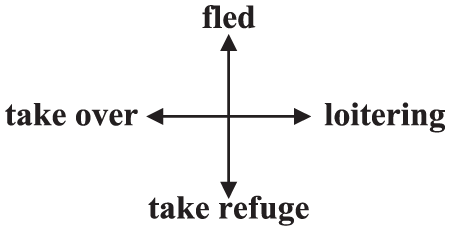
While the first two actions capture seeking ‘safety’, the last two illustrate ‘settlement’. The fact that the Nigerian actors fled Bakassi to take refuge in Nigeria projects the image of fear and insecurity that engulfed them in Bakassi. That is, they are in ‘apparent state of despondency’ (NDS41). ‘Despondency’ depicts hopelessness occasioned by discomfort. It also shows the misery the displaced Nigerians face in their ‘unequipped’ camp, caused by the ‘increasing’ and ‘continuous’ harassment. By collocating ‘despondency’ with ‘apparent state’, the report has substantiated their findings that a large number of displaced people were in great despair. Their suffering, both physical and psychological, includes harassment, torture, maiming, congestion, hunger and hardship, which have been magnified through the use of the hyperbolic elements.
On the other hand, Cameroonian news reports emphasize the positive actions of the security forces through the use of hyperbolic items. It counters the negative impression of the soldiers reported in the Nigerian reports as well as presents the soldiers as the sufferers of the ‘huge’ crimes in Bakassi. Instances are as follows: In each of those attacks, The rebels stroke again on Monday 9 June 2008 killing … DO and several Cameroon soldiers. Meanwhile, in the night of Sunday 29 September 2008, banks in Limbe were attacked by gunmen using It should be recalled that in riposte to the It should be noted that this is the
Hyperbolic elements are deployed in the excerpts above to emphasize the negative deeds of the Nigerian insurgents (rebels, gunmen, militants, etc.). The negative effects on the Cameroonian soldiers are magnified and emphasized through words such as ‘several attacks’ and ‘continuous menaces’ (CDS42), ‘huge quantities’ (CDS39) and ‘huge sums’ (CDS40), ‘heavy artillery’ (CDS40) and ‘umpteenth time’ (CDS44). The mental model of event created is that the soldiers lost a lot of lives and ammunition. The implied meaning is that everything the insurgents do is quite enormous – the insurgents stole ‘huge quantities of ammunition’ (CDS39), ‘huge sum of money’ (CDS40) and also use ‘heavily artillery’ in their attacks which are ‘several’ and ‘continuous’ (CDS42). Thus, shooting by the soldiers is portrayed as retaliatory since the attacks from the insurgents were ‘unending’. Instances of number game and labelling also appeared in the use of this strategy. For instance, ‘200’ (NDS43, NDS44) and ‘No fewer than 1000’ (NDS41) are used in Nigerian reports to represent the number of Nigerians who were tortured and displaced by the Cameroonian soldiers, while 21 (CDS44) is used in the Cameroonian report to represent the number of soldiers killed by Nigerian pirates. Also, Cameroonian reports represent the Nigerian conflict actors using negative labels such as ‘pirates’ (CDS42, CDS44), ‘rebels’ (CDS39) and ‘gunmen’ (CDS40).
Victimization strategy
This is a discourse strategy of creating polarity by representing the negative deeds of the other and portraying self as victims. Here, the negative behaviour of the ‘out group’ is associated with threats, while the ‘in group’ is represented as victims of such threats. Instances in the Cameroonian newspaper are as follows: Unidentified gunmen considered to be The shooting came seven months after … supposedly In yet another attack,
The victims, in CDS45–CDS50, are the Cameroonian forces who lost their lives and weapons. The constructed mental model is one in which the security forces have become the victims of the actions of the out-group, the militants. Through the victimization strategy, the soldiers (victims) are portrayed as being frequently ‘killed’ (CDS46), ‘wounded’ (CDS46 and CDS49), ‘attacked/raided’ (CDS45, CDS48 and CDS50) and ‘routed’ (CDS49) by the armed insurgents (pirates, gunmen and gangs). Thus, the Cameroonian newspapers have utilized this strategy to depict Cameroonians as the victims (prey).
On the other hand, the Nigerian news reports employ victimization strategy to represent Nigerians as the victims of the Cameroonian soldiers’ attacks. Instances include the following: Officials of the United Nations (UN) have visited the returnee camp in New Bakassi to douse tension over The battle for Bakassi is not yet over, as Like Kuapie, other returnees related their ugly experiences in the hands of the gendarmes. In fact the
In NDS50–NDS55, the victims of the deeds of the Cameroonian gendarmes (police) are Nigerians in Bakassi. The Nigerian reports focus on the Nigerians as the victims of the violent acts of the Cameroonian police and militants. However, while the militants are represented as not directly fighting the civilian population, the police are portrayed as precisely targeting the people. Hence, the gendarmes have sacked (NDS50 and NDS51), killed (NDS50 and NDS55), brutalized, raped and seized the property of Nigerians (NDS53) in their bid to sack them from the peninsula. The mental model is that an in-group is the victim of the actions of an out-group. Thus, through this strategy, Nigerians have been represented as victims by the Nigerian newspapers. In using this strategy, negative labelling, number games and hyperbolism are also utilized to support the argument. For instance, pirates (CDS45), gunmen (CDS45, CDS46) and armed gangs (CDS48) are used in the Cameroonian reports to depict the faceless perpetrators who attacked Cameroonian soldiers, while 21, 6 (CDS46) and 3 (CDS49) capture the numbers of Cameroonian soldiers who were either wounded or killed. Nigerian reports also use number game to show the number of Nigerians who were either killed or displaced from the peninsula. This is seen in 21 and 2000 (NDS50), 50,000 and 300 (NDS51) and 17 and 2000 (NDS55). Hyperbolism such as ‘frequent bloody raids’ (CDS48) magnifies constant attacks on the soldiers in the Cameroonian report, while ‘no fewer’ exaggerates the number of Nigerians killed by Cameroonian soldiers in the Nigerian report.
Depersonalization strategy
This is a discourse strategy that involves implicit generalization of self’s views by suppressing the actual advocates of the opinions. In depersonalization, there is no explicit inclusion of precise references to the doers or speakers of a particular discursive action or opinion. Thus, the speakers or doers are mystified/suppressed while their opinions or actions are foregrounded. The essence is to draw the attention of readers to the fact that there are ‘experts’ who have drawn conclusions on the events while at the same time subtly projecting personal views. Instances of depersonalization strategy in the Cameroonian news reports are as follows: At the time of going to press, Meanwhile,
In the Cameroonian news reports above, the actors who have ‘interpreted’ (CDS52), ‘suspected’ (CDS53), ‘attributed’ (CDS54), ‘believed’ and ‘said’ (CDS55) are not made explicit. Through the depersonalization of the speakers’ strategy, the Cameroonian news reporters want the readers to concentrate on the effect of the attacks of the Cameroonian soldiers and see the opinions that the soldiers are under attack as general. In the excerpts, the supposed agents of the process of ‘saying’ (and reporting) are anonymous and faceless. Thus, the reports have tried to influence the mental model of the readers who would want to believe what is projected in the texts, that is, the Nigerian pirates are fighting against the peaceful handover of the peninsula to Cameroon.
Nigerian news reporters also exploit depersonalization strategy to generalize self opinions. Instances include the following: However, with the unexpected arrival of the gendarmes and their decision to stay on, Nigerians in the area are worried, particularly as She only saw her husband last on one fateful day when he left home for fishing business.
The Nigerian news reports have also generalized opinions of one person or a small group to a larger group or category in the excerpts above. That is, views of a reporter or the entire media house are more generally attributed to the views of a country in general through depersonalization strategy. The implication of NDS59 in particular is that ‘Nigerians’ have ‘termed the treatment of Cameroonians a violation of the Green Tree Agreement’. Also in NDS60, The Punch tries to make it acceptable that a group of the displaced ‘believed that a Nigerian was shot and thrown into the river by the gendarmes’. The use of the verbal processes ‘are said’ (NDS58), ‘has been termed’ (NDS59) and ‘was believed’ (NDS60) implies that the ideas are shared by the majority who ‘said’, ‘termed’ and also ‘believed’ the actions. Hence, the readers are implicitly drawn into the discourse and persuaded to accept the views as concluded.
Conclusion
This article has discussed the newspaper coverage of a political, territorial conflict between Nigerian and Cameroonian states. It examined instances of manipulation of seven discourse strategies, namely, slanted headlining, negative labelling, evidentiality, number game, hyperbolism, victimization and depersonalization deployed by the Nigerian and Cameroonian newspapers in their reports on the Bakassi Peninsula border conflict. The article argues that there is a link between the strategies and ideologies as the strategies embody ideologies. While both nations employ the seven strategies, they differ in their use of some of them. In deployment of slanted headlining, while the Cameroonian reports use agentless passive constructions to focus attention on the Cameroonian victims and conceal perpetrators, the Nigerian reports deploy both active sentences to foreground the Cameroonian perpetrators and passive constructions to highlight Nigerian victims. The use of negative labelling also shows ideological differences in the representation of conflict actors by both nations’ media reports. While the Cameroonian reports explicitly tag Nigerian conflict actors as rebels, militants, gangs, criminals and so on, the Nigerian reports describe Cameroonian soldiers as violent using the negative labels (rampaging, frenzy, overzealousness, terrorist acts, etc.). Under evidentiality, Nigerian reports use both reference to authorities and evidence from victims/eyewitnesses to substantiate claims of the Cameroonian soldiers’ violent disorder, while the Cameroonian reports use only reference to authorities to depict Nigerians as threats to the soldiers. In the deployment of number game, Nigerian reports magnify the number of Nigerian victims displaced or killed using the intensifying adverb ‘over’, while the Cameroonian reports amplify the number of soldiers killed using the phrases ‘at least’ and ‘up to’. Hyperbolic items such as ‘increasing harassment’, ‘continuous harassment and torture’ and ‘large number’ are used in the Nigerian reports to capture the negative deeds of Cameroonian soldiers, while in the Cameroonian reports, hyperbolic expressions like ‘several attacks’, ‘continuous menaces’, ‘umpteenth time’ and so on portray the ‘endless’ attack on the Cameroonian soldiers by the supposedly Nigerian perpetrators. Both nations’ reports also portray their own conflict actors as victims using victimization strategy. However, in Depersonalization strategy, while the Cameroonian reports use the expressions such as ‘interpreted’, ‘suspected’, ‘attributed’, ‘believed’ and ‘said’ to shroud the identities of the people whose opinions support the killings of the soldiers, the Nigerian reports use ‘are said’, ‘has been termed’ and ‘was believed’ to generalize self-opinion on the Cameroonian soldiers’ negative activities. The strategies are motivated by underlying ideologies of patriotism and altruism. From the data, both nations’ reports showed great love, loyalty and devotion to their specific countries as well as displayed concern for the suffering and welfare of others. Patriotism is evident in the Cameroonian news report in defence of the Cameroonian soldiers’ interests and actions and also in the Nigerian newspapers’ positive presentations of Nigerians in Bakassi. In the same vein, altruism is apparent in the Nigerian newspapers’ disapproval of the killings of Nigerian residents as well as their implicit view for their welfare and proper resettlement and in the Cameroonian newspapers’ concern on the deaths of the soldiers. While the strategies are motivated by patriotism and altruism, they are also deployed to create polarity of positive in-group and negative out-group ideologies; hence, they embody ideological prejudices of positive self and negative other-representations which are rife in both nations’ news reports on the disputed Peninsula.