




Abstract
Social media have become the main channel of news and public affairs information for the public. They have also become the platform on which new actors in public communication emerge. As the institutions of public communication are reconfigured, the way news flows and evolves also changes. This article draws upon and revises Chadwick’s conception of political information cycle and argues that news should be understood as circulating and evolving in the political information cycles embedded in an integrated media system. Within a political information cycle, various actors other than mainstream media outlets can serve as intermediaries and engage in agenda-steering and frame generation. The arguments are illustrated with a case study of the 2017 Chief Executive election in Hong Kong. An examination of the overall prominence of different types of actors in social media and analyses of a number of incidents during the election illustrate the multifarious ways the political information cycle can operate.
Keywords
Social media constitute an increasingly important source of news information for the public in many societies. The 2016 Digital News Report by the Reuters Institute for the Study of Journalism (Newman, Fletcher, Levy, & Nielsen, 2016) found that among the 26 (mostly European and North American) countries in the study, 51% of the respondents said they used social media as a source of news and 12% said social media were their main news source. For many people, news is no longer something they proactively pull from news outlets. Instead, news is often pushed to them via social media by various digital intermediaries.
Social media are not only channels through which mainstream media contents reach the public; they are also spaces in which people connect and communicate with others, conduct part of their lives, and sometimes organize collective actions (Bennett & Segerberg, 2013). Social media constitute the platforms for established organizations to connect with each other and the public; they are also the platforms on which new types of agents emerge (Galuszka, 2015; Lahey, 2016; Lobato, 2016; Wiesslitz & Ashuri, 2011). Understanding the impact of social media on the communication of public affairs, thus, requires us to see social media not so much as a medium than as the space within which the institutional infrastructure and the dynamic processes of public communications are reconfigured (e.g. Thorson & Wells, 2016).
Based on the above premise and consistent with Latham and Sassen’s (2005) emphasis on new “digital formations,” this article aims to examine the interactive and multi-directional circulation of news information and political messages on social media through the lens of what Chadwick (2011) called political information cycles. Nevertheless, this article would also revise and elaborate on Chadwick’s (2011) conceptualization, especially through emphasizing the emergence of new agents in public communications. The operation and significance of the social-media-based political information cycles are then illustrated by a study of the 2017 Chief Executive (CE) election in Hong Kong. The analysis shall contribute to the further development of a theoretical approach highly pertinent to understanding political communication in the changing media and information environment.
News flows and political information cycles in social media
As social media are platforms through which people connect with others, understanding the impact of social media as a news source requires an understanding of how online networks shape the circulation of news and, hence, the contents that individuals are exposed to. Different lines of studies were developed to tackle this problem. For example, studies have examined the factors influencing news sharing on social media (Bright, 2016; Celli, Ghosh, Alam, & Riccard, 2016; Kim, 2015). There were renewed interests in the notion of opinion leadership (Bobkowski, 2015; Karlsen, 2015; Turcotte, York, Irving, Scholl, & Pingree, 2015; Zhang, Zhao, & Xu, 2016). Schaefer and Taddicken (2015), in particular, argued that a new category of “mediatized opinion leaders” has emerged. The mediatized opinion leaders scored particularly high on personality strength, used a full range of media channels very frequently, and had much larger online networks. The number of people belonging to this category is relatively small, but they could have disproportionate influence in social-media-based public opinion formation.
However, opinion leadership is only a small part of the complex dynamics of news diffusion through social media. Thorson and Wells (2016) developed the concept of curated flows to characterize people’s increasingly contingent access to contents in the digital arena. They argued that with the proliferation of channels, the dissolution of the producer–consumer distinction, and the multiplication of user experiences, there is no one dominant pattern of content flow in the digital arena. Instead, “there are competing patterns based on individual interests, social networks, and the infrastructure of digital communication” (p. 310). Thorson and Wells (2016) identified five types of curators: journalistic curators, strategic communicators, personal curators, social curators, and algorithmic curators. These curators operate according to different norms and logics, and their interactions result in a complex set of routes through which information flows.
Similar to Thorson and Wells (2016), this article emphasizes the importance of identifying the players that constitute “the infrastructure of digital communication.” Yet, Thorson and Wells’ (2016) discussion remains rooted in a concern with “media effects” and, hence, a concern with the contents that citizens are exposed to. The metaphor of curation emphasizes material selection. The curators are treated largely as gatekeepers who decide what to pass on instead of communicators who may produce new contents or meanings. In addition, underlying the conceptualization of curated flows is the presumption that contents flow in one overall direction, that is, from the originator to the audience. The complex formation of curated flows is similar to a complex river system: no matter how many branches and routes there are, water flows from the headstream to the sea.
This article, in contrast, is interested in how news not only flows but also evolves and sometimes mutates. For instance, when news contents travel from mainstream media to strategic actors in the social media arena, the strategic actors can comment on the materials and/or generate responses. The materials produced by the strategic actors could then be transmitted to other actors, who may add more layers of meanings onto the content and/or further steer the news in other directions. In addition, the materials produced by various actors can feedback into the mainstream news media and even the news event itself. Actors in the news events might be compelled to respond to “online developments.” The overall result is the temporal unfolding, sometimes in unpredictable directions, of a news event or story.
To characterize such a process, Chadwick’s (2011) concept of the political information cycle is more pertinent. In his original study, the concept was proposed to replace the notion of the news cycle. The latter focuses on how the news about an event is generated through the cycle composed of often routinized mainstream news programs and media events. Chadwick rightly argued that news production in the digital era is no longer driven only by mainstream media routines. Political information cycles are “complex assemblages in which the personnel, practices, genres, technologies, and temporalities of supposedly ‘new’ online media are hybridized with those of supposedly ‘old’ broadcast and press media” (p. 7).
Compared to conventional news cycles, the political information cycles involve larger numbers and a more diverse range of actors and interactions. “They include many nonelite participants, most of whom now interact exclusively online in order to advance or contest specific news frames or even entire stories” (Chadwick, 2011, p. 8). Nonetheless, Chadwick (2011) emphasized that political information cycles are different from crowd-sourcing. Although the political information cycles “contain pockets of engagement that may momentarily bring greater numbers of players into news-making assemblage” (p. 19), the truly decisive interventions were made typically by only a small number of actors.
For this study, two aspects of Chadwick’s (2011) conceptualization can be revised or further elaborated. First, although Chadwick (2011) did mention the involvement of a larger number of new actors in the political information cycles, his characterization of the media system as “hybrid” remains limiting. Hybridity presumes the presence of two existing, separate entities that become “mixed” in certain ways. In other words, the “hybrid media system” presumes the separate existence of the “mass media” and “digital media.” However, this presumption is questionable. Mainstream media institutions that conventionally constituted “the mass media” have—through their YouTube channels, Facebook pages, or Twitter accounts—a prominent or even dominating presence in the digital world. A digital media platform such as Twitter, as mentioned, provides the space for the emergence of new actors and institutions. Instead of being a hybrid system, it should be more appropriate to see mainstream media institutions, new communication actors, and digital media platforms as intertwined and forming an integrated mediascape.
More importantly, similar to Thorson and Wells’ (2016) attempt to identify the main types of curators, it would be useful to identify the main types of actors who are influential players in the political information cycles. Nevertheless, instead of producing typologies that are expected to be generalizable across countries, a more contextualized approach to the identification of main types of actors can provide better bases for empirical analyses. What types of actors would appear in the political information cycles in a country is likely to be related to its political system and the political economy of its communication industry. A context-sensitive actor typology should allow more context-sensitive analyses of the political information cycles.
Second, it would be useful to identify the sub-processes involved in the political information cycles. That is, instead of speaking generally about the evolution or mutation of the news, it would be useful to identify what kinds of transformation are involved. This article highlights two sub-processes: agenda-steering and frame generation. Agenda-steering refers to the process through which different actors alter the original agenda associated with a news event or issue. Different from the notion of agenda-setting and more similar to agenda-building (Lang & Lang, 1981) and agenda-melding (Shaw, McCombs, Weaver, & Hamm, 1999), the notion of agenda-steering stresses the dynamic process through which certain issues come to be regarded as important by the media and society or through which the issue at hand is defined in the first place. But different from agenda-building as conventionally conceptualized, agenda-steering in the integrated mediascape is more open-ended. The feedback loops can operate much more quickly, and agenda-steering does not focus merely on shaping the mainstream news agenda. Actors may steer the agenda or the definition of the issue involved in a news story mainly for influencing online discourses and/or mainly for specific groups of target audience. At any given time-point, there can be multiple agendas created by different actors co-existing in the integrated mediascape.
Frame generation refers to the emergence of main themes or central ideas with which a news event or issue can be understood. The emphasis is on framing as a public and dynamic process involving the possibilities of contestation among multiple actors (Matthes, 2012). In the digital arena in particular, media institutions, political actors, and ordinary citizens can all engage in the framing process. The actors, however, do not necessarily suggest holistic and coherent “ideological packages” (Gamson & Modigliani, 1989) for understanding the matter at hand. Rather, the actors may propose simple yet effective themes, metaphors, catchphrases, and so on. These themes or rhetorical devices may then constitute the overarching ideas with which people make sense of the news event. Sometimes they can point to new ways to understand the significance or implications of the news event. Hence, they have the function of “framing,” and the process can be described as frame generation.
Certainly, there can be sub-processes beyond agenda-steering and frame generation in the political information cycles, but the two should suffice for this study. The next section discusses the background of the case and its context.
Social media in Hong Kong and the 2017 CE election
Social media—especially Facebook—constitute a major news source for many Hong Kong citizens. The 2017 Digital News Report (DNR 2017) of the Reuters Institute found that 50% of the Hong Kong respondents reported coming across news via social media and 18% saw social media as their main news source. 1 Besides, research in the city has shown that political communication via Facebook has significant influences on people’s political attitudes and participation (e.g. Lee, Chen, & Chan, 2017; Lee, So, & Leung, 2015; Tang & Lee, 2013).
Mainstream media have retained a dominant presence in the digital arena. According to DNR 2017, 8 of the top 10 online news brands in Hong Kong are mainstream newspapers or broadcasters. As to be shown below, mainstream news media also have a strong presence in social media. However, in line with the previous discussion of the emergence of new actors, four other categories of actors are worth noting in the Hong Kong context:
Internet alternative media: By lowering the costs of content production and distribution, the Internet provided the impetus for the growth of alternative media in Hong Kong (Leung, 2015). Here, alternative media refer to media outlets that challenge the mainstream media’s power to define reality (Couldry & Curran, 2003). By definition, alternative media are critical in their political stances. In Hong Kong, the significance of online alternative media is enhanced by problems of self-censorship in the mainstream media (Leung & Lee, 2014). Online alternative media have a non-negligible readership and are an important source of “oppositional knowledge” for the public (Lee, 2015).
Pro-government sites: Hong Kong has an open information system and a tradition of free expression. The Chinese and Hong Kong governments cannot exercise direct information control on the Internet. Instead, the government and conservative forces have spent substantial resources to establish their own social media presence. A few pro-government Facebook pages are particularly prominent in online public communication.
Politicians, political parties, and established civic and political organizations: Social media constitute an arena for politicians and established groups to directly communicate with their supporters and the public. Conducting Facebook campaigns has become a norm in local elections (Tang & Lee, 2017). Hence, politicians and political organizations constitute a distinctive group of actors in digital-media-based political communication.
“Key opinion leaders” and other niche media: Social media have led to the emergence of new types of micro-celebrities (Jerslev, 2016; Mercea, 2014). In local parlance, influential individuals in the social media arena are often called “KOLs,” that is, key opinion leaders. They are of many types. Some are already prominent public figures or media persona; others are emerging opinion leaders on specific topics. The Facebook pages of the latter KOLs are not different from the full range of niche online media outlets, in the sense that they are outlets appealing to distinctive communities of interests. Without complicating the typology too much, KOLs and other niche media can be grouped as one category.
These categories of actors, together with mainstream media, constitute the mainstay of the infrastructure for public communication in the social media arena in Hong Kong. Notably, while alternative media and pro-government sites are defined by their political stances, the other categories include mixes of pro-government, oppositional, and neutral/centrist entities.
The overarching research question is how the various types of actors interact in the political information cycles and drive the evolution of news. Under this question, three analytical issues are worth raising: First, to what degree do the mainstream media remain central in the political information cycles? Second, to what extent can the other strategic actors alter the agenda and frame of a news event? Third, how does the political information cycle relate to the strategies and discourses of the political actors in the news event?
This article addresses these issues by focusing on the 2017 CE election in Hong Kong. In the current set-up, only the 1200 members of an election committee have the right to vote. Since China has tight control of the committee’s membership, it also has final control of the election result. However, the general public and the news media still followed the election closely. Meanwhile, the candidates also needed to try to garner public support in order to bolster their legitimacy. Therefore, the CE election is still marked by election campaigns appealing to the public as if the latter have the right to vote.
In the 2017 election, retired judge K.H. Woo, former government official and legislator Regina Ip, former Chief Secretary of the Hong Kong government Carrie Lam, and former Financial Secretary John Tsang announced their intention to run between late 2016 and January 2017. But to stand in the election, a candidate needs to first obtain 150 nominations from the election committee members. The nomination period lasted from 14 to 28 February. Carrie Lam, John Tsang, and K.H. Woo obtained enough nominations and formally became candidates in the race. On 26 March, Carrie Lam won the election by getting 777 votes from the committee, although she was far behind John Tsang in most opinion polls. 2
To estimate the relative prominence of different types of actors in Facebook communications related to the election, the author utilized the Facebook page search engine QSearch to derive relevant information. Using “CE election” and a series of names and nicknames of the three final candidates as the keyword set, 3 the search engine could provide (1) counts of the total number of Facebook posts by public pages containing the keyword(s); (2) counts of the number of likes, comments, and shares obtained by the posts within the first 48 hours of their publication; (3) a list of the top 25 pages in terms of engagement obtained (i.e. number of likes, comments, and shares combined by using a formula) 4 ; and (4) a list of all the posts containing the keywords published by the top 25 pages.
The search was conducted for each of the 10 weeks between 16 January (the day the eventual winner Carrie Lam announced her participation) and 26 March. The top pages were then classified as (1) mainstream media 5 ; (2) alternative media; (3) pro-government pages; (4) the candidates’ pages; (5) politicians, parties, and social and political groups; (6) KOLs; or (7) all others. The total amount of engagement obtained by each type of actors in each week was then calculated. Here, the total amount of engagement refers to the total number of likes, shares, and comments obtained, within the first 48 hours after publication, by all the posts published by the pages belonging to the category. Then, the relative prominence of different types of actors over the 10-week period was calculated—it refers to the percentage of engagement obtained by all types of pages accounted for by pages belonging to a category. Figure 1 summarizes the results. Because actors belonging to the last three categories were relatively much less prominent, they were combined into a single category for simplicity.
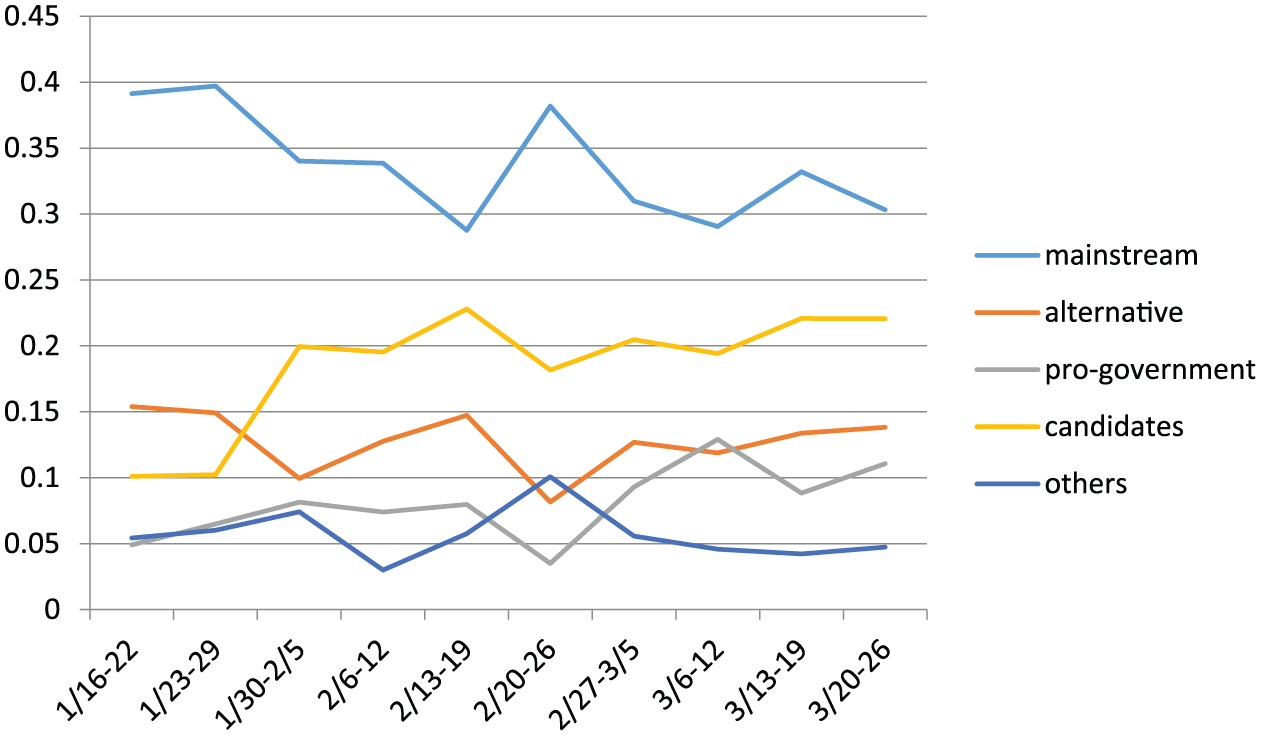
Relative prominence of five types of actors in Facebook on the Chief Executive election.
The results show that mainstream media accounted for about 30%–40% of the engagement obtained by the top 25 pages in each week. From 30 January onward, the candidates’ own pages accounted for about or beyond 20% of the engagement. Alternative media and the pro-government pages accounted for about 10%–15% of the engagement each. Overall, mainstream media could still be regarded as the dominant player even in the social media arena. Yet their “domination” was far from overwhelming.
Although the KOLs and the pro-government pages did not obtain a large proportion of engagement, it did not entail that they played a minor role in the political information cycles. To gain an understanding of how the political information cycle operates, the following examines three incidents more closely. These incidents are among the most widely discussed ones in the election. For each incident, relevant posts were derived from QSearch using a more directly pertinent keyword set. The author then read through the posts, sometimes including the contents that the posts were linked to. The analysis is qualitative in nature. The aim is to reconstruct the political information cycle involved in each of the incidents.
Sub-case 1: The “Octopus” blunder
On 20 January 2017, 5 days after Carrie Lam announced that she would join the race, she visited the Southern part of the Hong Kong Island by taking the underground metro system Mass Transit Railway (MTR). It was a typical “district visit,” a routine in election campaigning in Hong Kong. In the evening, the free-to-air broadcaster TVB aired a story about the visit in its newscast. The story covered Lam’s activities in a matter-of-fact manner. In the middle of the story, the video showed that Lam was entering the MTR gate, but she stood still for a second after putting her Octopus card—the stored value smart card for public transportation and purchases at a wide range of shops in Hong Kong—onto the sensor. She walked past the gate only when a voice behind her said, “ok, you can go.” Lam seemingly did not know how to use the Octopus card, but the news story did not contain any description or comments on this scene.
We could not trace the immediate reactions by netizens on Facebook via their private communication, but a 29-second video clip, which was extracted from the TVB story, was uploaded onto YouTube in the evening of 20 January. The clip was titled “Carrie Lam took the MTR and didn’t know how to enter the gate by using the Octopus card.” In other words, what was originally a 3-second segment of a news story was highlighted by the citizens to articulate a criticism toward Carrie Lam. In the world of Facebook pages, based on a keyword search on QSearch, 6 there were 367 posts matching the keyword requirement in the 4-day period between 20 and 23 January. These 367 posts obtained a total of 68,150 likes, 7750 comments, and 15,172 shares within 48 hours of their publication.
A reading of these posts following the order of their publication showed a clear instance of agenda-steering and frame generation. It should be noted that because Carrie Lam was a former government top official and apparently favored by China, the pro-government pages were supportive toward her candidacy, whereas the pro-democracy media were critical toward her throughout the election. On 20 January, the first post about Lam’s activities on the day retrievable via QSearch was published by the pro-government page Silent Majority for HK. It reads, “Empty talks about ‘level of support’ are meaningless. Let’s look at how citizens react when candidates go to the district!” Interestingly, even the pro-democracy alternative media 852 Post did not highlight the mishap of Lam when it posted about Lam’s district visit for the first time in the evening of 20 January.
The first retrieved post highlighting Lam’s mishap came from KOL Lam Kay, published right at midnight (0:00:22 in the QSearch record). It stated, “What a pity! Henry Tang used 200 dollars to buy egg tarts, showing his ignorance about prices; Carrie Lam does not even know how to use the Octopus card to take the MTR!” The statement compared Lam to Tang, another former government official. Tang came from a rich family and had the reputation of being a profligate son. Yet, the KOL argued that Carrie Lam was worse. The post attracted 1837 likes, 286 comments, and 1719 shares in 48 hours.
In the morning hours of 21 January, the pages of a number of other niche media and KOLs continued to post about Lam’s blunder. KOL Wong Sai-chak posted at 11:42 a.m., saying that “Lam is cramming right before the deadline; she learns how to take the MTR only now.” A few minutes later, Apple Daily became the first mainstream media to post on the incident from a critical perspective: “No wonder Carrie Lam did not like other people calling her Nanny; she is the one who needs to be taken care of.” The post attracted 8357 likes, 817 comments, and 1472 shares within 48 hours. In the few hours afterwards, numerous pages of mainstream media, niche media, and KOLs continued to post about the incident.
A few points can be noted from the above chronology. First, KOLs and niche media played the role of initiating the agenda-steering process through highlighting “the issue” that people should focus on. Certainly, in this incident, the KOLs and niche media might have been following netizens’ lead. But even if the latter is true, it can still be argued that the KOLs and niche media played the role of articulating, crystallizing, and publicizing netizens’ reactions. Second, the KOLs and niche media arguably helped signal the “hotness” of the matter to the mainstream media. Temporally speaking, the mainstream media’s focus on Carrie Lam’s blunder followed the reactions from the earliest KOLs and niche media. Third and nonetheless, the most prominent mainstream media, especially Apple Daily, remained the outlets most capable of attracting social media engagement.
Associated with the steering of the agenda was the emergence of lei-dei, which literally means “far above the ground,” as the overarching theme to understand the incident. In local parlance, lei-dei is typically used to critical people for losing touch with the mass public and citizens’ everyday lives. That is, Carrie Lam’s apparent inability to use the Octopus card was taken as a sign showing her distance from ordinary people. In the election, it became a frame the media could adopt when reporting other incidents. In fact, in the week after the Octopus incident, Lam was criticized for being lei-dei at least two more times. In one occasion, Carrie Lam told the media that after leaving her official residence, she found out she did not have tissue papers in her new home. She went to a convenient store, only to realize that convenient stores do not sell tissue papers. So she took a taxi back to the official residence to get what she needed. In this incident, the mainstream media were much quicker in highlighting Lam’s ignorance about everyday matters because the frame of lei-dei was already established.
Moreover, lei-dei became the theme for commentators to elaborate on when discussing Lam’s suitability to be the CE. For example, a veteran journalist wrote, After serving as a career bureaucrat for more than 30 years, Carrie Lam and John Tsang were both living the lives of the upper middle class … Not knowing how to use the Octopus card and not knowing where to buy tissue papers are not “scandals”; but with the new demand that government officials need to get close to the people and breath with the people, losing touch with common people on small matters could be transformed into big political problems. (Ming Pao, 2 February, 2017)
The term lei-dei would continue to be associated with Lam throughout the election. For example, on 19 March, a prominent commentator wrote in a piece published by the alternative media site Stand News that even if I try my best to sympathize with her, not calling her lei-dei, not saying that she used language tricks. … I want to ask, if a political figure cannot stand the pressure of an election, how could she manage the “complex and changing environment?
Using the keyword set “Lam-Cheng AND lei-dei” (Lam-Cheng being the full surname of Carrie Lam), there were only 20 posts matching the keyword set from 1 to 20 January, that is, there was little association between Carrie Lam and lei-dei before the Octopus card incident. The figure jumped to 279 between 21 and 31 January. There were 146 posts in February and 126 posts from 1 to 26 March. There were still 28 posts in the first 2 weeks after the election. The first incident, thus, illustrates how the social-media-based political information cycles could generate sustained framing of a politician.
Incident 2: Love letters on Valentine’s Day
Throughout the entire election, former Financial Secretary of the Hong Kong Government John Tsang, who lost the election despite maintaining a substantial lead in polls, was widely regarded as having conducted a highly successful social media campaign. In fact, the prominence of candidates’ pages shown in Figure 1 was largely a result of the ability of Tsang’s page to attract engagement. In the last 4 weeks of the election, his Facebook page invariably topped the weekly list of the most prominent pages on the CE election.
As part of his social media campaign, his page published a video of his wife on 13 February 2017, 1 day before the Valentine’s Day. In the video, Mrs Tsang talked about her husband in an informal manner and offered her support to her husband’s candidacy. The video was well received, attracting 24,558 likes, 1381 comments, and 3166 shares in 48 hours. It also gained the acclaim by online media and some KOLs. Ming Pao and Apple Daily reported about the video within 2 hours after its uploading. Tsang apparently had the ability to influence mainstream media coverage by publicizing materials on his own page.
On 14 February, “Carrie Lam Office,” the official page of the candidate, posted a “love letter” by her husband at 11:12 a.m. Interestingly, earlier that morning, Lam had already noted the pending publication of the letter in a radio interview. The pro-government pages were the first to react. We Support Carrie, for example, shared the letter at 12:13 p.m., prefacing it by stating that “Valentine’s Day has come! Carrie received a heart-warning letter from her husband. Deep love is embedded in every word.” Almost simultaneously (at 12:10 p.m.), alternative media Stand News published a related post. It stated that In the letter, Mr. Lam mentioned that at first he did not want his wife to run, but he changed his attitude, and now he wishes Carrie success, “to work hard for Hong Kong citizens,” “to contribute to the realization of one country, two systems.”
7
Although Stand News did not explicitly criticize or make fun of the letter, it would not be difficult for readers to recognize the implicit irony in highlighting the line “the realization of one country, two systems.” The apparently neutral sentence might be read as having the underlying judgment of the inappropriateness of having political discourses (i.e. one country, two systems) intruding into a love letter. Here, despite being classified as an alternative media outlet, Stand News still tried to maintain a certain degree of journalistic professionalism by sticking to “factual reporting.” In contrast, KOLs tended to articulate the inappropriateness of the letter more explicitly. About half an hour after Stand News’ report, KOL Pun Siu-to wrote, “Seeing the appearance of [Tsang’s wife], Carrie Lam awkwardly copied.”
Adding another twist to the incident, John Tsang posted his own version of Valentine’s Day message at 2 p.m., stating that the most important thing on the Valentine’s Day is not the person of one’s affection, but the idea of “blessing.” Together with the message was a photograph of the Tsang couple having lunch at a social enterprise with friends. At the end of the message, he added a hashtag “#we don’t talk about one country two systems, only one life one love,” clearly mocking Lam’s letter. Almost immediately, several niche media and KOLs provided the verdict that John Tsang “knocked out” Carrie Lam in the “love letter competition.”
In the love letter incident, the mainstream and alternative media reacted very quickly because they were already closely monitoring the candidates’ pages. The newsworthiness of the posts from the candidates was obvious; there was no need of certification by KOLs and niche media. Nonetheless, the KOL and niche media pages remained more capable of providing explicit judgment immediately, generating the “breaking views” driving online discourses. The incident quickly turned into another “public relations disaster” of Carrie Lam.
Similar to the Octopus card incident, some commentators attempted to elaborate on the significance of the incident. A commentator opined that it felt like going back to the Cultural Revolution when reading Mr Lam’s love letter. The writer regarded the letter as illustrating how political ideologies can intrude into and distort intimate relationships. Another writer argued that the love letter incident was not only a “public relations problem”; it also reflected the personality of Carrie Lam. Yet another commentator tied the incident to the frame of lei-dei, suggesting that public relations involves the art of grasping the mind of the people, and it is impossible for people “living in the universe” to understand the thoughts of ordinary citizens.
Nevertheless, when compared to the Octopus card incident, the love letter incident did not generate a new, sustained, and prominent frame adopted by many people simultaneously. The social-media-based political information cycle does not always end up with a powerful frame or a substantively altered agenda.
Incident 3: The “white terror” controversy
The third incident analyzed here started on 8 March at 9:28 p.m. when a video featuring veteran movie star Josephine Siao was uploaded onto the Carrie Lam’s Facebook page. In the video, Siao recounted how Carrie Lam had helped her 16 years ago when she started her non-government organization End Child Sexual Abuse Foundation. Although Siao herself was a popular actress and the video did not contain particularly controversial claims, the video still attracted a lot of “angry icons” and critical comments. Some citizens simply expressed their discontent toward Carrie Lam and argued that whoever supported Lam was misguided. Some offered more reasoned criticisms, emphasizing that Carrie Lam was Head of the government’s Social Welfare Department 16 years ago. There is no need to thank a government official for just doing her job.
Nevertheless, some netizens criticized Siao by referring to her old age and hearing disability. Online incivility is not rare in Hong Kong. The presence of personal attacks against Siao on Carrie Lam’s Facebook page was not picked up by any mainstream media on 8 and 9 March. Even alternative media such as Stand News and 852 Post reported on Siao’s video in a largely neutral and descriptive manner, simply summarizing the message of the video.
The agenda-steering process was started by the pro-government pages on 9 March. At 14:42, the page Salute the Hong Kong Police posted Siao’s video and asked, “let’s see if even Josephine Siao will be criticized because of ideological struggles?” The answer came hours later when the page HKG Pao noted at 23:15: “Sister Josephine is only trying to offer support to Carrie Lam, why should she be insulted? Even her hearing disability is mentioned? Are these yellow people human?” “Yellow people” is the term used by pro-government pages to refer to pro-democracy citizens. Similar messages were posted by Silent Majority for Hong Kong and Speak Out Hong Kong on 10 March. On 12 March, pro-government legislator Elizabeth Quat posted about the incident in the morning and asked whether Hong Kong still had freedom of speech. The pro-government pages and politicians have seemingly utilized netizens’ reactions to orchestrate a unified attempt to criticize the pro-democracy camp.
This framing of pro-democracy citizens’ response as condemnable was picked up by Carrie Lam herself. In the televised candidate debate on 12 March, when she was asked about the presence of “white terror” in the higher education sector because of government intervention into academic freedom, Carrie Lam turned the question around and argued that she was the victim of “white terror” by citing online reactions toward Siao’s video. Predictably, Lam’s appropriation of the term white terror aroused criticisms from the pro-democracy camp. Some commentators pointed out that Lam misused the term because white terror was typically committed by people in power. Some media reports clarified that the majority of netizens did not engage in personal attack against Siao. On social media, a post by KOL Pun Siu-to in the morning of 13 March acknowledged that personal attack against Siao was wrong, but Carrie Lam was exploiting Siao when she called herself a victim. Internet radio station D100+ posted at around noon that Carrie Lam was “talking bullshit” when she equated online comments with white terror. A commentary published by Hong Kong Citizen News at 15:00 stated, [Carrie Lam] is the forceful and arrogant person, but she said she was the victim of suppression. She then tried to take advantage of the situation … It is likely that she will “return the favor” to Hong Kong people after the election. This kind of “nanny-style white terror” is the most chilling thing.
This passage, thus, turned the criticism of “white terror” back onto Carrie Lam and the established political power that she represented. However, it does not mean that online discourses have turned completely against Lam. In this incident, what emerged were parallel echo chambers in which both sides continued to put forward their viewpoints. Particularly, in the candidate debate on 12 March, John Tsang responded to Carrie Lam’s discourse of white terror by stating that online comments should be respected as the true opinions of the people. The pro-government pages not only defended Carrie Lam but also criticized John Tsang for neglecting the presence of what they considered “cyberbullying.” The pro-government page Good News Hong Kong, for instance, published a post at 11:03 a.m. on 14 March which read, “so it turns out that in someone’s eyes, ‘respect’ is equal to cyberbullying and personal attacks. Then maybe we can use the same approach to ‘respect’ [that person]!” Numerous pro-government pages also quoted a famous film director, who was known for his conservative views, saying that John Tsang should apologize to Josephine Siao.
The pro-government side continued to emphasize the matter in the week after 12 March. Notably, the pro-government pages framed the issue mainly in terms of cyberbullying instead of “white terror,” that is, they acknowledged implicitly the inappropriateness of the latter phrase. On 19 March, in another televised candidate debate, the pro-government legislator Elizabeth Quat questioned John Tsang for turning a blind eye on or even rationalizing cyberbullying. Tsang responded by clarifying that he did not support cyberbullying. Yet, he reemphasized the need to respect freedom of speech. The response failed to satisfy the pro-government forces. Pro-government Facebook pages continued to treat the matter as an important item in the election agenda after the 19 March debate. The pro-government pages did not have the capability to force the agenda onto the society at large. The notion of cyberbullying was largely ignored by the mainstream and alternative media. However, to the extent that the pro-government pages served as an online enclave for the pro-government citizens, their agenda-steering and framing could have shaped the views of their own supporters.
Discussion and conclusion
The previous sections analyzed three incidents during the 2017 Hong Kong CE election. The analysis illustrates Chadwick’s (2011) argument that in the digital era, news should be understood as circulating in political information cycles comprising both mainstream media institutions and digital media platforms. However, the analysis also shows that online political communication cannot be understood merely in terms of the relationship between conventional media outlets and the dispersed mass of Internet users. Various new actors and institutions play important roles in the political information cycles.
The three incidents cannot be reduced to one single process. In the Octopus card incident, mainstream media materials were captured and elaborated by netizens. Netizens’ reactions were crystallized and expressed through KOLs and niche media before they were fed back into the mainstream media. In the process, the agenda changed to a focus on Carrie Lam’s blunder, framed in terms of her losing touch with citizens’ everyday lives. The latter was then treated as having implications on her suitability for the post of the top government leader. In the love letter incident, candidates’ online campaign drove media coverage. Yet, the reactions from certain KOLs and niche media remained significant in explicitly expressing what was perceived to be problematic in the “love letter” on Carrie Lam’s side. The incident did not generate prominent and sustained frames with broader political significance though. Finally, in the “white terror controversy,” pro-government pages picked up the problematic reactions from some netizens and steered the agenda toward criticizing the pro-democracy camp. Carrie Lam’s controversial characterization of the incident led to criticisms from the pro-democracy politicians and alternative media. Yet, the pro-government side adjusted the frame to cyberbullying and kept criticizing the pro-democracy camp and John Tsang on the matter. The result were parallel discourses in different parts of the social media arena.
What the analysis illustrated, therefore, is that the complex configuration of institutions and actors in the social media arena allowed news stories to evolve in multifarious ways. The social-media-based political information cycle has no single operational logic. In fact, the patterns observed from the case studies probably do not exhaust the range of possibilities of how information flows and how online actors relate to and interact with each other.
Notably, since the new digital intermediaries such as online KOLs and the mainstream media are responding to each other and to online sentiments, there is a tendency for online sentiments, KOLs’ expression, and the evolution of news to be consistent in their overall direction. However, neither online sentiments nor the new digital intermediaries are homogeneous. As the third incident illustrated, the political information cycles can produce not a single agenda and frame adopted by all, but separate agendas and frames adopted by groups that are more or less separated from each other in the online arena.
Although effects of social media on public opinion are not the primary concern of this study, the analysis of the operation of the political information cycles has implications on how we may understand the formation of online public opinion. In the 2017 CE election, some media organizations have attempted to track online sentiments toward the major candidates. Figure 2 shows the data publicized by the online media outlet Hong Kong Citizens News. Online sentiment about John Tsang had become increasingly positive from January to March. This corresponds to the aforementioned point that Tsang was regarded by many as having conducted a highly successful social media campaign. Nevertheless, our analysis suggests that the positive online sentiment toward Tsang should not be detached from how online actors, especially the alternative media and KOLs, often shaped the evolution of news in favor of him or in disfavor of his main opponent Carrie Lam.
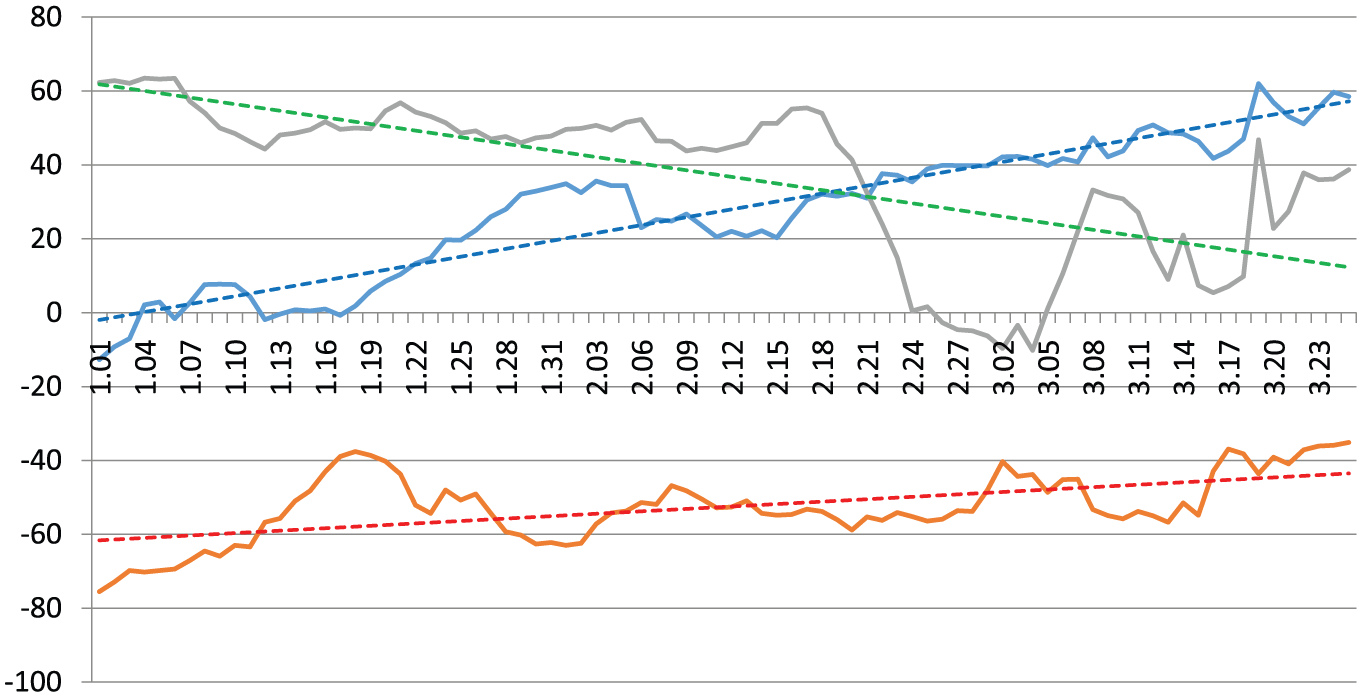
Online sentiments toward the three major candidates in the Chief Executive election.
Figure 2 shows that online sentiment toward Carrie Lam had been negative throughout the period. However, despite various mistakes and controversies, online sentiment toward Lam did not become more negative over time. There were even two short periods when online sentiments toward her became less negative. The first was in early January before she formally announced her candidacy. The second was in the last few weeks of the election, which corresponded to the period of the third incident analyzed above. As noted, separate agendas and frames about the incident were developed. The pro-government pages had arguably created an online enclave for Lam’s supporters. Besides, Figure 1 has actually shown that the relative prominence of pro-government pages had increased in the last month of the election period. It was possible that the pro-government forces had strengthened their online communication efforts in the last stage of the election to “protect” Lam’s popularity.
The above discussions also suggest that certain social media phenomena, such as the formation of echo chambers (e.g. Sunstein, 2009, 2017), did not originate merely from how citizens used social media and interacted with each other. Echo chambers are formed because people have the tendency to selectively listen to like-minded views; they can be constituted by the strategic actions of actors in the political information cycles.
One emphasis of this study is the emergence of new types of institutional actors in the online arena (e.g. Thorson & Wells, 2016). This study adopts a contextualized approach to identify the new actors in online political communication in Hong Kong. Alternative media, for instance, may not play such an important role in other countries where the mainstream media do not exhibit the same degree of self-censorship. In countries where the Internet is subjected to tighter control, the range of actors in the online arena would also differ. What is applicable to various contexts is the general point that digital media do not constitute a singular medium; they are the platform on which public communication is reconfigured. Analysis of political communication would benefit from a characterization of the institutional infrastructure in a society’s digital arena. It also echoes the argument for identifying new digital formations (Latham & Sassen, 2005) within which communication processes unfold.
The analysis suggests that the significance of the new actors cannot be entirely captured by their overall degree of prominence in the online arena. Percentage-wise, the total amount of engagement the new actors obtained is still far from the level obtained by mainstream media outlets. However, the new actors, such as the KOLs and niche media, can play an important role in articulating and expressing online sentiments, steering the issue agenda in online discussions, promoting emerging frames for news events, and quickening the flow and evolution of news. Methodologically, their role can be discerned by reconstructing the temporal unfolding of events and identifying the moments of their intervention.
The new actors could achieve these functions due to at least two factors. First, compared to conventional news media or even some online alternative media, the new actors are free from the norms of objectivity and factual accuracy. They can be highly opinionated and even highly speculative in their commentaries. Second, many of these new online actors are not established social organizations “migrating” to the online arena; instead, they can be completely digital media or social media entities and are arguably more in tune with online culture. KOLs, in particular, are by definition those people who have excelled in attracting online followers and attention. Many of the new digital intermediaries are therefore more sensitive to online sentiments and can react quicker than the mainstream media.
Certainly, the findings in the present analysis can also be read as offering evidence for the continual dominance of the mainstream media. The dominance is only relative, as new actors have taken up a substantial proportion of citizens’ attention and engagement. Yet, mainstream media could remain the providers of the raw materials that kick-start a political information cycle. Besides, mainstream media can be the platform through which materials originated online reach a much larger public, as evidenced in all three incidents.
This study has several limitations. The operation of the political information cycles needs to be further examined with other cases. Although it is argued that there is no single way through which the political information cycles operate, more case studies may help us identify the more prominent patterns. More case studies can also help identify if the political information cycles operate systematically differently on different types of issues.
In addition, this study does not analyze the interactions between the various actors in the political communication cycles and the social media users. This is partly due to the difficulty in accessing citizens’ private communications, and even if one has access to the materials, the vastness of the materials would create practical problems in analysis. Despite such difficulties, at the conceptual level, one might argue that the mass of netizens constitutes an actor on its own in the social-media-based political information cycles. In at least the first and third incidents analyzed, there is a sense that the online actors were strategically responding to emerging online sentiments from the citizens at large.
In conclusion, the conceptual framework of political information cycles should be helpful for analyzing and characterizing the increasingly dynamic and contingent development of news events in the digital era. Paying attention to the operation of political information cycles should help us better understand the effects of social media use on people’s political attitudes and behavior, as well as a wide range of social media phenomena.