




Abstract
This essay examines the phenomenon of embodied philanthropy on the move, with a focus on the WeRun (weixin yundong, an add-on to Weixin) for charity initiative. It analyzes key features of mobile-enabled micro and handy philanthropy that is at the same time on the move and examines its cultural and political implications on Chinese society. It also critiques embodied philanthropy, which is a market-driven, consumer-empowered, and individualistic form of bodily improvement or engagement in the name of charity. It points out that philanthropy on the move is used as a platform to educate, nurture, and realize neoliberal citizenship, which is managed, sponsored, and aspired by the Chinese state, the private sector, and individuals. It argues that cultivating neoliberal citizenship through micro, individual, and highly mediated activities (via volunteering and handy philanthropy) can displace criticism of the Party-state and disinterest people from participating in social actions on the ground. But it also has the potential to transcend the dichotomies of altruism versus self-interest or state versus society.
Introduction
The explosion of grassroots civil associations in the last decade in China indexes the emergence of volunteerism, rights consciousness, and alternative politics on self-governance, with well connected, knowledgeable, and entrepreneurial individuals as the lead sheep to guide the herd to new fields (H. Yu, 2015b and forthcoming). The citizen-led grassroots philanthropy is represented by media-savvy, socially engaged, and globally connected individuals who, aided by social media, wedge into the “grey” areas of social welfare, charity, and philanthropy, including environmental protection, education, food security, labor rights, animal rights, and health. They call on fellow citizens to pay attention to social issues, rally support to address social causes, and mobilize donors and volunteers to help those in need.
Such citizen-initiated and citizen-led philanthropic actions often derive from individuals’ wish or drive to help those in need and build upon personal social networks to rally support and resources. They are built on small amounts in donation, small pieces of information, small words of kindness, and small acts of courage, all mediated and transmitted via social media such as Weibo (the Chinese term for microblogging), Weixin (the Chinese term for micro-messaging and China’s most popular social application that combines key functions and features of Facebook, Twitter, WhatsApp Instagram, and PayPal), and QQ (China’s oldest and still most popular instant messaging tool).
From Yu Jianrong’s call via Weibo for “Random Snapshots to Rescue Street Children” in 2011 to Deng Fei’s “Free Lunch (for school children)” campaign via Weibo and Weixin (H. Yu, 2015b), philanthropy in China has taken on new forms characterized by its small scale, individualistic, and random nature—all made possible by mobile communication technologies such as smart phones. Known as suishou gongyi in Chinese, “handy” philanthropy is a grassroots addition to an expanding field of elite and government-led philanthropy in China.
This field, which used to be dominated by state-led and state-sponsored charity organizations, includes new additions such as celebrity philanthropy where celebrities turn their fame toward good purposes (Hood, 2016; Jeffreys, 2015); elite or billionaire philanthropy, in which China’s most generous and wealthy individuals are joining “The Giving Pledge” initiated by global leaders such as Bill Gates and Warren Buffett to give part of their profits and shares to charity (Cunningham, 2016; Deng, 2015); and corporate or venture philanthropy, where businesses establish their brands through corporate social responsibility (CSR) initiatives (Saunders and Borland, 2013). Despite a poor regulatory framework and government control and intervention, Chinese rich and/or famous individuals have “mobilized not only capital, but also management experience and social networks, to build their own charities and to enhance the autonomy, sustainability and social impact of the NGO sector as a whole” (Deng, 2015, p. 567)
As such, we have witnessed the Maoist “bai hua qi fang (let a hundred flowers bloom)” logic being applied in the philanthropy sector. There is not only “let a hundred businesses donate” (Cheung, 2014) but also “let a hundred celebrities speak for charity.” Entrepreneurs and celebrities are encouraged by the Chinese government to support the development of a new philanthropy culture in China through various administrative, regulatory, financial (e.g. tax incentives), and publicity and reward systems (Hassid & Jeffreys, 2015; X. Yu, 2011). At the grassroots level, we have witnessed a similar drive to “let hundreds and thousands of young people volunteer.”
Since the 2008 Wenchuan earthquake when China witnessed a new tide of volunteerism and citizen activism in disaster relief and rescue efforts (Shieh & Deng, 2011; Teets, 2009), a new “crowd” politics has emerged, mainly online through microblogging and instant messaging. The power of online crowds come from the power of witness, the strength in numbers, and the key role of opinion leaders (or super-netizens) to guide the herd (H. Yu, 2015b). Young people (those born in the 1980s, 1990s, and early 2000s) constitute the main force of online crowds that promote and engage in “handy” philanthropy, which has often been incorporated and embedded in CSR programs since 2011.
The state, the corporate sector, civil society organizations, and citizens have all worked together to find new ways to unlock the potential of the market and citizen enthusiasm toward philanthropic endeavors. Increasingly, people are resorting to market mechanism and creative capitalism to solve social problems. As elsewhere in the world, China has also witnessed the emergence of consumer (or consumer-driven, consumer-empowered) philanthropy, when consumers are endorsed with good conscience through “green” or charity consumption. The “handy” philanthropy can be viewed as a form of consumer philanthropy, when individuals are mobilized emotionally, relationally, imaginatively, and physically to do good for others through “randomly” taking a street snapshot and uploading it onto social media or donating little money (1 to 10 yuan or US$0.15 to US$1.5) to charity organizations via their mobile payment apps (Alipay or Weixin Payment).
In fact, mobile payment systems and mobile donation apps on smart phones have been driving the rise of micro philanthropy in China since 2015. As the world’s largest smart phone market with over 650 million mobile Internet users (92.5% of all Chinese Internet users) as of June 2016 (China Internet Network Information Center, 2016), the technological infrastructure enables the rise of micro and handy philanthropy on fingertips and on the move. Philanthropy has taken new forms. One can do good to others and oneself by choosing a third way, apart from volunteering (time, resources, networks, and skills) and monetary donation (big or small), that is, exercising (running or walking). One can “donate” one’s steps through running or walking via mobile fitness apps to a charity program, and one’s steps (from 1000 to 10,000 steps) can be converted to real money sponsored by corporations.
There are many fitness tracking gadgets and mobile phone apps on the Chinese market to target the young, fitness-conscious, and charity-minded group. From the Imo+ Wrist Ring and Xiaomi Mi Band to various apps on smart phone free from iPhone Operating System (iOS) and Android App stores (such as “Mi Fit,” “Love You,” “Warm for China,” Myrunner, RiceDonate, and WeRun or Weixin yundong in Chinese), various mobile devices and apps offer Internet companies, private corporations, and individual users new means to get bodily, socially, and publicly engaged in social welfare ventures. They have done so by mobilizing the crowd politics and market mechanism to turn raindrops and trickles of altruism into a flood of kindness.
As this essay argues, philanthropy becomes personalized and embodied when the body gets worked on in the name of doing good for others. It examines the new phenomenon of embodied philanthropy on the move, with a focus on WeRun, an add-on to Weixin. It analyzes key features of mobile-enabled micro and handy philanthropy that is at the same time on the move and examines its cultural and political implications on Chinese society. It points out that philanthropy on the move is used as a platform to educate, nurture, and realize neoliberal citizenship, which is managed, sponsored, and aspired by the Chinese state, the private sector, and individuals.
Using snowballing methods, data for this research are collected through informal surveys among “friend circle” and group chats on Weixin in June, August, and September 2016. Two steps are taken to collect the data: first, through the author’s own “friend circle” and group chats on Weixin, and, second, through friends’ networks and their teenage or young adult children’s networks (mostly born in the 1990s and early 2000s). Three simple questions are asked: (1) Have you ever donated your steps for charity via WeRun and/or any other apps and platforms? (2) (If “yes”) how often have you done so, and why? (3) (If “no”) why not?
The survey generated 8 surveys that said “yes” and 15 surveys that said “no.” People who have returned the “no” surveys are all mature-age professionals who enjoy walking and jogging on a daily basis. The reason for not ever donating their steps is simple: They never heard of such a thing as donating steps until the author asked them. A few of them have since explored the steps-donation function on WeRun. Some people donate their steps via WeRun only occasionally because they are either too busy to do it or simply forget about it in the flux of life. Others participate in WeRun steps donation regularly as a social competition alongside other volunteering activities such as rage walk for charity. The following analysis is based on the data from the small survey samples collected via Weixin. It is hoped that this preliminary pilot research will lead to more systematic large-scale surveys and in-depth face-to-face interviews in the future to gain more informed knowledge of the relation between social media and social formations in the Chinese context.
Mobile communication and philanthropy on the move
The development of mobile communication in China is said to be the fastest and the most energetic in the world, and mobile phone has transformed from being a symbol of power and money (used by successful businessmen, high-ranking government officials, and those in the special forces such as the army) to “a poor man’s PC” (Harwit, 2012, p. 92; Wang & Cheng, 2012, p. 65). This has happened while China experiences a compressed modernity that has forced the country and its people into a double juggernaut—a march into the global economy and a great leap forward into the cyber era (Chu, 2012). Mobile communication studies on China has increased since 2003, with some adopting a political-sociology analysis (e.g. Lu & Weber, 2007; Zhao, 2007), some using class analysis (e.g. Qiu, 2009), and others focusing on the cultural dimension of mobile media practices (e.g. Law & Chu, 2008; Law & Peng, 2008; H. Yu, 2004).
Termed as the “technology of freedom” by some (Fortunati, Manganelli, Law, & Yang, 2008), mobile communication is burdened with the task of expanding democracy in China. They are tasked with the role of communication, organization, and mobilization in contentious politics, such as being the arsenal or toolkit of working-class social media on the picket line (Liu, 2015; Qiu, 2007, 2016). Mobile devices empower people in information collection, public monitoring (of environment and official behaviors, for example), mass mobilization, and social service delivery (e.g., Huang & Sun, 2013; Qiu, 2010).
At the sociocultural level, mobile phone contributes most to the reconfiguration of the communicative, socialization, and activist spheres. It responds to people’s very fundamental need—communication and social networking, irrespective of variables in human diversity. It allows almost everybody, including the less advantaged members of the Chinese society (such as people with disabilities and the information-have-less with low income, low level of education, and/or of rural origin) and “unimagined users”—referring to unlikely users (rural women, elderly people, and people with little education or disposable income) who do not imagine themselves as information and communication technology (ICT) users but nevertheless use smart phone apps with direct or indirect help of family and community members (Cartier, Castells, & Qiu, 2005; Oreglia, 2013, 2014)—to widen and enhance their social, communicative, and financial networks and opportunities.
At the individual level, with the widespread availability of 4G mobile networks, smart phones at affordable prices, powerful social media apps, and handy e-commerce and digital payment platforms, Chinese netizens have experienced an unprecedented power of the thumb. In fact, their everyday life has become so digitally connected and enabled via their mobile phones that their phones have become their indispensable friends, gadgets, wallets, and tools of everything, from gaming, dating, networking, selfie-sharing, or cellflixing (Osawa, 2016b; Voci, 2010; H. Yu, 2015a) to hailing a taxi, ordering takeaway food, holiday booking, and shopping for almost everything, all at one’s fingertips.
The ability to use mobile media to overcome spatial, physical, structural, cultural, economic, and temporal restrictions and boundaries varies, depending on people’s “gendered, classed, and ‘placed’ (e.g. their rural origin) subjectivity” (Wallis, 2011, p. 7). As we all know, mobile networking is embedded in traditional kinship ties and guanxi networks. These ties and networks often render the mobile phone a technology “without guarantees” in terms of advancing economic and social mobility (for rural-to-urban migrant workers) and upsetting patriarchal power relationship (for rural women) in the real world (Wallis, 2011, 2013).
Hence, we see the paradox of mobile media in everyday life: the power of the thumb, individual freedom, and agency are at the same time coupled with structural constraint, inequality, and imbalance, which empowers some people with more agency and freedom but not others. In the Chinese context, the structural constraint includes mobile-related surveillance and institutionalized modes of technological control and censorship by a highly organized central authority, be it the government (the big brother) or private corporations (a multitude of little brothers and sisters; Qiu, 2007; Wallis, 2011). Not only mobile short messaging but also mobile-based social media traffic are under “perpetual control,” “while mobility, power, and counter-power are intricately and sometimes paradoxically intertwined” (Qiu, 2007, p. 79).
All of these studies have laid out a dynamic mobile mediasphere, in which the use of mobile devices and apps for social service delivery and charitable and philanthropic activities is situated. The central role of social media and mobile communication to identity formation, civic expression, community building, and collective action cannot be underestimated, despite human and sociopolitical variables. The mobile-communication-enabled “philanthropy on the move” is one piece in the kaleidoscope of civic activism in China today. As the following analysis will show, it is telling of both individualized and corporatized nature of philanthropic activism in China.
The philanthropy on the move is enabled by Tencent, China’s biggest social-network company that operates the popular Weixin and QQ applications. QQ and Weixin are the key mobile platforms for Chinese (especially the millennials and post-millennials) to have fun, socialize, and live a life. 1 Tencent’s QQ Wallet and Weixin Payment (both launched in 2014) are the biggest competitors and threat to Alipay, controlled by China’s e-commerce giant Alibaba, in China’s fast-growing mobile payments business. 2 Unlike Alipay, which is China’s biggest equivalent of PayPal and dominates China’s digital payment market, both Weixin Payment and QQ Wallet are not associated with traditional e-commerce in the first place. Rather, these two mobile payment platforms are initially associated with social networking, gaming, or any entertainment-related purchases: QQ Wallet is used by gamers to buy virtual weaponry in gaming or upgrading one’s QQ membership, and Weixin Payment is often used to gift small amount of money to friends as “red envelops” in social networking. 3 However, once your bank cards are attached to the apps, the door for all sorts of online and offline purchases has opened up. Weixin Payment, especially, has become the strongest competitor to mobile Alipay, and the mobile payment war still continues (Osawa, 2016a). 4
Seeing the potential of mobile payment platforms for eliciting micro donations, grassroots civic associations have started to turn digital red envelops into charity. They call on supporters to donate their digital red envelops or issue red envelops of small amount of money (such as 3.5 yuan) to charity courses. This call has been met with great enthusiasm among the millennials and post-millennials, supported by mobile payment platforms, and endorsed by celebrities. Deng Fei’s team (under the banner of United Philanthropy for Rural Children) is one of the new grassroots associations who have relied heavily on social media and mobile communication to solve resource strategy problems (H. Yu, forthcoming). Through the innovative “philanthropy for fun” and “philanthropy at finger tips,” they are able to scale up impact and raise large amounts of fund by getting lots of people involved in donating red envelops to their charity programs and transforming fund-raising into a social competition on social media (Anonymous, 2015). Mobile payment platforms like Weixin Payment have become central to the rise of handy philanthropy, as donating money to charity through direct debit or giving away red envelops is simply at one’s fingertips and takes only seconds.
The ambition of Tencent to become China’s leading Internet company is exemplified in its role as the platform provider, endorser, and promoter of handy philanthropy. Like China’s other A-list information technology (IT) companies, Tencent has aligned with state policy goals since the mid-2000s to promote responsible citizenship and volunteerism among Chinese young people, as part of its CSR efforts and cause-related marketing. 5 While its competitor Alibaba has promoted CSR through its e-commerce platforms (such as helping nongovernmental organizations (NGOs) and various foundations set up their charity auction sites at Taobao.com and Tmall.com), Tencent capitalizes on its lead in mobile media technologies and big pool of social media users—QQ with 899 million monthly active users and Weixin with 806 million monthly active users (as of 30 September 2016) 6 —to scale up its CSR mission. Apart from its “WeCountry” initiative that aims to connect China’s remote villages with the world (culturally and economically) through mobile Internet technologies (Ma, 2015), another strategy that ticks all boxes (politically, culturally, socially, and economically) is to employ the logic of handy philanthropy to make philanthropy easy, fun, personal, and interpersonal at the same time. Philanthropy on the move is born in such a context.
Philanthropy on the move is an embodied philanthropy that involves ordinary people (predominantly urbanites) to “randomly” do good for other people while doing good to their bodies. It is embodied because of the bodily experience and engagement that is central to one’s motivation to participate in the philanthropy on the move. Rather than purchasing a project that triggers a monetary donation to a non-for-profit organization or volunteering in a charity program that takes time away from one’s busy work, study, or life, philanthropy on the move employs mobile platforms such as Weixin and its add-on WeRun to turn exercising for personal fitness into charitable and social experience. As Figure 1 illustrates, every 10,000 steps counted by one’s smart phone can be “donated” via WeRun public account to a charity program supported by Tencent Foundation; and the steps are transformed into real money donated by corporations to Tencent Foundation for charity purposes.
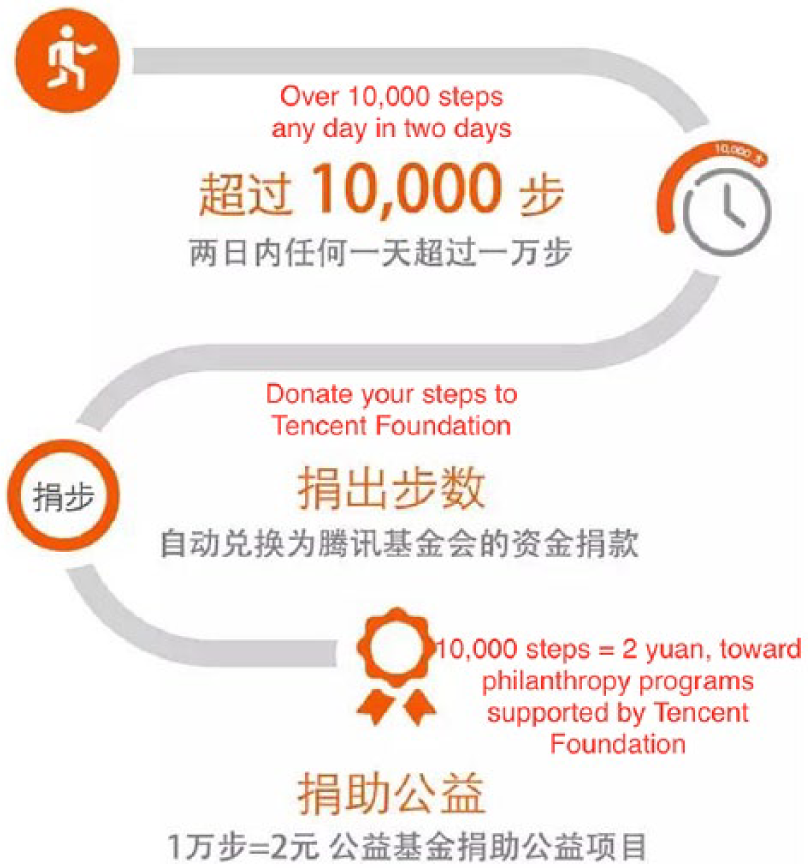
WeRun fitness-for-philanthropy formula.
Tencent Foundation was established in 2006 as part of Tencent corporate citizen and social responsibility initiatives. It is the first public welfare foundation set up by an Internet enterprise in China, with a focus on educational infrastructure (such as building schools) in poor and rural regions. Through its digital wallet platforms, its charitable donation grew tenfold from 10 billion yuan in 2006 to over 100 billion by 2016, 90% of which were processed via mobile devices, owning to the burgeon use of smart phones and mobile Internet across China (Soo, 2016). Enabled by the Foundation, in 2014, Tencent Charity Hiker (Weixin ID: txyixingjia) was launched among 15 universities to mobilize university students in a charity hiking competition. Each team proposed fund-raising plans and to participate in a hiking competition that ended up in Tibet. It was a huge success, with a donation of more than 2.43 million yuan from nearly 60,000 donors within a month, via QQ and Weixin (Jeffrey, n.d.).
The success of Charity Hiker was followed by the launch of WeRun in 2015. WeRun is a fitness tracking plugin and public account integrated within the Weixin app. It was released in August 2015 as an updated fitness tracker add-on to Weixin from its earlier version called Weixin Sports (released in February 2015). WeRun has outpaced fitness tracker gizmos such as Mi Band and Fitbit Tracker to get people moving, help monitor one’s steps, and turn it into a social competition among one’s friends. Its “steps donation” function makes it further outshine any other similar devices and apps as it fulfills people’s need to “feel good” after improving their fitness, helping others by turning one’s steps into good courses through the “steps donation” link, and being “liked” by their friends in “steps rankings.” All these are achieved via Weixin, which is accessible on multiple devices (mobile phones, tablets, and computers). Philanthropy thus becomes embodied (getting fitter and healthier), on the move (walking or running), and handy (at one’s fingertips).
Embodied participation in philanthropy is not new to human expression of benevolence toward fellow human beings. It can take medicalized forms of involvement such as blood donation and organ or tissue donation. Or it can take non-medicalized bodily modifications, such as hair shaving (to support cancer patients), mustache growing (for Movember in Australia to raise awareness of men’s health issues, mainly prostate cancer and depression), or pubic hair grooming (for Julyna in Canada to raise fund and awareness for cervical cancer and research and treatment). In the West, Movember and Julyna have been used as examples of individualistic and embodied participation in health-related fund-raising and awareness campaigns, through temporary body modifications (Robert, 2013). It will be interesting to see whether Chinese fun-seeking and trend-chasing millennials will adopt such individualized (and private) bodily modifications in the name of philanthropy to make themselves more physically, sexually, and socially desirable.
Embodied philanthropy of the WeRun type emphasizes bodily improvement and individual initiatives. Its fitness-for-philanthropy formula requires little investment or bodily modifications, sacrifice, or donation. Compared to other types of embodied philanthropy, the WeRun type appeals more to Chinese, who have been told that “The body, hair and skin, all have been received from the parents, and so one doesn’t dare damage or alter them—that is the beginning of xiao (filial piety)” (from Xiaojing, The Classic of Xiao). For the less rebellious, daring, cosmopolitan, or resourceful Chinese, the WeRun type of embodied philanthropy is more culturally and socially acceptable and hence more appealing. Hence, we have witnessed the increasing popularity of various hiking or “thon”-type charity activities (including bike-a-thons and charity marathons) organized by the third sector and embraced by people of all ages in China.
Unlike the hiking or thon-type activities, which require making or soliciting monetary donations and commitment of one’s time to organized activities, donating one’s steps for charity via WeRun only requires self-discipline, a sense of social justice, and acceptance of various charity programs chosen by Tencent Charity Foundation and its partners. It is particularly appealing to those who are individualistic, self-cultivating, and enterprising at the same time. They grow up during China’s economic takeoff and cultural transformation. Materialistic surplus is accompanied by a “spiritual” deficiency. This has led to a multi-layered and multi-directional moral landscape, which is characterized by extremely egocentric and anti-social behaviors as witnessed in the little Yueyue’s death Agence France-Presse (AFP) (2011) at one end of the spectrum and outpouring of unconditional love and support to earthquake victims in Wenchuan in 2008, Yushu in 2009, or Nepal in 2015 at the other end.
As Yunxiang Yan (2011) points out, the Chinese moral landscape has gone through three types of profound changes. First, there has been a shift away from a perceived “collective” moral experience of responsibility and self-sacrifice toward a more “individualistic” morality that emphasizes individual rights and self-cultivation. Second, this shift in moral life has led to a widespread public perception of a moral crisis, as individualistic values clash with collective values (of both the officially endorsed socialist morality and the Confucian morality). Finally, moral practices in everyday life are moving in two opposite directions, with one toward social apathy and morally “disturbing” practices and the other toward a new, altruistic, and more promising moral horizon. People have to “draw on multiple sources of morality to create a livable social environment around themselves, including particularistic networks, the conjugal family, socialist or religiously informed ideas of brotherhood, egalitarianism and fairness, individualism, and the renewal of the public spirit” (Y. Yan, 2009, p. 25). These morality systems are coexistent and often combine in new and unexpected ways at one’s fingertips, as witnessed in the WeRun fitness-for-charity module.
One respondent in her 20s said she was introduced to WeRun-Steps Donation in her “Friend Circle” on Weixin in late 2015. She was surprised to see that one could donate steps and also excited to see that such a function would prompt her to get fitter while doing good for others. She started to set daily targets for herself and encouraged her colleagues to do the same. It soon became a social competition among her friends as they all tried to be among the top 10 in steps ranking on WeRun. And they often reminded one another to donate their steps. “I’m killing two birds with one stone, in a healthy way,” she said. Helping strangers without taking any real sacrifice or risk (financially and socially) seems to be very appealing to China’s young adults.
Another respondent, in year 12, also commented on the risk-free, self-molding and networking effort of steps donation on WeRun. Apart from peer pressure—to be a daren (talent) in fitness and charity—the individualistic, voluntary, and non-monetary feature also attracted him and his friends to join the philanthropy on the move. He said,
Donating steps via WeRun is quick and easy. I’ve done that. And that does not impact on my life, as I don’t have to give up any part of my life or my body. I emphasize that I only donate steps, which does not have any consequence for my daily consumption.
He and his peers choose to donate their steps because they feel their agency—I do it at my own time and my own will and for my own benefit (both physically healthier and socially more acceptable among friends).
The above quoted experience is typical of the post-millennials. Self-enterprising and cultivation is both a voluntary choice and a networking necessity. Self-sacrifice, which characterized Maoist morality, does not dominate their decision-making process. Altruism can be both self-serving and serving others. Their vision of and participation in philanthropy on the move is both individualistic and collective (in terms of sharing with friends and social competition on social media, not the Maoist emphasis of social responsibility and self-sacrifice to help others). They promise a new altruistic and promising moral horizon.
Other responses from young adults have echoed the point. One 16-year-old boy wrote, “I’m a student and have no money, and hence donating my steps is the best way to help others.” Another cheeky one said, “I’m happy to donate things that I don’t need to others, such as my steps and calorie ☺☺☺.” A year 11 girl wrote in length on why she and her classmates took part in the steps-donation competition: time, money, and creativity are the three key considerations. Below is her account:
The school asked us to learn from Lei Feng.
7
Our class had a discussion on what kind of creative, practical and affordable public service that we could do. We were all very busy with study and couldn’t do anything that would disrupt our study plans such as volunteering in a rural school. At the same time, we have no income to make donations to charity organizations. We wanted to do something innovative, not those mundane and outdated activities such as sweeping the street or colleting rubbish. In the end we decided to have a steps-donation competition via WeRun. For a whole month we all walked to school rather than taking buses or cars, and had a chart to map our donations via steps. I made steps donation worth of more than 40 yuan in a month! We are healthier while helping students in rural areas at the same time.
The girl later added in a separate message that not all of her friends were able to continue the practice because of pressure from the school and parents, requiring more time for and commitment to study—walking to and from school took more time than driving of course. But there is possibility that they’d do it again in the future. Their sense of responsible citizenship, particularly toward strangers, is not unconditional, as reflected by a response from a university student (year 1) who had not donated steps via WeRun. Apart from lack of time (he just went through the grueling year 12 experience), he was suspicious of the so-called voluntary donations (monetary or not). In his view, most people are “forced” or “pressured” (bei xiepo) to make any donation to help strangers; one only voluntarily help people they know or when their hearts are deeply touched. “Am I selfish and lack of benevolence toward others? I don’t think so,” he said.
Such accounts are illustrative of the complex sociocultural and moral frameworks that have influenced Chinese young people in their participation in charity activities. The sociomoral landscape they represent sometimes falls in line with the collective morality of responsibility and self-sacrifice propagated by the mainstream media, sometimes seems consistent with the traditional division of moral responsibility between in-group and out-group members when people only help those they know or associate with, and sometimes is defined by an anti-materialism concept of philanthropy based on individualism and individual morality.
Both self-serving and altruistic at the same time, the WeRun-type embodied philanthropy is not only on the move but also moving in a direction that is designed by both power (the state) and money (the corporate world). It represents a market-driven, corporate-sponsored, and consumer-empowered form of neoliberal governance, which aims to mold self-entrepreneurial and responsible citizenship within an institutional framework that supports market economy and authoritarianism at the same time. 8 In the case of WeRun, embodied philanthropy is a CSR and cause-marketing initiative. It has taken on forms of awareness and fund-raising campaigns originated in the West that target educated, networked, socially conscious, urban middle-class, and the “Me” generation. 9 Like other forms of embodied philanthropy, such as charity hiking, rage walks, fun runs, “thon” type activities, and amyotrophic lateral sclerosis (ALS) ice bucket challenge, it taps into the young Chinese citizens’ imperatives for self-betterment, self-management, and self-empowerment in the state-sponsored neoliberal discourses that transfer responsibility for personal health and social service provisions to individual “responsible” citizens.
Philanthropy on the move as neoliberal citizenship
As discussed above, philanthropy on the move adds to the arsenal of embodied philanthropy, which ranges from complete bodily involvement (such as blood, organ, or tissue donation) and partially bodily modifications (such as shaving one’s head bald to raise awareness of social issues—cancer or gender equality) to fitness and fund-raising events such as fun runs, rage walk, and walkathon type activities. While the other forms of bodily involvement in charity runs, walks, thons, or races are marketed as fund-raising events and rely on large groups of people participating at once, WeRun for charity does not involve any kind of monetary donations from participants or the participation of a large number of people at the same time. Corporate donations to the Tencent Foundation have been allocated to its various charity programs from a range of civil society organizations, with or without individuals donating their steps. Hence, for Tencent and its corporate partners, WeRun for charity is a public relations platform and a publicity tool to attract both loyal and new customers. For individual participants, it can be both individualized and networked exercise of citizenship that contributes to China’s “new mentalities of government” (Bray & Jeffreys, 2016). The corporate sector, third sector, and individual participants all fall into the state-sanctioned framework of ideal enterprising citizenship as the “new normal.” 10
The corporates’ role in promoting engaged philanthropy (and on the move) falls in line with the logic of philanthrocapitalism. The term “philanthrocapitalism” takes market mechanism and capitalism as core to solving social problems through charitable activities. It includes consumer philanthropy, corporate philanthropy, billionaire philanthropy, and celebrity philanthropy. It upholds capitalist logic as instrumental into dealing with the problem of inequality (Thorup, 2013). It asks for faith in the market and valorizes entrepreneurial capitalism as a magic wand and productive force to address a whole range of issues from poverty reduction to capacity building for individuals and organizations. Quite often, philanthrocapitalism takes the form of top-down approach in cause-related marketing, driven by the interests of corporates or venture capitalists, endorsed by celebrities, managed by social entrepreneurs, and ornamented by positive media publicity. 11
WeRun for charity employs the logic of philanthrocapitalism as a corporate answer to bridging the top-down approach with bottom-up drives by engaging individuals (as consumers) emotionally, morally, and physically to solve social problems such as rural education and poverty reduction. 12 WeRun for charity uses market mechanism to form alliances among corporate partners, NGO partners, and Weixin users in the name of self-improvement (getting fitter and healthier), self-fulfillment (getting more socially acceptable and popular), and social obligation (helping others or meeting social imperatives). Consumers are turned into prosumers and given the agency to decide when and how they wish to undertake personal acts of volunteerism and charity service to their fellow citizens.
Social media (including Weixin) are used by businesses as a communication tool, a marketing technique, and a public relations platform to build a positive image for the company and to interact directly with consumers. Tencent and its business partners are able to not only generate positive publicity but also use user data for targeted marketing and value-added revenue generation. By providing the platform for grassroots participation in charity and channeling CSR attempts, Tencent and its business and third-sector partners have killed three birds with one stone: supporting the state policy on developing a new philanthropy culture, encouraging grassroots participation by turning consumers into prosumers and followers, and incorporating consumer and celebrity philanthropy into corporate philanthropy to achieve its CSR obligations while providing a veneer of intellectual respectability and emotional attachment to corporate giving.
Their efforts in shaping and defining what counts as grassroots and socially responsible actions at the mobile end are embraced by individual participants as both networked and individualized exercise of ideal citizenship. As the earlier analysis has shown, people participate in the WeRun for charity campaign because their friends are doing it and it will make them socially, politically, and physically more attractive (and hence popular). What seems to be personalized and individual actions are bounded by loosely coordinated activities centered on emotional identifications, aspirations, or simply obligation to one’s group or circle of friends. In other words, individuals are mobilized around personal lifestyle values as well as friendship networks to engage in collective causes. Philanthropy on the move and at fingertips is built upon traditional kinship and guanxi networks, which are built upon familiarity and years of cultivation and yet can expand into a cyber kinship and guanxi network. This cyber guanxi network often extends connectivity to out-group strangers when there is no perceived damage to one’s personal interest.
Thus, the seemingly individualized exercise of citizenship is connective and collective in nature. WeRun for charity is not comparable to contentious social movements such as the Arab Spring in terms of nature, scale, or impact. But like the latter, it is based on personalized communication via digital media, which is core to digitally networked actions. Such digitally networked actions are often characterized by a “connective politics,” a hybrid of or between the more conventional collective action (organizationally managed or self-organized) and relatively more personalized social action (Bennett & Segerberg, 2012). WeRun for charity hence sits between the so-called “slacktivism”-type symbolic action—clicking on “Like” or competing in steps donation on social media—and more contentious forms of citizen activism online (Tufekci, 2014; Yang, 2009). It is neither too individualist nor collective. It is personalized and connective (networked) exercise of citizenship, with the body as an instrumental tool of expression.
The IT company, its business and NGO partners, and WeRun participants have all taken the body as a project to craft an image of the ideal citizen that has been encouraged by the Party-state. The Chinese state has aimed to craft the ideal subjects who are subject to neoliberal concepts of individual responsibility, entrepreneurship, and self-improvement. It has encouraged Chinese people to actively participate in philanthropy and volunteerism in its effort to address deficiency in social provision and welfare system, as well as to fashion self-reliant and social responsible citizens. Not only are entrepreneurs and celebrities mobilized to support the development of philanthropy in China (Hassid & Jeffreys, 2015), but ordinary people from all walks of life (especially young people) are also encouraged to participate in community service and volunteering activities (Fleischer, 2011). Their participation in philanthropy is seen as a form of ideal citizenship. It is supposed to improve people’s personal capacities or qualities (sushi; for both givers/donors and receivers) while making people “feeling good” for being altruistic individuals, although altruism may be a consequence but not necessarily the motivating factor of people participating in WeRun for charity.
The discourse of suzhi is seen as a form of neoliberal governmentality born out of the context of China’s entry into global capitalism and its own post-socialist transformations. 13 It encourages people (especially young people and the middle class) to cultivate an entrepreneurial identity and be responsible for their own profits and losses, including managing their own health, problems, and careers. The desire for self-improvement, from appearance to social status, requires individuals to take responsibility and initiatives to make bodily modifications—from losing weight, coloring gray hair, working out for a trimmer and fitter physique, to plastic surgery; from moving to big cities to work as migrant workers to pushing oneself and one’s kids up the social ladder through educational attainment and achievement. Now adding to the toolkit of high suzhi (and hence good citizenship) is to be socially responsible through volunteering or any other kind of charitable activities.
Hence, bodily improvement (better health), self-fulfillment, social mobility, and social responsibility are all implicated in WeRun for charity. After settling into their newly found wealth and fortunes, China’s wealthy elite, middle class, and their children have attached greater importance to social recognition, quality of life, and social rights (Graham-Harrison, 2015; Li, 2010). Their desire for self-improvement and self-entrepreneurialism is not without a moral obligation to their environment and others. The moral surplus value is embedded in, for example, donating one’s steps for charity, purchasing ecological or fair trade products (as ethical consumers), or promoting environmental awareness. In the case of WeRun for charity, doing good to one’s body and soul happens at the same time as doing good to others. The exercising self and the needy other are loosely connected in the same loop of neoliberal discourse on ideal citizenship.
This neoliberal citizenship emphasizes the “surprise, unforeseen and unexpected opportunities of ‘helping out’ or ‘pitching-in’” through volunteering (Mills, 2013, p. 6). The ethic of walking out, reaching out, helping out, and pitching in without the burden of Maoist self-sacrifice constitutes the core of neoliberal citizenship, as illustrated by WeRun for charity survey responses. It has inspired a growing number of idealistic and resourceful youths to volunteer in social services and take handy philanthropy as a “technology of self” in order to transform themselves into moral, entrepreneurial, responsible, and functional subjects (Fleischer, 2011). The technology of self does not conflict with the “technology of power” from above, which can be translated as the state’s plan to refashion Chinese young citizens into responsible and self-reliant subjects in an increasingly competitive world (Fleischer, 2011). Philanthropy provides a perfect platform to educate, nurture, and realize the neoliberal citizenship.
This ideal citizenship, however, is inward looking in that it requires self-examination, self-improvement, and self-cultivation by individuals or communities. It asks people to turn critical eyes inward toward themselves, rather than outward toward the state, the government, and broader politico-economic structure. As discussed earlier, people’s participation in the WeRun steps-donation activity is premised on their acceptance of various charity programs chosen by Tencent Charity Foundation and its business and NGO partners. The latter are all sanctioned by the state, of course. In a tightly controlled speech environment, private corporations have played the role of “little brothers and sisters” to help contain a “civilized” public sphere. This corporatized and harmonized public sphere is full of cheer leaders and their followers but not inquisitors or cynics. No questions are asked on the structural reasons of extreme poverty and social inequality that exist in contemporary China; no criticism of the state or the government is found to exist in such a corporatized public sphere.
Are private corporates, entrepreneurs, celebrities, and middle-class (such as WeRun-for-charity participants) allies of civil society or the government? This question has intrigued many people. As Johan Lagerkvis (2011) argues, the state–capitalist power alliance has formed to develop a “harmonious” and “healthy” Internet in China, after Chinese Internet entrepreneurs and capitalists “have either been co-opted by the CCP or have chosen to ingratiate themselves with political power” (Lagerkvis, 2011, p. 171). This alliance has enabled Internet companies to continue to profit from the power–money alliance, and it has helped reduce the government’s need for the use of coercion and centralized guardianship as a means of control. It is unlikely that they will directly challenge the Party-state or assist in social change in the foreseeable future. However, by promoting responsible and participatory citizenship and providing a communicative space to enable people to participate in social service provision (such as charity donation and other volunteering activism), Tencent and other Internet companies are able to strike a balance among the political imperative (to maintain a sanitized public sphere), market imperative (to attract and maintain customers), and social imperative (to provide civil society with tools to create a more inclusive and accountable society).
Conclusion
Philanthropy on the move is based on the assumption that convenient, inexpensive, and consumption-based acts of generosity can have significant sociopolitical effect, such as nurturing responsible citizens who take responsibility for their own health and well-being while fulfilling their moral obligations and responsibilities toward fellow citizens. It fosters a form of ideal citizenship based on an ethics of self-governance. Participating in social lives and helping solving social problems are seen as being a responsible citizen who turn critical selves inward toward themselves, rather than outward toward the state and the government. It asks people to work on themselves, to turn their criticism inward (ask what I can do for my community and country), and to achieve the common goal of “building a harmonious society” (the catchword of the Hu-Wen era; Kahn, 2006).
The various forms of micro, handy, embodied, and mobile philanthropy appeal to a socially and culturally privileged demographic, who do not need to invest too much resource or time into doing good for others. Unlike monied private entrepreneurs who donate generously to charity (particularly government-sponsored welfare projects), the (mostly) urban, educated, and middle-class individuals who participate in rage walk, run for love, bike for philanthropy, or WeRun for charity are not motivated by the prospect of any potential material return like tax break, media publicity, or access to political and business elites. Nor is there any sense of martyrdom (as in the case of Lei Feng). Instead, they participate in the embodied philanthropy for self-enhancement, self-fulfillment, and self-entrepreneurialism.
The connective and collective micro-actions of enterprising and cultivating individuals are mediated by social media mobile apps, sponsored by corporates, and supported by the state. Together, they form an enabling environment for the cultivation and exercise of neoliberal citizenship. Social welfare, CSR, and active consumer-citizen of neoliberalism are all intertwined in the philanthropy on the move. However, no questions are asked about the fundamental and structural reasons for the political and economic disadvantage of those being helped. Nor any question has been posed on the corporatized public sphere of Weixin. (Or if it were posted, it would disappear within minutes if not seconds.) As Samantha King’s critique of the pink-ribbon breast cancer activism in the United States reminds us, “By according responsibility for the health and welfare of individuals to personal generosity, we simultaneously deploy a constructed understanding of the economic political, social and cultural forces that converge to shape problems of health and welfare” (King, 2004, p. 489). In the Chinese context, cultivating neoliberal citizenship through micro, individual, and highly mediated activities (via volunteering and handy philanthropy) can displace criticism of the Party-state and disinterest people from participating in social actions on the ground. But it also has the potential to transcend the dichotomies of altruism versus self-interest or state versus society.
Individuals and NGOs who are part of the state-capitalist-civil society triumvirate are not passive and compliant game players. Just as volunteering in any other organized or unorganized social activities, participating in WeRun for charity can reproduce and challenge the “technology of power” at the same time: It produces the ideal neoliberal citizens, who can transform the volunteering experience into a “technology of self” and then are in a better position to negotiate their relationship with powerful entities such as the state and corporations, as Fleischer (2011) points out. Such a negotiation can be issue- and locality-specific and contingent; it can have noticeable social impact in the long run.
Footnotes
1.
The “millennials” refer to those reaching adulthood around 2000, otherwise known in China as the post-1980s. The “post-millennials” refer to the post-1990s and post-2000s.
2.
The mobile payment functions allow app users to pay for a range services such as a taxi ride, a restaurant meal, a flight or hotel booking, movies, and various other services including donation to charity. Tencent collects a small fee from the merchants offering the services.
3.
Giving and receiving red envelops is a Chinese cultural tradition during festivals and on special occasions, as a monetary gift for bonding, linking, bridging, and networking with family members, friends, associates, superiors, customers, and so on. It has increasingly become an everyday tool of networking with open or hidden agendas, especially since Weixin initiated the digital red envelope function in 2014 (Tu, 2016, p. 348; Xu, 2016).
4.
While Alipay and Weixin Payment together dominate China’s third-party mobile payments, other players and imitators have come onboard, such as Baidu Mobile Payment, Apple Pay, Huawei Pay, and Samsung Pay.
7.
Lei Feng is a Mao-era model soldier who has been revived in the post-Mao era as a philanthropy poster boy to encourage volunteering among young people (Jeffreys & Xu, 2016).
8.
Defining the concepts of neoliberalism and neoliberal governance requires a separate paper. Numerous authors have contributed to the debates, the best known of which is David Harvey in his A Brief History of Neoliberalism (Oxford University Press, 2005) and, in the Chinese context, Aihwa Ong in her Neoliberalism as Exception: Mutations in Citizenship and Sovereignty (Duke University Press, 2006) and David Bray and Elaine Jeffreys in their coedited volume New Mentalities of Government in China (Routledge, 2016). Neoliberalism and neoliberal governance are concerned with defining the relationship between individuals and the state within a market economy framework. In the neoliberal regime, governance means putting decision-making power back into the hands of responsible citizens, especially those who possess (economic, cultural, and social) capital.
11.
The Third World Quarterly features a special issue (35.1) on “New Actors and Alliances in Development” in 2014, which takes issue with philanthrocapitalism. It is not within the scope of this essay to offer a critical review of contending positions on key relations, alliances, public statements, and private agendas of new and old actors in development financing and intervention.
12.
Rural education and poverty reduction are regarded as the safest areas (politically) to engage with in China, according to the author’s conversations with nongovernmental organization (NGO) activists and leaders.
13.
The discourse of suzhi as a neoliberal discourse has been discussed by several authors such as Kipnis (2006, 2007), H. Yan (2003), Anagnost (2004), Sigley (2009), and  , pp. 189–193).