




Abstract
This study explores Chinese journalists’ discursive practices of nostalgia in the context of transition and “crisis” of media and the journalism profession in order to understand how the journalistic community looks back and forward at such a historical juncture. I conduct a textual analysis of writings of nostalgia produced by journalists and media commentators in a wide range of settings: the commemoration of diseased journalists, resignation letters by former journalists, celebration of media organizations’ anniversaries, and reflections on scandals and crises in the media. The analysis reveals that golden ages emerging from such writings refer to the period of the press reform and the rise of market-oriented media in the mid-1990s and through the early 2000s. Within the interpretive community, the ideal of golden age is constructed to serve as a benchmark for critiquing the state of journalism, enhance the legitimacy of those journalists who embrace the new practices in the new media era, and chant a requiem for both the press reform and the decline of traditional media.
Introduction
In June 2002, the famous Chinese journalist Chen Juhong resigned from Southern Weekly, where she had worked for 7 years, to become a Nieman Fellow at Harvard University. 1 In late 2003, she recounted in great detail “all those days of gold that shined so brightly that it is hard to believe.” In this essay titled Leaving, she also observed, “a great number of reporters who used to sweat and shed tears for this newspaper had left by 2001” (17). 2 But she did not lament the passing of a particular journalistic era.
Ten years later, “those days of gold” were reminisced as constituents of “golden age,” again and again on various special occasions, or at “hot moments,” to borrow a nice phrase from Zelizer (1992), moments such as the retirement of Jiang Yiping, the Editor-in-Chief of Southern Weekly during its heyday. The name of golden age of Chinese journalism, however, is not reserved exclusively for this Guangzhou-based liberal newspaper or its parent company the Nanfang Media Group. It also refers to media in the north, including in particular CCTV in Beijing, which is the state-owned national TV network. The deaths of the CCTV producer Chen Meng in 2008 and the former CCTV director Yang Weiguang in 2014 were among the special occasions that propelled television journalists to memorialize these idols and express their nostalgia for the passing of an era.
These are not isolated cases, but part of nostalgic reminiscence of golden ages across various settings, ranging from the death of prominent individuals, journalists’ resignation in print media, to anniversaries of TV shows or news organizations, and even reporting of scandals and crises in the media sector. At the end of the first decade of the twenty-first century, abruptly, it seemed nostalgia became one of the keywords spreading in China’s journalistic community; sentimental feelings about the youthful days and the memorable past could easily be found in journalists’ self-reflections. I contend that the narrative of golden ages was not simply a rhetorical strategy of remembrance, but a set of discursive practices performed by Chinese journalists at a particular historical juncture, which connected personal nostalgia for youthful years to the collective memory of the professional community. When encountering the nostalgic discourse, the immediate question may be, “Was there really a golden age for Chinese journalism?” And probably more interesting, I would argue, is the question of why a great number of golden age stories arose at this particular historical moment.
Addressing these questions, this article examines nostalgic narratives produced by Chinese journalists and media commentators in the context of transition and “crisis” of journalism, media, and media operations. It focuses on the narrative of golden ages in order to understand how the journalistic community has been looking back at an important historical juncture and how it has been looking forward for its future prospect. For this purpose, this research collects and analyzes data that go beyond any single case; it incorporates a large number of stories, recollections, and essays on CCTV, Southern Weekly, and the print media at large into its analytical framework. By comparing the narrators, discursive settings, implicated audiences, and historical moments, I aim to uncover the referent of golden age, its defining features, and its historical configuration. I also explore how journalists made sense of the changing media environment, established continuity and/or rupture between the past, the present, and the future as they constructed the myth of golden ages. By doing so, I believe, the study contributes to a better understanding of the significance and implication of nostalgia in the interpretive community of journalism.
Nostalgia and the transition of journalism
Nostalgia is, to appropriate Raymond Williams (1961), a “structure of feeling” that is widespread in modern society. It “invokes a positively evaluated past world in response to a deficient present world” (Tannock, 1995, p. 456). It is like “a double exposure, or a superimposition of two images—of home and abroad, of past and present, of dream and everyday life” (Boym, 2007, p. 7). Although in the 17th century the term “nostalgia” was used to refer to homesickness among displaced people, it now captures “a symptom of our age, an historical emotion” (Boym, 2007, p. 8). It is closely related to modernity in the sense that it is “both the bittersweet side-effect of modernity and a potential cause of a deadening hostility to the changes that modernity brings” (Atia & Davies, 2010, p. 181). As a cultural practice, the “forms, meanings, and effects” of nostalgia “shift with the context,” “depend(ing) on where the speaker stands in the landscape of the present” (Stewart, 1988, p. 227). Nostalgia is not only about retrospection, it also connects the past, the present, and the future. As Boym (2007) aptly puts it, “the fantasies of the past, determined by the needs of the present, have a direct impact on the realities of the future” (p. 8).
As nostalgia always involves the dislocation of people from a particular time or place, its rhetoric embraces several key tropes, including “the notion of a Golden Age and a subsequent fall, the story of homecoming, and the pastoral” (Tannock, 1995, p. 456). For journalists, the central thread of various nostalgic narratives can be the construction of golden age. The death of renowned figures provides an opportunity to revisit a past era, reflect on the current state of the media, draw boundaries between good and bad practice, and reinforce their cultural authority. In the memorialization of the legendary American TV anchor Walter Cronkite, for instance, journalists not only recollected Cronkite’s professional career, but also revisited the journalistic era of the 1960s and 1970s and contrasted this golden era with the present (Carlson & Berkowitz, 2012). In China, journalists composing commemorating texts treat the retirement of Jiang Yiping and the death of Yang Weiguang as signs of the end of a golden age and contrast it with the post-golden age. This common feature across the two cultural contexts indicates that “commemorative discourse is not about remembering the past, but lamenting the present.” (Bai, 2014, p. 55; Chen, 2015)
Constructing such a nostalgic discourse on journalistic profession and work is also intertwined with the emergence of a crisis discourse (Zelizer, 2015). In recent years, journalism on a global scale is facing various challenges from rapidly changing technologies, political-economic institutions, and social conditions. Take the American newspaper industry as an example: Dozens of newspaper titles have disappeared, the average circulation has fallen dramatically, advertising revenues have declined year after year, and newsroom employment has shrunk by 39% in the last two decades (Mitchell & Holcomb, 2016). The crisis of journalism has become a self-evident proposition and has been taken as a starting premise by many researchers and practitioners (Nielsen, 2016).
However, as Zelizer (2015) points out, the notion of “crisis” does not capture the full scope of contingency and local nuances of transition in journalism. Instead, journalists’ talks of “crisis” are highly varied and situated, as shown in many publicized farewell statements by those who were laid off or left the industry voluntarily. While these texts reflect prevalent awareness of a crisis and pervasive nostalgic sentiment, they reveal varying ingredients of nostalgia available in the journalistic community. However, in their farewell musings, these journalists confess to embrace a journalistic ideal that no longer exists; on the other, they express little direct indications of self-reflexive examination of their role in a changing media environment (Usher, 2010). These nostalgically sounding and publicly shared meditations almost inevitably connect the narrators’ personal experiences with journalistic community’s storytelling. They reveal the significance that nostalgia builds a bridge between individual and collective sense making, which serves as a re-examination of the core values of journalism (Spaulding, 2016). In China, the farewell contemplates similarly touch upon the impact of technology and digital media. But they also express discontent with the oppressive political control over the news media. Such an expression is often entangled with recollecting unforgettable moments of their careers and lamenting the passing of golden age (Chen & Zhang, 2016).
Moving beyond the studies that focus on individual cases or “hot moments” (e.g., Bai, 2014; Chen, 2015), this article relates the discursive practice of nostalgia to the transition in journalism in China and examines the “golden age” narratives produced by journalists in a variety of settings. The goal is to address the following research questions: (1) What historical period of Chinese journalism is considered as a golden age by contemporary journalists? What are the visions, values, and ideals embodied in such a golden age narrative? How does it connect personal recollections to collective memory? (2) How do journalists separate the golden age from the present and establish discursive (dis)continuities between the past, present, and future? (3) For the nostalgic subjects, does invoking golden age mean escaping from or evading the present reality? Or does it provide a framework for them to make sense of the present or a cultural resource to envision the future?
Regarding empirical materials and analytical strategy, I do not aim to have an exhaustive coverage of all the nostalgic texts—an impossible task anyway, but I do hope to discuss the major moments of Chinese journalism that cut across multiple cases, in terms of nostalgic subjects, their organizational affiliations, and their discursive settings. I combed textual materials from the past 10 years published in mainstream media, trade journals, journalists’ blogs, and social media platforms, and analyzed them against the backdrop of the three decades of development in Chinese journalism since early 1980s. The materials cover the following categories: (1) commemorative essays or statements on well-known journalists who retired or passed away, (2) farewell narratives produced by those who left journalism or reports about their exit, (3) texts on occasions of organizational anniversaries, (4) news reports and commentaries on scandals in the media sector, and (5) other general discussions of the state and prospect of news media.
Golden ages of Chinese journalism
“Yan’an in television journalism”
In Chinese journalists’ nostalgic writings, three periods are often identified as golden ages. They are associated with two particular news organizations, CCTV and Southern Weekly, but “the print media” (zhi mei) in general is also recognizable as a prominent player.
The dominant narrative of the golden age of CCTV unfolds along two plotlines. The first is to see the period under Yang Weiguang’s directorship (1991–1999) as a golden age. This plotline is most clearly manifested in the commemorating discourse on his death in 2014. In these writings, former and current television journalists across the country labeled the “Yang Weiguang era” as not only CCTV’s golden age but also “the golden decade of the 1990s of Chinese television” (47, p. 8). They emphasized that Yang Weiguang “created a glorious era for CCTV” (13) and “spent 14 years to bring CCTV into a golden age that is hard to duplicate” (4). His 1999 retirement from CCTV “ended the decade-long historical enlightenment of Chinese television” (7) and “brought the golden age of television to an end” (1). These sentiments, however, can also be found in similar expressions a few years earlier. In 2008, Shi Feike, a media critic who achieved national recognition through his journalistic career in Nanfang Media Group, wrote that the “Yang Weiguang era was the heyday of CCTV” (34). In 2009, CCTV insider claimed in an interview, “older employees still cherish the memory of the decade from 1991 to 1999, the most glorious years of CCTV” (42).
The second plotline focuses on CCTV’s program Oriental Horizon that was launched in 1993. According to former CCTV producer Wang Qinglei, the launch of this program “marked the beginning of a glorious era of CCTV” (52). Given that the program is often seen as a signature achievement of Yang Weiguang, this plotline is interconnected and overlapping with the first. And while Yang has passed away, the program is still part of CCTV’s regular offering. However, it is no longer a signifier of golden age as it once was, because, as some journalists profess, the show has “become an empty shell” (37, p. 298) and “only retained its name and logo” (15).
The second plotline has additional ambiguity. Unlike the end that was marked “naturally” by Yang’s retirement, when would be the “fall” or decline of Oriental Horizon as a symbol of golden age? Contributors of the nostalgia for the golden age have various answers to the question. First, some have taken as an indication the departure of the core members of the team that created the show. For example, some have written, the death of the producer Chen Meng in 2008 “to a certain extent signified the end of an era” (10), which meant that “the page of Oriental Horizon ha(d) been turned” (15). The sentiment is more fully illustrated in this passage: (T)he life of Chen Meng belongs to the years of burning passion of the press reform at CCTV, which began in the spring of 1993, from the maiden broadcast of the morning program Oriental Horizon; it belongs to the News Commentary Department, which was often compared to Yan’an in Chinese television journalism; to an era when idealists came together and waved their flags. (36, p. 2)
This is a typical description of golden age. The metaphor of Yan’an, the birthplace of the Chinese Revolution, is frequently invoked by journalists: “twenty years ago, young people came to Oriental Horizon from all over the country, just like revolutionary youths went to Yan’an in the 1930s and 1940s, exercising their own free will” (29). In contrast, now, “CCTV is not Yan’an in television journalism any more; there are less and less normative concerns in hard times” (54).
Second, changes to the format and content of the show have taken place several times in its long history, some of which have been referred to as signs of the show’s decline. Shi Jian, a well-known producer of the show, noted, “in 2001, the show was shrunk from 150 minutes to 45 minutes; the press reform ceased to exist except in name and Oriental Horizon was on the decline” (59). The book The Days When Ideals Shined, an edited volume based on interviews with the members of the show’s founding team, limits the golden age of the show to an even shorter period. Although the book was published in 2013, as a tribute to the 20th anniversary of the program, it only focused on those 3 “years of burning passion” (60) or “days in Yan’an” (37, p. 96) immediately after its debut, which were “full of daring courage, wisdom, innovativeness, free atmosphere, egalitarian association, and avant-garde spirit” (37, p. 322). For the founding members, “that was the most glorious moment of Oriental Horizon; it was also a turning point in the ‘real revolution for Chinese television’” (37, p. 180). The nostalgic lament by the contributors of this volume for the golden age of Oriental Horizon is evident: “since 1996, the new Oriental Horizon has been transformed into a different kind of show” (37, p. 298).
“Whampoa in the South”
In a similar fashion, journalists’ nostalgia for Southern Weekly and Nanfang Media Group also created diversified and differentiated golden ages, albeit in a different setting. The first plotline is also formed around pivotal individuals. Zuo Fang, who is the paper’s fourth Editor-in-Chief (1991–1994), fit the bill; he was believed to have “created the first golden age of Southern Weekly” (65). But most journalists associate the paper’s golden age with Jiang Yiping, the Editor-in-Chief from 1996 to 2000. Jiang’s retirement in 2013 propelled many to proclaim the “Jiang Yiping era” as the “most glorious time” (3) of Southern Weekly; they praised her for having turned the paper into the “Whampoa Military Academy” 3 of the press (9), which trained many accomplished journalists for other media organizations.
The coming of age of the “golden generation” constitutes another plotline of this set of golden age narratives. As early as 2005, a special report on China’s Journalist’ Day sought to “look for the golden generation of Southern Weekly”; these are journalists who “have bought a newspaper into a golden age of Chinese journalism” (51). A Sohu webpage devoted to Jiang Yiping 4 lists 25 journalists as being members of this golden generation; included were Southern Weekly’s reporters Zhu Defu, who joined the paper in 1991, and Li Haipeng and Lin Chufang, who came on board in 2002. Despite the ambiguity, most of the writings included in the golden generation the journalists who were most active in the mid to late 1990s, roughly corresponding to the Jiang Yiping era.
If the Yan’an metaphor for CCTV implies attracting talented people from all over the country, the Whampoa metaphor for Southern Weekly suggests dispersing “battle-tested” journalists to other media outlets to achieve their professional successes. Just like the retirement of Jiang Yiping, the passing of the golden generation was also a marker of the end of golden age. For example, writing about Fang Sanwen, a journalist who joined the paper in 1997 but left in 2002 to become CEO of a successful social network site, a reporter described the end of golden generation: He had experienced and witnessed the most glorious years of China’s most outstanding newspaper … But all of a sudden, his comrades began leaving … Before his departure, Jiang Yiping had left, Chi Yuzhou had left, Qian Gang had left, Chen Juhong had left; after his exit, others also followed suit. A whole generation of journalists left; an era came to an end. (55)
Another journalist, Li Yuxiao, also left Southern Weekly in 2002. According to an online author with the account name Silvia, they departed “at the heyday of the paper’s golden age,” without realizing that they were turning way from a paper that is “moving from its golden age to its twilight” (50). Ever since then, the “spirit of the South has withered away.” (63)
The fall of the print media from its golden age
Just as golden age narratives of CCTV and Southern Weekly, the departure of some prominent print journalists from the profession was taken to signify the fading of a golden age of the print media at large. This is well illustrated in this online essay saluting journalists: [The Founder and Executive Editor] Feng Xincheng left New Weekly, [Editor-in-Chief] Zhu Wei resigned from Sanlian Life Weekly. All this marks the end of a golden age of the traditional media … The withering of print media is beyond the point of reversibility. New media, especially mobile platforms, are rising so quickly that they are the tidal waves of our time. (44)
Other journalists expressed similar sentiments. Wu Xiaobo claimed that “the departure of Qin Shuo [Editor-in-Chief of China Business News], to a certain extent, means the end of a golden age” (27) and the resignation of Phoenix TV reporter Lüqiu Luwei was also interpreted as “ringing down the curtain of the golden age associated with a whole generation of journalists and arrival of a brand new era” (26).
Those journalists who left journalism tended to associate important moments of their career, their entries and exits in particular, to the rise and fall of golden age, conflating, consequently, individual nostalgia and collective storytelling. For example, one former reporter wrote, “I am very lucky to start my career with Xinhua News Agency [in 2001] at a glorious moment of print media” (16). Another wrote, “people like me, who joined serious journalism business in the summer of five to six year ago [2007], were really working in good times” (24). A former Southern Metropolis Daily reporter recalled, In July 2005, I was a reckless fresh graduate with a master’s degree and very proudly found a job at Nanfang Media Group … Back then, journalism was thriving and print media were glorious … Ten years later, the golden age has gone. This is the case of not just a particular newspaper, but the whole newspaper business. (21)
Against this background, scandals or crises in the business have also been critical moments for journalists to lament the decline of golden age. In September 2014, Shen Hao, a former senior editor of Southern Weekly and the president of the 21st Century Media Ltd, was arrested and charged of extortion. The scandal shocked the journalist community and generated a wave of public outcries, as reflected in the following commentary on the case by Hu Yong, a journalism professor at Peking University: Shen Hao’s inspiring words, including “even if journalism goes extinct, it will leave behind countless dedicated disciples” and “may the powerless find strength, may the pessimists march forward,” reflect, to use Shen’s own words, “the idealistic spirit of the generation of journalists who worked at Southern Weekly during the 1990s.” Shen’s fall from grace is a sign that that era is gone forever, and the curtain has closed on the golden age of commercial media in China. (46)
“May the powerless find strength” was a widely disseminated New Year’s Day well-wish published on Southern Weekly in 1999. Shen penned those words. If Shen Hao’s past corresponds to the glorious days of Southern Weekly, his dramatic fall from grace signals the end of golden age of Chinese journalism. As one media commentator wrote, in the golden age of print media … there would never be such systematic journalistic corruption from top to bottom … The current financial circumstances of print media cannot be compared to the time when Shen Hao wrote “sunshine brightens your face” [in 1999] (38)
when print media were more confident about its capability to make money together with good news.
The golden age of print media emerged from such nostalgic narratives referring to the decade from 1995 to 2005, which is also the decade of media becoming rapidly commercialized in China. For journalists, those 10 years are “commonly believed to be the best decade for print media, especially for metropolitan newspapers” (57). To many, this “golden decade” (20) was marked by “blazing youth and burning passion,” (57) when “the market-oriented media marched forward triumphantly” (40). But in the current “decade of stagnation” (58), “traditional media have reached the final stage of their lifecycle” (18). Most of the observers who contributed to the corpus of the golden age for print media attributed this decline to the rise of new media. In the nostalgic turn to the past, journalists lament not only the passing of a golden age but also hail a new era.
Unpacking golden age
The above analysis shows that the nostalgic turn to the pasts has created not one golden age, but several, ranging from the early years at Oriental Horizon (1993–1996) to Yang Weiguang’s directorship at CCTV (1991–1999), from the Jiang Yiping era of Southern Weekly (1996–2000) to the golden decade for print media (2005–2015). However, in constructing these golden ages, journalists share a set of vocabularies, storytelling resources, and writing styles. We may cluster them into three storylines. The first is a story of growth, constituted by elements of youth and idealism; the second is a narrative of fostering environment in which the institutional environment was fertile for the journalism of golden ages. It included elements of a favorable political-economic condition, an “unusual” organizational atmosphere, and open-minded leaders. The third is a story of withering, namely, the present has deteriorated from the past. Together, these stories not only constitute an overall narrative of nostalgia, articulate personal life experiences of the authors and participants with the larger histories of the changing journalism and media in China, but also make such a narrative a biting critique of the present and, to some degree, a gloomy forecast of the future.
“Forever young”
In the golden age discourse, “youth” denotes the youthful years of the narrators who were active journalists during that era. It also refers to a certain kind of organizational atmosphere or zeitgeist that was neither stale nor rigid: “Those were the glorious days of the (CCTV’s) News Commentary Department’s youth, when (an anchor of CCTV) Cui Yongyuan was also very young” (41). The CCTV anchor Jing Yidan, acknowledging that she was no longer young during those years, nevertheless felt the youthful spirit: “When I joined Oriental Horizon, I had already passed the age of being young. But working in that team, you could always feel the vigorous energy and youthful strength” (12).
For some journalists, the golden age meant “the era when you could be the best young journalist” (37) and “achieve a professional career that was worthy of the golden years of your life” (8). But no matter if it was the youthful years of journalists or the “adolescent stage of the newspaper industry” (12), in the reminiscence of youth, its blossom simply had to fade. After Chen Meng passed away in 2008, CCTV’s celebrity anchor Shui Junyi wrote, “in our tears and condolences, we feel sad about the passing of the youthful years of a generation of television journalists. Our tears are shed for Chen Meng but also for ourselves.” (10) Whether referring to the actuality of youth or used as a metaphor, “youth” weaves together the individuals, organizations and the journalistic community to form a coherent story of the prime of life, with a beginning and an inevitable end.
We can detect three different ways in which “youth” appears in golden age discourse. First, remembering and celebrating the youthful years becomes the purpose of recalling the golden age, as in “giving proper respect for our youthful years” (37, p. 322). Second, lurking behind the journalists who were young in the golden age, there was a story of them being summoned by the spirit of the time. The Yan’an metaphor for CCTV in its golden years is a vivid illustration of this narrative, while Southern Weekly in its golden age was also “a place that almost all young people from all over the country dreamed about” (33). Former Southern Weekly reporter Fang Kecheng captured this connection when describing his personal journey of choosing a career in journalism: I have told the story of an adolescent boy being “bewitched” by media in the south on many occasions. That was a special time—the SARS epidemic, the Sun Zhigang incident,
5
and the Southern Metropolis Daily Case;
6
also a special stage of growth for myself … I bought Southern Weekly every week, and mistakenly believed that being a reporter was a better option to undertake social responsibilities and promote social progress than being a scientist. (19)
Third, youthful passion, which expresses the spirit of golden age, constitutes the core element of journalists’ personal recollections. Individuals’ personal growth serves as the bridge between the narrative of youth and the development of Chinese journalism. Often in poetic terms, these nostalgic subjects offered thick descriptions of the “fearless mental state full of creativity and wicked ideas” of the “martyr-like hot-blooded youngsters who left their families and previous jobs behind” (37, p. 180). In such recollections, they also emphasized that golden age provided an environment for their growth that enabled them “to establish their career and reputation at the right place, and the right time” (37, p. 101) and gave them “the courage to face the world boldly” (37, p. 262).
Idealist spirit
In addition to passion and enthusiasm, being young also means being idealistic, as reflected in such book titles like The Days When Ideals Shined (37) and The Gene of Idealism (32) published on the 20th anniversary of CCTV’s Oriental Horizon. A term frequently appearing in nostalgic narratives, “idealism,” is seldom defined. Journalists assume a tacit understanding of its meaning, lying unsaid between the lines. The indicator of idealism is in the labels that attached to professionals, such as “fearless watchdogs” (27) and “journalistic saints at No. 289 Guangzhou Avenue” (56). 7 Ruminating over the golden age, a journalist described an idealist as “Confucian journalist,” who “used the ideas of professionalism and muckraking journalism from the West as tools to uncover the truth with perseverance” (22). So, the idealism imbued to the youthful pursuits in the golden age is said to combine the spirit of traditional Chinese literati and journalistic professionalism imported from the West.
The idealism is often set in a sharp contrast with “reality,” which in turn enables a template for comparisons between the past and the present. As the opposite of idealism, reality first implicates material conditions: To say that there once was an atmosphere “full of idealism” is to mean that “the aspiration to material success, even though was present, but was not nearly as strong as in the more recent period” (37, p. 149). It does not mean that golden age was a time of journalists suffering from scanty material means. On the contrary, journalists long for “a past when they were idealistic, had high social status, and received a booming income” (57). An illustrative temporal comparison stated, “ten years ago, journalists working in print media were regarded as ‘uncrowned kings’; now, they have become ‘migrant workers.’ Parallel to the demise of idealism was the decrease of income” (53). Moreover, reality also points to the political environment of news making. When the tough reality replaces idealism, golden age ends. From “waving the idealist flag” (23) to idealism “being laughed at” (21), journalists no longer fancy to “turn idealism into something real”: When you mention idealism to a journalist, how would he or she respond? Ten years ago [in 2002], he or she would probably say, without any hesitation, “may the powerless find strength, may the pessimists march forward.” At that moment, you would see the sunshine brightening his or her face. But now, he or she would possibly reply sarcastically, “You are the one who is idealistic! Not me!” (53)
In this excerpt, the author used Southern Weekly’s 1999 New Year’s editorial to illustrate idealism. The inspiring statements from the editorial expressed the sense of responsibility of news media and the optimism that journalists once embraced in the golden age, whose decline, as one reporter wrote in a social media post, implies that “journalistic idealism has been turned from an embraced belief to being a wishful fancy, and to finally, despair” (61).
Idolized golden age
As the heyday of the news business, the golden age was supposed to produce a large amount of good journalism. Journalists frequently mention certain news stories in their golden age narratives, including, for example, the investigative coverage of Yinguangxia manipulating the stock market by Caijing magazine in 2001, and the investigative series of the Sun Zhigang’s death in 2003 by Southern Metropolis Daily (57). While these stories left indelible impressions as cases of journalistic excellence, there is no commonly accepted epoch-making or milestone piece, as, for example, the Watergate coverage was in American journalism (Zelizer, 1993). Instead, journalists regard “people” rather than “works” as the scaffold of golden age. The rhetoric of connecting the departure of well-known and influential figures to the passing of an era illustrates this point. Among those journalists being recalled, leading figures are granted a privileged position and are always portrayed in an idealized manner: The “whole era” defined by Jiang Yiping was an era when you could see among the older generation, integrity and backbone, and among the younger people, respect and aspiration. Ms. Jiang never got involved in any fractional politics. She developed her professional career together with the advances of the press in the country. She influenced at least three generations of younger journalists who had great respect for her, and inspired countless more. By bidding farewell to Ms. Jiang, our spiritual mentor and shelter, we come to the realization that we have to adapt to the world without her. (11)
The idolization of the leading figures is in congruence with nostalgia of the atmosphere of the past, and these towering individuals’ departure is said to “have taken the air out of the whole golden age of the press” (11). The focus of such portrayal is not the professional achievements of these leading figures, but their personality, charm, and charisma. In the nostalgic recollection, it is primarily about the lack of bureaucratic aura. Jiang Yiping is compared to “a beautiful tree in the Southern Weekly” (6), embodying the old saying that “a man of true worth attracts admiration” (17). As veteran journalist He Sanwei recalled, “after joining Southern Weekly, I learned that news executives such as Zuo Fang, Fan Yijin and Jiang Yiping, were news people, not bureaucrats” (3). Similarly, Yang Weiguang of CCTV is addressed as “a considerate old captain” (2), “an experienced captain,” and “Old Yang” (4). Moreover, the influences of these idols were said to transcend their own time and reach later generations. One reporter, although joined Southern Weekly after Jiang Yiping being removed from her position, considered himself among “the small flames ignited by her” (8). The younger generation “recited those New Year’s editorials written or edited by Jiang Yiping and strove to find a way between high ideals and hard reality” (12).
“The unusual years”
Golden age also implies a unique organizational culture and institutional environment, in which the journalists of the golden generation developed their careers. Bai Yansong, a well-known anchor at CCTV, described these “unusual years” in an emotion-laden way: Oriental Horizon in its beginning stage was unusual, even abnormal, and because of that, unforgettable. The leaders and rank and file could pound each other’s desk without being considered disrespectful. If you had good ideas, you would be respected and the ideas could soon be turned into something real. All flattering or brownnosing was despised … People would not be laughed at when they talked about ideals and dreams. (29, p. 2)
Idealizing the past, as shown in this excerpt, is to depict an “unusual” working condition, characterized by a non-bureaucratic organizational atmosphere, open and egalitarian relationships between supervisors and subordinates. The recollections of golden age at CCTV are filled with descriptions of “cramped spaces” that tended to foster comradeship. The New Year’s parties at the News Commentary Department, for instance, were remembered as gatherings “to make fun of producers and other supervisors” (37). Such acts were taken as a good illustration of “the times when everybody worked together toward success and there was no rigid hierarchy” (43). In a similar vein, “Southern Weekly in the 1990s,” it was later remembered, “was more like a family workshop, making you feel like you were at home” (51). “Reporters or editors back then did not address their supervisors with formal titles, but with their first names” (46).
“Unusual” also means a unique institutional arrangement. In recalling the Yang Weiguang era or the golden age of Oriental Horizon, most journalists mentioned the “personnel and financial policies in this ‘special zone’” (37, p. 199), especially the then experimental producer system. In such a system, producers could sign a contract with the station, recruit his or her own team members, and retain a portion of the advertising revenues generated by the program that they produced. Under this flexible system, “if you did a poor job, you would have no money, and then you would have to leave. It was logical and reasonable” (37, p. 41). This was believed to have made Oriental Horizon an “incubator”: “As long as you have good ideas, passions, and ability, supervisors will approve your project and let you test your ideas” (37, p. 127).
In accordance with this innovative system, there was a “macro environment of ideological opening at the time” (34). For journalists, the political-economic environment outside their organization was like a “glass greenhouse,” while programs like Oriental Horizon were “trees” being nurtured inside. The greenhouse shielded the trees from wind and rain, but also set the limits for their growth. “Given the size of the greenhouse, how tall could the tree grow? Oriental Horizon has possibly reached the ceiling” (37, p. 214). One former producer of the show Shi Jian used another set of metaphors, a bird and cage: “The size of the cage matters, and the wisdom of the bird also matters” (59). He attributed the founding and early success of Oriental Horizon to the favorable ideological atmosphere and a need for reform in the early 1990s, and imputed its later decline to authorities tightening up political control and a growing pressure from ratings and profits.
Whether it is reaching the ceiling of a glass greenhouse or living in too small of a cage, the broader environment that made golden age possible no longer exists. Shi Jian laments, “without a hospitable environment, space, and passion, there is no way for my artistic vitality to thrive” (59). Similarly, He Sanwei, a famous reporter at Nanfang Media Group, pointed out, “now we also have the best talents, but they do not live in the best era” (3).
The historical configuration of golden age
Ten years apart: before and after
On the 10th anniversary of Oriental Horizon in 2003, Sun Yusheng, the man who led the show’s founding team, published a memoire, A Decade: Starting with Changing Television’s Mode of Expression. In it, he chronicled the reform activities at CCTV from 1993 to 2002. Ten years later in 2013, another CCTV producer Zhang Jie made a documentary titled The Days When Ideals Shined and published a book with the same title, in which he invited veteran journalists to recollect their days at Oriental Horizon. Despite the 10-year interval, the two books have a lot in common. A Decade portrayed the News Commentary Department as “a tribe of idealists” and used metaphors like “Yan’an” or “Shenzhen 8 in television.” These expressions and imageries also appeared in the nostalgic texts of the later book. Many historical details in A Decade were recycled and invoked by later writers and have become important raw materials for golden age narratives.
Both A Decade and The Days When Ideals Shined were released on anniversaries of Oriental Horizon and began their story in the same year, 1993. But the stories told in A Decade ended with the publication date, while The Days When Ideals Shined focused on the early three years of the program. In other words, the former told the “unfinished stories” of an “ongoing reform” (35); the latter told finished stories of an era that no longer existed. On the first page of A Decade, Sun made a comparison between the launch of CCTV’s News Channel to the founding of Oriental Horizon 10 years earlier and noted that “these changes are signs of a new round of television reform” (35, p. 1). In the postscript of the revised edition released 9 years later, however, Sun did not provide any reflection on or appraisal of the decade between 2003 and 2012. This is probably due to the fact that the News Channel did not live up to people’s expectations, as “the live broadcasting of historic events made the News Channel popular for a while, but later it declined. Without ‘mechanisms for innovation’, CCTV no longer was dynamic or had vitality” (49).
There is a similar contrast between the essay Leaving by Chen Juhong in 2003 and the later nostalgic sentiments about Southern Weekly that have recently emerged. Although in Leaving Chen recalled a number of memorable moments in her career and displayed a strong personal nostalgia, the essay is more like a personal meditation on leaving her post. At that time, “even though some veteran journalists left, Southern Weekly was still the paper that it was known for, new blood continued to come in and brought with them youthful vigour” (51). Thus, such departure was still a normal job change and did not induce people to lament the passing of an era. Similar to Chen’s essay, resignation letters and other departure narratives produced in the early 21st century focused more on personal reasons for leaving. Authors would occasionally criticize the organizations they worked for, but seldom related their personal situation to the overall state of Chinese journalism. But from 2009 to 2015, many who left the trade bid farewell to the time or era (Chen & Zhang, 2016). Former The Beijing News reporter Tian Ying expressed a sentiment shared by others: “despair is the greatest sorrow … I felt extremely disappointed at the wider environment in which journalists work. Farewell!” (25).
As for Chinese journalism more generally, 10 years ago in 2005, the trade was thriving and journalists were thought to be like birds flying freely, as the veteran journalist Zhu Xuedong lamented, “Guangzhou was the nest, Beijing was the wings, and Shanghai was the furthest sky.” But in 2014, “the nest was poked and dropped on the ground, the wings were broken, and the new sky was shadowed by a curtain” (62).
When exactly in this decade did journalistic nostalgia start to spread? Since 2003, Zhu Xuedong has been writing annual reviews of journalism. These reviews provide clues for us to capture the changes of journalists’ collective mind-set. The decline of traditional media and the rise of new media are the main plotline threading these reviews, and the years around 2013 can be seen as the turning point in the discourse about journalism and journalists. Around that time, expressions that popped up in Zhu’s reviews are “a big mess and devastation,” “loss of professional dignity and honor,” “the fall of the south” [in 2014],” and “the coldest winter of journalism [in 2015].” Similar expressions could be found in others’ year-end reviews. For example, in one of such reviews, the author characterized 2013 as a year when “journalists never felt so powerless” (61). Another claimed that by 2014, “the golden age of the market-oriented media in China has passed, and journalists will have to face a tottering and unstable decade” (45). Another indication was the sheer volume and variety of well-publicized departure statements. Among the 52 such essays collected by Chen and Zhang (2016), 49 of them were released from 2013 to 2015.
In brief, while the expressions of golden age could be found in earlier texts, only since 2013 have they been reformulated into the golden age narrative in the form of collective nostalgia. To a certain extent, the contrast between the narratives produced at earlier and later moments highlights the difference between real-time reporting and nostalgic recollection, between the narratives of an era as “history” and as “myth.” At this particular historical juncture, journalists’ nostalgic turn to the recent past has created golden ages of CCTV, Southern Weekly, and the print media at large; together, they form a historically configured myth of the press reforms started from the early 1990s.
The past and present in nostalgia
When journalists lament the passing of golden ages, they incorporate the past and present in their nostalgia. As I pointed out earlier, the death of Yang Weiguang and the retirement of Jiang Yiping provided occasions for the journalistic community to revisit the past and name golden ages. In both cases, naming an era after the person was retrospective. Whether their “reigns” were glorious or not rests not only with a comparison to the previous period but also with a contrast to the subsequent period. In other words, golden age is historically configured. It does not have natural or essential attributes that can be easily identified. Only by looking back from today’s perspective can that historical period be taken as golden age. As media commentator He Sanwei writes, Many of the news reports and commentaries published then (during the time when Jiang Yiping was leading the Southern Weekly) would hardly get into print today; back then, you could offer political suggestions and express concerns over the country; you could talk about the rule of law, of the constitution; you could report whatever was happening in China …; you did not need to do watchdog journalism covertly. Back then, it was the bad guys who were afraid of news media, not vice versa … It was definitely the best era, wasn’t it? (3)
If journalists today could still engage in the activities enlisted in this passage, it would be hard to render some assessments on when might be the “best era.” As one media commentator writes in an interview, it is exactly because “journalists are facing the harsh reality in which they are more and more powerless, [that] they cannot help longing for the so-called golden years of Southern Weekly” (55). In a reply to the journalistic community’s sentiment expressed on her retirement, Jiang Yiping pointed out, “Under the current circumstances of traditional media being challenged by new media, people are more likely to recall and cherish the time passed. My retirement provided an occasion for them to do so” (5). Since many journalists are frustrated over the current state of journalism and unsettled by the rapidly changing media environment, they turn to the past and dwell on it as a way to locate their ideals or find a steady foundation to make sense of their career as well as their trade. As a result, “more and more people are getting involved in nostalgia … The tinges of nostalgia are just everywhere” (31). This logic is well illustrated by a former Southern Metropolis Daily reporter: Print media in those days were much simpler and purer. They only cared about the content and quality of coverage. Journalists were very proud of complete independence of the editorial departments. Reporters and editors paid no attention to advertising and management, focused only on producing independent content. But it has become very difficult. Nowadays, no matter at which stage of news production, you have to consider whether it will sell or not. (23)
However, no media outlet in China, even the market-oriented outlets known to uphold a high level of professionalism, has ever achieved a clear separation of the editorial department from the business section. This excerpt thus clearly illustrates an idealization of the past. It is an imaginative undertaking rather than historical inquiry; it is informed by imputations based on some oughtness principles rather than factual connections among activities or events.
Such a narrative construction is part of the myth-making process. In this process, journalists not only narrate golden age stories in the present but also, as the above except shows, incorporate “the present” into their narrative and connect the past with the present. This logic of constructing golden age as a lens to view the present is clearly illustrated by a poem, composed by the CCTV anchor Jing Yidan in 2012. It was the occasion of the eighteenth anniversary of Focus Interview, a long-running TV show of investigative reporting modeled after 60 Minutes. She wrote, At that time, for news supervision we had Focus Interview At that time, ratings were not continually being shouted out to us At that time, we cared more about honor, expectations and trust At that time, reporters were like soldiers, on site, on location. At the present time, we have the Internet; weibo and wechat shatter us like thunder, like lightning At the present time, television is fading far away from young people’s sight At the present time, passion has become a scarce commodity, a luxury At the present time, wrinkles crawl to the corner of our eyes, also in our hearts. (31)
The poem sets up a contrast between the glorious “that time” and deplorable “the present time” and refers to two trends to characterize the latter. The first is the deterioration of the news environment in which material concerns of ratings have overwhelmed ideals. The second is the challenge from the new media. The poem also illustrates the general logic of the nostalgia for golden age that the past is better than the present. Glorifying the past is critiquing the present. For CCTV, the present also means the institutional sclerosis in the organization that was once open to institutional innovations: “those ‘special administrative zones’ outside the (state-control) system [innovations in organizational structure] have been gradually congealed into the rigid system” (14). For Southern Weekly and print media as a whole, “the news environment is getting much worse.” In the end, in journalists’ perception, “the media did not transform China,” rather, “China has transformed the media” (39).
The nostalgia for golden ages inevitably expresses disapproval or criticism of the current news environment. Such an inherent critical stance needs to be carefully managed in actual discursive practice. First, if a critique is too sharp, it may lead to censorship or self-censorship. Take Blog Weekly’s cover story “Farewell CCTV” and the feature story “Director Old Yang” as examples. Compared to the versions posted on the magazine’s social media account, those appearing in the print magazine had several sensitive paragraphs removed. One of these paragraphs, for instance, praised Yang Weiguang’s man-of-the-people style and compared him favorably to his successors. It stated that of all the directors of CCTV, only Yang Weiguang was addressed by subordinates informally, as “Old Yang”; others were addressed officially, as “Director So and so.” Even on social media platforms, which have a greater tolerance for somewhat deviant views and opinions, some farewell narratives were being censored. 9 Nostalgic subjects often resort to euphemisms and a circumventing writing style to avoid censorship. Media commentator Wu Xiaobo, for instance, attributed the fall of golden age to the “technological revolution of the Internet” and “social conspiracy” (27), but did not offer any specific explanation of the conspiracy.
Second, in constructing golden age narratives, news organizations are more reluctant to provide accounts of their own pasts; journalists as individuals and as a community became the main subjects of the nostalgia. More than 10 years ago, when Sun Yusheng published his memoire, A Decade, in 2003, he was part of the tidal wave of telling CCTV story to posterity, as witnessed by numerous volumes edited by CCTV staffs during the mid-1990s and early 2000s. This marketing and branding campaign culminated in a multi-volume series named Moving in Concert with Our Time in the same year to commemorate the 10th anniversary of Oriental Horizon. The director of CCTV at the time penned the preface. Clearly, commemorating this anniversary was primarily an institutional act. Ten years later, when CCTV producer Zhang Jie made the multi-episode documentary The Days When Ideals Shined to commemorate the 20th anniversary of this show, the situation was very different. It was not initiated and sponsored by CCTV, and in the end, it was not even aired on any of CCTV channels; it was only made available on CCTV’s official website. In contrast, on 20 May 2015, a market-based newspaper that did not come into existence until later 2003, The Beijing News, devoted 12 pages to commemorate the 20th anniversary of Oriental Horizon. After golden age lapsed, nostalgia might be a shelter for journalists as individuals or as a group with shared professional memories, but for media organizations, it is a burden too heavy to bear.
Conclusion and discussion
The myth of golden age of Chinese journalism constructed through collective nostalgia does not exist in isolation. Rather, it is a part of the meta-discourse on the transition or crisis of journalism in China. During a period of transition, the present is unstable and the future is unpredictable. Whether journalists worked for official or market-oriented media outlets, the feeling of powerlessness was pervasive. As one reporter wrote in her year-end reflection in 2013, “the stories of ‘twilight’ or ‘cold winter’ can be heard everywhere” (61). Similarly, 2 years later, veteran journalist Zhu Xuedong also used the metaphor of winter to describe the helplessness of the changing times: “This year has become the coldest winter for the media industry” (64).
Given the differences in media outlets’ positions in the media system and individuals’ value orientations, Chinese journalists do not necessarily have an interpretive community that aims to establish consensus among practitioners (Zhang & Gan, 2014). But the nostalgia embodies some common feelings among media practitioners about transitions and changes. Both the older generation of active journalists during golden ages and the younger ones who are facing newly arising challenges are involved in the discursive practices of nostalgia. Across the boundaries of organizations, generations, and media types (i.e. state-controlled vs market-oriented outlets), the stories of golden ages, in recollections of veteran journalists and retellings by others, provide expressions of “a nostalgic community.” These stories lit a bonfire of nostalgia, allowing journalists to comfort each other and keep each other warm as they look for a path to reconcile their professional ideals and changing conditions in the rupture and/or continuity between the past, the present, and the future.
At the microscopic level, nostalgia involves personal storytelling and varies in significance among narrators, discursive settings, the specific purposes of the narration, and audience. As I have shown in this article, nostalgia can be used as a rhetorical device to coronate prominent figures, to critique the present, to legitimize personal choices, or to clear the way for embracing the future. But despite such differences, the nostalgic narratives of golden ages are commonly shared by journalists. As a group-based cultural phenomenon, nostalgia performs social and cultural functions for a community. No matter whether a collective is a profession or a nation-state, it is necessary for such a community to construct a mythologized past to enhance a collective identity and establish its legitimacy as a community. Anthony Smith (1996) discussed the functions of the myth of golden ages in the historical formation of nation-states. He argues that the ideal of a golden age defines the normative character of a particular community, stimulates a sense of regeneration, suggests a source of authority and renewal through filiation, and creates a sense of collective destiny. For example, it has been argued that modern Zionism was created in the narrative of revival of a great epoch constituted by the heroes and heroism of the golden age, such as the siege of Masada and its spirit (“Masada shall not fall again”). The golden age narrative provided cultural, ideological, and emotional resources for the Zionist movement (Zerubavel, 1997).
The golden age of nation-states often refers to ancient pasts; the myth-making process can last for generations. The focus of this article is a professional community, and the golden age being constituted in and by this community is a recent one. Both contemporaries and those who went through the era of the past have been active participants in myth making. Under the circumstance of a highly compressed “past-present-future” axis, what is the function of a golden age for the Chinese journalistic community? From the above analysis, we may draw three tentative conclusions.
First, the nostalgic turn to the past reflects a different mode of narrating history. Instead of media organizations and authorities dominating historical writing, individuals fare prominently in narrating the past through their personal lens and bottom-up vantage points. Visible at the intersection of the overlapping personal experiences is the trajectory of press reforms in the 1990s that includes institutional reforms at CCTV and the rise of market-oriented newspapers. To be clear, the constituting elements of golden ages are not the core values of journalism; nonetheless, they did prescribe some normative ideas of how good journalism might emerge, including idealism, leaders with social responsibilities and courage, and hospitable institutional arrangements and political-economic environment.
Second, nostalgia in the retellings of the past at various discursive settings provides a unique perspective and relatively safe strategy for journalists to intervene in the present. The contrast between the golden age and the post-golden age makes the critique more powerful and emotionally resonating, while situating the current state of journalism in a longer period also confers a strong sense of history to such critique. To be sure, many nostalgic narratives are constrained by the tacit cultural norms of specific discursive settings, such as mourning, resignation, or reporting of scandals. Their primary purpose is to cherish the memory of the past, mourn and express grief, or take a stand, rather than develop a rational and systematic explanation or critique of the present. As a result, their discussion and critique of the present tend to be brief and scattered. However, these highly situated and confined critiques are made at moments that reflect the undergirding broader historical juncture. They illustrate, if not elaborate on, a number of major themes of the transition, or crisis, in Chinese journalism, including the stagnation of press reforms, the fall from idealism, the deterioration of the institutional environment, and the challenges posed by new media. Some of these themes are unique to the Chinese context, while others are among the challenges that journalism faces in various societies. Thus, comparative studies of nostalgic narratives of journalism are sorely needed.
Third, implications of golden age myth for the future are ambiguous or even contradictory. They depend on how nostalgic subjects elaborate on the meaning and legacy of the historical era, as well as narrators’ generation and their position in the journalistic field. If golden age is perceived as a general spirit or atmosphere, it will be more likely to transcend spatial and temporal boundaries; but if it is defined as a concrete achievement and exemplar, it can hardly provide any valuable guidance to the new media era. The editor of The Days When Ideals Shined professed their purpose of making the documentary by that name: “We lit up the memories of 58 people of Oriental Horizon, now we will use their stories to light up more people” (37, pp. 322). But others hold different views. Some believe that “there is no need to shed nostalgic tears” for the “total collapse” of market-oriented media because journalists from traditional media are like “blacksmiths” in the social media era, who have to “learn to be engineers of this era to keep their job” (45). Clearly, this narrator interprets golden age and its legacy from the perspective of media platforms and concrete skills or capabilities. This is echoed in Zhu Xuedong’s comments: Each age brings forth new geniuses; old soldiers fade away when new blood is infused … I already know that my past experience cannot illuminate the future … In the era of technology-driven media … younger people are leading the way in most of the innovations closely connected to technology and foreign investment, and the target audience is also the young. The world belongs to the younger generation. (63)
On one hand, the new media is “the baby of new technologies, new capital and new values” (63), and the new era is not derivable from the old one. On the other hand, as contributors to the nostalgia recognize, golden age was also the product of that particular era. To some, the golden age is “glorious” or “beautiful” precisely due to the “paucity” of the historical period in which the media of the golden age operated (30); the so-called “revolutionary changes” brought about by those media exemplars reflected the “abnormal state” or “excessive suppression” of society (37, p. 199). Put in a different historical context, some of the core elements of golden ages would be considered not worth pursuing. Take idealism as an example. A young journalist Lan Qichang pronounced, “it is not enough to have only idealism … At this moment, it would be inappropriate to repeatedly chant ‘there will always be a power capable of bringing us to tears’” (22). Even some of the veteran journalists such as CCTV anchor Yang Liu, who decided to leave CCTV after having witnessed the past era, stated that “as a media worker, we have to adapt to the changes and keep pace with the progress of our times” (28). For those who have embraced the new era, expressing disenchantment on and bidding farewell to the golden age have become part of their strategy to legitimize the new media ecology and the corresponding modes of media production. Just like Ouyang Hongliang, a former Caijing magazine reporter and the CEO of Wujie Media, noted, “the decline is only temporary. One era is overturned, there will always be a much better era coming” (48). 10 In this sense, the nostalgic turn to the golden age chants a requiem for both China’s press reform and the decline of traditional media.
Footnotes
Primary materials cited by the article (listed in alphabetic order, all in Chinese).
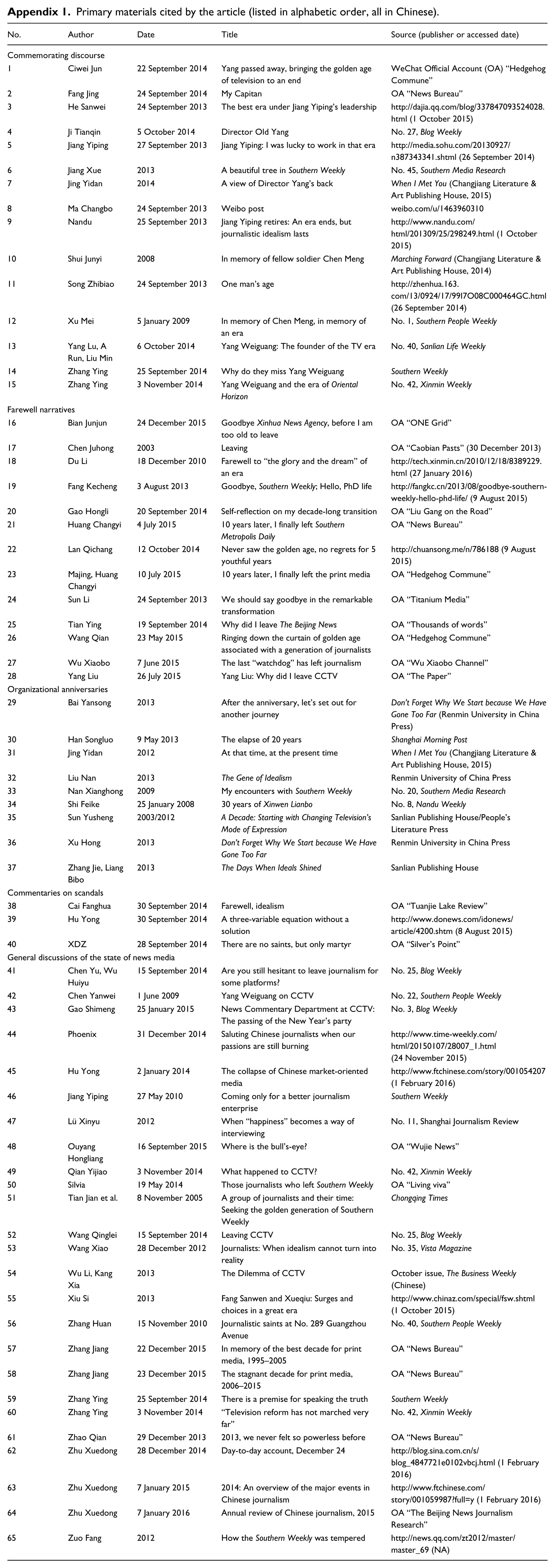
| No. | Author | Date | Title | Source (publisher or accessed date) |
|---|---|---|---|---|
| Commemorating discourse | ||||
| 1 | Ciwei Jun | 22 September 2014 | Yang passed away, bringing the golden age of television to an end | WeChat Official Account (OA) “Hedgehog Commune” |
| 2 | Fang Jing | 24 September 2014 | My Capitan | OA “News Bureau” |
| 3 | He Sanwei | 24 September 2013 | The best era under Jiang Yiping’s leadership | http://dajia.qq.com/blog/337847093524028.html (1 October 2015) |
| 4 | Ji Tianqin | 5 October 2014 | Director Old Yang | No. 27, Blog Weekly |
| 5 | Jiang Yiping | 27 September 2013 | Jiang Yiping: I was lucky to work in that era | http://media.sohu.com/20130927/n387343341.shtml (26 September 2014) |
| 6 | Jiang Xue | 2013 | A beautiful tree in Southern Weekly | No. 45, Southern Media Research |
| 7 | Jing Yidan | 2014 | A view of Director Yang’s back | When I Met You (Changjiang Literature & Art Publishing House, 2015) |
| 8 | Ma Changbo | 24 September 2013 | Weibo post | weibo.com/u/1463960310 |
| 9 | Nandu | 25 September 2013 | Jiang Yiping retires: An era ends, but journalistic idealism lasts | http://www.nandu.com/html/201309/25/298249.html (1 October 2015) |
| 10 | Shui Junyi | 2008 | In memory of fellow soldier Chen Meng | Marching Forward (Changjiang Literature & Art Publishing House, 2014) |
| 11 | Song Zhibiao | 24 September 2013 | One man’s age | http://zhenhua.163.com/13/0924/17/99I7O08C000464GC.html (26 September 2014) |
| 12 | Xu Mei | 5 January 2009 | In memory of Chen Meng, in memory of an era | No. 1, Southern People Weekly |
| 13 | Yang Lu, A Run, Liu Min | 6 October 2014 | Yang Weiguang: The founder of the TV era | No. 40, Sanlian Life Weekly |
| 14 | Zhang Ying | 25 September 2014 | Why do they miss Yang Weiguang | Southern Weekly |
| 15 | Zhang Ying | 3 November 2014 | Yang Weiguang and the era of Oriental Horizon | No. 42, Xinmin Weekly |
| Farewell narratives | ||||
| 16 | Bian Junjun | 24 December 2015 | Goodbye Xinhua News Agency, before I am too old to leave | OA “ONE Grid” |
| 17 | Chen Juhong | 2003 | Leaving | OA “Caobian Pasts” (30 December 2013) |
| 18 | Du Li | 18 December 2010 | Farewell to “the glory and the dream” of an era | http://tech.xinmin.cn/2010/12/18/8389229.html (27 January 2016) |
| 19 | Fang Kecheng | 3 August 2013 | Goodbye, Southern Weekly; Hello, PhD life | http://fangkc.cn/2013/08/goodbye-southern-weekly-hello-phd-life/ (9 August 2015) |
| 20 | Gao Hongli | 20 September 2014 | Self-reflection on my decade-long transition | OA “Liu Gang on the Road” |
| 21 | Huang Changyi | 4 July 2015 | 10 years later, I finally left Southern Metropolis Daily | OA “News Bureau” |
| 22 | Lan Qichang | 12 October 2014 | Never saw the golden age, no regrets for 5 youthful years | http://chuansong.me/n/786188 (9 August 2015) |
| 23 | Majing, Huang Changyi | 10 July 2015 | 10 years later, I finally left the print media | OA “Hedgehog Commune” |
| 24 | Sun Li | 24 September 2013 | We should say goodbye in the remarkable transformation | OA “Titanium Media” |
| 25 | Tian Ying | 19 September 2014 | Why did I leave The Beijing News | OA “Thousands of words” |
| 26 | Wang Qian | 23 May 2015 | Ringing down the curtain of golden age associated with a generation of journalists | OA “Hedgehog Commune” |
| 27 | Wu Xiaobo | 7 June 2015 | The last “watchdog” has left journalism | OA “Wu Xiaobo Channel” |
| 28 | Yang Liu | 26 July 2015 | Yang Liu: Why did I leave CCTV | OA “The Paper” |
| Organizational anniversaries | ||||
| 29 | Bai Yansong | 2013 | After the anniversary, let’s set out for another journey | Don’t Forget Why We Start because We Have Gone Too Far (Renmin University in China Press) |
| 30 | Han Songluo | 9 May 2013 | The elapse of 20 years | Shanghai Morning Post |
| 31 | Jing Yidan | 2012 | At that time, at the present time | When I Met You (Changjiang Literature & Art Publishing House, 2015) |
| 32 | Liu Nan | 2013 | The Gene of Idealism | Renmin University of China Press |
| 33 | Nan Xianghong | 2009 | My encounters with Southern Weekly | No. 20, Southern Media Research |
| 34 | Shi Feike | 25 January 2008 | 30 years of Xinwen Lianbo | No. 8, Nandu Weekly |
| 35 | Sun Yusheng | 2003/2012 | A Decade: Starting with Changing Television’s Mode of Expression | Sanlian Publishing House/People’s Literature Press |
| 36 | Xu Hong | 2013 | Don’t Forget Why We Start because We Have Gone Too Far | Renmin University in China Press |
| 37 | Zhang Jie, Liang Bibo | 2013 | The Days When Ideals Shined | Sanlian Publishing House |
| Commentaries on scandals | ||||
| 38 | Cai Fanghua | 30 September 2014 | Farewell, idealism | OA “Tuanjie Lake Review” |
| 39 | Hu Yong | 30 September 2014 | A three-variable equation without a solution | http://www.donews.com/idonews/article/4200.shtm (8 August 2015) |
| 40 | XDZ | 28 September 2014 | There are no saints, but only martyr | OA “Silver’s Point” |
| General discussions of the state of news media | ||||
| 41 | Chen Yu, Wu Huiyu | 15 September 2014 | Are you still hesitant to leave journalism for some platforms? | No. 25, Blog Weekly |
| 42 | Chen Yanwei | 1 June 2009 | Yang Weiguang on CCTV | No. 22, Southern People Weekly |
| 43 | Gao Shimeng | 25 January 2015 | News Commentary Department at CCTV: The passing of the New Year’s party | No. 3, Blog Weekly |
| 44 | Phoenix | 31 December 2014 | Saluting Chinese journalists when our passions are still burning | http://www.time-weekly.com/html/20150107/28007_1.html (24 November 2015) |
| 45 | Hu Yong | 2 January 2014 | The collapse of Chinese market-oriented media | http://www.ftchinese.com/story/001054207 (1 February 2016) |
| 46 | Jiang Yiping | 27 May 2010 | Coming only for a better journalism enterprise | Southern Weekly |
| 47 | Lü Xinyu | 2012 | When “happiness” becomes a way of interviewing | No. 11, Shanghai Journalism Review |
| 48 | Ouyang Hongliang | 16 September 2015 | Where is the bull’s-eye? | OA “Wujie News” |
| 49 | Qian Yijiao | 3 November 2014 | What happened to CCTV? | No. 42, Xinmin Weekly |
| 50 | Silvia | 19 May 2014 | Those journalists who left Southern Weekly | OA “Living viva” |
| 51 | Tian Jian et al. | 8 November 2005 | A group of journalists and their time: Seeking the golden generation of Southern Weekly | Chongqing Times |
| 52 | Wang Qinglei | 15 September 2014 | Leaving CCTV | No. 25, Blog Weekly |
| 53 | Wang Xiao | 28 December 2012 | Journalists: When idealism cannot turn into reality | No. 35, Vista Magazine |
| 54 | Wu Li, Kang Xia | 2013 | The Dilemma of CCTV | October issue, The Business Weekly (Chinese) |
| 55 | Xiu Si | 2013 | Fang Sanwen and Xueqiu: Surges and choices in a great era | http://www.chinaz.com/special/fsw.shtml (1 October 2015) |
| 56 | Zhang Huan | 15 November 2010 | Journalistic saints at No. 289 Guangzhou Avenue | No. 40, Southern People Weekly |
| 57 | Zhang Jiang | 22 December 2015 | In memory of the best decade for print media, 1995–2005 | OA “News Bureau” |
| 58 | Zhang Jiang | 23 December 2015 | The stagnant decade for print media, 2006–2015 | OA “News Bureau” |
| 59 | Zhang Ying | 25 September 2014 | There is a premise for speaking the truth | Southern Weekly |
| 60 | Zhang Ying | 3 November 2014 | “Television reform has not marched very far” | No. 42, Xinmin Weekly |
| 61 | Zhao Qian | 29 December 2013 | 2013, we never felt so powerless before | OA “News Bureau” |
| 62 | Zhu Xuedong | 28 December 2014 | Day-to-day account, December 24 | http://blog.sina.com.cn/s/blog_4847721e0102vbcj.html (1 February 2016) |
| 63 | Zhu Xuedong | 7 January 2015 | 2014: An overview of the major events in Chinese journalism | http://www.ftchinese.com/story/001059987?full=y (1 February 2016) |
| 64 | Zhu Xuedong | 7 January 2016 | Annual review of Chinese journalism, 2015 | OA “The Beijing News Journalism Research” |
| 65 | Zuo Fang | 2012 | How the Southern Weekly was tempered | http://news.qq.com/zt2012/master/master_69 (NA) |
Acknowledgements
Translated by the author from the Chinese version originally published in Chinese Journal of Journalism and Communication (Guoji Xinwen Jie), 2016, 38(5), 6–30. The author would like to express his deepest gratitude to Prof. Zhongdang Pan and Prof. Guobin Yang for their constructive comments and editorial help on earlier drafts.
Funding
This study received support from the Fundamental Research Funds for the Central Universities in China and from the Centre for Advanced Study at the Norwegian Academy of Science and Letters.