




Abstract
This study focuses on the impact of social media use on young adults’ public affairs participation on the issues of environment, education, and politics in China. It is interested in not only levels of participation but also the structure of participation, especially the degree to which young adults’ public affairs participation is issue-specific. Analysis of a representative survey of university students (N = 897) in Guangzhou, China, shows that, generally speaking, online and offline participation on the three issues are explained by different sets of factors. Social media communication concerning public affairs is a strong predictor of online participation related to political issues, but it does not predict the other participation variables. Connection with public actors via social media, meanwhile, consistently predicts participation on different issues both online and offline. Moreover, time spent on social media is a consistent and significant predictor of degree of issue specificity of young people’s participation. Implications of the findings are discussed.
Keywords
Introduction
Normative theories of democracy and public opinion formation, such as Habermas’ (1962/1989) original formulation of the ideal of the public sphere, often expect the presence of an informed public willing to and capable of deliberating about various public issues rationally. Ordinary citizens’ level of knowledge of and capability to reason about public affairs, however, have been questioned for decades by political scientists (Converse, 2006; Page & Shapiro, 1992; Zaller, 1992). Some scholars thus adjust their expectations of the “good citizen” (Schudson, 1999): instead of expecting citizens to be informed about a wide range of public matters, some argue that most citizens tend to pay attention to and are thus knowledgeable about only a few specific issues (e.g. Iyengar, 1990; Krosnick, 1990). In his later writings, Habermas (2006) also asserted that empirically existing deliberative democracy demanded a responsive civil society composed of “issue publics” (p. 422).
In the context of China, despite the absence of a democratic system and a well-developed civil society, the recent decade has also arguably witnessed the rise of issue publics. Certain issues, especially environmental concerns (Yang & Calhoun, 2007), have attracted a large amount of public attention and even aroused a significant degree of social mobilization. The differential levels of participation on different issues arguably reflect an issue-based “participation opportunity structure” in the Chinese society (Yang, 2010).
Meanwhile, the rise of issue publics may also be facilitated partly by digital media technologies. There is a large body of literature about the relationship between digital media use and civic engagement, both in the West (e.g. Bakker & de Vreese, 2011; Rojas & Puig-i-Abril, 2009) and in China (e.g. Fedorenko & Sun, 2015; Huang & Sun, 2014; Sima, 2011). One basic reason for the positive relationship between digital media use and public affairs participation lies in the reduced costs of participation (Anduiza, Cantijoch, & Gallego, 2009). But more important for this study, digital media have contributed to the emergence of a “high-choice media environment” (Bennett & Iyengar, 2008; Prior, 2007) which facilitates higher levels of selective exposure. It should have become easier for people to focus on the issues they are interested in or concerned about. Hence, an important question would be whether and how digital media shape people’s structure of participation, especially the degree to which their participation is issue-specific.
This study, therefore, attempts to go beyond the demonstration of a generally positive relationship between social media use and public affairs participation. It focuses on university students in urban China and asks, Does social media use have the same influence on young people’s online and offline participation regarding different issues? Does social media use relate to the degree of issue specificity of the young adults’ public affairs participation? The study is exploratory because we do not have an established theory to derive exact hypotheses regarding how social media use may influence participation in each of the specific issues. But by exploring whether and how social media use shapes the structure of participation, this study should allow us to better understand how the influence of social media is embedded in and shaped by the participation opportunity structure existing in a social context.
The next sections review the relevant literature, further explicate the conceptual arguments, and set up the hypotheses and research questions. They are followed by descriptions of the survey methodology and presentations of the data analysis.
The concept of issue publics and the significance of media environment
The rational capacity of the public is a theme running through philosophical discussions from the 17th to the 19th century in Europe (Habermas, 1962/1989), to the Lippmann–Dewey debate in the United States in the early 20th century (Splichal, 1999), and then to empirical political science in the latter half of the 20th century (Lupia, McCubbins, & Popkin, 2000). Scholars conventionally judged whether the public is rational or not by examining the amount of public affairs information they hold (Fiorina, 1990). Yet from an economic perspective, rationality can also be understood as maximizing behavior. Taking information costs into account, it is unreasonable to expect most citizens to be well informed because the costs involved in acquiring and processing information would not be matched by substantive benefits. Hence, a more realistic picture of the citizenry is that most people would not be informed about all kinds of matters. At best, specific groups of people would be informed about the issues they are most concerned with. The rationality of the public is therefore reliant not on the existence of omniscient citizens but on an informal division of labor among groups of citizens.
This is the picture Converse (2006) portrayed when he coined the term “issue publics” to refer to the subsets of the mass public who were concerned with specific issues relevant to their interests. From a psychological perspective, Krosnick (1990) further identified three explanations for the formation of issue publics. First, people may be concerned only with issues directly related to their self-interests. Second, people identify themselves with specific reference groups and hence are concerned primarily with issues affecting the groups. Third, people can be particularly concerned with issues related to their most fundamental values. Following these arguments, Iyengar (1990) proposed that citizens are “information specialists.” He demonstrated that individuals paid different levels of attention to the issues of foreign affairs, economy, race, and group politics. People were also more likely to recall the subject matters they processed attentively.
However, the thesis of citizens’ knowledge structure being issue- or domain-specific was countered by other researchers. Price and Zaller (1993), in particular, found that a measure of general political knowledge, rather than domain-specific knowledge items, is the best predictor of new information acquisition. They argued that the well-informed audience is able to process information regardless of the domains involved. People tend to be information generalists: those knowledgeable about one domain are also knowledgeable about other domains. Similarly, Delli Carpini and Keeter’s (1996) analysis of Americans’ political knowledge levels also found no evidence for the issue-specific knowledge structure thesis.
Nevertheless, these studies in the 1990s were situated within a “mass media context.” While individuals may have certain psychological tendencies to specialize their attention to specific matters, it is not always convenient for people to pick up only the information about specific issues when reading a newspaper or watching a newscast. The situation has arguably become different in the digital age. As articulated by Prior (2007) and Bennett and Iyengar (2008), the digital media environment is marked by the proliferation of information outlets. Digital media thus present individuals with a high-choice media environment in which selective exposure is easier to exercise (Iyengar & Hahn, 2009; Stroud, 2010). For Prior (2007), the high-choice media environment would enlarge the knowledge and participation gap between people because it allows the uninterested to stay away from politics to an even larger extent. By the same token, the high-choice media environment should allow people to focus attention on the specific issues of concern to them. Hence, it may facilitate increasing levels of issue specificity of people’s knowledge and participation structure.
Certainly, this impact of digital media should not be taken for granted. Researchers have questioned Bennett and Iyengar’s (2008) arguments in various ways. Some argued that selective exposure is a matter of degree, and people may prefer pro-attitudinal information without avoiding counter-attitudinal information (Garrett, 2009; Holbert, Garrett, & Gleason, 2010). Digital media also facilitate incidental exposure to news information because of the blurred boundaries among sites and channels in the online environment (e.g. Brundidge, 2010; Kim, Chen, & Gil de Zúñiga, 2013). Social media, in particular, are places useful for the building and maintenance of weak ties. Hence, social media use is related positively to network heterogeneity (e.g. Gil de Zúñiga & Valenzuela, 2011; Lee, Choi, Kim, & Kim, 2014). To the extent that people’s online social networks are heterogeneous, one might also expect people to encounter a wider range of information. Therefore, the relationship between digital and social media and the knowledge and participation structure of citizens remains an open question awaiting more empirical explorations.
Issue publics and structure of participation in the Chinese context
Although China is not a democracy and hence ordinary citizens have limited channels to participate in institutionalized politics, there has been a significant increase in levels of civic participation and non-institutionalized political participation, including protests, in the past two decades (e.g. Huang & Yip, 2012; Hung, 2010; Xie, 2011). There have also been an increase in the number of civic associations, and some scholars have debated whether there is the rise of a civil society in China (e.g. Ho, 2001; Ma, 2006).
For this study, the important point is not only the general increase in levels of civic and political participation in China but also the fact that Chinese citizens do not enjoy the same degree of freedom of expression and participation across different issues and topics. Drawing upon the notion of political opportunity structure from social movement studies, Yang (2010) suggested that one way to conceptualize political opportunities in China is to distinguish among the opportunities for different issues. This is because different issues pose different levels of challenges to the legitimacy of the political system. Therefore, the state is willing to accept or endure social mobilization on different issues to different extents.
Specifically, environmental issues constitute an area where mobilization, civic participation, and mainstream media coverage are largely allowed, at least as long as they do not target the political system itself. This explains why environmental mobilization constitutes a particularly conspicuous and powerful phenomenon in contemporary China (Deng & Yang, 2013; Li, Liu, & Li, 2012; Yang & Calhoun, 2007). In contrast, participation and mobilization regarding other issues, such as human rights (Otsuka, 2009) and labor (Chen, 2016), can be subjected to higher levels of control and even suppression.
It follows that Chinese citizens’ civic and political participation is highly issue-specific at the collective level, that is, overall levels of citizen participation in different issue areas are likely to be highly uneven since opportunities of participation are unevenly distributed across issues. The interesting question is whether Chinese citizens’ participation would also be issue-specific at the individual level, that is, whether individuals would tend to participate mainly in one specific issue area (as opposed to having individuals active in one issue area also being active in many other issue areas).
More specifically, this study is interested in the implications of social media use on people’s structure of participation. Similar to Western democracies, past studies have found that digital and/or social media use is related to higher levels of civic participation in China (e.g. Huang & Sun, 2014; Yang, 2009). This positive impact can exist because the Chinese government does not completely suppress online civic and political discussions. Although the Chinese authority is well known for blocking access to numerous foreign websites and using sophisticated censorship devices to detect and suppress sensitive contents (King, Pan, & Roberts, 2013; Taneja & Wu, 2014), it remains possible for some citizens to access alternative views and information by “crossing the firewall.” The alternative views and information may then diffuse through the online arena (Yu, 2006), particularly during emergent public crises. Hence, the Internet does provide relatively less strictly controlled platforms for information transmission and opinion expressions (Mou, Atkin, Fu, Lin, & Lau, 2013).
However, just as the Chinese state does not allow the same extent of mobilization and participation on all issues in the society, it is reasonable to expect degree of censorship and control in the online arena to also vary by issues and topics. Moreover, as MacKinnon (2012) argued, authoritarian states may allow online citizen expressions only to the extent that the online expressions do not evolve into offline actions. Indeed, at the individual level, the resources and access to participation also differ from online to offline (Anduiza et al., 2009). Therefore, it would be reasonable to expect the impact of digital and social media on participation in China to vary across issue areas as well as between online and offline forms of participation.
Research hypotheses and questions
Tying together the arguments and considerations in the previous sections, the analysis would focus on the impact of social media use on Chinese young adults’ online and offline participation in three specific issue areas, namely, environment, politics, and education. Environmental issue, as noted, constitutes a “hot topic” with much media attention and participation on the part of the citizenry. Politics, in contrast, is much more sensitive, and social mobilization regarding political topics, especially offline ones, is much more likely to be suppressed by the state. Meanwhile, education may not be an issue area arousing huge public attention and controversies in contemporary China. But since this study focuses on university students, it would be meaningful to examine how social media impinge on young people’s participation in an area that is arguably closest to themselves.
Regarding social media use, past research on the relationship between social media and civic and political engagement has suggested that general usage frequencies may not have influences on participation. It is because people can use social media for many purposes. Therefore, it is social media use for news or political communication that would impinge on participation (Gil de Zúñiga, Jung, & Valenzuela, 2012). In addition, social media are not only platforms through which people consume communication contents; they are also platforms through which people get in touch and maintain connections with others. Hence, online network characteristics may also shape the political impact of social media (Gil de Zúñiga & Valenzuela, 2011). Specifically, Tang and Lee (2013) called for a multi-dimensional approach for the study of social media effects. Their analysis of the impact of Facebook in Hong Kong includes the dimensions of network size, network heterogeneity, and direct connections with public actors (e.g. journalists and social activists) via social media. The latter variable has a particularly strong influence on political participation.
This study thus also examines the impact of public affairs communication via social media, social media network size, and connections with public actors via social media. Given the identification of the social media use variables and the participation variables and based on the expectation of a generally positive impact of social media use on civic engagement, a set of hypotheses is stated.
H1. Public affairs communication via social media relates positively to both online and offline participation on the issues of environment, education, and politics.
H2. Social media network size relates positively to both online and offline participation on the issues of environment, education, and politics.
H3. Connection with public actors via social media relates positively to both online and offline participation on the issues of environment, education, and politics.
H1–H3 are composite hypotheses. They presume the positive influence of social media use to be applicable across different types of participation. Nevertheless, this study is concerned with the possibility that people’s participation is issue-specific. While testing H1–H3 is basically an attempt to replicate the literature’s finding of the generally positive impact of social media on participation, the unique contribution of this study resides in its tackling of two exploratory research questions. First, to the extent that the various types of online and offline participation are not entirely equivalent to each other, the predictors of the different types of participation may vary. The social media use variables may also have differential influence on different types of participation as the cost structures and degrees of sensitivity vary. It is beyond the scope of this study, however, to theorize the variation systematically and develop specific hypotheses about how participation in each issue may or may not relate to social media use. We state an exploratory research question instead:
Q1. Do the various dimensions of social media use have varying impact on online and offline participation on the three different issues?
Second, this study examines whether social media use would lead to higher degrees of issue specificity of people’s structure of participation. That is, issue specificity will be treated as an individual-level variable. It represents the extent to which an individual’s participation in public affairs focuses mainly on one issue but not others. The analysis will examine whether social media use and other factors could predict degree of issue specificity. As argued, social media and the Internet in general should facilitate the development of more issue-specific knowledge and participation structure by making it easier for people to concentrate on specific matters. But whether individuals would leverage on the affordance is an open question. Hence, another research question is stated as follows:
Q2: Does social media use lead to higher degrees of issue specificity in young people’s structure of participation?
Method and data
The data analyzed below came from a survey of university students in Guangzhou, China, conducted in November 2014. Guangzhou is the biggest and most developed urban city in the southern province of Guangdong, which borders Hong Kong. Partly because of its geographical location, the city has long had a “more open news environment” (Lee, 2003, p. 2). Also partly due to economic reform and growth of intermediate social organizations, Guangzhou has been considered propitious for the development of civil society (Chan, 1999). Levels of Internet penetration are considerably high (Shen, Wang, Guo, & Guo, 2009), and the public is relatively active (Hung & Ip, 2012).
Ten universities located in a “university town”—an area developed by the city government to host the major universities—were included in the study. Dorm rooms were used as the basis for sampling since almost all students at the universities lived in dormitories. With a target of 900 respondents, different numbers of dorm rooms and target respondents were calculated for each of the universities based on the proportion of students at each university relative to the total number of students in the 10 universities. Research assistants visited each of the chosen dorms, which were systematically sampled based on gender, location, and target sample size. A total of 225 dorm rooms were selected because there are four students in each room. If a dorm room was empty during the visit, the research assistant visited the next dorm room instead. A total of 897 valid responses were obtained. All respondents were assured that they would remain anonymous. Each participant would get RMB 5 dollars upon completing the survey. Response rates reported by the research assistants were higher than 90%.
The main variables were operationalized as follows.
Participation
The survey questionnaire included two sets of matrix items asking the respondents about their participation in 14 forms of online activities and 13 forms of offline activities. The activities covered the main forms of civic and political engagement in the Chinese context, such as joining online groups for or against an organization or issue, online and offline petition, and contacting governmental officials online and offline. For each activity, the respondents were asked to report whether they had participated in it in relation to environmental issues, education issues, and political issues. In other words, the answer is dichotomous (Yes = 1, No = 0) for each activity regarding each issue. Six indices—for online environmental participation, online education participation, online political participation, offline environmental participation, offline education participation, and offline political participation—were created by summing the relevant items. The descriptive statistics of the items and indices are discussed in the analysis section below.
Issue specificity of participation
Issue specificity of participation was constructed by calculating the variance of individual respondents’ scores on online environmental participation, online educational participation, and online political participation (M = 1.65, standard deviation (SD) = 4.13). The larger the score, therefore, the higher the degree of issue specificity of a respondent’s public affairs participation. Issue specificity of offline participation was likewise constructed by taking the variance of the scores of the three offline participation indices (M = 1.39, SD = 2.85).
Social media use variables
The survey asked the respondents to name, in order of usage frequencies, up to three of their most frequently used social media sites. Regarding each of the first two most frequently used social media sites, the respondents were further asked a range of questions about specific usages and network characteristics. Based on these questions, a number of social media–related variables were constructed. Time spent on social media refers to the total amount of time per day the respondents spent on the two social media sites (measured in hours, M = 4.11, SD = 3.87). The respondents were then asked to report the rough number of friends they were connected to, number of people they followed, and number of people who followed them via each of the two social media sites. Since different social media sites have different architecture, the precise meanings of the three figures vary across sites. For simplicity, we adopted the largest of the three numbers as the estimation of the size of a respondent’s network on the social media site. Social media network size was constructed by first summing the two network size estimates. The resulting variable is very highly skewed, with a few respondents having thousands of online connections. The sum was therefore square-rooted in order to reduce the skewness (M = 15.95, SD = 8.51).
Public affairs communication via social media
Public affairs communication via social media was measured by asking the respondents how frequently they and their friends, respectively, shared “information related to social affairs” and “information related to political issues” via each of the two most frequently used social media sites. There is hence a total of eight items (four items × two social media sites). The answers were registered by a 4-point scale ranging from 1 = never to 4 = very frequently. The answers were averaged to derive the index (α = .83, M = 2.20, SD = 0.61).
Moreover, the respondents were asked whether they were connected to four types of people via each of the two most frequently used social media sites: (1) journalists or news commentators, (2) academics, (3) government officials, and (4) social activists. The answers were registered with a 4-point scale (1 = none at all, 4 = many). Connection with public actors via social media was the average of the eight items (α = .80, M = 1.84, SD = 0.65).
Control variables
Control variables included five demographics (gender, age, family socioeconomic status, Party membership, and urban vs rural background), news exposure (average of exposure to five news media sources), political interests (agreement with the statement “I am interested in politics and public affairs”), and three dimensions of political efficacy (Lee, 2006), that is, internal, external, and collective (each measured by the average of agreement with two statements). The details of the operationalization are omitted due to space concern.
Analysis and findings
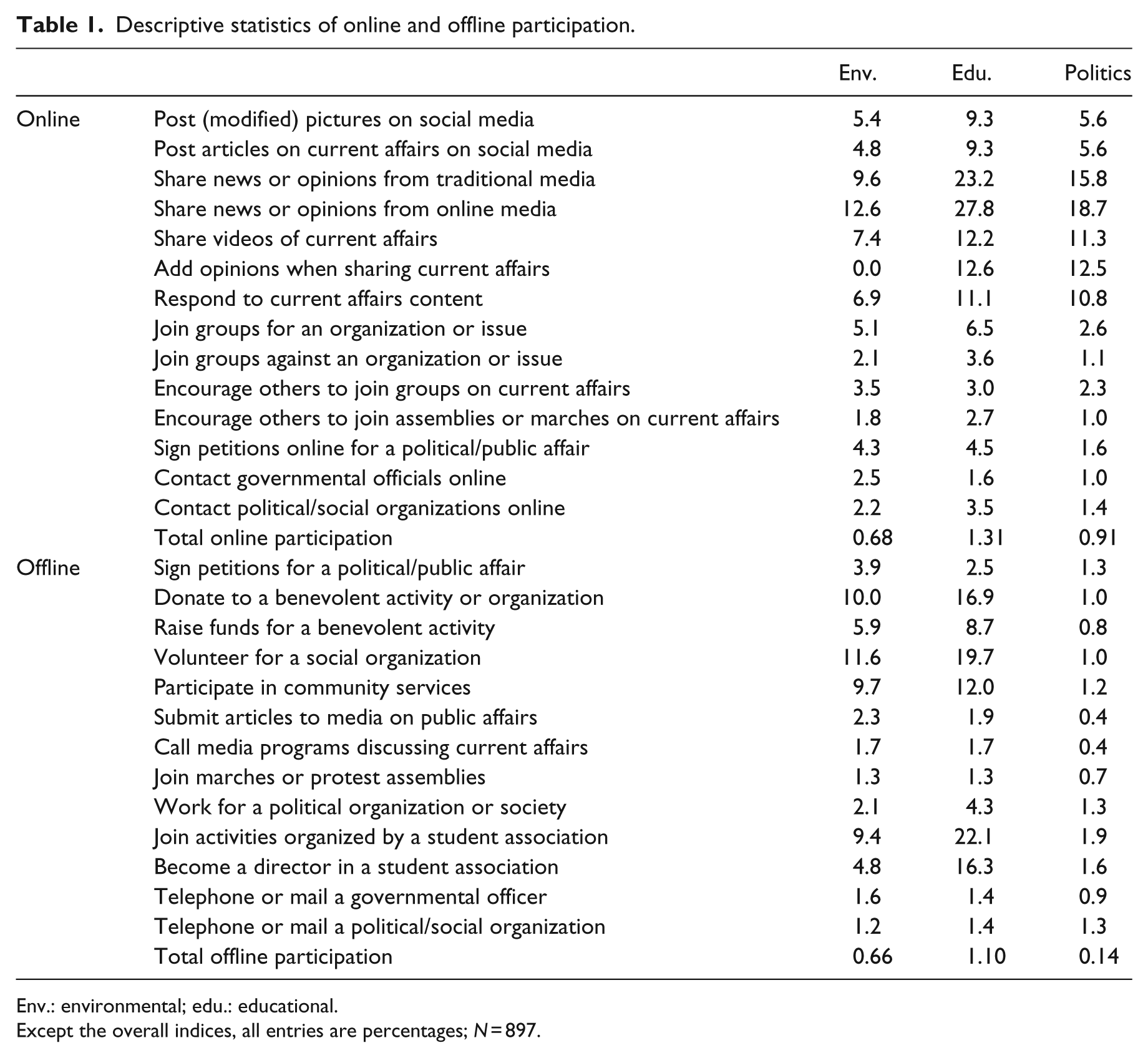
Table 1 summarizes the descriptive statistics of the online and offline participation items as well as the six participation indices. The table gives a sense of the levels and structure of the respondents’ public affairs participation. Several points are worth noting. First, the percentages saying yes for each item are often very small. This is partly because the items are highly specified into distinctive forms of actions, platforms, and issues. Yet, this may also reflect a generally low level of civic engagement by young adults in contemporary China.
Descriptive statistics of online and offline participation.
Env.: environmental; edu.: educational.
Except the overall indices, all entries are percentages; N = 897.
Second, participation is most frequent on education. This is unsurprising, given education is directly related to the everyday lives of the respondents. Around 28% of the respondents had shared news or opinions from online media, while 23% had shared news or opinions from traditional media. Offline participation on the issue of education is also prevalent: 17% had donated to a benevolent activity or organization, 20% had volunteered for a social organization, and 22% had joined activities organized by a student association.
Third, when comparing between the forms of actions, it is clear that respondents were much more likely to have engaged in communicative forms of participation such as sharing information and posting relevant images or messages online. But even in the online arena, engagement through signing petition, contacting government officials, or encouraging others to join assemblies or marches is relatively rare. Similarly, when offline participation is concerned, community services and volunteering are much more frequent than protesting and working for political organizations. These figures are strongly suggestive of the participation opportunity structure in contemporary China.
Fourth, the relative prevalence of environmental and political participation changes when one moves from online to offline. In the online arena, the respondents were most active on educational issues (α = .73, M = 1.31, SD = 1.85), followed by political issues (α = .75, M = 0.91, SD = 1.62) and then by environmental issues (α = .70, M = 0.68, SD = 1.34). Moving to the offline arena, the respondents were still relatively most active on educational matters (α = .71, M = 1.10, SD = 1.65), followed by environmental issues (α = .75, M = 0.66, SD = 1.40). The respondents’ levels of participation on political matters are very low (α = .72, M = 0.14, SD = 0.64). The finding that respondents were more active on political matters online but not offline is strongly suggestive of how the state’s suppression of real-world mobilization influences how and to what extent the respondents participated in politics offline.
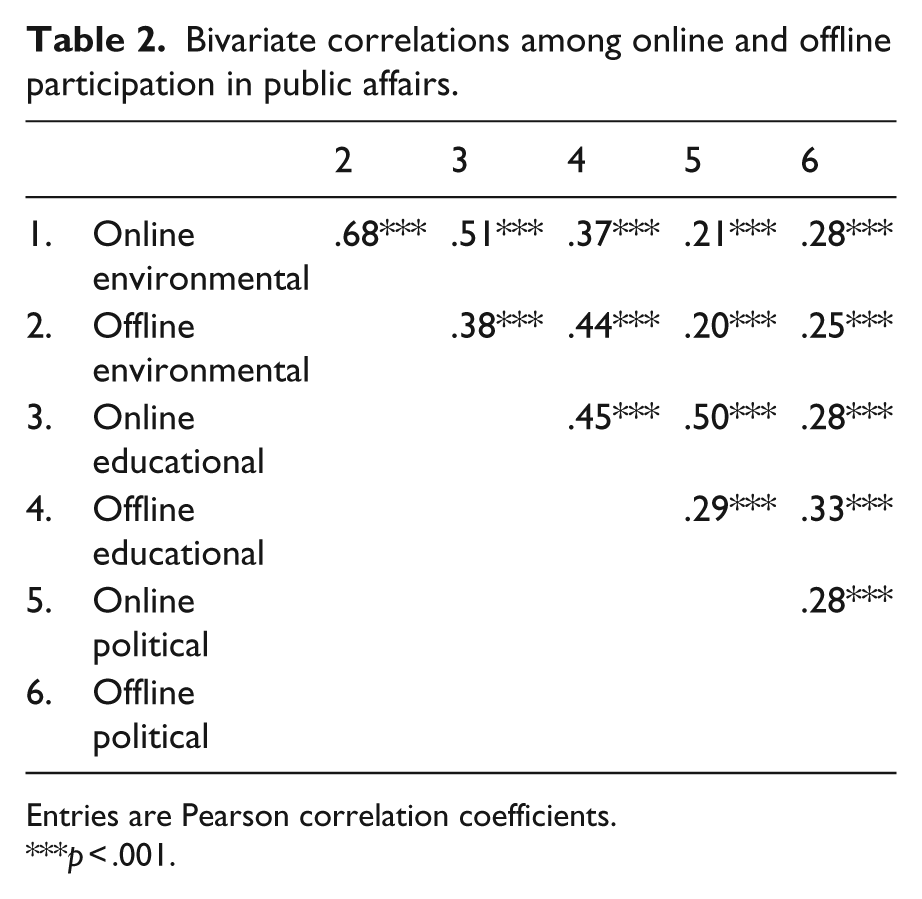
On the whole, Table 1 illustrates that, at the collective level, the structure of our respondents’ public affairs participation has a high degree of issue specificity, that is, level of participation varies substantially across issues and platforms. But is there a high degree of issue specificity at the individual level? Table 2 provides the bivariate correlations among the six participation indices. Understandably, the six indices are all positively correlated with each other. Some of the correlations are particularly substantial, such as that between online and offline environmental participation. The generally positive and significant relationships suggest that a respondent who participated on one issue either online or offline was also likely to have participated on other issues both online and offline.
Bivariate correlations among online and offline participation in public affairs.
Entries are Pearson correlation coefficients.
p < .001.
However, issue specificity is a matter of degree. Table 2 also shows that some of the correlations are moderate in size. For example, the correlation between online environmental and political participation is only .21. It suggests that people who participated online regarding environmental matters were only somewhat more likely to participate online regarding political issues. The relationship between online and offline political participation is also moderate (r = .28). This contrasts sharply with environmental and educational issues, where online and offline participation are more strongly correlated (r = .68 and .45, respectively). It suggests that online and offline participation are more closely linked to each other on environmental and educational matters. But on the more sensitive category of politics, online participation does not move equally smoothly into offline participation.
The moderate sizes of some of the coefficients suggest that a certain degree of issue specificity of participation does exist at the individual level. Against this backdrop, we can now turn to tackle the hypotheses and Q1. While the hypotheses state the different dimensions of social media use should promote participation, Q1 asks whether social media use has the same impact on all kinds of participation. The hypotheses and research question were examined through multiple regression analysis. The six participation indices are the dependent variables. The independent variables were entered into the model in three blocks: (1) demographics, (2) news exposure and attitudinal controls, and (3) the social media variables.
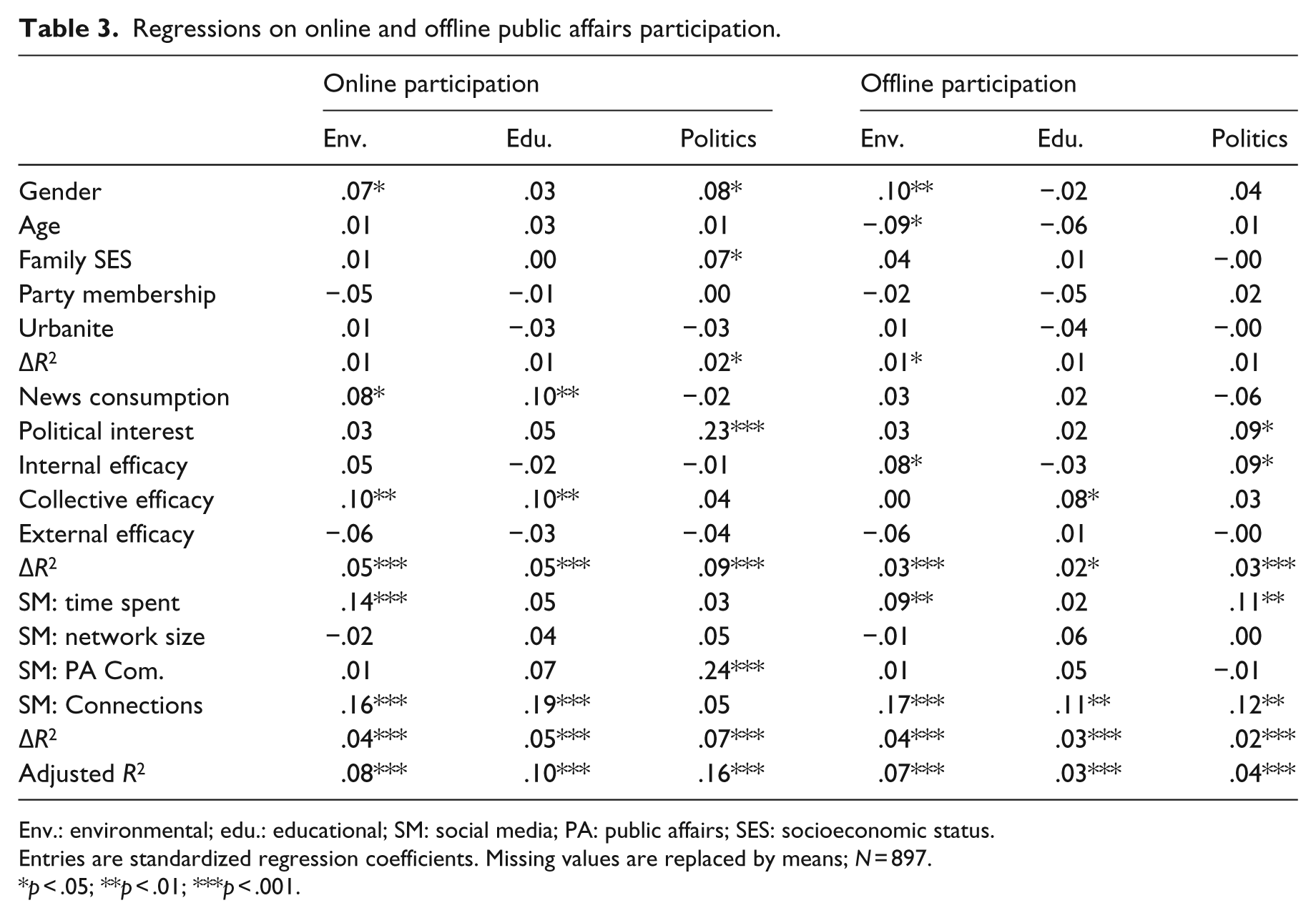
Table 3 summarizes the results. The demographics, news exposure, and attitudinal controls only have sporadic relationships with the dependent variables. But these findings also suggest that the different types of participation are indeed predicted by different sets of factors. Self-reported family socioeconomic status, for instance, is positively related only to online political participation. Collective efficacy is positively related to online environmental participation and both online and offline educational participation, but it does not relate to online or offline political participation. It is also noteworthy that political interest is strongly related to online political participation but not to participation in the other two issues.
Regressions on online and offline public affairs participation.
Env.: environmental; edu.: educational; SM: social media; PA: public affairs; SES: socioeconomic status.
Entries are standardized regression coefficients. Missing values are replaced by means; N = 897.
p < .05; **p < .01; ***p < .001.
Regarding the impact of social media use, Table 3 shows that social media network size is not related to any of the six indices. Hence, H2 is not supported. Public affairs communication via social media, meanwhile, is strongly related only to online political participation. Therefore, H1 is only weakly supported. Notably, the operationalization of the online political participation index involves a few items directly related to online communication activities. Therefore, one might argue that the relationship between online political participation and public affairs communication via social media results partly from the conflation of the two measures. Nevertheless, it remains an important finding that there are no similarly significant relationships between public affairs communication via social media and online participation on the two other issues.
Connection with public actors via social media emerges as the social media use variable with the strongest impact on participation. H3 is generally supported. But even in this case, the variable does not significantly predict online political participation. Meanwhile, although we did not set up relevant hypotheses, sheer time spent using social media is significantly related to three of the six participation indices. Overall speaking, as a response to Q1, our findings show that specific dimensions of social media use rarely have across-the-board positive impact on participation when issues and platforms are specified.
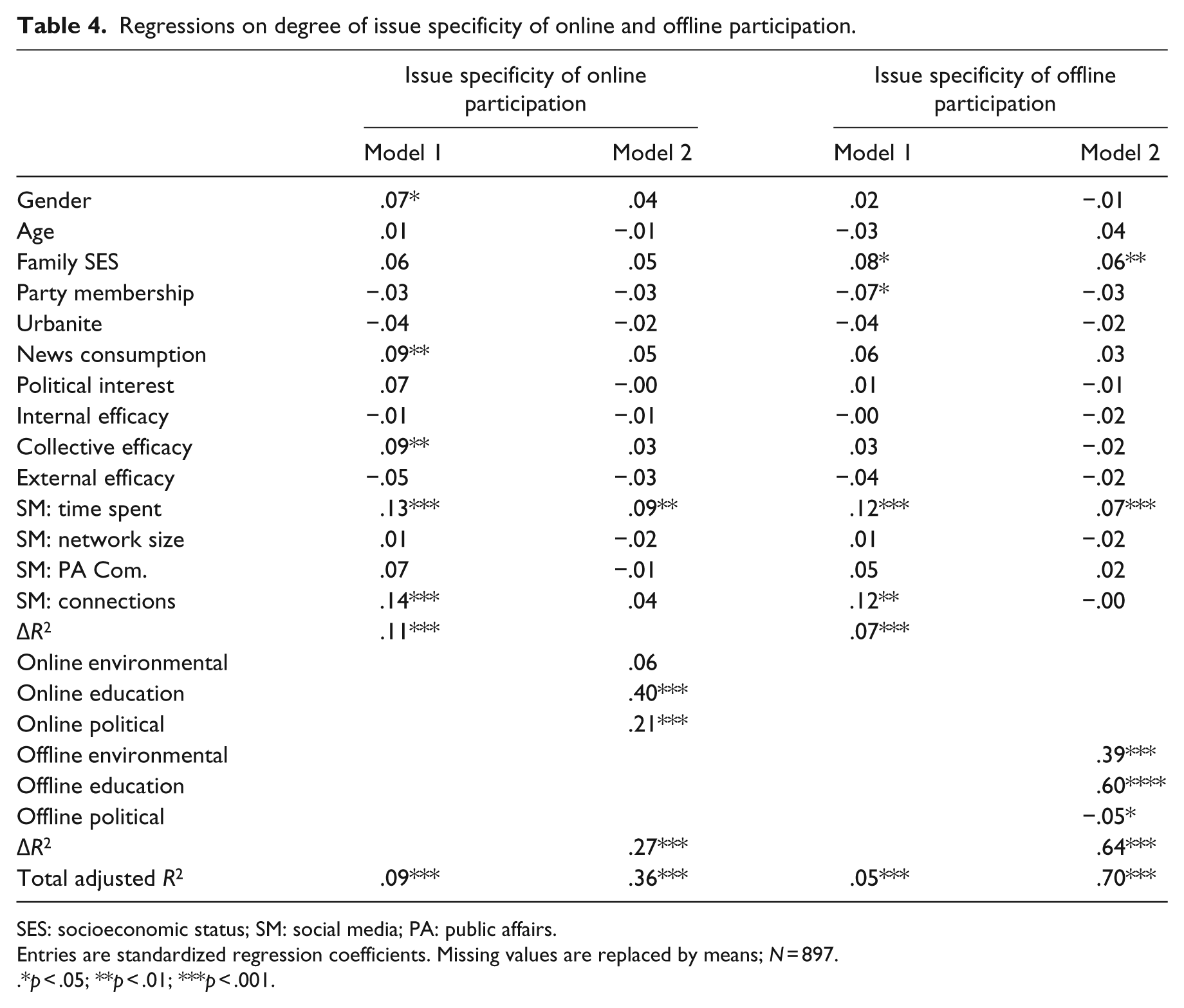
Finally, Q2 asks whether social media use would be related to degree of issue specificity of participation. Multiple regression analysis was conducted with the two issue specificity indices as the dependent variables. Two regression models were employed. The first model is exactly the same as that in Table 3. The second model includes the relevant level of participation indices themselves. The original indices should be included because, given the distributions of the participation indices and the fact that degree of issue specificity was measured as the variance of the three indices, people who score higher on the participation indices are simply more likely to have larger variance among the scores of the three indices.
Table 4 shows that, for both online and offline participation, degree of issue specificity is related significantly to two of the four social media use variables in the first regression model. Respondents who spent more time using social media sites and those more closely connected to public actors are more likely to exhibit higher degrees of issue specificity in their structure of participation. But when the participation indices are controlled, connection with public actors no longer relates significantly to the dependent variables. Only time spent using social media remains significantly related to higher degrees of issue specificity. The finding suggests that, as people spend more time using social media, their public affairs participation would not spread more evenly across issues. Rather, spending more time using social media seems to have allowed the respondents to focus their attention on one specific issue, thus generating a higher degree of issue specificity in their structure of participation.
Regressions on degree of issue specificity of online and offline participation.
SES: socioeconomic status; SM: social media; PA: public affairs.
Entries are standardized regression coefficients. Missing values are replaced by means; N = 897.
p < .05; **p < .01; ***p < .001.
Concluding discussion
The above analyses have examined hypotheses and research questions related to the impact of social media on different types of public affairs participation—online versus offline—and on three different issues. There are both similarities and differences between this study’s findings and the major findings in the literature. For instance, this study shows that social media network size does not have a significant influence on public affairs participation when other factors are controlled, whereas direct connections with public actors via social media constitute the most powerful social media use variable in explaining public affairs participation. This is consistent with the findings from Tang and Lee (2013). Besides, similar to what Gil de Zúñiga et al. (2012) found, sheer time spent on social media does not relate to online political participation. However, sheer time spent on social media does relate to both online and offline environmental participation, as well as offline political participation.
Therefore, while the extant literature has repeatedly demonstrated a generally positive relationship between social media use and civic and political participation, this study shows that the relationships between social media and participation can be more complicated when issue arena and platform of participation are specified. Admittedly, the analysis of the varying impact of social media on participation related to different issues is exploratory. But we can still try to provide some post hoc interpretations of some of the findings. Specifically, the finding that time spent using social media can relate to online and offline environmental participation suggests that there can be a significant degree of incidental exposure to environmental information and, as a result, incidental participation in relation to environmental matters. That is, to the extent that the transmission of environmental information in the social media arena is not restricted to groups of concerned netizens, time spent using social media could be related to exposure to the information. And since environmental issues tend to be relatively less controversial and risky when compared to other issues, exposure to related information can more readily lead to online and offline actions.
Meanwhile, one possible interpretation of the relationship between time spent using social media and offline political participation is that information about offline political actions may be, contrary to environmental information, particularly non-prevalent in the social media arena. This can be the result of likely political suppression of mobilizing information related to offline actions. Therefore, only the most avid users of social media could get into contact with the mobilizing information and participate in the offline actions.
The above post hoc explanations about the specific relationships among specific variables definitely require further theorization and empirical analysis. But generally speaking, what one can argue based on this study’s finding is that social media use may not have the same influence on all types of public affairs participation regarding all issues. This statement is particularly likely to be valid in a social and political context where public affairs participation is not completely free, the cost of participation can be rather high, and the state has shaped the participation opportunity structure (Yang, 2010) for citizens in specific ways.
In fact, one broader concern underlying this article is the degree of issue specificity of Chinese people’s public affairs participation. The findings confirm a number of arguments. First, there is indeed a high level of issue specificity in our respondents’ structure of public affairs participation at the collective level. That is, levels of participation in relation to the three issues are highly uneven. While the respondents’ relatively high levels of participation in relation to educational matters may be related to their own identity as students, their relatively high levels of online political participation and yet extremely low level of offline political participation are highly illustrative of how the state-dominated participation opportunity structure shapes people’s structure of participation.
Second, there is also a significant degree of issue specificity in people’s structure of participation at the individual level. On one hand, the various participation indices are indeed positively correlated with each other. It suggests that people who are active on one issue are also more likely to be active on other issues. This seems to go against the thesis of issue specificity. However, there is no reason to expect issue specificity to be so overwhelming and extreme that participation in relation to various issues would be totally uncorrelated. Keeping this in mind, it is noteworthy that the correlations between some of the participation indices are moderate or even weak in size, especially considering the similar ways the indices were operationalized. For instance, the correlation between online environmental and political participation is only .21, while the correlation between offline environmental and political participation is .25. These figures are in line with the claim that environmental issues in China are kept largely apolitical so that the government would allow mobilization regarding environmental matters (Li et al., 2012). As the two issue areas are separated from each other, it also means that people active on environmental matters are not necessarily active on political matters.
As suggested in the conceptual sections, besides the specificities of the Chinese context, a degree of issue specificity in people’s knowledge and participation structure can be the result of psychological tendencies (Krosnick, 1990) and the consequence of a new media environment which allows people to exercise a higher degree of selective exposure (Bennett & Iyengar, 2008). This study is therefore interested in whether social media use would relate to individual-level issue specificity of participation. The results show that there is indeed a consistently positive and significant relationship between time spent using social media and issue specificity of both online and offline participation. It is notable that, among the social media use variables, it is time spent using social media that is related to degree of issue specificity. Direct connection with public actors, in contrast, mainly relates to levels of participation. It suggests that when people get into contact with public actors via social media, the public actors are likely to transmit information and messages about a wide range of issues to the users. Such connection, hence, would not bring about higher degrees of issue specificity in participation.
Rather, time spent on social media matters. Presumably, when people spend more time using social media, they may be able to pay attention to a wider range of issues and thus develop a participation structure that is less issue-specific. The findings, however, show that the opposite occurs: spending more time on social media tends to facilitate the focusing of attention on one specific issue, thus generating a more issue-specific participation structure. The finding is therefore more in line with arguments emphasizing selectivity online.
As a first study exploring the relationship between social media use and issue-specific participation, this study has some limitations that require further research to rectify. First, only three issues are examined due to space limitations of the questionnaire. This study picked the issue registering the highest level of mobilization in China (environmental), the issue most likely to be subjected to state control (political), and the issue most directly related to the respondents (education). Future research can examine a larger number of issues to ascertain whether the core findings of this article would remain applicable.
Second, the survey is cross-sectional. From a methodological perspective, the study cannot ascertain causal relationships. Yet, this problem should be relatively minor for this study since some of the core findings—such as the relatively low level of correlations among some of the participation indices—are not dependent on assumptions of causal directions. For the relationship between degree of issue specificity and time spent using social media, it is difficult to see how, conceptually speaking, degree of issue specificity can be the cause of more frequent usage of social media.
Third, this study focuses only on university students in a major, relatively liberal-oriented city in China. It is noteworthy that the findings of a high degree of issue specificity in public affairs participation at the collective level and a very low level of offline political participation are applicable to people presumably with high levels of cultural capital and technological know-how. But in any case, there is a need to extend the study to the larger population in order to ascertain the generalizability of the findings.