




Abstract
This study examines the audiences’ discussions on the local adaptations of The Voice of China and The Voice of Germany through a content analysis of 128 microblogging posts. Specifically, this research explores the content, language and tone of the sampled posts on Sina Weibo and Twitter, respectively. The study found that while German audiences take notice of various topics relating to the show, Chinese audiences mainly focus on talents. The Chinese audiences have also paid attention to the talents’ age in accordance with their respect to the elderly in the society. Compared to the German audiences, the Chinese audiences post in their mother tongue exclusively and they are more critical. The findings suggest marked differences of the audiences’ responses to the shows on microblogging websites in different national contexts, but also partly challenge the traditional cultural values proposed by Hall and Hofstede based on researches of offline behaviors.
Introduction
Watching television is a social event. Families, groups, or friends gather in the same place at the same time. They exchange opinions and feelings while watching television programs. Today’s multimedia environment has changed the traditional TV viewing habit. New technologies and social media have extended interpersonal communications beyond boundaries of families, friends, and geographical regions (Buschow, Schneider, & Ueberheide, 2014). On social networking sites such as Facebook and Twitter, users chat and comment in real time parallel to TV programs. Conversations online may take place between either acquaintances or strangers.
As The Voice series were introduced into China and Germany, the programs have drawn mass audiences and triggered heated debates on social networking sites. Originally aired in the Netherlands in 2010, The Voice was created by Talpa, a Dutch media company. It is an interactive singing competition where contestants sing in front of four coaches, and coaches are responsible for seeking out the nation’s best vocal talent. So far this format has been sold in more than 50 countries and regions.
Recent studies have dealt with the localization of global television formats at the production level. For example, Skovmand (1992) has studied the local adaptations of the game show Wheel of Fortune in the United States, Germany, pan-Scandinavia, and Denmark, and illustrated that the four Wheels differ in the number of game rounds and participants. Compared to the American and Scandinavian versions, the German Wheel “relied on its consumerist address and appeared as primarily a vehicle for advertising” (Skovmand, 1992, p. 98). In China, Zhang and Fung (2014) have explored the television formatting of Ugly Wudi, the Chinese version of Ugly Betty, and explicated that Ugly Betty’s localization reflects the political, cultural, and commercial imperatives. In the case of The Voice format, Xu Jifeng (2012), an official at Zhejiang Satellite TV, has pointed out that the local adaption of The Voice of China has integrated the successful elements from other versions around the world. For example, the stage setting is similar to the English and American versions. It is the contestants and their songs that distinguish the Chinese version from the other.
Few studies (Liebe & Katz, 1990; Moran, 1998) have compared audience interpretations of localized formats. In this study, we explore the simultaneous communication activities on microblogging websites during the broadcast period of The Voice series in China and Germany by using the cultural models proposed by Hall and Hofstede, and aim to answer the following research question:
Do the audiences interpret the local adaptations of The Voice on microblogging websites differently?
Theoretical background
Social TV
“Social TV” is described as “the use of social media such as Twitter or Facebook stimulated by TV programs” (Buschow et al., 2014, p. 129). Social media connect TV viewers by providing them various channels to exchange opinions and interact with each other, thus creating shared yet remote experiences around TV content.
Television has been around for many decades. Since its introduction, TV viewing has had a social dimension associated with it (Buschow et al., 2014; Chorianopoulos & Lekakos, 2008). Traditionally, watching television is a social experience. Families, groups, or friends gather at a mutually convenient time and place to watch some interesting programs together. They exchange opinions while watching television programs.
Today, social media, including blogs, microblogs, and other social networking websites are rapidly converging with television and affecting the way in which the audiences experience programming (Proulx & Shepatin, 2012). The increasing use of social media platforms such as Twitter or Facebook is replacing former face-to-face-interactions in front of a single TV screen. It allows geographically dispersed people to meet in a virtual shared space to watch TV while being able to interact with each other via social media platforms (Buschow et al., 2014). They share their watching experiences over distance or in distant time zones.
Various communication modalities, such as audios, texts, video photos, and nonverbal cues could be employed in computer-mediated interpersonal communication over distance on social websites (Chorianopoulos & Lekakos, 2008). User profile shows information about participant’s background. The use of avatars and emoticons replaces facial expressions and promotes seamless and nonverbal communication among distant viewers.
In recent years, social TV has received much academic attention. Scholars in China (D. Lu & Chen, 2013; Shi & Guo, 2014) have studied the official microblogging accounts of TV shows and pointed out that the official accounts use videos, photos, and texts referring to the shows in order to introduce topics, increase the influence, and raise the reputation of the program. He (2014) has analyzed posts of the official account of I am a Singer, a singing competition program, and concluded that the official account posted not only on the broadcasting day of the show, but at other times as well. To attract the audiences’ attention, many of the posts related to contestant’s individual life.
Microblogging and audience research
The rise and rapid spread of the Internet and digital communication technologies bring challenges to audience research. Proulx and Shepatin (2012) have observed, “as the number of people engaging within social media continues to increase, the amount of online conversations about television when shows are airing within those platforms also increase” (p. 11). Therefore, social media bring a new approach to audience research.
Microblogging, one of the leading social media platforms, has become a popular co-usage medium with TV. Especially in the case of talent shows, the high level of both temporal relevance and emotional involvement evokes real time discussions on TV shows among audiences (Buschow et al., 2013), while microblogging offers audiences a good platform to express their opinions. Audiences comment on the content of TV shows before, during, and after programs or episodes air (Proulx & Shepatin, 2012).
Founded in 2006 by a company based in San Francisco, Twitter is the most widely known microblogging platform (Bredl, Ketzer, Hünniger, & Fleischer, 2014). According to the statistics in 2012, there are more than 500 million active Twitter users worldwide, including 4.1 million users in Germany (Buschow et al., 2014). Miller (2008) describes Twitter as “a kind of cross between social networking, blogging, and text messaging” (p. 396). Tweet, or Twitter post, is limited to 140 characters, so that people can easily read and write anytime and anywhere through the Internet or mobile devices (Bredl et al., 2014).
In China, Sina Weibo is the most popular microblogging website. Launched in 2009, it has more than 600 million registered users by the end of 2013 (Rapoza, 2014). Similar to Twitter, Weibo users can post up to 140 Chinese characters. However, comparing to 140 German or English characters, which amount to one short sentence, 140 characters in Chinese is much informative (Hewitt, 2012).
In academic fields, microblogging offers great opportunities for searching audiences’ conversations about television (Bredl et al., 2014). Using microblogging as a research tool has several practical advantages compared to other forms of media contents such as newspaper archives. First, microblogging provides rich data that are accessible to everyone. Second, the real-time commentaries on microblogging sites reflect the audiences’ spontaneous reactions towards the TV program. Third, microblogging occurs in a stress-free, fail-safe environment.
For example, Buschow et al. (2014) did a quantitative content analysis of 31,388 tweets relating to seven different TV programs in Germany include Deutschland sucht den Superstar (Germany Seeks the Superstar), The Voice of Germany, Ich bin ein Star, holt mich hier raus! (I’m a Celebrity, Get Me Out of Here), Schlag den Raab (Beat the Star), Tatort (Crime Scene), Maybritt Illner, and Günter Jauch. All programs belong to the appropriate genres for social TV, including talent shows, talk shows, and TV events. The results showed that different genres of TV programs evoked different kinds of tweets. Three talent shows, including The Voice of Germany, Deutschland sucht den Superstar, and Ich bin ein Star, holt mich hier raus stimulated communication that was particularly characterized by an evaluation of the talents, either positive or negative. Schlag den Raab, the live game show, evoked a critical debate about the show itself and what was happening on screen. Two political talk shows, Maybritt Illner and Günter Jauch, stimulated a public discourse.
Tweeting or microblogging during television broadcasting has not received sufficient attention in the research to date (Bredl et al., 2014), especially in China, most studies (D. Lu & Chen, 2013; Shi & Guo, 2014) only focus on the production level. Few have related to audiences’ research. In response to this neglected area, this study chooses Twitter in Germany and Sina Weibo in China as the representative social media channels and aims to compare the audiences’ responses to The Voice shows in the two countries.
Globalization, national culture and roles of the media
As the world becomes increasingly interconnected, widespread concerns naturally arise about the impact of social media on national cultural identity. Waisbord (1998) suggested that media have been the catalyst in the making of cultural identities, which overcome the space that sets apart populations and brings them together in the creation of national or global communities. Anderson (1996) argued that the development of print technology transformed the meaning of space and gave a new fixity to language, which is a pillar of nationhood, thus creating the possibility of a new form of imagined community. With the rise of social media, the conclusions of these early researchers are even more valuable today.
Specifically long before the emergence of microblogging about television shows, researches recognized that TV itself has a tremendous impact on defining national character (Waisbord, 1998). It functions to provide models of identity by integrating individuals into social order, celebrating dominant values, offering models of thought, behaviors, and gender for imitation, and so on (Kellner, 1995). Studies (Barker, 1999; Moran, 1998) have convincingly shown that television played a crucial role in the construction of national identity. Waisbord (1998) suggests that audiences may join others remotely located when exposed to the same media-delivered events and develop awareness that thousands or even millions are simultaneously watching the same images beyond the immediate surroundings. X. Lu (2003, 2009) did researches on the Spring Festival Gala on Chinese Central Television (CCTV). As one of the premier television events of China, the annual Spring Festival Gala is shown on the eve of Chinese New Year. Since 2006, the Gala has been broadcast live around the world via the Internet and CCTV’s international channels in multiple languages. Whole families, including overseas Chinese gather to watch it, making it a unique television event and a new folk custom in China (X. Lu, 2009). X. Lu (2009) pointed out that the Gala placed stress on the significance of “Beijing Time,” which is the only time zone in China and embodies the consciousness of the nation. Through the countdown to midnight, every Chinese could celebrate the arrival of the New Year at the same time across the world. It is the realization of space through time, creating a sense that the Gala was relevant to all audiences and promoting the national unity.
In a globalized world, Anderson’s print era is superseded by electronic and Internet era (X. Lu, 2009). Electronic media and the Internet are able to overcome international and intercultural barriers and can provide a more direct simultaneity than print (X. Lu, 2009; Trepte, 2008). Scholars argued that electronic media have had a tremendous impact on solidifying group identities by fundamentally extending the geographical spaces and information access (Meyrowitz, 1985; Waisbord, 1998). The Internet exists as a global medium in its abilities to connect, and users are more likely to communicate and interact online with like-minded individuals from their same region, which reinforces traditionally cultural values and beliefs (Waters & Lo, 2012).
Social media have made people more densely networked than ever. Yet for all this connectivity, it is suggested that social media can actually enhance physical isolation, loneliness, and detachment from others (Marche, 2012). The social time users spend online can cause detachment from in-person relationships (Marche, 2012). Social media constitute a new virtual space where individuals and communities co-create and discuss content by exchanging messages and comments. At the expense of real-life communities, users seek a sense of belonging and cultivate group identities in virtual communities. In this study, social media platforms, from Twitter to Chinese Weibo, offer the possibility of simultaneous viewing and posting and link individuals and their families to a larger online community where national culture can be noticed.
To compare Chinese and German audiences’ responses to the localized version of The Voice shows and to explore the cultural reasons behind them, an approach based on both Hall’s (1985) cultural context model and Hofstede’s (2011) cultural dimensions will be presented in this study.
Media behavior and cultural values
Hofstede (2011) has defined culture as “the collective programming of the mind that distinguishes the members of one group or category of people from others.” Hence, the term could be applied to nations. Different nations have different cultures.
Hofstede and Hall each produced models for cultural index, which covered different aspects of national values. Hall (1985) divided cultures according to their ways of communicating, calling these “high-context” and “low-context” cultures. A high-context communication is the one in which “most of the information is either in the physical context or internalized in the person, while very little is in the coded, explicit, transmitted part of the message” (Hall, 1985, p. 91). In low-context communication, “the mass of the information is vested in the explicit code” (Hall, 1985, p. 91). The differences between high- and low-context communication may influence the audiences’ online behavior. Audiences from high-context cultures tend to express their opinions implicitly and indirectly while those from low-context cultures explicitly and directly. According to Hall’s (1985), of the cultures in this study, Germany can be labeled as low-context, while China as high-context.
Hofstede (2011) developed four dimensions of cultural variability, including power distance, uncertainty avoidance, individualism/collectivism, and masculinity/femininity. Power distance refers to “the extent to which the less powerful members of organizations and institutions accept and expect that power is distributed unequally” (Hofstede, 2011). Hofstede scored Asian countries higher and Germanic countries lower in the power distance index. Uncertainty avoidance deals with a society’s tolerance for ambiguity. It indicates to what extent a culture programs its members to feel either uncomfortable or comfortable in unstructured situations. The score relates to anxiety and the need for security (Hofstede, 2011). Uncertainty avoidance index (UAI) scores tend to be higher in German-speaking countries, and lower in Chinese culture countries (Hofstede, 2011). Individualism/collectivism relates to “the integration of individuals into primary groups” (Hofstede, 2008, p. 29). In individualistic cultures, people think in terms of “I,” and they are supposed to take care of themselves (Waters & Lo, 2012). In collectivistic cultures, people belong to groups and show their loyalty to collectivities. In Hofstede’s (2008) finding, Chinese culture countries and regions score considerably lower on individualism than those of the western world. Masculinity is defined as a situation in which the dominant values in society are success, money, and material possessions, while femininity is defined as a situation in which the dominant values in society are caring for others and the quality of life (Waters & Lo, 2012). Based on Hofstede’s (2011) masculinity/femininity index scores, masculinity is high in German speaking countries, and moderately low in Asian countries.
Hofstede has added two new dimensions including long-/short-term orientation, and indulgence/restraint by 2010. The long-/short-term orientation is based on Confucian values such as persistence, thrift, personal stability, and respect for tradition. China is long-term oriented and a medium term orientation is found in Germany (Hofstede, 2008, 2011). On the sixth dimension, indulgence stands for “a society that allows relatively free gratification of basic and natural human desires related to enjoying life and having fun,” while restraint stands for “a society that controls gratification of needs and regulates it by means of strict social norms” (Hofstede, 2011). Indulgence tends to prevail in Western Europe and restraint prevails in Asia (Hofstede, 2011).
Hall’s model and Hofstede’s dimensions can be referred to for many kinds of questions in cross-cultural communication studies. Microblogging is a rich area of communication studies that can benefit from applications of both of these complimentary models.
Methodology
Content analysis is a highly regarded research method when it comes to analyzing media and message content. It is used not only to study the characteristics of communication content, but also to draw inferences about the nature of communicators, audiences, and effects (Wright, 1975). The content is taken as a clue to the nature of audiences—their values, likes, and dislikes.
Content analysis employs either quantitative or qualitative procedures, or both (Wright, 1975). Qualitative approach requires a close reading of relatively small amounts of textual matter, while quantitative approach is a research technique for the quantitative description of the media content (Krippendorff, 2004). Content analysis, including quantitative and qualitative components, will be carried out in this article in order to examine audiences’ discussions on microblogging sites.
Data collection and sampling
Sampling is a procedure of limiting observations to a manageable subset of units that is statistically or conceptually representative of the set of all possible units, the population or universe of interest (Krippendorff, 2004).
Hashtags (#) play an important role in the formation of ad hoc publics around specific themes and topics (Bruns & Burgess, 2011). In terms of microblogging research, hashtag becomes a search-based mechanism for collating all tweets sharing a specific textual attribute (Bruns & Burgess, 2011). Hashtag—a short keyword, prefixed with the hash symbol “#”—is widely used when microblogging users write about popular TV shows. Almost every TV show today has its own official or semi-official hashtag. It serves as an instructional prompt for the audiences to join by tweeting their own thoughts (Proulx & Shepatin, 2012). On the talent show The Voice of Germany, select tweets with #tvog hashtag from both celebrities and viewing audiences were displayed on the lower third onscreen. This leads to a real-time co-viewing experience that allows spectators to become and feel as though they were part of the show (Proulx & Shepatin, 2012).
This study looks at the microblogging posts hashtagged #tvog (abbreviation for The Voice of Germany) on Twitter and #中国好声音# (The Voice of China in Chinese) on Sina Weibo during the broadcasting period of The Voice of Germany Season 3 and The Voice of China Season 2 in 2013 correspondingly. All eligible posts are defined as the sampling frame.
As the sampling frame is too large, examining all microblogging posts that meet the above conditions is impossible for a qualitative content analysis. Therefore, a systematic sampling is used here to select samples from the sample frame.
Systematic sampling is a technique which the researcher selects every kth unit from a list after determining the starting point of the procedure at random (Krippendorff, 2004). In content analysis, systematic samples are favored when texts stem form regularly appearing publications, newspapers, television series, interpersonal interaction sequences, or other repetitive or continuous events (Krippendorff, 2004). The posts about The Voice appeared regularly on microblogging sites because people commented actively before, during, and after the broadcast. Considering the large population in this study, it would be problematic to calculate the number of all posts and work out the fraction of the total sampling frame. To make the sampling process feasible in this study, the systematic sampling technique has been modified.
Twitter itself does not have a searchable archive of tweets, so this study decides to use a free third-party service Topsy.com. Topsy is a real-time search engine for Twitter and Google Plus posts (Geron, 2011). Topsy can search tweets back to May 2008 (Sullivan, 2010). It has an advanced search page. Since The Voice of Germany was broadcast at 20:15 in Season 3, the time frame is divided into two parts: from 20:15 to 22:00 and from 22:00 to 24:00. The official hashtag # tvog (abbreviation for The Voice of Germany) is used as the single keyword for searching. All the tweets are sorted by timeline and the newest tweet comes first. The 1st and the 100th tweets in both time frames are taken into the sample.
The same method is applied to the search of Chinese microblogging posts. All the microblogging data concerning The Voice of China are collected from Sina Weibo, one of the most popular social media sites in China. Sina Weibo has a comprehensive archive of weibos (microblogging posts). Using #中国好声音# (The Voice of China in Chinese) as the keyword, the 1st and the 100th weibos are collected in two specific time frames, from the begin of the program (21:10) to 22:00 and 22:00 to 24:00. After clicking “researching for weibos” on its advanced search page, all qualified weibos are shown in reverse chronological order.
Since the research question of this study focuses on audiences’ discussions of The Voice, only posts written by ordinary viewers are selected from the sampling frame. When the 1st and the 100th posts in the time frame on both Twitter and Sina Weibo are written by either an official account (e.g. the account of The Voice producers), celebrities, contestants, media organizations, or any other intuitional account, it moves to the next post.
Four posts of each episode of the show are sampled. The Voice of Germany consists of 17 episodes, and 68 tweets are collected. The Voice of China contains 15 episodes, and 60 weibos are sampled. A total of 128 microblogging posts are coded in this study.
Coding
Coding is a crucial element of content analysis (David & Sutton, 2011). Deductive coding involves the productions of a list of categories by which data are to be coded prior to the collection of the data themselves, and inductive forms of coding involve the generation of codes after the collection and initial reading of the data themselves (David & Sutton, 2011).
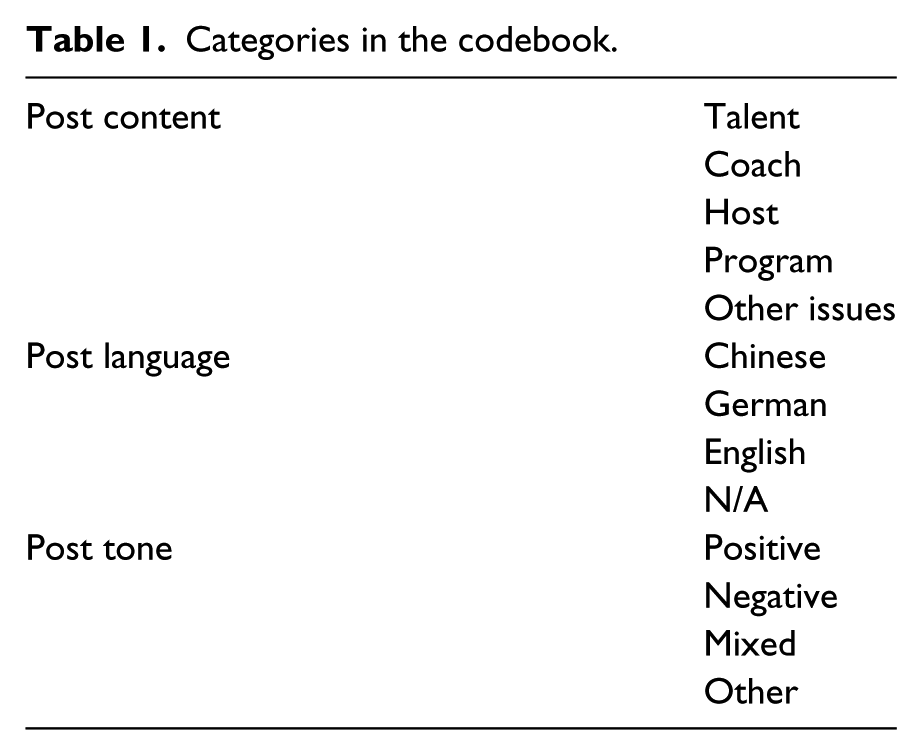
After all samples were drawn, the actual coding process started. The development of the codebook used for this study was devised in a mixed approach of inductive and deductive procedures. To answer the research question “do the audiences interpret the local adaptations of The Voice in China and Germany differently,” it is necessary to look at the post language, post content and to examine whether the audiences have a negative or positive tone towards the show. Therefore, the codebook contains three main categories: content, language, and tone, and each main category has subcategories as following (Table 1):
Categories in the codebook.
Key findings
Post content
The core elements of The Voice series include roles and characters, procedure of the show, visual designs, and so on. When the audiences comment on the shows, they write on topics relating to these issues. Therefore, all the sampled microblogging posts are coded and sort into the following five categories:
Talent—posts about the talents of The Voice;
Coach—posts about the coaches of The Voice;
Host—posts about the hosts of The Voice;
Program—posts remark upon the show in general;
Other issues—topics other than the previous categories.
The following pie chart (Figure 1) shows an overall picture of the themes in all coded posts. The roles and characters on The Voice series get the most attention on two microblogging sites. Out of a total number of 128 coded posts, 60% focuses on talents, which represents the largest share. Posts dealing with coaches constitute approximately one-fifth of the total posts (19%). Eleven percent of the posts comment on the show in general, while posts with “other” content are found in roughly 3% of the cases, covering topics such as hosts, staff, and advertisements.
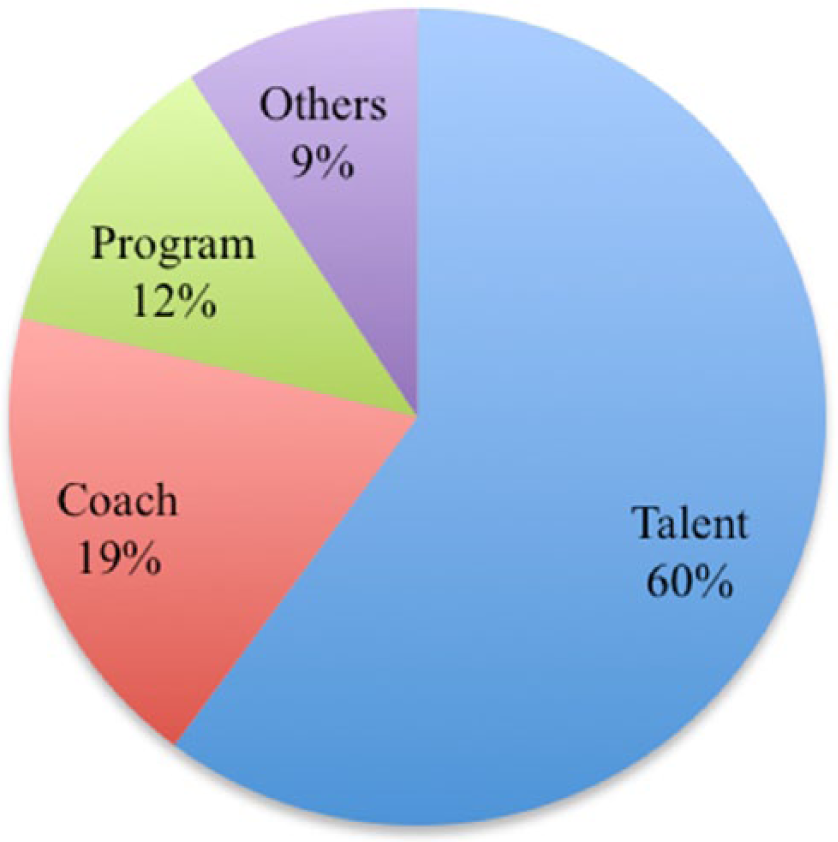
Themes of microblogging posts.
Examining the themes covered on Weibo and Twitter, respectively (Figure 2), talent is the most discussed issue among the audiences of both The Voice of China and The Voice of Germany. In all, 45 out of 60 Chinese weibos focus on the talents, whereas 32 tweets discuss about the talents of The Voice of Germany. Compared with the posts on Sina Weibo that focus on the talents, tweet topics are dispersed. Among 68 sampled tweets, 19 comment on the coaches, which represent 28% of the total number. Meanwhile, there are 10 tweets with #tvog comment on the show in general and 7 tweets relating to other topics.
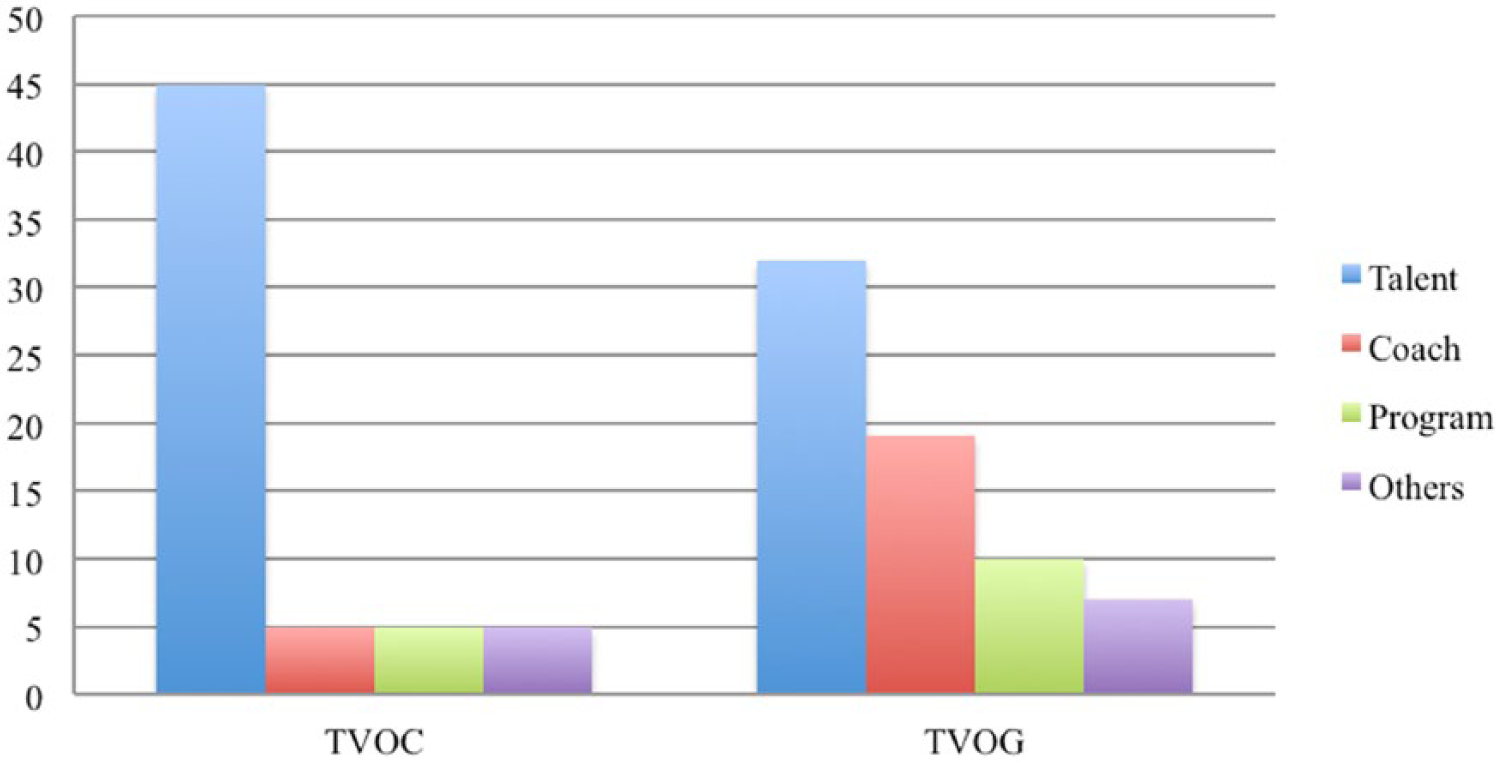
Themes of posts on two microblogging sites.
The most discussed issue relating to the talents among the audiences of The Voice of China is the age. As the majority of the talents are young people, some audiences spoke highly of the performance of young talents on the stage. A Weibo user commented on Bi Xia, a 22-year-old talent, “I wondered how she could sing so well at such a young age.” Another user put emphasis on the youthfulness of the talents, “the 17-year-old girl sings very well.” But some audiences questioned their real talent, “except their young age, they do not have any strengths. They are not as good as those over 30.”
Old age is highly respected in Hofstede’s scale of high power distance cultures, such as China. The elders dominate the society, and adults have more power and higher status than children. On the stage of The Voice of China, young talents always win over the elder talents, which reverses the normal social order and leads to heated discussions on microblogging websites. In contrast, the audiences of The Voice of Germany concentrate mainly on the performances of the talents. For example, one user addressed to a Luxembourg-Icelandic singer Thorunn, “@ThorunnE_music almost made me cry! Her showdown was beyond beautiful.”
There are 19 tweets devoted to coaches, composing the second largest fraction. It is interesting to note that 15 out of 18 coach-related tweets deal with Samu Haber, the Finnish coach of The Voice of Germany. Several Twitter users became frantic fans of Samu. For example, one user wrote, “My Friends call me “Mrs. Haber” because I’m so addicted to Samu.” Samu also became the main attraction in the program for some audiences. As one user tweeted, “I watched last year’s TVOG because of Nick, and this year because of Samu.” The presence of the Finnish coach made the show diversified. The adoration of Samu indicates the tolerance of German audiences for exotic cultures. Unlike German audiences’ unanimous affection for Samu, Chinese audiences paid equal attention to four coaches. Many users mentioned the names of four coaches in one single Weibo. For example, one user found all the coaches adorable, “the four coaches are all my favorites.”
The posts fall under the category of “program” commented on the show generally. For example, one Weibo user compared this season to the last and concluded that this season was disappointing. A twitter user remarked that blind auditions are the best part of The Voice of Germany.
Five weibos in the category “other issues” cover topics, including life stories, lyrics, and music genres, while seven tweets relate to songs, advertisements and hosts, and other staff of the show.
Post language
The distribution of languages used in the select samples is displayed in the above pie chart (Figure 3).
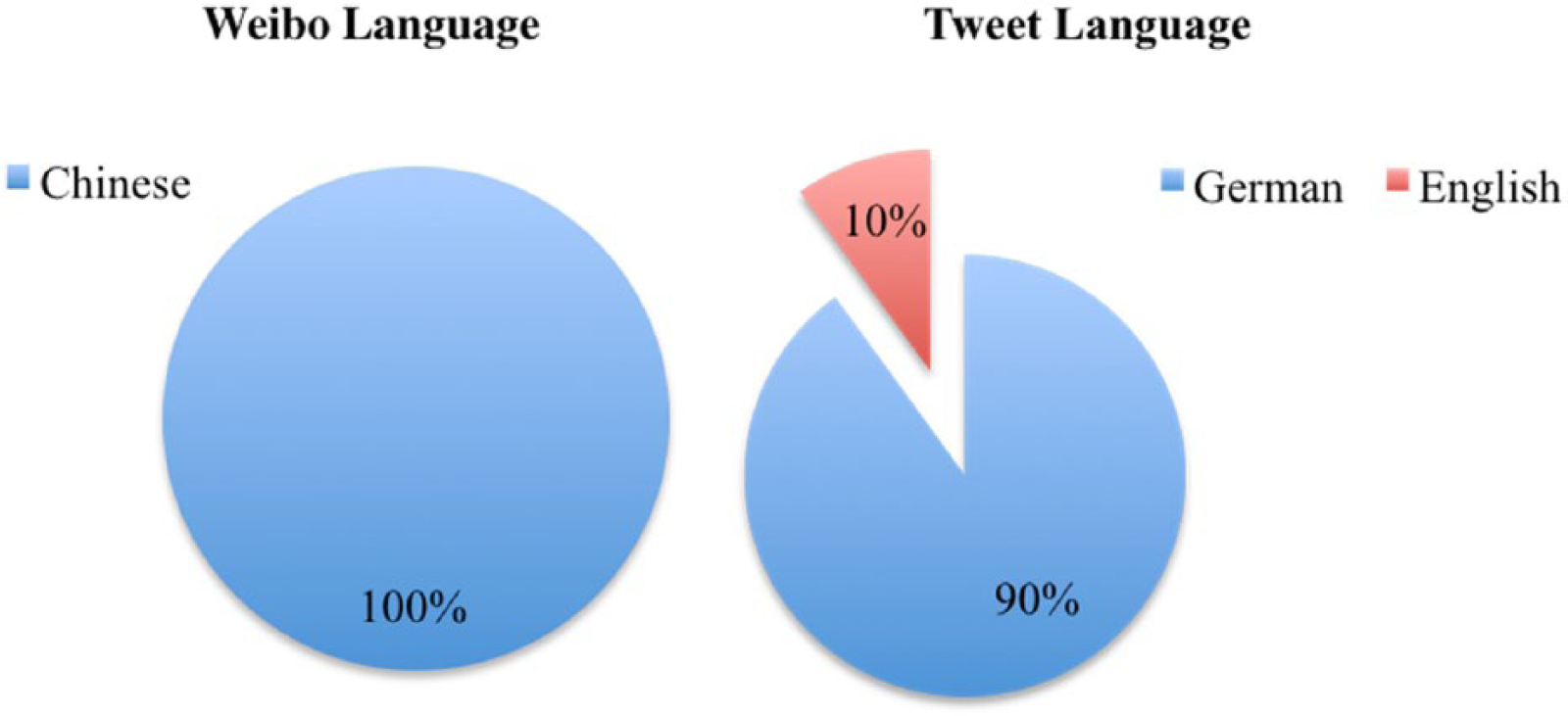
Post languages on two microblogging sites.
It clearly depicts that the major language used in the microblogging posts is the native language of the audiences. All the Weibo posts are written in Chinese, while 90% of the tweets are posted in German. Among all the tweets, the share of English tweets represents 10%. There may be multiple causes for the common use of English among the audiences of The Voice of Germany on Twitter. One contributing factor is that one coach of The Voice of Germany is not German and he always spoke English in the show. Three out of seven tweets in English address to the Finnish coach Samu. Another possible reason could be that Twitter is a multilingual space. In contrast to Sina Weibo, which is used predominantly by Chinese people, Twitter attracts users across the globe. Both Germans and non-Germans who have watched The Voice of Germany can not only post on Twitter, but also read other people’s tweets following the hashtag topic #tvog. Considering the proliferation of English in Twitter community, it can be expected that English is the second most used language when tweeting The Voice of Germany.
Post tone
The general tone of the microblogging posts is rated as belonging to one of four categories: positive, negative, mixed, and other. “Mixed” posts include those that contain both positive and negative components and “other” is a category included to catch non-evaluative statements or questions (Diakopoulos & Shamma, 2010).
The first step in our analysis of post tone is to look at the overall tone of posts from all content categories. The result is visualized in the bar charts in Figure 4.
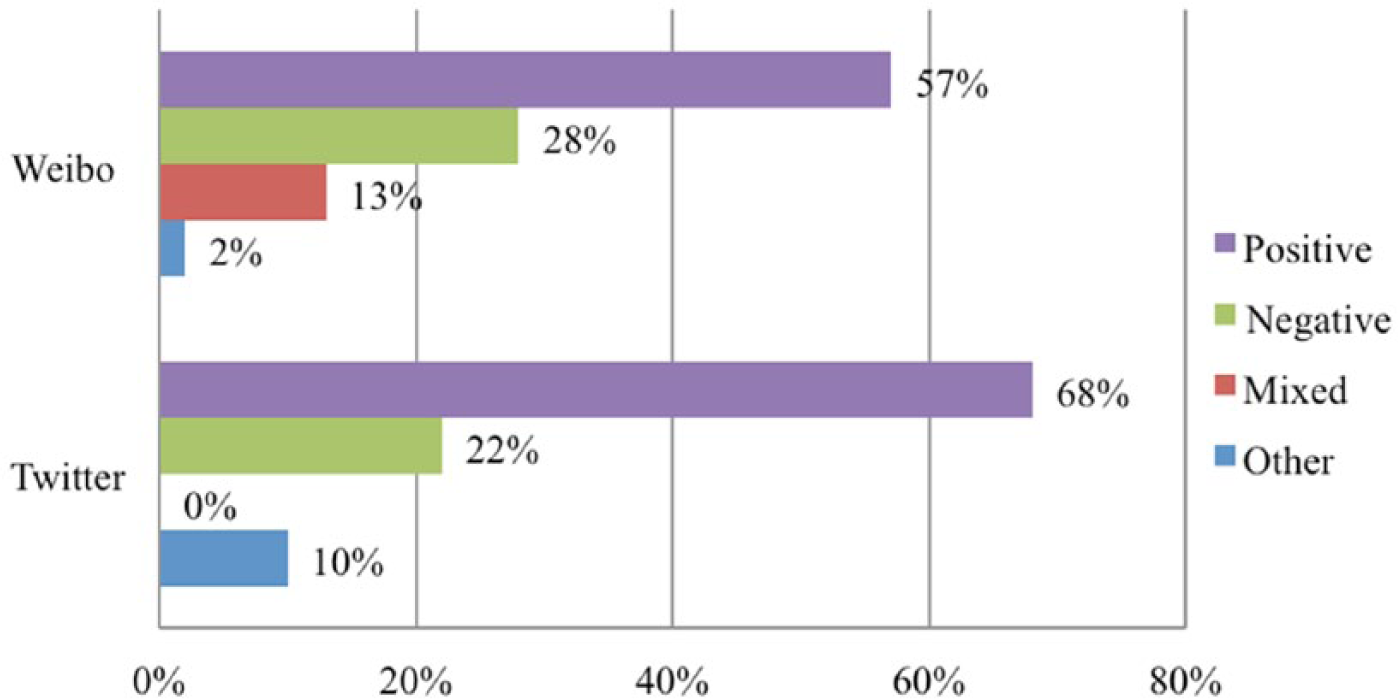
Overall post tone.
The analysis of tweet tones shows that out of a population of 128 coded microblogging posts, more than half of them have a positive tone. The proportion of positive tones is 57% on Sina Weibo and 68% on Twitter. Compared to the overall Weibo tones, the tenor of the tweets is less negative. Negatively tagged tweets only represent 22% of the set, and the remainder (10%) is tagged as “other.” There are no tweets with a mixed tone. Negative tones have a bigger share at 28% in the select weibos, 13% have a mixed tone, and only 2% of the weibos are non-evaluative. Mixed and negative weibos (41% combined) compose a similar proportion to positive weibos, which reflects a rather critical attitude of the Chinese audiences towards the talent show.
The bar charts in Figure 5 show the tones for different kinds of contents of The Voice in two countries individually. These two charts reveal different attitudes of the audiences in two countries. The talents of The Voice of China received much more attention among Chinese audiences. Accordingly, Weibo users were more critical towards the talents. For example, some Weibo users thought this season a failure; the participants are not as talented as those in the last season. The direct critics by Chinese audiences contradict the traditional cultural expectation that Chinese people always avoid speaking their minds in public in order to maintain harmony. In contrast, the proportion of tweets with negative tones concerning talents and coaches is very low. Only four tweets in categories “talent” and “coach” have negative tones. These audiences either disliked the talents or they disagreed with the coach’s decision when their favorite talents were eliminated.
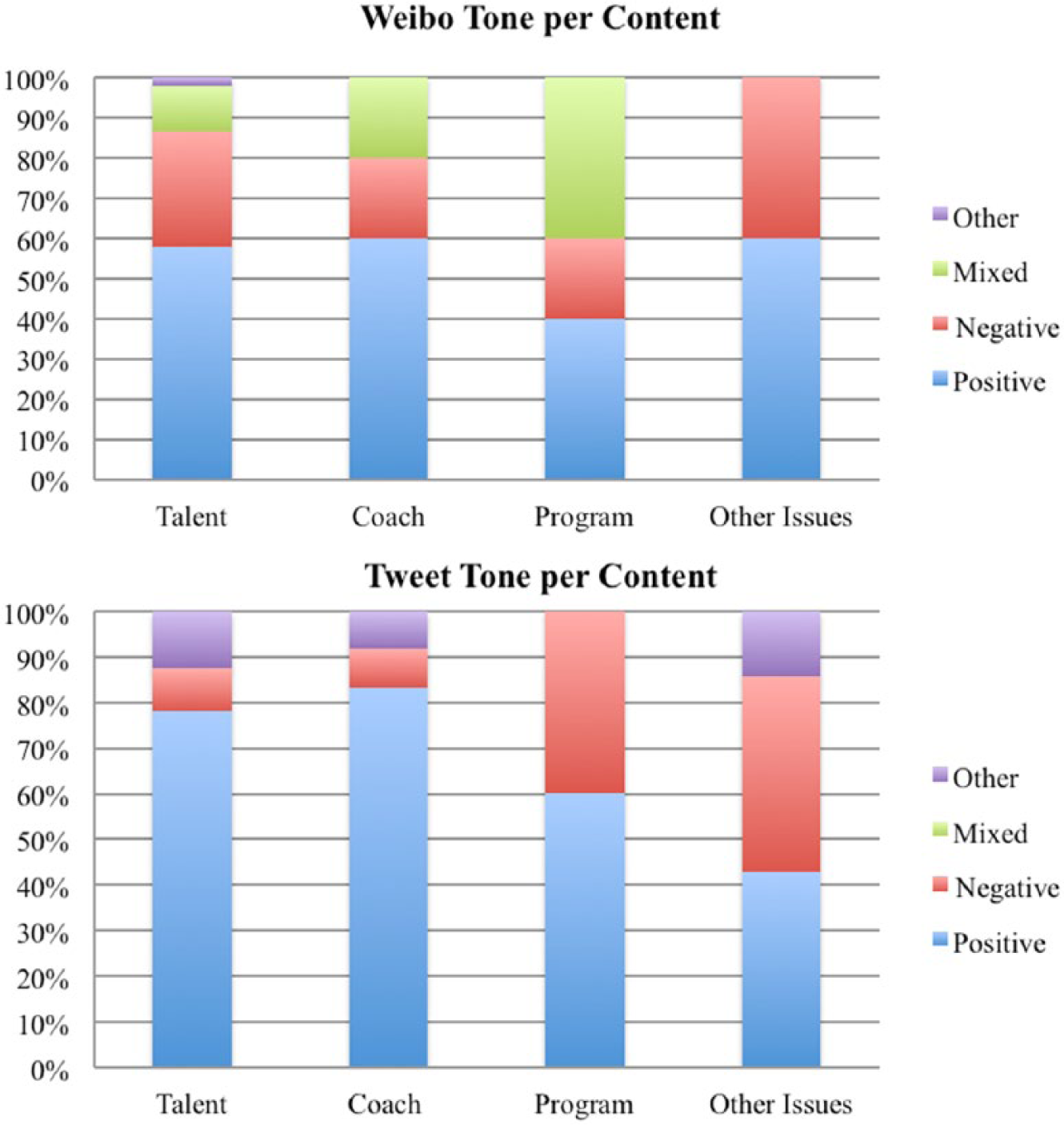
Weibo and tweet tone per content.
In terms of the program, the audiences of both shows have a more negative outlook on the voting systems. After all the talents in each group have sung their individual songs in the live-show rounds of The Voice of Germany, the responsible coach has to award 20, 30, and 50 points to these talents, which makes up 50% of the final score. The televoting makes up another half of the score. The “20, 30 & 50 points” voting system has been harshly criticized by the audiences. The Chinese audiences were disappointed with the media voting system on The Voice of China. A total of 131 representatives from the media industry across the country joined the voting procedure in the team championship rounds and the final concert. Media representatives decided the finalists and the champion together with either the coaches or the public.
The audiences were also dissatisfied with the long advertisement time during the broadcast. Chinese audiences complained that there is “too much commercial advertisement,” while German audiences compared the show to “an advertisement marathon.”
Conclusion and discussions
The main goal of this study is to explore the online discussions occurring on microblogging sites while people watch The Voice simultaneously. The results show a distinctive pattern of communication between Chinese and German audiences on Weibo and Twitter in different national contexts.
After examining 128 microblogging posts with the hashtag #TVOG or #中国好声音#, the findings indicated that there are several similarities between two countries. First, talents and coaches are at the center of discussions on both Twitter and Sina Weibo. Second, most posts are written in the audiences’ native language and have a overall positive tone.
The results also show differences. First, compared to similar proportions of negative tweets written by German audiences that are addressed to talents and coaches, Chinese audiences are more critical towards talents than coaches. Hofstede’s scale reveals that China is a large power distance country. In Chinese society, it is important for people to respect authority, age, and hierarchy. According to Hofstede (2008, 2011), in high power distance index countries, parents teach children obedience. Older people are both respected and feared, and there is less questioning of authority in general. On The Voice show, coaches are the authority. In a hierarchical society, people never dare to challenge the authority of their superiors, so it is not surprising to see that there are fewer critics or negative comments on coaches than talents in the Chinese sample. This also explains that much attention is paid to talents’ ages among Chinese audiences. In large power distance countries, hierarchies are based on age. Top leaders are older, and adults have more power and higher status than younger people and children. The audiences are not accustomed to seeing talents younger than 20 years old perform significantly better than the elder ones. This is especially true in the battle rounds of the show, when two talents compete with each other and younger talent wins.
Second, as the majority of Chinese weibos focus on the talents, the audiences of The Voice of Germany take notice of various topics, and there is a higher percentage of tweets written in English. The exotic elements on The Voice of Germany have the appeal to its audiences. For example, Samu, the Finnish coach, became the highlight of the show. More than 80% of the coach-related tweets sampled in this study addressed to him, and all of them have a positive tone. Furthermore, there are several tweets covering songs originating from America and the United Kingdom sung in the program. Unlike Hofstede’s argument that Germany belongs to higher UAI countries, the findings show Germany’s openness to new experience and information on the dimension of uncertainty avoidance. According to Hofstede (2008, p. 161), there is more tolerance of diversity in low-UAI countries, “what is different is curious.” The high percentage of positive tweets towards Samu reveals the acceptance of a foreigner as the authority of the show. It is in accord with Hofstede’s (2008) argument that there is an acceptance of foreigners as managers on the low-UAI side. The openness of German culture might trace back to the post World War II period. Hofstede started his research in the 1960s, and he could not have foreseen the impact of migration flows in Germany. Immigrants retain their own culture, including language and religion, and that culture coexists with German culture. As a result, the society is becoming more tolerant towards otherness and more open to diversity. Furthermore, compared to Chinese weibos, the higher percentage of tweets written in English also proves a multilingual and multicultural online community in Germany.
Finally, in terms of the post tones, the Chinese audiences are more critical than German audiences in general. Traditionally, China is a high-context culture where communication is more implicit and indirect. Hall supposed that Chinese audiences would avoid expressing their opinions explicitly. Although compared to Germany, which is labeled as a low-context culture, there are more Chinese weibos with a mixed tone, showing their neutrality. The majority of sampled weibos has a clear attitude, either positive or negative. The social media might change the way the audiences used to perform. Unlike in their offline daily life, the Chinese audiences tend to articulate their opinions, including negative comments clearly and directly in the online community. The anonymity of social media users helps to reduce the power of the conformist mentality and change the traditional social norm (Wang & Dai, 2010). The virtual identity stimulates a lively online community where people could boldly express and share their feelings and ideas. Users do not need to be highly concerned about the possible negative repercussions of sharing their information with others and they are less afraid to hurt each other’s feelings.
As noted in the results, the audiences in China and Germany interpret the local adaptations of The Voice shows differently. The reasons for differences related to national cultural values. However, due to the global connectivity of social media, it does not always support the traditional cultural expectations conceptualized by Hall and Hofstede.
As The Voice format was sold in more than 50 countries around the world, future researches could include countries in Africa, Latin America, or Middle East. Microblogging remains a goal of future researches. It is a source for quantitative and qualitative oriented researches (Bredl et al., 2014, p. 206). Future studies could include a larger sample size when analyzing the content of posts in order to validate other dimensions from Hofstede’s model. It may also be more helpful to conduct in-depth interviews with microblogging users, which would allow researchers to get insights into the motivation and reasons for their online behaviors.