




Abstract
Children’s religious education is vital for the formation of pupils in Dutch Orthodox Protestant schools. Therefore, it seems self-evident that parents and teachers cooperate. This article presents research on parents’ and teachers’ opinions about the helpfulness of cooperative practices in religious education. A total of 1346 parents and teachers completed questionnaires developed from a previous study. This article finds that parents and teachers cherish the ideal of ‘coherence between school and family’ although differences between the respondent groups and school types occurred. Moreover, the research shows that this ideal influences the valuing of cooperative practices of religious education.
Keywords
Introduction
An estimated 5% of elementary schools in the Netherlands can be considered Orthodox Protestant schools (De Muynck et al., 2014). They commit themselves to doctrinal statements in the Reformed tradition, but the schools’ educational practices vary. They are also called ‘tradition schools’ because transmitting the faith is at the forefront compared to other Protestant schools (compare Bertram-Troost et al., 2012; De Muynck, 2008; Exalto and Bertram-Troost, 2019; Markus et al., 2018, 2019). Due to differences in student populations, Orthodox Protestant schools are distinguished into two groups: homogeneous and heterogeneous. Homogeneous populations, consisting primarily of students from the same church communities, are prominent in schools that are organized as Reformed (in Dutch, Reformatorische scholen). Heterogeneous populations, also having pupils of non-Christian families, are found in Protestant Christian schools (in Dutch, Protestants Christelijke scholen). The student populations of all schools have traditionally been relatively homogeneous, but over time, some Orthodox Protestant schools have had heterogeneous populations. The ‘tradition schools’ (they can occur in any faith tradition, see Bernts et al., 2018) were founded by parents who wanted a Christian education and upbringing for their children. In doing so, they took advantage of the legally established freedom of education that provides space to launch private schools that, like public schools, are funded by state resources. The ideal of this group of parents is that education at school should be an extension of the education within the family (Markus et al., 2018; see also McCreery et al., 2007). There is a desire for education into religious traditions, protection from outside influence, offering a specific social and moral framework, and ensuring continued adherence to the faith. Religious education at school is close to religious upbringing at home. Therefore, it can be assumed that the close relationship between parents and the school their children attend, due to the choice for these particular schools, is even stronger when religious education is included, as it is the case in Catholic schools in Canada (Hamlin and Flessa, 2018). That bond can be observed in the way parents and teachers work together in providing religious education to children. Previous qualitative pilot research (Noteboom et al., 2019) suggested that parents of children in these schools in the Netherlands have confidence in the teachers’ expertise in religious education, but that there are no forms of active cooperation in this area. However, empirical evidence on the extent to which cooperation is valued and whether that valuation depends on different forms of cooperative practices is lacking. We also do not know whether the perspectives, related to the roles of teachers and parents, differ. And lastly we lack insight in how ideals on cooperation relate to valuing practices of cooperation. To fill this research gap, we conducted a survey, part of a much larger empirical study into the relationship of parents and teachers. The report of this study concerns the following central question:
What role does the ideal ‘coherence between school and family’ play when it comes to working together on religious education?
The following sub-questions have been derived from this central question, which will be answered in this article: - What are the differences between parents and teachers of the different types of schools regarding the ideal ‘coherence between school and family’? - How does the ideal ‘coherence between school and family’ affect parents’ and teachers’ appreciation of religious education practices?
We first outline the theoretical framework on which the study was based. Then, we describe the methods, after which we present the results. We discuss the answer to the research question in the final section.
Religious education and the cooperation of parents and teachers
Religious upbringing and education
We understand religious education as pedagogical actions provided by people of faith who intend to introduce children to their faith with the desire that they will develop into God-fearing adults (De Muynck and Visser-Vogel, 2020; Van de Koot-Dees, 2013). Home and church seem to be the places where parents are most involved in the religious education of their children. However, parents’ choice of Orthodox Protestant schools has often religious motivations (Bunnell, 2016; Ter Avest et al., 2013). This study focuses on parents and teachers because, in the target group, Christian teachers are expected to play a role in children’s religious education. The role differs between the two groups of schools. In Orthodox Protestant schools with heterogeneous student populations, teachers also introduce children of non-religious parents to the Orthodox Protestant faith. In Orthodox Protestant schools with homogeneous school populations, there are usually no students of non-religious parents, and thus, the role of teachers in religious education is different.
We place religious education within the broader framework of the core of Christian education: personhood formation (De Muynck and Visser-Vogel, 2020). Religious education concerns learning from or about religion and a person’s self-awareness and moral choices. In the context of personhood formation, guiding children in exploring faith and making meaning of religious texts is emphasized (Bertram-Troost and Visser, 2020; De With, 2020; Vermeer, 2009). Research on raising children in the Christian faith shows that parents differ in religious ideals, religious practices, and parenting styles (Van de Koot-Dees, 2013). Only the first two (ideals and practices) are examined in this study.
In strategic documents of the Dutch government on educational policy, there is consensus that parents are not only holders of legal rights and duties but also partners of the school (Onderwijsraad, 2010). They are collaborative partners of the school regarding their children’s learning and education (Epstein, 2018; Walner and Hiatt-Michael, 2017). The term ‘cooperation’ indicates that religious education is a joint responsibility, involving a meaningful relationship between parents and teachers in which both parties mutually support each other to promote student learning, motivation, and development (Noteboom and De Vries, 2017: 5). In the field of educational research, there is evidence that cooperation between teachers and parents contributes to the broad development of children (Bakker et al., 2013; Epstein, 2018; Jeynes, 2010).
The research by Markus et al. (2019) in Orthodox Protestant schools suggests that teachers can also be called religious educators because of their high level of religious commitment. At the same time, the study found that these teachers position themselves in opposition to parents because, as teachers, they also want to encourage probing or asking critical questions, about which they believe parents have less nuanced views.
Forming an educating community of parents and teachers requires social cohesion because, in addition to what all individuals have in common, there are differences. Social cohesion occurs through social capital (Koonce, 2011; Putnam, 2007), which consists of being able to form relationships with individuals who are similar in important ways (‘bonding’) as well as being able to form relationships with individuals who differ in important ways (‘bridging’). When bonding predominates, isolation from persons who are not considered group members can occur. In this way, diversity can lead to distancing. The previously mentioned qualitative pilot study (Noteboom et al., 2019) showed that parents could experience small (but for them, significant) differences (e.g. in lifestyle) as a threat to the coherence between them and the school. Making those differences negotiable was not easy. Perhaps in homogeneous schools, the factor bonding is more strongly developed than bridging. It is essential to gain insight into this to form an educational community in which parents and teachers work together on religious education.
Ideals of cooperation
An ideal is an image or idea that represents the perfect situation or the best (characteristic of a) person. The person who has an ideal attaches a high value to the image or idea. The ideal has so much value to that person that he strives to achieve it, although an ideal is never fully attainable (De Ruyter, 2003; 2007a). Ideals can be divided into ideal aims (images of the goal to be pursued), ideal means (images of how the goals should be achieved), and ideal content (images of the desired content to which goals and activities relate) (De Ruyter, 2007b). These three types of ideals play a role in the cooperation between parents and teachers of faith. Primarily, teachers and parents share the ideal aims and content ideals regarding religious education (Boele-De Bruin and De Muynck, 2018). This article is mainly concerned with examining ideal means. Ideal means concern the images that parents and teachers have of the style of cooperation in religious education and its characteristics. Hoover-Dempsey and Sandler (1997) and Hoover-Dempsey et al. (2005) showed that parents’ role expectations define their beliefs about what they are supposed to do in their children’s education and appear to establish the basic range of activities that they see as important and necessary. So the view of role can be seen as an important part of ideal means regarding cooperation in religious education.
The study by Noteboom et al. (2019) showed that religious education is considered very important by schools that have highly homogeneous populations. First, in all interviews conducted with parents, the coherence between school and family was named. The parents’ motives align with the teachers’ desire to work in Orthodox Protestant elementary schools (Markus et al., 2018). They believe that education is inextricably linked to children’s religious education and consider similarities between the religious climate in the family and at school essential. They also appreciate that the school’s religious climate matches their identity. The second ideal for parents was that religious education begins in the family, and the school complements it with its capabilities. Again, this view is consistent with research by Markus et al. (2019) showing that teachers see themselves as religious educators and feel very responsible, but attribute the most significant responsibility to parents. Third, parents mentioned the ideal that school is an extension of education at home. Teachers more often mentioned ‘reinforcing each other’ as an ideal. This ideal is about children learning the same things at school and home, with parents and the school supporting each other. Although this ideal is mentioned mainly by teachers, they do not consciously focus on strengthening and supporting parents, but instead think of an attitude of shared trust and beliefs in parenting. Occasionally, respondents said that parents and teachers should appreciate and encourage each other.
Practices of cooperation and mutually perceived support
The reality of cooperation between schools and parents consists of a myriad of forms of involvement. According to Epstein (1995), parental involvement consists of parenting, communicating, volunteering, support for learning at home, participating in decision-making, and finally collaborating with the community. Research shows that home-based forms of parental involvement are most prominent related to the development of children (both cognitive and non-cognitive) (Jeynes, 2010, 2012). It has also become clear that the involvement of parents with school (like volunteering and participating in boards and committees) has no or little impact (Bakker et al., 2013; Hamlin and Flessa, 2018). Jeynes (2012) gives attention to the more subtle social variables of parental involvement, such as parental expectations, the quality of parent–child communication, and parental style. He suggests that parental participation may be more a function of subtle but important demonstrations of love and respect than a matter of instructing parents to apply particular methods of helping children. Interestingly, teachers can play a role in enhancing the involvement of parents by adopting a positive attitude to parents, by communicating openly and transparently about expectations and about the development of the child, and by offering concrete and useful tips to parents for supporting children (Bakker et al., 2013).
School leaders tend to emphasize the primary importance of personal relationships between parents and teachers (Walner and Hiatt-Michael, 2017). When teachers are personally involved with parents, they develop close relationships and a strong commitment to the school. Mutual trust begins with open, transparent, and regular communication. Based on observations of the variety in communication, De Vries (2019) distinguished three types of schools regarding parental involvement: informing, communicating, and collaborating. Based on their pilot study, Noteboom et al. (2019) added a fourth type, the appropriating school, in which the school tends to take over the parents’ role. The four types are described below in terms of religious education.
An informing school (De Vries, 2019) takes over many tasks in religious upbringing and education from parents but also provides a good flow of information toward them. The implicit message from the school is that it does a lot, and the expectation is that parents will take it further at home. Such a school is not directly focused on real input from parents and cooperation with them. In an informing school, the parents are mainly the ones who experience support because they know what the school is doing regarding religious education. Teachers experience little or no support from this one-sided provision of information because they are the sending party. Moreover, sending information does not automatically lead to positive reactions from parents that can be perceived as supportive by teachers (Noteboom et al., 2019).
A communicating school (De Vries, 2019) can be characterized as an institution in which information is exchanged. The appeal of this type of school is that reciprocal information is needed for both school and parents. By proper exchange of information, inappropriate images of the parties can be corrected. Teachers and parents also build relationships in which it is possible to show vulnerability and honesty about not knowing how to act properly. The pilot research on Orthodox Protestant schools did not reveal practices that fit this type of school (Noteboom et al., 2019).
In a collaborative school (De Vries, 2019), it is communicated that parents and teachers need each other in terms of exchanging information and reciprocal support. It starts with a good relationship and personal contact in which parents and teachers listen to each other and get to know each other to support each other and give tips where necessary. This interaction happens during the registration interview and during other planned and unplanned conversations. These conversations can occur if it appears that children have questions about their faith. This cooperation style fits a Christian community of the church, school, and family, in which the members of one body cannot function without each other and help each other (De Muynck and Kunz, 2021). However, qualitative research (Noteboom et al., 2019) in Orthodox Protestant schools has not revealed the practices that fit this type of school.
Orthodox Protestant schools seem often to act as appropriating schools (Noteboom et al., 2019). An appropriating school practically assumes the parents’ responsibility. But by doing so, the school communicates that parents can rely on the school’s expertise. Teachers do not seek cooperation with parents to help them with their expertise. These schools are not focused on cooperation and seem to find it challenging to talk to parents about religious education. In addition, parents of children in denominational schools appear to take little initiative to cooperate (Vogels, 2002). They do not experience the need for this because they see the school as competent. Parents of children at an appropriating school experience support through the knowledge that the school is an expert and will take over some of the responsibilities (Noteboom et al., 2019). Parents and teachers have a positive image of each other, trust each other, and complement each other. However, teachers at an appropriating school seem to experience little or no support from parents due to a lack of cooperation.
Research method
To answer the research question, we conducted a large-scale descriptive survey using questionnaires.
Respondents
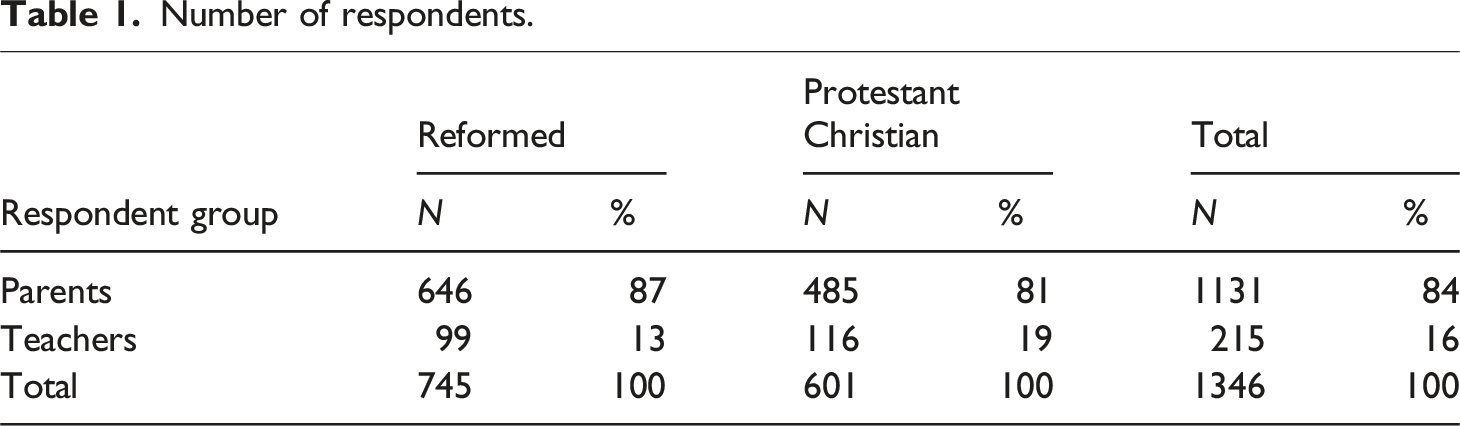
From a data file of Orthodox Protestant elementary schools, 44 schools were randomly approached with a request to participate in the study. Attention was paid to an even split between Reformed and Protestant Christian schools. Forty of the 44 invited schools participated in the study. The participating schools are located in the Bible Belt, a strip that runs diagonally across the Netherlands from southwest to northeast and is home to relatively large numbers of Orthodox Protestants. Half of the participating schools (20) are Reformed; the other half (20) are Protestant Christian. Of the total number of students at these schools (9206), 56% attend Reformed schools, and 44% attend Protestant Christian schools. The average size of the participating schools is 227 students. This average hardly differs from the national average school size of 226 pupils.
Number of respondents.
Average percentage of students belonging to a Christian denomination.

Analysis of variance with ‘denomination’ as independent variable and ‘percentage of students belonging to a Christian denomination’ as dependent variable shows a significant difference of means between Reformed and Protestant Christian schools, .F(1,1197) = 915.86, p = < .001). The percentage of Christian students at Reformed schools (98.00) is significantly higher than at Protestant Christian schools (71.00).
Research tools
Two questionnaires were developed: one for parents and one for teachers. The items on the two questionnaires about cooperative practices in religious education were the same. The personal questions were tailored to the target group. The following steps were taken to arrive at usable questionnaires.
First, indicators were sought. To this end, the report of the qualitative study was consulted (Noteboom et al., 2019). This study contained two significant clusters of results: views on cooperation and opinions on practices of cooperation. In addition, the first cluster was divided into two parts: ideal of cooperation and view of role.
Results from a CFA of the subscale ‘coherence between school and family’.
Results from a CFA of the subscale ‘interaction’.
Results from a CFA of the subscale ‘receptive’.
Appropriate response options accompanied the statements. The point was to allow respondents to express their views on the extent to which cooperative practices are helpful, their ideal image of cooperation, and their perception of their role. We also asked about the extent to which the frequency of the collaborative practices should change.
After the sections on cooperation, we added a couple of biographical questions. Some were the same for parents and teachers, and some were specific to either parents or teachers.
The draft questionnaires were completed by some parents and teachers in a try-out. Based on the feedback, the wording was adjusted slightly to improve comprehensibility.
Procedure
Ethical approval was received from the Research Ethics Committee of the University to which the researchers are affiliated before the project started, following the university’s regulations. The school leaders of the participating schools ensured that teachers and parents were invited to participate in the survey via email. The message contained a link to the online questionnaire. Respondents were shown the items only after they declared their consent in the privacy statement. The data were collected in a secure data file that only members of the research team could access.
The respondents had several weeks to complete the questionnaire and received a reminder halfway through this period.
Analysis
The items reported in this article were assessed with 5- and 6-point Likert scales. The results are ratio-level measurements that allow the calculation of means and standard deviations. Analyses of variance were applied to these data, with the respondent group (parents and teachers) as the independent variable and the items in question as the dependent variables. These analyses established whether the differences between the respondent groups were significant. The effect size (Cohen’s d) was calculated to capture the strength of these (significant) differences. The results of these analyses are shown in the tables in the following section.
Results
This section contains the report and analysis of the respondents’ responses to items in two questionnaire sections. The wording of the items was taken from the questionnaire for the parents. The teacher questionnaire contained the same items but was formulated from the teachers’ perspective.
The ideal ‘coherence between school and family’
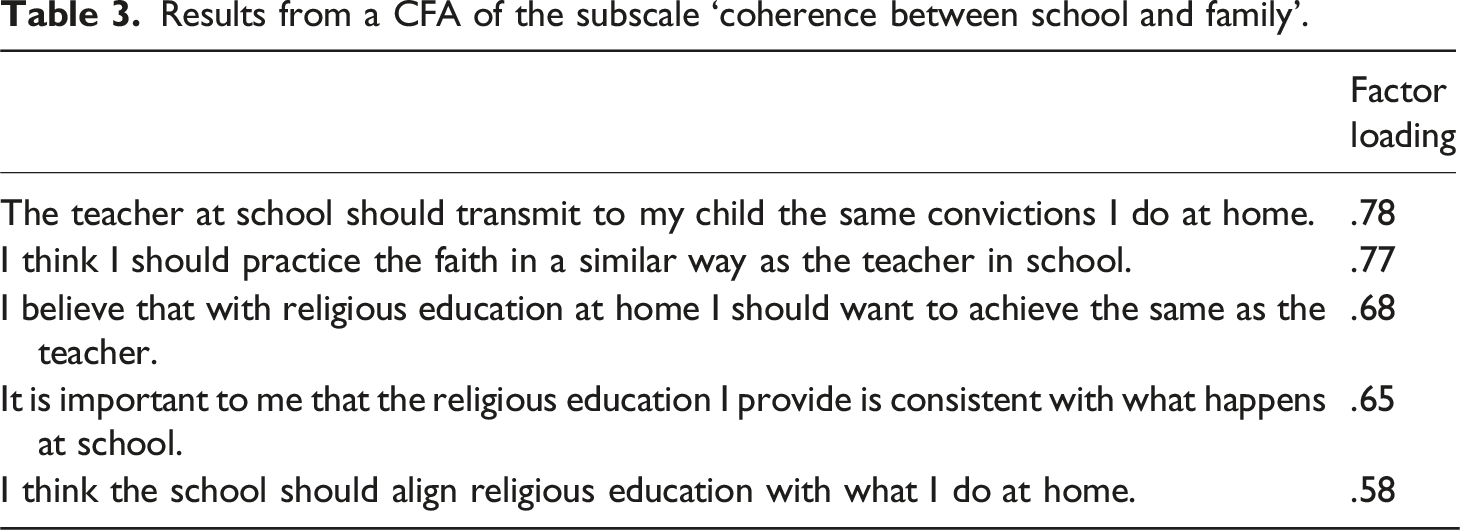
One questionnaire section contains five statements related to the ideal ‘coherence between school and family’. The response options were strongly disagree (1), disagree (2), do not disagree/do not agree (3), agree (4), or strongly agree (5). A confirmative principal components factor analysis (CFA) was conducted on the data of these five statements. One factor was extracted which accounted for 48% of the overall variance. Table 3 shows the loadings on the extracted factor. The Cronbach’s alpha coefficient of the scale was found to be 0.73. So, the reliability of this scale is acceptable. The conclusion of these analyses is that the five statements about ‘coherence between school and family’ form a reliable subscale.
Results of the subscale ‘coherence between school and family’.
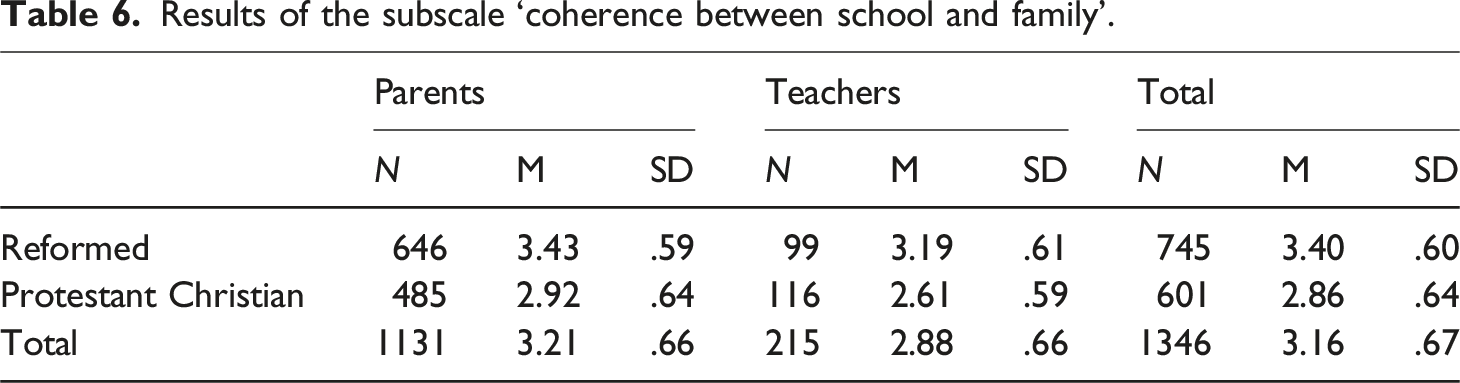
Analysis of variance with ‘denomination’ as independent variable and the subscale ‘coherence between school and family’ as dependent variable shows a significant difference of means between Reformed and Protestant Christian schools, F(1,1344) = 251.38, p = < .001. The mean of Reformed schools (3.40) is significantly higher than the mean of Protestant Christian schools (2.86). The effect size is large (.87).
Analysis of variance with ‘respondent group’ as independent variable and the ideal ‘coherence between school and family’ as dependent variable shows a significant difference of means between parent and teachers, .F(1,1344) = 46.07, p = < .001. The mean of parents (3.21) is significantly higher than the mean of teachers (2.88). The effect size is medium (−.51)
Analysis of variance applied to the data of the parents with ‘denomination’ as independent variable and the ideal ‘coherence between school and family’ as dependent variable shows a significant difference of means between parents of Reformed and Protestant Christian schools, .F(1,1129) = 192.06, p = < .001. The mean of parents of Reformed schools (3.43) is significantly higher than the mean of parents of Protestant Christian schools (2.92). The effect size is large (.83).
Analysis of variance applied to the data of the teachers with ‘denomination’ as independent variable and the ideal ‘coherence between school and family’ as dependent variable shows a significant difference of means between teachers of Reformed and Protestant Christian schools, F(1,213) = 49.64, p = < .001. The mean of teachers of Reformed schools (3.19) is significantly higher than the mean of teachers of Protestant Christian schools (2.61). The effect size is large (.96).
Valuing collaborative practices
Another section of the questionnaire contains statements about collaborative practices. Respondents were asked to indicate for each practice whether it occurs and to what extent it helps them with religious education. The Likert scale in question consisted of four response options: occurs, but it does not help me (1), occurs and it helps me somewhat (2), occurs and it helps me quite a bit (3), and occurs and it helps me a lot (4).
In this section of the questionnaire, six statements related to the interaction between parents and teachers can be distinguished. These statements involve cooperation between parents and teachers, requiring direct contact, conversation, and deliberation. Another six statements relate to information received by the parents from the school and are labelled as ‘receptive’. We checked whether both sets of statements form reliable subscales.
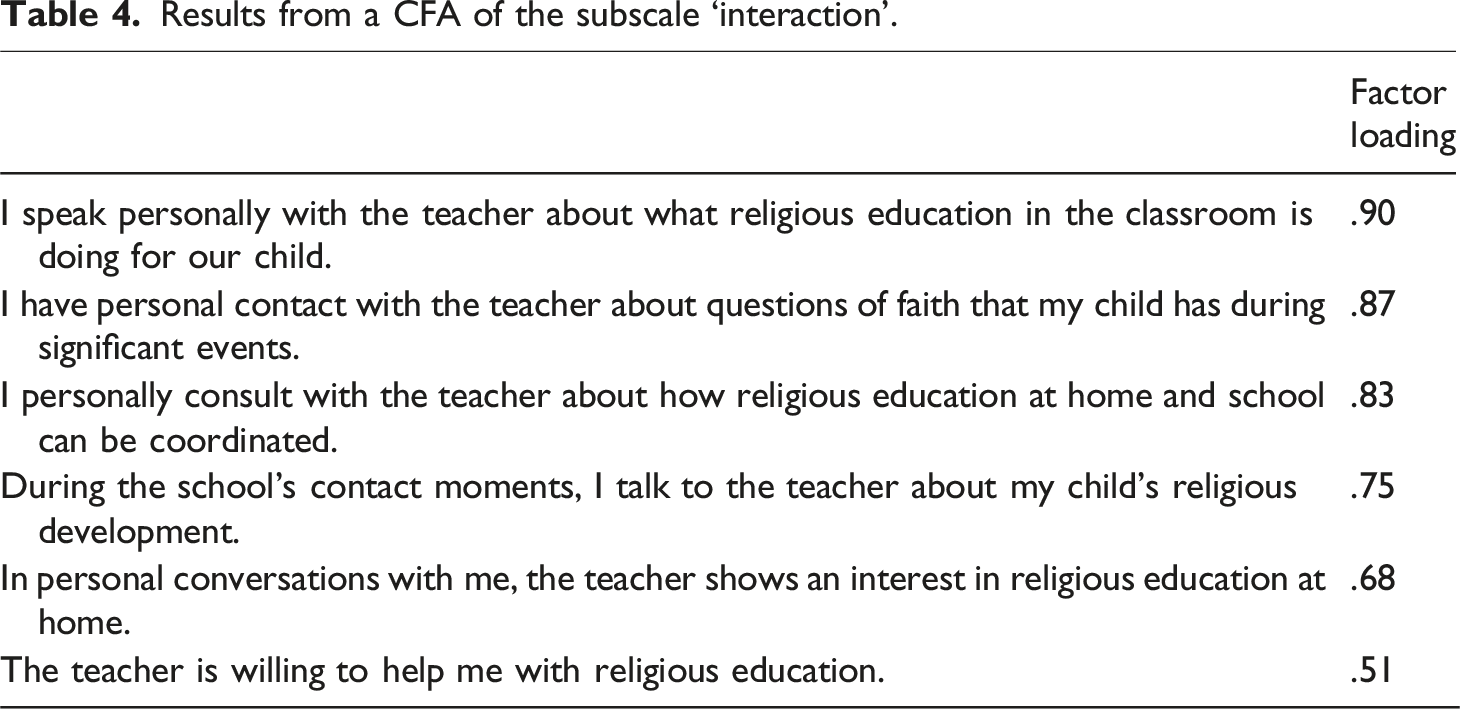
A confirmative principal components factor analysis was conducted on the data of the six ‘interaction statements’. One factor was extracted which accounted for 58.95% of the overall variance. Table 4 shows the loadings on the extracted factor. The Cronbach s alpha coefficient of the scale was found to be 0.85. So, the reliability of this scale is good. The conclusion is that the six ‘interaction statements’ form a reliable subscale.
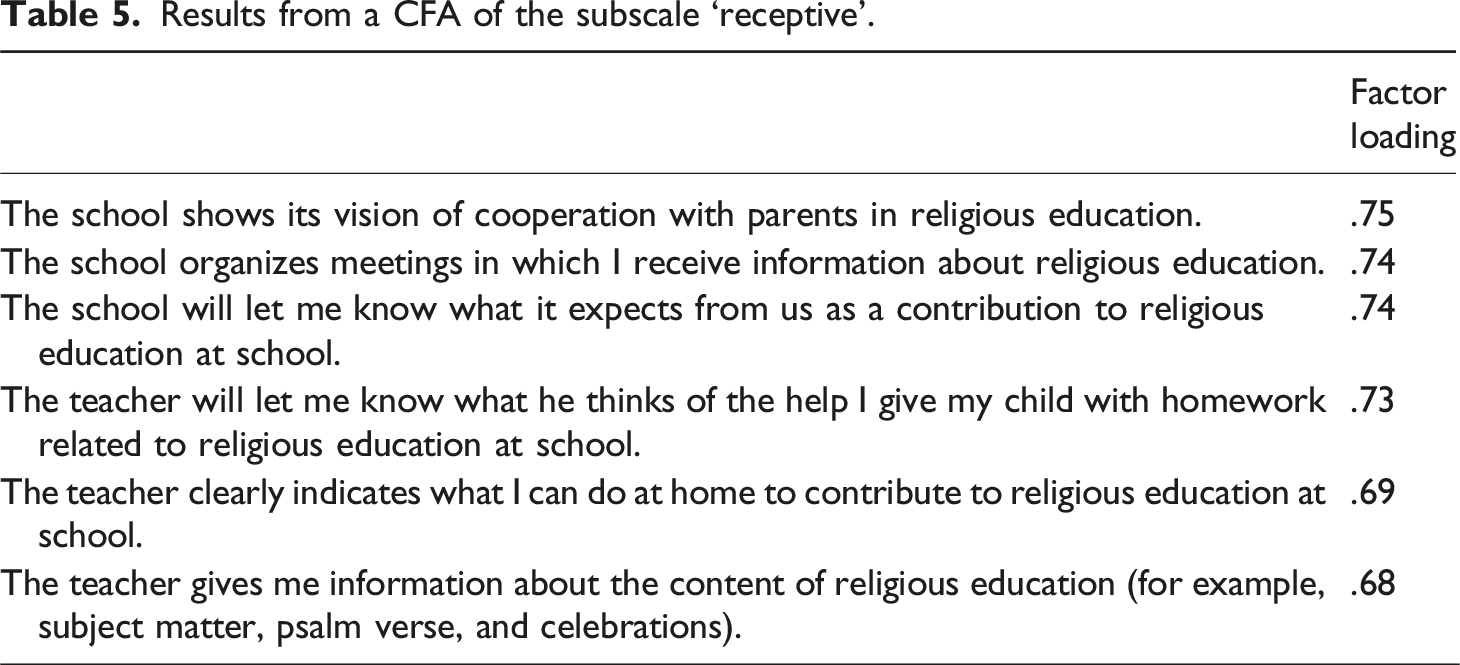
A confirmative principal components factor analysis was conducted on the data of the six ‘receptive statements’. One factor was extracted which accounted for 52.40% of the overall variance. Table 5 shows the loadings on the extracted factor. The Cronbach’s alpha coefficient of the scale was found to be 0.82. So, the reliability of this scale is good. The conclusion is that the six ‘receptive statements’ form a reliable subscale.
After it had been determined that the two sets of six statements are reliable subscales to measure the appreciation of collaborative practices in religious education, it was examined whether there is an effect of the subscale ‘coherence between school and family’ on these two subscales ‘interaction’ and ‘receptive’. Therefore, a dichotomization was applied on the data of the subscale ‘coherence between school and family’ with the mean score as a cut-off value. Because there is only a slightly skewed distribution of scores (for the parents −0.15 and for the teachers 0.16, for the respondents of Reformed schools 0.09 and for the respondents of Protestant Christian schools −0.17), dichotomization is justified in this case. The group of respondents who score below average on the scale ‘coherence between school and family’ is referred to as ‘low’; the group that scores above average is called ‘high’.
Results of dichotomizing the subscale ‘coherence between school and family’.
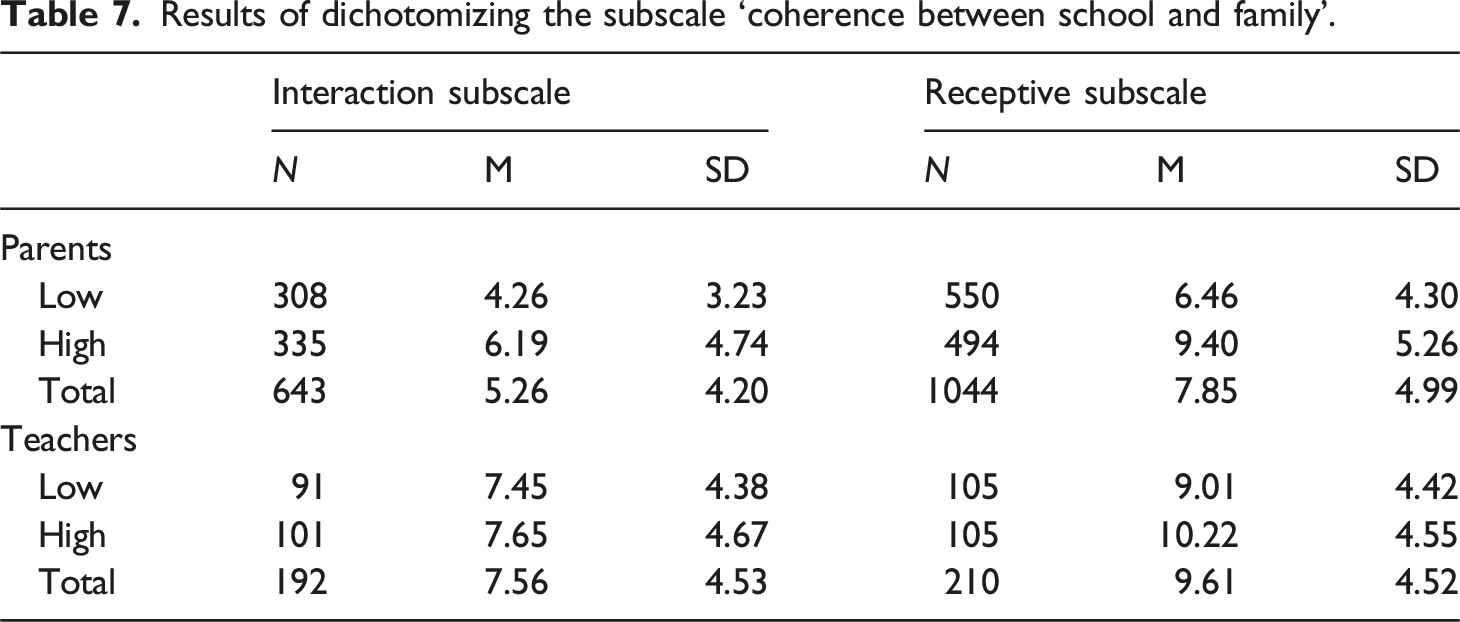
ANOVA applied to the parents’ data with the dichotomized subscale ‘coherence between school and family’ as independent variable shows that on the subscale ‘interaction’ the means of the parents’ high-group (6.19) are significantly higher than the means of the parents’ low-group (4.26), F(1, 641) = 35.78, p < .001. For the subscale ‘receptive’, the mean of the high-group (9.40) is also significantly higher than that of the low-group (6.46), F(1, 1042) = 98.31, p < .001. The effect sizes (Cohen’s d) are medium (−0.62 and −0.47).
ANOVA applied to the teachers’ data with the dichotomized subscale ‘coherence between school and family’ as independent variable shows that on the subscale ‘interaction’ the means of the teachers’ low-group (7.45) do not significantly differ from the means of the teachers’ high-group (7.65), F(1, 190) = 0.096, p = .78. For the subscale ‘receptive’, the mean of the low-group (9.01) is also not significantly different from that of the high-group (10.22), F(1, 208) = 98.31, p = .05. The effect sizes (Cohen’s d) are negligible (−0.05) and small (−0.27).
ANOVA to the totals of Table 7 with the respondent group as independent variable and the subscale ‘interaction’ as dependent variables shows that the teachers’ mean (7.56) is significantly higher than the mean of the parents (5.26), F(1, 833) = 42.56, p < .001. For the subscale ‘receptive’, the mean of the teachers (9.61) is also significantly higher than the parents’ mean (7.85), F(1, 1252) = 22.44, p < .001. The effect sizes (Cohen’s d) are medium (−0.54) and small (−0.36).
Paired samples t-tests applied to the results of Table 7 show significantly higher means for the receptive subscale than for the interaction subscale. The significant differences apply to both parents, t(624) = −21.52, p < .001) and teachers, t(187) = −7.11, p < .001) The effect sizes (Cohen’s d) are large (−0.86) and medium (−0.52).
Conclusions and discussion
The ideal ‘coherence between school and family’
The first sub-question ‘What are the differences between parents and teachers of the different types of schools regarding the ideal ‘coherence between school and family’? can be answered as follows.
For all respondents, the ideal of coherence between school and family is essential, but this is more true for parents than teachers. This is in line with the findings of previous research (Noteboom et al., 2019), which showed that parents consider similarities between religious education at school and in the family to be essential. Teachers see themselves as religious educators (Markus et al., 2019) but see parents as the most responsible. This point of view may explain why they attach less importance to the ideal ‘coherence between school and family’. In any case, the results show that the teachers want to be somewhat more independent towards the parents than the parents want to be towards the school.
Respondents from Reformed schools consider the ideal ‘coherence between school and family’ much more meaningful than those from Protestant Christian schools. The fact that Reformed schools have considerably more pupils belonging to a Christian denomination than Protestant Christian schools will play a role in this. In addition, the number of denominations to which parents (and their children) and teachers belong is likely smaller than in Protestant schools. This results in a high degree of homogeneity, which leads to a more vital adherence to the ideal of ‘coherence between school and family’ than in schools with more religious diversity.
The difference between respondents from Reformed schools and Protestant Christian schools becomes even stronger when the results of the parents and teachers are looked at separately. This outcome seems to support the idea that bonding is essential for parents and teachers of Reformed schools. More than parents and teachers at Protestant Christian schools, Reformed people want to be on the same page concerning religious education. This outcome is unsurprising, given the homogeneous population involved in these schools.
In summary, it can be said that the ideal ‘coherence between school and family’ is considered more important by respondents from Reformed schools than by respondents from Protestant Christian schools, that the ideal is considered more important by parents than by teachers and that this difference in appreciation by the respondent groups becomes even more apparent when the denomination is involved.
Valuing collaborative practices
Regarding the question ‘How does the ideal “coherence between school and family” affect parents’ and teachers’ appreciation of religious education practices?’ the following picture emerged.
Concerning valuing collaborative practices in general, the data show that receptive practices of collaboration are much more prevalent than interactive practices in parental perceptions. The same difference between both types of collaboration practices is minor among teachers but is certainly present. So the appreciation of both parents and teachers for the receptive collaborative practices is much higher than for the interactive ones. Respondents from Orthodox Protestant schools are not very focused on the mutual exchange of information (as in communicating schools) and interactive cooperation (as in collaborating schools). The teachers provide the parents with information about religious education at school (as with informing schools) but do so from an appropriating attitude, which parents accept. After all, they trust the teachers because they form a reasonably homogeneous community (bonding between parents and teachers). This mutual trust could also explain the relatively low average valuation of collaborative practices. Nearly no mean exceeds 10.00, while both subscales have a maximum of 24.00.
Parents who consider the ideal ‘coherence between school and family’ to be of great importance value receptive and interactive collaborative practices much more than parents who find that ideal less critical. This result can be understood from the idea that parents who consider the ideal of coherence important also want to shape it in practice. The ideal ‘coherence between school and family’ thus influences the appreciation of collaborative practices.
The difference in the appreciation of collaborative practices between teachers who find the ideal ‘coherence between school and family’ essentially does not differ significantly from the group who find that ideal less critical. The fact that teachers find the ideal ‘coherence between school and family’ clearly less critical than parents (see above) may be a reason for this outcome.
Remarkably, teachers’ appreciation of both types of collaborative practices is much higher than that of parents. The question arises whether teachers are more focused on collaboration with parents than parents are focused on collaboration with teachers. This image would not fit well with the image of the appropriating school.
The answer to whether the ideal ‘coherence between school and parents’ influences the appreciation of collaborative practices is, therefore, nuanced: this is the case for parents but not for teachers.
Recommendations
Follow-up research should investigate whether mutual trust between parents and teachers of Orthodox Protestant schools explains the limited degree of cooperation in religious education. There could also be other reasons, such as little focus on active parenting or feelings of inadequacy (especially with the parents) (Hoover-Dempsey and Sandler, 1997; Hornby, 2011; Hornby and Blackwell, 2018).
This article reports on two types of collaborative practices, but it would be good to explore collaborative practices that fit the communicating school and the collaborating school. In this way, it can be checked whether Orthodox Protestant schools also have characteristics of these types of schools.
This study investigated the effect of one ideal (coherence between school and family). It is also worthwhile to include other ideals of cooperation on religious education in a study and to examine their effects.
As this study shows the little genuine cooperation between parents and teachers in religious education and the low valuing of the collaborative practices, it is recommended that teacher education familiarize students (and also teachers working in practice) with the barriers to cooperation, and also to allow them to practice cooperation with parents (Epstein, 2018). To provide training with more accurate information on this topic, future research could investigate what parents and teachers understand by ‘religious education/formation’, what competencies a teacher needs to cooperate in religious education, and the role the church plays in religious education in the family and at school.
Footnotes
Declaration of conflicting interests
The author(s) declared no potential conflicts of interest with respect to the research, authorship, and/or publication of this article.
Funding
The author(s) received no financial support for the research, authorship, and/or publication of this article.
CORRECTION (June 2024):
Three authors’ affiliations have been changed as they are affiliated with multiple institutions.
