



Abstract
The Christian practice of a shared meal, including shared hospitality, sacred meal, testimony and prayer, stimulates students’ engagement to act on issues of justice in relation to classmates and the wider community. Integration between the teacher’s personal faith and the pedagogical approach by redesigning teaching practices re-imagines the class beyond rejigging techniques. Seriously considering each student as a creative human being made in the image of God and embodied participation in communal activities that reshapes pedagogy is instructive as we move into a post-Covid era revealing a need for deeper relational approaches to education.
Introduction
Before the global Covid pandemic began, in the second semester in 2019, I undertook a research project in my class in the Christian higher education institute (College) where I teach. An experimental intervention was introduced with an expectation that the class could become more of a community of learning, where students would grow in character, knowledge of themselves, others and the world, all in response to God’s purpose and call. The research project was conducted from the philosophical and theological assumptions of a Christian worldview, although the broader term Christ-enlivened perspective and way of life is preferred. This approach sought to apply pedagogical wisdom to question the pervasive consumerist and instrumentalist pressures on teaching and learning implicit from regulatory authorities and humanist philosophies and assumptions in the domain of education. The quest was to re-think and re-enact this class to incorporate a number of Christian practices, taking seriously that each student is a creative human being made in the image of God (Genesis 1:26–27). It was not merely to pursue techniques for student engagement and participation.
Faith integration
My interest was in whether introducing a Christian practice would make any difference in my learning as an educator and particularly student learning in a class. The College is committed to faith integration in the design of various subject disciplines, but it had not intentionally explored the deliberate integration between our Christian faith and the pedagogical approach in the classroom itself. A decision was made to redesign the format of a weekly class called Faith, Reason and Justice, one of the College’s capstone units for all our undergraduate programs. It has prerequisites in some Christian foundation core units and students participate in this class over a 14-week semester from various schools, including Education and Applied Social Science. The unit/subject’s learning outcomes focus on students being able to: • Elaborate the biblical basis for Christian engagement in acts of social justice. • Discuss some approaches to a reasoned Christian public voice. • Describe the interplay between faith, reason and justice in historical and contemporary figures engaged in justice. • Engage in a social justice activity and reflect upon it.
I was interested to discover if the students could develop as a Christian community of learning, grow in character, engage in and reflect on social justice activities beyond the subject’s written assessment tasks.
College graduate attributes
Furthermore, the College’s goal is that by the end of their course graduates will have achieved a number of attributes including: • Be ‘motivated to assume responsibility for justice and [to] be a transformative influence. • Be equipped to live with humility in an interdependent world. • Engage morally and ethically in relationships. • Engage [and] contribute to society… as compassionate… spiritually integrated, ethical, justice seeking… individuals’.
With the subject’s learning outcomes and the ambitious graduate attributes in mind, my goal was to reduce the gap between aspirations and reality by reshaping the class in light of a substantial body of literature that claims, ‘human beings become who we are in large part through embodied participation in shared activities sustained by traditional communities and oriented towards specific goods’ (Dykstra and Bass, 2011: vii).
Classroom practice
While the College faculty does seek to integrate faith and learning, and wrestle with theological concepts and a Christian worldview, this particular intervention was an attempt to contribute further to countercultural change in classroom practice. For Christian educators, the Biblical worldview of knowledge as personal and relational and the role of the Gospel and the Spirit would be recognised as integral in leading to the transformation of learners. However, insights from the community of practice theorists, critical pedagogies and constructivist pedagogies were helpful in recognising how to empower the participation of learners in the learning process and in the formation of students. Theory around critical pedagogy provided assistance when exploring various possible interventions. Its theories and practices emphasise self-directed students, the teacher as facilitator and well-organised learning experiences. Acknowledging that Paulo Freire, in the Pedagogy of the Oppressed (2017), was the father of applying this theory to pedagogy, Lee and Givens were of the view that both critical pedagogists and Christian teachers would endorse problem-posing methods to encourage full engagement and effective teachers’ dispositions in classrooms. Critical pedagogists teach us that education does not happen in a neutral classroom environment but in the complex daily realities of life interacting in personal settings as well as the macro environment (2012: 204).
Christian educators would want to go further and recognise the spiritual dimension of being human, particularly when we examine anthropological models of humanness. Although modern education theories recognise the rational, critical, political, social, postmodern, emotional and social dimensions, this research was designed to focus on developments in the Christian view which are able to converse with the various theories. Christian educators in more recent years, like James K.A. Smith in You Are What You Love: The Spiritual Power of Habit (2016) have been looking at the forming or shaping of our desires primarily by cultural liturgies or regular practices and not only at our thinking. This counters some of the more rationalist assumptions and an overly intellectual approach that overemphasises worldview transmission over spiritual formation and wisdom. Although Smith is not against ‘worldview’ per se, or critical of knowing and thinking, he recognised that it is not enough to facilitate spiritual formation and maturity. More recently, Professor Perry Glanzer (2022) articulated the notion of a ‘Christ-animating learning’. In his view, Christ is not simply integrating faith and learning but rather brings to life all learning. As the Imago Dei, we are called to ‘Be imitators of God’… (Eph. 5:1). This involves placing the subject discipline area and one’s pedagogy in God’s story. Activities include teaching and expecting ethics to arise from this story and this requires teachers to be a spiritual, ethical and pedagogical model to students. To enact this ‘Christ-animating learning’, Glanzer (2022) suggests using constructivist methodologies (learner-centred, inquiry-guided, problem-based models of teaching), using Jesus’ questioning formats, and also the parables as examples. It is a discussion-oriented approach that decentralises power. I prefer to refer to this as the Christ-enlivening approach or perspective. It also has to be acknowledged that from his research, William Danaher had previously concluded in a qualitative assessment of student exercises that constructivist pedagogies have benefits over traditional pedagogies (Danaher, 2009).
Christian educator’s pedagogy
Unfortunately, in practice, Christian-based education often mirrors modern education systems that emphasise information at the expense of formation. Doug Blomberg maintains that our teaching and learning has erred on the side of information overload that creates shallow learners (2007: 189). Rod Thompson refers to New York Times columnist David Brooks’ description of the current obsession with data as ‘dataism’, which assumes that electronic algorithms are the most valuable overall measure in any given situation. This challenges traditional liberal and humanist beliefs in that human beings, their feelings and decisions are no longer placed at the centre but instead information flow is all important. Authority is no longer located in the individual nor in the biblical texts but in the immense flows of information. As a result, we are again faced with the critical question of our age: what does it mean to be human? A Biblical worldview, the Gospel and the Spirit of God on the other hand have a deep commitment to the uniqueness of humanity made in the image of God and to an ‘ongoing counter-formation of humans in the likeness of Christ [which] also include a profound personal commitment to wisdom as a crucial human virtue’ (Thompson, 2018: 6).
Character transformation
Educators in a Christian higher education environment should aim to care as much about the kind of person the student is becoming as to what kind of job they will get after graduating (Plantinga, 2002 cited in Herr, 2016). Faculty should be able to lead students to engage in soul work, to become more self-aware and develop a deeper self-knowledge (Herr, 2016). Christian writers on vocation Smith (2011) and Sherman (2011) (cited in Herr, 2016), both clarify that this self-knowledge is for the purpose of vocational discernment and, ultimately, redemptive engagement in God’s kingdom. Soul work leading to transformation can be done in light of a biblical worldview and under the sphere of redemption, but it requires activities and a pedagogy that facilitates an appropriate a safe space for this to occur in the classroom.
Wanner’s study (2015) confirms that students do value student engagement and active learning including during a traditional face-to-face lecture (Cavanagh, 2011; Huxham, 2005 cited in Wanner, 2015). How we eat and worship together shape our lives through regular liturgies that establish a rhythm that helps form character that shapes our worldview, our desires and outlook in life with outcomes that influence how we interact with the world as a natural consequence. We learn ways to embody the Kingdom of God and its values so that we can respond appropriately and consistently in our everyday lives. This is just as important as cognitive content of the teaching. Character formation is as much an important part of the classroom ecology, not only information. Two years of Covid isolation and lockdowns in the author’s city of Melbourne, Victoria, in Australia (261 days), including the longest continuous lockdown in the world of 111 days (Zhuang and Cave, 2021), have underscored the critical need to reset the way we conduct face to face class learning experiences as we re-enter this space. This approach taken in this research project could encourage students to take more responsibility for their own learning.
From transmission to social reform
As a result of this project, I also became more aware of the need to improve my own teaching practices. Understandings from critical pedagogy opened up for me the possibilities of change from a ‘transmission’ approach to a ‘social reform’ teaching perspective. Insights and admissions from Arch Wong’s (2014) research resonated with my own findings; the more you engage with your students the more you became aware of your own ‘living contradiction’ between your teaching beliefs and actual practices (Whitehead, 1989; Whitehead and McNiff, 2006 cited in Wong, 2014, 49). By focussing on the content of the course, students’ prior knowledge is not challenged sufficiently, and this contradiction hinders moving students forward in their learning (Wong, 2014: 49). Shifting to a social reform approach using a problem-posing strategy can more effectively facilitate students’ participation (Moustakim, 2007 cited in Wong, 2014: 59). This requires fostering a more open relationship between the students and the teacher. Freire speaks about the significance of humanising the relationship between learner and facilitator by removing the myth of the teacher as knowledge expert and endorsing instead the important role that students play in the learning-and-teaching situation (cited in Wong, 2014: 9).
Some of the practices around critical pedagogy can operate to disrupt students’ prior knowledge and influence their learning. However, change is an ongoing process and not immediate. Instigating a shared meal format could provide a safe space to enact these aims. In my view, Christian educators should seek to be transformational cross-cultural agents who seek to contextualise Christ’s message for their situations (Bonner, 2016: 106). This could include implementing such Christian practices in the classroom. It must be pointed out as a caution that the way this spiritual practice has been implemented in this specific study may not be appropriate in all types of courses. Due consideration will need to be given for differences in culture, variations in time and space available and other logistics.
Spiritually based pedagogy
Christian educators would also be mindful that spirituality plays a significant role as part of everyday life. Riyad Shajahan (2009) challenges us to rethink what kinds of knowledge systems inform our practices as pedagogues. Spirituality is not confined to temples, mosques, churches or nature. It also shapes peoples’ motivations and desires, moving them towards praxis in academic practice. Teaching is a holistic process, which includes the spiritual as well as the emotional, intellectual and physical. The notion teachers should suppress the spiritual in favour of the purely intellectual is debateable. Although there are difficulties inducing spirituality in secular educational contexts (which may be antagonistic towards any discourses perceived as proselytising), arguably Christian higher education institutions should be more open (Shajahan, 2009: 129–130).
Within the classroom setting, students go through experiences that challenge many of their normal perceptions. Evoking spirituality in the academy is not solely about support and nurture but is important in the process of teaching and learning for pedagogues who are challenging students’ usual thinking. Shajahan’s research does leave some questions unanswered as the faculty in his study were all part of the social sciences and humanities which consistently question existing academic norms and ‘disembodied ways of knowing’ (2009: 129–130). Teachers in other scientific disciplines may face greater challenges in expressing their spirituality. Further research would be needed to provide a more comprehensive understanding of the role of spirituality in wider areas of teaching and learning in higher education.
Hilton III et al.’s research found most students view spiritual and religious outcomes as an essential part of their personal education and development and therefore lecturers should support a more comprehensive education. Classes that combine intellectual enlightenment with personal relevance and application will likely result in enhancing student spiritual outcomes (2016: 355). Conroy et al. state, ‘[t]he full development of the young person’s academic [achievement] is important, but so is the social, the emotional, the personal, the spiritual’ (2013: 105 cited in Hilton III et al., 2016).
In a related concern, Olatunji (2014) argues that affective education and assessment are necessary conditions for successful education and will result in improvement in the quality of graduates’ educational experience. Further, Johannes van der Walt et al. claim that forgiveness and forgiveness education, particularly when viewed from a spiritual point of view, add value to education in general and render the ethos of schools more meaningful (2018: 115). A significant challenge for Christian educators in line with the intention of the gospel is to move that which has been limited to the cloister into the lived world of the students, in this case the (adult) higher education classroom.
It is fascinating moreover, that over the past century, a ‘systems thinking revolution’ has been causing a shift in scientific and social worldviews based on the holism of living systems with an emphasis on relationships, rather than only on the mechanistic parts (Wheatley, 1999 cited in Shimabukuro, 2008). Applied to teaching, this perspective advocates: learner-centred rather than teacher-centred learning; encouraging variety, not homogeneity; multiple intelligences and diverse learning styles and understanding a world of interdependency and change rather than memorising facts and striving for right answers (Senge et al., 2000: 55 cited in Shimabukuro, 2008). Researching in Catholic education contexts, Gini Shimabukuro found when students actively engage in their learning through new ‘generative’ and ‘transformative’ pedagogical models, they experience opportunities to advance their spiritual development. In contrast, Industrial Age methods emanate from a ‘transmission’ pedagogical model, which consigns students to passive learning modes. Active engagement should be seriously considered given the millennial generation’s desire for interactivity in their learning, perhaps indicating their cry for ‘spiritual activation’ (Shimabukuro, 2008: 519).
Community of practice and individualism
Community of practice studies confirms the value of empowering the participation of learners in the learning process and how it forms people. Educational theoretician Étienne Wenger argued pedagogical practices can be the source of coherence within a community by the interrelation of joint enterprise, mutual engagement in actions together, negotiated meanings and in a shared repertoire of stories, artifacts and language (1998: 73). This requires teachers being prepared to allow students to have a part to play (with the teacher’s leading) in providing direction and in creating shared meanings, and a specific language of practice for the class.
Although sharing a meal in itself is not necessarily a Christian practice, it can be made so if we know and acknowledge that food comes from God’s ultimate provision and that love for our neighbour requires that we include the ‘other’. When a meal is connected with other spiritual practices such as prayer, giving of thanks, testimony, reconciliation, fellowship, listening and caring for ones’ or another’s health, we not only share food but also live out the gospel (Acts 2:42). This kind of hospitality was a universal practice of the early church. Today when ‘stranger’ often suggests ‘danger’, we need to ‘affirm the goodness of taking people in’ instead of separating ourselves to avoid ‘risky encounters’ (Pineda cited in Walton and Walters, 2011: 86). This is true for students who often are wary of allowing classmates into their lives. Likewise, lecturers are particularly cautious for reasons of protocol and the need to be aware of the danger of crossing boundaries with power differentials. Individualism, technology and classroom architecture and practices conspire to lure students to be bodily present but emotionally and relationally distant. Sharing a meal, however, can be a relaxed and safe way to enable these ‘stranger’ students to make personal relationships and find a shared identity as fellow classmates (Walton and Walters, 2011: 86–87).
A sacred meal as Christian practice
These theories and perspectives help to shape the idea that pedagogically driven change could be facilitated through the frame of applied Christian practices. Distinctly one of the aims of a Christian educators’ pedagogy would be to include helping students find out more about God, encounter his presence in the context of their studies and the subject matter. Although Christian higher education has a different function to that of the church, it should not be limited to cognition or right perception but aim for integration of biblical perspectives with discoveries in the sciences and other phenomenological experiences and insights. This is critical to the ability to take in new knowledge, to compare and connect it with what is already known, to understand how it fits (or not) into a Christian worldview and identify and articulate how it challenges assumptions and shapes behaviours. Walton and Waters point out, ‘[a] move towards valuing and practicing wholesome student engagement with the material, one another and faculty, is fundamental to what it means to learn, and to what it means to learn in community’. This is a vital part of Christian formation (2011: 87–88).
It was concluded that a shared sacred meal is a specifically Christian practice that arguably can be implemented in a classroom setting with the goal of contributing to mutual sharing and building community. Such a meal could assist to develop deeper level understanding essential to student engagement and learning. It could help move us from our protective space and welcome us as ‘equals’ at a table filled with grace, to fellowship and discuss the implications of the subject under study. It calls us out from behind our desks, books, laptops and smart phones to face each other in openness and authenticity, risking vulnerability. In this space, we can thank God for his provision and learn about the real lives of fellow students as neighbours made in the image of God. We are summoned to lay down our facades, fears, false identities and images, to partake of grace, to learn, grow, to show mercy and do justice to each other (Micah 6:8). As Walton and Walters advocate, ‘… our task as educators is to help students learn to navigate a precarious world…. The shared meal as a practice among believers brings us together in ways that few other practices can as we continue to learn together what it means to love and serve God and neighbour’ (2011: 101). The specific processes utilised to develop the research project and the findings are now explained.
Research project
For teachers to examine their own teaching in the context of a classroom setting with respect to a subject area, its learning outcomes and the graduate attributes, an effective method often utilised by teacher practitioners is a qualitatively based action research project (Cohen et al., 2011: 344). Practitioner-based research works best on problems that teachers have identified themselves and they become more effective when they examine and assess their own work and consider how to work differently (Ferrance, 2000: 1 cited in Cohen et al., 2011: 344). Action research is also ideal as the aim is to modify traditional teaching to better impact students’ values with regard to justice issues (Cohen et al., 2011: 344). In this case, a specific learning outcome and a key graduate attribute both expect students to engage in and reflect on social justice activities in their life.
Research stages
A modified and adapted version of McNiff’s and Bassey’s eight stage action research models (Cohen et al., 2011: 352) was devised as the most suitable in this situation (see Figure 1 below). Over recent years, there had been some discussions in the College’s community of practice about various ways that pedagogy could better reflect Christian values, ethos and worldview. This research project began with a general idea about improving the classroom practices and outcomes. Action research model stages.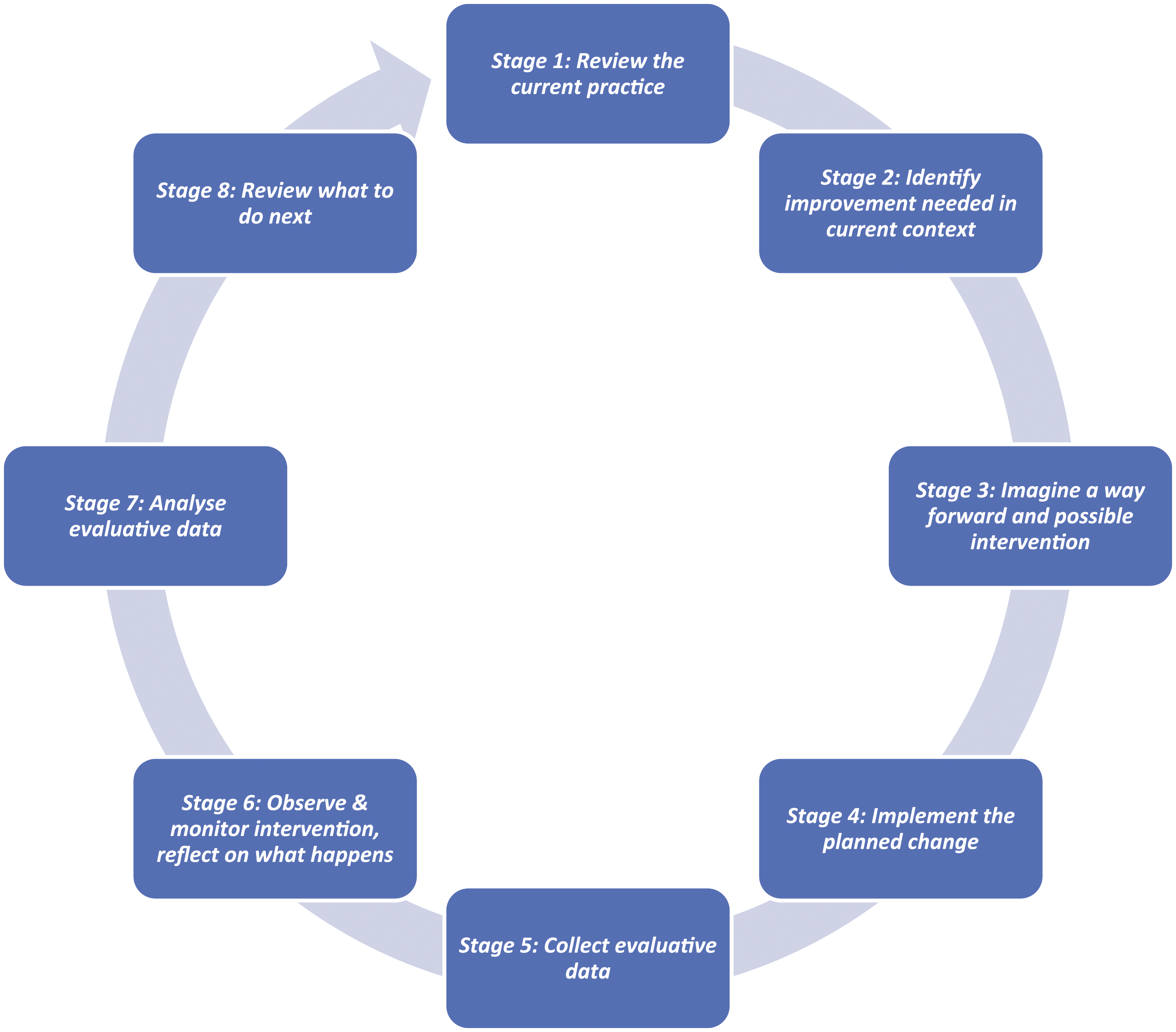
Stage 1: reviewing current practice
Although the content of the subject area refers to changes in students’ attitudes and behaviour with regard to social justice from a Christian perspective, past years’ class discussions, previous observations as a teacher and written assessment responses by students revealed this was not being deeply enacted in students’ lives. In particular, there was little awareness of lived experience in the current student school setting. With some exceptions, there was more emphasis on a cognitive understanding of the subject matter and passing the written assessments. Over the previous 12 months, it became increasingly clear there needed to be better student engagement. Implementing faith and reason to do justice had to start with the person who is our closest neighbour, in this case our fellow classmates. If there was little or no learning in relation to those next to us in the classroom, what hope is there that it would be extended in students’ lives, into the College community and into the students’ wider community? As a result, the possibility of introducing various Christian practices into the classroom along with what specific interventions could be implemented was discussed with the College’s Director of Educational Research.
Stage 2: identifying improvement needed
After teaching the particular subject for a number of years, observing the learning outcomes for students, reflecting on the teaching practices, and after consulting other teachers and educational experts, a question began to form in my thinking that developed into a research working hypothesis: Would the addition to the class of a Christian practice that involves a shared meal including showing hospitality, fellowship, testimony, and prayer, significantly stimulate student engagement to understand and act on the justice issues and needs of their fellow classmates, the college community and the wider community?
In the pre-Covid pandemic environment, I engaged the students in a number of discussions in the first few weeks of the class to consider what could happen if the Christian practice of hospitality via a sacred meal were introduced into the classroom. Would students’ learning be improved if a community setting is introduced where there is a hands-on context beyond that of a cognitive lecture format? Would a redesigned class demonstrate what doing justice looks like in relation to those we are learning with? From a Christian educator’s perspective, it was hoped that this redesign would lead to an understanding that knowledge is acquired from a relational connection with God and with others, not just individualistic cognitive endeavour.
Stage 3: imagining a way forward
The discussions with students resulted in a mutually agreed trial to dedicate the last 30 minutes of each class towards the Christian practice of a sacred meal, commencing in week 6 of the 14-week face to face class. Although faculty members were committed to faith integration in the general design and learning outcomes of subject disciplines, there still needed to be further investigation as to the impact of an intentional integration between a teacher’s own personal Christian faith and the pedagogical approach in the classroom itself. As a result, a redesign of the teaching practices of the weekly class to include a Christian practice component via a sacred meal was included with the goal to impact individuals, the class culture and wider community. The ‘intervention’ was designed to bridge the gap between research and practice and contribute to the theory of education and teaching that could be accessible to other teachers. It combined diagnosis, action and reflection to hopefully bring about practical improvement, development of social practice and teachers’ practices (Cohen et al., 2011: 345). Further, as a form of ‘self-reflective enquiry’ it sought to improve practices ‘with a view to maximising social justice’ (Carr and Kemmis, 1986 cited in Cohen et al., 2011: 345).
One of the purposes of the sacred meal was to give students opportunities to hear each other’s life stories and help shape students’ character in the classroom setting. Perhaps it would help students put their faith into operation using reasoning skills to understand each other’s life circumstances and so enact justice in one another’s lives and so enable them to understand the content of the subject in more meaningful ways. Seeing people through the lens of the learning outcomes or the graduate attributes requires practice and not just cognitive exercise. In this subject, students need to be involved in social justice activities to become more effective in the learning outcomes and develop as (potential) followers of Christ. I was seeking to create opportunities for discipleship to occur in the ‘here and now’, and not only when students graduate and leave College. Arguably it would be negligent to not provide such opportunities and just assume that after they graduate students will be able to outwork their faith in a reasoned way with acts of justice. Faith has implications for how you relate to your studies and to other students as neighbours. The focus should be in observing how belief informs and guides how students relate and approach study. Perhaps involvement in a Christian practice during class would deepen and broaden students’ faith operating with Christian values and ethos.
In contrast to an individualistic framework for study and progress often found in educational contexts, opportunities were to be given for students to become more aware of each other’s life circumstances. It was hoped a more communal approach would foster an awareness of the other’s progress and growth, develop a sense of belonging and encourage responsibility for each other to do well, both in the subject and life in general. It was hoped students would begin to examine the elements of injustice in their own lives, in other students and in the wider community and be empowered to respond in meaningful ways. It was expected that formation questions would be explored, and the class be challenged in areas such as hospitality, doing justice, showing mercy, stewardship of their resources, care of the earth, living simply and so forth. Learning from a Christian perspective is more than cognitive content but also engaging an idea and then practicing it. Learning is to be seriously involved in shaping and forming Christian character.
There are not many opportunities given in higher education settings to facilitate the practice of ideas in the classroom ‘here and now’, rather than leaving it until after graduation. Guided practice is an important part of learning, similar to an internship. Often there is a disconnect between practice in a course of study and life in general. Practice shapes Christian character and the person the student becomes, rather than only theoretical ideas. This has often become a neglected aspect in higher education institutions. It was hoped that patterns and insights would be revealed that provide a grounded theory of these practices in the classroom that can be applied to a wider sphere in other classes or courses. It must be cautioned, however, that in other subjects, the learning outcomes may not provide such a neat fit with the practices of a shared meal as in this specific subject that deals with social justice.
Stage 4: implementing the planned change
Discussions with the class resulted in an agreed plan of action comprised of a number of components that were planned, developed, monitored, reviewed and adjusted as the Christian practices proceeded week by week. In particular students: • Reconfigured classroom layout to form one large, long table to sit around. • Contributed food to share a meal in the allocated time. • Made decisions about preparations, prayer before the meal and clean up. • Ascertained dietary needs identifying any problematic ingredients for individuals. • Exchanged pleasantries, topics for discussion and focus on learning outcomes. • Shared personal stories in a relational setting, including students’ life circumstances, challenges and social justice issues. • Prayed for each other as requested and as appropriate. • Implemented protocols to ensure mutual respect, safety and confidentiality.
An evaluation of the meal as a Christian practice was conducted in a spiral of planning, action and fact finding about the actions taken in a repeating cycle. Decisions were made after discussions with students inviting their collaboration.
Stage 5: collecting evaluative data
Data was gathered in this micro-longitudinal study from: • Observations as a teacher-researcher. • Discussions with the community of practice in the College and students. • Field diary-journal notes. • A review of accreditation and institutional documentation.
All research observations and data collection were separated from the students’ assessment processes. As adult learners, students were involved in the decision-making process. There was no requirement for students to attend the Christian practice meal segment. No recordings were made, and participation was purely voluntary and did not form part of the required academic assessment tasks. No surveys or interviews were conducted requiring individual consent.
Stage 6: observing, monitoring and reflecting
In the first class to include the meal (week 6), students constructively responded to the invitation to discuss how to implement the learning outcomes about faith, reason and justice, as part of the class learning experience. Encouraged by the open, more informal and less hierarchical class format, students were liberated to enter into discussions, some of which involved issues of justice and fairness both in academic and personal life realms.
Over the life period of the class it was observed that: • Students spent time during the meal getting to know one another and recounting their various life experiences. • Most students expressed their realisation that a number of classmates were enduring difficult life circumstances, some involving issues of justice. • Some mature age students openly revealed significant challenges coping with return to academic life. • As the weeks progressed, more students became increasingly open in revealing their own life experiences and difficulties.
Stage 7: analysing the data
Data collected in the form of field notes and the other materials referred to above was evaluated with an aim to improve teaching practices and student learning outcomes. In comparison with previous years’ classes, the shared meal format appeared to facilitate a growing mutual sharing and building of community. Students seemed to be developing deeper levels of understanding essential to their engagement and learning. The following actions were observed: • Students demonstrated hospitality bringing food to share with others on a regular basis. • Students regularly expressed concern for those who had not been able to, or omitted to bring food. • Most students regularly participated in fellowship and discussions around spiritual issues. • Most students gave testimonials and recounted stories of God’s care and love and offered prayer for each other. This depth of engagement had never been observed in previous classes in this subject. • The meal setting appeared to stimulate students to understand and act on the needs and justice issues of their fellow classmates and wider community. • A number of students expressed positive changes in attitudes towards ‘the other’, and the marginalised, as evidenced by the various accounts and testimonials they recounted about their own self-confessed behaviour changes. • Students began to consider their own growth and learning and entered into conversations around taking responsibility for each other’s growth. Students were observed being increasingly helpful to others to better understand the subject matter and assessment tasks. • Various conversations indicated that the students were rating the elements of injustice or unfairness in their own lives, those of other students and the wider community and showed an increasing interest to respond meaningfully. • There were more collegial interactions than experienced in previous years’ classes, which had a more competitive posture. • A greater confidence in students than observed in previous years to share their own personal paradigm of how to integrate the subject’s content in their own lives.
Students explained how they were implementing learning by putting faith into operation. They used their reasoning skills to acknowledge and understand the other’s life circumstances. Through, prayer, empathetic conversations and engaged actions, they were outworking practices of justice from a subject informed biblical understanding. It appeared this Christian meal practice was providing a supportive and safe place that assisted to meet fellow students’ needs and contributed positively on students’ awareness and increased concern for each another and the wider community. Taken together, the data appeared to confirm the hypothesis of the research question.
Stage 8: reviewing the change in light of evaluation
The change in teaching practice clearly made a positive impact on pedagogy when as a teacher I was more intentional about the place of faith and spirituality in classroom teaching through the use of the sacred meal practice. Diagnosis, taking action and reflection and focussing on the practical issues that can be changed in teaching practice bring about practical improvement, innovation, change and the development of social practices in the students. The introduced Christian practice of the sacred meal assisted students, and myself as teacher, to be more vulnerable to ‘unpredictable encounters with God and others’ (Dykstra and Bass, 2011: ix). It clearly demonstrated that the students were, at various levels of engagement, participating in a social justice activity in the classroom context and reflecting on it beyond the required formal written assignments and assessments expected.
Two years later with the Covid pandemic now becoming more manageable and a return to face-to-face classes, discussions with other College faculty members are being held as to whether the sacred meal (or similar Christian practices) could be implemented in other class subjects. It may not always be possible to implement in the same way in every delivery format, particularly with online classes. Further, as the College has an open enrolment policy, impact on students that do not hold to a Christian faith must be considered. It is hoped that after deliberations with the faculty community of practice, and with some adjustments, the findings could be incorporated as part of professional development for faculty with a view to enhance pedagogical practices in other courses and subjects. Further research may be required to clearly ascertain whether the stated approach would elicit similar findings in other subject areas other than classes on social justice or theologically related subjects. Would similar results be found in a science class, a mathematics subject or a class on technology and faith or education and technology?
Conclusion
The initial aim behind this research project was for a class in a Christian higher education institution to become a community of learning where students grow in character, knowledge of themselves, others and the world, all in response to God’s purpose and call where it intersects with the world’s need. A shared sacred meal as part of the classroom experience is a plausible improvement to pedagogical practice. Christians have participated in faith-based practices individually and in community for millennia – it is how spiritual formation is undertaken towards Christlikeness. This Christ-enlivened practice of the sacred meal is formative as an ongoing process seeking after virtue and wisdom along with the important pursuit of identity and meaning. As part of the classroom, it contributes to practices that facilitate mutual sharing and building community that are needed to develop deep level understanding essential to student engagement and learning. This is critical now as we move into the post-Covid pandemic phase in education with a renewed focus on face-to-face interactions.
Footnotes
Declaration of conflicting interests
The author(s) declared no potential conflicts of interest with respect to the research, authorship, and/or publication of this article.
Funding
The author(s) received no financial support for the research, authorship, and/or publication of this article.
