



Abstract
Middle leaders play a central role in the Christian leadership of their school. This research explores how nine middle leaders in three distinct Anglican Schools in Australia enact their roles, and the conditions that influence faith expression within their schools. Findings demonstrate that middle leaders shape and are shaped by school culture and community. Our theory of Christian middle leadership, derived from four key themes, shows how school middle leaders navigate the personal and institutional dimensions of faith expression, through three distinct discourses. Their responses and the responses of their school enable them to interpret their role, career and calling.
Introduction
The Christian influence of a school leader has an impact upon the culture and climate of a school (Cairney, 2018; Iselin, 2011). However, much of the research on Christian influence in schools has been focused on principals in faith-based schools (Stanton, 2015). The extent of Christian leadership influence requires closer examination (Green, 2012). In particular, the influence of faith in middle leadership is an area underexplored in the literature. Where research on middle leaders in Christian settings is researched, it tends to focus on their pedagogical role, or the differences between their role and the principal role and deemphasises a spiritual role (Banke et al., 2012; Fleming, 2002; Spencer and Lucas, 2019). The aim of our research was to increase our understanding of how the Christian faith of middle leaders in Anglican schools influences their leadership role. Of particular interest was how middle leaders connect their Christian faith with their leadership practices.
Anglican schools in Australia share a connection with the Anglican Church through history and governance, and many share similar educational purposes and beliefs as stated in the Anglican Schools Australia Constitution, 2015. However, each school has its own distinct school culture and community (Smith and Cooling, 2015). Anglican schools in Australia ‘show great diversity both in concepts and in beliefs about religion’ (Edwards, 2011: 1) and can vary considerably in the way their shared Anglican heritage is expressed in day-to-day school life. This diversity can often be attributed to ‘diocesan tribalism’ (Frame, 2006: 162) that is reflected in the similarity between religious expression in the school and the mores of the diocese in which it is located. The diversity among Anglican schools in Australia is integral to this project. This research explores the similarities and differences in how Christian middle leadership is perceived and enacted within three different Anglican school contexts in Australia.
Middle leader is not a role title. It is a recognition that there are formal leadership roles in schools today beyond the principal. The role titles for middle leaders differ across schools, sectors and contexts. Middle leading is therefore seen as an umbrella term that encompasses the relational practices of someone in a school with a positional title and a teaching load (Grootenboer, 2018). Middle leaders lead in the middle (Hargreaves et al., 2018) and beyond it when they are given the capacity to do so by themselves and by others (Day and Grice, 2019). Middle leaders become a team of individuals in a school who are collectively responsible for teacher-teams and student academic progress and wellbeing. The role itself is determined by how middle leaders and others see their role in their particular school context. In the simplest terms, middle leading is an action that occurs in the spaces between executive leaders and classroom teaching colleagues (Gregory, 2002) and is fundamentally different from principal leadership (Wilkinson and Kemmis, 2015).
Middle leadership is increasingly being recognised as an important sphere for influencing student wellbeing and spirituality, separate from academic attainment. Middle leaders have the capacity to influence students in classrooms directly as well as having an impact upon curriculum, pedagogy and formation amongst teams of teachers. Therefore, their role is central to influencing learning, culture and care. Middle leaders professing faith may also play a role in supporting the ethos, values and conditions within their Anglican school through the intersection of their faith and their curriculum knowledge and the pastoral care they provide in collaboration with other staff.
Methodology
This qualitative study used a multi-site case study approach utilising in-depth, semi-structured interviews to collect data to understand the influences and practices of Christian middle leadership. Researchers sought to identify phenomenographic conceptions of global meaning and to discern variations in these conceptions (Baxter and Jack, 2008; Denzin and Lincoln, 2005; Marton and Pong, 2005; Simons, 2009; Yin, 2014). Phenomenography is not a philosophical approach but an empirical research tradition that focuses on cases of conceptions that go beyond description towards discerning through reconceptions of meaning (Marton and Poing, 2005; Svensson, 1997).
This study was guided by two research questions: (1) What is the relationship between a school’s expression of Christian faith and middle leadership? (2) How does the Christian faith of middle leaders influence the exercise of their role in the school?
The study drew on difference as a guiding principle in the selection of schools, participants and analysis, to support the development of a rich and complex account of phenomena beyond description (Svensson, 1997). This is evident in the differences in the three Anglican schools in which our research subjects were located, in the way the schools and participants were identified, and in the variety of middle leadership roles these participants held. In addition, further reliability and depth were added to the study because the three researchers who interviewed at each of the schools, despite bringing their own style to each interview, used the same open-ended questions as well as coder and dialogic reliability checks (Akerlind, 2012).
Of the four schools approached to participate, three opted to join the study. These schools were all large, well-resourced, academically high-achieving and prestigious private schools operating within the Anglican tradition. Two of the schools were in Sydney and one in Melbourne, Australia. Each researcher took responsibility for organising and conducting interviews in one of the three schools. Pseudonyms have been used for schools and participants to maintain confidentiality. St Anselm’s was approached because Researcher 1 taught at the school. Researcher 1 met with the school Principal and they discussed who to invite to participate in the research. Researcher 2 contacted St Brigid’s through the formal channel of the Principal, and has no personal connection to the school. The school was keen to be involved because of its interest in research, and forming stronger connections with the researcher’s institution. The school identified a range of middle leaders known to them as being Christian to voluntarily participate in the project. Contact with St Cuthbert’s came through a personal relationship between Researcher 3 and the school Chaplain. While permission to contact members of staff was sought from the school Principal, identifying the specific individuals who were willing to be interviewed was left to the Chaplain. Once the Chaplain had provided contact details for each individual, the researcher had no other contact with the rest of the school.
In keeping with the guiding principle of difference, participants in the study represent a diversity of middle leadership roles. At St Anselm’s, Amelia is a Head of House, Alyssia a Grade Leader and Andrew is the Head of Learning and Analytics. At St Brigid’s, Bruce is Dean of Middle School, Belinda is Head of Year, and Ben is Chaplain. At St Cuthbert’s, Colin is Head of Middle School, Camilla is the Deputy Head of Middle School and Chris is a Head of Department. Of these leaders, four are female and five are male. One of the participants works in a junior school, seven work in high schools and one has Kindergarten to Year 12 responsibilities.
Open-ended qualitative interviews with the nine Christian middle leaders were used for this study because they provide an ‘opportunity to explore detailed accounts of participants’ experiences’ (Trainor and Bundon, 2020: 4), acknowledging how these are dependent upon internal and external conceptions of knowledge (Svensson, 1997). Initially, themes were generated for each data set by individual researchers. This analysis was iterative and systematic using both inductive and deductive coding and theming techniques. The researchers used independent line-by-line and word-and-phrase approaches to initial coding. They then cross-checked codes moving from focused coding to axial coding to develop initial themes for analysis. They drew from their realised differences to collaboratively and reflexively generate themes to explicate understanding of the relationships between Christian faith, middle leadership and school expectations of their middle leaders, thereby increasing reliability (Akerlind, 2012). The authors met regularly over a 1 year period to plan and carefully analyse the data, constantly questioning how the findings reflect the phenomenon being studied and whether the ways the data were being represented was a defensible interpretation useful to an education audience (Akerlind, 2012). This collaborative process sought to thoughtfully engage with the data to ‘develop a richer more nuanced reading of the data’ (Braun and Clarke, 2019). Ultimately, guided by the research questions and initial analysis, the three researchers worked together, actively identifying meanings and patterns in the data (Terry et al., 2017) through examining both variation and common areas of emergence in their search for meaning (Akerlind, 2012). A further period of collaborative and iterative analysis and discussion enabled the authors to develop theory out of this multi-staged analysis. This allowed the theory to be derived from an understanding of commonality and difference between perceived experiences of middle leaders in their different contexts. The strength of the authors’ differences, as an educator, a theologian and an educational leadership academic, gave strength to the theory as multilayered themes were considered and prioritised in keeping with a phenomenographical approach that looks for qualitatively different experiences that emerge as related (Akerlind, 2012).
Findings: Faithful middle leaders
The findings of this research underscore the importance of context for Christian middle leaders. While the schools in this study are all Anglican, how faith is expressed and expectations of teachers are different in each school. Edwards (2011) similarly examines the ‘dichotomy in Anglican schools between secularism and religious identity’, and the social nature of religion and ‘personal and transcendent’ nature of spirituality (p. 35), noting that Anglicanism is bound by central creeds with different outward expressions of faith. Consequently, the nine Christian middle leaders in this study share a common faith, but their Christian middle leadership experiences have evolved in unique ways in each of the three contexts. Despite their denominational affiliation, the schools are all functionally independent of one another, and engage with the Christian faith along a continuum of personal and cultural expression of faith: St Anselm’s actively encourages teachers to talk about their faith and integrate it into their teaching; St Cuthbert’s has no expectation for the leaders or teachers to have a Christian faith; St Brigid’s sits between these two approaches. Amelia recognises the expectation of St Anselm’s that she be ‘a church going person… to act with integrity… be a model of Christian virtue… [and] to take good evangelistic opportunities when I can’. At St Brigid’s the values of the school are supported by the messages given in Chapel, where the Christian culture of the school is informed by the Bible. As Ben explains, in chapel, ‘we’re teaching them about the school’s values, the school’s culture’. In contrast, when the middle leaders from St Cuthbert’s were asked whether the school had any expectations regarding their personal Christian faith, each of them simply answered, ‘no’.
Thematic coding of the interview data revealed four themes common to how all nine middle leaders reflected on the influence of their faith on their leadership role.
‘God is in control’
Middle leaders in this study share a belief that God is in control and that they undertake their work mindful of God’s calling and guidance. However, Alyssia was the only leader in the study who uses the term ‘calling’, stating that: ‘I believe that God called me into this job’, others imply a calling when they describe how God had put them in their role for a reason. For example, Amelia explains, ‘I think God has me here for a reason and will keep me here for that reason’, and Colin, using almost identical words, states that: ‘I believe that God has put me in this place for a reason’.
God’s control does not just manifest in a one-off calling event; rather, it is a continuous journey punctuated by the leaders’ daily recognition of God’s involvement in their lives. This involvement is evident in how Belinda emphasises the importance of starting meetings with a devotion where ‘we all sit under God and under His word, which is really refreshing’. It can also be seen in their expectation that God will answer their prayers. Consequently, Camilla describes how, ‘mostly with my work, I just pray a lot … I bring to God the things I feel concerned about’. Similarly, Andrew explains how he is ‘prayerful in specific situations when I felt I needed wisdom’. The leaders’ belief that God is in control is aligned with their belief that God expects them to perform their roles consistent with the teaching of Christ, providing them with ‘guidelines in which I work’ (Colin) and impacting the way they lead.
The leaders describe the challenges of leadership where unexpected situations regularly present themselves, and new tasks and expectations are regularly added to their roles. In addition, several of the leaders in this study described how they did not feel prepared for their roles. At its extreme, this manifests in Amelia’s description of ‘stumbling along’ in her leadership, experiencing a ‘steep learning curve’. For some leaders, this complexity is exacerbated by colleagues who either do not acknowledge their leadership or question the value of the tasks they do. However, regardless of the challenges the middle leaders experience, they are confident God has called them and guides them in their roles.
These leaders’ sense of calling as a way of ‘honouring the Lord’ (Camilla), also feeds their ethic of working hard. For example, Belinda describes how she believes that ‘Jesus doesn’t want me to slack off. So, then I made sure that I am always… trying to do things properly’. However, Bruce acknowledges the challenge of ‘achieving a healthy balance as a Christian person’ due to the workload demands of school and points out that he was ‘unable to find a Bible study group that fits’ with his busy work life. Ultimately, while these middle leaders rest on their sense of God’s call and control in their lives, there is a cost and challenge in the work they do.
Pastoral care everywhere
As these middle leaders move between their leadership and teaching roles, pastoral concern for students remains at the centre of their thinking. Regardless of whether their role focuses on administration, explicitly pastoral tasks, or interacting with other teachers, their emphasis is ultimately on supporting positive student outcomes driven by questions like ‘How could we make this a better experience for the students?’ (Camilla). For some, this means being ‘very hands on… building capacity… solving problems … spending most of my time with kids that have complex needs and families that are tricky’ (Bruce).
These middle leaders often emphasise the relational aspects of the roles, drawing a connection between how nurturing relationships with students points to a relational God. For example, Alyssia believes that her job is ‘yes to educate the kids, but to love them and show them hopefully in some way God’s love towards them as well in a very authentic way’. Four of the leaders describe the importance of exhibiting the fruit of the Spirit in their role.
For the leaders with more administrative than explicitly pastoral roles, their emphasis remains on not ‘losing sight of the child at the centre’ (Colin). These leaders describe how completing administrative tasks with sensitivity to the needs of students and teachers is ultimately a pastoral act. This may manifest in reviewing how students of concern are being supported (Camilla), ‘reviewing school programs [to ensure whether] they’re in the kids’ interest’ (Colin), or designing a timetable that considers the pastoral needs of students and teachers. Bruce concludes that the administrative tasks are important because they support ‘that community building, relational side of things’.
As these leaders look to their future, some are inspired to move beyond the classroom where they have ‘greater scope to make a change on teachers and educators which would then have an impact on children’ (Colin). Others choose to remain focused on the classroom where they can continue to have a direct relationship and influence on students.
Faith in action
Each leader in this study emphasised the importance of authentically expressing their faith through their actions. They believe that their faith impacts every aspect of their work, ‘all day, every way, every minute’ (Chris). The leaders’ most frequently referenced mode of expressing their Christian faith is through practical action. They emphasise the importance of authentically embodying their Christian faith to reflect their identity in Christ. As Chris explains, ‘The best way to demonstrate my faith, to demonstrate my Christianity, is to act it out… it’s who I am, and that’s how I act, how I behave’. Similarly, Camilla describes her service-oriented leadership as: ‘a really key way that I express myself… and this expression comes out of who God made me to be’. Bruce describes how he believes that ‘you give off your Christianity’ in your actions.
To be authentic, it is important to these leaders to have consistency between their interactions with students, parents and teachers, and their faith. Colin describes his Christian faith as being ‘very much a part of me as a teacher and a leader in my interactions with students and teachers and people’. Rather than putting on a mask, Belinda explains how, ‘you want your faith to be real in every situation’, including being willing to share when she is ‘wrestling with doubt’.
Authentic faith is often closely tied to the Christian virtue of love. Amelia underlines the importance she places on ‘loving students, modelling a Christ-like life’. Colin makes explicit reference to Jesus’ great commandment to love God and neighbour (Matthew 22: 37–29) and Chris has Paul’s instructions to love others (1 Corinthians 13) printed and pinned to the wall of his office. Camilla believes that both her teaching and leading are expressions of Christ’s love for others, and emphasises the importance of acting with integrity, showing care, and demonstrating love when she is making decisions or dealing with people. Similarly, Alyssia describes how she is not only in school to educate students, ‘but to love them and show them hopefully in some way God’s love towards them as well in a very authentic way’.
Faith in words
Alongside expressing faith in action, the middle leaders in this study also express their faith in words that respond appropriately in conversation with others. This ‘faith talk’ is clearly secondary in prominence to ‘faith walk’; yet, it is important for these leaders that their speech is consistent with their action, and that their speech is appropriate for their institutional setting.
Faith in words is evident in formal contexts including teaching with a Christian emphasis (particularly at St Anselm’s), as well as Colin at St Cuthbert’s being ‘tokenly asked, would you read this prayer or do this reading’. More often, faith talk comes up with teachers and students in informal conversations, as Colin says, ‘on request’. Camilla’s students ‘come and ask me questions, maybe because they know that I’m a Christian’.
The authors acknowledge that learning and curriculum occurs in formal spaces such as classroom lessons and assemblies and chapel services, and in informal spaces, such as in conversations between learners and educators. Therefore, we have not distinguished between these modes, as schools are fundamentally about learning in responsible relationships. However, the data also showed that whether in formal or informal contexts, the middle leaders in this study want to avoid any sense of coercion or intrusion in the way they speak about their faith. Andrew acknowledges ‘the power imbalance’ that exists between him and his students, particularly ‘because they were either there [in his office] because they were struggling or because they were in trouble, and they were very vulnerable in those spaces’. In chapel and Christian Studies lessons where students have no choice about attendance, Ben notes ‘we don’t want to force Christianity onto people, in the sense that we don’t want them to ever think we’re trying to make you Christian’.
Even when faith talk is expected in the school, these middle leaders recognise the need for their words to be expressive of authentic faith rather than being forced. At St Anselm’s, where Amelia is expected to ‘display her Christianity in all aspects of her teaching’, she pleads for Christian teachers, ‘Let’s just be normal about being a Christian! If the kids have a question I’ll try and answer it, if staff have a question I’ll try and answer it, but I don’t think you need to bring it into every lesson and every conversation, I think that’s pushing it’. Belinda notes that as St Brigid’s is a Christian school, ‘we’re obviously encouraged to pray with the kids’, but similar to Ben, that praying is ‘not ever forced upon people’.
Common to the way all these middle leaders engage in faith talk is their posture of response. They do not set aside verbal confession as a feature of Christian discipleship but aim to speak in ways that are appropriate within the expectations of their role. Faith talk is therefore integrated with the preceding themes of being called by God to serve students through authentic Christian faith and life.
Discussion: Toward a theory of Christian middle leadership
The institutional context in which each of the middle leaders works is central to understanding how their personal Christian faith impacts their role as middle leaders. While each school had its own set of expectations regarding the personal expression of faith, the four themes identified in the findings were common to each of the middle leaders: God is in control, Pastoral care everywhere, Faith in action and Faith in words. This was unexpected given the differences in institutional support for Christian faith at each school. Yet on reflection, because the nine leaders share a common Christian faith, sharing these four themes is not so surprising. This is not to say that the themes were expressed in the same ways by each leader. Each theme was present, but was flavoured by the particularities of school context, specific roles and individual beliefs about what it means to be a Christian leader that come from their ‘habitus’ (Bourdieu, 2002), through which the social structures and beliefs of each institution are established over time.
As structures of social behaviour develop over time (Lizardo, 2004), habitus is ‘a system of dispositions, or permanent manners of being, seeing, acting, and thinking’, that functions as ‘a system of long-lasting (rather than permanent) schemata or structures of perception, conception and action’ (Bourdieu, 2002: 27). Such unconscious schemata guide, organise, constrain and evaluate the choices and behaviours of individuals and groups (Bourdieu, 2002). These unconscious schemata are acquired through exposure to particular social conditions (Wacquant, 2008), and become shared by school communities over time. Habitus informs practice arrangements and builds practice traditions in social sites (Kemmis et al., 2014) as groups develop similar tastes and ways of behaving. Bourdieu describes this as an ‘affinity of style’ (2002: 28); with this strengthening of affinity, we find the emergence of a particular school culture. School culture is not only formed by the school community at the time, but also through the practice traditions and assumptions individuals form about what middle leaders should ‘be’ and ‘do’. These cultures are influenced by what Lortie (1975) describes as ‘apprenticeship of observation’ – that process by which the schemata that we have formed about school leadership have been formed over extended time periods from our experiences and observations as teachers, but also from our experiences as students ourselves.
The two research questions asked were, what is the relationship between a school’s expression of Christian faith and middle leadership, and how does the Christian faith of middle leaders influence the exercise of their role in the school? Rather than being two separate lines of enquiry, we have come to recognise them as representing two dimensions of three distinct and interconnected areas of discourse, subconsciously built from the middle leaders’ schemata. In phenomenography, the researcher aims to constitute not just new meaning, but a logical, inclusive structure that relates different meanings together to grow new understanding or theory (Akerlind, 2012). Figures 1–3 below represent the ‘outcome space’ explaining how new phenomena are discerned through analyses of variations in practice and their global meaning (Akerlind, 2012; Marton and Pong, 2005). Four themes in three discourses. Three discourses in two dimensions. Outcome Space: Four themes, in three discourses, in two dimensions.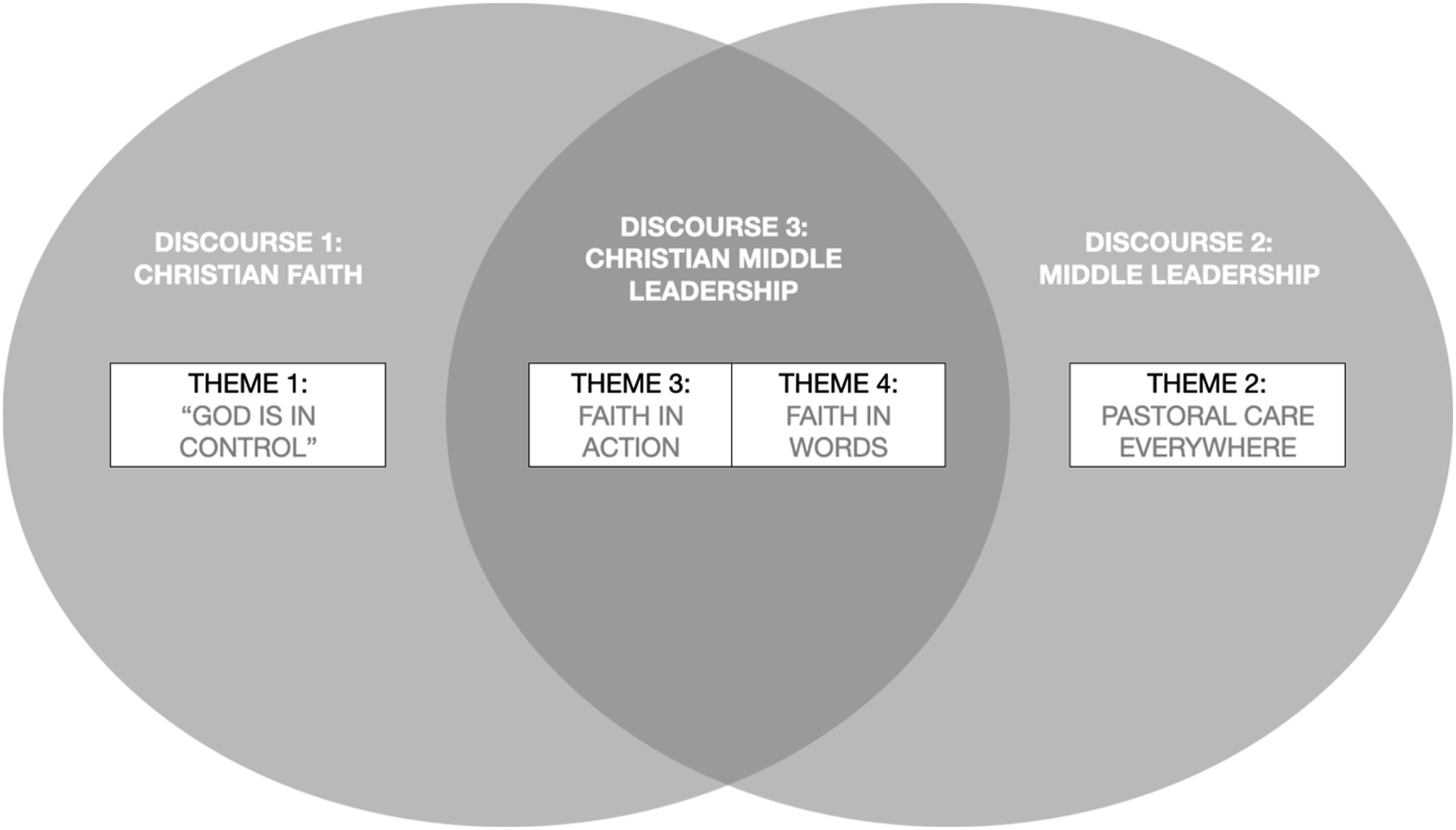
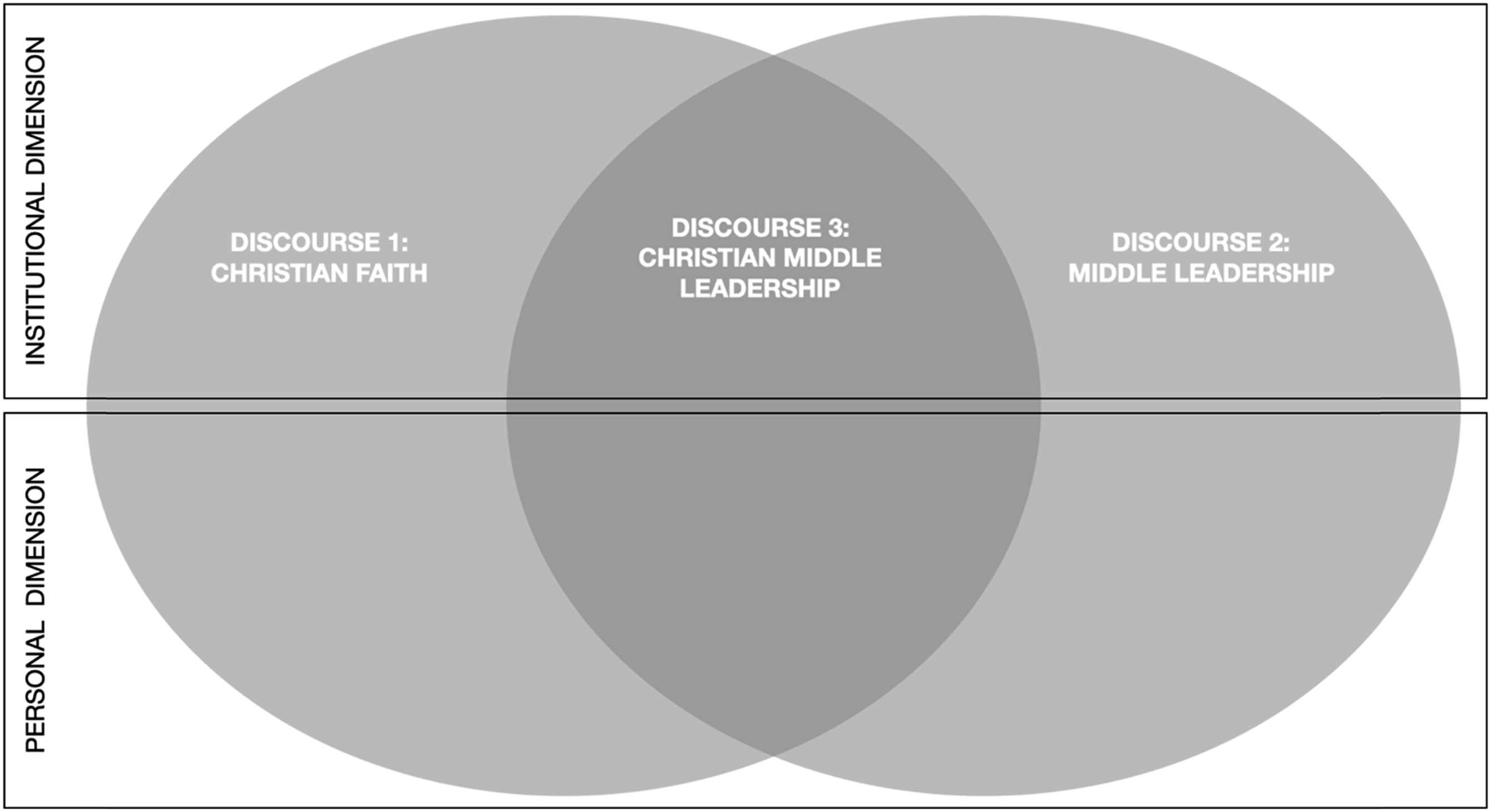
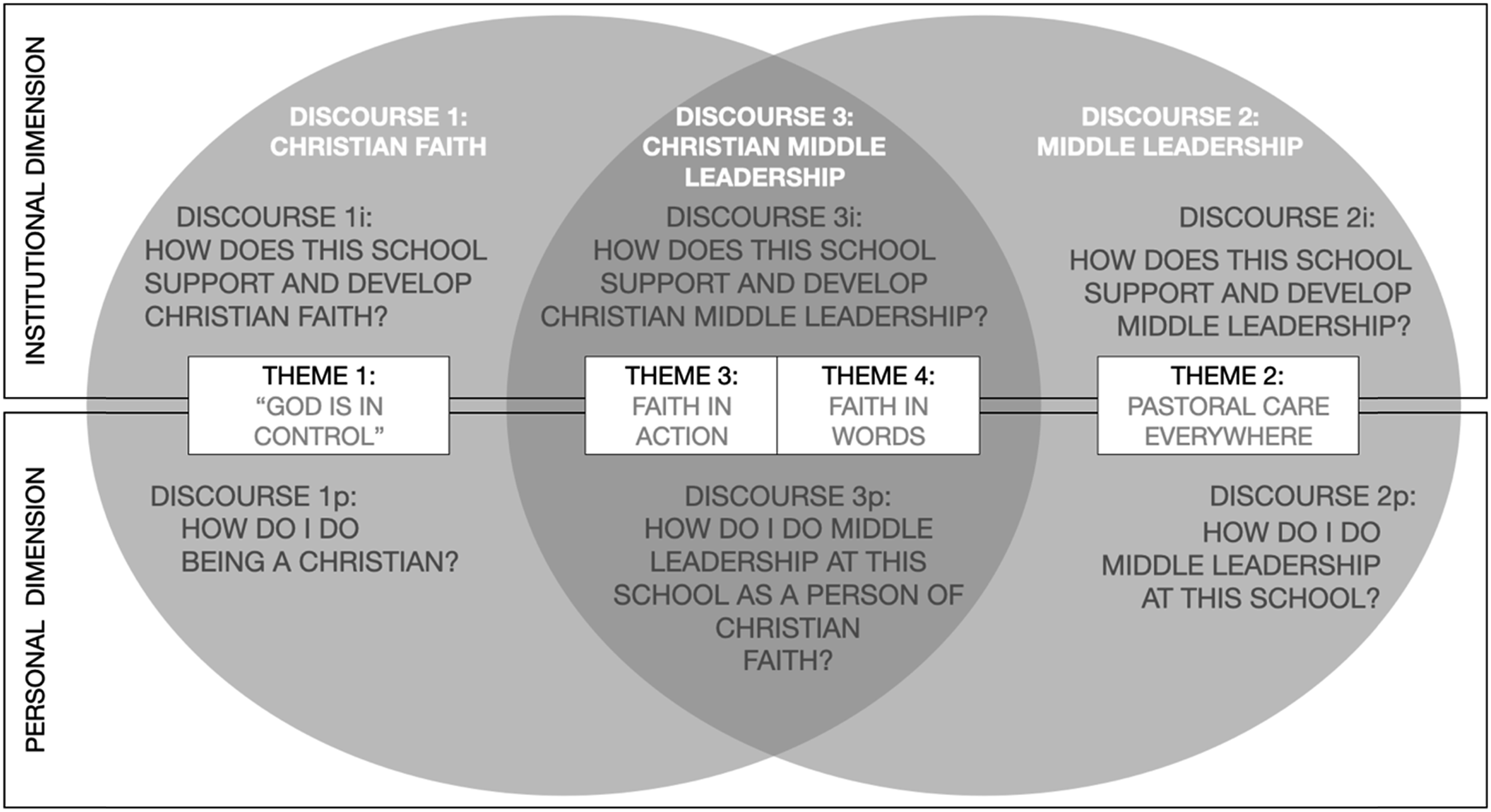
Figure 1 identifies three areas of discourse that frame the accounts of the phenomenon of Christian middle leadership of our research subjects. Each of the four themes identified in our research can be located within these three discourses. Theme 1, ‘God is in control’ is located within the discourse of Christian faith (Discourse 1). Theme 2, ‘Pastoral care everywhere’ is located within the discourse of middle leadership (Discourse 2). Themes 3 and 4 (Faith in action, and Faith in words), are located within the overlap of discourses 1 and 2, which we have called ‘Christian middle leadership’ (Discourse 3). Identifying Christian middle leadership as a specific area of discourse (rather than simply the overlap of the other two), is fitting with the nature of the participants’ expression of their role as the intersection of their Christian vocation with their role as middle leaders. These leaders do not see themselves as Christians who are also middle leaders; nor are they middle leaders who are Christian. They are Christian middle leaders.
Figure 2 indicates how the three areas of discourse that frame the phenomenon of Christian Middle Leadership have both an institutional dimension and a personal dimension. The institutional expression of each discourse (Discourse 1i, 2i, 3i) denotes the manner in which this discourse is present in and enabled by the institutional structures of the school. The personal expression of each discourse (Discourse 1p, 2p, 3p) denotes the manner in which individual middle leaders engage in this discourse in their personal reflection and conversation.
Overlaying the three areas of discourse with the two dimensions of expression, our proposed outcome space identifies six questions that shape the expression and experience of Christian middle leadership (Figure 3). In discourse 1 about Christian Faith, the institutional dimension asks the question, ‘How does this school support and develop Christian faith?’ The personal dimension asks, ‘How do I do being a Christian?’ The institutional expression of discourse 2 asks, ‘How does this school support and develop middle leadership?’, where the personal dimension asks, ‘How do I do middle leadership at this school?’ In the overlap of these two areas of discourse, discourse 3i, the institutional expression of Christian Middle Leadership asks, ‘How does this school support and develop Christian middle leadership?’, where the personal dimension asks, ‘How do I do middle leadership at this school as a person of Christian faith?’.
This theory of Christian middle leadership clarifies the similarities and distinctives of each school examined in this study. In relation to Discourse 1i (institutional support and development of Christian faith), St. Anselm’s provides both support and opportunities for development, St. Brigid’s provides support, and at St. Cuthbert’s provides neither. In relation to Discourse 2 (middle leadership at this school), while each middle leader engages in 2p at least tacitly to fulfil the requirements of their role, the level of institutional support is at best informal at each school. Indeed, the institutional structures and demands can sometimes become a hindrance, such as at St. Brigid’s, where middle leaders recognised that being a busy serving community came at a personal cost to their families, and more concerningly, cost the commitment of their students to Christian devotional activities.
Discourse 3i, institutional support and development of Christian middle leadership, is largely absent from all three schools. This is unsurprising for St. Cuthbert’s, given the absence of Discourse 1i, but less so for the other two school. Despite St. Anselm’s and St. Brigid’s having an explicit commitment to Christian education, the data suggests that there has been no explicit engagement in discourse 3i at either school. We wonder if, by assuming that middle leaders are Christian, discourse 3i gets subsumed within discourse 2i. That is, Christians thinking about middle leadership is equated with Christian middle leadership.
At St Cuthbert’s, not only is discourse 3i absent, discourse 3p remains an individual concern that is not shared between Christian colleagues. Colin and Camilla work closely together as the Head and Deputy Head of Middle School. Yet, though they are both aware of each other’s Christian faith, they have not spoken together about the influence of their faith on their roles as middle leaders. When asked whether she speaks with Colin about faith, Camilla said (with a note of surprise) ‘We don’t have any dialogue about it really’. Camilla was left to assume that discourse 3p was occurring but acknowledged that it did not occur explicitly. Since personal faith concerns are relegated to an individual’s private life, the influence of faith commitments on the middle leadership role had no obvious environment in which they might be pursued. At St Cuthbert’s, as discourse 1i is inappropriate, discourse 3, in both institutional and personal dimensions, is overlooked.
Each school context presented these leaders with certain factors that both hindered and enabled Discourse 3. We found that even in a school that has no encouragement of the expression of personal faith there are opportunities that enable Christian middle leaders to live out their vocation. Conversely, even in a school that champions the expression of personal faith, there are factors that impede Christian middle leaders in living out their vocation. This discourse is accounting for the spiritual beliefs, and religious and educational practices that form the identities of individual leaders within a school setting. The nature of middle leadership is also working in collaboration with others. If all three schools had a dominant Anglican eschatology, but variance in curriculum and pedagogy (Gregory, 2002), careful consideration is needed of how middle leaders’ faith builds their own Christian middle leadership identities whilst influencing communities of practice within their context, as Cairney (2018) suggests. Anglican schools need to examine their own religious assumptions and how they are lived out in practice in their school contexts to afford middle leaders opportunities for growth in Christian middle leadership identity, alongside the development of collective agency as middle leaders (Green, 2014). Perhaps you don’t just lead who you are (Palmer, 2000), but you lead who you are with others as you are enabled and constrained by the conditions in your school context.
Our contention is that Christian middle leaders will flourish when all three discourses are engaged at both a personal and institutional level. It is likely that the efficacy of Christian middle leaders declines with the absence of any of the discourses, at the personal or institutional level.
Implications and support for middle leaders
There are several implications that arise out of our findings and from the theory of Christian middle leadership we have built. Initially, both Anglican schools and individual Middle Leaders need to identify the relevance of faith and leadership in their context to determine the importance of developing their Christian middle leadership. Anglican schools who acknowledge the need for engaging the three discourses could provide opportunities for explicit discussion of how the convictions and practices of Christian faith can shape the middle leadership role. Further, Christian middle leaders need to be able to develop their personal faith alongside genuine leadership opportunities. Where institutional support is lacking, Christian middle leaders need access to training, support and networks beyond their school. Ultimately, developing congruence between faith expression and middle leadership roles and opportunities may encourage leadership. Without this, middle leaders could remain constrained, and potentially become dispirited in their role.
Reflecting on the experiences of the three schools in this study, while St Anselm’s has a high support for discourse 1 and 2, to support and promote the work of Christian middle leaders, more could be done to invite explicit discussion of how the convictions and practices of Christian faith can shape the middle leadership role at both an institutional and personal level (discourse 3i and 3p). St Brigid’s enables Christian middle leaders to lead by valuing the Christian ethos they represent for their school and the sense of community they build that comes from their enactment of the school’s purpose through their work with students and families. However, at the same time this is constrained by high community expectations and a busy culture where there isn’t always time to express faith. If parents are choosing a religious school for reasons other than religion (Green, 2018), St Brigid’s sense of community is a valid faith enterprise, as long as it retains its theology in conversation with community (Cooling and Bowie, 2021) and is wary of creating a busy culture. At St Cuthbert’s, with no expectation or encouragement of personal faith expression, middle leaders were enabled by the alignment between the values and mission of the school and the outputs of Christian vocation. These leaders were enabled because the outcomes that Christian faith produces are what the school desires, even though the school has little interest in what generates or sustains such outcomes. Consequently, any development of Christian middle leadership at St Cuthbert’s would have to be driven at a personal level by individual middle leaders (discourse 3p) rather than institutionally (discourse 3i).
Conclusion
Middle leaders have the capacity to influence students in classrooms directly and impact curriculum, pedagogy, and formation amongst teams of teachers, integral to authentic, hospitable expressions of faith (Cairney, 2018; Smith et al., 2014). We identified different expectations of faith enactment in middle leadership roles across the three Anglican contexts. In each of the schools, Christian middle leaders saw themselves as supported and trusted by executive leaders in their capacity and given agency and trust to fulfil their role, even though each faith-based context was distinct (Cooling, 2021). Christian middle leaders need to be supported by school leadership practices that help to affirm what leadership looks like in their specific context. Christian middle leaders will benefit from opportunities to reflect upon their beliefs and practices in order to understand what middle leaders can be, and what middle leaders can do, as they shape Christian culture, and it shapes them.
Middle leaders provided us with insights into how their expression of faith and concern for students is integral to the community and identity of their Anglican school. They play a central role in the pastoral care, community building and curriculum work of their schools, which suggests that authentic, faith-based leadership capacity is part of their daily practice. Conceptualising their role as fixed or sandwiched in a middle space may be unhelpful in recognising the central role Christian middle leaders play in enacting the ethos and values of their school. Their faith supports the shape of the Christian culture and community whilst it concurrently shapes them. Principals and executive leaders need to carefully consider the distinct cultures of faith expression in their schools. By considering the opportunities middle leaders in their schools have in sharing faith in action they can strategically consider how these moments are enabled through mentoring, structures of support, and trust, and constrained through workload, so that middle leaders can exercise what they describe as their calling with students.
Footnotes
Declaration of conflicting interests
The author(s) declared no potential conflicts of interest with respect to the research, authorship, and/or publication of this article.
Funding
The author(s) received no financial support for the research, authorship, and/or publication of this article.
