



Abstract
This report focuses on part of a recently completed New Zealand case study exploring teachers’ experiences of effectively supporting students with social, emotional and mental health needs. The participants came from nine diverse faith-based and State school contexts. The findings pertain to the first interview question which invited participants to reflect on and share anonymized experiences of teaching children with SEMH needs. These life-world insights will be useful to Christian teachers and teacher-leaders as they pursue their own contextualized professional dialogue, policies and programmes to engage with this significant educational opportunity, to make a positive difference in students’ troubled lives.
Introduction
This research report focuses on part of a strengths-based inquiry into teachers’ dispositions and strategies for effectively supporting students with social, emotional and mental health (SEMH) needs. The causes of SEMH issues vary widely, and the effects often negatively impact children’s behaviour and learning (Iachini et al., 2016; Strahan and Poteat, 2020; Werner-Seidler et al., 2017). The national and international literature reviewed affirmed the number of school-aged children experiencing complex needs has been increasing (Brettkelly, 2020; Hall et al., 2019; Kenny, 2021; Mission Australia, 2017; Ministry of Health, 2018; Penney et al., 2019; Pritchett et al., 2014; Quinlan, 2017). Teachers’ professional and personal capacities to respond in positive, compassionate and sustainable ways are being stretched (Ebersold et al., 2019; Gibson, 2015; Kim, 2017; Wolpow et al., 2016), as they endeavour to provide inclusive and nurturing learning environments for all their students (Carroll and Hurry, 2018; Carton and Fruchart, 2014; Gibson, 2016; McGruder, 2019; O’Reilly and Parker, 2014; O’Toole, 2018; Penney et al., 2019; Prior, 2020; Rappolt-Schlichtmann et al., 2018; Schonert-Reichl et al., 2017; Svane et al., 2019; Swaner et al., 2021; Taxer et al., 2019).
The research was informed by a constructivist and interpretivist view of reality, underpinned by a phenomenological qualitative methodology, inclusive of theistic perspectives (Van Manen, 2016). A descriptive, singular, multi-site, instrumental case study strategy was used to understand the bounded phenomena of teachers’ lived experiences of students with SEMH needs. The research employed a 30-minute, semi-formal interview instrument, to gather descriptive, qualitative textual data. Ethical approval and permission to conduct the research project was received in September 2020 from Bethlehem Tertiary Institute. Personalized emails with attached consent forms were sent to principals and various teachers affiliated with the Association for Christian Schools organization throughout New Zealand. A few teachers with relevant roles within several State schools were also invited to participate.
Seventeen participants were recruited from nine diverse educational contexts comprising five faith-based schools, two state Primary Schools and two teacher education organizations. One of the participants is a principal of a large ‘faith-based’ Primary and Secondary school. Two participants are deputy principals (DP); one a non-teaching DP in a State Primary School and the other a teaching DP in a ‘faith-based’ Primary School. Fifteen of the participants are experienced Primary School teachers serving or having recently served in junior, middle and senior primary class levels. Three of the teachers hold significant team leadership roles in large ‘faith-based’ schools. One experienced teacher is serving as a school-wide, ‘Learning Support Co-ordinator’ for a State Primary School. One participant is a pastoral support provider and release teacher within a Y1-8 State Primary School.
The interview schedule comprised five questions. This report focuses on responses to question 1 where participants were invited to reflect on and share anonymized experiences of teaching children with SEMH needs. The findings provide credible and trustworthy personalized insights into what the literature statistically affirms is an increasing challenge for educators around the world.
Findings
The findings draw on a combined 305 years of diverse professional teaching and teacher-leadership experience. All 17 participants emphasized that the number, diversity and complexity of students with social, emotional and mental health needs has been increasing.
The subsequent findings reflect participants’ responses to the first cluster of questions that were part of a broader research project. • Upon reflection, how would you describe the social, emotional and mental health needs of your students? • Can you please elaborate (anonymously) upon two or three students to illustrate the type and range of SEMH needs in your class?
P1 described a 5-year-old boy who can make friends but does not have the social skills to keep them. ‘If he bites, or scratches or hits them, which is often what he does in a moment of frustration, they are no longer his friends. And he wonders why’? She described how students expressed their anxiety through ‘constantly asking for that reassurance that they’re on track’. Or wanting, ‘to know everything that’s going to happen in the day’. Expounding on the SEMH needs within the school, P1 explained that some of the children were undiagnosed, with some having trauma-related needs. She said some of children at the school were under the services of MICAMHS (Maternal, Infant, Child, Adolescent, Mental Health Services), particularly children who have been diagnosed with autism and ADHD. She stated there were ‘approximately 10 children who are medicated at school and there’s probably double that number who are medicated at home, before they came to school’. Furthermore, P1 explained that there were two mental health clinicians attached to the local cluster of schools who were available to assist with providing mental health support services. ‘We have some really, quite serious mental health needs amongst some of our children which requires, in my position, to liaise with MICAMHS and Oranga Tamariki (Government Ministry for children), … there’s whole whanau (family) related issues… as well’.
The needs are vast and varied… One with an ADD, autism spectrum diagnosis; practically that would present a lot of social conflict from lying, deceit, being disruptive but underlying that a lot of anxiety. Number two; a dyslexic, physically very active and athletically gifted (male), very anxious, and quite often drawn into social conflict… Number three; academically very able, gifted, a creative student but would avoid academic task requirements and become very overwhelmed with the day to day…
Illustrating her experience, P3 described a senior primary male student that was withdrawn, anti-social, and often had anger outbursts in the playground for no apparent reason. He would arrive at school without any food and his uniform was always tatty and ripped. He was a brilliant sportsperson but couldn’t engage with sports because his anger would be triggered on the field. He was a reluctant learner, not engaged in the classroom and could be triggered by anything. He appeared to have no parental support… only a grandmother was occasionally available to pick him up from the principal’s office when he had got into trouble. ‘His family were definitely in a gang and in that area domestic violence was not that uncommon...’
I would describe the social, emotional, and mental health needs of students today as abysmal… In my many years of teaching I have seen a decline in children’s health; mentally, emotionally, physically – right across the spectrum, and it’s worrying, it really is. It’s worrying to me as a teacher… How do I teach these kids?... The problem is teachers don’t understand fully the ramifications of children with those problems in their classrooms… they don’t know how to handle it.
P4 described a female student who was hearing and seeing things that apparently weren’t there; she was receiving specialist ongoing care from several agencies, one of which had encouraged her to write a booklet about herself. P4 explained, ‘She battles with a good angel and a naughty angel… the naughty angel is telling her to do naughty things… However, the good angel is telling her not to’. P4 explained how the naughty angel tells her to hurt others or to hurt herself, while good angel counteracts that. ‘She wanders off, you can’t stop her… she makes excuses… she lies and carries on… she is from a broken family situation. She’s behind academically’.
Young people who have been diagnosed with ADHD or ADD. A number of children who have been identified as autistic or Aspergers… I’ve had children with oppositional defiance disorder… children experiencing trauma through tremendous loss of a parent or growing up without a parent… I had a terminally ill young man in my class who also passed away and we journeyed with his family until he left this world… thankfully to be with Jesus.
P6 described a current student orphaned in China, adopted by parents, and brought to New Zealand. ‘The child has a cultural shift to make and an emotional load of being an orphan and adopted… but also has serious deformities that require numerous surgeries… the child is barely functioning just out of kindergarten level’. P6 also described a different student who, ‘just in the last week and a half, the parents are going through a trial separation and this child’s behaviour has understandably deteriorated hugely as he negotiates what his new reality is’.
P7 described another child with ‘very complex’ SEMH needs that have been difficult to ‘get to the root of’ even with the assistance of specialist counselling. The difficulty for the teacher was in learning how best to mitigate or prevent the student experiencing tearful episodes. ‘Child B is a very complex and private student, and will cry if given too much attention, even if it’s positive… where it stems from is hard to get to the root of’. Furthermore, P7 explained that part of the problem was that his last year at school was not a good experience. ‘Personality clashes both with other students and with the teacher… This year he does have a close friend in the class who is relatively similar to him… that has led to his positive start to the year’.
P8 described a boy in her class with ADHD that is compounded by trauma associated with domestic violence and a split between his mother and father. The teacher has been unable to contact the mother, and the child grieves the absence of the dad, whom he loves ‘very much’. These emotional and mental health needs made the student sensitive to social relationships with other children in the class, resulting in him disengaging from lessons, not wanting to complete work, and not wanting to go outside.
P9 described a Year 6 girl, who lived with a caregiver, and who had experienced multiple forms of unkindness and abuse through her young life. As a result, it manifested through her being very withdrawn and impulsive at times. The student would have bursts of violence and aggression, sometimes provoked, sometimes unprovoked. She would use her words, her tongue as a weapon towards others including adults and other parents. He also described how this Y6 student, ‘would have bouts of remorse, and there would be quite massive floods of tears. She would find it really hard to focus on learning… she had a very low self-esteem’.
P9 also described a Year 4 boy he had taught a few years earlier. The boy lived in a situation where there was just him and his mother. The boy exhibited severe ASD traits, with a very short attention span and could be very aggressive. ‘I mean physically violent, … lashing out towards other people, creating harm or potential situations of harm… very intimidating talk towards other students and adults’. The student struggled with conflict resolution and restorative processes. Notwithstanding these significant SEMH challenges, he especially looked for a male role model because there was no father at home. Although later on, the child’s mother found a friend who would often stay overnight, P9 explained the traumatic impact this would have on the student because he would come to school ‘in a real mess’. Another complicating issue was that the student ‘was medicated and that was something done at home, but on a number of occasions, he’d come to school having forgotten his medication, or he’d refused, or had run out of medication’.
P11 then described a student who is easily disappointed and sulks, internalizing his feelings. But sometimes ‘he would lash out at an unrelated incident or an unrelated child’. She said candidly, ‘it’s hard to correct this child… he’s got a story that he’s internalized that he’s like his dad’ who hated school. P11 said, ‘he finds other children stressful; he finds school a stressful place to be… other kids try to be his friend but he kind of pushes back’. P11 also highlighted a range of positive attributes exhibited by this student. ‘The boy loves cuddles, he loves touch, he loves a calm, quiet classroom, but he’s often the centre of the noise… he loves writing… he’s beginning to use writing as a calming thing’.
P11 provided another vignette of a student that, ‘any reliever or any child or adult in the school knows his name’. This student was described as having ‘extreme unsettled behaviours’, a ‘huge need for control’ and ‘I’ve never seen this child truly relaxed’. He is in ‘a constant state of flux’, with ‘high agitation or frustration’. Very minor incidents escalate quickly, ‘he yells, pushes, growls, bites, and when he’s triggered, he’s unable to listen to others’. When probed further, the teacher said the student is ‘really smart… we’ve been told he would be on the autistic spectrum and… he’s got possible oppositional defiance disorder. This boy wants to be liked by his teachers and often asks, “Do you like me? Do you think I’m cool?” He’s got a strong need for positive affirmation and reassurance’.
P12 described a 5 ½ year old student, an only child, whose mother had passed away and was being raised by his dad. Understandably this child required more emotional support when they felt wronged by another student or when incurring a minor injury in the playground. P12 viewed the child’s heightened frustrations and lack of resilience as the student seeking a ‘more maternal response in the face of the circumstances with his mum no longer alive’. In contrast, P12 described another student, recently arrived at the school, and having come from South Africa. In this case, the SEMH health needs were prominent but short lived. The culture of the learning community, the patience of the teacher and other students, emphasis on routines, expectations and personal affirmations helped to assist a ‘very vivacious’ student who came in like a ‘whirlwind’ to adjust socially, culturally and educationally. ‘This student is actually a real joy to have in the class now… She settles to work much more quickly… she is looking for ways to serve around the classroom… she’s made some friendships’.
Another profile involved a student ‘whose dad had recently been released from prison… the father is not allowed to come to the school campus’. P13 said he knew there was quite a bit going on for this student on the home front, and he noticed the student tended to retreat into her shell a lot and, ‘become a little fly on the wall if I didn’t intentionally try to include the student in conversations… and lately the student has been engaging in answering questions which probably for the first 5 weeks of school never happened’. A third scenario provided by this teacher involved a boy who is very fearful of participating in activities at the school camp. ‘He was Petrified of things including the Burma trail and kayaking, because he had an experience when he was younger… he freaked out and came out hyperventilating after trying to have a go on his own’.
When probed for further insights, P14 and P15 explained, that when the student-teachers reported that most of the children were coming to school without having any food, even for the whole day, including breakfast, ‘we know from a Western construct that that affects their learning, you’ve got to step in and do something… and we invited all the students we were training into the problem. How can we solve it’? As a result, P14 and P15, along with the student-teachers, set up a feeding programme. P14 added that the normalization of the difficulties was so common that no one complained. ‘Children didn’t come to school and say, ‘Oh I’m hungry or I’m sick’… there was an expectation that you just pushed through it… the children didn’t know it wasn’t right’.
P16 provided specific examples of traumatized, bullied and neurodiverse students he felt were representative of the SEMH needs across the school community. He also expressed concern over the effects of modern learning environments (MLE) on some students, due to the greater numbers of students within larger, more open, distracting and fluid learning spaces. He gave the example of a student with Tourette’s syndrome, attention deficit hyperactivity disorder, and oppositional defiant disorder. P16 explained that this boy had manifested very volatile experiences at his previous school. In contrast to MLEs P16 said, ‘We’re cellular, (single classrooms) so it’s almost been a complete transformation… because he just doesn’t get elevated often’.
This past term there’s been a series of incidents involving six students requesting therapy. School has employed the services of an educational programme… Other students’ needs relate to anxiety… and anger management… one student has been diagnosed with an attachment disorder… a few years ago this student was removed by Child, Youth and Family, Oranga Tamariki now… the school gates needed to be locked, the student kept running away, … all kinds of screaming bouts… student has been cared for by a grandparent…
Summary
The findings from question 1 of this case study of experienced and well qualified teachers are summarised in Figure 1. The findings highlight that the SEMH needs of their students are a significant ongoing challenge within their professional contexts. For example, ‘teaching is becoming increasingly complex’, ‘SEMH needs have risen dramatically’, ‘SEMH needs are abysmal’, ‘Needs have increased greatly’, ‘A lot more students today coming from families that are stretched’, ‘A lot more ADHD and autism than there ever was’, ‘Lack of funding for students with high needs’, ‘SEMH needs are more visible, more serious’, ‘Hugely concerning’, ‘Decline in children’s sense of wellbeing’, ‘I find kids are really lost’, ‘Completely diverse, multiple disparities’, ‘One of the least resilient groups of children that I’ve ever taught’, ‘Lack of resilience when things strike young people, that can knock them for six’. Several participants described situations where they were concerned a student might hurt someone or harm themselves. One participant said, engaging with the complex needs is, ‘time consuming and exhausting’. Summary of interrelated and complex SEMH needs of students as described by participants.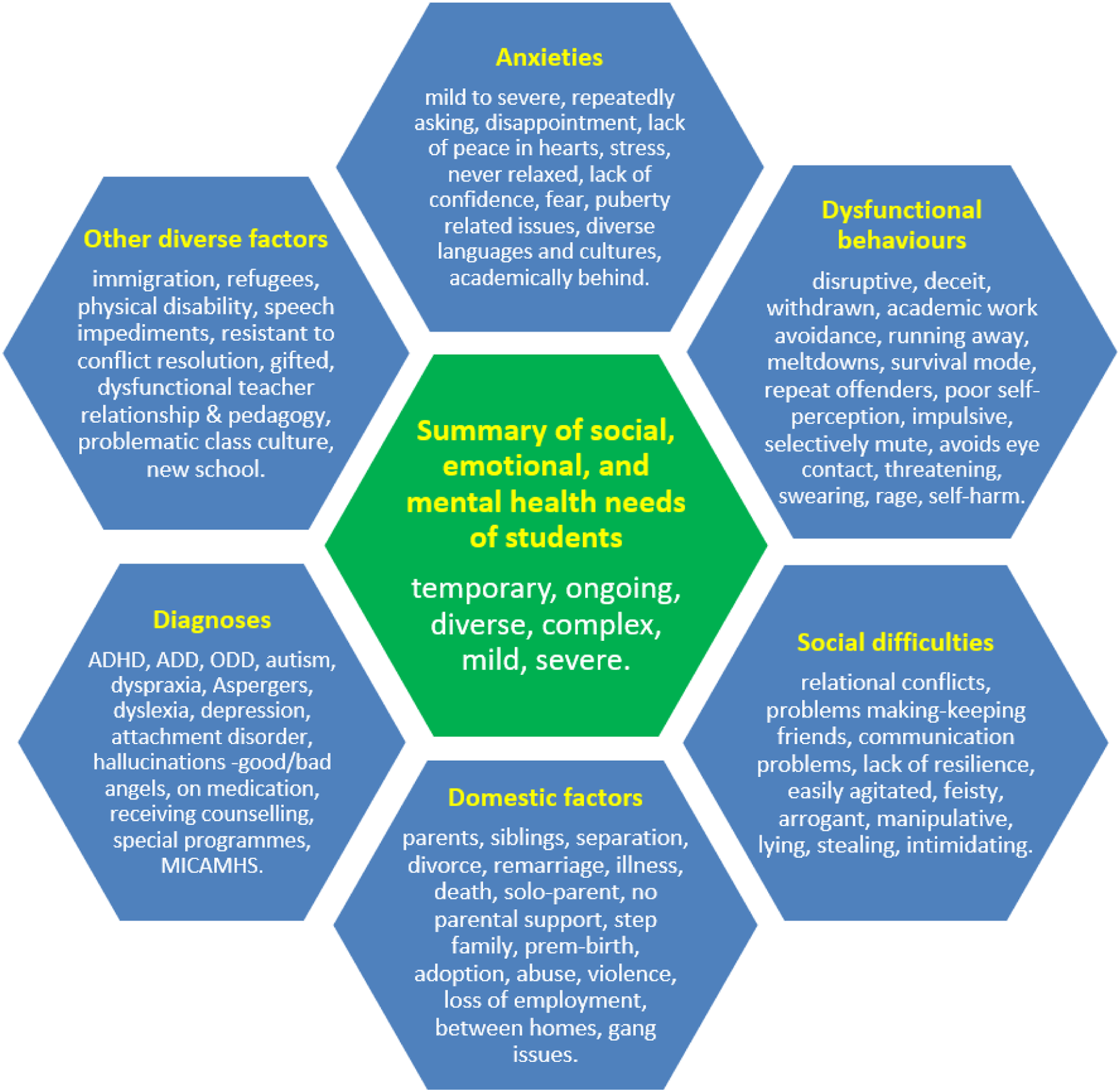
It is hoped these findings will be useful for pre-service and in-service teacher education purposes to prompt collegial dialogue and collaboration to better understand the complex SEMH needs of students. These findings are part of a larger research project which explored the 17 participants’ dispositions and strategies they perceived were effective in supporting the SEMH needs of their students.
Footnotes
Declaration of conflicting interests
The author(s) declared no potential conflicts of interest with respect to the research, authorship, and/or publication of this article.
Funding
The author(s) received no financial support for the research, authorship, and/or publication of this article.
