




Abstract
Misinformation is a pervasive problem in the social media era, undermining social trust, while the emergence of AI-generated misinformation further exacerbates this issue and threatens social order. This study employs the third-person effect as a theoretical framework and collected 726 questionnaire responses to examine individuals’ perceptions of AI-generated misinformation. When exploring the relationships among misinformation exposure, social undesirability, perceived realism, and AI literacy with respect to perceived effects on oneself and on others, individuals recognize that they themselves are also easily influenced by AI-generated misinformation. Furthermore, perceived effects on oneself and others are positively correlated with corrective actions, while no significant relationship is observed with restrictive actions, thus providing suggestions for individual involvement in combating AI-generated misinformation.
Keywords
Introduction
Rapid advances in generative AI technology have reshaped the global information ecosystem. Powered by natural language generation (NLG) and image synthesis technologies, AI-generated tools can produce large amounts of content rapidly and at low cost. However, much of this content includes misinformation. Compared with traditional misinformation, AI-generated misinformation may have greater negative societal impacts due to its high degree of realism, especially in video formats. Research has shown that AI-generated faces can appear even more realistic than actual human faces, a phenomenon referred to as AI hyperrealism (Miller et al., 2023).
Currently, research on AI-generated misinformation primarily focuses on its characteristics, such as automated production, high realism (Feuerriegel et al., 2023), and its prevalence in entertainment-related topics (Drolsbach & Pröllochs, 2025). Based on this foundation, many studies have explored its impact, but the conclusions remain inconsistent. On one hand, some scholars argue that AI-generated misinformation may have a significant negative impact on society. For example, AI has been identified as a “super spreader” of misinformation (Verma, 2023). Empirical studies have also investigated reasons for the high perceived credibility of AI-generated misinformation, such as its high source vividness (Lee & Shin, 2022) or perceived realism (Sundar et al., 2021), which indirectly supports the notion that AI-generated misinformation could lead to substantial negative consequences.
On the other hand, some studies suggest that the negative impact of AI-generated misinformation is less severe than that of traditional forms of misinformation and may even be overestimated. For instance, scholars have found that AI-generated misinformation does not significantly increase persuasiveness (Barari et al., 2021). In addition, when encountering deepfakes, individuals are more likely to feel uncertain rather than misled (Vaccari & Chadwick, 2020).
Overall, the actual impact of AI-generated misinformation is challenging to quantify, but public perceptions of it are measurable. Regardless of its actual effects, excessive public concern about AI-generated misinformation may indeed exist and could significantly influence individual behavior. Therefore, this study, grounded in the third-person effect theory, examines individuals’ perceptions of the impact of AI-generated misinformation, further exploring the factors contributing to these perceptions and how they drive individuals’ information behaviors.
Quantifying the impact of AI-generated misinformation on society is challenging. However, it is feasible to measure how individuals perceive the effects of misinformation. People make decisions based on their perceptions of media effects (Gunther, 1991), for instance, one is less likely to act if one views its effects as negligible. Therefore, it is crucial to understand how individuals perceive the influence of misinformation to comprehend individual behavioral reactions and even societal collective responses. Moreover, given that misinformation within the public sphere is more likely to attract public attention due to its potential to harm societal interests, this study primarily focuses on AI-generated misinformation related to public sphere topics.
Guided by the third-person effect framework (Davison, 1983), this study examines individuals’ perceptions of the effects of AI-generated misinformation, focusing on both influencing factors and resulting behavioral responses. Perceived effects are divided into two categories: effects on oneself and effects on others. The research explores how relevant antecedents influence perceptions to understand why individuals feel vulnerable to media effects in the context of AI-generated misinformation. In addition, the study investigates the influence of individual perceptions on restrictive and corrective actions to explore the potential and possibilities of individuals in managing generative AI misinformation.
This study has several theoretical implications. First, while previous research has primarily focused on the third-person effect in traditional misinformation contexts, this study extends third-person effect theory to the domain of AI-generated video misinformation. By focusing on emerging media technologies, the research tests the applicability of mass communication theories in new technological environments, thereby broadening the scope of third-person effect theory. Second, while earlier studies have typically examined the third-person effect as a whole (Jang & Kim, 2018; Yang & Tian, 2021), this research distinguishes between perceived effects on oneself and on others. This distinction enhances our understanding of how perceived effects on different actors relate to antecedents and behavioral consequences. In addition, by integrating perceived effects with corrective actions, the study enhances understanding of the link between perceived effects and behavioral outcomes, offering practical suggestions for combating misinformation.
Literature Review
Third-Person Effect in AI-Generated Misinformation
Third-person effect theory posits that individuals generally perceive a gap between the effects of media content on themselves and on others (Davison, 1983). People tend to overestimate the effects on others while underestimating the effects on themselves, particularly when dealing with socially undesirable messages (Golan & Day, 2008). As a classic theory in the field of communication, the third-person effect has been validated across various contexts. For instance, research indicates that people often believe pornographic content (Lo & Wei, 2002), violent content (Rojas et al., 1996), and persuasive messages (Scherr & Müller, 2017) have a greater impact on others.
Research has shown that misinformation, often considered socially undesirable information, negatively impacts political democracy (Ha et al., 2021) and health behaviors (Caceres et al., 2022). Consequently, it is likely that the third-person effect also manifests in the context of misinformation. Since 2018, scholars have begun applying the third-person effect theory to misinformation research. Jang and Kim (2018) found that individuals perceive fake news to have a greater impact on members of external groups compared with internal members. In other words, subjects viewed voters of their own party as less susceptible to fake news than voters of other parties. Another study investigated the relationship between misinformation and the third-person effect in the context of COVID-19, finding that the third-person effect was also present regarding COVID-19 fake news, thereby advancing the application of third-person effect theory to health misinformation contexts (Yang & Tian, 2021).
Compared with traditional misinformation, AI-generated misinformation poses greater identification challenges, especially for the general public. Produced automatically through advanced generative AI, AI-generated misinformation is characterized by large-scale generation, rapid production, personalization, and user-friendly tools (Feuerriegel et al., 2023). With only simple commands, anyone can now produce large volumes of hyperrealistic and multimodal misinformation, especially persuasive videos and images. These technological advancements make AI-generated misinformation not only harder for individuals themselves to recognize but even more difficult for others to identify and resist. This is because people tend to believe that others lack the necessary media literacy, technical skills, or awareness of AI’s manipulative potential, making them vulnerable to the deceptive realism and subtlety of AI-generated content. Moreover, AI-generated video misinformation is particularly insidious: visuals are processed quickly and perceived as highly credible, which fosters false familiarity and trust, further increasing the likelihood that others will be misled (Vaccari & Chadwick, 2020). As a result, individuals are likely to perceive others as more vulnerable to the negative effects of AI-generated misinformation than themselves.
The Antecedent of the Third-Person Effects
The four independent variables, misinformation exposure, social undesirability, perceived realism, and AI literacy, were selected to represent the major dimensions that influence individuals’ perceptions of AI-generated misinformation. Drawing on the research context of AI misinformation and the literature on the third-person effect, we identified three primary categories of antecedents: information behavior, message characteristics, and user attributes. Specifically, misinformation exposure is information behavior representing individuals’ contact with media content, which serves as a fundamental prerequisite for media effects. Social undesirability and perceived realism represent a core message characteristic. Specifically, social undesirability reflects the public’s collective judgment and value orientation regarding the social impact of misinformation, indicating the extent to which misinformation is perceived as negative by society. Perceived realism captures how authentic and credible AI-generated misinformation appears to individuals, highlighting the degree to which the content is taken as real and believable. Finally, AI literacy represents user characteristics, indicating individuals’ abilities to critically assess and respond to AI-generated content. Taken together, these four variables provide a systematic framework for analyzing how external exposure, message attributes, and individual competencies collectively shape people’s perceptions of the effects of AI-generated misinformation.
Misinformation Exposure and Perceived Effects
When individuals think about the causes of media effects, they often adopt a relatively basic schema, assuming that media influence mainly comes from information exposure. Eveland et al. (1999) found that information exposure has strong predictive and explanatory power for the third-person effect. However, existing studies have shown inconsistent findings regarding the relationship between information exposure and perceived effect on self. Some scholars argue that, driven by self-enhancement motives, individuals tend to adopt a more complex reasoning process when evaluating media effects on themselves. That is, exposure does not directly determine media influence on the self but is shaped by factors such as personal knowledge and the social desirability of the information (McLeod et al., 2001). In McLeod et al.’s (2001) study, music lyrics exposure was not significantly related to perceived effect on self. However, Boyle et al. (2008) found that individuals who frequently played violent video games were more likely to believe that they were less influenced by the content. Liu and Lo (2014) found a positive relationship between news exposure and perceived effect on self, and this correlation was stronger than the relationship between news exposure and perceived effect on others. Given these inconsistent findings, this study raises the research question: What is the relationship between AI-generated misinformation exposure and perceived effect on self?
In contrast, previous studies have found that individuals often use simple heuristic thinking when evaluating media effects on others, similar to the “magic bullet theory”—believing that as long as others are exposed to media, they will be influenced (McLeod et al., 2001). This assumption has been confirmed by multiple studies. McLeod et al. (2001) found that the more frequently individuals believed others were exposed to violent and misogynistic lyrics, the more they believed others would be influenced by the lyrics. Li and Guo (2018) found that exposure to news about the South China Sea issue on both traditional and new media platforms positively predicted perceived effect on others. In other words, the more frequently individuals were exposed to such news, the more likely they were to believe that others’ attitudes would be influenced. When individuals are frequently exposed to AI-generated misinformation, they are also more likely to believe that others are widely exposed to such misinformation. Therefore, this study argues that the more frequently individuals are exposed to AI-generated misinformation, the more likely they are to believe that others are influenced by it.
Social Undesirability and Perceived Effects
Misinformation is socially undesirable media content that contains false or misleading information that can harm individuals, communities, and public discourse. Previous research has indicated that the social undesirability of media messages influences the third-person effect (Jensen & Hurley, 2005). Specifically, when the perceived social undesirability of a message is high, individuals are more likely to believe that others are more affected by the message than themselves. For example, Lim et al. (2020) found that the first-person effect increased with the social desirability of anti-panhandling public service announcements (PSAs), whereas the third-person effect became more pronounced as the social undesirability of the message increased. Studies suggested that participants perceived hate speech as having a greater impact on the public than on themselves (Guo & Johnson, 2020). This pattern is consistently observed in research examining media messages deemed socially undesirable, such as political advertisements (Golan et al., 2008; Wei & Lo, 2007), pornography (Chen et al., 2015; Lo & Wei, 2002), and defamatory news (Cohen et al., 1988). Meta-analyses confirmed that social undesirability is a stable predictor of the third-person effect (Sun et al., 2008a).
This can be attributed to individuals’ self-enhancement tendencies. Self-enhancement refers to the inclination to hold overly positive perceptions of oneself that may not align with reality (Dufner et al., 2019). Guided by self-enhancement motives, individuals tend to perceive socially desirable media messages as affecting themselves as much or more than others, while viewing socially undesirable messages as less influential on themselves. Research on misinformation has consistently shown that the higher the social undesirability of fake news, the stronger the third-person effect (Jang & Kim, 2018). That is, as fake news becomes more socially undesirable, individuals increasingly believe that others are more affected by it than themselves.
Building on this pattern, previous work also finds that the social undesirability of fake news is positively correlated with the perceived effects of fake news on others (Cheng & Chen, 2021). Therefore, this study suggests that social undesirability will positively influence the perceived effect on others. However, although prior third-person effect studies have demonstrated a gap between the perceived effect on oneself and on others, there is no direct evidence showing how social undesirability influences the perceived effect on oneself specifically. Thus, the relationship between these two remains uncertain.
Perceived Realism and Perceived Effects
Perceived realism refers to the extent to which AI-generated misinformation is perceived as realistic, accurate, and credible (Aitamurto et al., 2022). The strengthened realism can arise from two key aspects: the diversity of content modalities and the realism of the content itself. According to Sundar’s MAIN model, the modality of content plays a crucial role in shaping perceived realism (Sundar, 2008). Specifically, richer content modalities—such as images, audio, and especially videos—enhance the perceived realism and authenticity of misinformation (Sundar et al., 2017; Sundar et al., 2021). Unlike traditional misinformation, which is typically limited to text or static images, AI-generated misinformation integrates multiple modalities, including text, images, audio, and video. Recent studies have shown that multimodal AI-generated misinformation, particularly in video and audio formats, is perceived as more vivid, authentic, and credible than textual misinformation (Hwang et al., 2021; Lee & Shin, 2022; Sundar et al., 2021). This heightened realism makes it more difficult for individuals to distinguish true from false content (Kobis et al., 2021), increasing both uncertainty and susceptibility to influence (Vaccari & Chadwick, 2020). Therefore, as the perceived realism of AI-generated misinformation increases, individuals are more likely to believe that both they themselves and others can be influenced by it.
AI Literacy and Perceived Effects
AI literacy is defined as “the ability to properly identify, use, and evaluate AI-related products under the premise of ethical standards” (Wang et al., 2023). Although no previous research has specifically examined the relationship between AI literacy and the third-person effect, studies have explored how knowledge impacts perceptual gaps. Given that AI literacy encompasses the ability to use and evaluate AI tools, it relies on a foundational knowledge of AI. Therefore, investigating the relationship between knowledge and perceptual gaps can illuminate the role of AI literacy in the third-person effect.
For instance, Price et al. (1997) found that higher levels of political knowledge corresponded to a stronger third-person effect about internet pornography. Specifically, political knowledge was negatively correlated with perceived effects on oneself and positively correlated with perceived effects on others. Similarly, McLeod et al. (2001) found that individuals with greater common sense were less likely to perceive negative rap lyrics as affecting themselves, believing they could better withstand the misogynistic and violent content.
The role of knowledge in the third-person effect has also been validated in misinformation contexts. For example, Yang and Tian (2021) found that individuals with higher levels of COVID-19-related knowledge experienced a greater perceptual gap regarding the effects of fake news on themselves versus others. In other words, those who perceived themselves as more knowledgeable believed that fake news had less impact on themselves and more impact on others. This suggests that individuals with higher levels of knowledge tend to see others as lacking relevant information and, therefore, more susceptible to media influence.
Individuals with higher AI literacy perceive themselves as more knowledgeable about generative AI tools. This heightened literacy means they are capable of using AI technologies and recognizing the risks posed by AI-generated misinformation, whereas the general public lacks such expertise (Feuerriegel et al., 2023). Consequently, individuals with high AI literacy are more likely to view others, who may not share the same level of expertise, as vulnerable to being misled and negatively affected by AI-generated misinformation.
However, how individuals with high AI literacy perceive the effects of AI-generated misinformation on themselves remains unclear. On one hand, greater AI literacy may lead individuals to believe they can better defend against misinformation because they understand how AI produces misleading content. On the other hand, increased literacy may heighten concern, as learning more about AI may also expose individuals to more information about its associated risks. Therefore, it remains uncertain whether individuals with high AI literacy perceive AI-generated misinformation as more or less harmful to themselves.
Perceived Effects, Restrictive Action and Corrective Action
Third-person effect theory suggests that perceptual gaps can lead to cognitive, attitudinal, or behavioral consequences (Davison, 1983; Sun et al., 2008b). In this study, “restrictive action” refers to support for platform-level measures to regulate AI-generated misinformation, with the platform as the primary actor. “Corrective action” involves individuals personally taking steps to counter or correct misinformation to mitigate its negative impact (Chung, 2023). Both platforms and individuals need to take action to address AI-generated misinformation and its negative impacts.
If users perceive that media messages may affect them personally, they are more likely to take action in response. Empirical research demonstrates that individuals who believe media content has a negative influence on themselves tend to support regulatory measures such as censorship. For example, McLeod et al. (2001) found that people who perceived misogynistic music lyrics as more influential on themselves were more likely to support censorship. Ho et al. (2012) reported that individuals who felt personally affected by homophobic media content were more inclined to endorse censorship policies.
There are also theoretical frameworks suggesting that individuals take action based on the perceived effects of media messages on others. The Influence of Presumed Influence (IPI) model posits that people respond to media messages not only because of personal impact, but also because they believe others are affected (Gunther & Storey, 2003). For example, when individuals believed a serialized radio drama would influence clinic health workers, they changed their own attitudes and reported more positive interactions with those workers (Gunther & Storey, 2003). Similarly, McLeod et al. (2001) found that individuals who perceived negative effects of rap lyrics on others were more likely to support government censorship of such lyrics.
Corrective action focuses on individual-level initiatives to prevent the dissemination of misinformation (Chung, 2023), and it is significantly related to the third-person effect. For example, Rojas (2010) found that a stronger third-person effect was positively associated with various corrective behaviors, such as attending political rallies, signing offline petitions, and expressing political views online or in forums. Similarly, Lim (2017) found that individuals who perceived a greater third-person effect were more likely to engage in corrective actions to limit online advertising for cosmetic surgery, including posting negative comments to warn others about potential risks.
The connection between the third-person effect and corrective action has also been demonstrated in the context of misinformation. Koo et al. (2021) found that a stronger third-person effect was positively associated with intentions to take corrective actions. Specifically, individuals who perceived a greater disparity between the effects of misinformation on themselves and on others were more likely to engage in initiatives to correct or expose misinformation, including addressing false information posted by others and self-correction. In addition, Jang and Kim (2018) discovered that individuals with a pronounced third-person effect were more supportive of media literacy education, which is a form of corrective action.
While the relationship between perceived effects on oneself and on others in relation to corrective action has been less extensively studied, corrective action shares similarities with restrictive action in that both aim to limit the spread of misinformation and mitigate its negative impact. If individuals perceive AI-generated misinformation as threatening or harmful to themselves or others, they are likely to engage proactively in corrective actions to counter its negative effects. Therefore, this study expects that both perceived effects on self and on others will be positively associated with corrective action. The conceptual model outlines the hypothesized pathways between variables (see Figure 1).
Theoretically, the impact of media information on individuals is shaped by the mediating role of the third-person effect, which posits that perceptions of media influence on others affect one’s own attitudes and behaviors. In line with this framework, the current study hypothesizes that exposure to misinformation, social undesirability, AI literacy, and perceived realism each exert an influence on both perceived effects on self and perceived effects on others. In turn, perceived effects are expected to predict individuals’ likelihood of engaging in restrictive action and corrective action. Thus, perceived effects on self and on others are proposed to mediate the relationships between the aforementioned factors and behavioral outcomes.

Conceptual model.
Previous studies supported the mediating influences of perceived effects. For instance, Li and Guo (2018) found that the perceived effects on self significantly mediated the relationship between media exposure and nationalism, while the perceived effects on others mediated the relationship between media exposure and government evaluation. Similarly, a study has demonstrated that the third-person effect of positive word-of-mouth (WOM) mediates the relationship between consumers seeking product-related online WOM information and sharing positive WOM content, whereas the self-effect of negative WOM mediates the relationship between seeking online WOM information and sharing negative WOM content (Bi et al., 2019). In the context of misinformation and the third-person effect, Li and Yan (2024) have found that the third-person effect significantly mediates the relationship between self-efficacy and behavioral intentions, such as correcting misinformation or promoting corrective information. These findings provide support for the mediation hypotheses proposed in this study. Given the number of mediation hypotheses involved, this study integrates them and summarizes the specific research questions as follows:
Method
Sampling
Purposive sampling was used to recruit suitable participants in this study. Two screening questions were included to identify eligible respondents: respondents had to have been exposed to AI-generated misinformation and must have successfully identified the content as AI-generated. Such recognition is necessary for participants to meaningfully evaluate the effects of AI-generated misinformation. However, because 98.9% of participants failed to correctly identify AI-generated fake news (Bashardoust et al., 2024), individuals who met both criteria were rare. Therefore, purposive sampling was used to ensure the recruitment of suitable participants.
Participants were recruited via Credamo. Prior studies have demonstrated the effectiveness of this platform in providing high-quality samples (Jin et al., 2025; Tang et al., 2023). In distributing the survey, the researchers did not impose sampling restrictions on the platform. As a result, Credamo released the questionnaire through its default procedure, randomly delivering it to users within its three-million–member participant pool. On top of this random distribution process, purposive sampling was applied through questionnaire-based screening to determine final eligibility.
To further ensure that participants met the recruitment criteria, the researchers included a video produced by Oscar-winning director Jordan Peele using advanced AI techniques to depict him delivering a speech while disguised as former U.S. President Barack Obama (Mack, 2018). Only respondents who correctly identified the video as AI-generated were allowed to continue with the survey. Subsequently, a detailed textual explanation of AI-generated misinformation was provided prior to the survey questions. This additional verification and explanation ensured that only respondents who met the sample requirements were included in data collection. A total of 997 questionnaires were collected, among which 726 were valid, resulting in an effective response rate of 72.8%.
Measures
Misinformation Exposure
The misinformation exposure scale was adapted from Lim’s self-exposure measure (2017). It included two items: “How often do you see AI-generated misinformation (1) on social media (2) when searching for information online?” Responses were measured using a 7-point Likert-type scale (1 = never, 7 = always). The average of the two items was used as the score for misinformation exposure, with higher scores indicating a higher perceived frequency of exposure to AI-generated misinformation. Since the scale included only two items, the Pearson correlation coefficient was r = .59, p < .001 (M = 4.66, SD = 1.16). Notably, this scale captures perceived rather than objectively verified exposure. Although perceived exposure may differ from actual exposure due to recall or recognition biases, it is theoretically appropriate for the present study. According to the third-person effect theory, individuals’ judgments about misinformation effects are driven by subjective perceptions of exposure rather than actual exposure. Thus, measuring perceived exposure aligns with the psychological mechanism under investigation.
Social Undesirability
Social undesirability was measured using items adapted from (Sun et al., 2008b). The scale assessed respondents’ attitudes toward the social undesirability of AI-generated misinformation using four pairs of bipolar adjectives (desirable-undesirable, positive-negative, beneficial-harmful, benign-detrimental) with the prompt: “What do you think is the impact of AI-generated misinformation on society?” The items were measured on a seven-point scale; items were reverse-coded so that higher scores indicated greater social undesirability, whereas higher scores on the original items indicated lower social undesirability. The mean of the four items was calculated to form the social undesirability score (M = 5.12, SD = 1.54, α = .95).
Perceived Realism
Perceived realism was measured using three items adapted from Aitamurto et al. (2022). The scale includes: “AI-generated content felt credible to me,” “AI-generated content represented reality accurately,” and “AI-generated content was realistic and believable.” Responses were rated on a seven-point scale, and the mean of the items provided the perceived realism score (M = 4.81, SD = 1.14, α = .76).
AI Literacy
The measurement of AI literacy was adapted from Wang et al. (2023). The original scale included 12 items, such as “I can distinguish between smart devices and non-smart devices” and “I can use AI applications or products to improve my work efficiency.” After adaptation, nine items were used in this study, measured on a seven-point scale. The average of these items provided the AI literacy score (M = 5.40, SD = .78, α = .87).
Perceived Effect on Self and Perceived Effect on Others
Adapted from Yang and Tian (2021), three items were used to measure the perceived effect on the self: AI-generated misinformation (1) “attracted attention from me”; (2) “persuaded me”; and (3) “influenced my decisions.” The same items were used to measure perceived effects on others, with “self” replaced by “others.” Responses were rated on a seven-point scale, and the mean of the items provided the scores for each variable. Higher scores indicated greater perceived effects on the self (M = 4.77, SD = 1.05, α = .67) or others (M = 5.31, SD = .93, α = .69).
Restrictive Action
The restrictive action scale, adapted from Chung’s (2023) support for content moderation, includes five items: “Putting a warning label on the post to inform users,” “Shutting down the account of the person who shared it,” “Placing a warning label if users try to reshare or like it,” “Stopping people from sharing by removing the ‘share’ button,” and “Not recommending or promoting posts to users’ feeds.” Responses were rated on a seven-point scale, with the mean of the items providing the restrictive action score (M = 5.43, SD = 0.95, α = .73).
Corrective Action
To measure corrective action, four items were adapted from Chung (2023): “Leave comments to inform others about the harm of AI-generated misinformation,” “Share news or information that refutes AI-generated misinformation,” “Share news or information that reports the dangers of AI-generated misinformation,” and “Report the post as AI-generated misinformation to the social media platform.” Responses were measured on a 7-point scale, and the mean of the summed items constituted the corrective action score (M = 5.48, SD = 1.05, α = .82).
Control and Demographics
The final sample comprised 726 participants. Young adults aged 20 to 29 accounted for 72.6% of the sample, a proportion reflecting that younger individuals are the primary users of social media (China internet Network Information Center [CNNIC], 2024), where they are more likely to encounter and identify AI-generated misinformation. In addition, 44.6% of the participants were male, 82.8% held an undergraduate degree, and 77.7% reported monthly incomes below 10,000. These demographic variables were controlled in the data analyses. Compared with the overall structure of Chinese internet users (CNNIC, 2024), the sample is slightly more female, substantially younger, and more highly educated.
Results
Third-Person Effect Testing
The study tested Hypothesis 1 using a paired samples t-test. The results indicated that the perceived effects on others (M = 5.31, SD = 0.93) were greater than those on themselves (M = 4.77, SD = 1.05), t(725) = −16.32, p < .001. Therefore, Hypothesis 1 is supported, indicating that individuals perceive AI-generated misinformation to have a greater impact on others than on themselves.
Confirmatory Factor Analysis
All confirmatory factor analysis (CFA) and structural equation modeling (SEM) were conducted using Mplus version 8.3. A confirmatory factor analysis was conducted to assess the validity of the measurement model. The model demonstrated an acceptable fit to the data: χ²(403) = 887.13, p < .001, comparative fit index (CFI) = .95, Tucker–Lewis index (TLI) = .95, root mean square error of approximation (RMSEA) = .041, standardized root mean square residual (SRMR) = .055. All standardized factor loadings were statistically significant (p < .001) and ranged from .48 to .93.
Structural Equation Modeling
Before estimating the structural model, Pearson correlations among the key variables were examined (see Table 1). This study employed structural equation modeling (SEM) to test the hypotheses. Education, income, age, and sex were included as control variables. Given the similarity in the measurement statements, the error terms of perceived effect on self and perceived effect on others were correlated. The model demonstrated an acceptable model fit: χ²(520) = 1,341.92, p < .001, χ²/df = 2.58, RMSEA = .047, CFI = .92, TLI = .91, and SRMR = .071. These indices suggest that the hypothesized structural model fits the data well.
Correlation Analysis Results.

Note. *p < .05. **p < .01. ***p < .001.
The results of the data analyses revealed that, addressing RQ1, misinformation exposure was positively related to perceived effect on self (b = 0.20, p < .01). Misinformation exposure was also positively related to perceived effects on others (b = 0.23, p < .001), supporting H2. Addressing RQ2, social undesirability was positively correlated with perceived effects on self (b = 0.14, p < .01). Social undesirability was positively correlated with perceived effects on others (b = 0.22, p < .001). Thus, H3 was supported. Perceived realism was positively related to perceived effects on self (b = 0.45, p < .001) and perceived effects on others (b = 0.21, p < .001), supporting both H4a and H4b. AI literacy had no significant relationship with perceived effects on self but was positively related to perceived effects on others (b = 0.17, p < .01), indicating that H5 was supported.
The results of the data analysis indicated that the relationships between perceived effects on self and on others and restrictive behavior were not statistically significant, so neither H6a nor H6b was supported. Perceived effects on self was positively related to corrective action (b = 0.15, p < .05), whereas perceived effects on others was also positively related to corrective action (b = 0.37, p < .001), supporting H7a and H7b. The SEM results show the direct effects between the key variables (see Figure 2).

SEM: The result of path analysis.
The results indicate that perceived effect on self and perceived effect on others did not mediate the relationships between the independent variables and restrictive action. However, perceived effect on self positively mediated the relationship between perceived realism and corrective action (b = 0.066, p < .05). Perceived effect on others positively mediated the influence of misinformation exposure (b = 0.085, p < .01), social undesirability (b = .083, p < .001), perceived realism (b = 0.078, p < .01), and AI literacy (b = 0.064, p < .05) on corrective action. The mediation analysis results are presented in Table 2.
Mediation Analysis Results.
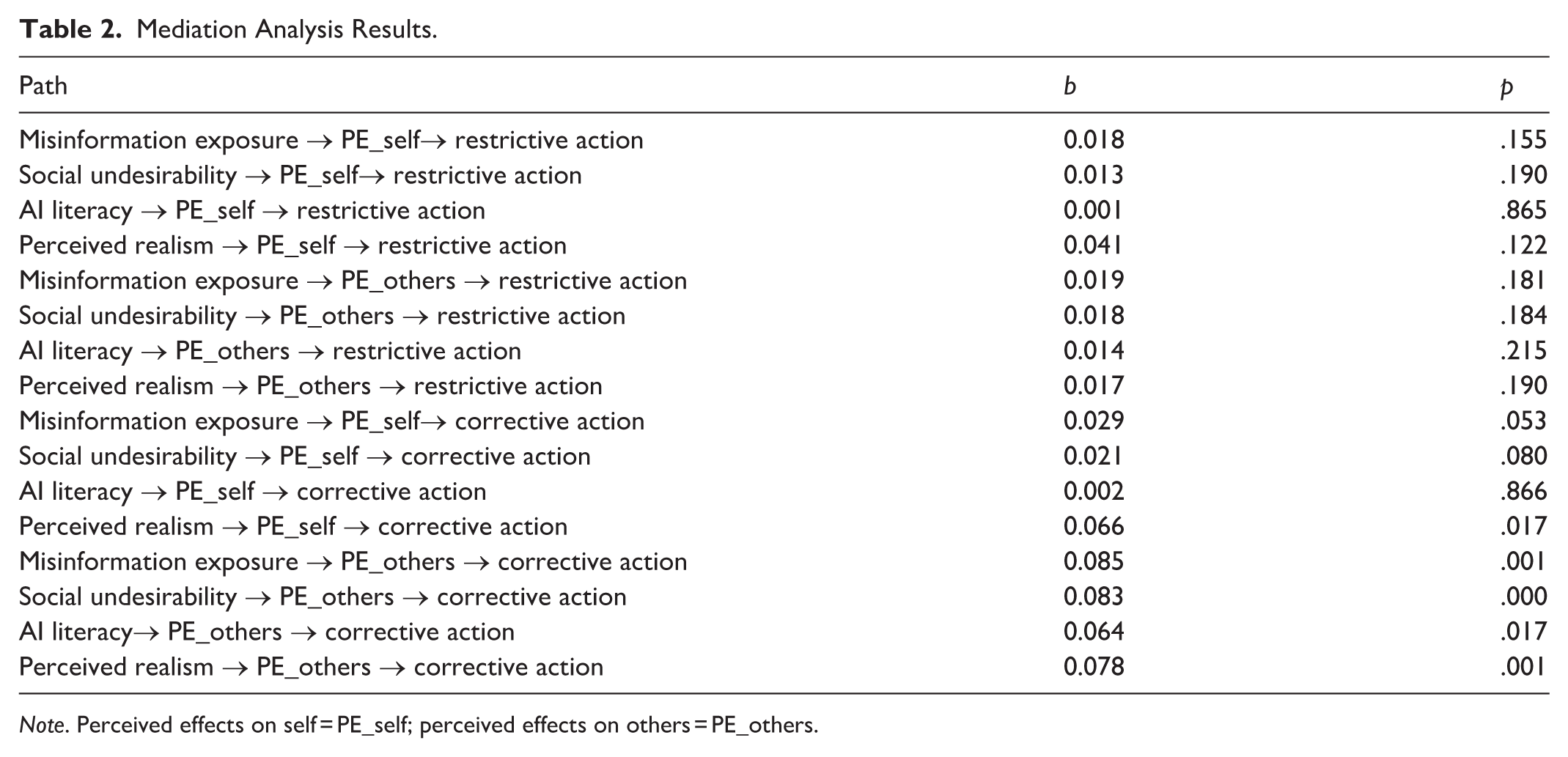
Note. Perceived effects on self = PE_self; perceived effects on others = PE_others.
Discussion
With the rapid development of artificial intelligence technologies, the threshold for generating AI-generated misinformation has significantly lowered. Meanwhile, the “hyperrealism” of such information makes it more deceptive, potentially raising public concerns about its negative impacts. Grounded in the third-person effect theory, this study examines the key factors influencing the public’s perception of AI-generated misinformation and how such perceptions drive individuals’ restrictive and corrective actions.
This study is one of the earlier studies to explore the third-person effect in the context of AI-generated misinformation, verifying the validity of the effect in this context. The findings indicate that individuals perceive others as being more affected by AI-generated misinformation than themselves. This aligns with previous research, which has consistently demonstrated a perceptual gap when individuals assess the impact of negative content (Eveland et al., 1999).
Notably, although a perceptual gap exists between the perceived effect on self and others, the difference is relatively small. This suggests that participants view both themselves and others as similarly vulnerable to AI-generated misinformation. One plausible explanation is the high level of perceived risk associated with AI-generated content observed in recent public discourse (Pew Research Center, 2025). When individuals perceive the overall threat of AI-generated misinformation as substantial, they may feel less confident in their ability to fully mitigate its influence, which in turn reduces the perceived self-other asymmetry. In addition, because the participants in this study had relatively high levels of AI literacy, they may have had a clearer understanding of how AI-generated misinformation works. With this deeper understanding, they were likely able to make more accurate and realistic judgments about its influence, further reducing the difference between perceived effects on self and others.
The relationship between misinformation exposure and perceived media effects indicates that exposure significantly predicts individuals’ perceptions of media influence, which is consistent with previous findings (Eveland et al., 1999). Prior third-person effect research has shown that when individuals assess the influence of negative or harmful media content on themselves, they tend to rely not only on exposure frequency but also on more complex personal considerations (McLeod et al., 2001). In contrast, when evaluating media effects on others, individuals are more likely to make judgments based on exposure alone, reflecting a more intuitive, heuristic processing style. However, this study found that the regression coefficients of misinformation exposure on perceived effects on self (b = 0.20) and others (b = 0.23) were similar. This suggests that in the context of AI-generated misinformation, individuals believe that merely being exposed to such information may already pose a considerable risk to themselves, thus no longer significantly underestimating its influence on the self. It may also reflect a reduced sense of “immunity” to misinformation when individuals encounter content that is more deceptive and uncertain, leading to more similar evaluations of media effects on self and others.
Social undesirability is positively correlated with both perceived effects on others and perceived effects on oneself. However, its effect on perceived effects on others is stronger, suggesting that people view others as more vulnerable to socially undesirable AI-generated misinformation, reaffirming the third-person effect. Interestingly, despite self-enhancement motivation leading individuals to perceive less impact of socially undesirable messages on themselves, the positive correlation between social undesirability and perceived effects on self-challenges this assumption. Based on this result, while the third-person effect still exists, the gap has narrowed. This discrepancy might stem from the unique context of generative AI. When dealing with such complex emerging technologies, individuals may lower their confidence in resisting misinformation and amplify their perception of risks posed by AI-generated misinformation. Thus, self-enhancement tendencies, though influential, do not entirely mitigate concerns about the adverse consequences of AI-generated misinformation on one’s self.
Research has shown that perceived realism enhances individuals’ perceptions of its effects on themselves and others. Previous studies indicate that content with high realism is often regarded as more credible and persuasive, leading to a greater impact on message recipients (Lee & Shin, 2022; Sundar et al., 2021). Notably, the effect score of perceived realism on perceived effects on oneself was b = 0.45, whereas the effect on perceived effects on others was b = 0.21. This suggests that perceived realism has a more significant influence on individuals’ perceptions of their own experiences compared with those of others, indicating that individuals may prioritize their own feelings and experiences when confronted with hyperrealistic AI-generated misinformation.
It is noteworthy that the results regarding social undesirability and perceived realism in relation to perceived effects on oneself and others indicate that individuals believe they and others are equally susceptible to the influence of AI-generated misinformation—social undesirability is positively correlated with perceived effects, while perceived realism is positively correlated with perceived effects. In other words, although the third-person effect still exists in the context of AI-generated misinformation, this perception gap may be narrowing, especially as individuals become aware of the high realism and low social desirability of such misinformation, which may pose significant potential risks to society.
In research examining AI literacy and perceived effects, it was found that individuals with higher AI literacy tend to believe that others are more affected by misinformation, which aligns with the assumptions of the third-person effect theory. Davison (1983) argues that experts often overestimate the influence of media on the general public. Individuals with high AI literacy may perceive others as lacking relevant skills, thus overestimating the impact of AI-generated misinformation on them. In addition, no significant relationship was found between AI literacy and perceived effects on oneself. This lack of correlation may stem from the belief that individuals with high AI literacy possess the skills necessary to defend themselves against misinformation, leading them to downplay its impact on themselves.
Our study also explored the relationship between perceived effects and behavioral outcomes. The findings revealed that neither perceived effects on oneself nor perceived effects on others significantly increased individuals’ willingness to support restrictive actions. This contrasts with previous studies and may be attributed to two factors (Lim, 2017). First, given the growing severity of AI-generated misinformation, the public has not observed platforms taking responsibility or implementing effective governance measures, leading to skepticism about their ability to manage such misinformation (Duffy, 2023; Epstein, 2020). Second, as the primary agent of restrictive action is the platform itself, and individuals have limited initiative, the public’s willingness to support such actions remains low.
However, both perceived effects on oneself and perceived effects on others can motivate individuals to take corrective action. This indicates that in the context of AI-generated misinformation, people are more inclined to adopt measures to limit its spread. Thus, corrective action may serve as an effective governance strategy for managing AI-generated misinformation.
The mediation results indicate that perceived effects on others mediate the relationship between independent variables and corrective action, while perceived effects on self only mediate the relationship between perceived realism and corrective action. This suggests that the influence of misinformation exposure, social undesirability, and AI literacy on corrective action is primarily driven by perceived effects on others. In other words, the motivation for corrective action likely stems more from social responsibility or concern for others’ well-being rather than self-protection. Perceived realism influences corrective action through both types of perceived effects. This highlights perceived realism as a core characteristic of AI-generated misinformation, triggering individuals’ cognitive evaluations and shaping their perceptions, judgments, and behavioral intentions toward misinformation.
Theoretical and Practical Implications
The findings have several theoretical implications. First, this study validates the effectiveness of the third-person effect theory in the context of AI-generated misinformation, broadening the theory’s scope, particularly concerning new communication technologies. Second, in addition to classical antecedents such as social undesirability, this study explores the roles of AI literacy and perceived realism in shaping perceived effects, enhancing our understanding of how information literacy and its characteristics influence perceptions of misinformation. Furthermore, the relationship between antecedents and perceived effects indicates that individuals believe they are as vulnerable to AI-generated misinformation as others, providing new insights for understanding the third-person effect in the context of AI-generated misinformation. Third, unlike previous studies that examined the third-person effect as a whole, this research separately analyzes perceived effects on oneself and on others, contributing to a more nuanced understanding of how these perceived effects influence behavioral outcomes (Lo & Wei, 2002).
The findings also have significant practical implications. First, the study underscores the importance of the third-person effect in the context of AI-generated misinformation, reminding relevant stakeholders—such as governments and platforms—that in managing misinformation, they should not only focus on its actual impact but also consider and leverage public perceptions of that impact. For example, by emphasizing the harmful effects of misinformation on society, governments can motivate individuals to take corrective action to curb its spread. Furthermore, the positive correlation between perceived realism and perceived effects suggests that enhancing perceived realism can help mitigate individuals’ overestimation of the impact of AI-generated misinformation on others and reduce their optimism regarding its effects on themselves. This could lead to a more comprehensive and objective understanding of the negative consequences of AI-generated misinformation.
Limitations and Directions for Future Studies
Despite the important findings of this study, several limitations remain. First, the purposive sampling approach resulted in a sample with relatively high levels of AI literacy. In addition, participants tend to be more female, younger, and better educated compared with the general population of Chinese internet users. These characteristics limit the external validity of the findings, and caution should be exercised when generalizing the results. Second, regarding the broader landscape of third-person effect research, like previous studies, the content and findings of this research are somewhat scattered and do not form a systematic theoretical framework (Perloff & Shen, 2023). Third, this study examined restrictive and corrective actions in a broad sense, but these actions have more specific meanings; for example, corrective actions can be categorized into self-correcting and correcting others, which could be explored in greater detail in future research (Koo et al., 2021). In addition, perceived misinformation exposure is often overestimated (Hameleers, 2025), which limits the extent to which the present findings can inform how actual exposure shapes perceived effects on oneself and others. Finally, due to potential cultural factors and the research context, the reliability of the scales measuring perceived effects is relatively low, which may impact the overall reliability of the study’s findings. Future research should focus on adapting these scales.
Footnotes

Funding
The authors received no financial support for the research, authorship, and/or publication of this article.
Declaration of Conflicting Interests
The authors declared no potential conflicts of interest with respect to the research, authorship, and/or publication of this article.