



Abstract
Even as platformization reshapes communication practices across professional fields, it is not a given that professional norms adapt accordingly. The field of politics is no exception. This study examines how parliamentary teams navigate incentives to embrace social media platforms in their everyday communications work, shedding light on how new media practices are normatively understood in the political field. Drawing on fieldwork in the French Assemblée Nationale and a descriptive mapping of MPs’ social media presences, I find that even as digital communications practices have converged, norms around the legitimacy of social media use in parliamentary work have not. On the one hand, engagement metrics provide guidance in the face of uncertainty, becoming normalized as markers of professionalism. On the other hand, institutional norms reject overt pursuits of ‘virality’. This creates a normative double bind for politicians, at once incentivizing them to adapt to platform demands and punishing communications that maximize metrics at any cost. Depending on party culture and institutional position, politicians have different levels of leeway in resolving this conflict. The study highlights that even as platformization incentivizes convergent practices, professional norms do not necessarily follow the same trajectory, explaining divergent uses of social media in the political field.
Introduction
Whether an individual is running for office, promoting their art, or touting brand deals, social media is making the work of reaching audiences at once more streamlined and more complicated. As a small number of social media platforms dominate more and more of our public sphere, communication work in disparate fields converges to adapt to the logics and needs of platforms, a process dubbed ‘platformization’ (Berman, 2025; Poell et al., 2022; Van Dijck et al., 2018). A key mechanism driving such adaptations is the centrality of engagement metrics (likes, shares, views, and follower counts) which act as visible, quantifiable proxies for success. In organizations, such quantification tends to rationalize new working practices in service of ‘objective’ measures (Caplan & boyd, 2018; Espeland & Sauder, 2007), helping to explain why diverse professionals adopt platform-native practices associated with full-time influencers (Bishop, 2025; Sarı, 2025).
However, we know less about the normative implications of this process: not just what professionals do with social media, but what they feel they should do. As sociologists like Viviana Zelizer (1994) have argued, the same practice adopted at different places does not necessary hold the same meaning. In particular, existing research has shown that the pursuit of platform visibility is often resisted when it clashes with field-specific norms. For example, Christin (2018, 2020) found that US newsrooms were more likely than French ones to embrace analytics metrics due to divergent professional cultures even in the face of technological convergence. Outside of the media and cultural sectors, however, we do not have as much empirical evidence on the kinds of conditions under which platformization and its accompanying instruments (notably, engagement metrics as a quantification of visibility) are normatively accepted or resisted.
This article brings this question to the field of electoral politics. While the idea that (social) media logics shape political work has been amply explored in the tradition of mediatization research (Strömbäck, 2014), less is known about the way that such adaptations take place on a normative level in the context of platformization. Although politics certainly has its unique characteristics as a profession, elected officials and their staff can be considered knowledge workers who are often at the forefront of changes in communication technologies (Fast & Enli, 2024), hardly exempt from dynamics identified in how other groups adapt to social media. Much of the existing literature focuses on social media’s role in elections (e.g., van Aelst et al., 2017), a particularly high-stakes context for politicians for which the increasing centrality of data-driven technologies has already been extensively documented (Dommett et al., 2024). We know less about how social media is used, interpreted, and valued in the day-to-day routines within the teams and institutions that surround elected officials.
These questions nevertheless touch upon key normative questions on how representative politics should be organized. Politicians have long grappled with a normative tension between their representative mandate and the pursuit of individual visibility (Boorstin, 1961), only heightened in a context where social media platforms provide politicians with a tool to engage in the latter without the intermediary of the news industry (Bennett & Pfetsch, 2018). The way that politicians resolve this tension has concrete consequences. For example, prioritizing the pursuit of online visibility could result in an increased emphasis on algorithm-optimized ‘politainment’ (Riegert & Collins, 2015; van Zoonen, 2005), attuned to the manufacturing of spectacle rather than discussions of policy (Edelman, 1988). Ultimately, how politicians think about how they should communicate affects who they hire as assistants, how they spend their time in office, and which audiences they prioritize.
Inspired by studies exploring the impacts of platformization (particularly social media metrics) through an organizational lens in other fields (Caplan & boyd, 2018; Christin, 2020; Petre, 2021), I aim to explore how these logics are integrated into parliamentary teams. I am interested in how and why politicians and their staff adopt social media and the working practices that platformized visibility labour (Abidin, 2016) requires. For this purpose, I conducted a mixed-methods study anchored in a period of fieldwork in the French Assemblée Nationale during 2 years in its 16th and 17th legislatures. Based on 48 interviews with MPs and their assistants, ethnographic observations, and descriptive statistics mapping of MPs’ platform presences, I analyse how French MPs and their staff make sense of social media’s role in parliamentary life, navigating contradictory normative incentives in their use of digital communication tools and making diverging interpretations on how to resolve these conflicts based on their political positioning in the field.
Specifically, I organize this study around the following questions:
RQ1: How and why did French MPs adopt social media during the 2022–2024 period?
RQ2: How was the role of social media normatively understood within the parliamentary context?
RQ3: How did these practices and normative interpretations vary among different groups?
Social Media – A Normalized Part of Politics?
First, it bears mentioning that social media does not necessarily represent a revolution in political communication practices. Today’s TikToking politicians fit into the long history of mediatized politics (Meyer, 2002; Strömbäck, 2014), where political activity is assumed to adapt to the ‘logic’ (Altheide & Snow, 1979) of various media formats, given the centrality of visibility in political activity. This perspective places social media as simply the latest technological innovation forcing politicians to adapt, including in how they organize their work. Such recent adaptations can be considered as an intensification of previous dynamics: more channels and tools to communicate, faster temporal intervals, and higher demands on the skills and characteristics needed to succeed in today’s media environment, where traditional and digital media combine to determine access to public attention (Chadwick, 2017). As Negrine and Lilleker (2002) argued, this multiplication of channels requires increased specialization among those who seek to make use of them, constantly expanding the CV requirements of political communication professionals.
In this context, journalists play a less central role in the ‘gatekeeping’ of public attention, motivating scholarly interest in how this disintermediation reshapes political communication (Bennett & Pfetsch, 2018). Notably, this shift has also coincided with the erosion of traditional party systems, increasing the pressure on individual politicians to develop their own media strategies to maintain visibility and influence (Chadwick & Stromer-Galley, 2016). Yet, as critical platformization studies often emphasize, platforms themselves still act as gatekeepers to attention (Gillespie, 2019), placing recommendation algorithms as a barrier or challenge that users need to ‘master’ in order to reach an audience (Bishop, 2020; Glatt, 2022; Mears & Beauvais, 2025). Politicians building social media profiles must also navigate these dynamics, wading through constant feedback in the form of likes, views, and followers, which many interpret as real-time indicators of public opinion (Keller & Kleinen-von Königslöw, 2018). This metric-driven environment rewards emotionally charged, attention-grabbing content, which encourages more informal and personality-driven communication styles from politicians (Metz et al., 2020; Riegert & Collins, 2015) or even collaborations with full-time influencers (Riedl et al., 2023).
However, existing studies have long documented normative unease with such practices among politicians, sometimes explaining a gap between political social media strategies observed on paper and in practice (Kalsnes, 2016). Driessens et al. (2010) found that while politicians did adapt their everyday practices to mass media demands, they negotiated the legitimacy of these practices in relation to other politicians, establishing boundaries to retain control over their own activities. Expectations on role performance shape these negotiations. Manning et al. (2017) found that politicians felt torn between the social media norm of ‘performing authenticity’ (Bishop, 2025) in informal and personable ways and an expectation to be seen as respectable and serious ‘briefcase politicians’ (Meyer, 2002). Much as parliamentary roles are diverse and sometimes contradictory (Searing, 1994), embracing social media may come easier to some politicians than others. Party cultures around digital communications have been noted to vary greatly (Chadwick & Stromer-Galley, 2016; Kreiss, 2016), with some parties centralizing digital communications in their internal structure to the extent that they can be classified as ‘platform parties’ (Gerbaudo, 2019). An enduring hypothesis posits that social media is favoured by ‘underdogs’ or ‘outsiders’ (actors in less dominant positions in the political field) (Hong et al., 2019; Larsson & Kalsnes, 2014), a way to access political capital for those who otherwise lack the resources to do so, thought this hypothesis sometimes finds contradictory empirical evidence stating that social media is most utilized by dominant actors (Rodarte and Lukito, 2025).
Further exploring how parliamentarians understand social media platforms from a normative standpoint could provide guidance for future investigations into convergence and variation in political social media use in our current media landscape. Case studies on particular institutions can be helpful for deeper insights in this regard. For this reason, I propose to use the French Assemblée Nationale as the object of this study, explained further in the next section.
The French Case
Traditionally seen as a weak institution in terms of its political power (Costa et al., 2012), the French parliament has recently undergone significant transformation. Party and voter fragmentation, mirroring broader Western European trends, has reshaped the Assemblée nationale. The 2022 elections ushered in a more fragmented parliamentary chamber, filled with diverging stances in terms of ideology as well as communication strategies (Boelaert et al., 2023). La France Insoumise, often classified a ‘platform party’ centralizing digital communication in all their activities (Gerbaudo, 2019) and a strengthened far-right Rassemblement Nationale intent on controlling its media narrative (Foessel & Ollion, 2024) particularly embody these shifts. The 2024 snap elections further entrenched this fragmentation, with no one camp securing a majority.
Neihouser (2020, 2021) has extensively researched the consequences of these upheavals on French digital communications. Contrary to the ‘social media favours underdogs hypothesis, more prominent MPs in dominant positions appear to be more active on social media than less established names (Neihouser & Ouellet, 2022). Digital communications remain in a transitional phase within French parliamentary work, not least in terms of the changing professional expectations of communications staff (Neihouser, 2020). In addition, the normative role of social media in politics has recently become a topic of national debate. During 2024 snap elections, the use of TikTok by the far right attracted much attention. 1 Later, the extent to which MPs adapted their speeches in the parliamentary chamber to suit short form video formats fired up a similar media debate on the quality of deliberative democracy in the digital age. 2
Similar debates and institutional conditions can be found in other Western European representative democracies that are experiencing comparable transitions in their political and media systems. Studying everyday parliamentarian social media use in the French case can help us understand how parliamentarians in similar circumstances understand the role of digital platforms in their work.
Methodology
Fieldwork
The main data of this study was collected during an extended period of fieldwork in the French Assemblée nationale (lower house of parliament) undertaken from January 2023 to December 2024, encompassing interviews and ethnographic observation. Aiming to understand parliamentary teams as mini-organizations, especially given previous research on the role that assistants play in shaping the communications of French MPs (Neihouser, 2020), I targeted both MPs themselves and their staff as participants. This was also motivated by the fact that politicians are an infamously hard-to-reach population for interviews (Cowley, 2021), the French members of the Assemblée being no exception. Though fieldwork was facilitated through an access badge that allowed me to move freely on parliamentary premises (granted by the Assemblée for researchers) the vast majority of my requests for participation went ignored or were given a response only months later, meaning that interview recruitment continued over the 2-year period until saturation was reached in terms of participant profile diversity and thematic content (Saunders et al., 2018). I mainly made contact with parliamentary teams through email solicitation, though some recruitment also took place through press conferences, focus group meetings, and other events organized by MPs, which also provided ethnographic material.
I undertook a total of 48 interviews (17 MPs, 31 assistants) with members of 37 different parliamentary teams and auxiliary institutional staff (such as communications officers from political groups) in the Assemblée nationale. The interviews covered teams from every parliamentary group across the political spectrum, roughly in proportion to the number of seats they occupied, and took place either with the MP themselves, their assistants, or both. Although I aimed for a maximally diverse participant pool, the final tally may be somewhat biased in favour of more media-interested profiles (a common reason for rejecting my request was that the MP ‘was not very active’ on social media), teams of MPs with little or no presence in social and/or traditional media were also present (representing roughly 15% of the team sample).
All interviews were conducted in French and lasted between 25 min up to 2 h, most taking place in-person in various locations in the Assemblée nationale. The semi-structured interviews focused on communications practices in a broad sense: how communications work (engagement with both traditional and social media) was organized within the team, whether strategies were formalized or improvised, the amount of time dedicated to certain tasks, strategic reflections on why certain choices were made, what they considered ‘successful’ communications, and what the MP would like to do given more resources. Participants were also asked to react to and explain the content they had recently posted on their social media feeds. Although this did not constitute a full formal content analysis, these ethnographic notes on social media posts also provided data for a subsequent analysis along with transcripts.
All transcriptions and notes were cleaned and imported into NVivo. For my coding and analysis, I followed Deterding and Waters (2021) flexible coding approach, argued to better fit interview studies with larger amounts of data handled by QDA software, and where multiple coding schemes may need to be applied to the same data. This inductive approach consists of first applying participant indexing and broad codes that are then broken down into more granular analytical codes, used to identify general patterns in the transcript data.
The fact that this study primarily relies on interviews can be considered a limitation in the sense that most descriptions of practices and strategies are essentially self-reported. However, since the study aims to understand perceptions of why social media was perceived as valuable for politicians, self-reported data still serves the function of illustrating the declared attitudes of the affected population. To mitigate this limitation, I also undertook a complementary quantitative analysis of platform presences, outlined in the next session.
Mapping Platform Presences
In order to get a more comprehensive overview of the social media use habits of French MPs, I carried out a mapping exercise of MP presences on social media platforms. For this study, this data should be considered primarily as a descriptive complement to the qualitative methodology, rather than a standalone quantitative analysis of the variables explaining platform practices. In December each year, I mapped out the social media presences of all 577 MPs during the period of 2022-2024. Though more limited than a formal content analysis, the number of platforms used can be used as a proxy measure for how much an individual invests in social media, particularly as diversifying platforms is a key feature of the content creator industry (Glatt, 2022). The same method was notably used by Neihouser and Ouellet (2022) to approximate a ‘digital visibility index’ in French politics.
Using both automated (scraping) and manual searches, I identified all platforms where MPs maintained accounts: Facebook, Twitter, Instagram, YouTube, TikTok, Twitch, LinkedIn, Telegram, personal websites, and (in 2024) Threads and BlueSky. I coded the MP’s presence on a given platform into binary form (1 = ‘Yes’, 0 = ‘No’). MPs were coded as having an ‘active presence’ if they posted at least once within a three-month window. This timeframe accounted for high variations in activity levels (with some MPs posting dozens of times each day on some platforms and others once a month), aiming to capture a minimum level of engagement. I then used this data to obtain descriptive statistics on the evolution of platform presences among French MPs. In addition, I collected data on sociodemographic characteristics, political position and constituency characteristics for each MP, including:
Gender
Age
Parliamentary group (party)
Number of times elected
‘Frontbencher’ status (whether the MP held one of the following positions: president or vice-president of the Assemblée Nationale, secretary, parliamentary administrator, president of a Commission, parliamentary group leader or parliamentary group spokesperson)
Whether the MP made appearances in TV and radio programmes during the 2022–2023 period 3
Average age of constituency population
Urban/rural composition of constituency
These variables were only available in full for the 16th legislature (2022–2023) at the time of writing, meaning that the 2023 dataset was the most complete one.
In addition to descriptive statistics, I also employed an unsupervised clustering analysis based on the number and types of platforms used by each MP to get an indication of more systematic variation. Clustering techniques aim to group similar observations together and separating dissimilar ones, assigning numerical values to the distance between observations. The primary goal was to capture patterns of platform presence (both how many platforms an MP used and which ones) and then relate these clusters to demographic and political variables. To create the clusters, I computed Gower distances and then applied the Partitioning Around Medoids (PAM) clustering algorithm. Based on silhouette analysis and interpretability, I selected a solution with three clusters. After assigning cluster labels, I merged the cluster results back into the full dataset and compared clusters across the full range of sociodemographic and political variables. This analysis sought to complement the qualitative findings to highlight variation in platform use.
Findings
Metrics as an ‘Objective’ Justification for Social Media Convergence
Answering my first research question (how and why French MPs adopted social media) first permits us to paint a descriptive picture of the observed social media practices of parliamentarian teams. Broadly, a relatively high level of investment in communication on digital platforms was widespread and increasing during the 2022–2024 period. Metrics served as a driver of this convergence, seen as providing guidance in a media environment defined by uncertainty.
A Fragmented Platform Landscape
As MPs in the 16th legislature established themselves in their mandate, they intensified their investment in social media. This is first of all observable in the number of platforms they used. Figure 1 shows a flow diagram of MP platform presence and how these evolved from 2022 to 2023. The majority of MPs maintained 3–5 active social media accounts, representing a ‘medium level’ of social media presence (with an overall average of 4.56). Less than 0.5% maintained no active accounts. From 2022 to 2023, the percentage of MPs with a high level of social media use increased from 28.7% to 37.7% (with the overall average raised to 4.95 platforms). A significant portion of MPs increased their social media presence by at least one platform (n = 171, representing almost 30% of all MPs). In 2023, there was not a single MP who completely abstained from social media.
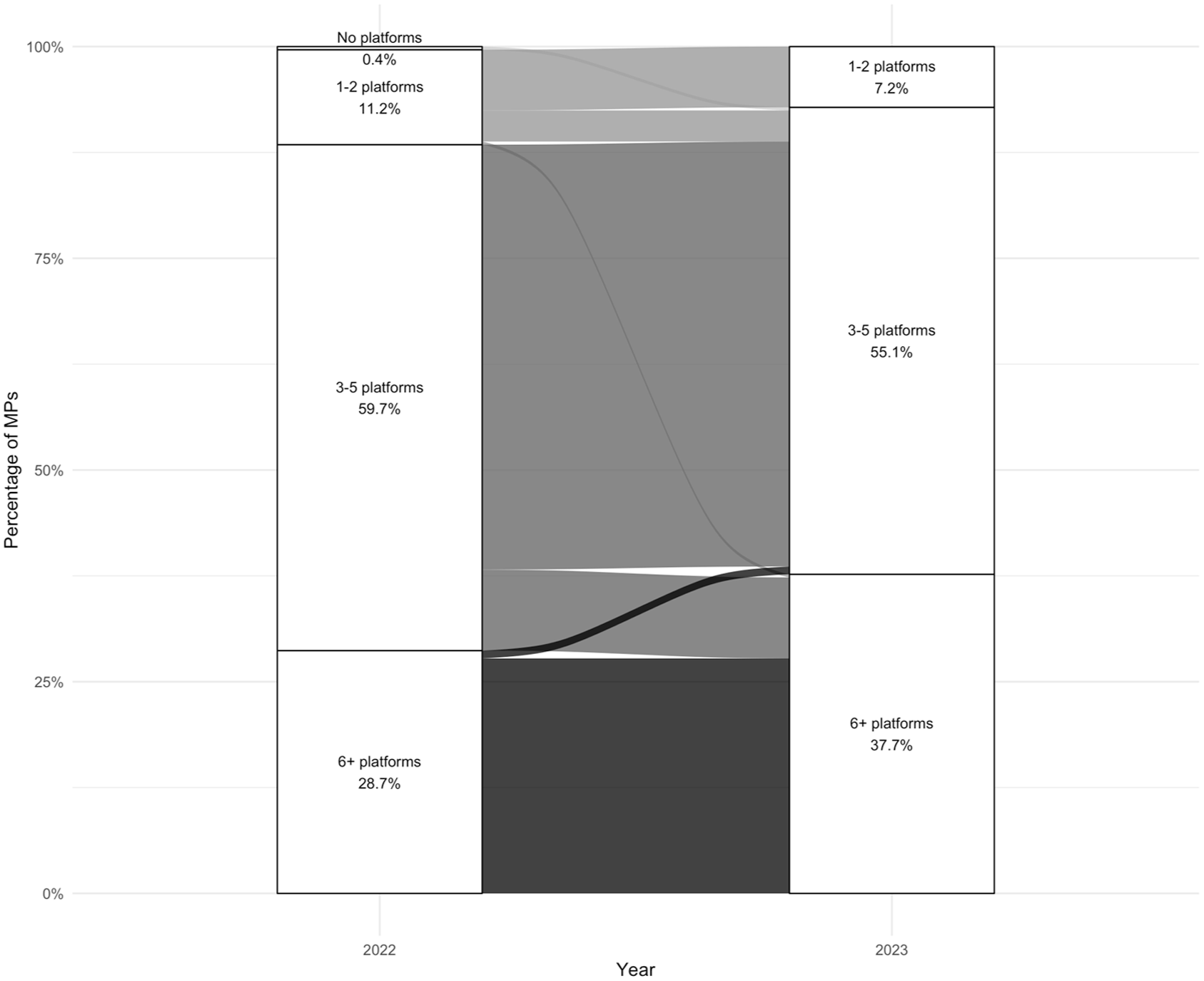
Evolution of percentages of MPs binned by number of active social media accounts, 2022–2023.
The new cohort of 2024 invested even more in their platform presence from the start of their mandate. Again, not a single MP completely abstained from social media. 5.1% maintained an active presence on 1–2 platforms, 44.9% maintained an active presence on 3–5 platforms, and half (49.9%) now kept up a presence on over 6 platforms. The overall average rose to 5.6 platforms. Out of all MPs who were re-elected in 2024, 54.6% (n = 209) increased their social media use by at least one platform. These numbers indicate a rising baseline of the expected number of social media platforms used by MPs, even between legislatures.
A convergence was also observed in the types of platforms used and content posted, notably in the form of a greater focus on visual platforms like TikTok and Instagram. Figure 2 specifies the percentage of MPs with an active account on each platform per year. This showcases that Facebook, Twitter and Instagram were the most used social media platforms, forming the ‘bread and butter’ of parliamentarian digital communication. TikTok steadily became an increasingly central part of the social media toolboxes of MPs, in particular with the new legislature in 2024. Accordingly, short-form videos optimized for TikTok or Instagram reels with captions and trending ‘sounds’ became more common sights on MPs’ feeds. One particular trend that rapidly spread on MP social media accounts was the ‘office tour’ or similar ‘behind-the-scenes’ content, showing where MPs ate lunch, spent time between debate sessions, or how their constituency surgeries were set up. On Assemblée grounds, assistants filming their MPs speaking directly into their phone camera to casually explain a law proposal became a common sight. These types of personalized and informal content styles represented adaptations to what participants in interviews perceived ‘worked well’ on platforms like TikTok, often inspired by what they had seen other MPs do.

Percentage of MPs with an active account on each platform, 2022–2024.
This practice of copying the social media habits of others was reported as the primary driver of the convergent platform usages visualized in Figure 1 and 2. Almost no team reported being explicitly told to use a certain platform or to post in a certain way by party leadership. MPs and staff consistently described their adoption of new platforms and new types of content as reactive, driven by a perceived need to ‘keep up’ with what was working for others. ‘We’re in a logic of competition’, said ‘Fabien’, an assistant to a left-wing MP who had been an early adopter of informal ‘behind-the-scenes’ content, ‘if others are doing something, we need to do it too.’ The practices of these reference points were not copied due to their ideological similarity or even their electoral success, but because their ‘success’ was directly visible and quantifiable by a number visible underneath every post: engagement metrics.
The guiding role of metrics in uncertain times
Ultimately, the appearance of a live barometer of visibility, popularity and renown in the form of engagement metrics proved difficult to ignore. In contrast to elections, everyday parliamentary life does not always provide clear indicators of success or failure. As André, a far-right MP in his thirties who invested heavily his platform presence across over six platforms, said:
For example, I don’t know, let’s say you work in a grocery store. How do you know at the end of the week whether you’ve done a good job or not? You look at your sales figures, you look at your stock, your other expenses, and you know whether you’ve managed the business well or not . . . MPs don’t do that. I mean, like, ‘I’m going to vote 2,500 times.’ OK? But is that what determines the quality of your work? (. . .) Let’s say I have great metrics [on social media]. Does that indicate an average of my performance, if you will? Is that what allows me to achieve a very high final performance? I think it might. But just because I think so doesn’t mean it’s true.
Just like André expressed doubt on his belief in social media metrics as a ‘performance indicator’, there were few explicit directives encouraging MPs and/or their staff to conduct their communications in any particular way. Rather, the commonly repeated refrain that ‘if you don’t communicate in politics, you might as well not exist’ was seen as a given (if implicit) rule of the political field. The best means to accomplish this visibility were less clear, a sense of uncertainty often attributed to changes in the media landscape.
While no participant expressed a belief that traditional media were obsolete, journalists were perceived as embedded in platform infrastructures, notably on Twitter, whose attention needed to be grabbed by making sure one’s content was visible in their feeds (as previously found by Chibois (2014)). In this sense, recommendation algorithm systems were seen as additional gatekeepers to public attention, rather than a way to bypass gatekeepers. These systems were seen as unreliable and opaque, necessitating the multiplication of platforms in order to maximize chances of being seen (similarly to how Glatt (2022) found that Youtubers needed to avoid ‘putting all their eggs in one basket’). ‘Yann’, an assistant with many years of experience in political communications across several left-wing parties, described that his job had become more and more demanding:
We lived through several successive periods between moments of innovation, when things are being tested for the first time and the slightest movement on social media seems very iconoclastic, very modern, very avant-garde, with algorithms that were, it must be said, rather favourable and helpful. For me, there was a bit of a golden age, let’s say around 2016-2018. . . And today, we are experiencing a new moment, in my opinion, when algorithms remain very unfavourable to political content . . . and now there has been a phenomenon that has made things worse, which is the multiplication of platforms, making it increasingly difficult to build communities of internet users around individuals, movements, or communities of ideas.
Assistants, who were often given significant autonomy in their day-to-day communications tasks, often chose to implement engagement metrics as a guiding principle in this uncertain context for lack of better alternatives. If an assistant saw that a certain type of content ‘worked’ (in terms of engagement metrics) for someone else, they copied the format. For example, the far-right candidate Jordan Bardella’s success on TikTok during the 2024 European election was often cited as driving MPs to also use TikTok. ‘We saw that Bardella exploded on it, so we had no choice,’ said ‘Ivan’, assistant to an older, centre-right MP to explain why he had recently started posting memes and entertaining content on TikTok. These sources of inspiration were taken both from political adversaries as well as content creators outside of the political sphere. ‘Yann’ said: ‘the good example that we should follow comes from Squeezie,
4
not Emmanuel Macron.’ This was echoed by ‘Hugo’, assistant to a prominent left-wing MP with highly developed social media presence (over six platforms, among the highest follower counts of all MPs) in his forties:
Me, I have no problem to say that I look at what (opposing party) do, not at all in terms of what they say, but just because I know they’ve had moments where things were working well on the Facebook page and all. It’s so problematic what I see there, but I analyse it purely in terms of style. Do they put a visual? Do they do simple messages? Pure text does not work anymore, or it works less well. Other than that, I also consume content outside of politics on TikTok and YouTube.
These results mirror how metrics have been interiorized as holding real evaluative meaning in other fields facing uncertainty, such as journalism (Christin, 2020). As Caplan and boyd (2018) note, algorithmic systems are often perceived as more objective than human ones, making them especially powerful tools for reorganizing practices in organizations. In the parliamentary context, engagement metrics were appealing precisely because they offered teams a seemingly objective, real-time gauge of how MPs were perceived. However, this incentive could not be integrated into existing normative visions of parliamentary work without friction. In the next section, I outline the normative implications of these incentives.
‘We Are Not Here to Go Viral, But . . .’ – The Double Bind of Pursuing Online Visibility
Answering my second and third research questions (how social media was normatively perceived and how these perceptions varied) I found that MPs and their staff navigated a shared tension: while overtly chasing engagement was broadly rejected as incompatible with the role of a parliamentarian, platform fluency and algorithmic savvy were increasingly seen as markers of professionalism. This created a double bind, where MPs had to demonstrate digital competence without appearing too focused on visibility for its own sake. Parties further from the political centre of power had more leeway in breaking these norms, especially when supported by favourable party cultures.
Normative Conflict Between Public Service and Professionalism
Categorically, MPs and their teams denied deliberately seeking social media visibility as an end in itself. Variations on the following statements almost always prefaced any description of social media strategy:
We are not here to go viral. Our MPs are here to be MPs. -‘Anaïs’, assistant to left-wing MP, high social media presence, late 30s
‘Marie’, the central communications officer of a left-wing parliamentary group, expressed that while there was a strong incentive to keep up with metrics, parliamentary motivations to do so differed from influencers, from which she drew an explicit boundary: ‘We’re not Youtubers who monetize their videos. It’s not the same thing.’
It appeared to be especially important to distance oneself discursively from the aim of ‘going viral’ even if subsequent descriptions of practices seemed to contradict this stance. ‘Olivier’, an assistant to a right-wing MP in his fifties who expressed a desire to invest more in his social media presence, said this most explicitly: ‘we don’t want to go viral just to go viral . . . well, though we do look at the numbers’. High engagement metrics were desirable, but could not be named as an explicit goal in itself. This apparent cognitive dissonance is not unusual among professionals whose normative codes bind them to a sense of ‘public service’ rather than individual gain, at least on paper (Haskell & Molyneux, 2025) and, more broadly, among organizations who sometimes need to decouple what they say from what they do (Meyer & Rowan, 1977).
However, in this case, a second emerging normative ideal competed with this taboo: that of a ‘professional’ communicator. This has been identified in other contexts. Kreiss et al. (2020) found that among US political campaign staff, definitions of ‘professionalism’ now include in-depth mastery of an increasing number of social media platforms. This was also the case with French MPs, who often explicitly described understanding social media infrastructures and platform cultures as a necessary mark of ‘professionalism.’ As ‘Cyril’, a prominent far-right MP who heavily invested in social media particularly in terms of differentiating and specializing his content across platforms, put it:
Since my election in 2022, we have professionalized. This means posting with more regularity, professionalizing practices, sponsoring content, posting at specific times . . . All the best practices of the communications profession.
‘Ideally, we would have one person posting fulltime on each platform,’ said ‘Victor’, an assistant to a similarly prominent left-wing politician. Conversely, other MPs bemoaned their lack of ‘professionalization’ in this area, notably struggling to take advantage of algorithmic recommendation systems and the specific affordances and norms of particular platforms. ‘Quentin’, an experienced MP in his late sixties from the government majority Renaissance group, expressed frustration over these new expectations of ‘performing well’ on social media, which he struggled to do with his primarily text-based and formal communication style:
We work on this issue a lot. Why can’t we get more traffic? What’s going on? What needs to be improved? Do we need hashtags? Do we need “@”-signs? Do we need photos or videos? Do we need to be very controversial, or on the contrary, very academic? We haven’t yet stabilized things.
This also affected the job titles, CV expectations, and time use of assistants. Those who invested most heavily in social media often had a dedicated digital communications officer who followed the MP around almost constantly, notably to shoot video. ‘Camille’, a young assistant to a government majority MP, said that while MPs who felt very established in their mandates may not have changed their practices, newer MPs prioritized ‘professionalizing’ digital communications:
I see in this corridor, for example, most of them have digital communications officers. So, I think this is something new compared to some who may have been here for 20 years, where it’s always the same person doing the communications. You get the feeling that there’s a desire among the new MPs, or those who were involved in the campaigns in 2017 and 2022, to have someone who knows graphic design and all that.
‘Camille’ had a background as a journalist and content creator, as did ‘Victor’ and ‘Olivier’ while others may have come from commercial marketing. This was the case for ‘Emilien’, assistant to a well-established right-wing MP, who said of his role: ‘before, I sold shoes, now I sell politics. Behind it all is a human, though we sell him like a brand’. Branding, identified by Bishop (2025) as a key aspect of how platformization informs the practices of fields outside full-time influencers, was sometimes literal: several MPs developed their own logos and ‘brand colours’, distinct from the party, to uniformize their visual communications.
Such practices were cited to fall in line with ‘what was expected’ of a prominent politician. Metrics were part of these expectations. ‘Yann’ said he found it most important to avoid a ‘shame zone’ of very low engagement metrics, struggling to have his current MP gain more than a few hundred followers on YouTube. Tellingly, after an interview with a well-established (over five mandates) MP who talked at length about his distaste for social media, his assistant ran up to me to reassure me that they were working on improving follower metrics for his Twitter and Instagram accounts ‘as befitted his status.’ For a self-respecting politician, opting out of social media and its associated metrics-maximizing game was no longer conceivable.
Standing with or outside the norm – the role of political positioning
Despite these convergences, the possible gains in esteem that an MP could hope to earn by adapting their digital communication were not uniform across the ideological spectrum. Nor can it be said that all MPs utilized social media the same way. To illustrate these variations, the results from the cluster analysis using the platform presence mapping data from 2023 give us indications of three types of parliamentary social media use.
The results of the clustering analysis are presented in Table 1, identifying three distinct groups. Cluster 1, of which the far-right Rassemblement National (RN) was the most common party, is characterized by low platform diversity and a reliance primarily on Facebook and Twitter, with some (though not extensive) use of ‘second-generation’ visual platforms. MPs in this cluster are also generally older and represent less-urban constituencies. Cluster 2, dominated by MPs from the government majority (Renaissance), maintain a stronger presence across multiple platforms, particularly Instagram, YouTube and LinkedIn, but notably avoid TikTok. They are also more likely to be experienced MPs and have the highest percentage of frontbenchers. Finally, Cluster 3, composed primarily of MPs from the left-wing La France Insoumise (LFI), exhibits the highest levels of platforms presence, notably with universal TikTok use. These MPs were younger, more urban, and more likely to not only be frontbenchers but also to appear on TV and radio. All clusters showed high levels of usage of Facebook, Twitter, and to a lesser extent Instagram, the most commonly used platforms as shown in Figure 2.
Cluster Analysis of Social Media Profiles (2023 Data).

These findings appear to nuance the idea that social media is favoured by ‘underdogs’ (Larsson & Kalsnes, 2014). While a generational factor did appear to be at play, more dominant actors (government majority MPs, frontbenchers, TV personalities) seem to invest more in social media use, similar to Neihouser and Ouellet’s (2022) findings from a previous legislature. These findings support the idea of social media use as a mark of professionalism, but also that this norm has certain limits. From interview findings, I noted that the three parties most featured in the clusters showcased distinct normative attitudes on how parliamentarians should use social media, explaining the variation observed in Table 1, outlined below.
First, for the far-right Rassemblement National (RN), interviews revealed that the lower levels of social media use observed in Table 1 were not necessarily motivated by ideological opposition, but rather the fact that the older, newly-elected MPs who were prominent in this group did not naturally adapt to platform cultures, nor did their constituencies (older, more rural) particularly demand it. These MPs (not unlike MPs with similar demographic profiles from different parties) focused on building local connections with their constituency and getting settled in their mandates.
However, among RN participants, differences between frontbencher and backbencher MPs were stark. During this period, the communications of the RN group were tightly controlled, with only a few MPs entrusted with prominent communication tasks. These MPs, like ‘Cyril’, professed to the importance of social media in appearing ‘professional’, but also in maximizing visibility through a deliberately confrontational style. On ‘Cyril’s’ feeds, visitors find many edited montages of Cyril criticizing other MPs with dramatic music and captions. On others, he posts personal photos of him spending time with his family or indulging in his favourite foods. ‘Succeeding in politics means developing notoriety, yes,’ he said. ‘You need communications that speak to a maximum of people.’ With the party’s electoral ambitions only growing during and after the 2024 snap elections, the RN appeared to strategically invest in the visibility of a few prominent individuals in both traditional and online media. As an anti-establishment, ‘outsider’ party, the RN could afford to break at least somewhat with institutional norms stigmatizing the pursuit of viral engagement, opening the door to more ‘politainment’ and metrics-maximizing tactics.
For the government majority group Renaissance (REN, renamed Ensemble pour la République [EPR] in 2024), the balance between professionalism and ‘institutional dignity’ was delicate. Social media savvy and innovation as a marker of professionalism was particularly compatible with ethos of the group’s younger MPs, as described by ‘Camille’: ‘I think (digital communications) is perhaps something that’s very specific to this younger generation (of MPs in the group), a bit like a start-up mindset.’ At the same time, being seen as protective of institutional norms was important. Camille’s MP had been elected to one of the most prominent positions in the Assemblée, which ‘Camille’ said limited the team’s ability to present him as ‘a normal guy’ or play on more informal formats and styles. This was a common predicament among Renaissance MPs. ‘Laura’, an assistant to a Renaissance MP who was highly active in both traditional and social media, explained having to rein in social media innovation with respect to voter demographics: ‘you know who votes for Renaissance, it’s still mostly people over 50. They might have Facebook, maybe 10% have Twitter. TikTok, don’t even mention it.’
At the same time, metrics still mattered. Amélie, an assistant to a relatively younger MP who experimented with social media formats, said: ‘I would love to say we don’t look at metrics, but at the same time . . . (the group) keeps an eye on, for example, MPs with over 10,000 followers, etc., to find out who can be entrusted with this or that message.’ The Renaissance group appeared to be particularly caught in the double bind of parliamentary norms around social media use, navigating a difficult balance between adhering to the image expected of them and to distinguish themselves through online visibility.
Finally, it is hardly surprising that the cluster displaying the most intense and diversified social media use was most populated by La France Insoumise (LFI), a party which has often been described as an ideal example of a ‘platform party’ (Gerbaudo, 2019). Several LFI MPs and assistants emphasized that the idea that ‘we are our own media’ and ‘communicate everything, all the time’ had long become creeds within the party. Here, we saw many teams experimenting with formats native to platforms like TikTok: informal, personal, and capitalizing on the logics of virality through memes, ‘sounds’, and attention-grabbing visuals. Although LFI teams were not officially instructed to use social media any particular way, they were given significant resources to produce content, including material support such as recording spaces and equipment for producing short-form video in the group’s office (something later taken up by other parliamentary groups).
‘We show solidarity with one another, we share resources, and we boost each other if needed,’ said ‘Thierry’, an LFI MP in his forties. This included coordinated visuals and messages on key legislative battles, sometimes described as taking a ‘conflictual’ tone. ‘Yes, we create conflict in order to politicize,’ said ‘Victor’, ‘there are clashes that we plan in advance . . . or rather controversies that we plan and create, knowing how they will play out.’ Breaking institutional norms was seen in a positive light, encouraging rather than sanctioning being seen as doing ‘too much’ social media. An idea of social media as a vector for transparency was also a common ideological justification. The LFI MP ‘Clara’, who otherwise was keen to criticize ‘toxic’ dynamics on social media platforms, said: ‘despite its flaws, it’s important that we stay there (on social media). It allows for a transparency that is important in politics. Leaving would be a loss.’ Combined with its younger demographic profile, LFI’s position in the political field and its wider political strategies facilitated a culture that put social media at the centre of operations.
In interviews, many participants explicitly discussed normative boundaries in terms of criticizing what political adversaries were doing. Accusations of ‘going too far’ in ‘chasing virality’ from the political centre to the periphery (mostly targeting LFI) were common. ‘Christine’, an MP with low social media use from a smaller parliamentary group allied to Renaissance, described her adversaries as ‘unserious’ in how they adapted all their parliamentary activities to platforms: ‘they’re not here to write the law. They just come to get attention and make their little videos on their social media. That’s their vision of the role of parliamentarian, not mine.’ Such ‘sanctions’ served to define the participant’s own normative stance in relation to what it was not.
These findings point at the normative tension at the heart of these divergences in party stances toward social media: to what extent did an MP want to frame themselves as aligned with the institution’s main normative framework? Social media uses offered a way to frame oneself as competent and popular (though metrics) and simultaneously as an ‘outsider’ going against the rules. This was seen as a viable strategy for parties framing themselves as anti-establishment (despite diametrically opposite ideological and policy platforms), but less straightforward for those closer to the government.
Discussion and Conclusion
This article has examined how French MPs and their teams adopt and interpret social media in the context of everyday parliamentary work. The findings showed that while digital communication practices have materially converged (reflected in increased social media use across the board) this convergence has not resolved deeper normative tensions on social media’s role in representative politics. While maximizing engagement metrics have become more accepted as markers of ‘success’ and professionalism, the open pursuit of visibility remains controversial. As a result, MPs face a double bind: they are expected to demonstrate digital competence without appearing to prioritize personal brand-building. This tension is negotiated differently across the political spectrum, with actors in less central positions more permitted to experiment with communication styles that adapt the most to platform cultures in ‘transgressive’ ways, perceived to prioritize attention as a prime goal.
These findings contribute to the growing literature on how platformization reshapes professional fields, aligning with Christin’s (2018, 2020) observation that technological incentives are filtered through organizational cultures. Metrics of visibility, while offering a tool for navigating uncertainty (Caplan & boyd, 2018), are interpreted and constrained by field-specific ideals of what counts as appropriate or professional communication styles. They may be subsumed and normalized into existing frameworks of professional behaviour (Bishop, 2025; Sarı, 2025), but not without negotiation.
For political communication studies, these findings highlight that while social media may now be a normalized part of parliamentary work, this normalization has not produced a shared understanding of how political actors ought to behave online. Instead, the technological promises of social media are mediated through varying interpretations of legitimate political communication as defined by party cultures and institutional roles. Embracing social media as a way to gain attention or prominence may be a more readily available tool for those ready to be seen as ‘rulebreakers’, possibly explaining why some studies find that social media is most favoured by less established political candidates (Hong et al., 2019). However, as political communication professionals copy practices that ‘work’ (in terms of metrics), the practices of ‘outsiders’ may become more and more mainstreamed over time, moving the needle on what types of communication is seen as ‘subversive’ for elected officials. A politician’s choice of platforms can in itself become an act of normative positioning.
As this study primarily relied on interviews, its findings reflect self-reported experiences and cannot be broadly generalized, particularly as it relies on a single-country case study. Qualitative and computational content analysis of social media posts and engagement metrics would further build our knowledge on how these experiences translate into practice. This study focused on a Western European context and can most certainly not be considered globally applicable, particularly given evidence that this region was not an early adopter of political social media in comparison to regions such as Latin America, where discussions on its normative role have followed different trajectories (Mitchelstein et al., 2021). Case studies from non-Western contexts would shed light on how platform logics intersect with different political systems, cultures and professional expectations, building our understanding of how politicians (and other professionals) adapt to platformization.
Footnotes
Acknowledgements
I would like to thank Rachel Griffin, Étienne Ollion and Sylvain Parasie for their useful comments on earlier drafts of this manuscript. I would also like to extend my thanks to the participants of the European Communication Conference and the Association of Internet Researchers, to whom this research project was presented in 2024.

Ethical considerations
The data collection and data storage processes involved in this research were approved by the data-protection officer at my institution, which is the established procedure for ethical approval in this context. Approval was also given by my thesis directors. Since the methodology involved public data and standard semi-structured interviews and observations, no further ethical approval was required as per standard protocol in French universities.
Consent to Participate
All interview participants provided verbal consent for their participation in the study. All transcripts and notes were pseudonymized and all data was stored on a secured server.
Funding
The author disclosed receipt of the following financial support for the research, authorship, and/or publication of this article: This research was undertaken in the framework of a PhD funded by the Agence nationale de la recherche, as part of the MEDIALEX project, through which the author was contracted at the CNRS (Centre national de la recherche scientifique).
Declaration of conflicting interests
The author declared no potential conflicts of interest with respect to the research, authorship, and/or publication of this article.