



Abstract
Distrust of young individuals in traditional political institutions, coupled with many youths’ heavy use of online platforms, raises questions about the nature of their online actions in light of mainstream political practices. Our study addresses this research gap by providing insights into the voices of these young individuals and their communities on TikTok, as they engage in partisan online political discourse. Using topic modeling, thematic content analysis, and sentiment analysis, we analyzed 124,963 audience comments and 100 video posts by young supporters of the Democratic and Republican parties in the United States. We found that the topics discussed in the young supporters’ video posts varied significantly between the two parties, as did the audience’s reactions to these posts. Young supporters often employ the platform to reinforce in-group solidarity and target ideological opponents, and their political messaging closely aligns with their respective parties’ ideologies. They leverage the platform’s socio-technical features to engage with their audiences in “politainment” by means of humor, sarcasm, and cultural references.
Introduction
Political discourse on social media has garnered interest among scholars that examine its nature on a wide range of platforms. With increased popularity of TikTok in the U.S. along with a larger user base of young people (eMarketer, 2023), the platform has become an effective tool for the youth to participate in creative political activism (Seppälä, 2022). Young TikTok users utilize the platform to develop and share their political identities, form online communities, and even expand or disrupt certain political campaigns they target (Fichman & Akter, 2024). There is already a robust ecosystem of online political communication that exists on TikTok, featuring different contents related to U.S. politics and their leaders (Fichman & Akter, 2024; Medina Serrano et al., 2020). And those comprehensive political communication strategies on TikTok utilize the platform’s unique socio-technical affordances that provide users with opportunities to effectively promote their individual ideology (Bach et al., 2023) and social agenda (Fichman & Amidu, 2024). That way, the platform fosters a new political language formation, known as “politainment,” that young people are becoming increasingly familiar with and specialize in (Cervi & Marín-Lladó, 2021; Cervi et al., 2023; Fichman & Akter, 2024).
While political activism is becoming decentralized through social media-driven and identity-focused connective engagements (Gillies et al., 2023), younger generations, especially in the United States, are contributing and consuming political information online through TikTok (Fichman & Akter, 2024). Despite the U.S. Government posing restrictions on the platform (CONGRESS.GOV: S. 1143-No TikTok on Government Device Act: 117th Congress (2021–2022)), as of February 2025, there are over 135.79 million users regularly use TikTok (Ceci, 2025), making TikTok one of the most popular social media sites in the country and ranking the United States as the second highest TikTok users’ country worldwide. The demographic breakdown on the platform in the United States suggests that TikTok is a young people’s playground, with around 66.8% of TikTok users are in between the ages of 12 and 34 years (Dean, 2024) and 56% of active users are between 18 and 34 years old (Bestvater, 2024). The platform’s popularity in news consumption also grew over the year, in 2020 only 3% U.S. adults to 17% in 2024 (Lepperd & Maatza, 2024), indicating that more U.S. adults are now using TikTok to get news regularly, and the usage is highest among youngest people (Adgate, 2024). This makes TikTok a valuable, new, and important source of data to study online political behaviors of youth.
Though the youth’s political engagement on TikTok contributes to the reshaping of traditional political behaviors online, research has not yet analyzed the types and nature of their online political discourse. Analyzing youth political behaviors are deemed crucial as disparities were found between mainstream politicians and young TikTok users on the platform (Cervi et al., 2023; Cervi & Marín-Lladó, 2021). While critically important, these studies were done mainly with data of Spanish political communication on TikTok, examining politainment in Peru and Spain, and therefore generalization should be made with great caution. It is unclear if similar disparities exist in the context of American political communication, for example. Considering this, our study aims to analyze the nature and effect of political content shared on TikTok by young political supporters of the two major political parties in the U.S. We analyzed 100 posts by young, self-claiming political supporters of the two parties on TikTok and 124,963 comments that were made on these posts, to address the following two research questions:
Background
Because digital media allows the mobilized public to express their interests directly (Daşlı, 2019; Deseriis, 2021), there have been attempts to integrate social media into mainstream politics (Grön & Nelimarkka, 2020). The integration of social media platforms in political communication facilitates direct communication between politicians and citizens (Kalsnes et al., 2017); it also allows politicians to publicize political campaigns (Bossetta et al., 2018) and to strategically engage in issues during election cycles (Meier et al., 2021). Due to TikTok’s popularity, the platform has also been leveraged as a tool by politicians around the globe and scholars began to study this phenomenon. For example, Cervi and Marín-Lladó (2021) analyzed the contents of Spanish political parties’ TikTok accounts to study how politicians are employing TikTok as part of their online communication strategy to connect with broader audiences. They found that political parties eventually failed to fully take advantage of the platform, and their unilateral communication patterns created an interaction effect that shifted perceptions of their content toward political entertainment. In another study, Cervi et al. (2023) analyzed TikTok content uploaded by Peruvian politicians during 2021 presidential campaigns and revealed similar patterns of online interactions, supporting the findings of their earlier study. Both studies suggest that traditional politicians and political parties may have failed to keep up with new technological tools or are lacking a serious tone in their political discourse on the platform. Meanwhile, young users are thriving on TikTok and participating in political discourse driven by mainstream political and policy-related issues (Fichman & Akter, 2024; Cervi & Tejedor, 2023). Given the platform’s capacity to amplify contents beyond traditional followers’ networks (Guinaudeau et al., 2022) and its “low effort, high visibility” nature, it is considered a popular tool of political mobilization, particularly among first-time voters (Hindarto, 2022). Using these studies as context and considering the nature of mainstream partisan politics in the U.S., we aim to understand how younger generations practice and transform politics when they are using popular online platforms like TikTok.
Political Partisanship
U.S. politics has long been a partisan battle ground (Hofstadter, 2012). Americans leverage their partisanship as a powerful tool in expressing their own political behavior (Huddy et al., 2015) and identity (Mason, 2015). Statistics show that the gap in political values between Democrats and Republicans has grown from 15% in 1994 to 36% in 2017 (Doherty, 2017), with voters almost equally dividing between the Democratic and Republican parties (Doherty et al., 2024). While the demographic differences between the parties are apparent, ideological and psychological differences between them in social media settings are also manifested through “partisan personality” (Sweetser, 2014; Sylwester & Purver, 2015). Partisan personalities often drive citizen behavior toward exhibiting in-party favor and out-party animosity in their political engagement on social media platforms (Iyengar & Krupenkin, 2018; Shin & Thorson, 2017; Yu et al., 2024). Political partisanship is also linked to selective political news consumption in social media (Messing & Westwood, 2014). Besides, political discourse in social media is largely influenced by non-expert and non-credible sources (Neuert, 2017). These, in combination with affective partisanship, group identity, and political bias, creates a rise in hostile political practice online (Fichman & Akter, 2024), making it more difficult to study political content on social media. Aside from this ideological and behavioral partisanship, platforms’ socio-technical features may play an important role in shaping users’ online behaviors, though it is somewhat unclear if and how they contribute to political partisanship.
Social media platforms provide technical features (e.g. like, comment, and share) that facilitate and amplify engagement with shared content (Marwick, 2018). For example, Medina Serrano et al. (2020) analyzed users’ partisan political discussions on TikTok and found that people are effectively taking advantage of the platform’s technicality to interact with their political opposition, giving more insights into the nature of expression of political partisanship in online communication. The authors found while Republicans were highly partisan, Democrats formed more cross-ideological interactions. Other scholars found that on TikTok, Republicans posts target their opponents more often than they promote their own agenda, but that the Democrats’ posts were promoting their own agenda more often than they targeting the Republicans, while both Democrats and Republicans engaged more often in humoristic than malevolent trolling in their comments on posts (Fichman & Akter, 2024). Moreover, TikTok’s algorithm can potentially lead users to be radicalized based on their chosen political ideologies (Carson, 2021), as TikTok’s selective exposure can heighten the political echo chamber among the political supporters on platform, contributing to political polarization (Karimi & Fox, 2023). Social media platforms may heighten existing political partisanship further, resulting in online political polarization. For example, Facebook’s algorithm can affect collective identity by promoting short-term mobilization efforts during protests (Coretti & Pica, 2018). In addition, political polarization dynamics is closely linked across different social media platforms based on people’s preexisting ideological divides, but they manifest distinctly on each platform due to platforms different norms and socio-technical affordances (Kligler-Vilenchik et al., 2020). Kligler-Vilenchik et al.’s (2020) study framed Facebook discussion as community-oriented, Twitter as more elite and professional and WhatsApp garnered diverse dialogue in their platform. But with growing divides in the political landscape partisan loyalty is often being prioritized over democratic principles (Graham & Svolik, 2020; Westfall et al., 2015), and platforms’ technicality may be used to feed political partisanship (Literat & Kligler-Vilenchik, 2023), with different agendas to be fulfilled (S. J. Kim et al., 2024).
Users’ political actions are often driven by their political ideologies (Kligler-Vilenchik et al., 2020) and the “political nature of technologies” (Bandy & Diakopoulos, 2020); shared partisanship drives users to form social ties in online environments (Mosleh et al., 2021). As a result, political content on social media may demonstrate and enforce political asymmetry. For example, studies found that TikTok content is mostly dominated by democratic and liberal views, which reinforces connection between like-minded individuals (Kambhampaty, 2022; Karimi & Fox, 2023), with proof that liberal users of TikTok were more likely to identify as “extremely liberal” (17.21%) compared with those who did not use the platform (13.99%) (Stiekman, 2024). Since teenagers increasingly using TikTok as a source for political information (Sodani & Mendenhall, 2021), and there is rise in politicians adopting social media behaviors that are resemble other influencers (Baghiu, 2025; Cervi, 2023), the potential for exposure to subjective one-sided information, necessitates an investigation into the types of political content that youth are likely to engage with on the platform.
Youth Political Engagement
Studies have revealed a growing disinterest in political participation among the younger generation (e.g. Keating & Melis, 2017; Zhang, 2022). Henn and Foard (2014) found that youth political orientation is not uniform and is significantly influenced by factors, that is, social class, education, ethnicity, and, to a lesser extent, gender. By analyzing data from 14 online focus groups with 86 young people who did not vote in the 2010 general UK election, they identified a pattern of diverse political (dis)engagement among the youth. Similarly, Zhang (2022) observed generational (dis)engagements among Singaporean young people, attributed to the changing nature of political environments in relation to social media. Keating and Melis (2017) also observed similar patterns in their study; the authors concluded that while social media provides new opportunities for young adults, the platforms themselves are not sufficient for those already disinterested in politics. Data privacy and surveillance have also become issues in certain political contexts contributing to increasing silence among the youth (Gürel & Eyüboğlu, 2023). Analysis on Chinese educational and social environments revealed that students view political participation as pragmatic steps rather than value-based decision, resulting in their lack of attentiveness (Zhou, 2021). In the U.S. context, Levy and Akiva (2019) discovered that the youth’s political interest varies depending on the demographic, like school grade level. Their survey involving 422 highschoolers revealed that personal interest and internal efficacies significantly impact the youth’s interest in future political engagements. But in recent years the nature of active political participation is slowly changing among the youths, partly because social media platforms help in amplifying the young voices (Schmir & Shlafstein, 2022). The growing political disdain among the youth is slowing down as they turn into a politically attentive generation (Gonzalez, 2023; Kight & Goo, 2020).
Young people used to love social media, even in its early forms (boyd, 2008). According to boyd (2008), early sites like Myspace and Facebook worked as a “networked public” for the youth to socialize in virtual spaces. Social media platforms allowed teens to form a sense of community and to build their own collective identity where they can re-articulate and negotiate their social values (Burns-Stanning, 2020). This further leads to the formation of digital communities where young activists engage in meaningful discussions related to politics and other societal issues. As social media usage expands over time, alongside the proliferation of platforms, platform selection became a matter of individual choice. Some platforms are used for more intimate communication, while others are used for public discourse and political expressions, in addition to already existing demographic gaps (i.e. age, professionals, and type of audience) on different platforms (Kreiss et al., 2020). For example, Grigoryan’s (2024) interviews with members of Generation Z revealed that young people perceived different platforms to fulfill distinct agendas; thus, they often use different communication styles across different platforms and defined TikTok to be a site for explicit political communication. Hernandez’s (2022) qualitative analysis revealed that TikTok creators frequently use the platform to share politically charged messages, sway voters, and even troll political figures by manipulating event attendance. Though TikTok enables the youth to be a part of the larger political discourse, expressions of partisanship is becoming a noticeable concern as little productivity in discussions between the parties being reported (Herrman, 2020), along with impolite political engagement among the youth on the platform (Literat & Kligler-Vilenchik, 2021). This raises questions such as the following: How does the rising use of social media, particularly TikTok’s use by young users, and the increase in politically influential youth contribute to mainstream politics? If they are indeed contributing to mainstream political communication, what types of partisan political agendas are these influencers trying to distribute? And how do their viewpoints impact other TikTok users? These questions are still largely unanswered, especially from the perspective of the youth’s social media use.
Method
To gain a better understanding of online political discourse by younger generation on TikTok, we used LDA (latent Dirichlet allocation) topic modeling to answer RQ1, VADER (Valence Aware Dictionary and sEntiment Reasoner) for sentiment analysis to address RQ2, and thematic content analysis to further clarify the answer to RQ2.
Sample of Accounts
To address the research questions, we used a purposive sampling method to select a sample of relevant TikTok accounts of young supporters of the Democrats and Republicans. With the objective of identifying accounts explicitly aligned with youth political affiliations, using TikTok’s search functionality, we searched for videos with hashtags such as, #youngdemocrat, #youngdemocrats, #youngdemocratsupporters, #youngrepublican, #youngrepublicans, and #youngrepublicansupporters. We included the term “young” in the hashtag as a key lexical anchor to isolate accounts where users publicly self-represented as youth affiliated with either Democratic or Republican ideologies; parallel hashtags were used for both parties. Then, we carefully examined the accounts that shared these video posts. From each of the relevant accounts, we examined at least 10 video posts to ensure that the account owner was indeed a young political supporter, who publicly expressed their political affiliation on their profile or through their posts. This meant that the TikTok accounts explicitly expressed their political support for a political party (i.e. “I am a Republican,” “ I love Biden”), their age (i.e. “I will be 17,” “I am 19”), or identified themselves as “Gen Z,” “young,” “young voter,” “young democrat,” or “young Republican.” Following these steps, we identified 20 accounts of young political supporters: 10 Republicans and 10 Democrats. Then, using the excel randomization function on each party list, we selected 5 accounts from each party for a total of 10 accounts in our sample. The selected accounts were active, as of November 2023, and collectively had 2.34M total followers (Democrats 1.72M and Republicans 615.3K) and 169.81M likes (Democrats 151.8M and Republicans 18M). Five account owners identified as men (three Democrats and two Republicans), four as women (two Democrats and two Republicans), and one as non-binary (Republican). Out of 10 accounts, seven were white (three Democrats and four Republicans); two self-identified Democrats were Hispanic, and one was an African American Republican. While none of them explicitly mentioned their nationality in their posted political contents, all of them indicated that they are either Americans or that they are young voters.
Data Collection
Between November 5 and 15, 2023, we collected each account’s top 10 posts (based on the number of views), for a total of 100 posts. For each post, we collected audio transcriptions to address RQ1 and all user comments on the selected posts to address RQ2. Since TikTok’s algorithm amplifies content beyond the followers’ network (Guinaudeau et al., 2022), we selected posts with the highest number of views, assuming they represent the most widely viewed content. This selection process ensured that we collected posts with the highest audience engagement. Hence, they serve as a valuable proxy for understanding the types of content that resonate with the account’s broader audiences, offering insights into audience preferences and content effectiveness. Using the chrome extension “Sort for TikTok,” we sorted out the most viewed posts for each of the accounts to extract the URL of the video posts. To capture the supporters’ own narratives on a given political issue, we only selected posts with the account owners’ voices and discarded posts that contained only music or voiceovers that were not part of on-screen action or were devoid of any audible contents (posts only containing songs in the background were discarded too).
Then, we used the online tool “Parrot AI” to extract the audio contents from each of the 100 selected videos. In cases where we were unable to use Parrot AI to extract data from any posts, we used the “TikTok’s transcript” option as well. All the contents were screened extensively to ensure accuracy of transcribed data. As a final step, we stored the data in CSV file format for our further analysis.
Later, between January 24 and 27, 2024, we utilized “Exportcomments.com,” a third-party website, to extract 177,740 comments that were posted on each of the 100 posts: 79,905 comments came from the posts of Republican supporters and 97,835 comments from the posts of Democrat supporters. The data underwent preprocessing using Python’s Pandas library to remove duplicate comments. The “re” function was employed to remove hyperlinks (
Data Analysis
Addressing the first research question, we used LDA topic modeling to analyze the audio transcripts. Using the LDA algorithm for unsupervised topic modeling helps to bring out important and undiscovered topics from the data corpus (Rohani et al., 2016). To address the second research question, we used VADER, a computational tool, to analyze the audience sentiment and thematic content analysis. VADER is a rule-based model designed to effectively analyze sentiment based on social media texts with higher accuracy (Bonta et al., 2019; Hutto & Gilbert, 2014). Statistical analysis focused on an independent sample t test to analyze the given score distribution of VADER. For thematic analysis, we coded 2400 audience comments based on our developed codebook (Table 1) and performed chi-square test of homogeneity using a 2 × 2 contingency table to examine the differences in audience reactions by party.
Codebook.

The TikTok examples provided here were paraphrased from their original form to maintain user anonymity.
LDA
Given the relatively small data corpus (N = 100), determining the LDA parameters to get the best output was crucial. We used the Python Gensim library to build the LDA model, NLTK for text preprocessing, and Pandas for data manipulation. Data were preprocessed using NLTK for word tokenization to remove stop words and any non-alphanumeric characters. We used the Bag-of-Words (BoW) approach to build the word dictionary. To enhance the quality and interpretability of the topic modeling outputs, we transformed the BoW corpus into TF-IDF (term frequency–inverse document frequency) weights using Gensim’s “TfidfModel.” The LDA model was built using the TF-IDF transformed corpus to identify eight distinct topics, with auto settings for hyperparameters α and η to allow Gensim to optimize them automatically. The coherence score of the model, computed using the CV metric, was CV = .37 for Republicans and CV = .44 for Democrats, indicating a moderate level of topic coherence in the data corpus.
VADER
For sentiment analysis of the audience comments using VADER, we used the library’s prebuilt dictionary to classify the comments into three categories: positive, negative, and neutral. VADER’s negative and positive scores are represented in a compound ratio scale from –1 (highly negative) to +1 (highly positive) to express the sentiment scores based on their lexical dictionary (Bonta et al., 2019; Hutto & Gilbert, 2014). We used the typical threshold values to classify the comments based on compound scores given in a –1 to +1 range where the negative compound score ⩽ -0.05, the positive score ⩾ 0.05, and the neutral score is in between >–0.05 and <0.05 (Bonta et al., 2019).
Thematic Content Analysis
We used a codebook with four codes that we developed and modified considering our data in an iterative process as the two authors examined relevant concepts in context (Table 1). To ensure coding reliability the two authors coded 100 comments; simple agreement was 87% and overall Cohen’s Kappa was at 0.79, indicating a high intercoder reliability.
Findings
We present our findings in two sections, each addressing one of the two research questions.
What are the Major Political Topics That Are Shared by Young Supporters of Democrats and Republicans on TikTok?
To answer the first research question, we performed topic modeling on the Republican and Democrat supporters’ posts (Table 2). We found that young Republican supporters’ posts predominantly revolved around social agendas, focusing on gender identity, race and racial divides, immigration, and minorities. We also found content in posts that was grounded in conspiracy. As young Republican supporters discussed race and reparations, their posts involved accusing Democrats of being racists, claiming, for example, that the Democrats “founded the KKK, supported slavery, defended segregation.” This claim is inaccurate and exaggerates the role of the Democratic party in funding the KKK. In fact, the KKK was founded by confederate veterans as a grassroots organization; while some of its founders were in fact Democrats, the organization was not part of the Democratic party (C. Kim, 2018; O’Rourke, 2018). Republican supporters also accused Disney of worshipping Satan (using words like “Disney,” “love,” and “Satan”) due to a scene in the company’s movie titled The Santa Clause where characters mistakenly spelled out “we love you Satan” instead of “we love you Santa” (Trela, 2022). Consequently, the Republicans were accused of promoting a conspiracy theory, and that led to sarcastic statement from Republican supporters mocking the Democrats by saying, for example, “It was just a joke so funny and they called us conspiracy theorists that we’re overthinking it, right?”
Topics in Posts by Young Democrats and Republicans Supporters.
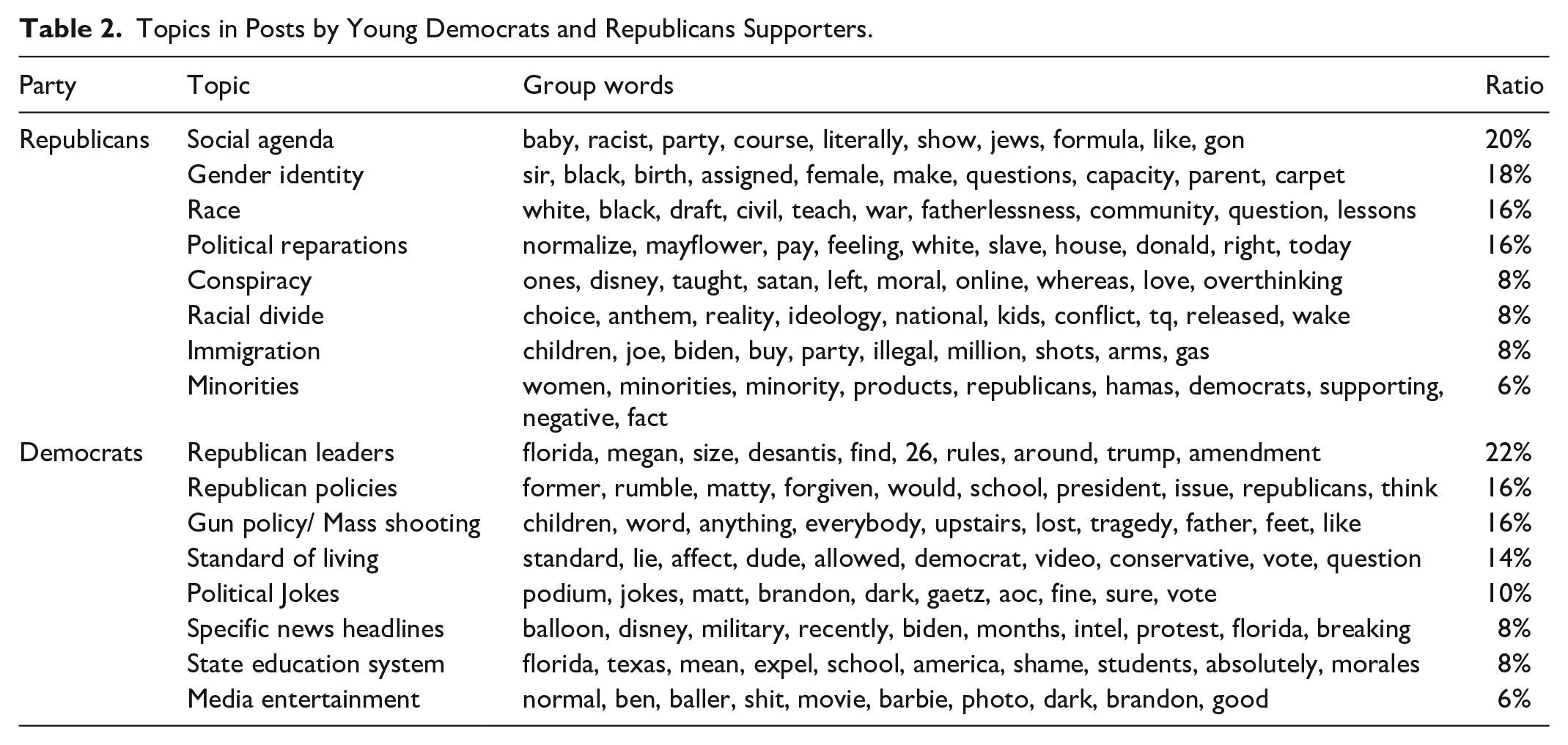
In Democrat supporters accounts, we found that young Democratic supporters’ posts predominantly focused on Republican policies, Republican leaders (Trump, De Santis, and Gaetz), gun control policies, and the education systems of Florida and Texas. Frequently, young Democrat supporters made political jokes; for example, one young Democrat supporter said, “I’m gonna be fine with your jokes, but I’m not sure about dark Brandon,” referencing a “Biden’s Black Brandon” meme, which is very popular online among young Democrat supporters, and was part of Biden’s political campaign (Romano, 2023). In another post, a young Democrat supporter satirically said, “Have you seen this photo of good old dark Brandon and Desantis, what a baller? Look at the face. I love it.” Their posts also involved discourse about fundraising, standards of living, and specific news headlines, such as the Chinese spying balloon, and the Disney-Desantis tension. In support of the Democrats’ social agenda, they also mentioned the Barbie movie, and their discussion targeted conservative political personality Ben Shapiro, that is, “ben” (Table 2) using statement like the following: “This is so funny. Ben Shapiro is getting destroyed online right now because of his reaction to the Barbie movie.”
Interestingly, young supporters of both parties used strong language that targeted their opposition. While posts by young Democrat supporters criticized Trump, using words like “lie,” “sh*t,” and “f*ck,” posts by young Republican supporters criticized Biden. While they used similar words, they presented opposing arguments on the matter, as was the case when mentioning Disney. For example, young Republican supporters attacked Disney and mentioned a conspiracy theory, while young Democrat supporters emphasized Disney’s economic contributions to Florida and their political tension with DeSantis.
To What Extent Does the Public React Differently to Posts by Young Supporters of Democrats and Republicans on TikTok?
To answer the second research question, we performed sentiment analysis and thematic content analysis. The results of our sentiment analysis using the VADER tool are illustrated in Figure 1. As can be seen, we found a higher positive sentiment in comments posted on the Democrat supporters’ posts than in comments on the young Republican supporters’ posts (Democrats 44.49% vs. Republicans 36.65%). We found higher negative sentiment in comments on posts by the Republican supporters compared with comments on posts by Democrat supporters (Republicans 34.55% vs. Democrats 28.72%).

Audiences sentiment in Republicans and Democrats supporter’s account.
Because the mean VADER score for supporters of the Republicans (n = 60,192) and Democrats (n = 64,771) indicates that the intensity of the sentiment was noticeably distributed differently across negative and positive sentiment, we did an independent-sample t test based on the given scores by VADER (Table 3). Our results showed significant differences between the positive and negative sentiments in comments on post by Republicans and Democrats, but with comparatively smaller effect size (Negative t = 7.20, d = 0.07; Positive, t = –28.01, d = –0.25) indicating that the difference between the audience’s sentiments between parties did not differ drastically.
Sentiment Score Distribution in Comments.

Sig. (***p < .001) (two-tailed).
Based on our thematic content analysis, we found significant differences in comments toward posts by young supporters of the Republican and the Democratic parties (Table 4). Serious, ideological support dominated the comments on posts by supporters of both parties; about half of the comments were supportive of the posts toward the young supporters and their political messages (Republican 47.36% vs. Democrat 53.28%). However, the variations between parties were significant but shown a weak association in regard to party; we found weak association between seriousness, ideological reactions, and the party supported by the posts, x2 (1, N = 2500) = 8.76, p < .01, Cramer’s V = 0.06. Overall, the audience were more likely to react in a supportive manner with humor or a serious ideological manner toward young Democrats’ posts than toward young Republicans’ posts. Indeed, we found a small-to-moderate association between humoristic comments and the party supported by the posts, x2 (1, N = 2500) = 44.17, p < .001, Cramer’s V = 0.13. Furthermore, we found that provocative and critical comments were overall less common than supportive comments on posts by supporters of both parties, yet there were significant differences between the supporters of each party. Specifically, we found a small-to-moderate association between sarcasm and the party supported by the posts, x2 (1, N = 2500) = 41.38, p < .001, Cramér’s V = 0.06, and a weaker association between malevolent comments and the party supported by the posts, x2 (1, N = 2500) = 17.09, p < .001, Cramér’s V = 0.08.
Variations in Audience Reactions by Party of Posts.

Sig. (**p < .01; ***p < .001) (two-tailed).
In sum, we found that young Republican supporters and young Democrat supporters prioritize different political topics in their TikTok posts, but they both practice target-based politics in posting about their political opponents. We also found significant differences in audience sentiments toward posts by supporters of the two parties, as well as significant differences in the extent of support and criticism in comments on posts, based on the political leaning of the young supporters who shared them.
Discussion
This study explores the ways young political supporters of Democrats and Republicans use TikTok for political discourse. The findings provide insights into the topics and patterns of young political supporters’ communication on TikTok, and the divide across party lines in audience reactions. We first discuss and explain the similarities and differences in the most prevalent topics that we identified in posts by Democrats and Republicans, based on the topic modeling performed. Then, we discuss and explain the differences in audience reactions to posts by Democrats and Republicans, based on the results of the sentiment and thematic content analyses.
Political Discussion in TikTok Posts by Young Supporters of Democrats and Republicans
Our analysis suggests that TikTok provides a fertile ground for the performative enactment of partisan identities, where young Republicans and Democrats articulate and amplify their ideological divides. Along with ideological differences young supporters of both parties are motivated by their partisan identities (Westfall et al., 2015). Rather than simply expressing support for their own party’s policies, young TikTok users often delineate their political identities by critiquing the perceived “other”; in this case their political opposition. Their discourse revealed the power of outgroup antagonism in shaping collective identity, as indicated by studies showing that online political engagement frequently derives more from animosity toward opposing ideologies than alignment with one’s own (Iyengar & Krupenkin, 2018; Shin & Thorson, 2017; Yu et al., 2024). This is intensified on TikTok even further because older political actors often become the target of negativity as youth perceive the platform as a youth-centric space (Cervi & Tejedor, 2023). Supporters often use these tactics to garner their audience and to engage in collective identity building processes, either by focusing on partisanship or engaging in cross-ideological discussion (Medina Serrano et al., 2020). Often, and as found in our study, this approach could lead toward more partisan-focused and decisive opinions as individuals strongly target their opposition in online engagement. The blunt cynicism we found in posts toward the opposing party and politicians from supporters from both sides imposes an explicit “ideological stress,” as target-based politics is being normalized on the platform by the young supporters, where users may be ideologically “radicalized and biased” (Carson, 2021).
Still, as young supporters of Republicans and Democrats engage in political discourse on TikTok, their posts are grounded in their respective political leaning. Their chosen topics reflect the same issues that Democrat and Republican politicians promote. Republicans promote strong family and pro-life values, stress a biological basis for sex, and call themselves “defenders of the First Amendment Right for Religious Liberty”; the most frequent topics in young Republican supporters’ posts revolve around these same values. Democrats promote the idea of reproductive freedom, endorse the Equality Act (legislation that would make sexual orientation and gender identity protected classes in federal nondiscrimination law), and protect the First Amendment right to free exercise of religion through maintenance of the separation of church and state (Closson, 2024). Due to this agenda, young Democrat supporters’ posts criticize Republicans to promote their own values. While both Republicans and Democrats prioritize family, they differ in their meanings of “life” (Silver & van Kessel, 2021).
Furthermore, posts by young supporters of Democrats and Republicans differ from each other in their alignment to the messages of their party’s platforms and politicians. The Republican party is primarily driven by ideological consistency and conservative principles, while the Democratic party represents a coalition of diverse interest groups (Grossman & Hopkins, 2016). We found that to some extent (between 8% and 10%), young Democrat supporters embrace satire, and young Republican supporters embrace conspiracy. Both tactics are used by young political supporters to increase audience engagement. In their posts, young Republican supporters’ embracing of conspiracy resembles prior research findings indicating that conservatives are more prone to endorse conspiracies than liberals (Enders et al., 2023; Enders & Smallpage, 2019). Conspiracies are often distributed across ideological lines (Van Prooijen & Douglas, 2017) and are associated with political affiliation (Uscinski et al., 2016), degree of political extremism (Van Prooijen et al., 2015), and with low political trust (Douglas et al., 2019). Conspiracies may hold unique roles in the digital age as individuals may utilize conspiratorial beliefs to seek validation and foster a sense of community, particularly within online spaces designed for community engagement. For example, anti-vaccination groups often leverage conspiratorial narratives to strengthen their group identity and enhance online engagement on community-oriented digital platforms (Douglas et al., 2019). Indeed, as young Republican supporters’ narratives accuse Disney of moral decay and promotion of Satanic values or Democrats of establishing the KKK, they may increase their audience engagement. These messages may also promote a sense of belonging between individuals who align themselves with the same political ideologies (Dow et al., 2023). In fact, scholars have suggested that supporters of each political party tend to endorse conspiracies that align with their own partisan biases while painting the opposing party as a threat (Albertson & Guiler, 2020). Another difference between posts by young supporters of the two parties that emerged from our analysis shows that posts by young Democrat supporters try to create a similar sense of belonging and ideological alignment with their audience through humorous content. This tendency to engage in “politainment,” a blending of politics with entertainment, has been increasingly documented in recent studies of social media political communication (Cervi et al., 2023; Cervi & Marín-Lladó, 2021). It was evident in the “Dark Brandon” meme and the frequent use of slang words like “dude,” “baller,” and “sh*t.” Bringing slang and politainment into their posts enhances their appeal, much like the broader appeal of the politainment phenomenon on social media. While politainment may trivialize the seriousness of political issues, it may also make political content more accessible and engaging for the audience; young Democrat supporters adopting politainment may effectively and positively promote their agendas. TikTok, which emphasizes short and engaging videos, often leads to a preference for “infotainment” (information mixed with entertainment), also a term closely aligned with politainment, over serious political content (Karimi & Fox, 2023), and the socio-technical features of the platform serve as the building blocks for politainment. While discussion topics by the young political supporters on TikTok reflect their traditional “ideological rigidity” (Hofstadter, 2012), more creative and engaging tactics like politainment and conspiracies could lead to greater audience engagement. Politainment could enable a broader reach, particularly among young audiences who may not purely resonate with core or strong ideological discourse. However, the potential success of political entertainment in driving higher engagement has yet to be explored in depth.
Audience Reactions to TikTok Posts by Young Supporters of Democrats and Republicans
Our sentiment analysis of comments on posts by young supporters of the two parties reveals that content produced by young Democrat supporters tend to resonate more positively with their TikTok audience, while young Republican supporters’ content garnered more negative reactions. These findings were consistent with the results of our thematic content analysis; comments on young Democrat supporters’ posts involved more support and encouragement through humoristic and serious comments, while comments on young Republican supporters’ posts involved more provocation and criticism through sarcasm and malevolent comments. Although the effect size was small, our t test analysis indicates that while differences exist in audiences’ sentiments toward those young partisan supporters, they may not be as extreme as one might expect in the context of broader political polarization observed on other social media platforms (Iyengar & Krupenkin, 2018). The relatively moderate sentiment differences may be a result of an echo chamber or imply that TikTok, while subject to polarization, might still provide opportunities for more balanced discourse with “cross-ideological” interactions. Indeed, the vast majority (about 70%) of the comments on posts by young political supporters of both parties included supportive and encouraging messages, and about half of the comments involved serious (not humoristic) support. Malevolent comments were rare, making up less than 15% of the total comments. Although TikTok algorithm often fosters echo chambers, reinforcing preexisting partisan viewpoints and contributing to political polarization (Karimi & Fox, 2023), it may also serve both as a space for resilience and vulnerability (Literat & Kligler-Vilenchik, 2023). Meaning whether the algorithm spreads messages to politically diverse audiences or simply reinforces the echo chamber could often lie a matter of audience’s individual engagement and preferences.
Since TikTok is increasingly gaining popularity as a news consumption platform (Lepperd & Maatza, 2024), our findings call attention to the platform’s potential as a significant space for political discourse, particularly given its large young user base (Bestvater, 2024; Dean, 2024). We found that over 30% of the comments on posts by young supporters of both parties were not serious nor malevolent, but rather they were humoristic or sarcastic. The prevalence of humor and sarcasm in audience reactions not only echoes and expands prior research (Fichman & Akter, 2024) but also suggests that politainment is common on the platform and is probably an effective strategy for engaging younger audiences and reinforcing messages within largely sympathetic audiences (boyd, 2008; Burns-Stanning, 2020). Indeed, the thematic analysis findings reflect broader trends in online political discourse, where humor and politainment can foster more positive audience engagement (Cervi et al., 2023).
Limitations
Our study’s observed limitations include the following: Data analysis from one social media platform, in this case TikTok, cannot fully capture the complexities of political engagement or the depth of young people’s political ideologies, nor can it give the full picture of the overall online community. Thus, future research may expand into other platforms and online communities. Another limitation is our strategy to use purposive sampling to select the accounts that limits the generalizability of the results. Future studies could use bigger samples that address some of the methodological limitations of our computational analysis and include a more diverse range of accounts to better represent the spectrum of political beliefs among young people. Nonetheless, the purposeful sample is appropriate for our aims and very useful for thematic content analysis, and our findings provide an exploratory examination of the accounts and their political discourse on TikTok. In addition, due to the small sample size, we did not train an LDA topic model on our own data corpus; this represents a methodological limitation that future research should address. To mitigate this, we incorporated manual observation along with qualitative interpretations to provide greater contextual depth to our findings. The sentiment analysis conducted using the VADER tool also presents limitations. As prior research has noted, VADER is not well equipped to detect more complex linguistic phenomena such as sarcasm and irony (Sykora et al., 2020). We sought to address this by complementing sentiment analysis with a qualitative, human-coded thematic analysis. However, our decision to analyze only 25 randomly selected comments per post further constrains the representativeness of our qualitative insights. Future studies should consider expanding the scale of comment analysis to capture a more nuanced and representative range of discourse.
Conclusion
Younger generations’ distrust in traditional political institutions and their leaders often make them strive for change (Della Volpe, 2022) by challenging existing social structures (Kaplan, 2020) and enacting contemporary activism (Hess, 2021), but the question of how their thoughts and actions transform traditional mainstream political practices remains largely unanswered. Our study makes a significant contribution in addressing this research gap and provides insights into the voices of younger individuals and their communities on TikTok as they engage in partisan online political discourse.
We found significant variations in topics between young supporters of Democrats and Republicans, as well as significant differences in audience reactions to these posts, both in the sentiments and the content of the comments. The discourse of young political supporters of both parties on TikTok was largely driven by targeting opposing ideologies. This may suggest that the youth may be increasingly drawn to combative and ideologically rigid tactics following their political leaders in communication style and ideologies. Their political messaging closely aligns with their respective parties’ ideologies, leverages the platform’s socio-technical features to engage with their audiences, either as a means of reinforcing their shared ideologies or exhibiting politainment through humor and sarcasm.
The long-term impact of these communication strategies on the political landscape, whether they are driving meaningful change or further entrenching partisan divide remains to be seen. These findings raise critical questions about the role of social media in potentially exacerbating political polarization and emphasize how community behaviors on such platforms may contribute to reinforcing partisan divides among the youth. However, future studies are required to substantiate and further explore this claim. Expanding on these insights will provide a clearer understanding of the long-term implications of platform-driven political discourse and explore the extent to which the younger generation’s digital engagement changes mainstream politics. Future research may provide a better understanding of this complexity, the motivations behind posts and comments, and the audience’s perceptions of political communication on TikTok through in-depth interviews, focus groups, or any experimental study. Furthermore, future research may also aim to better delineate the correlations between audience behaviors, content sharing, and their political leaning to examine how platform, users demographic and political ideology shape online communication.
Footnotes

Ethical Considerations
This research has been approved by the office of Institutional Review Board at Indiana University Bloomington.
Funding
The author(s) received no financial support for the research, authorship, and/or publication of this article.
Declaration of conflicting interests
The author(s) declared no potential conflicts of interest with respect to the research, authorship, and/or publication of this article.
Data availability statement
The data generated and analyzed during the current study were publicly available.