



Abstract
Drawing from dynamic systems theory, we examine how incivility is collectively constructed in an online discussion community. Using secondary data consisting of comments shared over a 3-week period to an online news community, we identified three sequences that reflect collective incivility practices. Whereas the persistent incivility sequence included a large proportion of uncivil comments, incivility occurred infrequently in the sporadic incivility sequence and not at all in the no incivility sequence. Once the persistent incivility or sporadic incivility sequences appeared, discussions were more likely to return to these sequences than the no incivility sequence. Contrary to our predictions, sequences containing incivility shaped discussion processes by depressing explicit expressions of agreement and disagreement. The results of this study demonstrate how the collective behavior of online community members contributes to the production and effects of incivility.
Incivility, which involves “features of discussion that convey an unnecessarily disrespectful tone” (Coe et al., 2014, p. 660), has been a topic of considerable interest among pundits and scholars alike in recent years. Even as certain forms of incivility sometimes serve the greater good, the potential for societies to function constructively and productively is at least in part contingent upon their ability to demonstrate in their public discourse some basic level of mutual respect (Boatright, 2022; Chen et al., 2019; Herbst, 2010). Researchers examining incivility—particularly incivility online—have considered intrapersonal (e.g., Kenski et al., 2020; Kim et al., 2021), message (e.g., Hwang et al., 2018; Muddiman & Stroud, 2017), contextual (e.g., Jakob et al., 2023; Lu et al., 2023), and other factors that shape an individual’s likelihood of being uncivil or their responses to incivility from others. These works have made important contributions to our understanding of incivility, demonstrating from whom, when, and why it is likely to appear online, as well as with what effects.
One important issue that remains to be addressed involves the role of collective action in producing and sustaining incivility on social media and related contexts. Online discussion communities, for example, are constituted of people who come together to share their ideas and opinions about topics of common interest. Such spaces are varied and widely used. In the United States alone, more than one in five adults report visiting the popular discussion site Reddit (Pew Research Center, 2024). Discussions in this type of online community are generally situated in a threaded structure in which contributions from individual members are displayed in order of chronology or popularity. Although researchers studying incivility in social media often focus on individuals (e.g., Hwang et al., 2018; Kenski et al., 2020; Lu et al., 2023; Muddiman & Stroud, 2017; Papacharissi, 2004) or entire digital spaces (e.g., Jakob et al., 2023), incivility can also be thought of as a phenomenon that emerges from the collective action of members. The threaded structure of discussions means that incivility typically appears as part of a sequence of messages from members that make up a thread. A message contributed by any given member appears in a thread adjacent to other members’ messages that may or may not contain incivility. Consequently, incivility is not simply the product of a single individual. Rather, it stems from the collective practices of interdependent actors over a series of adjacent contributions within and across discussion threads.
Given this, research is needed that examines incivility as a collective phenomenon. A few recent studies have taken initial steps in this direction, looking at how social norms (Shmargad et al., 2022) or feelings of communal connection (Van Duyn & Muddiman, 2022) relate to incivility in online discussion. We take an important next step, using dynamic systems theory (Thelen & Smith, 2006) to explore how incivility is collectively constructed in online communities dedicated to the discussion of news. We focus on sequences that form in the presence of incivility among consecutive comments contributed in response to a given news story (e.g., comment one [contains incivility] → comment two [contains incivility] → comment three [contains incivility] → comment four [no incivility] → comment five [no incivility]). Using secondary data consisting of online discussions, we first identify different patterns in the sequences of incivility among consecutive comments. From the perspective of dynamic systems theory (Thelen & Smith, 2006), these sequences are attractor states reflecting collective incivility practices that can have downstream effects on later thread contributions. We then evaluate how those sequences of incivility impact discussion processes. The results from this project add to scholarship on incivility by offering insights about how the collective behavior of community members in online spaces contributes to the production and effects of incivility.
Incivility online
Although questions about civility in public discourse online emerged along with widespread diffusion of the internet (Benson, 1996), interest in this topic has intensified over the past decade (Boatright et al., 2019). We conceptualize incivility as a multidimensional construct involving specific behaviors like name-calling, aspersion, pejorative for speech, vulgarity, and lying accusations (Coe et al., 2014). Name-calling, aspersion, and pejorative for speech focus on disparaging a person (name-calling), idea (aspersion), or the way someone communicates (pejorative for speech). Vulgarity includes profane speech, and lying accusations involve claims that a communicator is being dishonest. Scholars studying incivility from this and related perspectives have worked to document the prevalence of incivility in online spaces (e.g., Jakob et al., 2023; Kim et al., 2021; Szabo et al., 2021), consider factors that contribute to its use (e.g., Gervais, 2015; Kenski et al., 2020; Kim et al., 2021), evaluate its outcomes (e.g., Hwang et al., 2018; Muddiman & Stroud, 2017), and other endeavors. Despite considerable progress, much remains to be learned about incivility online.
We address a gap in research stemming from the way this construct tends to be thought about and studied. Much of existing research examines incivility at the individual level, focusing on how individuals perceive or use incivility (e.g., Coe et al., 2014; Lu et al., 2023; Muddiman & Stroud, 2017). Scholars have, to a much lesser degree, also considered uncivil behavior across an entire online space like a social network site or news community (e.g., Jakob et al., 2023; Sun et al., 2021). These works focus on comparing and contrasting incivility in different types of digital spaces. Just as there is merit in examining incivility among individuals and whole communities, there is also merit in understanding incivility as it is constructed by collections of people whose behavior is interdependent. Social media tends to be communal in nature such that the behavior of any one individual is informed and shaped by the behavior of others. This occurs in part due to the visibility afforded by these technologies where contributions to a discussion can be observed by most or all community members (Treem & Leonardi, 2013).
Whereas existing work on incivility has tended to focus on micro or individual levels (e.g., Coe et al., 2014; Lu et al., 2023; Muddiman & Stroud, 2017) and macro or community levels (e.g., Jakob et al., 2023; Sun et al., 2021), there remains a meso or group/collective level situated in between that warrants attention. From this perspective, incivility can be thought of as a collective phenomenon that is produced through the interdependent and mutually contingent behavior of members. Incivility is shaped by the messages that proceed it in a discussion, and incivility also shapes the types of messages that follow (Lu et al., 2023; Shmargad et al., 2022). This may result in contributions from members forming broader patterns that represent collective incivility practices. In other words, incivility is not just about individuals acting in isolation; it is about groups producing the communicative conditions that make incivility more or less likely. Learning more about how incivility manifests among collectives on social media is an important objective for building the scholarship on this topic. Dynamic systems theory (Thelen & Smith, 2006) provides a useful theoretical framework from which to explore this possibility.
Dynamic systems theory
Dynamic systems theory emerged from the broader general systems approach to explain how systems self-organize (Thelen & Smith, 2006). Systems are conceptualized broadly in the theory as a collection of interdependent components that change over time, such as individuals participating in an online community. This theory has been used to explain developmental processes in humans (Granic et al., 2016; Newman & Newman, 2020; Thelen & Smith, 2006) as well as examine dyadic (Solomon et al., 2021) and group (Meinecke et al., 2019) interaction. For example, Solomon et al. (2021) showed how talk in supportive conversations coalesces into patterns as part of a broader dynamic system. When support seekers asked questions, support providers were more likely than expected to respond with elaboration. This pattern represented a source of stability in the conversational system.
The dynamic system examined in this project involved an online community dedicated to the discussion of news articles appearing in a local newspaper. The news community was structured around discussion threads dedicated to individual stories. Consistent with many other online discussion forums, each contribution appeared as part of the thread in the order in which it was contributed, and all messages in the thread were visible to the entire community. Three elements of dynamic systems theory—attractor states, reciprocal causality, and system hierarchy—provide a framework to better understand the collective development of incivility in communities such as this one and the implications of those patterns for community processes.
A central idea in dynamic systems theory (Thelen & Smith, 2006) is that, despite existing in a state of perpetual change, dynamic systems tend to coalesce into relatively stable patterns that are called attractor states (Granic et al., 2016; Thelen & Smith, 2006). These attractor states are regularly occurring patterns in the behavior of a system. We focus the presence of incivility across consecutive contributions to discussion threads to identify patterns that emerge in how community members use incivility. Discussions are unique in online communities in part because the communities typically afford visibility in which the contributions of individual members are observable to others. One way that discussions are structured is by listing comments in chronological order based on the time when they were posted. This structure creates the potential for patterns to form based on the presence or absence of incivility in consecutive comments that reflect collective practices of using incivility (e.g., comment one [contains incivility] → comment two [contains incivility] → comment three [contains incivility] → comment four [no incivility] → comment five [no incivility]). A common starting point for understanding a dynamic system involves documenting its attractor states (Granic et al., 2016; Thelen & Smith, 2006). In this case, we pose a research question to identify patterns in the sequences of uncivil behavior during discussion. Patterns that emerge in sequences of incivility are the attractor states in the community that are formed through coordinated behavior of members:
Attractor states are important in a dynamic system because they possess a kind of gravity that pulls the system toward that state (Granic et al., 2016; Thelen & Smith, 2006). In the context of conversations between two people, attractors form when a particular type of talk from one person yields a specific response from the other person (Solomon et al., 2021). In supportive conversations, for example, Rains et al. (2023) found that support seekers were more likely to change the topic after receiving low-quality support from providers. This pattern appeared consistently across conversations. In the context of incivility, scholars have documented a general trend in which uncivil behavior tends to beget more incivility (Gervais, 2015; Kim et al., 2021). A meta-analysis examining organizational behavior documented an “incivility spiral” in work settings in which a person who is the target of incivility later becomes a perpetrator (Park & Martinez, 2022, p. 10). Notably, this trend appeared even when participants only observed uncivil behavior targeting others, as opposed to being targeted themselves.
Building from these findings, we advance research in this area by examining the potential for collective incivility patterns to reappear throughout a discussion. As attractor states (Granic et al., 2016; Thelen & Smith, 2006), the appearance of an incivility sequence should make that specific pattern more likely than other sequences to reappear later during discussion. Following dynamic systems theory, a given incivility pattern should exert a pull on the system to return to that same pattern later within a discussion. Accordingly, we expect to see specific incivility sequences recur within discussion threads:
Dynamic systems are maintained by reciprocal causality that functions like a feedback loop within components at the same level of a system (Granic et al., 2016; Lougheed & Keskin, 2021). The expression of emotion and arousal during conversation, for example, can be mutually reinforcing through reciprocal causality (Lougheed & Keskin, 2021). In the case of incivility in an online discussion community, the notion of reciprocal causality suggests that attractor states that form sequences of incivility should be sustained over time through their connection to other elements of discussions. One factor likely to be important involves reinforcement in the form of audience feedback.
Researchers have shown that incivility can yield engagement in the form of both approval and disapproval. Muddiman and Stroud (2017) reported a positive association between incivility in comments appearing in New York Times articles and both reader recommendations as well as abuse flags. Kim et al. (2021) found a positive relationship between the toxicity of comments and likes on Facebook. In our previous work (Coe et al., 2014), we evaluated a community where users had the opportunity to register a positive or negative evaluation of a comment that was displayed as a running total appearing along with the comment. Uncivil comments received significantly more negative evaluations than comments without incivility. Although the trend was similar for positive evaluations, the difference between civil and uncivil comments was not statistically significant.
We make a unique contribution in this project by considering how engagement with collective incivility practices serves to further those practices in future contributions to a thread. Following the idea of reciprocal causality in dynamic systems theory (Granic et al., 2016; Lougheed & Keskin, 2021), we examine how audience engagement with sequences containing incivility encourages the reoccurrence of those same sequences later in a discussion. Audience engagement, in other words, moderates the likelihood that an incivility sequence recurs in a discussion. We expect that sequences rewarded with more engagement in the form of positive and negative evaluations will be more likely to recur within a discussion than sequences that receive less engagement. Engagement should function as part of reciprocal causality in the system, signaling that sequences with incivility have received the attention—both negative and positive—of the community and encouraging these practices to be repeated:
A final aspect of dynamic systems theory relevant to incivility in online communities involves the idea of system hierarchy (Granic et al., 2016). Systems are hierarchical structures in which lower levels that have more basic functions combine to create higher levels with more complex functions. From this perspective, patterns of incivility should operate in conjunction with other processes and give rise to more complex discussion practices. Online deliberation quality is a multidimensional construct consisting of incivility along with a collection of other factors (Friess & Eilders, 2015; Friess et al., 2021). One particularly relevant to online news discussion is interactivity in which participants engage with one another’s ideas (Friess & Eilders, 2015). Interactivity can be—but is not always (Stromer-Galley, 2004)—a part of healthy deliberation by indicating that people are listening to one another.
We examine interactivity in the form of expressions of agreement and disagreement with the contributions from other users (Friess & Eilders, 2015). This perspective of interactivity reflects the notion of give and take that is central to deliberation by capturing efforts to affirm or counter others’ contributions. Incivility has been argued to both stem from (Rossini & Maia, 2021) as well as foster (Hwang et al., 2018; Rossini, 2022) disagreement, and the connection between these two variables has been documented in experimental (Hwang et al., 2018) and observational (Rossini, 2021, 2022; Rossini & Maia, 2021) research. In particular, Hwang et al. (2018) found that incivility caused antipathy toward a discussion partner advocating an opposing position, which ultimately led to greater expressions of disagreement and fewer expressions of agreement. The notion of system hierarchy in dynamic systems theory (Granic et al., 2016) suggests that incivility should be connected to other elements as part of broader discussion practices. Incivility and expressions of (dis)agreement should function interdependently as part of the more general process of online deliberation (Friess & Eilders, 2015; Friess et al., 2021). Accordingly, we expect that incivility will co-occur with expression of agreement and disagreement as well as foster expression of agreement and disagreement in future contributions to a discussion thread. Disagreement will be more likely to appear and agreement will be less likely to appear in and following sequences that include incivility relative to sequences without incivility:
Method
The data for this project are from a 3-week census of comments made in response to news stories posted on the website for a newspaper representing Tucson, Arizona. Three previous manuscripts have been derived from the dataset. All previous projects examined incivility at the level of individual comments. The analyses conducted for this project—examining incivility at the level of sequences of consecutive comments—are unique to it and have not been previously reported. A document outlining prior uses of the dataset appears on the Open Science Framework (OSF) dedicated to this project. 1
Sample and content analysis
All articles and comments posted on the website operated by a local newspaper (i.e., Arizona Daily Star) during a 3-week period (21 consecutive days) during 2011 were manually downloaded by the authors. A span of 3 weeks was selected because it generated the maximum amount of data that could be evaluated by our coders. A total of 706 unique articles were identified consisting of 6535 total comments. Teams consisting of three to five undergraduate students, who were unaware of the study’s hypotheses, were trained on an extensive codebook to evaluate the articles and comments over the course of approximately 6 weeks. The variables examined in this study are described briefly below with the complete operational definitions reported in Table 1. Intercoder agreement was computed using Krippendorff’s alpha.
Operational Definition for All Variables Evaluated in This Study.

Incivility (α = .65) was operationally defined in terms of the presence of one or more of five specific behaviors (also see Table 1): name-calling (i.e., disparagement directed at a group or person; α = .67), aspersion (i.e., disparagement directed at an idea or policy; α = .61), lying accusations (i.e., stating that an idea is disingenuous; α = .73), vulgarity (i.e., profanity; α = .91), pejorative for speech (i.e., disparaging how someone communicates; α = .74). In addition to these behaviors, comments that were removed by newspaper staff for violating community guidelines (n = 110 comments; 1.7%) and replaced with the “comment removed” label were also included in an effort to be exhaustive. 2 A comment was deemed uncivil when it included one or more of the five message features or had been removed. Agreement (α = .84) was operationally defined in comments as a statement signaling support for a previous contribution to the discussion. Disagreement (α = .84) was evaluated in terms of statements indicating opposition to a previous contribution. Because comments were evaluated in the order in which they appeared during discussions, coders were able to determine when a given comment addressed a previous idea advanced in the discussion thread.
The total number of comments and message engagement were determined using data reported on the newspaper website. A number was assigned to each comment based on the chronological order in which it was contributed to a discussion. The total number of comments for each discussion was counted. The newspaper website had a feature that allowed users to evaluate each comment by clicking on an icon displaying a thumbs-up icon (indicating approval) or thumbs-down icon (indicating disapproval). Comment engagement was evaluated by summing the number of thumbs-up and thumbs-down ratings for each comment and then computing the mean rating for each sequence. This value reflects the degree to which users, on average, engaged with the comments in a sequence.
Procedures for data analysis
Data analysis proceeded in a series of steps. Sequence analysis was used to answer the research question and identify sequences of incivility in comments made to discussions. Multilevel modeling was then used with the sequences identified in the previous step to test the hypotheses. The analyses were conducted in R using the TraMineR package (Gabadinho et al., 2011) for the sequence analysis and glmmTMB package (Brooks et al., 2017) for the multilevel models. Data and script necessary to replicate the hypothesis tests can be found on the OSF page for this project.
Results
Sample descriptives
After removing duplicates from the original sample of 6535 comments, there were 6444 remaining comments from 310 discussions. Incivility was included in 1419 comments. On average, discussion threads included 20.79 comments (SD = 46.11, Mdn = 4), and a typical comment included a total engagement mean of 21 thumbs-up/down ratings (SD = 29, Mdn = 14). There were 165 comments containing expressions of agreement, and 69 comments containing expressions of disagreement. Our analyses focused on patterns among groups of consecutive comments that reflect collective incivility practices.
Identifying sequences of incivility
Our research question asked about patterns in sequences of incivility appearing in consecutive comments made in discussions of news stories online. Sequence analysis (MacIndoe & Abbot, 2004) is a data-driven approach that makes it possible to identify patterns in consecutive messages and was used to answer this question. The number of messages included in a sequence and number of sequences extracted are determined by the researchers based on statistical information and the conceptual coherence of the results. Our goal in applying sequence analysis was to identify the largest segment of consecutive comments that produced coherent sequences in the use of incivility. Accordingly, we adopted an iterative approach that followed prior work applying sequence analysis to communication phenomena (Solomon et al., 2021).
A starting point for sequence analysis involves determining the number of consecutive comments to include in a sequence. We evaluated sequences consisting of 3, 5, 7, 10, and 20 consecutive comments to consider a range of possibilities. For each sequence length (e.g., three consecutive comments), we constructed a moving window to extract comments from discussion threads. Each individual comment was coded as containing or not containing incivility. In examining three comment windows, for example, the first window consisted of the first three comments appearing in chronological order, the second window included comments two through four, the third included comments three through five, and so forth. Once all possible moving windows had been extracted from each thread in the sample, we applied sequence analysis (MacIndoe & Abbot, 2004) using the optimal matching algorithm to identify dissimilarities between sequences. A constant substitution cost of two was applied. Sequences were clustered hierarchically to identify those sequences that were similar based on the presence/absence of incivility among the ordered comments in the moving window. The number of clusters was determined using the resulting dendrogram and the coherence of clusters.
Returning to our goal of capturing the largest possible number of consecutive comments that produced coherent sequences, we selected a window of seven comments configured into three sequences. For comparison, we have posted sample solutions for different sequence lengths for the seven-comment window as well as the three-sequence solutions for windows of 3, 5, 10, and 20 consecutive comments on our OSF page. There were 108 articles with seven or more comments, resulting in 5282 windows of seven consecutive comments. Following the conventions of sequence analysis, we labeled the three sequences based on the patterns they contained. As illustrated Figure 1, a persistent incivility sequence (n = 1318, 25% of windows) was observed in which incivility appeared regularly in half or more of the comments. This sequence was unique in that incivility consistently appeared throughout the seven comments. The second sequence was labeled as sporadic incivility (n = 2749, 52% of windows) and consisted of incivility occurring one or a small number of times. Incivility was infrequent in this set of comments. The final sequence, labeled no incivility (n = 1227, 23% of windows), contained no instances of incivility. These three sequences served as the basis for the remaining analyses.

Sequences of incivility in seven consecutive comments made to discussion threads.
Incivility sequences as an attractor state
H1 predicted that the appearance of an incivility sequence during discussion will make that same sequence more likely to appear later within a discussion relative to other sequences. H2 further predicted that reader engagement would moderate the relationship predicted in H1 such that sequences yielding greater levels of reader engagement would be more likely to reappear. A series of negative binomial multilevel models were tested to evaluate these predictions. The models evaluated how frequently incivility sequences recurred during the next 14 windows in the discussion. Fourteen windows were selected as the evaluation frame to hold constant the volume of discussion being examined; because each window that makes up a sequence consists of seven consecutive comments, 14 moving windows reflects an observation period that spans three times the original sequence length. The outcome variable for the models consisted of count data reflecting the number of times a given sequence appeared in the next 14 windows (possible range = 0–14). Given count data with the potential for a large number of zeros, negative binomial models were tested. Separate analyses were constructed for each of the three sequences of incivility following the same form: The first model included two dummy-coded variables capturing the presence of a given type of sequence with the no incivility sequence serving as the reference group along with the mean engagement for the comments that made up the sequence. The second model consisted of the previous two variables and their interaction. A random intercept was included for each discussion thread to account for the nesting of comments within discussion threads. The results appear in Table 2.
Incivility Sequence and Comment Engagement as Predictors of Subsequent Incivility.

Note. The outcome variable was the number of the next 14 windows that were composed of a given incivility sequence. Comment engagement was evaluated as the mean number of thumbs-up and thumbs-down ratings for the seven consecutive comments that make up a sequence. A random intercept was included for each discussion thread. Marginal R2 only accounts for the fixed effects; Conditional R2 accounts for the fixed and random effects. IRR = incidence rate ratio; 95% CI = 95% confidence interval; ICC = intraclass correlation.
As can be seen in Model 1 reported in Table 2, the persistent incivility sequence was more likely to recur in the 14 windows after it first appeared than following the no incivility sequence. The incidence rate ratio (IRR) indicated that the persistent incivility sequence was 2.19 times as likely to recur after an initial persistent incivility sequence than the no incivility sequence. The sporadic incivility sequence was 1.19 times as likely to recur in the next 14 windows following the sporadic incivility sequence compared with the no incivility sequence. Finally, the no incivility sequence was more likely to recur than either the persistent incivility sequence or the sporadic incivility sequence. Recall that the no incivility sequence was the reference group, so an IRR less than zero for the persistent (IRR = .49) and sporadic (IRR = .62) incivility sequence coefficients indicate that the no incivility sequence was more likely. These patterns collectively support H1 and offer evidence that the appearance of each incivility sequence makes it more likely for that same sequence to reappear subsequently during discussion threads.
As reported in Model 2 of Table 2, two-way interactions between a given sequence type and engagement for the likelihood of the same sequence appearing in the next 14 windows was statistically significant for the sporadic incivility sequence and the no incivility sequence. The interaction effects have been illustrated in Figure 2. As can be seen in that figure, the patterns are inconsistent with H2. Increased engagement with the no incivility sequence made sporadic incivility more likely in subsequent comments (Figure 2a); increased engagement with the no incivility sequence also made the no incivility sequence less likely in subsequent comments (Figure 2b). These findings will be further considered in the discussion section.
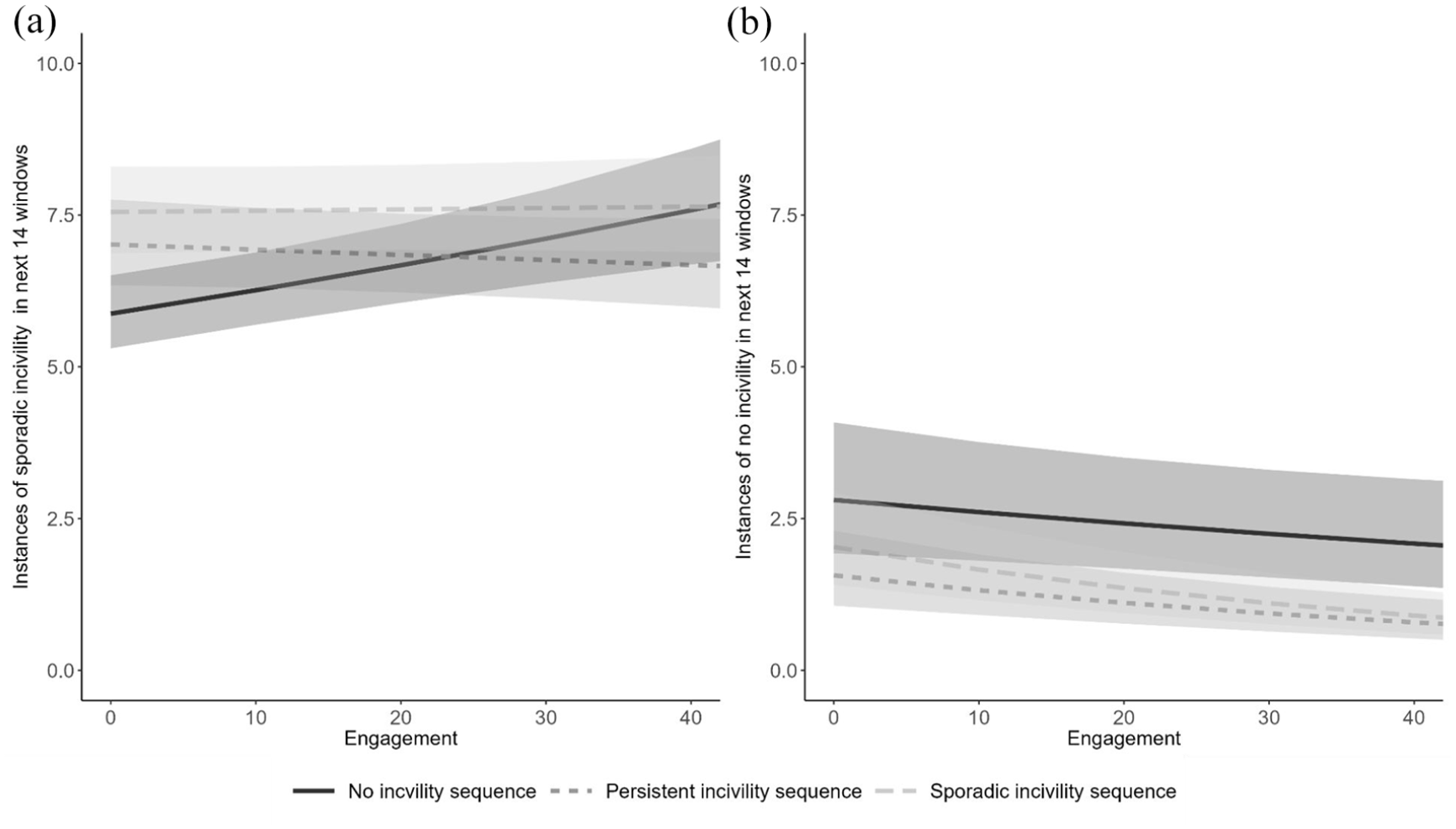
Incivility Sequence × Comment Engagement. (a) Sporadic incivility sequence, (b) No incivility sequence.
Incivility and (dis)agreement
H3 and H4 predicted that sequences of comments containing incivility will be more likely to include (H3a) and be followed by (H4a) expressions of disagreement and less likely to include (H3b) and be followed by (H4b) expressions of agreement. Because expressions of (dis)agreement appeared infrequently in less than 15% of all complete seven-comment windows (agreement = 14%; disagreement = 7%), we dichotomized this variable to reflect the presence (coded as 1) or absence (coded as 0) of each behavior in the comments that make up a sequence (H3) or the 14 windows of comments appearing after the sequence (H4). Logistic multilevel modeling was used to test these hypotheses. Given the three sequences, two dummy-coded variables were again constructed with the no incivility sequence serving as the reference group. Each model included the two dummy-coded variables as predictors of the dichotomous outcome involving the expression of (dis)agreement. The results appear in Table 3.
Incivility Sequences and Expressions of (Dis)Agreement.
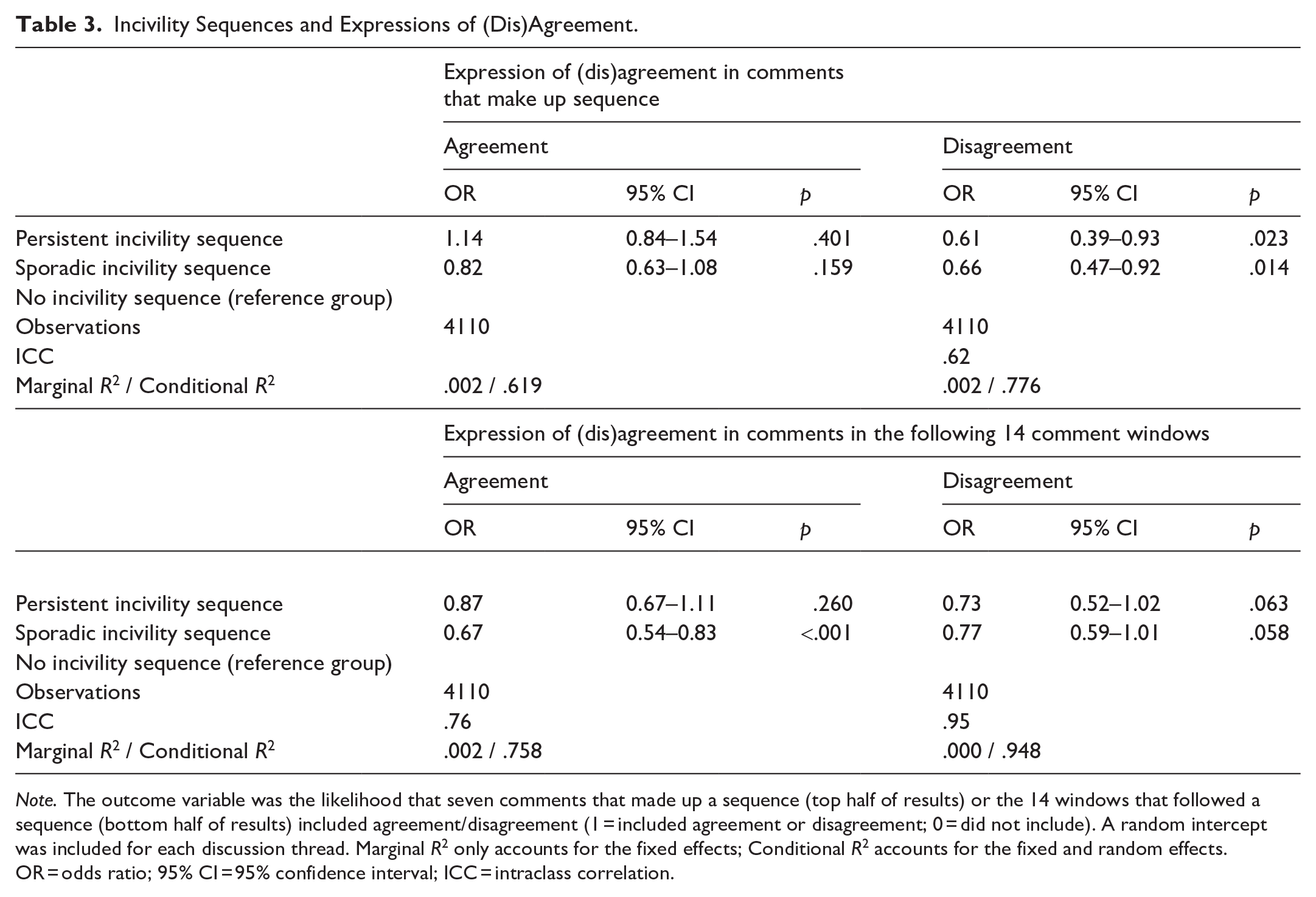
Note. The outcome variable was the likelihood that seven comments that made up a sequence (top half of results) or the 14 windows that followed a sequence (bottom half of results) included agreement/disagreement (1 = included agreement or disagreement; 0 = did not include). A random intercept was included for each discussion thread. Marginal R2 only accounts for the fixed effects; Conditional R2 accounts for the fixed and random effects. OR = odds ratio; 95% CI = 95% confidence interval; ICC = intraclass correlation.
The first set of analyses examined the presence of (dis)agreement expressions within the seven comments that make up a sequence. As reported in Table 3, the persistent incivility sequence and sporadic incivility were both significantly less likely to include expressions of disagreement compared with the no incivility sequence. The odds ratios (ORs) indicate that the odds of disagreement were .61 times as likely in the persistent incivility sequence and .66 times as likely in the sporadic incivility sequence. These findings are inconsistent with the prediction made in H3a. There was no difference between the sequences in expression of agreement. H3b was not supported.
The next set of analyses examined the presence of (dis)agreement in the comments appearing in the 14 windows after a sequence. As shown in the bottom half of Table 2, agreement was significantly less likely following the sporadic incivility sequence than the no incivility sequence. Agreement was .67 times as likely following sporadic incivility. This pattern provides partial support for H4b. None of the other coefficients were statistically significant. H4a was not supported.
Robustness tests
We conducted a series of analyses to investigate the robustness of the results. In conducting our sequence analysis, we chose to focus on windows of seven consecutive comments because they produced the most coherent sequences. Readers may wonder, however, whether the results were an artifact of this decision. Accordingly, we reconducted the analyses using windows consisting of five and 10 consecutive comments. The three sequence solutions for both sets of analyses contained patterns that were similar to the no, sporadic, and persistent incivility patterns we observed with the seven-comment window. These results appear in a Supplementary file on our OSF page. We next replicated our hypothesis tests using the sequences constructed from five and 10 consecutive comment windows. As can be seen in the Supplementary file on our OSF page, the results largely follow the same patterns as reported in the article. The most notable discrepancies are in the analyses involving (dis)agreement. Sequences generated from five-comment windows did not replicate the results for disagreement in the following comments, whereas the sequences generated from 10 comment windows did not replicate the results related to disagreement within the comment that make up a sequence. Despite these discrepancies, the analyses generally offer evidence that our findings were not an artifact of focusing on a window of seven consecutive comments.
We conducted a second set of analyses to address concerns readers may have with our exclusion of control variables in the analyses conducted for our hypothesis tests. We reconducted the analyses for H1 through H4 including the total number of comments generated by a discussion thread and a second random intercept for the section of the newspaper (opinion, news, sports, etc.) from which the articles being discussed appeared. The results, which appear in a Supplementary file on our OSF page, were the same as reported in the article. There were no instances where a statistically significant coefficient became nonsignificant or vice versa. This second set of analyses should provide additional assurance that the findings reported in this article are robust.
Discussion
This project advances scholarship on incivility by examining it as a collective phenomenon in social media. We leveraged dynamic systems theory (Granic et al., 2016; Thelen & Smith, 2006) to identify patterns in incivility appearing in discussion threads and consider how those patterns shaped discussion processes. Our results inform online incivility research in several important ways.
One contribution involves documenting different patterns of uncivil behavior in online discussions. The three sequences we observed reflect collective incivility practices. Rather than an individual-level phenomenon, the three sequences are regular ways that incivility was produced as part of the collective action of members. This included a sequence where incivility was persistent, a sequence where incivility occurred sporadically, and a final sequence in which incivility did not appear. From the perspective of dynamic systems theory (Granic et al., 2016; Thelen & Smith, 2006), these sequences are attractor states reflecting routine patterns of behavior in community. They are the ways in which the community regularly performs incivility. Notably, these sequences were observed across a relatively large window consisting of seven consecutive comments. In considering such a sizable comment window, the analyses focused on those articles that generated at least modest discussion by readers. The results demonstrate how community members self-organize into stable patterns in which incivility is pervasive, infrequent, or does not appear.
The analyses further show how the sequences serve as attractor states (Granic et al., 2016; Thelen & Smith, 2006) to which discussions returned. All three sequences were more likely to recur in discussion compared with other sequences. This included both sequences that contained incivility as well as the no incivility sequence. That is to say, each of the three sequences exerted a pull that led the community to return to that same sequence later in a discussion thread. This pattern of findings offers evidence that discussion in online communities is shaped in part by the practices that emerge among community members. More broadly, the results extend the “incivility spiral” documented in prior research (Park & Martinez, 2022, p. 10) and other work showing that incivility begets more incivility (Gervais, 2015; Kim et al., 2021; Park & Martinez, 2022) by offering evidence that this phenomenon occurs at a larger scale among collective action in online communities. It is also consistent with experimental research showing that people may be drawn to (Kim et al., 2021) or avoid (Lu et al., 2023) different types of discussions based on the presence or prevalence of incivility. Future work would be valuable to examine other states of dynamic systems. Although difficult to study, it would be valuable to examine repeller states involving those collective incivility patterns that occur infrequently. Such information would be valuable to better understand the kinds of patterns that are dispreferred in online communities.
The remaining findings were more nuanced but offered additional insights about how incivility contributes to discussion processes. Engagement was expected to function as a feedback loop in the system (Granic et al., 2016; Lougheed & Keskin, 2021) and influence the likelihood that a given sequence reappears later in a discussion. Although several of the interaction effects were statistically significant, the results were inconsistent with our predictions. Rather than leading a particular pattern to recur, it appears that engagement serves as a more general harbinger of incivility. The largest slopes in Figure 2 appear for the no incivility sequence and show that the likelihood of patterns containing incivility increased and the no incivility sequence decreased as readers became more engaged. Reader engagement, in other words, appears to set the stage for incivility. This conclusion is consistent with the conditional effects for incivility reported in Table 2. Incivility appears to emerge as people become more invested in a discussion. These results may also be an artifact of how community members consume comments. Our analyses assume that comments are read and responded to by the community in chronological order but this may not be the case. It could be that incivility later in discussion leads individuals to re-evaluate and affirm prior messages that lacked this behavior. Additional research examining the order in which community members consume comments in news communities would be valuable.
The findings regarding the connection between incivility and expressions of (dis)agreement were mostly inconsistent with our predictions. We found a general trend in which the two incivility sequences were less likely to include explicit expressions of disagreement, and the sporadic incivility sequence was less likely to foster agreement in future comments. These results reflect a broader pattern in which incivility appears to depress interactivity between community members. Given the role of interactivity in healthy deliberation (Friess & Eilders, 2015; Friess et al., 2021), our findings suggest that incivility may undermine reasoned debate by minimizing explicit expressions of (dis)agreement that demonstrate people are listening to one another. Although these findings are consistent with the idea that incivility and interactivity are interdependent as part of a system hierarchy (Granic et al., 2016), their function runs counter to what we predicted. Rather than operating in concert with interactivity, incivility appears to chill efforts of community members to explicitly recognize and engage one another’s ideas by expressing (dis)agreement.
Limitations
Several limitations of this project deserve note. The sample for this study was drawn from a single online news community and some of the patterns may be unique to this particular group. The total number of threads examined in this project was also modest. Yet, focusing on a single community made it possible for us to capture the entirety of discussions that occurred over a 3-week period. Nonetheless, additional research would be valuable to consider incivility dynamics of collectives in more diverse contexts and, when possible, with larger samples. It is also important to consider the sequences that form among individual dimensions of incivility. Although the size of our dataset made it impossible to pursue this issue, future work considering patterns that emerge in name-calling, aspersion, and other dimensions would be valuable. Another limitation involves our decision to include comments removed by newspaper staff in our analyses as instances of unspecified incivility. We believe that it is highly likely that these comments included some form of incivility. Yet we cannot be certain to what degree they were seen by community members before they were redacted.
Conclusion
To extend the research on incivility, we examined how it was constructed as a collective phenomenon in an online news community. The results from this project underscore the value of investigating the ways in which incivility is collaboratively produced and the implications of those practices for online discussions. Through additional efforts, it is our hope that we can foster more productive societies by better understanding the role of incivility in public discourse.
Footnotes

Funding
The author(s) received no financial support for the research, authorship, and/or publication of this article.
Declaration of conflicting interests
The author(s) declared no potential conflicts of interest with respect to the research, authorship, and/or publication of this article.