



Abstract
Black Twitter, now operating on X (formerly Twitter), is a crucial online platform that shapes cultural production, political activism, and educational exchange within the global Black community. This study broadens the scope to examine the global influence of Black Twitter, with a focus on the hashtag #diasporawars. This hashtag serves as a lens through which we can observe the tensions and interactions across the global Black community. Black Twitter’s significance extends beyond the United States, deeply embedded in the historical and cultural contexts of Blackness, which inform global conversations on identity. By employing both quantitative and qualitative research methods to analyze #diasporawars, this study aims to shed light on the complexities of global Blackness and how social media platforms contribute to shaping these identities and connections. Our findings reveal that #diasporawars reflects broader dynamics within the global Black community, highlighting how platforms like X both facilitate positive engagement and exacerbate conflicts. This research underscores the multifaceted nature of Black digital spaces, illustrating how they serve as arenas for collaboration and contention, influenced by diverse experiences and perspectives within the global Black diaspora.
Introduction
Black Twitter 1 is a dynamic online community and a significant cultural phenomenon in the digital age. Research has extensively explored its impact on community dynamics (Klassen et al., 2021), cultural production (A. Brock, 2012), democratic participation (Jackson, 2016), consumer behavior (Brouard et al., 2023), and identity formation (Maragh, 2018). While most studies have focused on Black Twitter within the United States, there is a growing interest in its global relevance (Feldman & De Kosnik, 2019; Risam & Josephs, 2021; Smit & Bosch, 2020). This study contributes to this emerging body of literature by examining Black Twitter’s global interactions, particularly through the lens of the #diasporawars hashtag. This hashtag reveals both collective engagement within the global Black community and the distinct, often conflicting, identities that exist within it.
The term “Black” in Black Twitter carries deep historical, cultural, and political significance. Historically, Blackness has been used as a marker of racial categorization within a patriarchal and anti-Black world (French, 2021; Wright, 2004). Today, Blackness symbolizes a broad spectrum of cultural, social, and political identities, representing both a lived reality and a way of thinking and acting in a world that remains hostile to Black people.
Today’s embrace of Blackness is rooted in a rich genealogy of movements across the African continent and its diaspora that reclaimed it from eugenic assumptions. Movements like the U.S. Black Power Movement (1966–) and South Africa’s Black Consciousness Movement (1969–) were interconnected in their liberation goals and practices (More, 2014) through transnational exchanges that have shaped global Black consciousness long before the internet era (Fredrickson, 1997). In some ways, #diasporawars echoes this legacy of global Black exchange, highlighting the ways in which Blackness is shared and reinterpreted among communities worldwide.
Mostly, #diasporawars reinforce how racial politics have evolved, embedding themselves in modern technologies and algorithms (Benjamin, 2019) and its subsequent effect on global Black relationality. Historic and ongoing injustices, such as anti-Blackness, colonialism, the Transatlantic Slave Trade, apartheid, Jim Crow laws, global mass incarceration, civil war, and modern-day slavery, are crucial to understanding how Black Twitter functions as a space for reconciling past and present realities.
Engagement with #diasporawars within the global Black community, particularly on Black Twitter, reveals two central dynamics. First, it illuminates the diversity within Black Twitter, asserting that it is a global digital space with many subcommunities that form its genealogy. This study takes a closer look at how Black Twitter operates as a network of interconnected but distinct digital communities composed of African and diasporic identities. Second, by framing Black Twitter through the lens of global Blackness, we disrupt the idea of a single, unified space defined primarily by U.S. Black culture and instead reveal multiple digital places—that, in turn, create the condition for Black culture wars to emerge.
This study examines the #diasporaWars hashtag as a digital Black manifestation of contemporary culture wars, exploring its role in shaping identity-related discourse among Black social media users. Utilizing a qualitative content analysis framework, incorporating thematic and descriptive cultural analysis, this research integrates quantitative data visualization to offer a comprehensive understanding of global Black interactions in Black Twitter. Given the highly contextual nature of this topic, we recognize that readers may have varying levels of familiarity with topics explored in this study. As authors, we acknowledge our limitations and encourage readers to engage with curiosity, understanding that #diasporawars transcends being solely a “Black thing.”
Black Twitter: place, practice, and plurality
Black Twitter is a gathering place (A. Brock, 2012; Walcott, 2021)—a digital juke joint (J. Brock, 2020), front stoop vibes (Klassen & Fiesler, 2023), a cipher where Black folks come to vibe out, debate, and bear witness to each other’s lives. Tressie McMillan Cottom argues that Black Twitter is not a place but a practice and a knowledge repository, where “being good at Twitter” often means engaging in Black communicative cultures (Cottom, 2022). However, this distinction is not absolute. Black Twitter operates as both a discursive space that facilitates cultural production (place) and a set of social and linguistic practices that shape engagement (practice).
But why can’t it be both place and practice? After all, what is a Black place, if not the rituals like call and response (A. Brock, 2012), signifyin’ (Florini, 2014), and community (Klassen et al., 2021) that give it life?
And if no one has said it outright yet, Black Twitter is one of the most successful online communities in the social media and information age, particularly in its ability to spread Black consciousness and facilitate cultural exchange (Amponsah, 2023). It is also a dynamic space where languages are flexed, power is critiqued, and identities are continually shaped through digital discourse (J. Brock, 2020; Florini, 2019; Jones, 2015). Harrell (2013) conceptualizes digital media as spaces where narratives and subjectivities are reimagined through computational expressions, a phenomenon reflected in Black Twitter’s evolving cultural practices (Harrell, 2013). This plurality is intentional and central to its dynamism.
Black Twitter is not a single community but a network of overlapping, sometimes conflicting, communities—a plurality that is central to our exploration and argument in this study. Cottom’s framing of Black Twitter as a practice reminds us that practice is not always harmonious, but it involves tension, resistance, and negotiation. This complexity is particularly evident in the platform’s relationship with power, where it functions both as a space of critique and a site of internal conflict.
Black Twitter, contd: power and exploitation
A consistent attribute of Black Twitter is the critiquing of power, which is part of a long lineage of Black folks speaking truth to power. Research highlights the way in which Black Twitter has become the consciousness of an increasingly controversial platform (Clark, 2020; Florini, 2019; Lockett, 2021). For instance, Musgrave et al.’s (2022) paper interviewed Black women and femme on their experiences with online harassment and harm on social media platforms, including Twitter/X, finding that they described incidences of intracommunity harm, also known as cultural betrayal, shifting the conversation to examining where power operates and who is complicit in maintaining it, especially if it is done by folks who look like you (Gómez & Gobin, 2020).
In addition, power and hegemony benefit from this type of harm within marginalized groups through a divide-and-conquer strategy (Gold, 2004; Kim, 1999), where harm is cyclical and reinforced over time in ways that uphold social control.
These internal fractures are not just the result of ideological disagreements but are also actively manipulated by external actors, who exploit historical divisions for political ends. As Lockett (2021) argues, Black Twitter plays a central role in challenging racialized disinformation and countering hegemonic narratives online. However, this resistance also makes it a target for state surveillance, algorithmic manipulation, and external co-option—all of which complicate intragroup and intergroup solidarity (Lockett, 2021).
But what if the call is coming from inside the house? Her research highlights how disinformation campaigns, such as those orchestrated by the Internet Research Agency (IRA), have strategically exploited Black Twitter’s influence to sow division within Black digital communities (Lockett, 2021). By infiltrating conversations, amplifying controversial hashtags, and manipulating discourse, these actors create fractures that mirror long-standing debates within Black political thought, culture, and activism. This raises urgent questions about how Black Twitter—as both a practice and a place—can navigate these internal conflicts while maintaining its role as a site of resistance and collective knowledge production.
Black Twitter . . . Black culture wars
If Black Twitter is where culture is created, shaped, practiced, and negotiated, it is also where it is contested. If it is a repository of Black knowledge, it could become a battleground over who gets to define and interpret that knowledge. Power pulls on the tension between solidarity and essentialism, exposing fractures, revealing differences, and forcing a reckoning with contradictions that have always existed.
Adamu (2023) critiques how race is framed in human–computer interaction (HCI) and digital discourse, warning against essentialized perspectives that risk reinforcing binary narratives of power and marginalization. His work underscores how debates over Blackness in digital spaces, like Black Twitter, are often shaped by broader epistemological and ideological battles over who defines knowledge and whose experiences are centered.
Research on culture wars highlights how online ideological conflicts are shaped by historical power structures and the internet’s role in amplifying them. Sotirakopoulos (2021) argues that contemporary ideological divisions are rooted in long-standing power struggles and that digital platforms intensify these divisions by fostering tribalism and identity-based conflicts. Black Twitter serves as a digital battleground where users challenge mis/disinformation (Nkonde et al., 2021), respectability politics (Hill, 2018), and hegemonic narratives (Lockett, 2021). Starbird et al. (2014) examine how rumors and digital vigilantism influence social media discourse, revealing how marginalized communities like Black Twitter are often forced to counteract disinformation and political propaganda.
Moreover, intersectionality complicates these online conflicts. Rankin and Thomas (2020) argue that intersectional perspectives are often erased or misunderstood in HCI research, reinforcing structural inequalities even in digital activism spaces. Black Twitter’s role in shaping digital activism is further emphasized in work by Starbird and Palen (2012), who show how information diffusion on social media can both empower and distort movements.
The persistence of racial capitalism and digital surveillance plays a role in these cultural battles. As Ralph and Singhal (2019) and Robinson (2020) theorized, racial capitalism structures how Black communities navigate marginalization, a dynamic that extends into online discourse and algorithmic discrimination (Robinson, 2019). Kuo et al. (2022) extend this analysis by showing how technocapitalism embeds racial hierarchies into digital platforms, shaping both the visibility and vulnerability of Black online activism. These tensions illuminate why Black Twitter is not only a space of cultural production but also a frontline in the struggle for epistemic justice.
The global dimensions of Black Twitter
I define Black Twitter as a temporarily linked group of connectors that share culture, language, and interest in specific issues and talking about specific topics with a Black frame of reference. And when I say “Black” that isn’t just limited to US Blacks, but Black throughout the diaspora . . . (Clark, 2020)
Meredith Clark said this back in 2015, defining Black Twitter as a global network that shapes contemporary Black discourse. Fast forward, Black Twitter maintains its glamor in the world as a cultural emblem of the peak internet culture of our information age. Netflix’s documentary, *Black Twitter*, does a fantastic job bringing together cultural influences and Black Twitter researchers on the platform to document the evolution, impact, and cultural significance of this Black digital public (J. Brock, 2020). It preserves key moments of activism, humor, and resistance that have shaped online and offline conversations. Netflix’s approach to Black Twitter did not touch too much on its global scale, but it seems more important than ever to acknowledge its boundless global nature as a central feature of its importance.
Global Blackness is a dynamic and relational framework that acknowledges how Black identity is practiced, situated, and contested across time, space, and digital geographies in Black Twitter. Michelle Wright (2015) challenges static and linear narratives of Black identity, instead proposing that Blackness is shaped by historical moments and the spatial contexts in which it emerges. Brent Hayes Edwards (2003) emphasizes that Blackness is not a singular, fixed identity but one constantly rearticulated through cultural and political exchanges across the diaspora. Tina Campt (2017) extends this idea by arguing that Blackness is not just spoken or performed but also felt—an embodied experience that resonates across generations and geographies. Andre Brock’s Distributed Blackness work does not explicitly theorize global Blackness; his concept of “distributed Blackness” highlights how Black digital culture is networked, collectively shaped, and resistant to hegemonic internet norms (J. Brock, 2020). This underscores the role of digital spaces in amplifying Blackness as a lived, relational experience that extends beyond national boundaries, even if its articulation remains largely shaped by specific cultural and political contexts.
In digital spaces like Black Twitter, these conceptualizations become tangible, as users engage in real-time negotiations over Black identity, belonging, and historical accountability. Here, Blackness is not simply a racial classification but a lived, fluid, and collectively debated reality, shaped by the tensions and solidarities that emerge within the global Black community. Another term often used in similar analyses is diaspora. However, while diaspora traditionally emphasizes the dispersal of Black communities from a geographic origin, global Blackness better captures the ongoing relationality and negotiation of Black identity in digital spaces, where Blackness is constructed through engagement rather than simply through historical displacement.
This framework allows us to explore how Black Twitter serves as both a site of global connection and a contested space, where cultural ownership, historical memory, and power are constantly renegotiated. Unlike diaspora, which often assumes movement from origin to destination, global Blackness captures the simultaneity of local and global articulations of Blackness in digital spaces. It also enables us to analyze how power operates within Black digital publics, from solidarity-building to intragroup tensions over authenticity, privilege, and representation.
Research on the global dimensions of Black Twitter has expanded significantly, shedding light on how Black communities across various geopolitical contexts engage with the platform to articulate, contest, and negotiate identity, history, and sociocultural realities. Scholars have examined how Black British digital media scholars perceive Black Twitter as an evolving diasporic space, emphasizing its role in connecting Black communities in the United Kingdom and beyond (Bruce et al., 2021). Similarly, studies on Black digital feminist communities in France illustrate how Twitter serves as a counterpublic for Afroféministes, who leverage the platform to challenge linguistic, racial, and gendered hegemonies in the French sociopolitical landscape (Prieu, 2022). In South Africa, Black Twitter has been studied as a critical space where audiences interact with television media to perform and negotiate class, race, and social belonging, particularly in relation to reality TV culture (Smit & Bosch, 2020). Moreover, research on the intersection of Black activism and technology reveals how Black and Tech communities in Brazil and the United States use Twitter to challenge racial inequalities in the tech industry, demonstrating the platform’s significance as a space of professional and political mobilization (Vasconcelos et al., 2022). Collectively, these studies illustrate that Black Twitter is not merely a digital extension of the U.S. Black experience but a transnational network where Black identity is continuously constructed, debated, and reshaped in response to local and global sociopolitical forces.
While Black Twitter operates as a global network fostering solidarity across the diaspora, it is also a space where ideological differences, regional perspectives, and sociopolitical tensions surface. Intragroup conflicts arise as different Black communities navigate histories of colonialism, migration, and national identity, shaping their approaches to activism, cultural expression, and political engagement. Harel et al. (2020) highlight how ideological divisions within a community can be deepened by external intergroup conflicts, reinforcing polarization even among those with shared identities (Harel et al., 2020). This dynamic is evident in debates on Black Twitter surrounding issues such as colorism, regional privilege, or the varying impacts of anti-Blackness across the United States, the United Kingdom, South Africa, and the Caribbean. On the intergroup level, Black Twitter often challenges dominant power structures, resisting hegemonic narratives and disinformation. However, as research on intractable conflicts suggests, external pressures—from state surveillance to platform algorithmic biases—can heighten internal tensions, making coalition-building more difficult and creating cultural betrayal (Gómez & Gobin, 2020; Noble, 2018; Tufekci, 2017). As Black Twitter continues to function as both a unifying and contested space, understanding these tensions is crucial for examining its role in shaping global Black consciousness and solidarities.
In this study, we argue that within Black Twitter, culture wars emerge from the diverse expressions of Black identity across geopolitical, regional, ethnic, and digital lines. While a sense of global Blackness unites these diverse expressions, it is actively embodied, performed, and reinterpreted in distinct ways within each locality. Afrocentric cultural symbolism, shared codes of conduct, collective values (“gospel”), and community-based justice traditions (transformative and restorative justice) persist. Black Twitter serves as a convergence point for global Black cultures, and #diasporaWars raises crucial questions about the nature of Black digital publics.
Methods
In the following sections, we outline our data collection methods and analysis approach. Importantly, unless addressing specific intricacies of identity requiring a more detailed approach, we use “Black” to describe the participants in our data set. This aligns with our argument that these conversations unfold on Black Twitter and contribute to the collapse of Black identity, reflecting the racial capitalist legacy embedded within digital platforms. However, Blackness is not monolithic but exists within a global framework of social, historical, cultural, and geopolitical differences when describing identity-based characteristics shaped by ethnicity, nationality, and regional affiliations. We move away from using “Black” in a singular sense and instead acknowledge the multiplicity of global Blackness as it manifests across our data set.
Data collection
In this section, we analyze the #diasporawars phenomenon using a Twitter data set spanning from March 21, 2006, to December 30, 2022, prior to Elon Musk’s acquisition of Twitter and the subsequent changes in Twitter’s API accessibility. The first and second authors, who are active participants in Black Twitter, became aware of this hashtag through their firsthand observations. Data were collected in February 2023 using the Twarc Python tool, focusing on tweets containing #diasporawar(s) or related keywords like “diaspora war” and “diaspora wars.” Both singular and plural forms are used interchangeably throughout this article.
The initial data collection revealed approximately 32,065 tweets since 2006. Tweets from 2006 to 2009 referenced various diasporic conflicts but lacked cohesion, making it challenging to construct a straightforward narrative. As a result, our content analysis did not include tweets between 2006 and 2009. As shown in Figure 8 and Figure 9, From 2009 to 2016, #diasporawars conversations centered on topics unrelated to African or Black intragroup conflict, such as the planned genocide in Ulster, Exotrust Wars, Star Wars diaspora, the Balkan War, and the Israeli diaspora. In addition, during this period, discussions on Twitter were focused on physical conflicts unrelated to this article’s topic resulting in not using these tweets for our content analysis. Importantly, our presented quantitative data, including location maps, timelines, and bar graphs, were incorporated only after it was thoroughly “cleaned” to ensure relevance to our study. This is why insider knowledge of the topic was essential to this article and data interpretation.
While earlier discussions were more diverse in focus, recent years have seen a more concentrated and recurring theme centered on the dynamics within the Black community globally. In 2017 and 2018, discussions emerged between African Americans (first- and second-generation Americans) and Black British individuals about the distinctions between Africans and the broader Black or African-descendant communities (see Figure 8). In another round of “cleaning” the data, we focused on irrelevant content with hashtags and keywords referencing other ethnic backgrounds, such as “Jewish,” “Israel,” “Bosnian,” “Balkan,” “Asian,” and “Asian diaspora.”
Finally, we refined the data set to 31,336 tweets from April 15, 2017, to December 30, 2022, which included 225 unique conversations for our in-depth thematic content analysis. This refined data set became the focus of our quantitative and qualitative analysis, reflecting a more concentrated discussion on Black community dynamics globally.
Due to platform instability and the disappearance of many original posts and profiles on Twitter (now X) by 2025, tweet-based content in this article has been anonymized and reformatted. Screenshots have been omitted to comply with SAGE’s permissions policy, even where their inclusion would have preserved crucial visual context, tone, and platform-specific dynamics. Instead, tweet texts are quoted or paraphrased under fair use for scholarly critique. Where screenshots were referenced, the phrase “Screenshot omitted per publisher policy” is included for transparency.
While this aligns with current publishing standards, it raises ethical and epistemological tensions within digital Black studies. Scholars like Casey Fiesler (Fiesler, 2016), Catherine Knight Steele (Steele, 2021), and Tonia Sutherland (Sutherland, 2017) emphasize care, consent, and anti-extractive citation practices. However, care must not become an euphemism for erasure in research. In this article, anonymization and reconstruction are treated as provisional strategies intended to protect users. Yet this method is not without consequences: it can inhibit accountability, flatten rhetorical nuance, and compromise the archival record, espeically as platfroms increasingly collapse, delete, or reformat content. For Black digital expression, which is often communal, affective, and ephemeral, these omissions may inadvertenly reproduce the very silence that scholarship seeks to disrupt.
Digital care, in this context, requires a dual insistence: on protecting users and preserving the evidentiary infrastructure necessary to document harm, conflict, and cultural memory. This article holds space for that contradiction while pushing toward future publishing frameworks that balance ethical rigor with archival fidelity.
Data analysis
We analyze quantitative and content data featuring the #diasporawars hashtag and keywords. For the quantitative analysis, we used Microsoft Excel to mathematically map out 31,336 tweets focused on where #diasporawars (location-based data) and when #diasporawars (time-based data). In addition, in our qualitative analysis, we leveraged a thematic and descriptive content analysis for 225 unique conversations focused on 2017–2022 data, focusing on what’s #diasporawars (themes) and who triggers #diasporawars (descriptive).
A central theoretical framework of this work is global Blackness, which we define as an approach to understanding how Black identity is practiced, situated, and contested across ethnic, political, social, geographic, temporal, and digital boundaries. This framework acknowledges that Blackness is not just individually constructed but collectively negotiated within communities, both locally and across the diaspora. These negotiations occur through shared cultural markers, historical memory, and relational dynamics that shape contemporary expressions of Blackness in global and digital spaces.
We apply this framework to #diasporaWars to examine how Black social media users engage in community-driven identity negotiations on Black Twitter. Through discourse, cultural exchange, and ideological debate, users affirm, contest, and redefine Blackness in response to historical legacies, migration, and digital connectivity. By analyzing the interactions and narratives within these conversations, we uncover how community participation in Black digital spaces influences the articulation of identity, reflecting broader diasporic tensions, solidarities, and cultural transformations.
Findings
In this section, we will detail our findings beginning with an overview of what’s #diasporawars? Following that, we describe What triggers #diasporawars? and Who starts #diasporawars? Afterward, we will explore the themes identified in What kind of #diasporawars conversations are there? Finally, we explore When #diasporwars and Where the #diasporawars participants are located? The findings are structured as a case study to introduce the reader to #diasporawars, a phenomenon.
What are #diasporawars?
Overview
Within Twitter’s amplified and highly visible platform, #diasporawars is a hashtag that organizes discourse marked by cross-cultural “war” or conflict among users with a shared African ancestry, differing Black or African ethnicities, those racialized as Black, or individuals deeply attuned to global Blackness who culturally and socially engage in the nuanced topics of these discussions. It is an active topic on local Twitter communities such as U.K. Black Twitter, Naija Twitter (Nigerian subcommunity on Twitter) and Caribbean Twitter (users from the Caribbean and its diaspora). This section presents an ethnographic approach to descriptive analysis including visual examples to illustrate the #diasporawars phenomenon.
Initial post
In diaspora wars conversations, a user often starts a thread with a provocative statement or question about identity, historical grievances, or contemporary issues affecting the global Black community. The initial post typically does not include the #diasporawars hashtag but may use hashtags specific to subcommunities like #BlackTwitter or #BlackUKTwitter. Sometimes, the #diasporawars hashtag is used to respond to a post that triggered a diaspora war. These discussions are often sparked by global topics of interest, such as pop culture, events, or viral influencers (Figures 1, 2).
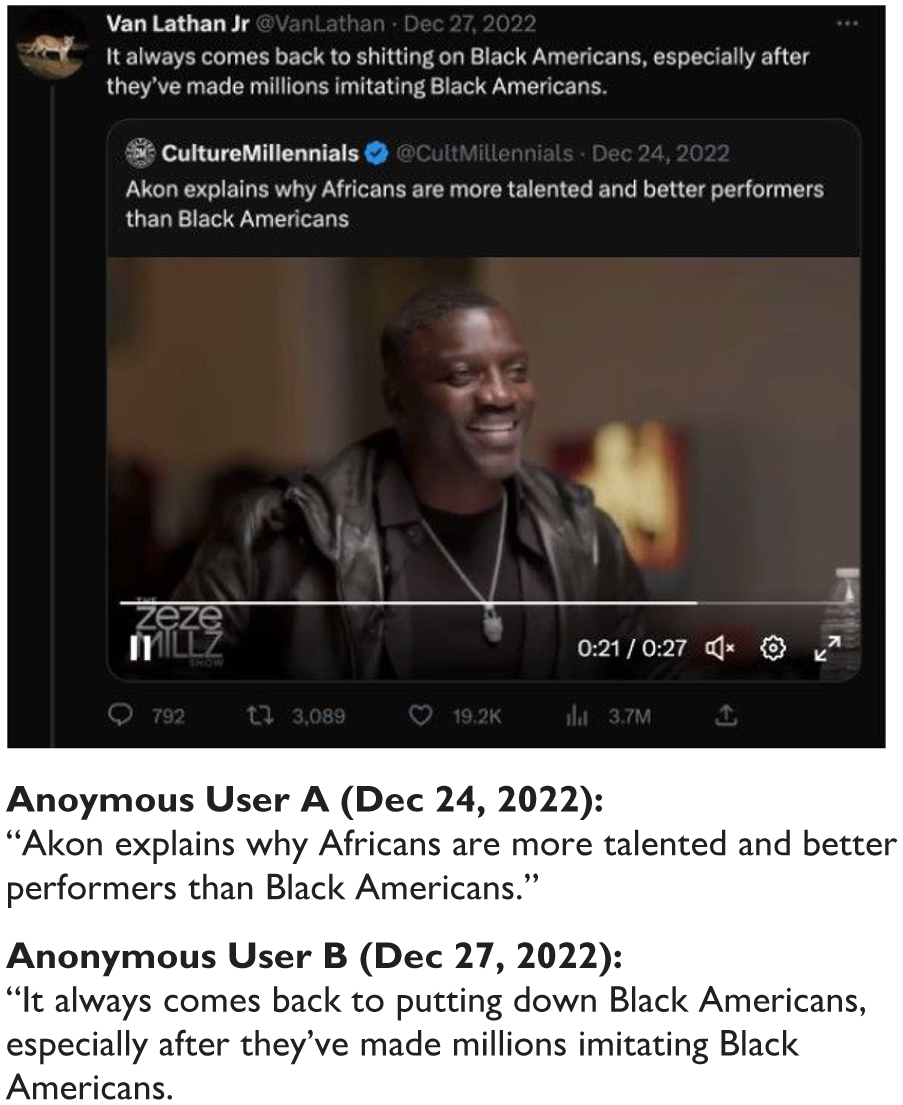
Example of an initial post with a retweet and response where an initial post by CulturalMillenials sparked a #diasporawar discussion. Screenshots omitted per publisher policy.

An anonymized reconstruction of a post from the #diasporawars discourse, expressing critique of online conflict and celebrity culture on Black Twitter. Screenshots omitted per publisher policy.
Responses
Responses to an initial post typically come in waves, with the initial poster’s community engaging first due to shared commonalities, as shown in Figure 3. Due to Twitter’s algorithmic curation, these posts can spread either by going viral across broader networks or staying semi-viral within the original community. Responses may vary from agreement to disagreement, depending on the responders’ relationship with the initial poster and the topic of #diasporawars. The discussion often evolves into a broader conversation, with participants sharing anecdotes, opinions, and jokes, or even engaging in harassment or bullying. When exchanges become harsh, some users, described in this study as influencers, may step in to mediate, calling out inflammatory posts or reminding others that internal conflicts hinder Black and African liberation and pan-African ideals, as illustrated in Figure 4.
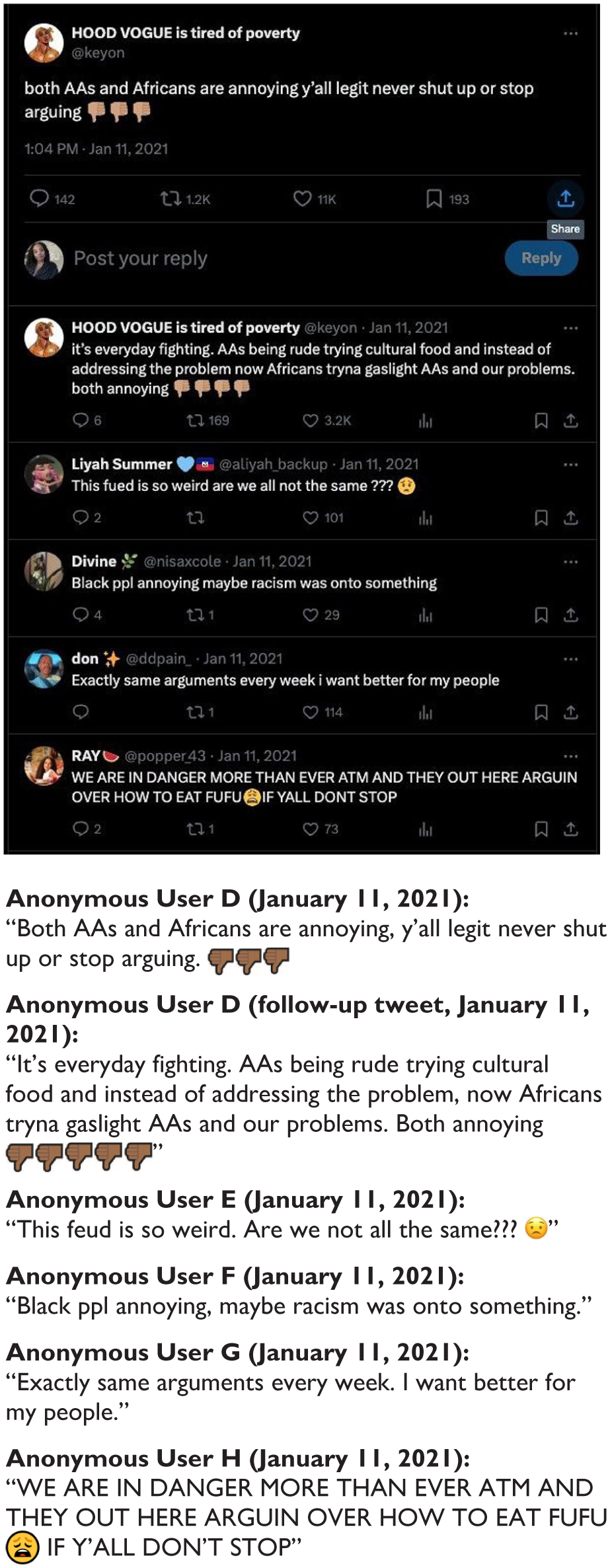
Example of multi-user conversation expressing fatigue, frustration, and irony in response to recurring diaspora wars discourse.Example of multi-user conversation expressing fatigue, frustration, and irony in response to recurring diaspora wars discourse. Screenshots omitted per publisher policy.

Example of a post where a responder calls out an inflammatory post causing division. Screenshots omitted per publisher policy.
Reflection
#diasporawar discussions, although frequent, are typically short-lived on Twitter due to the rapid turnover of trending topics. Frequent contributors often act as mediators, helping to de-escalate heated debates. These discussions sometimes migrate to platforms like YouTube or TikTok, where they can be explored in more depth. Occasionally, old #diasporawars threads resurface when users search for specific topics, but there is a general consensus to move on from past conversations, as shown in Figure 5.

Example of a post where an old #diasporawar discussion was resurfaced, and the reposter and responders in agreement that it was good to move on from discussion. Screenshots omitted per publisher policy.
Users often speculate about the origins and objectives of #diaspora(s) (Appendix 1, Theme: Instigation, Bots and Blackfishing, User R; and Appendix 1 Theme: Politics, User S). Some suggest outside instigators like Cointelpro, psyops, or misinformation campaigns by Western powers, particularly the United States. Others point to inside-group instigators, identifying specific subcommunities as active participants in #diasporawars discussions, as shown in Figure 15 in Appendix 3.
The data reveals sentiments among users participating in #diasporawars discussions suggest a common belief that the ultimate goal is to divide, control, and conquer the global Black population and their movements. Many claim that non-Black individuals pose as Black to further divide the community, as seen in Figure 16 in Appendix 3. While some participants question if #diasporawars extends offline, the consensus is that it remains primarily an online discourse.
Our data reveals that users compare #diasporawars to other conflicts like “gender wars,” “tribal wars,” and “colorism wars,” all involving harassment, bullying, and a lack of intervention (see Figure 17 in Appendix 3). These discussions provide a platform for identity-driven dialogues, blending cross-cultural and ethnic elements, historical contexts, and personal self-identification, with occasional calls for unity and solidarity.
Although our data are platform-limited to Twitter, users suggest similar discussions occur on platforms such as YouTube and TikTok (see Figure 18 in Appendix 3). The #diasporawars hashtag serves various purposes, from calling in or out inflammatory posts to expressing exhaustion toward #diasporawars, discussing origins and solidarities, and assigning blame and antagonizing.
We captured both direct and indirect sentiments about #diasporawars from an expressive demographic. “Global South” users felt a lack of support toward the “Global North” during Global South uprisings, like #ENDSARS in Nigeria, compared to the solidarity seen during the U.S. Black Lives Matter (BLM) movement (see Figure 19 in Appendix 3). Conversations about #diasporawars also triggered feelings of hate, disrespect, and superiority among Black, Caribbean, African diaspora, African, and Caribbean Twitter users.
Direct sentiments in tweets and replies included disappointment, confusion, and exhaustion, while indirect sentiments often conveyed negativity, accusations, or grudges. Despite the negativity, some discussions showed agreeability or healing, and direct sentiments of solidarity and unity were also present. For instance, one user believes diaspora wars are necessary for fostering authentic connections.
Participants in #diasporawars note that the discourse has led to online xenophobia, entertainment, misguided frustrations, identity gatekeeping, and a lack of accountability. It is unclear who the main instigator or victim is, as users often play both roles. While the discourse features anti-Blackness, harmful stereotypes, and harassment, it has also fostered increased dialogue among the global Black community, revealing both shared and distinct experiences of identity (see Figure 20 in Appendix 3).
Participants use #diasporawars to call out conversations that spark these conflicts and to express their fatigue with the discourse (see Figure 21 in Appendix 3). The hashtag is widely discussed on Black Twitter, with many users calling for an end to the negative impact on the community’s well-being.
What triggers #diasporawars?
This section examines the factors behind the emergence of #diasporawars. Our content analysis identifies three main triggers: (1) Events (Figure 6), (2) Individuals, and (3) Communities involved in #diasporawars. We use a high-level descriptive approach, focusing on the phenomenon itself rather than the identities of participants. Although identities were covered earlier, we now provide an overview of the trends without focusing on specific contributors.
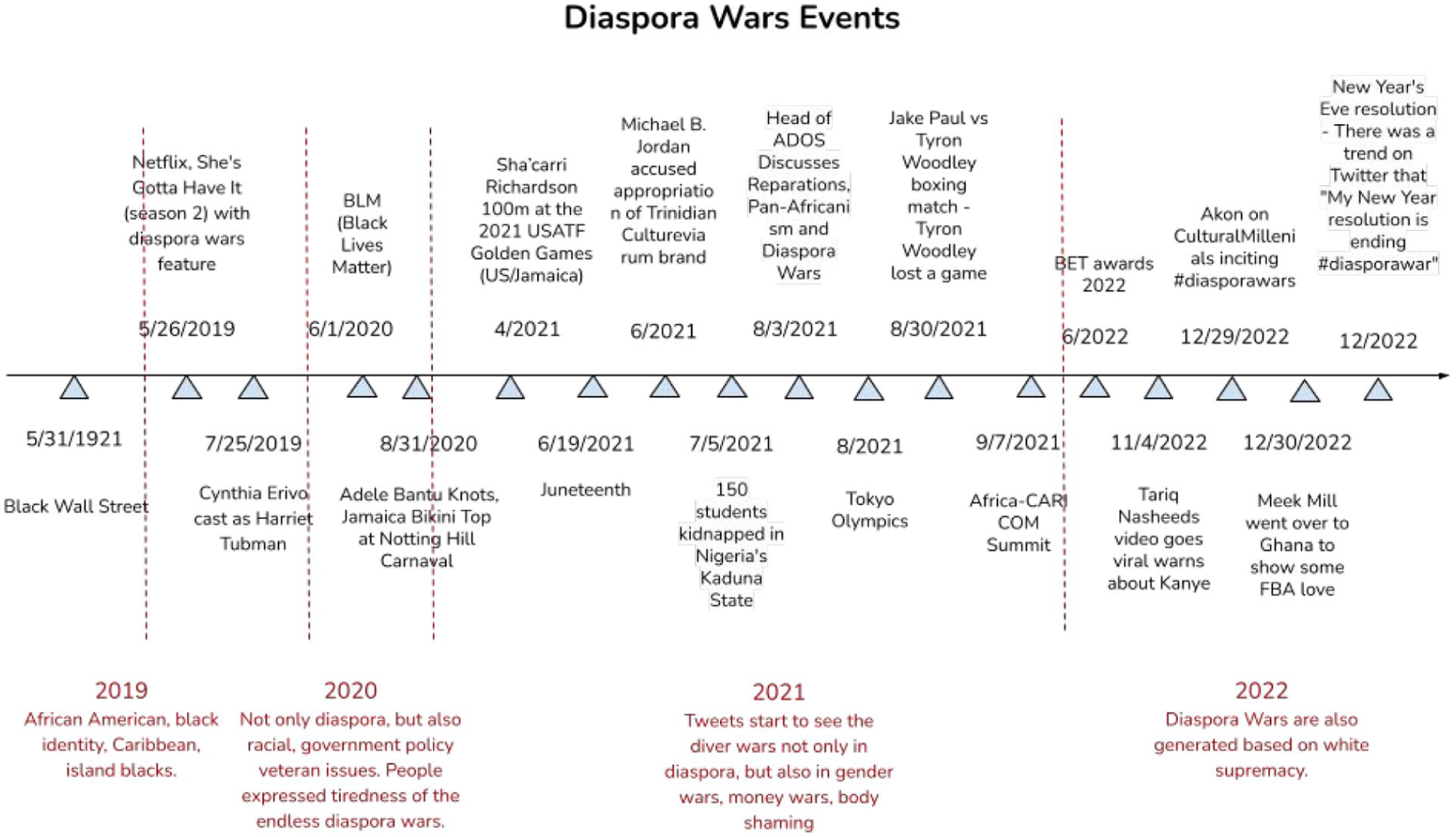
Visual timeline of diaspora war events.
Events that trigger #diasporawars
As shown in Figure 6, among the 225 conversations on #diasporawars, we identified 18 offline events discussed between May 2019 and December 2022. The earliest event, Black Wall Street, referenced in October 2021, occurred on May 31, 1921. The most recent was Meek Mill’s visit to Ghana for AfroNation on December 30, 2022. Of the 18 events, 8 were from 2021, with the rest occurring between 2019 and 2022. Most events involved pop culture, politics, or social movements. For a full summary, see Appendix 1 and Appendix 2.
Spike Lee’s “She’s Gotta Have It” remake featured a scene critiquing the hiring of Black British actors over American ones in films rooted in Black American-related topics ignited controversy on Twitter. This relates to another event that triggered #diasporawar discussion related to Cynthia Ervio’s casting as Harriet Tubman in “Harriet.” Both events triggered #diasporawar discussions about cultural authenticity and representation of Black identity in Hollywood. In addition, our data found that events triggering a #diasporawar often involved power dynamics based on nationality, citizenship, Western positionality, and a lack of reciprocity over struggles in Africa. For instance, the murder of George Floyd in 2020 led to global protests and expressions of Black solidarity. However, Africans living in Africa and some members of the African diaspora living in the West felt a lack of support for similar issues occurring in Africa. As one user posted, “Black lives matter until it is Africans, then the whole world develops hearing difficulties.” Furthermore, events triggering #diasporawars included comparisons between American athlete Sha’carri Richardson and Jamaican athlete Usain Bolt, as well as Nigerian artist Wizkid’s boycott of the BET Awards. These events highlighted disparities in recognition and respect for talent from different regions and their treatment in the sports and entertainment industry. Also, Akon made a comment that sparked a #diasporawar during a YouTube show, claiming Africans are more talented than Black Americans. The resulting discussion touched on cultural differences, xenophobia, and disrespect with a general sentiment of exhaustion and desire to end #diasporawars.
Discussions surrounding Emmanuel Acho’s advocacy for Nigeria following the kidnapping in Kaduna State and Tariq Nasheed’s critique of Kanye West’s activism, which was seen as self-serving despite both being Black Americans, raised questions about the responsibilities of prominent figures and influencers within the diaspora. These conversations often led to disagreements over the extent to which individuals should advocate for issues affecting their ancestral homelands or their communities despite differences in class, nationality, and citizenship. Finally, an event that triggered #diasporawars discussions included the Africa-CARICOM Summit, which aimed to foster unity among African and Caribbean nations. The hashtag highlighted how the summit sought to overcome existing divisions and tensions within the diaspora. Overall, these events triggered #diasporawars by exposing underlying tensions, disparities, and complexities within the Black diaspora, including representation, solidarity, recognition, and advocacy issues. Social media platforms played a central role in facilitating discussions and debates, often amplifying conflicts and exacerbating divisions within the community.
Who starts #diasporawars?
Our data reveal the role of frequent contributors in #diasporawars, who became prominent starting in July 2019. Two types emerged: (1) influencers with large followings (around 10 K or more) and (2) contributors with mid-to-low followings. Influencers often have a “blue check” for verification, although Twitter’s verification system has recently changed. Within our data set, we have calculated Influencers. We identified 15 #diasporawars influencers, characterized by high engagement and followings over 10 K. Their follower counts range from 13 K to 700 K. Nine are based in the United States and the United Kingdom, while six have no listed location. Three influencers contributed to eight distinct conversations in our data set, and the remaining seven participated in at least one conversation.
Two influencers stand out in our data set. One, with 700 K followers, is a Black U.K. culture influencer. This person has six #diasporawars-related conversations and primarily posts original content with high user engagement. Their discussions, spanning from 2019 to 2021, focus on popular culture, politics, social issues, ancestry, and history (see Appendix 1). We classify this influencer as a diffuser rather than an instigator of #diasporawars, as their content tends to de-escalate tensions. For example, a post with 12 K likes criticized a 2021 #diasporawar between African Americans and Africans as rude and nonsensical.
The second standout influencer has 300 K followers and the most #diasporawars-related conversations in our data set, with eight. Between 2020 and 2022, this influencer frequently instigated #diasporawars on the Twitter platform. This influencer is known for creating political and racial content and is respected as an active Foundational Black American (FBA) community member. You will find an American flag on their Twitter profile next to their name. In addition, this influencer does not hide behind anonymity; their Twitter profile displays an action photo of themselves. Various users actively engage with this influencer’s content to either validate and agree or label and call out content as instigating a #diasporawar.
This influencer’s eight conversations in our data set are characterized by an agitated, accusatory, and political tone. Their content covers pop culture, social issues, politics, ancestry, xenophobia, and misinformation (see Appendix 1). They are often labeled as state operatives or bots for inciting #diasporawars. For example, they used global Black popular culture discussions to challenge accusations of cultural appropriation, notably questioning Caribbean concerns over a Black American actor’s rum named after a Caribbean festival, which led to a rebranding. This influencer has also accused Caribbean Americans of appropriating “Foundational Black American music.”
Another key influencer, with 19 K followers in the United States, engaged in four #diasporawars conversations in 2022. They have branded themselves as a thought leader on the topic, founding an organization to address the discourse’s impact on the global Black community. Describing themselves as an author and publisher, their tone is tired yet peace-promoting. Their content covers misinformation, xenophobia, social issues, ancestry, history, bots, and politics (see Appendix 1). Notably, they criticized politically conservative British articles about a U.S. civil rights group refusing to repatriate artifacts, urging against blame on African countries and emphasizing that such actions counteract the reparations movement. They also warned about global conservative interest in #diasporawars.
Frequent contributors
This study reveals a second group of influencers: frequently contributing influencers (or frequent contributors). These contributors do not meet the criteria of high-following influencers, as they have between 100 and 2500 followers, yet their consistent engagement in the #diasporawars discourse allows them to shape conversations and influence narratives. From our sample data, we identified 16 users as frequent contributors.
Our most active frequent contributor identifies as a pan-Africanist and humanitarian and has been present in six separate #diasporawars conversations from 2019 to 2021. Their commentary spans pop culture, social issues, ancestry, and history (see Appendix 1 for the themes chart). Their influence comes from their persistence in engagement, as they frequently challenge divisive content by promoting solidarity as a tool against #diasporawars. For example, this frequent contributor leveraged a meme to describe the nonsensical nature of #diasporawars, critiquing how Nigerians and Black/African Americans (of slave descent) blame each other for their oppression. They commented four times within this post alone, responding directly to opposing views of the meme. Their response positioned them as mediating between Africans and Black/African Americans, arguing that neither side is inherently superior.
Despite their small following, their posts received engagement in the form of replies, likes, and retweets, amplifying their influence beyond their immediate audience. Their role in challenging misinformation, introducing counter-narratives, and consistently engaging over time positions them as key discourse shapers within #diasporawars, even without the large followings typically associated with influencers. Their influence comes from their ability to sustain engagement over time, repeatedly challenging divisive content and promoting solidarity as a tool against #diasporawars.
Miscellaneous
The study reveals that #diasporawars is started by the agitations of social media users participating in various African, African descent, and Black communities online. In the above sections, we highlight specific users who impact the discussion given their online status and/or frequent contribution. However, #diasporawars are started by many more users who trigger the conversation based on one-off initial posts and comments to initial posts that have an impact. In addition, we want to acknowledge that #diasporawars as a hashtag is used by this miscellaneous group to call attention to inflammatory #diasporawar posts and comments, too. We reference the theme section to provide an understanding of the topics this miscellaneous group participates in when the #diasporawars hashtag is leveraged.
Communities engaged in #diasporawars
We aim to overview the most active communities in our #diasporawars study, highlighting their interactions and contributing to a deeper understanding of social media dynamics. Although we have no political affiliations with these groups, we support their right to engage online. Our analysis involved examining user tweets and profiles, focusing on six distinct communities based on their presence and relevance from 2019 to 2022.
Black Twitter
In our data set, numerous users have explicitly or implicitly suggested that #diasporawars occur within the discourse of Black Twitter. Figure 9 highlights the topics most frequently discussed on Black Twitter. While #diasporawars is not depicted on this “Wheel of Black Twitter” (see Figure 7) within our data, there was an extensive conversation where one user inquired about topics that should be included on the wheel but are not. A significant number of users responded by suggesting that #diasporawars should be added, as it is a topic frequently discussed within Black Twitter. In addition, #diasporawars was part of a long threaded discourse on topics that Black Twitter would like to move away from because of its stronghold on the community and its discourse. Furthermore, users have suggested that Black Twitter is exposed due to its frequent virality, making it susceptible to trolls, blackfishing, and bad actors who participate in #diasporawars conversations. Finally, users in the #diasporawars discourse acknowledge that Black Twitter engages with Black, African, and Caribbean communities and individuals outside of the United States, while also interacting with subcommunities such as FBA, American Descendants of Slaves (ADOS), U.K. Black Twitter, and Pan-African Twitter. These subcommunities and their discourses will be further described below.
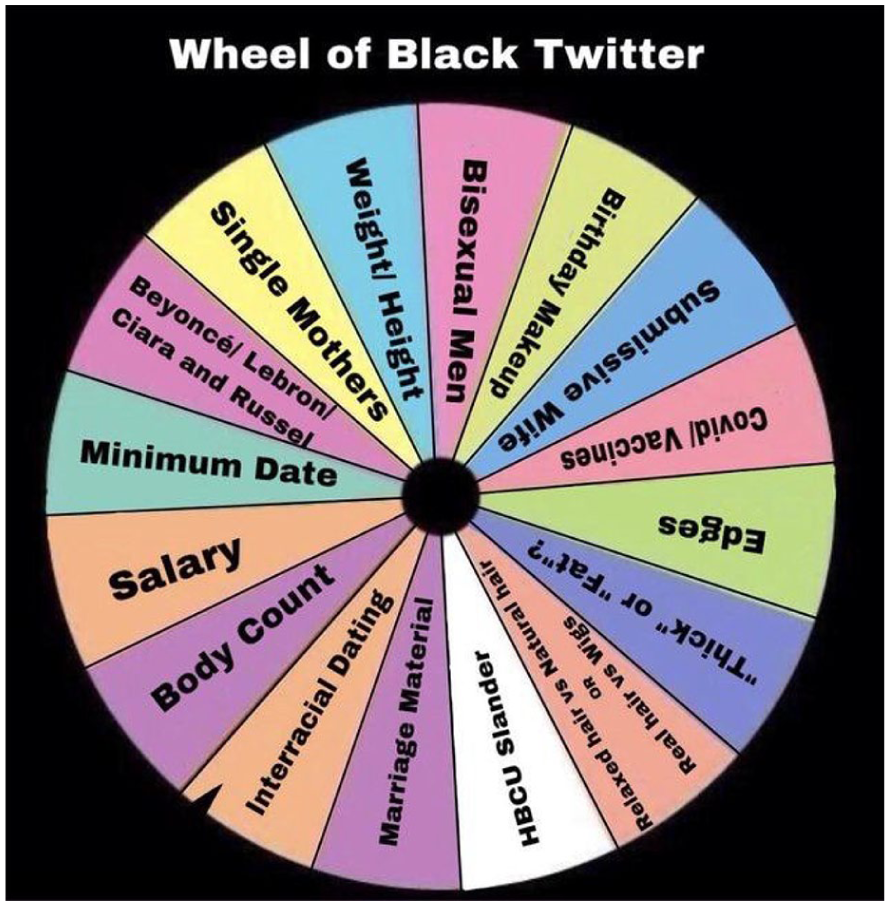
Users assert that this is how Black Twitter selects its topics, with several suggesting that #diasporawars and BBLs should be included on this “Wheel of Black Twitter” meme (source: circulating image on Twitter, origin unknown, retrieved January 2023).

Diaspora wars annual themes.

Number of tweets by year.
FBA
FBAs are involved in #diasporawars as instigators, self-identifiers, and participants in debates. They are associated with conservative ideologies, including opposition to immigration and reparations, which has caught the attention of the DNC, particularly regarding reparations (Sands, 2019). A key influencer in our data set, an FBA founder, primarily uses YouTube for communication. FBA members, often descendants of enslaved people with conservative views, identify as “FBA” in profiles and comments during #diasporawars discussions.
FBA is frequently confused with ADOS, although they are separate movements. The data set shows notable conflicts between FBA and ADOS, with FBA members criticizing figures like Akon for perceived hypocrisy. While not all FBAs oppose immigration, they use the movement to reclaim pride in their ancestry and advocate for unity and reparations for all Black people impacted by colonialism and slavery.
Many view FBA as instigators in #diasporawars, spreading misinformation about U.S. immigration. Some communities, including Black Twitter and its subgroups, reject FBA’s ideologies, viewing the group as existing only online and targeting non-FBA Black Americans. Users outside the United States, especially those not identifying as Black American, also dismiss FBA, seeing anti-immigrant sentiments as anti-Black. Our data suggest concerns among non-FBA users and Black Twitter subcommunities about misinformation spread by FBA leaders.
ADOS
ADOS community is active in the #diasporawars data set, representing those of African descent, especially from enslaved people in the Americas. ADOS functions on Twitter in two forms: as the ADOS Advocacy Foundation and as a broader community with diverse ideologies, yet both still identify under the ADOS umbrella. Supporters seek to establish distinct ethnic and cultural boundaries from other Black and African identities, often focusing on self-definition. Critics accuse ADOS of spreading misinformation and fostering division, with some alleging that ADOS contributes to #diasporawars instead of promoting unity (Nkonde et al., 2021).
Black U.K. Twitter
Black U.K. Twitter is an online community adjacent to Black Twitter, with users either residing in or engaging with Black U.K.-related content. Users’ behavior may or may not be different than that of users on Black Twitter. However, the content differs essentially since Black U.K. culture differs from Black U.S. culture. Black U.K. Twitter conversations frequently exemplify this, discussing the roots of Black Americans or African Americans (descendants of enslaved people), particularly during times when conflicts are happening on the continent. Black U.K. Twitter has called out Black Americans for their perceived inactivity and silence during issues like #ENDSARS in Nigeria. One user specifically asked U.K. Black Twitter by tagging its hashtag the most significant issues impacting the online community, and several users stated #diasporawars.
Pan-African Twitter Individuals in the digital Pan-African community often signal their affiliation by including “Pan-African” in their Twitter bio or through content shared on #diasporawars. Our data show that Pan-Africanism spans both online and offline, influencing identities politically, nationally, and culturally. One influencer aligned with this community works to mediate and pacify debates within #diasporawars, emphasizing commonalities among users. This community often speculates on how #diasporawars began, such as with a TikTok by a White woman pretending to be Black or rebutting stereotypes about Black Americans. They express exhaustion from the discourse and focus on efforts to end it.
Caribbean Twitter Caribbean Twitter is a large community comprising individuals from countries like Jamaica, Barbados, and Trinidad and Tobago. Often referred to as West Indians in #diasporawars, members use flag icons to represent their islands or sometimes the Caribbean as a whole. A significant moment for this community was during Sha’Carri Richardson’s race against Jamaica at the USATF Golden Games, sparking #diasporawars debates about the fastest runners. With a large Caribbean population in the United States, offline conflicts between Black Americans, African Americans, and Caribbean Americans often emerge online. In addition, debates arise about who can claim Caribbean identity if not born there. Our data also highlighted discussions questioning #diasporawars’ relevance to global African struggles, referencing historical figures like Denmark Vesey, who led a U.S. uprising despite being born in what is now the U.S. Virgin Islands.
Naija or Nigeria Twitter
Naija Twitter, or Nigeria Twitter, is a major player in #diasporawars discussions, involving both Nigerians in Nigeria and the Nigerian diaspora in the United States and the United Kingdom. “Naija” reflects national pride and cultural identity, and Nigeria Twitter is known for lively debates on politics, culture, and social issues with a unique blend of humor and slang. It is a key part of African and Black Twitter, adding a Nigerian perspective to global conversations.
U.K. Black Twitter, linked to Nigeria, often engages in #diasporawars by criticizing Black Americans for perceived indifference to African issues, like during #ENDSARS, which was similar to #BLM. Some U.K. Black Twitter users expressed disappointment over what they see as Black Americans’ selective solidarity with Africans, leading to tense exchanges over identity and migration. Despite these conflicts, U.K. Nigerians and Nigerian Americans generally show strong solidarity and rarely argue among themselves.
What kind of #diasporawars conversations are there?
In this section, we categorize #diasporawars conversations by themes to address: What kinds of #diasporawars discussions are there? Our study identified 10 themes: (1) popular culture, (2) misinformation, harassment, and xenophobia, (3) social issues, (4) ancestry, history, and traditions, (5) cultural expressions, (6) instigation, bots, and blackfishing, (7) politics, (8) defining diaspora wars, (9) unity and solidarity, and (10) sentiments of detest and fatigue. The Chart in Appendix 1 provides further details of these themes. Multiple themes can appear in a single #diasporawars conversation.
Discussions on popular culture in #diasporawars often involve debates on cultural appropriation, ownership, and artifacts like music and influencers. These conversations typically span multiple platforms, starting on sites like TikTok, Instagram, and YouTube, and frequently intertwine with themes of harassment, misinformation, and xenophobia.
Social issues also dominate #diasporawars, with a focus on movements like #ENDSARS and #BLM and topics such as White supremacy, anti-Blackness, classism, colorism, and internalized racism. These discussions aim to shift focus from #diasporawars to collective movements affecting Black communities worldwide, while also addressing political themes related to Kenyan, Nigerian, Black U.S., and Black U.K. politics.
Conversations on ancestry, history, and traditions often address topics like slavery, colonialism, and notable figures such as Kwame Ture and Marcus Garvey, as well as shared roots and denied ancestry among Black people globally. Expressions of culture in these discussions are broader and less focused on popular culture, often referencing shared foods and literature to deepen understanding. In #diasporawars, terms like bots, trolls, and operatives are used to identify intruders and instigators, with FBAs often singled out as instigators. FBA users, in turn, use the term “FBA” to define their position in the discussions. In addition, conversations on solidarity and unity are frequent within the #diasporawars dialogue to challenge the #diasporawar.
Timeline of #diasporawars
From 2019 to 2022, #diasporawars featured an annual recurring theme involving Black communities worldwide, including African Americans, the Caribbean, and the United Kingdom. The BLM campaign significantly influenced these conversations from 2020 through 2022. Over these 6 years, #diasporawars discussions evolved from initial frustration and conflict to eventual peace and compromise. Notably, 2019 is a critical year for #diasporawars.
We also mapped out the number of Tweets correlated with #diasporawars for prior years. Before 2015, the number of Tweets posted each year was lower than 100. The first jump was from 2016 to 2017, increasing by 186% from 69 in 2016 to 253 in 2017. The second soar was identified from 2019 to 2020 when it doubled from 971 in 2019 to 2173 in 2020. The #diasporawars conversations kept becoming more involving, vivid, and eloquent.
Where are #diasporawars participants located?
After analyzing #diasporawars conversations on Twitter, we examined their geographical distribution by categorizing locations into cities, states (U.S.), and countries Figures 10-13. While location data can be ambiguous—since users may mention places they do not reside in—these data, linked to users’ Twitter profiles, help us identify patterns, key regions, and the global impact of #diasporawars conversations.

#diasporawar user country locations for all tweets in the data set (N = 31,336).

#diasporawar user country locations on profiles—unique conversations.
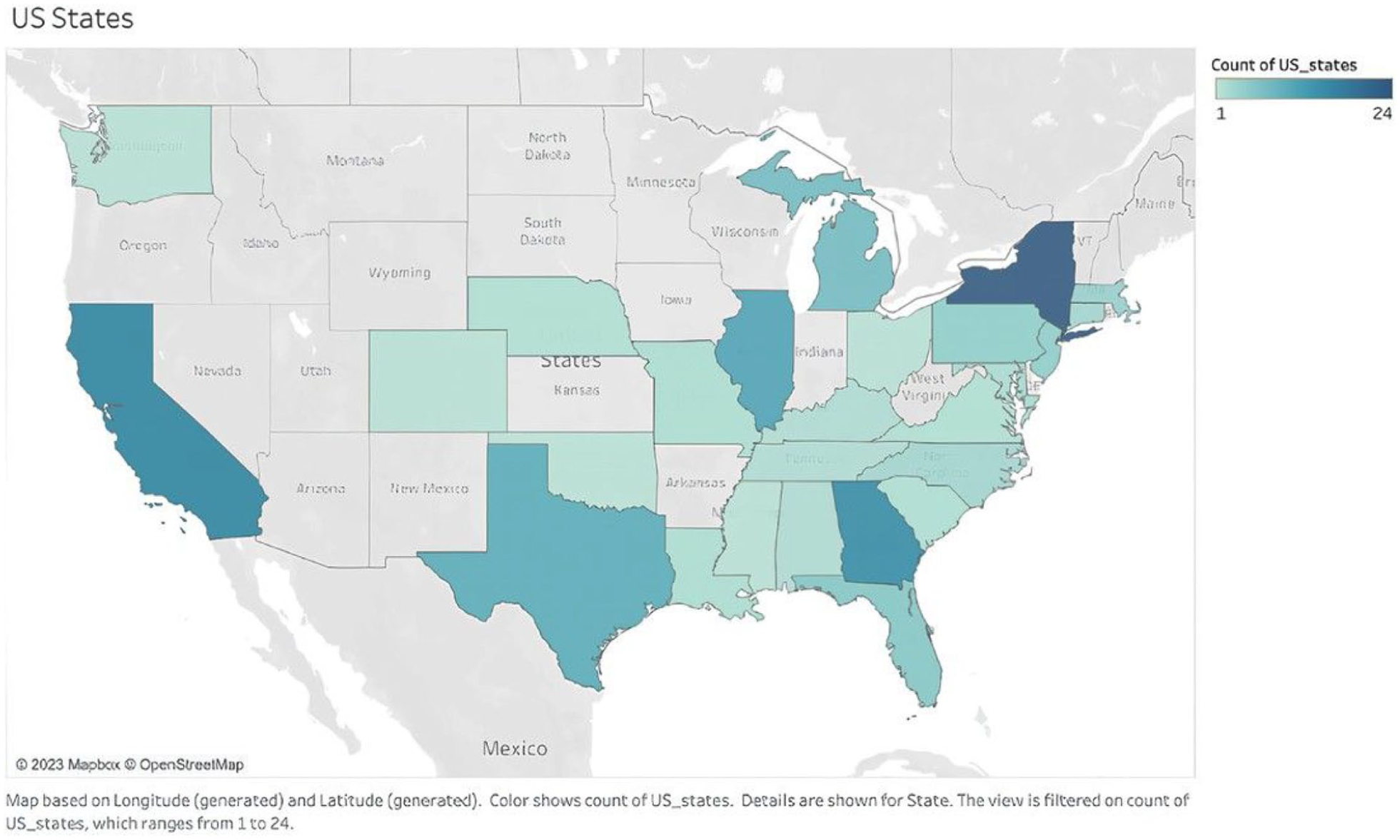
#diasporawar U.S. state locations on profiles—unique conversations.
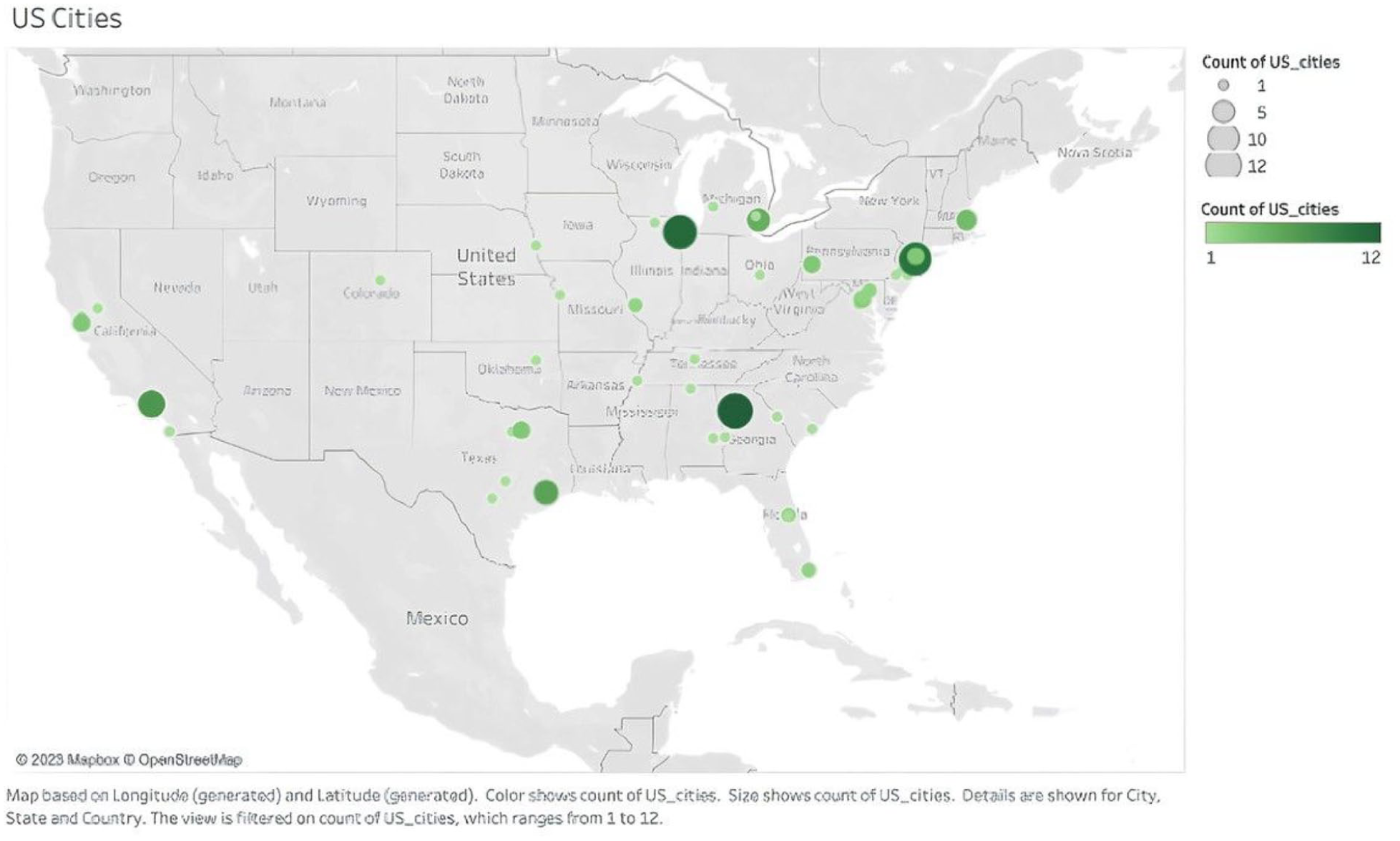
#diasporawars U.S. city locations on profiles—unique conversations.
We examined the user_location field in the Twitter data set, where profile locations are available if users permit access or specify them. Out of 31,336 tweets, only 695 had accessible profile locations, representing just 2.2% of the data Figure 10. Despite this, we found that 77.6% of #diasporawars participants are in the United States, 7.2% in the United Kingdom, 3.6% in Canada, and 5.8% in Africa and the Caribbean Figure 11. In analyzing 225 unique #diasporawars conversations, we reviewed each tweet’s profile location and content. This revealed 305 profile locations. The United States led with 71.4% of conversations, followed by 8.2% in the United Kingdom, 5.2% in Canada, and 15.2% in other regions, including France, South Africa, Kenya, and several others. In the United States, #diasporawars discussions are concentrated in four cities: New York City (13), Atlanta (12), Chicago (11), and Los Angeles (7) Figure 13. New York City, particularly Brooklyn, is the most active, with Houston and Detroit also contributing. The discussions are more prevalent on the East Coast, Southern California, and the South, with little activity in the Midwest except Detroit Figure 12. Tweets specifying only states show higher activity in the Eastern and Southern United States compared to the West Coast, where only California is notably involved Figure 12.
In #diasporawars discussions, users also use pseudo-locations on their Twitter profiles to express their identity Figure 14. These pseudo-locations fall into five categories: (1) cultural or ethnic references, (2) emotional or psychological states, (3) fictional or fantasy places, (4) conceptual or abstract regions, and (5) sociocultural areas Figure 14. For instance, the Mason-Dixon line represents historical social divisions, while “the belly of the beast” can refer to a challenging situation or cultural references like Nas’s song or Da’Shaun Harrison’s book.
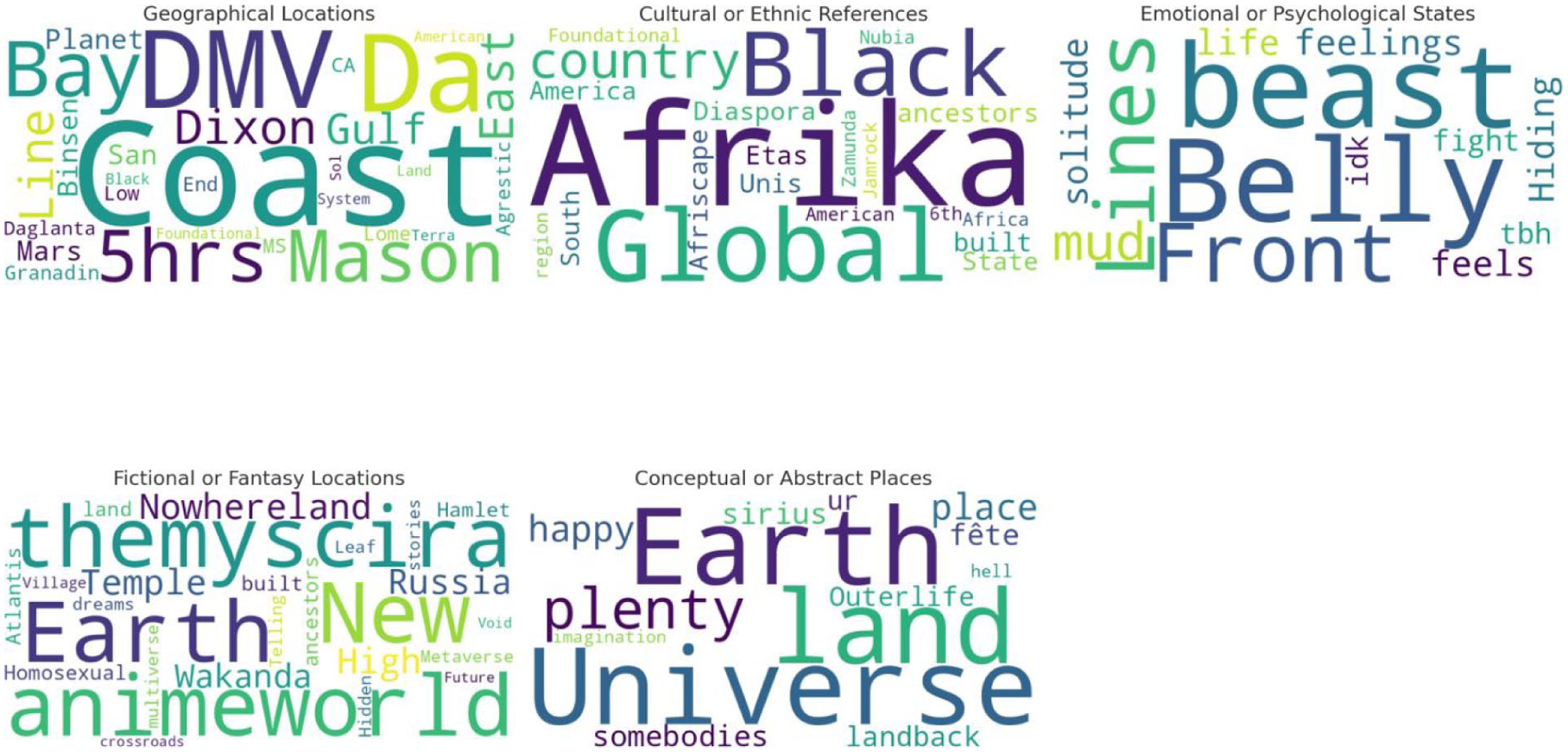
Pseudo-locations of users involved in #diasporawars discussions on their profiles.
These pseudo-locations offer insights into diverse Black experiences and the creative use of location to define them.
Discussion
Our study of the hashtag #diasporawars in the global Black Twitter community explores diverse expressions of Blackness and intersecting identities. We find that these hashtags are key to understanding online Black dialogues and the complexities of diasporic and conflictual conversations. Our analysis shows that #diasporawars provides critical insights into Black digital life, highlighting how users navigate differentiation and community identity. Adopting an intersectional perspective is crucial for a nuanced view of global Black digital experiences, especially in conflict contexts.
Our study shows that discussions on #diasporawars often start confrontational but can end in reconciliation, thanks to informal mediators or community influencers. While some influencers may exacerbate conflicts for attention, there is evidence of effective organic conflict resolution without traditional moderation. This indicates that these online spaces can resolve tensions that formal moderation might suppress.
#diasporawars demonstrates the capacity for unity and solidarity within the global Black community. While some conversations begin with inflammatory remarks, they often evolve into broader discussions about global Black identity and solidarity, particularly during significant events like the #EndSARS movement. This evolution from conflict to unity suggests that differentiation, when properly navigated, serves as a foundation for collective identity within the diversity of the Black diaspora.
The findings from #diasporawars challenge the prevailing assumptions in research on online conflicts. Rather than viewing all tense conversations as requiring content moderation, our study suggests that these conflicts can be part of authentic dialogues that contribute to identity formation and community building. This perspective calls for social media platforms to adopt intersectional approaches to content moderation that recognize the complexities of global Black digital life. Such approaches should aim to preserve the authenticity of these dialogues while mitigating the negative impacts of unresolved conflicts.
In summary, #diasporawars reflects a broader sociocultural process where Black identities are continuously negotiated and redefined through digital interactions. The differentiation strategies observed within these conversations align with broader theories of social identity and differentiation, offering valuable insights into the dynamics of online Black communities. Understanding these dynamics is crucial for developing more nuanced and effective approaches to managing online spaces, particularly in fostering authentic and inclusive digital communities.
Conclusion and future research
Our findings have important implications for media, technology, and computing fields, highlighting how online conflicts shape identity. Insights from #diasporawars suggest moving away from monolithic views of Black identity toward a more intersectional understanding, addressing deeper power dynamics in digital spaces. Future research should explore how social identities influence online conflicts and develop intersectional and restorative approaches to tackle issues like misinformation and harassment. This will help create more effective strategies for managing online communities and fostering inclusive dialogues in global Black digital life.
Footnotes
Appendix 1
Themes and Subjects.
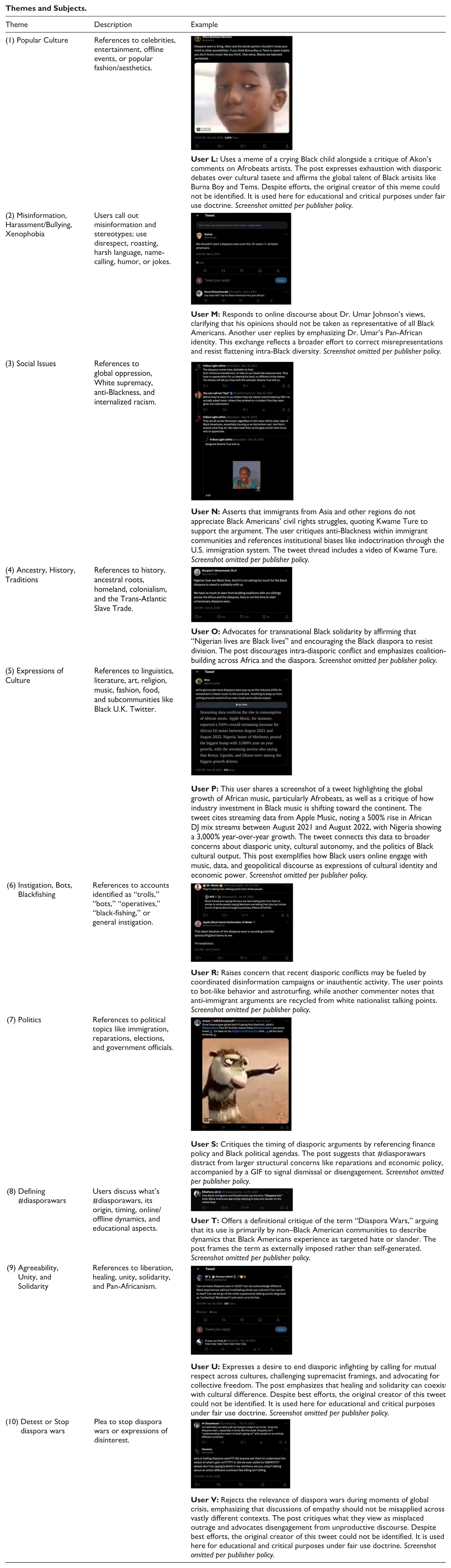
| Theme | Description | Example |
|---|---|---|
| (1) Popular Culture | References to celebrities, entertainment, offline events, or popular fashion/aesthetics. | |
| (2) Misinformation, Harassment/Bullying, Xenophobia | Users call out misinformation and stereotypes; use disrespect, roasting, harsh language, name-calling, humor, or jokes. | |
| (3) Social Issues | References to global oppression, White supremacy, anti-Blackness, and internalized racism. | |
| (4) Ancestry, History, Traditions | References to history, ancestral roots, homeland, colonialism, and the Trans-Atlantic Slave Trade. | |
| (5) Expressions of Culture | References to linguistics, literature, art, religion, music, fashion, food, and subcommunities like Black U.K. Twitter. | |
| (6) Instigation, Bots, Blackfishing | References to accounts identified as “trolls,” “bots,” “operatives,” “black-fishing,” or general instigation. | |
| (7) Politics | References to political topics like immigration, reparations, elections, and government officials. | |
| (8) Defining #diasporawars | Users discuss what’s #diasporawars, its origin, timing, online/offline dynamics, and educational aspects. | |
| (9) Agreeability, Unity, and Solidarity | References to liberation, healing, unity, solidarity, and Pan-Africanism. | |
| (10) Detest or Stop diaspora wars | Plea to stop diaspora wars or expressions of disinterest. |
Appendix 2
Appendix 3

Funding
The authors disclosed receipt of the following financial support for the research, authorship, and/or publication of this article: This work was supported by the National Science Foundation under Grant No. 2311102.
Declaration of conflicting interests
The authors declared the following potential conflicts of interest with respect to the research, authorship, and/or publication of this article: I would ask for new reviewers, as I know one of the reviewers, as they revealed themselves to me. By mistake, of course!