



Abstract
Democratic citizenship is continuously evolving, shaped by changing political, social, and media contexts. Digital natives—those who have come of age in environments where digital technologies are embedded in everyday life—have experienced citizenship in markedly different ways than previous generations. While the internet has broadened the repertoire of participatory behaviors, existing research has struggled to capture the complexity of contemporary citizenship. Drawing on deliberative systems theory and a triadic framework of citizenship—examining normative expectations, behaviors, and attitudes—this study develops a nuanced exploration of citizenship orientations. Using an innovative questionnaire and latent profile analysis of survey data from Norwegian digital natives (aged 18–40), we identify seven distinct citizenship types that reveal the multidimensional nature of contemporary citizenship. Our research moves beyond binary distinctions between active and passive citizenship, emphasizing the importance of both expressive and receptive behaviors across online and offline contexts. By highlighting the diverse roles citizens play in sustaining democratic processes, we offer new insights into citizenship in the digital age, demonstrating how different citizens contribute to the democratic system through varied and interdependent forms of engagement.
Keywords
Introduction
Democratic citizenship is a concept in constant flux, shaped by evolving political, social, and media environments. At its core, citizenship refers to an individual’s membership in a political community, encompassing both horizontal relationships with fellow citizens and vertical relationships with state institutions (Marshall, 1950). These relationships are expressed through a range of political behaviors, underpinned by attitudes and normative expectations of “good” citizenship (Schmitt-Beck & Schnaudt, 2023). Although political views and behaviors shift throughout life, the “impressionable years” of adolescence and early adulthood are especially formative in shaping lasting civic attitudes and practices (Neundorf & Smets, 2015). As each generation experiences this period in distinct contexts, the characteristics of democratic citizenship evolve accordingly.
Media play a crucial role in political socialization processes (Moeller & De Vreese, 2013). As the first “digital natives” (Prensky, 2001), today’s young adults (Generation Z [Gen Z], born 1998–2005) and those entering middle age (Millennials, born 1983–1997) have grown up in a significantly different media environment than earlier generations. The rise of socially networked, algorithm-driven media environments has diversified information sources, personalized media habits, and expanded the opportunities for civic engagement available to citizens (Ohme & de Vreese, 2020).
Considering these changes, researchers have provided valuable insights into how the political behaviors, citizenship norms, and attitudes of 21st-century cohorts differ from those of earlier generations (Bennett, 2008; Dalton, 2008). Numerous studies have developed typologies to categorize the different ways these groups engage in citizenship (Oser et al., 2023; Reichert, 2017) highlighting patterns of participatory inequality. These typologies have advanced our understanding of how political participation and civic engagement manifest across both online and offline contexts, revealing that citizens’ involvement with public life spans a wide spectrum (Kligler-Vilenchik et al., 2022; Lane et al., 2022). However, many of these studies remain limited by focusing on either online or offline behavior, or normative perceptions in isolation, potentially missing the full complexity of citizenship in a rapidly changing digital environment. Given the complexity of the media environment, significant variation likely exists within these groups (Ohme et al., 2022; Thorson, 2015).
Another limitation is that much research on political participation and civic engagement now includes online actions but often focuses on visible behaviors like posting while overlooking less visible but common forms of engagement, such as private communication or viewing political content (James & Lee, 2017; Ruess et al., 2023). This emphasis reinforces simplistic active versus passive binaries and misses the nuanced ways individuals engage with civic life (Amnå & Ekman, 2014). Recent studies show citizens increasingly emphasize quality over quantity of online political expression and consider silent, receptive practices—such as monitoring debates and critically evaluating information—as central to good citizenship (Gagrčin et al., 2022; Solverson, 2024). However, these less visible forms remain underexplored.
In this article, we build on these insights, addressing calls to explore the full range of citizenship orientations within younger generations, particularly those who fall between “apathetic” and “activist” (Harris et al., 2010; Oser, 2017). Our study makes a threefold contribution to the literature:
Taking an exploratory approach, we incorporate new variables that better capture the nuances in how digital natives perceive and enact their roles as citizens. The questionnaire we developed to realize this is informed by qualitative research and operationalizes normative, behavioral, and attitudinal dimensions of citizenship (Schmitt-Beck & Schnaudt, 2023), spanning both offline and online contexts.
Moving beyond the binary framing of active versus passive citizenship, we present a multidimensional, seven-fold typology of citizenship styles based on a survey of Norwegians aged 18–40 (n = 504). Norway offers good conditions to address our research interest, being a stable democracy whose population in international comparison shows high levels of political participation and whose well-developed digital infrastructure enables various forms of (digital) civic engagement.
While much previous research on digital-era citizenship has centered on Millennials and the early phases of social media (see Boulianne & Theocharis, 2020), our study includes a near-even split between Millennials (26–40 in our sample) and Gen Z (aged 18–25 in our sample), based on participants’ ages at the time of data collection in June 2023. These cohorts represent the first generations of “digital natives” (Prensky, 2001) to enter the electorate, having experienced political socialization in environments where digital technologies were already deeply embedded in everyday life. Although their digital immersion is shared, the societal conditions shaping their formative civic experiences differ in meaningful ways. Millennials navigated early political adulthood during a period marked by optimism about the internet’s democratic potential (Xenos et al., 2014)—exemplified, for instance, by the mobilizing success of the Obama campaign—while Gen Z has come of age in a more mature but also more turbulent digital landscape, shaped by algorithmic feeds, platform fatigue, and increased public scrutiny of social media’s political effects (Battocchio et al., 2023). They have also encountered a more polarized and crisis-prone political climate, which may shape their orientations in distinct ways. Although the concept of digital natives has been critiqued for essentializing youth by implying universal digital fluency (Kirschner & De Bruyckere, 2017), we use the term pragmatically to describe those who have grown up in media environments where social and political life are deeply intertwined with digital technologies. By including both cohorts, we are able to consider both continuity and change in how citizenship is imagined and enacted in an increasingly digitalized world.
Drawing on deliberative systems theory (Mansbridge et al., 2012; Moe, 2023) and our findings, we argue that citizenship should be viewed as a division of labor, where different citizens contribute in distinct ways—some through visible participation, and others through more indirect forms. This broader approach allows us to develop more nuanced understandings of the different roles of those who may appear passive but still contribute to democratic systems, while also identifying those genuinely excluded from politics to better target re-engagement efforts.
Previous citizenship typologies
This section outlines citizenship typologies from recent research across political science, sociology, and communication studies (for a comparative overview, see Table S1 in the Supplementary Appendix). While some argue that the extreme personalization of digital natives’ approaches to citizenship defies categorization (Thorson, 2015), typologies remain valuable frameworks for understanding the different forms citizenship can take within the population. This review does not aim to be exhaustive but highlights studies that explicitly offer typologies capturing variation in civic norms, attitudes, and behaviors—particularly among younger cohorts—to help contextualize our own framework.
Two influential perspectives on contemporary citizenship come from Dalton (2008) and Bennett (2008, 2012), both of which underscore generational shifts in citizenship norms. Citizenship norms refer to shared expectations regarding the responsibilities of “good citizens” (Dalton, 2008). Dalton described a shift from duty-based citizenship—rooted in loyalty to institutions and conventional participation—to engaged citizenship, characterized by expressive, issue-oriented participation and skepticism toward institutions. Similarly, Bennett outlined a shift from dutiful citizenship to self-actualizing citizenship, explicitly linking this change to the rise of digital platforms that foster more individualized and self-expressive modes of participation. Despite their influence, these frameworks have been critiqued for presenting an overly binary view that fails to fully capture the complexity and ambivalence of young people’s citizenship orientations (Oser, 2017; Thorson, 2015). As Sveningsson (2015, p. 154) put it: In a time of transition, most people—both young and old—will not fall neatly into one or the other box but will exhibit a mix of old and new ideals. Therefore, we need more research that looks at the complexity and ambivalence that characterize these individuals’ relation to the political.
Building on these foundational perspectives, other studies have developed nuanced typologies to better capture the diversity of young people’s citizenship norms and behaviors. For instance, Oser and colleagues (2023) and Reichert (2017) confirmed the persistence of both duty-based and engaged citizenship norms across diverse contexts, including Scandinavia (Oser & Hooghe, 2013). Surprisingly, these studies show that both sets of norms increased over time, challenging expectations of a shift toward more engaged citizenship. They also identified two additional groups: a small minority of highly engaged citizens, labeled “all-around activists” (Oser & Hooghe, 2013), “enthusiastic” (Reichert, 2017), or “maximalist” (Oser et al., 2023), and a disengaged group—referred to as “subject citizens” (Reichert, 2017) or simply “disengaged” (Oser, 2017)—who place minimal importance on citizenship norms. Oser et al. (2023) introduced a further category, “mainstream citizens,” representing those with average support for norms, positioned between the maximalist and subject groups.
Several additional studies proposed typologies capturing diversity of young people’s citizenship norms and behaviors within specific European contexts. Along with dutiful citizens, Ohme (2019) identified three further citizenship styles among Danish young adults: optional citizens, who see political participation as a choice; individualist citizens, whose engagement is driven by personal beliefs and facilitated by digital platforms; and collectivist citizens, who emphasize shared identity and collective action. Amnå and Ekman (2014) distinguished four categories among Swedish youth: active citizens, disillusioned, unengaged, and standby citizens. Representing the largest group in their sample, standby citizens, although not visibly active, remain politically attentive and ready to act if necessary, thereby constituting an asset to democracy, despite their lack of visible engagement. Mascheroni (2017) outlined five participatory habitus among politically active youth in the United Kingdom and Italy: legitimate, critical, alternative, radical-antagonist, and excluded citizens.
Other typologies focus more explicitly on young people’s political behaviors, particularly in relation to political discourse and digital engagement. Kligler-Vilenchik et al. (2022) categorized young people’s approaches to political talk across five countries, identifying five distinct types: the uninterested, who are disengaged from politics altogether; quiet attentives, who are interested but avoid political discussion; face-to-facers, who prefer in-person political conversations; calculating expressers, who selectively engage in online discussions; and steadfast expressers, who frequently share their political opinions across platforms. Lane et al. (2022) mapped four political repertoires taking shape in digital contexts: expressors, who actively share content; likers, who endorse others’ content through “likes” rather without contributing their own; all-engaged, who do both; and disengaged, who do neither. Finally, Dennis (2019) similarly identified digital citizenship styles among young Australians including: civic instigators, who initiate political discussions; contributors, who engage by commenting but rarely initiate discussions; listeners, who follow along without contributing; and avoiders, who actively steer clear of political content.
Collectively, these studies have advanced our understanding of citizenship by moving beyond binary or one-dimensional models, revealing that digital natives’ citizenship orientations span a broad and multifaceted spectrum of normative views and behavioral tendencies. They emphasize not only visible, active participation but also subtle, receptive forms of civic engagement that help distinguish truly disengaged citizens from those passively engaged (Amnå & Ekman, 2014; Dennis, 2019). However, many of these studies remain limited by focusing on specific aspects of citizenship—such as either online or offline behavior or only normative perceptions—thus overlooking the full complexity of contemporary citizenship. Moreover, as social media platforms constantly evolve and new forms of engagement and expectations for good citizenship emerge, it is essential to continue revisiting the field to fully capture how these changes shape citizenship in the digital age.
Our study addresses this gap by offering a multidimensional typology of citizenship that captures how norms, behaviors, and attitudes—across both offline and online contexts—combine to shape distinct citizenship orientations. Our first research question is:
RQ1. How do the citizenship norms, behaviors, and attitudes of Norwegian digital natives, including their engagement with social media, interweave to form different types of citizens?
In the next section, we outline the key theoretical concepts guiding our analysis.
Conceptualizing citizenship
To encapsulate the multifaceted nature of contemporary citizenship, we draw on Schmitt-Beck and Schnaudt’s (2023) triadic framework of democratic citizenship, encompassing normative, behavioral, and attitudinal dimensions. This model examines views on good citizenship, participation in democratic processes, and support for democratic systems. Recognizing the central role social media plays in shaping digital natives’ relationship to politics (Boulianne & Theocharis, 2020), we consider how these pillars apply across both online and offline contexts. This approach facilitates a nuanced exploration of democratic citizenship, focusing not only on patterns of participation but also on how individuals define their roles, perceive democratic institutions and media environments, and how these perspectives may inform or motivate civic engagement.
Normative pillar
The normative pillar explores citizens’ beliefs about their roles within democracy and citizenship norms—essentially, what they perceive as the responsibilities of “good citizens” (Dalton, 2008). These norms shape relationships with state institutions and among citizens, influencing both behaviors and underlying motivations (Schmitt-Beck & Schnaudt, 2023).
Different democratic theories set out distinct expectations for good citizenship. Our analysis draws on two contrasting democratic theories. The liberal model emphasizes representation through political parties, advocating minimal civic involvement beyond voting (Ferree et al., 2002). The participatory model, by contrast, values active citizen engagement in policy making and public discussion, viewing political passivity as harmful to democracy (Pateman, 1970). These perspectives provide a framework for understanding divergent citizenship orientations and expectations of civic engagement.
However, while these models often prescribe universal ideals of citizenship, we adopt a systemic approach to better understand the varied orientations identified in our typology. Deliberative systems theory emphasizes functional differentiation, viewing democracy as a system composed of distinct but interrelated parts (Mansbridge et al., 2012). Proponents emphasize the collective role of citizens, which essentially involves defining the aims that society ought to pursue and ensuring the political system does its best to fulfill those aims (Christiano, 2015; Moe, 2023). Importantly, however, it is neither necessary nor desirable for every citizen to pursue these aims in equal or identical ways. Instead, “we need many different kinds of citizens doing different kinds of things” (Chambers, 2013, p. 207). While the liberal and participatory models are often positioned in opposition, a systemic perspective allows us to understand how these orientations may coexist and relate to one another within a broader system (Asenbaum, 2022), including role-shifting (Moe, 2023). Crucially, however, a systemic approach does not imply that “anything goes” in terms of civic responsibility. The concept of public connection—defined by Couldry et al. (2007) as sustained attention to matters of shared concern—offers a useful normative threshold. While not all must speak or protest, some degree of public connection is essential for individuals to be able to meaningfully contribute to the shared project of democracy (Moe, 2023).
Normative expectations around social media use have become an increasingly salient dimension of citizenship. While political expression online is often equated with participation and framed as inherently valuable (James & Lee, 2017; Sakariassen & Meijer, 2021), this ideal is challenged by the volume of content citizens must navigate—much of it marked by misinformation, hostility, or low-quality discourse (Cotter & Thorson, 2022; Ercan et al., 2019). Social media is thus seen not only as an opportunity for both political expression and observation but also as a space that demands discernment, restraint, and contextual judgment (Gagrčin et al., 2022), further reflecting the distributed nature of civic engagement described above.
By examining both general and context-specific norms—including those shaped by the affordances and challenges of social media use—this study sheds light on the different ways citizens understand their roles in democracy today against the normative background of what is needed for a functioning democracy.
Behavioral pillar
The behavioral pillar concerns what individuals actually do as citizens—how they engage with democratic life through action. Two key concepts within this dimension are political participation and civic engagement. While political participation typically refers to behaviors aimed at influencing political decision-making or institutions—such as voting, contacting elected officials, or protesting—civic engagement encompasses a broader range of activities (Ekman & Amnå, 2012; Theocharis & Van Deth, 2017). This includes not only overt political acts but also expressive, interpersonal, and receptive practices that reflect attentiveness to public issues, even when not explicitly aimed at institutional change (Ekman & Amnå, 2022).
This broader perspective is particularly relevant in contemporary democratic societies, where civic engagement may take more diverse forms. Digital natives tend to participate less in conventional modes (e.g. voting, party membership) (Valgarðsson, 2019) but are more involved in short-term, cause-oriented, and digital civic activities (Boulianne & Theocharis, 2020; Copeland & Feezell, 2017). Social media platforms lower barriers to engagement by providing low-cost, immediate avenues for interaction. While critics dismiss social media-based engagement as superficial “slacktivism” (Morozov, 2009), others argue it can foster political interest and offline mobilization (Dennis, 2019; Kim & Ellison, 2021). Still, because political participation is typically defined in terms of overt political actions, most research on online participation emphasizes visible behaviors such as posting or sharing political content, which are relatively uncommon (Ruess et al., 2023; Sakariassen & Meijer, 2021). However, this focus leaves less visible but more widespread practices—such as seeking political information or discussing politics in private forums—underexplored, even though these forms of civic engagement are central to how many citizens interact with public issues online (Crawford, 2011). Although such practices are more difficult to observe and measure than public political expression, they may be more in line with what citizens expect from one another in online spaces (Gagrčin et al., 2022), as concerns about “dark participation” (Quandt, 2018), toxic discourse (Collins et al., 2020), and the increasing use of semi-private channels (Zhu et al., 2022) challenge the assumption that visibility equals value in digital civic life. Moreover, such practices can facilitate public connection, support political learning and opinion formation, and inform future action (Solverson, 2024).
In this study, we adopt a broad operationalization of the behavioral dimension, spanning both online and offline actions. Our survey includes behaviors commonly considered non-electoral political participation as well as less visible or latent forms of civic engagement (Ekman & Amnå, 2022). For social media, we include both expressive (e.g. sharing or commenting) and receptive behaviors (e.g. viewing posts or reading comments). We use the term civic engagement to describe the behavioral dimension of citizenship, encompassing both overt political acts and more latent or receptive practices related to attentiveness to public issues. While our indicators span both traditional political participation (e.g. voting, protesting) and broader civic engagement (e.g. viewing political content, discussing politics privately), we use civic engagement as an umbrella term throughout the article. When referring specifically to actions on social media platforms, we use digital civic engagement; when referring to other political activities, we use general civic engagement, while acknowledging that some general activities (e.g. signing petitions) may also occur in digital settings.
By examining a broad spectrum of civic engagement behaviors—online and offline, expressive and receptive—our study moves beyond binary classifications of active versus passive citizenship to recognize the diverse ways citizens contribute to sustaining democracy across both digital and traditional domains.
Attitudinal pillar
The attitudinal pillar concerns citizens’ perspectives on democracy as a system of governance and the performance of political institutions (Schmitt-Beck & Schnaudt, 2023). Such attitudes can shape patterns of civic engagement in complex ways. For instance, negative assessments may lead to disengagement, as some individuals perceive political action as futile (Cammaerts et al., 2014). At the same time, dissatisfaction may also motivate non-institutional forms of engagement, such as protests or social media activism (Waeterloos et al., 2024). In contrast, positive attitudes toward democracy are crucial for sustaining democratic legitimacy (Easton, 1975) but may also reduce participation if citizens feel little urgency to act (Amnå & Ekman, 2014; Schudson, 1998).
Global trends reveal declining democratic satisfaction among younger generations, sparking debates about whether this reflects discontent with specific systems or broader skepticism of democracy itself (Kirbiš & Lubej, 2024; Zilinsky, 2019). Prior research suggested that young people are generally more critical than apathetic, dissatisfied with the performance of democratic institutions rather than with democracy itself (Cammaerts et al., 2014). However, increasing support for populist and authoritarian leaders raises concerns that ideas incompatible with core democratic principles may be taking root. Today’s young adults have been described as increasingly disenchanted with democracy (Foa et al., 2020). Wuttke et al. (2022) find that while European citizens broadly support democracy in principle, younger cohorts in several countries, including Norway, are increasingly open to nondemocratic alternatives. Although these trends remain modest overall, gender differences further underscore the need to examine intragenerational diversity, as young men and women are exhibiting increasingly divergent political attitudes and voting behaviors (Yerushalmy, 2024).
Beyond general attitudes toward democracy, our study explores perceptions of social media as a political sphere. Previous research shows that citizens who see social media as an effective political tool are more likely to engage in online political expression (Fan & Zhang, 2022; Lane et al., 2023). Yet while digital natives are often broadly depicted as social media enthusiasts, skepticism regarding political uses of these platforms is widespread (Sveningsson, 2014). Many critique the quality of online discourse, often preferring private chats or closed groups over public forums (Sakariassen, 2020; Zhu & Skoric, 2025). As recent studies show, citizens understand civic engagement on social media less as a matter of public visibility and more in terms of staying connected to ongoing debates, forming and refining opinions, and exchanging views in trusted spaces (Gagrčin et al., 2022; Solverson, 2024).
These varied attitudes reflect the complexity of digital political engagement and underscore that social media’s role in democratic participation is far from straightforward.
Correlates of participation
Finding different types of citizenship roles is interesting given the normative loading of the citizen concept, but it becomes even more meaningful when connecting it with other important real-world phenomena. These can be potential antecedents such as demographics, potential consequences such as political efficacy, or even the decision to vote in an election or not. We therefore defined a set of potentially meaningful correlates to map what characteristics, conceptions, and behaviors citizenship types are systematically associated with, including factors that prior empirical research has consistently identified as significant predictors of political attitudes, behaviors, and broader civic engagement. All correlates considered are located at the individual level, including politics-related characteristics, media consumption, psychological characteristics, and socio-demographics.
Regarding individuals’ politics-related characteristics, political interest has been shown to be a strong predictor of various forms of both conventional and unconventional political participation (Zukin et al., 2006), including online activities (Lane et al., 2023). Political orientation, or ideological self-placement on the left-right spectrum, also influences civic behaviors and attitudes: right-leaning individuals may prefer traditional participation like voting and party affiliation, whereas left-leaning individuals more often engage in non-institutional activism and community organizing (Silagadze et al., 2023). Higher internal efficacy—that is, an individual’s perceived ability to participate in politics, encompassing feelings of being informed, knowledgeable, well-qualified, and understanding political processes (Craig et al., 1990)—is associated with greater political involvement and a stronger sense of civic responsibility (Boulianne et al., 2023).
Regular consumption of news media is linked to higher political knowledge and engagement (de Vreese & Boomgaarden, 2006). Interpersonal trust fosters social capital, enhancing civic participation and collective action. Trust in others is fundamental for collaborative civic and political activities (Almond & Verba, 1963; Putnam, 2000). Regarding age, older individuals typically show higher conventional political participation (Verba et al., 1995), while younger cohorts often engage more in unconventional means like online participation (Andersen et al., 2021). Gender differences in political engagement are well-documented, with men often showing greater interest and participation (Schlozman et al., 1994), including online, although the gap is narrowing (Grasso & Smith, 2021). Women are more likely to engage in community-based participation and social movements, while men tend to participate more in formal political processes (Coffé & Bolzendahl, 2010). Education is a key predictor of political participation. Individuals with higher levels of education often have greater political knowledge, a stronger sense of political efficacy, and more engagement across varied political activities such as voting and community involvement (Nie et al., 1996).
We are interested in how these factors relate to the citizenship types we identified. Our second research question therefore asks:
RQ2. How are citizenship types linked to individuals’ political, media-related, psychological, and demographic characteristics?
Methods
Case selection
Norway is a relevant case to investigate democratic citizenship, given its conducive environment for various forms of civic engagement, including digital civic engagement. It is a stable, representative democracy whose population in international comparison shows high levels of political participation (Gallego, 2007; Henriksen et al., 2018) and of trust in public institutions and politics (Torcal, 2017). The Norwegian education system is characterized by a high degree of equity, expressed by 82.2% of pupils/apprentices having completed upper secondary education within 5/6 years in 2017–2023 (Statistics Norway, 2024). The Norwegian media system is high on “any ranking of freedom of expression, transparency, and journalistic autonomy” (Skogerbø & Karlsen, 2021, p. 98). As a typical representative of the democratic-corporatist countries (Hallin & Mancini, 2004), it is characterized by a high newspaper circulation and strong public service broadcasting, which contribute to a robust political information infrastructure, with the public service broadcaster NRK being among the population’s most important news sources (Skogerbø & Karlsen, 2021).
Norway’s internet penetration rate is among the highest globally (98%), and social media are widely used (use of the respective social media platform the last week): most common is the use of Facebook (72%), followed by Facebook Messenger, YouTube and Snapchat (54% each), Instagram (50%), and TikTok (21%). Social media are in general most popular among younger age groups, with some variation: Snapchat and TikTok are most popular among younger age groups, while Facebook and Facebook Messenger are more commonly used by older adults (Newman et al., 2023) (Table S2 in Supplementary Appendix). These factors create favorable conditions for practicing “good” democratic citizenship, both online and offline.
Sample and data collection
We conducted a cross-sectional online survey in June 2023. The fieldwork was done by Norstat, a survey company based in Norway. The participants were recruited from Norstat’s online panel (response rate: RR1 = 504/6054 = 8.3%; RR2 = 686/6054 = 11.3%). Participants were compensated with the survey platform’s internal currency, receiving the equivalent of 11 NOK (approximately 1 USD). The final sample consisted of 504 participants, aged 18–40 years (sample weighted to include 250 under 25 years; 53% female; M = 27.4 years (SD = 6.8); see Table S3 in the Supplementary Appendix). The age range and weighting were chosen to ensure a balanced representation of digital native generations, enabling us to explore potential differences across Gen Z and Millennial age cohorts in their participatory patterns.
Measures
Participants answered all questions using item batteries that were shown in randomized order. The original questionnaire was developed by compiling items from existing survey instruments investigating democratic citizenship norms, behaviors, and attitudes and adjusting them based on a preceding exploratory focus group study involving young adults in Norway (see Solverson, 2024). Additional original items, such as those addressing expectations for online discursive participation and collective citizenship norms, were crafted based on the qualitative study. The questionnaire (see Supplementary Appendix) makes an innovative contribution to the literature.
Our measurements are subdivided into two sets: Set 1 (RQ1) comprises measures that give expression to (digital) citizenship and democracy notions of individuals. It is based on six questions, which converted into 10 measures by means of Principal Components Analysis (PCA) or index calculation (Figure 1, left panel). We grouped the measures into the normative, behavioral, and attitudinal pillars described by Schmitt-Beck and Schnaudt (2023). Set 1 measures are displayed in Table 1.

Finding citizenship types.
Set 1 Measures (See Also Figure 1, Left Panel).

Note. For each of the seven conceptual areas (measured by Q13 [12 items on what an exemplary citizen should do, e.g. “Engage in political discussions”], Q14 [6 items on how democracy is, should be, or what is required to make it work, e.g. “The governance of our country would function better if independent experts made the decisions.”], Q12 [7 items on how social media do or should contribute to democracy, e.g. “ Social media strengthens democracy”], Q17 [7 items], Q7 [6 items], Q11 [8 items]), we ran a test of internal consistency for all items to check if there is a one-dimensional structure, which was successful in Q13, Q17, Q7: Cronbach’s α < .70). When then calculated average (Q13, Q7) or sum indexes (Q17) as indicators of our concepts. If not (Cronbach’s α < .70), a principal components analysis (PCA) was run to map the measures on a minimal empirically justified number of principal components (PC) and extract scores for each unit (Q14, Q12, Q11); the minimum needed number of PCs was assessed using multiple criteria (Kaiser criterion, parallel analysis, acceleration factor, optimal coordinates). This resulted in two PCs for Q14 (PCA1, dimension [D]1 and D2), for Q12 (PCA2, D1 and D2), and for Q11 (PCA3, D1 and D2), for which z-standardized scores were extracted and used as indicators of the concepts.
We label the two behavioral indexes as the social media civic engagement index and the general civic engagement index. The former captures expressive (e.g. posting, commenting) and receptive (e.g. viewing, reading) political behaviors on social media, while the latter captures general civic actions (e.g. signing petitions, demonstrating, volunteering) not specific to social media platforms. Social media activities were measured as weekly frequencies (up to “more than 10 times per day”), whereas general activities were recorded as binary yes/no over the past 12 months.
Set 2 (RQ2) comprises measures of possible correlates of these notions of citizenship and democracy that are theoretically relevant or have empirically been shown to correlate with political participation, as discussed in the theory section: media-related activities (news consumption intensity [0 = “0 out of 7 days per week” to 7 = “7 out of 7 days per week]), politics-related characteristics (political interest [1 = very uninterested to 7 = very interested], left-right political orientation [−5 left to +5 right], voting in past election [0 = no; 1 = yes], efficacy: understanding politics [“I can understand and assess important political issues well,” 1 = does not apply at all; 7 = fully applies]), and psychological and demographic correlates (interpersonal trust [1 = you cannot trust anyone; 7 = you can trust most people], gender [0 = male; 1 = female], age [years], education [0 = no college degree; 1 = some college degree]).
Analysis
To identify citizenship types (RQ1), we conducted a latent profile analysis (Figure 1, middle panel) (using the mclust package in R; Fraley & Raftery, 2007) using the Set 1 of variables along with analysis of variance with post hoc tests (to estimate the typical values on the citizenship variables for each cluster). A latent profile analysis (LPA) seeks to find unobserved (“latent”) profiles in respondents’ responses. This is like assigning respondents to groups using cluster analysis, but unlike cluster analysis, a respondent can be a partial member in a group; differently put, the responses of an individual are described as a mixture between several different profiles. The analyst must choose which variables the algorithm should try to explain in terms of a mixture of profiles, and how many profiles the algorithm is allowed to use in the solution.
A high number of “latent profiles” allows for greater precision at the expense of simplicity and parsimony. To choose the number of profiles, we systematically compared different LPA solutions that varied both the number of latent profiles and the complexity of the shapes of profiles in the vector space that are allowed. We used the Bayesian Information Criterion (BIC) as a common point of reference (following Fraley & Raftery, 2007). Since explanatory power will always increase with a higher number of profiles, the BIC “punishes” complex models (complexity of shapes and number of profiles both boost complexity), fostering a compromise between good explanatory power and a simple solution. Still, choosing the number of profiles to distinguish is only partly a statistical question. For example, a low number of profiles might be statistically justifiable but not very rich in creating a better understanding of citizen types and what orientations they are associated with. In our case, we dismissed the top BIC solution (EVE-3) and chose the second-best BIC solution (VEI-7) instead, which is a seven-profile solution where the shapes of profiles in the vector space are allowed to be diagonal, varying in volume but equal in shape (these restrictions in geometric shape simplify the solutions mathematically, allowing for more, but more simply shaped profiles).
The choice between different numbers and shapes of profiles is less consequential in our case than one might think: across the best-BIC solutions, there is high statistical contingency between the cluster assignments made (Cramér’s V = 0.715 for all 36 tested solutions); in the same vein, there is high correlation between the cluster membership probabilities of related clusters (r = .697 across all 36 tested solutions; for further details, see Supplementary Appendix).
As the clusters were designed to capture, explain, and thereby maximize the differences on these dimensions, the question is usually not if but how the clusters differ. We used analysis of variance with all pairwise comparisons, with p-values adjusted according to the single-step method (Herberich et al., 2010).
To describe the citizenship types in greater detail (RQ2), we investigated the relationship between citizenship types and the Set 2 variables such as social demographics, political interest, political orientation, and media consumption (Figure 1, right panel). When exploring RQ2, we regress the outcome variables (e.g. political interest) on the citizenship clusters and report the R² of that model as a measure of explanatory power (i.e. for how many percent of variance in the outcome variables the clusters accounted for). Then, we delve into which clusters stick out and how.
Results
Citizenship types (RQ1)
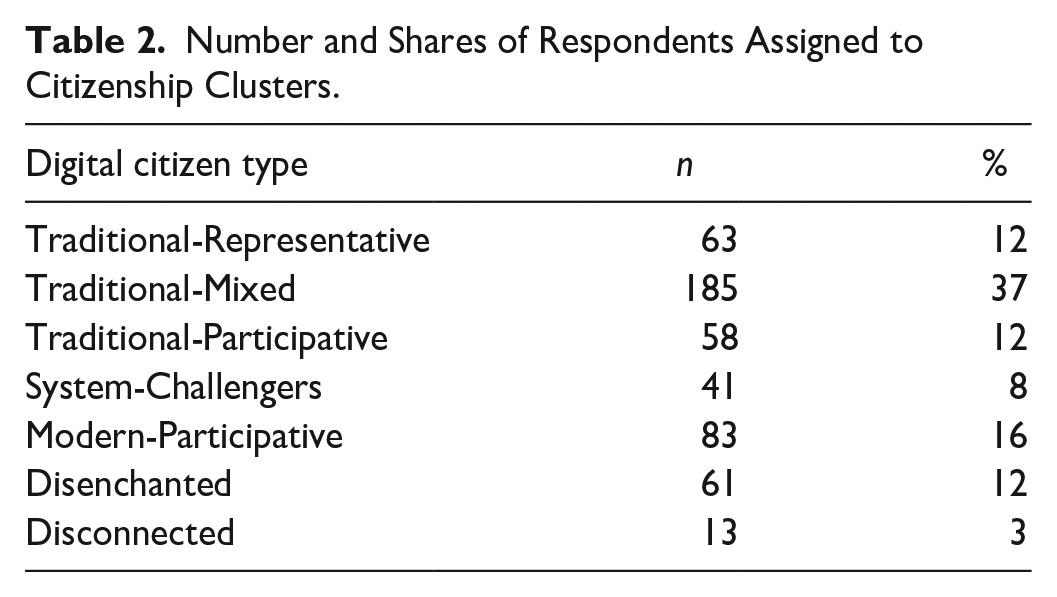
We identified seven citizenship types (clusters), based on the Set 1 variables, which included normative, behavioral, and attitudinal aspects of citizenship. Table 2 shows these seven clusters and their prevalence in our sample. In what follows, we will describe these citizenship types in more detail. We will specifically zoom in and check for their political activities on social media. While the cluster-building itself considers only the total intensity of political uses of social media, we will explore what types of engagement may be typical for which clusters.
Number and Shares of Respondents Assigned to Citizenship Clusters.
Traditional-Representative (Cluster 1)
The first cluster embraces a traditional-representative view of citizens’ role in democracy. They believe democracies function with minimal citizen activity, relying on elites and experts for decision-making while citizens are rather in a receptive role and select representatives. They prefer a strong division of labor and endorse a low-complexity, low-demand democracy. Rejecting mass participation, they strongly support a stratified democracy and are somewhat disenchanted with democracy in Norway, neither being statistically significantly different from the most satisfied and the most dissatisfied clusters. They favor elite-driven over citizen-driven online discourse, engage only minimally in civic engagement, whether offline or on social media, and perceive social media as having a largely negative impact on politics (Figure 2).

Differences between the clusters regarding the cluster-building variables (Set 1).
Traditional-Mixed (Cluster 2)
The second cluster—the most prevalent in our sample—holds a traditional-mixed view of citizens’ roles in democracy. Their notion of democracy is demanding and complex, strongly endorsing stratified democracy while also valuing some mass participation. They are among the most satisfied with democracy in Norway. They moderately support both citizen-driven and elite-driven discourse, engage only to a low degree in civic activities-both offline and on social media-and perceive both positive and negative impacts of social media on politics (Figure 2).
Traditional-Participative (Cluster 3)
The third cluster holds a traditional-participative view of citizens’ role in democracy. Their image of an ideal democracy is very demanding toward the citizens. They reject the notion of a stratified democracy whose day-to-day discourse and decision-making is mainly carried out by representatives and experts. Instead, they strongly endorse an ideal of mass participation, emphasizing the importance of widespread civic engagement. Like the other “traditional” clusters, they very rarely contribute political content on social media; however, unlike the other two traditional clusters, they are very active in other channels of political participation. They are highly critical of social media’s impact on democracy, strongly emphasizing the negative aspects and largely rejecting any positive impacts (Figure 2).
System-Challengers (Cluster 4)
The fourth cluster holds a system-challenging view of citizens’ role in democracy. They think that democracy demands little to nothing from citizens. They reject the mass participation ideal, only partly accept the stratified democracy ideal, and are very dissatisfied with democracy in Norway. Their engagement in conventional forms of political participation is very low, but they are extremely politically active on social media—the most active of all clusters. This does not, however, mean that they are generally supportive of social media; they cite both many positive and many negative impacts of social media on democracy (Figure 2).
Modern-Participative (Cluster 5)
The fifth cluster holds a modern-participative view of citizens’ role in democracy. They are extreme in many ways, holding the most taxing notion of democracy, endorsing both a mass participation and a (somewhat weaker) stratified democracy ideal. They display the highest levels of political participation through conventional channels, as well as very high levels of political activity on social media, and they endorse both elite discourse and citizen discourse ideals. They recognize many benefits of social media for democracy and see few pitfalls. They are between the “low” and “high” variance groups regarding disenchantment with democracy, which expresses the contrast between their high ideals and the probably sobering reality they observe (Figure 2).
Disenchanted (Cluster 6)
This cluster expresses strong dissatisfaction with democracy as it currently is and reports very low levels of civic engagement, both through conventional channels and on social media. They hold a very minimalistic view of citizens’ role in democracy, rejecting the mass participation ideal and endorsing stratified democracy. They also reject the elite discourse ideal and express only minimal support for the citizen discourse ideal. They see neither positive nor negative impacts of social media on political discourse (Figure 2).
Disconnected (Cluster 7)
The last cluster represents individuals who are disconnected from politics. It is by far the smallest cluster of our sample. Whereas the Disenchanted cluster still holds expectations regarding how democracy should function and how public discourse should be organized, the Disconnected express almost no such expectations. They endorse the simplest and least taxing vision of citizens’ role in democracy, rejecting both stratified and mass participation ideals. They report virtually no civic engagement, whether through conventional means or on social media, and reject both elite-driven and citizen-driven discourse ideals. They do not perceive social media as having a significant impact on political discourse, either positive or negative (Figure 2).
Clusters and civic engagement on social media
Given the special place that civic engagement on social media holds in debates about young people’s political behavior, we specifically examine the engagement profiles across the seven clusters (Figure 3). A strong divide emerges: while two clusters—the System-Challenger and Modern-Participative clusters—exhibit relatively high levels of social media engagement, the remaining five—the three Traditional clusters, the Disenchanted cluster, and the Disconnected cluster—display comparatively minimal engagement across most forms of participation, and particularly more expressive uses (e.g. sharing posts or comments). However, even among the non-expressive clusters, there are a few nuanced differences: the traditional-participative cluster is significantly more likely to read posts and comments and engage in personal communication compared to the most passive clusters; the traditional-mixed cluster is more active in viewing posts than the most passive clusters. Among the expressive clusters, the System-Challenger and Modern-Participative groups differ in their activity profiles: System-Challengers report intensive use across all types of engagement, while Modern-Participatives focus more on receptive activities (viewing, reading, liking) and are relatively less inclined to engage in personal communication, sharing, and commenting. This suggests that willingness to publicly expose one’s views is particularly pronounced among System-Challengers.

Frequency of Political Activities on Social Media by Citizenship Types.
Core and peripheral dimensions reflected in citizenship clusters
The clusters explain between roughly one-third and two-thirds of the variance in seven of the ten variables that underlie the latent profiles. The seven variables for which the latent profiles provide a good or very good account are (in descending R2 order): Taxingness of good citizen ideals (R2 = 63.0%), endorsement of mass discourse ideals (R2 = 57.2%), social media civic engagement index (R2 = 52.8%), general civic engagement index (R2 = 47.1%), endorsement of stratified democracy ideals (R2 = 35.1%), mass participation ideals (R2 = 31.0%), and positivity toward social media in political discourse (R2 = 31.2%). These are the core dimensions that discriminate between the latent profiles (Figure 2a to f and j).
Three additional variables—endorsement of stratified discourse ideals (R2 = 16.2%), negativity toward social media in political discourse (R2 = 5.7%), and disenchantment with democracy (R2 = 4.3%)—are less well-accounted for by the clusters (Figure 2g, h, k). While these peripheral dimensions have lower explanatory power, they align conceptually with the pillars of citizenship explored in this study. These variables may hold potential for explaining variation within the clusters.
Correlates of citizenship types (RQ2)
Now we turn to comparing the citizenship types regarding the second set of variables. None of these were considered in building the clusters; any differences between these clusters indicate correlates of the citizenship types, which help to further characterize them and map the wider (potential) social and political phenomena associated with citizenship types. While some may be causes or consequences of citizenship types, we refrain from making any causal statements due to our cross-sectional design.
News consumption intensity
News consumption intensity differs substantially between the clusters (analysis of variance [ANOVA]: F(6, 497) = 4.63; p < .001; η2 = 5.3%). The Disconnected cluster had the lowest (M = 3.46 days per week), and the Modern-Participative cluster has the highest news exposure (M = 5.98). A large middle group leaned toward low news exposure (Disenchanted cluster [M = 4.79]) or toward high news exposure (System-Challenger [M = 5.41] and the three traditional clusters [representative: M = 5.44; mixed: M = 5.57; participative: M = 5.79]) (Figure 4, panel A).
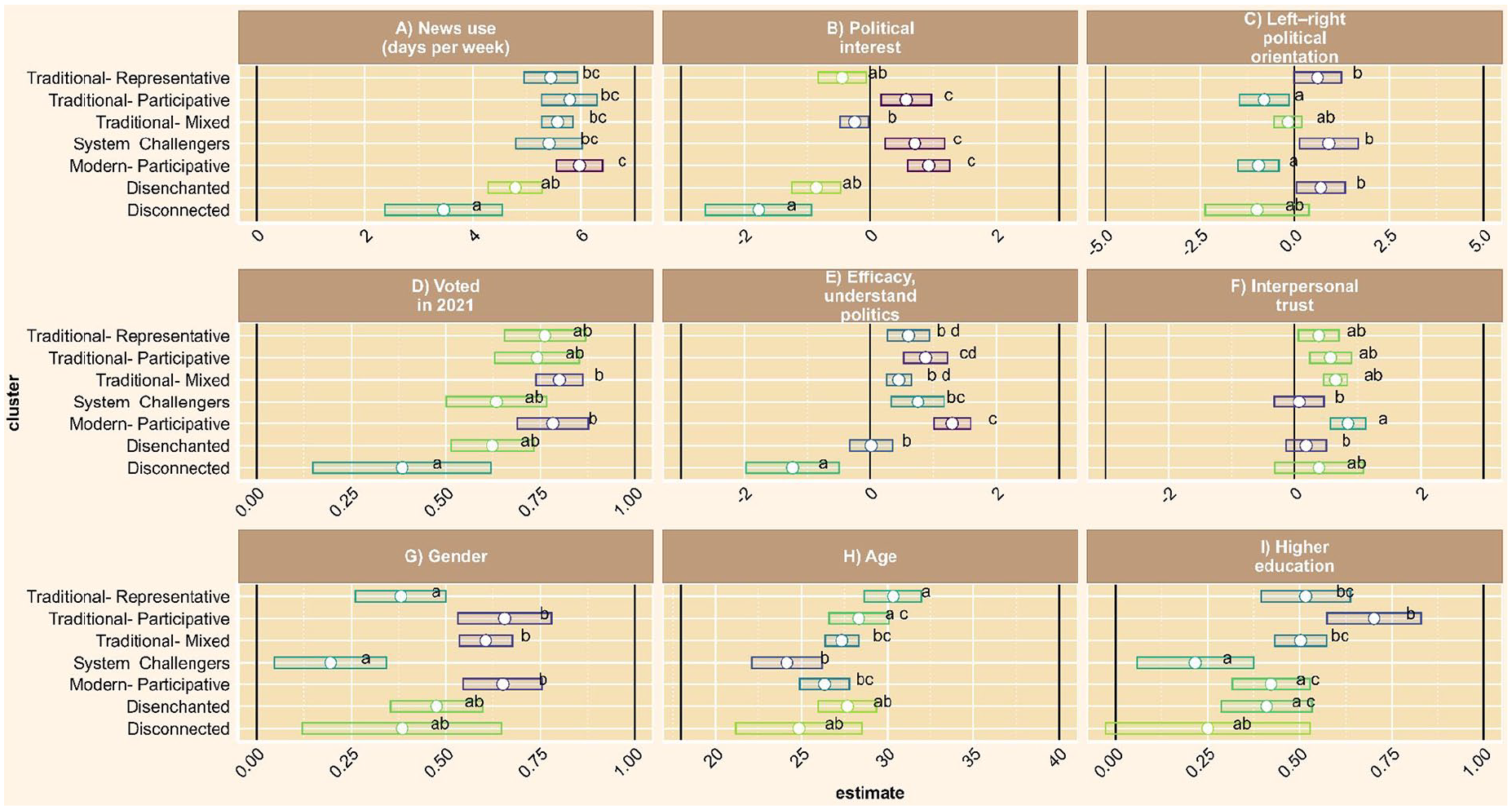
Differences between the clusters regarding the correlates of citizen types (Set 2).
Politics-related characteristics
Political interest
Political interest differed significantly between the clusters (ANOVA: F(6, 497) = 15.24; p < .001; η2 = 15.5%, n = 504). It was lowest in the Disconnected cluster (M = −1.77) and highest in the Modern-Participative (M = 0.93), System-Challenger (M = 0.71), and Traditional-Participative (M = 0.57) clusters. The Traditional-Mixed cluster (M = −0.25) defined a group with moderate political interest. The Traditional-Representative (M = −0.44) and Disenchanted (M = −0.85) clusters ranged between low and moderate political interest, not being significantly different from either group (Figure 4, panel B).
Left-right political orientation
The clusters differ significantly in their left–right political orientations (ANOVA: F(6, 497) = 5.58; p < .001; η2 = 6.3%). There were three right-leaning clusters: the Disenchanted (M = + 0.69), System-Challengers (M = + 0.90), and Traditional-Representative (M = + 0.60) clusters. Two clusters were clearly left-leaning: the Modern-Participative (M = −0.96) and the Traditional-Participative (M = −0.81) clusters. In between, the Disconnected (M = −1.00, very wide confidence range) and Traditional-Mixed (M = −0.18) clusters were not different from either the left or the right groups in terms of statistical significance (Figure 4, panel C).
Voting in past election
There was a significant statistical relationship between self-reported voting turnout and the clusters (binary-logistic regression: χ2(6) = 34.15; p < .001; R2 Tjur = 9.0%; n = 427; we excluded those who had not been eligible to vote in 2021). The Disconnected cluster had the lowest propensity to vote in the past election (56%), but the System-Challengers (68%) and the Disenchanted (75%) are in the same variance group. The Traditional-Participative (98%), Modern-Participative (94%), and the Traditional-Mixed (92%) clusters had the greatest propensity to vote. The Traditional-Representative (87%) cluster is compatible with both the high and the low turnout clusters (Figure 4, panel D).
Efficacy: understanding politics
There were significant differences between the clusters regarding the efficacy to understand politics (ANOVA: F(6, 497) = 10.37; p < .001; η2 = 11.1%). The Modern-Participative cluster is most confident in being able to understand political issues (M = 1.30), but System-Challengers (M = 0.76) and Traditional-Participative (M = 0.88) are in the same variance group. The other traditional groups are also relatively high in their efficacy beliefs (representative: M = 0.60; mixed: M = 0.45). The Disenchanted cluster tends toward lower efficacy (M = 0.02), and the Disconnected cluster (M = −1.23) has a very low belief in their ability to understand political issues (Figure 4, panel E).
Psychological and demographic correlates
Interpersonal trust
There were significant differences between the clusters in terms of interpersonal trust (ANOVA: F(6, 497) = 2.87; p = .009; η2 = 3.4%). Interpersonal trust is low in two clusters—Disenchanted and System-Challengers—but high in the Modern-Participative cluster. All other clusters range in between, with Traditional-Mixed and Traditional-Participative clusters leaning toward higher trust and Disconnected and Traditional-Representative clusters leaning toward lower trust (Figure 4, panel F).
Demographic variables
The gender composition differed significantly between the clusters (contingency: χ2 = 38.62; p < .001; Cramér’s V = 0.277; n = 504). Two clusters displayed a gender imbalance where the male gender dominates (<25% female)—the System-Challengers and the Traditional-Representatives; three clusters exhibit a female-dominated gender imbalance (Modern-Participative, Traditional-Participative, Traditional-Mixed). The remaining clusters are relatively balanced in their gender composition (Figure 4, panel G).
Regarding age (ANOVA: F(6, 497) = 4.48; p < .001; η2 = 5.1%), large age differences are not to be expected, given the relatively limited range within the sample (18–40). Youngest in composition are the System-Challenger (M = 24.1) and Disconnected (M = 24.8) clusters, followed by the Modern-Participative (M = 26.3), Traditional-Mixed (M = 27.3), Disenchanted (M = 27.7), and Traditional-Participative (M = 28.3). The cluster with the highest average age was the Traditional-Representative cluster (M = 30.3) (Figure 4, panel H).
Regarding education (contingency: χ2 = 27.1; p < .001; Cramér’s V = 0.234; n = 497), the share of persons in our sample with completed higher education appears low because our sample includes many young adults who are currently enrolled in educational programs. The two youngest clusters—System-Challengers (M = 21.6%) and Disconnected (M = 25.0%)—are probably most affected by this bias. The Disenchanted (M = 41.0%), Modern-Participative (M = 42.2%), Traditional-Mixed (M = 50.3%), and Traditional-Representative (M = 51.6%) clusters are more highly educated, and the Traditional-Participative cluster (M = 70.2%) comes out on top (Figure 4, panel I).
Discussion
Citizens’ understanding and engagement with political processes profoundly shape democratic systems. The current high-choice media environment has diversified citizenship styles, particularly among digital natives (Ohme & de Vreese, 2020; Thorson, 2015). Existing citizenship typologies, while valuable, have consistently struggled to capture this complexity. Typically relying on binary distinctions—active versus passive, online versus offline, dutiful versus engaged—or focusing narrowly on single dimensions, these frameworks fall short of representing the multifaceted nature of contemporary citizenship orientations. Our study addresses these limitations through a comprehensive, multidimensional approach that simultaneously examines citizenship norms, behavior, and attitudes across both digital and traditional political spheres, revealing intricate differences obscured by more reductive analytical models.
Typology of citizenship orientations
Employing an original questionnaire building upon prior qualitative research (Solverson, 2024), we identified seven distinct citizenship types among Norwegian digital natives of voting age: Traditional-Representative, Traditional-Mixed, Traditional-Participative, System-Challengers, Modern-Participative, Disenchanted, and Disconnected. The identified types reflect a broad range of normative expectations, participatory behaviors, and attitudes, across both online and offline contexts.
Our typology clearly shows the value of considering the different pillars of citizenship together. For example, when looking only at participatory behavior, one may overlook differences between Modern-Participative and the System-Challengers who are highly politically engaged and actively contribute political content online. Yet, upon closer inspection, we see that their ostensibly similar behaviors are underpinned by sharply contrasting normative views and attitudes toward democracy: the Modern-Participative align closely with the maximalist, all-round activists identified by Oser and others (Oser, 2017; Oser et al., 2023; Reichert, 2017) while the System-Challengers engage only minimally offline, express strong dissatisfaction with democracy, and reject mass participation ideals. The study also shows that not all politically active digital natives embrace digitally mediated forms of civic engagement. The Traditional-Participative cluster, for instance, is highly interested and active in political processes, yet refrains from online political expression. As such, our typology illustrates that civic engagement is not only a question of “yes or no” but rather “how” and “how much.”
The four seemingly “passive” clusters we identify also show a high degree of heterogeneity in terms of normative expectations, behaviors, and attitudes. Traditional-Representative and Traditional-Mixed are equally cautious in their civic engagement on social media, but seemingly for different normative reasons: the Traditional-Representatives engage selectively, believing that limited public expression may best serve democratic legitimacy. The Traditional-Mixed, by contrast, resemble “standby citizens” (Amnå & Ekman, 2014) who value civic engagement and remain attentive and willing to act if needed but currently see no urgency—either because they are satisfied with the status quo or because they trust that more actively engaged citizens will address pressing issues.
If, however, we were to only consider citizens’ attitudes and normative perspectives and neglect their behavior, one might lump the System-Challengers together with the Disconnected and Disenchanted. Yet, attention to patterns of civic engagement reveals key differences between the groups: While Disenchanted and Disconnected appear largely disengaged from public life, System-Challengers show high interest, efficacy, and critical views of the existing order rather than apathy. Thus, our findings underscore the importance of considering normative expectations, behaviors, and attitudes when investigating citizenship. Future studies of digital engagement should therefore incorporate a wide range of actions—from invisible, receptive to visible, expressive behaviors—as well as citizens’ normative perspectives and attitudes.
Correlates of citizenship types
The complexity of the seven types we found is further underlined by their contextualization with diverse political, media-related, psychological, and demographic characteristics of the participants, which clearly differed between the seven citizenship types (RQ2). Much of the relationships we found resonates well with previous research, for example, that more expressive participation of the Modern-Participative and System-Challengers relates to higher political interest (Zukin et al., 2006), and higher efficacy (Boulianne et al., 2023), that the Disconnected consume less and the Modern-Participatives more news (de Vreese & Boomgaarden, 2006), and that older participants prefer more conventional forms of political participation (Andersen et al., 2021; Verba et al., 1995).
In our study, the latter is illustrated particularly by the clusters with the highest average age, Traditional-Representatives and Traditional-Participatives, who prefer conventional participation over social media engagement. The cross-sectional design of our study leaves open if this indicates a cohort effect (“Gen Z” vs “Millennials”) or rather that the stage of life (student life with higher flexibility and more time vs. working life with more structured daily routines and more obligations) determines how extensively citizens use social media for political expression—a clear limitation of our cross-sectional study. However, our study can be a starting point for future panel studies, which may clarify these causalities. Another limitation is that we only investigated one country. Although Norway’s representative democratic system suggests transferability to similar contexts, future comparative studies are needed to test this. Our questionnaire offers a solid methodological basis for such research.
The relatively lower alignment of certain variables, such as disenchantment with democracy and negativity toward social media, raises questions about their centrality in this study. Future research could explore whether these findings stem from our sample size or context or whether they reflect broader empirical patterns. In addition, alternative operationalizations of these variables might better capture their relevance to the core dimensions. These investigations would clarify their potential role in understanding citizenship ideals and inform more robust typological analyses in future studies.
Implications and limitations
By identifying the coexistence of different approaches to “good citizenship,” our research underscores the importance of a systemic perspective on citizenship according to which democracy can be sustained without necessitating or assuming that all citizens engage in equal or identical ways (Mansbridge et al., 2012). Since a healthy democratic system requires “different kinds of citizens doing different kinds of things” (Chambers, 2013, p. 207), citizens’ varying behaviors, experiences, and viewpoints can contribute to the system’s vibrancy and adaptability. Citizenship thus becomes a collective effort where individuals may play different roles based on their unequal levels of interest, experience, and expertise in specific issues (Moe, 2023). Our newly developed questionnaire provides a means of shifting the focus from expecting uniform citizen participation to appreciating diverse roles within the democratic system in empirical research. From a systemic perspective, our findings of widespread (although not universal) support for stratified participation ideals (particularly in the online sphere) should not be interpreted as indicating a participatory malaise. Rather, many citizens seem to agree with functional differentiation and support cooperative frameworks of online engagement, prioritizing epistemic quality over quantity of political expression and a shared responsibility for collective discourse (Solverson, 2024).
Such a division of labor can strengthen the system in many respects. For example, our findings revealed that those most actively contributing to online debates are the most politically interested and partisan, with Modern-Participatives leaning left and System-Challengers leaning right. While this may produce polarized debates and can lead to a distorted picture of opinion distributions (Stark et al., 2017), partisan participation can also positively impact a deliberative system by broadening inclusion of issues and perspectives in the public agenda (Chambers, 2013). Furthermore, the high level of news use among these expressive clusters may enable them to make well-informed contributions (Moe, 2023). While these visible contributors may be fairly set in their political views and therefore reluctant to take on board their coconversants’ perspectives, their visible contributions may support many other citizens who would rather observe and contemplate the arguments on offer, which potentially support them to form more considered opinions (Goodin, 2003). Thus, a systemic approach provides a reality-sensitive understanding of contemporary citizenship, highlighting the valuable contributions different behaviors and civic styles may make to complex democratic processes.
Finally, a systemic approach can be instrumental in identifying those citizens who may fall outside productive divisions of labor altogether. While most types we identified can be understood as engaging in “good citizenship” within one or another model of democracy (Ferree et al., 2002), the System-Challengers, Disenchanted, and Disconnected signify that the political discontent observed among young people in other parts of the world is also present in Norway (Foa et al., 2020). However, it is particularly the Disconnected who raise concern due to their near-total detachment from politics. Although this is only a small group in our sample, it remains unclear whether this indicates that there are few Disconnected in Norway. The small group size may partly reflect self-selection (another limitation of our study), as the topic of citizenship may have been off-putting to this type of citizen, or they may be generally less inclined to participate in surveys, making the group appear smaller than it is. Also, it is in principle possible that the group is not as disconnected from politics as it appears but that the measures we used to examine it failed to accurately capture these respondents’ interests, perceptions, experiences, and behaviors. This highlights a need for more targeted efforts in both research and education to better understand and engage those members of younger cohorts who are or appear genuinely disengaged, alienated, or tuned out from politics. Such efforts could aim at strengthening the Disconnected’s inclusion in and sense of belonging to the system, thereby bolstering democratic inclusion and legitimacy.
While the size and scope of our study are limited, it provides a robust exploratory framework that can be tested further in future studies. We acknowledge that a larger sample size would offer more granularity in identifying cohort differences, but our findings still offer a meaningful first step in understanding the complex ways digital natives engage with democratic citizenship in Norway. However, as mentioned above, Norway stands out in international comparisons due to its favorable conditions and high levels of political participation, trust, and equity. Therefore, our findings are not directly transferable to other democratic countries with lower levels of participation, trust, and equality, let alone non-democratic countries where the opportunities for political participation and civic engagement are quite different. Thus, our work emphasizes the need for additional research across different countries and larger samples to fully map how these citizenship types evolve over time and across generations under different framework conditions.
Conclusion
In conclusion, by combining normative expectations, behavior, and attitudes, our typology provides a much-needed framework for researchers and policymakers to better understand and address the complexities of modern citizenship. By developing a seven-fold typology that integrates normative, behavioral, and attitudinal dimensions, our research transcends simplistic categorizations of citizenship. Our approach reveals the diverse and multidimensional nature of contemporary citizenship among digital natives. Our typology challenges monolithic understandings of citizenship, demonstrating that participation is not merely a matter of “yes or no” but a complex interplay of motivations, capabilities, and systemic roles. This nuanced perspective not only advances theoretical debates but also offers practical insights for designing more targeted civic engagement initiatives that reflect the diversity of contemporary citizenship styles.
Supplemental Material
sj-docx-1-sms-10.1177_20563051251346744 – Supplemental material for The Complexity of Contemporary Citizenship: A Typology of Citizenship Orientations Among Norwegian Digital Natives
Supplemental material, sj-docx-1-sms-10.1177_20563051251346744 for The Complexity of Contemporary Citizenship: A Typology of Citizenship Orientations Among Norwegian Digital Natives by Elizabeth Solverson, Stefan Geiß and Melanie Magin in Social Media + Society
Footnotes
Acknowledgements
The authors express their gratitude to Audun Michael Knudsen at Norstat for his invaluable support and patience throughout the questionnaire development and fielding process. His assistance was crucial to this research. The authors also extend their thanks to the New Media and Journalism research group at Nord University and the EVPOC research group at NTNU. In particular, the authors appreciate the excellent comments and support from Astrid Marie Holand, Lisbeth Morlandstø, Conor Kelly, and Andreas Goldberg during the early stages of this research.

Ethical Consideration
The study was approved by the Norwegian board of research ethics (NSD; now Sikt).
Consent to Participate
The participants provided informed consent by checking a box before accessing the survey.
Funding
The author(s) received no financial support for the research, authorship, and/or publication of this article.
Declaration of Conflicting Interests
The author(s) declared no potential conflicts of interest with respect to the research, authorship, and/or publication of this article.
Data Availability Statement
Data are available upon request.
Supplemental Material
Supplemental material for this article is available online.
Author biographies
References
Supplementary Material
Please find the following supplemental material available below.
For Open Access articles published under a Creative Commons License, all supplemental material carries the same license as the article it is associated with.
For non-Open Access articles published, all supplemental material carries a non-exclusive license, and permission requests for re-use of supplemental material or any part of supplemental material shall be sent directly to the copyright owner as specified in the copyright notice associated with the article.
