



Abstract
Using three U.S. public opinion survey datasets, this study examines whether use of specific social media platforms affects the gaps in factual and perceived knowledge of three wicked science issues among Americans with different racial and socioeconomic makeup. Less-educated Americans are less likely to gain factual knowledge but more likely to gain perceived knowledge from increased social media use than more-educated Americans. Racial minorities are more likely to gain both factual and perceived science knowledge than White Americans with increased social media use. Furthermore, social media use was linked to wider education-based gaps in factual knowledge and narrower education-based gaps in perceived knowledge among racial minorities than among Whites. Theoretical and practical implications for equitable science communication are discussed.
In an era of increasingly fast-moving and disruptive scientific and technological advances (Rittel & Webber, 1973), communicating science to broad segments of the populations becomes more important than ever. A scientifically and technologically skilled population is more likely to achieve economic success and competitiveness and respond to challenges that emerge in society, many of which can be understood or addressed at least in part through science (National Academies of Sciences, Engineering, and Medicine [NASEM], 2016b). More importantly, it is a democratic imperative to engage broad publics and stakeholder groups in the dialogue to ensure the quality of the resolution to the many ethical, social, and political questions raised by contemporary and emerging science and technology issues that do not have purely technical answers (Funtowicz & Ravetz, 1993). Scientific understanding matters in part because it provides the basis for one’s ability to engage with science-related issues (NASEM, 2016b). As modern science and technologies are extremely complex, in order for informed public debate involving those issues to happen, it is necessary that citizens have certain scientific awareness and some baseline knowledge of the issues at hand (European Commission, 1995).
Empirical evidence suggests that a sizable portion of the American public has limited knowledge about scientific methods and processes, limited interest in science, and low involvement in science activities (National Science Board, National Science Foundation, 2022). Perhaps what is more concerning is that such trends are especially pronounced among racial minorities and population segments that are less educationally and financially well-off (Kennedy & Atske, 2019; Kennedy & Hefferon, 2019). There are wide educational differences in science knowledge in the U.S., with more highly educated Americans scoring higher on science knowledge than Americans who are less educated, when knowledge is conceptualized as an understanding of scientific processes and facts (related to life sciences, earth, and other physical sciences), as well as numeracy and the ability to read charts (Kennedy & Hefferon, 2019). With these same science knowledge measures, White Americans also tend to have substantively higher levels of science knowledge than Blacks and Hispanics, and such differences persist across domains of scientific facts as well as individuals’ education levels (Kennedy & Atske, 2019). Similar education- and race-based gaps are also identified for science interest. For example, White Americans and people who have college degrees report greater interest in following science news than their counterparts who are Black, Hispanic, or less educated (Saks & Tyson, 2022). Corroborating these trends are persistent disparities in racial diversity and inclusion in science, technology, engineering, and mathematics (STEM) jobs in the U.S. (Christopherson et al., 2021).
Disparities in science knowledge between different social segments, like those discussed earlier, can be understood through the lens of digital divides (Howell & Brossard, 2021) and the knowledge gap hypothesis (Tichenor et al., 1970). Representing “who has access to online tools and information,” digital divides exist along socioeconomic, racial, and other demographic lines (Howell & Brossard, 2021, p. 4). In the U.S., those who are White, male, wealthy, and well-educated are more likely to have access to and benefit from digital technologies and information (Christopherson et al., 2021; Kiser & Harrison, 2018; Voss, 2018). Furthermore, even when given equal physical access to information technologies and resources, those who are already advantaged in society have different patterns of use and can often gain the most from informational resources (Howell & Brossard, 2021).
Another useful framework for understanding differential gains in knowledge from informational resources is the knowledge gap hypothesis (Tichenor et al., 1970), which states that members of society with different socioeconomic status (SES) do not learn from media information equally fast. Specifically, high-SES individuals are able to extract meaningful knowledge from media information more efficiently than low-SES individuals. Therefore, as media information circulates in society, high-SES audiences will experience greater knowledge growth than low-SES audiences, widening existing gaps in knowledge between high- and low-SES social segments (Tichenor et al., 1970).
Both frameworks point to the role of information and media systems in the formation of knowledge gaps between social segments. With digital media quickly outdating traditional media infrastructures as a primary source of science information for many people (Brossard, 2013), scholars have started to turn attention to various online media, examining how the use of the internet (Cacciatore et al., 2014; Lee, 2009; Shim, 2008), science blogs (Su et al., 2014), online newspapers (Chang et al., 2018; De Silva-Schmidt et al., 2022), and social media (Gerosa et al., 2021) might affect SES-based gaps in science knowledge. Building on this emerging line of research, this study examines both factual knowledge and perceived knowledge about wicked science issues (Rittel & Webber, 1973) across socioeconomic and racial segments to explore how individuals’ social media use as well as science issue contexts might shape disparities in scientific understanding.
Outcome of Interest: Science Knowledge
Science knowledge—especially knowledge that cuts across multiple dimensions related to the science, application, history, and policy of given science issues—matters because it provides the basis for one’s ability to engage effectively with science (Sarewitz, 2015). Importantly, how science knowledge is measured could affect to what extent knowledge gaps are identified. In their original thinking on the knowledge gap hypothesis, Tichenor et al. (1970) did not formally define knowledge and used both true/false factual statements and acceptance of stated beliefs to measure knowledge. However, ensuing research revealed that factual knowledge about a novel science issue such as nanotechnology and perceived familiarity with the science issue are only slightly correlated with each other and are predicted differently by media use and cognitive processing variables. Specifically, increased attention to internet science information has a stronger association with perceived familiarity with nanotechnology than with factual nanotechnology knowledge (Ladwig et al., 2012). Moreover, SES-based knowledge gaps are often observed and more pronounced when science knowledge is measured with close-ended, factual-type questions, as opposed to when open-ended, belief-type measures are used (Chang et al., 2018; Hwang & Jeong, 2009, 2010; Su et al., 2014).
As part of “civic science literacy” or “understanding of the many elements that shape the production of scientific knowledge” (Howell & Brossard, 2021, p. 2), factual science knowledge is a crucial basis for effective public engagement with science in society. Nonetheless, how knowledgeable about science people think themselves are could also matter for important outcomes of democratic decision-making about science, such as public support for science issues (Akin et al., 2020). In addition, scholars have argued that facts are less definitive than often assumed and are subject to group and cognitive biases as well as contextual influences (Johnson, 1993). Which facts are relevant also depends on the specific audiences and situation of concern (Johnson, 1993). Given these considerations, this study examines both factual and perceived knowledge of wicked science issues.
Social Media Use and Science Knowledge Gaps
A range of factors have been identified that contribute to knowledge gap formation. Tichenor et al. (1970) outlined five reasons why knowledge gaps are expected to occur or widen with increasing media inputs into society, namely (a) individuals’ communication skills, (b) their prior issue knowledge, (c) their relevant social networks, (d) individuals’ selective exposure, acceptance, and retention of information, and (e) the nature of the media system. More highly educated individuals tend to possess stronger communication skills, higher prior issue knowledge as a result of formal education or prior media exposure to the topic, and more knowledgeable social contacts with whom they can discuss complex issues, all of which put high-SES individuals in a better spot of acquiring knowledge about public issues than low-SES individuals. Since Tichenor et al. (1970), scholars have identified additional factors that explain why knowledge gaps form, including those related to individuals’ motivations and abilities (Grabe et al., 2009; Liu & Eveland, 2005), issue characteristics, and community structures (for a review, see Hwang & Jeong, 2009; Lind & Boomgaarden, 2019; Viswanath & Finnegan, 1996).
Media and communication scholars have paid special attention to how the nature of the media system that delivers information shapes knowledge gaps. Early research has typically examined newspaper and television use. Studies have generally shown that newspaper reading is associated with widened knowledge gaps due to the financial barrier of newspaper subscriptions (Eveland & Scheufele, 2000) and the tailoring of print media content and writing style to the interests, tastes, and literacy levels of high-SES audiences (Donohue et al., 1986; Kleinnijenhuis, 1991). In contrast, television viewing tends to narrow science and political knowledge gaps among SES segments as television content is generally more accessible and comprehensible, sometimes even meager and superficial (Ettema & Kline, 1977), and uses audiovisual components to contextualize and reinforce information (Graber, 1990; Neuman et al., 1992).
Although traditional mass print and broadcast media used to play a central role in disseminating news about scientific breakthroughs and bridging the science-public divides, they are giving way to online media as lay Americans are now turning to the internet for information about science (Brossard, 2013). In particular, social media have become a prominent general news source, especially for younger generations (Newman et al., 2022). Most social media users in the U.S. encounter science-related information on these platforms (Funk et al., 2017).
The rise of social media poses interesting opportunities to (re)examine knowledge gap formation and some of the basic assumptions of the framework. On the one hand, social media algorithms are designed to maximize user engagement by amplifying and delivering information based on audience preferences and routines. Such personalized information on science and public affairs may be better accepted and retained by low-SES individuals and audiences who are underserved by traditional mass media systems, as the content and creative style of online science information are usually more accessible and comprehensible and tailored to the demands of audiences who are otherwise discouraged from looking for science information (Cacciatore et al., 2014; Goh, 2015). In addition, the prolonged attention cycles for science issues in online media (Anderson et al., 2013), compared with traditional print newspapers, may allow low-SES audiences to gradually catch up and diminish the science knowledge gaps over time. For these reasons, social media could potentially close science knowledge gaps.
On the other hand, by the nature of algorithmic tailoring, social media also challenge some of the basic assumptions of the knowledge gap hypothesis. The central proposition of the knowledge gap hypothesis is that high-SES audiences can extract meaningful knowledge more efficiently from the same piece of information than low-SES audiences. However, information tailoring and preference-based targeting may well mean that various audience segments receive entirely different sets of information, with those already interested in science and public affairs (e.g., high SES, White Americans) selecting and consuming more science information and audiences lacking interest in science more easily shying away from it, which, of course, will exacerbate science knowledge gaps not due to differences in learning rate but due to unequal information distribution.
Research in the space of social media use and science knowledge gaps indicates an overall negative relationship between social media use and factual science knowledge (Chang et al., 2018; Gerosa et al., 2021; Lee et al., 2022) with a few exceptions (e.g., W. Li & Cho, 2021; Su et al., 2014) and an overall positive relationship between social media use and perceived science knowledge (Chang et al., 2018; Lee et al., 2022; Su et al., 2014). Moreover, although there is some evidence indicating that increased attention to science information on social media overall was associated with a narrower gap in perceived science knowledge between high- and low-education groups (Chang et al., 2018), it is less clear whether social media use would similarly narrow factual science knowledge gaps among education and racial groups.
Furthermore, differences in social media platforms could potentially influence how science knowledge gaps form. Media richness and self-disclosure, for example, are two dimensions along which social media platforms may vary (Kaplan & Haenlein, 2010). A platform is high in media richness if it achieves (a) a higher degree of multimodal communication such as visual, acoustic, and physical contact; (b) a higher degree of communication immediacy via synchronous, as opposed to asynchronous, communications; and (c) a higher degree of communication intimacy via interpersonal, as opposed to mediated, communications. In addition, a social media platform permits more or less self-disclosure depending on to what extent it is focused on specific content domains or ruled by strict guidelines that force users to behave in a certain way (Kaplan & Haenlein, 2010).
Despite differences across platforms, existing research has rarely examined how the use of specific social media platforms shapes (science) knowledge gaps, with the exceptions of the study by Su et al. (2014) that looked at science blog use and SES-based gaps in nanotechnology knowledge and the study by Yoo and Gil-de-Zúñiga (2014) that examined how the use of specific social media platforms including blog, Twitter, and Facebook was associated with education-based gaps in political knowledge. One should not assume that individuals’ use of various social media platforms will uniformly impact their science knowledge as well as disparities in scientific understanding within the broader society. However, the extent to which these effects vary depending on the specific social media platforms is an empirical question that requires further investigation.
Therefore, this study examines the relationship between science knowledge and the use of five social media platforms that are among the most widely used in the U.S. and worldwide for both general purposes and news use specifically: Facebook, YouTube, Instagram, Twitter, and TikTok (Newman et al., 2021). The five social media platforms differ in a number of ways (see Table 1). First, they have varied audience makeup. For example, Twitter users tend to be younger, have higher incomes and educational attainment, and identify themselves as Democrats compared to the general U.S. adult population (Wojcik & Hughes, 2019), although this may have changed drastically since Elon Musk took over the platform in 2022 (Anderson, 2023). Second, the types of information sources that people pay attention to on these platforms also differ. For instance, while Twitter users tend to follow mainstream news, users of Instagram and TikTok tend to pay attention to internet personalities (Newman et al., 2021). However, this does not mean that serious issues such as COVID-19 are not discussed on these platforms. News stories blend in with videos and images shared by users of Instagram and TikTok and tend to be highly engaging to reach a wide audience (Newman et al., 2021). Third, these platforms also differ in their primary communication modality. Instagram, TikTok, and YouTube are primarily visual platforms where users create, share, and discover images, videos, visual stories, and the like, whereas Facebook and Twitter are more text-based (Pelled et al., 2017). Such differences in modality may matter for science knowledge gap formation, as reading news articles about science via social media may function in a way more akin to reading traditional print newspapers given the elite orientation of professional news websites (Chang et al., 2018), whereas watching online science videos may work in a way similar to watching televised science programs. In addition, because audiences with lower levels of educational attainment tend to process audiovisual information better than text-based information (Grabe et al., 2009), differences in the primary communication modality of the social media platforms may imply differential effects on the knowledge gap phenomenon.
Launch Year, Proportion of Sampled Users Using Each Social Network for Any Purpose (for News Purpose) in the Last Week, Audience Age Distribution, Primary Platform Use, and Primary Modality of Five Social Media Platforms.

Source. Data from Newman et al. (2021) (all 46 markets globally).
Data from Newman et al. (2022) (12 markets including UK, USA, Germany, France, Spain, Italy, Ireland, Denmark, Finland, Japan, Australia, and Brazil).
Taken together, because Twitter users primarily use the platform to follow mainstream news (Newman et al., 2021), it is likely that increased Twitter use would lead to greater factual science knowledge gains. However, it is less clear how the use of other social media platforms affects factual science knowledge. Research has generated mixed findings regarding the relationship between overall social media use and factual science knowledge. Furthermore, even if users of Facebook, YouTube, Instagram, and TikTok do not tend to actively seek science news and information when on these platforms (Newman et al., 2021), they may still incidentally learn about science (Mueller-Herbst et al., 2020). In light of this discussion, we pose the following hypothesis and research questions:
While prior research has not directly examined how the use of specific social media platforms contributes to individuals’ perceived science knowledge, a positive relationship between overall social media use and perceived science knowledge has been identified in the literature (see, e.g., Chang et al., 2018; Lee et al., 2022; Su et al., 2014). Therefore, we pose the following hypotheses:
Turning to the knowledge gap phenomenon, prior research has identified narrower factual science knowledge gaps with increased television use than with newspaper reading partly due to the visual nature of television. The audiovisual component of television content helps contextualize and reinforce information, making information more digestible and retainable (Graber, 1990; Neuman et al., 1992). In addition, audiences with limited educational attainment tend to process audiovisual information better than text-based information (Grabe et al., 2009). Given that Instagram, TikTok, and YouTube are primarily audiovisual platforms, whereas Facebook and Twitter are more text-based (Pelled et al., 2017), we pose the following hypotheses:
In addition, because prior research has identified a narrower gap in perceived science knowledge with increased attention to science information on social media overall (Chang et al., 2018), we pose the following hypotheses:
Finally, research on the knowledge gap phenomenon has almost exclusively focused on inequalities in knowledge among SES or educational segments, largely overlooking inequal knowledge distribution along other demographic lines such as race (Howell & Brossard, 2021), let alone the intersectionality of these demographic identities. Nonetheless, empirical evidence has identified wide educational and racial differences in Americans’ science knowledge (Kennedy & Atske, 2019; Kennedy & Hefferon, 2019) and the differing abilities among educational and racial segments to utilize digital media for knowledge acquisition (Howell & Brossard, 2021; Wei & Hindman, 2011; Yang & Grabe, 2014). Moreover, the intersectionality of education and race could potentially matter for how knowledge gaps turn out. Therefore, we examine how social media use might shape science knowledge gaps formed on the basis of the intersectionality of education and race:
The Role of Issue Contexts in Shaping Science Knowledge Gaps
Besides media systems that disseminate information about public issues in society, characteristics of the issues themselves could also affect knowledge gaps pertaining to these issues. Particularly, the more an issue appeals to the basic concerns within a society, the more likely that members of the society, from all walks of life, will overcome some of the personal and system barriers contributing to knowledge gaps and engage with the issue, ultimately equalizing knowledge distribution within the society (Donohue et al., 1975). Relatedly, the more an issue evokes social conflict within a society, the more likely that widespread concerns will occur within the society as a result of the conflict, and the more likely that both high- and low-SES segments will pay attention to the issue, diminishing the knowledge gap between these segments (Bauer & Bonfadelli, 2002; Donohue et al., 1975). Moreover, complex issues could instigate wider SES-based knowledge gaps than relatively simple issues (Moore, 1987). As most science issues are “beyond hard” for the ordinary citizen to grasp (Xenos, 2017, p. 285), we should expect to see persistent gaps in knowledge about many scientific issues among SES and racial segments. Echoing calls for more research that compares across science topics, we examine how knowledge gaps might be conditioned on science issue contexts.
Three science issues serve as the contexts for this study, namely human gene editing (HGE), artificial intelligence (AI), and COVID-19. These issues will likely have, or are already having, profound impact on society, raising complex social, political, and ethical questions that do not have purely technical answers. As examples of “wicked problems,” these issues have policy and lifestyle implications, involve trade-offs between competing values held by different stakeholders, and have no definitive best solution moving forward (Rittel & Webber, 1973). For instance, employers requiring workers to be vaccinated against COVID-19 at public and private institutions during the pandemic raised intense political debate within the U.S., as some members of the public viewed such mandates as an infringement on personal liberties and religious freedom while others upheld them as an imperative to avoid harms to others. Similarly, while HGE has been lauded for its potential to treat diseases that are otherwise difficult or impossible to cure and AI for its ability to enhance human decision-making, both technologies raise a broad range of concerns such as possibly worsening social equity. Addressing those concerns requires an extended peer community—one that includes not just scientists and official experts but also anyone who has a stake in the issue, such as citizens, pressure groups, and investigative journalists (Funtowicz & Ravetz, 1993).
Aside from their commonalities, the three science issues also differ in a number of ways. A useful framework for understanding these issues’ differences is the issue attention cycle model (Downs, 1972), which states that many issue topics in public life follow a life cycle where public and media attention to these issues goes up and down (see Figure 1 for a broad representation of the position of each issue in the issue attention cycle). An issue starts with receiving no or very little media attention and public concern. Then, in the alarmed discovery phase, media and public attention to the issue suddenly increases, usually driven by a focusing event (e.g., OpenAI launching ChatGPT). Next, in the mobilization phase, media coverage of the issue problems continues to grow and increasingly pays attention to the political conflicts surrounding the issue as more actors participate in the issue negotiation. After that, media and public attention starts to gradually decline as policy measures are being developed to solve the problems. News coverage at this stage tends to focus on the technical aspects of the issue (Nisbet & Huge, 2006). The issue cycle continues, and public and media attention tends to remain higher at the end of the cycle than before issue discovery.
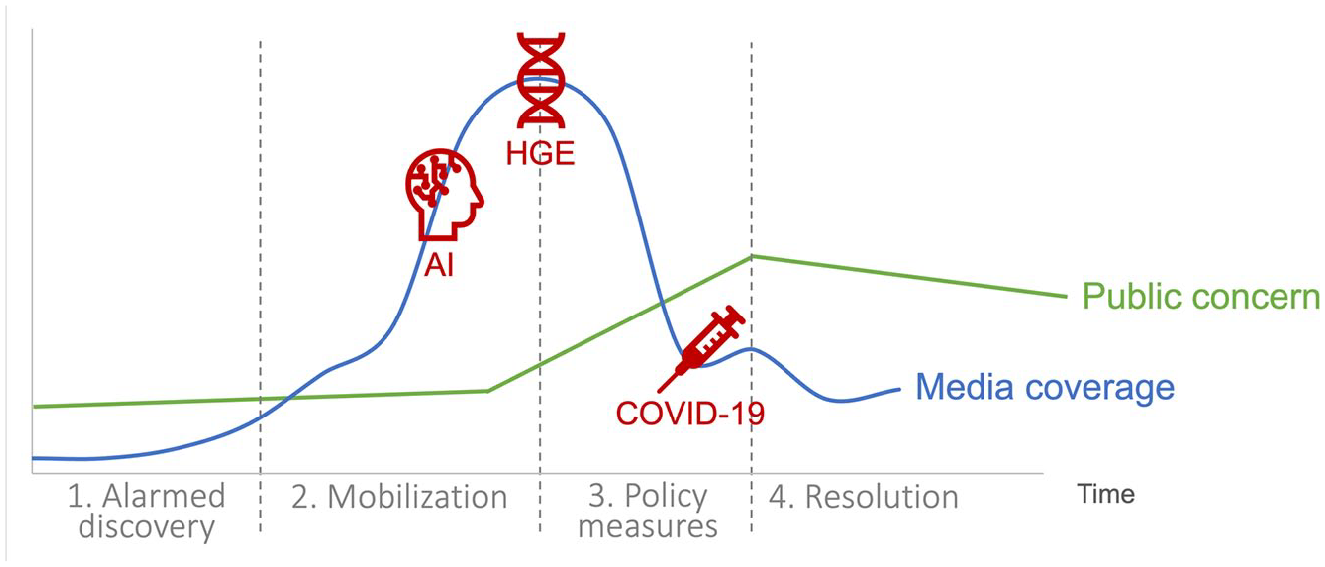
HGE, AI, and COVID-19 vaccines and the issue attention cycle.
Arguably, COVID-19 is further into the policy measures stage along the issue attention cycle (Figure 1). There are already many policy measures in place regarding COVID-19. Coverage of COVID-19 including its related vaccines was highly saturated in the news (see Table 2) and has passed its peak, gradually declining. The pandemic also raised widespread public concern within the U.S., as nearly half (45%) of the U.S. adult population named COVID-19 as the nation’s most important problem in April 2020, topping the list of a host of public issues (Brenan, 2021). In comparison, HGE has just entered the policy measures stage in the issue attention cycle, with 1,280 federal regulatory documents being released and 2,397 congressional hearings held on HGE since 2010 (Table 2). The NASEM (2016a, 2017) also issued two consensus reports on gene-editing technology—one on genetically engineered crops and the other on human genome editing specifically. Media and public attention to HGE surged when the birth of the first gene-edited babies was announced in 2018 and when the developers of CRISPR-Cas9—a novel gene-editing technique—won the 2020 Nobel Prize in Chemistry. Turning to AI, it is still at an early stage in the issue attention cycle compared to COVID-19 and HGE. While AI has received some policy attention, the extent of regulatory developments on AI is not comparable to that on COVID-19 or HGE. Nonetheless, with the advent of ChatGPT and other highly disruptive AI tools, we should expect that media, public, and policy attention to AI technology will continue to grow (Yang et al., 2023).
Total Volume of U.S. News Coverage, Congressional Hearings, and Federal Register on HGE, AI, and COVID-19 From January 2010 to May 2023.

Source. Data on volume of news coverage come from Newspaper Source Plus index of New York Times, Wall Street Journal, Washington Post, and USA Today. Data on number of congressional hearings held and federal register come from the ProQuest Congressional Record (U.S.). The Boolean search string is (human*) AND ((gene edit*) OR (genome edit*) OR (genetic engineer*)) for HGE; artificial intelligence for AI; covid* for COVID-19; and (covid*) AND (vaccin*) for COVID-19 vaccines.
In addition, COVID-19 is highly politicized, raising intense political controversy. In the U.S., newspaper and network news coverage of COVID-19 was highly politicized, often citing politicians and employing partisan framings (Hart et al., 2020; Myers, 2024). Accordingly, public opinion on COVID-19 was starkly polarized, with wide partisan differences in views of public health officials (Schaeffer, 2021), medical experts and scientists (Funk et al., 2020), government and politicians (Kerr et al., 2021), and ways to handle the pandemic (Schaeffer, 2021). Because the more an issue evokes social conflict and controversy within a society, the narrower the knowledge gap will be (Bauer & Bonfadelli, 2002; Donohue et al., 1975), it is expected that COVID-19 will engender narrower knowledge gaps among social segments than HGE or AI due to the high degrees of politicization and polarization of COVID-19.
Finally, the three science issues also differ in level of wickedness, as they involve varying degrees of uncertainty related to the production, processes, and implications of the science. Specifically, COVID-19 involves arguably lower scientific uncertainty than AI or HGE. For example, the science behind the different types of COVID-19 vaccines has been around for decades despite the vaccines being relatively new developments (Cid & Bolívar, 2021; Fang et al., 2022; Vrba et al., 2020). Moreover, COVID-19 is a transient issue and has limited scopes of application and implications; that is, the related scientific uncertainty is constrained by the temporality and scope of the issue. In contrast, HGE and especially AI have a very broad range of applications with long-term, far-reaching impacts at the societal level, making these issues very high in “completeness uncertainties” (Funtowicz & Ravetz, 1993, p. 744). Because more complex issues tend to instigate wider knowledge gaps within society (Moore, 1987), we should expect to see wider knowledge gaps for HGE and AI than for COVID-19.
Taken together, because COVID-19 (a) involves high, tangible personal risks and hence appeals to the basic concerns of members of the broad public much more than HGE and AI (Brenan, 2021); (b) receives much more media and public attention in society than HGE and AI (see Table 2); (c) raises controversy and political conflict (especially in the U.S.) more than HGE and AI; and (d) involves lower scientific uncertainty than HGE and AI, we expect that the factual knowledge gap pertaining to COVID-19 across social segments will be smaller than that pertaining to HGE or AI:
Methods
Data were collected through three national surveys examining U.S. public opinion on HGE, AI, and COVID-19, respectively. For the HGE dataset, a nationally representative online survey with N = 1,600 U.S. adults aged 18 years and older was conducted by YouGov in December 2016 and January 2017. The completion rate was 41.7%, defined as the percentage of panel members invited to the study who provided a usable response (American Association for Public Opinion Research [AAPOR], 2016; Callegaro & DiSogra, 2009). To ensure representativeness across sociodemographic characteristics, YouGov matched respondents to a sampling frame based on gender, age, race, education, political ideology, party identification, and political interest. The sampling frame was constructed using stratified sampling from the Census Bureau’s 2010 American Community Survey. Matched cases were weighted to the sampling frame based on propensity scores.
For the AI dataset, data were collected through a nationally representative web-survey with U.S. adults aged 18 years and older, conducted by YouGov from February to March 2020. The survey sample was randomly selected from the YouGov’s U.S. panel, which had 2 million respondents. The final sample size was N = 2,700 with a completion rate of 41.3%. YouGov then used propensity score matching techniques for adjustment to make the sample representative of the U.S. population in terms of sociodemographic characteristics including age, education, gender, race, party identification, and political ideology.
For the COVID-19 dataset, data were collected from an online survey of a national sample of 1,306 U.S. adults aged 18 years and older who had experience using Instagram. The survey was conducted by Forthright in March 2022. For the purpose of comparing results across datasets, we used optimization-based stable balancing weights to construct weights for the COVID-19 sample by balancing it against the 2020 AI sample—which served as the reference sample—in terms of sociodemographic characteristics including age, education, gender, race, Hispanic ethnicity, party identification, and political ideology. This led to a postweighting effective sample size of N = 901 for the COVID-19 sample. All weighting procedures were performed using R statistical software and packages including “weightit” and “optweight.” Table 3 shows descriptive statistics of demographic variables for the three datasets.
Descriptive Statistics of Demographics of the HGE, AI, and COVID-19 Samples.

Postweighting effective sample size is 901.
Measures
Factual Science Knowledge
In the HGE dataset, factual knowledge of HGE was assessed with four true/false statements using 4-point scales (1 = “definitely true,” 4 = “definitely false”), including (a) “Over time, human DNA has picked up pieces of DNA from different species and viruses that naturally mixed in with human DNA” (T), (b) “Personal behavior or environmental factors cannot change human DNA” (F), (c) “To date, no scientists have started human gene editing trials” (F), and (d) “According to scientists, human beings developed from earlier species of animals” (T). Correct answers were coded as 1. False answers and “don’t know” were coded as 0. Correct answers were summed up for each respondent to form a single variable measuring HGE factual knowledge (with a range of 0–4, M = 1.8, SD = 1.3).
In the AI dataset, factual knowledge of AI was measured with nine true/false statements using 4-point scales (1 = “definitely false,” 4 = “definitely true”): (a) “AI research began in the early 2000s” (F), (b) “Programmers of AI know exactly how their algorithms adapt to new information” (F), (c) “Self-driving cars are currently being road tested in all 50 states” (T), (d) “The news you see on Facebook news feeds is curated by AI” (T), (e) “Federal law prohibits financial institutions from using AI in lending decisions” (F), (f) “President Trump signed an executive order to increase research and development on AI technology” (T), (g) “Tech companies use AI to combat online misinformation in U.S. elections” (T), (h) “When AI is used to make hiring decisions it is always free of bias” (F), and (i) “Police use of AI can result in systematic targeting of specific neighborhoods” (T). Correct answers were coded as 1. False answers and “don’t know” were coded as 0. Correct answers were summed up for each respondent to form a single variable measuring AI factual knowledge (with a range of 0–9, M = 3.9, SD = 2.3).
Using the same 4-point scale, factual knowledge of COVID-19 was assessed with three true/false statements: (a) “COVID-19 can be treated with antibiotics” (F), (b) “COVID-19 is a respiratory syndrome caused by SARS-CoV-2 virus infection” (T), and (c) “COVID-19 is spread through droplet transmission only” (F). Correct answers were coded as 1. False answers and “don’t know” were coded as 0. Correct answers were summed up for each respondent to form a single variable measuring COVID-19 factual knowledge (with a range of 0–3, M = 1.8, SD = .9).
Perceived Science Knowledge
In the HGE dataset, perceived knowledge of HGE was measured on a 5-point scale item (1 = “not at all informed,” 5 = “very informed”) that asked respondents how informed they would say they are about HGE (M = 1.9, SD = .9). Similarly, perceived knowledge of AI was measured by averaging five 5-point scale items (1 = “not at all informed,” 5 = “very informed”) asking respondents how informed they are about (a) the science behind AI, (b) concrete uses or applications of AI, (c) impacts of AI on society, (d) regulatory or legal questions emerging from AI applications, and (e) what kinds of information companies collect about ordinary citizens, respectively (M = 2.4, SD = .9, Cronbach’s alpha = .92). Perceived knowledge of COVID-19 was measured on an item using the same scale that asked respondents how informed they are about COVID-19 (M = 4.1, SD = .8).
Social Media Use
In the HGE and COVID-19 datasets, the use of specific social media platforms was measured by a series of 7-point scale items (1 = “less than once a month,” 7 = “multiple times per day”) asking respondents how often they use Facebook (HGE: M = 6.5, SD = 2.1; COVID-19: M = 5.3, SD = 2.3), Twitter (HGE: M = 2.9, SD = 2.5; COVID-19: M = 2.7, SD = 2.7), YouTube (HGE: M = 5.1, SD = 2.1; COVID-19: M = 5.1, SD = 2.2), Instagram (HGE: M = 2.8, SD = 2.5; COVID-19: M = 3.9, SD = 2.6), and TikTok (not asked in the HGE dataset; COVID-19: M = 2.2, SD = 2.7), with those who answered “never” recorded as “0.” In the AI dataset, the use of specific social media platforms was measured on a 6-point scale item (1 = “less than 10 minutes a day,” 7 = “more than 3 hours a day”) that asked respondents in the past week about how much time on average they have spent each day on Facebook (M = 3.4, SD = 1.9), Twitter (M = 1.9, SD = 1.5), YouTube (M = 3.3, SD = 1.9), Instagram (M = 2.0, SD = 1.6), and TikTok (M = 1.3, SD = 1.0), with those answering “none” recorded as 0.
Control Variables
Age was measured as a continuous variable (HGE: M = 46.7, SD = 16.7; AI: M = 48.9, SD = 17.6; COVID-19: M = 48.8, SD = 16.9). Gender was a dichotomous variable with male coded as 1 and female coded as 2 (HGE: 48.5% males; AI: 48.7% males; COVID-19: 43.5% males). Race was measured by a dichotomous variable, with White coded as 1 and Black and other racial minorities coded as 2 (HGE: 66.9% White; AI: 63.5% White; COVID-19: 62.8% White). In line with the study by Tichenor et al. (1970) and other knowledge gap research, education was employed as an indicator of SES. Education was an ordinal variable with six levels ranging from “no high school diploma” (coded as 1) to “post graduate degree” (coded as 6). For each of the three samples, the median value for education was 3 or “attended some college.” Political ideology was measured by asking respondents where their views align on both economic and social issues using 7-point scales (1 = “very liberal,” 7 = “very conservative”). The two items were averaged to form a single variable (HGE: M = 4.1, SD = 1.6, r = .79; AI: M = 4.1, SD = 1.7, r = .84; COVID-19: M = 4.1, SD = 1.6, r = .84). In the HGE dataset, science newspaper use was measured by asking respondents how often they use newspapers and news magazines (online and offline) for news about science and its societal applications with response categories ranging from “never” (coded as “0”) to “everyday” (coded as “4”) (M = 1.8, SD = 1.4). Science television use was measured in the same manner by asking respondents how often they use television (online and offline) for news about science and its societal applications (M = 2.2, SD = 1.4). These questions were not asked in the AI and COVID-19 datasets.
Analysis
To examine the role of social media use in shaping factual and perceived science knowledge, as well as gaps in knowledge across educational and racial segments (H1 through H4 and RQ1 through RQ2), we conducted hierarchical ordinary least squares (OLS) regression analyses, entering independent variables in blocks into the regression models based on their presumed causal order. The final two blocks of the regression models contained interaction terms. To prevent multicollinearity between interaction terms and their constitutive components, main effect variables were standardized before being multiplied together to create the interaction terms (Cohen & Cohen, 1983).
To examine the role of issue contexts in shaping science knowledge gaps (H5 and RQ3), we compared the zero-order correlations between knowledge and education and between knowledge and race across the three issues, following Tichenor et al.’s approach (1970). A stronger, positive relationship between knowledge and education, for example, would indicate a larger gap in knowledge between education groups with more highly educated individuals possessing more knowledge than their less-educated counterparts, whereas a weaker relationship between knowledge and education would indicate a smaller education-based knowledge gap. Fisher’s z-transformation for correlation coefficients was used to test whether two correlations are statistically significantly different from each other (Fisher, 1921).
Results
Results from the OLS regressions are presented in Tables S1–S6 in the Online Supplemental Material. H1 hypothesized that Twitter use will be positively associated with factual knowledge. Across all three science issues, Twitter use was positively related to factual knowledge (HGE: β = .07, p ⩽ .05; AI: β = .08, p ⩽ .001; COVID-19: β = .06, p ⩽ .05), thus supporting H1. RQ1a–RQ1d asked how the use of Facebook, YouTube, Instagram, and TikTok might be associated with factual knowledge, respectively. Facebook use and YouTube use had no significant relationship to factual knowledge across all three science issues. Instagram use (β = .06, p ⩽ .05) was positively related to HGE factual knowledge. TikTok use was measured only in the AI and COVID-19 datasets and had no significant relationship to factual knowledge of either issue.
Turning to perceived knowledge, H2a–H2e hypothesized that the use of Twitter, Facebook, YouTube, Instagram, and TikTok will be positively associated with perceived knowledge, respectively. Twitter use was positively related to perceived knowledge across all three science issues (HGE: β = .12, p ⩽ .001; AI: β = .21, p ⩽ .001; COVID-19: β = .14, p ⩽ .001), supporting H2a. Facebook use was only positively related to AI perceived knowledge (β = .11, p ⩽ .001) while having no significant relationship to perceived knowledge of HGE or COVID-19, partially supporting H2b. YouTube use was positively related to perceived knowledge of AI (β = .21, p ⩽ .001) and COVID-19 (β = .12, p ⩽ .001) but not HGE, partially supporting H2c. Instagram use was also positively related to perceived knowledge of AI (β = .20, p ⩽ .001) and COVID-19 (β = .14, p ⩽ .001) but not HGE, hence partially supporting H2d. Finally, in both datasets where it was measured, TikTok use was positively related to perceived AI (β = .21, p ⩽ .001) and COVID-19 (β = .07, p ⩽ .05) knowledge, supporting H2e. Overall, social media use appeared to be more positively associated with perceived knowledge than with factual knowledge.
Turning to factual knowledge gaps, H3a–H3e hypothesized a series of two-way interactions between education and social media use and between race and social media use on factual knowledge levels. Specifically, H3a and H3b hypothesized that Twitter use and Facebook use, respectively, will widen factual knowledge gaps (a) between high- and low-education groups and (b) between White and non-White groups. Across all three issues, Twitter use did not significantly increase factual knowledge gaps between education groups nor between racial groups. Therefore, H3a was not supported. The interaction between education and Facebook use was significant on AI factual knowledge (β = .04, p ⩽ .05), providing some support for H3b. As Figure 2a illustrates, increased Facebook use led to a widened gap in AI factual knowledge between high- and low-education groups. H3c–H3e hypothesized that YouTube, Instagram, and TikTok use, respectively, will narrow factual knowledge gaps (a) between high- and low-education groups and (b) between White and non-White groups. The interaction between education and YouTube use was significant on AI (β = .04, p ⩽ .05) and COVID-19 (β = .07, p ⩽ .05) factual knowledge. However, contrary to our expectation, YouTube use widened these education-based factual knowledge gaps, as shown in Figure 2b and c. Therefore, H3c was not supported. H3d was partially supported as the interaction between race and Instagram use was significant on COVID-19 factual knowledge (β = .07, p ⩽ .01). Increased Instagram use closed the gap in COVID-19 factual knowledge between Whites and racial minorities, as shown in Figure 2e. Finally, H3e was also partially supported as the interaction between race and TikTok use was significant on AI factual knowledge (β = .04, p ⩽ .05). As Figure 2d illustrates, increased TikTok use narrowed the gap in AI factual knowledge between Whites and racial minorities. Notably, individuals who were more highly educated tended to gain factual knowledge from increased social media use at a significantly faster rate than people who were less educated (Figure 2a–c). Racial minorities were also able to gain factual knowledge significantly faster than Whites with increased social media use (Figure 2d and e).
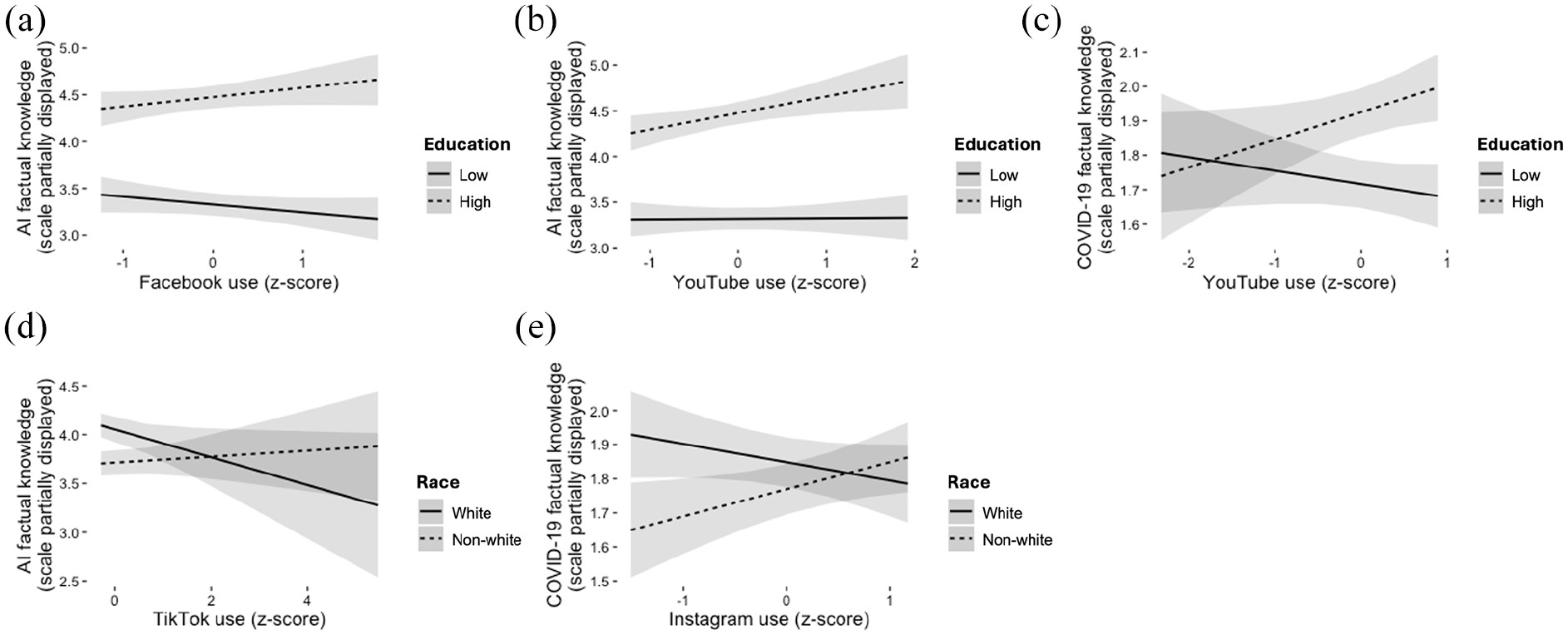
Two-way interactions between education and social media use and between race and social media use on factual knowledge of science issues.
Moving to perceived knowledge gaps, H4a–H4e hypothesized that Twitter, Facebook, YouTube, Instagram, and TikTok use, respectively, will narrow perceived knowledge gaps (a) between high- and low-education groups and (b) between White and non-White groups. In terms of H4a, the interaction between education and Twitter use was significant on AI perceived knowledge (β = −.04, p ⩽ .05). In addition, the interaction between race and Twitter use was significant on HGE perceived knowledge (β = .07, p ⩽ .01). Increased Twitter use diminished the gap in AI perceived knowledge between high- and low-education groups (Figure 3a) while increased the gap in HGE perceived knowledge between non-Whites and Whites (Figure 3c). Therefore, H4a was only partially supported. H4b was also partially supported given the significant interaction between race and Facebook use on COVID-19 perceived knowledge (β = .07, p ⩽ .05). Specifically, the gap in COVID-19 perceived knowledge narrowed between Whites and non-Whites with increased Facebook use (Figure 3d). Similarly, H4c was partially supported given the significant interaction between race and YouTube use on COVID-19 perceived knowledge (β = .09, p ⩽ .001). Here, increased YouTube use closed the gap in COVID-19 perceived knowledge between Whites and racial minorities (Figure 3e). Next, H4d was partially supported by the significant interaction between education and Instagram use on AI perceived knowledge (β = −.06, p ⩽ .001). As Figure 3b illustrates, increased Instagram use narrowed the gap in AI perceived knowledge between high- and low-education groups. Finally, TikTok use did not significantly narrow perceived knowledge gaps between education groups nor between racial groups. Therefore, H4e was not supported. Notably, one common pattern emerged from the analyses that increased social media use led to racial minorities growing perceived knowledge at a significantly faster rate than Whites, making the race-based knowledge gap narrow in some cases (Figure 3d and e) but widen in other cases (Figure 3c). In addition, less-educated individuals tended to gain perceived knowledge significantly faster than their more-educated counterparts with increased social media use (Figure 3a and b).
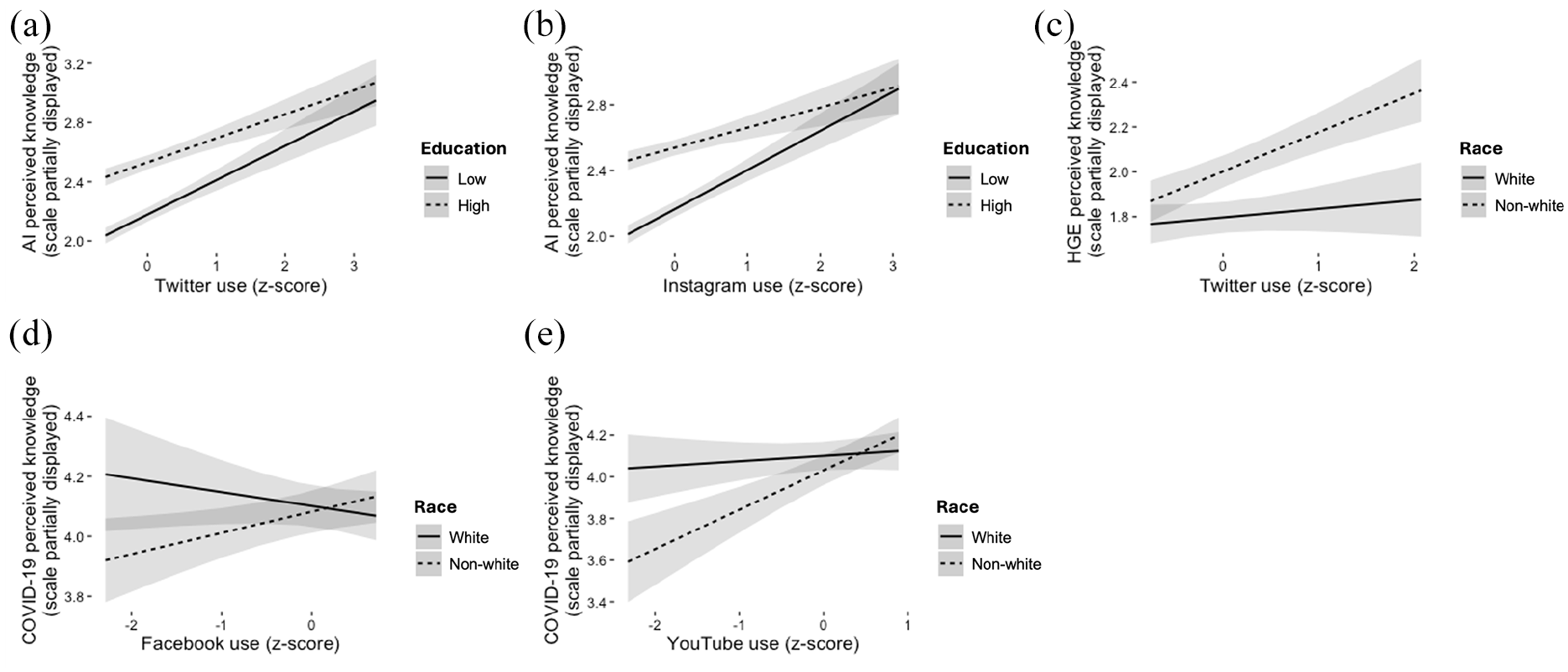
Two-way interactions between education and social media use and between race and social media use on perceived knowledge of science issues.
Furthermore, regarding the intersectionality of education and race, RQ2a–RQ2e asked how the effect of Twitter, Facebook, YouTube, Instagram, and TikTok use, respectively, on (a) factual and (b) perceived knowledge gaps between high- and low-education groups might differ depending on race. We ran a series of three-way interactions between social media use, education, and race on factual knowledge (Figure 4) and perceived knowledge (Figure 5) to examine these questions. In response to RQ2a, there was a significant three-way interaction between Twitter use, education, and race on HGE factual knowledge (β = .05, p ⩽ .05). As Figure 4a illustrates, among White respondents, increased Twitter use can lead to a diminished gap in HGE factual knowledge between high- and low-education groups as low-education White respondents caught up with their high-education counterparts in knowledge with increased Twitter use. Among non-White respondents, however, increased Twitter use was associated with a wider education-based gap in HGE factual knowledge, as high-education non-White respondents gained knowledge at a significantly faster rate than their low-education counterparts. Addressing RQ2b, there was a significant three-way interaction between Facebook use, education, and race on AI perceived knowledge (β = −.05, p ⩽ .01). Figure 5a shows that increased Facebook use had limited impact on the education-based gap in AI perceived knowledge among White respondents but was associated with a diminished education-based gap among racial minorities whereby low-education minorities caught up with their high-education counterparts in AI perceived knowledge as they used Facebook more. Next, addressing RQ2c, there were significant three-way interactions between YouTube use, education, and race on COVID-19 factual knowledge (β = .08, p ⩽ .01) and AI perceived knowledge (β = −.05, p ⩽ .05). As Figure 4b illustrates, increased YouTube use had virtually no impact on the education-based gap in COVID-19 factual knowledge among White respondents, whereas among non-White respondents, increased YouTube use seemed to increase the knowledge gap between high- and low-education groups, with those possessing higher education gaining knowledge more quickly than those with lower education. In contrast, when it comes to perceived knowledge gaps, increased YouTube use reduced the education-based gap in AI perceived knowledge among minorities significantly more than it did so among Whites (Figure 5b). Turning to RQ2d, there was a significant three-way interaction between Instagram use, education, and race on AI perceived knowledge (β = −.05, p ⩽ .01). While increased Instagram use slightly reduced the education-based gap in AI perceived knowledge among White respondents, it did so to a significantly greater extent among non-Whites (Figure 5c). In response to RQ2e, the three-way interaction between TikTok use, education, and race was not significant for factual or perceived knowledge levels. Overall, two common patterns emerged from the three-way interaction analyses. First, increased social media use significantly enlarged education-based factual knowledge gaps among minorities more than it did among Whites (Figure 4). Second, contrary to factual knowledge gaps, increased social media use significantly reduced education-based perceived knowledge gaps among minorities more than it did among Whites (Figure 5).

Three-way interactions between education, race, and social media use on factual knowledge of science issues.
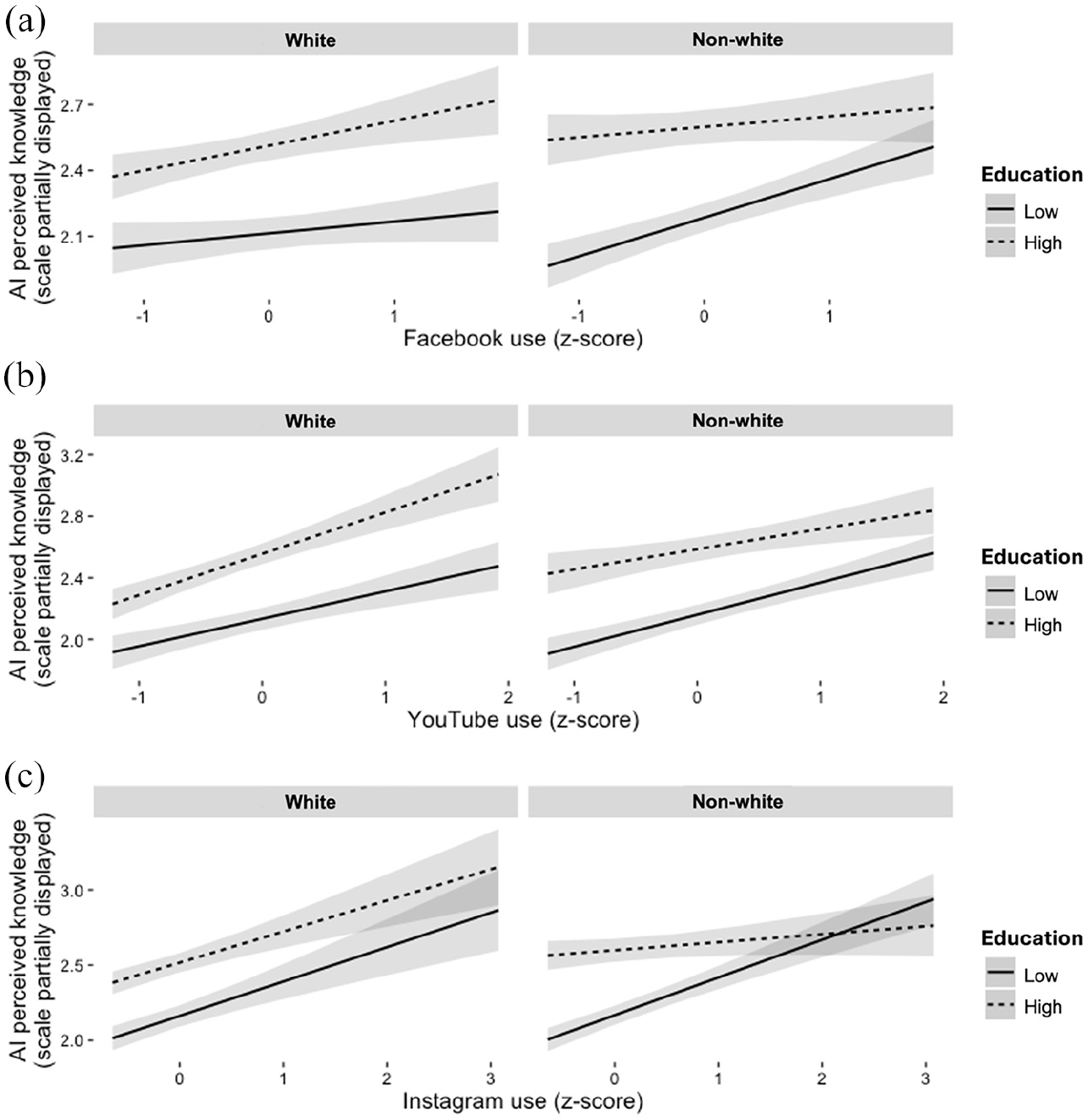
Three-way interactions between education, race, and social media use on perceived knowledge of science issues.
Finally, turning to the role of issue contexts, H5 hypothesized that the gap in factual knowledge among education and racial groups would be smaller for COVID-19 than for HGE or AI. Relatedly, RQ3 asked how the gap in perceived knowledge among those groups might differ across the three science issues. In response to H5 (see Table 4), a smaller education-based gap in factual knowledge was identified for the issue of COVID-19 than for HGE and AI, as the correlation between factual knowledge and education in the COVID-19 dataset was significantly smaller than those in the HGE (Fisher’s z = 4.17, p ⩽ .001) and AI (Fisher’s z = 4.30, p ⩽ .001) datasets. In addition, a smaller race-based gap in factual knowledge was identified for the issue of COVID-19 than for HGE, as factual knowledge had a significantly weaker correlation with race in the context of COVID-19 than HGE (Fisher’s z = −4.63, p ⩽ .001). However, the correlation between factual knowledge and race for COVID-19 was not significantly different from that for AI (Fisher’s z = −1.49, p = .137). Therefore, H5 was partially supported. Addressing RQ3, the correlation between perceived knowledge and education was significantly stronger in the AI dataset than in the HGE (Fisher’s z = −2.61, p ⩽ .01) and COVID-19 (Fisher’s z = 3.34, p ⩽ .001) datasets, while the latter two did not significantly differ from each other. The correlation between perceived knowledge and race was significantly stronger in the HGE dataset than that in the AI (Fisher’s z = 2.23, p ⩽ .05) and COVID-19 (Fisher’s z = 3.77, p ⩽ .001) datasets; furthermore, the correlation between perceived knowledge and race was significantly stronger for AI than for COVID-19 (Fisher’s z = 2.08, p ⩽ .05).
Partial Correlations Between (a) Knowledge and Education and (c) Knowledge and Race and Fisher’s z-Test Statistics Comparing the Correlations Between (b) Knowledge and Education and (d) Knowledge and Race Across Three Science Issues.

Note. Table entries in row (a) are Pearson’s partial correlations between education and knowledge, after controlling for age, gender, race, and political ideology; row (b) has Fisher’s z-test statistics for comparisons of correlations from (a); row (c) has Pearson’s partial correlations between race and knowledge, after controlling for age, gender, education, and political ideology; row (d) shows Fisher’s z-test statistics for comparisons of correlations from (c).
p ⩽ .05; **p ⩽ .01; ***p ⩽ .001.
Discussion
This study examines the influences of education, race, use of specific social media platforms, and issue contexts on both factual and perceived knowledge gaps across three wicked science issues including HGE, AI, and COVID-19. Findings suggest that increased social media use overall predicted larger factual science knowledge gaps and smaller perceived knowledge gaps between high- and low-education groups. Compared with more highly educated Americans, those with less education are less likely to gain factual science knowledge from increased social media use while they are more likely to grow confidence in their own knowledge. Racial minorities are more likely to gain both factual and perceived science knowledge than White Americans with increased social media use. Moreover, increased social media use was linked to wider education-based gaps in factual science knowledge and narrower education-based gaps in perceived knowledge among racial minorities than among Whites. We discuss the theoretical and practical implications of these findings in more detail below.
Theoretical Implications
Findings from this study have several important theoretical and practical implications. First, although research on social media and science knowledge gaps has for the most part examined aggregate social media use, the findings suggest that there is value in differentiating specific social media platforms because the use of different platforms may not shape factual knowledge (gaps) in the same way. Consistent with our expectation, Twitter was the only platform among the five platforms examined whose increased use was consistently linked to greater factual science knowledge across all three science issues. Whereas frequent Twitter users consistently reported higher factual knowledge about all three science issues even after controlling for demographics, frequent users of Facebook, YouTube, Instagram, and TikTok did not necessarily possess higher or lower factual knowledge (about AI and COVID-19) than people who used those platforms less often. Such differences in platform use’s influence on factual science knowledge may in part be attributed to the different types of information sources that people pay attention to on these platforms. While Twitter users tend to seek out mainstream news when they are on the platform, potentially contributing to the growth in their factual knowledge, users of Instagram, TikTok, YouTube, and Facebook tend to pay attention to a mix of internet personalities, ordinary people, and news (Newman et al., 2021), which may not be the types of information sources that are most conducive to factual science knowledge acquisition.
In addition, the role of platform modality in shaping science knowledge gaps warrants further investigation. While we expected that social media platforms with primarily audiovisual modality (e.g., YouTube, Instagram, TikTok) would outperform those with primarily textual modality (e.g., Twitter, Facebook) in leveling factual knowledge gaps, our findings did not entirely support such expectations. Indeed, increased Facebook use widened the education-based gap in AI factual knowledge, whereas increased Instagram and TikTok use narrowed the race-based gaps in AI and COVID-19 factual knowledge. However, unlike Facebook, increased Twitter use did not, as hypothesized, significantly widen factual knowledge gaps. It is also unclear why YouTube, a primarily audiovisual platform, widened the education-based factual knowledge gaps instead of leveling them. These surprising findings led us to asking what other features—beyond platform modality—matter to our understanding of how these text-based, as well as audiovisual, platforms differ from each other. One feature that could potentially matter, for instance, is message length limit. Compared to Facebook articles and posts, the much more stringent character limit on tweets might have constrained tweets’ informational potential, imposing a ceiling effect on high-education audiences’ learning as these audiences can only acquire limited new knowledge from reading a tweet, thus limiting the growth of factual knowledge gaps. Similarly, YouTube videos on average are significantly longer than TikTok videos or Instagram reels, which may impact the formation of knowledge gaps on these platforms. Of course, more research is needed to disentangle such possibilities and investigate how social media platforms’ features, attributes, and use patterns shape factual science knowledge gaps.
When it comes to perceived science knowledge, however, the five platforms examined did not appear to differ that much from each other in the extent to which they enabled users to develop perceived knowledge. For all five platforms examined, increased platform use was linked to greater perceived knowledge of at least one, and often more or all, of the three science issues. Furthermore, the five platforms were also similar in terms of narrowing perceived knowledge gaps between education and/or racial groups. As users spent more time on these platforms (with the exception of TikTok), the education- and/or race-based gaps in perceived knowledge of at least one of the science issues decreased. These patterns of findings suggest that social media overall are more conducive to the growth of perceived knowledge than factual knowledge, as well as to the leveling of perceived knowledge gaps than factual knowledge gaps.
Second, consistent with Ladwig et al. (2012) who found that factual nanotechnology knowledge and perceived nanotechnology knowledge were only slightly correlated with each other and were predicted differently by media use and cognitive processing variables, our results indicate that the identification of knowledge gaps depends on how knowledge is conceptualized and measured. Scholars should be careful not to conflate factual knowledge measures with self-reported knowledge measures when examining science knowledge gaps. Specifically, whereas social media use seemed to overall widen education-based gaps in factual science knowledge, it appeared to narrow education-based gaps in perceived knowledge.
The fact that social media use could widen factual knowledge gaps between high- and low-education groups is noteworthy. It turns out that social media may not differ very much from traditional media systems such as print newspapers when it comes to the democratizing potential for science learning and knowledge acquisition. Still, people who are already highly educated are able to gain the most useful knowledge from social media use despite that social media content may be more accessible and comprehensible in general than, say, newspaper content geared toward elite members of society. Future research is needed to investigate why this is the case. One speculation is that the algorithmic tailoring in many social media platforms—including the five examined here—contributes to widening factual knowledge gaps. Because less-educated audiences tend to select entertainment over information-oriented content when online (Bonfadelli, 2002), it is possible that less-educated individuals do not pay as much attention to science topics when using social media as their more educated counterparts. By tailoring information to people’s preferences, biases, and contexts, social media could potentially exacerbate information siloing and “filter bubbles” (Pariser, 2011). As social media users can easily preset or select content they do and do not want, individuals who are less educated and less interested in science will have less opportunity of exposure to science information and may therefore become increasingly disconnected from science over time, leading to widened gaps in factual science knowledge between themselves and their more educated, science-engaged counterparts.
Third, the identification of knowledge gaps could also depend on the science issue at hand. Previous research has suggested that knowledge gaps are contingent upon issue characteristics such as issue complexity (and thus knowledge complexity), controversy, general interest in the issue, and media publicity (Bauer & Bonfadelli, 2002; Donohue et al., 1975; Moore, 1987). Largely consistent with theoretical expectations, we found smaller education- and race-based gaps in factual as well as perceived knowledge for COVID-19 than for HGE and AI, arguably because COVID-19 is further into the issue attention cycle and generated much more media and policy attention, public concern, as well as political controversy, all of which led to increased information flows across communities and all walks of life. In addition, these science issues differ in their scope, temporality, and risks involved. While COVID-19 has a constrained issue scope, is relatively transient, and involves highly tangible, personal risks to the self, HGE, and especially AI have a very broad range of applications touching many aspects of society, and their impacts are long-term, latent, and far-reaching at the societal level, involving high levels of uncertainty and wickedness. These and additional issue characteristics may also affect people’s concerns, salience, and self-efficacy regarding science issues and the way they acquire knowledge (Ettema et al., 1983; Shim, 2008). More systematic research is needed to examine what and how science issue characteristics might matter for knowledge gaps.
Practical Implications
The findings also have implications for equitable science communication practices. First, education and race matter for determining how much people are able to pick up useful science knowledge from social media platforms. Because it is a democratic imperative to engage broad publics and stakeholder groups in the dialogue about contemporary science and technologies that pose challenges to many aspects of people’s lives, systematic efforts are required to tackle inequalities in science information use and distribution along socioeconomic, racial, as well as other potential demographic lines.
Second, social media matter for the formation of science knowledge gaps, especially considering these platforms are quickly outdating traditional legacy media in disseminating science information. Social media use could differentially benefit different SES and racial segments when it comes to science knowledge acquisition. Among SES segments, less-educated individuals are more likely to gain confidence in their own science knowledge with increased social media use when in fact they do not necessarily acquire knowledge, resulting in an “illusion of knowledge” (Rock et al., 2005). This aligns with Chang et al.’s (2018) finding that low-education individuals are more likely to perceive higher science knowledge than high-education individuals as aggregate social media use for science information increases. Such a false sense of knowledge develops as individuals repeatedly encounter similar posts on the same topic in social media content recommendations without reading the sources in full (Schäfer, 2020). This illusion of knowledge could be conducive to increasing self-efficacy to engage with science (Lee & Valenzuela, 2024) and willingness to discuss science with others (Schäfer, 2020) but might also impede informed decision-making and debates around science. Therefore, it may be beneficial for basic education to include a media literacy component that equips citizens early on with the necessary skills and incentives to navigate the social media information landscape.
Third, while knowledge gap research has primarily focused on unequal knowledge distribution among SES segments, we consider how race might also play a role in these processes. Race-based gaps in science knowledge matters even after accounting for educational influences on science knowledge, partly because individuals are deeply embedded in racially homophilic social networks that narrow one’s information diets and interpretation of new information (McPherson et al., 2001). Particularly, individuals from minority communities tend to have fewer similar others and media outlets to target for information, inhibiting them from acquiring and retaining information at the same pace as Caucasians (Spence et al., 2011). In addition, race-based digital divides often generate differential gains from informational resources among racial segments (Howell & Brossard, 2021). Despite these challenges, our findings suggest that social media may be a valuable avenue for bridging such disparities, as racial minorities are more likely to acquire both factual and perceived science knowledge from increased social media use than Whites, often leading to a diminished gap in knowledge between racial groups. This may have to do with differences in media expectancies held by racial and ethnic groups. As a 2015 state-wide survey with Texas residents found, Hispanic and African Americans reported greater informational motivation of internet use than Caucasians, whereas Caucasians and Hispanics are more likely than African Americans to use the internet for entertainment purposes (Eastin et al., 2015). In light of this evidence, we may expect different racial groups to also hold varying expectancies regarding social media use that explain differences in knowledge growth. Of course, future research is needed to unpack the specific mechanisms underlying these patterns of findings.
Moreover, when looking at the intersectionality of education and race more closely, we identify overall more severe adverse effects of social media use on factual science knowledge gaps formed on the basis of education among racial minorities than among Whites. Specifically, less-educated Whites are able to catch up with more-educated Whites in their factual science knowledge as they use social media (e.g., Twitter, YouTube) more, leading to a reduced knowledge gap between the two groups. However, the same is not true for racial minorities. Less-educated non-Whites learn virtually nothing more about science when increasing their social media use, whereas more educated non-Whites acquire significantly more factual knowledge than their less-educated counterparts when social media use increases, widening factual knowledge gaps between the groups. In contrast, social media use is more effective at reducing education-based gaps in perceived science knowledge among racial minorities than among Whites. These findings together suggest that knowledge gaps can be multifaceted phenomena that warrant attention to the intersectionality of sociodemographic influences. More importantly, special efforts should be made to support low-SES racial minorities so that they could equally benefit from advancements in information technologies as these technologies (including social media) have become increasingly integrated with our life. Efforts toward developing science literacy (Howell & Brossard, 2021) as well as social media literacy (Cho et al., 2022) among low-education minority segments may prove especially fruitful for reducing disparities in scientific understanding in the American society.
Limitations
Finally, we must point out several limitations of the study. The first limitation concerns our samples. Specifically, the HGE sample was collected in December 2016 and January 2017. Since then, many changes regarding science, politics, and social media have occurred in the U.S., including the official landing of TikTok in 2018, as well as a growing partisan rift in public confidence in the scientific community (The Associated Press-NORC Center for Public Affairs Research [AP-NORC], 2022). Given these changes, it may be beneficial for future researchers to continue to examine the evolving dynamics of social media use and science knowledge gaps in the context of HGE. In addition, the COVID-19 sample was limited to U.S. adults who had experience using Instagram (with or without an account). As of 2022 when the data were collected, 48.6% of Americans used Instagram (NapoleonCat, 2022). Compared to the overall U.S. adult population, Instagram users tended to skew younger, female, and more highly educated (NapoleonCat, 2023a, 2023b; Statista, 2022). To counter this, we weighted the COVID-19 sample to balance it against the AI sample—the largest nationally representative sample among the three datasets—in terms of key demographic variables, which increased the representativeness of the COVID-19 sample and enhanced the comparability of the results across the three issues.
A second limitation concerns some of our measurement. We used single-item measures to assess the use of specific social media platforms, as well as perceived knowledge of HGE and COVID-19, which could have reduced the sensitivity of these survey instruments due to increased random measurement error. However, had multi-item measures been used, the observed relationships between social media use and perceived and factual science knowledge would likely have been even stronger. The number of true/false statements measuring factual knowledge also differed across the three issues examined, which might have limited the variance observed for issues whose factual knowledge measures consisted of fewer items (e.g., HGE and COVID-19). In addition, the social media use measures focused on overall use frequency, without looking into specific content consumed or activities conducted on those platforms. Future research would benefit from using multi-item measures that tap into the specific activities and content that people engage with when they are on different social media platforms. Furthermore, even though online media platforms including social media are quickly outdating traditional legacy media in disseminating scientific information, people still learn about science from television and newspapers (Newman et al., 2022). This may be especially true for COVID-19 as traditional media were the largest source of COVID-19 information for the U.S. public during the early outbreak (Ali et al., 2020). While we controlled for science newspaper and television use in the HGE dataset, such measures were not available in the AI and COVID-19 datasets. Future research should control for traditional media use to strengthen the findings. Finally, while we combined racial minorities into a single non-White category, it is important to note that the various racial minorities may not behave the same way when it comes to how they use social media and how they gain science knowledge from social media use. Nonetheless, the relatively small sample sizes of racial minorities such as Native Americans and Asians made it impractical to test the influence of more detailed racial categories on science knowledge. Future research would benefit from intentionally oversampling racial minority groups to better understand the impacts of racial identities (e.g., N. Li et al., 2023; Yang et al., 2024), as well as the interaction between racial identities and social media use, on science knowledge.
Third, the analysis reported here assumes, with theoretical justifications, that social media use influences how individuals develop science knowledge, but we cannot rule out alternative causal orders with cross-sectional survey data. For example, a reciprocal relationship between social media use and science knowledge is possible whereby one’s social media use affects knowledge levels, and knowledge in turn drives social media use patterns. Future research should use longitudinal surveys and experiments to test the causal relationships between social media use and science knowledge development, as well as how these processes vary across sociodemographic segments of the population.
Conclusion
The persistent challenge to engage diverse publics with science, especially those traditionally underserved by science outreach efforts, is complicated by the accelerated speed of scientific development nowadays and the fast-evolving information environment we live in. Despite the deepening integration of social media into everyday lives, it remains unclear how these preference-based, algorithmically driven media tools might shape important individual and collective outcomes such as knowledge of emerging science and technologies. This study, therefore, asks and answers two main questions: What roles do social media platforms play in shaping science knowledge gaps between educational and racial groups? Do these patterns vary depending on the specific science issues examined? Answers to these questions could inform efforts to accelerate greater use of equity-based communication strategies to fortify a more democratic civic science society. While addressing inequalities in scientific understanding requires substantive reforms to be made at various societal, systemic, and individual structures, it is an ethical imperative that future research and practice continue to focus on understanding and preventing widening knowledge gaps between groups that are traditionally served and underserved by science.
Supplemental Material
sj-docx-1-sms-10.1177_20563051251325592 – Supplemental material for Connecting Social Media Use With Education- and Race-Based Gaps in Factual and Perceived Knowledge Across Wicked Science Issues
Supplemental material, sj-docx-1-sms-10.1177_20563051251325592 for Connecting Social Media Use With Education- and Race-Based Gaps in Factual and Perceived Knowledge Across Wicked Science Issues by Shiyu Yang, Dominique Brossard, Dietram A. Scheufele, Michael A. Xenos and Todd P. Newman in Social Media + Society
Footnotes
Declaration of Conflicting Interests
The author(s) declared no potential conflicts of interest with respect to the research, authorship, and/or publication of this article.
Funding
The author(s) received no financial support for the research, authorship, and/or publication of this article.
Data Availability
The data required to reproduce the findings are available upon request.

Supplemental Material
Supplemental material for this article is available online.
Author Biographies
References
Supplementary Material
Please find the following supplemental material available below.
For Open Access articles published under a Creative Commons License, all supplemental material carries the same license as the article it is associated with.
For non-Open Access articles published, all supplemental material carries a non-exclusive license, and permission requests for re-use of supplemental material or any part of supplemental material shall be sent directly to the copyright owner as specified in the copyright notice associated with the article.
