



Abstract
This article presents an analysis of YouTube videos wherein creators reveal the results of their direct-to-consumer genetic ancestry tests. I analyze these reveal videos, their comment threads, and the role of YouTube in hosting these videos, to capture the popular discourse around the relationship between DNA and racial identity. By employing critical technocultural discourse analysis (CTDA), I explore how Caribbean content creators discuss racial identity, and how online discourses negotiate, codify, or disrupt neoliberal notions of racial authenticity. I focus on videos made by creators who self-identify as being from the Caribbean or of the Caribbean diaspora. By bringing the Caribbean existentialist thought of Stuart Hall and Édouard Glissant into my analysis, I explore how Caribbean creators employ what C. Rhonda Cobham-Sander deems “the Creole imagination” to interrogate notions of racial authenticity while de-/re-constructing racial identity in digital spaces.
Keywords
Introduction
In the summer of 2015, it seemed all anybody in the United States could talk about was Rachel Dolezal. At the time, Dolezal was the president of the Spokane, Washington chapter of the National Association for the Advancement of Colored People (NAACP). In the now-infamous interview, the reporter she is speaking with on camera shows a photo of a Black man and asks Rachel if he is her father, which Rachel confirms. The reporter continues pressing her with increasingly specific questions, which Rachel seems to get more flustered by. Finally, the reporter asks her directly if her parents are White. Dolezal, looking confused, answers, “I refuse . . .,” takes her mic off, and walks away. The video immediately went viral. The summer of Rachel Dolezal was filled with late-night jokes, televised interviews with psychologists and race scholars, and countless think pieces. This flurry of attention culminated in a nationally televised Today Show interview with Matt Lauer, in which Dolezal firmly asserted, “I identify as Black” (TODAY, 2015).
In the years since, there have been numerous other claims of so-called “race fakers,” with some cases achieving more attention than others within the U.S. context. Both Rachel Dolezal and Raquel Evita Saraswati assumed different racial minority statuses to work in the social justice space (Mikati, 2023; Rose, 2016). There have been several academics, notably many of whom were scholars specializing in indigenous studies, that have been outed as “pretendians,” a term used to identify persons falsely claiming or faking Indigenous ancestry (Pewewardy, 2004). In Dolezal’s memoir, “In Full Color: Finding My Place in a Black and White World,” she claims that by proclaiming herself transracial, she is challenging White supremacist ideology. She argues that by showing that a White person can “identify” as Black, she is proving the socially constructed nature of race and is invalidating the notion that race is a biological fact (Dolezal & Reback, 2017).
While many dismissed Dolezal’s argument, there were some that publicly came to her defense, agreeing that her logic was a valid deconstruction of race (Schmitz, 2015). Many of these debates played out on Twitter where everyday people, celebrities, and academics alike debated what qualified a person as White or Black. In particular, the #AskRachel hashtag was employed by users to pose multiple choice questions to Rachel to decipher her “true” racial identity (Stevens & Maurantonio, 2018). Although these authenticity tests were often amusing, they also revealed two larger questions: why does racial authenticity remain so salient in the American construction of identity, and in what ways are people asked to verify their racial belonging?
This notion of racial authenticity in the American consciousness is one that has always fascinated me. As someone who was born in the Caribbean nation of Trinidad, my conception of my identity has never been based on the ethos of authenticity. In the Caribbean, we tend to celebrate the murkiness. One day, as I was speaking to a colleague in my department for the first time, they referred to me as Indo-Trinidadian. I had never heard this term, much less had it bestowed upon me. It was not a derogatory term, just one of classification. But the act of a stranger classifying me using an assumed racial category made me feel uncomfortable.
The juxtaposition between a culture of not needing to define and one that seems rooted in definition often feels conflicting. Wanting to know how other folks from the Caribbean were thinking through their racial identity, I turned to YouTube and found a genre of videos I had not encountered before: the genetic ancestry test (GAT) “reveal” video. In recognizing that looking at the discourse on social platforms can illuminate how publics process social phenomenon, such as in the case of #AskRachel, I was led to the following research questions:
What role does the platform possibilities of YouTube play in shaping the discourse around racial identity?
How do Caribbean YouTubers use reveal videos of their GAT results to engage with their followers and commenters in discourses of racial authenticity?
I use critical technocultural discourse analysis (CTDA) to look at the public discourse sparked by Caribbean GAT reveal videos, knowing that the platform possibilities of YouTube are a crucial part in examining how this discourse is shaped. In sharing this study, it is not my intention to deliver a fixed notion of Caribbean racial identity, but to uplift the ways in which people of the Caribbean are theorizing identity online. By analyzing both the YouTube discourse and platform through the lens of Caribbean existentialism, I hope to illuminate modes of racial signification that differ from those of the American context, creating space for a less-rigid and fixed frame of racial identity than one based in authenticity. I offer this study as a way of bringing Caribbean cultural theory to the forefront of both new media studies and science and technology studies (STS), demonstrating that while many of these theorists were grappling with the challenge of finally being empowered with the ability to self-define after gaining independence in the region, these moments of thinking through identity remain salient in understanding a current Caribbean technocultural self.
Problematizing Racial Authenticity
The American Project of Racial Authenticity
Many theorists have recognized the radically socially constructed nature of racial identity, while also arguing that race and racial identity have significant material and psychic consequences on a national scale. In the groundbreaking Harvard Law Review article “Whiteness as Property,” Cheryle Harris demonstrates how the property rights associated with Whiteness from the start of the American project evolved into the ideology of Whiteness as property (Harris, 1993). Harris traces the codification of this White supremacist ideology into the American legal system, citing both examples of laws that protected the privilege and power associated with Whiteness, and laws for determining who classified as White (Harris, 1993). Within this ideology came another form of protection: quantification as a basis for determining identity. From the “one-drop rule” to indigenous blood quantum, there is a legal history in America of determining racial categorization through quantification (Reardon & TallBear, 2012). As a result of this ideology, there are countless examples in U.S. history of Black and mixed-race people attempting to “pass” as White to gain the privileges that were denied to them as non-White people (Hobbs, 2016).
The White supremacist ideology of Whiteness as property was born out of the colonial project, imbedded in it the notions that (1) racial categorization grants specific privileges along a hierarchy of power, (2) racial identification is essential to be categorized, and (3) the authentication and quantification of racial lineages are a necessary factor in determining categorization (Harris, 1993; Reardon & TallBear, 2012; TallBear, 2003). Viewing race as an asset or commodity has continued to this day. We now have initiatives such as affirmative action and resources for minority-owned businesses, which seek to balance out the privileges of Whiteness. However noble the intent may seem, it is still built upon the same ideology: a property or asset needs to be distributed to make up for the property lost in a person’s lack of Whiteness (Harris, 1993).
GAT has complicated the legal framework around racial and minority status. Ralph Taylor, a man that had identified as White his whole life, sued the Washington State Office of Minority and Women’s Business Enterprises (OMWBE) after they rejected his request to have his business certified as a minority business (Karl, 2020). Taylor requested the business certification after taking a direct-to-consumer (DTC) GAT, which informed him that he had 4% Sub-Saharan African ancestry (Karl, 2020). The push to be racially authenticated via ancestry testing data draws on the logics of White supremacy and a long history of racial authentication in the American legal system. Paradoxically, the OMWBE initially rejected Taylor’s application for minority business certification on the basis that he “wasn’t visibly identifiable as a minority,” a logic imbedded in notions of racial categorization based on phenotypical features.
Appealing to categorization based in the genetic code or on physical features seem equally problematic in attempting to reinforce that race is a social, not biological, construct. The discussions around this phenomenon have often centered on the ideas of ethnic fraud, deliberately falsifying or changing one’s ethnic identity to achieve personal advantage or gain, and cultural appropriation, taking or using things from a culture that is not your own, especially without demonstrating a respect for the culture (Cherid, 2021; Pewewardy, 2004). These ideas also reinforce an appeal to authenticity in both claiming and protecting the bounds of racial categories.
The Authenticating Power of GAT and Commercial Commodity
In the field of STS, there have been several researchers that have attended to the intersection of genetic testing and race. DTC GAT companies use a vast database of their previous customers’ genetic profiles and a proprietary algorithm to determine a test taker’s ethnic and/or national identity by interpreting their “ancestral” DNA. The limits of these so-called “ancestral DNA” tests are widely reported, and “their validity and meaning is contested” (Reardon & TallBear, 2012). Alcoff describes visual racial signifiers as “visible identities,” suggesting that an effect of visual social identity is that global capital and neocolonial political formations can overdetermine encounters where authenticity is questioned (Alcoff, 2006). This overdetermination is also present in biotechnological representations of identity. In the work of Alondra Nelson, she notes that DTC GAT companies use the term “ethnicity estimates,” yet there is an implicit conflation of ethnicity and race, one which DTC GAT companies do not attempt to differentiate. She describes this overdetermination by showing how ethnicity sometimes functions as a biologized subdivision of a race, while sometimes it refers to a cultural phenomenon (Nelson & Hwang, 2011). Alondra Nelson is one of the major STS theorists to explore racial construction via YouTube videos. In her work, Nelson describes Finding Your Roots with Henry Louis Gates Jr. and Who Do You Think You Are? as two widely known television programs, wherein the host leads a prominent figure through their genetic ancestry results and genealogical records (Nelson, 2016). These and other genealogical series frame genetic ancestry reveals as a celebration of American multiculturalism, echoing the claim by population geneticists that their efforts to demystify the human genome have undermined biological conceptions of race, thereby having the potential to end racism (Reardon & TallBear, 2012). Reardon and TallBear are dubious, arguing that “there is no necessary link between antiracialism—that is, opposing racial categories—and antiracism” (Reardon & TallBear, 2012).
Notably, Finding Your Roots with Henry Louis Gates Jr. is partly funded by Ancestry.com LLC, whose subsidiary AncestryDNA is a leader in the DTC GAT market (Public Broadcasting Service [PBS], 2025). The deployment of Gates Jr., a respected scholar of race in America, as the host lends legitimization and authentication of both the television program and the business of consumer genetics testing. This relationship ensures that there is a strong link between consumerism and self-discovery. As a technocultural artifact, the YouTube GAT reveal video occupies a liminal space between interpersonal and platform-mediated communication which incorporates the commercial practice of DTC GAT into a vernacular ritual. An analysis of this practice cannot overlook the interaction between these videos and consumerism. Abu El-Haj’s work is particularly generative in discussing “the economic and political rationalities of neo-liberalism, including identity politics as it meets biological citizenship” in understanding “why and how group-based diversity emerges as an object of value—something to be studied and specified, something to be fought for and embraced, and something that is profitable” (El-Haj, 2007). In most GAT reveal videos, content creators detail which company’s test was taken, with some content creators taking multiple tests to compare the results and inform their subscribers which tests are most financially justifiable, based on the level of details in their genetic data results. Profitability is an obvious motivation in the DTC GAT industry, and as such, many of the reveal videos created by popular content creators are sponsored by GAT companies.
Platform Politics
YouTube’s dominance in the realm of personal online video creation makes it one of just a few video “platforms” and “interactive online spaces that are now the primary keepers of the cultural discussion as it moves to the internet” (Gillespie, 2018). YouTube DNA reveal videos can be seen as a vernacular version of the genealogy television shows discussed earlier, with a key difference. In the show, Gates Jr. presents as a subject matter expert on race, giving him credibility that encourages the audience to invest in the premise and purchase their own test. Rather than academic credibility, YouTube creators from specific racial and ethnic identities present themselves not as subject matter experts, but as consumers that are offering a product review. YouTube GAT reveal videos follow a similar pattern to genealogy television shows of long-form storytelling about a person’s known family history, the questions they have about the missing pieces of this narrative, a reveal of their GAT results, and a reflection on how they reconcile their families orally passed down genealogy with the scientifically constructed one. However, there is the added element of the consumer review: in their videos, creators will often describe the test-taking process, show the test kit contents, discuss the ease of use, lament if their results take too long or are too vague, and offer an opinion as to whether they “recommend” the product, based on their experience (AncestryDNA Results—Caribbean Person Edition,” 2018; “I’M WHAT?,” 2019; Indo-Guyanese Ancestry DNA Results, 2017). As Gillespie notes, platforms such as YouTube “substantially simplified the tools needed for posting, distributing, sharing, commenting; they linked users to a larger, even global audience; and they did so at an appealing price” (Gillespie, 2018). This wide access to YouTube content creation facilitates the ability for anyone with a computing device and internet connection to review their GAT experience, while facilitating easy access to this content for those curious about how members of their own specific ethnic identity have experienced this product or whether they suggest the product.
YouTube Creators is an official YouTube website that serves as a learning hub for content creators. YouTube provides free online videos and FAQ-style articles that can help content creators strengthen their YouTube skills, build their audience, and optimize their channel to achieve success (YouTube Creators, n.d.). The “Create Videos With Worldwide Appeal” video in the YouTube Creators YouTube channel model features successful YouTube creators sharing how they reach a wider audience and increase engagement. Creator Julie Loock (@ONE_shot_GURL) encourages creators to share new experiences and to talk about things they struggle with or are relatable to engage people no matter where they live (YouTube Creators, 2017).
Caribbean Cultural Theory and Caribbean Existentialism
Existentialism involves sorting through the haziness of lived experience in an attempt to make meaning of one’s existence. I utilize the term existentialism not as a theoretical category, but rather as a method of reading and interpreting the work of Caribbean thinkers. Doing so follows the tradition of reading Frantz Fanon’s body of work as foundational to Black existentialism, wherein Fanon describes a Eurocentric, narrow construction of humanity—a condition he refers to as the crisis of the European Man—and attempts to broaden the understanding of humanity in a racialized body through descriptions and analyses of his own lived experience (Fanon, 2008). In looking at the descriptions of the lived experience of Caribbean people for theory formation, I reject a narrow, Western conception of a theory. As Barbara Christian points out, “people of color have always theorized—but in forms quite different from the Western form of abstract logic. And I am inclined to say that our theorizing (and I intentionally use the verb rather than the noun) is often in narrative forms, in the stories we create, in riddles and proverbs, in the play with language, since dynamic rather than fixed ideas seem more to our liking” (Christian, 1987).
Reading Caribbean cultural theory through an existentialist lens gives us a way of thinking about the human condition rooted in the Caribbean experience, with recognition that Caribbean-ness is a significant modifier indicating a specific history that infuses this experience with unique political and social meanings. It is important to clarify that when I use the term Caribbean existentialism throughout this article, I am focusing on the anglophone and francophone Caribbean. This distinction is important as the hispanophone Caribbean has its own long and complicated history with race, with a unique, complex system of racial categories.
In his 1996 lecture Race, the Floating Signifier, Jamaican-British cultural theorist Stuart Hall argues that race is a “discursive construct” (Hall, 2021). Hall posits that race works like a language. In semiotics, signifiers refer to “the systems and concepts of classification of a culture, to its practices for making meaning.” Hall reiterates that there is no essential/biological and, therefore, ontological component in defining racial categories, but that race can only be defined through shifting relations of difference. Because of its relational nature, race can never be fixed and is “subject to constant processes of redefinition and appropriation: to the losing of old meanings, and appropriation and collection and contracting of new ones, to the endless process of being constantly resignified, made to mean something different in different cultures, in different historical formations at different moments of time” (Hall, 2021).
In the book Poetics of Relation, Édouard Glissant, a Martinican writer, poet, philosopher, and literary critique, explores the concept of opacity: a lack of transparency, a sense of unknowability. Glissant demands the “right to opacity,” indicating the oppressed—who have historically been constructed as the Other—can and should be allowed to be opaque, to not be completely understood, and to simply exist as different (Glissant, 1997). Glissant explains that the colonizer, in the act of distancing themselves from the Other to justify their dominance, is prevented from truly understanding or knowing the colonized. This created a fear and anxiety in the colonizer that could only be quelled through compliance from the colonized in responding to the colonizer’s demands for transparency and conformity. Glissant rejects this framework in its denial that there are aspects of the self that are difficult to grasp and calls for accepting difference without measuring it to an “ideal scale” through comparison and judgments, “without creating a hierarchy”—as Western thought has done (Glissant, 1997). Glissant’s rejection of transparency and embrace of opacity has the radical potential to challenge and subvert racial systems based on authenticity (Glissant, 1997).
Caribbean professor and literary critic C. Rhonda Cobham-Sander examines the Creole imagination as a dynamic force that emerges from the intersections of these different cultural traditions, languages, and experiences (Cobham-Sander, 2021). Cobham-Sander’s exploration of the Creole imagination also encompasses the diasporic experiences of Caribbean communities living outside the region. She examines how the Creole identity is reconfigured and reimagined in the context of migration and displacement, emphasizing the ways in which Caribbean diasporic communities maintain and transform their cultural connections to their homeland. Cobham-Sander highlights the significance of language and other cultural forms in shaping the Creole imagination. I posit that YouTube GAT reveal videos are cultural expressions that serve as vital tools for the Caribbean diaspora to reclaim their heritage, assert their agency, and challenge the legacy of colonialism and imperialism.
Method and Analysis
I employ CTDA as the primary method to examine the YouTube platform, GAT reveal videos, and their video comment threads. CTDA emphasizes that digital content is not constructed in a vacuum, but rather deeply rooted in its cultural context. As explained by Brock, CTDA permits an interrogation of a technology not just for what it is but also for how it works, how users understand themselves when they use it, and for the ideologies embedded in the design of the technology (Brock, 2020). Scholars have employed CTDA to demonstrate the digital practices of specific communities, including how beauty bloggers use and remix traditional Black beauty shop rhetorical strategies (Steele, 2016); how Becky and Karen memes perform as a cultural critique of White surveillance and racial dominance (Williams, 2020); and how Black women call out antiblackness and colorism in the beauty industry (Childs, 2022).
Walcott investigates how the discursive practices of Black British users in digital communities coalesce into the performance of a specific Black British identity (Walcott, 2023). Walcott brilliantly demonstrates how CTDA can unearth the multi-layered complexities of racial and cultural identity performance online, the constraints and affordances of online platforms in negotiating these performances, and an analysis of both the performances and digital platforms through the lens of Black feminist thought (Walcott, 2023). This study in particular served as a possibility model for my research, in that Walcott not only uses CTDA to show how Black people perform race online, but how they also develop new technocultural markers of identity. CTDA demands an analytical intersection of the “technological artifact and user discourse,” (YouTube platform, videos, and comment threads) “framed by cultural theory,” (Caribbean existentialism) “to unpack semiotic and material connections between form, function, belief, and meaning of information and communication technologies” (Brock, 2018, 2020). Employing CTDA to analyze YouTube creators’ use of seemingly nonpolitical discourse allows us to broaden our future examinations of how marginalized groups organize to interrogate racial ideologies online, while recognizing how the YouTube platform shapes this discourse.
Data Collection, Analysis, and Ethics
To complete a deep reading, I use a small sample of nine YouTube videos uploaded between 2017 and 2021 and their comment threads as existing in October 2023. I used the phrases “Caribbean DNA results” and “Caribbean ancestry test results” as my search terms. I purposefully selected videos where the creator self-identifies as being from the Caribbean, either by birth or by parental lineage. Once I had identified the videos that would comprise my data set, I took extensive notes on them. For each video, I wrote detailed, analytic memos on the video itself: the way the creator presented themselves, including their clothing choices, the background behind them, whether the video looked to be edited or shot in one take, and so on. I then took notes on the metadata for the video, including the video title, hashtags, view numbers, date of creation, etc. Next, I took notes on the comment section of each video, paying particular attention to the number of responses and likes for the comments I found particularly notable. Because CTDA requires not just an analysis of discourse but also an analysis of how a technology mediates this discourse, my final step in data analysis was to take a broad, zoomed-out view of my data and consider the ways in which YouTube as a platform had shaped the online discourse. CTDA also requires analyzing the discourse and platform’s role in shaping discourse through a theoretical lens derived from the community under study, so I also looked for connections between platform, discourse, and Caribbean existentialism. In deploying CTDA, I recognize that platform, discourse, and ideological structures are co-constitutive; therefore, all these levels of analysis must occur fluidly, necessitating a Findings section that weaves findings and a discussion of them together.
My epistemological commitments dictate that my research not cause harm to the communities I study; therefore, I must make an explicit statement on my research ethics. The content creators within my corpus have not been directly identified within this article. Most identifying information has been redacted, and videos are only identified by video title. While they have created publicly available content, these creators perhaps did not do so with the knowledge that their content would be studied in an academic setting. Thus, my aim is to prevent potential undue attention or harm to these creators.
My sample is not representative of all GAT reveal videos but purposive as a case study to support using Caribbean existentialism as an analytic for understanding racial formation practices on YouTube. I use this theoretical framework to draw connections between the public discourse on racial authenticity and the affordances of YouTube as a platform. Caribbean existentialism offers a lens through which I can assess Caribbean racial logic and layer it onto the discourse practices of Caribbean people online. It allows me to consider how the public discourse around GAT has specific possibilities and constraints in the formation of alternate understandings of racial identity.
Positionality and Methodology
As a person from the Caribbean that migrated to the United States when I was a child, I acknowledge that my understanding of the world is shaped by both the Caribbean experience and the experience of diaspora. As mentioned in the Introduction, the juxtaposition between experiencing a culture of not needing to define and one that seems rooted in a demand for definition felt conflicting, which ultimately led to my decision to pursue my current research agenda. Therefore, I make no claims to objectivity and instead offer that my unique positioning has given me the lived experience of both Caribbean and American logics of racial identity formation, offering me a double-consciousness that enriches my analytical capacity.
Findings
In the analysis that follows, I discuss the possibilities and constraints within the YouTube platform that guide the formation of alternate understandings of racial authenticity in videos and user comments. As previously noted, YouTube remains dominant in the area of personal online video creation and is considered one of just a few “online spaces that are now the primary keepers of the cultural discussion as it moves to the internet” (Gillespie, 2018). While the idea of an affordance refers to things users can do on a platform, users are not always aware of all the affordances of a platform (I am embarrassed by how long it took me to realize I could screenshot my phone). I use the term “imagined affordances” to note that while there are technically many affordances available to a user on a platform, often this list is limited to what they think they can do, or the affordances they are aware of (Nagy & Neff, 2015). Although there are many affordances of YouTube, I focus on the most basic “imagined affordances” of video creation, search, and video commenting. In its most basic sense, YouTube provides a digital space where people can easily create their own videos and upload them to be viewed by anyone with internet access. Videos do not require special equipment; many YouTube creators shoot videos using their mobile phones. The accessibility and ease of creation on YouTube allow for an abundance of GAT reveal videos, with great variety in genealogical discussion. As Fouché notes, the view of technology as material oppression strips marginalized people of their technological agency, which does not allow us to understand the creative and resourceful ways in which they both use and innovate on technologies (Fouché, 2006). While videos can be viewed by anyone, YouTube often serves as a space for people with shared interests to find each other, creating digital communities (Poell et al., 2022). This is a result of both the search feature within YouTube as well as the proprietary algorithm that determines which videos are shown in a user’s recommendation feed. For example, if a user types “Caribbean genetic ancestry test” into the search box, a list of videos around that topic will be displayed to the user. However, if the user watches a few of these videos, it is likely that their recommendation feed will begin to feature videos around this topic, highlighting the opportunity to continue to interact with this subject matter. The more a user interacts with these recommended videos, the more these types of videos will be recommended to them, thereby encouraging users to interact with this “community” of creators. YouTube videos about Caribbean GAT results serve as a digital discourse community, wherein these videos reveal whether scientific and technological logics overdetermine constructions of racial identity. Analyzing this public digital discourse shows whether constructions of racial authenticity are salient in Caribbean people’s understanding of their racial identities. Three major themes that I explore further in the following sections are long-form storytelling, platform signification, and race as a floating signifier.
Long-Form Storytelling: How Revelation Resists the Reification of Racial Authenticity
Herein lies the explanation of why the quest for identity becomes for certain peoples uncertain and ambiguous: there is a contradiction between a lived experience through which the community instinctively rejects the intrusive exclusiveness of a single History and an official way of thinking through which it passively consents in the ideology “represented” by its elite. Ambiguity is not always the sign of some shortcoming. (Édouard Glissant, Caribbean Discourse, 1989)
The narratives around DNA ancestry reveal videos are shaped by YouTube’s digital infrastructure. As previously mentioned, these reveal videos can be seen as the combination of a vernacular version of familiar genealogy television shows with consumer product review. As noted by Gillespie, “‘platforms’ are ‘platforms’ not necessarily because they allow code to be written or run, but because they afford an opportunity to communicate, interact or sell” (Gillespie, 2010). YouTube videos are not limited in length in the way that other video platforms are (such as TikTok or Instagram Reels). Because of this feature, YouTube creators can take their time in communicating and interacting with their audience, in the hope that this level of investment and engagement can attract followers, subscribers, and/or monetization. Video creators explain what they know of their family’s genealogical history, subverting attempts to truncate their identity into a neat racial category. In the reveal videos I analyzed, the creator is often seen up close; we usually see them from the elbows up, sometimes just from the neck up. They are the only subject in the video. They seem to be in a private space, such as a living room or bedroom. They look directly at the camera, allowing the viewer to feel as if they are being spoken directly to, as if chatting with a friend in their home. This affordance of intimacy on the YouTube platform provides the perfect setting for something as intimate as a revelation. The long-form storytelling that is encouraged by the YouTube platform offers multiple levels of revelation. Not only are users revealing their GAT results; the video narratives of creators reveal what Glissant terms the “contradiction between a lived experience through which the community instinctively rejects the intrusive exclusiveness of a single History and an official way of thinking” (Glissant, 1989).
In the video “Indo-Guyanese Ancestry DNA Results,” the creator greets their audience and states that in the video, they will be discussing the results of their AncestryDNA test. They state that this will be a long video, and they will place a timestamp to jump directly to the results because they will first explain a bit about Indo-Guyanese ancestry before they give their results. This follows a similar pattern to other DNA ancestry reveal videos, where many creators also place time stamps on their results. While this may seemingly negate the intimacy of the video, it fulfills the other goal of the GAT reveal video: the consumer review. While some viewers may engage with a video to gain a deeper understanding of Caribbean identity, others may simply be researching whether the specific brand of test yields satisfactory results and would work for a consumer from a similar ancestry. By using the timestamp feature, the creator signals that their video conforms to the traditional structure of the GAT result reveal video and can satisfy the needs of both curious viewer and information-seeking consumer. In the video description box, the creator provides the timestamp to their results and writes, “this is more of a factual video because many people are unclear about the ethnicities of Guyana. I’m sorry it’s such a long video but I hope you find it somewhat interesting!” (Indo-Guyanese Ancestry DNA Results, 2017). The creator then goes on to deliver the following context: I’m 100% Guyanese, not ethnically, if it was ethnically, I would be Native American but I’m not, that’s my nationality, but my ethnicity, as far as I know, at least before doing my ancestry test, was East Indian. That’s all I know. There have been points in my life where I did feel ethnically ambiguous, I don’t feel Desi, I know Desi is anyone of Indian decent, but I don’t consider myself Desi, I don’t say that I am, I say Guyanese, so it’s really complicated, I don’t know about you, if you are a fellow Indo-Guyanese, I know you’ve had a hell of a long time trying to explain to somebody what your ethnicity is, trust me, it’s like a good hour conversation. We have to tell you all about Guyana’s history, ok . . . The number one thing I get mistaken for is Pakistani or Indian, but Indian is not an ethnicity, Indian is a nationality, but inside India there are different ethnic groups . . . (Indo-Guyanese Ancestry DNA Results, 2017).
In this introduction, the creator surfaces their relationship with racial ambiguity and their discomfort with Western notions of racial authenticity. They describe self-identifying as Guyanese and not feeling a connection to a sense of Indian identity, even though they are aware that this is the racial category that society wants to place them in. They also surface the absurdity of this concept by pointing out that Indian is not a race, but a national identity, and that India is comprised of many different ethnicities. This rich deconstruction of national, racial, and ethnic identity mirrors Glissant’s “struggle against a single History for the cross-fertilization of histories,” which results in “repossessing both a true sense of one’s time and identity: proposing in an unprecedented way a revaluation of power” (Glissant, 1989).
In the comment sections under this YouTube video, viewers also reinforce this repossession of identity and a re-evaluation of the power of colonial racial identities. According to colonial racial projects, the creation of the categories “White” and “Black” did not serve the purpose of identifying a region of origin, but of designating a position within a racial hierarchy of power. Hall identifies this as evidence that race is not based on a genetic or biological fact but is instead a discursive concept (Hall, 2021). In Figure 1, a viewer posts a comment under the video agreeing that they identify “with being Caribbean/West Indian before race.” The respondents in the comment thread agree, using the words “more connected,” “comfortable,” “natural,” “welcoming,” and “trusting,” to describe their connection with other Caribbean people. One commenter replies that this comfort extends to the point of being able to “tease each other,” a signifying practice in Caribbean oral culture (Glissant, 1989). In the language used by the posters, we see a description of community ties, a shared history and culture, that positions these regional ties as privileged above racial ones. Hall states that “it’s not that nothing exists of differences, but that what matters are the systems we use to make sense of society” (Hall, 2021). When commenters interrogate and reformulate the systems that have been used to enforce colonial racial logics, they are engaging with the praxis of race as a “discursive concept,” of race working “as a language.” The aforementioned discourse thread reveals a challenge to the colonial system of privileging race as the most important signifier in identity formation. YouTube’s comment thread is a feature that not only affords discursive opportunities but also affords an opportunity for consensus-building across a far-flung diaspora. The original post has 77 “Likes” and no “Dislikes,” demonstrating that there is strong support among the community for their expressed views. There are also several “Likes” for the responses that agree with the original poster’s comment, again signaling support for this idea of structuring identity formation along regional and cultural rather than racial lines.
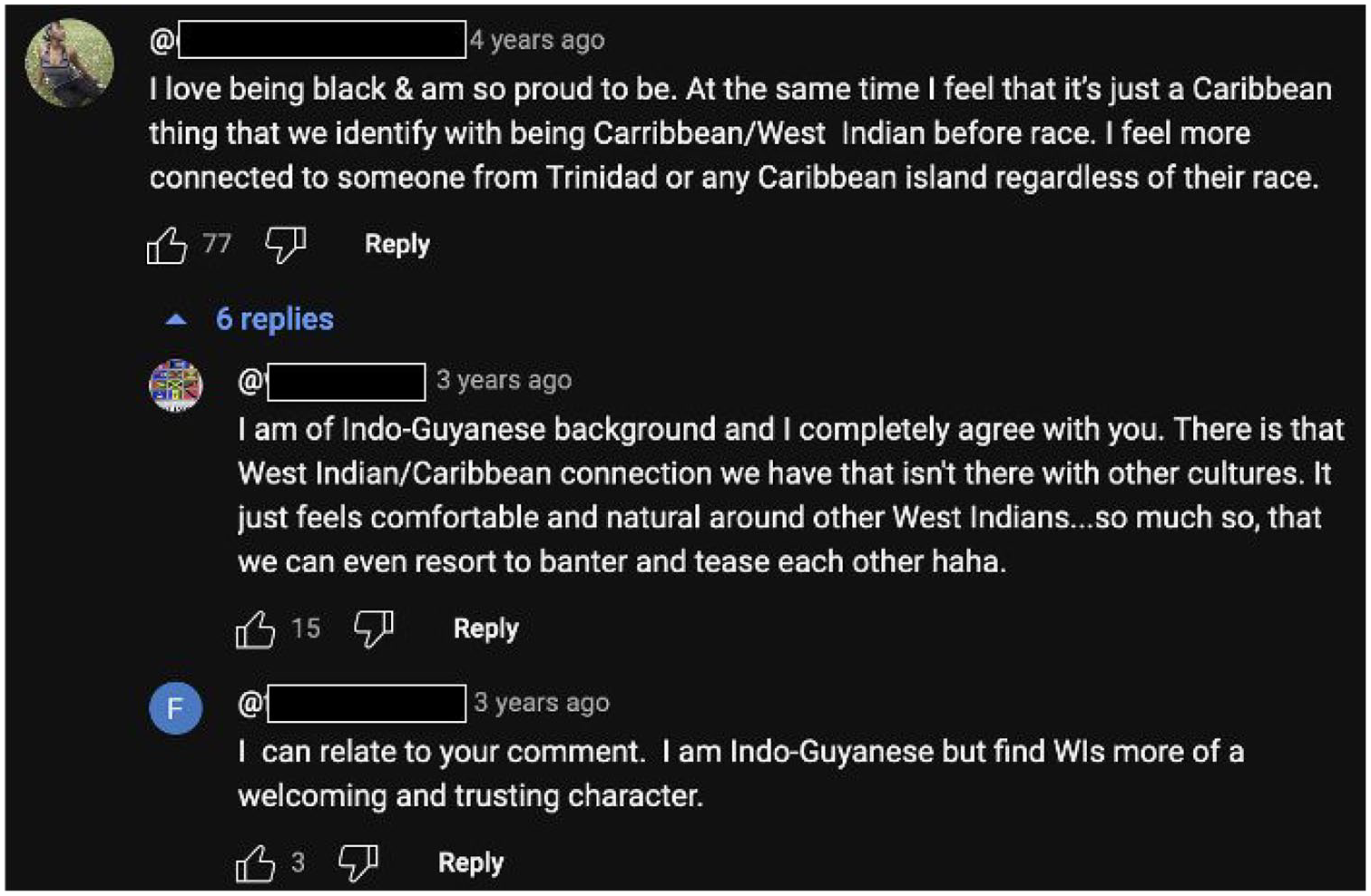
Screen capture of a “Indo-Guyanese Ancestry DNA Results” comment thread about regional solidarity.
Platform Signification: Answering the Question, “What Am I?” by Reading the Body as Text
And the body is here, which you know is sighted . . . the very obviousness of the visibility of race is what persuades me that it functions because it is signifying something. It is a text, which we can read. (Stuart Hall, Race, the Floating Signifier, 1997)
Gillespie notes several semantic territories that the word “platform” has signified by analyzing the etymology of the word. Gillespie posits that platforms afford being “raised, level, and accessible” as ideological features that mirror the physical features of platforms, suggesting a “progressive and egalitarian arrangement” in supporting “those who stand upon it” (Gillespie, 2010). In the genealogical shows described in the Introduction, the audience learns about the genealogy of a specific celebrity, but the show does not provide the audience with an opportunity to connect and discuss the results. In YouTube GAT results videos, genetic information becomes a rich text for making new meaning in defining the self through the narrative element of the “reveal” (Fox, 2020). Not only can a person present their results in the same narrative structure as genealogy shows, but the added layer of interaction provided by the YouTube platform interface between both creator and viewers as well as among viewers creates a space of agreement, contestation, and consensus-building.
In reviewing the etymology of the word “platform,” the first and oldest definition Gillespie highlights from the Oxford English Dictionary is architectural, “a raised level surface on which people or things can stand, usually a discrete structure intended for a particular activity or operation” (Gillespie, 2010). In YouTube GAT reveal videos, Caribbean creators place themselves on a discursive platform. By positioning themselves as the only focus within the video frame, they implicitly invite viewers to listen to their stories and read their bodies as a text, using the comments section as a mediating technical environment for this discursive praxis. Toles-Patkin cautions that “gender-reveal” parties appropriate the unborn body as a contested discursive site (Toles-Patkin, 2021). For Caribbean creators, DNA ancestry reveal videos perform similarly, platforming the body and presenting it as a contested discursive site.
Creators also explicitly invite viewers to read their bodies as texts. GAT reveal videos follow a similar narrative structure. While there is some variation across videos, one element is consistent: there is a reveal of the creator’s GAT results. While the audience knows this is part of the trope, many videos still ask some version of the question “What am I?” This distinctly existentialist question can appear in various places, such as in the video title, as a text overlay on the video thumbnail image, in the description box, or as a spoken question during the video itself. With this question, the creator places themselves on a platform, inviting viewers to read the body in a co-constructed performance of signification.
In the video “What am I, Ancestry DNA Results are finally here, Afro Caribbean/Trinidadian and St Vincentian,” the creator poses several variations of this question. The title of their video starts with the question “What am I,” and the text in the description box starts with the sentence, “Where do you think i am from” (What Am I, Ancestry DNA Results Are Finally Here, Afro Caribbean/Trinidadian and St Vincentian, 2021). In both the title of the video and during the beginning narrative of the video, the creator states that they were born in Trinidad to a Trinidadian mother and a father from St. Vincent. During the course of the video, they tell how they posted the question “Which part of Africa do you think I’m mostly from” on their Instagram stories, using the Instagram stories question box affordance which allows for a creator’s Instagram followers to answer their question in a text box. In the YouTube video, the creator goes on to share some of the responses they received on Instagram through a series of screenshots, during which they use a voiceover to ask YouTube viewers to comment on the video with their own guesses. This invitation to read the body, thereby attempting to answer the existential question of “what am I?” is extended by other content creators as well (AncestryDNA Results—Caribbean Person Edition, 2018; Indo-Guyanese Ancestry DNA Results, 2017).
Hall states, insofar as what we are talking about is the system for classifying difference, the body is a text. And we are all readers of it. And we go around, looking at this text, inspecting it like literary critics. Closer and closer for those very fine differences, these are such small differences, and then when that doesn’t work, we start to run like a true structuralist, we start to run the combinations . . . not so big nose, with rather fuzzy hair, and a sort of largish behind . . . We are readers of race, that’s what we are doing . . . And the body is here, which you know is sighted . . . the very obviousness of the visibility of race is what persuades me that it functions because it is signifying something. It is a text, which we can read (Hall, 2021).
In Hall’s positioning, the body is without agency, and this reading is done by all who visually survey it. Hall illustrates this point by interpreting Fanon’s book Black Skin, White Masks, saying that Fanon is driven wild by the fact that he is caught, caught and locked in this body which the other, the white other, knows just by looking at him. The other can see through him just by reading the text of the black body (Hall, 2021).
Yet in YouTube GAT reveal videos, Caribbean creators are not passive or lacking agency. Rather than assuming there is one way in which their bodies may be read, they directly ask the question, “What am I?” inviting viewers to not only read their bodies but to explicitly display these readings in the comments. In doing so, the internalized and normally subconscious practice of reading the body becomes an externalized process, a text that is also then positioned on a “platform,” positioning itself for interrogation by other viewers and the content creator themselves. Hall states that the body is invoked in the discourse as a text as proof of the biological reality of race, as if the body is “the ultimate transcendental signifier” beyond which “all arguments will stop, all language will cease, all discourse will fall away before this reality” (Hall, 2021). However, in GAT reveal videos, Caribbean creators do not offer their bodies as texts to be read to put an end to racial discourse, but instead to begin it.
Creators begin by offering the body on the “platform” with the invitation to observe and read the body while narrating the rich genealogical histories passed down through their families. As the viewer visually attends to the “small differences” and “running the combinations” that Hall describes in the process of reading the body, they are simultaneously confronted with the auditory genealogical histories that the creator describes. Instead of the discourse falling away before the visual reality of the body, the body is just the starting point for the process of signification. While reading the body visually, the viewer must also absorb the genealogical history of the creator and then process the biological information offered in the GAT results. During this process, the viewer must confront their initial visual reading, deciding whether this initial reading can evolve during the next two levels of information reveal: the “reveal” of the creator’s family genealogical history, and the “reveal” of the GAT results.
In Figure 2, a viewer “reveals” their reading of the creator’s body in a comment, sparking a discourse around the instability of visual signifiers in determining race. They disclose that they originally thought the creator was going to have Asian ancestry, agreeing with what the creator had also guessed about their ancestry before looking at their GAT results. This commenter describes the evolution of their reading, noting that the phenotypical marker of a specific eye shape that they originally associated with the Asian racial category also presents in other ethnic categories. This distinction is important because we see the reading of the body moving from racial categorization to the use of specific regional categories. In this move away from Asian or Black to Nigerian, the resolution of the platform signification process is one in which the discourse still acknowledges the reality of visual signification but recontextualizes it from a reality of race to a reality of space, a regional reality. This reality is supported again through the affirmation of others through “Likes” and through a threaded discourse where other users offer confirmation of this repositioning.

Screen capture of a “AncestryDNA Results—Caribbean Person Edition” comment thread about the instability of visual signifiers in determining race.
Of course, the invitation to read the body by video creators should not be seen as a noble act to spark dialogue for the purpose of critiquing colonial racial logics. As Jessica Clark notes, “users’ motives and experiences are not clear-cut” (Clark et al., 2014). Van Dijk notes that “even with the most refined instruments, it remains very difficult to grasp the essence of a platform’s abilities to steer and affect user engagement,” challenged by “invisible back ends and entangled data streams” and “the vulnerability of users vis-à-vis platforms” (Clark et al., 2014). Social media users engage using a shared logic, a systematic set of rules in which there is a basic understanding that platforms steer online communication via an “algorithmic logic” (Clark et al., 2014). By encouraging viewers to answer the question, “What am I?” content creators are soliciting engagement to increase visibility for their videos through algorithmic logic; they request engagement by directly asking for viewers to complete polls to speculate on their possible ancestry or by commenting on their videos (AncestryDNA Results—Caribbean Person Edition, 2018; Indo-Guyanese Ancestry DNA Results, 2017; What Am I, Ancestry DNA Results Are Finally Here, Afro Caribbean/Trinidadian and St Vincentian, 2021). The Caribbean content creators whose videos I analyzed had modest levels of subscribers, ranging from around 200 to 6,000 subscribers. One creator writes in the description box under their video, “If you guys have any comments or more information of what you think my ethnicity may be, I’d love to read them!” (Indo-Guyanese Ancestry DNA Results, 2017). Another creator says in their video that they are posting a poll on their Twitter account, requesting cross-platform engagement from their viewers, and wonders, “what do you guys think I am?” (AncestryDNA Results—Caribbean Person Edition, 2018). Yet another creator is a makeup artist that uses YouTube to promote their business, which is perhaps why they request a higher level of engagement by appealing to viewers to engage across both YouTube and Instagram (What Am I, Ancestry DNA Results Are Finally Here, Afro Caribbean/Trinidadian and St Vincentian, 2021). As small-time creators, these creators may not have a nuanced understanding of how to grow their channels, but they display a basic understanding of algorithmic logic in their attempts to increase engagement through polls, comments, and cross-platform engagement.
Race, the Floating Signifier: Redefinition and Appropriation
What do I mean by a floating signifier? Well to put it crudely, race is one of those major concepts, which organize the great classificatory systems of difference, which operate in human society. And to say that race is a discursive category recognizes that all attempts to ground this concept scientifically, to locate differences between the races, on what one might call scientific, biological, or genetic grounds, have been largely shown to be untenable. We must therefore, it is said, substitute a socio-historical or cultural definition of race, for the biological one. (Stuart Hall, Race, the Floating Signifier, 1997)
In Caribbean creators’ GAT reveal videos, both creators and commenters challenge the fixed boundaries of racial categories, revealing just how tenuous they are. Hall states that there is always someone—a constitutive outside—whose very existence the identity of race depends on, and which is absolutely destined to return from its expelled and abjected position outside the signifying field to trouble the dreams of those who are comfortable inside (Hall, 2021).
I contend that Caribbean content creators on YouTube are positioned as these outsiders; because of their mixed and often ambiguous racial appearance, they trouble the dreams of those comfortably living inside the social categories of race. These creators embody the sliding signifier; as they present their stories, comprised of their family histories as well as their genetic ancestry results, their embodied existence is a negation of the fixed nature of Western racial logic. As they weave together tales of racial mixing over generations, the viewer’s understanding of the storyteller’s race becomes increasingly destabilized.
In the video “AncestryDNA results—Caribbean Person Edition,” the creator describes their excitement at getting their DNA ancestry results. Being from the U.S. Virgin Islands with parents who both came from the island of Dominica, they do not have a complete family history and want to know more about their ancestry. They state, “From what I was told, all my ancestors came from Dominica. The only thing is I don’t know where my grandfather’s father’s side is from, cuz he passed away before he [their grandfather] was born” (AncestryDNA Results—Caribbean Person Edition, 2018).
In Figure 3, commenters rehash the various socio-historical redefinitions and appropriations of racial categories of difference. One viewer states that they would have guessed that the creator would have slightly less African ancestry than what was revealed in their GAT results. They reconcile this by stating, “But I guess phenotype DO NOT (≠) always equal genotype.” Another commenter responds in a thread, noting that there are some West African groups “who are not very dark at all,” and goes on to contest the original commenters assumptions by stating that “People need to pay more attention to features rather than skin tone.” In several comment threads, commenters debated whether specific phenotypical features were enough evidence to substantiate claims of specific racial identities. The constant process of definition and revision involved in the public discourse around racial, ethnic, and regional identities in the comment sections is a process of sliding signification. This process demonstrates our inability to ontologically fix race, reinforcing Hall’s notion of race as a sliding signifier. The comments section feature ensures that this signification process need not end; the comments feature does not close after a period of time, affording new viewers the opportunity to comment on stances made days, months, and years before. As Hall notes, “You get some people over there and a few people over there, and then there are all those wishy-washy things in the middle that keep slipping and sliding from inside to outside” (Hall, 2021). The process of meaning-making through redefinition and appropriation in the comments section signal an uneasiness with a fixed notion of racial authenticity.

Screen capture of a “AncestryDNA results—Caribbean Person Edition” comment thread about historical racial categorization.
Although they can insert images in the same way that one can on TikTok, the YouTube creators in my corpus did not take advantage of this feature to offer photographs of family members during the narrative of their family’s genealogical history. Perhaps this is because this feature is not as easy to use on YouTube as it can be on TikTok. Whatever the reason, the result is that family members are not offered as additional bodies to be read, helping to narrow the visual evidence that their viewers may use in their analysis of the creator’s body. When the creator is the only person in the video, this encourages a deeply intimate connection between the creator and the viewer. Perhaps partially due to the intimate connection created through the single-subject video framing, direct “eye contact” with the viewer, the “reveal” of family histories passed down, and the “reveal” of personal genetic information, I found very few derogatory comments in my video corpus. Toles-Patkin posits that “gender-reveal” parties “offer a community or family celebration of that information” (Toles-Patkin, 2021). For Caribbean content creators, GAT results reveal videos are a performative act of social media content that presents an opportunity for sharing and celebrating their genetic information with a community. YouTube GAT reveal videos and the discussions in the video comments establish a community of other people in the Caribbean diaspora that come together virtually to support and congratulate each other in the collective reclamation of identities striped away by colonization and slavery. This congratulatory ethos indicates an excitement by others of the diaspora to answer the existential question, “what am I?” on their own terms, no longer defined by the terms of a colonial oppressor.
As evidenced by Figures 4–6, many commenters simply congratulated the content creator on learning about their genetic ancestry without offering an analysis of the results themselves. This collective celebration becomes a practice of digital community-building across the diaspora.

Screen capture of a “I’M WHAT??? MY ANCESTRY DNA RESULTS—AFRO-CARIBBEAN” comment thread congratulating the creator on their ancestry test results.
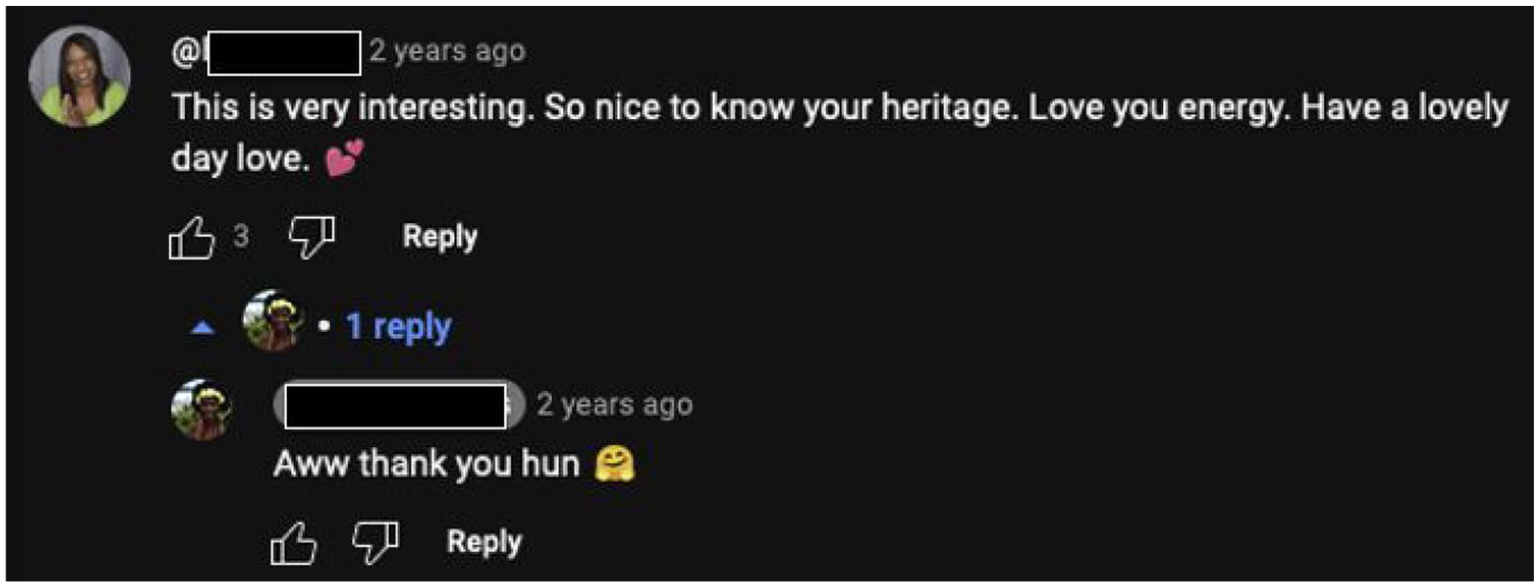
Screen capture of a “What am I, Ancestry DNA Results are finally here, Afro Caribbean/Trinidadian and St Vincentian” comment thread congratulating the creator on their ancestry test results.
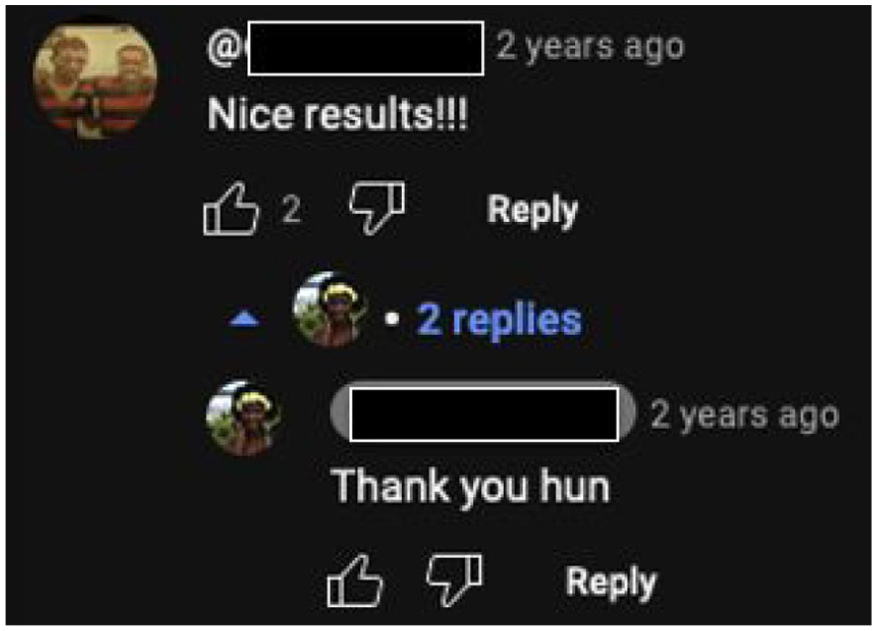
Screen capture of a “What am I, Ancestry DNA Results are finally here, Afro Caribbean/Trinidadian and St Vincentian” comment thread, again congratulating the creator on their ancestry test results.
As seen in Figures 7 and 8, some commenters congratulated the creator on their results and went on to offer interpretations based on their own knowledge of historical global lineages. This collective analysis and interpretation become a practice of digital meaning-making across the diaspora. As commenters offer bits of knowledge, other commenters add to the analysis in threaded comments. The feature of threaded comments affords a back-and-forth between commenters and creators in which they seek to clarify elements of the creator’s genetic identity, co-constructing meaning. This process is apparent when one viewer describes having “Asian looking features,” like the video creator. This commenter describes the experience of people over time believing that they had some Asian ancestry but finding out via ancestry testing that, to their own surprise, their Asian ancestry was in trace amounts. They end their comment by seeming to ultimately dismiss the reliance on visual “Asian features” and affirm that the similar case of the video creator validates this dismissal. At a philosophical level, this meant that the signifiers of race have “floated” free of any transcendental visual reality that might stabilize their meaning. In more concrete terms, it means that although the signifiers of race are most often visual cues found on the body, there is nothing in the body that gives those signifiers meaning.

Screen capture of a “I’M WHAT??? MY ANCESTRY DNA RESULTS—AFRO-CARIBBEAN” comment thread unpacking possible ancestral lineage.

Screen capture of a “AncestryDNA Results—Caribbean Person Edition” comment thread validating the instability of visual signifiers of race.
Conclusion
In this study, I employ CTDA to show how GAT reveal videos and the discourse community created through them enable interrogations of racial authenticity. I show how the YouTube platform provides the discursive space for this interrogation, where the features of the platform shape the discourse engaged in by the Caribbean diaspora. Glissant argues that the beauty of Créolité is that identity is conceived as an “archipelago of signifiers,” none of which enjoys primacy over the others and whose unity lies not in the fact of possessing a single source but, rather, in the complex amalgamation of these myriad forces that hold themselves in relation to each other (Glissant, 1989). Although genetic testing is posited as an objective truth, the findings of this study show that it is only one potential story in understanding our identity.
According to Cobham-Sander, the Creole imagination operates as a means of resistance and self-affirmation, challenging dominant narratives and stereotypes imposed by colonial powers and mainstream culture (Cobham-Sander, 2021). Throughout this work, I address how Caribbean content creators destabilize the legitimacy of both scientific and social definitions of race and reveal how commenter discourse interrogates complex structures of power and truth as they intersect with science and technology. By bringing into conversation Caribbean scholars and Caribbean YouTube users, we gain valuable insights into the ways in which the Creole imagination continues to evolve, adapt, and thrive in the face of social, political, and cultural challenges. This project reaffirms the resilience and creativity of Caribbean people and their diasporic communities, revealing how they dismantle scientifically constructed notions of racial authenticity. I hope that with this article, I can spotlight how Caribbean people theorize liberation from the limits of these constructions, allowing for not just an expansion of the definition of racial identity, but for creativity in developing a multiplicity of definitions that can coexist without the need for validation via the colonial project of authenticity.
Footnotes
Declaration of Conflicting Interests
The author(s) declared no potential conflicts of interest with respect to the research, authorship, and/or publication of this article.
Funding
The author(s) received no financial support for the research, authorship, and/or publication of this article.
