




Abstract
The #StopAsianHate hashtag movement emerged as a challenge to the rising tide of racism in the United States during the coronavirus pandemic and contributed to the legislation of the Covid-19 Hate Crimes Act. Our research brings together concepts from social movement studies as well as network science and celebrity-fandom studies to examine a corpus of tweets about the movement. We employ a mixed-methods design combining structural topic modeling with digital discourse analysis. Even though the movement rose up against White Supremacist structural racism, we find that right-wing provocateurs with large followings often hijacked its hashtags to amplify sporadic Black-on-Asian violence. But the active participation of Asian celebrities such as BTS, with their own huge followings online, bolstered the movement. Their posts and statements about anti-Asian violence were heavily reposted and dominated the digital discourse. Crucially, we show how their fans helped boost the movement’s anti-racist agenda by repeatedly posting similar messages in concert, which we compare with the offline fan practice of “chanting” as a form of collective identity performance. While theories like the logic of connective action view digital activism as individualized and decentralized, our research elucidates its hierarchical structure and the oversized role of provocateurs and celebrities in raising the visibility of competing claims and agendas by re-contextualizing hashtags. At the same time, culture industries and practices can create bottom-up solidarities that can have a political impact by raising particular agendas in the digital attention economy.
Keywords
Racial persecution is nothing new for Asians living in the United States, but it mounted during the coronavirus pandemic. The Stop AAPI Hate (2022) organization recorded more than 10,000 “hate incidents” between March 2020 and December 2021, ranging from verbal attacks and online harassment to workplace discrimination and physical assaults. These attacks sparked a response, especially on social media platforms like Twitter and TikTok, in the form of anti-racist hashtags such as #StopAsianHate (C. S. Lee & Jang, 2023; J. J. Lee & Lee, 2023).
Anti-Asian abuse and attacks surged after then U.S. President Donald Trump used the term “Chinese virus” to describe the coronavirus in a Twitter post in March 2020 (New York Times, 2020). A year later and under a new administration, Congress passed the Covid-19 Hate Crimes Act. The legislation, introduced by two Asian American members of Congress, aimed to make the reporting of hate crimes easier and expedite their review. Joe Biden, Trump’s successor in the White House, signed it into law (NPR, 2021).
This study examines the online response to anti-Asian racism at this pivotal moment as a form of “hashtag activism” (Yang, 2016). Hashtag movements, perhaps even more than their offline counterparts, are not monolithic but can comprise a range of consonant and conflicting claims (Gallagher et al., 2018; Mousavi & Ouyang, 2021). While ordinarily expected to represent underprivileged voices speaking to centers of power, they can also include reactionary agendas (Lindgren, 2019; Shahin et al., 2024). Jackson and Kreiss (2023), therefore, make a distinction between counterpublics and defensive publics—the former pursuing emancipatory social change against biases and disenfranchisement and the latter “seek[ing] to preserve the ordering of systems of inequality” (p. 103). They argue that movement claims should not be taken at face value but empirically investigated in the light of histories of oppression within a social order, relations among groups, as well as their access to centers of power.
Following Jackson and Kreiss’s (2023) recommendation, we start with an overview of anti-Asian racism in the United States, contextualized within the history of White supremacism and how it structures relations not only between White and Asian Americans but also among different minority groups. Employing a mixed-methods research design, we analyze a corpus of nearly 100,000 tweets related to #StopAsianHate to (a) distinguish the different claims that compete for attention online and (b) identify the characteristics that enable certain claims to garner more attention than others. The computational modeling of tweets ranging across high and low re-tweet counts detects various competing claims and their relative prominence. A closer reading of tweets associated with different claims using digital discourse analysis reveals the characteristics that make particular claims, and the agendas they represent, predominate.
While our research primarily contributes to the literature on digital activism, we also draw upon insights from network science and media and culture studies. In particular, we find the principle of “power law distribution” (Barabási & Albert, 1999) helpful for explaining the asymmetries of power that are inherent in hashtag activism and its wider consequences. Our analysis delineates the role of provocateurs and celebrities as “crowd-enabled elites” (Shahin et al., 2024) amplifying and re-contextualizing hashtags—and its implications for the politics of race and identity online. At the same time, theoretical advances on active audience practices in culture studies, particularly fandom research (Proctor, 2021), enable us to elucidate how the collective performance of solidarity—as opposed to individualistic expression of grievances (W. L. Bennett & Segerberg, 2012)—can help generate attention for marginalized voices online. In doing so, the study elides both uncritical celebration of and non-constructive cynicism toward hashtag activism and instead offers a nuanced perspective on the sociotechnical mechanisms that undergird its promises and its pitfalls. The research also deepens our theoretical understanding of the complexities of structural racism and emphasizes the significance of multiracial alliances in response to it.
Anti-Asian Racism in United States
Racism against Asian Americans has a long and complex history, closely entwined with the persecution experienced by other ethnic, racial, and religious minorities in the United States—Blacks in particular. It takes both sporadic and structural forms. Chinese migrant laborers were termed the Yellow Peril and faced attacks by “locals”—typically White immigrants from Europe—ever since they started arriving on the shores of California in the mid-1800s (Kurashige, 2016). One example is the 1871 Chinese Massacre of Los Angeles, the biggest mass lynching in U.S. history in which 19 immigrants—10% of the city’s Chinese population—were killed and their shanties looted (Rasmussen, 1999). Such lynch mobs were emboldened by a Californian Supreme Court decision that “[n]o black or mulatto person, or Indian, shall be permitted to give evidence in favor of, or against, a white person” (Traynor, 2017). The ruling “virtually guarantee[d] that Whites could escape punishment for anti-Asian violence” (Brockell, 2021).
Various immigration acts passed since the late 19th century limited Chinese, Japanese, Korean, Indian, and Filipino immigration into the “land of the free” (Kurashige, 2016). World War II and the geopolitics of the Cold War led to the easing of immigration law, but this was also the period of Japanese internment camps and the vilification of “communist” Asians in the wake of Korean and Vietnam wars. Ironically, Asian Americans were simultaneously stereotyped as the “model minority” that was hard-working and law-abiding, a tag that was “leveraged to challenge and delegitimize the social and political disruption caused by Black civil rights activists” in the 1960s (Zheng, 2021; see also the article by Okihiro, 1994). The history of anti-Asian racism thus needs to be viewed within the wider frame of American White Supremacism, which takes recourse to playing different minority groups against each other, not only to normalize White violence against all “others” but also to hobble the prospect of cross-ethnic alliances that can challenge White Supremacy (Ho, 2021).
The model minority, however, did not turn out to be all that “model.” Man (2020) draws attention to grassroots movements that emerged in the 1980s in cities like Los Angeles, San Francisco, and New York, not only to fight anti-Asian racism but also to demand better housing and health care. These movements “were sustained through collaboration with other movements fighting for the same things, out of a shared recognition that violence against any one group was a violence against others” (p. 30).
The spurt in hate crimes against Asian Americans following the outbreak of Covid-19 should be viewed as a part of this historical trajectory. The FBI stated that hate crimes against Asians increased by 73% in 2020 (Venkatraman, 2021). On 16 March 2020, U.S. President Donald Trump referred to the coronavirus as the “Chinese Virus” in a tweet, after which the hashtag #chinesevirus spread across Twitter and to other platforms. One study found that anti-Asian hashtags were four times more likely to be used alongside #chinesevirus than #covid19 (Hswen et al., 2021). But the threat was not just virtual: New York Times (2020) reported that Trump’s tweet preceded a rise in physical hate crimes against Asians. Multiple national polls suggested heightened fears about personal safety across the Asian American community (Findling et al., 2022).
Calls to “Stop Asian Hate” predate Covid-19. The first tweet with the #StopAsianHate hashtag dates back to 2011 (C. S. Lee & Jang, 2023). But its use as a slogan was sporadic until a series of rallies around the United States began protesting anti-Asian hate crimes following the outbreak of the pandemic. The Stop AAPI Hate organization also came into being in its aftermath (Takasaki, 2020). #StopAsianHate became prominent as a hashtag movement after a shooting in Atlanta on March 16, 2021—exactly a year after Trump first used the term “Chinese virus”—in which six women of Asian descent were among the eight casualties (C S. Lee & Jang, 2023).
Multiple scholars have examined the themes or “topics” discussed in #StopAsianHate posts on Twitter. C. S. Lee and Jang’s (2023) study in the week following the 2021 Atlanta shooting found a focus on calls to action, political participation, and legislative change rather than mere “articulation of victimization and blaming the antagonists” (p. 19). But these tweets also did not feature any concrete plan of action or resource mobilization. Cao and colleagues (2022) studied themes that emerged on Twitter after Biden approved the Covid-19 Hate Crimes Act. Besides calls to participate in the movement, these tweets emphasized the history of racism against Asian Americans as well as the need to enhance Asian Americans’ visibility and appreciate their culture. More recently, J. J. Lee and Lee (2023) looked at TikTok videos posted by Asian American women using the #StopAsianHate hashtag. Such videos, they found, helped “create an ad hoc community” for Asian American women and their followers (p. 9). Community building involved being attentive to each other’s “raced-and-gendered experiences” by making use of the platform’s expressive and interactive features as well as affect and humor, for instance, by “laughing at the racists” (p. 7). Drawing on but also departing from this body of research, our study turns attention to the diversity of claims and competing agendas associated with #StopAsianHate and related hashtags and how and why different agendas garner different levels and forms of visibility. To do so, we bring together inter-related ideas and concepts from social movement studies, network science, and culture studies.
Hashtag Activism and Crowd-Enabled Elites
The #StopAsianHate movement is an example of hashtag activism. Over the past 15 years or so, the hashtag (#) has come to occupy a prominent place in the domain of digital politics. Hashtag activism “happens when large numbers of postings appear on social media under a common hashtagged word, phrase or sentence with a social or political claim” (Yang, 2016, p. 13). As social media platforms have gained in popularity, such activism has allowed citizens around the world to express their political preferences and grievances against institutions of power. Dadas (2017) noted that “hashtags can prove a valuable resource through their ability to bring attention to a cause” (p. 31). Tens of thousands of social movements have come into being with the help of hashtags, ranging from globally influential movements such as #BlackLivesMatter (Shahin et al., 2024) and #MeToo (Zeng, 2020) to more localized movements like #HongKongPoliceBrutality (Wang & Zhou, 2021) and #FreeYouth in Thailand (Sinpeng, 2021).
One reason why hashtag activism—and digitally networked action more broadly—is deemed to be different from traditional forms of mobilization is its decentralized character. Such action tends to draw on large numbers of private individuals sharing private stories and experiences publicly, connecting with other individuals in the “crowd” with similar stories and experiences with the help of devices such as hashtags and constituting a social movement in the process (Bimber et al., 2012). W. L. Bennett and Segerberg (2012) thus call it “connective action” and argue that “these more personalized, digitally mediated collective action formations have frequently been larger; have scaled up more quickly; and have been flexible in tracking moving political targets and bridging different issues” (p. 742).
Other scholars have looked at how hashtag activism gives rise to “counterpublics.” Jackson and colleagues (2020), for instance, argue that hashtags on platforms such as Twitter enable counterpublics in the form of “alternative networks of debate created by marginalized members of the public” (p. 20563051241309701iii). They assert that “Twitter hashtags have become an important platform for historically disenfranchised populations to advance counternarratives and advocate for social change” (p. 20563051241309701viii). Their comprehensive study looks at a number of hashtags that have promoted racial, gender, and intersectional justice in the United States on Twitter, from #GirlsLikeUs to #Ferguson.
But empirical studies do not always support celebratory claims about hashtag activism. One issue relates to the polysemy of hashtags, or their potential to be co-opted and repurposed. A movement’s hashtag can be “hijacked” for a number of reasons—from general spamming and clicktivism to concerted attempts aimed at undermining the movement (Mousavi & Ouyang, 2021; Shahin & Ng, 2022). Lindgren (2019), for instance, found that the #MeToo movement on Twitter “became increasingly noisy” and eventually “produced increasingly negative and antagonistic expressions” (p. 432). This happened because some users started adopting the “trending hashtag” to push attention to otherwise unrelated posts, and still others used the hashtag to attack the movement. Similarly, Gallagher and colleagues (2018) found that while #AllLivesMatter emerged as a countermovement to #BlackLivesMatter, each of these hashtags was frequently used by the other side for engagement but also for confrontation.
Another concern about hashtag activism is that digital networks tend to be—or become—“highly centralized and fragmented, far from the horizontal and fluid structures they are often assumed to be” (González-Bailón & Wang, 2016, p. 96). This happens because tie-formation in such networks is not random but follows the logic of what network scientists Barabási and Albert (1999) call “preferential attachment.” Already well-connected nodes in the network, known as hubs, are more likely to garner newer connections: their connections, as a result, keep growing exponentially relative to other nodes. Thus, instead of a normal distribution in which most nodes would tend to have an average number of connections, such networks follow the “power law distribution”—with a few hubs having substantially high volume of connections and the rest of the nodes lying along a long tail of limited connections.
Digital action networks tend to be such “scale-free networks” with a centralized and hierarchical structure, held together by a small number of hubs wielding considerable influence on the network as a whole (Barabási & Albert, 1999; González-Bailón & Wang, 2016). In their study of the global diffusion of #BlackLivesMatter on Twitter, Shahin et al. (2024) refer to these emergent hubs as crowd-enabled elites, defined as “individuals or institutions that organically rise to dominant positions in the process of network formation” (p. 217). Their research illustrates how a range of actors, representing varied agendas, can garner attention in a digital action network and become influential as a result of the crowd’s networking practices, such as reposting.
Provocateurs, Celebrities, and Fans
In Shahin and colleagues’ (2024) analysis of BLM hashtag networks on Twitter in Brazil, India, and Japan, the crowd-enabled elites included activists and social movement organizations as well as local and global celebrities and self-described “journalists-cum-activists” claiming to serve as alternative sources of information and opinion. Many of them had enormous online followings, which progressively amplified the likelihood of their tweets gaining more visibility and more re-tweets—continuously expanding their influence over time and turning them into crowd-enabled elites in Twitter’s attention economy (see also the article by Shahin, 2023). This process parallels the findings of other research that shows the global scope and interactive mode of digital communication have transformed public figures and their visibility (Marwick and boyd, 2011; Hou, 2021). Different types of public figures have a presence on Twitter, making the highly visible Twitter users a mixed category. For example, Maly (2020) studied how far-right political figures borrowed strategies of intimacy and staged authenticity from social media influencers to put forward their metapolitical ideas on Twitter. The contemporary notion of celebrity therefore includes not only personalities from the field of entertainment but also (in)famous commentators, journalists, politicians, microbloggers, and influencers.
Rønlev and Bengtsson (2022) conceptualize media provocateurs as individuals who build a career through strategically and repeatedly staging provocative, or provocatively formulated, viewpoints with the intention of attracting media attention and circulation. The authors illustrate the concept with the example of British far-right political commentator Katie Hopkins describing migrants as “cockroaches.” While anti-immigrant sentiments and opinions are not scarce, such incendiary language is likely to produce strong reactions and potentially spiral into a large controversy. In this sense, media provocateurs adopt a polemic style to elicit often-negative responses and thereby garner public attention.
But celebrities’ salience is also constituted by audience reception and engagement. Fandom is “the recognition of a positive, personal, relatively deep and emotional connection with a mediated element of popular culture” (Duffett, 2013, p. 3). Fandom studies have long recognized that although a media text or personality attains attention because of media representation, fans can also express their voices through consumer activism and oppositional interpretation, thus producing a parallel form of attention. The subversive and participatory potentials of fandom culture have led some scholars to argue that fandom is a training ground for social activism (Jenkins, 2015). K-pop fans, in particular, are known to invest efforts in supporting the career success of their “idols.” Translated into concrete fan practices, they actively manage and disseminate idols’ positive publicity transculturally through social media (Proctor, 2021), initiate charity causes (Jung, 2012), and protect idols’ right against exploitive labor contract in the entertainment industry (S. Lee, 2015). These fandom activities exemplify skills of self-organization, mobilization, and creative online communication.
One example of successful celebrity-fan activism relates to the Korean cultural sensation BTS, described as “a counter-hegemonic cultural formation from the periphery” (Kim, 2021, p. 1061). The music band announced donating a million dollars to Black Lives Matter in the summer of 2020, making it a “crowd-enabled elite” in Black Lives Matter discussion networks on Twitter across multiple countries (Shahin et al., 2024). Kim (2021) points out that BTS’s ability to espouse social issues is a function of digital networks, the Korean popular culture industry colloquially known as K-pop, and fandom practices. To illustrate, BTS’s $1 million donation to BLM was matched within 25 hours by their global network of fans, collectively known as the ARMY (Davis, 2020). S. Lee (2015) demonstrates how fan support can also develop into formal petitions on labor rights and human rights—exactly because of their skills in digital organization and message sophistication. In other words, the communicative strategies required for digital activism are comparable to those in online fandom activities and “fannish” practices.
Our review of literature thus draws on the logic of preferential attachment (Barabási & Albert, 1999) from network science to emphasize the centralized and hierarchical nature of online social movements, in particular why celebrities and provocateurs can emerge as crowd-enabled elites (Shahin et al., 2024) and dominate them. At the same time, insights on active audience online from fandom studies help us better understand how ordinary users of social media and their fannish practices of collective behavior can also garner visibility in the digital attention economy.
Research Objective and Design
This study examines the #StopAsianHate movement as a form of hashtag activism against anti-Asian racism during the Covid-19 pandemic. Activist networks, especially online, can comprise diverse and sometimes even conflicting claims and agendas (W. L. Bennett & Segerberg, 2012; Dadas, 2017). The study aims to shed light on what types of claims and agendas garner more attention than others—and the characteristics that are likely to contribute to their visibility.
But attention itself can mean different things on a social networking platform like Twitter. One way of thinking about attention is at the level of individual posts: particular tweets that get re-tweeted a lot can be deemed highly visible. But another way of conceptualizing attention is at the level of broader themes or “topics” constituted by multiple tweets. That is to say, particular topics of discussion could be highly prevalent and occupy a significant proportion of the discourse as a result of multiple users posting about them—even though no individual post gains high attention on its own. We consider both forms of attention in our analysis.
To gather data for the study, we scraped Twitter posts for a week starting May 18, 2021—or the day U.S. Congress passed the Covid-19 Hate Crimes Act. Tweets using at least one of the following hashtags were collected: #StopAsianHate OR #StopAAPIHate OR #StopAsianHateCrimes OR #COVIDHateCrimesAct. We focused on this period for data collection because the new legislation put anti-Asian violence and the movement against it in the limelight, triggering a large volume of tweets from a variety of stakeholders, representing diverse interests and agendas. Data mining was carried out via Netlytic.org, which uses Twitter’s REST API v1.1 (Gruzd, 2016). A total of 172,324 tweets were extracted, out of which all English-language tweets (n = 97,649) were sampled for analysis. These tweets were separated into two categories based on their re-tweet count (range = 0–83,889, M = 951.67, SD = 4,435.09). High re-tweet count or HRC tweets (n = 19,671) were re-tweeted above the mean; low re-tweet count or LRC tweets were re-tweeted at or below the mean (n = 77,978).
Previous empirical research on #StopAsianHate has employed either computational (C. S. Lee & Jang, 2023) or qualitative techniques (Cao et al., 2022; J. J. Lee & Lee, 2023). Our study integrates both approaches into a more holistic mixed-methods design. We first used structural topic modeling (STM) to distinguish the various “topics” present in the discourse. Subsequently, a close reading of the prominent tweets under each topic using digital discourse analysis helped us distinguish the characteristics of tweets and topics that gained more attention.
Structural Topic Modeling
Topic modeling is increasingly used in social science disciplines for analyzing large volumes of text (Maier et al., 2018). Being inductive in orientation, it is especially suitable for analyzing social media posts—in which users do not always follow standard rules of spelling and grammar (Guo et al., 2016). The technique has been employed to study social movements online (Shahin, 2023), including the #StopAsianHate movement (C. S. Lee & Jang, 2023).
Topic modeling assumes that words that are repeatedly used in proximity across a large set of documents constitute a semantically meaningful theme or “topic.” An algorithm parses a set of documents—which can range from lengthy speeches to short social media posts—to distinguish such keyword clusters in terms of their probability of co-occurrence (Blei, 2012). The semantic links between the keywords are then interpreted by the researcher to distinguish the “meaning” of each topic. In addition, topic modeling reveals the proportion of different topics in a corpus. As each document may contain multiple topics, the algorithm calculates the probability of a particular document belonging to a particular topic. STM is a more advanced form of topic modeling that also allows researchers to include covariates that may influence the distribution of topics across documents (Roberts et al., 2020). Besides distinguishing keyword clusters as topics, it calculates the proportion of each topic in the corpus or across covariates, allowing for a comparison of covariate effects in terms of topical proportions. In addition, it calculates the likelihood of each document in the corpus belonging to a particular topic, thus enabling the identification of documents most closely associated with each topic, respectively.
In this study, the tweet was defined as the document, while the re-tweet count (HRC, LRC) was defined as the covariate. STM was conducted in RStudio using the custom-built “stm” package. Preprocessing included tokenization, stemming, lowercasing, and removal of numbers, punctuations, hyperlinks, Twitter handles, and stopwords. Topic modeling was carried out over multiple iterations, ranging from 10 to 24 topics with intervals of two topics in between. Ultimately, we settled on a model with 20 topics. Each topic in this model had a significant proportion in at least one of the two samples (HRC and LRC tweets). At the same time, the overlap of keywords across topics was negligible in this model. We subsequently filtered out the tweets that were most closely associated with each topic for a close reading to understand the “meanings” of each topic and differences in the characteristics of HRC and LRC topics.
Digital Discourse Analysis
Digital discourse analysis attends to the social practices that people perform through discourse. On digital media, people achieve social goals, enact social identities, and reproduce social relationships through digitally mediated discourse (Jones et al., 2015): not only typing text (linguistic signs) but also annotating with hashtags, clicking the like button, posting videos and other multimodal semiotic practices. To perform our qualitative analysis, we first read all unique tweets with a high probability of association under each of the 20 identified topics (n = 526) in the data sample to identify the textual features of the tweets that constitute HRC and LRC topics, respectively. We also looked at the metadata available through the Twitter API, including likes, re-tweet count, and author bios for each tweet. To conduct the analysis of situated digital practices, we searched back on Twitter to obtain the original tweets and observed the comments they received. Viewing digital discourse as technologically afforded social practice, the analysis of the tweets was carried out across four levels: text, context, action and interaction, and power and ideology (Jones et al., 2015). The text level is about what semiotic elements are used to form socially recognizable text. The context is about the social and material situations in which the text is produced and consumed. Action and interaction denote what people do with digital discourses. Power and ideology are manifested in how people use text to create versions of social reality. For text, we first examined the multimodality of tweets, or what semiotic means—language, emojis, punctuations, pictures, videos, and audio—were used in the tweets. We then analyzed the intertextual relationship between the tweets with the texts from wider sources. Specifically, we examined how social events and news reports were tweeted and thus brought into discussions around the Stop Asian Hate hashtag activism. For context, we paid attention to how movement hashtags were used to contextualize the tweets. For action and interaction, we examined how the tweet text called for action, help, or solidarity with ongoing activism. Finally for power and ideology, we analyzed how racial injustice and racial relationships were made sense of in the tweets. We also considered the power embedded in the technological design of Twitter in influencing the types of visibility of the topics in the hashtag activism.
In the rest of this article, we present the key findings of our analysis and subsequently discuss these findings in the light of previous research on hashtag activism and anti-Asian racism. While identifying public figures in our examples because their “publicness” is a factor contributing to our analysis, we decided to anonymize the handles of common Twitter users so as to avoid them being traced back through our study.
Topical Framework
STM revealed 20 distinct topics in the corpus (see Table 1). Twelve of these topics were more likely to feature LRC tweets (see Figure 1). These topics referenced a broad range of issues. Topic 16, with keywords including pass, just, today, report, hous, anti, and stop, was related to the House of Representatives passing the hate crimes bill. Topic 19 (sign, law, american, violenc, biden, thank, white) was about President Biden signing the bill into law. Topics 2, 3, and 4 related to community support within Asian Americans (see Table 1 for keywords). Topic 11 encouraged concerned citizens not to remain bystanders but intervene when they saw incidents of racial harassment, and Topic 18 related to the AAPI Heritage Month, celebrated in May. Topic 17 suggested Dr. Li Meng Yan, a Chinese virologist who claimed China had intentionally spread the coronavirus, was disseminating fake news. Topic 8 was about racial discrimination in general, while Topics 5 and 20 related to solidarity with Blacks and Palestinians, respectively.
Topic Model of #StopAsianHate Tweets.


Distribution of topics across HRC and LRC tweets.
Eight topics were more likely to be present in HRC tweets. These topics featured quite different themes from the ones in LRC tweets. Three of these topics—15, 7, and 10—were about instances of Black violence against Asians. Topic 9 was about the Miss Universe contestant from Singapore calling to “Stop Asian Hate” during the pageant. Topics 1 and 14 were about K-pop stars supporting the Stop Asian Hate movement. Topic 6 related to police violence against Asian Americans while Topic 13 focused on community support.
As noted earlier, the reposting of individual tweets is not the only form of visibility online. Four LRC topics—17, 20, 19, and 16—were among the top 5 topics in the corpus in terms of overall proportion (see Figure 2). However, Topic 15—an HRC topic about Black violence against Asians—was the topmost topic in the model.

Order of topics by proportion.
Discursive Characteristics
Topic modeling enabled us to develop a probabilistic framework for interpreting the discourse and quantifying different forms of visibility. We drew on digital discourse analysis to closely examine the features of HRC and LRC tweets and understanding their distinguishing characteristics. Our analysis identified a “celebrity-fandom” dynamic at play. In other words, the features of HRC and LRC tweets and the ways they constitute a topic can be viewed through the lens of celebrity and fandom culture practices. The HRC topics were driven by tweets from—or about—celebrity figures. Content-wise, they were about a particular event or situation that illustrated either the efforts to stop Asian hate or the ongoing hate practices toward Asians. This makes the HRC topics more personalized than the LRC topics. The LRC topics were typically constituted by posts from ordinary Twitter users repeating similar expressions and echoing one another, which can be understood as fan activism and “fannish” tweeting practices. These topics were slogan-like expressions that built solidarity and called for community support. Next, we focus on more detailed analyses of HRC topics 15, 7, 10, and 14 as they help us shed light on the impact of provocateurs and celebrities on hashtag activism. Subsequently, we also look closely at LRC topics 16 and 6, which draw attention to the tweeting practices of fans and ordinary users’ “fannish” protocols of engagement.
The Media Provocateur and K-pop Celebrity
Topics 15, 7, and 10 related to Black violence toward Asians, and they were all driven by tweets from Andy Ngô (@MrAndyNgo), a right-wing commentator. Our digital discourse analysis sheds light on the situated digital practices and controversy that constitute these topics. Figure 3 shows the single tweet driving Topic 15—a news report from CBS News Bay Area. The tweet included the picture from and link to the original online news article, and the text narrated that an Asian woman was beaten and robbed on her way to work in the train. The last sentence mentioned the suspect was a Black man.
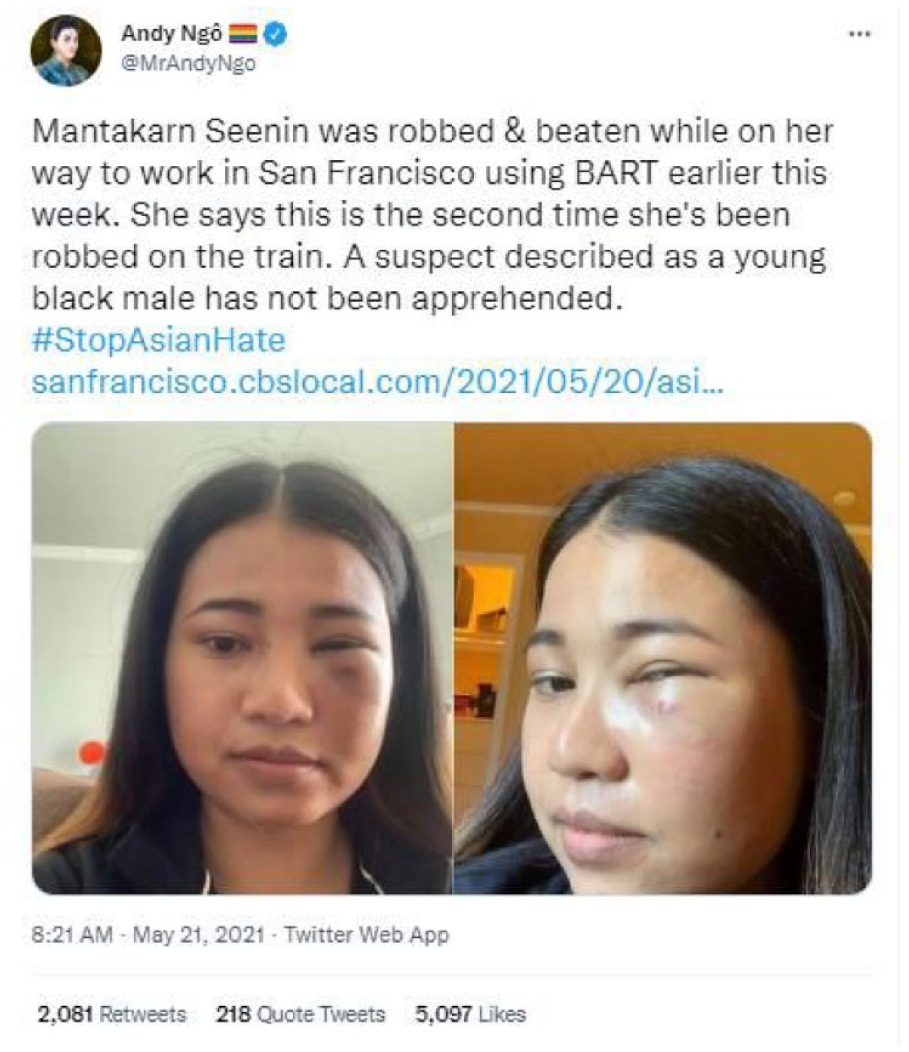
Tweet associated with Topic 15.
In this tweet, Andy Ngô re-contextualized the online news article into the #StopAsianHate hashtag public and his own social network on Twitter. A controversy was raised by mentioning the “young black male” as the suspected attacker. This evidence, showcasing Black racial discrimination toward Asians, hence becomes a special case in which the privileged-underprivileged racial relationship between White and Asian communities, which is the target of the #StopAsianHate movement, was re-oriented to conflicts between racial minority groups. Importantly, the tweet constituted the single largest topic in the corpus.
The redefinition of causality in Asian hate crimes becomes more salient in Topic 7. Andy Ngô posted another news report (Figure 4) about an armed Black male suspect robbing and hitting an elderly Taiwanese Lyft driver, adding that the suspect had a long history of violent crimes. An image of a Black habitual offender was thus constructed. The hashtags #StopAsianHate and #BLM are used as topic markers in this tweet. Both of these hashtag movements are originally meant to draw attention to White supremacist racism in the United States: the commentator appropriates another case of sporadic Black-Asian violence to re-contextualize them. As a result of this re-contextualization, a Black person shifts from being a victim to a villain in the #BLM discourse. In the #StopAsianHate discourse, the perpetrator of violence is no more the White community but another racial minority group.

Tweet associated with Topic 4.
Crucially, our analysis indicates that these tweets are not on the fringes of the #StopAsianHate movement but represent a prominent agenda within the networked discourse. Topic 15 is the largest topic by proportion in the entire corpus while Topic 7, too, comprises of a single tweet because it was heavily re-tweeted (Figure 2). This happens because Andy Ngô is a highly visible commentator on Twitter as a media provocateur. His large following ensures his tweets would reach a significant number of users, and thus also have a high probability of being re-tweeted multiple times—further enhancing their reach and visibility, especially in comparison with tweets from users with fewer followers. The logic of “preferential attachment” (Barabási & Albert, 1999) thus creates a scale-free network in which an agenda that perversely seeks to undermine the original intention of the hashtag movement gains increasing attention.
But the same logic can also help expand attention to the movement’s intended purpose. The tweet constituting Topic 14 is another example illustrating the influence of highly followed celebrities in hashtag activism. Figure 5 shows that K-pop star Lee Chae-rin (@chanelin CL) was conducting a celebrity activist project with the ride-sharing brand Lyft. The company would provide ride discounts through non-profit partners to Asian American and Pacific Islanders who might feel unsafe to go outside of home because of the rising hate crimes. The celebrity helped to publicize this project because of her wide popularity and her media persona in K-pop culture. The tweet text conveyed a sense of solidarity by using the words “rise together” and “take care of one another,” thus adding the positive and convivial sentiment to the hashtag activism. It demonstrated a particular effort to stop the hate crimes thus changes the situation.

Tweet associated with Topic 14.
The high re-tweet number of this post can be understood through the mobilization power of celebrity activism (L. Bennett, 2014) and also the characteristic K-pop fandom practice (S. Lee, 2015). For one, CL’s Korean celebrity persona functioned as a cultural example for fans and wider audiences to relate to and make meaningful the political struggles around racial discrimination. This is a typical approach to draw connections between popular entertainment activities with political movements. For another, K-pop fans take the responsibility to support their idols’ career success. An observation of the comment section of this tweet showed that many fans were posting fancam and calling CL her fan nickname “queen.” They were actively publicizing CL’s positive media image by re-tweeting and leaving complimentary comments. In this way, fans promoted the activist image of CL, strengthened the fandom community, and further evangelized prospective new fans.
This contrasts with the user engagement with Andy Ngô’s tweets, where comments mainly focused on the provocative feature of the reported crimes rather than the provocateur himself. Moreover, although a higher number of re-tweets for posts both by CL and Andy Ngô can indicate either a gesture of support or calling out, CL’s tweet had a higher like-to-re-tweet ratio. This suggests that fans strongly endorsed CL’s position, thus forming homophily, compared to the more diverse reactions toward Andy Ngô’s controversial post. Thus, while both Andy Ngô and CL can be considered as celebrities for their level of visibility on Twitter, their voices are disseminated through very different audience engagement practices.
K-pop artists were not the only type of highly visible popular entertainment stars in the tweets. A major contribution to Topic 1 came from a highly re-tweeted entry by Filipino actress and singer Lea Salonga. She tweeted the song Change jointly performed by RM, a BTS member, and Wale, a Black American rapper. In this topic, while the tweet was composed by an Asian artist, the cultural content of the tweets promoted solidarity between different minority groups in the context of racial discrimination.
Fandom Activism
To illustrate the features of fandom activism, we focus on Topic 16, one of the most prominent topics in the corpus overall that was driven predominantly by LRC tweets. Tweets from BTS fans—the ARMY—played an important role in constituting this topic. It was about the passing of the Act and an appeal to establish solidarity with Palestinians. The tweet followed an outbreak of violence in the Israeli-occupied territory. Since 2010, Korean popular culture has been influential in the Middle East (Otmazgin and Lyan, 2014). The following tweets, which called for helping Palestinians, were brought to #StopAsianHate by local BTS fans.
Tweet 1
@User1: @BTS fan account 1 @BTS fan account 2 @BTS_twt BTS needs to speak up for Palestine. I STAN BTS BUT THIS BREAKS MY HEART. @BTS_twt #StopAsianHate but no #MuslimLivesMatter ? #AqsaCallsArmies #IsraelStopPlayingVictim #BTS_Butter #BTSARMY #BTS #ARMY #BTSPakistan
Tweet 2
@User2: BTS NEEDS TO SPEAK UP FOR PALESTINE WE STAN BTS I STAN BTS BUT THIS BREAKS MY HEART #StopAsianHate but no #MuslimLivesMatter? #AqsaCallsArmies #IsraelStopPlayingVictim #BTS Butter #BTSARMY #BTS ARMY #BTSPakistan #BTSPAK
Tweet 3
@User3: RT @User 1: AT LEAST SPEAK UP FOR PALESTINE?? WE STAN BTS!! I STAN BTS BUT THIS BREAKS MY HEART. @BTS_twt #StopAsianHate but no #MuslimLivesMatter ? #AqsaCallsArmies #IsraelStopPlayingVictim #BTS_Butter #BTSARMY #BTS #ARMY #BTSPakistan #BTSPAK
Tweet 4
@User4: AT LEAST SPEAK UP FOR PALESTINE WE STAN YOU #StopAsianHate but no #MuslimLivesMatter ? #AqsaCallsArmies #IsraelStopPlayingVictim #BTS_Butter #BTSARMY #BTS #ARMY #BTSPakistan #BTSPAK
These tweets illustrate how political messages can be disseminated via fandom practices. @User1’s profile said “STAND UP FOR PALESTINE PS-Not a BTS hate acc //I
//I
 .” Judging from the screen name and the profile introduction, the user was a BTS fan, and this account was dedicated to support Palestine and criticize Israel’s occupation (the account has been deactivated since then). Moreover, @User1 did not post directly but replied to a BTS fan account and addressed another fan account and the official BTS Twitter account.
This tweet therefore connects with a fandom community as a potential public for political messaging. In a similar way, #BTS Butter is the hashtag for the band’s newly released digital single titled Butter. It is the second English single of the band and was released on 21 May 2021. In this case, @User1 strategically took the most trending topic in the fandom community as a platform to disseminate the political appeal. Besides the hashtag for the general BTS fandom community ARMY, @User1 also annotated the tweet with Pakistan BTS fan hashtag.
“WE STAN BTS” and “I STAN BTS” are typical features of fannish discourse that show passionate support for the band and also to display the fan identity. The contrasting transition to “BUT THIS BREAKS MY HEART” conveyed one’s frustration with BTS being silent on the Palestine case. Both #StopAsianHate and #MuslimLivesMatter were used as syntactical elements to form a full sentence “#StopAsianHate but no #MuslimLivesMatter.” The appeal for helping Palestine was thus brought into the Stop Asian Hate hashtag activism through this pair of contrast. The local BTS fans were conducting fan activism. As the band took a high-profile stance in fighting against anti-Asian hate crimes, local fans believed they could also speak up for Palestine. Hashtags such as #BTS_Butter, #ARMY, and #BTSPAK are the fandom community infrastructure through which the fan activists put across their political message.
Second, these tweets were using similar expressions. @User2 posted the same words as @User1, but “BTS needs to speak up for Palestine” was in capital letters. @User4 uses “WE STAND YOU,” in comparison to @User3 “WE STAN BTS.” This feature illustrates how K-pop fans maintain consistency in their communication by following a template. Although these fans do not have high visibility like the media provocateur and K-pop star mentioned earlier, they nevertheless form a prominent topic through repetition and echoing of each other’s voices. Fan activists are thus able to put across political messages through their communicative habits developed in everyday fandom practices (Proctor, 2021). Theoretically, this illustrates how ordinary voices can gain visibility in the digital attention economy—despite the constraints of power law distribution. However, unlike individualized expressions of grievance, as expected by the logic of connective action (W. L. Bennett & Segerberg, 2012), bottom-up mobilization takes place through collective practices of identity construction and performance (Gerbaudo & Treré, 2015).
Fannish Tweeting Practices
Topic 6 relates to the passing of the Covid-19 Hate Crimes Act. Using it as an example, our analysis found that the communicative practices of fans and activists are comparable. This topic is driven by nine unique tweets. Five of the LRC tweets that constituted this topic were marked by the repetition of similar expressions. For example, tweets in Figure 6 adhered to a template with the sentences “we can’t stop Asian hate if we don’t understand the problem” and “ensure better tracking and reporting of hate crimes, and more support for victims.” While K-pop fans keep an information regime to boost idols’ positive publicity, these repeated expressions about the Covid-19 Hate Crimes Act functioned as slogans that coordinate and solidify the narrative in social movements. We may draw a parallel: for popular entertainment, the celebrity’s image is publicized in a controlled way; for activism, the urgency and the benefits of the political agenda are strategically defined, agreed upon, and communicated.

Tweets associated with Topic 6.
Figure 6 includes a tweet posted by Judy Chu, a representative of the 27th District of California and chair of Congressional Asian Pacific American Caucus. The tweet received higher responses than other tweets with similar expressions. This pattern is similar to the acoustic structure of activism offline, where one leader shouts the slogan first, and the rest of the participants follow by repetition. The pattern is also comparable to fans’ “chanting” culture evident in sporting arenas and at music concerts.
To summarize, the discursive pattern of such tweets and related topics can be understood metaphorically through the model of fannish engagement. While the most salient themes can be formed by a highly visible individual Twitter user, we cannot ignore the fact that significant voices are expressed by ordinary users tweeting the shared values and common ideas through similarly worded tweets. This also explains why the HRC topics in our study are highly personalized events, while the LRC topics are slogan-like, conveying solidarity and calls for communal support. In addition, the success of these fannish practices in making particular agendas more visible illustrates the importance of collective identity formation (Gerbaudo & Treré, 2015; Shahin, 2023)—as opposed to individualized connective action (W. L. Bennett & Segerberg, 2012).
Discussion and Conclusion
The #StopAsianHate hashtag gained momentum on platforms like Twitter (now X) in opposition to anti-Asian racism during Covid-19, especially following President Donald Trump’s “Chinese virus” tweet. Previous research identified themes and topics prominent in the movement (Cao et al., 2022; C. S. Lee & Jang, 2023), as well as the use of the hashtag as a discursive space for community building (J. J. Lee & Lee, 2023). Our study, in contrast, shifts attention to the diverse and even conflicting claims and agendas competing for attention within the movement. Despite the hashtag emerging as a response to hate crimes driven by White Supremacism, the most prominent topic in our corpus was driven by a tweet about an Asian woman being assaulted by a Black “suspect.” Two other topics related to Black violence against Asians featured tweets with high re-tweet counts—all of them posted by the same provocateur account. Our analysis thus illustrates how a hashtag movement can constitute an arena of contention between “counterpublics” and “defensive publics”—the latter representing a reactionary attempt to shear the movement of its emancipatory impetus (Jackson & Kreiss, 2023).
Our study complements scholarship on digital movements like #BlackLivesMatter and #MeToo that has similarly found conflict and confrontation accompanying their respective hashtags (Gallagher et al., 2018; Lindgren, 2019; see also the study by Jackson et al., 2020). In addition, our mixed-methods research design, combining STM with digital discourse analysis, sheds light on how the attention economy of a platform like Twitter can enable provocateurs like Andy Ngô and celebrities such as BTS and CL to raise the visibility of particular claims and agendas within a hashtag movement. We link the influence of these “crowd-enabled elites” with the logic of scale-free networks (Barabási & Albert, 1999; Shahin et al., 2024). Tweets posted by provocateurs or tweets about celebrities, who have large followings online, are likely to be re-tweeted more from the outset. But this initial advantage grows exponentially because of what Barabási and Albert (1999) call “preferential attachment.” Attention to individual tweets within a hashtag network thus resembles the “power law distribution,” with a small number of tweets garnering high levels of attention, and the vast majority comprising the long tail.
The role of celebrities here prima facie appears counterintuitive: after all, celebrities are typically viewed as part of the “mainstream” rather than a voice from the margins. But celebrities, like everyone else, have multiple social identities, and these identities can belong to different publics. Many women celebrities, for instance, have successfully drawn attention to feminist causes—partly because they are celebrities and, therefore, more easily able to garner public attention. Alyssa Milano’s contribution to #MeToo is a good illustration: the movement had been on the fringes of public attention for a decade until the Hollywood actress took up the cause, after which it became a global outcry (Boyd & McEwan, 2024). Such amplification becomes even more likely on social media platforms as they can network different publics together (Kim, 2021).
At the same time, our study delineates how ordinary voices of dissent can still rise to prominence despite the constraints of scale-free networks and their tendency for exacerbating asymmetries of attention. Specifically, we show how particular agendas can elicit attention through the activism of fans or as a result of fandom practices (Jenkins, 2015; S. Lee, 2015). BTS fans can bring attention to Israeli violence against Palestinians within the broader discourse about anti-Asian racism by repeating certain hashtags, words, and phrases consistently across large numbers of tweets and echoing each other—much like fans do while “chanting” at sporting events or musical concerts. Moreover, these fannish practices can be replicated to drive up the visibility of other topics. Ordinary users and accounts with small numbers of followers often lead the formation of such topics. Crucially, we argue that this kind of bottom-up social action is not individualistic, as expected by proponents of connective action (W. L. Bennett & Segerberg, 2012). Instead, it relies on the construction of collective identity and the continuous performance of social solidarity (Gerbaudo & Treré, 2015; Sadler, 2022; Shahin & Ng, 2022).
Our study thus adds new insights to the interlinks between political activism and popular culture. Contemporary celebrity culture is one of the primary locales where social identities are constructed and negotiated. Indeed, our analysis shows that the media personae of K-pop artists become the cultural frame through which fans and wider audiences can become aware of political issues. Although fans are mobilized in fragmented fandom groups, the political message from entertainment stars invites fans to fight for a coherent agenda for racial justice. Fans, such as members of the Palestinian BTS fandom, are also aware of the attention power brought by their idols, which can help endow local voices with a global reach. In addition, our analysis suggests that digital discursive practices act as a bridge between popular entertainment and political participation. The need to carry out certain tasks and meet certain goals as part of fandom culture enables fans to acquire the communicative and organizational skills necessary to gain media salience. These skills can be—indeed, are being—replicated in activist movements unfolding online.
Overall, the study advances a more nuanced perspective on the politics of race and identity online and underlines the significance of regarding it as part of broader technological as well as historical regimens. To be sure, there are many instances of Black violence against Asians—just as there are many examples of Asians racially abusing or assaulting Blacks. These ought to be a part of sincere conversations about racism (Ho, 2021). Nonetheless, a concerted attempt to hijack the #StopAsianHate hashtag by a provocateur with a large online following replicates the long history of amplifying sporadic instances of strife between Blacks and Asians to normalize the systematic White persecution of both minorities and undermine the possibility of cross-ethnic alliances against racism (Zheng, 2021). It also reinforces the stereotype of Asians as a passive “model minority,” which itself came into being during the civil rights era as a means of delegitimizing Black Americans’ struggle for equal rights (Okihiro, 1994).
But as Ho (2021) reminds us, “there are other stories of solidarity and coalition work” between Black and Asian Americans, and these “should also be known, told, and shared” (p. 7). Our analysis sheds light on such stories, too, being told as part of the #StopAsianHate hashtag—from a fan remembering the musical collaboration between Black American rapper Wale and BTS’s RM to online gaming events that bring together Black and Asian players. These contradictions illustrate the polysemic nature of hashtags and their capacity for re-contextualization, which generates creativity within hashtag movements but also leaves them vulnerable to elite control (Dadas, 2017).
Our analysis should be viewed within the limitations of our study. First, we have studied hashtag activism on a single platform. Twitter has, since its inception, served as an important platform for hashtag activism and the formation of hashtag publics (Bruns & Burgess, 2011). Our insights may be relevant for other social media platforms where hashtags play a prominent role. But cross-platform comparisons can better illustrate the influence of other platform-level features in shaping discursive characteristics, the diversity of topics, as well as the significance of celebrities and provocateurs in hashtag activism. Second, while we combine two different methods in our research design, other methods may be employed to derive further insights. For instance, social network analysis can quantify the relative impact of different types of “crowdsourced elites” (Jackson et al., 2020) or “crowd-enabled elites” (Shahin et al., 2024) within the hashtag public. In-depth interviews with activists can provide a better understanding of their motivations for participation and the formation of collective identity through fannish practices.
To conclude, our study has shed light on #StopAsianHate as a form of hashtag activism, identifying the diverse claims and agendas that compete for attention within the movement and distinguishing their discursive features as well as the role of celebrities, provocateurs, fans, and fannish practices in the process. It develops a nuanced understanding of the movement as both historically contingent and sociotechnical in character. Integrating the literature on digital activism with insights from network theory and media and cultural studies, this research expands our understanding of contemporary social mobilization and racialization. The analysis can perhaps also assist activists and movements in making optimal use of social media for espousing the cause of social justice.
Footnotes
Declaration of Conflicting Interests
The author(s) declared no potential conflicts of interest with respect to the research, authorship, and/or publication of this article.
Funding
The author(s) received no financial support for the research, authorship, and/or publication of this article.
