




Abstract
Pets, companion animals, and “more-than-human” kin play important roles in people’s lives. Animals are familiar and familial—they are often integral family members and can help create communities beyond the family unit. People rely on their pets for emotional, physical, and spiritual well-being. More recently, research into the role of animals in the lives of older adults has come into focus, especially through the visibilities and visualities of social media. The significance of animals in the lives of older adults in conjunction with the storification and sharing potential of social media leads us to ask: What do the practices of pet image sharing on social media reflect about ideas of aging and human and more-than-human kinship? In this article, we draw on ethnographic and interview data conducted with Australian older adults (65 years and above) about how and why they share images of their pets on social media. How do these visualities represent the feelings, care practices, and experiences of older adults and the value of the more-than-humans in their lives? This article seeks to contribute to social media literature by engaging with the under-explored lives of older adults and how their sharing practices reflect shifting relationalities between older adults and their pets.
Introduction
It’s nearly a month since my old dog died at the ripe old age of 17 years, 2 weeks and 2 days old. I have referred to her since, online, as my Hairy Dogdaughter. I am playing on the words “fairy” and “godmother” here, but my intent is deliberate and earnest as I wait for a visitation, or an apparition. I want her to leave signs and traces for me that reassure me that wherever she is now, she is peaceful, happy, and watching over me. I don’t know what it is to lose a child, unless it’s a “furchild” like this, who shared my world for close to a quarter of my life. With her death a playful kinning ritual of almost two years has also come to an end . . . It was a flipped story world, and it endured for almost 18 months.
In the opening vignette, Melbourne theater-maker and academic Peta Murray speaks after the death of her Terrier, Salty. Living with her partner and their two terriers (see Figure 1), Peta had been documenting the dimming vitality of the older dog as she lived with dementia. For 2 years prior, Peta’s Facebook had become a “dedicated diary space for charting the decline of [her] older dog” through daily photos and playful captions. Peta’s votive desire to dedicate time and energy to building and recording an everyday “fanciful” world a was a way of expressing the mutuality and materiality of care between Peta and her partner and their dogs. The Facebook documentation process became a way of preserving and sharing the memories and moments of Salty’s dementia, alongside the household’s everyday life. While Salty was declining, the captions to Peta’s photos were often written in the imagined voice of the dogs and retained a playful quality as a way of highlighting the absurdity and profundity of end-of-life care.

Salty and Loretta lie in their beds.
Peta’s playful social media posts of Salty were about sensemaking in everyday life. As Lee Humphreys’ (2018) has argued, increasingly we are using social media to qualify (rather than quantify) ourselves in everyday life. The posts became testaments to the power of human and more-than-human kinship, and the role social media storytelling in older adults’ lives. In this article, we seek to uncover some of the many ways the sharing of more-than-human images online reflect about playful everyday practices, care and routines of older adults in a datafied world. We draw on interviews conducted with 10 Australian older adults (65 years and above) about how and why they share images of their pets on social media. Our interviews incorporated social media methods such as “app walkthroughs” (Light et al., 2018) to explore the meanings, motivations, and memorialisation processes. By talking in, with, and through social media storytelling, we were able to situate some of the complex feelings and emotions informing the posts.
Much of the fieldwork began “hanging out” (Ito et al., 2009) and recruiting on both Facebook and in dog parks where we started to observe that older adults were creating and curating stories around human and more-than-human kinship. Here we are using the notion of more-than-human drawn from critical geography and environmental humanities. As Sarah Whatmore (2006) notes, the more-than-human refers to the contexts in which multiple species and processes coalesce in ways that make us rethink the relationship between humans, more-than-humans and the environment.
Framing pets as more-than-humans shifts discussion away from pets as objects of consumption for humans and human-centric approaches, toward an understanding of pets—as Donna Haraway (2008) has identified—as deeply intwined in human and more-than-human kinship. In this article, we use “more-than-humans” and “pets” to refer to the non-human companions of our participants. We do this to account for how—for many people—living with animals is about expanding relationality and kinship beyond human bonds, while acknowledging that not all pets can be considered “more-than-human” (Irvine & Cilia, 2017; Rogers et al., 2013). While “pets” can imply a hierarchical relationship, many people refer to their non-human companions as “pets” while simultaneously talking about the kinship they feel they are building together. We acknowledge the complexity of human and non-human animal relations, including that the non-human animals in question are unable to articulate their relationship toward or feelings about the humans in their lives and that anthropomorphism can have unintended consequences for non-human animals (Parkinson, 2021). We conceptualize the relations of humans and non-human animals through the lens of “materialities of care” (Buse et al., 2018) in which care is practiced in everyday material, spatial, and temporal ways.
Pets, companion animals and more-than-human kin play important roles in people’s lives. Animals are familiar and familial—they are often integral family members and can help create communities beyond the family unit (R. Fox, 2006; Power, 2008). As Haraway (2003) puts it, dogs (and other companion species) are “not here just to think with,” they “are here to live with” (p. 5). People rely on their pets for emotional, physical, and spiritual well-being (Enders-Slegers & Hediger, 2019; R. Fox & Gee, 2016, 2019; M. Fox & Ray, 2019; A. Franklin, 2006; A. M. Hughes et al., 2021). More recently, research into the role of animals in the lives of older adults has come into focus (Applebaum et al., 2021; Fine, 2021; Fine & Friedmann, 2018; Reniers et al., 2022), especially through the visibilities and visualities of social media (Leaver et al., 2020; Maddox, 2021).
The significance of pets in the lives of older adults in conjunction with the storification and sharing potential of social media leads us to ask: What do the practices of pet image sharing on social media reflect about ideas of aging and human and more-than-human kinship? How do these visualities represent the feelings, care practices, and experiences of older adults and the value of the more-than-humans in their lives? This article seeks to contribute to social media literature by engaging with the under-explored lives of older adults and how their sharing of more-than-humans reflect shifting relationalities.
This article seeks to bring some key contributions to social media research. It does so by exploring two themes under-explored in social media research. First, pets as important in human and more-than-human relationships. Second, critical sociogerontology and the important role of more-than-humans. As we suggest, social media contexts are providing different ways for older adults to narrate and make sense of these practices. Older adults’ online practices in everyday life still remains under-researched (Martin & Pilcher, 2017; Rosales & Fernández-Ardèvol, 2020). By exploring these everyday practices of social media storytelling with pets we seek to also highlight the power of pets not as objects of consumption, or as expressions of social identity and companionship that are defined by and for us, to more complex models of worlding, care, and kinning (DeMello, 2016). In addition, we identify the role of playfulness—intrinsic to digital media cultures (Mäyrä, 2012; Papacharissi, 2016; Sicart, 2014)—as not just something for young people but rather a mode of critical inquiry and methodology used by older adults in their social media storytelling as a kinship practice.
We begin the paper with recent conceptual and theoretical work around older adults, technology, and social media; we explore how storytelling and playfulness are deployed on social media; and bring these threads together to explore kinship and “kinning” through playful social media posts. Next, we outline our ethnographic methods. In our third section, we use four case studies, drawing on quotes, thick description, and images of participants’ more-than-human companions to illustrate how kinship is enacted by older adults with animal images online as an ongoing, relational process with and through technology.
Background
Older Adults, Technology, and Social Media
Digital technologies and digital literacy have become increasingly important for social inclusion and aging well (McCosker et al., 2023; C. Wilson, 2018). Discrimination toward older adults can be a barrier to digital participation, leading to poor health and social outcomes (Hunsaker & Hargittai, 2018). Recent Australian research has demonstrated that older Australians can be digitally excluded by a range of factors including affordability and accessibility as well as perceived risks of online harm (Figueiredo et al., 2023; Maccora et al., 2019).
Telecommunication technologies have long been used by older adults for building, strengthening, and maintaining social bonds and kinship (Baldassar et al., 2007; Baldassar & Wilding, 2020; Neves et al., 2018). At the same time, the positive effects of technologies are unevenly distributed, requiring an approach that acknowledges the “co-constitution of ageing and technology” (Peine & Neven, 2019). In conceptualizing the relationship between technology and older people, Wanka and Gallistl (2018) argue for a practice-based approach in which age is an ongoing social practice and technology use is a part of these processes, “[ageing] is something that people do, not something they are” (p. 4). Several scholars argue that we need to overcome simplistic dichotomies about whether technology is good or bad when exploring uses, impacts, and perceptions with older adults (Gallistl et al., 2023; Neves & Vetere, 2019; Ohashi et al., 2017; Silva et al., 2022). As Beneito-Montagut and Begueria (2021) put it, technologies “usually have a variety of effects and affects that are contingent to the circumstances and places of use” (p. 119). Situated research with older adults and their technologies is one way to acknowledge these contingencies and give voice and visibility to older adults’ diverse perspectives.
Beneath the broad umbrella term of “technology,” our focus is on social media. boyd (2015) defines social media as “a set of tools, practices, and ideologies” (p. 1). Our analysis includes all three components of the definition, exploring how social media apps are incorporated into everyday practices and what these practices tell us about contemporary ideologies of kinship. Studies of older adults’ uses of and perceptions toward social media have produced mixed results, indicating both diversities and asymmetries between different groups (Hajek & König, 2023; Tng & Yang, 2022). Previous research has investigated how older adults enjoy using social media to post and look at photos (Righi et al., 2012), foster community and connection (Jung & Sundar, 2018) and alleviate loneliness (Hajek & König, 2023). Other research has pointed out that positive uses of social media are contingent on social positionality and privilege (Crow & Sawchuk, 2011; Tng & Yang, 2022). While such studies have contributed important findings toward understanding the co-constitution of aging and social media, the role of storytelling, kinship, and pets in the lives of older adults has not been fully incorporated.
Following scholars such as Jessica Maddox (2021, 2022)—who foregrounds the importance of joy in the sharing of animal images on social media—playfulness and storytelling can be a method of creating and strengthening kinship bonds. At the same time, playful sharing with friends, family, and acquaintances through animal images on social media can also be a method of relieving some of the tensions inherent in those relations. While the internet might seem to be a “garbage fire” (Maddox, 2022) thanks to the convergence of crises in politics, climate and health, animal images can be a means to find solace amid these discourses through finding and sharing commonality, community, and fun with animals.
Playfulness, Storytelling, and Joy With Pets
Social media platforms offer accessible methods for storytelling and playfulness (Mäyrä, 2012; Miguel Papacharissi, 2016; Sicart, 2014). Sicart (2014) defines playfulness as an attitude toward “things, people and situations” (p. 21) that influences our orientation toward the world, helping us to see people, places, and things with less seriousness. Frans Mäyrä (2012) defines playful media as having three elements: spontaneity, surprising or unusual content, and signaling “non-instrumental” play through affordances (p. 58). Attending to playfulness encourages us to see how we incorporate play into everyday activities, enabling a “mode of enquiry” (Hjorth et al., 2020, p. 99) that can help us uncover unspoken feelings and motivations.
Social media image sharing of animals can be both deeply playful and joyful. The ephemerality of smartphone images combined with social media affordances (Nagy & Neff, 2015; Ronzhyn et al., 2023) that enable easy image sharing makes for an inviting provocation to share quotidian stories and moments of play and joy (Maddox, 2021; Mäyrä, 2012). Sharing stories about one’s life through spontaneous and playful photos can be important to building, maintaining, and strengthening bonds (Hjorth et al., 2014). Telling stories creates community, while playfulness or silliness can be essential to balance out the impacts of negative emotions or events (Segal, 2018).
Deploying humor can be a powerful affective force on social media—creating shared meanings and moments of levity. As Papacharissi (2016) describes, networked publics “come together and/or disband around bonds of sentiment” that are “affective, convening across networks that are discursively rendered out of mediated interactions” (p. 309). When it comes to animal pictures on social media, humorous mediated interactions can serve to lighten mental and emotional loads (Maddox, 2021).
Stories and moments of play can function as an invitation for reciprocity and mutual sharing among social media users (John, 2024; Kennedy, 2016; Lewis, 2015). Sincere and playful affects that circulate on social media create an openness between people, who may be known and unknown to each other. Even if one does not share images oneself, the network made visible by social media can feel reciprocal and shared, as though one is an active participant in the lives of others (Belk, 2013). In our framing of participant practices as playful, we are attuned to the ways some participants described sharing images on social media without the expectation that their audience would share anything in return. Therefore, our definition of sharing is in alignment with Kennedy’s (2016) conceptualization of sharing as practice, which allows us to attend to the how of sharing across different contexts. Despite the decline in the rhetoric of sharing from social media platforms in recent times (John, 2024), our participants’ deploy practices of sharing images as a method of developing and deepening kinship relations.
Kinship and Kinning Through Playful Storytelling
Kinship has a long history as an important marker in social relations and connection (Carsten, 2004, 2020; S. Franklin & McKinnon, 2002; Miller, 2007) which has, more recently, expanded to include non-blood ties across human and more-than-human relationality (Van Horn et al., 2021). Carsten (2004) has argued that kinship is “shaped by the ordinary, everyday activities of family life” (p. 6), allowing for new possibilities and ways of being. According to Van Horn et al. (2021), expanding our understanding of kinship ties requires recalibrating the relationality between humans and more-than-humans in terms of kinship and “kinning.” Kinning is “kinship as a verb” and involves becoming “more receptive to the languages of others, especially non-human others, and better listeners to their stories, which reach out to us through place and time” (Van Horn et al., 2021, pp. 3–4). When we take photos of our more-than-human kin, are we “thinking with” their relationality in a Haraway (2003, 2008) sense? As we will explore through our participants’ insights, sharing these stories on social media can create meaning in our social worlds, expanding relations with other humans and more-than-humans.
Research into companion animals has exposed the powerful and yet often unrecognized role they play in contemporary kinship models—especially for older adults (M. Fox & Ray, 2019; A. Franklin, 2006; M. J. Hughes et al., 2020). In Australia, where one in three people prefer pets to people (Dalzell, 2020), pets are a crucial part of connection and social inclusion. These relations also cross boundaries and hierarchies; interspecies co-existences can rearrange the co-constitutional geometries of “chosen families.” Potawatomi botanist Robin Wall Kimmerer (2021) writes on kinship, “there is no hierarchy in a circle—everyone has a place inside the circle, connected through the reciprocal exchange of gifts and responsibilities” (p. 114). Through this, we are led to understand that within such circles of care are embedded practices of mutuality and obligation across the life course. As our participants make clear, the responsibilities are not just about mutuality and care they are also about playfully depicting the mundane.
Previous research into reasons for pet ownership in Australia has found that companionship was the “single biggest reason given” (A. Franklin, 2006, p. 140) for why people lived with pets. Companion animals enable us to expand our definitions and conceptualization of kinship and belonging in our homes. Adrian A. Franklin (1999, 2006) has traced these histories across Australian cultures and found that the shift from thinking about “pets” to “companion animals” coincided with socio-economic and social shifts in family configuration that made living with animals more affordable, accessible, and appealing. A. Franklin (2006) accounts for this as hybridizing the family where the companion animals contribute to building the relationships as much as the human (p. 142). Thinking about human–animal relations as being about creating hybrid families is a generative way of expanding our concepts of self and family.
At the same time, people who live with more-than-humans can conceptualize these relations in anthropomorphic terms, which can be seen as a method for making the extension of their sense of self feel legible to others. As Belk argued, pets can feel like extensions of the self (1988) and online sharing allows these extensive relations to become socialized, recognized, and legitimized by others (2013). Furthermore, as Parkinson (2021) argues, when anthropomorphism is employed in the service of non-human animals and their needs, it “is a disruptive force, a capacity for imaginative appreciation of another’s perspective; it opens the opportunity for cross-species intersubjectivity, and it can play a role in the development of empathetic relationships with other animals” (p. 2). In the case of our participants, when they use anthropomorphic tropes in sharing images of their pets online, they are making their sense of self visible and legible to others while also communicating empathic, careful kinship between humans and non-human animals. By using anthropomorphic language, our participants felt non-pet owners could understand the depths of kinship.
In many ways, companion animals are more than property, more than accessories to human identity and meaning-making. Rather, as co-evolutionary partners with whom we share our homes and our hearts, they are deeply entangled with our sense of selfhood, family and with the shaping of our lives. As Mary Bouquet (2001) elaborates, family photographs “circulate as a kind of substance that parallels other constitutive substances of kinship” (p. 76) and “what are taken to be the visual traces of a relation, posed or unposed . . . somehow become part of that relation” (p. 101, emphasis in original). That is, when we take family photos of our human and more-than-human kin we both represent those relations and bring them into being.
In recent years, the relationship between digital technologies, older adults and pets has become more apparent (Hjorth, 2022; D. M. Wilson et al., 2021). The significance of pets for older adult well-being has been strengthened (A. Franklin, 2006; Friedmann et al., 2020; Ikeuchi et al., 2021; Reniers et al., 2022), emphasizing the necessity of further ethnographic work to understand how the diversity of older adult and pet relations are expressed.
Recruitment
We adopted Mizuko Ito et al.’s (2009) approach to digital media involving “hanging out” in specific interest-group spaces, where we observed “publics that are engaged in their particular hobby or area of interest” (p. 20), observing human and more-than-human interactions. Hanging out involved physical hanging out in dog parks and engaging in observation of interactions and relations between humans and animals. Hanging out also took the form of online exploration of human and more-than-human posts on Facebook. To recruit participants for interviews, we posted a short blurb about the research aims and images of our own more-than-human kin in Facebook community groups and through our social and professional networks.
The project received ethical approval from our University’s Human Research Ethics Committee (ID: 25681) to conduct semi-structured online interviews with participants aged 65 and over who live with animals. Potential participants were invited to email the authors if they were interested in participating in a 30-minute interview. No financial compensation was given to participants. After participants gave written consent, interviews were conducted on Microsoft Teams so the audio could be recorded for transcription and analysis. The interviews were participant-led—that is, while we had a few prompts such as “show us some of your favourite posts and tell us why you posted them,” much of the discussion was led and directed by the participants. In exploring posts we adopted Light et al.’ (2011) “app walkthrough” methods which involves participants talking us through their posts, comments and the associated meanings. Interviews were conducted in June to October 2023. In total, we conducted 10 interviews with participants based across three states in Australia.
Methods: Ethnography Toward Playful and More-Than-Human Approaches
Ethnography focuses on practices in context and empowers participants in the ways in which their lived experience and rituals are sense-making mechanisms (Pink et al., 2016). Our ethnographic approach to the research focuses on the often-overlooked complex entanglements between humans, more-than-humans and digital media. For us, this means our ethnography centers on how our participants’ everyday social media practices inform and are informed by the socio-cultural milieu in which they are produced. To achieve this, we reflect on how the more-than-human is experienced in mundane ways through the playful entanglement between humans, social media, and pets.
Celia Lury and Nina Wakeford’s work on inventive methods also informed our approach. Inventive methods are those that “contribute to the framing of change” as something that is simultaneously “complex, contradictory and uncertain” and “everyday, routine and ongoing” (Lury & Wakeford, 2012, p. 6). Such methods are important because they are answerable to the questions they pose. In this case, our question is What do older adults’ practices of more-than-human image sharing on social media say about aging and human and pet kinship? To answer this question, we deployed thick description as a method of analysis to “draw large conclusions from small, but very densely textured facts” (Geertz, 1973, p. 321). As Geertz (1973) argues, thick ethnographic description helps us to weave together specificities from participants with theoretical frameworks and prior research to contribute to how we understand the social worlds of specific groups. In this case, we wanted to understand how older adults in Australia use pet image sharing on social media as a mode of kinship to build relations between themselves, their more-than-human companions, and other people in their communities.
In interviews, we deployed interview techniques including social media app “walkthroughs” (Light et al., 2018) and “scenarios of use” (Hjorth & Arnold, 2013) to capture everyday routines and affordances of participants’ social media use. These methods enabled us to highlight the dynamic and multiple ways participants and their companion animals deployed social media image sharing as a kinship practice. The insights from participants are important because they show us different examples of what becoming kin with pets can look like, and how the significance of these relations can make growing older a shared experience. Many of our participants emphasized the responsibility and relationality they feel toward their pets, and how care between humans and pets is reciprocal. In the following section, we introduce the participants and their more-than-human kin and use their stories to illustrate how they enact kinship relations online with their companion animals through storytelling and playfulness.
Our Participants
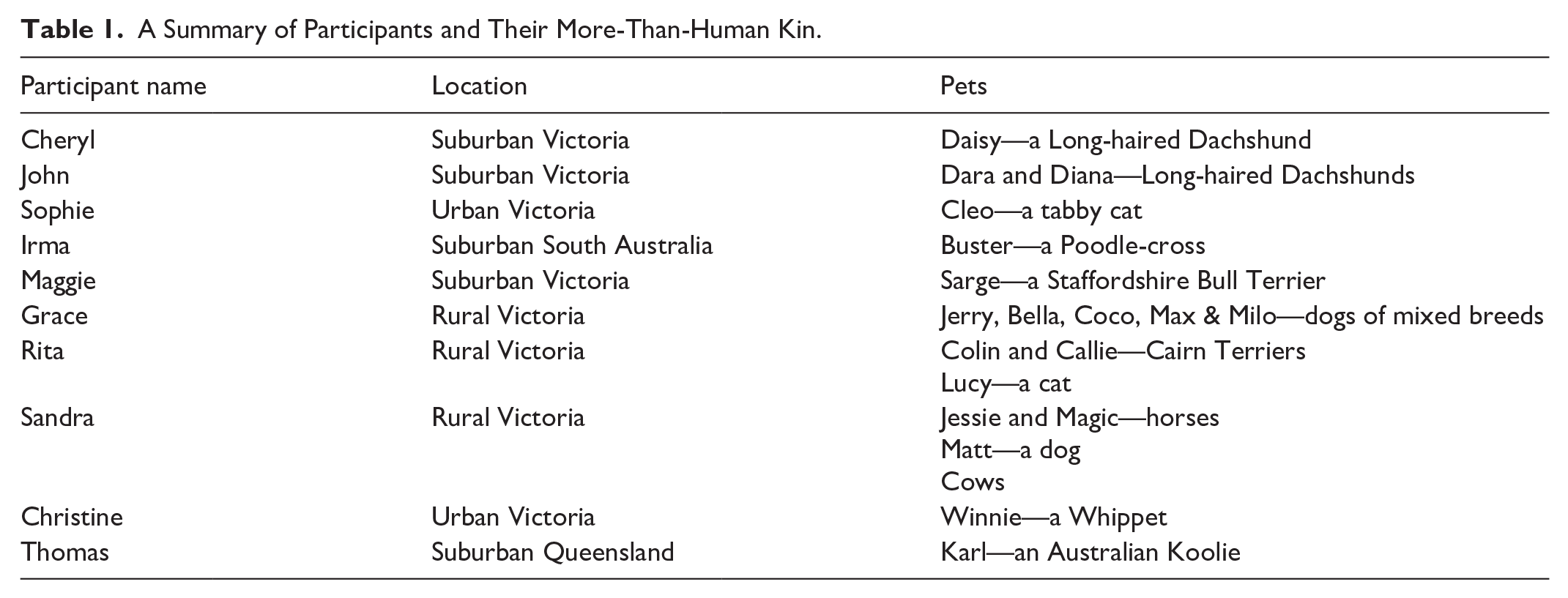
We interviewed 10 Australian older adults who live with pets and share their images on social media. Many of our participants live with more than one animal. Nine participants live with at least one dog, two live with cats (one only with a cat, the other also with dogs). One participant lives with horses and cows alongside her dog. Table 1 summarizes all the participants and their pets. Participants and their pets have all been given pseudonyms.
A Summary of Participants and Their More-Than-Human Kin.
After they had been transcribed, the interviews were read and thematically coded (Alejandro & Zhao, 2024) to uncover overlapping and interconnected themes. We identified four key themes: parasocial play, acceptance, everyday play, and more-than-human play. These themes show that our participants’ lives are deeply interconnected with their companion animals, and they deploy social media images to share some of the multitude of affects and meanings that they co-create with their pets. In the following section, we draw on four participants as case studies to illuminate our findings and themes.
Playful Digital Kinship: Stories From the Field
Having outlined our methods, we now focus on the four participants. These participants span the range of responses and meanings, highlighting the important role pets as more-than-human play in older adults’ life.
Sharing Parasocial Play: Sophie & Cleo
Sophie is an artist and bookseller who lives in an apartment in the inner suburbs of Melbourne with her cat, Cleo, age unknown. After her last cat—Roger, “a particularly beautiful looking tabby cat”—died, Sophie was bereft and felt “unable” to consider living with another animal for some time. Instead of adopting a new cat right away, Sophie decided to foster a cat, Cleo, but ended up becoming so attached to Cleo that she adopted her. For 3 months, Cleo was so timid that she hid under Sophie’s furniture all day (see Figure 2) only coming out at night to use her litter tray and eat. Three years on from those initial cautious months, Cleo is a little more adventurous with Sophie who said, “[Cleo’s] my little mate now.”

Cleo being gently coaxed out of her cardboard box with a toy.
Sophie shares pictures on her Facebook and Instagram accounts of Cleo, often with silly, anthropomorphic captions about Cleo being a “scaredy cat.” Sophie feels connected to the animals she sees and shares on her social media. The images provide an “intimate glimpse into someone else’s life.” Sophie added, In a world that’s so crazy and so awful, a lot of the time, it’s just comforting to know that there are people out there who care about animals and that there’s a place of peace and tranquillity where animals and humans kind of interact with one another.
Seeing and sharing the entanglement between humans and companion animals has enabled Sophie to see herself as connected with people, nature, and cultures. These kinship relations enable her to making sense of the “crazy mad house” world and build kinship relations with Cleo. Other participants shared the feeling that social media images can be a sense-making and world-clarifying mechanism.
Sharing Acceptance, Diversity and Inclusion: Irma & Buster
Irma lives with her partner and their dog, Buster (Figure 3, age unknown), in suburban Adelaide and is a prolific poster on social media. Irma uses Facebook, X, LinkedIn and Instagram alongside several personal and professional websites to document and share her various advocacy projects and interests, including Buster. Across the platforms, Irma estimates she posts 10–15 times every day. Irma is an active advocate for LGBTIQA+ rights and people suffering and recovering from certain cancers, having recovered herself. Irma’s public visibility, her advocacy and her sexuality can contribute to her feeling like a target for abuse online, so she sometimes posts playful pictures of Buster to diffuse difficult or fraught online relations.

Buster relaxes in his bed.
Dogs have played an important role in Irma’s life, being a source of particular comfort after she was “thrown out of home at 18” for being gay. Irma appreciates the playful silliness of dogs, as well as the deep affection they can show. For Irma, dogs have been and are her family. She describes sharing images as “a kind of expression of love that is very similar to sharing of my grandchildren . . . if I say I do it to build bridges that sounds a bit manipulative or strategic” when her intention is to build kinship relations as part of advocating for a better world. While Irma is a passionate poster looking to make the world a better place, other participants are less ambitious and instead are looking to ensure inter-species relations are smooth in their own home.
Sharing Everyday Practices of Play: Rita, Colin, Callie, & Lucy
Rita is a lifelong animal lover who has retired to a rural Victorian property with her Cairn terriers, Colin and Callie and “an elusive cat” called Lucy, ages all unknown (Figure 4). Rita uses Facebook to connect with “the outside world” (meaning people outside of the small town near where she lives) and says that seeing pictures of other people’s pets “makes me feel better about the world . . . cause I sometimes think humans can be really hard work.” Rita describes human/pet relationships as less complicated or compromised than human/human. To illustrate this point, Rita playfully describes how her last cat, Wednesday, was a good judge of character, having scratched at her ex-husband while sleeping in their bed. The affective bond between Rita and her pets is so strong that Rita says she has grieved the loss of dogs more than she did her parents.

Colin sits in a plant pot.
To illustrate the entanglement of their relations, Rita described how each night she engages in a choreography of managing more-than-human relations to avoid the dogs and the cat interacting, which she calls “this whole ridiculous routine.” Rita enjoys negotiating sharing her space with other beings, and uses Facebook posts to express that “I completely love and adore them, they’re my world.” This choreography indicates how the “independent agency of these animals . . . shape meanings and practices of home” (Power, 2023, p. 286). Rita works collaboratively alongside her animal companions, ensuring they are comfortable and happy, despite any mild inconvenience this causes her. Maintaining a playful attitude toward these choreographies can be a way of ensuring their longevity and enhancing the kinship relations between them all. Another participant, Sandra expressed how she deploys social media images carefully to maintain relations within her community.
Sharing More-Than-Human Play (Beyond Cats and Dogs): Sandra, Jessie, Magic, and Matt
Sandra lives on a rural property in Victoria surrounded by companion animals and is suspicious of most social media. She claims to only use Facebook out of necessity to participate in communities, rather than feeling the platform has any intrinsic value. Although she dislikes Facebook, Sandra uses it to post funny, playful pictures of her companion animals (ages all unknown)—including cows (see Figure 5), her horses, Jessie and Magic, and her dog Matt who she describes as “a rescue mutt who came from the streets.” Sandra and the animals have strong kinship relations—Sandra says she is proud of them and that during the pandemic they all became closer and more interdependent, building their own community.

A highland kiss.
Sandra describes how Facebook is “changing some older adults into children . . . with this pressure, this peer group pressure at our age.” She feels there are pressures and expectations from people on Facebook that are disconnected from the “real world,” echoing previous research findings about older people’s concerns about the social impact of mobile phones (Crow & Sawchuk, 2011). While Sandra might find using Facebook a bit tiresome, she does also recognize its utility for older people for connection, friendship, and engagement.
Summary of Findings
Our participants demonstrate the multiplicity of meanings and ways older adults use social media to post pet images. Our participants give voice to older adult agency on social media, as well as highlighting the important role of pets in kinship. Familial love and quotidian joy were strong emotional motivations for participants to share pet images on social media—some anthropomorphized their relations with pets to make sense of and emphasize the strength of their bonds. While this anthropomorphisation still centers the human perspective, it also offers a view into the affective social worlds that can exist between older adults and their pets (Parkinson, 2021). Older adults share pet images on social media to narrate and make sense of their relationships with their pets. In sharing everyday practices of quotidian, material care, older adults are demonstrating the extension of their kinship relations with more-than-humans while also building community with other animal-loving people. While older adults’ everyday social media storytelling has been overlooked by researchers (Martin & Pilcher, 2017), it is important to explore the multiplicity of older adults’ social media uses as we continue to live longer and age at home.
Sharing their playful, caring relationship with their non-human kin on social media allowed some participants to feel content with the possibility of bringing joy to other humans through sharing their relationship with pets. As participant Maggie put it, “I only do it [share images on social media] for a bit of joy for myself and that it might bring joy to someone. I don’t care if it’s one person.” Sharing online can be a method of co-constructing the self (Belk, 2013), which can create communities both actual and imagined with humans and non-humans (Parkinson, 2021). Other participants, while still maintaining a sense of playfulness, were also attuned to the ways animals can encourage humans to foster acceptance, harmony, diversity, and inclusion. This sentiment was expressed poignantly by participant Grace who said, People underestimate the importance of your relationship with the dog . . . because it’s going to the notion of legitimacy. To me that’s my family. There’s lots of rhetoric about fur families versus “real” families, but I think family is who you make it to be, it doesn’t matter. It’s to do with your situation in life.
In Grace’s experience, we can see how sharing multispecies kinship can open up acceptance around alternative family dynamics and arrangements, fostering inclusion, compassion, and empathy.
Conclusion, Limitations, and Further Research
If, as Carsten (2004) argues, “kinship involves not just rights, rules, and obligations but is also a realm of new possibilities [that] is apparent whether we look at mundane rituals of everyday life” (p. 9), then we must look to the everyday encounters between humans and more-than-humans to grasp the complexity of these relations. In this article, we have explored the role of older adult sharing more-than-human social media storytelling to give voice to contemporary forms of kinship. This article has sought to investigate two under-studied areas in social media research—older adult everyday online practices and pets as more-than-human kin.
As a study, there are some limitations, two of which we see as significant. The first is the sample, which was limited in terms of diversity and size. While all our participants were aged over 65, none were aged over 80 and most were relatively privileged socio-economically. Future research could address this limitation by collaborating with organizations that reach diverse communities and recruiting a larger sample size. A second limitation is that more-than-humans could have been more actively involved in the research to contribute additional textures to the kinning practices we outline above. Future research could address this through more intensive “hanging out” with more-than-humans and documenting their interactions with humans.
Footnotes
Acknowledgements
The authors wish to thank the anonymous reviews for their generous feedback on the manuscript and the participants who shared their experiences with us.
Declaration of Conflicting Interests
The author(s) declared no potential conflicts of interest with respect to the research, authorship, and/or publication of this article.
Funding
The author(s) disclosed receipt of the following financial support for the research, authorship, and/or publication of this article: This project received funding from the Canadian Social Science and Humanities Research Council (SSHRC) network, “Aging in Data,” which has a mandate to investigate “how age studies intersect with communications, media studies and critical data studies, and explore how an era of unprecedented digital data-gathering impacts and governs how we grow old in our communities”.

Author Biographies
Distinguished Professor