




Abstract
One of the most obvious characteristics of Iran’s protests in September 2022 is the emergence of a type of cyber activism that, unlike mass activism, is formed first in cyberspace. Networks have redefined social action and structure in our societies and have important consequences on production processes, power, and culture, challenging political systems, and creating legitimacy crises. The subject of the present research is important because cyber activism has an external aspect and has changed the shape of Iran’s social movements. This article is based on the Twitter data analysis method and using MAXQDA. Referring to Castells’ network society theory, it addresses this question: What role did the Twitter play in September 2022 in Mahsa Amini’s social movement? This article shows that the Twitter, in the context of existing dissatisfactions and in the absence of active organizations and parties, has led to an increase in cyberactivism in Iran. This cyberactivism encompasses mass self-communication, occupation of urban space, horizontal leadership, globalization of messages, mobilization and guidance of public opinion, nationalism, the subjectivity of women, and their identification has been its external manifestation.
Introduction
Historically, the activism of society members often took place in a mass form and through social and political groups and organizations, elections, and parties. But today, people’s activism appears in cyber form and in the form of networks and self-communication of the masses. The network campaigns are characterized by establishing a network of horizontal relations between supporters and the management team of the campaign. The Internet and social networks have created spaces where groups and individuals can collaborate, connect, and mobilize. Computer and mobile systems facilitate local and global communications in this space (Castells, 2000, p. 695). In fact, the new information technology paradigm has laid the foundation for the extensive expansion of networks across all social structures. The distinctive feature of this society is the superiority of social form over social action. Networks are open structures that can expand without any restrictions and accept new index points within themselves. For this reason, the importance and role of networks for social activists have doubled, especially in new social movements. Because societies composed of new networks have even changed the shape of new social movements. Social movements exercise counter-power by initially constructing themselves through a process of independent communication and free of the control of institutionalized power holders. Digital social networks provide the possibility of in-depth thinking and coordination of activities in a mostly free and unrestricted way and outside the control of the government (Dearnley et al., 2001, p. 68). Network communication allows complaints and protests to be first raised in the space of internal users and individually, and then, they become a pervasive and wavy issue among other users of networks across geographical locations. Social network analysis is a powerful diagnostic method for analyzing the nature and pattern of communication among members of a particular group (Oftade, 2014, p. 19). Social developments such as collective cyber actions on Twitter are among the most important events that have prompted researchers and political activists to analyze and investigate. Twitter has a great ability to mobilize communities and gather audiences. This media is used to advertise activities, create a sense of collective identity with its supporters, and mobilize them in collective leadership actions (Bortree & Seltzer, 2009). Regardless of its technological aspects, Twitter literature studies the content of tweets and retweets, the types of users and audiences, the circulation of messages, the nature of viral and trending messages, and their social-political effects. Of course, it is clear that neither the Internet nor any other technology can be the source of social causality. Social movements arise from contradictions, crises, and conflicts in certain societies. But it is necessary to simultaneously emphasize the important role of communication in the formulation and functioning of social movements.
In September 2022, the people of Iran held mass demonstrations in various cities to protest the murder of Mahsa Amini. The freedom movement of the people of Iran refers to a series of actions in which the society protested against the compulsory hijab, and other human rights violations policies by the Islamic Republic of Iran and demanded the removal and trial of government officials. With the help of social networks, this movement was accompanied by the reactions and support of people all over the world, and they asked the international forums to follow the events inside Iran more quickly.
Also, the masses in the recent social movements of Iran not related to its intellectual current and have different demands from one another. Some are looking for the quality of life, and others are looking for its quantity. Iran’s recent movements are mostly looking for the quality of life. Mohammadreza Tajik argues in the book “Life of the Movement (2020)” that only social movements that focus on life can be considered movements. The life of order and military is independent and a self-sufficient territory that gives form and meaning to political action. Life is the domain of people’s governance through the actions of correction, exclusion, normalization, discipline, therapy, and optimization. With this image and idea of “life,” only a movement that aligns itself with the biological laws and life and accepts them as a policy can be considered a movement and is in line with reality, and only life and it is the minutes that determine what kind of relationship between people and what kind of collective action and reaction should take place.
Therefore, a bio-movement is prior and preferable to anything related to life, biological and civil life or bare life and political life; it is an organism and a living being that is born and grows in the lap of life; an action overseeing the life of a collective subject who is aware and sovereign over his body and soul. From Tajik’s point of view, the bearers and agents of this type of movement are all those who feel alienation, political abandonment, political meaninglessness, powerlessness, mistrust, political discontent, and relative deprivation, have a sense of racial, ethnic, gender, cultural otherness, and also those who lack a sense of autonomy and self-discipline, who have a sense of silence and invisibility, or who feel a sense of naked life and living in a camp. The biopolitics of the movement originates from real situations, from what they can say in these situations and from what they can do in these situations.
This article explores the relationship between social networks and the formation and evolution of protest movements in Iran. The study focuses on Twitter as a textual and easily accessible platform, providing a statistical population for analyzing hashtags related to the movement. The research aims to conduct an unbiased analysis, adhering to value neutrality, and minimizing bias through the use of MAXQDA. Limited research has been conducted on the connection between networks and the socio-political movements in Iran, due to the topicality of the subject, the sensitivity of investigating the issue in authoritarian political systems, and the filtered nature of these networks. The codes were selected based on the theoretical concepts of Castells’ network society theory. MAXQDA software provided the possibility of coding Twitter data using an analogical method (deductive reasoning). With its help, we were able to use a general theory and arrive at a partial hypothesis or hypotheses. All texts containing coded hashtags have been reviewed one by one, and irrelevant items have been removed.
The number of Mahsa Amini’s hashtags on Twitter, which were widely used after his death, reached more than 85 million. This study analyzes the findings from the Twitter social network from the perspective of the Castells network community and shows the change in activism from a mass to a (cyber) network in the recent social movement (protests) of Iran. It also examines how to communicate, express public demands, and form mobilization and collective identity in cyberspace, which ultimately leads to collective action in real space. In this study, the statistical collection of 1000 tweets from the Twitter social network data in protests from September to March 2022 is focused. This article shows that the Twitter social network, in the context of existing dissatisfactions and in the absence of active organizations and parties, has led to an increase in cyberactivism in Iran. This includes mass communication, occupation of urban space, horizontal leadership, globalization of messages, cosmopolitanism, mobilization and guidance of public opinion, nationalism, the subjectivity of women, and their identification of women as its external manifestation.
Method
Tweets were randomly selected from the larger dataset to ensure sufficient representation. These tweets were selected based on the snowball method and hashtags related to the Mahsa Amini protests. We have shown these criteria clearly in the revised version of the article in the form of a figure. The snowball method is a non-random sampling technique often used in research where accessing members of a specific population is challenging. In the context of collecting and analyzing 1000 tweets, this method was used as follows:
We used a specific hashtag or keyword related to the main topic of the research (i.e. hashtag #Mehsa_Amini) to select a number of initial tweets (100 tweets). These tweets were used as a starting point. We looked at the tweets of the identified users and added more relevant tweets that addressed the same topic to the sample (related hashtags: Mahsa Amini, women, call, revolution, strike, protests, woman, life, freedom, national, Iranian Yuz [Cheetah] and . . .). We gradually expanded the network of tweets until it reached 1,000 tweets. This method has helped to maintain sufficient diversity in the sample and to have a good representation of the entire network of tweets. At each stage, we identified new users and their interactions and added relevant tweets. During collection, we tried to ensure that the sample included enough diversity in terms of types of users, time frame, and types of interactions to be a good representative of the entire network of tweets.
The snowball method and checking tweets more accurately with the software has the ability to identify real interactions and communications on the Twitter. However, we are aware of its limitations, and we have tried to reduce these limitations by examining each of the content of the collected tweets. We selected 1,000 tweets due to time and resource constraints in Iran. This number has been selected as an initial sample for preliminary analyses. It is true that limited data can create limitations in the analysis, but the main goal of the article was to show the changing nature of social movements in Iran and the emergence of cyber activists in recent protests, and with these data, we were able to reach acceptable results. In future research, we will use a larger and more diverse data set, and we have plans to expand our research.
The Network Society
Regarding the network society and the impact of the Internet on political trends and social movements, there have been many discussions among researchers (Castells, 2011; Kalathil & Boas, 2010).
Advances in information technology have enabled the collection and packaging of any message, including sounds, images, and data, facilitating the creation of data networks that transmit a wide range of symbols without the need for a central control point. Global horizontal communication was enabled (Motamednezhad, 2012, pp. 135–136). In information age studies, networks and network connections are primarily defined as informal communications between individuals, between individuals and organizations, and between organizations (Stammers & Eschle, 2005). According to Howard, networks are made up of links that make it possible to create a network campaign with political goals. Networks are important strategies for building consensus and connections among politicians, lobbyists, and leaders of social movements. These campaigns are mostly formed on popular digital media such as Facebook, Twitter, and Instagram with the aim of maintaining links and donations. Most of these campaigns are local and temporary. Network power allows political leaders to run different campaigns and send different messages to various sub-networks of supporters. Network campaigns allow campaign managers to become news sources and bypass traditional media (government news and radio) (Howard, 2011, pp. 41–44).
Terms such as information society, network society, cyber society, silicon civilization, and digital society are used to understand the political, economic, cultural, and social aspects of life to reflect the latest life manifestations of modern life. Movements and mobilizations arise when social, institutional, economic, and political conditions are challenged. Individuals come together in collective action to seek change when existing institutions fail to meet their social, economic, and political demands (Huntington, 1968).
The reason for choosing Castells’ theory and its components of the network society is the connection of this theory with culture and the role of the network in mobilizing protesters in social movements. Iran’s civil society is weak and repressed; therefore, social movements in Iran become mass movements and have recently appeared on the networks. In these movements, similar to Castells’ theory, there is a dispersion of goals, lack of leadership, and a lack of organization. According to research findings, Iranian online protesters are mostly from the middle to upper class, and the presence of the lower classes is weak, reducing their chances of success.
In the book “Revolution Without Revolutionaries; Making Sense of the Arab Spring (2017),” Asef Bayat states that the revolutions of the 21st century contain the concepts of freedom, liberation, equality, and brotherhood and keep the hope of change alive in the heart of society. This work was about revolutions without revolutionary ideas. Revolutions are affected by neoliberal conditions. He considers the reason for the failure of the Arab Spring revolutions to be the radicalization of neoliberalism from political opposition. These revolutions failed because they failed to challenge neoliberalism and are post-ideological in nature. These revolutions occur without organization and leadership and without ideology and coordination.
In fact, what happened in Tunisia, Egypt, and Yemen was not the type of revolutions of the 20th century, that is, the rapid and radical transformation of the government under the pressure of popular movements from below, and not just reforms in the sense of gradual and managed change, often from above and within the framework of order. In addition, the existing structural arrangement was a complex and contradictory combination of both, according to Bayat’s interpretation, they were Esghelab. Revolutionary movements emerged to force established governments to change themselves and make meaningful reforms on behalf of the revolution. But they had a loose, flexible, and horizontal organization and suffered from fragmentation. They supported the civil opposition, but neglected the danger of counter-revolution. They were more concerned with democracy, human rights, and the rule of law than with property redistribution and distributive justice. Therefore, its result was similar to revolution in terms of mobilization and reform in terms of change. These revolutions were reformist, meaning that the progressives who led the mobilization were in charge in a masterful way, they could not imagine different forms of organization and governance from those that they had rebelled against.
In his book “Post-Islamism: The Changing Faces of Political Islam” (2013b), Asef Bayat examines Islamism and post-Islamism and Islamist currents in terms of discourse and practice in Muslim countries such as Iran, Egypt, Turkey, Syria, Sudan, Morocco, Indonesia, Lebanon, Pakistan, and Saudi Arabia pays. Bayat believes that Islamism is not compatible with democracy, but post-Islamism can be compatible with democracy. Post-Islamism is neither anti-Islamic nor non-Islamic or secular. Despite its similarities to the approach of liberal Islam, it has gone beyond it and is an attempt to combine religiosity and rights, faith and freedom, and Islam and freedom, emphasizing rights instead of duties. The relationship between religion and rights, pluralism instead of monotony, inclusiveness and flexibility in principles and practice, historicity instead of rigidity and the future is a place of the past.
Post-Islamism represents a discursive and pragmatic break from Islamism, which seeks to create an alternative modernity through linking Islam with individual choice and freedom, with democracy and modernity, so it is not a post-Islamic turn and should not be wrong with electoral Islamism. The concrete manifestation of the post-Islamist trend can be seen only in Iran during the period 1998–1999, Turkey under the rule of the Justice and Development Party and Tunisia under the leadership of the Ennahda Party. Also, according to Asef Bayat, post-Islamism does not necessarily mean the end of Islamism, but it is seen as a birth in a critical departure from the experience of Islamism and as a distinct policy and discourse.
Asef Bayat, in his other study titled “Street Politics: Poor People’s Movements in Iran (1997),” is dedicated to the movement of the ordinary people, that is, poor people, during the last three decades of Iranian history, and to the lower levels of the revolution and the classes that have been neglected. That is, he pays attention to what happened in the back alleys of cities and poor neighborhoods. The author analyzed the Poor People’s Movements from the perspective of the slow progress of ordinary people on the street and explained the policies of the popular people, individuals, and families without institutional power, informal people such as the new poor people, the homeless, the unemployed, peddlers, and itinerants who do not belong to a certain class.
These groups have been searching for a livelihood on the streets, and by creating an independent but unstable network, these groups were in a state of conflict and negotiation with the government. They attempted to gain concessions from the government by occupying the space, while the government insisted on passive use of the streets and public places. Also, the occupation of public space deprived the business class of privileges and economic opportunities, and for this reason, the government sided with the businessmen and began to fight with empty hands. The author examines the poor people’s effort to occupy the public space under the title of street politics.
Asef Bayat in the book “Life as Politics; How ordinary people are changing the Middle East (2013a),” provides a different analysis and an inside look at Middle East societies, especially Egypt and Iran. The main emphasis of the work is on the currents, movements, and tactics that are adopted by ordinary people in the slow progress of the lower class, to subsistence, to be in the public arena, to improve the quality of life, or for political resistance. Bayat, by avoiding falling into the trap of Orientalist or Eurocentric discourses, also pays attention to the structural and historical aspects of Middle Eastern societies.
He reveals the historical structures of these societies, such as post-colonial populism, neoliberalism of the global economy, authoritarian government structures, and guardianship in family and neighborhood life, and the impact of these structural processes on the social life and political expression of Middle Eastern societies. By redefining the theories of social movements and the sociology of revolutions, Bayat explains the trends of development and change in Middle Eastern societies, the relationship between the government and civil society, and the way politics emerges in the lives of these people. What is important for the author is to understand how ordinary people, that is, urban poor, women, and youth, think and act.
Formulation of concepts and categories such as social “non-movements,” slow progress, reform, and passive networks are done in this direction. The author’s priority in this book is to describe “slow progress”; an alternative popular strategy for social and political movements to deal with the triangle of Islamism, neo-liberalization of the economy, and autocratic governments that have unilaterally canceled their social contract with the people. The tools through which ordinary people change their societies are not limited to mass demonstrations and revolution; they are a reflection of popular mobilization; but people are increasingly turning to “non-movements,” which are the collective actions of millions of individual activists that take place in squares, alleys, courts, or gatherings. Therefore, this book is about the “art of presence”; the story of agency in the time of hardship. One important aspect of street politics is the conflict over space and public order. In the course of the movement, the streets become a space for expressing people’s dissatisfaction and expand solidarity, create identities, and become a mediating arena for common communication between passers-by and strangers.
Harsij and Rabeie nia (2023), in their article, The Formation Pattern of Protest Movements with an Emphasis on the Role of Social Networks, tried to answer the question of what pattern existed between the use of virtual social networks and the formation and evolution of protest movements in the country. Using in-depth and semi-structured interviews with academic elites in the field of communication and political science, this article attempted to investigate the mobilization mechanism of protest movements through social networks. The research findings showed that social networks affected the protest movements based on three general themes: “Normalization,” “mobilization and organization,” and “field reaction.”
Razmjo and Enayati (2016), in the book “The Role of Virtual Media in the Sedition of 2018,” examine the role of the media (both satellite, news sites, and social networks) in organizing and covering the protests after the 2018 elections. In this book, the impact of new media on the political behavior of users in Iran has been examined, and while analyzing the conceptual and theoretical aspects, the interaction between the Internet and the political behavior of users in Iran, the patterns of communication actions in virtual space have also been explained. The authors have tried to explain the role of social networks and the Internet in the process of intensifying the polarization of society, By examining 13 types of the propaganda techniques of the opposition media in the 10th presidential election period. Finally, they survey the role of new media in post-election crises and the capacities of social networks in investigates post-election protests.
Hank Johnston in the book “What is a Social Movement (2023 [2014])” refers to concrete cases to examine the formation of social movements, different forms of movements, the influence of performances and media in new movements, and the prospects of movements. All movements pursue goals based on social change. Their main characteristic is mobilization and activities outside the established political and institutional networks. According to Johnston, collective identity is the central feature of all movements and plays an important role in coordinating protest behaviors. Collective identities emerge through conversation. The collective identity of the movement originates from the multiple interactions among the participants of the conversation about who they are, what they do together, and why. It is through exchange that they create, test, and modify their personal versions of what it means to be a member of the group in response to the reactions of others.
It is the process through which the different meanings of group membership and participation are often subsumed under a common understanding. New social movements are formed with environmental contexts, women’s rights, students’ rights, animal rights, anti-institutionalism, and lifestyles and identity. The politicization of identity and lifestyle is a fundamental issue in many social movements. The members of this movement are mostly middle class and educated people.
Many scholars such as Alain Touraine (1981, 2000), and Alberto Melucci (1989) have theorized about new social movements. The new social movement is often referred to as the spontaneous struggles of women, students, the environment, and nuclear weapons who want to change the quality of life (Chesters & Welsh, 2011, p. 28). Daniel Bell with the theory of information, nation-state, and surveillance; Jürgen Habermas with the theory of management and manipulation of information; destruction of the public domain, Manuel Castells with the theory of network society and information and urban change, as well as thinkers such as Jean Baudrillard and Jean-François Lyotard, have described information and communication technology as the defining aspect of the image of the new world. From this point of view, a new information and communication method has dominated the world’s society and social movements, which is important to investigate (Webster, 2014). In most research, it is stated that the Internet has changed the form of social movements and plays an effective role in the deterioration of the foundations of civil society in the modern era and its transformation into a network society (Olsson, 2008). According to Ronald F. Inglehart, social movements are the result of increasing the cognitive capacity of society and turning from material to metamaterial values. The main feature of the network society is that information is its most powerful social and economic factor. Therefore, professions that depend on information are dominant in that society and technologies that support the capture, processing, and dissemination of information are commonly used (Katz, 1988, p. 1). In the research history of the Internet, we see some empirical studies that often start with the analysis of new information and communication technology and then try to estimate its political significance (Bentivegna, 2002). According to these researchers, information and communication technology and networks are also of political importance (Dahlgren & Olsson, 2007) and are a threat to personal alliances, opening political processes and increasing civic participation, and creating new political communities (Feenberg & Barney, 2004).
Iran’s new social movements are mostly self-motivated, without organization and leadership, and in some cases have a street form and symbolic challenge. In addition to the constant existence of economic protests such as dissatisfaction with high prices and inflation and labor strikes, one of the most important recent movements in Iran has been focused on lifestyle. For example, the headscarf movement has been a symbolic collective action of women protesting against their social definition in recent decades (Cohen, 2006).
The Emergence of Cyber Society and Cyber Activism in Iran
Manuel Castells is the famous author of the book “Communication Power,” known in Iran for the Trilogy Age of Information (1999), and as one of the prominent theorists of the “Network Society” (1996). He is one of the researchers who have studied the social, political, economic, and cultural changes based on the development of communication technology. According to his belief, technological developments are the driving force behind society’s shift toward the information age and, in his particular interpretation, the realization of a networked society. As a technologist, Castells considers the flow of information to be more powerful than the flow of power and views it as the creator of global cities (Castells, 2011). He defines information networks as an explanatory and guiding factor in the activities of social activists since the end of the 20th century and investigates the relationship between these networks and modern social changes (Nasri, 2008).
According to Castells, a network is a set of connected points or nodes. Network components organize relationships within and between levels or units of social reality. Each approach emphasizes the importance of relationships compared with the units that are connected. Comparing the main characteristics of the network society in comparison with the mass society in Figure 1 helps us to better understand Castells’ theory.

Network Society.
In Figure 1, the difference between the mass society and the network society is examined in terms of the main components, the nature of the components, the level of action, communication, concentration, the type of society and organization and the number of media. In the networked society, people’s communication is networked, and they are mobilized at both the local and global levels. The type of communication is horizontal, and the amount of media use is high in the network society.
According to Castells, the components of self-communication, horizontal communication, diffusion of technology, identification, nationalism, and the priority of freedom form the foundation of the network society. In fact, the characteristic of the new era is the transformation of material culture through new technology, which is organized on information technologies. Social movements under the influence of networks lead to disobedience and change in the new public sphere, whether reformative or revolutionary change is fundamentally multi-dimensional.
But in the form of changing mentality, it becomes possible for both individuals and groups. The main emphasis of this research is on Mahsa Amini’s movement, which was a spontaneous protest against the government due to violence and human rights violations. This movement is characterized by the change in traditional forms of social organization in the communication conditions of the Internet age, which has achieved significant success, caused the West to confront the government and induced a sense of danger for the system’s existence, leading to shifts in foreign policy and the Saudi pact. The protests of September 2022, known as the Mahsa Amini (Jina) movement, were widely reflected on Twitter. Given the importance of the topic, according to the four main components of Castells’ network society model, the data of 1000 Twitter users were coded and analyzed in March 2023. The data were coded with MAXQDA, and their most important themes were identified and classified.
Mass Self-Communication
Information age culture is formed in the framework of the transfer of symbols through electronic interfaces. These diverse interfaces deal with diverse audiences and provide them with rich collections of symbolic content in the form of electronic texts. A person’s way of feeling and thinking determines his way of acting, and changes in individual behavior and collective action have a gradual but certain effect and lead to the change in norms and institutions that determine social actions. Traditionally, in state-controlled media, there is a vertical flow of information, and subsequently, the voices of the few are disseminated (Wright, 2009). But by simultaneously using horizontal communication networks and mainstream media in conveying their ideas and messages, social movements increase their chances to implement the process of social and political change and changing symbols, even if they start their work from inferior positions in institutional power and have weak financial resources or symbolic legitimacy. Social networks provide an opportunity for more diversity of participants and the inclusion of different voices. Consequently, this creates a horizontal network of information that goes beyond state-controlled media (Boyd & Ellison, 2007; Van Stekelenburg & Klandermans, 2017).
Also, these protest movements need public space and the creation of free communities in the urban space. Since the public space of the institution, which is legally a dedicated space for thinking, is occupied by the interests of the dominant elites and their networks, social movements need to create a new public space that is not limited to the Internet and makes itself visible in the places of social life. This is why these movements occupy the urban space and symbolic buildings such as mosques and governorates and stadiums and city squares. New technologies may reduce the need for formal organizations of social movements, but they cannot fulfill the necessity of organizing in general. Organization beyond information networks requires the physical presence of people. However, the use of information technology in turn can facilitate network solidarity (Alamdari, 2019, p. 20). The new public space, the networked space between the digital space and the urban space, is a space for the autonomy of communication of social movements, and it enables it to connect with society by circumventing the control of power holders and authorities over the power of communication. Social media creates open, conversational communication with followers and increases trust and a shared sense of community. This strategic dimension of social media is an important factor in mobilizing beneficiaries in the urban space (Breakenridge, 2012, p. 54).
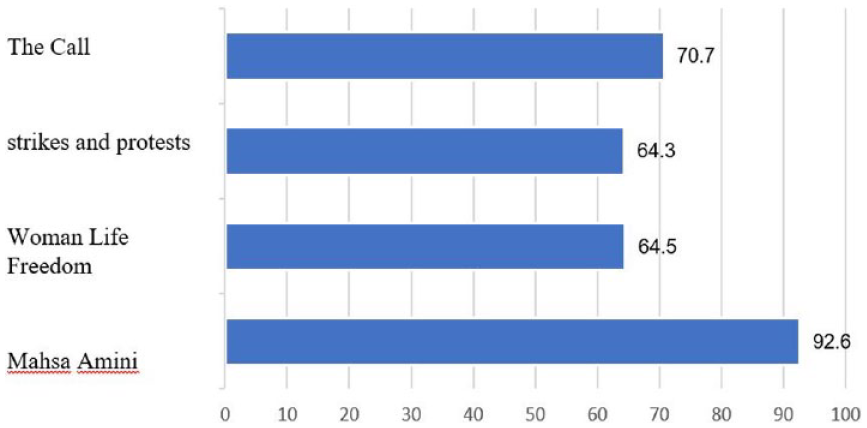
To strengthen the data, Figure 1 shows the percentage of Twitter social network hashtags without coding in Hashtagify from September 2022 to March 2023 (Twitter, 2023). According to these data, people’s cyber activism has increased in the Mahsa Amini protests, and with the publication of the call, the possibility of mass mobilization and self-communication in the urban space has been provided. The high percentage of users of the hashtags of calls and protests and strikes shows that this social movement needs a real space that is not limited to the Internet to make their protest visible in social places that is why these people communicate with the network itself. They facilitate the possibility of mobilizing and guiding the protesters in occupying the urban space.
In fact, it seems that most revolutionaries had few preconceived ideas about revolution when they started their street protests. They found themselves engulfed in mass riots that they never expected or had a clear idea of how to lead. In these moments, the revolutionaries become the masters of the streets not only to fight against the established powers but also to experience the unique moments of popular democracy and egalitarian order (Bayat, 2017).
Figure 2 and Figure 3 show the number of published tweets corresponding to each component in March 2023 for 1 week. According to the coded data of a total of 1000 tweets, in each set of 100, mass self-communication has the highest frequency of tweets with 15 instances and 71.4%. Nationalism follows with 66.7% and 14%, freedom priority with 13% and 61.9%, and local cosmopolitanism of protests with 5 instances and 23.8%, respectively.

Analysis of Twitter Documents.
Hashtagify.
The extracted tweets were coded according to the first component (mass self-communication), and the codes of this section were selected based on the themes of Mahsa Amini, unity, solidarity, the Iranian revolution, nationwide strikes and protests, political prisoners, and the call. The relationship between the content of each tweet and the desired hashtag was checked; for example, three of them are mentioned below.
The tweets and hashtags used by users show well that the multifaceted, multiple, and inclusive nature of Twitter has achieved mass communication, and people have united with each other through the media language and interaction formats within the communication network and common demands such as demonstrations; they express the freedom of political prisoners and solidarity. In this movement, demands are not announced through parties or organizations but through the network. In their protests against the government, individuals call for strikes, demonstrations, and the occupation of urban spaces. Leadership and organization within these movements occur horizontally and are managed through the network.
The Priority of Freedom in the Network Society
According to Castells, social movements are formed through the transmission of outrage and hopeful messages. The special structure of communication in a particular society greatly shapes social movements; in other words, social and political movements, whether rebellious or non-rebellious, experience the effects of life in a public space. Public space is the space of meaningful social interaction in which opinions and values are formed, transmitted, supported, or resisted; the space that eventually turns into a training ground for action and reaction is the reason why, throughout history, the control of social communication has been in the hands of ideological and political officials, and along with wealth, it has been considered a key source of social power. In describing the process of social change in the modern public sphere formed by communication networks, an important example of disobedience is momentary movements of resistance against political mistakes, which can often reduce the hatred in the politics of disobedience by paying attention to the multi-purpose and capabilities of the network and change the networking capabilities of mobile phones (Castells, 2015).
In order for such independence to be realized, social activists must always emphasize the right to self-motivated mass communication through the surveillance of freedom and justice in the management of the network infrastructure of communication and multimedia industries. Freedom and, as a result, social change are intertwined with the institutional and organizational performance of communication networks. Social movements in any society have their roots in the tyranny and fundamental injustice of that society and the non-stop confrontation of the justice-seeking ideals with this injustice. Ignoring freedom, encroachment on the private sphere, domination of men over women, religious bigotry, and sex discrimination are the causes of protests of new movements.
Therefore, social movements always have a range of structural causes and individual reasons for rising against one or more dimensions of social dominance. Networked social movements come naturally to many people. The transition from sharing sociability to sharing outrage, hope, and conflict, therefore, the culture of freedom at the social level, and the culture of individuality and autonomy at the level of social activists simultaneously created Internet networks and networked social movements, and actually between these two. There is an invigorating effect transformation. The real goal of these movements is to increase awareness among all citizens to empower themselves through their participation in the movement and broad thinking about their life and country (Castells, 2015). The tweets extracted according to this component include codes that were related to the content and hashtags of freedom, against tyranny, Mahsa Amini, and woman life freedom.
The themes of the tweets show that freedom was the main priority of these users. The repeated use of the hashtag “Woman Life Freedom” shows the main demands of the protesters. Ignoring women’s rights and violating human rights is a clear characteristic of demanding in this movement, which wants to confront and unite against the tyranny and injustice.
Nationalism
The important point in better understanding the role of civil actors in the network society is to understand how collective identity and actions and interactions are formed. Collective action necessitates collective identity. Sociologists have long stated that having a collective identity is very important for the emergence of a movement or collective participation (Jenkins, 1983; Melucci, 1989). Individuals serve as the main unit in public movements and mobilization, so interaction and communication between individuals are important resources in advancing collective action. People engage in collective action when they feel they are part of a group or share ideologies, beliefs, and desires. Identification with a group is the most important factor in participation in collective actions (Hercus, 1999; Kelly & Breinlinger, 1995).
According to Castells, the era of globalization is the era of the resurgence of nationalists, and this fact can be seen in the struggle against established national governments and in the comprehensive reconstruction of identity based on nationality, which is always defended against foreigners. How individuals relate to a group makes a profound difference in their participation in collective action, especially in areas of political and social change. The choice of identity in the network is a voluntary choice (Huddy, 2001; Saeidi & kia, 2008). National identities are not acquired by choice, while network identities are adopted by choice. New social movements are examples of voluntary group membership, so collective identity is strong in such groups. When considering contemporary nationalism, four analytical points should be emphasized. First, contemporary nationalism may or may not be aimed at establishing the sovereignty of an independent national state. Therefore, nations are historically and analytically independent entities from the state. Second, nation-states are not limited to the modern nation-state (French Revolution). Third, nationalism is not a phenomenon that is necessarily related to elites, and in fact, today’s nationalism is often a reaction against global elites. Fourth, since contemporary nationalism is more reactionary, it aims to defend a culture that has already been institutionalized.
The political role of civil society in connection with networks is not only to collect, represent, and express nationalist interests but also to shape awareness and help define public and political needs. Civic actors build social capital and create communities with different networks and beneficiaries (Foley & Edwards, 1996, pp. 38–50). The extracted tweets were coded according to the third component (nationalism), and the codes of this section were selected based on the themes of nation, nationalism, national identity, Iran, and Iranian Cheetah (Pirouz), and the relationship of the content of each tweet with the desired hashtag was checked, for example, some of them are mentioned below.
The Iranian Cheetah (Pirouz), has also been used as an identity symbol for the Iranian nation in expressing nationalistic demands. Also, the national identity in the themes of the present tweets is not imposed and is different from the imposed identities. The identity of the government has a religious and Islamic dimension, but the chosen identity of the users is completely Iranian and has an ancient symbol of lion and sun.
Therefore, ancient nationalism is robust among these groups. The national solidarity of Iranians all over the world and the emphasis on a united Iran and the rejection of division show that these groups are not seeking separatism. This correlation is a kind of “Unitarianism in multiplicity” or, in better words, “Monism in pluralism.” It seems that the “nationalism” that came out of the current movement will be different from the two currents of “nationalism” that Iranians have experienced since the constitutional movement. However, referring to constitutional nationalism in the themes of some tweets indicates that this type of nationalism still inspires a limited group of Iranians.
Local Cosmopolitanism
New social movements have adopted a more practical approach through their interaction with the media and global public opinion. Today, the use of digital technology is essential for mobilizing information, organizing online meetings, and coordinating street protests in intra-system movements. Individuals share common interests, visions, and identities with other members of their groups. It creates a shared vision around which people rally. The Internet provides new spaces for communicating and mobilizing these networks. (Mitra, 2001). According to Castells, new political movements form network identity politics through internal coordination between small groups in political movements, as well as the formation of external opinions of the movement, through the Internet (Castells, 1997). The Internet can be particularly beneficial for groups outside the boundaries of traditional public institutions or political organizations because it significantly reduces the costs and barriers to organizing collective action (Van Aelst & Walgrave, 2004, p. 87). The advantages of using this technology are the low cost, the speed of work and its extent without the need to meet them in person in time and place and its availability for everyone. Official media needs special equipment and the official presence of a reporter at the place of demonstrations and events, but large unofficial media transmit news and images to the world and cause people’s reactions all around the world. In fact, this new situation and platform created by digital technology have made it possible for ordinary people to communicate and coordinate their civil protests without having special organizations and expertise (Castells, 2015).


Local media influence public opinion and global media. The reflection of the recent movement in the world media is the clearest example of its impact on global public opinion. According to Figure 4, the regional data of Hashgify show the geographical distribution of the two English hashtags Woman Life Freedom and Mahsa Amini in Canada, the United States, the United Kingdom, Germany, the Netherlands, Sweden, France, India, Turkey, and Saudi Arabia. In support of protests inside Iran, extensive demonstrations were also held in foreign countries and even concerts and public spaces around the world. These areas have been chosen because there are more Iranians in these areas and the cyber support action of Iranian protesters has been more in these areas. In addition, more foreigners have supported Iranian protests in these areas.

Regional Data of Mahsa Amini and Woman Life Freedom Hashtags.
Below are some examples of non-Persian tweets in support of Mahsa Amini’s movement.
1. Freiheit, Tanz, Gesang und Leben zu lieben. Eine Regierung, die Geld und Kapital eines Landes dafür ausgibt, Menschen zu unterdrücken, anstatt Armut und Entbehrungen im Land zu beseitigen, ist des iranischen Volkes nicht würdig und muss gehen.”
#Mahsa_Amini
2. Moral police forces (Sharia police) of the Islamic Republic are preparing to repress women in Iran for not wearing the Islamic hijab.
#Mahsa_Amini
The globalization of the slogan of “Woman Life Freedom” and its expression in different languages shows that this desire had a global potential. Women in this movement were looking for identity, subjectivity, and self-determination to get out of the objectification and domination of power. Women in Mahsa Amini’s movement were in a way the leaders of the movement and demanded freedom. It is worth noting that the global media also influence the local media. A clearer example of the global influence on the local media is the creation of native software and the proposal of a protection bill.
But these plans and networks in Iran have not been able to compete with foreign platforms. However, the government still exerts significant control over the production and content of the media. For example, with the rise of the movement, media such as Instagram, LinkedIn, WhatsApp, and Skype were filtered, and it was announced to software such as Instagram and WhatsApp that they must obtain a license and accept national laws to continue their work. In general, Mahsa Amini’s movement in Iran showed how activists and protesters could make their protests known on a global scale using Internet technologies.
Conclusion
According to Castells’ theory of the network society, the rise of the information-based society has resulted in greater global interdependence among individuals, regions, markets, and cultures through network flows. Iran’s social movements in the new era are in different forms. First, they start in the Internet social networks and become a movement by occupying the urban space. The space of autonomy has become the new space of Iran’s social movements that are both local and global at the same time. These movements are largely spontaneous and are usually aroused by anger that is either related to a particular event, or policy or intensified hatred for the actions of the rulers. The power of images is the most important in these networks. Visual media plays a crucial role in these networks. Platforms such as YouTube and Instagram were among the most powerful tools for mobilization in the early stages of the movement, especially the images of repression and police brutality that are loaded with meaning.
Following the logic of Internet networks, the transition from outrage to hope is realized through mutual thinking within the space of autonomy. In these networks, different inspiring cultures are mobilized and hope for the possibility of change, and they are distrustful of any representation and delegation of power. Multifaceted horizontal networks on the Internet and the urban space create togetherness. The horizontality of networks strengthens cooperation and solidarity and reduces the need for formal leadership. These movements are extremely self-tolerating. They constantly question themselves and explore the kind of freedom, democracy, and society they aspire to. First, they engage in peaceful and social civil disobedience, and gradually, they focus on the political sphere agreeing on a single issue.
In this regard, the rapid development of technology and the development of horizontal communication networks provide the possibility of integrated actions in all regions of the world in the Mahsa Amini protests. In these protests, domestic and foreign users used social networks such as Twitter to spread their message around the world. With the use of Twitter, global cross-flows between protesters and their followers became possible by connecting through the network and transmitting unified messages regardless of geographic location. Through this platform, users were informed about Iranians’ desire for freedom and the creation of a national identity. This issue can be considered a manifestation of Castells’ horizontal communication network, which unites integrated actions around the world in the form of a common desire and increases global interdependence. Mahsa Amini’s movement showed how activists could use Internet technologies to mobilize resources and attract new supporters. This leadership movement did not have a clear plan, organization, and stable coordination, but its plans were continued by opponents of the system and the opposition and remained a limited and wavy protest rising.
Footnotes
Declaration of Conflicting Interests
The author(s) declared no potential conflicts of interest with respect to the research, authorship, and/or publication of this article.
Funding
The author(s) received no financial support for the research, authorship, and/or publication of this article.
