




Abstract
Despite social media companies’ public commitments to do good, they regularly face international criticism. This article explores how platforms engage in corporate public relations campaigns to negotiate social and political responsibilities. Through a qualitative analysis of the values promoted in the social initiative TikTok for Good, I show how TikTok promotes messages that amplify positivity, minimize negativity, and focus on individual well-being, while consistently assigning responsibility to other actors. Together, these strategies allow TikTok to symbolically empower users while maintaining control. I conceptualize these strategies that downplay and distance a company from conflicts associated with struggles over power as depoliticization by platforms. This study highlights platform companies’ soft forms of governance and demonstrates how the analysis of platform values allows researchers to cut through the strategic vagueness of claims to do good.
The mission statements of social media platforms often emphasize aspirations to do good: TikTok (2023a) wants to “inspire creativity” and “spark joy,” Facebook aims to “bring the world closer together” (Meta, 2023), and YouTube (2023) strives to “give everyone a voice and show them to the world.” These declarations are part of corporate public relations (PR) efforts to create and maintain a positive image, signaling commitments to desirable social change (Bietti, 2020). However, these goals often remain elusive. Moreover, over the past years, platform corporations have received significant and sustained international scrutiny for bad conduct.
One realm of criticism focuses on user data scandals, which are common across social media companies. Notable examples include privacy breaches, such as Cambridge Analytica (González et al., 2019), and controversial moderation of “potentially harmful content” (Gillespie et al., 2020), such as TikTok’s directive to filter out users “deemed too ugly, poor, or disabled” (Hern, 2020). Researchers have also critiqued the spread of violent content and misinformation across platforms, for example, highlighting threats of polarization (Marwick & Partin, 2022). Platforms face a “content governance dilemma” of determining which principles should govern global digital spaces, often failing to balance private norms with national laws or international standards (Celeste et al., 2023).
In response to these allegations, corporations have demonstrated concern for the promotion of good by professing their commitment to ethical standards, declaring their dedication to sound governance, and taking steps toward legal and social responsibilities. These include, for example, establishing the independent Facebook Oversight Board (Klonick, 2019), publishing transparency reports (Gorwa & Ash, 2020), giving select academics access to data (King & Persily, 2019), and helping advance global issues through computational initiatives (Aula & Bowles, 2023). While efforts toward enhancing platform accountability and transparency have received academic and journalistic attention, social initiatives launched to counterbalance negative backlashes, such as YouTube’s Black Voices Fund (2020) or TikTok for Good (2019), have rarely been investigated. Although these PR campaigns may not show up on the top of users’ algorithmic recommendations, they provide an important tool for platforms to mediate their relationships with different stakeholders, as well as a rich site for researchers to identify the values platforms actively promote.
Building on previous research (Hallinan et al., 2022; Scharlach et al., 2023), platform values can be broadly defined as the underlying principles governing and expressed through the products of social media companies. Platform corporations strategically utilize values in policies (Chan et al., 2023; Scharlach et al., 2023), design (Scharlach & Hallinan, 2023), and public documentation such as mission statements (Haupt, 2021). Values play a crucial role in addressing the concerns of stakeholders involved in platform governance, who often have conflicting interests. However, a close examination reveals that the public communication of platform values is strategically vague (Hallinan et al., 2022; Scharlach & Hallinan, 2023).
Paying attention to these strategies can inform our understanding of how corporations negotiate contrasting notions of power (Poell et al., 2022) associated with their dual function as digital artifacts and companies (Winner, 1980). As corporations, social media platforms hold different forms of structural power related to their material conditions, allowing them to shape economic and legislative landscapes (Helmond & van der Vlist, 2019; Nielsen & Ganter, 2022). As socio-technical artifacts, platforms wield power by creating affordances and constraints through design choices and algorithmic curation that guide how people communicate and consume information, structuring social and political dynamics.
Companies often work to downplay their power and diffuse the responsibilities associated with it, utilizing the fuzziness associated with the meaning of “platforms” (Gillespie, 2010) to simultaneously position themselves as integral to shaping technological futures while seeking legal protections as “online content providers” that limit their liability for user-generated content (Gillespie, 2010). Another way in which platform corporations mitigate their own power is by distributing power to various stakeholders, including individual users (van Dijck et al., 2019). However, this distribution of power often remains symbolic. Companies claim to empower users to make their own choices about their feeds (Scharlach et al., 2023) and promote LGBTQ content on their platforms during Pride Month. Yet, they often prioritize profit over genuine inclusivity and user autonomy, leading to performative actions rather than substantial change (Highfield & Miltner, 2023).
In this article, I use the term “platform” to explore how the corporation behind TikTok, ByteDance, utilizes symbolic forms of power associated with values to navigate tensions associated with political and societal responsibilities. In the literature review, I discuss two bodies of literature that inform this study relating to corporate social responsibility (CSR) and platforms’ public communication strategies. I then present and discuss the concept of depoliticization by platforms, defined as strategies to downplay and distance a company from conflicts associated with struggles over power. Thereafter, I introduce the case study—TikTok’s social initiative TikTok for Good (TTFG), a “global program” inspiring positive impact through creativity (TikTok, 2023c). Next, I outline the methodology, detailing the qualitative consensus coding and thematic analysis of 185 videos featured in the TTFG campaign. In the results section, I present four strategies the company employs to depoliticize what doing good means: amplifying positivity, minimizing negativity, focusing on individual well-being, and assigning responsibility to individuals. This article demonstrates the importance of exploring soft forms of platform governance. My main argument is that ByteDance employs depoliticization strategies through TikTok to downplay and detach itself from corporate responsibility while maintaining control over its operations. Symbolically, the platform delegates power to creators and individuals, urging them to contribute to collective good. Yet, TikTok positions itself as praiseworthy for providing the space to do good and benefits from the actions of others.
Literature Review
Communicating CSR
Broadly defined as the “variety of practices employed by corporations to exhibit ethical business conduct” (Boxman-Shabtai, 2019), CSR has a long-standing history (Latapí Agudelo et al., 2019). The understanding of a corporation’s responsibilities has changed over time as corporations have gone from positioning themselves as non-political private businesses to assuming political and social responsibility for “setting, implementing, and developing the values of contemporary society” (Brysk & Stohl, 2017). This body of work discusses values such as sustainability and well-being as core principles of corporate practices.
CSR often goes hand in hand with PR, as both are integral to a company’s communication strategies. PR involves managing the company’s image and communication, while CSR involves managing its ethical responsibilities and impact on the society and environment (Cho et al., 2017). As such, CSR can be seen as setting the basis for PR, as it involves a set of behaviors that “do good,” which can then be utilized to improve a company’s image.
CSR and related PR tactics have existed since the early 20th century. However, the emergence of social media has been crucial for companies to successfully market themselves as socially responsible. Researchers have studied how companies utilize PR strategies on social media to enhance their reputation through promoting societal goals. Such studies delve into how businesses operationalize values such as sustainability and well-being through social media campaigns on Twitter (Okazaki et al., 2020), Facebook (Cho et al., 2017), or Instagram (Loureiro & Lopes, 2019), concluding that companies must foster engagement that extends beyond social media to be perceived as socially responsible and authentic.
Another prominent research focus is the use of influencers to cultivate brand engagement and users’ attitudes toward companies’ CSR campaigns. For example, in a recent study examining the perception of influencers within Instagram-based CSR advertisements, Li (2022) explored how influencers’ group identity (LGBTQ/non-LGBTQ) shapes users’ perceptions of Pride advertisements. While consumers responded favorably to promotion from queer influencers, there were accusations of rainbow-washing directed at the straight influencer, underscoring the paramount role of authenticity in influencer marketing. Moreover, it reflects previous research positioning authenticity as a core social media value emphasized by many but often debated in practice (Hallinan et al., 2022). Other studies examine user interactions through engagement metrics such as comments, shares, and reactions (Austin & Gaither, 2016; Liao & Mak, 2019). These studies offer valuable insights into the significance of social media PR in CSR tactics yet rarely address social media corporations’ CSR efforts. This gap is particularly intriguing given the central societal role and multifaceted responsibilities of platform companies, which must comply with policymakers, national and international standards, and political and societal expectations.
Over the years, platform companies have developed various forms of soft governance tactics to address social and political expectations. NGOs and digital rights organizations have become key players in creating public pressure for responsible platform governance, building “soft forms of governance through codes of conduct” (Gorwa, 2019, p. 860). This is similar to how advocacy groups in the 1970s organized against firms like Nestlé by pressuring and “shaming” them into adopting more socially responsible business practices (Gorwa, 2019). Yet, the outcomes of these efforts differ: While companies in the 1990s like Starbucks or Ikea implemented substantial changes in their business practices (Vogel, 2006), changes at social media companies often focus more on symbolic gestures rather than comprehensive structural reforms (Gillespie, 2023; Gorwa, 2019). Nowadays, platform companies communicate CSR efforts through common PR tactics that can be summarized into three overarching categories: policy updates, design changes, and initiatives addressing societal topics, which will be the focal point of this study.
One way through which platforms respond to scandals or the threat of new regulations is through updating policies such as community guidelines or legal documents such as privacy policies (Scharlach et al., 2023). Rapid policy updates are part of what Barrett and Kreiss (2019) call “platform transience,” a key strategy through which companies respond to external normative pressures (Barrett and Kreiss, 2019). These updates are followed by the (irregular) publicization of policy updates via press releases (Klonick, 2019), explanatory videos (YouTube, 2020), CEO statements (Haupt, 2021; Hoffmann et al., 2018), or content from creators employed by the platform (He & Tian, 2023). These public statements play a crucial role for companies, offering public proof of the company’s continuous efforts to improve.
A second tactic used by platform corporations to improve their image involves changes in platform design, particularly alterations that align with specific social causes and events. These changes in interface design and user experience are often small, such as introducing new filters or emoji-based hashflags (Highfield & Miltner, 2023). While hashflags (or, more recently, hashmojis) are one of Twitter’s advertising products, the platform has also donated specific hashflags to represent societal issues, such as those related to the Black Lives Matter movement (Highfield & Miltner, 2023, p. 14). Tech companies understand the importance of interface design (Zhao et al., 2013) and use affordances to give visibility to societal issues, as seen with Google’s daily logo change highlighting cultural events or anniversaries (Griffin & Lurie, 2022). A popular cross-platform example is Pride Month, where platforms introduce rainbow filters or LGBTQ+-related hashtags automatically appended with a rainbow flag (Highfield & Miltner, 2023, p. 2). Highlighting the importance of these design changes, it is crucial to observe that modifications linked to a platform’s PR are not subtle, as is frequently seen with privacy-related design changes. Instead, they get publicly announced through press statements or directly advertised through pop-up messages on individual feeds.
The third way platform companies address expectations and concerns is by creating initiatives that tackle issues of public concern. For example, in response to criticism about pornographic content, Douyin, TikTok’s Chinese counterpart, launched a “positive energy” campaign in 2018 to highlight the platform’s efforts to promote mainstream political ideology (Chen et al., 2021). Entangled with the aforementioned strategies, tech companies have established several AI and Data for Good endeavors to use new computational techniques to solve societal problems (Aula & Bowles, 2023). One long-standing example of a “for Good” initiative is Facebook’s Data for Good campaign, which started in 2017 and offers tools built from de-identified Facebook data that are “shared responsibly with the communities that need it, [to] improve wellbeing and save lives” (AWS, 2023). In practice, improving well-being is exemplified through data visualization of friendship ties (John, 2019), and Facebook data have been used to assist in crisis management, such as in the event of earthquakes.
A subset of initiatives focuses on providing support for creators from underrepresented communities, such as YouTube’s Black Voices Fund (2020). While the support of minority groups is the official focus of these campaigns, the content produced by creators also addresses societal concerns. Often, such initiatives are spotlighted on annual events, such as the International Day of Women’s Rights (e.g., TikTok, 2023b). Social media companies use these occasions to give visibility to specific topics. This underlines well-established corporate responsibility efforts, emphasizing sustainability, social justice, and well-being and demonstrating allyship, diversity, and inclusion (Castillo-Abdul et al., 2022).
Critical Evaluations of CSR Initiatives and Their PR
The aforementioned tactics surely have positive implications, such as increasing visibility for marginalized communities or pressing political issues such as global warming. Yet, they also face significant criticism from various stakeholders. A central point of critique is that these tactics are forms of ethics-washing, or “tech companies’ self-interested adoption of appearances of ethical behavior” (Bietti, 2020). Green-washing, the earliest of these washing terms, was coined in the mid-1990s to describe “the dissemination of false or incomplete information by an organization to present an environmentally responsible public image” (Furlow, 2010, p. 22). Similarly, Tarvin and Stanfill (2022) established the concept of governance-washing, criticizing YouTube’s public performance of its commitment to content moderation “while deflecting questions about substance” (Tarvin & Stanfill, 2022). Other related washing forms are white-washing (forms of covering up faults), rainbow-washing (declaring LGBTQ+ allyship but acting differently in practice), or blue-washing (deceptive marketing to convey social responsibility). Simply put, these various types of washing animate a clash between what companies declare they aim to do versus what they do in practice.
Engaging in “woke capitalism” (Highfield & Miltner, 2023) via diversity initiatives enables platform companies to adopt trendy political positions devoid of genuine substance. Previous research has also flagged the lack of political, ethical, or democratic accountability of tech companies (Greene, 2021). Furthermore, proposed CSR initiatives such as Facebook for Good do not increase a firm’s responsibility but mainly provide resources for others. Critical analyses of “for Good” campaigns have highlighted a mismatch between ethical intentions and actual outcomes (Powell et al., 2022). Claiming the benefits of social initiatives offers ways to avoid or dilute corporate responsibilities, with platform companies carefully tiptoeing around political topics.
While platform companies refrain from making political stances on some topics, their public actions in relation to platform regulation and moderation have been criticized as PR strategies, merely adding “tactical value” (Gillespie, 2023, p. 406). For instance, in 2019, a few months after the Cambridge Analytica scandal, Mark Zuckerberg called for the U.S. government to regulate platforms similar to the General Data Protection Regulation (GDPR), addressing issues such as harmful content, election integrity, privacy, and data portability (Zuckerberg, 2019). Such public gestures allow companies to selectively govern the narrative about their power and potentially shape regulatory standards to their advantage.
Platform governance research further adds to these critical evaluations, advocating for the treatment of platforms as active political actors (Helberger, 2020) and highlighting the importance of paying more attention to platform companies’ public communication efforts (Caplan, 2023; Gorwa, 2019; Scharlach et al., 2023). Addressing both of these calls, I will now further explore the public strategies platform companies utilize to communicate and negotiate platform power.
Depoliticization by Platforms
In the introduction to this article, I outlined the distinction between symbolic and structural distributions of power, differentiating between the symbolic outward-facing narratives of building responsible platforms and user empowerment, as well as the structural underlying economic and affordances shaping platform operations. While platform governance research predominantly focuses on the latter form of power, I argue that examining the use of soft forms of power to shape public perception is equally important for understanding how platform power is negotiated.
Building on the aforementioned critical body of literature, I suggest approaching these efforts through the lens of depoliticization. This perspective can uncover how public commitments to do good allow platform companies to distance themselves from underlying political conflicts and power dynamics. To understand depoliticization, we first need an understanding of what it means to be political. Previous research shows that “the political” is entangled with questions of power. Political theorist Chantal Mouffe defines the political as “the antagonistic dimension which is inherent to all human societies,” arguing the political is always tied to conflict and opposition (Mouffe, 2013, p. 3). In that sense, the essence of the political is “a space of power, conflict and antagonism” (Mouffe, 2005, p. 9).
What it means for something to be “depoliticized,” then, involves limiting conflict and antagonism central to relations of power. In other words, depoliticization is “an attempt to remove something—whether this is to remove responsibility, politics or, more extensively, human agency” (Jenkins, 2011, p. 158). Building on previous research, Wood and Flinders (2014) outline three facets of depoliticization: governmental, societal, and discursive. They expand the typical focus on governance, positioning depoliticization as a phenomenon relevant to all levels of society. Governmental depoliticization involves shifting power over regulatory decisions from a state to a group of experts, such as when elected officials rely on climate scientists to formulate environmental policies. Societal depoliticization entails transferring power over collective challenges from social institutions to individuals, shifting the debate to private choices. For example, a politician framing climate change as personal lifestyle choices hinders systemic solutions. Discursive depoliticization involves denying choice by framing power as beyond human control. An example would be if discussions solely focus on describing climate change as inevitable, ignoring the possibility of human intervention (see Scott, 2022).
Despite Wood and Flinders’ (2014) call to broaden the domains of depoliticization research and research on platform power (Nielsen & Ganter, 2022; van der Vlist & Helmond, 2021; van Dijck et al., 2019), depoliticization is used primarily within the field of political science. In addition, researchers have rarely explored its connection with the governance of digital platforms. Platform politics are understood as “the assemblage of design, policies, and norms” that encourage certain cultures and restrict others (Massanari, 2017). The study by Gibson et al. (2023) on the discursive legitimization of content moderation is one of the few exceptions to consider the aspect of depoliticization. Tracing the discursive meaning and usage of the metaphor’s “health” and “toxicity,” often treated as self-evidentially good and bad, respectively, they show how these metaphors function as tools that enable governance while avoiding questions, conflicts, or tensions. As a result, using these terms depoliticizes the “deeply political nature” of content moderation (Gibson et al., 2023, p. 12).
While Wood and Flinders’ three facets of depoliticization are highly relevant to the social media context, they need to be tweaked to fit discussions of platform governance practices. For platform governance, governmental depoliticization involves shifting regulatory power away from platforms to external actors, allowing a platform to distance itself from direct political involvement, as seen in Facebook’s delegation of content-moderation policy decisions to Meta’s Oversight Board. Societal depoliticization symbolically transfers power to individual users over social and technical structures by fostering personalized control, like customizing privacy settings or content preferences, which companies promote to transfer liability, although users must actively customize privacy settings to utilize these choices (Kotliar, 2021). Finally, discursive depoliticization by platforms promotes individual empowerment and responsibility to avoid acknowledging their own power. Companies use various strategies to diffuse potential conflict, such as focusing on individualized solutions. For example, aligning with Wood and Flinders’ definition, users may depoliticize privacy by resigning themselves to platforms’ control over their data, believing change is unlikely (Hargittai & Marwick, 2016), or reframing power as achievable only through individual commitment.
Building on the aforementioned work, I broadly define depoliticization by platforms as corporate strategies implemented to downplay and distance a company from conflicts associated with struggles over power. I will now turn to the case study of TTFG to explore how depoliticization by platforms looks like in practice.
TikTok for Good
Our idea is simple . . . use TikTok to do good. TikTok wants to inspire and encourage a new generation to have a positive impact on the planet and those around them. (ByteDance, 2023)
To gain a better understanding of TikTok’s social initiative TTFG, I will first outline its development based on publicly available information. 1 The initiative launched under the name #EduTok in 2019 in response to criticism and a looming ban by the Indian government due to the platform hosting pornographic and potentially harmful content (Zeng & Kaye, 2022). The initiative was thus similar to Douyin’s “positive energy campaign” addressing criticism of the Chinese government (Chen et al., 2021). #Edutok focused on promoting videos with educational value and evolved into TTFG around 2021, expanding its focus to include themes such as animal welfare, environmentalism, and “heartwarming humanity” (ByteDance, 2023). Since then, it has been managed by the American ad agency ATTN: (Cohen, 2022). The media company is known for creating “social good” content such as Facebook’s campaign for Climate Week in 2021 (Cohen, 2021). In an interview, ATTN: CEO Segal stated that platforms such as Instagram and Facebook are willing to pay high prices for “social change content.” In 2021, TikTok paid ATTN: over 1 million dollars for the operation of TTFG (Fischer, 2021).
TTFG has a website and accounts on X, Instagram, and Facebook. My analysis centers on the TikTok account @tiktokforgood, which is the main site of the initiative. @tiktokforgood has over 1.2 million followers (May 2024) and publishes two to four videos per week. The initiative describes itself as a “global social impact content program” aimed at helping creators make a positive impact and promoting videos on “inspiring” and “encouraging” topics (TikTok, 2023c). However, there are currently no public sources detailing whether featured creators are paid or if the content is specifically made for the initiative or curated from the platform. Notably, U.S. creators appear to be regular contributors, either producing new videos or stitching existing content. Starting in May 2024, TTFG now functions as the hub for TikTok’s “global change maker program” in collaboration with ATTN: and has donated over 1 million dollars to non-profit organizations. It aims to support and showcase individual missions to create “meaningful change” (TikTok, 2024).
To better understand TikTok’s public communication efforts, we first need to examine the principles the company advocates in less-public sites such as platform policies. Previous research has shown that TikTok’s policies, similar to other major platforms, claim to promote values such as safety, expression, choice, improvement, and community (Scharlach et al., 2023). Through a longitudinal study of the evolution of TikTok’s community guidelines, Chan et al. (2023) showed that the platform selectively mobilizes values such as community, safety, and engagement to address changes in their platform governance. These results suggest that TikTok strategically adapts the values it promotes in response to public criticism.
Social initiatives like TTFG address conflicts associated with power struggles of platforms. To further understand how corporations address conflict, I explore the depoliticization strategies of TTFG through a focus on platform values. Taking the aforementioned discussion of public communication strategies and criticism into account, I ask: What types of content does the “TikTok for Good” initiative promote? What values are promoted through TikTok for Good videos? Who is responsible for realizing these values? And finally, to what extent and in which ways does this framing of values enact depoliticization?
Method
To address these questions, I analyzed 185 TTFG videos. I used the Python-based package Pyktok (Freelon, 2022/2023) to collect metadata of the entire corpus of TTFG at the time of data retrieval (April 2023), resulting in 360 videos. To prevent possible data loss, I downloaded each video manually, and randomly selected half of them (n = 185) for my corpus.
A close reading of a randomly chosen subset of these videos (n = 50) facilitated the formulation of a codebook for a systematic qualitative analysis. The codebook included three main categories for analysis: (1) the meaning of “good,” (2) the values promoted, and (3) the actor responsible for enacting said values.
The first category addresses what each TTFG video stands for. Through the preliminary coding phase, I identified seven categories of what “doing good” means: (1) living sustainably; (2) effective interpersonal communication; (3) being your authentic self; (4) educating yourself; (5) creating supportive and inclusive communities; (6) improving mental health; and (7) combatting inequality, which focuses on giving visibility to underrepresented groups or social topics such as gender disparities. The second category of the codebook is dedicated to identifying the principles promoted through TTFG videos. I employed a list of 29 values with definitions (available upon request), synthesizing lists from previous research on platform values (Hallinan et al., 2022; Scharlach et al., 2023; Scharlach & Hallinan, 2023) and values in design (Flanagan & Nissenbaum, 2014). The third category focuses on the actors responsible for enacting values. I distinguish between ordinary users, creators, corporations, and governments.
To analyze the corpus of 185 videos, I applied the principles of qualitative consensus research to validate the results through a collaborative process (Hill et al., 1997). After the pilot coding phase, a research assistant and I analyzed each video independently and then met to discuss differences in our coding until we reached a consensus (Hill et al., 1997). Next, I employed thematic analysis to discern overarching “patterns of meaning” (Braun & Clarke, 2012), evaluating TikTok’s strategic public communication of values, taking into account the aforementioned literature. The combination of the two analytical phases resulted in the identification of four comprehensive depoliticization strategies, expounded upon in the next section.
Findings
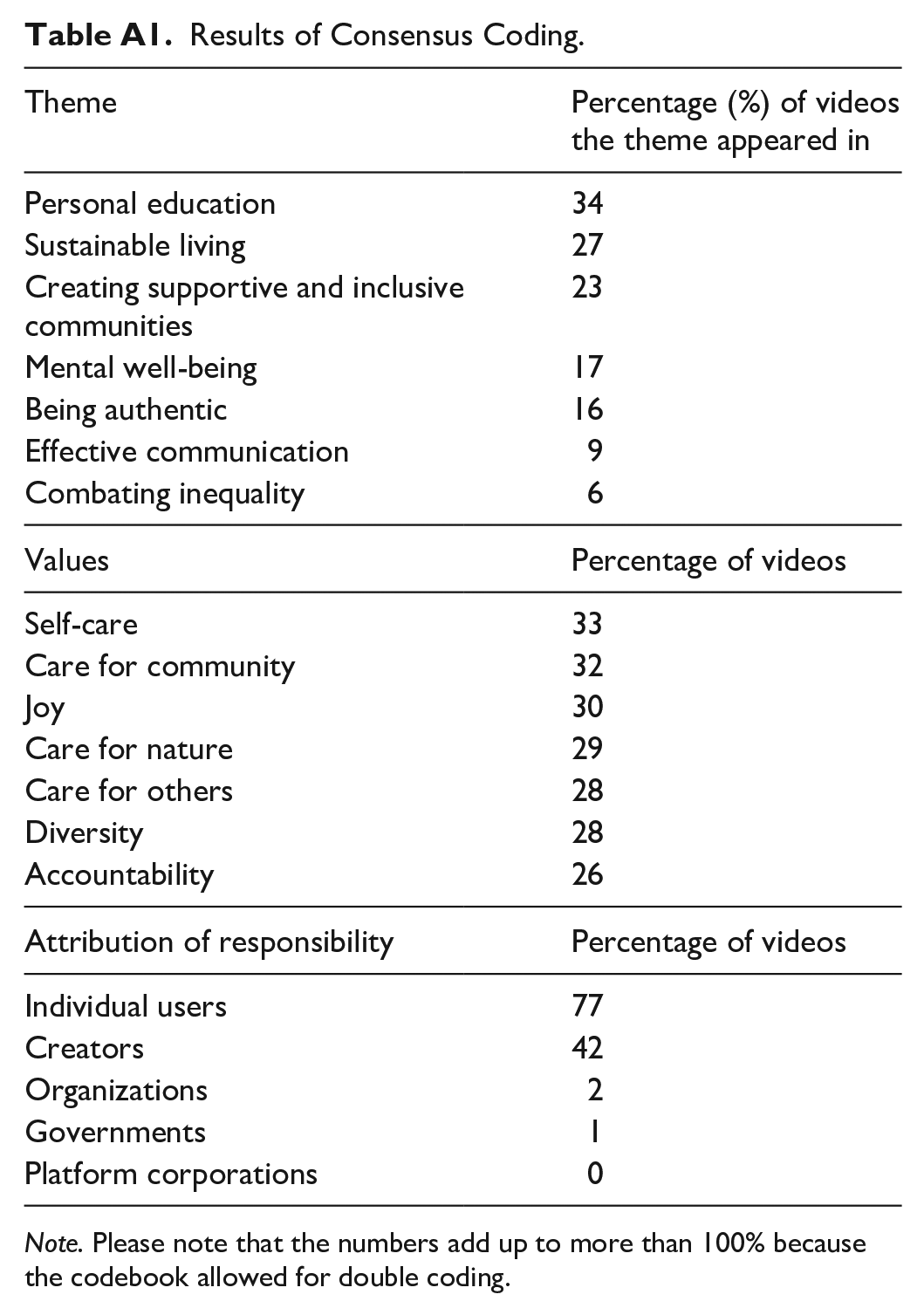
The results of the consensus coding reveal that TTFG videos often relate to personal education, which includes videos focused on practical tips about specific topics; sustainable living, which concentrates on finding strategies in everyday life to reduce waste; creating supportive and inclusive communities, which includes videos that celebrate togetherness; mental well-being, which focuses on practical tips for holistic health; and being authentic, highlighting content that discusses why self-expression is important (see Table A1 in Appendix).
Promoting these topics aligns with documented CSR tactics, which emphasize sustainability, engagement, and well-being (Brysk & Stohl, 2017). Prominent values promoted within TTFG videos were self care, care for others, care for nature, care for community, joy, diversity, and accountability. However, as detailed below, the presentation of these values changed depending on the strategy they were part of. While the social initiative promoted certain principles, videos primarily assigned responsibility for “doing good” to individual users and creators, aligning with previous research on platform values (Scharlach et al., 2023). Organizations or governments were invoked only three times, and corporations did not come up as responsible actors at all.
Depoliticization Strategies
Building on the consensus coding results and the thematic analysis, I identified four discursive strategies of depoliticization employed in the campaign. The first three strategies are amplifying positivity, avoiding negativity, and focusing on individual well-being. The fourth one, assigning responsibility to individuals, is an overarching strategy found across all TTFG videos (see Figure 1). In the subsequent section, I introduce each tactic and explore its ramifications in greater detail.

The four depoliticization strategies of TikTok for Good.
Amplifying Positivity
Amplifying positivity is a strategy that enhances the display of positive emotions, attitudes, or experiences, in line with the company’s mission to bring joy and inspire creativity (TikTok, 2023a). TTFG frequently promotes content with an uplifting message. For example, one video covers the story of a queer family’s In Vitro Fertilization (IVF) journey. In this video, the creators recall positive experiences, the wishes they have for their future baby, and how “being queer will not stop [them] from creating a family, it will just be extra” (see Figure 2). They do not discuss any hurdles, stigma, or financial struggles this journey potentially raises.
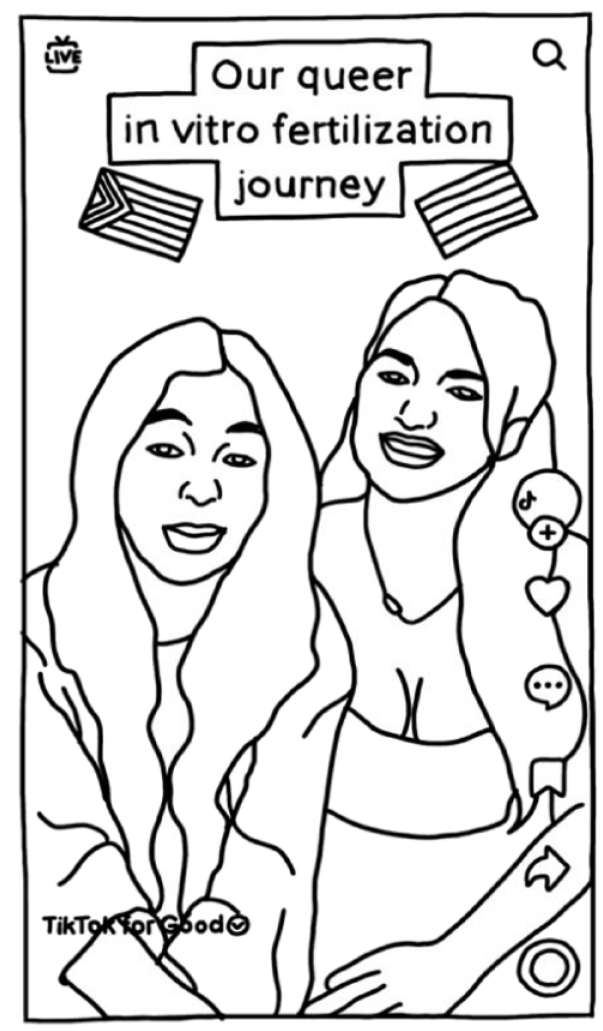
Queer couple IVF journey.
Values associated with this strategy include creativity, joy, and care for others. Creativity, understood as the pursuit of new forms of thought and expression, is often communicated through examples like upcycling or craft projects. Joy is a core value of TikTok. In TTFG videos, joy is associated with actions that make viewers feel better. Care for others stands for having compassion for and helping others. Videos typically promote this value by offering practical tips about caring for family or community members. One video features a music producer who is a full-time caretaker for his grandmother. He uses TikTok to demonstrate how taking care of his grandma has contributed to his personal growth (see Figure 3).

Good grandson.
Amplifying positivity emphasizes happiness through feeling good about helping others or hearing uplifting stories.
Minimizing Negativity
The strategy of minimizing negativity involves mitigating the negative implications of contentious topics, behaviors, and events. TTFG promotes videos that channel negative experiences through personal stories of individuals overcoming hardship, often presented in relation to specific days, such as International Pronouns Day or Earth Day.
Minimizing negativity communicates values such as diversity and civility through a personal viewpoint. Diversity stands for promoting a range of people with different ethnic, socioeconomic, or cultural backgrounds and lifestyles. TTFG videos particularly focus on minorities and sexual diversity connected with LGBTQIA+-related content. Civility encompasses treating others with respect, often promoted through calls for polite communication. Values that would potentially conflict with political and ideological perspectives of users rarely come up. Thus, equality, often associated with coordinated struggles, is hardly invoked in the sample.
One example of this strategy is found in a video of a creator sharing her personal story about sexual assault in college. She highlights how this experience led her to become a lawyer who is passionate about helping women and minorities navigate the complex justice system in the United States (see Figure 4). The story does not focus on the assault itself, but on how this experience motivated the creator to initiate an attorney mentorship program with over 600 students, help those in need, and ultimately become an inspiration for others.

Inspirational personal success story.
As the video exemplifies, this strategy focuses on exceptional and motivational stories of individuals overcoming hardship. Content within this category rarely goes beyond the individual level, avoiding discussions of institutional or governmental aspects.
Focusing on Well-Being
The strategy of focusing on individual well-being involves topics that promote physical, mental, and emotional health. Because mental health can be a sensitive topic, this strategy frames the majority of the content through the more neutral term of well-being. This framing is in line with platform policies and public statements (TikTok, 2022). Most of the content employing this strategy focuses on practical tips to feel better. These include straightforward tips on how to sleep better and discussions of scientific studies that show knitting is good for mental well-being (see Figure 5).

Knitting and well-being.
Values associated with this strategy center around care, community, and vulnerability. Care is an integral value for the TTFG initiative, found across strategies. Yet, the framing of care changes depending on the strategy. In focusing on well-being, care is enacted by practicing mindfulness or doing sports. Creating community stands for building and nurturing close relationships. This focus on well-being especially promotes togetherness through spending time with loved ones, with several videos pointing out that spending time with friends is proven to improve one’s mental state. The value of vulnerability is emphasized through honesty about personal hardships. Videos promoting this value present personal experiences with mental health challenges and emphasize what you can do to improve your mental state or to help a loved one feel better.
Assigning Responsibility to Individuals
This overarching strategy can be defined as designating specific obligations to individuals. In the context of social media, this tactic emphasizes the personal responsibility of users, including creators. While the social initiative is called TTFG, the responsibility for doing good is assigned to individuals rather than the company. In this setting, viewers are urged to hold themselves and others accountable.
Creators ask viewers to consider donating money to social causes, learn about the do’s and don’ts of recycling, or be kind to themselves and those around them. For example, a creator explains how loneliness has increased worldwide during the pandemic, which can lead to anxiety or depression. They suggest viewers “invest in experiences instead of material goods” and “share happiness” (see Figure 6).

Isolation brain.
In another video, a creator explains how Christmas wrapping paper contributes to pollution, presenting ways to wrap gifts sustainably “without ruining the planet.” The emphasis in TTFG videos is on personal responsibility for oneself, others, and the planet.
Overall promoted values in TTFG, such as accountability, care for nature, and achievement, are closely linked with attributing responsibility to individuals. Accountability can be defined as taking responsibility for one’s actions. TTFG emphasizes acting responsibly in everyday life, often intertwined with traditional CSR ideals such as caring for the environment or living sustainably (Latapí Agudelo et al., 2019). Attaining these principles leads to a third value of achievement, which can be defined in this context as feeling good about accomplishing something. TTFG videos often demonstrate small tasks everyone can do to make the world a little better, promoting the message that taking responsibility will make you feel good.
A somewhat surprising finding is that alongside the strong stress on positivity, TTFG also triggers action by leveraging social pressure, inducing viewers to feel ashamed of their lack of participation. Videos implementing this method often center around recycling, discussing how failing to wash out plastics or reduce landfills will ultimately kill the planet (see Figure 7).

Plastic problems.
Assigning responsibility to individuals uncovers the initiative’s overall aim: TTFG promotes the idea of doing good, but ByteDance does not practice what it preaches—that remains on the shoulders of others.
Discussion
At first glance, the analysis of TTFG illustrates how TikTok upholds traditional CSR values such as sustainability and mental well-being (Latapí Agudelo et al., 2019). ByteDance also uses well-established PR methods like working with influencers (Li, 2022) to cultivate brand engagement. However, TikTok breaks from traditional CSR by spotlighting creators driving societal change rather than highlighting its own achievements. TikTok effectively integrates the altruistic efforts of select users into its social initiative, allowing the company to present individual achievements as integral to its corporate responsibility narrative.
TTFG’s four depoliticization strategies elucidate how the company redistributes CSR responsibilities among creators, who then further transfer these responsibilities to a larger audience, turning “doing good” into an aggregation of individual actions. The creators showcased encourage “everyone” to take tangible steps toward making the world a better place. The solutions presented within TTFG videos predominantly center on empowering individuals, urging each of them to contribute to collective well-being. This deliberate shift of attention distances responsibility from the company and creators, transforming taking responsibility for “doing good” into an individual concern.
These moves shift attention from the company to its products to individuals, distancing and downplaying corporate power struggles. Attending to corporations’ soft governance practices reveals a disparity between those rhetorically entrusted with power and those who wield it in practice. Symbolically, the platform empowers creators and individuals to take responsibility for doing good. Yet, as a corporation, TikTok positions itself as praiseworthy for providing a space for such benevolence, leveraging this narrative for brand enhancement. This approach further blurs the line between individual and corporate responsibilities, conveniently serving ByteDance’s interests. In sum, this analysis shows how paying attention to soft governance practices is equally important as companies’ material conditions for understanding how platform power is negotiated and communicated.
Directing attention toward the values strategically woven into this process expands previous studies focusing on TikTok’s platform values (Chan et al., 2023; Scharlach et al., 2023). By providing insights into how TTFG deliberately downplays power dynamics, it also addresses previous calls from platform governance researchers (Caplan, 2023; Scharlach et al., 2023), showing that TikTok publicly promotes personal stories that emphasize harmonious values and positive ideals with broad relevance and minimal risk. However, the emphasis on universally accepted values and individual responsibility masks more contentious issues that might cast the company in a negative light. TikTok adeptly addresses power struggles by strategically diverting focus from potential antagonism and conflict, foregrounding personal responsibility for harmony and cooperation.
Conclusion
This article sets out to explore the depoliticization strategies of TTFG. Based on previous research on social media companies’ communication tactics, I introduce the concept of depoliticization by platforms, defined as strategies that downplay and distance a company from conflicts associated with struggles over power. Derived from this background, I analyzed 185 TTFG videos. Paying attention to the values promoted in TTFG allowed me to identify four discursive depoliticization strategies (amplifying positivity, minimizing negativity, focusing on individual well-being, and assigning responsibility to individuals). The analysis demonstrated how TikTok’s social initiative deliberately downplays corporate responsibility by shifting attention to the accomplishments of creators and placing responsibilities for action on individuals.
Moreover, this article shifts attention from structural to symbolic forms of platform power, demonstrating the rising significance of soft forms of governance that future platform studies research should pay close attention to. However, it only examines discursive depoliticization strategies within one social initiative of a single platform. Considering the examples of other initiatives of other platforms discussed within this article, these strategies are likely not limited to ByteDance and may apply to other social media companies. Yet, more research in this area is needed, for example, to further explore the financial connection between the creators showcased in social initiatives and the companies. Another prospective avenue for future research involves delving deeper into the socio-political underpinnings of social media platform initiatives. Just weeks after the impending U.S. TikTok ban was set into motion, ByteDance announced a $1 million “first-ever global social impact creator elevation program” on TikTok in collaboration with ATTN:. The content of this program will be showcased on the @tiktokforgood account (TikTok, 2024). Considering previous examples, such as Douyin’s “positive energy” campaign, this development is likely a response to regulatory pressures and a strategic effort to reinforce TikTok’s image as a socially responsible platform amid geopolitical tensions.
As platform corporations are confronted with new power struggles, needing to adapt to the European Digital Service Act and encountering multiple E.U. and U.S. lawsuits (Van Sparrentak, 2023), their efforts to downplay and distance themselves from potential conflict over power are likely to continue, taking on different faces. Yet, the political aspect always comes with conflict. As scholars, it is not our responsibility to solve the platform’s problems (Gillespie, 2023) but to detangle the conflicts of power struggles connected with sparking joy and bringing the world closer together and pay close attention to the strategies platform corporations employ to navigate them.
Footnotes
Appendix
Results of Consensus Coding.
| Theme | Percentage (%) of videos the theme appeared in |
|---|---|
| Personal education | 34 |
| Sustainable living | 27 |
| Creating supportive and inclusive communities | 23 |
| Mental well-being | 17 |
| Being authentic | 16 |
| Effective communication | 9 |
| Combating inequality | 6 |
| Values | Percentage of videos |
| Self-care | 33 |
| Care for community | 32 |
| Joy | 30 |
| Care for nature | 29 |
| Care for others | 28 |
| Diversity | 28 |
| Accountability | 26 |
| Attribution of responsibility | Percentage of videos |
| Individual users | 77 |
| Creators | 42 |
| Organizations | 2 |
| Governments | 1 |
| Platform corporations | 0 |
Note. Please note that the numbers add up to more than 100% because the codebook allowed for double coding.
Acknowledgements
This article would not exist without the invaluable support and guidance of my advisor Limor Shifman and mentor Blake Hallinan. I thank Anna Balestrieri for her meticulous assistance in coding the TTFG videos; the DigitalValues team; Paloma Viejo Otero for her feedback on earlier versions of the definitions of depoliticization strategies; Christian Katzenbach and the ZeMKI crew for their hospitality during the last stretch of writing this article; the “Moderation” panel at AoIR 2023; and the truly excellent anonymous reviewers of Social Media + Society for their constructive criticism and collegial comments which greatly improved this article.
Data Availability
The data underlying this article will be shared on reasonable request to the author.
Declaration of Conflicting Interests
The author(s) declared no potential conflicts of interest with respect to the research, authorship, and/or publication of this article.
Funding
The author(s) disclosed receipt of the following financial support for the research, authorship, and/or publication of this article: This project has received funding from the European Research Council (ERC) under the European Union’s Horizon 2020 research and innovation program (grant agreement no. 819004).
