




Abstract
Many employees are engaging in personal social media for work (PSMW), which involves posting work-related content from a user’s individual social-media account. Despite quantitative studies demonstrating the presence and outcomes of talking about work on social media, scholars know little about the process of using PSMW. To fill this gap, the current study uses social identity theory and boundary theory as conceptual frames to learn why and how people engage in PSMW. Through analyzing interview and observational data from employees’ social media across a variety of industries and work arrangements, we present a model of PSMW. Our findings contribute to scholarship in at least three ways. First, this study exposes the “work” behind PSMW through a pattern of Labored Worklife: a paradox of communicating both authentically and strategically. Second, our findings show PSMW as a distinctive, flexible way through which workers can traverse complicated work and non-work borders and communicate multiple (even conflicting) identities on social media. Third, this project suggests connections between PSMW and scholarship surrounding emotion at work.
“Social media was once mostly just for fun, but not anymore. Social media is now . . . a key part of how work gets done.”
A decade ago, the only employees compelled to use social media for their work were marketing professionals and business owners. Yet today, social media are becoming integral to many jobs, like creative professionals who publicize their work on Instagram, 1 teachers who engage with colleagues and students through their personal Twitter 2 accounts, and pastors who share sermons alongside family photos on Facebook. 3 Many employees are engaging in personal social media for work (PSMW), which involves posting work-related content on a user’s individual social-media account. With data showing that over 36% of employees’ personal tweets contained work-related topics (van Zoonen et al., 2016), this common behavior holds potential promise and risk, since many people are using their personal social media accounts to talk about work, which prompts ceaseless online interaction and blurs boundaries between home and work.
Despite quantitative studies demonstrating the presence and outcomes of talking about work on social media, we know little about the process of using PSMW. To fill this gap, the current study uses social identity theory and boundary theory as conceptual frames to learn why and how people engage in PSMW. Through analyzing interview and observational data from employees’ social media across a variety of industries and work arrangements, we present a model of PSMW. Our findings contribute to scholarship in at least three ways. First, this study exposes the “work” behind PSMW by showing the process as one that involves paradoxical authenticity and strategy, which we found common among ordinary workers, not merely celebrities or content creators. Second, our findings show PSMW as a distinctive, flexible way through which workers can traverse complicated work and non-work borders and communicate multiple (even conflicting) identities on social media. Third, this project suggests connections between PSMW and scholarship surrounding emotion at work. To frame these contributions, we begin by explaining PSMW and the conceptual work that guided our study.
Personal Social Media for Work
Scholars have only recently attended to how individuals use PSMW, a behavior that van Zoonen and Rice (2017) define as individuals’ voluntary social media acts done outside the explicit control of the organization. PSMW, van Zoonen et al. (2017) explain, “refers to the content that is published through these platforms [such as Facebook, Instagram, and Twitter], which can refer to work experiences, organizational news or industry-related information sharing” (p. 595). Note that PSMW differs from “enterprise social media” or “social media use in organizations”—using internal social media platforms, such as Slack, for/at work (Treem & Leonardi, 2012). Moreover, we categorize LinkedIn as an organizational social media, not PSMW, as it is a professional informational and information-management tool, rather than a platform that individuals adopt for personal use (Utz, 2016). Finally, PSMW should also be distinguished from “personal use of social media at work,” which involves the use of social media for personal purposes during work hours (Kühnel et al., 2017). PSMW involves posting about work, which might occur at any time—at work or at home—on one’s own accord.
Burgeoning research elucidates both positive and negative outcomes of using PSMW. Studies have shown a relationship between PSMW and higher work performance (Leftheriotis & Giannakos, 2014). In addition, employees may bolster their organization’s image through PSMW, as demonstrated by officers using their personal Twitter handles to address the work, community events, and complaints related to their police department (Kudla & Parnaby, 2018). However, employees who post work-related content on their personal social media experience work pressure (van Zoonen & Rice, 2017) and emotional exhaustion (van Zoonen et al., 2016). Despite our knowledge of the various effects of using PSMW, scholarship has yet to explain why people post work-related content on their personal social media.
Although we lack an understanding of the process of PSMW, a handful of quantitative research has pointed to the role of organizational identification in users’ propensity to talk about work. For example, one survey of 679 communication and marketing managers concluded that the more an employee personally identifies with their organization, the more likely those individuals are to overlap their online personas as well as perceive themselves as having greater confidence in using social media in a professional capacity (Fieseler et al., 2015). Olfat et al. (2019) also conducted a study on 5,925 Iranian employees in various industries, showing that a worker’s organizational commitment facilitates employee use of work-related content in social networks and that organizational commitment is reflected in the user’s voice on their personal social media accounts. Similarly, Van Zoonen and Treem (2019) studied the Twitter accounts as well as survey responses of 430 Dutch employees, focusing on employees’ personal social media and their motives for posting work-related content. They concluded that organizational identification and desire to succeed in the organization are both positively related to personal posts about organizational information. Organizational identification also plays a role in employees’ online ambassadorship behaviors: “using their personal social media channels to contribute to organizational goals” (van Zoonen et al., 2018, p. 354). In sum, this body of literature clearly shows that employees who feel attached to their organization are more likely to talk about work on their personal social media accounts. Therefore, the current study draws on social identity theory and boundary work to help frame the process of PSMW.
PSMW, Social Identity Theory, and Boundary Theory
Social identity theory is based on individuals’ categorization of themselves and others into various social groups (Ashforth & Mael, 1989). The theory is used both to “segment and order the social environment” as well as to enable “the individual to locate or define himself or herself in the social environment” (Ashforth & Mael, 1989, p. 21). In short, our identity arises from how we (and others) view ourselves as members of collective groups. Individuals can feel various degrees of ingroup or outgroup membership within multiple identity categories (e.g., American, triathlete, veterinarian). Social identity theory helps us understand the process of PSMW, to a certain extent, because if work is part of individuals’ identity, they might talk about that collective group membership on social media alongside the other social categories that represent their sense of self. Although these different collective groups might conveniently overlap, social identity theory suggests that identities can “impose inconsistent demands” and “may conflict” with one another (Ashforth & Mael, 1989, p. 29). How might an executive, for example, present herself simultaneously as a caring mother but also an industrious employee on social media?
Decades ago, Ashforth et al. (2000) conceptualized “boundary theory” to describe how individuals manage multiple roles—like the role of “worker” and “mother” (p. 481)—and the psychological transitions that are required for various identities. More recently, Ollier-Malaterre et al. (2013) theorized how employees manage multiple social categories or identities in online interactions. They focus on what and how much personal information employees share in mediated social networks. The authors suggest that workers determine their online boundary management behaviors based on two factors: (a) preference for segmentation vs. integration of professional and personal identities and (b) motives for self-enhancement (presenting themselves in a positive socially desirable manner) vs. self-verification (behaving in ways that confirm their positive and negative views). Taken together, these options create four sets of online boundary management behaviors: open, audience, content, and hybrid. Ollier-Malaterre et al. (2013, p. 651) claim that these four behaviors are “meant to be illustrative, not exhaustive.” Although the authors adequately conceptualize and offer hypothetical examples of how these behaviors might come to be, empirical data have yet to hear about the lived experiences of employees who are sharing work-related content on their personal social media. In sum, although social identity theory and boundary theory help scholars understand the multiple identities and tensions between work and non-work domains that employees face, we still know little about the process of PSMW. Thus, this study asks, “Why and how do employees talk about their work on their personal social media accounts?”
Method
Participants
To answer this research question, we drew upon qualitative research methods, which were more appropriate for understanding why and how working professionals engage in PSMW (Tracy, 2020). The institutional review board approved this study, and all participants provided verbal consent.
Communication studies graduate students at a large southwestern university in the United States recruited participants for this study. The students suggested individuals in their personal networks that could be recruited as participants for the study, brainstorming a list of eligible participants that had a personal social media account and posted about work on the account in any capacity. Once eligible participants were identified, the first author contacted participants by email to recruit them for the study. From there, participants that responded were provided the study’s consent form and participation details.
The final sample included 35 employees, made up of 22 who identified as female (63%) and 13 who identified as male (37%), with ages ranging from 22 to 69 years, with a mean age of 32 years. Participants held a variety of different positions across various industries. The sample included 23 organizationally-employed (66%) and 12 self-employed (34%) individuals, with 26 participants working in the for-profit (74%) sector and 8 working in non-profit or government sectors (23%). The sample reported from a range of industries, with 10 participants from arts and creative expression fields, 8 within sales retail and customer products, 6 in education and training, 4 from media information and communication technology, 2 in administrative, and 2 in government. Participants additionally shared a wide range of social media platforms used, but consistency was identified with all participants mentioning one or more of the following platforms, common at the time of data collection: Facebook (n = 29), Instagram (n = 29), and Twitter (n = 15).
Data Collection
We collected data via observational methods and interviews to provide data triangulation (Tracy, 2020). Prior to interviews, in-depth field notes were used to investigate participants’ social media accounts. Participants consented to these observations, providing their social media user handle(s) and understanding that a researcher would be requesting to follow them prior to the interview. Observations entailed looking at workers’ feeds on their social media platform(s) and taking notes about the content, nature, timing, and response of participants’ posts. Specific details were observed in regard to participants’ bios, their visual and written communication, and comments/replies to followers. The field notes also paid careful attention to posts about work presented within the account. In the end, all 35 social media accounts were described within 312 pages of single-spaced typed field notes.
In the second step, we conducted semi-structured interviews surrounding specific topic areas such as social media platforms, decision-making processes, content distribution, followers, and industry norms. Examples of interview questions included, “Do you have separate handles for work-related versus purely personal social media content? Why or Why Not?” “What are your goals with social media?” “What’s the best (and worst) thing that could happen by you posting about work on social media?” And “How prevalent is social media in your line of work?” Interviews took place in the months of February and March 2020 over the phone and Zoom. All interviews were recorded and transcribed with participants’ consent, resulting in 528 pages of single-space transcripts, with interviews averaging 54 min per participant. To protect their identities, participants self-selected pseudonyms at the end of the interview, and we provided pseudonyms for participants who declined to choose one.
Data Analysis
In conducting the analysis, the authors worked through a number of steps. First, researchers began by immersing themselves in the data, reading all the interview transcripts and field notes. From this phase, it became clear that the richest data came from interviews with participants, and observations provided supplemental, contextual data. Thus, we began by analyzing interview transcripts.
Interviews were analyzed using NVivo software for qualitative data analysis. Through the coding process, the second author read and coded all 35 transcribed interviews. In primary-cycle coding, sections of data were assigned to one or more codes, using an iterative, grounded-theory-inspired approach (Tracy, 2020). In this step, we coded emerging themes or “categories” (Charmaz, 2014) and used constant comparisons to group data and modify code definitions to accommodate new data or create new codes (Corbin & Strauss, 2008). After all the interviews were open coded, a second-level analysis was used to visualize codes and emergent themes from the data. In this step, 14 axial codes were created, including “To Express” and “Where Am I Posting?” A primary set of category codes was created composed of four formal codes derived from familiarity with the data: “Authentic Reasons for PSMW,” “Strategic Filters,” “Labored Worklife,” and “Feedback.” Figure 1 depicts these four formal codes, along with the axial codes that fell underneath each broad theme.
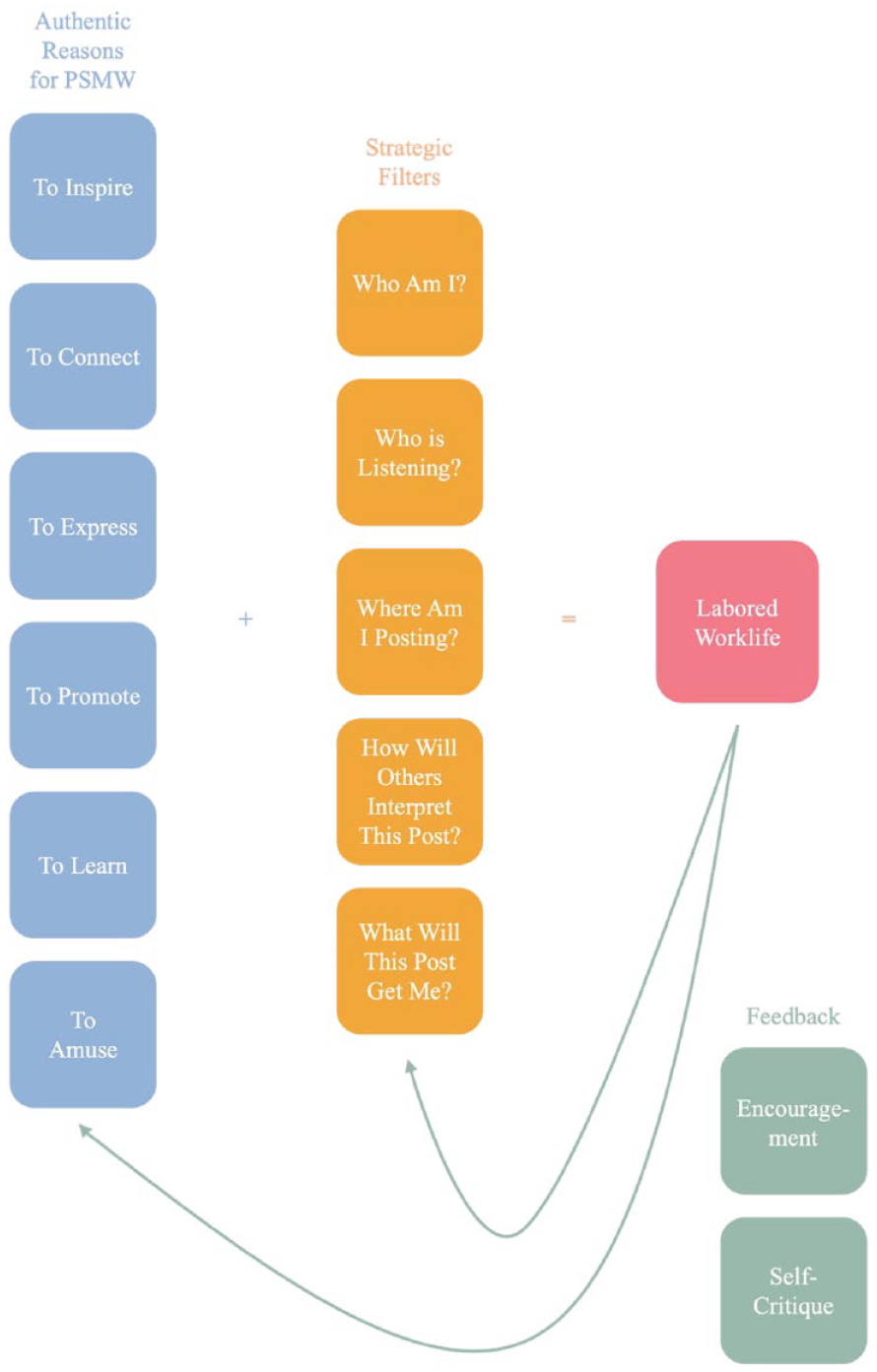
The process of personal social media for work.
After the interviews were coded, the researchers then returned to the field notes to analyze descriptions of participants’ personal social media. Sections of the field notes were added to existing codes to provide further triangulation of the data.
The Process of PSMW
Through analyzing interviews with a variety of workers, we found six authentic reasons for PSMW. However, social media users also employed Strategic Filters when crafting posts. We call this paradoxical behavior Labored Worklife. Finally, our analysis demonstrated that feedback reinforced users’ authentic reasons for PSMW and Strategic Filters used. We have visually represented our findings in Figure 1, and we explain them in greater detail below.
Authentic Reasons for PSMW
When we asked participants about work-related content on their personal social media, employees offered several motives for PSMW. We thematically organized these goals into six categories, which appear in blue boxes on the left side of Figure 1. The following paragraphs explain genuine reasons why workers wanted to talk about work on social media.
To Inspire
First, respondents engaged in PSMW to inspire. This audience-focused purpose involved giving advice, sharing ideas, motivating others, or teaching. For example, TJ, a personal trainer, explained how he tried to “show people good quality information that they need to know . . . I try to impact as many people’s lives as I can . . . whether it be adults, athletes, etc. You name it; I’m just trying to help people realize their potential.” Trens, a self-employed writer, noted a similar force behind PSMW, to “inspire people, keep people motivated, and keep people—giving them hope in something, even if it’s just through my words. I feel like words are power.” When sharing information about her entrepreneurial work as a voiceover storyteller and copywriter on her personal social media, Zahra suggested she posts content that is “uplifting and encouraging.” This theme was common among people who were seeking to educate others, such as students, fellow small business owners, or burgeoning entrepreneurs. Whereas research investigating people’s general social-media use has tended to show the self-serving side of social media (e.g., frequent Facebook users score higher on overt narcissism than non-users, Ljepava et al., 2013), we found that employees engaging in PSMW to inspire talked about their social media in a manner that was quite other-oriented.
In observing participants’ posts, we noticed that users, like Amber, a telecommunications account manager, would often give advice and encouragement to others in their work-related posts, including captions like “hustle, work, ethic, and passion.” For example, executive communication coach Kelsea wrote, “Becoming an entrepreneur actually means embracing uncertainty—choosing trust over control,” and Blair, an apparel and lifestyle retail manager, posted, Women are the best to hype you up and make you feel like the queen you are [queen emoji]. We don’t need permission to feel whatever we’re feeling but sometimes we do need to get out of our own way and just feel beautiful [heart emoji].
To Connect
Second, participants incorporated work-related content into their social media routine to connect. This theme involved both giving and receiving social support through PSMW. This purpose seemed particularly salient for employees who worked alone or apart from others. Dobby, an emergency medical technician (EMT) with past military experience, reported, “for the most part, it is the way I keep in touch with a lot of people over the years,” and alluded to the fact that sharing work-related information helps hold him accountable. In addition, Gator, who worked in a restaurant, claimed that PSMW is “good because you can commiserate with other people who can share their experiences, and basically just connecting with other people is what social media is for.” In addition, Jeanette recalled a time when she, as an artist who paints pet portraits and makes jewelry, tagged a podcaster in a post because “I wanted to tell people about that and help support her, so hopefully people clicked on her handle.”
In addition to participants talking about supportive communication via PSMW, we also saw these actions in our observations of participants’ social media posts. An assistant professor named Emmy, for instance, posted a gif of a whale with the caption “Whale Hello There” to her new colleague who had just joined Twitter, encouraging followers to also follow her new colleague. Another form of connection came in the form of work-related thanks, like Associate Professor Diane who wrote: “some really great examples and discussion about emotions today in #[course number], thanks for being awesome, guys!”
To Express
A third authentic reason why workers engaged in PSMW was to express elements of themselves. Participants claimed they posted work-related content to communicate milestones, events, and emotions that felt like genuine expressions of their work experiences. Assistant Professor Emmy delineated PSMW for significant career experiences, “like a new publication or when I got my position at my university . . . I’ll post certain things if it’s been a particularly good experience or challenging experience or something like that. I’ll share some, kind of, professional highlights.” When we asked about a specific work-related post, Jeanette mentioned posting about her artwork when she felt a bona fide emotion: “I think I was just super happy and wanted to post about all the cool stuff that happened to me that week.” Lucille, who taught sixth grade, echoed how pride motivated her PSMW use. She disclosed, “Sometimes when I really like something that we are doing in the classroom or I’m really proud of something that the kids did, [I] want to post it on there.”
When observing participants’ social media activities, we saw this expression theme when respondents posted about genuine work emotions, like being extremely excited, and work milestones, like a new job. This finding contrasts with the conclusion provided by van Zoonen et al. (2016) about work-related posts on Twitter, where the majority of messages were informational, lacking positive or negative emotion. In the last decade, perhaps norms surrounding PSMW have changed, and employees are feeling more comfortable sharing relational information about work.
To Promote
Fourth, respondents engaged in PSMW to promote. Social media users reported talking about work to network, build/maintain a brand, or promote a(n) product/idea. For example, artist Jeanette equated Instagram with free advertising. Amber even admitted that “the main primary uses of my social is, is to promote myself, my brand . . . I mean I’ve got my full-time job [as an account manager] partly from someone following me.” Eman, in his role as a PhD student and public speaking instructor, was also aware that through social media, organizational leaders are “seeing the work that you’re doing, and so I want future employers to see that.” Gerado, a part-time (aspiring) artist, reiterated this idea by talking about his “persona” being “consistent throughout all [his] social media channels.” He explained, “That’s mainly because of branding. Branding consistency is so important for any small business or any business. I am beginning to see myself as a business.” This quote resonated with previous work conceptualizing online social networking as a form of labor (Scolere et al., 2018; Scolere & Humphreys, 2016) and self-branding (Duffy & Pooley, 2017). As we will explain more in the Discussion section, we see our work contributing to this conversation by extending the labor of social media production beyond content creators and influencers (i.e., people whose primary job is to post on social media) to a broader work population, like the business managers, teachers, and retail workers in our sample.
Some self-promotion came in the form of infamous “humble brags” (like when we asked Jeanette to explain one of her captions) or disguises of other motivations (inspiring, supporting, or sharing). Eighth-grade teacher Michael admitted: Honestly, on Twitter, I will post things that make me look good. Like I said, I have my Twitter mainly for the district, and so, it’s kind of like . . . I don’t want to sound like I am just posting only to toot my horn, but if I am doing something I feel like someone might be able to learn something from, I’ll share it.
Other self-promotional posts were much more blatant, like one post we observed of a retired scholar posting about his book “available for pre-order on Amazon and at other booksellers.”
To Learn
A fifth authentic reason employees practiced PSMW was to learn. This theme involved actively seeking work-related knowledge as well as passively lurking for information. Hairstylist Eliza exclaimed, “Oh 100% I am constantly learning from my peers in the industry. I mean honestly, I learned everything that I know from Instagram.” Similarly, an associate professor named Diane claimed to use PSMW to “stay in the loop.” Even in her role in selling supplements, which took place primarily through her personal social media, Ruby advised others to “find people that they trust that are sharing [on social media.] Watch them and use them as a model, model after them. And just to learn from those people by watching those people.” This motivation for PSMW use mirrored recent socialization research that shows how employees learn through passive, active, interactive, and indirect access on social media (Kramer et al., 2018).
To Amuse
Sixth, workers explained a final reason for PSMW was to amuse. Respondents posted work-related information on social media to entertain, appear funny or interesting, and engage others with shared personal interests. Luis, a witty correctional officer, professed, “I just kind of poke fun of everything, whether it political, work stuff, just recent events, basically anything of entertainment value.” Throughout interviews, participants agreed that if something “funny” happened at work, they might share it on social media. In her role as an associate professor, Diane used PSMW to “unwind a little bit, and/or make other people laugh if I find something that I think is funny or re-tweet something that’s funny, or if I had a [work] experience that was dorky that I want to share.” When contemplating whether or not to share content about her art or jewelry, Jeanette would ask herself, “is this funny? Is this cool? Would I think this is interesting? Or Is it annoying?” We observed such entertaining posts on social media, like Lucille’s post, “Roses are red, violets are blue, I moved my papers off the kitchen table like you asked. #AcademicValentines,” and Steffie’s joke about thinking in airport codes when she worked for an airline.
Strategic Filters
When we asked respondents about the process of posting work-related information on social media, employees were careful to explain that despite authentic reasons for engaging in PSMW, they were highly aware of the social and professional ramifications of social media missteps. Here, a paradox emerged between authenticity and impression management, as participants expressed contradictory actions surrounding their personal social media use for work. On one hand, individuals would share very genuine reasons for sharing work-related content, which we delineated as “Authentic Reasons for PSMW” above. But on the other hand, individuals simultaneously engaged in impression management, realizing the social and professional risks and benefits of talking about work on social media. Thus, employees would strategically filter work-related content. We heard participants share the following five “Strategic Filters” (the orange boxes in Figure 1) as if they were asking themselves the following questions before posting, seeking to manage both personal and work impressions.
Who Am I?
Participants strategically filtered their content through the lens of their personal/work identities. Respondents carefully thought about who they were both on social media and outside of social media, which shaped how they presented work information on social media. There was a mindful illusion of authenticity and overlap between work and home, as well as their online and offline persona. Michael relayed how he chose his Twitter and Instagram usernames, which matched the nickname his eighth-grade students appointed him. In her role as an artist, Jeanette avowed, “I do feel like I try and just be myself and that’s what draws people to [commission] my work . . . I’m more whimsical. I want everything to be fun and colorful, and that’s just who I am.” Similarly, Diane reflected, “On my nerd Twitter, it is probably close to 100% my professor identity, so that’s what is really being highlighted.” Dobby also alluded to this theme of staying “on brand” in work-related posts: If you ask any of my friends, any of group that I’m socializing with, I’m kind of the funny one. [I’ve] been described by my colleagues as the “funny EMT.” I’m the guy who can put a humorous spin on the most serious situations.
Participants strategically crafted posts, calculated to align with their identity offline.
In observing social media posts, we also saw the explicit reference and strategic exposition of identity. In profiles, respondents often mentioned their work titles—either explicitly, “Assistant Professor . . .” and “multidisciplinary artist,” or implicitly, “big boss.” Interestingly, such work identities were always cast alongside personal identities, like “from Brownsville,” “dog mom of two,” and “LGBTQIA+.” As Molyneux (2019, p. 1) noted, “the online profile page has become a sort of status symbol, communicating to the rest of the world one’s place within it.” In line with this, our findings point to the blurred nature of work and non-work identities present in participants’ profile descriptions. We saw this trend in post captions, too, like Steffie, who wrote, “Me ‘I’m graduating in 10 days and I already have a job lined up, who cares about school?!’ Also me *studies super hard and strives for a 4.0*.”
Who Is Listening?
In our interviews, workers who talked about their jobs on social media also spoke about their audience awareness. Employees were conscious that clients, coworkers, and organizational leaders might see their posts and feared the repercussions of social media blunders. In her role as an apparel and lifestyle retail manager, Blair described her concerns about who was reading her posts: “I’ve had the CEO like one of my pictures . . . I don’t need somebody coming to my door, being like, ‘excuse me ma’am, we no longer need you. You are posting inappropriately.’” Similarly, Eliana, an executive assistant, told us how her boss followed her on Instagram. Eliana knows that “anything I post I feel comfortable knowing that they’ll see it. Even my personal stuff.” She described this as a lens or filter when posting, conceding: “I think I also always have that lingering understanding that [people are watching] . . . I have to constantly have on loop in my head whenever I post anything.” Social media users had to be strategic with content because it often served diverse audiences in the same collapsed context (Marwick & boyd, 2011). Emmy cataloged all the people who follow her on Twitter and Facebook, including close family, close friends that are on there, but then also a huge amount of acquaintances that either at one time were a friend or someone I went to school with at one of my institutions or someone I worked with or all that kind of stuff.
At the same time, we also heard participants sharing how their target audience was not always their current audience. In other words, their followers were primarily family and friends, but they wanted their audience to be a different market/consumer, so they were strategically filtering their content to appeal to imagined audiences, not their existing followers. Even though art served as a “side hustle” for Gerado, he hoped his personae on social media would convey otherwise: I kind of have to cater to a specific image which is that of being an artist. I think if you look at my social media you would think I just pursue art full time and that’s exactly what I want people to believe.
Gerado used social media to promote a “possible” professional identity (Ibarra, 1999) or a desired self, comparable to participants in an online dating app (Ellison et al., 2006). Similarly, in her job as a hairstylist, Eliza confessed: I am looking to target a specific audience on Instagram. So that’s why I choose to use [Instagram] because I can use the proper hashtags, I can tag my place at somewhere different, and get views from there. My trendiest clients are [local college] students and very blonde and cute; their friends are gonna see my post pop up when I put, you know, #[local college] or whatever.
Eliza went on to share an example of how this strategy worked: I posted a photo of myself at a [music] festival this past year, I tagged the festival, and I got followers. And then that turned into clients just from me posting that I was at that festival. They found my stylist Instagram and then they came to me to do their hair.
Where Am I Posting?
Participants chose to deal with multifarious audiences on social media in different ways. One strategy was to set their profiles to private. Anna, who worked for a family business, had “a private profile” but would field requests: “If I see their account, I say okay, you don’t look like a weirdo; then, I’ll let them follow me.” We noticed many educators managed their privacy settings in this way to filter content from students. Others, however, chose to have public profiles to maintain a broad audience/customer base. Whether public or private, these were primarily personal accounts with work-related content.
A second strategy or calculated decision was to create a professional account apart from one’s personal social media account. Similar to the trend of teenagers making a finsta account—a portmanteau word combining “fake” and “insta(gram)”—for family members or distant friends, we noticed participants making a separate “winsta” or w(ork)-insta(gram) account for specific audiences. Although winsta accounts look like personal accounts, they are primarily work accounts with personal life-related content strategically added. The first author admittedly thought she was following an individual’s personal account, only to find out through the interview that the account was a winsta, a work account that appeared purely personal! Participants with winstas, like Ginger, who owned a medical spa, liked “keeping it separate. I do want to involve patients in my life, but sometimes there needs to be a separation.” Ginger went on to share how she did not think clients might not “want to see anything about [her] kids,” another salient part of her identity. Eliza had a similar approach in her career as a hairstylist, with two separate accounts. “I will give every client a business card that has my stylist Instagram on it,” Eliza indicated, “and I will give a selective view that I think they’ll be okay with.” For example, on Eliza’s winsta, she posted before and after images of clients’ hairstyles alongside travel photos and dishes she cooked. Eliza created this account separate from her original personal Instagram handle, and her content was primarily geared toward current and prospective clients. In addition to communicating with others, Eliza’s winsta also provided suggested content related to her profession, which fostered her occupational socialization and learning. Although not all participants had winstas, over half (n = 19) reported having separate social media accounts.
For some participants, this division did not come easily. Jeanette recounted that, “at first I tried to separate personal from business. So I had a paintings profile, which was only finished work . . . But I found that people also wanted to know [about me].” Jeanette now has only one Instagram account, where she shares information about her paintings, jewelry, and candles alongside her children and beach trips. Similarly, Tony, a personal trainer, did not feel the need to create two separate pages because what you see is what you get, this is what I do, this is what I love doing so I don’t feel the need to separate my two personalities as far as training and then me as a regular person. I feel like they are all working together as one to make me be the best person I can be, to be the best trainer I can be. There’s really no need to separate it. It is what it is.
How Will Others Interpret This Post?
Another large concern we heard throughout our interviews was that of participants cleaning up work-related content to adhere to norms and others’ expectations. Social media users were careful not to be too negative, political, or inappropriate. Before posting, they carefully considered how their content would be received. Ginger, who owned a medical spa, maintained, I care a lot about my patients and I didn’t want them to not want to come to me because they were offended by something I said . . . Sometimes you say a cuss word. In my case, a lot of the times. And sometimes people get offended by that, and so I don’t want to lose business because someone judges me on my personal viewpoint of because I went off on [something].
Closely, Jeanette avoided posting anything political or “put[ting] anyone on blast,” which, she admitted, was often challenging. As a business owner for voiceover and copywriting services, Zahra explained her litmus test for appropriate content: “I try not to post anything that a sane person could be like, ‘Fuck you,’ you know?” In observing our participants’ profiles and posts, we noticed strategic steps to this end, such as Luis, who added #notworkrelated to some of his thoughts on social media, and Steffie, whose profile stated, “I work for [Airline] but the views expressed are my own and do not necessarily represent those of [Airline].”
What Will This Post Get Me?
Finally, we heard participants refine work-related content in light of their goals. PSMW was a calculated way to cultivate relationships that would help participants in some way. Steffie remembered a time she posted about work on her personal social media because her office was hiring. “A few friends sent me their resumes,” she added. Eliza presumed that by posting about her work as a stylist on social media, “I’m cultivating the kind of clientele that I want.” A guitarist named Snake listed several goals that social media could help him achieve: “Realistically, a show would be nice. You know, that’s cool. Or like another band hitting us up to go on tour with them because they like us, that’s another big goal.”
Labored Worklife
Although presented here separately, we noticed during our analysis that when sharing their experiences using PSMW, participants simultaneously articulated “Authentic Reasons for PSMW” and “Strategic Filters.” For example, if an exciting milestone occurred, such as a promotion, employees felt the genuine desire to communicate that news (“To Express”), but they also considered how others in their personal and professional circles would interpret that message, and they engaged in impression-management behaviors while crafting their post, considering, for instance, “Who is Listening?”
The paradoxical combination of “Authentic Reasons for PSMW” and “Strategic Filters” created a common theme of what we call Labored Worklife: a form of filtered authenticity that involves genuine but curated professional content. As executive communication coach Kelsea summarized: I want people to see my real personality. Vulnerability is one of my core values as well. Sometimes I post things where I’m really vulnerable—it doesn’t necessarily have a business strategy in mind, but it’s a way for me to express myself, get social support, and someone could see that. [However,] I do think about that if a client or a potential client [reads it], they would think this is what I’m really like.
We call this “Labored Worklife” because participants felt authentic in their desire to talk about their worklife; however, they did so in a manner that was labored or calculated. Emmy, an assistant professor, embodied the idea of “Labored Worklife:” I’m honestly being me, of course it is still a curated version of me because I know it’s professional, I’m not as likely to say like, fuck this or something like that, then I might in my daily life, but at the same time, I’m also kind of funny and still try to be authentic in as many ways as possible.
Another professor, Diane, articulated this nicely too, by stating that “I don’t think any of them are an inaccurate representation of what I am like in person, but you’re maybe just seeing different slices of me.” Duffy and Hund (2019) noticed this pattern—what they called “Instagram’s authenticity bind”—among aspiring and professional Instagrammers, influencers who felt tension in being “too real” and “not real enough.” We suggest that this tension rings true for employees using PSMW more broadly, not just for influencers whose work hinges on social-media use.
In observing posts, we saw participants infuse personal/work information, prudently showing care and attention to multiple social identity categories. For instance, Jeanette wrote, “I love traveling. I love painting. But the best is when I can do them both at the same time.” Participants seemed to understand personal social media use for work as a way to express these overlapping social identities—namely, work and life. For example, supplement-selling Ruby posted, I found myself stopping to pray so many times today for sick friends or children of friends. It made me realize how blessed I am to have my supplements in my life and the lives of my family that truly help us stay OUT of the doctor’s office!
Finally, Blair’s Instagram caption read, Working at [retailer] isn’t just a job, it’s a way of life . . . it’s about empowering females to feel beautiful no matter the size, color, tummy roll, tattoos, or wrinkle. I love being able to empower my customers by showing encouragement when they aren’t sure or praise when they need that push [heart emoji].
In this way, participants talked about their work (and) life simultaneously, but always with a careful and calculated eye toward their audiences. Unlike LinkedIn or other organizational social media used to narrowly communicate with professionals for the sole purpose of conducting (or managing impressions of) work, participants engaging in PSMW shared work-related information with a whole host of characters, and their communication reflected their desire to both genuinely and strategically speak to their diverse following.
Conceptually speaking, participants engaging in PSMW endured “Labored Worklife” because of their desire to share information about work via social media. Social media are an integral part of our lives, as billions of users use various platforms to communicate information and connect with others. Today, rather than mailing physical invitations to a baby shower, users post an event on social media. Rather than attending a recipe swap, users post and save dishes on social media. Rather than inviting friends over to view a post-vacation photo album, users post pictures to social media. Just as family, cooking, and travel might be part of one’s social identity or the various “hats” individuals wear in life, work is also a social category that people may wish to communicate (Ashforth & Mael, 1989). Rather than talking about work around the dinner table (Gibson & Papa, 2000), users share on social media. Employees who considered work as part of their identity experience a genuine desire to share their worklife along their other social identities. Here, we show that this communicative process is labored, perhaps cautioned by the reality that many people’s livelihoods are tied to employment. Users recognize that everyone is listening on social media, and they could be perceived poorly. So, workers calibrate their worklife to maximize the benefits of posting, such as sharing with others and deepening connections, and to minimize the risks associated with sharing, such as avoiding negative attention and controversy.
Feedback
In addition to “Authentic Reasons for PSMW” use and “Strategic Filters” contributing to participants’ “Labored Worklife,” we also observed a feedback loop that further fueled the process of PSMW. Feedback came in two forms—encouragement and self-critique—depicted with green boxes in Figure 1.
Encouragement
First, participants shared how likes and positive comments on their work-related posts motivated them in their careers as well as prompted more PSMW use. Tyler, a musician, volunteered: When I first started learning to play jazz, occasionally [a follower would] comment and be like, “Oh my gosh, like you sound way better!” . . . Now, I like[d] that. Really, that’s also sometimes why sometimes . . . I’m honestly just fishing for compliments . . . If someone who you look up to is like, “Hey, that sounded really good,” that’ll really help you, even if it’s like something superficial.
Participants, like Michael, recounted positive, not negative, comments on their posts. “On Instagram,” he recognized, “I’ll get comments on posts that are just . . . like you know, just positive . . . affirmations and things like that.” We believe that this positive feedback motivated users to continue their authentic, yet strategic, use of social media for work. Blair, an apparel and lifestyle retail manager, affirmed that encouragement is “a really good thing because it keeps you motivated and keeps you in check to realize you’re doing the right thing, because people are recognizing [what] you’re doing.” Encouragement also came in the form of compliments. Drake, for example, who owned a photography business, revealed, “some of those messages in the past where people have said like ‘Hey, I just want to say thanks for posting this’ or ‘thanks for sharing your thoughts and whatnot,’” which he admitted was “really important.”
Self-Critique
Second, participants mentioned the opportunity to archive posts, which reinforced the authenticity behind PSMW but also the strategy that goes into publishing work-related information on social media. Workers evaluated their feeds and would remove content when it was no longer relevant or aligned with their social media persona. This reinforced the strategic filters that participants used in making work-related content decisions. Interestingly, participants never mentioned deleting the post; rather, they referenced “archiving” it—a method of saving the post for personal use but not for public consumption. As Gerado, an artist, mentioned, I’ve had stuff saved, like when you remove it from your actual feed but it’s still on Instagram. I have done that with a couple pieces that I just thought were ugly. That they didn’t really fit with the new work that I was doing.
Harper, an area marketing manager, also shared that she “archived things because they’re not relatable anymore and . . . clog up [my] feed.” Finally, in a powerful example, Eliana described archiving one of her most popular posts about work: I actually got a tremendously positive response to a post that I made when I got my first job out of graduate school . . . When I finally landed a job, I posted a selfie that was kind of like one of those first day of school things . . . It was one of my most liked photos, 250 likes 20, 30, 40 comments about, “Oh my gosh, I relate to this so much,” “Thank you for sharing this,” or “Eliana, you are so awesome.” . . . It was just such a positive response. I think I archived it because I thought I looked ugly whenever I was going back in my feed . . . so I can just archive this and see these comments later.
This feedback shows that participants who use PSMW look at their identity as a whole on social media (i.e., their feed) to assess whether they are portraying the personal/work selves they seek to display. Interestingly though, when past posts do not “make the cut,” participants do not actually cut them. They tuck those posts away, out of view, but still saved them as part of their (private) online identity.
Discussion
Social media research has proliferated across multiple disciplines, but scholars are still uncovering new insights about the communication that surrounds social media use and work. This study adds to this growing body of knowledge by investigating the process of PSMW. Beyond quantitative research confirming the presence of PSMW and both positive and negative outcomes of the behavior, this research illustrates how and why people talk about work on social media. Specifically, our model of PSMW demonstrates authentic reasons for posting work-related content, but that employees paradoxically adopt strategic filters when engaging in PSMW. As a result, PSMW content embodied Labored Worklife: work-related communication that was genuine yet filtered or curated for professional purposes. Finally, motivations for posting and employing strategic filters were reinforced by two forms of feedback, including encouragement and self-critique, which fueled Labored Worklife. These findings are theoretically significant for at least three reasons.
Theoretical Contributions
To begin, our study unveils the “work” behind PSMW use through the concept of Labored Worklife. What audiences perceive as a casual joke about work or a humble brag about a promotion represented conceptually as Labored Worklife—a strategic representation of bona fide work information or emotions. The notion of Labored Worklife contributes to theory by extending the scope of our understanding about the tensions that arise in depicting the self on social media. For example, Pooley (2010) wrote about the idea of the “authenticity bind” on Facebook, where self-disclosure is carefully managed: “It’s the song of myself, but with the lyrics tapped out very carefully” (p. 72). Research has shown similar patterns in dating profiles (Ellison et al., 2006) and teens’ social media discourse (Malvini Redden & Way, 2019). In short, we know that obvious tensions in social media use exist between expressing one’s true self and a curated impression of that self for others. Our study contributes to theory by revealing this phenomenon in the context of work.
Whereas scholars have noted similar tensions in influencers and bloggers (Abidin, 2017; Duffy & Hund, 2019; Long & Wilhoit, 2018; McRae, 2017), we expand this idea beyond those who are paid to write social media content. Previous research has theorized the labor of social media production solely in the context of influencers and content creators (Scolere et al., 2018; Scolere & Humphreys, 2016), yet our study demonstrates this labor is not limited to those who are paid for posting on social media. Similar to Duffy’s (2018) revelations on the work of fashion bloggers, beauty vloggers, and other content creators, much of participants’ “work” via PSMW is “aspirational labor.” Employees post work-related content to social media thinking that one day, it will pay off; that their posts—a form of what Berkelaar and Buzzanell (2015) call digital career capital—will lead to some end-goal that will make their work worth the effort.
Adding to this idea, we find that ordinary workers, not just celebrities or content creators, create fake accounts, which we call winstas, to post professionally-curated content. We coin the word “winsta” to describe a work account disguised as a personal social media account, offering social media users the opportunity to show their personal identity to followers but under the protection or freedom of having a separate “real” account for a selected audience. Just as Malvini Redden and Way (2019) called teenagers’ “finstas” or fake Instagrams “a segmented approach to authenticity,” (p. 493), we conceive of winstas as a segmented approach to communicating personal and work identities. Similar to celebrities and teenagers, creating a separate social media handle allowed participants to maintain control of their audience, sharing tailored information to both public (winsta account) and more private (personal account) groups.
This finding builds upon Marwick’s (2013) concept of “aspirational production,” which involves social media users’ attempts to portray themselves like celebrities, and Fiers’ (2020, p. 1) notion that such attempts are successful because they “conceal the ‘inauthentic’ nature of this production.” Such profiles are often built on the illusion of a personal account but purposely infuse work-related information into the mix for a selected audience.
Labored Worklife and winstas both extend the social identity theory and border theory by highlighting how employees navigate multiple social identities and border decisions through communication via PSMW. PSMW is a unique and malleable vehicle through which workers can express multiple overlapping or conflicting identities and traverse complicated work and non-work borders. In this way, PSMW aligns with the “crystallized self” (Tracy & Trethewey, 2005, p. 168), a theoretical treatment of identity that views the organizational self “as a product or an effect of competing, fragmentary, and contradictory discourses.” From this approach, work and personal identities are neither real nor fake; identities are crystallized, multidimensional structures with many facets, which are reflected in various contexts. The process of PSMW, according to our data, allows employees a way to navigate and express crystallized identities by offering the ability to strategically traverse and intersect personal and organizational discourses in a collapsed context with diverse audiences (Martwick & boyd, 2011). Just as physical work environments can encourage identity crystallization (Baumler & Piercy, 2024), so can virtual spaces. As emerging personal social media platforms, such as TikTok, become widely adopted, future research should explore how work and non-work identities take shape through PSMW.
Finally, we suggest that our findings contribute to the concept of emotional labor. This sociological concept originally explained how service workers must express, repress, or manufacture emotion as part of their job requirements (Hochschild, 1983). Since its inception, scholars have extended the idea of emotional labor into other professions, noting that emotional labor can originate from coworkers themselves, and communication research has explored the notion of “emotional work,” authentic feelings that develop at work (e.g., Miller & Koesten, 2008; Tracy, 2000). We suggest Labored Worklife as a combination of emotional labor and emotional work that transpires on social media. Through the process of PSMW, workers express genuine emotion (i.e., emotional work) through authentic reasons for PSMW, but they also take part in their own emotional control (i.e., emotional labor), acting in alignment with organizational and professional norms through strategic filters. A handful of previous studies have explored emotional labor via social media, including Evers’s (2018) study of professional surfers on and off social media. In addition, Davidson’s and Poor’s (2014) quantitative analysis of artists who use social media platforms to crowdfund found that the relationship between surface acting (a particular dimension of emotional labor that involves superficially managing feelings) and intentions to crowdsource in the future was mediated by enjoyment. Overall, we see the current study adding to this growing body of scholarship that demonstrates how emotional work occurs on social media, and we encourage future research to explore a wider range of professions to further investigate this finding. About half of our sample consisted of creative and customer service professionals—occupations in which personality and emotion are largely infused in work. Hopefully additional research will investigate how others experience both emotional work and emotional labor through PSMW.
In sum, this research informs current scholarship by investigating why and how employees use PSMW. We encourage future research to build on this work to further explore the nuances among various types of workers who engage in PSMW, as well as the identity and boundary work that it entails.
Footnotes
Declaration of Conflicting Interests
The author(s) declared no potential conflicts of interest with respect to the research, authorship, and/or publication of this article.
Funding
The author(s) received no financial support for the research, authorship, and/or publication of this article.
