




Abstract
U.S. anti-abortion activists use social media to advocate for their cause. While influencer scholarship has proliferated within media studies, the advent of political influencers remains understudied, despite their ability to influence public opinion. Through 16 interviews with anti-abortion political influencers combined with digital observation, we examine the emergent tactics of “progressive” anti-abortion influencers. We find that these influencers co-opt marginalized communities’ ideological frameworks and experiences of discrimination in an effort to influence public opinion on abortion. We build upon the concept of identity propaganda from Reddi, Kuo, and Kreiss, but crucially reveal the ways in which these influencers mobilize their own experiences of oppression as members of marginalized communities themselves. Thus, we put forth the theoretical concept of embodied political influencers to articulate these influencers’ aim to change political opinion through identifying as members of marginalized groups, calling on their own historical—and at times contemporary—experiences of subjugation to propagate embodied propaganda.
Introduction
A pregnant woman collapses in pain outside the clinic where she waits to obtain an abortion of her wanted child, who has a fatal fetal abnormality. She is going into labor—a necessary step in her abortion—but cannot get inside. Five anti-abortion activists block her path. These anti-abortion activists were convicted of violating the Freedom of Access to Clinic Entrances Act, which prevents individuals from blocking the entrance to a reproductive clinic, and felony conspiracy against rights (United States Attorney’s Office, 2023).
But these are not typical anti-abortion individuals. 1 Indeed, the one who directed and livestreamed the blockade, Lauren Handy, self-describes as queer. 2 Drawing from their self-identification, they are what we call “progressive pro-lifers,” or those that do not align with the typical U.S. anti-abortion individual, who is more likely to be conservative, religious, older, White, and male (Gallup, Inc., 2023). The described people differ from the anti-abortion community captured by Gallup not only in identity, but also in ideology. Whereas anti-abortion leaders continue to uncritically compare abortion with the Holocaust, American enslavement of Black people, and the civil rights movement, these progressive pro-lifers portray a movement founded on anti-racist, anti-capitalist, queer ideological frameworks, rather than religion or reductive comparisons (Moseley-Morris, 2023). In addition, they heavily use social media to spread such messaging—targeting platforms especially popular among younger Americans, such as Instagram and TikTok (Martin et al., forthcoming).
But does this new rhetoric signify an authentic desire to change the anti-abortion movement, or merely the next political strategy to sway minds and votes on abortion criminalization? After Roe v. Wade was overturned in the United States, 21 states banned or restricted abortion (The New York Times, 2022). Anti-abortion activists are not content with returning this issue to the states, and instead aim to ban abortion nationwide, under federal law. Despite purportedly different ideological frameworks, establishment and progressive anti-abortion activists agree on this goal.
Progressive pro-lifers are distinct from the larger anti-abortion community, and they are potentially consequential. They are being covered in internationally recognized news organizations, running for or already in political office, and critically, highly online (Martin et al., forthcoming). Ultimately, they are trying to change hearts, minds, and votes on abortion policies. Overturning Roe v. Wade was merely their first step in their ultimate goal to abolish abortion nationwide. Social media is a crucial element of their strategy to convince the American electorate and elected politicians of the illegality and immorality of abortion.
To understand these mostly young, highly online, and progressive anti-abortion activists, who at times engage in extreme and even criminal behavior to further their cause, we interviewed 16 anti-abortion activists who we consider a part of these new “progressive” activists. Our interviews are bolstered by digital ethnographic fieldwork. We aim to understand the influence—both online and offline—of this community. We thus ground in media studies scholarship surrounding influencers—especially political—and propaganda. Ultimately, we find that progressive pro-lifers are using social media to spread propaganda that mimics but also reproduces establishment anti-abortion ideological frameworks through drawing on the embodied knowledge and experiences of marginalized communities in service of passing anti-abortion legislation. We thus put forth a new theoretical category of social media influencer—that of embodied political influencers 3 —to describe influencers who co-opt narratives, imagery, and/or ideological frameworks of marginalized communities to which they belong to influence public opinion of a political issue (in our case access to abortion). We ultimately argue that although some of these embodied political influencers may genuinely believe their own messaging, their “new” ideological frameworks work in tandem with establishment rhetoric to encourage the public to support policies that do not align with feminist, queer, anti-racist ideology, particularly in the current U.S. two-party system.
Establishment Anti-Abortion Rhetoric
The narratives promoted by the progressive anti-abortion movement are markedly different from typical understandings of the American anti-abortion movement. Despite the movement’s long-standing attempts to dissociate from religion (Lowe & Page, 2019; Ziegler, 2013, 2020), it is generally associated with the American religious right given that anti-abortion individuals tend to be religious and conservative (Gallup, Inc., 2023). There is a long history in the anti-abortion movement of demonizing “feminists” and secularism as antithetical to the pro-life movement (Holland, 2020b) and relying upon conspiracies such as the idea that abortion is a modern-day Holocaust or comparable to American enslavement of Black people (Holland, 2020a, 2020b).
American anti-abortion activists adopted historical comparisons to the Holocaust and American slavery starting as early as the 1960s (Holland, 2020b). Anti-abortion activists believe themselves to be fighting against a modern-day genocide. They compare abortion with well-known historical travesties like slavery and the Holocaust to relay a greater sense of urgency and historical importance to potential converts. Anti-abortion activists identify fetuses as potential victims of the abortion genocide, in the same vein as Jewish victims of the Holocaust and Black victims of enslavement (Holland, 2020a). Abortion providers and advocates are villainized through comparisons to German Nazis killing innocent people at the command of the state (Haugeberg, 2017).
Portraying themselves as fighting “a noble battle against evil,” the anti-abortion movement purports to advocate not only for the unborn, but for all marginalized groups subject to harm and oppression (Haugeberg, 2017, p. 78; Holland, 2020b). It is important to note that these comparisons have historically been adopted by White Christian activists, thus posing the question of co-optation and tokenization of marginalized communities’ experiences by anti-abortion activists (Holland, 2020b).
Increasingly, however, anti-abortion groups are diversifying through mobilizing a wider range of ideological frameworks. The “pro-woman narrative”—or the idea that abortion is not only immoral because of the value of the fetus’s life but also a human rights abuse against the pregnant woman—has been gaining influence for the past decade (Lowe & Page, 2019; Roberti, 2021; Rose, 2011; Saurette & Gordon, 2013). A version of this narrative has existed in the anti-abortion movement since the 1970s, when Feminists for Life (FFL) was founded (Ziegler, 2013). But “pro-life feminists” have historically been a very small, understudied part of the movement (Oaks, 2009; Ziegler, 2013). The reigning narratives within the anti-abortion movement remain conservative, particularly on the topic of maintaining traditional gender roles (Swank, 2021). Yet women wield a large amount of influence and power due to their overrepresentation as activists and leaders in the movement (Kelly, 2012). Notably, “pro-woman” and “feminist” are not synonyms, and conservative female politicians use these pro-woman frames to advocate for anti-feminist policies (Schreiber, 2008).
The leaders of the anti-abortion movement remain broadly White, conservative, and even homophobic, as in the case of Abby Johnson and Kristan Hawkins, two major anti-abortion figures. Establishment rhetoric seeks to erase queer people from the reproductive experience and has succeeded in doing so in legislation that bans saying “person” instead of “woman” in reference to pregnancy (Sparkman, 2023). Rather than connecting with the prominent members of the movement and sharing the common values of anti-abortion groups writ large, progressive activists are breaking with larger anti-abortion ideology (Moseley-Morris, 2023; Ziegler, 2013) but remain committed to the primary goal of eradicating abortion in America.
Influencing Politics
The success of today’s anti-abortion movement hinges on their ability to convert pro-choice voters to anti-choice voters now that the U.S. Supreme Court decision in Dobbs v. Jackson Women’s Health Organization has eradicated federal protections for abortion. Prior to the overturn of Roe v. Wade, rolling back abortion access was a challenging feat, attained only through implementing restrictions on clinics and civil workarounds like Texas Senate Bill 8 (Astor, 2021). Now, anti-abortion activists are pushing for laws that ban abortion not only in individual states, but federally, under the constitution (Ms. Editors, 2023). Given this, anti-abortion activists must be able to influence public perception of abortion to change minds, and ultimately, votes across the U.S. Given Americans’ heavy use of social media as an outlet for news consumption (Pew Research Center, 2022), social media is a crucial component of anti-abortion activists’ efforts. Highly online anti-abortion activists can thus be conceptualized as political influencers, or “content creators who promote political and social causes toward their audiences by expressing support for them and endorsing them implicitly or explicitly” (Goodwin et al., 2023, p. 1614).
Influencer scholarship has predominantly focused on social media influencers who participate in the market economy through selling products and promoting brands rather than those who promote political causes, yet studies of political influencers are increasing (Goodwin et al., 2023; Riedl et al., 2021; Woolley, 2022). Broadly, influencers can be defined as, “shapers of public opinion who persuade their audience through the conscientious calibration of personae on social media” (Abidin & Ots, 2016, p. 155). To influence their audiences, influencers depend on their accumulation of cultural capital, taste, intimacy, credibility, and authenticity (Abidin, 2015; Abidin & Ots, 2016; Abidin & Thompson, 2012; Banet-Weiser, 2012, 2021; Duffy, 2017; McQuarrie et al., 2013), which may especially hinge upon sharing personal details of their lives (Abidin, 2015).
Measuring and analyzing the clout of political influencers extend beyond follower count (Riedl et al., 2021). Meaning, a political influencer may exert sway over an audience size ranging from moderate to large. To position their impact, influencers must attain a certain level of microcelebrity, or “a state of being famous to a niche group of people,” to develop trust with their audience members and thus affect the opinions of a substantial—yet specific—faction of society (Marwick, 2013, p. 114). Critically for online political influencers, “microcelebrity can be adopted and practiced by individuals with very small audiences” (Marwick, 2017. p. 2). Therefore, political influencers with smaller audiences may still use social media techniques of microcelebrities—including different tactics of self-presentation, like the curation of shared personal experiences—without the huge following (Marwick, 2017). In political influencing, this credibility may be even more valuable than a high follower count (Goodwin et al., 2023).
Furthermore, “micro-influencers”—influencers with a smaller, but intimate following— have been shown to execute more persuasive messaging than “mega-influencers”—influencers with a large, but less intimate following in the realm of product endorsement (Park et al., 2021, p. 585). Park et al. (2021) argue that micro-influencers cultivate and maintain more personal relationships with their following, which in turn builds trust. This intimate style of influencing is shown to be particularly successful with endorsed products framed as emotional and enjoyable consumption (as opposed to rational, utilitarian consumption) (Park et al., 2021). Himelboim and Golan (2023) extend these micro-influencer findings from the realm of products to social causes. Influencers endorsing veganism and adjacent causes deployed more successful persuasive campaigns in tightly interconnected and smaller networks (Himelboim & Golan, 2023). Thus, “having more followers is not always better” in deploying influence campaigns on social media (Himelboim & Golan, 2023, p. 10), particularly when emotions are involved, as they are in politics (Mason, 2018).
The power of this smaller scale influence has been recognized and adopted by political actors through the hiring and deployment of “nanoinfluencers” on social media (Woolley, 2023, p. 88). These nanoninfluencers traditionally have fewer than 5,000 followers but are specifically recruited and paid by political campaigns and parties (Woolley, 2023). The logic behind these choices is that “these regular people have more intimate, local connections” and their messaging will “hit harder” (Woolley, 2023, p. 88). Studies in various contexts have shown that social media influencers, political and otherwise, can increase their followers’ interest in politics (Schmuck et al., 2022), shape discourse on political issues (Tang, 2023), and act as catalysts in connective action movements (Ma & Zhang, 2022; Mirbabaie et al., 2021). This gives credence to the power of political and social micro- or nanoinfluencers within intimate, smaller, and highly connected social media spaces. Given this setup for political impact, it is crucial to study political influencers with a varying set of followers in the post-Roe era.
Propaganda
Propaganda may be broadly understood as “information with an agenda” (DiResta, 2018, p. 12). However, the intention—and normative value—behind this agenda is disputed through the history of propaganda research, with scholars alternately arguing that propaganda is neutral (Bernays, 1928/2005), beneficial for democracy (Lippmann, 1922), and put forth by elites to maintain hegemonic power (Herman & Chomsky, 1988/2011). Thus, the transmitted information is not necessarily harmful for the receiver, for example, public health information. Yet when this information is patently false, as in the case of misinformation (Jack, 2017; Wardle & Derakhshan, 2017), it can have disastrous effects on democracy (Howard, 2020; Woolley, 2023; Woolley & Howard, 2018) and public health (Bridgman et al., 2020; Lee et al., 2022).
Following Herman and Chomsky (1988/2011), we theorize the strategic agenda and narrative framing within anti-abortion activism as soft propaganda. Soft propaganda has the capacity to influence individuals’ opinions of societal and political issues (Huang, 2015, p. 434). In this light, propaganda is defined as, “the attempt to transmit social and political values in the hope of affecting people’s thinking, emotions, and behavior” (Kenez, 1985, p. 4). Political propaganda is deployed by governments, civic agencies, and individuals around the world to sway public opinion, target political opponents, consolidate authoritarian power, and accrue personal revenue (Woolley & Howard, 2018). Today, political propaganda transmitted via social media is often deployed through computational measures to vastly increase the scale and sophistication of propaganda campaigns (Lukito, 2020; Woolley, 2016; Woolley & Howard, 2018). However, it is important to keep in mind that humans decide the narrative, targeting, and deployment measures of political propaganda campaigns. Therefore, studying political propaganda qualitatively is imperative to understand the motivation and objectives behind propaganda campaigns with explicit political purposes.
Propaganda targets vulnerabilities within societal hierarchies and structures to maximize effects and influential power, as has been shown in the Russian tactic of creating propaganda that targets existing cleavages in American society, like racial tensions (Jamieson, 2020). One key element of these propaganda campaigns is to target individuals based on identity. Identity propaganda is, “strategically designed to undermine or manipulate target populations in pursuance of a political goal through appeals about identity or identities that accord with racial and other power structures” (Reddi et al., 2021, p. 5). These political propaganda campaigns are particularly compelling because they operate within already established, complex social dynamics. Oftentimes, the exploitation of racial identities is the focus of identity propaganda campaigns (Freelon et al., 2022; Freelon & Wells, 2020). Identity propaganda relies on three major narratives: othering, essentializing, and authenticating (Reddi et al., 2021). Identity propaganda uses narratives that aim to divert blame, distract publics, or create an “us versus them” narrative because there already exist identity power dynamics that give way to disagreement, harassment, and oppression. Scholars (Martin et al., forthcoming) have extended this concept to capture the production of identity propaganda within and by marginalized community members against their own community, or “embodied propaganda.” Crucially, embodied propaganda differs from identity propaganda in that identity propaganda does not focus on “the individual identity of the person behind a strategic set of appeals” (Reddi et al., 2021, p. 2203), while embodied propaganda examines the phenomenon of people within marginalized identity groups targeting their own communities.
Embodied propaganda builds on the concept of “embodied knowledge” to identify the ways in which some members of marginalized communities can—and do—use personal experiences of marginalization to manipulate the opinions of others (Martin et al., forthcoming). Embodied knowledge as a concept is rooted in the work of 20th-century philosophers’ rejection of Cartesian dualism in favor of the understanding that knowledge is produced also in the body through perception (Merleau-Ponty, 1945/2013; Sartre, 1948/2022). Yet the authors (Martin et al., forthcoming) particularly draw upon feminist science and technology scholar Haraway’s (1988) concept of “situated knowledge,” which she identifies as knowledge produced in the particular body, thus rejecting notions of aperspectival objectivity in the sciences. As they identify, marginalized groups enact embodied propaganda when they use a personal experience (for instance, that of oppression as a Black woman in the United States) to further a false and damaging narrative intended to manipulate public opinion (e.g., that Planned Parenthood exists to decimate the Black community). In this way, embodied propaganda is identity propaganda flipped on its head: while embodied propaganda still works through playing on the power dynamics embedded in society (e.g., systemic racism), these propaganda campaigns are proliferated by those within the marginalized group. While these campaigns may be rooted in ideology perpetuated by the dominant group (e.g., White U.S. society), they transform when they are taken up by the marginalized community and imbued with the embodied experiences of individual marginalized people.
Influencing by Way of Propagandizing
Stevens (2021) demonstrates that the culture of marginalized communities has been co-opted by influencers for marketing purposes. We thus intervene at the intersection of political influencers, co-optation of marginalized identity, and the proliferation of political propaganda online. As such, we ask: What are the narrative strategies of contemporary anti-abortion political influencers? In what ways do these narratives differ (or not) from establishment anti-abortion narratives? How might old and new narratives work in tandem to influence public opinion?
Crucially, we query whether the foregrounding of feminist, queer, and anti-racist ideology among progressive anti-abortion political influencers is authentic expression or propaganda. Ultimately, we find that while some anti-abortion political influencers mimic and reproduce extant establishment anti-abortion frameworks, others reject these frameworks, and create new ones. This latter group performs authenticity to their followers by strategically rejecting establishment frameworks that are harmful to marginalized communities, identifying as members of marginalized groups, and crafting counternarratives that call on historical marginalization and oppression in ways that are inclusive rather than alienating. In this way, they specifically target communities who are not typically anti-abortion, like queer people and people of color. Through demonstrating in-group affiliation, understanding, and compassion for embodied oppression, they produce embodied propaganda. We thus conceptualize these influencers as “embodied political influencers.”
Data Collection
Interviews
As detailed within the literature surrounding microcelebrity, micro-influencers, and nanoinfluencers (Himelboim & Golan, 2023; Marwick, 2013; Park et al., 2021; Woolley, 2023), the political impact of social media influencers extends beyond mere follower count. Influencers with a moderate, but intimate and devoted following may exert meaningful sway over a niche community. The niche and highly interconnected network of the progressive anti-abortion movement is one such effective breeding ground for influencers with a small (less than 1,000) to moderate (over 5,000) following. Interviewed political influencers within the progressive anti-abortion community were first identified on social media as activists due to their awareness and policy advocacy efforts.
However, after interviewing these activists about their online work and motivations for creating their digital presence, we defined these activists as influencers subsequently. Influencers tailored their anti-abortion digital presences with the motivation to impact current and potential followers. Meaning, the purpose of these carefully crafted accounts—from explicit Instagram bios to aesthetically pleasing, emotional, and captivating posts—was to persuade minds and bodies (in this case quite literally) to align with an anti-abortion worldview. The imagined result from these persuasive digital presences is the change or cementation of political attitudes and behavior. Meaning, these influencers aimed to bolster support for anti-abortion policies and political figures from both their existing base and potential converts to the movement. Due to these goals, interviewees were classified as political influencers, or “content creators that endorse a political position, social cause, or candidate through media that they produce and/or share on a given social media platform” (Riedl et al., 2023, p. 2).
Two authors conducted digital observation on Instagram and TikTok to identify individuals advocating against abortion with self-identifying characteristics in their bios or posts that identified them as in some way “progressive” in the anti-abortion community in that they did not conform to the typical perception of an anti-abortion individual, because they were a person of color, young (defined as Gen Z), and/or LGBTQIA+. 4 From there, we utilized snowball sampling (Noy, 2008) to access other individuals who fit the criteria of the study. We concluded interview outreach after attaining data saturation, which we conceptualized in two ways: (1) when asking interviewees for further study participants, they began to give us the names of individuals we had already interviewed; and (2) similar findings were increasingly repeated by different interviewees. We ultimately interviewed 16 individuals with varying follower counts and identities. The lowest follower count was 535 and the highest was 30,900, but the majority hovered in the low to mid-thousands (Figure 1). These follower counts demonstrate the minimal to moderate, but intimate, influence of these community members, as opposed to the high, but less intimate, influence of the leaders of the anti-abortion community, who continue to put forth conservative and traditional positions.

Interviewees.
All interviews were conducted on Zoom by the research team. All interviewees were offered pseudonymization but refused. Thus, participants are identified by their provided first names only, to respect their requests without unduly amplifying their messaging. All interviewees gave informed verbal consent in line with our Institutional Review Board (IRB) guidelines, approved on 10 June 2022.
Digital Ethnographic Fieldwork
We conducted digital ethnographic fieldwork (Burrell, 2009; Hine, 2017) on Instagram and TikTok from May 2023 to August 2023 to identify participants and salient narratives in the community, which we used to formulate our interview questions. Instagram served as our entry point for a small-scale version of a networked ethnography (Burrell, 2009), in which findings from our interviews and digital ethnographic fieldwork intersect to reveal narratives and strategies throughout the community. Rather than relying on Instagram exclusively, we engaged in a “flow” style of research (Markham & Gammelby, 2018) which is well-represented in digital ethnography (Hine, 2017; Murthy, 2008; Schrooten, 2016), in which we moved between digital locations to trace the larger network (Burrell, 2009). However, we focused on Instagram for collection of posts and stories after repeatedly hearing in interviews that Instagram is the most used platform by the anti-abortion community we engaged with. In total, we observed 218 public anti-abortion Instagram accounts through daily interactions with an Instagram account we created for the purpose of our digital observation, which consisted solely of anti-abortion content, and identified us as researchers.
Data Analysis
The research team created interview memos for all interviews. The memos consisted of biographical information about the interviewee, interview-specific findings, consistent findings across interviews, and salient quotes. In addition, memos drew upon digital ethnographic fieldwork to draw connections across observed discourse/imagery/strategies and interviewee-reported discourse and strategies (Figure 2). To develop our themes, we relied on Charmaz’s (2006) approach to grounded theory, which iteratively builds thematic codes through (1) familiarizing oneself with the entire dataset through open coding; (2) developing open codes for the entire dataset; (3) collapsing these codes into persistent themes or axial codes; and ultimately (4) developing a cohesive and theoretically informed argument. We find this method useful for our data given that Charmaz (2006) rejects a positivist approach to grounded theory established in prior research, instead recognizing the role of the researchers’ subjectivity in constructing findings. This method allows for developing theoretical concepts grounded in the data.
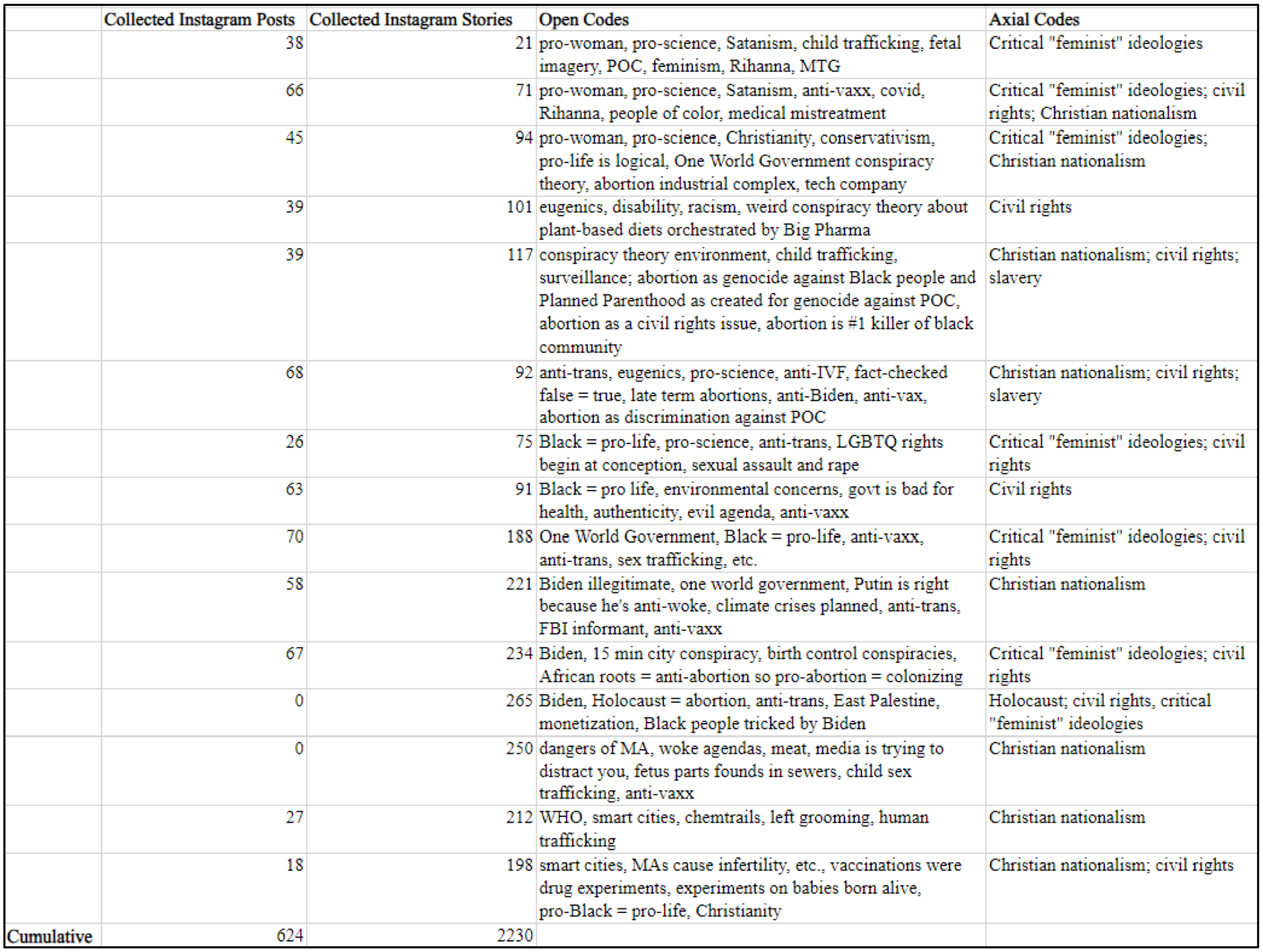
Digital ethnography fieldnotes.
Findings
Three main narrative frameworks within the establishment anti-abortion movement were discussed and analyzed by interviewees as follows: (1) the direct and indirect comparison of abortion to the enslavement of Black people in the United States, (2) the direct and indirect comparison of abortion to the Holocaust, and (3) the integration of Christian nationalism. The objective of deploying these three frameworks is to persuade existing and potential members that (even) post-Roe, activism against abortion is crucial. Yet in our data, we saw distinct cleavages in the levels of support for these frameworks, ranging from acceptance to condemnation. Below, we examine the ideological fragmentation among progressive anti-abortion political influencers—on one hand, influencers mimicked and reproduced establishment anti-abortion ideology, while on the other, influencers mitigated, rejected, and condemned establishment anti-abortion ideology and proposed new ideological frameworks in support of banning or eradicating abortion.
Mimicking and Reproducing Establishment Anti-Abortion Ideology
Supporting Comparisons to Slavery and the Holocaust
Interviewees’ feelings surrounding the narrative strategies of comparing abortion to slavery and comparing abortion to the Holocaust coalesced, thus these frameworks are discussed in tandem. There were three distinct camps within the comparison of abortion to slavery or the Holocaust: direct support, indirect support, and rejection of comparison. Direct and indirect supporters argued that abortion, just like slavery or the Holocaust, is a tragedy, and that there exists a morally right and wrong side on the issue of abortion. These “supportive” interviewees, as we will call them, agreed that, at the end of the day, all three narratives may be boiled down to a tale of “dehumanization.” They thus mobilized historical anti-abortion strategies which aim to portray the movement as fighting against “evil” in all forms.
Direct comparisons by interviewees typically expressed that abortion is much worse than slavery or the Holocaust and it is definitely appropriate to make these comparisons within anti-abortion activism. The strategy behind the direct comparison was to convince followers and dissenters alike that abortion is the most egregious human rights travesty of our time. As Mayra said, “To me, it’s [abortion] even worse than that [the Holocaust and slavery], you know, because, like I said, they [fetuses] cannot defend themselves, they cannot run and hide.” Speaking about the comparison to slavery, Kayla argued that the pro-choice movement can be compared with owning slaves: “it goes hand in hand . . . if you kind of look at the concept of slavery . . . a lot of it was by choice, like it was the buyer’s choice, or it just was about choice.”
Direct comparisons often cited specific attributes of the Holocaust or slavery to justify their comparison to abortion. For example, one popular justification was that “abortion has killed thousands, if not millions, more than the Holocaust killed.” Some proclaimed that they “don’t see why people are so sensitive” about comparing abortion to the Holocaust or slavery. As Mayra said: I think that it will open more eyes to people if they get to see how the unborn are facing the same thing that someone that was able to scream did. A lot of people were able to realize what was happening in the big cremation centers because they could hear the screaming coming out. We cannot hear the unborn scream.
Influencers who fell into the indirect comparison camp framed these comparisons as generalizable. While not 1:1, the comparisons were nevertheless “appropriate.” The comparisons’ ultimate goal was to spark alarm among listeners and help them understand that abortion is just as bad as these historical tragedies. Instead of pointing to specific attributes and making a direct comparison, influencers choosing the indirect path oftentimes decontextualized these issues, for instance, by extracting certain aspects of the Holocaust or slavery, yet not going as far as cultural genocide or systemic racism. As one Jewish anti-abortion influencer said, “Obviously slavery, abortion, the Holocaust are completely different issues, but where they have a common denominator is that they are all human rights violations, where people have been deemed to be ‘not human,’ to be less than human.”
Indirectly supportive influencers were outwardly strategic in their comparisons. For example, influencer Carrena discussed how the directness of her comparisons to the Holocaust or slavery was “depending on the conversations” and “the audience.” The comparison itself was justified, yet the parameters that defined the comparison and the translatability to different audiences were clearly outlined.
Inspired by the Civil Rights Movement
Anti-abortion influencers responded to establishment anti-abortion activism’s comparison to the civil rights movement with feelings of inspiration or accusations of hypocrisy. In this section, we examine the former—those influencers who are supportive of the comparison to civil rights.
Similar to comparisons to the Holocaust and slavery, the Black civil rights movement was understood by these influencers as a direct parallel to the anti-abortion movement for fetal rights. In their minds, both movements address the systemic dehumanization of a people. The civil rights movement of 1960s America was cited as an inspiration for some anti-abortion influencers. For example, influencer Ana compared anti-abortion advocacy with civil rights activism: Overall I personally, and like the people I associate with, we really embody, like non-violence, like things that were really like kind of mainstream because of the civil rights movement, like nonviolence, civil disobedience, like kind of putting ourselves on the line to protect innocent lives.
The civil rights movement was seen both as a moral, righteous pathway to delivering equality and an example of a successful civil rights campaign that resulted in strengthened legalized protection. For many influencers, the civil rights movement was understood as successful in that it resulted in what anti-abortion activists ultimately hope to deliver to fetuses: constitutional protection. As Christina said, loosely paraphrasing Rev. Martin Luther King, Jr.: So you know whether or not you can change hearts, you know, is yet to be seen, but we can put in legislation that would stop people from lynching people, or at least would give them a consequence. . . . That’s basically what we are trying to do when we create legislation, we’re trying to fight for civil rights.
Kayla said the same: [The Fourteenth Amendment] is what we use to establish explicit personhood for everyone in America, like with the Civil War and the civil rights movement. . .we wouldn’t need to create another amendment. . .we can just find that it is constitutional to restrict abortion under the Fourteenth Amendment.
Influencers’ comparisons to the civil rights movements attempted to solidify the anti-abortions’ stance for racial equality. Many anti-abortion influencers were adamant that the anti-abortion side was the only side of the abortion debate who actively cared about the disenfranchisement and systemic oppression of Black Americans, an argument that supports their false claim that abortion is modern-day eugenics against Black and disabled communities. Anti-abortion influencers pointed to the highly circulated fabricated quote from Planned Parenthood founder Margaret Sanger, in which she is misrepresented as comparing Black Americans to weeds that need to be exterminated. As influencer Savannah commented: Actually, the pro-life movement is on the side of those who are African American, because we see that these clinics are put in their neighborhoods. We see that they are targeted. Margaret Sanger, or the founder of Planned Parenthood, literally said she wanted to pluck them out like weeds.
Supporting Christian Nationalism
Integrating the framework of Christian nationalism 5 into the anti-abortion movement was met with a wide array of emotional responses. In this section, we address those influencers who expressed justification, promotion, and—in one instance—aspiration for incorporating Christian nationalism into anti-abortion activism.
Several influencers opted to justify the idea of Christian nationalism by depoliticizing and disregarding its ties to White supremacy, instead claiming that America is a historically Christian nation: “There’s no denying that the United States was founded on Christian principles,” Caleb said. “If we look through history, the Founding Fathers were devout Christians.”
Influencers also expressed that the framework of Christian nationalism aligns with their own religious and ideological beliefs, but called on American conservative talking points, like the liberal attack on children: “God has been basically taken out of the nation,” Kayla said. “And it’s kind of pushed this agenda where we think abortion’s okay, we think that pushing gender on children’s okay.”
Furthermore, one influencer supported the idea of Christian nationalism but insisted that America is simply not Christian enough to be considered a Christian nation. Influencer Mayra pointed to countries such as Mexico and Columbia as being laudable for their tough anti-abortion legislation. Mayra was “concerned” that anti-abortion activists think America is a Christian nation, because America is not yet Christian enough.
Rejecting and Creating New Anti-Abortion Ideology
Although some interviewees expressed their alignment with establishment anti-abortion rhetoric, others expressed severe discontent with these old ideological frameworks and narratives. They rejected comparing abortion to slavery or the Holocaust, found it hypocritical to tie anti-abortion activism to the civil rights movement, condemned Christian nationalism as a goal, and aimed to create new, inclusive ideology, often founded upon, or incorporating, feminist and anti-racist rhetoric.
Rejecting Comparisons to Slavery and the Holocaust
Rejecting the comparison of abortion to the Holocaust or slavery was seen by some as a necessary step to modernize the anti-abortion movement. Some influencers strategically stopped comparing abortion to the Holocaust or slavery to avoid alienating marginalized or minority communities—including liberal activists and activists of varied faiths—that could potentially be won over by modern-day anti-abortion influencers. Rejection of these comparisons was based on strategic initiatives to expand and strengthen the anti-abortion movement, rather than on the basis of morality. Ana, for instance, said, “the whole, like, comparing abortion to slavery or to the Holocaust. . .sometimes just can turn people off even if, like, we can definitely see those connections.”
Yet others rejected such comparisons because they believed they led to the tokenization of marginalized groups, in particular Black anti-abortion influencers. Cherilyn noted the difference between systemic and structural oppression versus individual: That framework makes me wanna stab my eyeballs out with a spoon. It is not the same thing. . . . The difference between abortion and slavery is who is in charge of that decision. If I decide to have an abortion, I am in charge of that decision. I did not choose to be a slave, my ancestors did not choose to be enslaved. . . . It is NOT the same as keeping people in concentration camps and burning them alive.
Rejection due to tokenization reflected a larger issue within the anti-abortion movement. Black anti-abortion influencers believed that they make impactful contributions to the growth of the movement, and yet, dominant factions with the movement still condemn or ignore issues important to Black Americans, like police brutality.
The Hypocrisy of Comparing Anti-Abortion Activism to the Civil Rights Movement
Several influencers felt that the establishment anti-abortion movement’s claim that they fully support the interests of Black Americans—and their related comparisons to the civil rights movement—was hypocritical. Britani said, “There are people in the pro-life movement who are very opportunistic . . . but, if we were to rewind years ago to the civil rights movement, they would be the ones throwing rocks at Ruby Bridges.”
In line with other influencers, Britani further expressed how the authenticity of these comparisons sometimes depends on its source. For example, when Britani discussed the framework of the civil rights movement in abortion advocacy with her Black friends, she felt that, “it’s not opportunistic. It’s not oh, you know, we have this political agenda.” However, when she was unsure of the source of these comparisons, she expressed doubt: “Okay, who’s actually making this comparison? And why?”
In some cases, influencers noted that the comparison might be helpful, but activists needed to remain aware of their intentions in making such comparisons. For instance, Aimee said: I think that in many ways there are parallels between the two movements. Anytime we’re talking about a movement to end the oppression of a group of humans and make space for the rise of that group in our culture, there are parallels that can be drawn. I think the question is, are we using it in a tokenizing way?
Mitigating and Condemning Christian Nationalism
Anti-abortion influencers who wished to expand the movement to be more inclusive and draw in a more diverse array of ideological frameworks, religions, and ethnicities understood that the idea of Christian nationalism could be alienating and off-putting. Thus, they mitigated and diminished the framework in a strategic move to recruit more people to the cause. As Melanie told us: We’re wanting to get everyone who’s willing to work with us. [We need] to just be aware of our language and how we may be coming across. . . . I personally would want to disclaim that . . . this is a movement for everyone, whether you’re Christian or not, whether you’re Muslim or Jew or Buddhist, etc., etc., like, this is a movement for everyone.
Furthermore, Christian nationalism was condemned by anti-abortion influencers who saw Christian nationalism’s ideas and values as morally opposed to their own. Others believed the United States to be fundamentally flawed, and thus not worthy of being associated with Christianity. Differently from those who hoped to see the United States adopt a more Christian nationalist framework, these influencers decried the systemic violence that the United States inflicts upon marginalized people. Cherilyn said, “I’m a Christian, so I understand, but . . . I think this idea that the U.S. is a Christian nation is ludicrous. It’s literally built on killing and blood and dominating and dehumanization and that’s how it continues.”
Britani noted the “White supremacy” and “toxic patriarchal views” inherent in Christian nationalism, and that the anti-abortion movement specifically has not always condemned this. “There’s so many people who do not understand how dangerous Christian nationalism is . . . Honestly, those type of people scare me. That language scares me.” She then recounted to us seeing White nationalists and neo-Nazis at the anti-abortion March for Life. As she said, “nobody turned them away.”
Critical “Feminist” Ideologies: Black, Latina, Queer, Leftist, Secular
As Cherilyn told us, “The reality is, if you want to change a narrative there has to be a counternarrative, or people will just continue to go on with what everybody is saying around them. So we create counternarratives.” Throughout our interviews with those who did not support the establishment anti-abortion narratives, interviewees introduced new ideological frameworks to support their anti-abortion activism, often grounded—at times explicitly—in feminist, Black, Latina, queer, leftist, and secular ideology.
“I believe abortion is a tool of the patriarchy,” Melanie said, “and for real equality, for real, like elevation of female voices, abortion is not going to accomplish our end goals of victory for women.” While arguing that abortion is good for women is not a new narrative, Melanie goes on to suggest: For example, like women in the workplace, I believe the answer is not pay for your abortion and pay for your travel. It’s paid family leave. It’s paying for daycare services. . . .We need to make birth free within the United States.
Melanie is arguing for leftist policies that can even be considered anti-capitalist. Many progressive influencers said the same: “I see no reason why pregnancy should cost money,” Ana said. These narratives were decidedly not present in conversations with anti-abortion influencers who perpetuated establishment rhetoric.
Progressive anti-abortion influencers also advocated for making the anti-abortion movement a secular, fact-based, and science-based movement, rather than a religious one. While this narrative has roots in the 1970s when the Willkes published the infamous anti-abortion manifesto, the Handbook on Abortion, this new rhetoric differed in that influencers connected it to anti-racism and even a “cultural shift in consciousness,” calling upon the work of feminist scholars. For instance, Cherilyn told us that she constructs counternarratives based on facts and statistics for the Black community, because the ones put out by White anti-abortion influencers will not be believed by Black people, and for good reason: The complaint that came from the pro-life community is that there aren’t enough Black people fighting for this. . . . “Look at all the Black babies that are dying. Why aren’t the Black community enraged about this?” Well, one, you’re talking about these statistics, and they just don’t believe you. They have real reason not to believe anything you’re saying. They have real reason to believe that you don’t have their best interests at heart.
Influencers constructed an expansive, “radically inclusive” movement founded upon more than anti-abortion activism, but also including human rights issues such as those experienced by Latina women in the detainment camps at the U.S.–Mexico border. As Jocabed said regarding the mistreatment of migrants in such detainment camps: “we can’t claim to care about preborn children, and then at the same time not care about these preborn children who were going to be born from immigrant parents.” Influencers directly tied other progressive issues to anti-abortion activism. Nino told us that he thinks, “all progressives are pro-life,” even if they haven’t yet realized this about themselves. Ana connected her anti-abortion activism to her animal rights and LGBTQIA+ activism: What made me really like go into activism is seeing people doing direct action and seeing some things online from various, like anti-abortion groups that were kind of like, allied with what I was doing for animals. . . . I’m also intersex. So that kind of like, tied into a little bit of my activism.
Discussion
In our data, there exists a major ideological fragmentation in the contemporary progressive anti-abortion influencer community. In one camp are those who mimic and reproduce establishment anti-abortion ideology uncritically. While they have updated their tactics in their heightened use of social media and targeting of the Gen Z community which is highly online (Martin et al., forthcoming), they have not fundamentally changed their messaging and often align themselves directly with the establishment leaders of the movement, like Students for Life of America and Live Action. In the other camp, progressive anti-abortion influencers reject and even condemn these past ideological frameworks as exclusionary and alienating and have commenced creating new ideology grounded in purportedly queer, anti-racist, and Black and Latina feminist frameworks. Anti-abortion influencers in both camps utilize the tactics outlined by Reddi et al. (2021) in producing identity propaganda: “othering,” “essentializing,” and “authenticating” (p. 2201). The establishment group mobilizes identity propaganda through co-opting historical travesties but stripping them of their roots in racism and anti-Semitism to allow comparisons to abortion, thus othering and essentializing marginalized groups. On the contrary, those who do not align with the establishment ideology claim that they are victims of othering, essentializing, and authenticating, thus producing “embodied propaganda” (Martin et al., forthcoming) instead.
We thus introduce and demonstrate the new concept of “embodied political influencers” to highlight not only the aim to change political opinion, but the strategy to do so through identifying as members of marginalized groups, and then crafting anti-abortion narratives that call on their own historical—and at times contemporary—experiences of marginalization. Yet critically, we highlight that by drawing on these embodied experiences of marginalization, these political influencers continue to reproduce establishment anti-abortion ideology toward the same political ends: that structural dehumanization of certain groups in America can be compared with that of fetuses, and that abortion is a human rights issue—not for people who can get pregnant, but for fetuses. In this way, the old and new frameworks work together toward the same goal—abolishing abortion.
Rather than othering a certain identity, anti-abortion political influencers construct themselves as the other by positioning anti-abortion activism as a moral crusade against the pro-choice hegemony. Under identity propaganda, the “other” is the marginalized community. Under embodied propaganda, the “other” (the marginalized) is the group spreading the propaganda. In our data, anti-establishment anti-abortion influencers cast themselves as a group that has been unfairly marginalized and othered by dominant (pro-choice) society. The “us” becomes the other, and the “them,” the othering dominant society. As such, they position themselves as the victims, rebelling against a hegemonic and oppressive pro-choice society.
A critical element of the embodied political influencer strategy is the “us versus them” narrative. As has been repeatedly shown by social identity theorists (Mason, 2018; Tajfel, 1974), people tend to construct their identities based upon their affiliation with their in-group (us) and perceived difference from an out-group (them). Such perceived difference can inspire hatred of the out-group, leading to divisions in society premised upon differences in identity, such as race, ethnicity, class, gender, and ability. As Mason (2018) points out, political parties have become strongly divided along identity lines in recent U.S. history, with people of color, secular, and liberal people generally aligning with the Democratic party and White, Christian, conservative people often being Republicans. Along these same lines, the former tend to be pro-choice, and the latter anti-abortion. Yet the embodied political influencers we encountered trouble this dynamic. They expressed feelings of being cast as the “out-group” in U.S. society as queer people, non-Christians, or people of color. At the same time, they reported feeling marginalized by dominant U.S. society as anti-abortion individuals, as well. They thus created a new “in-group.” Anyone who is anti-abortion is included, even—and particularly—if one is otherwise marginalized. As such, the feeling of marginalization and the associated rebellion against hegemonic society becomes a feature of their identity. Furthermore, being anti-abortion is the most important feature of their identity, and all other difference (gender, sexual, race, and ethnicity) is stripped away, thereby furthering essentialism. They thus speak to marginalized people’s emotions rather than relying on logic in their efforts to ban abortion, a tactic that has proven to be effective in politics, as evidenced by the election of Donald Trump (Mason, 2018).
In this way, embodied political influencers produce a form of what Reddi (2023) identifies as, “shared identity endorsement narratives,” in which shared social identity between the endorser and the endorsed is highlighted to build community (p. 126). Yet in this case, the influencer demonstrates their shared identity with their followers to manipulate their political opinion. They perform authenticity (Abidin, 2015; Abidin & Ots, 2016; Abidin & Thompson, 2012; Banet-Weiser, 2012, 2021; Duffy, 2017; McQuarrie et al., 2013) to enhance their credibility with marginalized communities and the potential political impact of their messaging (Goodwin et al., 2023; Ma & Zhang, 2022; Mirbabaie et al., 2021; Schmuck et al., 2022; Stewart et al., 2023; Tang, 2023). Rather than forcing members of marginalized groups to “authenticate” themselves (Reddi et al., 2021), they authenticate their own position in the marginalized community expressly for the purpose of manipulating opinion.
As Reddi (2023) points out, even in cases where shared identity narratives build community, such rhetoric can be damaging as it homogenizes and “essentializes” identity. In the case of embodied political influencers, we find that such narratives are damaging not only because they homogenize and essentialize (Reddi, 2023) and reproduce dominant power structures of White supremacy, patriarchy, and Christian nationalism (Reddi et al., 2021), but also because those who mobilize such rhetoric do so not necessarily to build community, but to manufacture false consensus (Woolley, 2023) on the topic of abortion. While this could be understood as identity propaganda, we argue that anti-abortion political influencers’ propaganda constitutes embodied propaganda (Martin et al., forthcoming) given that it co-opts the embodied experiences of and discrimination enacted against these marginalized communities to manipulate these communities’ opinions of abortion from within the marginalized communities themselves. With this in mind, we find embodied political influencers to be substantially different from other conceptions of political influencers, as they particularly aim to increase their influence on their followers through performing their authentic identities as members of marginalized groups and foregrounding their experiences of embodied oppression.
Future research might expand this work through studying embodied political influencers of political issues other than anti-abortion, such as climate activists, pro-choice activists, men’s rights activists, and others. Furthermore, quantitative analysis, for instance, social network analysis, would reveal other aspects of embodied political influencer strategies. While this study draws strength from multiple qualitative methods, quantitative inquiry would contribute crucial knowledge regarding the breadth of political influence. Speaking to those impacted by such political influencing and primarily examining content, rather than producers, would lend further insights into this phenomenon.
While many of these influencers do engage in activist work for the marginalized communities they support, like pregnant migrants along the California/Mexico border, queer people, and Black people who can get pregnant, they are spreading embodied propaganda to support anti-abortion policies that are disproportionately damaging to these communities (Abrams, 2023; Berger, 2022). While they claim to support the destabilization of capitalism and White supremacy and the implementation of free birth and social support for people who can get pregnant, their messaging almost exclusively focuses on federally banning abortion under our current legal system, rather than on implementing policies that could reduce abortion while allowing abortion to remain legal, or imagining and working toward frameworks that dismantle institutional oppression.
Footnotes
Declaration of Conflicting Interests
The author(s) declared no potential conflicts of interest with respect to the research, authorship, and/or publication of this article.
Funding
The author(s) disclosed receipt of the following financial support for the research, authorship, and/or publication of this article: This study is a project of the Center for Media Engagement (CME) at the Moody College of Communication at The University of Texas at Austin, where research is supported by the John S. and James L. Knight Foundation, Omidyar Network, Open Society Foundations, as well as the Miami Foundation.
