



Abstract
This study explores COVID-19 communications disseminated by the top 100 most followed Twitter profiles—what we call the Twitter influencing elite. Focusing on a critical period from January to July 2020, we conducted a quantitative and qualitative analysis of 6,602 tweets about COVID-19 produced by these Covid Influencers. The findings reveal that approximately two-thirds of the COVID-19 tweets in our sample originated from established global media organizations. While these sources were prominent, they were not the “loudest” in terms of engagement and virality. That belonged to powerful politicians like Trump and Obama, popular singers such as Harry Styles and Taylor Swift, and business personalities like Elon Musk. What is more, our qualitative analysis highlights how the affordances of the digital space and the context of the pandemic were leveraged by these influential Twitter users to advance their own agendas. For instance, some blended health information and caring narratives with promotional appeals, while others, such as Elon Musk and Donald Trump, engaged in political agitation and/or anti-care discourses creating a staccato of conflicting messaging and mis/dis-information. These findings demonstrate that the Twitter space is as political and politicized as it is commercial and commercialized. We conclude that digital influencers and celebrities cannot just simply be used to produce communications during times of crisis as many across the study of health and medical communication have argued. The involvement by digital influencers and celebrities—much like the Covid Influencers we examined here—in spreading information must be critically scrutinized, considering the potential for mixed motives, agendas, and real-world outcomes.
Introduction
The dissemination of factual and timely information to the public is key to an effective management of a health crisis. In the predigital era, communications in and about pandemics were firmly in the hands of traditional institutional gatekeepers, that is, national media and relevant health and governmental authorities, who largely controlled the narrative and its dissemination top–down. Yet, digital technologies, especially social media, have opened up these gates: “Ordinary” people with access to a social media account can participate in creating, curating, and spreading particular narratives from the bottom–up which might support, undermine, or disrupt efforts deployed by health authorities and/or governments (Gallagher et al., 2021). Social media communications surrounding the outbreak of the so-called “infodemic” that accompanied the spread of COVID-19 is a compelling case in point (e.g., Hyland & Jiang, 2021).
Given the indisputable significance of social media sites as information outlets and the unequal power dynamics related to persona, influence, voice, and messaging, this study explores the COVID-19 communications disseminated by the top 100 most followed and verified Twitter profiles between January and July, 2020; this represents a followership of 4.1 billion global followers (see Appendix A). We refer to these profiles as the Twitter “influencing elite”—which includes individual, group, and corporate “celebrities”—given their outsized influence on society based on their very large followship and their wide, media-based circulation. We captured these communications during a critical time in the history of the pandemic and its response: From the day the first cases started to be reported in January 2020 in international media through the 7-month period ending on 31 July 2020 which contained several lockdown periods across much of the world and the initial responses designed to contain the pandemic.
The research presented here was approached through two related questions:
Of the top 100 most followed profiles—the influencing elite on Twitter—which were the “loudest” to speak about COVID-19 during this time period?
What contents about COVID-19 did these Twitter influencing elite disseminate to their followers during this critical time period in the evolution of the pandemic?
In answering these questions, this study builds on existing social science studies of Twitter, media influencers, and information about COVID-19 (e.g., White et al., 2023). However, our unique focus on these elite influencers and our combined quantitative and qualitative approach to data analysis contributes new insights into elite influencer—or “Covid Influencers” as we call them here—voices beyond individual media celebrities or politicians who generated narrative content and suggested material responses to the COVID-19 pandemic. More broadly, this article works to understand the dynamic ways in which information is created, spread, engaged with, and valued across social media sites in the context of a global health crisis. As presented and addressed more fully below, we take particular issue with recent naive and uncritical calls by some for the current and future use of social media’s “celebritariat” (Rojek, 2001) in light of not just our findings here, but the life and death stakes of past, current, and future pandemic events.
Situating the Research
A considerable amount of research has explored the impacts of social media in the context of numerous crises, significant events, and societal concerns. Examples include research on social media use in relation to disasters (Gunawong et al., 2019), disease contact tracing (e.g., Masri et al., 2019), as well as for organizing social movement such as the youth climate movements (Boulianne et al., 2020). Social media such as Twitter, Facebook, and YouTube have also become vital—and possibly ubiquitous for many—in news and information ecosystems and this seems to have been exacerbated during the pandemic and in periods of lockdown. At the same time, research has analyzed the negative impacts and increasing social harms of social media to groups and individuals. Many of these social harms are a result of the informational, affective, and ideological polarization facilitated by the social media algorithms that tend to separate audiences into “rabbit hole-like” information bubbles and echo chambers that develop and continue existing biases (Rhodes, 2022).
It is critical to recognize that not all voices on the vast landscape of social media are created or “performed” equally, nor are they engaged with equally by audiences. From the number of followers to the quantities and kinds of responses that “influencers” get to their social media posts, it is clear that those people and groups we might colloquially refer to as media “celebrities” garner greater and more sustained attention than others (Boykoff & Goodman, 2009; Marshall, 2014). Indeed, this is what makes a digital celebrity a celebrity: They are, to extend a well-used tautology, famous in digital space for being famous in both digital space and/or in “real life.” Put in more material terms, “celebrities . . . enjoy privileges that ordinary people do not, such as greater economic, social and cultural capital” (Cohen, 2020, p. 728) that then leads to increased and, some might argue, outsized (digital) media attention.
Yet, as many critical scholars have pointed out, the fact that celebrities are in these powerful, node-like positions is increasingly problematic from both ideological (e.g., Kapoor, 2013) and practical viewpoints (Abidin et al., 2020). As Rojek (2014, p. 139) puts it, this undemocratic “celebritariat” “. . . provides glamour and romance around the formidable, complex problems of hunger, illness, corruption and environmental distress facing the world” with the vast majority of these politized celebrities failing to grapple with, challenge, or make audiences aware of the structural roots of inequality, poverty, and ecological destruction. The power of celebrities to act as attention-seeking, media-facilitated nodes who/that frame societal issues in particular ways comes directly from the “affective power” of the relationships developed between audiences and media celebrities, brands, and corporations. As celebrity and persona studies have persuasively articulated (e.g., Marshall, 2014; Marshall et al., 2020; Wheeler, 2013), these affective, parasocial relations work to construct individual celebrities as authoritative, trustworthy, and “un-ignorable” voices across a range of socially relevant issues, particularly now in digital spaces in the form of what Marshall (2020) calls the online “pandemic persona” and its unrelenting “will-to-fame.”
Social media has worked to greatly accentuate the feelings of intimacy between audiences and celebrities because of the more “direct” route the platforms of Facebook, Instagram, and Twitter give us into the private lives, thoughts, and feelings of the rich and famous (Goodman & Jaworska, 2020). Yet, because Twitter specifically allows the likes of groups, corporations, and institutions to tweet, retweet, and reply as discrete entities, Twitter’s top celebrity profiles go much beyond individualized media celebrities to include, for example, musical groups and bands, sporting leagues and corporations, and technology companies such as Twitter and Google who have their own distinct “voices.” Thus, unlike a great deal of the previous work on celebrity politics and that specifically on the elevated social media voices framing COVID-19 and its responses (see below), in this article, we consider—and argue—that to understand the digitally mediated politics of COVID-19, these more “collective,” elevated “celebrity” voices of, for example, musical groups and corporations, must be included and analyzed. As we show in detail below, in addition to more typical individual media celebrities, these entities played crucial roles in framing affects, knowledge, and responses to the pandemic.
Covid, Social Media, Celebrities, and “Loud” Profiles
Recent research has explored the specific impacts of social media on the spread of information, disinformation, and misinformation about the COVID-19 pandemic showing the ways in which social media have greatly undermined effective responses to the pandemic (e.g., Burki, 2019; Shahi et al., 2021). Another growing body of research that we specifically build on here has worked to understand the ways that particular social media platforms, including Twitter, differentially elevated distinct authoritative voices surrounding the pandemic as well as how the already rich, famous, and political figures framed COVID-19. For example, Lookadoo et al.’s (2022) study of top celebrity influencers’ framing of COVID-19 on Instagram showed that the influencers engaged in a “management” of the health crisis by urging their audiences to “take personal action” to protect themselves and others by adhering to official health precautions and to take “civic action” to help community members. In rather glowing terms, Lookadoo et al. (2022) conclude that social media celebrities contributed to the normalization of the experience of the pandemic by helping people to make sense of the new reality and cope with isolation. In these authors’ view, their support for protective measures has shown that celebrity influencers might be useful when it comes to promoting appropriate actions during a public health crisis. Looking specifically at Twitter, a strand of research has focused on the specific Twitter accounts of heads of state during the pandemic. For example, Rufai and Bunce (2020) looked at G7 leaders and, from the content analysis of their tweets, found that the vast majority (85%) of these tweets were classified as “informative,” while the rest were considered “less useful” as they were “morale-boosting” and “political.” These scholars argue that Twitter might be a useful and powerful tool to communicate with citizens during a crisis situation.
A second area of related research has explored the various characteristics of social media influencers’ framing of Covid on Twitter. Through an analysis of Twitter and Instagram, Smith (2022) shows the role that UK footballers played in “supporting society” by sharing stories of their personal vulnerabilities, daily routines, exercises, and diets. While this affective and performative “ordinary-ification” of celebrities is nothing new (e.g., Goodman, 2013a), Smith (2022, p. 15) argues that the pandemic performances by these celebrity athletes (who are after all ultra-wealthy and privileged) gave them the space to construct themselves as “responsible and active citizens.” Mututwa and Matsilele (2020) analyzed Twitter feeds of 15 global celebrities who used the platform to announce a positive Covid infection. The authors argue that these celebrities’ announcements of infection worked to challenge Covid disinformation and help alleviate public fears. Finally, Kamiński et al. (2021) performed a sentiment analysis that compared audience reactions with the tweets of different profiles, stakeholders, and institutions. They found that tweets related to COVID-19 and posted by celebrities and politicians attracted a higher degree of attention that those tweeted by health and scientific institutions with celebrities recognized for their artistic, media, or sport performances having the greatest “reach.” Overall, politicians’ and celebrities’ Covid tweets had more positive undercurrents than the other profiles in their study.
While the studies discussed above have pointed to beneficial uses of social media platforms by celebrities during the global health crisis, some of the positive results need to be treated with caution, simply because they do not seem to consider in any detail who and/or what profile(s) is/are doing the disseminating nor what they are actually saying. Put another way, as Kamiński et al. (2021, p. 127) argue, “[a]ctive engagement of Twitter influencers may help key messages go viral” yet, what if, as we discuss below, these influencers are people like Elon Musk who produced great volumes of misinformation about COVID-19? And yes, influencers might also get audiences to care more about their own health and that of others, but what if, based on the information and sentiments that also might go viral, these influencers, such as Musk, are pushing the line that there is no need to care about pandemics such as COVID-19 and audiences follow suit IRL (“in the real world”)? These questions, in addition to a more descriptive analysis of who the “loudest of the loud” on #CovidTwitter where, what these Covid Influencers said and the salience, power, and spread of their messages, are explored in detail below.
Methodology
Our approach combines quantitative and qualitative social media analysis underpinned by insights and tools from computer science and linguistics. First, we identified the 100 most followed Twitter accounts that were determined as such by Social Blade 1 at the start of this research project in August 2020. The list of the accounts together with the number of followers (as recorded in August 2020) is available in Appendix A. In considering the top 100 most followed accounts, we intended to capture the voice of the “Twitter elite” whether they are individuals, groups, or organizations. This allowed us to better understand the dynamics of participation and information dissemination on Twitter during the historical moment of the outbreak of the global health crisis.
Using the user’s profile names from their verified accounts and the “GET statuses/user_timeline” Application Programming Interface (API), the last 3,200 tweets from each account were collected together with their metadata including the number of likes and retweets. This returned 228,327 tweets in total. From these data, a subset was created consisting of tweets that were produced from 1 January 2020 to 31 July 2020. This reduced the number of tweets to 52,551. We then filtered such tweets using a set of key words including: Covid, COVID-19, corona, coronavirus, virus, pandemic, mask, face mask, covering, face covering, lockdown, stay(ing) home, stayhome, stay(ing) at home, stayathome, stay(ing) inside, social distance, social distancing, socially distanced, self-isolate(ing), stay(ing) healthy, stay(ing), safe, staysafe, quarantin*, hand sanitizer, wash(ing) hands. The search terms were identified iteratively through a close reading of approximately 10% of the sample to determine the kinds of words and phrases used to “talk” about the pandemic. The terms reflect issues that were salient during the first phase of the COVID-19 and, specifically, matters pertaining to first lockdowns and general safety and hygiene measures. Vaccines were not discussed during that time. Applying the key words and terms to the data set reduced our sample to 6,602 tweets that we termed Covid tweets.
However, just tweeting about a relevant topic is not enough to reach salience. Arguably, the most followed accounts that we considered in this study have large audiences and therefore what they tweet is more likely to be widely spread. Yet the actual uptake of a message can be better estimated using the available Twitter metrics of likes and retweets per tweet or profile. These comparable data can tell us more about the engagement with a specific message and the extent to which other users affiliate with or simply endorse this message. Bear in mind, however, the fine distinctions that exist between retweeting and liking: Likes on Twitter are important indicators of appreciation and acknowledgment signaling an affective stance toward the message conveyed in the liked post (Lipsman et al., 2012). Yet, users may like a post but not retweet it because the content might not entirely fit their own profile or the kind of impressions that they themselves want to display on their feed. In contrast, retweeting is a sharing function, which means that the retweeted message will appear automatically on the retweeter’s profile and will be shared with their audiences. This, in turn, considerably enhances the visibility of the original tweet and the message that it conveys (Vargo, 2016). It also makes retweeting a stronger indicator of conspicuous association and salience because it shows that the retweeter is publicly engaging with the content of the retweeted tweet, expressing affiliation and amplifying the visibility of the tweet, its contents, and its sentiments (boyd et al., 2010). Importantly, retweeting does not always mean a positive evaluation of the retweeted messages: retweeters can take a particular—including negative—stance toward the contents that they retweet by commenting, criticizing, or mocking these messages. Regardless of the position taken, retweets are marked as attention worthy and valuable to the profile’s networks and the wider community of Twitter users (Zappavigna, 2012), wherein they give rise to what boyd et al. (2010, p. 1) describe as “an emotional sense of shared conversational context” and thus, are the kind of messages that stir and steer communication, networks, affects, and debates on Twitter.
Finally, the practice of retweeting is essentially a practice of repeating and hence retweets can signal ideas and narratives that are widely circulated in the digital sphere. Therefore, we used Twitter metrics to identify messages that were highly retweeted and liked, with the assumption that these messages had a large and wide resonance with audiences. Because we were interested in identifying those Covid Influencers which were particularly “loud” in communications about COVID-19 pandemic, that is, whose Covid tweets were consistently retweeted, we introduced the metric of magnitude by dividing the number of retweets of Covid tweets by the number of individual Covid tweets produced by an account. This gives an average number of retweets per one Covid tweet. In other words, the magnitude metric allowed us to detect the profiles that had their Covid tweets on average more widely taken up via retweeting, thus indicating the power and reach of individual tweets from a particular profile’s Covid messages.
Overall, then, analyzing Covid tweets—as a proportion of the total number of tweets produced by a profile—can tell us something about the attention that the profile and its “voice” gave to the pandemic in its first phase. The number of likes of Covid tweets can indicate the engagement with Covid messaging produced by an account, while the number of retweets point to the power of their reach with the magnitude of this power indicating who or what profile was particularly “loud” and consistently retweeted. In general, this allows us to understand the dynamics of participation in the information flows on social media sites and what kind of social actors dominate and drive messaging in the context of a crisis such as the COVID-19 pandemic.
Yet, the power of an account does not lie just in its ability to spread messages to massive audiences. It is also the content of the messages to which people respond when liking or retweeting it/them. While numerical metrics based on followership, likes, and retweets can help us aggregate participation and engagement, they tell us little about the narrative or the textual nuance that forms the content of the tweet and might give cues as to why it was especially liked or retweeted. Understanding what powerful Twitter users actually say and how they say it in their tweets is vital if we want to better understand what motivates and steers communications on this platform.
To this end, we qualitatively analyzed all Covid messages that were sent by the top 10 most powerful voices as identified by our measure of magnitude and power. The analysis is conceptually based in grounded theory (Flick, 2018) and analytically based in linguistic discourse analysis. Since the data in question are essentially language data, insights from linguistics can help us understand not just what various loud profiles and voices were saying but, crucially, how they were saying it. Thus, we started from the position of the pragmatic understanding of language as a tool to do things in the world: Every time we use language, we do not just put words into sentences to say something about the world, events, or people, we also have a particular purpose in mind of how the message should be understood, for example, as a warning, advice, joke, appeal, explanation, and so on. This is referred to as an illocutionary act or simply a function of “utterance” (Austin, 1962) and can tell us something about the intentions of the user and the statements that they make. When writing a tweet, profiles—and/or the users operating them—chose the language available to them to get across their communicative intentions. These choices are constrained by the particular circumstances in which they are written and are thus highly contextualized (Zappavigna, 2012). Studying tweeted messages and the kinds of communicative intent—that is, the function and meanings of the tweets that they convey—allows us to understand what these powerful Twitter profiles were doing on Twitter in relation to the pandemic during its first wave.
All 264 Covid tweets obtained from the top most powerful accounts were read with the view to identify the dominant purpose and meaning of the messages that they were tweeting. Since most of the tweets contained multiple clauses, there were, in most cases, more than one communicative function. For our analysis, we focused mostly on the text but, when relevant, other semiotic data such as, for example, shared images, were included as they helped to contextualize the intended meanings or purpose(s) of the message. The coding scheme was developed through an iterative process of reading and rereading the tweets. Two of the co-authors first coded three messages from each account of the 100 accounts independently to arrive at the dominant communication functions and coding categories. These were compared and agreed upon, and the rest of the data was coded accordingly focusing on each clause of the tweet. Subsequently, attention was paid to prominent lexical choices that were made in each category, shedding light on the language choices used to get a particular message across.
Findings
Quantitative Findings
Out of the 100 most followed accounts, Figure 1 shows the top 10 accounts with the largest number of tweets disseminated during that time of data collection from 1 January 2020 to 31 July 2020. These included three individuals (the former president of the USA Donald Trump, the pop singer Neill Horan, and the business leader Elon Musk) as well as some well-recognized international media organizations (e.g., BBC World, CNN, NY Times, National Geographic) and the tech company Google. While having a high participation of media organizations producing a large quantity of tweets over this time period is not surprising since it is their main “job” to disseminate information, the high level of activity by Trump, Musk, and Horan shows that the digital spaces of Twitter were occupied and framed by already powerful and/or prominent people who, alongside their jobs as politicians, business leaders, and pop stars, have appeared to take on the role of information diffusers. The outsized presence of Google is also striking given that Google is not a media organization per se.
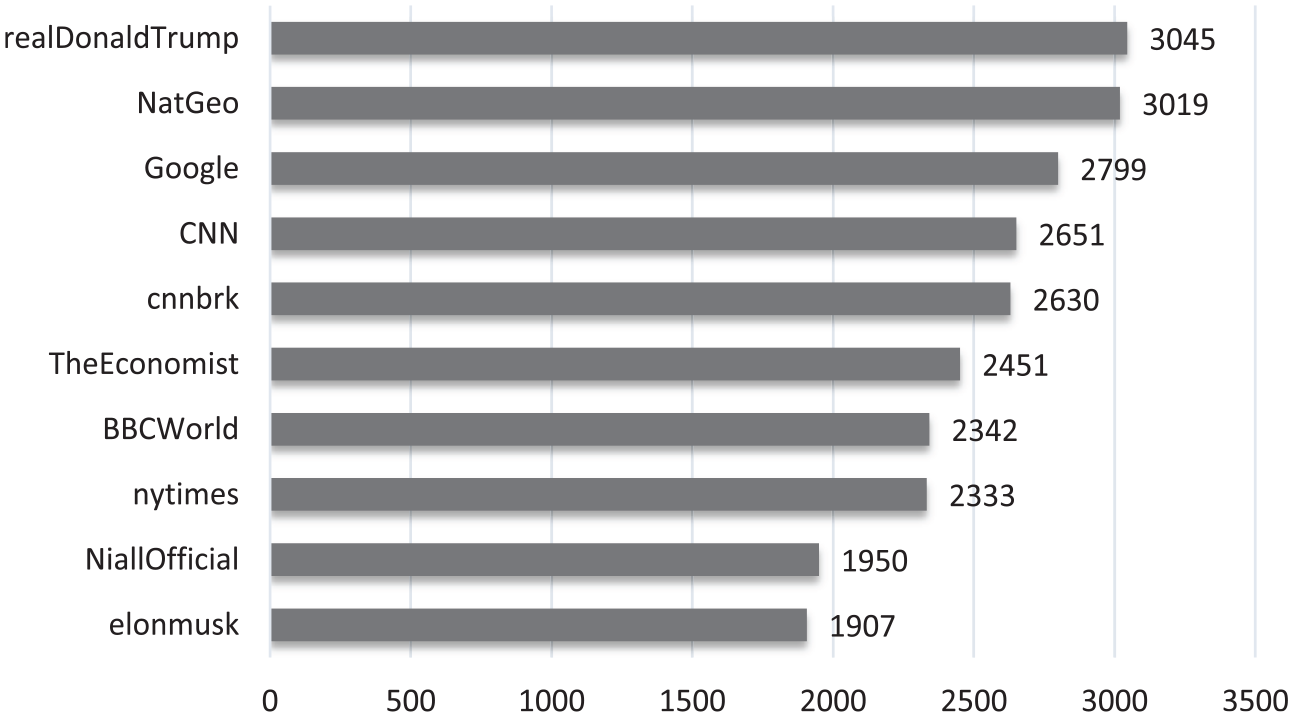
The top 10 accounts with the largest number of tweets produced between 1 January and 31 July 2020.
Yet, producing a huge number of tweets does not mean that the most followed and “productive” voices were equally participating in Covid messaging. Of all 52,551 tweets collected during the period of time, we identified 6,601 Covid tweets; these received in total 16,131,188 retweets and 82,370,796 likes. If we consider the raw numbers of Covid tweets, as shown in Figure 2, then the largest amount of Covid and Covid-related tweets over our period of analysis came from news organizations, but also several other profiles such as that of the Indian prime minister Narendra Modi and the White House (see Appendix B for the full list). It is not surprising to see media organizations, especially their breaking news sections, pay more attention to Covid since by January 2020 this was by far and away the most covered topic. Figure 3 shows the percentage of Covid tweets per account as per the total of number of tweets in our sample. It confirms that the top voices that produced the most tweets about Covid and related matters were media organizations contributing two-thirds of messages, while the remaining one-third was shared between political actors, celebrities of all kinds and commercial organizations.

The top 10 accounts with the largest number of Covid tweets.

The main contributors of Covid tweets in the data sample.
When we consider the proportion of Covid tweets as of the recorded number of tweets per account, then a different pattern emerges (see Appendix C). Global media organizations top the list again but they are also accompanied by some famous personalities, politicians, and businessman including Emma Watson, Neil Patrick Harris, Bill Gates, and Narendra Modi.
Despite being the top account with the largest number of tweets in our data set, @realDonaldTrump, who used to be an avid tweeter until he was banned from using the platform, was not tweeting as much about Covid than he was about other matters. The proportion of Covid tweets for his account stood at mere 5.4% (163 tweets). At the bottom of the list, we also have accounts of various global celebrities including members of the Kardashian family as well as pop stars and bands (e.g., BTS, Ariana Grande, Louis Tomlinson, Taylor Swift), some of whom produced less than a handful of Covid messages, with others producing none (e.g., Adele, Rihanna). Thus, these results show that, quantitatively, celebrities were not driving Covid messaging on Twitter in the first phase of the pandemic, and the claims made in previous literature about their engagement and support for health communications need to be better contextualized and critically evaluated.
Yet, given their global popularity and large followships, even if they produced only a few Covid tweets, the reach and resonance of their Covid messaging was much greater than that of established media voices. Considering the raw number of retweets, Covid messages that received the most retweets were predominantly produced by politicians including Donald Trump, Narendra Modi, Barack Obama, and Hilary Clinton followed by the businessman Elon Musk. It was politicians whose messages were mostly retweeted even though they did not produce as many Covid tweets as did media organizations (see Figure 4). Although not a politician, Elon Musk is a good example of a Twitter profile with very high salience. He only produced 31 Covid tweets, but these were more widely retweeted than those produced by CNN or BBC suggesting that Twitter audiences are more likely to affiliate with messages produced by personalities like Musk and less so with established and reputable media sources. An even more striking example is that of the British pop singer Louis Tomlinson, who only tweeted 6 Covid messages but which were retweeted 330,039 times.
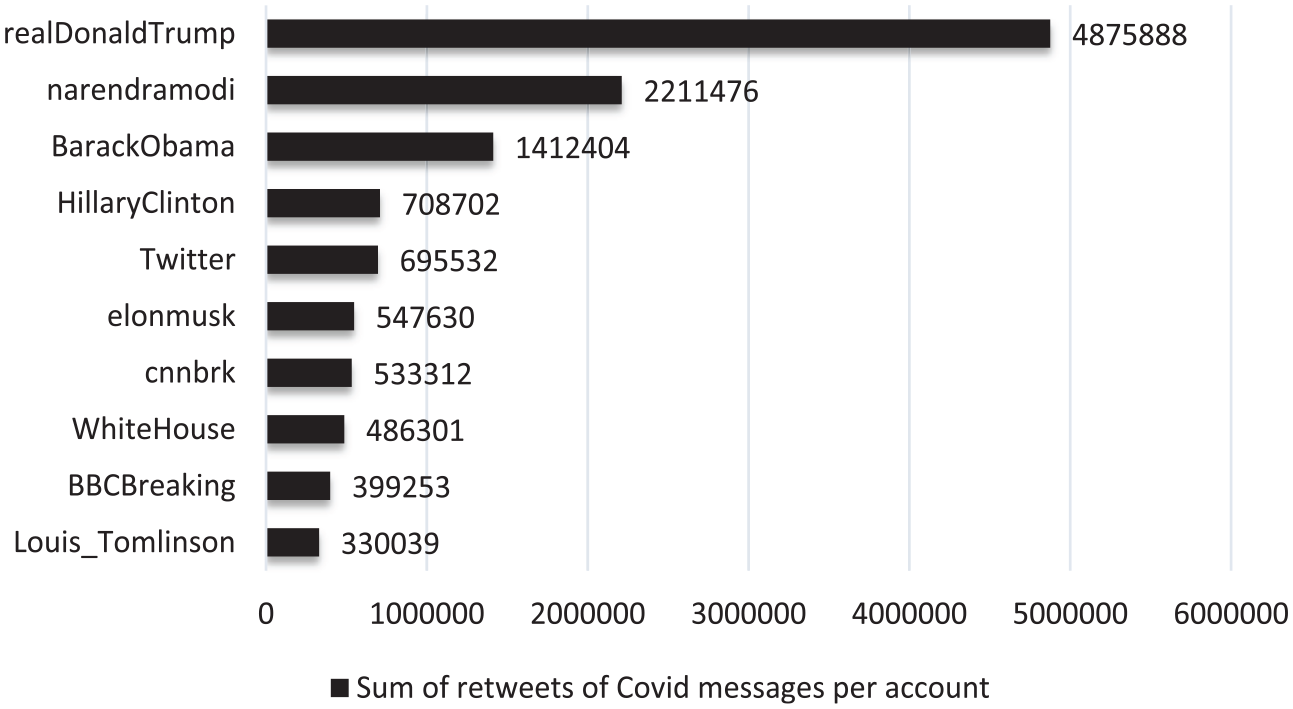
Number of total retweets of Covid messages per account (the top 10).
A similar picture emerged for the likes of Covid messages. Here again, the most liked Covid messages were those produced by politicians as well as Elon Musk and Louis Tomlinson (see Figure 5). The footballer Cristiano Ronaldo made it to the top 10 of most liked Covid messages although he only tweeted 10 times on matters pertaining to Covid.

The number of total likes of Covid messages per account (the top 10).
Similar to understanding the power of profiles and their overall Covid messaging in terms of the raw number of retweets and likes, we calculated the magnitude of Covid-related retweeted tweets. Thus, in addition to the data above showing which profiles had the greatest quantity of Covid tweets, this analysis of magnitude demonstrates another iteration by which profiles had the “loudest” voices and greatest reach about Covid over our analysis period. Put another way, no matter how few or many Covid-related tweets that came from a particular profile, having an elevated magnitude suggested a greater level of voice and engagement by audiences to a profile’s individual Covid tweets relative to other profiles on our list.
Thus, in terms of the magnitude of Covid individual tweets, the British pop singer Harry Styles had the highest magnitude, salience, and reach per tweet with 97k retweets per Covid tweet (see Figure 6). Other profiles with relatively powerful voices about Covid included the Korean pop band BTS (60k retweets on average), Twitter (58k), and the British pop singer Louis Tomlinson (55k) all of whose Covid messages were very much liked and heavily retweeted. In the top 10 were also Barak Obama (48k), Donald Trump (30k), pop singer Taylor Swift (27k), footballer Cristiano Ronaldo (18k), as well as Elon Musk (18k) and the Canadian pop singer Shawn Mendes (17k). With the exception of Barak Obama, Donald Trump, and Elon Musk, the loudest voices produced less than a dozen of Covid messages and, in some cases, only 3 (Harry Styles) or 2 (Shawn Mendes).

Magnitude of Covid tweets as a factor of retweets.
A similar picture emerges if we consider magnitude as a factor of likes. As seen in Figure 7, again Covid messages produced by the two British pop singers were on average most liked by Twitter audience with Barack Obama, Donald Trump, and Elon Musk making it into the top 10 most liked Covid “messengers.”

Magnitude of Covid tweets as a factor of likes.
The findings highlight that in the context of the first wave of the Covid pandemic, when so much was unknown, established media voices such as CNN, BBC, Reuters, and so on had much less resonance and reach compared with powerful politicians like Trump and Obama, pop singers such as Harry Styles and Taylor Swift, and business personalities such as Elon Musk. It was their Covid messages that were on average mostly liked and retweeted suggesting that these individual media, political, and business celebrities were the most salient—and thus the loudest and arguably incredibly influential—with respect to the Covid messaging in the early days of the pandemic. Yet, the question remains: What were these Covid Influencers saying and what kind of messages about Covid were they distributing to their vast audiences? The following section discusses qualitative findings that emerged from the analysis of Covid messages produced by our top 10 loudest voices by magnitude.
Qualitative Insights Into the Utterances of Covid Influencers
Based on the reading and coding of the 264 Covid tweets that were produced by the loudest voices as identified by the magnitude of their retweets, the following communicative functions of the messages were identified: emotional appeal, health appeal, information, explanation, promotion, political agitation, doubt, sarcasm, thanks, instruction, and warning. Overall, these identified categories demonstrate the large variety of discursive functions Covid Influencers were performing and curating when posting messages about Covid on Twitter. Which particular communicative function dominated #CovidTwitter cannot be articulated for two reasons. First, each profile produced vastly different numbers of Covid tweets with, for example, Donald Trump having the most at 163 and Harry Styles the least at only 3 tweets. Second, as we engaged with the data and identified their different communicative functions, it quickly became apparent that each Twitter personality had their particular communicative style and were curating particular narratives. What they produced in their tweets depended very much on their status, that is, whether they were a media celebrity or politician, and the context of the situation in which they were operating in and from at that time.
The profile with the most retweeted Covid tweets in our data set was Harry Styles, a British pop singer who came to fame in the TV competition The X Factor and his subsequent career as a member of the best-selling pop band One Direction. After the band broke up in 2016, he continued a solo career. Harry Styles produced only 3 Covid-related tweets in the time of our data collection, and these were retweeted 290,978 times, with an average of 96,992 per tweet, giving him the highest magnitude of retweets per Covid tweet of any profile here.
His messages performed three dominant functions: promotion, emotional appeal, and health appeal. The most retweeted tweet merged the promotion of his new song Watermelon Sugar with a health appeal. He creatively used the context of the pandemic and the need for social distancing to introduce a video of his new song, in which a group of young people are shown having fun on a beach and engaging in physical contact. The message “DO NO TRY THIS AT HOME” instructs the audiences to not behave like those in the video (see Figure 8). In doing so, he arouses curiosity around the “transgressive” acts of being closely together the video, which is likely to persuade many people to watch it. The text reinforces the necessity of compliance and social distancing, which was the overt pertinent message from “official” sources at that time. And while Styles aligns with public health advice, this is done specifically in the context of advertising and self-promotion. The two other Covid-related messages that Styles posted on his Twitter feed are similar in that they combine promotional aspects (e.g., announcing a new tour which was postponed due to the pandemic) with health and emotional appeal underpinned by imperatives as shown in this tweet:
For the safety of yourself and others, please self-isolate. We’re all in this together. We’re all in this together. I can’t wait to see you out on the road as soon as it’s safe to do so. Until then, treat people with kindness. (H)
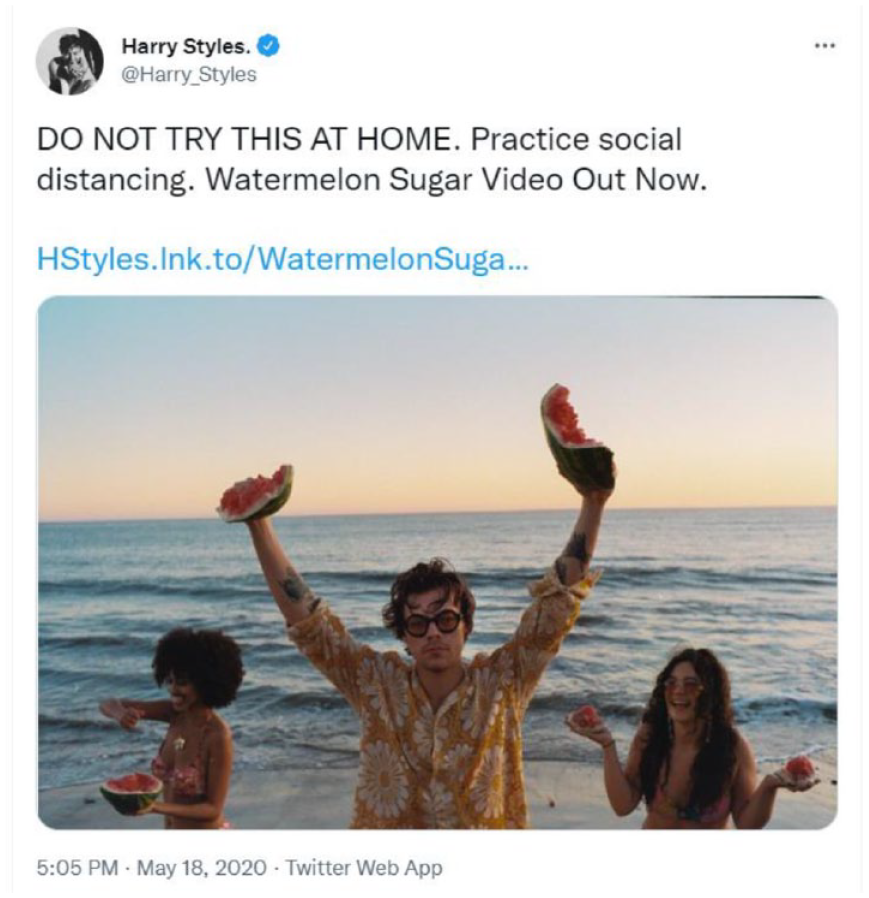
Harry Styles’s most retweeted Covid message.
Thus, the pop singer used Twitter to instruct his vast audience to behave in compliant ways that are required to combat the pandemic, yet he also promoted himself by emphasizing that he will be touring again. He self-presented as a responsible citizen who takes issues around health safety seriously (“as soon as it’s safe to do so”). The emotional appeal was intensified through direct engagement with the audience as demonstrated in the use of the personal pronouns “I,” “you,” and “we.” This helps builds affiliations (“we’re all in this together”) and evokes a sense of an informal spontaneous conversation similar to those that we normally have with friends (“I can’t wait to see you”) (cf. Jaworska & Sogomonian, 2019).
A similar combination of communicative intention was identified in the tweets produced by Louis Tomlinson, Shaw Mendes, and Taylor Swift. All of them utilized the space and affordances of Twitter to do self-promotional work mixed with contextually relevant health and emotional appeal. Similar to Harry Styles, Louis Tomlinson and Shawn Mendes constructed themselves as responsible people who care for the safety of others, but both self-promote at the same by including photographs or videos of themselves (see Figures 9 and 10). All of them use an informal conversational style as evidenced through the use of language that directly addresses individuals and audiences (“I want to check with you”), an inclusive stance (“we”), and personalized messages (“I am really gutted”).

Louis Tomlinson’s Covid-related message.
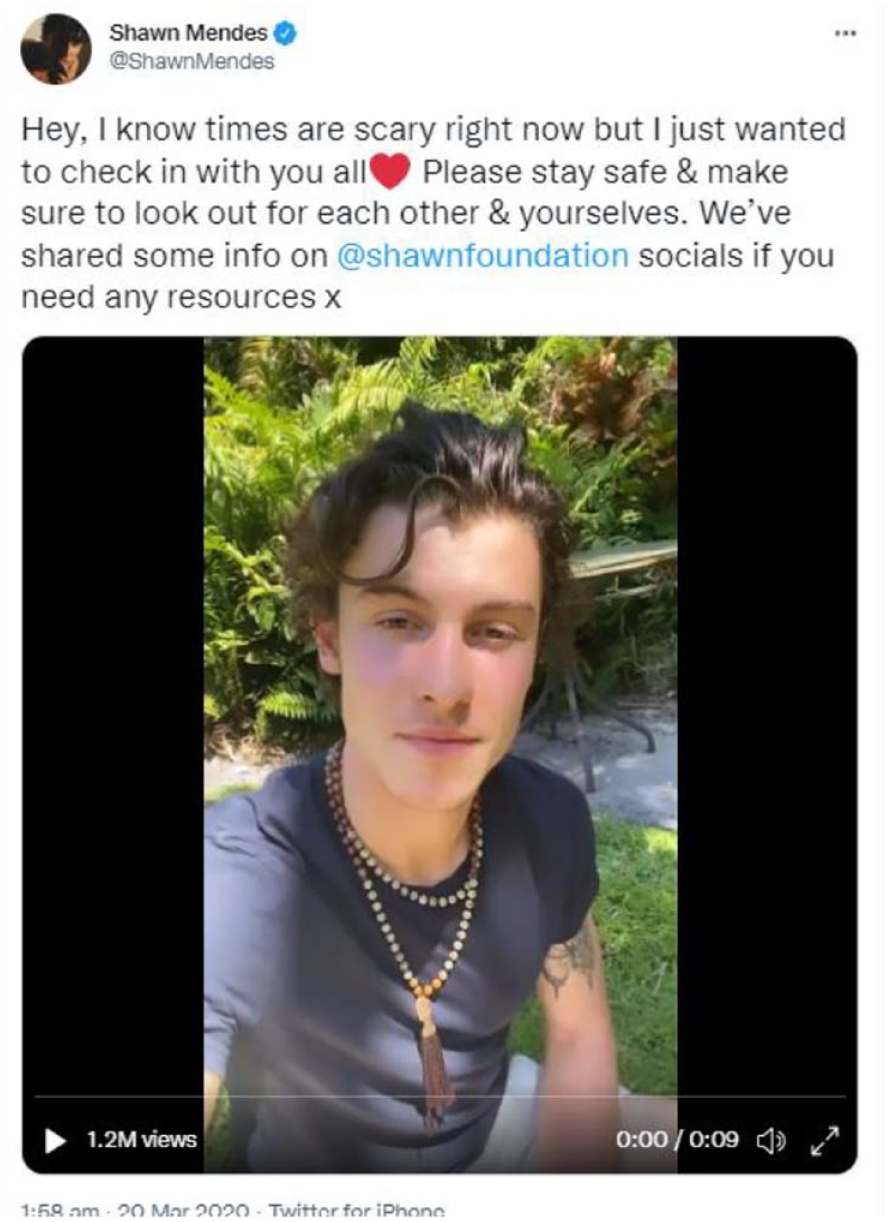
Shawn Mendes’s emotional appeal.
A different style is evoked by the businessman Elon Musk, for whom Covid messaging was predominantly about doubting and critiquing the official reporting on Covid deaths. During the time of data collection, he produced 31 Covid messages, of which 15 questioned the official reporting as misleading. Some of the messages had prominent, obfuscating content, as the examples below illustrate:
Classifying all deaths as corona even if corona didn’t cause the death is simply a lie. Virality of C19 is overstated due to conflating diagnosis date with contraction date & over-extrapolating exponential growth, which is never what happens in reality. Keep extrapolating & virus will exceed mass of known universe!
The use of scientific terminology (exponential growth, extrapolation, statistics) and declarative sentences creates a sense of factual knowledge. Here, Musk uses his Twitter space to construct himself as a knowledgeable expert on matters pertaining to science and specifically epidemiology. The focus on self-presentation as an expert is emphasized by the fact that he is the one who formulates the “facts” and there are no references to other sources of knowledge. While Musk is certainly many things, we can hardly describe him as an epidemiologist. Sometimes, his skepticism turned into sarcasm, which worked to undermine the threat of the pandemic, as in the tweet that he posted on 30 April 2020: “California HHS server crashed. Maybe it has covid.” His Covid messages also tended to be overtly negative, the tone of which was set by his first message on Covid, which read: “The coronavirus panic is dumb.” This is the second most retweeted tweet in our data set (325,626 retweets). He posted it on 6 March 2020, around the time when the first serious COVID-19 outbreak happened in Europe in the town of Bergamo in Northern Italy, where in March alone 670 people died.
In the top loudest voices by magnitude, there were two US politicians: Former president Barack Obama and the then current president Donald Trump. Both used Twitter, yet both communicated in distinctively different ways. Barack Obama produced 30 Covid tweets and a third of those were health appeals encouraging his audiences to comply with the necessary precautions and/or emotional appeals to the sense of community and togetherness. The tweet below exemplifies this kind of messaging:
Protect yourself and your community from coronavirus with common sense precautions: wash your hands, stay home when sick and listen to the @CDCgov and local health authorities. Save the masks for health care workers. Let’s stay calm, listen to the experts, and follow the science.
Yet, as a former president and a politician, he also interweaved political contents into his tweets that aimed to critique directly or indirectly Trump’s government:
This holiday weekend, let’s be safe and smart. It’s going to take all of us to beat this virus. So wear a mask. Wash your hands. And listen to the experts, not the folks trying to divide us. That’s the only way we’ll do this—together.
At the same time, he also expressed thanks and gratitude to those who were working on the frontline during the first wave of the pandemic:
Our medical professionals are heroes putting their lives on the line to keep our country going. Here’s a look at how an ER doctor who already fought on the front lines of one crisis makes it through a day in this one. A good reminder for us to help them out by staying home.
The last dominant function of his Twitter messaging on Covid was sharing information and/or explanations on why certain measures were relevant which, we can assume, was done with the view to foster compliance and educate the public (see Figure 11):

Barack Obama’s tweet.
Not surprisingly, Donald Trump’s tweets represent a different style of communication. Trump is well known for his provoking rhetoric, for the dissemination of which he used Twitter extensively (Kreis, 2017) until Twitter suspended his account following the Capitol riot on 6 January 2021. Trump was quick to recognize Twitter as a strategic means for political agitation and a direct line to the electorate (Enli, 2017). As Bartlett (2014, p. 106) observes, Twitter is an ideal platform for right-wing populists since it is an alternative to legacy media, which populists generally distrust, and it allows anyone to communicate without being edited. In this way, Twitter messages can intensify the sense that communication is coming from “real” people, and not the elites who are seen by the populists as the “enemy” of the “people.”
Previous research on Trump’s tweets has confirmed his direct, overtly negative and polarizing communication style on Twitter, and his attempt to self-present as an authentic, strident “man of the people” (Ross & Caldwell, 2020). This probably explains why during his time in the office he continued to use his personal Twitter account @realDonaldTrump, which through the use of the modifier “real” underscores this supposed authenticity. During our study period, he produced 164 messages that were Covid-related. Of those, 71 messages were direct forms of political agitation, of which more than half had an overtly negative tone. Those messages were explicit attacks on mainly three opponents: Established media, the Democratic Party, and specific members of the Party such as Hillary Clinton. Trump criticized the media, especially The New York Times, for not reporting on his perceived “successes” in combating the pandemic and mainly described their reporting as fake news. Democrats, on the contrary, were accused of not acting, being frequently referred to as “The Do Nothing Democrats.” The tweets below illustrate this direct and accusatory style of communication:
So now the Fake News @nytimes is tracing the CoronaVirus origins back to Europe, NOT China. This is a first! I wonder what the Failing New York Times got for this one? The Do Nothing Democrats are spending much of their money on Fake Ads. I never said that the CoronaVirus is a “Hoax,” I said that the Democrats, and the way they lied about it, are a Hoax.
The polarizing style of his tweets is evidenced through frequent juxtapositions of positive presentations of himself and his administration and negative Other-representations (e.g., media, the Democratic Party) often combined in one tweet:
CDC and my Administration are doing a GREAT job of handling Coronavirus, including the very early closing of our borders to certain areas of the world. It was opposed by the Dems, too soon, but turned out to be the correct decision.
One of the typical features of populist discourse is xenophobia and the tendency to denigrate the “Other” presenting them as threat and/or scapegoat, which can be conveniently blamed for misfortunes. This is a strategy that Trump used in his Covid messaging: This comes clearly into the view in the ways in which he described the Coronavirus as “China Virus” or “Chinese Virus.” In our sample of Trump tweets, these terms are used 21 times, and often in the ways that directly assign the responsibility to China, as the tweet example below shows:
For the people that are now out of work because of the important and necessary containment policies, for instance the shutting down of hotels, bars and restaurants, money will soon be coming to you. The onslaught of the Chinese Virus is not your fault! Will be stronger than ever!
The way in which Trump communicated during the first wave of the pandemic emulates his usual communicative style on Twitter. His messages are simple, direct, and polarizing designed to stir prejudice and hate, especially toward some of the established media and the Democratic Party, while perpetuating an idealized vision of the USA, the Republican Party, and its supporters. The similarities also come into view in the ways in how he uses language including simple adjectives and superlatives (great, sad, fake, best), the first-person pronoun “I,” capitalizations and exclamation marks to underscore his messages—features that have been identified as Trump’s signature style on Twitter (Kreis, 2017). It is the use of this kind of bold, straightforward and first-person messages with extra emphasis that evoke a sense of authenticity and simplicity that is very often used by populists to articulate and further their agenda.
Finally, a different style of discourse was identified in tweets produced by Twitter itself. The corporation produced 12 Covid tweets in total. The message, which Twitter posted on 2 July: “You can have an edit button when everyone wears a mask” is the most retweeted tweet in the data set at 693,049 retweets and most liked tweet at 2,898,910 likes. Here, Twitter tries to encourage Twitter users to wear masks to help slow down the spread of Covid. In a teasing tone, this is set as a condition for the much-desired edit button. It could be said that in this specific message, the company uses the issue of face covering—which turned out to be politically and socially divisive and so likely to be retweeted a great deal—to raise the attention of the platform in a clearly promotional way. This message stands in contrast to the other 11 messages which addressed questions many people were worried about in the first wave of the pandemic, such as symptoms, how to keep safe, and what needs to be done in preparation for a lockdown. All the messages had links to other sources of information, mostly those produced by the World Health Organization (WHO). Among the top 10 loudest Covid Influencers, Twitter’s profile account on its own platform was the only one which supplied regular information on health measures validated by health authorities.
Discussion and Conclusion
During one of the most impactful events in the course of recent human history—the global spread of the COVID-19 pandemic—a series of some of the loudest digital media voices were crucial in telling their massive audiences about the pandemic, how to think and feel about it, and what to do about it with respect to societal and individual responses. They became “translation devices” (Goodman, 2013) of and around the pandemic sharing their feelings, suggesting what experts and/or information to listen to or not listen to and telling us what was going on (or not) in their lives. The implications of the potential life and death power of these individuals and, as we have argued here, “branded” (musical) groups, corporations, and institutions cannot be underestimated.
We conclude with a series of points about what our research says about the making of #CovidTwitter, namely, who were the loudest Covid Influencers and what it was they were saying to their audiences. First, in general, those profiles that produced the greatest volume of tweets about Covid did not garner the most engagement. In short, those who were the loudest in terms of the absolute number of followers, tweets, or the greatest volume of Covid tweets were perhaps quantitatively “loud” but as measured in likes, retweets, and the power of Covid tweets but they were not the “loudest” by way of speaking to audiences in terms of engagement, salience, and virality. This is most starkly expressed through the magnitude of Harry Styles’ Covid tweets: He produced only 3 tweets about Covid but by far and away these received the most engagement of any other profile—and indeed, set of Covid tweets—in the study. In addition, it was the tweets that had a mix of affect, urgings about behavior related to oneself and to others and that, sometimes, also included information about the “products” they produce, which by measure of magnitude, power, and reach were the most salient with audiences. What this suggests is that some sort of mix of emotion, information, direction, connection, and/or a something about the celebrity or profile as a “product” or “service”—unlike simply and only providing health information—produced the greatest engagement with audiences over the initial impacts of the pandemic. Biopolitics and neoliberal capitalism, even during a pandemic, continue to go hand in hand (Foucault, 2010).
Second, this research laid bare the important role that Rojek’s celebritariat, Big Citizens and other elite influencers and profiles in digital spaces play in the biopolitical “caringscapes” of individuals and societies more broadly. Littler (2008) argued over a decade ago that a fundamental part of the job description of being a celebrity is that of caring for others. She and others (e.g., Menga & Goodman, 2022) have argued this given the ways that celebrities had begun to visibly take up roles as the spokespeople for charities and causes (i.e., climate change, fair trade, clean water), their involvement in the likes of “LiveAid” and “Comic Relief,” and how caring for others became an established part of many celebrities’ brands (e.g., Bono, Oprah). As above, this is what it means to be a celebrity or influencer Big Citizen: You care for others because you have an elevated voice, you, perhaps, genuinely do care for others and/or the environment, and/or this allows the development of one’s brand as a “caring” celebrity. In the context of #CovidTwitter, we can see this clearly with the likes of Harry Styles, Shawn Mendes, and other pop stars: They produced caring narratives for us to wear masks, stay at home during lockdowns, and socially distance to keep ourselves and others safe through direct expressions of affect and/or insights into what they were doing, how they were feeling, or how Covid was impacting them.
Yet from our work, a qualification of Littler’s earlier aphorism that celebrity and care are now intrinsically relational is needed. While some celebrities have indeed built care into their public personas, others have done the opposite by building in “anti-care” and “contrarianism” into their embodied, celebrity brands. This is certainly the case with Trump and Musk who, as above, continually pushed disingenuous, muddying, scientifically dubious, and at times, utterly specious discourses from the start of the pandemic and even up to today. What we found then, was a kind of informational and affective elite influencer “battle” between the likes of Trump and Musk—each with a massive followership and engagement though likes and retweets—and their “anti-care” mis- and disinformation campaigns about Covid versus a much more broad “coalition” of musicians, musical groups, and sports organizations articulating affective messages of care, safety and concern to their audiences and those around their audiences. Put in biopolitical terms, we saw the two massively influential profiles of Trump and Musk producing tweets that would most likely lead to sickness and potential death versus another set of elite influencers urging their audiences and others to stay healthy and alive.
This leads to our final point, which is that elite influencers, celebrities, and other branded businesses are not apolitical—and never have been nor will they ever be—and cannot just simply be used or wheeled out to spread information during times of crisis as many in the medical, communications, and health community have argued. That celebrities and other digital influencers are fundamentally political and politicized—and indeed, central to the workings of media capitalism, politics, and contemporary societies more broadly—is a central tenant of celebrity, (social) media, and cultural studies. This should certainly be obvious from not just our research findings, but from the day-to-day travails of anyone who spends any time on social media and on Twitter in particular. If Musk’s purchase of Twitter shows us anything, it is the ways that online media—and the individual and group influencers and profiles who make it up—is not just politicized but reflects, in this case, the political whims of a billionaire rapidly turning into a right-wing troll. Moreover, merely getting the “right” celebrities or profiles to amplify the “right” messages is also complicated by our findings: Who would have thought from casual observation that Harry Styles and BTS would have gained more engagement through their Covid tweets than the likes of, say major, global news organizations? And, surely one would think that one of the most powerful figures and influencers in the world in the form of the US President would be the “right” digital profile producing and amplifying the “right” messages about Covid. Similarly, the supposed virtues of vast wealth also did not lead to the “right” forms of messages by the likes of Musk and, if anything, the globe was probably very lucky he did not own Twitter during the worst days of the pandemic as who knows what kinds of (worse) messages and information could have been spread to audiences about Covid. Overall, any use of digital influencers and celebrities to solve any of the world’s immediate or long-term problems must first and foremost critically engage with and consider the political and politicizing nature of not just digital space as it currently stands, but the very influencers being mobilized as part of any communications strategy.
Potential Limitations of the Study
Our study combines a quantitative analysis based on metrics such as likes and retweets with a qualitative analysis of functions of messages grounded in the the pragmatic understanding of language. While this combination allowed us to identify who the loudest voices were and what they had to say in the context of the COVID-19 pandemic, our research is limited to the monologic or one-way dimension of social media communications—the elite influencers talking to us. Future research needs to consider the dialogic nature of social media and consider aspects such as “who talks with whom” and user responses to messages. This would require application of methodologies such computational network analysis (e.g., Della Giusta et al., 2020) to explore networks of communication or content analysis and other text-focused approaches to study how users engage with messages and what they have to say on contents that social media elite influencers spread.
Coda
In between the start and completion of this article, several important events have occurred to make it virtually impossible to replicate the crucial data collection and analysis at the heart of our findings. The first, as mentioned above, was the high-profile purchase of Twitter (and its subsequent name change to “X”) by the so-called free speech “absolutist” Elon Musk. The second involves the sweeping changes he has instituted at Twitter/X, including a paid for “X premium service” for its authenticating “blue check,” changes to its moderation policies that enable hate-speech to thrive on the platform (Dang, 2023; Knight, 2022; Siddiqui & Merrill, 2023), and crucial changes to the existing Twitter API which allowed researchers to easily access and “scrape” individual tweets from the platform. Being able to scrape and analyze tweets like we have done here—similar to a great many other researchers—has facilitated critical research on social trends, extremism, mis- and dis-information, and the impacts of social media on our digital and offline lives (e.g., Calma, 2023). Yet this ability to conduct research within the digital spaces of Twitter/X have been severely curtailed as Musk has now made it exceedingly expensive and increasingly difficult to use Twitter APIs to conduct this kind of crucial social research on the platform. And, while it appears as if greater monetization of the platform has been his goal from the beginning (Yeo, 2023), a more cynical analysis suggests this is yet another move to block researchers and activists from holding Musk, Twitter/X, and other social media platforms accountable for the material that appears on their platforms and the “real world” impacts this material has on individuals, communities, and societies at large. This lack of transparency is not only problematic for social researchers but is dangerous in light of the increasingly authoritarian, racist, and misogynist movements that organize, strive, and thrive online, many of whom have been given a new lease on life on a Musk-run Twitter/X. It is critical we understand, albeit with hindsight, how and to what effect social media works to facilitate or disempower more socially just, informed, and democratic societies and easy, direct, and affordable access to Twitter/X’s posts—and indeed those on all social media platforms—is essential to the operation of more egalitarian and democratic societies.
Footnotes
Appendix
The Top 100 Most Followed Twitter Accounts (as of August 2020).
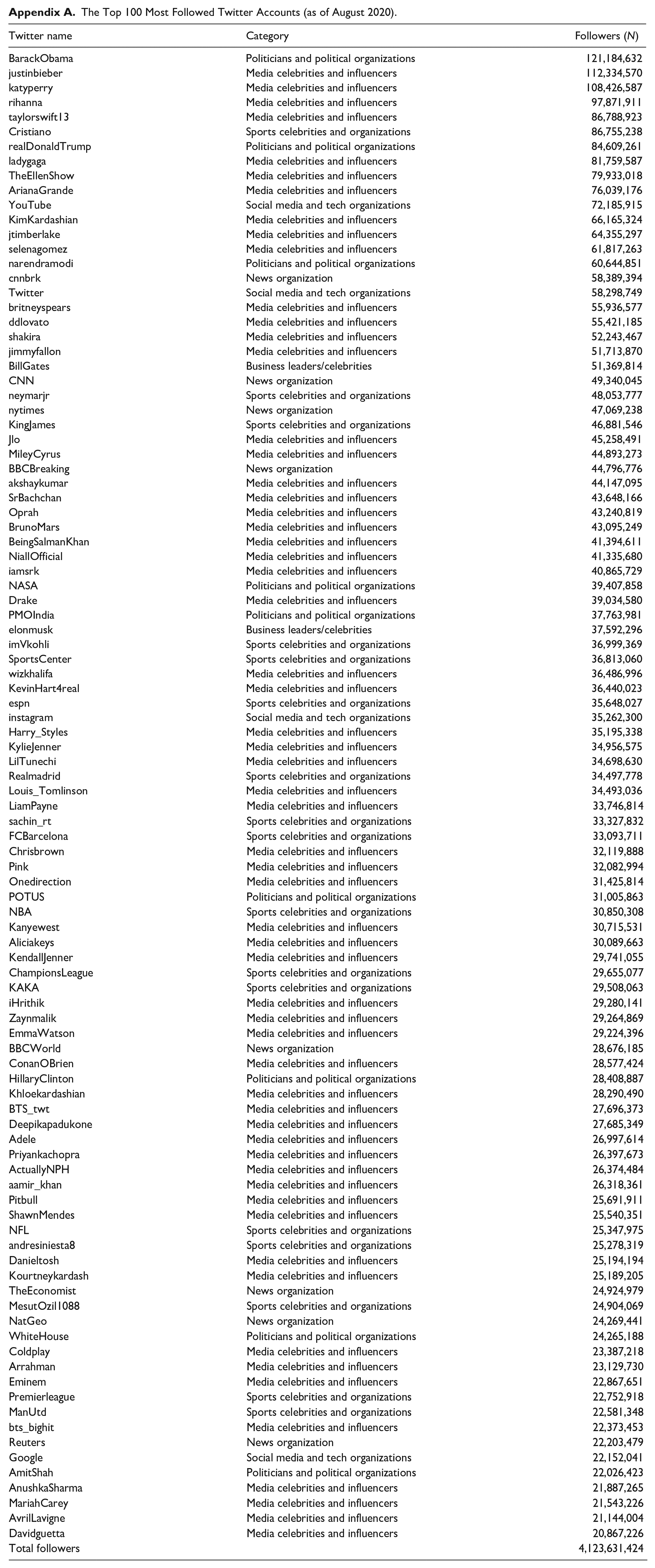
| Twitter name | Category | Followers (N) |
|---|---|---|
| BarackObama | Politicians and political organizations | 121,184,632 |
| justinbieber | Media celebrities and influencers | 112,334,570 |
| katyperry | Media celebrities and influencers | 108,426,587 |
| rihanna | Media celebrities and influencers | 97,871,911 |
| taylorswift13 | Media celebrities and influencers | 86,788,923 |
| Cristiano | Sports celebrities and organizations | 86,755,238 |
| realDonaldTrump | Politicians and political organizations | 84,609,261 |
| ladygaga | Media celebrities and influencers | 81,759,587 |
| TheEllenShow | Media celebrities and influencers | 79,933,018 |
| ArianaGrande | Media celebrities and influencers | 76,039,176 |
| YouTube | Social media and tech organizations | 72,185,915 |
| KimKardashian | Media celebrities and influencers | 66,165,324 |
| jtimberlake | Media celebrities and influencers | 64,355,297 |
| selenagomez | Media celebrities and influencers | 61,817,263 |
| narendramodi | Politicians and political organizations | 60,644,851 |
| cnnbrk | News organization | 58,389,394 |
| Social media and tech organizations | 58,298,749 | |
| britneyspears | Media celebrities and influencers | 55,936,577 |
| ddlovato | Media celebrities and influencers | 55,421,185 |
| shakira | Media celebrities and influencers | 52,243,467 |
| jimmyfallon | Media celebrities and influencers | 51,713,870 |
| BillGates | Business leaders/celebrities | 51,369,814 |
| CNN | News organization | 49,340,045 |
| neymarjr | Sports celebrities and organizations | 48,053,777 |
| nytimes | News organization | 47,069,238 |
| KingJames | Sports celebrities and organizations | 46,881,546 |
| Jlo | Media celebrities and influencers | 45,258,491 |
| MileyCyrus | Media celebrities and influencers | 44,893,273 |
| BBCBreaking | News organization | 44,796,776 |
| akshaykumar | Media celebrities and influencers | 44,147,095 |
| SrBachchan | Media celebrities and influencers | 43,648,166 |
| Oprah | Media celebrities and influencers | 43,240,819 |
| BrunoMars | Media celebrities and influencers | 43,095,249 |
| BeingSalmanKhan | Media celebrities and influencers | 41,394,611 |
| NiallOfficial | Media celebrities and influencers | 41,335,680 |
| iamsrk | Media celebrities and influencers | 40,865,729 |
| NASA | Politicians and political organizations | 39,407,858 |
| Drake | Media celebrities and influencers | 39,034,580 |
| PMOIndia | Politicians and political organizations | 37,763,981 |
| elonmusk | Business leaders/celebrities | 37,592,296 |
| imVkohli | Sports celebrities and organizations | 36,999,369 |
| SportsCenter | Sports celebrities and organizations | 36,813,060 |
| wizkhalifa | Media celebrities and influencers | 36,486,996 |
| KevinHart4real | Media celebrities and influencers | 36,440,023 |
| espn | Sports celebrities and organizations | 35,648,027 |
| Social media and tech organizations | 35,262,300 | |
| Harry_Styles | Media celebrities and influencers | 35,195,338 |
| KylieJenner | Media celebrities and influencers | 34,956,575 |
| LilTunechi | Media celebrities and influencers | 34,698,630 |
| Realmadrid | Sports celebrities and organizations | 34,497,778 |
| Louis_Tomlinson | Media celebrities and influencers | 34,493,036 |
| LiamPayne | Media celebrities and influencers | 33,746,814 |
| sachin_rt | Sports celebrities and organizations | 33,327,832 |
| FCBarcelona | Sports celebrities and organizations | 33,093,711 |
| Chrisbrown | Media celebrities and influencers | 32,119,888 |
| Pink | Media celebrities and influencers | 32,082,994 |
| Onedirection | Media celebrities and influencers | 31,425,814 |
| POTUS | Politicians and political organizations | 31,005,863 |
| NBA | Sports celebrities and organizations | 30,850,308 |
| Kanyewest | Media celebrities and influencers | 30,715,531 |
| Aliciakeys | Media celebrities and influencers | 30,089,663 |
| KendallJenner | Media celebrities and influencers | 29,741,055 |
| ChampionsLeague | Sports celebrities and organizations | 29,655,077 |
| KAKA | Sports celebrities and organizations | 29,508,063 |
| iHrithik | Media celebrities and influencers | 29,280,141 |
| Zaynmalik | Media celebrities and influencers | 29,264,869 |
| EmmaWatson | Media celebrities and influencers | 29,224,396 |
| BBCWorld | News organization | 28,676,185 |
| ConanOBrien | Media celebrities and influencers | 28,577,424 |
| HillaryClinton | Politicians and political organizations | 28,408,887 |
| Khloekardashian | Media celebrities and influencers | 28,290,490 |
| BTS_twt | Media celebrities and influencers | 27,696,373 |
| Deepikapadukone | Media celebrities and influencers | 27,685,349 |
| Adele | Media celebrities and influencers | 26,997,614 |
| Priyankachopra | Media celebrities and influencers | 26,397,673 |
| ActuallyNPH | Media celebrities and influencers | 26,374,484 |
| aamir_khan | Media celebrities and influencers | 26,318,361 |
| Pitbull | Media celebrities and influencers | 25,691,911 |
| ShawnMendes | Media celebrities and influencers | 25,540,351 |
| NFL | Sports celebrities and organizations | 25,347,975 |
| andresiniesta8 | Sports celebrities and organizations | 25,278,319 |
| Danieltosh | Media celebrities and influencers | 25,194,194 |
| Kourtneykardash | Media celebrities and influencers | 25,189,205 |
| TheEconomist | News organization | 24,924,979 |
| MesutOzil1088 | Sports celebrities and organizations | 24,904,069 |
| NatGeo | News organization | 24,269,441 |
| WhiteHouse | Politicians and political organizations | 24,265,188 |
| Coldplay | Media celebrities and influencers | 23,387,218 |
| Arrahman | Media celebrities and influencers | 23,129,730 |
| Eminem | Media celebrities and influencers | 22,867,651 |
| Premierleague | Sports celebrities and organizations | 22,752,918 |
| ManUtd | Sports celebrities and organizations | 22,581,348 |
| bts_bighit | Media celebrities and influencers | 22,373,453 |
| Reuters | News organization | 22,203,479 |
| Social media and tech organizations | 22,152,041 | |
| AmitShah | Politicians and political organizations | 22,026,423 |
| AnushkaSharma | Media celebrities and influencers | 21,887,265 |
| MariahCarey | Media celebrities and influencers | 21,543,226 |
| AvrilLavigne | Media celebrities and influencers | 21,144,004 |
| Davidguetta | Media celebrities and influencers | 20,867,226 |
| Total followers | 4,123,631,424 |
Acknowledgements
This article’s research was supported by funding from the Prosperity and Resilience Research Theme, the Global Development Research Division, and the Human Geography Research Cluster at the University of Reading. Many thanks to Adrian Bell, Alex Arnall, and Hilary Geoghegan for their financial support of this project. Many thanks to the three research assistants who collected and sorted the data into useable formats: Reuben Reid, Joe Freestone, and Pheobe Plunkett. A very large thank you to Jo Littler, Zeena Feldman, Anna Jackman, and Alex Arnall who read earlier versions of the article and greatly improved it. Many thanks also to the journal editor, Zizi Papacharissi, and the very helpful comments from the reviewers. Finally, M.G. would like to thank his Consumption, Politics, and Space classes, who had to endure lecture slides with lots of bar charts, tables, and images showing Covid tweets, retweets, and likes; as always, they kept and continue to keep him on his toes. Any omissions or errors remain those of the authors.
Declaration of conflicting interests
The author(s) declared no potential conflicts of interest with respect to the research, authorship, and/or publication of this article.
Funding
The author(s) received no financial support for the research, authorship, and/or publication of this article.
