



Abstract
Despite the widespread use of YouTube by children, there has been limited research undertaken on the “why” questions of their use. Past theoretical approaches have framed these questions in terms of broader individual needs and their relation to media use, though this work has mainly focused on adults and adolescents. This article presents relevant findings from a mixed methods study of children’s (aged 0–16) uses of social media in the United Kingdom to consider instead the “purposes” of children’s YouTube use, drawing on: (1) an online family survey; (2) family case studies; (3) child focus groups; and (4) child telephone interviews. “Purpose” is theorized in the article in relation to the ways children themselves make sense of and articulate the reasons they use YouTube or, in the case of parents and carers, for allowing, facilitating, or encouraging their children to use YouTube. Parents tended to frame the purposes of children’s YouTube use more instrumentally, focusing on perceived educational benefits and their own convenience needs. While sharing a focus on instrumental purposes, children sometimes emphasized broader dimensions of purpose, with an increased focus on humor, sensory, and hedonic dimensions. Children’s responses also emphasized the autotelic nature of play. The study foregrounded the extent to which the purposes of others (such as commercial entities) are served by children’s YouTube use. Seven child-centered, parent-centered, and “other” purposes for children’s YouTube use are discussed: cognitive, corporeal, cultural, collaborative, creative, commercial, and convenience.
Keywords
Introduction
Since its launch in 2005, YouTube has grown in popularity and is currently the most popular internet site for children in the United Kingdom (Ofcom, 2022). YouTube can be considered a form of social media, that is, it enables users to create and share content and/ or network with others. YouTube is also a powerful commercial entity, whose users are presented with an ever-growing range and complexity of commercial content (Schwemmer & Ziewiecki, 2018). Despite widespread use, there has been limited research undertaken on children’s engagement with YouTube (Neumann & Herodotou, 2020). YouTube is ostensibly aimed at users aged 13 and above, yet its children’s content is among the most popular on the platform. In July 2022, ChuChu TV Nursery Rhymes and Kids Songs had over 57 million subscribers. 1 Anastasia Radzinskaya, the 8-year-old child star of “Like Nastya” was the sixth highest YouTube earner in 2021, accruing $28 million (Iqbal, 2022). YouTube Kids was launched in 2015 in an attempt to provide a bespoke service for children, but there is some evidence that children are still largely viewing YouTube and that it is facing increasing competition from the video-sharing platform TikTok, which is also aimed at users aged 13 and above (Ofcom, 2022).
As such, it was felt that a study which explored children’s uses of it in greater depth would be valuable. The large-scale study reported in this article, undertaken in 2018, was devised to examine UK children’s (aged 0–16) engagement with social media and television. The overall study examined multiple themes. Rather than presenting comprehensive findings of the overall study, which was large in scale and has been reported elsewhere (Marsh et al., 2019), this article draws on theories of children’s motivations and their play to address the questions: (1) What are the purposes for children’s uses of YouTube? and (2) How do the findings contribute to rethinking what drives children’s uses of social media through the lens of “purposes”?
Theorizing “Purpose” in Children’s Uses of YouTube
Why do children use YouTube? What for? Why do parents and carers of children allow, facilitate, or actively support this use? While definitively understanding the “whys” of children’s media use may represent a philosophical impossibility, media scholars have nonetheless attempted to theorize the reasons, often framing this study in terms of motivations and the needs a child is seeking to meet by undertaking a particular activity, something Galpin (2016) has previously termed a “needs approach” (p. 385). The uses and gratifications (U&G) approach associated with Katz et al. (1973b) constructed media users as both cognizant of their own needs and intentional in selecting particular media experiences to gratify them. The authors’ largely quantitative approach considered both the holistic human needs that individuals brought to their media use (“uses”) and the extent to which the media they engaged with fulfilled those needs (“gratifications”). The authors’ collapsed typology for understanding audience needs identified: (1) cognitive needs, associated with knowledge and understanding; (2) affective needs related to pleasurable and emotional experiences; (3) needs associated with confidence and status; (4) the need for connections with others and the world; and (5) needs associated with escapism or tension release. Deci and Ryan’s (1985) Self-Determination Theory (SDT) also proposed that human behavior is motivated by needs, specifically for autonomy, competence, and relatedness. In keeping with Katz et al., however, other approaches have emphasized that children’s media use is also motivated by hedonic aspects of need, that is to say, children engage with media to fulfill needs relating to arousal and affect (Tamborini et al., 2011). Needs approaches have been widely critiqued for their ingrained assumptions that media use is motivated by rational, intentional thought and individual choice. Conversely, Ang (1996) emphasizes that people are “always-already implicated in, and necessarily constrained by, the web of social relationships and structures” (p. 34). Though some aspects of social context are captured in SDT and the U&G approach, both overlook the fact that individuals, and children especially, are parts of broader social, cultural, and material contexts that place limits on aspects of their agency in media use. For example, the type and amount of content children access on YouTube can be influenced by personal choice in combination with the rules set by primary caregivers, local content restrictions, and the availability and quality of particular devices and internet access.
A further critique of needs approaches corresponds with the growing body of literature that characterizes children’s engagement with moving image media, including YouTube, as a form of play (Marsh et al., 2018). Play scholars have argued that play is an autotelic practice (Eberle, 2014), undertaken for its own sake rather than in the pursuit of a particular goal. Rautio (2013) has urged adults to abandon the “why” questions associated with these practices and instead “consider seriously what takes place in practices that children usually find inherently rewarding” (p. 395).
While acknowledging, and concurring with, critiques of U&G approaches, we would argue that there is still value in attempting to understand what drives children to engage with social media. In recent years, topics such as risk and instrumental educational potential have sometimes been over-emphasized within the study of children’s digital lives. Though this work is vital, understanding how children and their families make sense of the “why” questions about their digital and media choices adds important context to understanding what children “get out of” digital engagement. Since the data reported in this article relied primarily on the self-reports of children and their parents and carers, “purpose” is employed in the article to denote the ways that children themselves articulate their motivations for using YouTube or, in the case of parents and carers, for allowing, facilitating, or encouraging their children to use YouTube. Our intended meaning for the term “purposes” is thus distinct from “uses” and “gratifications” because it relates to how individuals make sense of their own behaviors and choices, rather than purporting to represent children’s holistic needs and their relation to digital media choices and behaviors. Our use of the term “purposes” is respectful of U&G approaches while representing a theoretical step away from them. In a sense, we propose starting further back before moving forward, looking to the early, qualitative studies that Katz et al. (1973a) critiqued as studies “whereby statements about media functions were elicited from the respondents in an essentially open-ended way” (p. 509). In the next section, we offer a brief overview of research undertaken to date that addresses children’s uses of YouTube and their purposes.
Children’s Uses of YouTube and Their Purposes
Recent studies have employed U&G approaches to consider the media habits of young adults and adolescents. However, few have employed U&G approaches to consider children’s digital and media engagement, particularly from a child’s own perspective, arguably emphasizing the difficulty of understanding children’s needs and their relation to digital and media use. Broekman et al.’s (2016) parent survey study offers a useful example of how parents perceive their own needs when seeking apps for their children, some of these needs being described by the authors as more adult- or more child-centered. Other recent studies have employed similarly creative approaches, including by analyzing customer reviews of children’s tablets (Schlebbe, 2023). Given a lack of research focusing on the U&G of children’s YouTube engagement, we have reviewed more general work on children’s YouTube engagement, which offers some indications of what children use YouTube for and what they appear to gain from this use. Research on children’s uses of YouTube to date encompasses a broad range of topics and approaches, summarized here as four strands. First, scholars have examined the extent and nature of children’s YouTube use. Studies suggest children are engaged with YouTube from birth, either watching it directly themselves or through the activities of their parents and carers (Marsh et al., 2015). Children in their first 6 months of life are attracted to the music videos of YouTube, and by 2 years old, children are requesting videos and attempting to navigate the screen independently (Yadav et al., 2018). YouTube is also attractive to older children and teenagers, although Livingstone et al. (2014) have also noted that it is one of the top platforms this age group finds problematic in terms of content, particularly pornographic and violent content.
Second, a number of studies have focused on children’s uses of YouTube for specific activities. The popularity of videos linked to game playing has been noted by a number of researchers, in particular the use of YouTube to pursue interest in Minecraft (Dezuanni, 2020). Dezuanni points to the presence of “peer pedagogies,” in which posters and viewers support each other in learning how to play Minecraft more effectively, suggesting cultural, collaborative, and cognitive purposes. Studies demonstrate how YouTube has served to circulate other specific popular cultural interests, such as virtual world machinima (Marsh, 2015). Lange (2014) points to its value as a participatory (collaborative) network, as children create and view videos as part of peer communities of practice; spaces where children engage in activities drawing on shared routines, conventions, and histories. Music is an important element of children’s cultural lives, and YouTube plays a significant role in related cultural practices, including as a space for tween fandoms (Bickford, 2016). YouTube also serves a cultural purpose in the sharing and learning of traditional playground games and rhymes (Veblen et al., 2018). Parents have described play and creativity as key drivers of their young children’s use of apps (Marsh et al., 2021), including YouTube (Marsh et al., 2018). Other studies have provided insights into parent motivation for allowing children’s YouTube uses, including their own convenience purposes, such as occupying a child to enable them to undertake household tasks or encouraging a child to eat or brush their teeth (Chaudron et al., 2018; Elias & Sulkin, 2017); educational; and cognitive purposes (Chaudron et al., 2018).
A third set of studies focus on individual and broader societal concerns about the possible risks of children’s YouTube use. Echoing earlier debates about television, scholars have questioned whether YouTube poses risks associated with inappropriate content and the advertising of particular products, including food (Coates et al., 2019). Many studies focus on the commercial dimensions of YouTube, especially their impact on children’s consumption. In the case of the “unboxing” phenomenon, Craig and Cunningham (2017) point to the labor involved in a child presenting what is effectively advertising for commercial products, though Marsh (2016) has emphasized that child viewers of unboxing videos are often watching because they wish to participate in a shared practice of playing with a specific toy. The YouTube content that children consume and produce increasingly blurs genre boundaries, raising important ethical questions, as Jaakkola (2020) discusses in more depth. For example, toy review videos frequently combine review, branded content, and entertainment, raising ethical questions about how explicit YouTube posters must be about defining the precise mode of their content. Furthermore, a range of recent work has addressed the role that human action and algorithmic intelligence are entangled in informing the content children view on YouTube, both through their own searching (Izci et al., 2019) and the search strategies of their teachers (Fyfield et al., 2021).
A fourth strand discusses the benefits of children’s YouTube engagement. Many have focused on learning, not least during the recent COVID-19 pandemic (Steinke et al., 2022) and the principles by which good educational content can be judged (Neumann & Herodotou, 2020; Shoufan, 2019). Dyosi and Hattingh (2018) considered South African children’s informal learning with YouTube, noting that there was both incidental and self-directed taking place. Others have argued that corporeal uses of YouTube may support children’s physical development (Chu & Hale, 2022), foregrounding the popularity of exercise videos produced during the COVID-19 lockdown.
Altogether, these studies suggest a range of purposes for children’s uses of YouTube. These have been collapsed under four thematic headings to serve as a framework for the presentation of findings in the article: (1) cognitive and creative purposes; (2) cultural and collaborative purposes; (3) corporeal and convenience purposes; and (4) commercial purposes. First, however, the study’s design and process are outlined.
Materials and Methods
To support the overall study’s aim of examining UK children’s (aged 0–16) engagement with social media and television, we deployed a mixed methods study of a convergent parallel design. Figure 1 presents a visualization of the research design. The research design was guided by the aims of the study, that is, four complementary methods were chosen to support the development of an expansive understanding of the topic. The theoretical approach was broadly what has been described as interpretative or interpretivist (Braun et al., 2022; McChesney & Aldridge, 2019), that is, guided by the notion that reality is situationally co-constructed and that data collection, analysis, and interpretation are all to some extent shaped and situated by research teams. The data collection featured four stages, one quantitative and three qualitative. While the four stages were timed successively (with the exception of Stages 2 and 3, whose timings overlapped), none of the findings of any stage informed the design of any of the others. Each dataset was analyzed independently, as described below, but interpreted collectively. The purpose of integration was convergence, that is, the findings across all four datasets were synthesized to develop a more complete understanding of UK children’s (aged 0–16) engagement with social media and television. For this article, we reviewed the overall study’s findings across all four datasets to identify insights relevant to the topic of children’s uses of YouTube and their purposes. Where necessary, additional analyses of both the quantitative and qualitative data were undertaken to generate more detailed insight in particular areas.

The mixed methods research design.
An overview of the samples for each stage can be found in Table 1. Stage 1 was conducted first and consisted of an online study conducted across 3,154 UK families, answering in reference to 3,154 focus children aged 0–16: 37.3% aged 0–7% and 62.7% aged 816. The sample was recruited from an established panel in line with industry practice, where parents were invited to complete the survey together with their children. In the case of older children, some completed it themselves with the support of parents. The survey respondents were drawn from a nationally representative sample, to ensure balanced distribution across age, gender, ethnicity, socio-economic class, and geography.
Sociodemographic Characteristics of the Children in the Online Survey, Case Study, Focus Group, and Telephone Interviews Samples.
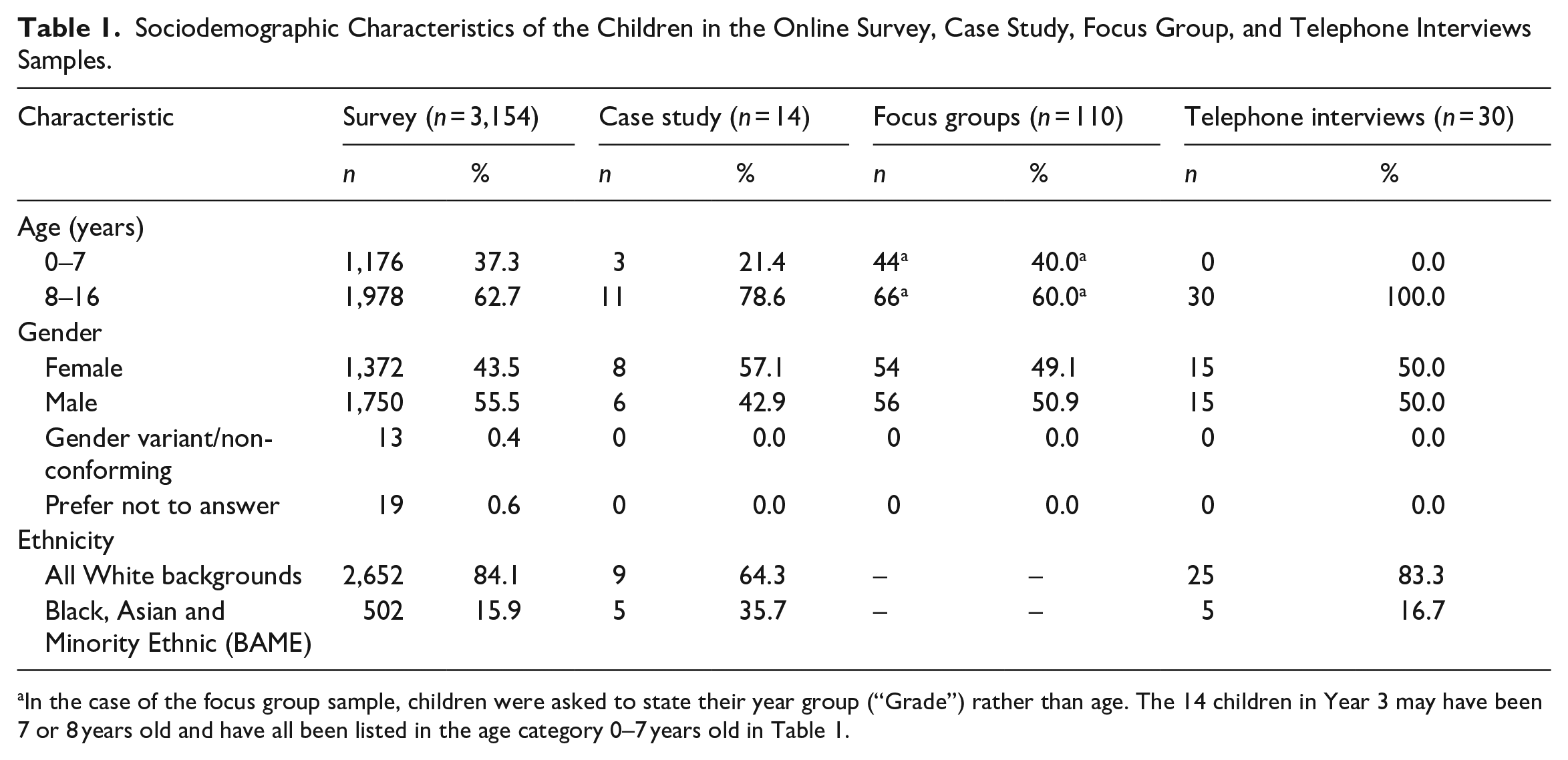
In the case of the focus group sample, children were asked to state their year group (“Grade”) rather than age. The 14 children in Year 3 may have been 7 or 8 years old and have all been listed in the age category 0–7 years old in Table 1.
The fieldwork periods for Stages 2 and 3 overlapped. In Stage 2, six case studies, conducted in family homes, provided deep insight into the perspectives and everyday practices of a small number of children and their families, including very young children as young as 3 months old. The families were visited 4 or 5 times over a 3-month period. Parents and children were interviewed and videoed. Parents filmed their children using social media, and they and their children were asked questions about the videos. Children in the families were given diaries to record their use of social media and television. 2 This work generated the observational and video data needed for analyses of practices, alongside the sustained reflections of children and other family members. It was also an appropriate approach for use with younger children (<5), who were not included in the other forms of qualitative data collection. Families were recruited through established contacts with the research team, including contacts with schools and previous research study participants (convenience sampling). The families were diverse in terms of income and one of the children had Down’s syndrome.
In Stage 3, focus group interviews conducted with 110 children in 7 primary schools enabled the team to include a larger cohort of mid-age-range children in the qualitative data collection. The children took part in focus group interviews, completed collages, and completed concept maps. This data reflects children’s own articulations about the purposes of their YouTube uses. The schools served demographically diverse communities, including primarily White working-class communities and primarily working-class communities with mixed heritages, including Pakistani and Somali heritages. Finally, in Stage 4, telephone interviews enabled researchers to engage in extended discussions with older children (30 children aged 12–16) about their uses of YouTube. These were recruited by asking for volunteers from those families who completed the survey.
Ethical issues were addressed throughout the study, in line with the BERA Ethical Guidelines for Educational Research, fourth edition (2018). The notion of informed consent underpinned the approach to the research, with an understanding that, for young children, assent must be judged through ongoing assessments of the child’s body language in addition to other potential markers of discomfort. A small reward in the form of vouchers was given to participants to acknowledge their time commitment.
Data Analysis and Reporting
Responses from each question in the survey were cross-tabulated against a range of variables, such as the child’s age and gender. Various steps were taken to test the validity of the statistical findings. All variables were analyzed using the chi-square test of association to indicate statistically significant relationships (Field, 2017). Statistically significant results were highlighted at the 1% and 0.1% levels of significance to account for the large size of the dataset and repeated statistical testing. In addition, post-test “Cramer’s V” effect sizes were calculated in cases where statistically significant results at the 1% level were found. The qualitative data were analyzed using thematic analysis (Braun et al., 2022). The data were coded in NVivo in a predominantly inductive manner. This involved an in-depth reading and rereading of the qualitative data by several researchers to develop initial codes. The researchers were, however, familiar with relevant existing research literature regarding children’s YouTube uses. As such, the coding can be considered both inductive and deductive, in the context of some awareness of existing themes and theories. As noted above, the four datasets were interpreted collectively. In line with an interpretivist theorization, multiple members of the team were involved across all of the data analysis and met regularly to reflexively discuss the quantitative findings, qualitative codes, and potential and agreed qualitative themes.
For this article, we reviewed findings across the four datasets to identify insights relevant to the topic of children’s uses of YouTube and their purposes, again in relation to a review of existing relevant literature. A range of survey measures, and collated responses to open-ended questions, were pertinent, such as: children’s content consumption and engagement choices; the purposes for their content choices; their search strategies; the social contexts of their content choices; children’s content production practices; and children’s engagement with advertising. Where necessary, additional analyses of both the quantitative and qualitative data were undertaken to generate more detailed insight in particular areas. In the next section, we present relevant findings from the survey and across all three stages of the qualitative data collection. In each case, we explain what they reveal about the purposes of children’s YouTube uses. While we do not consider the study’s qualitative findings to be generalizable, we do consider that they are likely transferable (Lincoln & Guba, 1985) to other situations. The descriptions provided in this article and longer study report are intended to offer other researchers of children’s digital engagement opportunities to apply the ideas discussed to other situations. Fuller materials and methods, including the quantitative instruments and full qualitative research tools, can be accessed in the study’s overall report (Marsh et al., 2019), ensuring that other researchers can duplicate the study.
Results
The study highlights that children’s YouTube uses serve the purposes of children, parents, and other individuals and organizations beyond. Family responses to the survey indicated that children demonstrated considerable independence in their YouTube content choices, with many families saying that children always (58%) or sometimes (35%) found content on their own. Only 7% said children never found content alone. However, age made a difference, with more families of under 8s (13%) saying children never found content alone. It is, then, particularly important to consider the purposes of parents and carers in the case of younger children, for whom adults play an important mediating role (Scott, 2022) and whose YouTube content choices appear more strongly influenced by adults than those of their older counterparts. Families were asked to indicate who influences the decision to watch particular types of content (Figures 2 and 3). There were important differences in who influenced the decision to watch particular types of content and some of these differences are discussed in more depth within the four themes, below.

Influences on the decision to watch a range of content for children aged 0–7 years, according to the online survey (N = 1,176).

Influences on the decision to watch a range of content for children aged 8–16 years, according to the online survey (N = 1,978).
Data about the search strategies families use for finding content offer further valuable insights into children’s agency and influences in selecting content. Finding content using the search bar function was the most popular strategy for both children (60%) and adults (60%). The popularity of this strategy suggests considerable intentionality on the part of both children and adults in relation to YouTube content choices for children, as users must input a particular word, part-word, or phrase into the search bar by speaking or typing. YouTube’s algorithms also play an important role in the content returned in a search bar search (Covington et al., 2016). The content children watch thus reflects the purposes, values, ideas, and politics (Selwyn, 2019) of the algorithm’s designers. These findings emphasize that others, with other purposes, play roles in children’s media choices, echoing Rautio’s (2013) notion of relational agency. Where relevant, the purposes of children, parents, and others are discussed across the four themes, below.
Theme 1: Cognitive and Creative Purposes
Past approaches have emphasized individuals’ uses of media to strengthen information, knowledge, and understanding and to strengthen confidence, stability, and status. These purposes were clustered under the term “cognitive” purposes in this study, to emphasize purposes that relate to thought and knowledge acquisition. Some studies have also emphasized creativity as an important driver of children’s use of apps, including YouTube (Marsh et al., 2018). Findings from the survey and qualitative case datasets offer further insights into the cognitive and creative purposes of children’s YouTube engagement. Parents were more likely than their children to choose content for children that they perceived to be “educational.” There was greater consonance around choosing educational content and videos related to schoolwork between older children (8–16) and their parents than younger children (0–7) and their parents. The qualitative data add depth to the survey findings, with parents giving particular examples of their families using YouTube as an educational resource. In Family 4, for example, Tanya (10) and Lily’s (8) Mum talked about using YouTube to research Black History with the girls, as they found schooling wanting in that regard.
Broadly, however, children’s content choices suggest a diverse range of motivations for engagement beyond the primarily or instrumentally educational. In response to the same survey question, younger children (0–7) were more likely than their parents to choose videos of play and toys (such as slime and Play Doh) and nursery rhymes (Figure 2). Older children (8–16) were more likely than their parents to choose music videos and funny videos, pranks, jokes, and challenges (Figure 3). Despite greater overlap in the purposes of older children and parents, then, children in general appeared to prioritize cognitive purposes beyond the formally “educational,” as well as cultural, collaborative, and corporeal purposes more so than their parents. The qualitative data add considerable nuance here. Like their parents, many children emphasized that videos can be educational and talked about using YouTube to solve specific problems. There were examples of children using YouTube in ways that supported formal learning. For example, YouTube viewing helped with homework, as one parent of twin 11-year-old girls noted:
Like last year they had to do a project about the Vikings I think, and Nina looked up all kinds of stuff about weaving and things like that, and we made a loom and she made a little Viking belt thing, which was brilliant. (Nina and Susie’s Mum, Family 2)
However, children’s learning in relation to YouTube was both formal and informal, as well as sometimes self-directed and incidental. Children learned how to operate particular toys incidentally as they watched unboxing videos. At other times, they sought out specific videos to help them understand how to use particular toys. In Family 1, Onya (8) liked to perform what her Mum called “life hacks”:
Onya plays with dolls, so she was quite into using Play Doh and making like dresses for her Barbies, and she got that idea . . . from YouTube. She’s always trying to do life hacks. (Onya’s Mum, Family 1)
Life-hacking content for children and their families has been popular on YouTube for some time. To give an example, “Best Crafts and Hacks For School”
3
has received 864,632 views to date. Kitchen science experiments were also popular, including for 11-year-old Rayna:
She was watching tons of stuff, and it would be like you’d find experiments all around the house [. . .] So that came from watching stuff . . . So lots of things where she might use, oh I don’t know, cornflour . . . I mean making slime was lots of experiments, and actually looking up how to do it. (Rayna’s Mum, Family 6)
Meanwhile, a number of children, such as Millie (14), said they used YouTube and other social media to relieve boredom:
But it’s just like moments I guess, with a lot of internet stuff it’s just moments where you just get bored and it’s just something to do, like it’s something to scroll through. I think sometimes, especially having a phone that you can just pick up, it’s like sometimes there’s not really much of a purpose, you just . . . and it’s not a feeling of missing out, it’s just if you’re really, really bored, to be honest. (Millie, Family 3)
Accessing YouTube content to relieve boredom often prompted new activities. Indeed, boredom has been shown to be central to learning and creativity (Belton & Priyadharshini, 2007). As a purpose for children’s YouTube use, then, boredom can also be understood in relation to the cognitive domain, as children seek to stimulate their thinking through engagement with content.
Connected to this, and in line with an acknowledged increase in children’s video production (Ofcom, 2022), the survey data emphasized creativity as an important purpose for children’s YouTube use. Notably, 17% of 0–16-year-olds uploaded their own videos to YouTube, many of which related to computer gaming, singing, or talking with family or friends. Boys represented almost two-thirds (64%) of those uploading their own videos, with girls representing only 36%. A recent study suggests greater gender parity among pre-teen YouTube influencers than this, although in that study more boys uploaded gameplays and more girls uploaded lifestyle content (Castillo-Abdul et al., 2020). In this study, age also made an important difference, with 23% of 8–16-year-olds uploading videos to YouTube in contrast to 11% of under 8s. Older children were more likely to upload videos of themselves playing video games, whereas younger children were more likely to upload videos of themselves singing songs. In the qualitative data, children articulated being able to express themselves as a purpose for using YouTube. Twelve-year-old Frankie (Family 6) had produced a series of videos with his friends a few years prior to the study. Frankie and his friends parodied music or filmed themselves completing challenges. The boys had enjoyed localized popularity, with their classmates viewing and commenting on the videos, emphasizing the ways YouTube supports children’s participation in communities of practice. In Family 4, Tanya (10) and Lily (8) had formed a musical duo and talked about using YouTube to launch their “brand.” The study documents some of the evolving practices in accessing, consuming, and producing texts made possible by shifts in technology, as well as a continued trend toward children’s production of digital texts, alongside their consumption (Bers, 2018). In addition to creating digital content, children drew on digital content, including stories and characters encountered on YouTube, in their non-digital play and creation, demonstrating the seamless movement of children’s play across digital and non-digital contexts. While they were without question creative, many of the observed and discussed production activities appeared to represent distinct cultural text production practices, which some have described as “mimetic” (Nicoll & Nansen, 2018), and do not yet appear to reveal a significant increase in more critical forms of text production, such as fictional filmmaking. This suggests there is still scope to support children in embracing the full creative opportunities provided by contexts such as YouTube, in line with other work (Wohlwend, 2015).
In sum, children and parents appeared to view cognitive and creative purposes as important drivers of children’s YouTube engagement. However, there were, at times, important differences in how cognitive drivers were understood. Both parents and children appeared to understand the cognitive aspects of children’s YouTube engagement in terms of children’s needs to strengthen information, knowledge, and understanding. However, children, particularly younger children, appeared to have a broader definition of the sorts of information, knowledge, and understanding needs they sought to fulfill, placing greater emphasis on learning about popular toys and learning about, and engaging with, peer trends. Children’s cognitive purposes appeared intertwined with their participation in peer cultures, suggesting a desire to strengthen confidence, stability, and status in relation to other children. Children also appeared more inclined to articulate the creativity implicit in their YouTube practices than their parents. In this sense, thinking back to the question of what drives children’s uses of social media through the lens of “purposes,” the study’s findings emphasize that children and adults sometimes have different motivations for children’s cognitive usages, and thus “purpose” can sometimes be defined and understood differently across these groups.
Theme 2: Cultural and Collaborative Purposes
Past approaches have emphasized both how YouTube has served to circulate and amplify children’s cultural interests and how children have engaged with YouTube as a participatory network. Acknowledging this, this study considered both “cultural” and “collaborative” purposes. Findings from the survey and qualitative data offer insights into both. When asked how children decided which videos to watch on YouTube, families said word-of-mouth at school was the most significant influence (44%). This finding supports the notion that children’s media use is driven by a desire for social connection with peers. The content families chose, and the reasons they articulated for those choices, also emphasize the cultural purposes of children’s YouTube use. Many of the favorite channels children named related to gaming and vloggers. Younger children (0–7) were most likely to search for videos portraying other children playing (with or without toys), whereas older children (8–16) were most likely to search for funny/prank and music videos. Favorite channels for younger children (0–7) were Peppa Pig, Disney, and Ryan’s Toys Review. For older children (8–16), these were music related, vloggers, and games related. These findings emphasize children’s desire to engage in peer cultures through YouTube.
Children’s reported digital practices also emphasize the important role YouTube plays in children’s collaborative communities of practice. A total of 43% of children said they left comments on videos (54% of over 8s and 31% of under 8s). Notably, 92% of all children read comments posted on their own videos and 64% on others’ videos. Younger children were less likely to read the comments left under the videos made by others, reflecting their developmental stage.
As previously noted (Marsh, 2015), children participating in the qualitative data generation enjoyed watching videos that reflected something of their own lives, passions, and interests, creating virtual communities of practice. Children emphasized collaborative and cultural dimensions, saying that they used YouTube because they can share videos with friends and you can comment on videos and because it contains videos about their own interests and passions. They also replicated elements of “crazes” in their own homes to participate in virtual communities. Tanya (10) and Lily (8) [Family 4] loved to watch videos of people doing a range of things with water beads, which were popular on YouTube for a while, and bought some without letting their family know, so they could make “squishies.” Collecting and crazes have a long history in children’s play (Marsh, 2020; McAlister et al., 2011), so it is of little surprise that YouTube plays a significant role in reflecting and amplifying current crazes, given its important role in the circulation of children’s popular cultural practices. A large number of children in the study’s qualitative dataset enjoyed watching vloggers and YouTube celebrities, including other children who produce YouTube content, including for commercial gain. Some of the vloggers’ content related to children’s gaming passions, such as Fortnite, Minecraft, and Roblox, others unboxed toys of interest and some gave make-up tutorials. Others simply reported on their daily lives.
This study thus suggests that children’s uses of YouTube are motivated by a desire for connections with others and the world. However, cultural and collaborative purposes were complexly entangled with commercial purposes in children’s textual consumption and production practices on YouTube. A more detailed investigation is required to understand both the production practices associated with these evolving content forms (Jaakkola, 2020) and children’s motivations for engaging with them.
Theme 3: Corporeal and Convenience Purposes
Past approaches have emphasized individuals’ uses of media to meet affective needs related to pleasurable and emotional experiences and also needs associated with escapism or tension release. These purposes have been clustered under the term “corporeal” purposes in the present study, in line with understandings of affects as visceral, bodily experiences (Thiel, 2015). Past studies have also emphasized that convenience is an important driver of young children’s use of digital media (e.g., Elias & Sulkin, 2017). Findings from the survey and qualitative datasets offer insights into the corporeal and convenience purposes of children’s YouTube engagement. In the survey, families were asked why children preferred the content they had mentioned (discussed under Theme 2) in an open-response format question. Researchers coded 300 themes overall, highlighting YouTube’s affordances in enabling children to pursue diverse, individual cultural interests, some of which are relatively niche. Humor was the dominant motivation for watching videos articulated. Families’ emphasis on this affective dimension of purpose for YouTube engagement echoes Katz et al.’s (1973b) focus on hedonic needs related to pleasurable and emotional experiences. Comparison of these themes by age (Table 2) also suggests important differences. Though humor was dominant across the sample, it was particularly important for older children, with 52% of families of 8–16-year-olds and 36% of families of 0–7-year-olds saying humor was the reason they favored this content. The responses relating to younger children (0–7) suggest a broader range of corporeal, sensory, and hedonic motivations, including children’s pleasure in catchy songs (9%), singing along (6%), and color (5%).
Reasons Respondents Articulated for Favoring Their Top Three YouTube or YouTube Kids Video Channels, by Age, Where the Percentage of the Sample Stating This Reason Is ≥5%.

In the qualitative aspects of the study, parents talked about their enjoyment of shared media engagement (e.g., music videos in Family 3). Adult pleasure relating to shared media engagement, which is less commonly foregrounded, can be understood as a hedonic, affective form of motivation, conceptualized as corporeal in the study. Children in the qualitative aspects of the study articulated diverse corporeal and hedonic purposes for watching YouTube. While children frequently reported extending their enjoyment of art and craft channels into their physical play, many also talked about simply enjoying watching other people being creative. Eleven-year-old Nina (Family 2) had chanced upon watching Mr. Kate, a YouTube channel focused on DIY home make-overs. She said that watching was “satisfying” because “the rooms look better” at the end. Such findings suggest important complexity around children’s motivations for viewing YouTube content, not least highlighting that researchers cannot infer from the nature of the content what different children’s uses of the same videos—or genres of video—are motivated by. Content that is intended as instructional may be used to meet emotional needs unanticipated by the content’s producers. These purposes might also change for individual children over time. In line with the findings of other recent studies about the consumption of craft (Gregg, 2021) and fitness (Sokolova & Perez, 2021) content by older children and adults, children watch a range of content, including instructional, creative, or sports-based content, for purposes both including and beyond a desire to gain knowledge and practical skills, or to prompt creative or physical pursuits. Children frequently say they use YouTube because they can watch other people’s lives, listen to other people’s problems, and learn from them, further suggesting such vicarious (hedonic) purposes.
This complexity also stems from the clear difficulty of articulating what one does something “for.” Most children expressed a preference for YouTube over television, stating that this was because the former enabled them to choose from a very wide variety of content. Indeed, the qualitative data illustrated that children’s tastes were extremely eclectic and, at times, baffling to their parents, such as a child who liked to watch DVD content lists displayed with a soundtrack. This, in fact, appeared to be a key attraction of YouTube as a platform—the ability to select videos meeting specific needs at a certain point in time, whether those needs are social, emotional, educational, or inexplicable even to the children themselves:
So it’s like when a lady, she’s called Wendy, and she eats . . .
Does she eat interesting foods?
Interesting food, yeah. And the interesting foods she eats is Takis
And . . .
But why would you watch a YouTube of eating?
I don’t know, it’s just satisfying.
[School 7 Year 3 Focus Group, ages 7–8]
There has been recent interest in the phenomenon of “autonomous sensory meridian response” (ASMR) videos, which feature individuals whispering, tapping objects, eating in certain ways, and so on. Some people reportedly find these kinds of videos calming to watch (Poerio et al., 2018), but they are also playful with many of the qualities of vlogging which might appeal also to Child A. The study thus offers intriguing insights into how children across a wide age spectrum perceive and articulate the purposes behind their YouTube use, emphasizing the need for more detailed work to understand the diverse and sometimes seemingly nebulous needs that children are seeking to fulfill.
Parents sometimes talked about their children’s YouTube use as a way of keeping children occupied, reflecting a more pragmatic, convenience purpose. In Family 5, Rory (5) and Ivan’s (3) Dad talked about keeping the boys entertained with YouTube on his phone when they ate out. The study, which included families with children across a broad age spectrum, captured the parental use of YouTube videos to soothe infants, including 3-month-old Anna in Family 5. As noted under Theme 1, a number of children, such as Millie (14), said they used YouTube and other social media to relieve boredom, an assertion that can be understood both in terms of cognitive and convenience purposes, as YouTube is, for many children, a readily available platform to meet situational boredom needs as and when they emerge.
This study, then, supports recent work highlighting the convenience needs served by platforms like YouTube, for both children and their parents. It also emphasizes corporeal needs including pleasurable and emotional experiences and the desire for escapism or tension release. The corporeal needs discussed in the study, however, appear to span beyond this and include sensory needs, humor, a sense of satisfaction, and self-calming.
Theme 4: Commercial Purposes
U&G approaches conceptualize media users as cognizant of their own needs and intentional in selecting particular media experiences to gratify them. While acknowledging that media campaigns can be designed to change opinions and attitudes, then, these approaches have not previously attempted to themselves capture the diversity of purposes that children’s digital media engagements serve for individuals beyond children (and their parents). This study highlights important examples of both the roles that commercial purposes play in shaping children’s YouTube uses and practices and the awareness and direct involvement that children and their families appear to have in relation to these commercial purposes. As noted above, survey data about the search strategies families use for finding content offer further insights into children’s agency and influences in selecting content. Children and adults frequently used the search bar and “suggested” and “popular” videos functions. These strategies suggest an entanglement of children’s (and parent’s) intentionality and algorithmic influence. A primary purpose designed into the platform is, of course, commercial, the algorithm favoring videos and channels likely to increase a user’s watch time (Gielen & Rosen, 2016). Approximately one-third of the study’s survey sample said they avoided watching adverts, but the rest did watch them, either frequently or less often. Notably, 64% of parents, meanwhile, said they would prefer children not to access adverts on social media platforms. While some children undoubtedly enjoy watching some adverts, advertising is an important example of the limitations of the U&G approach, since engagement with advertising is often incidental to watching desired content, rather than something users intentionally pursue. Children’s engagements with these adverts, of course, serve the platform’s own commercial purposes and the purposes of the advertisers themselves. Although YouTube content increasingly blurs genre boundaries (Jaakkola, 2020), children in this study also spoke about their own explicitly commercial purposes for intentionally accessing specific YouTube content, for example, using YouTube to watch other people use products before purchasing them. In Family 5, Rory and Ivan watched unboxing videos with their parents to see if they would be interested in buying particular toys.
As discussed above (Theme 2), cultural and collaborative purposes were complexly entangled with commercial purposes within children’s YouTube engagements. A significant amount of the content currently consumed by children on YouTube represents a complex hybrid that simultaneously represents peer cultural phenomena and diverse commercial interests. Videos such as “Paw Patrol Skye’s BIRTHDAY Animation for Kids!” 4 from the YouTube channel, Genevieve’s Playhouse—Learning Videos for Kids, offer useful exemplification. The popularity of videos of this nature, which feature child-like play and storytelling, based on children’s media texts, is entirely understandable from the perspective of children’s peer cultures and passions. They are, at the same time, produced (and narrated) by adults who are benefiting commercially from their popularity through advertising revenue. In this sense, again thinking back to the question of what drives children’s uses of social media through the lens of “purposes,” the study’s findings emphasize individuals and organizations beyond children and their families have different motivations for children’s usages, suggesting an important, further definitional strand for “purpose.”
Discussion
Past research focused on the “whys” of media use has often been guided by (often critiqued) U&G approaches, particularly those stemming from the influential work of Katz et al. (1973b). Rather than attempting to explain children’s holistic needs and their relation to children’s digital media choices and behaviors, we have attempted to foreground how children and their families make sense of, and articulate, children’s engagement with YouTube—something we have termed “purposes.” Understanding and articulating why one does something is difficult at any age. Attempting to facilitate this sort of self-reflection when researching children’s experiences and perceptions, then, is both methodologically imperfect and, arguably, worthwhile. There is a need for an enhanced understanding of what drives children’s engagement with social media, not least because this may improve adult awareness of the holistic benefits of children’s media engagement. Drawing on a review of existing literature in combination with the study’s empirical data, we offer a typology that summarizes the purposes of children’s YouTube engagement for children, parents, carers, and others as: (1) cognitive and creative; (2) cultural and collaborative; (3) corporeal and convenience; and (4) commercial. Children’s cognitive needs have long been discussed as a motivator for their digital and media pursuits and as a reason that parents allow children to engage with them (Brito et al., 2018). This study adds considerable nuance. Children’s cognitive purposes for YouTube use included, but spanned beyond schoolwork and included engaging with YouTube content to reflect on, and solve, problems in their lives and to relieve boredom. Children, particularly younger children, appeared to be seeking to fulfill information, knowledge, and understanding needs in relation to popular toys and learning about, and engaging with, peer trends. Their cognitive purposes thus appeared intertwined with their participation in peer cultures, suggesting a desire to strengthen confidence, stability, and status in relation to other children. Children also discussed the creativity implicit in their YouTube practices more often than their parents. For older children, creative purposes were more likely to be realized through video production and sharing, with almost a quarter of older children (23% of 8–16-year-olds) saying that they had uploaded their own videos to YouTube. Creative uses of YouTube are not limited to uploading content and children used YouTube to inform creative activities such as dance, music, arts, and crafts.
Our findings confirm the role YouTube plays in circulating and amplifying children’s cultural interests. Children used YouTube to produce, view, share, and comment on content reflecting their own lifeworlds. This included global popular cultural trends, such as the water beads craze, but also more niche cultural interests specific to smaller groups, such as the videos created and consumed by Frankie and his school friends. While word-of-mouth mentions at school were an important driver of children’s content choices, YouTube’s eclecticism was both highly valued and exploited by children. The study’s findings connect with past discussions on global, local, and glocal cultural flows in children’s media consumption and production. Extending past work (e.g., Lange, 2014), this study demonstrates children’s use of YouTube to form and/ or maintain communities of practice. Highlighting YouTube’s collaborative design features, children emphasized that they used YouTube because you can share videos with friends and comment on videos. Children also bonded over YouTube at school, sharing recommendations and playing games related to videos. However, this study emphasized how closely entangled cultural and collaborative purposes were with commercial purposes within children’s textual consumption and production practices on YouTube.
The study foregrounds lesser-explored aspects of children’s corporeal purposes for YouTube use. Children used YouTube as a prompt for physical activities, but also to stimulate or satisfy particular emotional, affective or sensory needs, some of which they appeared to find hard to clearly articulate or even fully understand themselves. There is mounting evidence to suggest that engagement with digital media may fulfill important sensory well-being functions for children, for example, through opportunities to achieve flow states (e.g., Johnston, 2021). Children also talked more clearly about using video-viewing as a means of calming down. Humor was a key driving force for the choice of videos, too, and has been recognized as an important means of enabling children to manage their emotions (Hoicka, 2016). Meanwhile, this study emphasized convenience purposes related to parents and carers planning child care responsibilities around other essential tasks and needs, such as professional and domestic labor and relaxation, adding weight to the limited studies which acknowledge the complex needs of parents in the study of children’s digital lives.
YouTube was a space in which children were engaged in commercial practices as potential consumers and potential producers of products that might have commercial outcomes (such as attempting to earn income through vlogging). The study emphasizes several important aspects of commercial purposes. First, the purposes of the platform’s designers and owners drive children’s YouTube use, for example, through algorithms designed to increase watch time. Second, children’s active seeking of content relating to commercial products emphasizes children’s own explicitly commercial purposes in consuming content on YouTube. Third, in the case of families who create YouTube content, children and their parents and carers are, themselves, driven at least in part by commercial purposes.
Theoretically, we offer a way to rethink what drives children’s uses of social media through the lens of “purposes.” Though the study suggests seven purposes, it is clear that different parties at times employed different lenses when making sense of, and articulating, the purposes of children’s social media use. Parents often emphasized more instrumental purposes, such as those associated with formally educational benefits for children or their own convenience needs. An important exception is the shared pleasure in joint media engagement emphasized by parents. Children also emphasized instrumental purposes, such as wanting to find out information or share in peer trends. However, at times, they appeared to understand and articulate their own purposes through a more autotelic lens. They often discussed more nebulous purposes, emphasizing sensory and hedonic aspects of need, including feelings of humor, satisfaction, and self-calming. Stakeholders beyond children and their parents were not included in the study, but could include YouTube’s owners, platform designers, and content creators. Despite this, data generated in the family survey and using a range of qualitative approaches still emphasized the commercial purposes of these parties.
The article describes the purposes children’s YouTube use serves for children, parents, and others individually. However, the study’s findings suggest that multiple purposes are usually at play in children’s uses of YouTube. Uses frequently crossed several purpose domains. For example, Tanya and Lily’s YouTube research on Black History can be understood as serving both cognitive and cultural purposes. Meanwhile, uses served multiple, simultaneous purposes for different parties. Rory and Ivan used YouTube on their Dad’s phone when the family ate out. As he himself described, this use served a convenience purpose for their Dad, but likely served different purposes for Rory and Ivan, while simultaneously serving commercial purposes for a range of other stakeholders. The study’s insights into algorithmic influences, combined with the nebulous purposes described by children in the study, combine to suggest a complex picture. The seven purposes, relating to multiple parties, are visualized in Figure 4. In summary, children’s choices and behaviors in relation to YouTube serve specific needs, for different parties, at different times. At times, these choices and behaviors could perhaps be better understood in more relational terms, that is to say, that the reason a child is watching a particular piece of content at a particular moment in time can only be understood within a nexus of numerous, intersecting purposes, located within numerous individuals and organizations.

The seven purposes of children’s YouTube uses.
The approach has a number of limitations. First, the study focused on the user end of YouTube and did not attempt to investigate the purposes for children’s YouTube use associated with YouTube’s owners and designers. Second, the study’s use of a flexible family survey meant that it was impossible to separate the responses given by children and by parents and carers. It is likely that the survey data are more directly representative of the perspectives and experiences of older children, while younger children’s responses reflect parent and carer approximations. Beyond the sort of consultative work with children and families our own study presents, further work is needed to understand children’s holistic needs and their relation to children’s social media choices and behaviors at a much deeper level. However, this would necessitate sustained, ethnographically informed research. Nonetheless, we would argue that the present study’s approach is valuable precisely because it facilitated discussions of purpose that drew on the articulations of both children and parents and carers. In doing so, it has been productive of results that offer new ways to theorize “purpose” in children’s social media engagement.
Conclusion
This study makes a contribution to knowledge in this field by: (1) expanding existing attempts to explain “why” children engage with media through a purpose orientation; (2) centering the articulations of children and their families to support this understanding from their own perspectives; and (3) offering a model that can be used by scholars researching other digital media, such as TikTok, where the popularity of content produced for and by children is rapidly growing. Although the study was focused on the United Kingdom, it resonates with other studies of children’s uses of YouTube across the globe (Dezuanni, 2020; Lange, 2014). The article reports on data from 2018, and changes in the children’s digital ecosystem since then raise important questions for future research. TikTok now plays a central role in the digital lives and experiences of children and young people (Ofcom, 2022). In early 2019, YouTube made the call to turn off comments on content targeted at children. While evidence-based decisions must always prioritize children’s safety online, the move raises questions about the extent to which changes in design features such as this one could affect the online aspects of children’s media communities of practice. Future work could fruitfully apply and test the “Seven Purposes” model to consider whether, or the extent to which, these and a range of other shifts have changed how and why children engage with video content, as well as how children and their parents and carers understand and articulate the purposes this engagement serves.
The findings emphasize diverse purposes and considerable complexity. Both children and the adults in their lives played important roles in children’s YouTube use. This was especially true for younger children. As such, it is important that future research considers both child and adult purposes. The study suggests both overlaps and disconnects in these purposes. Children were driven by a more diverse range of cognitive purposes than parents, and broader purposes beyond. For older children, humor was particularly important, while younger children emphasized sensory dimensions, such as sound and color. Other, external factors shaped children’s YouTube use, emphasizing a key limitation of U&G. YouTube’s algorithms and advertising were important examples of this.
As exemplified by the remarks of the children themselves, the purposes of one’s own media behaviors are hard to clearly understand and articulate. One implication is methodological, highlighting the need to be very clear whether a study is primarily discussing purposes as they are understood and described by participants, or whether more sustained work has supported the generation of data about children’s needs at a much broader level, and how those needs appear to connect with their digital media choices and practices.
Another implication is theoretical. A shift to theorizing “purpose” in children’s social media engagement may hold particular scope for expanding understandings of what children “get out of” their digital engagement, which acknowledges the complexity of purposes beyond those of children themselves. As the moving image content that children access through platforms such as YouTube and TikTok continues to diversify, more work is needed to make sense of the diverse and sometimes seemingly nebulous needs that children seek to fulfill, whether consciously or subconsciously, when they engage with it. Exploring these needs through the lens of “purposes” offers opportunities to consider the tangible well-being and learning motivations articulated by children and their families and to take up children’s invitations to consider their YouTube use through the lens of play as an autotelic practice. In either case, further, in-depth and ethnographically informed work is needed to more fully understand the needs children bring to their engagements with digital media. Once these needs are more fully understood, parents, educators, policymakers, and the children’s media industry more broadly can seek to better support children’s fulfillment of these needs, be that through better digital design or, for example, greater opportunities to learn about the critical dimensions of digital text production.
Finally, the findings emphasize a need for balance. While children and their parents appear to share an understanding of the cognitive benefits of engaging with particular, educational YouTube content, it is likely that children also need the freedom to pursue content that meets the niche cultural and individual interests and broader sensory or seemingly nebulous purposes that emerge at different points in their lives. Though these uses and purposes may sometimes baffle parents and carers, there is mounting evidence to suggest that engagement with digital media may fulfill important well-being functions for children.
Footnotes
Acknowledgements
We would like to thank the schools, children, and families who participated in the research.
Declaration of Conflicting Interests
The author(s) declared the following potential conflicts of interest with respect to the research, authorship, and/or publication of this article: We have no conflicts of interest to disclose. BBC Children’s and Dubit were research partners who contributed to the co-produced project through collaborative development of the project aims and objectives and were involved in data collection, analysis, and dissemination.
Funding
The author(s) received no external financial support for the research, authorship, and/or publication of this article.
