



Abstract
The body-positive movement is one of many decentralized, user-generated movements on social media that seek to engender positive societal change. In support of the body-positive movement, social media users employ a variety of messages and images to advocate for more inclusive beauty standards across different online platforms. We examine how the nature of body-positive messaging (mainstream body positivity vs body neutrality), the degree to which images are sexualized (sexualized vs non-sexualized), and the platform that hosts body-positive content (Instagram/Flickr/blog) influence how people evaluate body-positive content online. The results indicate that the more participants felt messaging was body-neutral, the more morally appropriate and less self-interested they found the posts. The extent to which participants felt messaging was morally appropriate also led them to embrace more inclusive beauty standards. Moreover, non-sexualized (vs sexualized) images were rated more morally appropriate and less self-interested. Implications for promoting body positivity and other prosocial movements online are discussed.
The body-positive movement is an influential social media–driven movement that has gained the attention of both the average social media user and corporate entities. Proponents of body positivity challenge prominent sociocultural beauty standards by encouraging body acceptance and increased representation of diverse bodies with respect to age, race, size, and so on (Cohen, Irwin, et al., 2019; Cwynar-Horta, 2016). Although the movement has received praise and researchers have documented positive effects on young women’s self-concept (Cohen, Fardouly, et al., 2019), scholars have critiqued hypersexual and appearance-focused manifestations of the movement (Cwynar-Horta, 2016; Darwin & Miller, 2021; Sastre, 2014). The current study examined two prominent critiques that might affect the ability of social media users to achieve body-positive goals.
First, following the work of Darwin and Miller (2021), we sought to empirically test how women evaluate online body-positive content that reflects two contrasting frames: mainstream body positivity and body neutrality. Mainstream body positivity is appearance-oriented and emphasizes loving all aspects of one’s body, whereas body neutrality seeks to disconnect self-worth from appearance and acknowledges that constant satisfaction with one’s appearance is likely unrealistic. Second, considering recent evidence that sexualized body-positive images attenuate positive effects of body-positive content shared on social media (Vendemia et al., 2021), we sought to further probe how the sexualization of body-positive imagery influences women viewers. Finally, given the prevalence of body-positive content on Instagram, we were interested if Instagram, as a unique platform, affected viewers’ evaluations of body-positive content hosted online.
Literature Review
The Body-Positive Movement Online
In recent years, there has been a proliferation of body-positive content on social media that has converged into what is known as the body-positive movement (#bopo). The body-positive movement seeks to challenge dominant Western sociocultural appearance standards (i.e., the young, thin, White ideal) by encouraging increased representation and acceptance of individuals with traditionally marginalized bodies. The body-positive movement grew from the critical feminist fat acceptance movement of the 1960s (Afful & Ricciardelli, 2015; Rodgers et al., 2022). The fat acceptance movement emerged as a reaction to popular anti-fat discourse and the “medicalization of obesity” (Afful & Ricciardelli, 2015, p. 454). The women of the movement advocated for a reimagining of the association of health and beauty and pushed for antidiscrimination efforts for individuals with larger bodies (Rodgers et al., 2022). The body-positive movement has emerged to challenge prominent narrow standards of beauty and body size and encourage body diversity, acceptance, and positive body image.
Instagram, in particular, has become an incredibly powerful tool for disseminating body-positive content with #bopo rendering over 1.2 million posts and #bodypositivity 11.6 million posts (Cohen, Irwin, et al., 2019; Cwynar-Horta, 2016; Instagram, July 2023). Content analyses sampling body-positive Instagram posts have found that body-positive posts on the platform tend to include diverse body sizes and appearances (Cohen, Irwin, et al., 2019; Lazuka et al., 2020). Thematically, body-positive content often tends to promote the concept of positive body image (Cohen, Irwin, et al., 2019; Lazuka et al., 2020). Positive body image is an all-encompassing respect and love for one’s body. Positive body image allows individuals to appreciate, accept, and admire their bodies and its functionality even if such qualities are unaligned with normative appearance ideals (Rodgers et al., 2022; Tylka & Wood-Barcalow, 2015). Positive body image also does not mandate that individuals love their bodies or appearance all the time, but rather that they care and have respect for their bodies even on days when they are unhappy with it (Rodgers et al., 2022). Research has found that positive body image is positively associated with women’s well-being (e.g., self-compassion, self-esteem, positive feelings, life satisfaction, proactive coping; for review see, Rodgers et al., 2022; Tylka & Wood-Barcalow, 2015).
Within the context of the body-positive movement, content analyses have shown that body-positive content on Instagram tends to promote themes of positive body image such as having a broad conceptualization of beauty, body acceptance and love, adaptive investment in body care, body appreciation, and more (Cohen, Irwin, et al., 2019; Lazuka et al., 2020). To investigate the efficacy of body-positive content, Cohen, Fardouly, et al. (2019) conducted an experiment examining the effects of viewing body-positive content on young women’s mood and body image. The results showed that brief exposure to body-positive content led to improvements in mood, body satisfaction, and body appreciation as compared with exposure to thin-ideal and appearance neutral posts. However, although research has shown that body-positive content online consists of many positive themes, the user-generated nature of Instagram, and the movement itself, allows body-positive content creators considerable reach and control over messaging. As a result of the decentralized and user-generated nature of the movement on social media, body-positive content tends to take on several forms with varied foci.
Qualitative Differences in Body-Positive Content on Social Media
Darwin and Miller’s (2021) critical discourse analysis highlights key differences in how the body-positive movement manifests online, identifying different frames of body-positive content. In the current study, we specifically focus on the frames of mainstream body positivity and body neutrality, given (a) the prominence of mainstream body positivity online and (b) mainstream body positivity’s contrast with the goals of body neutrality. Mainstream body positivity focuses on the practice of self-love and emphasizes loving all aspects of one’s body. Both corporate campaigns and users who share selfies promote mainstream body positivity online with messaging that suggests that beauty is universally attainable and conflates empowerment to feeling beautiful and sexy (Darwin & Miller, 2021). Darwin and Miller (2021) discuss how mainstream body positivity’s continued focus on appearance as a vessel of empowerment reinforces a “patriarchal value system” that equates a woman’s worth with her appearance.
Other scholars echo the concern that body-positive messaging can actually serve to reinforce the same sociocultural ideals that the movement claims to challenge (Cwynar-Horta, 2016; Johnston & Taylor, 2008; Orgad & Gill, 2022). Companies and brands, in particular, are culpable of commodifying body-positive themes into what is known as “femvertising” or “love your body advertising,” targeting women and girls with messaging that calls for them to “feel sexy at any size” and encouraging positive self-image (Orgad & Gill, 2022, p. 36). However, these messages ring hollow as many of the same brands have upheld the very sociocultural standards they now claim to reject (Orgad & Gill, 2022). In addition, brands, body-positive advocates, and influencers often produce a version of body positivity that still centers the notion of self-love and body acceptance with dominant beauty standards (Cwynar-Horta, 2016; Orgad & Gill, 2022). For example, (a) representation in body-positive imagery may only slightly deviate from the normative ideal, (b) entities may still rely on filters and photo-editing, and (c) products are promoted that encourage body maintenance (e.g., dieting products, makeup, and workout). Finally, some body-positive messaging perpetuates the idea that women’s bodies are “difficult to love” by reaffirming cultural norms about specific attributes of women’s bodies being bad (e.g., cellulite, big thighs, belly rolls), and needing to be accepted (Orgad & Gill, 2022, p. 37). Although this perspective encourages women to feel good even if they deviate from sociocultural norms, a caveat is that women’s “affective experiences” are still dependent on their appearance (Orgad & Gill, 2022, p. 39).
Finally, the frame’s emphasis on celebrating one’s appearance may be perceived as self-promotional or alienating to those who do not view their bodies favorably. For instance, research indicates that exposure to the curvy ideal, despite being more representative of the average American woman, promoted more self-objectification (Betz & Ramsey, 2017) and state social comparison (Betz et al., 2019) as compared with body-acceptance messages. In addition, increased state social comparison led to increases in body surveillance and decreases in body appreciation and esteem (Betz et al., 2019). Thus, despite the promotion of more representative body types, an overall focus on appearance still causes women to ruminate about their bodies and make comparisons.
Body neutrality directly challenges mainstream body positivity’s focus on self-love and appearance arguing for body acceptance (Darwin & Miller, 2021). For individuals whose bodies are systemically marginalized or othered by society, moving from feelings of body-hatred to self-love may be difficult, if not impossible (Darwin & Miller, 2021). Thus, body neutrality is understood to be a step away from body-positivity’s focus on self-love and beauty. Rather than promoting forced positivity or mandating body love, which can feel inauthentic, body neutrality aims to change society’s emphasis on the value of appearance and encourage appreciation of bodily abilities and health (Rodgers et al., 2022; Weingus, 2018). However, due to the user-generated nature of the body-positive movement, components of body neutrality are often categorized under a broad domain of content qualified as body-positive. Content analyses have shown that hashtags related to body-positive content display a wide variety of thematic imagery, including appreciation of body functionality (Cohen, Irwin, et al., 2019; Lazuka et al., 2020).
Similar to body neutrality, a core tenant of the body functionality perspective is focused on the body’s ability. The body functionality perspective emphasizes what the body can do (e.g., physical capability, internal processes, senses, creativity) rather than how it appears (De Lenne et al., 2021); research suggests that promoting body functionality can lead to greater body acceptance (Avalos & Tylka, 2006) and decreased levels of self-objectification (Alleva et al., 2015). With this in mind, body-positive messaging that can be classified as body neutral may include text that encourages body acceptance despite not conforming to ideal standards, or encourage appreciation of the features, functionality, or health of their bodies instead of focusing on the body’s appearance (Lazuka et al., 2020). To that end, the body neutrality frame may disentangle the mainstream body positivity emphasis of beauty and sexiness as indicative of worth and encourage bodily acceptance or neutrality.
Taken together, these two contrasting frames illustrate that within a singular movement there are varying perspectives on what constitutes body positivity and how to effectively promote it. As mainstream body positivity content is more likely to include messaging that not only underscores the importance of appearance, but often celebrates one’s own appearance, viewers may perceive such content as self-promotional or self-involved (relative to body-neutral content). For instance, viewers might evaluate mainstream body-positive messages (e.g., I feel good about myself because I know I am beautiful) that highlight one’s own beauty as promoting oneself rather than body-positive aims. This might be particularly true for women who share mainstream body-positive posts given (a) the high level of misogyny and policing women experience on social media (Duffy & Hund, 2019), (b) the large proportion of influencers who are women, and (c) the degree to which women are socialized to objectify and commodify themselves in online spaces (Drenten et al., 2020; Rodgers et al., 2021).
Brathwaite and DeAndrea (2022) found that body-positive posts containing self-promotion or product promotion were viewed as less morally appropriate and less body-positive relative to posts containing no promotion. In that work and in the current study, body-positive reasons for posting reflect viewers’ perceptions that sources shared posts to promote core body-positive aims, such as displaying diverse bodies and challenging traditional beauty ideals. In addition, moral appropriateness can be understood as individuals’ perception of the normative acceptability of persuasive appeals, with the understanding that certain appeals may be deemed appropriate in one context, and not in another (see Brathwaite & DeAndrea, 2022; Friestad & Wright, 1994; Hudders et al., 2017). Consequently, although mainstream body positivity includes prosocial or altruistic themes, the messaging’s appearance focus may signal self-interest to viewers—who tend to already be hypercritical of women—thus producing more negative evaluations of such messages. Viewers may deem mainstream body positivity relatively less morally appropriate than body neutrality messaging that promotes non-appearance attributes (e.g., competencies or skills) or universal inclusion.
Although scholars (e.g., Darwin & Miller, 2021) have made compelling distinctions between mainstream body-positive messaging and body-neutral messaging, there currently is not empirical evidence that viewers make these distinctions on their own, especially given that such messaging can accompany similar images. Indeed, past research suggests that, in certain circumstances, images on Instagram can have a greater effect on viewer impressions than the captions that accompany them, even rendering the captions unimportant (Brown & Tiggemann, 2020; McComb et al., 2021). If viewers do recognize the uniqueness of body-neutral messaging—that avoids tethering self-worth to physical appearance and celebrating one’s own beauty—we anticipate the following effects:
Hypothesis 1 (H1). The more body-positive posts are perceived to contain body-neutral messaging, the more morally appropriate viewers will find the posts.
Hypothesis 2a (H2a). The more body-positive posts are perceived to contain body-neutral messaging, the more viewers will ascribe body-positive reasons for sharing the posts.
Hypothesis 2b (H2b). The more body-positive posts are perceived to contain body-neutral messaging, the less viewers will ascribe self-interested reasons for sharing the posts.
Objectification theory (Fredrickson & Roberts, 1997) explains why mainstream body positivity may produce negative consequences for women. The theory posits that indirect and direct sexually objectifying experiences, such as receiving or witnessing appearance commentary, may lead women to adopt an outsider’s view of their own bodies (i.e., self-objectification) and become preoccupied with their appearance (i.e., body surveillance). Continuing, research has shown that even favorable appearance comments can result in body dissatisfaction and self-objectification in women and girls (Calogero et al., 2009; Rodgers et al., 2009; Tiggemann & Boundy, 2008). Viewing other women in an objectified and/or sexualized way can cultivate norms and expectations about the role of women and how they are valued in society (Grower et al., 2019). Despite the fact that mainstream body positivity encourages all to feel satisfied in their bodies, the focus on appearance and body satisfaction might make dominant sociocultural beauty standards salient and/or encourage self-objectification. Objectifying images of women can accompany both body-neutral and mainstream body-positive messages online. However, the nature of body-neutral messaging might prove more effective in challenging traditional sociocultural beauty ideals relative to mainstream messaging that still stresses satisfaction with appearance as an aim for women to achieve.
Hypothesis 3a (H3a). The more body-positive posts are perceived to contain body-neutral messaging, the more viewers will report that others embrace inclusive beauty standards.
Hypothesis 3b (H3b). The more body-positive posts are perceived to contain body-neutral messaging, the more viewers will report that they embrace inclusive beauty standards.
Body Positivity and Sexualization
Distinct from body-positive message framing, body-positive images of women vary in the extent to which they are sexualized. Body-positive images that present women as sexual objects have the potential to elicit harmful effects. While some scholars note the empowering impact of sexualization, a large body of objectification scholarship documents the negative effects of sexualized media exposure on women and girls, particularly by heightening consciousness of one’s own appearance and sexual attractiveness (e.g., American Psychological Association, 2007; Ward, 2016). In addition, research demonstrates that sexualized women are more likely to be dehumanized by others, are considered less competent, and have less self-respect (Bernard et al., 2020; Heflick et al., 2011; Loughnan et al., 2010).
Cwynar-Horta (2016) suggests that body-positive content is often sexualized, reinforcing sociocultural beauty ideals in a manner similar to advertisements or pornography. Empirical work supports the assertion that appearance-centered and sexualized body-positive imagery is prevalent online. Cohen, Irwin, et al. (2019) found that 41% of body-positive posts sampled on Instagram contained at least one appearance-focused theme and just over a third of the images featured at least one aspect of objectification. Lazuka et al. (2020) found similar results; over 36% of the body-positive Instagram images in their sample were photographed in sexually objectifying manner and 23% were sexually suggestive.
Recent work by Vendemia et al. (2021) found that women who viewed sexualized body-positive Instagram images had a greater tendency to objectify themselves and others relative to those who viewed non-sexualized body-positive images. They also found that participants who viewed sexualized body-positive images were more likely to endorse traditional beauty ideals and make more negative attributions for sharing the images. And although not a focal component of their study, Brathwaite and DeAndrea (2022) found that the perceived sexualization of body-positive images was negatively associated with ratings of moral appropriateness and positively associated with endorsement of traditional sociocultural beauty ideals.
Hypothesis 4 (H4). Viewers exposed to sexualized body-positive images will find the posts less morally appropriate, relative to non-sexualized body-positive images.
Hypothesis 5a (H5a). Viewers exposed to sexualized body-positive images will ascribe less body-positive reasons for posting relative to non-sexualized body-positive images.
Hypothesis 5b (H5b). Viewers exposed to sexualized body-positive images will ascribe more self-interested reasons for posting relative to non-sexualized body-positive images.
The tripartite influence model of body image and eating disturbance suggests that, in part, women base their standards of size and appearance on sociocultural norms set by the media (Thompson & Stice, 2001). Media depictions of women often promote narrow standards of beauty and link these standards with women’s apparent sexiness and worth (American Psychological Association, 2007). Moreover, objectification theory suggests that internalization of sociocultural ideals about the body is applied to individuals’ self-concept, leading to body surveillance (Fredrickson & Roberts, 1997). Within the context of the body-positive movement, research has shown that exposure to sexualized body-positive imagery can lead to self-objectification (Vendemia et al., 2021). Thus, it stands to reason that the historical alignment of sexualized portrayals of women as the ideal may trigger an internalization process in viewers that body-positive messaging is unable to subvert.
Hypothesis 6a (H6a). Viewers exposed to sexualized body-positive images will report others embrace inclusive beauty standards to a lesser extent, relative to non-sexualized body-positive images.
Hypothesis 6b (H6b). Viewers exposed to sexualized body-positive images will report embracing inclusive beauty standards to a lesser extent, relative to non-sexualized body-positive images.
Online Platform Effects
With the rise of body-positive content on Instagram, additional research is warranted examining how the platform that hosts body-positive content may impact how viewers perceive such content. Waterloo et al. (2018) assert that distinct features of social media platforms tend to attract users to those platforms with the belief that certain expressions are appropriate. They further indicate that features such as privacy settings might influence not only how comfortable individuals are in sharing certain information about themselves but also in how appropriate they view others sharing certain information on specific platforms (Waterloo et al., 2018). Sheldon and Bryant (2016) found that many Instagram users utilize the platform to gain popularity. Along the same lines, Abidin (2016) discusses the notion of “visibility labor” on Instagram by female users who engage in self-publicity work (e.g., models, creative workers, and influencers). Visibility labor refers to the level of attention seeking behavior individuals take online for benefit. Online, engaging in visibility labor may involve individuals curating their self-presentations to be viewed positively by their digital audience (Abidin, 2016). Features of Instagram make it easier for users to engage in self-promotion; specifically, a particular goal of many users is to gain “likes” or have a large number of followers. Researchers have also indicated that viewers might by default assume that images on Instagram are digitally modified (Marwick, 2015; Vendemia & DeAndrea, 2018). For example, individuals looking to gain attention may over utilize hashtags, @mentions or tags to increase visibility online, which observers may find undesirable or attention seeking behavior (Abidin, 2016). Duffy and Hund (2019) highlight how content creators are astutely aware of the feedback their online profiles and receive. In light of facing criticism for having too curated of a page, some interject moments of authenticity, or realness to perform well with their audiences; however, at the same time, content creators may face accusations of being too calculated with their “authentic” self-presentations (Duffy & Hund, 2019). Herein lies the paradoxical nature of authenticity on Instagram; what may appear to be authentic, may actually be strategic and purposeful—leaving viewers skeptical of the motives of content creators and other users alike.
Rodgers et al. (2021) suggest that the visual nature of social media can foster a self-promotive environment where users are encouraged to self-brand and seek profit. Instagram, with approximately one billion monthly users (Statista Research Department, 2022), is the exemplar of such sites. Other photo-sharing sites do not possess the reach of Instagram, nor do they have such strong connections to influencer culture. For instance, Flicker has about 60 million monthly users (Campbell, 2022), and is not occupied by popular influencers. Given the self-promotional nature of Instagram and its unique popularity, we seek to examine if prosocial movements are hindered by using Instagram as a platform. As past research illustrates that audiences are aware and make judgments about the potential self-serving reasons content creators share body-positive content on Instagram (see Brathwaite & DeAndrea, 2022), perhaps it is not solely the nature of the content that is being judged by viewers, but the host platform of choice as well that influences their evaluations.
Research Question 1 (RQ1). Is body-positive content hosted on Instagram viewed as more self-promotional and digitally altered than content hosted on other platforms?
Method
Research Design Overview
We designed a 3 (platform) × 2 (message type) × 2 (sexualization) between-subjects experiment to test our hypotheses and inform our research questions. Participants were randomly assigned to one of 12 experimental conditions that varied the platform hosting the content (Instagram/Flickr/blog), the nature of the body-positive messaging (mainstream body positivity vs body neutrality), and the degree to which the women in the images were sexualized (sexualized vs non-sexualized). The Office of Responsible Research Practices at the host institution approved our study.
Participants
We conducted a power analysis with G*Power that revealed 967 participants were necessary to achieve conventional values of statistical power (.80) for detecting small effects (f = .10) with 12 groups. We obtained a sample of 1002 adult women participants from TurkPrime (Litman et al., 2017). We included a modified version of a validated attention check by Berinsky et al. (2014). There were 86 participants who failed the attention check, resulting in a final sample of 916 adult women. Participants identified as White/Caucasian (n = 721), Black/African/American (n = 84), Asian/Asian American/Pacific Islander (n = 39), Hispanic/Latinx (n = 36), Multiracial (n = 26), and American Indian/Indigenous American (n = 3); seven participants preferred not to identify their race/ethnicity. Participants ranged in age from 20 to 78 years (M = 41.90, SD = 12.59).
Procedure
Individuals who chose to participate in our study were directed to a Qualtrics survey and consent was obtained. After providing consent, participants were randomly assigned to one of the 12 experimental conditions. We instructed participants to view 10 different body-positive posts that were consistent with their assigned experimental condition (e.g., 10 posts containing mainstream body-positive messages, with sexualized images, on Instagram). After viewing the posts, participants were instructed to complete the questionnaire. After submitting their responses, participants were automatically compensated the agreed upon rate (US$2.00).
Stimuli
We used the content analysis by Cohen, Irwin, et al. (2019) to guide our selection of images so that the 10 images each participant viewed approximated what is typical of body-positive imagery found on Instagram. Specifically, we sought to emulate the proportion of body-positive images on Instagram that feature women of different races/ethnicities, ages, body sizes, and depict noticeable “flaws.” We selected all images from publicly available Instagram posts containing the hashtag (#) bopo. We only included women who were not celebrities or popular influencers based on their number of followers. To minimize confounds across the sexualized and non-sexualized image conditions, we selected two #bopo images from each woman, one that was sexualized and one that was not sexualized so that the same 10 women appeared in the sexualized and non-sexualized conditions. Sexualized images contained women in minimal clothing (e.g., swimwear, lingerie) and non-sexualized images featured the same women fully clothed (Bell et al., 2018). To ensure the anonymity of the women depicted in our stimuli, we removed any names, location, or other potentially identifying information from images.
Captions and tags served two purposes in our design. First, captions and tags were used to indicate that the content was generally body-positive in nature (e.g., #bopo). Second, we used captions to manipulate the type of body-positive messaging (mainstream body positivity or body neutrality). We selected and, if necessary, slightly modified naturally occurring messages from body-positive posts on Instagram that reflected Darwin and Miller’s (2021) classification of mainstream body positivity messaging and body neutrality messaging, keeping the total word count (189 vs 198) and other factors as consistent as possible across conditions (see Table 1 for complete wording of all messages).
Captions for Messaging Type Conditions.

Finally, we replicated the same posts across three platforms: Instagram, Flickr, and a fictitious blog search engine. Flickr was chosen due to sharing many features with Instagram, including being image-centric, containing captions, tags, and similar reaction metrics and commenting features; reaction metrics, usernames, and other extraneous information was blacked out across all conditions to avoid confounds and normative influence cues. Flickr was also chosen due to its comparatively smaller active user base of approximately 60 million monthly users as compared with Instagram’s 1 billion monthly users (Campbell, 2022; Statista Research Department, 2022). We made minor adjustments to the natural layout of Flickr to ensure the size and prominence of images, captions, and tags were as consistent as possible across conditions. As Flickr is already a known, but less popular, platform, we rationalized that it would be a fair comparison. In addition, we created a fictitious blog search engine website to allow for the presentation of the same images, captions, and tags on a site that participants could not have any prior experience with or attitudes about as a baseline comparison. We thought a blog would be a plausible alternative, given how widely blogs can vary in their nature; many are multi-modal and emphasize visuals while others are almost exclusively text based.
Measures
Unless otherwise noted, all items were measured on seven-point scales that ranged from strongly disagree (1) to strongly agree (7). We use omega (ω) to estimate scale reliability instead of Cronbach’s α (Goodboy & Martin, 2020).
Moral Appropriateness
A semantic differential scale from Boerman et al. (2018) was used to measure the perceived moral appropriateness of the posts. A prompt stated, “I think showing content in this manner online is . . .” followed by a series of seven bipolar adjectives: inappropriate/appropriate, unacceptable/acceptable, wrong/right, bad taste/good taste, undesirable/desirable, unfair/fair, and illegitimate/legitimate (ω = .97).
Reasons for Posting
The degree to which participants believed the images were shared for self-serving reasons and body-positive (BoPo) reasons was measured with two scales. Items from Vendemia and DeAndrea (2018) and Vendemia et al. (2021) were used for the self-serving reasons scale. A prompt stated, “The women in the photos that you viewed shared these images on this particular platform to . . .” followed by nine self-serving explanations (e.g., to get attention, to show off, to gain popularity; ω = .93). For the body-positive (BoPo) reasons scale (Brathwaite & DeAndrea, 2022), a prompt stated, “The women in the photos that you viewed shared these images on this particular platform to . . .” followed by six body-positive explanations (e.g., to display diverse bodies, to challenge traditional beauty standards, to show a variety of body types; ω = .93).
Sociocultural and Personal Body Image Ideals
We employed the revised Ideal-Body Stereotype Scale (IBSS-R; Stice et al., 2016) to measure participants’ perceptions of sociocultural appearance ideals (i.e., the degree to which others embrace inclusive beauty standards). The scale contains six items such as, “Women with toned (lean) bodies are more attractive” and “Women who are in shape are more attractive” (ω = .86). We used the four-item revised Sociocultural Attitudes Towards Appearance Questionnaire (SATAQ-4R; Schaefer et al., 2015) to measure the degree to which participants desired a thin body. Sample items include, “I think a lot about having very little body fat” and “I want my body to look very thin” (ω = .91). Thompson et al. (2018) outline the benefits of measuring both sociocultural and personal appearance ideals in body image research.
Body-Neutral Messaging
We used three items to assess our message manipulation based on Darwin and Miller’s classification of body-neutral and mainstream body-positive messaging. A prompt stated, “The messages that accompanied the images . . .” and was followed by the statements “encourage women to focus on their abilities,” “suggest self-worth is not related to appearance,” and the reverse-coded item “encourage women to feel sexy” (ω = .72).
Perceived Photo Modification
Six items were used to measure the degree to which participants believed that the images were digitally altered (DeAndrea & Carpenter, 2018; Vendemia & DeAndrea, 2018). Sample items include, “The women digitally altered their photos” and “The women retouched or airbrushed their photos” (ω = .97).
Perceived Sexualization
Three items were included to measure the perceived sexualization of the women in the images. The stem read, “The women in the photos were . . .” with three sets of bipolar adjectives (Not sexual/ Sexual; Not revealing/ Very revealing; Fully clothed/ Minimally clothed) evaluated on a 7-point scales (ω = .94).
Results
Analysis Plan
SPSS Statistics (Version 28) was used for all analyses. The data underlying this article will be shared on reasonable request to the corresponding author. A non-exhaustive list of reasonable requests includes: educational purposes, to aid meta-analyses, and to address any data fidelity or analysis accuracy concerns than cannot be ameliorated via sharing syntax and output. We first compared via analyses of variance (ANOVAs) the effect of the platform type factor (Instagram/Flickr/blog) on how viewers evaluated the content (RQ1). Next, we tested via PROCESS Model 4 (Hayes, 2017) whether participants meaningfully distinguished between mainstream body-positive messaging and body-neutral messaging and, if so, the predicted effects this difference would have on the outcome measures (H1-H3b). Then we examined via ANOVAs the effect of the sexualization factor (sexualized vs non-sexualized) on the outcome measures (H4-H6b). Finally, we tested via PROCESS Models 7 and 14 whether the sexualization factor (sexualized vs non-sexualized) interacted with the message type factor (mainstream body positivity vs body neutrality) to affect the outcome variables. Model 7 tests whether the effect of the message factor on perceived body-neutral messaging varies depending on the sexualization of the images (i.e., moderating the independent variable/mediator relationship). Model 14 tests whether the effect of perceived body-neutral messaging on the outcome measures varies depending on the sexualization of the images (i.e., moderating the mediator/dependent variable relationship). Please see Figure 1 for a conceptual model. Following our main analyses, we conducted post hoc tests. Specifically, we ran serial mediation tests (PROCESS Model 6) to examine if the indirect effect of the message factor on perceived moral appropriateness in turn influenced the two beauty ideal outcome measures (IBSS-R; SATAQ-4R). Please see Table 2 for descriptive statistics and a correlation matrix for our study variables. Although we did not have any hypotheses or research questions involving age as a variable, we re-ran all analyses with age as a covariate; no substantive differences emerged so we retained our initial analysis plan.

Moderation of the IV/M relationship (model 7) and the M/DV relationship (model 14).
Descriptive Statistics and Correlations for Study Variables.
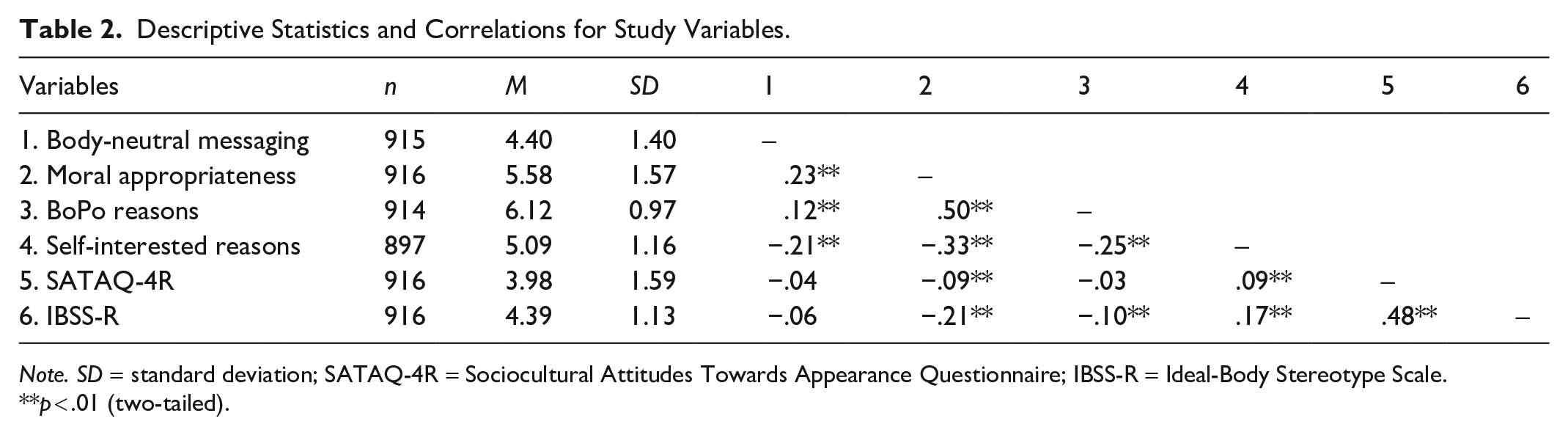
Note. SD = standard deviation; SATAQ-4R = Sociocultural Attitudes Towards Appearance Questionnaire; IBSS-R = Ideal-Body Stereotype Scale.
p < .01 (two-tailed).
Platform Effects
RQ1 asked if the platform that hosts body-positive content influenced how viewers evaluated the body-positive content. We conducted two one-way ANOVAs with the platform type factor (Instagram, Flickr, and Blog) as the independent variable and perceptions of photo-modification and self-interested reasons for posting as two separate dependent variables. There were no significant differences in perceptions of photo-modification between the blog (M = 3.07, SD = 1.50), Flickr, (M = 2.90, SD = 1.44), and Instagram (M = 3.02, SD = 1.48) conditions, F(2, 905) = 1.01, p = .36, η2 = .002. In addition, there were no significant differences in perceptions of self-interested reasons for posting between the blog, (M = 5.11, SD = 1.13), Flickr (M = 5.09, SD = 1.17), and Instagram (M = 5.06, SD = 1.17) conditions, F(2, 894) = 0.14, p = .87, η2 < .001. Given the absence of platform effects (including across all other variables), we collapsed the following analyses across all platform conditions to enhance our statistical power.
Messaging Effects
Model 4 in the PROCESS macro (Hayes, 2017) was used to estimate the indirect effect of the message type factor (X) on the outcome variables (Y) through perceptions of body-neutral messaging (M). For all mediation analyses, effect estimates are reported with 95% percentile confidence intervals based on 10,000 resamples and complete results of all tests appear in our Supplemental file. Our message type factor was dummy coded as follows: 1 = body-neutral condition, 2 = mainstream body-positive condition. Participants in the mainstream body-positive condition, M = 3.43, SD = 1.17, rated the messages as less body-neutral than participants in the body-neutral condition, M = 5.34, SD = 0.87, F(1, 913) = 834.48, p < .001, η2 = .47, indicating that participants differentiate between the two forms of body-positive messaging. H1 stated that the more body-positive posts are recognized as containing body-neutral messaging, the more morally appropriate viewers will find the posts. Supporting H1, a significant indirect effect was detected in the predicted direction, B = −0.78 (SE = 0.01), 95% CI = [−0.97, −0.58].
H2 predicted that the more body-positive posts were recognized as containing body-neutral messaging, the (H2a) more viewers would ascribe body-positive reasons for sharing the posts, and the (H2b) less viewers would ascribe self-interested reasons for sharing the posts. Supporting H2a and H2b, significant indirect effects were found in the predicted direction for the outcome of body-positive reasons for sharing, B = −0.36 (SE = 0.07), 95% CI = [−0.50, −0.22], and for self-interested reasons for sharing, B = 0.46 (SE = 0.07), 95% CI = [0.32, 0.61].
H3 predicted that the more body-positive posts were recognized as containing body-neutral messaging the (H3a) more viewers would report others embrace inclusive beauty standards (IBSS-4), and (H3b) the more viewers would report they embrace inclusive beauty standards (SATAQ-4R). The results indicated that there was no indirect effect of the message type factor on ratings on IBSS-R, B = 0.13 (SE = 0.08), 95% CI = [−0.02, 0.28], or ratings on the SATAQ-4R, B = 0.08 (SE = 0.10), 95% CI = [−0.11, 0.28]. H3a/b were not supported.
Sexualization Effects
The final set of hypotheses focused on the effects of the sexualization factor. The non-sexualized condition (M = 2.09, SD = 1.07) was rated as significantly less sexualized relative to the sexualized condition (M = 5.90, SD = 0.91), F(1, 911) = 3335.54, p < .001, η2 = .79, indicating a successful induction. H4 stated that viewers exposed to sexualized body-positive images would find the posts less morally appropriate, relative to non-sexualized body-positive images. We conducted a one-way ANOVA with sexualization (sexualized vs non-sexualized) as the independent variable and moral appropriateness as the dependent variable. The results show a significant difference in perceptions of moral appropriateness in the predicted direction. Viewers who were exposed to sexualized images rated the images as less morally appropriate (M = 4.85, SD = 1.72), relative to viewers who were exposed to non-sexualized images (M = 6.31, SD = 0.94), p < .001, η2 = .21.
H5 predicted that viewers exposed to sexualized body-positive images would ascribe (H5a) less body-positive reasons for posting and (H5b) more self-interested reasons for posting, relative to non-sexualized body-positive images. We conducted two one-way ANOVAs where the sexualization factor was the independent variable and the body-positive reasons for posting and self-interested reasons for posting were the dependent variables. The results for H5a show a significant difference in the predicted direction. Viewers who were exposed to sexualized images ascribed less body-positive reasons for posting (M = 5.98, SD = 1.09), relative to non-sexualized images (M = 6.26, SD = 0.78), F(1, 912) = 19.99, p < .001, η2 = .02. In addition, results for H5b show a significant difference in the predicted direction. Viewers who were exposed to sexualized images ascribed more self-interested reasons for posting (M = 5.31, SD = 1.08), relative to non-sexualized images (M = 4.86, SD = 1.19), F(1, 895) = 36.19, p < .001, η2 = .04.
H6 predicted that viewers exposed to sexualized body-positive images would report (H6a) others embrace inclusive beauty standards (IBSS-R) to a lesser extent, (H6b) and they embrace inclusive beauty standards to a lesser extent, relative to non-sexualized body-positive images. We conducted two one-way ANOVAs where the sexualization factor was the independent variable, and IBSS-R and SATAQ-4R were the dependent variables. There was not a significant difference in perceptions that others embrace inclusive beauty standards (IBSS-R) between the sexualized condition (M = 4.38, SD = 1.13) and the non-sexualized condition (M = 4.40, SD = 1.12), F(1, 914) = 0.67, p = .79, η2 < .001. In addition, there was not a significant difference in viewers own embracing of inclusive beauty standards (SATAQ-4R) between the sexualized condition (M = 3.98, SD = 1.64) and non-sexualized condition (M = 3.96, SD = 1.54), F(1, 914) = 1.01, p = .82, η2 < .001. H6a/b was not supported.
Post Hoc Analyses
After concluding our focal analyses, we conducted a series of post hoc analyses. The first set of analyses examined whether the sexualization factor moderated the relationships predicted in H1–H3. To explore this possibility, Model 7 in PROCESS was used to examine whether the sexualization factor (W) moderated the relationship between the message type factor (X) and the extent to which messaging was perceived to be body-neutral (M). Moderated, mediation was detected for the outcomes of moral appropriateness, index = 0.19 (SE = 0.05), 95% CI = [0.08, 0.31], body-positive reasons for posting, index = 0.08 (SE = 0.03), 95% CI = [0.03, 0.15], and self-interested reasons for posting, index = −0.11 (SE = 0.03), 95% CI = [−0.19, −0.05]. The nature of the moderation was contributory (Holbert & Park, 2020), such that the message effects remained significant at both levels of the moderator but were stronger in the non-sexualized condition relative to the sexualized condition. Thus, the sexualized images did not eliminate the positive effects of the body-neutral messaging but attenuated them by making the difference between the messaging conditions relatively smaller.
Model 14 in PROCESS was used to examine whether the sexualization factor (W) moderated the degree to which the body-neutral messaging (M) influenced the outcome variables (Y). Across all outcome variables, there was no evidence of moderated, mediation. That is, any effect perceived body-neutral messaging had on the outcomes did not differ depending on whether the images were or were not highly sexualized. Complete results of all moderated, mediation tests are provided in the Supplemental Material.
Finally, we examined if the indirect effect of the messaging factor on moral appropriateness influenced either of the beauty ideal outcomes (IBSS-R; SATAQ-4R). Thus, we used Model 6 in PROCESS to explore if serial mediation occurred. For the outcome IBSS-R, the test of serial mediation was significant (message condition → body-neutral messaging → moral appropriateness → IBSS-R), B = 0.12 (SE = 0.02), 95% CI = [0.07, 0.16]. The more body-neutral viewers perceived posts, the more morally appropriate they viewed them, and thus, the less they reported that others endorse traditional beauty standards. For the outcome SATAQ-4R, the test of serial mediation was also significant (message condition → body-neutral messaging → moral appropriateness → SATAQ-4R), B = 0.07 (SE = 0.03), 95% CI = [0.01, 0.13]. The more body-neutral viewers perceived posts, the more morally appropriate they found the content, and the less they personally endorsed traditional beauty ideals that value thinness.
Discussion
The primary goal of our study was to empirically test how women evaluate and are affected by two contrasting frames of body-positive messaging that commonly accompany body-positive images. Our results indicate that the more participants viewed messaging as body-neutral, the more morally appropriate and less self-interested they found posts, and the more they felt that posts were shared for body-positive reasons. Although initial mediation analyses indicated body-neutral content did not influence participants’ endorsement of sociocultural beauty ideals, a serial mediation analysis indicated that the more participants perceived posts to be body-neutral, the more they found the posts morally appropriate, and consequently, the less they reported societal and personal endorsement of traditional beauty ideals.
We also found that exposure to sexualized (vs non-sexualized) body-positive images led participants to perceive posts as less morally appropriate, more self-interested, and less body-positive. Additional analyses examined whether sexualization dampened the relationship between message type and the extent to which messaging was perceived to be body-neutral. The results indicated that sexualization does not eliminate the positive effects of body-neutral messaging but does attenuate the positive effects.
Theoretical Implications
Although a large body of objectification scholarship has documented the negative effects of sexually objectifying media (American Psychological Association, 2007; Ward, 2016), less work has examined how sexualized body-positive imagery (Vendemia et al., 2021) or text-based body-positive messaging (e.g., captions; Betz & Ramsey, 2017; Davies et al., 2020; Hendrickse et al., 2021; Tiggemann et al., 2020) on social media impact women. Replicating previous findings from Vendemia et al. (2021), we found that individuals evaluated sexualized body-positive images less positively than non-sexualized body-positive images. However, our study also demonstrated that sexualization can reduce—but not eliminate—the effects of textual body-positive messaging; the same messages were perceived as less body-neutral when accompanied by sexualized images relative to non-sexualized images.
The juxtaposition of photographs and textual captions is commonplace on photo-centric social media platforms like Instagram. Several recent experiments (see Rodgers et al., 2021) have tested how exposure to different body sizes (e.g., thin, athletic/fit, curvy, plus-size) with varying captions on Instagram affects viewers’ body image outcomes, revealing mixed findings for body-positive captions (Davies et al., 2020) and generally positive effects of body-positive images (Hendrickse et al., 2021; Tiggemann et al., 2020). Within the scope of the body-positive movement, although body-positive messaging strategies are diverse (Lazuka et al., 2020), appearance-centric messaging is pervasive (Darwin & Miller, 2021; Lazuka et al., 2020) and often found in the presence of sexualized imagery. Given the various frames of body-positive content identified by Darwin and Miller (2021) that have distinct implications toward the movement, our work adds nuance in understanding the impact of the unique combination of appearance-centric body-positive messaging and sexualized body-positive images on women. Our results provide evidence that certain messages (i.e., body-neutral messages) can produce positive effects that are not canceled out by accompanying images. This provides a degree of support for the power of messaging to promote positive body image despite how characteristics of visuals can serve as detractions.
These findings stand somewhat in contrast to past work that suggests that the positive effect of captions may not be enough to subdue the effect of accompanying images. Messages that accompanied images that were body-positive (Tiggemann et al., 2020), empowering (Couture Bue & Harrison, 2019; Halliwell et al., 2011; Hendrickse et al., 2021), or pointed out the unrealistic nature of images (Fardouly & Holland, 2018) did not overshadow the influence of the images; the visuals appeared to be more powerful than the text. Our results do lend some degree of support to this contention as well. The effect of the sexualization factor on the outcomes did not vary across the messaging conditions. As suggested by Fardouly and Holland (2018), the juxtaposition of idealized or sexualized imagery with messaging that encourages body acceptance may be viewed as inauthentic and not taken seriously by viewers. Despite the inability of body-neutral messages to cancel out the effects of sexualized imagery, the positive message effects were resilient to the sexualized images to which they were attached.
Our results also suggest that perceived moral appropriateness, or normative acceptability (Friestad & Wright, 1994), of body-positive content functions as a determinant of content effectiveness and influences endorsement of traditional beauty standards. Research suggests that perceived sociocultural pressures to conform to beauty ideals are often associated with body image disturbance in women (Frederick et al., 2022; Groesz et al., 2002; Grower et al., 2019; Thompson et al., 1999; Thompson & Stice, 2001). Experimental work also has shown the influence of social context on shifting body ideals, suggesting that women tend to shift their ideal to match perceived sociocultural body ideals (Bair et al., 2014; Mills et al., 2012). In the context of the body-positive movement, body-neutral content’s focus on body acceptance over appearance may make traditional sociocultural beauty standards less salient as compared with mainstream body-positive content. Moreover, our work demonstrates that body-neutral messaging was perceived more favorably by viewers compared with mainstream messaging which was rated as (relatively) more self-interested and less morally appropriate. With this in mind, body neutrality’s lack of appearance emphasis coupled with viewers’ perceptions that content is normatively acceptable or endorsed (e.g., morally appropriate), may lead them to be more willing to shift their body ideals. Thus, alteration of sociocultural ideals may be contingent upon how approving viewers think others will be (see Grower et al., 2019).
Practical Implications
Popular social media platforms, such as Instagram, have become incredibly powerful tools for disseminating prosocial content. Specifically, the user-generated nature of Instagram allows body-positive content creators greater reach and control over a movement’s ideas and messaging compared with traditional media outlets. However, an implication of greater user control is that although it allows diverse expression, it may lead social media organized movements to have a decentralized voice. The user-generated nature of online movements may result in complimentary and competing views from the movement’s stakeholders, which may distract from the original intent of a movement and reduce its effectiveness. A recent scoping review of social media content aiming to promote positive body image recommends downplaying appearance-related content (Rodgers et al., 2021). Our work provides additional support for this contention and illustrates how text-based interventions can promote better body image.
Another challenge with social media movements is that content creators may not be able to successfully merge their brand image with the prosocial cause they are trying to promote (Wellman, 2022). For example, Wellman (2022) argues that in the context of the #BlackLivesMatter (BLM) movement, content creators promoted BLM related imagery to maintain credibility with their followers; yet they often prioritized their brand or personal aesthetic in promoting prosocial content, ultimately centering themselves within the movement. Wellman (2022) suggests that the self-promotional content that contains prosocial messaging may ultimately fail to support a prosocial cause due to being perceived as inauthentic. Along the same lines, research suggests that perceived authenticity matters in impacting how favorably viewers respond to online content (Pöyry et al., 2019). In the context of sponsored content on social media, if viewers perceive content to be misaligned with content creators perceived values, posts may be ineffective (Pöyry et al., 2019). In the case of our results, sexualized, mainstream body-positive images were perceived as more self-interested than non-sexualized body-neutral posts. And, as indicated in Table 2, we see that perceived self-interested motives for posting are negatively correlated (r = −.25, p < .001) with perceived body-positive reasons for posting (e.g., to challenge traditional beauty ideals). Overall, our results provide further support that the perception of competing priorities can undermine seemingly prosocial content online.
Limitations and Future Directions
Although our study yields useful findings for scholars and practitioners, there are several areas future work should consider. First, our study exclusively compared the effects of two out of four existing frames of body positivity online, as highlighted by Darwin and Miller (2021). Mainstream body positivity and body neutrality emphasize individual-level processes and feelings about one’s body, whether it be expression of love or acceptance. Additional experimental work is needed to examine the impact of exposure to fat positivity = body positivity messages and radical body positivity messages as these frames focus more on combatting systemic oppression of identities marginalized in the mainstream. Scholars should continue to critically examine how body-positive content manifests online and empirically test its effects on individuals. In addition, as our work focuses, in part, on the efficacy of body-positive messaging, future research should continue to include scales such as state positive body image (e.g., body appreciation), body satisfaction, and perhaps even mood. Inclusion of these measures would give scholars greater understanding of the efficacy of certain movement imagery. Continuing, our work focuses on a specific prosocial, social media–driven movement (i.e., the body-positive movement) documenting what kinds of messaging and psychological mechanisms lead to greater inclusion (in this case, beauty ideals). Future work is needed to investigate if these findings extend to other social movements that exist online.
One consideration for future work examining the impact of sexualized body-positive content online is to examine the impact of context. Although a large body of objectification scholarship establishes the negative effects of sexualized media exposure on women and girls (e.g., American Psychological Association, 2007; Ward, 2016), critical studies literature indicates that sexualized imagery can carry different meanings. Gill (2008) suggests that, within the media landscape, there has been a shift from sexual objectification (i.e., being objectified) to sexual subjectification (i.e., choosing to objectify yourself). Gill (2008, 2012) indicates that women’s choice to objectify themselves through certain activities (e.g., pornography, burlesque, or pole dancing) is not for male benefit, but rather for their own interests and can serve as a form of empowerment (Donaghue et al., 2011). With this in mind, online photo-sharing platforms (e.g., Instagram, Facebook) have provided users the ability to choose how they want to represent themselves online. The fat positivity community, for example, has started to use hashtags (e.g., #fatpositive, #fatbabe, #thickspiration, etc.) on Instagram and Tumblr to showcase themselves in manners that they please (Lupton, 2017). Continuing, other online communities have sought to post erotically attractive photos of both male and female fat bodies to normalize representation of fat bodies with sexual appeal (for review, see Lupton, 2017). Future work examining the intersection between body-positive imagery and text should investigate how the context in which sexual body-positive content is nested (e.g., signaling empowerment or choice) impacts viewer perceptions.
Another limitation of our work is that our sample was restricted to women residing in the United States. Further work should examine how individuals from different geographic locations and nationalities evaluate body-positive content on social media in comparison to US audiences. Given that the body-positive movement focuses on highlighting historically marginalized bodies (Cohen, Irwin, et al., 2019; Cwynar-Horta, 2016), future work should adopt an intersectional approach to explore how various aspects of one’s identity might influence how body-positive content is received. For example, research suggests that women who identify as ethnic or racial minorities (e.g., Black, Latino, Asian) tend to not have the same sociocultural ideals of beauty as their White counterparts (e.g., Evans & McConnell, 2003; Fujioka et al., 2009; Sabik et al., 2010). Thus, future studies should consider how differences in race and ethnicity as well as nationality might affect how individuals respond to body-related content. Furthermore, body image scholars should not solely consider the intersection of race but also consider other factors that shape an individual’s social categorization and group identities (Crenshaw, 1989; Else-Quest & Hyde, 2016), such as ability, age, class, and sexual orientation.
Conclusion
The goal of this work was to empirically document how different frames of body-positive messaging online, coupled with imagery, can impact women viewers. Although the ultimate goal of the body-positive movement is to challenge prominent sociocultural beauty standards through encouraging body acceptance and increased representation of diverse bodies, its increase in popularity online has led to the dissemination of different genres of messaging and imagery that can potentially detract from the movement’s intent. Guided by Darwin and Miller’s (2021) critical discourse analysis of body positivity online, our experiment demonstrates how contrasting body-positive frames, both seeking to positively impact viewers, can be perceived differently: Non-sexualized images accompanied with body-neutral messaging can enhance perceptions of moral appropriateness and ultimately increase the efficacy of the body-positive movement. The mechanism through which these more desirable effects occur should be considered with other important prosocial movements online.
Supplemental Material
sj-docx-1-sms-10.1177_20563051231207852 – Supplemental material for Non-Sexualized Images and Body-Neutral Messaging Foster Body Positivity Online
Supplemental material, sj-docx-1-sms-10.1177_20563051231207852 for Non-Sexualized Images and Body-Neutral Messaging Foster Body Positivity Online by Kyla N. Brathwaite, David C. DeAndrea and Megan A. Vendemia in Social Media + Society
Footnotes
Declaration of Conflicting Interests
The author(s) declared no potential conflicts of interest with respect to the research, authorship, and/or publication of this article.
Funding
The author(s) received no financial support for the research, authorship, and/or publication of this article.

Supplemental Material
Supplemental material for this article is available online.
Author Biographies
References
Supplementary Material
Please find the following supplemental material available below.
For Open Access articles published under a Creative Commons License, all supplemental material carries the same license as the article it is associated with.
For non-Open Access articles published, all supplemental material carries a non-exclusive license, and permission requests for re-use of supplemental material or any part of supplemental material shall be sent directly to the copyright owner as specified in the copyright notice associated with the article.
